Research Article CritiqueKayla Muth
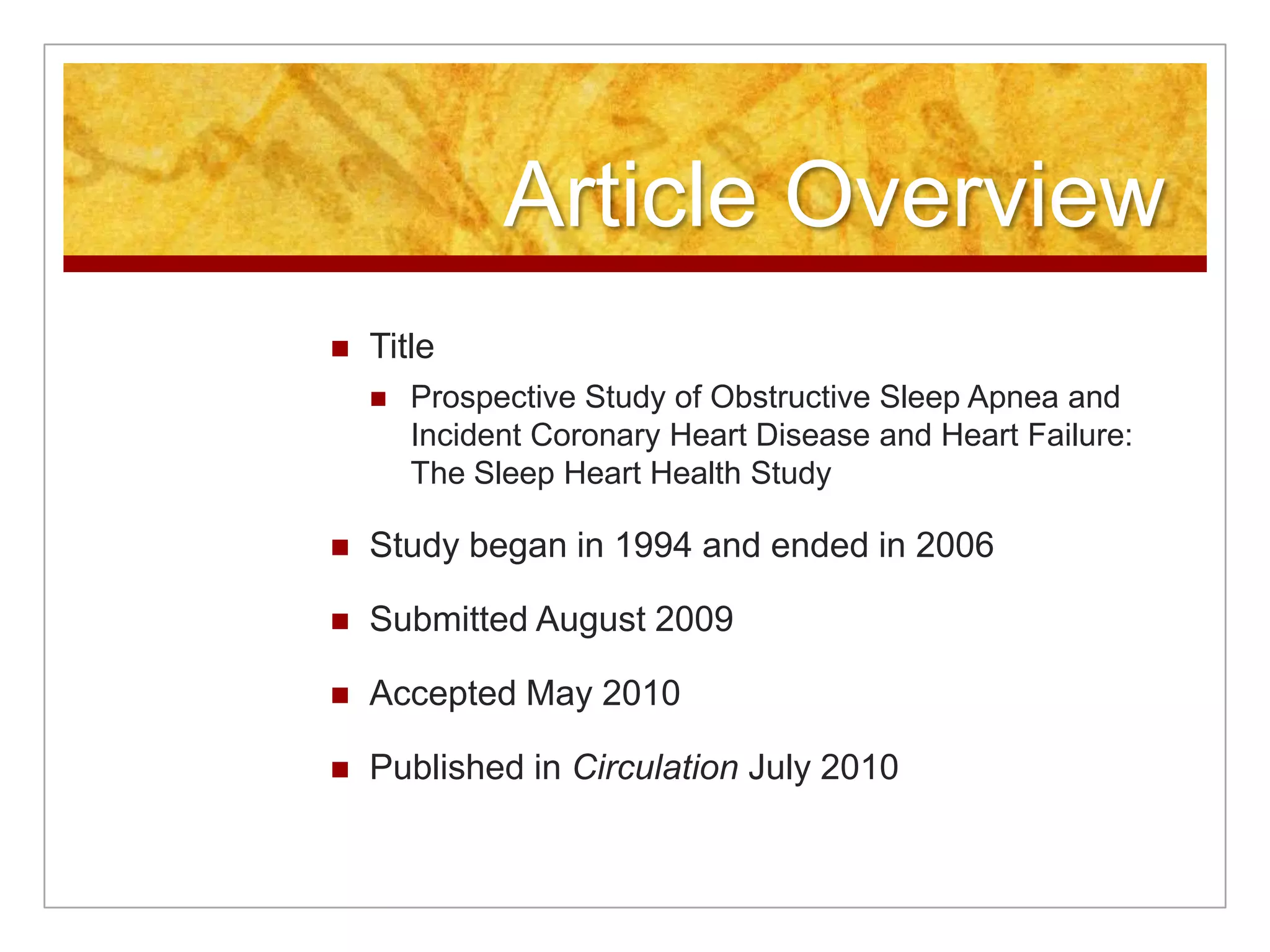
Article OverviewTitleProspective Study of Obstructive Sleep Apnea and Incident Coronary Heart Disease and Heart Failure: The Sleep Heart Health StudyStudy began in 1994 and ended in 2006Submitted August 2009Accepted May 2010Published in Circulation July 2010
SourcesPublication dates ranged from 1975-2009Selection of Journals and StudiesAmerican Journal of CardiologyAmerican Journal of MedicineCirculationFramingham Heart Study Journal of the American Medical AssociationJournal of Applied PhysiologyNew England Journal of Medicine Sleep
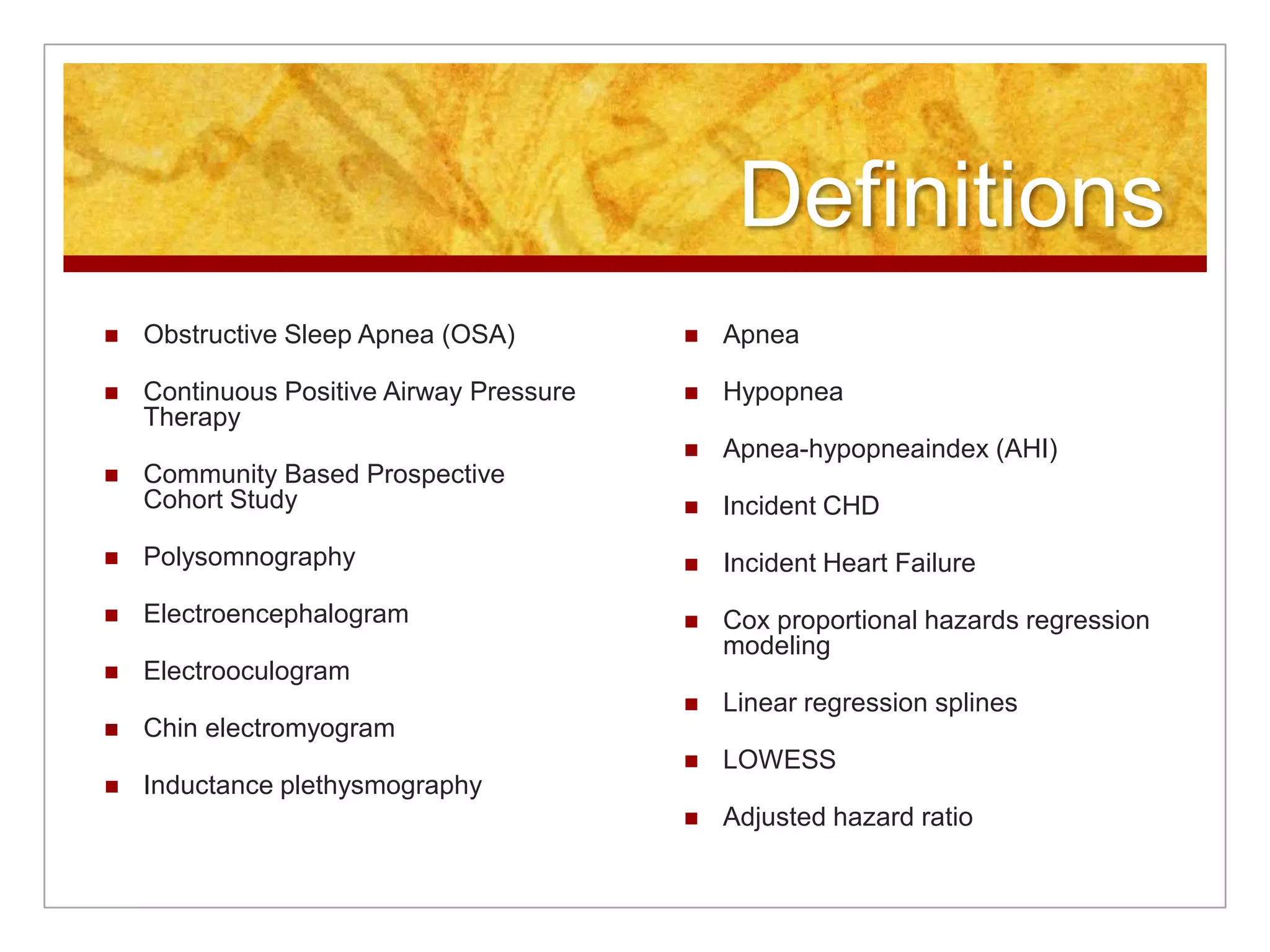
DefinitionsObstructive Sleep Apnea (OSA)Continuous Positive Airway Pressure TherapyCommunity Based Prospective Cohort StudyPolysomnographyElectroencephalogramElectrooculogramChin electromyogramInductance plethysmographyApneaHypopneaApnea-hypopneaindex (AHI)Incident CHDIncident Heart FailureCox proportional hazards regression modelingLinear regression splinesLOWESSAdjusted hazard ratio
Purpose of the Study“To assess the independent contribution of OSA to cardiovascular disease, the Sleep Heart Health Study (SHHS) was initiated in 1994 as a multicenter, prospective cohort study of the cardiovascular consequences of OSA.”“The present report details the incidence of CHD and heart failure in SHHS participants free of these conditions at the baseline examination.”
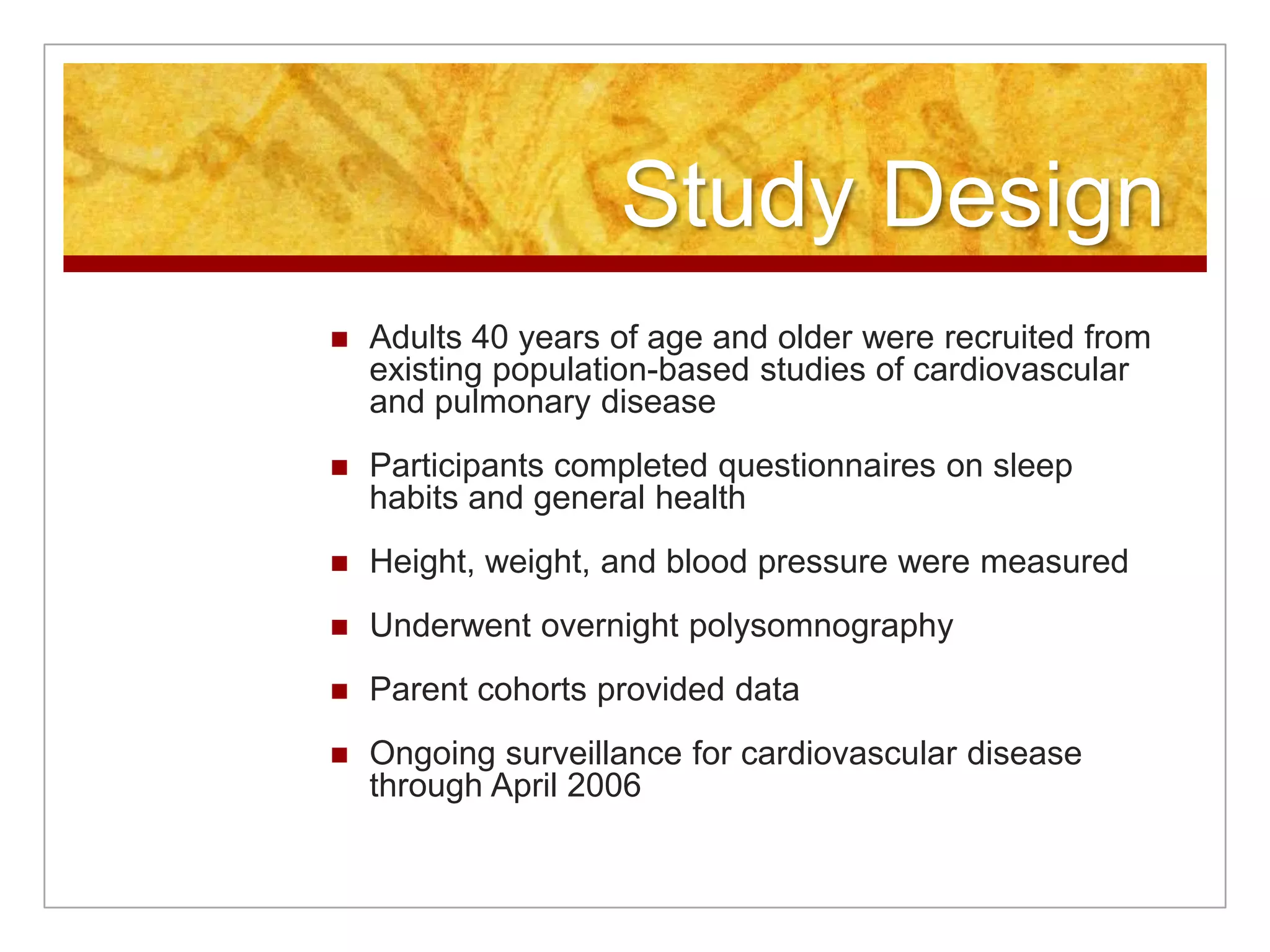
Study DesignAdults 40 years of age and older were recruited from existing population-based studies of cardiovascular and pulmonary diseaseParticipants completed questionnaires on sleep habits and general healthHeight, weight, and blood pressure were measuredUnderwent overnight polysomnographyParent cohorts provided dataOngoing surveillance for cardiovascular disease through April 2006
Study Sample10,737 cohort participants invited to participate6,441 were enrolled in study760 participants from NYU-Cornell site excluded783 participants excluded due to prevalent heart disease or heart failure at baseline21 participants lacked follow-up data and were excluded455 participants were missing baseline measures and excluded4,422 subjects remained for participation2,495 females1,927 males
MethodsIn-home polysomnographyPolysomnograms scored centrally and AHI determinedOngoing surveillance for CHD and heart failure by parent-cohortsFollow-up procedures performed by cohortsMedian follow-up ranged from 8.3-9.2 yearsAll CHD and heart failure outcomes extracted from hospital and physician’s records by trained abstractors~5 years post-baseline, survey relative to diagnosis of and treatment for OSA completed by 3,794 participants
CovariatesBaseline prevalent CHD or heart failureSmoking statusMedicationDiabetesBlood pressureWeightRace/ethnicityHeightTotal cholesterolHDL cholesterol
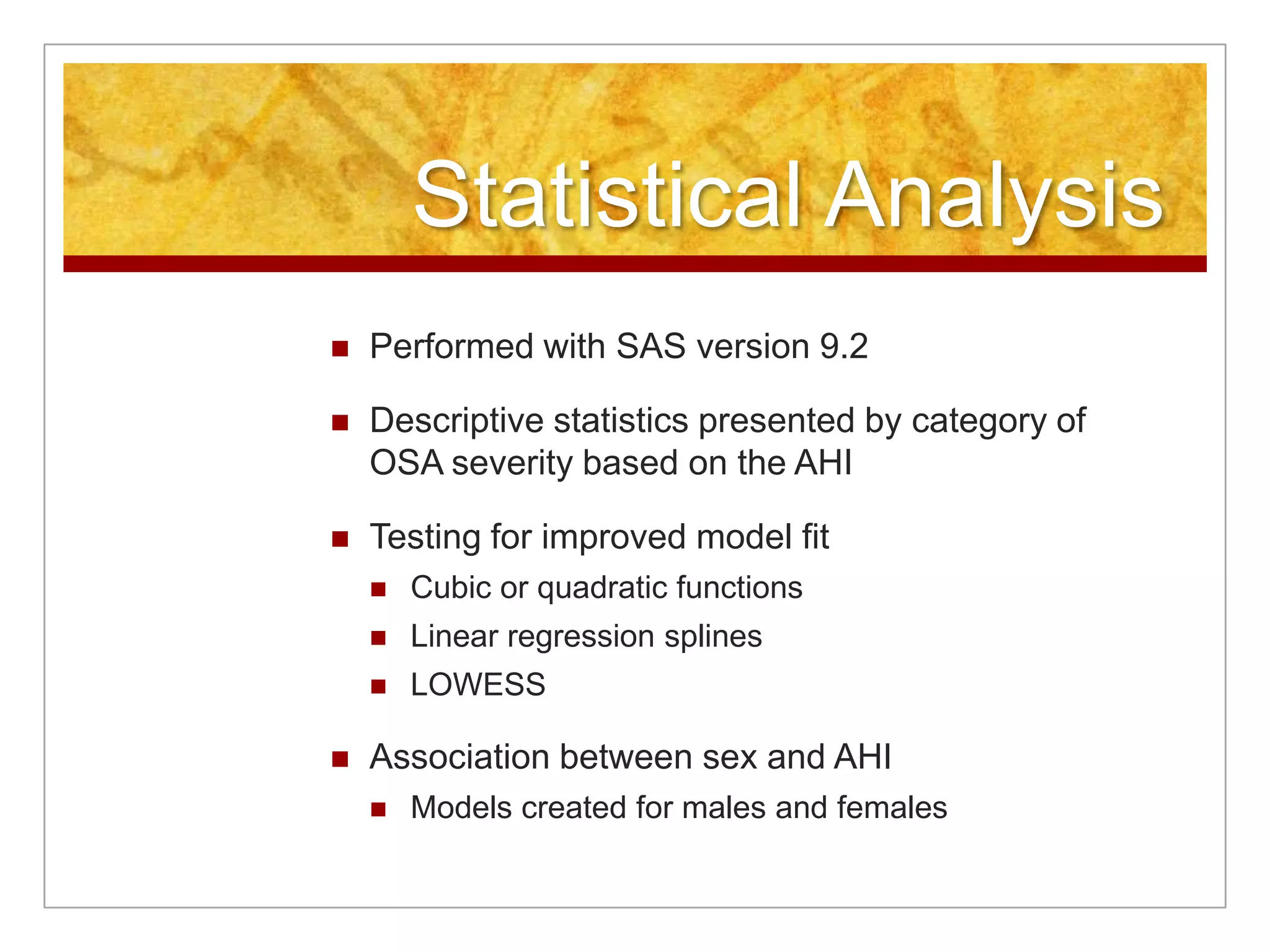
Statistical AnalysisPerformed with SAS version 9.2Descriptive statistics presented by category of OSA severity based on the AHITesting for improved model fitCubic or quadratic functionsLinear regression splinesLOWESSAssociation between sex and AHIModels created for males and females
Statistical Analysis cont.Models using AHI as continuous dependent variable adjusted for the following independent variables:(1) Age, race, BMI, and smoking status(2) Variables from model (1) plus total and HDL cholesterol and diabetes(3) Variables from model (2) plus hypertensionModels repeated using parent cohort instead of raceModels constructed to stratify age>70 years old≤ 70 years old
ResultsIncreasing severity with OSA was associated with male sex, higher BMI, higher systolic blood pressure, lower HDL cholesterol, and higher prevalence of hypertension and diabetesMedian AHI in women was 2.7 (interquartile range 0.8 to 7.5) and 6.2 in men (interquartile range 2.3 to 14.3)During follow-up period there were 473 incident CHD events	76 CHD deaths185 MI’s212 revascularization procedures
Results cont.During follow-up there were 308 incidents of heart failure; 144 also had incident CHDRate of events increased with severity of OSA in men, but not as clearly in womenWhen adjusted for age, race, BMI, and smoking status there was a significant association between AHI with incident CHD in men
DiscussionThis study found an association between incident CHD and OSA in men that was considerably weaker than previous clinic-based studiesScreening of non-clinic-based population identified many asymptomatic individuals with OSASHHS may underestimate the true cardiovascular risk associated with OSA due to median age of 62Study demonstrates a 58% higher adjusted risk for incident heart failure for men with OSA
StrengthsCommunity-based recruiting limited referral biasDetailed covariate dataExclusion criteria providedFew received treatment for OSA allowing for assessment of natural history of untreated OSAIncludes both men and womenEthnically diverse
WeaknessesOlder age of the cohortEchocardiograms were not routinely performedVarying protocols at different facilities Varying frequency of follow-upsAuthors do not appear to be individuals who extracted data from medical recordsBMI is imperfect way to collect anthropometric dataDiet and exercise not recorded
SignificancePotentially significant because it does suggest an increased risk of incident heart failure in those with OSAThose with OSA tend to have all other risk factors predisposing them to heart disease, so it is hard to demonstrate if OSA has significant impact independent of those risk factors

Research Critique

  • 1.
  • 2.
    Article OverviewTitleProspective Studyof Obstructive Sleep Apnea and Incident Coronary Heart Disease and Heart Failure: The Sleep Heart Health StudyStudy began in 1994 and ended in 2006Submitted August 2009Accepted May 2010Published in Circulation July 2010
  • 3.
    SourcesPublication dates rangedfrom 1975-2009Selection of Journals and StudiesAmerican Journal of CardiologyAmerican Journal of MedicineCirculationFramingham Heart Study Journal of the American Medical AssociationJournal of Applied PhysiologyNew England Journal of Medicine Sleep
  • 4.
    DefinitionsObstructive Sleep Apnea(OSA)Continuous Positive Airway Pressure TherapyCommunity Based Prospective Cohort StudyPolysomnographyElectroencephalogramElectrooculogramChin electromyogramInductance plethysmographyApneaHypopneaApnea-hypopneaindex (AHI)Incident CHDIncident Heart FailureCox proportional hazards regression modelingLinear regression splinesLOWESSAdjusted hazard ratio
  • 5.
    Purpose of theStudy“To assess the independent contribution of OSA to cardiovascular disease, the Sleep Heart Health Study (SHHS) was initiated in 1994 as a multicenter, prospective cohort study of the cardiovascular consequences of OSA.”“The present report details the incidence of CHD and heart failure in SHHS participants free of these conditions at the baseline examination.”
  • 6.
    Study DesignAdults 40years of age and older were recruited from existing population-based studies of cardiovascular and pulmonary diseaseParticipants completed questionnaires on sleep habits and general healthHeight, weight, and blood pressure were measuredUnderwent overnight polysomnographyParent cohorts provided dataOngoing surveillance for cardiovascular disease through April 2006
  • 7.
    Study Sample10,737 cohortparticipants invited to participate6,441 were enrolled in study760 participants from NYU-Cornell site excluded783 participants excluded due to prevalent heart disease or heart failure at baseline21 participants lacked follow-up data and were excluded455 participants were missing baseline measures and excluded4,422 subjects remained for participation2,495 females1,927 males
  • 8.
    MethodsIn-home polysomnographyPolysomnograms scoredcentrally and AHI determinedOngoing surveillance for CHD and heart failure by parent-cohortsFollow-up procedures performed by cohortsMedian follow-up ranged from 8.3-9.2 yearsAll CHD and heart failure outcomes extracted from hospital and physician’s records by trained abstractors~5 years post-baseline, survey relative to diagnosis of and treatment for OSA completed by 3,794 participants
  • 9.
    CovariatesBaseline prevalent CHDor heart failureSmoking statusMedicationDiabetesBlood pressureWeightRace/ethnicityHeightTotal cholesterolHDL cholesterol
  • 10.
    Statistical AnalysisPerformed withSAS version 9.2Descriptive statistics presented by category of OSA severity based on the AHITesting for improved model fitCubic or quadratic functionsLinear regression splinesLOWESSAssociation between sex and AHIModels created for males and females
  • 11.
    Statistical Analysis cont.Modelsusing AHI as continuous dependent variable adjusted for the following independent variables:(1) Age, race, BMI, and smoking status(2) Variables from model (1) plus total and HDL cholesterol and diabetes(3) Variables from model (2) plus hypertensionModels repeated using parent cohort instead of raceModels constructed to stratify age>70 years old≤ 70 years old
  • 12.
    ResultsIncreasing severity withOSA was associated with male sex, higher BMI, higher systolic blood pressure, lower HDL cholesterol, and higher prevalence of hypertension and diabetesMedian AHI in women was 2.7 (interquartile range 0.8 to 7.5) and 6.2 in men (interquartile range 2.3 to 14.3)During follow-up period there were 473 incident CHD events 76 CHD deaths185 MI’s212 revascularization procedures
  • 13.
    Results cont.During follow-upthere were 308 incidents of heart failure; 144 also had incident CHDRate of events increased with severity of OSA in men, but not as clearly in womenWhen adjusted for age, race, BMI, and smoking status there was a significant association between AHI with incident CHD in men
  • 14.
    DiscussionThis study foundan association between incident CHD and OSA in men that was considerably weaker than previous clinic-based studiesScreening of non-clinic-based population identified many asymptomatic individuals with OSASHHS may underestimate the true cardiovascular risk associated with OSA due to median age of 62Study demonstrates a 58% higher adjusted risk for incident heart failure for men with OSA
  • 15.
    StrengthsCommunity-based recruiting limitedreferral biasDetailed covariate dataExclusion criteria providedFew received treatment for OSA allowing for assessment of natural history of untreated OSAIncludes both men and womenEthnically diverse
  • 16.
    WeaknessesOlder age ofthe cohortEchocardiograms were not routinely performedVarying protocols at different facilities Varying frequency of follow-upsAuthors do not appear to be individuals who extracted data from medical recordsBMI is imperfect way to collect anthropometric dataDiet and exercise not recorded
  • 17.
    SignificancePotentially significant becauseit does suggest an increased risk of incident heart failure in those with OSAThose with OSA tend to have all other risk factors predisposing them to heart disease, so it is hard to demonstrate if OSA has significant impact independent of those risk factors