Guidelines for the technological
development in the e-health
application domain 
Ivano Malavolta
Università degli Studi dell’Aquila
Introduction

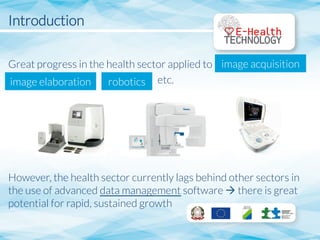
Great progress in the health sector applied to


 etc.


However, the health sector currently lags behind other sectors in
the use of advanced data management software à there is great
potential for rapid, sustained growth
image acquisition
image elaboration
 robotics
Introduction

The E-Health Technology project focusses on


Remote assistance via mobile devices
Modernization of business processes 
Design of new services in the cloud
Introduction

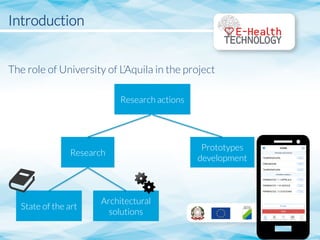
The role of University of L’Aquila in the project
Research
Prototypes
development
Research actions
State of the art
Architectural
solutions
Introduction

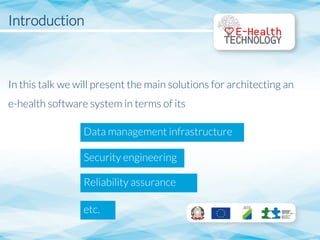
In this talk we will present the main solutions for architecting an
e-health software system in terms of its
Security engineering 
Reliability assurance
etc.
Data management infrastructure
 	
  
Remainder of the talk

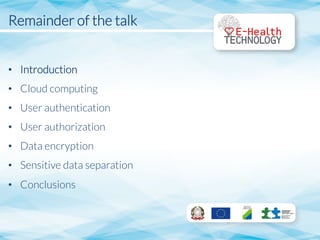
•  Introduction
•  Cloud computing
•  User authentication
•  User authorization
•  Data encryption
•  Sensitive data separation
•  Conclusions
Cloud computing


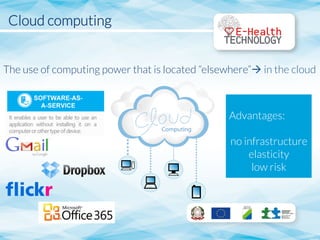
The use of computing power that is located “elsewhere”à in the cloud

Advantages:

no infrastructure
elasticity
low risk
Cloud computing


Challenges in the e-health application domain:
Who can enter the system?
Who can do what in the system?
Who can read my data?
Where is my data?
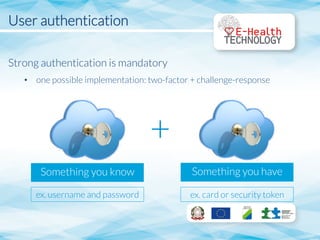
User authentication


Strong authentication is mandatory
•  one possible implementation: two-factor + challenge-response
Something you know
 Something you have
ex. username and password
 ex. card or security token
+
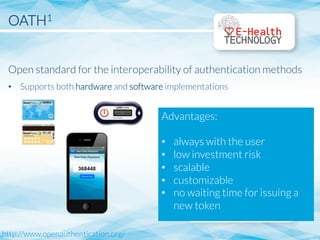
OATH1


Open standard for the interoperability of authentication methods
•  Supports both hardware and software implementations
http://www.openauthentication.org/
Advantages:

•  always with the user
•  low investment risk
•  scalable
•  customizable
•  no waiting time for issuing a
new token
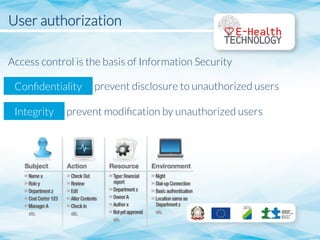
User authorization


Access control is the basis of Information Security


 prevent disclosure to unauthorized users


 prevent modification by unauthorized users
Confidentiality
Integrity
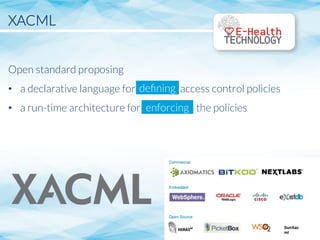
XACML


Open standard proposing
•  a declarative language for defining access control policies
•  a run-time architecture for enforcing the policies
defining
enforcing
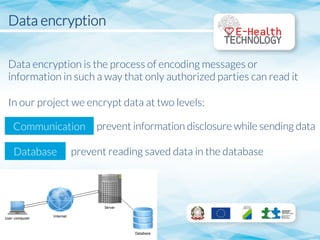
Data encryption


Data encryption is the process of encoding messages or
information in such a way that only authorized parties can read it

In our project we encrypt data at two levels:


 prevent information disclosure while sending data


 prevent reading saved data in the database
Communication
Database
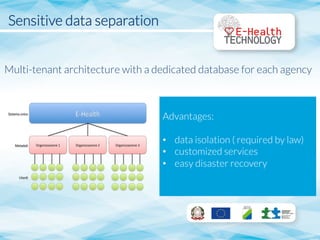
Sensitive data separation


Multi-tenant architecture with a dedicated database for each agency

Advantages:

•  data isolation ( required by law)
•  customized services
•  easy disaster recovery
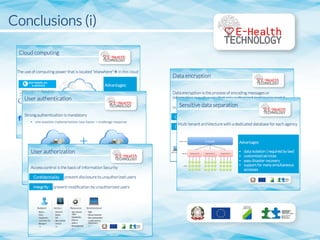
Conclusions (i)
Conclusions (ii)


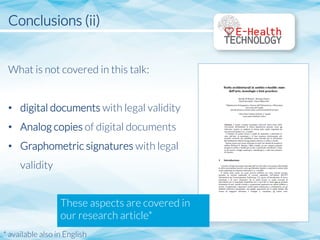
What is not covered in this talk:
•  digital documents with legal validity
•  Analog copies of digital documents
•  Graphometric signatures with legal
validity
These aspects are covered in
our research article*
* available also in English	


Contact


Ivano Malavolta
Università degli Studi dell’Aquila

ivano.malavolta@univaq.it
http://www.di.univaq.it/malavolta
Images credits


•  http://www.tutorialspoint.com/shorttutorials/cloud-computing-from-the-home
•  https://www.tcnp3.com/home/cloud-technology/what-is-cloud-computing-infographic/
•  http://www.carestreamdental.com/it/it-it/computedradiography
•  http://www.kavo.it/Prodotti/Imaging-Radiologia/Tomografia-volumetrica-3D.aspx
•  http://www.siriweb.com/wp/?product_cat=ecograf_multi
•  http://cdn.bills.com/images/articles/originals/rate-lock.jpg
•  http://www.ftsafe.com/product/otp/hotp
•  https://www.hidglobal.com/partner-products/single-button-time-based-oath-otp
•  http://www.solidpass.com/authentication-methods/time-synchronized-security-token.html
•  http://www.partnerdata.it/prodotti/identificazione/one-time-pw/modelli-epass/
•  http://www.telos.com/secure-communications/secure-unified-directory/

Guidelines for the technological development in the e-health application domain

  • 1.
        Guidelines forthe technological development in the e-health application domain Ivano Malavolta Università degli Studi dell’Aquila
  • 2.
    Introduction Great progress inthe health sector applied to etc. However, the health sector currently lags behind other sectors in the use of advanced data management software à there is great potential for rapid, sustained growth image acquisition image elaboration robotics
  • 3.
    Introduction The E-Health Technologyproject focusses on Remote assistance via mobile devices Modernization of business processes Design of new services in the cloud
  • 4.
    Introduction The role ofUniversity of L’Aquila in the project Research Prototypes development Research actions State of the art Architectural solutions
  • 5.
    Introduction In this talkwe will present the main solutions for architecting an e-health software system in terms of its Security engineering Reliability assurance etc. Data management infrastructure
  • 6.
        Remainder ofthe talk •  Introduction •  Cloud computing •  User authentication •  User authorization •  Data encryption •  Sensitive data separation •  Conclusions
  • 7.
    Cloud computing The useof computing power that is located “elsewhere”à in the cloud Advantages: no infrastructure elasticity low risk
  • 8.
    Cloud computing Challenges inthe e-health application domain: Who can enter the system? Who can do what in the system? Who can read my data? Where is my data?
  • 9.
    User authentication Strong authenticationis mandatory •  one possible implementation: two-factor + challenge-response Something you know Something you have ex. username and password ex. card or security token +
  • 10.
    OATH1 Open standard forthe interoperability of authentication methods •  Supports both hardware and software implementations http://www.openauthentication.org/ Advantages: •  always with the user •  low investment risk •  scalable •  customizable •  no waiting time for issuing a new token
  • 11.
    User authorization Access controlis the basis of Information Security prevent disclosure to unauthorized users prevent modification by unauthorized users Confidentiality Integrity
  • 12.
    XACML Open standard proposing • a declarative language for defining access control policies •  a run-time architecture for enforcing the policies defining enforcing
  • 13.
    Data encryption Data encryptionis the process of encoding messages or information in such a way that only authorized parties can read it In our project we encrypt data at two levels: prevent information disclosure while sending data prevent reading saved data in the database Communication Database
  • 14.
    Sensitive data separation Multi-tenantarchitecture with a dedicated database for each agency Advantages: •  data isolation ( required by law) •  customized services •  easy disaster recovery
  • 15.
  • 16.
    Conclusions (ii) What isnot covered in this talk: •  digital documents with legal validity •  Analog copies of digital documents •  Graphometric signatures with legal validity These aspects are covered in our research article* * available also in English  
  • 17.
        Contact Ivano Malavolta Universitàdegli Studi dell’Aquila ivano.malavolta@univaq.it http://www.di.univaq.it/malavolta
  • 18.
    Images credits •  http://www.tutorialspoint.com/shorttutorials/cloud-computing-from-the-home • https://www.tcnp3.com/home/cloud-technology/what-is-cloud-computing-infographic/ •  http://www.carestreamdental.com/it/it-it/computedradiography •  http://www.kavo.it/Prodotti/Imaging-Radiologia/Tomografia-volumetrica-3D.aspx •  http://www.siriweb.com/wp/?product_cat=ecograf_multi •  http://cdn.bills.com/images/articles/originals/rate-lock.jpg •  http://www.ftsafe.com/product/otp/hotp •  https://www.hidglobal.com/partner-products/single-button-time-based-oath-otp •  http://www.solidpass.com/authentication-methods/time-synchronized-security-token.html •  http://www.partnerdata.it/prodotti/identificazione/one-time-pw/modelli-epass/ •  http://www.telos.com/secure-communications/secure-unified-directory/