Insight into today's IT Strategic Challenges Jorge Sebastião Founder and CEO [email_address] www.esgulf.com
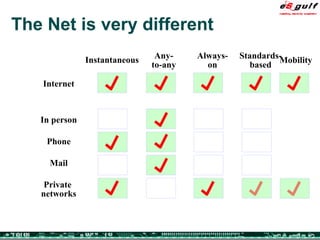
The Net is very different Internet Instantaneous Any- to-any Standards- based Always- on Mobility In person Phone Mail Private  networks
 
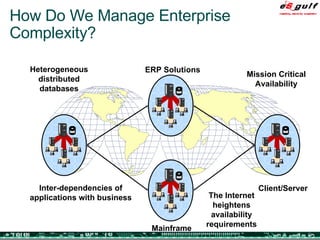
How Do We Manage Enterprise Complexity? ERP Solutions Mainframe Client/Server Heterogeneous distributed databases Mission Critical Availability The Internet heightens availability requirements Inter-dependencies of applications with business
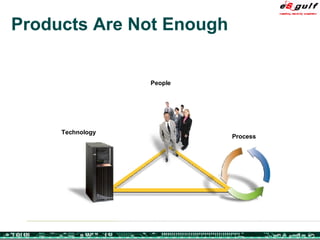
Products Are Not Enough People Technology Process
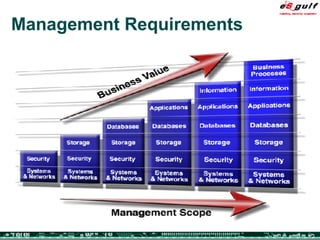
Management Requirements
10 Challenges End User Awareness Unavailability Technical skills Leveraging New Generation Networks New devices Mobile Computing Security and Privacy Evolving Risks Compliance and Regulation New Technologies Biometrics Smart Cards and eGov Challenges Infrastructure Management
“…  disasters are not technical, they’re people and culture related… “ The soft stuff is the hard stuff.” Bryan Fiman Principle and Co-Founder,  Implementation Management Associates User Awareness and Adoption?
Support Requirements “ … . uneducated users require  3 to 6 times more support  than educated users over the life of a new technology and process.” Research Note
Unavailability Technical skills Rapid rate of change of technologies Shortage of skilled staff Key to recognize the risk areas Take appropriate preventive actions: obtaining training hiring consultants right people These factors might apply to your team: inadequate training  poor understanding of methods, tools, & techniques  inadequate application domain experience  new technologies or methods  ineffective, poorly documented, or neglected processes
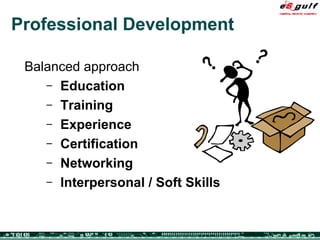
Professional Development Balanced approach Education Training Experience Certification Networking Interpersonal / Soft Skills
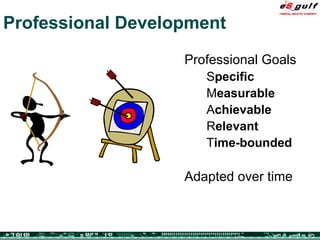
Professional Development Professional Goals S pecific M easurable A chievable R elevant T ime-bounded Adapted over time
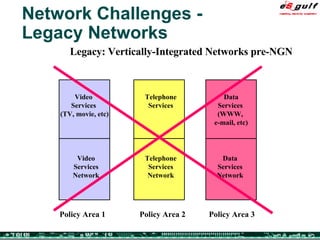
Telephone Services Data Services  (WWW,  e-mail, etc) Video  Services  (TV, movie, etc) Telephone Services Network Video Services Network Data Services Network Policy Area 1 Policy Area 2 Policy Area 3 Legacy: Vertically-Integrated Networks pre-NGN Network Challenges - Legacy Networks
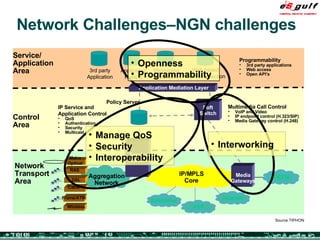
Network Challenges– NGN challenges Source TIPHON Control Area lP/MPLS Core Network Transport Area Service/ Application Area PSTN Internet Soft Switch IP Service and Application Control QoS Authentication Security Multicast Multimedia Call Control VoIP and Video IP endpoint control (H.323/SIP) Media Gateway control (H.248) Messaging Application Media Gateways Application Hosting Programmability 3rd party applications Web access Open APl's Web based Service selection Application Mediation Layer Enterprise ASP 3rd party Application Policy Server Aggregation Network Metro Optical RAS DSL Cable Frame/ATM Wireless Service Switch Manage QoS Security Interoperability Openness Programmability  Interworking
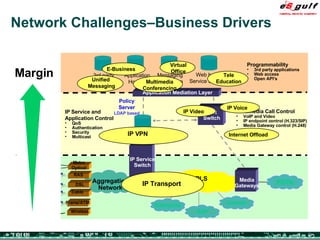
Network Challenges– Business Drivers Service Control Layer lP/MPLS Core Network Layer Application Layer PSTN Internet Soft Switch IP Service and Application Control QoS Authentication Security Multicast Multimedia Call Control VoIP and Video IP endpoint control (H.323/SIP) Media Gateway control (H.248) Messaging Application Media Gateways Application Hosting Programmability 3rd party applications Web access Open APl's Web based Service selection Application Mediation Layer Enterprise ASP 3rd party Application Policy Server LDAP based Aggregation Network Metro Optical RAS DSL Cable Frame/ATM Wireless IP Service Switch IP Video Internet Offload IP Voice IP VPN IP Transport Multimedia Conferencing Unified  Messaging Virtual Office Tele Education E-Business Margin
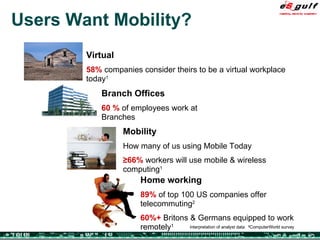
Users Want Mobility? Home working 89%   of top 100 US companies offer telecommuting 2 60%+   Britons & Germans equipped to work remotely 1 Mobility How many of us using Mobile Today  ≥ 66%   workers will use mobile & wireless computing 1 Branch Offices 60 %   of employees work at Branches Virtual 58%   companies consider theirs to be a virtual workplace today 1 interpretation of analyst data  2 ComputerWorld survey
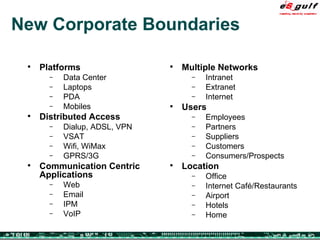
New Corporate Boundaries Platforms Data Center Laptops PDA Mobiles Distributed Access Dialup, ADSL, VPN VSAT Wifi, WiMax GPRS/3G Communication Centric Applications Web Email IPM VoIP Multiple Networks Intranet Extranet Internet Users Employees Partners Suppliers Customers Consumers/Prospects Location Office Internet Café/Restaurants Airport Hotels Home
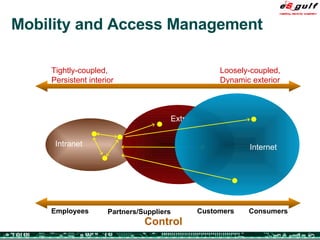
Mobility and Access Management Control Loosely-coupled, Dynamic exterior Tightly-coupled, Persistent interior Intranet Extranets Customers Partners/Suppliers Employees Consumers Internet
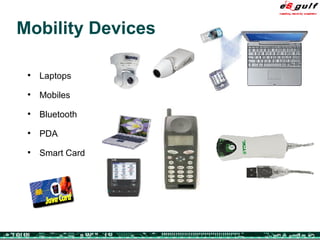
Mobility Devices Laptops Mobiles Bluetooth PDA Smart Card
What Is Privacy & Why Does It Matter? Privacy is a malleable concept Physical security and liberty as one version Information privacy is another Information privacy is the issue here  Privacy is a human right that preserves  individual autonomy That autonomy is necessary for a free and democratic society It is a community interest
Does New Technology  Threaten Our Privacy? US $200 and 24 hours will get you anything you want to know about someone (ex-partners, detailed asset lists, convictions, video rental preferences,  etc.)   CVS Pharmacy, Doubleclick, Amazon  HRDC’s  detailed, lifelong files on all of us - lacking real controls on use or disclosure
Technology - Opportunities and Challenges Some opportunities: Easy access  to central data-bases Use of virtual records ( e.g. , health records) Digital transaction security  Improved resource allocation and needs predictions Some challenges: Improper personal data access Security breaches Improper data-linkage, sharing and mining
Mitigating Privacy Risks By Legislation Establishing principles for all cases Designing privacy into systems and programs Building privacy into systems and programs Dealing with  boundary cases - the gray areas lawyers love Public and private sector rules are needed Public sector (provincial and federal legislation) Private sector
Mitigating Risks Using Technology Privacy enhancing technologies (PETs) Smart cards, toggles, digital certificates Technology enhances privacy - it does not define it Always ask: Who can  override the security?  Remembering that design is key What data, to whom, when and for what purposes? What happens to it after that? Data destruction
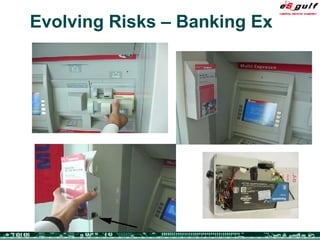
Evolving Risks – Banking Ex
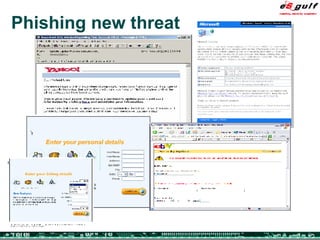
Phishing new threat
First Phishing – Now Ransomware Phishing Pharming Ransomware- So far theses attacks are quite rare but it brings a new dimension to the usage of the internet and a new generation of attacks.
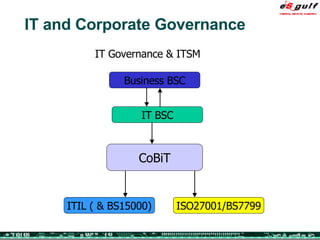
IT and Corporate Governance Business BSC IT BSC CoBiT ITIL ( & BS15000) ISO27001/BS7799 IT Governance & ITSM
Multitude of Governance SOX AML ISO27001 ISO90000 ISO20000 (BS15000) CoBIT PAS56 Basel 2 HIPAA EMV ...
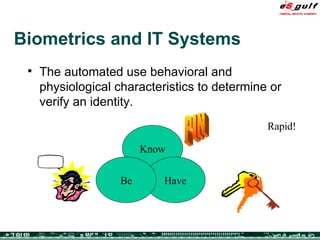
Biometrics and IT Systems The automated use behavioral and physiological characteristics to determine or verify an identity. PIN Rapid! Know Have Be
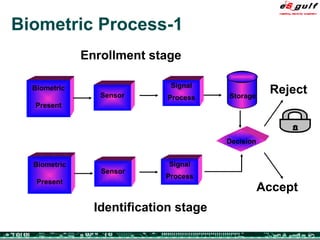
Biometric Process-1 Enrollment stage Identification stage Biometric Present Sensor Signal Process Reject Accept Sensor Biometric Present Storage Decision Signal Process
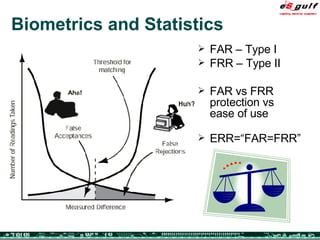
Biometrics and Statistics FAR – Type I FRR – Type II FAR vs FRR protection vs ease of use ERR=“FAR=FRR”
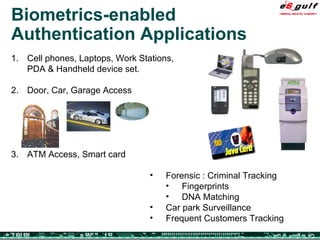
Biometrics-enabled Authentication Applications Cell phones, Laptops, Work Stations, PDA & Handheld device set. 2. Door, Car, Garage Access 3. ATM Access, Smart card Forensic : Criminal Tracking Fingerprints DNA Matching Car park Surveillance Frequent Customers Tracking
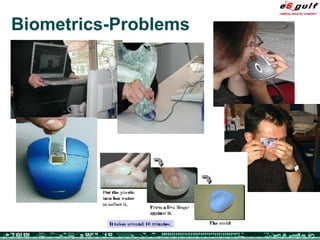
Biometrics-Problems
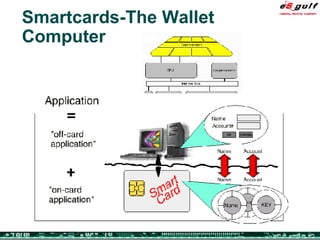
Smartcards-The Wallet Computer
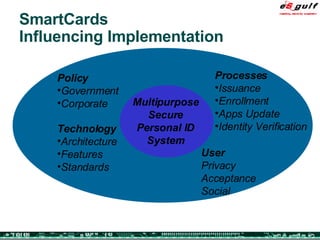
SmartCards Influencing Implementation Multipurpose Secure Personal ID System Policy Government Corporate Processes Issuance Enrollment Apps Update Identity Verification Technology Architecture Features Standards User Privacy Acceptance Social
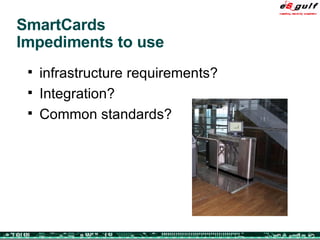
SmartCards Impediments to use infrastructure requirements? Integration? Common standards?
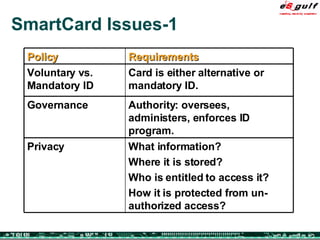
SmartCard Issues-1 What information? Where it is stored? Who is entitled to access it? How it is protected from un-authorized access? Privacy Authority: oversees, administers, enforces ID program. Governance Card is either alternative or mandatory ID. Voluntary vs. Mandatory ID Requirements Policy
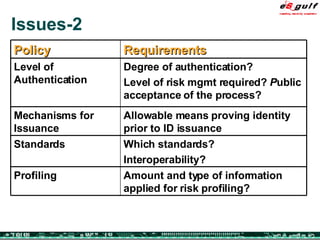
Issues-2 Amount and type of information applied for risk profiling? Profiling Allowable means proving identity prior to ID issuance Mechanisms for Issuance Which standards? Interoperability? Standards Degree of authentication? Level of risk mgmt required?  P ublic acceptance of the process? Level of Authentication Requirements Policy
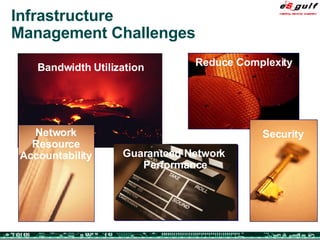
Infrastructure Management Challenges Reduce Complexity Bandwidth Utilization Network Resource Accountability Guaranteed Network Performance Security
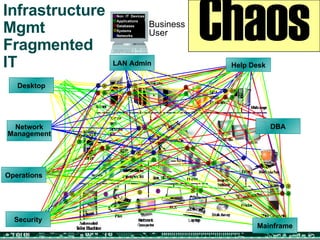
Infrastructure Mgmt Fragmented IT Desktop Help Desk LAN Admin DBA Operations Mainframe Security Network Management Chaos Business User Non  IT  Devices Applications Databases Systems Networks
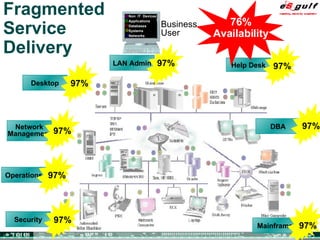
Fragmented Service Delivery Desktop Help Desk LAN Admin DBA Operations Mainframe Security Network Management 97% 97% 97% 97% 97% 97% 97% 97% Business User Non  IT  Devices Applications Databases Systems Networks 76% Availability
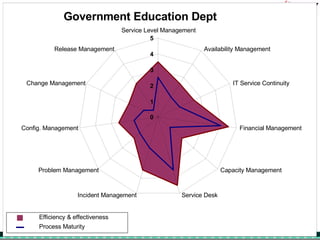
Government Education Dept 0 1 2 3 4 5 Service Level Management Availability Management IT Service Continuity Financial Management Capacity Management Service Desk Incident Management Problem Management Config. Management Change Management Release Management Efficiency & effectiveness Process Maturity
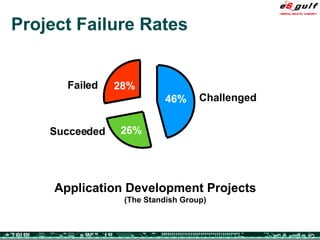
Project Failure Rates Application Development Projects (The Standish Group) Challenged Succeeded  Failed 28% 46% 26%
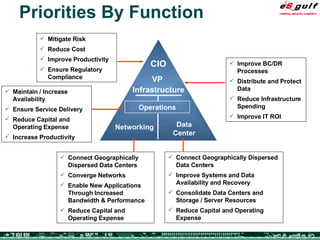
Mitigate Risk Reduce Cost Improve Productivity Ensure Regulatory Compliance Connect Geographically Dispersed Data Centers Improve Systems and Data Availability and Recovery Consolidate Data Centers and Storage / Server Resources Reduce Capital and Operating Expense Maintain / Increase Availability  Ensure Service Delivery Reduce Capital and Operating Expense Increase Productivity Connect Geographically Dispersed Data Centers Converge Networks Enable New Applications Through Increased Bandwidth & Performance Reduce Capital and Operating Expense Priorities By Function Improve BC/DR Processes Distribute and Protect Data Reduce Infrastructure Spending Improve IT ROI CIO Data Center Networking Operations VP  Infrastructure
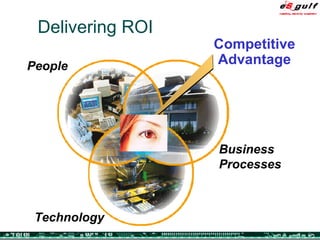
People Business Processes Technology Delivering ROI Competitive Advantage
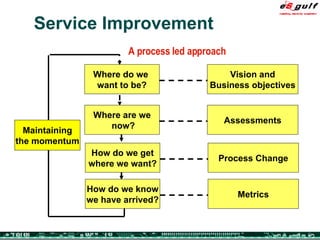
Service Improvement A process led approach Maintaining the momentum Where do we  want to be? Vision and Business objectives Where are we now? Assessments How do we get where we want? Process Change How do we know we have arrived? Metrics
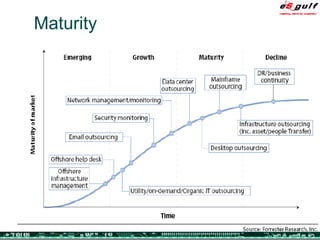
Maturity
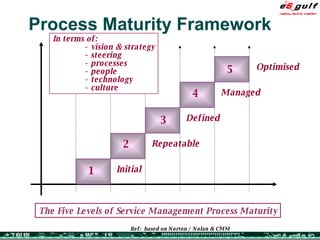
Process Maturity Framework The Five Levels of Service Management Process Maturity Ref:  based on Norton / Nolan & CMM In terms of: - vision & strategy - steering - processes - people - technology - culture 1 Initial 2 Repeatable 3 Defined 4 Managed 5 Optimised
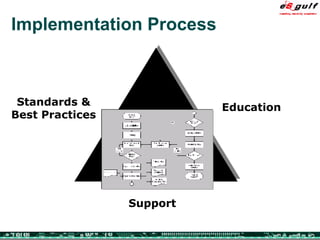
Implementation Process Education Standards & Best Practices Support
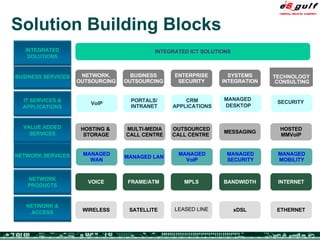
Solution Building Blocks INTEGRATED ICT SOLUTIONS VOICE FRAME/ATM MPLS BANDWIDTH INTERNET MANAGED WAN MANAGED LAN MANAGED VoIP MANAGED SECURITY MANAGED MOBILITY BUSINESS SERVICES VALUE ADDED SERVICES NETWORK SERVICES NETWORK PRODUCTS NETWORK & ACCESS INTEGRATED SOLUTIONS IT SERVICES & APPLICATIONS WIRELESS SATELLITE xDSL ETHERNET LEASED LINE HOSTING &  STORAGE OUTSOURCED CALL CENTRE  MESSAGING HOSTED MMVoIP MULTI-MEDIA CALL CENTRE VoIP PORTALS/ INTRANET CRM APPLICATIONS MANAGED  DESKTOP SECURITY NETWORK. OUTSOURCING BUSINESS OUTSOURCING ENTERPRISE SECURITY SYSTEMS INTEGRATION TECHNOLOGY CONSULTING
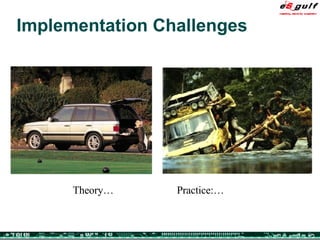
Implementation Challenges Theory… Practice:…
Questions?

Insight into IT Strategic Challenges

  • 1.
    Insight into today'sIT Strategic Challenges Jorge Sebastião Founder and CEO [email_address] www.esgulf.com
  • 2.
    The Net isvery different Internet Instantaneous Any- to-any Standards- based Always- on Mobility In person Phone Mail Private networks
  • 3.
  • 4.
    How Do WeManage Enterprise Complexity? ERP Solutions Mainframe Client/Server Heterogeneous distributed databases Mission Critical Availability The Internet heightens availability requirements Inter-dependencies of applications with business
  • 5.
    Products Are NotEnough People Technology Process
  • 6.
  • 7.
    10 Challenges EndUser Awareness Unavailability Technical skills Leveraging New Generation Networks New devices Mobile Computing Security and Privacy Evolving Risks Compliance and Regulation New Technologies Biometrics Smart Cards and eGov Challenges Infrastructure Management
  • 8.
    “… disastersare not technical, they’re people and culture related… “ The soft stuff is the hard stuff.” Bryan Fiman Principle and Co-Founder, Implementation Management Associates User Awareness and Adoption?
  • 9.
    Support Requirements “… . uneducated users require 3 to 6 times more support than educated users over the life of a new technology and process.” Research Note
  • 10.
    Unavailability Technical skillsRapid rate of change of technologies Shortage of skilled staff Key to recognize the risk areas Take appropriate preventive actions: obtaining training hiring consultants right people These factors might apply to your team: inadequate training poor understanding of methods, tools, & techniques inadequate application domain experience new technologies or methods ineffective, poorly documented, or neglected processes
  • 11.
    Professional Development Balancedapproach Education Training Experience Certification Networking Interpersonal / Soft Skills
  • 12.
    Professional Development ProfessionalGoals S pecific M easurable A chievable R elevant T ime-bounded Adapted over time
  • 13.
    Telephone Services DataServices (WWW, e-mail, etc) Video Services (TV, movie, etc) Telephone Services Network Video Services Network Data Services Network Policy Area 1 Policy Area 2 Policy Area 3 Legacy: Vertically-Integrated Networks pre-NGN Network Challenges - Legacy Networks
  • 14.
    Network Challenges– NGNchallenges Source TIPHON Control Area lP/MPLS Core Network Transport Area Service/ Application Area PSTN Internet Soft Switch IP Service and Application Control QoS Authentication Security Multicast Multimedia Call Control VoIP and Video IP endpoint control (H.323/SIP) Media Gateway control (H.248) Messaging Application Media Gateways Application Hosting Programmability 3rd party applications Web access Open APl's Web based Service selection Application Mediation Layer Enterprise ASP 3rd party Application Policy Server Aggregation Network Metro Optical RAS DSL Cable Frame/ATM Wireless Service Switch Manage QoS Security Interoperability Openness Programmability Interworking
  • 15.
    Network Challenges– BusinessDrivers Service Control Layer lP/MPLS Core Network Layer Application Layer PSTN Internet Soft Switch IP Service and Application Control QoS Authentication Security Multicast Multimedia Call Control VoIP and Video IP endpoint control (H.323/SIP) Media Gateway control (H.248) Messaging Application Media Gateways Application Hosting Programmability 3rd party applications Web access Open APl's Web based Service selection Application Mediation Layer Enterprise ASP 3rd party Application Policy Server LDAP based Aggregation Network Metro Optical RAS DSL Cable Frame/ATM Wireless IP Service Switch IP Video Internet Offload IP Voice IP VPN IP Transport Multimedia Conferencing Unified Messaging Virtual Office Tele Education E-Business Margin
  • 16.
    Users Want Mobility?Home working 89% of top 100 US companies offer telecommuting 2 60%+ Britons & Germans equipped to work remotely 1 Mobility How many of us using Mobile Today ≥ 66% workers will use mobile & wireless computing 1 Branch Offices 60 % of employees work at Branches Virtual 58% companies consider theirs to be a virtual workplace today 1 interpretation of analyst data 2 ComputerWorld survey
  • 17.
    New Corporate BoundariesPlatforms Data Center Laptops PDA Mobiles Distributed Access Dialup, ADSL, VPN VSAT Wifi, WiMax GPRS/3G Communication Centric Applications Web Email IPM VoIP Multiple Networks Intranet Extranet Internet Users Employees Partners Suppliers Customers Consumers/Prospects Location Office Internet Café/Restaurants Airport Hotels Home
  • 18.
    Mobility and AccessManagement Control Loosely-coupled, Dynamic exterior Tightly-coupled, Persistent interior Intranet Extranets Customers Partners/Suppliers Employees Consumers Internet
  • 19.
    Mobility Devices LaptopsMobiles Bluetooth PDA Smart Card
  • 20.
    What Is Privacy& Why Does It Matter? Privacy is a malleable concept Physical security and liberty as one version Information privacy is another Information privacy is the issue here Privacy is a human right that preserves individual autonomy That autonomy is necessary for a free and democratic society It is a community interest
  • 21.
    Does New Technology Threaten Our Privacy? US $200 and 24 hours will get you anything you want to know about someone (ex-partners, detailed asset lists, convictions, video rental preferences, etc.) CVS Pharmacy, Doubleclick, Amazon HRDC’s detailed, lifelong files on all of us - lacking real controls on use or disclosure
  • 22.
    Technology - Opportunitiesand Challenges Some opportunities: Easy access to central data-bases Use of virtual records ( e.g. , health records) Digital transaction security Improved resource allocation and needs predictions Some challenges: Improper personal data access Security breaches Improper data-linkage, sharing and mining
  • 23.
    Mitigating Privacy RisksBy Legislation Establishing principles for all cases Designing privacy into systems and programs Building privacy into systems and programs Dealing with boundary cases - the gray areas lawyers love Public and private sector rules are needed Public sector (provincial and federal legislation) Private sector
  • 24.
    Mitigating Risks UsingTechnology Privacy enhancing technologies (PETs) Smart cards, toggles, digital certificates Technology enhances privacy - it does not define it Always ask: Who can override the security? Remembering that design is key What data, to whom, when and for what purposes? What happens to it after that? Data destruction
  • 25.
  • 26.
  • 27.
    First Phishing –Now Ransomware Phishing Pharming Ransomware- So far theses attacks are quite rare but it brings a new dimension to the usage of the internet and a new generation of attacks.
  • 28.
    IT and CorporateGovernance Business BSC IT BSC CoBiT ITIL ( & BS15000) ISO27001/BS7799 IT Governance & ITSM
  • 29.
    Multitude of GovernanceSOX AML ISO27001 ISO90000 ISO20000 (BS15000) CoBIT PAS56 Basel 2 HIPAA EMV ...
  • 30.
    Biometrics and ITSystems The automated use behavioral and physiological characteristics to determine or verify an identity. PIN Rapid! Know Have Be
  • 31.
    Biometric Process-1 Enrollmentstage Identification stage Biometric Present Sensor Signal Process Reject Accept Sensor Biometric Present Storage Decision Signal Process
  • 32.
    Biometrics and StatisticsFAR – Type I FRR – Type II FAR vs FRR protection vs ease of use ERR=“FAR=FRR”
  • 33.
    Biometrics-enabled Authentication ApplicationsCell phones, Laptops, Work Stations, PDA & Handheld device set. 2. Door, Car, Garage Access 3. ATM Access, Smart card Forensic : Criminal Tracking Fingerprints DNA Matching Car park Surveillance Frequent Customers Tracking
  • 34.
  • 35.
  • 36.
    SmartCards Influencing ImplementationMultipurpose Secure Personal ID System Policy Government Corporate Processes Issuance Enrollment Apps Update Identity Verification Technology Architecture Features Standards User Privacy Acceptance Social
  • 37.
    SmartCards Impediments touse infrastructure requirements? Integration? Common standards?
  • 38.
    SmartCard Issues-1 Whatinformation? Where it is stored? Who is entitled to access it? How it is protected from un-authorized access? Privacy Authority: oversees, administers, enforces ID program. Governance Card is either alternative or mandatory ID. Voluntary vs. Mandatory ID Requirements Policy
  • 39.
    Issues-2 Amount andtype of information applied for risk profiling? Profiling Allowable means proving identity prior to ID issuance Mechanisms for Issuance Which standards? Interoperability? Standards Degree of authentication? Level of risk mgmt required? P ublic acceptance of the process? Level of Authentication Requirements Policy
  • 40.
    Infrastructure Management ChallengesReduce Complexity Bandwidth Utilization Network Resource Accountability Guaranteed Network Performance Security
  • 41.
    Infrastructure Mgmt FragmentedIT Desktop Help Desk LAN Admin DBA Operations Mainframe Security Network Management Chaos Business User Non IT Devices Applications Databases Systems Networks
  • 42.
    Fragmented Service DeliveryDesktop Help Desk LAN Admin DBA Operations Mainframe Security Network Management 97% 97% 97% 97% 97% 97% 97% 97% Business User Non IT Devices Applications Databases Systems Networks 76% Availability
  • 43.
    Government Education Dept0 1 2 3 4 5 Service Level Management Availability Management IT Service Continuity Financial Management Capacity Management Service Desk Incident Management Problem Management Config. Management Change Management Release Management Efficiency & effectiveness Process Maturity
  • 44.
    Project Failure RatesApplication Development Projects (The Standish Group) Challenged Succeeded Failed 28% 46% 26%
  • 45.
    Mitigate Risk ReduceCost Improve Productivity Ensure Regulatory Compliance Connect Geographically Dispersed Data Centers Improve Systems and Data Availability and Recovery Consolidate Data Centers and Storage / Server Resources Reduce Capital and Operating Expense Maintain / Increase Availability Ensure Service Delivery Reduce Capital and Operating Expense Increase Productivity Connect Geographically Dispersed Data Centers Converge Networks Enable New Applications Through Increased Bandwidth & Performance Reduce Capital and Operating Expense Priorities By Function Improve BC/DR Processes Distribute and Protect Data Reduce Infrastructure Spending Improve IT ROI CIO Data Center Networking Operations VP Infrastructure
  • 46.
    People Business ProcessesTechnology Delivering ROI Competitive Advantage
  • 47.
    Service Improvement Aprocess led approach Maintaining the momentum Where do we want to be? Vision and Business objectives Where are we now? Assessments How do we get where we want? Process Change How do we know we have arrived? Metrics
  • 48.
  • 49.
    Process Maturity FrameworkThe Five Levels of Service Management Process Maturity Ref: based on Norton / Nolan & CMM In terms of: - vision & strategy - steering - processes - people - technology - culture 1 Initial 2 Repeatable 3 Defined 4 Managed 5 Optimised
  • 50.
    Implementation Process EducationStandards & Best Practices Support
  • 51.
    Solution Building BlocksINTEGRATED ICT SOLUTIONS VOICE FRAME/ATM MPLS BANDWIDTH INTERNET MANAGED WAN MANAGED LAN MANAGED VoIP MANAGED SECURITY MANAGED MOBILITY BUSINESS SERVICES VALUE ADDED SERVICES NETWORK SERVICES NETWORK PRODUCTS NETWORK & ACCESS INTEGRATED SOLUTIONS IT SERVICES & APPLICATIONS WIRELESS SATELLITE xDSL ETHERNET LEASED LINE HOSTING & STORAGE OUTSOURCED CALL CENTRE MESSAGING HOSTED MMVoIP MULTI-MEDIA CALL CENTRE VoIP PORTALS/ INTRANET CRM APPLICATIONS MANAGED DESKTOP SECURITY NETWORK. OUTSOURCING BUSINESS OUTSOURCING ENTERPRISE SECURITY SYSTEMS INTEGRATION TECHNOLOGY CONSULTING
  • 52.
  • 53.

Editor's Notes

  • #2 Introduction of presentation, speaker, and thank you. Introduction into an updated strategy for eSecurity effective for today’s technologies, and eGovernment environments.