Building choice of high quality support for commissioners
care.data
High quality care for all: now and for future generations
Dee Moore
Intelligence Specialist
September 2013
1
care.data - Agenda
• NHS Changes
• What is care.data
• Reality
• Why care.data?
• Starting point
• Growth
• Information Governance & Confidentiality
• Data Pipes
• Forward Timeline
The NHS is changing
Francis Report Recommendations (2013)
http://www.midstaffspublicinquiry.com/sites/default/files/report/Executive%20summary.pdf
“Develop and share ever improving means of measuring and understanding the
performance of individual professionals, teams, units and provider organisations for the
patients, the public, and all other stakeholders in the system.”
“A coordinated collection of accurate information about the performance of organisations must
be available to providers, commissioners, regulators and the public, in as near real time as
possible, and should be capable of use by regulators in assessing the risk of non-compliance. It
must not only include statistics about outcomes, but must take advantage of all safety related
information, including that capable of being derived from incidents, complaints and
investigations.”
“If the culture of those engaged in and with the NHS is to change, information must be made
available about the performance and outcomes of the service provided to enable patients to
make treatment choices and have a proper understanding of the outcomes for them.”
We thought we had taken steps to improve the patients’ perception of the hospital care. Accordingly,
when we saw the results, we were looking at historic information. How could we measure such
feedback when the data was so old? The Francis Report, (February 2013)
“All our data is secondary use; none of it is used for the purpose for which it was collected. When it
comes to the big data collections, their quality and uptake, we have found that one of the most
important levers is giving people who entered the data the chance to see it.” The Round Table
Report, (February, 2013)
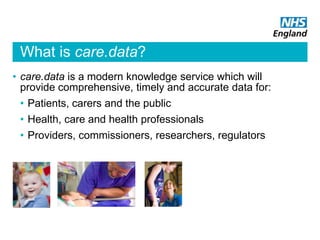
What is care.data?
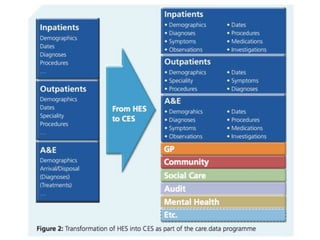
• care.data is a modern knowledge service which will
provide comprehensive, timely and accurate data for:
• Patients, carers and the public
• Health, care and health professionals
• Providers, commissioners, researchers, regulators
TextText
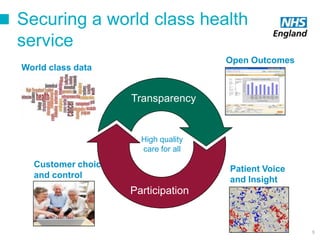
World class data
Open Outcomes
Patient Voice
and Insight
Customer choice
and control
Transparency
Participation
Securing a world class health
service
High quality
care for all
5
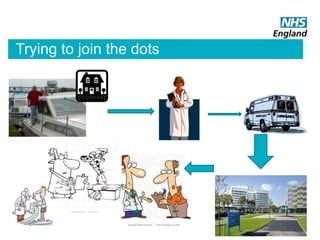
And what does this mean in real terms?
Trying to join the dots
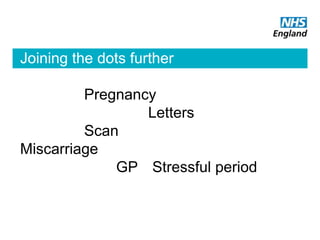
Joining the dots further
Pregnancy
Letters
Scan
Miscarriage
GP Stressful period
Why?
• To avoid mistakes of the past and improve patient care
• the elimination of variation in the quality and equity of
services provided across the country
• the identification of wasteful duplications
• in service and gaps in care
• the detection of systemic failings
Why? (continued)
• monitoring of outcomes
• trends over time
• comparisons of different patient pathways
• the development of predictive models
• Visibility of where NHS has been under-investing in different
areas of the country, in different groups of people, and in
different diseases and conditions.
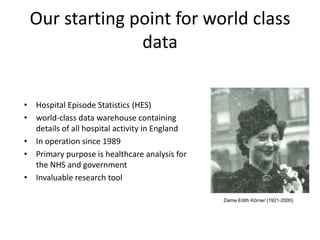
Our starting point for world class
data
• Hospital Episode Statistics (HES)
• world-class data warehouse containing
details of all hospital activity in England
• In operation since 1989
• Primary purpose is healthcare analysis for
the NHS and government
• Invaluable research tool
Dame Edith Körner (1921-2000)
UNCLASSIFIED
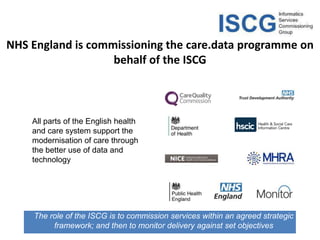
NHS England is commissioning the care.data programme on
behalf of the ISCG
All parts of the English health
and care system support the
modernisation of care through
the better use of data and
technology
The role of the ISCG is to commission services within an agreed strategic
framework; and then to monitor delivery against set objectives
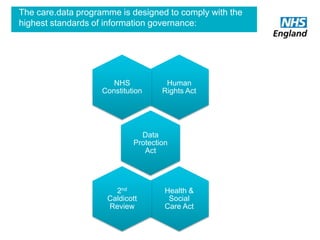
The care.data programme is designed to comply with the
highest standards of information governance:
Human
Rights Act
NHS
Constitution
Data
Protection
Act
Health &
Social
Care Act
2nd
Caldicott
Review
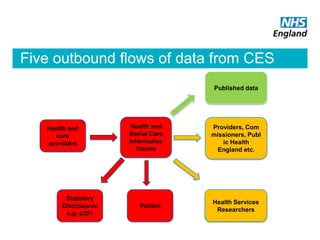
Five outbound flows of data from CES
Health and
care
providers
Health and
Social Care
Information
Centre
Statutory
Disclosures
e.g. s251
Patient
Health Services
Researchers
Providers, Com
missioners, Publ
ic Health
England etc.
Published data
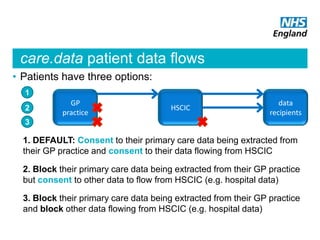
care.data patient data flows
• Patients have three options:
HSCIC
data
recipients
2. Block their primary care data being extracted from their GP practice
but consent to other data to flow from HSCIC (e.g. hospital data)
GP
practice
3. Block their primary care data being extracted from their GP practice
and block other data flowing from HSCIC (e.g. hospital data)
1. DEFAULT: Consent to their primary care data being extracted from
their GP practice and consent to their data flowing from HSCIC
1
2
3
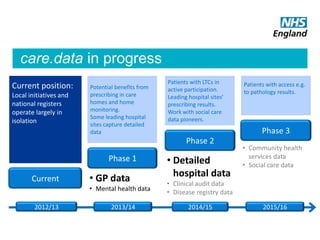
care.data in progress
Current
Phase 3
Phase 2
Phase 1
• GP data
• Mental health data
• Detailed
hospital data
• Clinical audit data
• Disease registry data
• Community health
services data
• Social care data
2012/13 2013/14 2014/15 2015/16
Current position:
Local initiatives and
national registers
operate largely in
isolation
Potential benefits from
prescribing in care
homes and home
monitoring.
Some leading hospital
sites capture detailed
data
Patients with LTCs in
active participation.
Leading hospital sites’
prescribing results.
Work with social care
data pioneers.
Patients with access e.g.
to pathology results.
Resources
Website www.nhs.uk/caredata
On-line toolkit with Patient FAQs
Look in your GP practice for patient leaflets and posters

Care.data 17 09-13

  • 1.
    Building choice ofhigh quality support for commissioners care.data High quality care for all: now and for future generations Dee Moore Intelligence Specialist September 2013 1
  • 2.
    care.data - Agenda •NHS Changes • What is care.data • Reality • Why care.data? • Starting point • Growth • Information Governance & Confidentiality • Data Pipes • Forward Timeline
  • 3.
    The NHS ischanging Francis Report Recommendations (2013) http://www.midstaffspublicinquiry.com/sites/default/files/report/Executive%20summary.pdf “Develop and share ever improving means of measuring and understanding the performance of individual professionals, teams, units and provider organisations for the patients, the public, and all other stakeholders in the system.” “A coordinated collection of accurate information about the performance of organisations must be available to providers, commissioners, regulators and the public, in as near real time as possible, and should be capable of use by regulators in assessing the risk of non-compliance. It must not only include statistics about outcomes, but must take advantage of all safety related information, including that capable of being derived from incidents, complaints and investigations.” “If the culture of those engaged in and with the NHS is to change, information must be made available about the performance and outcomes of the service provided to enable patients to make treatment choices and have a proper understanding of the outcomes for them.” We thought we had taken steps to improve the patients’ perception of the hospital care. Accordingly, when we saw the results, we were looking at historic information. How could we measure such feedback when the data was so old? The Francis Report, (February 2013) “All our data is secondary use; none of it is used for the purpose for which it was collected. When it comes to the big data collections, their quality and uptake, we have found that one of the most important levers is giving people who entered the data the chance to see it.” The Round Table Report, (February, 2013)
  • 4.
    What is care.data? •care.data is a modern knowledge service which will provide comprehensive, timely and accurate data for: • Patients, carers and the public • Health, care and health professionals • Providers, commissioners, researchers, regulators
  • 5.
    TextText World class data OpenOutcomes Patient Voice and Insight Customer choice and control Transparency Participation Securing a world class health service High quality care for all 5
  • 6.
    And what doesthis mean in real terms?
  • 7.
  • 8.
    Joining the dotsfurther Pregnancy Letters Scan Miscarriage GP Stressful period
  • 9.
    Why? • To avoidmistakes of the past and improve patient care • the elimination of variation in the quality and equity of services provided across the country • the identification of wasteful duplications • in service and gaps in care • the detection of systemic failings
  • 10.
    Why? (continued) • monitoringof outcomes • trends over time • comparisons of different patient pathways • the development of predictive models • Visibility of where NHS has been under-investing in different areas of the country, in different groups of people, and in different diseases and conditions.
  • 11.
    Our starting pointfor world class data • Hospital Episode Statistics (HES) • world-class data warehouse containing details of all hospital activity in England • In operation since 1989 • Primary purpose is healthcare analysis for the NHS and government • Invaluable research tool Dame Edith Körner (1921-2000)
  • 12.
  • 13.
    NHS England iscommissioning the care.data programme on behalf of the ISCG All parts of the English health and care system support the modernisation of care through the better use of data and technology The role of the ISCG is to commission services within an agreed strategic framework; and then to monitor delivery against set objectives
  • 14.
    The care.data programmeis designed to comply with the highest standards of information governance: Human Rights Act NHS Constitution Data Protection Act Health & Social Care Act 2nd Caldicott Review
  • 15.
    Five outbound flowsof data from CES Health and care providers Health and Social Care Information Centre Statutory Disclosures e.g. s251 Patient Health Services Researchers Providers, Com missioners, Publ ic Health England etc. Published data
  • 16.
    care.data patient dataflows • Patients have three options: HSCIC data recipients 2. Block their primary care data being extracted from their GP practice but consent to other data to flow from HSCIC (e.g. hospital data) GP practice 3. Block their primary care data being extracted from their GP practice and block other data flowing from HSCIC (e.g. hospital data) 1. DEFAULT: Consent to their primary care data being extracted from their GP practice and consent to their data flowing from HSCIC 1 2 3
  • 17.
    care.data in progress Current Phase3 Phase 2 Phase 1 • GP data • Mental health data • Detailed hospital data • Clinical audit data • Disease registry data • Community health services data • Social care data 2012/13 2013/14 2014/15 2015/16 Current position: Local initiatives and national registers operate largely in isolation Potential benefits from prescribing in care homes and home monitoring. Some leading hospital sites capture detailed data Patients with LTCs in active participation. Leading hospital sites’ prescribing results. Work with social care data pioneers. Patients with access e.g. to pathology results.
  • 18.
    Resources Website www.nhs.uk/caredata On-line toolkitwith Patient FAQs Look in your GP practice for patient leaflets and posters