Download as PDF, PPTX
![Suggested readings
1. Striebeck, M., "Ssh! We are adding a process... [agile practices],"
Agile Conference, 2006 , vol., no., pp.9 pp.,193, 23-28 July 2006
2. Nicolò Paternoster, Carmine Giardino, Michael Unterkalmsteiner,
Tony Gorschek, Pekka Abrahamsson, Software development in
startup companies: A systematic mapping study, Information and
Software Technology, Volume 56, Issue 10, October 2014, Pages
1200-1218, ISSN 0950-5849
3. Alfonso Fuggetta and Elisabetta Di Nitto. 2014. Software process. In
Proceedings of the on Future of Software Engineering (FOSE 2014).
ACM, New York, NY, USA, 1-12.](https://image.slidesharecdn.com/ivano05agiledevelopment-171123214423/85/2017-2018-Agile-development-19-320.jpg)


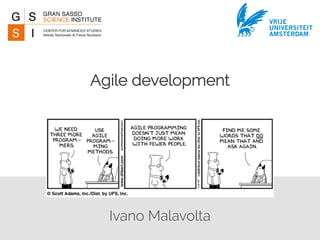
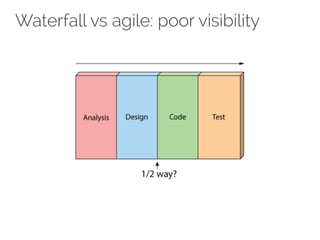
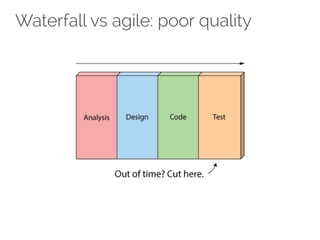
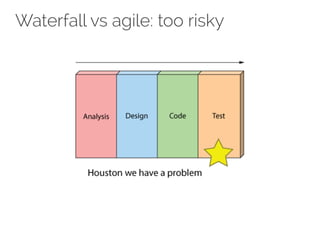
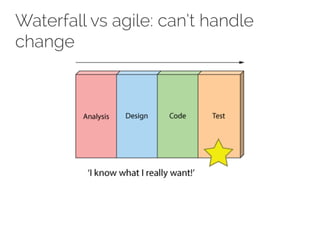
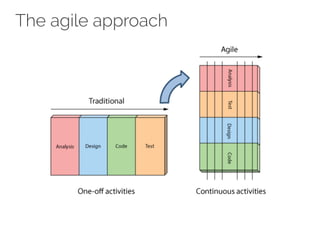
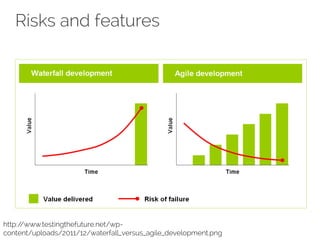
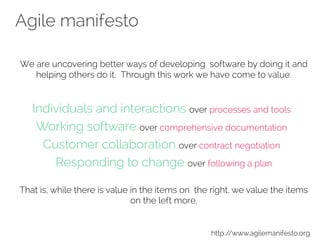
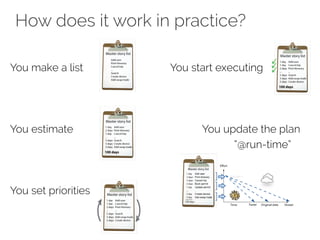
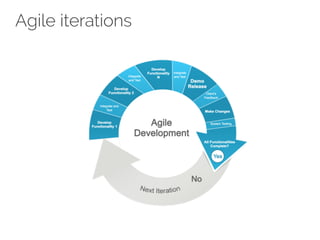
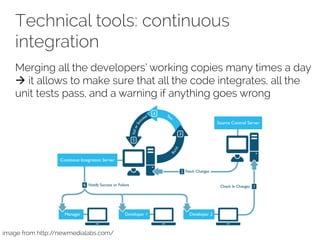
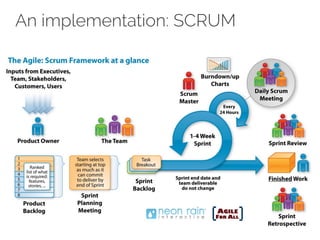
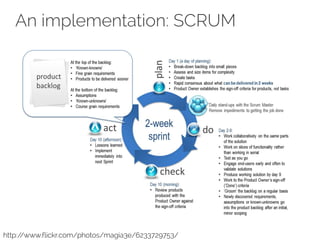
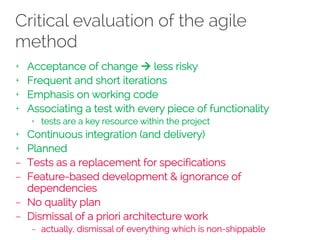
The document discusses the differences between Agile and Waterfall methodologies in software development, emphasizing the Agile Manifesto's principles that prioritize individuals and interactions, working software, customer collaboration, and responsiveness to change. It outlines how Agile methods, such as Scrum, advocate for iterative development, continuous integration, and incorporating testing throughout the process. Additionally, the document critiques certain limitations of Agile methods, highlighting the potential neglect of comprehensive planning and architectural considerations.


![[2016/2017] Modern development paradigms](https://cdn.slidesharecdn.com/ss_thumbnails/ivano06moderndevelopment-161220160423-thumbnail.jpg?width=640&height=640&fit=bounds)
![[2016/2017] RESEARCH in software engineering](https://cdn.slidesharecdn.com/ss_thumbnails/ivano01seresearch-161220160404-thumbnail.jpg?width=640&height=640&fit=bounds)
![The Green Lab - [02 C] [case study] Progressive web apps](https://cdn.slidesharecdn.com/ss_thumbnails/02-ccasestudyprogressivewebapps-161108211742-thumbnail.jpg?width=640&height=640&fit=bounds)
![Are service workers draining my battery? [Talk at AmsterdamJS 2017]](https://cdn.slidesharecdn.com/ss_thumbnails/ivanoamsterdamjs-170608173710-thumbnail.jpg?width=640&height=640&fit=bounds)


![How Maintainability Issues of Android Apps Evolve [ICSME 2018]](https://cdn.slidesharecdn.com/ss_thumbnails/icsme2018-180928081558-thumbnail.jpg?width=640&height=640&fit=bounds)


![Modeling objects interaction via UML sequence diagrams [Software Design] [Com...](https://cdn.slidesharecdn.com/ss_thumbnails/06sequencediagrams-180314152521-thumbnail.jpg?width=640&height=640&fit=bounds)
![Modeling behaviour via UML state machines [Software Design] [Computer Science...](https://cdn.slidesharecdn.com/ss_thumbnails/05statemachines-180306225932-thumbnail.jpg?width=640&height=640&fit=bounds)
![Object-oriented design patterns in UML [Software Design] [Computer Science] [...](https://cdn.slidesharecdn.com/ss_thumbnails/04designpatterns-180228160652-thumbnail.jpg?width=640&height=640&fit=bounds)
![Structure modeling with UML [Software Design] [Computer Science] [Vrije Unive...](https://cdn.slidesharecdn.com/ss_thumbnails/03structuremodeling-180219151135-thumbnail.jpg?width=640&height=640&fit=bounds)
![Requirements engineering with UML [Software Design] [Computer Science] [Vrije...](https://cdn.slidesharecdn.com/ss_thumbnails/02requirements-180213083117-thumbnail.jpg?width=640&height=640&fit=bounds)
![Modeling and abstraction, software development process [Software Design] [Com...](https://cdn.slidesharecdn.com/ss_thumbnails/01intro-180206151252-thumbnail.jpg?width=640&height=640&fit=bounds)

![[2017/2018] AADL - Architecture Analysis and Design Language](https://cdn.slidesharecdn.com/ss_thumbnails/ivano04saaadl-171122165132-thumbnail.jpg?width=640&height=640&fit=bounds)
![[2017/2018] Architectural languages](https://cdn.slidesharecdn.com/ss_thumbnails/ivano03salanguages-171122083931-thumbnail.jpg?width=640&height=640&fit=bounds)
![[2017/2018] Introduction to Software Architecture](https://cdn.slidesharecdn.com/ss_thumbnails/ivano02softwarearchitecture-171120182731-thumbnail.jpg?width=640&height=640&fit=bounds)
![[2017/2018] RESEARCH in software engineering](https://cdn.slidesharecdn.com/ss_thumbnails/ivano01seresearch-171120182253-thumbnail.jpg?width=640&height=640&fit=bounds)
![[13 - B] Experiment reporting](https://cdn.slidesharecdn.com/ss_thumbnails/13-bexperimentreporting-171017120820-thumbnail.jpg?width=640&height=640&fit=bounds)


![谷歌留痕技术教程[ 𝙩𝙤𝙥 𝟮𝟯𝟯. 𝙘 𝙤𝙢 ]](https://cdn.slidesharecdn.com/ss_thumbnails/top233-260130173900-2eb784f9-thumbnail.jpg?width=640&height=640&fit=bounds)


