Welcome! Thursday, October 22, 2009
  The Global Opportunities and Legal Challenges Posed by Health Information Technology:   Presented by Robert D. Marotta October 1, 2009 A Domestic Perspective
Speaker Bio Robert D. Marotta, Esq. Senior Vice-President and Chief Regulatory Counsel, HLTH/WebMD Health Corp. President, eHealth Foundation, New York, NY October 1, 2009
Building a Health IT Technical Assistance Capability at the Regional Level The new “regional extension centers,” launching in 2010, will play a significant role in enhancing technical assistance capabilities at the state and local levels. These centers will provide technical assistance and disseminate best practices and other information to support and accelerate efforts to adopt, implement and effectively utilize health IT. October 1, 2009
Building a Health IT Technical Assistance  Capability at the Regional Level The Office of the National Coordinator for Health IT (ONC) recently published a draft description of these regional centers.  Solicitation for hosting applications will be released this summer. ONC proposed that each regional center prioritize direct assistance first to the following: Public or not-for-profit hospitals, or critical-access hospitals Federally-qualified health centers Entities located in rural and other areas that serve uninsured, underinsured and medically underserved individuals (regardless of whether area is urban or rural) Individual or small-group practices that are primarily focused on primary care. October 1, 2009
Building a Health IT Technical Assistance  Capability at the Regional Level ONC proposed that regional centers furnish direct, individualized and (as-needed) on-site assistance to individual providers. This on-site assistance will be a key service and will represent a significant portion of the centers’ activities. The extension program should provide at least a minimal level of technical assistance across the nation. October 1, 2009
Building a Health IT Technical Assistance  Capability at the Regional Level It is expected that each regional center will provide technical assistance within a defined geographic area, and that each area will be served by only one center. It is required that centers be affiliated with any U.S.-based nonprofit organization, or group thereof, that applies and is awarded financial assistance; awards shall be decided on the basis of merit. ONC proposes a number of other requirements and preference criteria. October 1, 2009
eHealth Initiative Survey on HIT  Regional Extension Centers In May, eHI surveyed its member and partner organizations to assess perceptions and expectations about the HIT Regional Extension Centers. Results were shared in late May with the Administration and the public. October 1, 2009
The Results: Survey on HIT Regional  Extension Centers 65% of respondents believed that the federal government should lay out an operational outline for the centers and allow each to adopt its own region-specific practices. 49% believed that the centers should cover a geographic area designed to meet need; 26% supported centers adhering to state boundaries. 62% of respondents felt that the centers, once created, should not overlap geographically or otherwise compete to provide services. 41% of respondents supported the creation of 10-50 centers; 24% supported 50-100. 64% of respondents thought that quality improvement organizations were the most appropriate hosts of such centers; no other type of organization received comparable support.  71% of respondents thought vendors were poorly-suited to host or help fund a center due to conflicts of interest.  At the same time, many respondents supported a coalition of organizations supporting a center.  Desired a truly competitive application process. October 1, 2009
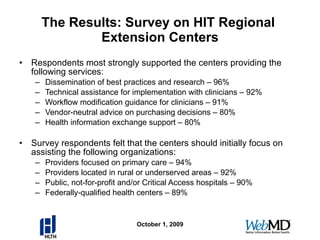
The Results: Survey on HIT Regional  Extension Centers Respondents most strongly supported the centers providing the following services: Dissemination of best practices and research – 96% Technical assistance for implementation with clinicians – 92% Workflow modification guidance for clinicians – 91%  Vendor-neutral advice on purchasing decisions – 80% Health information exchange support – 80% Survey respondents felt that the centers should initially focus on assisting the following organizations: Providers focused on primary care – 94% Providers located in rural or underserved areas – 92% Public, not-for-profit and/or Critical Access hospitals – 90%  Federally-qualified health centers – 89% October 1, 2009
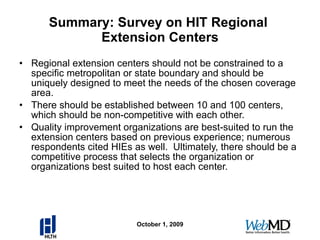
Summary: Survey on HIT Regional  Extension Centers Regional extension centers should not be constrained to a specific metropolitan or state boundary and should be uniquely designed to meet the needs of the chosen coverage area. There should be established between 10 and 100 centers, which should be non-competitive with each other. Quality improvement organizations are best-suited to run the extension centers based on previous experience; numerous respondents cited HIEs as well.  Ultimately, there should be a competitive process that selects the organization or organizations best suited to host each center. October 1, 2009
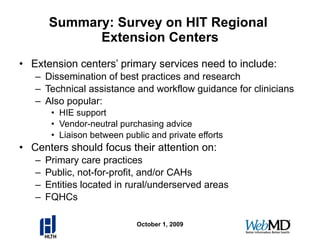
Summary: Survey on HIT Regional  Extension Centers Extension centers’ primary services need to include: Dissemination of best practices and research Technical assistance and workflow guidance for clinicians Also popular: HIE support Vendor-neutral purchasing advice Liaison between public and private efforts Centers should focus their attention on: Primary care practices Public, not-for-profit, and/or CAHs Entities located in rural/underserved areas FQHCs October 1, 2009
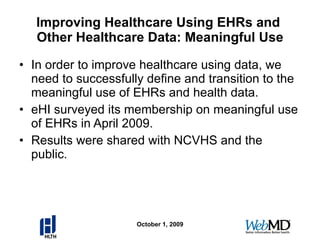
Improving Healthcare Using EHRs and  Other Healthcare Data: Meaningful Use In order to improve healthcare using data, we need to successfully define and transition to the meaningful use of EHRs and health data. eHI surveyed its membership on meaningful use of EHRs in April 2009. Results were shared with NCVHS and the public. October 1, 2009
Improving Healthcare Using EHRs and  Other Healthcare Data: Meaningful Use Survey/discussion results: members, including broad range of healthcare stakeholders, recognized that the definitions of “meaningful use” and “meaningful user” must not set the bar too high or too low. Consistent theme of flexibility. Though members differed on details, all emphasized the need for flexibility to allow: Continued innovation;  Any provider who puts in significant time and effort to be able to qualify as a meaningful user; and  For the definition of meaningful use to evolve as technology and health care systems evolve. October 1, 2009
Improving Healthcare Using EHR and Other  Healthcare Data: Meaningful Use Majority of respondents (58%) recommended that ‘meaningful user’ definition take into account differences between various practice sites and specialties. When asked to review a list of actions that could be considered elements of ‘meaningful use,’ responses varied widely: Functions with most support were: e-prescribing (88%); viewing lab and imaging results (79%); warning of drug interactions (76%); and problem lists and diagnoses, computerized orders and allergies (all exactly at 72%).  Functions with least support were: clinical messaging (47%); reminders (42%); and exchanging data with patients and consumers (38%). Significant majority (68%) opposed requiring providers to perform all the functions that would eventually become part of meaningful use.  Half of those respondents supported HHS creating a defined set of basic functions, while leaving others optional until there is broader adoption and use of HIT. October 1, 2009
Thank You! Robert D. Marotta, Esq. Senior Vice-President and Chief Regulatory Counsel, HLTH/WebMD Health Corp. President, eHealth Foundation [email_address] (614) 462-5435 October 1, 2009
October 22, 2009 The Impact of Federal HIT Policy and the State of Ohio Jennifer Covich Bordenick Chief Operating Officer  and Interim Chief Executive Officer
About the eHealth Initiative Independent non-profit based in Washington, DC.  Focused on informing, educating and advocating for the use of health information and health information technology to drive improvements in the quality, safety, and efficiency of healthcare. 170 member organizations Coalition of 260 state and local organizations working on health information exchange October 22, 2009
What Does eHI Do? Public Policy Organization: Monitor, Assess and Influence Public Policy  Convener and Consensus-Builder  Research and Support Efforts Related to HIT and Quality: Medical Product Safety Chronic Care Management Consumer Engagement Health Information Exchange at State Level Education and Awareness about state of the field October 22, 2009
Multi-Stakeholder Membership Consumer and Patient Groups Clinicians, Hospitals and other providers Employers and healthcare purchasers Health Plans Health Information Technology Suppliers Pharmacy Organizations Pharmaceutical and medical device manufacturers Public Health agencies Laboratories and other ancillary providers Quality organizations Academic Institutions State, regional and community based organizations October 22, 2009
Today’s Discussion The National eHealth Landscape Developing and Rewarding Meaningful Use The State of Health Information Exchange (HIE) in the Nation The Role of States and Regions October 22, 2009
Overview of National Landscape October 22, 2009
Federal HIT Policy Enactment of the American Recovery and Reinvestment Act in February, included a 100+ page section on HIT titled the “HITECH Act” Most significant legislative effort ever introduced in its affect on HIT Roll out of its provisions is underway, but will continue to directly impact the industry for the next decade October 22, 2009
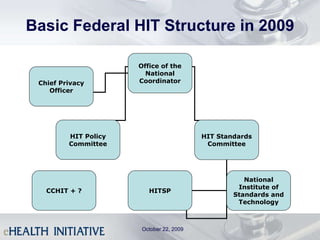
Federal HIT Policy What does the HITECH Act do? Develops a permanent federal governance structure for HIT Provides $2 billion in direct funding to support: State HIE grants Regional Extension Centers HIT Work Force Rewards Meaningful Use of EHRs with $30-$40 billion for Targeted Providers Revamps HIPAA Privacy and Security October 22, 2009
Basic Federal HIT Structure in 2009 October 22, 2009 HITSP CCHIT + ? Office of the National Coordinator HIT Policy Committee HIT Standards Committee Chief Privacy Officer National Institute of Standards and Technology
HIT Policy and Standards Committee HIT Policy Committee Recommend a policy framework for development and adoption of a nationwide health information technology infrastructure Recommend and prioritize areas in which standards, implementation specifications, and certification criteria are needed HIT Standards Committee Recommend to National Coordinator standards, implementation specifications, and certification criteria  React to Policy Committee recommendations of areas where standards are needed Will, as appropriate, provide for testing by NIST October 22, 2009
Regional Extension Centers 70 Regional Extension Centers will be established to furnish assistance (education, outreach, and technical) to help providers adopt HIT, become meaningful users, and achieve health information exchange Will focus on primary care providers Federal government is providing $598 million to help these centers get off the ground. Centers will receive $3-$30 million each. October 22, 2009
State HIE Grants The government will award contracts to states that are seeking to develop a comprehensive, multi-stakeholder plan to advance appropriate and secure health information exchange (HIE).  The federal funding is intended to help states continuously improve and expand HIE services to reach all health care providers, and should be used to develop governance policies, technical services, business operations, and financing mechanisms for HIE over a four year performance period with milestones for the states to meet, including support for meaningful use.  Government will provide $564 million to support the states and territories. States will receive $4-$40 million each. October 22, 2009
Key Dates in 2009 December 2009 Proposed rule released to govern Meaningful Use Dec 11, 2009 First Regional Extension Center contracts awarded Dec 15, 2009 State HIE Grants awarded Dec 31, 2009 HHS adopts an initial set of standards, implementation and certification criteria to guide adoption of EHRs for the Medicare and Medicaid incentives October 22, 2009
Developing and Rewarding Meaningful Use October 22, 2009
Developing and Rewarding Meaningful Use HITECH lays out the guidelines for physicians and hospitals to be rewarded or punished based on their willingness and ability to show that they are achieving meaningful use of a qualified electronic health record A meaningful user is an eligible provider that: Shows meaningful use of a qualified HER Reports on required clinical quality measures Exchanges health information electronically October 22, 2009
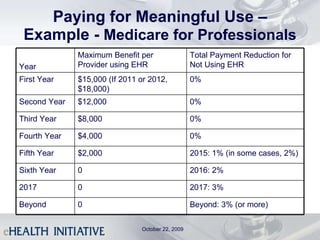
Paying for Meaningful Use Payments to reward meaningful use through Medicare until 2015 (physicians) or 2016 (hospitals), then penalties kick in Medicaid provides a different track of payments over a longer time frame with no penalties Most hospitals are eligible to try for Medicare and Medicaid payments, physicians have to choose one or the other Most eligible providers can earn maximum amounts of $44,000 (Medicare) or $65,000 (Medicaid), hospitals can earn millions – based on patient population and other factors October 22, 2009
Paying for Meaningful Use – Example -  Medicare for Professionals October 22, 2009 Year Maximum Benefit per Provider using EHR Total Payment Reduction for Not Using EHR First Year $15,000 (If 2011 or 2012, $18,000) 0% Second Year $12,000 0% Third Year $8,000 0% Fourth Year $4,000 0% Fifth Year $2,000 2015: 1% (in some cases, 2%) Sixth Year 0 2016: 2% 2017 0 2017: 3% Beyond 0 Beyond: 3% (or more)
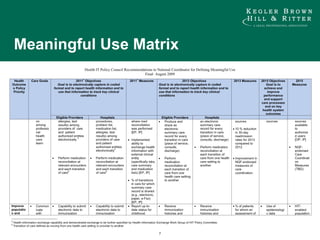
Meaningful Use Policy  HIT Policy Committee has been holding public meetings since May to develop the objectives and measures to judge meaningful use in 2011, submitted final recommendations in August October 22, 2009
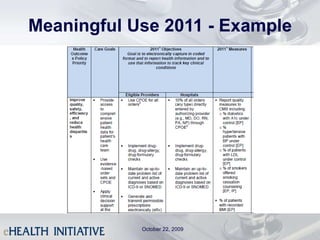
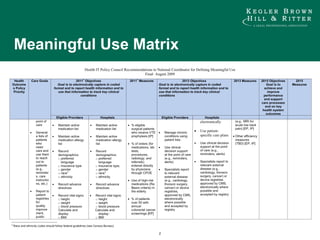
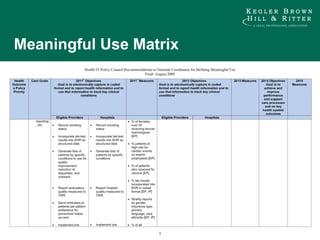
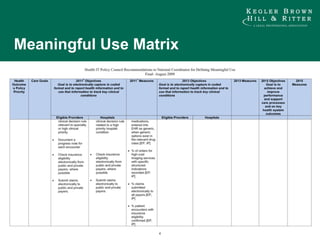
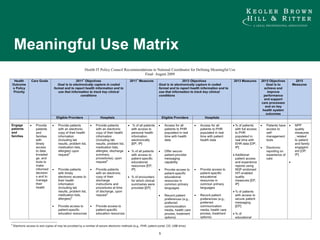
Meaningful Use 2011 - Example October 22, 2009
Meaningful Use – Next Steps CMS is developing a proposed rule to govern the actual process of meeting and assessing meaningful use Proposed rule expected out in December Will be followed by 60-day comment period Final rule out spring 2010 Proposed rule will cover the 2011 criteria, future criteria for more advanced years will be developed as the program rolls out October 22, 2009
The State of Health Information Exchange (HIE) in the Nation October 22, 2009
October 22, 2009
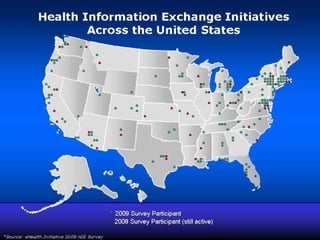
Quick Background on eHI Survey Since 2004, eHI has conducted an annual survey to look at activities and maturation of health information exchange (HIE) initiatives Data used by public agencies such as ONC, AHRQ, CDC and HHS to inform strategies related to health IT  Responses to the survey are self-reported Report provides detailed look at what is working and where it is working October 22, 2009
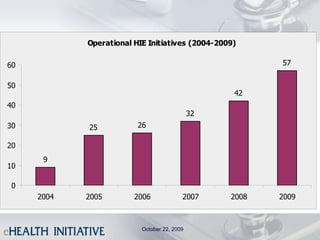
How Many Initiatives Are There? The number of initiatives involved in health information exchange is growing.  67 health information exchange initiatives responded to the eHI survey for the first time. There are at least 193 active initiatives involved in health information exchange.  150 initiatives responded to the survey.  eHI identified 43 additional initiatives from the 2008 survey which are still functioning, but did not complete this year’s survey. Directly of all exchanges is available online at  www.ehealthinitiative.org October 22, 2009
October 22, 2009
October 22, 2009
Who Is Exchanging Health Information? October 22, 2009
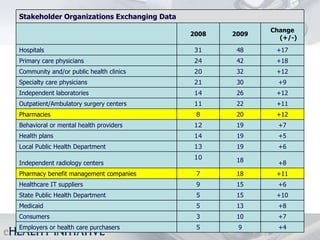
October 22, 2009 Stakeholder Organizations Exchanging Data 2008 2009 Change (+/-) Hospitals 31 48 +17 Primary care physicians 24 42 +18 Community and/or public health clinics 20 32 +12 Specialty care physicians 21 30 +9 Independent laboratories 14 26 +12 Outpatient/Ambulatory surgery centers 11 22 +11 Pharmacies 8 20 +12 Behavioral or mental health providers 12 19 +7 Health plans 14 19 +5 Local Public Health Department 13 19 +6 Independent radiology centers 10 18 +8 Pharmacy benefit management companies 7 18 +11 Healthcare IT suppliers 9 15 +6 State Public Health Department 5 15 +10 Medicaid 5 13 +8 Consumers 3 10 +7 Employers or health care purchasers 5 9 +4
What and How is Health Information is Exchanged?  October 22, 2009
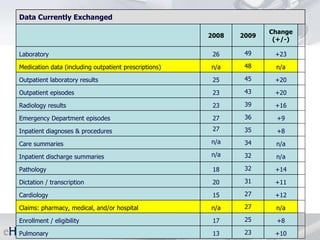
October 22, 2009 Data Currently Exchanged  2008 2009 Change (+/-) Laboratory  26 49 +23 Medication data (including outpatient prescriptions) n/a 48 n/a Outpatient laboratory results 25 45 +20 Outpatient episodes 23 43 +20 Radiology results 23 39 +16 Emergency Department episodes 27 36 +9 Inpatient diagnoses & procedures 27 35 +8 Care summaries n/a 34 n/a Inpatient discharge summaries n/a 32 n/a Pathology 18 32 +14 Dictation / transcription 20 31 +11 Cardiology 15 27 +12 Claims: pharmacy, medical, and/or hospital n/a 27 n/a Enrollment / eligibility 17 25 +8 Pulmonary 13 23 +10
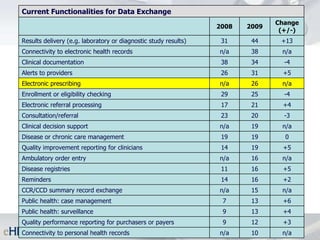
October 22, 2009 Current Functionalities for Data Exchange 2008 2009 Change (+/-) Results delivery (e.g. laboratory or diagnostic study results) 31 44 +13 Connectivity to electronic health records n/a 38 n/a Clinical documentation 38 34 -4 Alerts to providers 26 31 +5 Electronic prescribing n/a 26 n/a Enrollment or eligibility checking 29 25 -4 Electronic referral processing 17 21 +4 Consultation/referral 23 20 -3 Clinical decision support n/a 19 n/a Disease or chronic care management 19 19 0 Quality improvement reporting for clinicians 14 19 +5 Ambulatory order entry n/a 16 n/a Disease registries 11 16 +5 Reminders 14 16 +2 CCR/CCD summary record exchange n/a 15 n/a Public health: case management 7 13 +6 Public health: surveillance 9 13 +4 Quality performance reporting for purchasers or payers 9 12 +3 Connectivity to personal health records n/a 10 n/a
What is the Impact? October 22, 2009
Cost Savings Cost savings resulting from health information exchange were reported by 40 operational initiatives Reduced staff time spent on handling lab and radiology results (26 operational initiatives). Reduced staff time spent on clerical administration and filing (24).  Decreased dollars spent on redundant tests (17). Decreased cost of care for chronic care patients (11). Reduced medication errors (10). October 22, 2009
What hurdles exist? October 22, 2009
What Are the Challenges? Addressing privacy and confidentiality issues – HIPAA and other (93 initiatives identified this as a pressing challenge). Defining the value that accrues to the users of the health information exchange (92). Developing a sustainable business model (90). October 22, 2009
October 22, 2009
The Role of States and Regions October 22, 2009
The Role of States and Regions States will continue to act as laboratories for innovation in HIT, but now there is a strong federal impetus for states to ensure the success of eHealth within their geographic boundaries Developing a statewide infrastructure for health information exchange State HIE grants Partnering with efforts to promote the adoption and meaningful use of EHRs Regional extension centers Drawing on the purchasing power and influence of state government to promote best practices Example: The Louisiana Rural Health Information Exchange, supported by Louisiana Medicaid October 22, 2009
eHealth In Ohio Ohio Health Information Partnership State-designated entity for HIT/HIE leadership State HIE Grant for Ohio: Full application was due Oct 16th Regional Extension Centers in Ohio: Full applications for first round are due Nov 3r Ohio announced in August that it would dedicate $10.1 million to HIT and quality improvement efforts October 22, 2009
eHealth In Ohio Other Health Information Exchange Initiatives in Ohio: HealthBridge (Stage 7) Northeast Ohio Regional Health Information Organization (Stage 3) Ohio Osteopathic Association Patient Information Network – Independent Hospital Network (Stage 4)  http://www.healthcarereform.ohio.gov/healthit.aspx   October 22, 2009
Thank You! Jennifer Covich Bordenick [email_address] 202-624-3288 www.eHealthInitiative.org Don’t Miss eHI’s Annual Conference in Washington, DC on January 25 th  and 26 th ! October 22, 2009
presented by Élise Spriggs Scanning the Legislative Landscape
Overview of HIT Provisions Included in the American Recovery and Reinvestment Act (ARRA)
What Problems Are We Trying to Solve with HIT? Continued challenges around quality and safety Predominantly fee for service payment system rewards doing more vs. doing better A 2002-2004 study of hospitalizations in the U.S. found that about 83,000 potentially preventable deaths occurred each year 1 1  Health Grades Third Annual Patient Safety in American Hospitals Study, Apr. 2006.
What Problems Are We Trying to Solve with HIT? Rising healthcare costs U.S. spending is rising at a rate of almost 7% a year—rapidly outpacing projected growth in GDP (4%) and wages (3%) U.S. spends 16% of total GDP an increase of 6.7% over 2004 spending—growth in spending is projected to average 6.7% annually over the period 2007 through 2017 2 Access issues The U.S. Census Bureau estimates that 45.7 million Americans (about 15.3% of the total population) had no health insurance at some point during 2007 3 2  “National Health Expenditures, Forecast Summary and Selected Tables,”  Office of the Actuary in the Centers for Medicare & Medical    Services , 2008, retrieved Mar. 20, 2008. 3  “Income, Poverty & Health Insurance Coverage in the United States,”  U.S. Census Bureau , Issued Aug. 2008
Information technology Reduces medical errors The US Department of Health & Human Services estimates that widespread use of electronic medical records would save 100,000 lives per year by reducing medical errors & lowering healthcare spending by as much as 30% 86% of doctors surveyed said Electric Medical Records (“EMR”) helped reduce medical errors 4 The Role of Information Technology in Improving Healthcare 4  “Electronic Health Records in Ambulatory Care – A National Survey of Physicians,”  New England Journal of Medicine , July 3, 2008, p. 54.
Information Technology Gets the right information to the right person at the right time to support care delivery 85% of the doctors claimed the records improved the delivery of long-term preventative care 5 Reduces administrative costs The Role of Information Technology in Improving Healthcare 5  “Electronic Health Records in Ambulatory Care – A National Survey of Physicians,”  New England Journal of Medicine , July 3, 2008, p. 54.
The Role of Information Technology in Improving Healthcare Enables more effective methods to improve population health (e.g. quality and efficiency performance measurement, medical product safety, clinical and effectiveness research, public health surveillance) Enables the patient to more effectively engage with the care delivery team
Current Adoption Rates are Low Based on findings from a survey conducted in late 2007 and early 2008, 4% of the physicians reported having an extensive, fully functional electronic records system, and 13% of the physicians reported having a basic system 6 1.5% percent of U.S. hospitals have a comprehensive electronic records system and an additional 7.6% have a basic system 7  6  “Electronic Health Records in Ambulatory Care – A National Survey of Physicians,”  New England Journal of Medicine : 359;1. July 3, 2008, pg. 50 7  “Use of Electronic Health Records in U.S. Hospitals,”  New England Journal of Medicine : 360;16. April 16, 2009.
Current Adoption Rates are Low Computerized provider-order entry for medications has been implemented in only 17% of hospitals 8 Larger hospitals, those located in urban areas and teaching hospitals were more likely to have electronic records systems 9   8  “Use of Electronic Health Records in U.S. Hospitals,”  New England Journal of Medicine : 360;16. April 16, 2009.  9  “Use of Electronic Health Records in U.S. Hospitals,”  New England Journal of Medicine : 360;16. April 16, 2009.
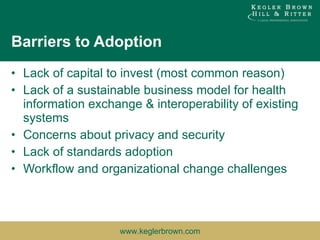
Barriers to Adoption Lack of capital to invest (most common reason) Lack of a sustainable business model for health information exchange & interoperability of existing systems Concerns about privacy and security Lack of standards adoption Workflow and organizational change challenges
American Recovery and Reinvestment Act Tries to Address the Barriers
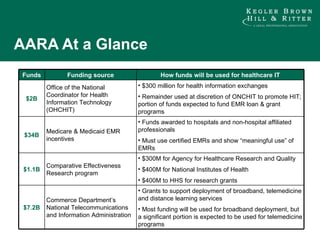
AARA At a Glance Funds Funding source How funds will be used for healthcare IT $2B Office of the National Coordinator for Health Information Technology (OHCHIT) $300 million for health information exchanges Remainder used at discretion of ONCHIT to promote HIT; portion of funds expected to fund EMR loan & grant programs $34B Medicare & Medicaid EMR incentives Funds awarded to hospitals and non-hospital affiliated professionals Must use certified EMRs and show “meaningful use” of EMRs $1.1B Comparative Effectiveness Research program $300M for Agency for Healthcare Research and Quality $400M for National Institutes of Health $400M to HHS for research grants $7.2B Commerce Department’s National Telecommunications and Information Administration Grants to support deployment of broadband, telemedicine and distance learning services Most funding will be used for broadband deployment, but a significant portion is expected to be used for telemedicine programs
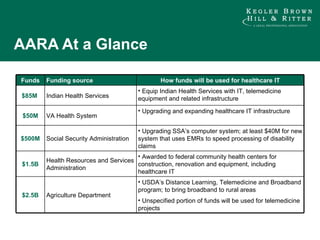
AARA At a Glance Funds Funding source How funds will be used for healthcare IT $85M  Indian Health Services Equip Indian Health Services with IT, telemedicine equipment and related infrastructure $50M VA Health System Upgrading and expanding healthcare IT infrastructure $500M Social Security Administration Upgrading SSA’s computer system; at least $40M for new system that uses EMRs to speed processing of disability claims $1.5B Health Resources and Services Administration Awarded to federal community health centers for construction, renovation and equipment, including healthcare IT $2.5B Agriculture Department USDA’s Distance Learning, Telemedicine and Broadband program; to bring broadband to rural areas Unspecified portion of funds will be used for telemedicine projects
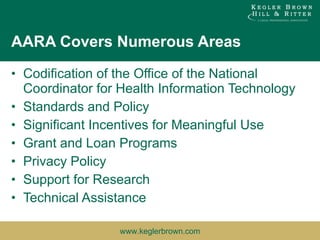
AARA Covers Numerous Areas Codification of the Office of the National Coordinator for Health Information Technology Standards and Policy Significant Incentives for Meaningful Use Grant and Loan Programs Privacy Policy Support for Research Technical Assistance
AARA-Office of the National Coordinator for Health Information Technology Establishes the Office of the National Coordinator Appointed by Secretary of Health and Human Services Dr. David Blumenthal, MD, MPP Leads the implementation of a nationwide interoperable, privacy-protected health information infrastructure set forth under AARA
Office of the National Coordinator Will play a key role within HHS Two federal advisory committees will provide guidance and recommendations to the National Coordinator HIT Standards Committee Health IT Policy Committee
What is the Role of the HIT Standards Committee? HIT Standards Committee makes recommendations to Dr. Blumenthal on standards, implementation specifications and certification criteria for the electronic exchange and use of health information Initial focus on policies developed by HIT Standard Committee’s 8 areas First set of standards have been sent to OMB for adoption by December 31, 2009 (as required by the legislation)
HIT Standards Committee Membership Membership consists of broad range of stakeholders: Jonathan Perlin , Hospital Corporation of America, Chair  John Halamka , Harvard Medical School, Vice Chair Dixie Baker , Science Applications International Corporation   Anne Castro , BlueCross BlueShield of South Carolina  Aneesh Chopra , Chief Technology Officer, OSTP    Christopher Chute , Mayo Clinic College of Medicine  Janet Corrigan , National Quality Forum  John Derr , Golden Living, LLC  Linda Dillman , Wal-Mart Stores, Inc.  James Ferguson , Kaiser Permanente  Steven Findlay , Consumers Union  Linda Fischetti , Department of Veterans Affairs  Douglas Fridsma , Arizona State University  Cita Furlani , National Institutes of Standards and Technology
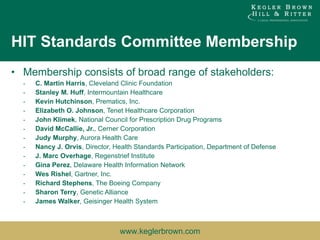
HIT Standards Committee Membership Membership consists of broad range of stakeholders: C. Martin Harris , Cleveland Clinic Foundation  Stanley M. Huff , Intermountain Healthcare  Kevin Hutchinson , Prematics, Inc.  Elizabeth O. Johnson , Tenet Healthcare Corporation  John Klimek , National Council for Prescription Drug Programs  David McCallie, Jr. , Cerner Corporation  Judy Murphy , Aurora Health Care  Nancy J. Orvis , Director, Health Standards Participation, Department of Defense  J. Marc Overhage , Regenstrief Institute  Gina Perez , Delaware Health Information Network  Wes Rishel , Gartner, Inc.  Richard Stephens , The Boeing Company  Sharon Terry , Genetic Alliance  James Walker , Geisinger Health System
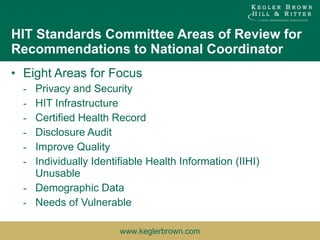
HIT Standards Committee Areas of Review for Recommendations to National Coordinator  Eight Areas for Focus  Privacy and Security HIT Infrastructure Certified Health Record Disclosure Audit Improve Quality Individually Identifiable Health Information (IIHI) Unusable Demographic Data Needs of Vulnerable
HIT Standards Committee Creation of three subcommittees to analyze recommendations of the HIT Policy Committee Clinical Quality Clinical Operations Privacy & Security Generally meet monthly and can participate via web conference or audio teleconference
What is the Relevance of the Standards? As each agency implements, acquires, or upgrades health IT systems, it shall utilize, where available, those systems that meet the standards requirements President shall take measures to assure that federal activities involving the broad collection and submission of health information are consistent with standards within three years of adoption Each agency relating to promoting quality and efficient healthcare in federal government administered or sponsored healthcare programs shall require in contracts or agreements with providers, insurers or health insurance issuers, that as they implement, acquire or upgrade health IT systems, they shall utilize, where available, health IT systems and products that use the standards
What is the Relevance of the Standards? To greatest extent practicable, the Secretary shall ensure that where funds are expended for the acquisition of health IT, such health IT shall meet the standards, implementation specifications and certification criteria under the legislation Medicare and Medicaid Incentives for healthcare professionals and hospitals require “meaningful use” of “certified EHR Technology” which must use the standards that are adopted
Health IT Policy Committee Makes recommendations to Dr. Blumenthal on an overall policy framework for the development and adoption of a national interoperable health information infrastructure, including standards for the secure and private exchange of patient medical information Generally, meet monthly and can participate via web conference or audio teleconference
Health IT Policy Committee Membership Membership consists of broad range of stakeholders: David Blumenthal,  HHS/Office of the National Coordinator for Health Information Technology,  Chair Paul Tang,  Palo Alto Medical Foundation,  Vice Chair David Bates , Brigham and Women’s Hospital  Christine Bechtel ,   National Partnership for Women & Families  Neil Calman , The Institute for Family Health   Richard Chapman ,   Kindred Healthcare  Adam Clark ,   Lance Armstrong Foundation  Arthur Davidson ,   Denver Public Health Department  Connie White Delaney ,   University of Minnesota/School of Nursing  Paul Egerman , Businessman/Entrepreneur  Judith Faulkner ,   Epic Systems Corporation  Gayle Harrell ,   Former Florida State Legislator  Charles Kennedy ,   WellPoint, Inc.  Michael Klag ,   Johns Hopkins University, Bloomberg School of Public Health  David Lansky ,   Pacific Business Group on Health  Deven McGraw , Center for Democracy & Technology  Frank Nemec ,   Gastroenterology Associates, Inc.  Marc Probst , Intermountain Healthcare  Latanya Sweeney ,   Carnegie Mellon University  Scott White ,   1199 SEIU Training and Employment Fund  Roger Baker ,   Department of Veterans Affairs  CDR Michael S. Weiner ,   United States Navy  Tony Trenkle ,   Centers for Medicare and Medicaid  James C. Borland ,   Social Security Administration
Significant Incentives for Meaningful Use Covered under Mr. Porter’s presentation
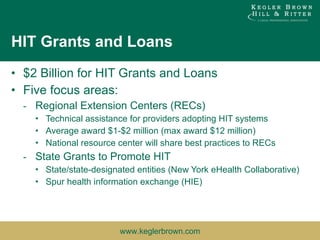
HIT Grants and Loans $2 Billion for HIT Grants and Loans Five focus areas: Regional Extension Centers (RECs) Technical assistance for providers adopting HIT systems Average award $1-$2 million (max award $12 million) National resource center will share best practices to RECs State Grants to Promote HIT State/state-designated entities (New York eHealth Collaborative) Spur health information exchange (HIE)
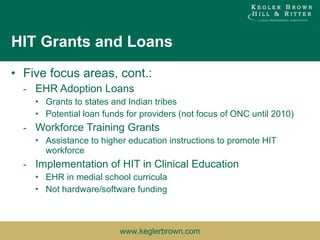
HIT Grants and Loans Five focus areas, cont.: EHR Adoption Loans Grants to states and Indian tribes Potential loan funds for providers (not focus of ONC until 2010) Workforce Training Grants Assistance to higher education instructions to promote HIT workforce Implementation of HIT in Clinical Education EHR in medial school curricula Not hardware/software funding
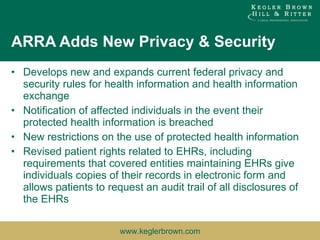
ARRA Adds New Privacy & Security Develops new and expands current federal privacy and security rules for health information and health information exchange Notification of affected individuals in the event their protected health information is breached New restrictions on the use of protected health information Revised patient rights related to EHRs, including requirements that covered entities maintaining EHRs give individuals copies of their records in electronic form and allows patients to request an audit trail of all disclosures of the EHRs
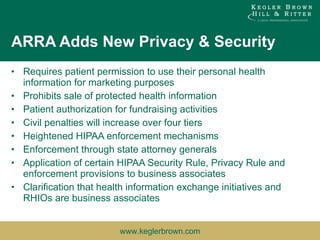
ARRA Adds New Privacy & Security Requires patient permission to use their personal health information for marketing purposes Prohibits sale of protected health information Patient authorization for fundraising activities Civil penalties will increase over four tiers Heightened HIPAA enforcement mechanisms Enforcement through state attorney generals Application of certain HIPAA Security Rule, Privacy Rule and enforcement provisions to business associates Clarification that health information exchange initiatives and RHIOs are business associates
Thank You! Élise Spriggs Director, Kegler Brown [email_address] (614) 462-5451
Rex Plouck, Enterprise Health IT Officer, State of Ohio Ohio Health IT Agenda
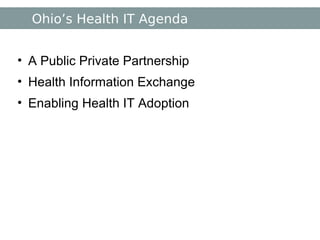
Ohio’s Health IT Agenda A Public Private Partnership Health Information Exchange Enabling Health IT Adoption
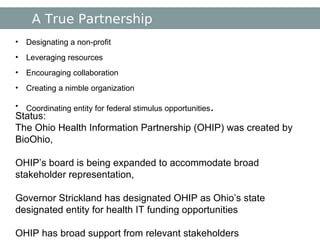
A True Partnership Designating a non-profit Leveraging resources Encouraging collaboration Creating a nimble organization Coordinating entity for federal stimulus opportunities . Status:  The Ohio Health Information Partnership (OHIP) was created by BioOhio, OHIP’s board is being expanded to accommodate broad stakeholder representation, Governor Strickland has designated OHIP as Ohio’s state designated entity for health IT funding opportunities OHIP has broad support from relevant stakeholders
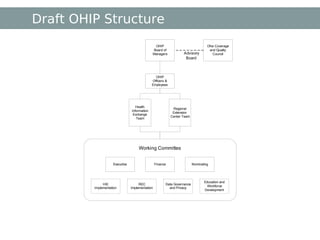
Draft OHIP Structure
Information Exchange as a Tool Providing access to the right information, at the right time, in any setting The Health Information Exchange Federated data model Standards based Supports population health and research efforts Enables patient participation Status: OHIP has submitted a letter of intent with HHS for federal funding OHIP intends to submit a final application in October 2009 Development of a state strategic plan and operational plan continues
Enabling Adoption A state wide extension center as a resource for health care providers Providing cost effective access to electronic medical record technology Integrating technology into the provider specific environment Helping providers become meaningful users of health IT Status: OHIP has submitted a preliminary application with HHS for federal funding OHIP has been invited to submit a complete application Development of a state strategic plan continues OHIP will create local partnership to deliver service to individual healthcare providers
Thank You! Rex Plouck, Enterprise Health IT Officer, State of Ohio Status: OHIP has submitted a preliminary application with HHS for federal funding OHIP has been invited to submit a complete application Development of a state strategic plan continues OHIP will create local partnership to deliver service to individual healthcare providers
presented by Jeff Porter Establishing Meaningful Use: From the HITECH Act to Improved Quality of Care
Role of the Office of the National Coordinator (ONC) Charged with coordinating nationwide efforts to implement and use the most advanced health information technology and the electronic exchange of health information.  ONC is working with the Centers for Medicare & Medicaid Services (CMS), through an open and transparent process, on efforts to officially designate what constitutes “meaningful use.”
When do we expect formal rules for meaningful use? CMS is expected to publish a formal definition of meaningful use, for the purposes of receiving the Medicare and Medicaid incentive payments, by December 31, 2009.  At that time, the public will be able to comment on the definition, and such comments will be considered in reaching any final definition of the term.
HIT Policy and Standards Committees The HIT Policy Committee and the HIT Standards Committee are providing recommendations to the National Coordinator that will help CMS develop initial criteria for meaningful use and assist in planning for any criteria expansion for the future incentive programs. Approximately 800 public comments were received on the HIT Policy Committee’s initial recommendations.
Defining “Meaningful Use” Federal HIT Policy Committee Meaningful Use Workgroup Working to develop draft definition of meaningful use CMS will consider the HIT Policy Committee’s recommendations as it drafts regulations. Makes recommendations to David Blumenthal, National Coordinator for HIT, on an overall policy framework for the development and adoption of a national interoperable health information infrastructure, including standards for the secure and private exchange of patient medical information. Federal HIT Standards Committee Makes recommendations to Dr. Blumenthal on standards, implementation specifications, and certification criteria for the electronic exchange and use of health information.
Defining “Meaningful Use” Must be “meaningful user” to be eligible for HIT incentive payments and avoid payment penalties Criteria not completely defined in HITECH Statute only provides that eligible providers must use a “certified system” that can exchange health information and report on quality measures.
Eligible Professionals Generally speaking, for purposes of meaningful use, “eligible professional” is defined in the following ways: Medicare Medicaid
Eligible Professionals: Medicare A physician as defined in section 1861(r) of the Social Security Act, which includes the following five types of professionals:  Doctor of medicine or osteopathy  Doctor of dental surgery or medicine  Doctor of podiatric medicine  Doctor of optometry  Chiropractor
Eligible Professionals: Medicaid Physicians  Dentists  Certified nurse-midwives  Nurse practitioners  Physician assistants who are practicing in Federally Qualified Health Centers (FQHCs) or Rural Health Clinics (RHCs) led by a physician assistant.
Incentives ARRA provides significant incentives for eligible professionals and hospitals…..
Medicare Eligible physicians, including those in solo or small practices, can receive up to $44,000 over five years under Medicare Physicians operating in “Provider Shortage Area” receive a 10% bonus
Medicaid Eligible physicians, including those in solo or small practices, can receive up to $63,750 over six years under Medicaid for being meaningful users of certified electronic health records.   30% or more of patients must be covered by Medicaid
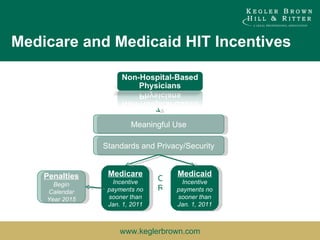
Medicare and Medicaid HIT Incentives Meaningful Use Standards and Privacy/Security Medicare Incentive payments no sooner than Jan. 1, 2011 Medicaid Incentive payments no sooner than Jan. 1, 2011 OR Penalties Begin Calendar Year 2015
Medicare Hospitals that become meaningful users could receive up to four years of financial incentive payments under Medicare beginning in 2011.  Large hospitals can qualify for up to $11 million dollars over the period.
Medicaid Hospitals that become meaningful users could receive up to six years of financial incentive payments under Medicaid beginning in October 2010. Eligible hospitals include Children’s hospitals and Acute-care hospitals.
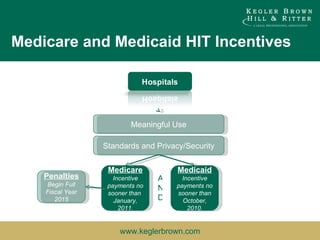
Medicare and Medicaid HIT Incentives Meaningful Use Standards and Privacy/Security Medicare Incentive payments no sooner than  January, 2011. Medicaid Incentive payments no sooner than October, 2010. AND Penalties Begin Full Fiscal Year 2015
Penalties There will be no incentive payments available for those who first become meaningful users after 2015. Penalties begin in 2015.
Meaningful Use Workgroup Develops Draft Definition Would define meaningful use in three distinct phases (years) 2011, 2013, and 2015 Approach focuses on how to leverage use of EHR/HIT systems to accomplish five goals Improve quality, safety and efficiency Engage patients and their families Improve care coordination Improve population and public health Reduce disparities Ensure privacy and security protections Each phase would define a meaningful user by tying requirements to measurement criteria.
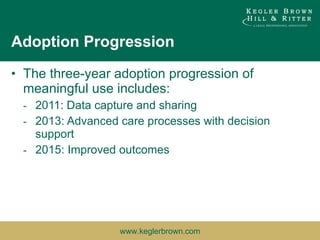
Adoption Progression The three-year adoption progression of meaningful use includes: 2011: Data capture and sharing 2013: Advanced care processes with decision support 2015: Improved outcomes
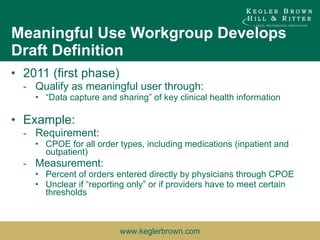
Meaningful Use Workgroup Develops Draft Definition 2011 (first phase) Qualify as meaningful user through: “ Data capture and sharing” of key clinical health information Example: Requirement: CPOE for all order types, including medications (inpatient and outpatient) Measurement: Percent of orders entered directly by physicians through CPOE Unclear if “reporting only” or if providers have to meet certain thresholds
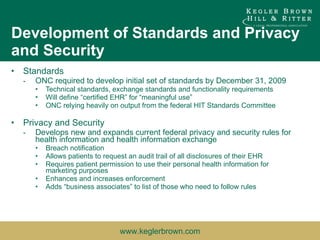
Development of Standards and Privacy and Security Standards ONC required to develop initial set of standards by December 31, 2009 Technical standards, exchange standards and functionality requirements  Will define “certified EHR” for “meaningful use” ONC relying heavily on output from the federal HIT Standards Committee Privacy and Security Develops new and expands current federal privacy and security rules for health information and health information exchange Breach notification Allows patients to request an audit trail of all disclosures of their EHR Requires patient permission to use their personal health information for marketing purposes Enhances and increases enforcement Adds “business associates” to list of those who need to follow rules
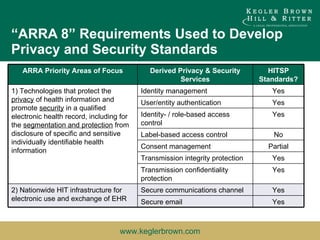
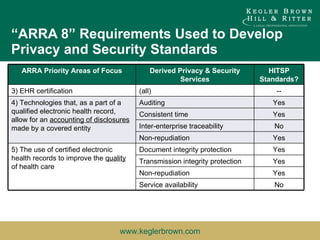
“ ARRA 8” Requirements Used to Develop Privacy and Security Standards ARRA Priority Areas of Focus Derived Privacy & Security Services HITSP Standards? 1) Technologies that protect the  privacy  of health information and promote  security  in a qualified electronic health record, including for the  segmentation and protection  from disclosure of specific and sensitive individually identifiable health information Identity management Yes User/entity authentication Yes Identity- / role-based access control Yes Label-based access control No Consent management Partial Transmission integrity protection Yes Transmission confidentiality protection Yes 2) Nationwide HIT infrastructure for electronic use and exchange of EHR Secure communications channel Yes Secure email Yes
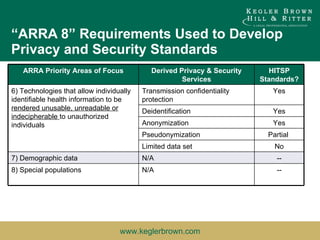
“ ARRA 8” Requirements Used to Develop Privacy and Security Standards ARRA Priority Areas of Focus Derived Privacy & Security Services HITSP Standards? 3) EHR certification (all) -- 4) Technologies that, as a part of a qualified electronic health record, allow for an  accounting of disclosures  made by a covered entity Auditing  Yes Consistent time Yes Inter-enterprise traceability No Non-repudiation Yes 5) The use of certified electronic health records to improve the  quality  of health care Document integrity protection Yes Transmission integrity protection Yes Non-repudiation Yes Service availability No
“ ARRA 8” Requirements Used to Develop Privacy and Security Standards ARRA Priority Areas of Focus Derived Privacy & Security Services HITSP Standards? 6) Technologies that allow individually identifiable health information to be  rendered unusable, unreadable or indecipherable  to unauthorized individuals  Transmission confidentiality protection Yes Deidentification Yes Anonymization Yes Pseudonymization Partial  Limited data set No 7) Demographic data N/A -- 8) Special populations  N/A --
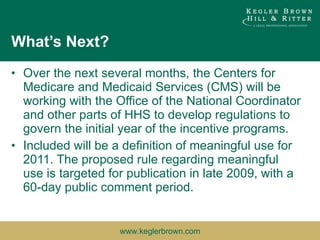
What’s Next? Over the next several months, the Centers for Medicare and Medicaid Services (CMS) will be working with the Office of the National Coordinator and other parts of HHS to develop regulations to govern the initial year of the incentive programs. Included will be a definition of meaningful use for 2011. The proposed rule regarding meaningful use is targeted for publication in late 2009, with a 60-day public comment period.
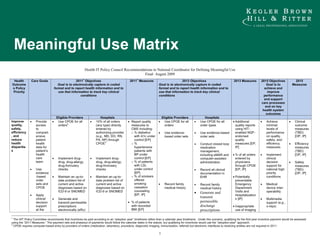
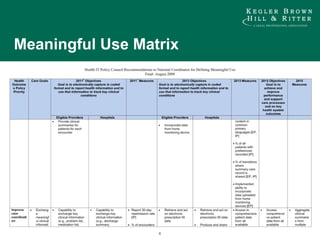
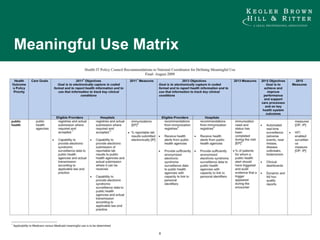
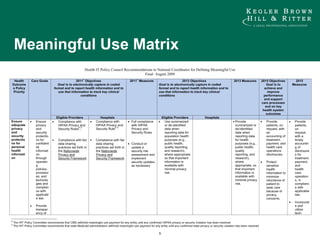
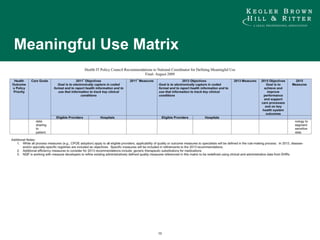
Meaningful Use Matrix
Thank You! Jeff Porter Director, Kegler Brown [email_address] (614) 462-5418
presented by Ralph Breitfeller E-prescribing
presented by Geoffrey Stern The Ethics of E-Health
Thank You for Coming!

2009 Kegler Brown HIT Seminar

  • 1.
  • 2.
    TheGlobal Opportunities and Legal Challenges Posed by Health Information Technology: Presented by Robert D. Marotta October 1, 2009 A Domestic Perspective
  • 3.
    Speaker Bio RobertD. Marotta, Esq. Senior Vice-President and Chief Regulatory Counsel, HLTH/WebMD Health Corp. President, eHealth Foundation, New York, NY October 1, 2009
  • 4.
    Building a HealthIT Technical Assistance Capability at the Regional Level The new “regional extension centers,” launching in 2010, will play a significant role in enhancing technical assistance capabilities at the state and local levels. These centers will provide technical assistance and disseminate best practices and other information to support and accelerate efforts to adopt, implement and effectively utilize health IT. October 1, 2009
  • 5.
    Building a HealthIT Technical Assistance Capability at the Regional Level The Office of the National Coordinator for Health IT (ONC) recently published a draft description of these regional centers. Solicitation for hosting applications will be released this summer. ONC proposed that each regional center prioritize direct assistance first to the following: Public or not-for-profit hospitals, or critical-access hospitals Federally-qualified health centers Entities located in rural and other areas that serve uninsured, underinsured and medically underserved individuals (regardless of whether area is urban or rural) Individual or small-group practices that are primarily focused on primary care. October 1, 2009
  • 6.
    Building a HealthIT Technical Assistance Capability at the Regional Level ONC proposed that regional centers furnish direct, individualized and (as-needed) on-site assistance to individual providers. This on-site assistance will be a key service and will represent a significant portion of the centers’ activities. The extension program should provide at least a minimal level of technical assistance across the nation. October 1, 2009
  • 7.
    Building a HealthIT Technical Assistance Capability at the Regional Level It is expected that each regional center will provide technical assistance within a defined geographic area, and that each area will be served by only one center. It is required that centers be affiliated with any U.S.-based nonprofit organization, or group thereof, that applies and is awarded financial assistance; awards shall be decided on the basis of merit. ONC proposes a number of other requirements and preference criteria. October 1, 2009
  • 8.
    eHealth Initiative Surveyon HIT Regional Extension Centers In May, eHI surveyed its member and partner organizations to assess perceptions and expectations about the HIT Regional Extension Centers. Results were shared in late May with the Administration and the public. October 1, 2009
  • 9.
    The Results: Surveyon HIT Regional Extension Centers 65% of respondents believed that the federal government should lay out an operational outline for the centers and allow each to adopt its own region-specific practices. 49% believed that the centers should cover a geographic area designed to meet need; 26% supported centers adhering to state boundaries. 62% of respondents felt that the centers, once created, should not overlap geographically or otherwise compete to provide services. 41% of respondents supported the creation of 10-50 centers; 24% supported 50-100. 64% of respondents thought that quality improvement organizations were the most appropriate hosts of such centers; no other type of organization received comparable support. 71% of respondents thought vendors were poorly-suited to host or help fund a center due to conflicts of interest. At the same time, many respondents supported a coalition of organizations supporting a center. Desired a truly competitive application process. October 1, 2009
  • 10.
    The Results: Surveyon HIT Regional Extension Centers Respondents most strongly supported the centers providing the following services: Dissemination of best practices and research – 96% Technical assistance for implementation with clinicians – 92% Workflow modification guidance for clinicians – 91% Vendor-neutral advice on purchasing decisions – 80% Health information exchange support – 80% Survey respondents felt that the centers should initially focus on assisting the following organizations: Providers focused on primary care – 94% Providers located in rural or underserved areas – 92% Public, not-for-profit and/or Critical Access hospitals – 90% Federally-qualified health centers – 89% October 1, 2009
  • 11.
    Summary: Survey onHIT Regional Extension Centers Regional extension centers should not be constrained to a specific metropolitan or state boundary and should be uniquely designed to meet the needs of the chosen coverage area. There should be established between 10 and 100 centers, which should be non-competitive with each other. Quality improvement organizations are best-suited to run the extension centers based on previous experience; numerous respondents cited HIEs as well. Ultimately, there should be a competitive process that selects the organization or organizations best suited to host each center. October 1, 2009
  • 12.
    Summary: Survey onHIT Regional Extension Centers Extension centers’ primary services need to include: Dissemination of best practices and research Technical assistance and workflow guidance for clinicians Also popular: HIE support Vendor-neutral purchasing advice Liaison between public and private efforts Centers should focus their attention on: Primary care practices Public, not-for-profit, and/or CAHs Entities located in rural/underserved areas FQHCs October 1, 2009
  • 13.
    Improving Healthcare UsingEHRs and Other Healthcare Data: Meaningful Use In order to improve healthcare using data, we need to successfully define and transition to the meaningful use of EHRs and health data. eHI surveyed its membership on meaningful use of EHRs in April 2009. Results were shared with NCVHS and the public. October 1, 2009
  • 14.
    Improving Healthcare UsingEHRs and Other Healthcare Data: Meaningful Use Survey/discussion results: members, including broad range of healthcare stakeholders, recognized that the definitions of “meaningful use” and “meaningful user” must not set the bar too high or too low. Consistent theme of flexibility. Though members differed on details, all emphasized the need for flexibility to allow: Continued innovation; Any provider who puts in significant time and effort to be able to qualify as a meaningful user; and For the definition of meaningful use to evolve as technology and health care systems evolve. October 1, 2009
  • 15.
    Improving Healthcare UsingEHR and Other Healthcare Data: Meaningful Use Majority of respondents (58%) recommended that ‘meaningful user’ definition take into account differences between various practice sites and specialties. When asked to review a list of actions that could be considered elements of ‘meaningful use,’ responses varied widely: Functions with most support were: e-prescribing (88%); viewing lab and imaging results (79%); warning of drug interactions (76%); and problem lists and diagnoses, computerized orders and allergies (all exactly at 72%). Functions with least support were: clinical messaging (47%); reminders (42%); and exchanging data with patients and consumers (38%). Significant majority (68%) opposed requiring providers to perform all the functions that would eventually become part of meaningful use. Half of those respondents supported HHS creating a defined set of basic functions, while leaving others optional until there is broader adoption and use of HIT. October 1, 2009
  • 16.
    Thank You! RobertD. Marotta, Esq. Senior Vice-President and Chief Regulatory Counsel, HLTH/WebMD Health Corp. President, eHealth Foundation [email_address] (614) 462-5435 October 1, 2009
  • 17.
    October 22, 2009The Impact of Federal HIT Policy and the State of Ohio Jennifer Covich Bordenick Chief Operating Officer and Interim Chief Executive Officer
  • 18.
    About the eHealthInitiative Independent non-profit based in Washington, DC. Focused on informing, educating and advocating for the use of health information and health information technology to drive improvements in the quality, safety, and efficiency of healthcare. 170 member organizations Coalition of 260 state and local organizations working on health information exchange October 22, 2009
  • 19.
    What Does eHIDo? Public Policy Organization: Monitor, Assess and Influence Public Policy Convener and Consensus-Builder Research and Support Efforts Related to HIT and Quality: Medical Product Safety Chronic Care Management Consumer Engagement Health Information Exchange at State Level Education and Awareness about state of the field October 22, 2009
  • 20.
    Multi-Stakeholder Membership Consumerand Patient Groups Clinicians, Hospitals and other providers Employers and healthcare purchasers Health Plans Health Information Technology Suppliers Pharmacy Organizations Pharmaceutical and medical device manufacturers Public Health agencies Laboratories and other ancillary providers Quality organizations Academic Institutions State, regional and community based organizations October 22, 2009
  • 21.
    Today’s Discussion TheNational eHealth Landscape Developing and Rewarding Meaningful Use The State of Health Information Exchange (HIE) in the Nation The Role of States and Regions October 22, 2009
  • 22.
    Overview of NationalLandscape October 22, 2009
  • 23.
    Federal HIT PolicyEnactment of the American Recovery and Reinvestment Act in February, included a 100+ page section on HIT titled the “HITECH Act” Most significant legislative effort ever introduced in its affect on HIT Roll out of its provisions is underway, but will continue to directly impact the industry for the next decade October 22, 2009
  • 24.
    Federal HIT PolicyWhat does the HITECH Act do? Develops a permanent federal governance structure for HIT Provides $2 billion in direct funding to support: State HIE grants Regional Extension Centers HIT Work Force Rewards Meaningful Use of EHRs with $30-$40 billion for Targeted Providers Revamps HIPAA Privacy and Security October 22, 2009
  • 25.
    Basic Federal HITStructure in 2009 October 22, 2009 HITSP CCHIT + ? Office of the National Coordinator HIT Policy Committee HIT Standards Committee Chief Privacy Officer National Institute of Standards and Technology
  • 26.
    HIT Policy andStandards Committee HIT Policy Committee Recommend a policy framework for development and adoption of a nationwide health information technology infrastructure Recommend and prioritize areas in which standards, implementation specifications, and certification criteria are needed HIT Standards Committee Recommend to National Coordinator standards, implementation specifications, and certification criteria React to Policy Committee recommendations of areas where standards are needed Will, as appropriate, provide for testing by NIST October 22, 2009
  • 27.
    Regional Extension Centers70 Regional Extension Centers will be established to furnish assistance (education, outreach, and technical) to help providers adopt HIT, become meaningful users, and achieve health information exchange Will focus on primary care providers Federal government is providing $598 million to help these centers get off the ground. Centers will receive $3-$30 million each. October 22, 2009
  • 28.
    State HIE GrantsThe government will award contracts to states that are seeking to develop a comprehensive, multi-stakeholder plan to advance appropriate and secure health information exchange (HIE). The federal funding is intended to help states continuously improve and expand HIE services to reach all health care providers, and should be used to develop governance policies, technical services, business operations, and financing mechanisms for HIE over a four year performance period with milestones for the states to meet, including support for meaningful use. Government will provide $564 million to support the states and territories. States will receive $4-$40 million each. October 22, 2009
  • 29.
    Key Dates in2009 December 2009 Proposed rule released to govern Meaningful Use Dec 11, 2009 First Regional Extension Center contracts awarded Dec 15, 2009 State HIE Grants awarded Dec 31, 2009 HHS adopts an initial set of standards, implementation and certification criteria to guide adoption of EHRs for the Medicare and Medicaid incentives October 22, 2009
  • 30.
    Developing and RewardingMeaningful Use October 22, 2009
  • 31.
    Developing and RewardingMeaningful Use HITECH lays out the guidelines for physicians and hospitals to be rewarded or punished based on their willingness and ability to show that they are achieving meaningful use of a qualified electronic health record A meaningful user is an eligible provider that: Shows meaningful use of a qualified HER Reports on required clinical quality measures Exchanges health information electronically October 22, 2009
  • 32.
    Paying for MeaningfulUse Payments to reward meaningful use through Medicare until 2015 (physicians) or 2016 (hospitals), then penalties kick in Medicaid provides a different track of payments over a longer time frame with no penalties Most hospitals are eligible to try for Medicare and Medicaid payments, physicians have to choose one or the other Most eligible providers can earn maximum amounts of $44,000 (Medicare) or $65,000 (Medicaid), hospitals can earn millions – based on patient population and other factors October 22, 2009
  • 33.
    Paying for MeaningfulUse – Example - Medicare for Professionals October 22, 2009 Year Maximum Benefit per Provider using EHR Total Payment Reduction for Not Using EHR First Year $15,000 (If 2011 or 2012, $18,000) 0% Second Year $12,000 0% Third Year $8,000 0% Fourth Year $4,000 0% Fifth Year $2,000 2015: 1% (in some cases, 2%) Sixth Year 0 2016: 2% 2017 0 2017: 3% Beyond 0 Beyond: 3% (or more)
  • 34.
    Meaningful Use Policy HIT Policy Committee has been holding public meetings since May to develop the objectives and measures to judge meaningful use in 2011, submitted final recommendations in August October 22, 2009
  • 35.
    Meaningful Use 2011- Example October 22, 2009
  • 36.
    Meaningful Use –Next Steps CMS is developing a proposed rule to govern the actual process of meeting and assessing meaningful use Proposed rule expected out in December Will be followed by 60-day comment period Final rule out spring 2010 Proposed rule will cover the 2011 criteria, future criteria for more advanced years will be developed as the program rolls out October 22, 2009
  • 37.
    The State ofHealth Information Exchange (HIE) in the Nation October 22, 2009
  • 38.
  • 39.
    Quick Background oneHI Survey Since 2004, eHI has conducted an annual survey to look at activities and maturation of health information exchange (HIE) initiatives Data used by public agencies such as ONC, AHRQ, CDC and HHS to inform strategies related to health IT Responses to the survey are self-reported Report provides detailed look at what is working and where it is working October 22, 2009
  • 40.
    How Many InitiativesAre There? The number of initiatives involved in health information exchange is growing. 67 health information exchange initiatives responded to the eHI survey for the first time. There are at least 193 active initiatives involved in health information exchange. 150 initiatives responded to the survey. eHI identified 43 additional initiatives from the 2008 survey which are still functioning, but did not complete this year’s survey. Directly of all exchanges is available online at www.ehealthinitiative.org October 22, 2009
  • 41.
  • 42.
  • 43.
    Who Is ExchangingHealth Information? October 22, 2009
  • 44.
    October 22, 2009Stakeholder Organizations Exchanging Data 2008 2009 Change (+/-) Hospitals 31 48 +17 Primary care physicians 24 42 +18 Community and/or public health clinics 20 32 +12 Specialty care physicians 21 30 +9 Independent laboratories 14 26 +12 Outpatient/Ambulatory surgery centers 11 22 +11 Pharmacies 8 20 +12 Behavioral or mental health providers 12 19 +7 Health plans 14 19 +5 Local Public Health Department 13 19 +6 Independent radiology centers 10 18 +8 Pharmacy benefit management companies 7 18 +11 Healthcare IT suppliers 9 15 +6 State Public Health Department 5 15 +10 Medicaid 5 13 +8 Consumers 3 10 +7 Employers or health care purchasers 5 9 +4
  • 45.
    What and Howis Health Information is Exchanged? October 22, 2009
  • 46.
    October 22, 2009Data Currently Exchanged 2008 2009 Change (+/-) Laboratory 26 49 +23 Medication data (including outpatient prescriptions) n/a 48 n/a Outpatient laboratory results 25 45 +20 Outpatient episodes 23 43 +20 Radiology results 23 39 +16 Emergency Department episodes 27 36 +9 Inpatient diagnoses & procedures 27 35 +8 Care summaries n/a 34 n/a Inpatient discharge summaries n/a 32 n/a Pathology 18 32 +14 Dictation / transcription 20 31 +11 Cardiology 15 27 +12 Claims: pharmacy, medical, and/or hospital n/a 27 n/a Enrollment / eligibility 17 25 +8 Pulmonary 13 23 +10
  • 47.
    October 22, 2009Current Functionalities for Data Exchange 2008 2009 Change (+/-) Results delivery (e.g. laboratory or diagnostic study results) 31 44 +13 Connectivity to electronic health records n/a 38 n/a Clinical documentation 38 34 -4 Alerts to providers 26 31 +5 Electronic prescribing n/a 26 n/a Enrollment or eligibility checking 29 25 -4 Electronic referral processing 17 21 +4 Consultation/referral 23 20 -3 Clinical decision support n/a 19 n/a Disease or chronic care management 19 19 0 Quality improvement reporting for clinicians 14 19 +5 Ambulatory order entry n/a 16 n/a Disease registries 11 16 +5 Reminders 14 16 +2 CCR/CCD summary record exchange n/a 15 n/a Public health: case management 7 13 +6 Public health: surveillance 9 13 +4 Quality performance reporting for purchasers or payers 9 12 +3 Connectivity to personal health records n/a 10 n/a
  • 48.
    What is theImpact? October 22, 2009
  • 49.
    Cost Savings Costsavings resulting from health information exchange were reported by 40 operational initiatives Reduced staff time spent on handling lab and radiology results (26 operational initiatives). Reduced staff time spent on clerical administration and filing (24). Decreased dollars spent on redundant tests (17). Decreased cost of care for chronic care patients (11). Reduced medication errors (10). October 22, 2009
  • 50.
    What hurdles exist?October 22, 2009
  • 51.
    What Are theChallenges? Addressing privacy and confidentiality issues – HIPAA and other (93 initiatives identified this as a pressing challenge). Defining the value that accrues to the users of the health information exchange (92). Developing a sustainable business model (90). October 22, 2009
  • 52.
  • 53.
    The Role ofStates and Regions October 22, 2009
  • 54.
    The Role ofStates and Regions States will continue to act as laboratories for innovation in HIT, but now there is a strong federal impetus for states to ensure the success of eHealth within their geographic boundaries Developing a statewide infrastructure for health information exchange State HIE grants Partnering with efforts to promote the adoption and meaningful use of EHRs Regional extension centers Drawing on the purchasing power and influence of state government to promote best practices Example: The Louisiana Rural Health Information Exchange, supported by Louisiana Medicaid October 22, 2009
  • 55.
    eHealth In OhioOhio Health Information Partnership State-designated entity for HIT/HIE leadership State HIE Grant for Ohio: Full application was due Oct 16th Regional Extension Centers in Ohio: Full applications for first round are due Nov 3r Ohio announced in August that it would dedicate $10.1 million to HIT and quality improvement efforts October 22, 2009
  • 56.
    eHealth In OhioOther Health Information Exchange Initiatives in Ohio: HealthBridge (Stage 7) Northeast Ohio Regional Health Information Organization (Stage 3) Ohio Osteopathic Association Patient Information Network – Independent Hospital Network (Stage 4) http://www.healthcarereform.ohio.gov/healthit.aspx October 22, 2009
  • 57.
    Thank You! JenniferCovich Bordenick [email_address] 202-624-3288 www.eHealthInitiative.org Don’t Miss eHI’s Annual Conference in Washington, DC on January 25 th and 26 th ! October 22, 2009
  • 58.
    presented by ÉliseSpriggs Scanning the Legislative Landscape
  • 59.
    Overview of HITProvisions Included in the American Recovery and Reinvestment Act (ARRA)
  • 60.
    What Problems AreWe Trying to Solve with HIT? Continued challenges around quality and safety Predominantly fee for service payment system rewards doing more vs. doing better A 2002-2004 study of hospitalizations in the U.S. found that about 83,000 potentially preventable deaths occurred each year 1 1 Health Grades Third Annual Patient Safety in American Hospitals Study, Apr. 2006.
  • 61.
    What Problems AreWe Trying to Solve with HIT? Rising healthcare costs U.S. spending is rising at a rate of almost 7% a year—rapidly outpacing projected growth in GDP (4%) and wages (3%) U.S. spends 16% of total GDP an increase of 6.7% over 2004 spending—growth in spending is projected to average 6.7% annually over the period 2007 through 2017 2 Access issues The U.S. Census Bureau estimates that 45.7 million Americans (about 15.3% of the total population) had no health insurance at some point during 2007 3 2 “National Health Expenditures, Forecast Summary and Selected Tables,” Office of the Actuary in the Centers for Medicare & Medical Services , 2008, retrieved Mar. 20, 2008. 3 “Income, Poverty & Health Insurance Coverage in the United States,” U.S. Census Bureau , Issued Aug. 2008
  • 62.
    Information technology Reducesmedical errors The US Department of Health & Human Services estimates that widespread use of electronic medical records would save 100,000 lives per year by reducing medical errors & lowering healthcare spending by as much as 30% 86% of doctors surveyed said Electric Medical Records (“EMR”) helped reduce medical errors 4 The Role of Information Technology in Improving Healthcare 4 “Electronic Health Records in Ambulatory Care – A National Survey of Physicians,” New England Journal of Medicine , July 3, 2008, p. 54.
  • 63.
    Information Technology Getsthe right information to the right person at the right time to support care delivery 85% of the doctors claimed the records improved the delivery of long-term preventative care 5 Reduces administrative costs The Role of Information Technology in Improving Healthcare 5 “Electronic Health Records in Ambulatory Care – A National Survey of Physicians,” New England Journal of Medicine , July 3, 2008, p. 54.
  • 64.
    The Role ofInformation Technology in Improving Healthcare Enables more effective methods to improve population health (e.g. quality and efficiency performance measurement, medical product safety, clinical and effectiveness research, public health surveillance) Enables the patient to more effectively engage with the care delivery team
  • 65.
    Current Adoption Ratesare Low Based on findings from a survey conducted in late 2007 and early 2008, 4% of the physicians reported having an extensive, fully functional electronic records system, and 13% of the physicians reported having a basic system 6 1.5% percent of U.S. hospitals have a comprehensive electronic records system and an additional 7.6% have a basic system 7 6 “Electronic Health Records in Ambulatory Care – A National Survey of Physicians,” New England Journal of Medicine : 359;1. July 3, 2008, pg. 50 7 “Use of Electronic Health Records in U.S. Hospitals,” New England Journal of Medicine : 360;16. April 16, 2009.
  • 66.
    Current Adoption Ratesare Low Computerized provider-order entry for medications has been implemented in only 17% of hospitals 8 Larger hospitals, those located in urban areas and teaching hospitals were more likely to have electronic records systems 9 8 “Use of Electronic Health Records in U.S. Hospitals,” New England Journal of Medicine : 360;16. April 16, 2009. 9 “Use of Electronic Health Records in U.S. Hospitals,” New England Journal of Medicine : 360;16. April 16, 2009.
  • 67.
    Barriers to AdoptionLack of capital to invest (most common reason) Lack of a sustainable business model for health information exchange & interoperability of existing systems Concerns about privacy and security Lack of standards adoption Workflow and organizational change challenges
  • 68.
    American Recovery andReinvestment Act Tries to Address the Barriers
  • 69.
    AARA At aGlance Funds Funding source How funds will be used for healthcare IT $2B Office of the National Coordinator for Health Information Technology (OHCHIT) $300 million for health information exchanges Remainder used at discretion of ONCHIT to promote HIT; portion of funds expected to fund EMR loan & grant programs $34B Medicare & Medicaid EMR incentives Funds awarded to hospitals and non-hospital affiliated professionals Must use certified EMRs and show “meaningful use” of EMRs $1.1B Comparative Effectiveness Research program $300M for Agency for Healthcare Research and Quality $400M for National Institutes of Health $400M to HHS for research grants $7.2B Commerce Department’s National Telecommunications and Information Administration Grants to support deployment of broadband, telemedicine and distance learning services Most funding will be used for broadband deployment, but a significant portion is expected to be used for telemedicine programs
  • 70.
    AARA At aGlance Funds Funding source How funds will be used for healthcare IT $85M Indian Health Services Equip Indian Health Services with IT, telemedicine equipment and related infrastructure $50M VA Health System Upgrading and expanding healthcare IT infrastructure $500M Social Security Administration Upgrading SSA’s computer system; at least $40M for new system that uses EMRs to speed processing of disability claims $1.5B Health Resources and Services Administration Awarded to federal community health centers for construction, renovation and equipment, including healthcare IT $2.5B Agriculture Department USDA’s Distance Learning, Telemedicine and Broadband program; to bring broadband to rural areas Unspecified portion of funds will be used for telemedicine projects
  • 71.
    AARA Covers NumerousAreas Codification of the Office of the National Coordinator for Health Information Technology Standards and Policy Significant Incentives for Meaningful Use Grant and Loan Programs Privacy Policy Support for Research Technical Assistance
  • 72.
    AARA-Office of theNational Coordinator for Health Information Technology Establishes the Office of the National Coordinator Appointed by Secretary of Health and Human Services Dr. David Blumenthal, MD, MPP Leads the implementation of a nationwide interoperable, privacy-protected health information infrastructure set forth under AARA
  • 73.
    Office of theNational Coordinator Will play a key role within HHS Two federal advisory committees will provide guidance and recommendations to the National Coordinator HIT Standards Committee Health IT Policy Committee
  • 74.
    What is theRole of the HIT Standards Committee? HIT Standards Committee makes recommendations to Dr. Blumenthal on standards, implementation specifications and certification criteria for the electronic exchange and use of health information Initial focus on policies developed by HIT Standard Committee’s 8 areas First set of standards have been sent to OMB for adoption by December 31, 2009 (as required by the legislation)
  • 75.
    HIT Standards CommitteeMembership Membership consists of broad range of stakeholders: Jonathan Perlin , Hospital Corporation of America, Chair John Halamka , Harvard Medical School, Vice Chair Dixie Baker , Science Applications International Corporation  Anne Castro , BlueCross BlueShield of South Carolina Aneesh Chopra , Chief Technology Officer, OSTP   Christopher Chute , Mayo Clinic College of Medicine Janet Corrigan , National Quality Forum John Derr , Golden Living, LLC Linda Dillman , Wal-Mart Stores, Inc. James Ferguson , Kaiser Permanente Steven Findlay , Consumers Union Linda Fischetti , Department of Veterans Affairs Douglas Fridsma , Arizona State University Cita Furlani , National Institutes of Standards and Technology
  • 76.
    HIT Standards CommitteeMembership Membership consists of broad range of stakeholders: C. Martin Harris , Cleveland Clinic Foundation Stanley M. Huff , Intermountain Healthcare Kevin Hutchinson , Prematics, Inc. Elizabeth O. Johnson , Tenet Healthcare Corporation John Klimek , National Council for Prescription Drug Programs David McCallie, Jr. , Cerner Corporation Judy Murphy , Aurora Health Care Nancy J. Orvis , Director, Health Standards Participation, Department of Defense J. Marc Overhage , Regenstrief Institute Gina Perez , Delaware Health Information Network Wes Rishel , Gartner, Inc. Richard Stephens , The Boeing Company Sharon Terry , Genetic Alliance James Walker , Geisinger Health System
  • 77.
    HIT Standards CommitteeAreas of Review for Recommendations to National Coordinator Eight Areas for Focus Privacy and Security HIT Infrastructure Certified Health Record Disclosure Audit Improve Quality Individually Identifiable Health Information (IIHI) Unusable Demographic Data Needs of Vulnerable
  • 78.
    HIT Standards CommitteeCreation of three subcommittees to analyze recommendations of the HIT Policy Committee Clinical Quality Clinical Operations Privacy & Security Generally meet monthly and can participate via web conference or audio teleconference
  • 79.
    What is theRelevance of the Standards? As each agency implements, acquires, or upgrades health IT systems, it shall utilize, where available, those systems that meet the standards requirements President shall take measures to assure that federal activities involving the broad collection and submission of health information are consistent with standards within three years of adoption Each agency relating to promoting quality and efficient healthcare in federal government administered or sponsored healthcare programs shall require in contracts or agreements with providers, insurers or health insurance issuers, that as they implement, acquire or upgrade health IT systems, they shall utilize, where available, health IT systems and products that use the standards
  • 80.
    What is theRelevance of the Standards? To greatest extent practicable, the Secretary shall ensure that where funds are expended for the acquisition of health IT, such health IT shall meet the standards, implementation specifications and certification criteria under the legislation Medicare and Medicaid Incentives for healthcare professionals and hospitals require “meaningful use” of “certified EHR Technology” which must use the standards that are adopted
  • 81.
    Health IT PolicyCommittee Makes recommendations to Dr. Blumenthal on an overall policy framework for the development and adoption of a national interoperable health information infrastructure, including standards for the secure and private exchange of patient medical information Generally, meet monthly and can participate via web conference or audio teleconference
  • 82.
    Health IT PolicyCommittee Membership Membership consists of broad range of stakeholders: David Blumenthal, HHS/Office of the National Coordinator for Health Information Technology, Chair Paul Tang, Palo Alto Medical Foundation, Vice Chair David Bates , Brigham and Women’s Hospital Christine Bechtel , National Partnership for Women & Families Neil Calman , The Institute for Family Health  Richard Chapman , Kindred Healthcare Adam Clark , Lance Armstrong Foundation Arthur Davidson , Denver Public Health Department Connie White Delaney , University of Minnesota/School of Nursing Paul Egerman , Businessman/Entrepreneur Judith Faulkner , Epic Systems Corporation Gayle Harrell , Former Florida State Legislator Charles Kennedy , WellPoint, Inc. Michael Klag , Johns Hopkins University, Bloomberg School of Public Health David Lansky , Pacific Business Group on Health Deven McGraw , Center for Democracy & Technology Frank Nemec , Gastroenterology Associates, Inc. Marc Probst , Intermountain Healthcare Latanya Sweeney , Carnegie Mellon University Scott White , 1199 SEIU Training and Employment Fund Roger Baker , Department of Veterans Affairs CDR Michael S. Weiner , United States Navy Tony Trenkle , Centers for Medicare and Medicaid James C. Borland , Social Security Administration
  • 83.
    Significant Incentives forMeaningful Use Covered under Mr. Porter’s presentation
  • 84.
    HIT Grants andLoans $2 Billion for HIT Grants and Loans Five focus areas: Regional Extension Centers (RECs) Technical assistance for providers adopting HIT systems Average award $1-$2 million (max award $12 million) National resource center will share best practices to RECs State Grants to Promote HIT State/state-designated entities (New York eHealth Collaborative) Spur health information exchange (HIE)
  • 85.
    HIT Grants andLoans Five focus areas, cont.: EHR Adoption Loans Grants to states and Indian tribes Potential loan funds for providers (not focus of ONC until 2010) Workforce Training Grants Assistance to higher education instructions to promote HIT workforce Implementation of HIT in Clinical Education EHR in medial school curricula Not hardware/software funding
  • 86.
    ARRA Adds NewPrivacy & Security Develops new and expands current federal privacy and security rules for health information and health information exchange Notification of affected individuals in the event their protected health information is breached New restrictions on the use of protected health information Revised patient rights related to EHRs, including requirements that covered entities maintaining EHRs give individuals copies of their records in electronic form and allows patients to request an audit trail of all disclosures of the EHRs
  • 87.
    ARRA Adds NewPrivacy & Security Requires patient permission to use their personal health information for marketing purposes Prohibits sale of protected health information Patient authorization for fundraising activities Civil penalties will increase over four tiers Heightened HIPAA enforcement mechanisms Enforcement through state attorney generals Application of certain HIPAA Security Rule, Privacy Rule and enforcement provisions to business associates Clarification that health information exchange initiatives and RHIOs are business associates
  • 88.
    Thank You! ÉliseSpriggs Director, Kegler Brown [email_address] (614) 462-5451
  • 89.
    Rex Plouck, EnterpriseHealth IT Officer, State of Ohio Ohio Health IT Agenda
  • 90.
    Ohio’s Health ITAgenda A Public Private Partnership Health Information Exchange Enabling Health IT Adoption
  • 91.
    A True PartnershipDesignating a non-profit Leveraging resources Encouraging collaboration Creating a nimble organization Coordinating entity for federal stimulus opportunities . Status: The Ohio Health Information Partnership (OHIP) was created by BioOhio, OHIP’s board is being expanded to accommodate broad stakeholder representation, Governor Strickland has designated OHIP as Ohio’s state designated entity for health IT funding opportunities OHIP has broad support from relevant stakeholders
  • 92.
  • 93.
    Information Exchange asa Tool Providing access to the right information, at the right time, in any setting The Health Information Exchange Federated data model Standards based Supports population health and research efforts Enables patient participation Status: OHIP has submitted a letter of intent with HHS for federal funding OHIP intends to submit a final application in October 2009 Development of a state strategic plan and operational plan continues
  • 94.
    Enabling Adoption Astate wide extension center as a resource for health care providers Providing cost effective access to electronic medical record technology Integrating technology into the provider specific environment Helping providers become meaningful users of health IT Status: OHIP has submitted a preliminary application with HHS for federal funding OHIP has been invited to submit a complete application Development of a state strategic plan continues OHIP will create local partnership to deliver service to individual healthcare providers
  • 95.
    Thank You! RexPlouck, Enterprise Health IT Officer, State of Ohio Status: OHIP has submitted a preliminary application with HHS for federal funding OHIP has been invited to submit a complete application Development of a state strategic plan continues OHIP will create local partnership to deliver service to individual healthcare providers
  • 96.
    presented by JeffPorter Establishing Meaningful Use: From the HITECH Act to Improved Quality of Care
  • 97.
    Role of theOffice of the National Coordinator (ONC) Charged with coordinating nationwide efforts to implement and use the most advanced health information technology and the electronic exchange of health information. ONC is working with the Centers for Medicare & Medicaid Services (CMS), through an open and transparent process, on efforts to officially designate what constitutes “meaningful use.”
  • 98.
    When do weexpect formal rules for meaningful use? CMS is expected to publish a formal definition of meaningful use, for the purposes of receiving the Medicare and Medicaid incentive payments, by December 31, 2009. At that time, the public will be able to comment on the definition, and such comments will be considered in reaching any final definition of the term.
  • 99.
    HIT Policy andStandards Committees The HIT Policy Committee and the HIT Standards Committee are providing recommendations to the National Coordinator that will help CMS develop initial criteria for meaningful use and assist in planning for any criteria expansion for the future incentive programs. Approximately 800 public comments were received on the HIT Policy Committee’s initial recommendations.
  • 100.
    Defining “Meaningful Use”Federal HIT Policy Committee Meaningful Use Workgroup Working to develop draft definition of meaningful use CMS will consider the HIT Policy Committee’s recommendations as it drafts regulations. Makes recommendations to David Blumenthal, National Coordinator for HIT, on an overall policy framework for the development and adoption of a national interoperable health information infrastructure, including standards for the secure and private exchange of patient medical information. Federal HIT Standards Committee Makes recommendations to Dr. Blumenthal on standards, implementation specifications, and certification criteria for the electronic exchange and use of health information.
  • 101.
    Defining “Meaningful Use”Must be “meaningful user” to be eligible for HIT incentive payments and avoid payment penalties Criteria not completely defined in HITECH Statute only provides that eligible providers must use a “certified system” that can exchange health information and report on quality measures.
  • 102.
    Eligible Professionals Generallyspeaking, for purposes of meaningful use, “eligible professional” is defined in the following ways: Medicare Medicaid
  • 103.
    Eligible Professionals: MedicareA physician as defined in section 1861(r) of the Social Security Act, which includes the following five types of professionals: Doctor of medicine or osteopathy Doctor of dental surgery or medicine Doctor of podiatric medicine Doctor of optometry Chiropractor
  • 104.
    Eligible Professionals: MedicaidPhysicians Dentists Certified nurse-midwives Nurse practitioners Physician assistants who are practicing in Federally Qualified Health Centers (FQHCs) or Rural Health Clinics (RHCs) led by a physician assistant.
  • 105.
    Incentives ARRA providessignificant incentives for eligible professionals and hospitals…..
  • 106.
    Medicare Eligible physicians,including those in solo or small practices, can receive up to $44,000 over five years under Medicare Physicians operating in “Provider Shortage Area” receive a 10% bonus
  • 107.
    Medicaid Eligible physicians,including those in solo or small practices, can receive up to $63,750 over six years under Medicaid for being meaningful users of certified electronic health records.  30% or more of patients must be covered by Medicaid
  • 108.
    Medicare and MedicaidHIT Incentives Meaningful Use Standards and Privacy/Security Medicare Incentive payments no sooner than Jan. 1, 2011 Medicaid Incentive payments no sooner than Jan. 1, 2011 OR Penalties Begin Calendar Year 2015
  • 109.
    Medicare Hospitals thatbecome meaningful users could receive up to four years of financial incentive payments under Medicare beginning in 2011. Large hospitals can qualify for up to $11 million dollars over the period.
  • 110.
    Medicaid Hospitals thatbecome meaningful users could receive up to six years of financial incentive payments under Medicaid beginning in October 2010. Eligible hospitals include Children’s hospitals and Acute-care hospitals.
  • 111.
    Medicare and MedicaidHIT Incentives Meaningful Use Standards and Privacy/Security Medicare Incentive payments no sooner than January, 2011. Medicaid Incentive payments no sooner than October, 2010. AND Penalties Begin Full Fiscal Year 2015
  • 112.
    Penalties There willbe no incentive payments available for those who first become meaningful users after 2015. Penalties begin in 2015.
  • 113.
    Meaningful Use WorkgroupDevelops Draft Definition Would define meaningful use in three distinct phases (years) 2011, 2013, and 2015 Approach focuses on how to leverage use of EHR/HIT systems to accomplish five goals Improve quality, safety and efficiency Engage patients and their families Improve care coordination Improve population and public health Reduce disparities Ensure privacy and security protections Each phase would define a meaningful user by tying requirements to measurement criteria.
  • 114.
    Adoption Progression Thethree-year adoption progression of meaningful use includes: 2011: Data capture and sharing 2013: Advanced care processes with decision support 2015: Improved outcomes
  • 115.
    Meaningful Use WorkgroupDevelops Draft Definition 2011 (first phase) Qualify as meaningful user through: “ Data capture and sharing” of key clinical health information Example: Requirement: CPOE for all order types, including medications (inpatient and outpatient) Measurement: Percent of orders entered directly by physicians through CPOE Unclear if “reporting only” or if providers have to meet certain thresholds
  • 116.
    Development of Standardsand Privacy and Security Standards ONC required to develop initial set of standards by December 31, 2009 Technical standards, exchange standards and functionality requirements Will define “certified EHR” for “meaningful use” ONC relying heavily on output from the federal HIT Standards Committee Privacy and Security Develops new and expands current federal privacy and security rules for health information and health information exchange Breach notification Allows patients to request an audit trail of all disclosures of their EHR Requires patient permission to use their personal health information for marketing purposes Enhances and increases enforcement Adds “business associates” to list of those who need to follow rules
  • 117.
    “ ARRA 8”Requirements Used to Develop Privacy and Security Standards ARRA Priority Areas of Focus Derived Privacy & Security Services HITSP Standards? 1) Technologies that protect the privacy of health information and promote security in a qualified electronic health record, including for the segmentation and protection from disclosure of specific and sensitive individually identifiable health information Identity management Yes User/entity authentication Yes Identity- / role-based access control Yes Label-based access control No Consent management Partial Transmission integrity protection Yes Transmission confidentiality protection Yes 2) Nationwide HIT infrastructure for electronic use and exchange of EHR Secure communications channel Yes Secure email Yes
  • 118.
    “ ARRA 8”Requirements Used to Develop Privacy and Security Standards ARRA Priority Areas of Focus Derived Privacy & Security Services HITSP Standards? 3) EHR certification (all) -- 4) Technologies that, as a part of a qualified electronic health record, allow for an accounting of disclosures made by a covered entity Auditing Yes Consistent time Yes Inter-enterprise traceability No Non-repudiation Yes 5) The use of certified electronic health records to improve the quality of health care Document integrity protection Yes Transmission integrity protection Yes Non-repudiation Yes Service availability No
  • 119.
    “ ARRA 8”Requirements Used to Develop Privacy and Security Standards ARRA Priority Areas of Focus Derived Privacy & Security Services HITSP Standards? 6) Technologies that allow individually identifiable health information to be rendered unusable, unreadable or indecipherable to unauthorized individuals Transmission confidentiality protection Yes Deidentification Yes Anonymization Yes Pseudonymization Partial Limited data set No 7) Demographic data N/A -- 8) Special populations N/A --
  • 120.
    What’s Next? Overthe next several months, the Centers for Medicare and Medicaid Services (CMS) will be working with the Office of the National Coordinator and other parts of HHS to develop regulations to govern the initial year of the incentive programs. Included will be a definition of meaningful use for 2011. The proposed rule regarding meaningful use is targeted for publication in late 2009, with a 60-day public comment period.
  • 121.
  • 122.
  • 123.
  • 124.
  • 125.
  • 126.
  • 127.
  • 128.
  • 129.
  • 130.
  • 131.
    Thank You! JeffPorter Director, Kegler Brown [email_address] (614) 462-5418
  • 132.
    presented by RalphBreitfeller E-prescribing
  • 133.
    presented by GeoffreyStern The Ethics of E-Health
  • 134.

Editor's Notes

  • #92 Support from: Almost all statewide healthcare associations,
  • #93 Support from: Almost all statewide healthcare associations,