EWRT 211 CLASS 9
AGENDA
■ Vocab 1-9
■ Review: In-text citations
■ GPU: Word Choice: Using exact words
■ Introduce Essay #3: Define a character trait, explain its
importance, and analyze its portrayal in a character.
■ Discussion:
– Gryffindor: bravery, chivalry
– Hufflepuff: dedication, loyalty
– Ravenclaw: intelligence, creativity
– Slytherin: ambition, pride
■ Library Demonstration:
– Encyclopedia/Dictionary
■ In-class writing
– A Focused Explanation: Define and describe the character
trait you have chosen in some depth, considering both the
potential good and bad aspects of that quality. Are there
multiple kinds of the quality? For example, physical, social,
moral, and emotional courage.
Vocabulary
1. simper : ○ “I’ll be waiting to open the door.” Dudley put on
a foul, simpering smile.
2. livid ○ Harry had slipped throughVoldemort’s clutches for
a second time, but it had been a narrow escape, and even
now, weeks later, Harry kept waking in the night,
drenched in cold sweat, wondering whereVoldemort was
now, remembering his livid face, his wide, mad eyes
3. jeer ○ Harry jumped to his feet just as a jeering voice
floated across the lawn.
4. nimble ○ Stepping nimbly out of Harry’s reach, he pulled a
thick wad of envelopes from the inside of the pillowcase
he was wearing.
5. lurch ○ Mouth dry, stomach lurching, Harry sprang after him,
trying not to make a sound.
6. fiasco ○ Harry told them all about Dobby, the warning he’d given
Harry and the fiasco of the violet pudding.
7. gnome ○Yeah, Mum’s always wishing we had a house-elf to do
the ironing,” saidGeorge. “But all we’ve got is a lousy old ghoul in
the attic and gnomes all over the garden.
8. strut○ Judging by the fact that Draco Malfoy usually had the best
of everything, his family was rolling in wizard gold; he could just
see Malfoy strutting around a large manor house.
9. berserk ○The teapot went berserk and squirted boiling tea all
over the place and one man ended up in the hospital with the
sugar tongs clamped to his nose.
■ Livid has a colorful history. The Latin adjective lividus means "dull,
grayish, or leaden blue." From this came the French livide and
eventually the English "livid," which was used to describe flesh
discolored by a bruise when it was first recorded in the early 17th
century. A slight extension of meaning gave it the sense "ashen or
pallid," as used in describing a corpse. "Livid" eventually came to be
used in this sense to characterize the complexion of a person pale
with anger ("livid with rage"). From this meaning came two new
senses in the 20th century. One was "reddish," as one is as likely to
become red with anger as pale; the other was simply "angry" or
"furious," the most common sense of the word today.
Berserk comes from Old Norse berserkr, which
combines ber- ("bear") and serkr ("shirt"). According to
Norse legend, berserkrs were warriors who wore bearskin
coverings and worked themselves into such frenzies
during combat that they became immune to the effects of
steel and fire. Berserk was borrowed into English (first as
a noun and later as an adjective) in the early 19th century,
when interest in Scandinavian myth and history was high.
It was considered a slang term at first, but it has since
gained broader acceptance.
Review: InText Citations
The picture budget was “over $125 million, and prospered to gross
over $317 million. “(boxofficemojo), which ….
“Harry Potter and the Sorcerer’s Stone (2001).” Box Office Mojo,
www.boxofficemojo.com/movies/?id=harrypotter.htm. 19
october 2017.
The picture budget was “over $125 million, and prospered to
gross over $317 million. “(boxofficemojo), which ….
The picture budget was “over $125 million, and prospered to
gross over $317 million” (“Harry Potter and the Sorcerer’s Stone
[2001”]), which ….
“Harry Potter and the Sorcerer’s Stone (2001).” Box Office Mojo,
www.boxofficemojo.com/movies/?id=harrypotter.htm. 19
October 2017.
Grammar, Punctuation, Usage:
Using Exact Words
■ Effective writers choose words carefully, paying attention to
meaning, form, idiomatic phrasing, and freshness.
■ Replace incorrect words with the exact words you intend, or omit
incorrect words if they are unnecessary.
■ Check a dictionary when you are uncertain of the meaning of a
word.Watch for incorrect words and for words similar in meaning
or sound.
Avoid Using “Thing”
When you write sentences, you may find yourself using the word “thing” when
you could use a more specific word. To move away from this problem, try to
find a more specific word that fits your meaning. The words on the list may
help you narrow down your choices.
Examples:
Weak: As I read about Ben Franklin, I learned many things about his life.
Better: As I read about Ben Franklin, I learned that his life was filled with
challenges.
Weak: The authors discussed three things about ever-changing
technology.
Better: The article described three features about ever-changing
technology.
Weak: The instructor did two things to encourage all her students to read
more.
Better: The instructor started two projects to encourage her students to
read more.
Weak: Of all the things the characters did in the book, living in the
underwater home was the most exciting.
Better: Of all the adventures the characters had in the book, living in the
underwater home was the most exciting.
There are things floating and appearing and doing things for themselves, and
it truly makes the viewer believe in magic.
AvoidWords Containing “Thing”:
“Something,” “Anything,” “Nothing,” and
“Everything.”
■ Nothing/everything. “There’s nothing worse than...” (This
harkens back to the best/worst entry. It says, in effect, the
worst thing in the world is X.)
■ Nothing is worse than a muffed PowerPoint? Really? Leprosy?
How about that? Losing your home or business in a fire? I could
go on, but there’s nothing worse than beating a dead horse.
Except beating a live one; that’s much worse. (I like horses.)
■ It’s easy enough to provide perspective: “When giving a
PowerPoint presentation, there are few things more distracting
than...” and then insert your glitch of choice — an upside-down
slide, a zombie apocalypse, whatever.
■ This is believable because had something happened to our very
own parents, the extremes to which Harry goes through for them
may also be ours
Essay #3:The Writing Assignment: Define a character trait,
explain its importance, and analyze its portrayal in a
character.
We know that each of the Hogwarts houses has specific personality traits that
are associated with the students in that house. For each of the four houses, we
have chosen two traits:
 Gryffindor: bravery, chivalry
 Hufflepuff: dedication, loyalty
 Ravenclaw: intelligence, creativity
 Slytherin: ambition, pride
For this essay, choose ONE of the eight qualities from the list above.
■ Define and describe that quality in some depth, considering both the
potential good and bad aspects of that quality.
■ Analyze how that quality affects the attitude and/or actions of ONE of the
characters in Harry Potter and the Chamber of Secrets.
■ Your final essay should be between three and five pages. (This means
you should have at least one line on page four to ensure you have filled
three complete pages).
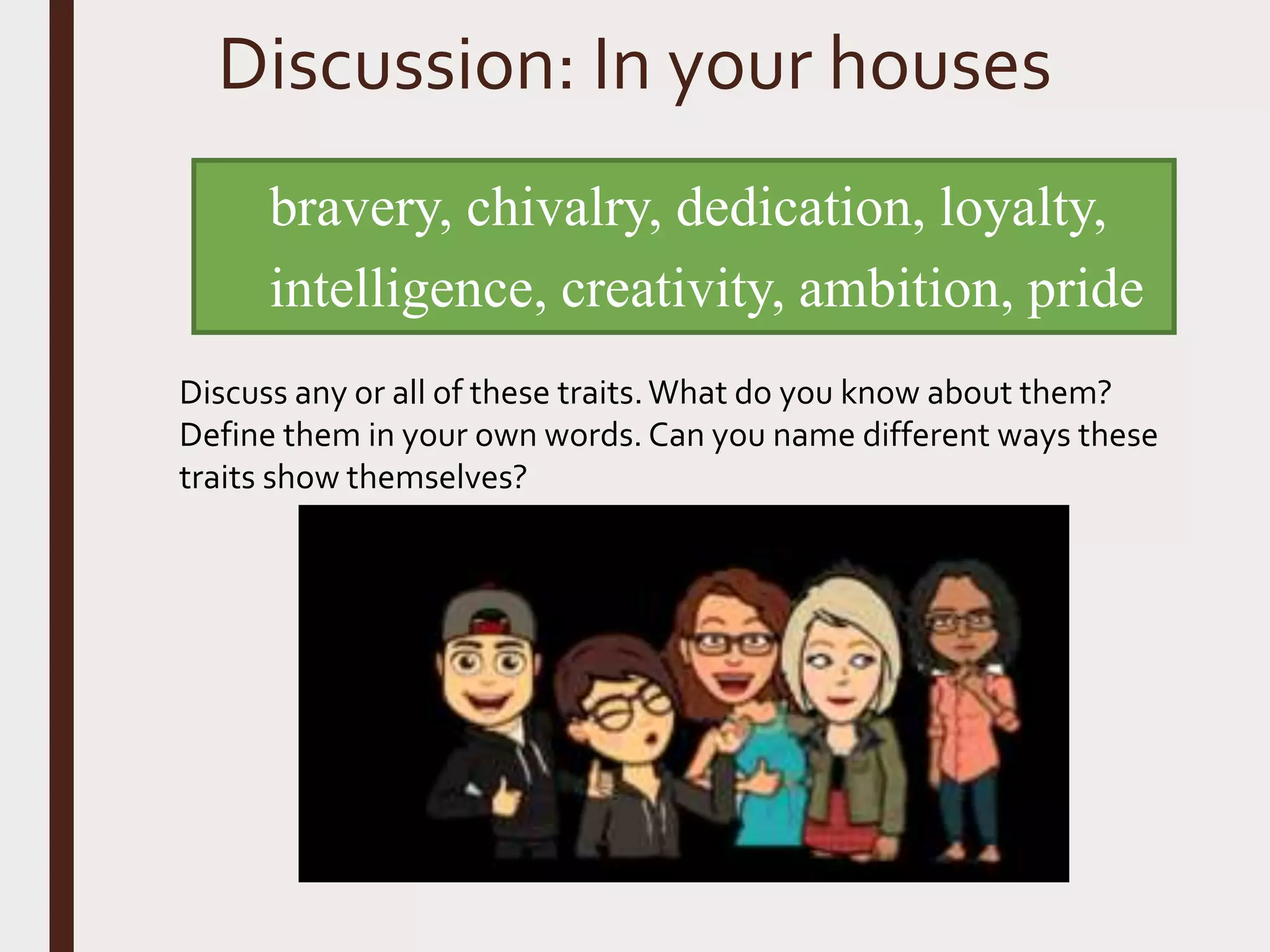
Discussion: In your houses
bravery, chivalry, dedication, loyalty,
intelligence, creativity, ambition, pride
Discuss any or all of these traits.What do you know about them?
Define them in your own words. Can you name different ways these
traits show themselves?
■ How did you define these traits?
■ What do we know about these traits?
■ Can you name different aspects of any of them? Spontaneous
creativity?Artistic creativity? Emotional bravery? Heroic
bravery? Ambition motivated by external goals (money,
awards, recognition) vs. those motivated by internal, personal
goals to create?
■ What do you know about any of these traits and various
aspects of them?
bravery, chivalry,
dedication, loyalty,
intelligence, creativity,
ambition, pride
Your definition and analysis will rely on several sources, including a dictionary or
encyclopedia, an outside article, a hip-hop song (optional), and Harry Potter and
the Chamber of Secrets.
Outside Sources:
■ Your essay will use multiple outside sources to provide different types of
information in support your definition and analysis.
■ In order to define and explain your trait, you will use a reliable and
authoritative dictionary or encyclopedia (NOT Wikipedia). (Use at least one
quotation.)
■ You will help to describe and explain your trait using discussion or examples
from an appropriate outside article. See Appendix I to this assignment for
links to at least one article for each trait. (Use at least one quotation.)
■ You can also use an appropriate hip-hop song to help you explain your trait
in more detail. See Appendix II to this assignment for links to useful hip-hop
songs. (Optional: one quotation.)
■ You will need at least two quotations describing and explaining your trait
from Harry Potter and the Chamber of Secrets. (Use at least two quotations.)
■ This means that your essay will contain at least four total quotations from
these sources.
Library Demonstration:
Encyclopedia/Dictionary
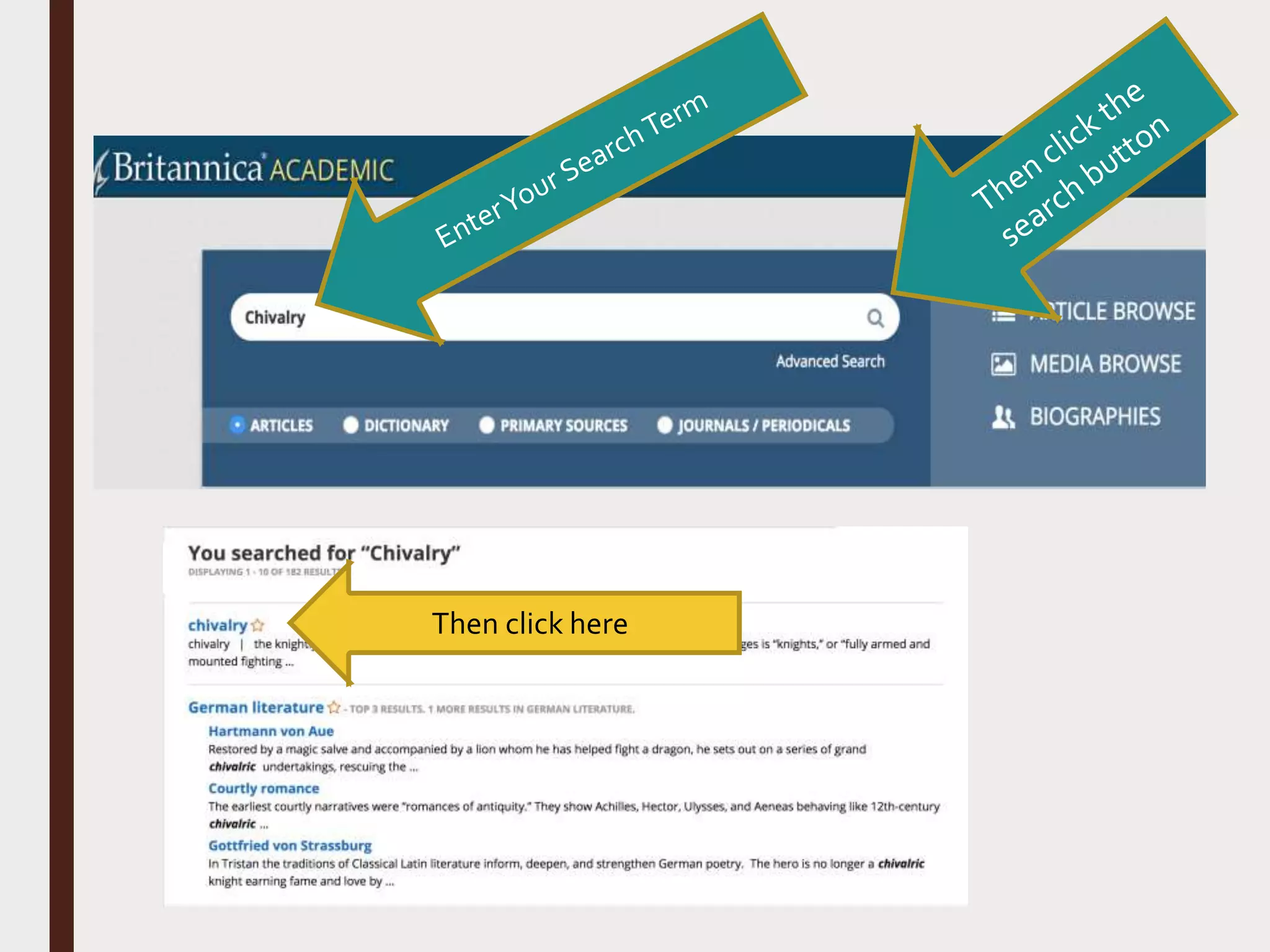
■ Start at De Anza’s Homepage: www.deanza.edu
■ Click Library Databases Click the “Library” link
Click “Library Databases”
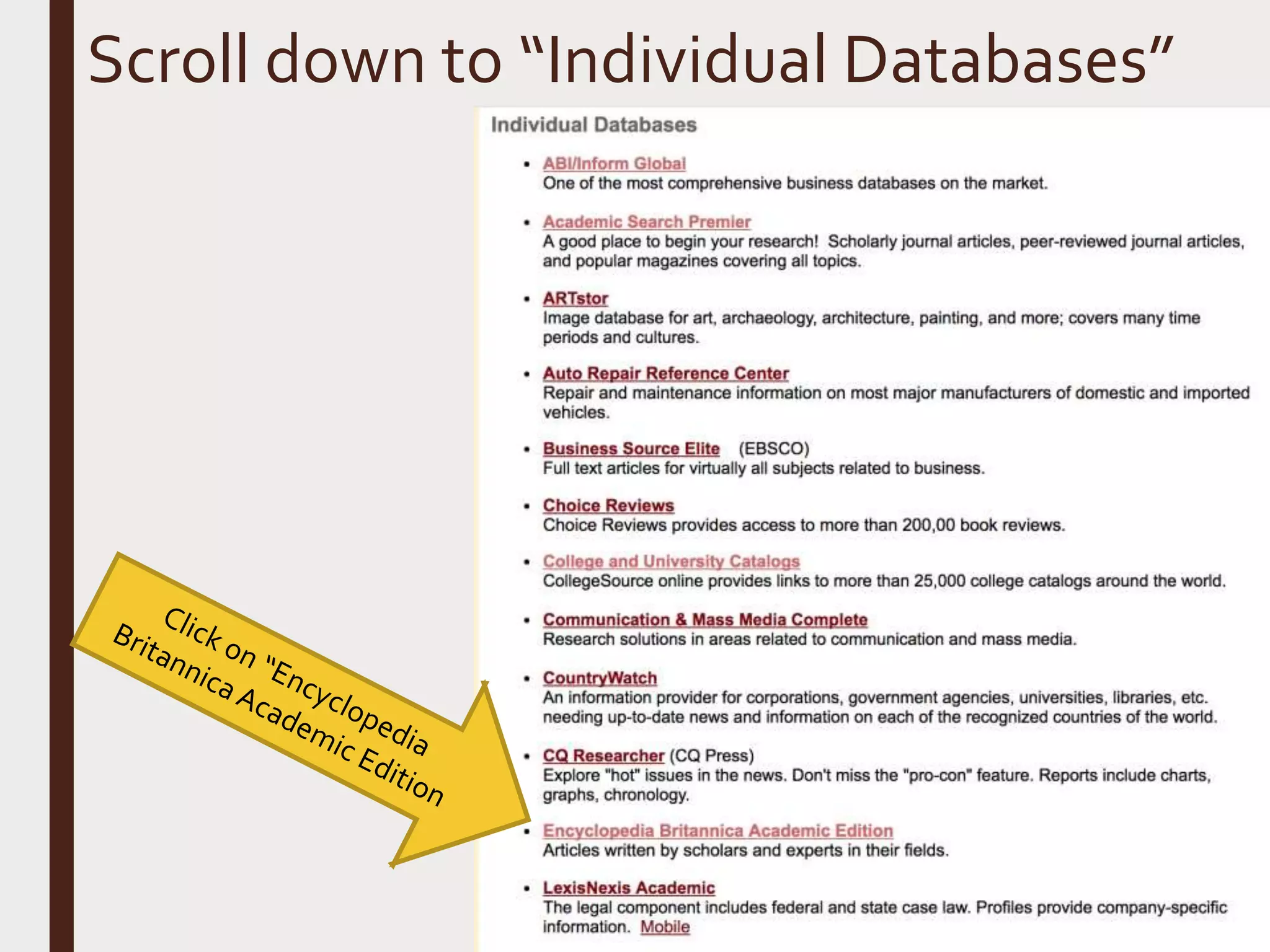
Scroll down to “Individual Databases”
Then click here
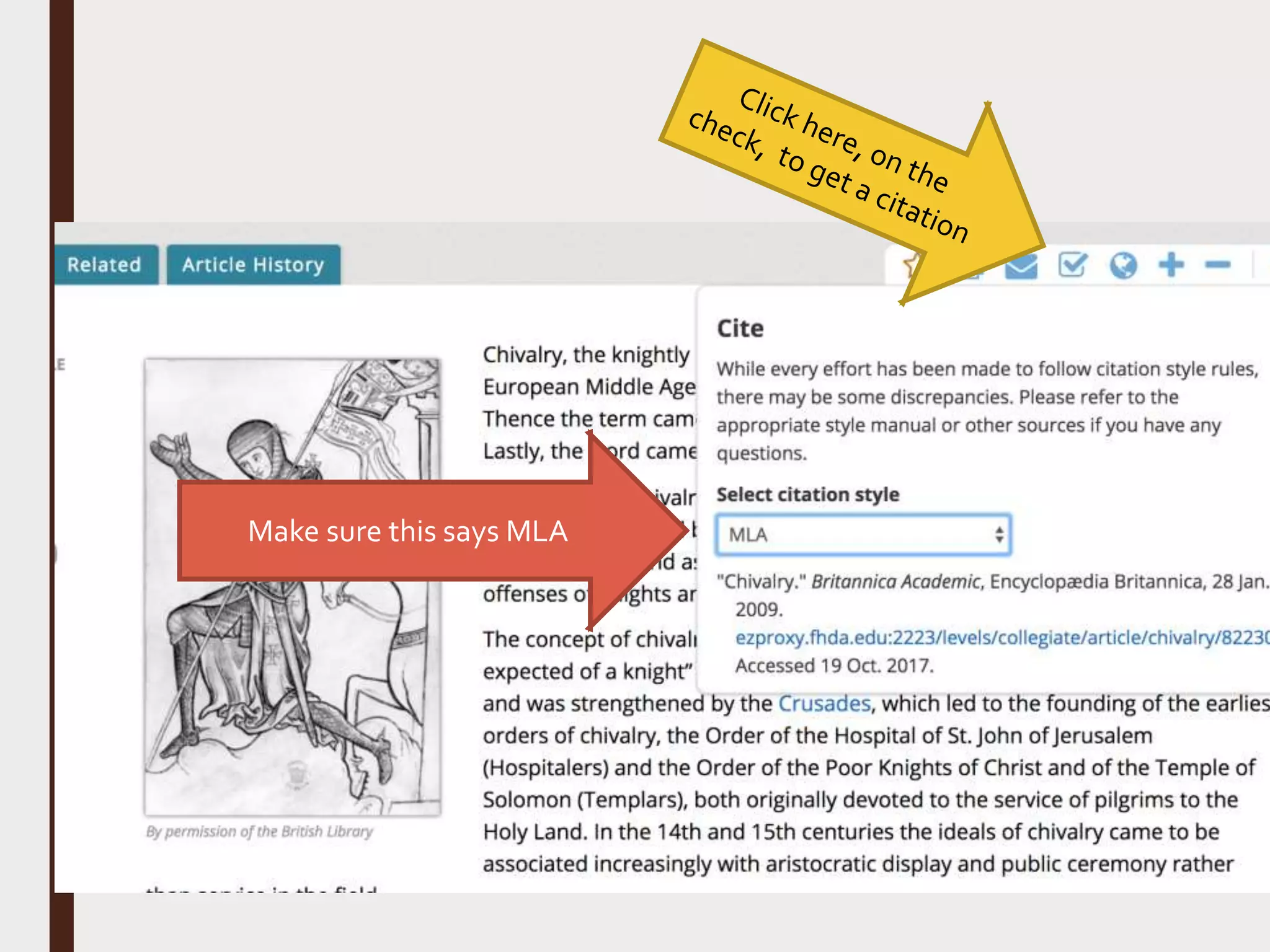
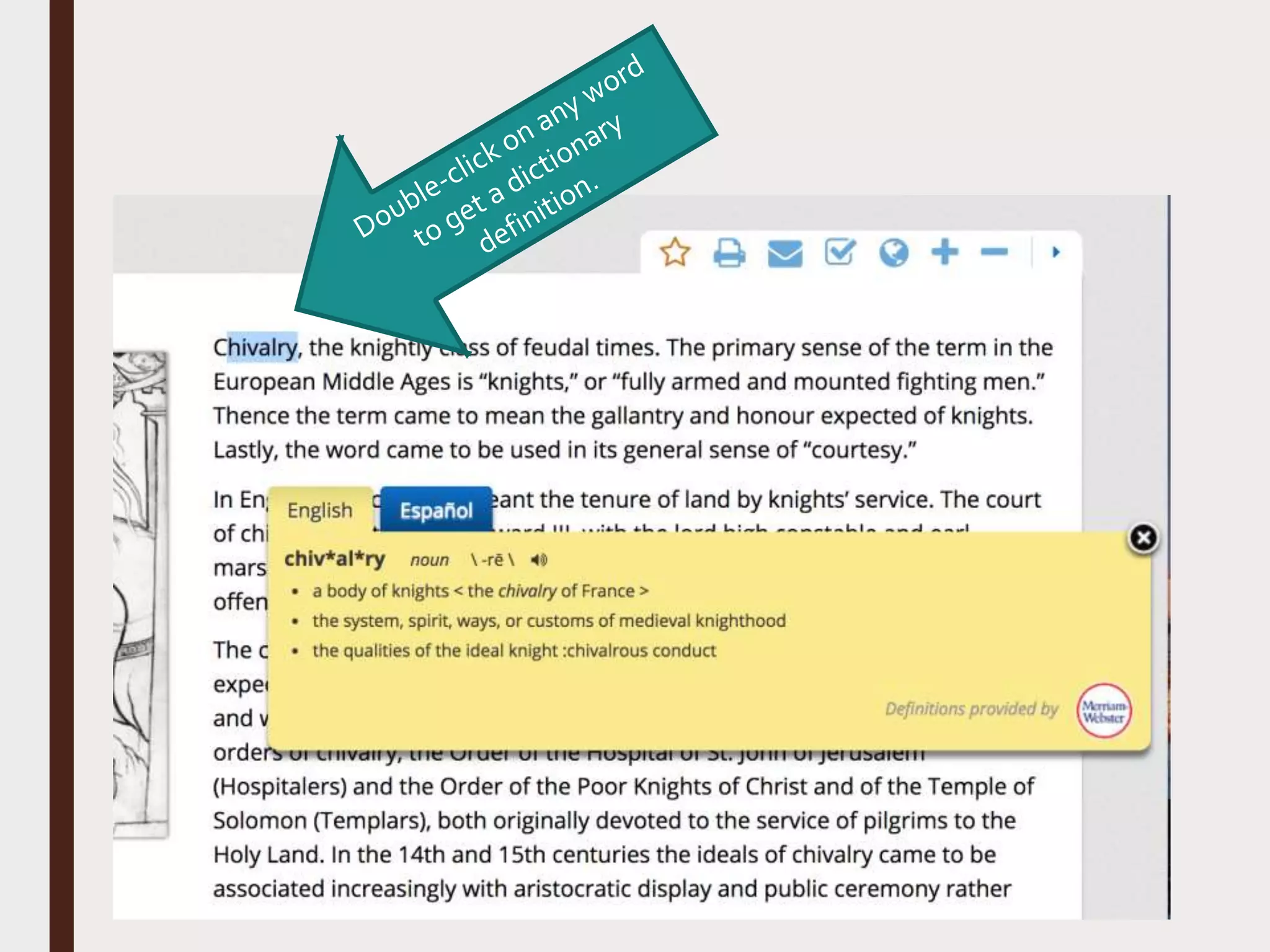
Encyclopedia Entry
Make sure this says MLA
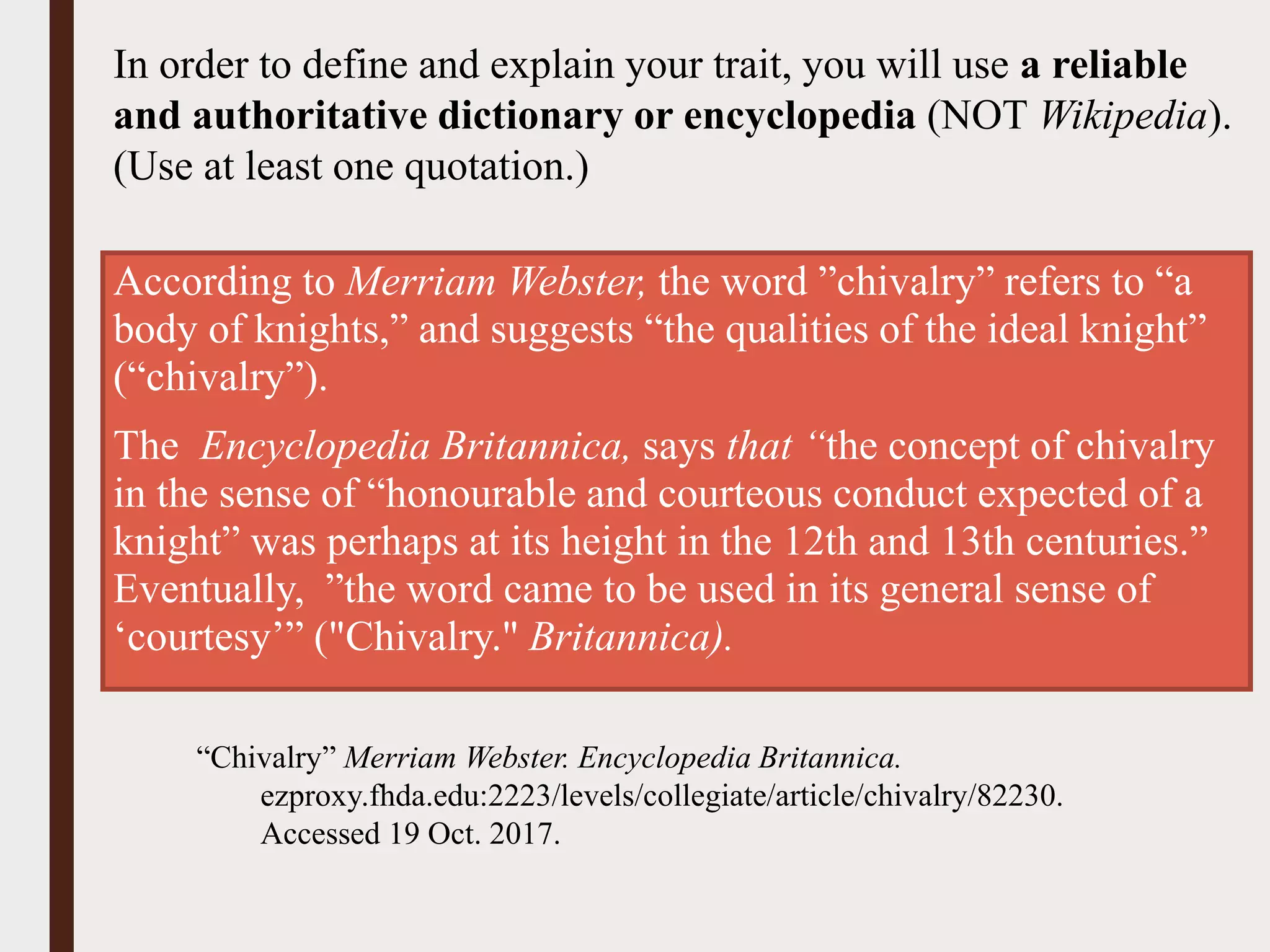
According to Merriam Webster, the word ”chivalry” refers to “a
body of knights,” and suggests “the qualities of the ideal knight”
(“chivalry”).
The Encyclopedia Britannica, says that “the concept of chivalry
in the sense of “honourable and courteous conduct expected of a
knight” was perhaps at its height in the 12th and 13th centuries.”
Eventually, ”the word came to be used in its general sense of
‘courtesy’” ("Chivalry." Britannica).
In order to define and explain your trait, you will use a reliable
and authoritative dictionary or encyclopedia (NOT Wikipedia).
(Use at least one quotation.)
“Chivalry” Merriam Webster. Encyclopedia Britannica.
ezproxy.fhda.edu:2223/levels/collegiate/article/chivalry/82230.
Accessed 19 Oct. 2017.
In-ClassWriting
A Focused Explanation: Define and describe the
character trait you have chosen in some depth,
considering both the potential good and bad aspects
of that quality. Are there multiple kinds of the quality?
For example, can you identify physical, social, moral,
and emotional courage?
HOMEWORK
Read HP Chapter 14 pages 249-264
Read At least one article about your concept.
Vocabulary: Vocab 10-12
HW Discussion 8
 Come up with your own draft definition of the
trait you have chosen. In your own words,
explain the trait as you understand it, and tell
why is it important?
 Choose and post at least one quotation from
the article you read that helps to explain your
character trait. Make sure to note the article so
you can find it again.
 Now find a reliable definition of that trait from
an authoritative source. Use a dictionary or an
encyclopedia (use the library sources we
learned about in class today). Make sure you
understand what this definition is saying.
Explain it as you understand it in your own
words.
 Choose one character who embodies this trait

HP 211 class 9

  • 1.
  • 2.
    AGENDA ■ Vocab 1-9 ■Review: In-text citations ■ GPU: Word Choice: Using exact words ■ Introduce Essay #3: Define a character trait, explain its importance, and analyze its portrayal in a character. ■ Discussion: – Gryffindor: bravery, chivalry – Hufflepuff: dedication, loyalty – Ravenclaw: intelligence, creativity – Slytherin: ambition, pride ■ Library Demonstration: – Encyclopedia/Dictionary ■ In-class writing – A Focused Explanation: Define and describe the character trait you have chosen in some depth, considering both the potential good and bad aspects of that quality. Are there multiple kinds of the quality? For example, physical, social, moral, and emotional courage.
  • 3.
    Vocabulary 1. simper :○ “I’ll be waiting to open the door.” Dudley put on a foul, simpering smile. 2. livid ○ Harry had slipped throughVoldemort’s clutches for a second time, but it had been a narrow escape, and even now, weeks later, Harry kept waking in the night, drenched in cold sweat, wondering whereVoldemort was now, remembering his livid face, his wide, mad eyes 3. jeer ○ Harry jumped to his feet just as a jeering voice floated across the lawn. 4. nimble ○ Stepping nimbly out of Harry’s reach, he pulled a thick wad of envelopes from the inside of the pillowcase he was wearing.
  • 4.
    5. lurch ○Mouth dry, stomach lurching, Harry sprang after him, trying not to make a sound. 6. fiasco ○ Harry told them all about Dobby, the warning he’d given Harry and the fiasco of the violet pudding. 7. gnome ○Yeah, Mum’s always wishing we had a house-elf to do the ironing,” saidGeorge. “But all we’ve got is a lousy old ghoul in the attic and gnomes all over the garden. 8. strut○ Judging by the fact that Draco Malfoy usually had the best of everything, his family was rolling in wizard gold; he could just see Malfoy strutting around a large manor house. 9. berserk ○The teapot went berserk and squirted boiling tea all over the place and one man ended up in the hospital with the sugar tongs clamped to his nose.
  • 5.
    ■ Livid hasa colorful history. The Latin adjective lividus means "dull, grayish, or leaden blue." From this came the French livide and eventually the English "livid," which was used to describe flesh discolored by a bruise when it was first recorded in the early 17th century. A slight extension of meaning gave it the sense "ashen or pallid," as used in describing a corpse. "Livid" eventually came to be used in this sense to characterize the complexion of a person pale with anger ("livid with rage"). From this meaning came two new senses in the 20th century. One was "reddish," as one is as likely to become red with anger as pale; the other was simply "angry" or "furious," the most common sense of the word today. Berserk comes from Old Norse berserkr, which combines ber- ("bear") and serkr ("shirt"). According to Norse legend, berserkrs were warriors who wore bearskin coverings and worked themselves into such frenzies during combat that they became immune to the effects of steel and fire. Berserk was borrowed into English (first as a noun and later as an adjective) in the early 19th century, when interest in Scandinavian myth and history was high. It was considered a slang term at first, but it has since gained broader acceptance.
  • 6.
    Review: InText Citations Thepicture budget was “over $125 million, and prospered to gross over $317 million. “(boxofficemojo), which …. “Harry Potter and the Sorcerer’s Stone (2001).” Box Office Mojo, www.boxofficemojo.com/movies/?id=harrypotter.htm. 19 october 2017.
  • 7.
    The picture budgetwas “over $125 million, and prospered to gross over $317 million. “(boxofficemojo), which …. The picture budget was “over $125 million, and prospered to gross over $317 million” (“Harry Potter and the Sorcerer’s Stone [2001”]), which …. “Harry Potter and the Sorcerer’s Stone (2001).” Box Office Mojo, www.boxofficemojo.com/movies/?id=harrypotter.htm. 19 October 2017.
  • 8.
    Grammar, Punctuation, Usage: UsingExact Words ■ Effective writers choose words carefully, paying attention to meaning, form, idiomatic phrasing, and freshness. ■ Replace incorrect words with the exact words you intend, or omit incorrect words if they are unnecessary. ■ Check a dictionary when you are uncertain of the meaning of a word.Watch for incorrect words and for words similar in meaning or sound.
  • 9.
    Avoid Using “Thing” Whenyou write sentences, you may find yourself using the word “thing” when you could use a more specific word. To move away from this problem, try to find a more specific word that fits your meaning. The words on the list may help you narrow down your choices.
  • 10.
    Examples: Weak: As Iread about Ben Franklin, I learned many things about his life. Better: As I read about Ben Franklin, I learned that his life was filled with challenges. Weak: The authors discussed three things about ever-changing technology. Better: The article described three features about ever-changing technology. Weak: The instructor did two things to encourage all her students to read more. Better: The instructor started two projects to encourage her students to read more. Weak: Of all the things the characters did in the book, living in the underwater home was the most exciting. Better: Of all the adventures the characters had in the book, living in the underwater home was the most exciting.
  • 11.
    There are thingsfloating and appearing and doing things for themselves, and it truly makes the viewer believe in magic.
  • 12.
    AvoidWords Containing “Thing”: “Something,”“Anything,” “Nothing,” and “Everything.” ■ Nothing/everything. “There’s nothing worse than...” (This harkens back to the best/worst entry. It says, in effect, the worst thing in the world is X.) ■ Nothing is worse than a muffed PowerPoint? Really? Leprosy? How about that? Losing your home or business in a fire? I could go on, but there’s nothing worse than beating a dead horse. Except beating a live one; that’s much worse. (I like horses.) ■ It’s easy enough to provide perspective: “When giving a PowerPoint presentation, there are few things more distracting than...” and then insert your glitch of choice — an upside-down slide, a zombie apocalypse, whatever.
  • 13.
    ■ This isbelievable because had something happened to our very own parents, the extremes to which Harry goes through for them may also be ours
  • 14.
    Essay #3:The WritingAssignment: Define a character trait, explain its importance, and analyze its portrayal in a character. We know that each of the Hogwarts houses has specific personality traits that are associated with the students in that house. For each of the four houses, we have chosen two traits:  Gryffindor: bravery, chivalry  Hufflepuff: dedication, loyalty  Ravenclaw: intelligence, creativity  Slytherin: ambition, pride For this essay, choose ONE of the eight qualities from the list above. ■ Define and describe that quality in some depth, considering both the potential good and bad aspects of that quality. ■ Analyze how that quality affects the attitude and/or actions of ONE of the characters in Harry Potter and the Chamber of Secrets. ■ Your final essay should be between three and five pages. (This means you should have at least one line on page four to ensure you have filled three complete pages).
  • 15.
    Discussion: In yourhouses bravery, chivalry, dedication, loyalty, intelligence, creativity, ambition, pride Discuss any or all of these traits.What do you know about them? Define them in your own words. Can you name different ways these traits show themselves?
  • 16.
    ■ How didyou define these traits? ■ What do we know about these traits? ■ Can you name different aspects of any of them? Spontaneous creativity?Artistic creativity? Emotional bravery? Heroic bravery? Ambition motivated by external goals (money, awards, recognition) vs. those motivated by internal, personal goals to create? ■ What do you know about any of these traits and various aspects of them? bravery, chivalry, dedication, loyalty, intelligence, creativity, ambition, pride
  • 17.
    Your definition andanalysis will rely on several sources, including a dictionary or encyclopedia, an outside article, a hip-hop song (optional), and Harry Potter and the Chamber of Secrets. Outside Sources: ■ Your essay will use multiple outside sources to provide different types of information in support your definition and analysis. ■ In order to define and explain your trait, you will use a reliable and authoritative dictionary or encyclopedia (NOT Wikipedia). (Use at least one quotation.) ■ You will help to describe and explain your trait using discussion or examples from an appropriate outside article. See Appendix I to this assignment for links to at least one article for each trait. (Use at least one quotation.) ■ You can also use an appropriate hip-hop song to help you explain your trait in more detail. See Appendix II to this assignment for links to useful hip-hop songs. (Optional: one quotation.) ■ You will need at least two quotations describing and explaining your trait from Harry Potter and the Chamber of Secrets. (Use at least two quotations.) ■ This means that your essay will contain at least four total quotations from these sources.
  • 18.
    Library Demonstration: Encyclopedia/Dictionary ■ Startat De Anza’s Homepage: www.deanza.edu ■ Click Library Databases Click the “Library” link Click “Library Databases”
  • 19.
    Scroll down to“Individual Databases”
  • 20.
  • 21.
  • 22.
  • 24.
    According to MerriamWebster, the word ”chivalry” refers to “a body of knights,” and suggests “the qualities of the ideal knight” (“chivalry”). The Encyclopedia Britannica, says that “the concept of chivalry in the sense of “honourable and courteous conduct expected of a knight” was perhaps at its height in the 12th and 13th centuries.” Eventually, ”the word came to be used in its general sense of ‘courtesy’” ("Chivalry." Britannica). In order to define and explain your trait, you will use a reliable and authoritative dictionary or encyclopedia (NOT Wikipedia). (Use at least one quotation.) “Chivalry” Merriam Webster. Encyclopedia Britannica. ezproxy.fhda.edu:2223/levels/collegiate/article/chivalry/82230. Accessed 19 Oct. 2017.
  • 25.
    In-ClassWriting A Focused Explanation:Define and describe the character trait you have chosen in some depth, considering both the potential good and bad aspects of that quality. Are there multiple kinds of the quality? For example, can you identify physical, social, moral, and emotional courage?
  • 26.
    HOMEWORK Read HP Chapter14 pages 249-264 Read At least one article about your concept. Vocabulary: Vocab 10-12 HW Discussion 8  Come up with your own draft definition of the trait you have chosen. In your own words, explain the trait as you understand it, and tell why is it important?  Choose and post at least one quotation from the article you read that helps to explain your character trait. Make sure to note the article so you can find it again.  Now find a reliable definition of that trait from an authoritative source. Use a dictionary or an encyclopedia (use the library sources we learned about in class today). Make sure you understand what this definition is saying. Explain it as you understand it in your own words.  Choose one character who embodies this trait