GUIDED
COMPOSITION
What is composition writing?
Composition can mean two things. It can mean a
piece of writing, or it can mean the art and process
of writing. Composition isn’t a specific type of
writing like an essay or a blog post. Instead, it’s a
broad term that can refer to any (usually nonfiction)
work and how a piece is written.
Every essay is a composition, but not every
composition is an essay. A composition can also be
a book report, a presentation, a short response to a
reading assignment, or a research paper.
Composition writing follows the same writing
process as every other kind of writing. Here
are the steps:
 Brainstorm
 Outline
 First draft
 Edit
 Proofread
What is Guided Composition?
 Guided compositions are those where the pupils
are supplied with all the necessary structures,
vocabulary, thoughts and ideas to be expressed.
 It is usually introduced at an early stage that's
why the teachers remain involved in it and
constantly guide the students to create short
writing content.
Why Guided Composition is practiced?
 Measuring the skill of the student
 Command over English
 General Knowledge
 Grasp on the themes
 Common Sense
 Academic Depth
Writing a guided composition is a skill of putting
together the given facts and information into a
cohesive composite structure.
 Given guidelines and information help the writer
to easily construct the composition with some
common sense and intelligence, backed up by a
reasonable amount of general knowledge expected.
 It is like filling up a skeleton with flesh to
compose a whole animal.
The use of proper sentences, correct and related
expressions can breathe life into it.
 For that read the clues carefully and understand
the subject with clear mind.
Dos and Don’ts:
• Keep your language straight forward.
• Don’t beat around the bush or spin meaningless
yarns.
• Keep the sentence brief, to the point,
grammatically correct and words simple.
• Do not use out-of-context bombastic words just to
show your vocabulary.
• Avoid twisting and exaggerating facts.
• Do not bury the central theme under poetic
expressions, slogans, loud wording and jargans or
unnecessary idioms.
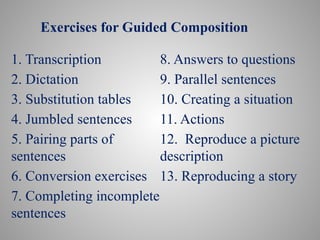
1. Transcription
2. Dictation
3. Substitution tables
4. Jumbled sentences
5. Pairing parts of
sentences
6. Conversion exercises
7. Completing incomplete
sentences
8. Answers to questions
9. Parallel sentences
10. Creating a situation
11. Actions
12. Reproduce a picture
description
13. Reproducing a story
Exercises for Guided Composition
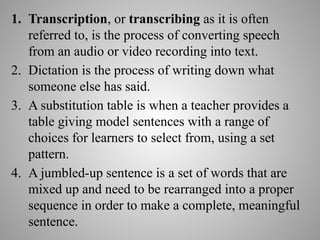
1. Transcription, or transcribing as it is often
referred to, is the process of converting speech
from an audio or video recording into text.
2. Dictation is the process of writing down what
someone else has said.
3. A substitution table is when a teacher provides a
table giving model sentences with a range of
choices for learners to select from, using a set
pattern.
4. A jumbled-up sentence is a set of words that are
mixed up and need to be rearranged into a proper
sequence in order to make a complete, meaningful
sentence.
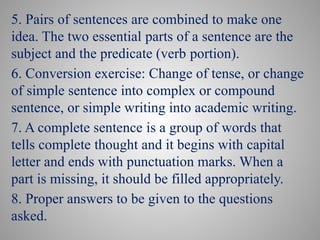
5. Pairs of sentences are combined to make one
idea. The two essential parts of a sentence are the
subject and the predicate (verb portion).
6. Conversion exercise: Change of tense, or change
of simple sentence into complex or compound
sentence, or simple writing into academic writing.
7. A complete sentence is a group of words that
tells complete thought and it begins with capital
letter and ends with punctuation marks. When a
part is missing, it should be filled appropriately.
8. Proper answers to be given to the questions
asked.
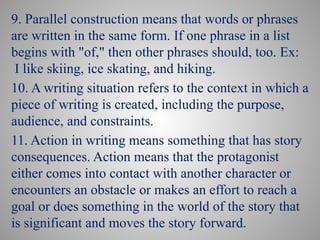
9. Parallel construction means that words or phrases
are written in the same form. If one phrase in a list
begins with "of," then other phrases should, too. Ex:
I like skiing, ice skating, and hiking.
10. A writing situation refers to the context in which a
piece of writing is created, including the purpose,
audience, and constraints.
11. Action in writing means something that has story
consequences. Action means that the protagonist
either comes into contact with another character or
encounters an obstacle or makes an effort to reach a
goal or does something in the world of the story that
is significant and moves the story forward.
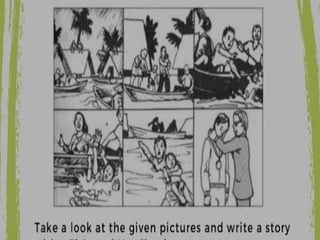
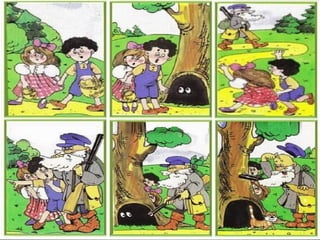
12. An image description is a written caption that
describes the essential information in an image.
Image descriptions can define photos, graphics,
gifs, and video — basically anything containing
visual information.
13. Reproducing a story: Developing a story with
the available hints.
Helping others
Once upon a time, there was a boy named Raju in Narmada
village. Everyday after school, he had to cross a river to reach
his home. One such day, he got onto a boat that was already
filled by three men, one woman and her five-year-old
kid. Once Raju climbed on board, the fisherman began to row
the boat to the other side of the bank. However once on
reaching the center, the heavy breeze began to push the boat to
and fro. Due to this hustle, the kid fell into the river. However
none of the men came up to lend a helping hand to the kid.
Raju brought up all his courage and jumped into the river to
save the kid. Raju rescued the kid and the kid's mother thanked
him. This news spread like wildfire throughout the village.
Raju's school headmaster rewarded Raju with a medal for
saving the kid.
Study the following hints and develop them into
a story
King Solomon -noted for voice down -Queen of
Sheba wanted to test it wisdom -the King came to
her court -The Queen offered two garlands -natural
and artificial -asked the King to choose the Garland
of real roses without touching them -the King
opened the window -bees came and sat on real
roses -The Queen surprised.
King Solomon’s Wisdom
King Solomon was very famous for his wisdom. The
Queen of Sheba wanted to test it. Once she was
invited by the King to his kingdom. The clever queen
brought two garlands of flowers one real and the other
artificial. But they looked alike. She went to King
Solomon’s kingdom and asked him to pick up the
garland of real flowers. The king was greatly puzzled.
Then he hit upon an idea. The king asked his men to
open the windows. When they were opened, bees flew
into the room and sat on the garland of real flowers
making the task easy for him. The Queen was deeply
impressed with the King’s wisdom.
Exercise:
Devan – clever thief – robs the rich – gives all to
the sick and the needy – other thieves jealous – plan
to get rid of him – challenge Devan to steal the
King’s pyjamas – Devan accepts challenge – finds
king sleeping – opens a bottle of red ants on the bed
– King badly bitten – cries for help – servants rush
in pretends to look for ants – Devan removes
King’s pyjamas – escapes – other thieves
dumbfounded – accept Devan their leader
Exercise:
Manager of a firm advertised – night watchman –
applicants presented – manager not satisfied –
found something wrong with each man – there was
Raju – an applicant – sat in a comer – patiently
waiting – his turn came – manager found nothing
wrong in his appearance – questioned about his
health – got the reply - suffering from sleeplessness
– manager happy – appointed him
Guided Composition for beginners in writing.pptx

Guided Composition for beginners in writing.pptx

  • 1.
  • 2.
    What is compositionwriting? Composition can mean two things. It can mean a piece of writing, or it can mean the art and process of writing. Composition isn’t a specific type of writing like an essay or a blog post. Instead, it’s a broad term that can refer to any (usually nonfiction) work and how a piece is written. Every essay is a composition, but not every composition is an essay. A composition can also be a book report, a presentation, a short response to a reading assignment, or a research paper.
  • 3.
    Composition writing followsthe same writing process as every other kind of writing. Here are the steps:  Brainstorm  Outline  First draft  Edit  Proofread
  • 5.
    What is GuidedComposition?  Guided compositions are those where the pupils are supplied with all the necessary structures, vocabulary, thoughts and ideas to be expressed.  It is usually introduced at an early stage that's why the teachers remain involved in it and constantly guide the students to create short writing content.
  • 6.
    Why Guided Compositionis practiced?  Measuring the skill of the student  Command over English  General Knowledge  Grasp on the themes  Common Sense  Academic Depth Writing a guided composition is a skill of putting together the given facts and information into a cohesive composite structure.
  • 7.
     Given guidelinesand information help the writer to easily construct the composition with some common sense and intelligence, backed up by a reasonable amount of general knowledge expected.  It is like filling up a skeleton with flesh to compose a whole animal. The use of proper sentences, correct and related expressions can breathe life into it.  For that read the clues carefully and understand the subject with clear mind.
  • 8.
    Dos and Don’ts: •Keep your language straight forward. • Don’t beat around the bush or spin meaningless yarns. • Keep the sentence brief, to the point, grammatically correct and words simple. • Do not use out-of-context bombastic words just to show your vocabulary. • Avoid twisting and exaggerating facts. • Do not bury the central theme under poetic expressions, slogans, loud wording and jargans or unnecessary idioms.
  • 9.
    1. Transcription 2. Dictation 3.Substitution tables 4. Jumbled sentences 5. Pairing parts of sentences 6. Conversion exercises 7. Completing incomplete sentences 8. Answers to questions 9. Parallel sentences 10. Creating a situation 11. Actions 12. Reproduce a picture description 13. Reproducing a story Exercises for Guided Composition
  • 10.
    1. Transcription, ortranscribing as it is often referred to, is the process of converting speech from an audio or video recording into text. 2. Dictation is the process of writing down what someone else has said. 3. A substitution table is when a teacher provides a table giving model sentences with a range of choices for learners to select from, using a set pattern. 4. A jumbled-up sentence is a set of words that are mixed up and need to be rearranged into a proper sequence in order to make a complete, meaningful sentence.
  • 11.
    5. Pairs ofsentences are combined to make one idea. The two essential parts of a sentence are the subject and the predicate (verb portion). 6. Conversion exercise: Change of tense, or change of simple sentence into complex or compound sentence, or simple writing into academic writing. 7. A complete sentence is a group of words that tells complete thought and it begins with capital letter and ends with punctuation marks. When a part is missing, it should be filled appropriately. 8. Proper answers to be given to the questions asked.
  • 12.
    9. Parallel constructionmeans that words or phrases are written in the same form. If one phrase in a list begins with "of," then other phrases should, too. Ex: I like skiing, ice skating, and hiking. 10. A writing situation refers to the context in which a piece of writing is created, including the purpose, audience, and constraints. 11. Action in writing means something that has story consequences. Action means that the protagonist either comes into contact with another character or encounters an obstacle or makes an effort to reach a goal or does something in the world of the story that is significant and moves the story forward.
  • 13.
    12. An imagedescription is a written caption that describes the essential information in an image. Image descriptions can define photos, graphics, gifs, and video — basically anything containing visual information. 13. Reproducing a story: Developing a story with the available hints.
  • 15.
    Helping others Once upona time, there was a boy named Raju in Narmada village. Everyday after school, he had to cross a river to reach his home. One such day, he got onto a boat that was already filled by three men, one woman and her five-year-old kid. Once Raju climbed on board, the fisherman began to row the boat to the other side of the bank. However once on reaching the center, the heavy breeze began to push the boat to and fro. Due to this hustle, the kid fell into the river. However none of the men came up to lend a helping hand to the kid. Raju brought up all his courage and jumped into the river to save the kid. Raju rescued the kid and the kid's mother thanked him. This news spread like wildfire throughout the village. Raju's school headmaster rewarded Raju with a medal for saving the kid.
  • 17.
    Study the followinghints and develop them into a story King Solomon -noted for voice down -Queen of Sheba wanted to test it wisdom -the King came to her court -The Queen offered two garlands -natural and artificial -asked the King to choose the Garland of real roses without touching them -the King opened the window -bees came and sat on real roses -The Queen surprised.
  • 18.
    King Solomon’s Wisdom KingSolomon was very famous for his wisdom. The Queen of Sheba wanted to test it. Once she was invited by the King to his kingdom. The clever queen brought two garlands of flowers one real and the other artificial. But they looked alike. She went to King Solomon’s kingdom and asked him to pick up the garland of real flowers. The king was greatly puzzled. Then he hit upon an idea. The king asked his men to open the windows. When they were opened, bees flew into the room and sat on the garland of real flowers making the task easy for him. The Queen was deeply impressed with the King’s wisdom.
  • 19.
    Exercise: Devan – cleverthief – robs the rich – gives all to the sick and the needy – other thieves jealous – plan to get rid of him – challenge Devan to steal the King’s pyjamas – Devan accepts challenge – finds king sleeping – opens a bottle of red ants on the bed – King badly bitten – cries for help – servants rush in pretends to look for ants – Devan removes King’s pyjamas – escapes – other thieves dumbfounded – accept Devan their leader
  • 20.
    Exercise: Manager of afirm advertised – night watchman – applicants presented – manager not satisfied – found something wrong with each man – there was Raju – an applicant – sat in a comer – patiently waiting – his turn came – manager found nothing wrong in his appearance – questioned about his health – got the reply - suffering from sleeplessness – manager happy – appointed him