UK Council for
Graduate Education
Research Supervision
Recognition Programme
Dr Owen Gower, Director
UK Council for Graduate Education
UK Council for
Graduate Education
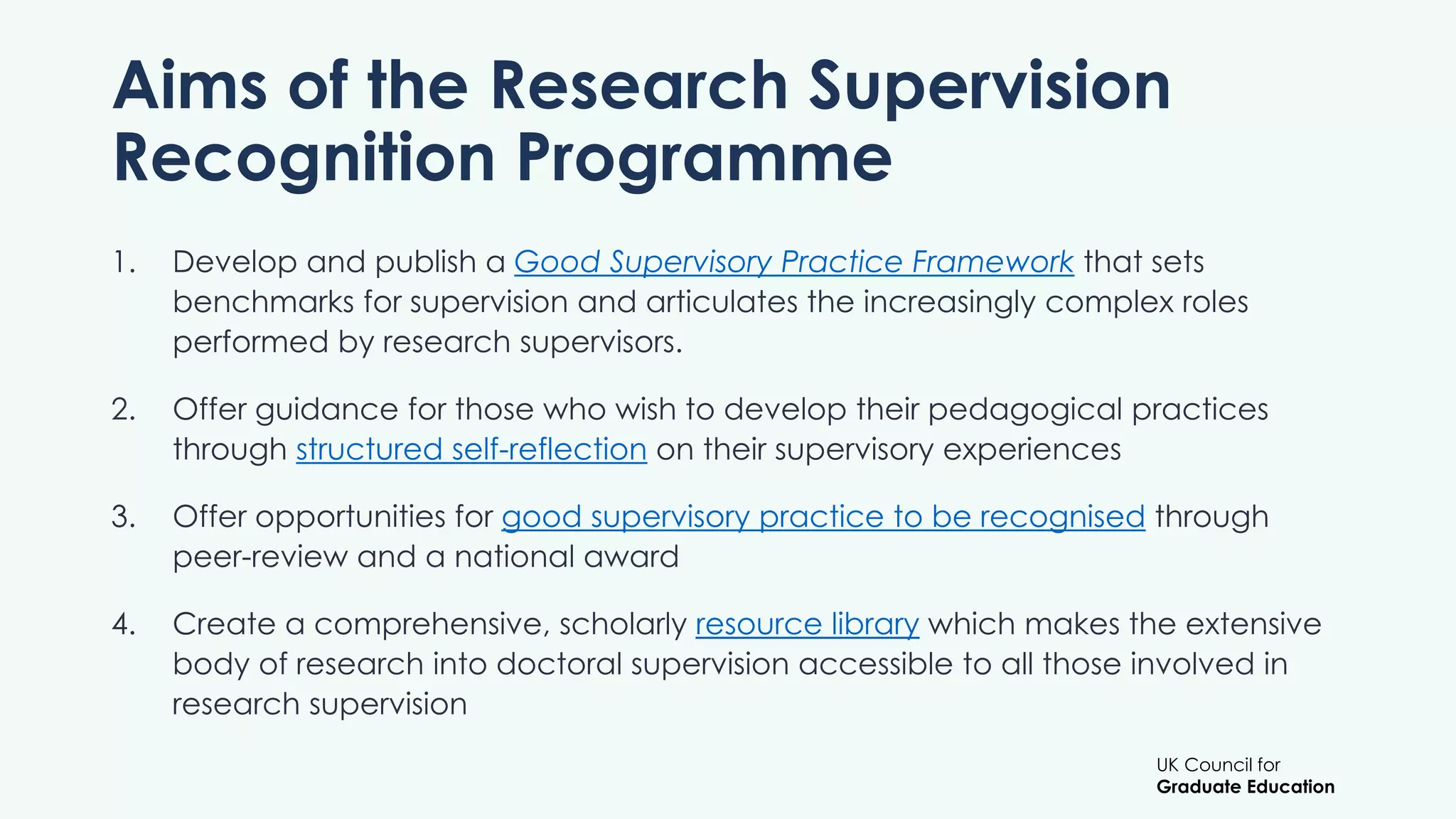
Aims of the Research Supervision
Recognition Programme
1. Develop and publish a Good Supervisory Practice Framework that sets
benchmarks for supervision and articulates the increasingly complex roles
performed by research supervisors.
2. Offer guidance for those who wish to develop their pedagogical practices
through structured self-reflection on their supervisory experiences
3. Offer opportunities for good supervisory practice to be recognised through
peer-review and a national award
4. Create a comprehensive, scholarly resource library which makes the extensive
body of research into doctoral supervision accessible to all those involved in
research supervision
UK Council for
Graduate Education
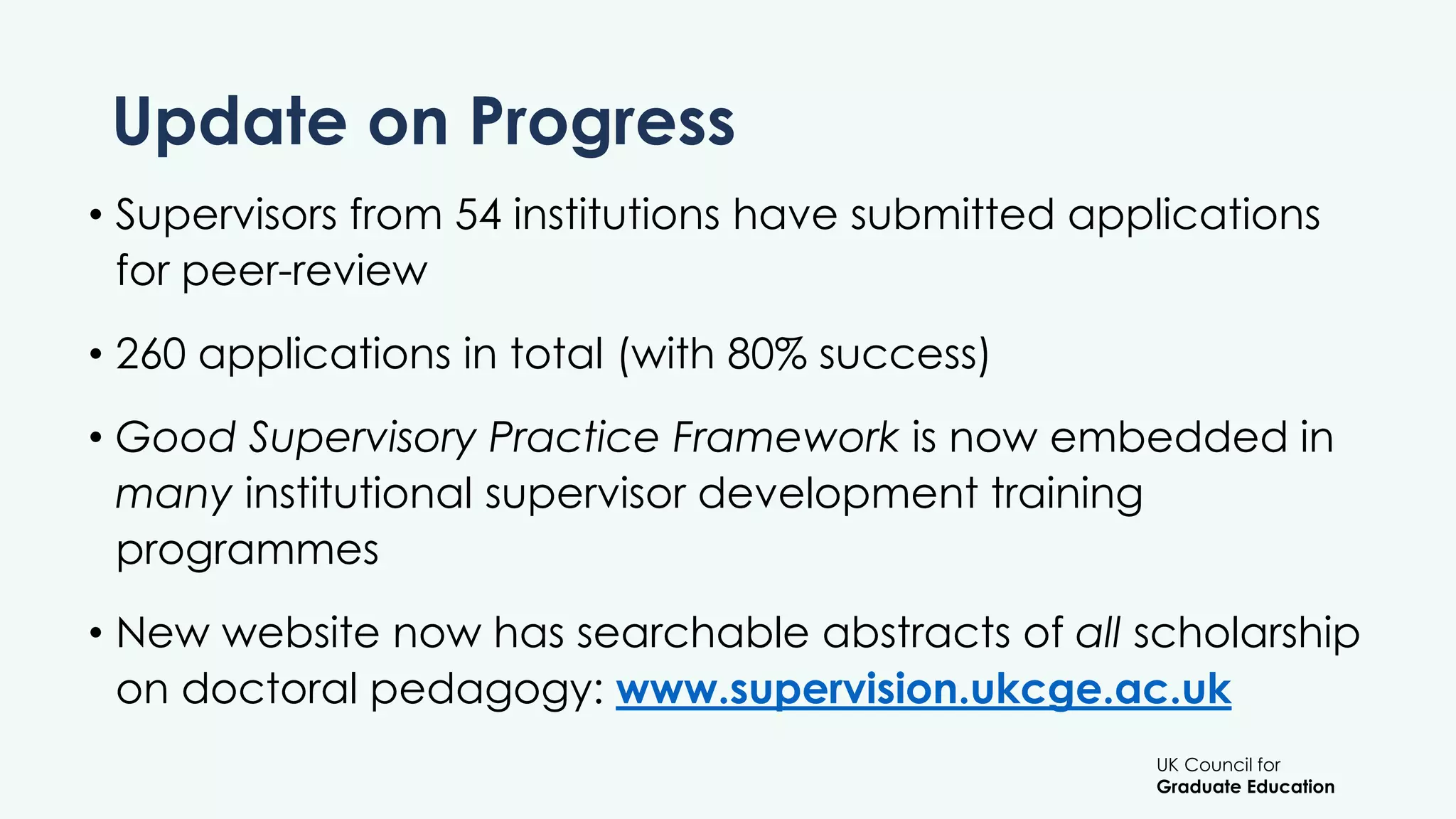
Update on Progress
• Supervisors from 54 institutions have submitted applications
for peer-review
• 260 applications in total (with 80% success)
• Good Supervisory Practice Framework is now embedded in
many institutional supervisor development training
programmes
• New website now has searchable abstracts of all scholarship
on doctoral pedagogy: www.supervision.ukcge.ac.uk
UK Council for
Graduate Education
“You don’t learn from
experience, you learn from
reflecting on experience”
John Dewey (probably)
UK Council for
Graduate Education
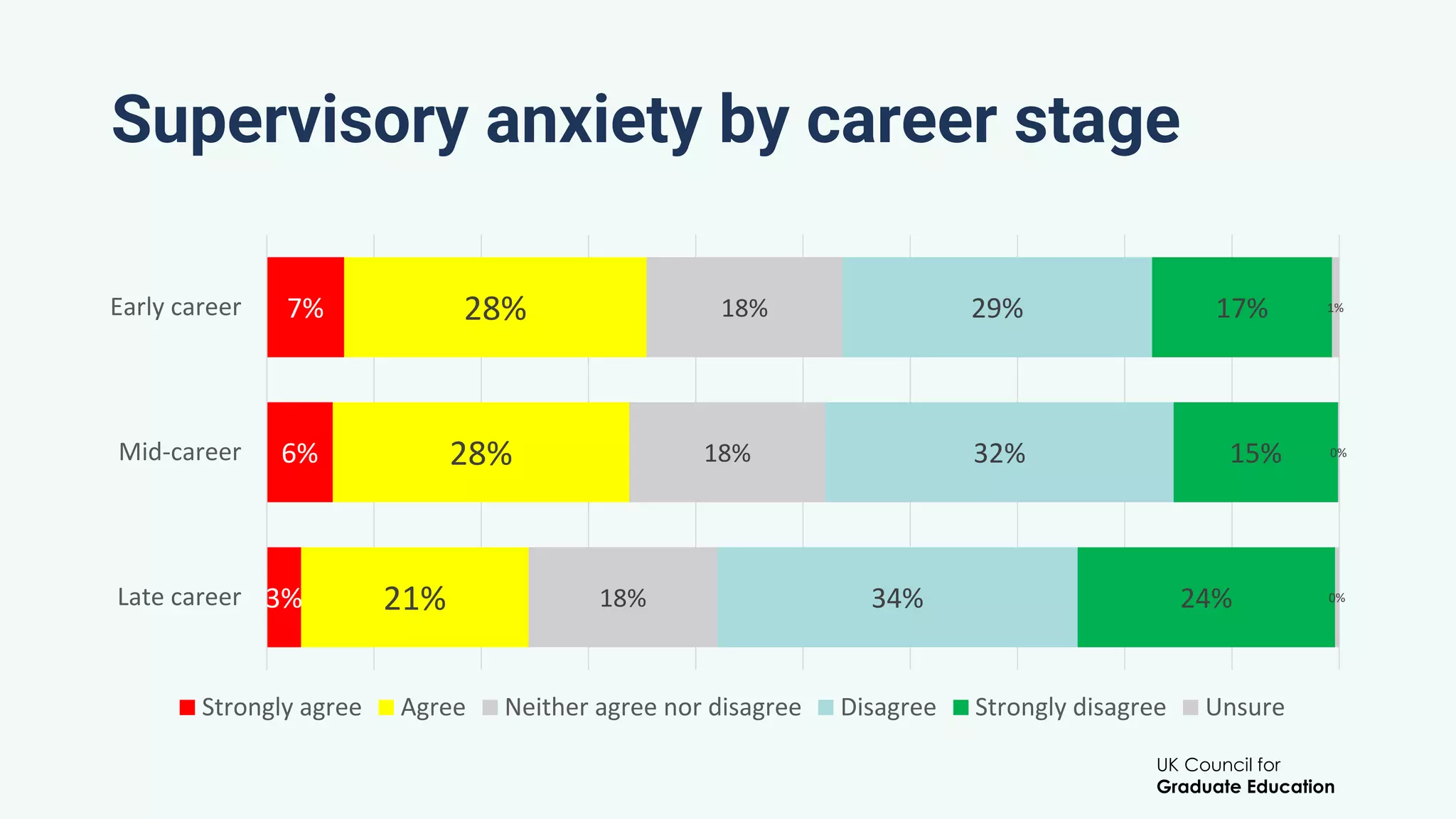
Supervisory anxiety by career stage
3%
6%
7%
21%
28%
28%
18%
18%
18%
34%
32%
29%
24%
15%
17%
0%
0%
1%
Late career
Mid-career
Early career
Strongly agree Agree Neither agree nor disagree Disagree Strongly disagree Unsure
UK Council for
Graduate Education
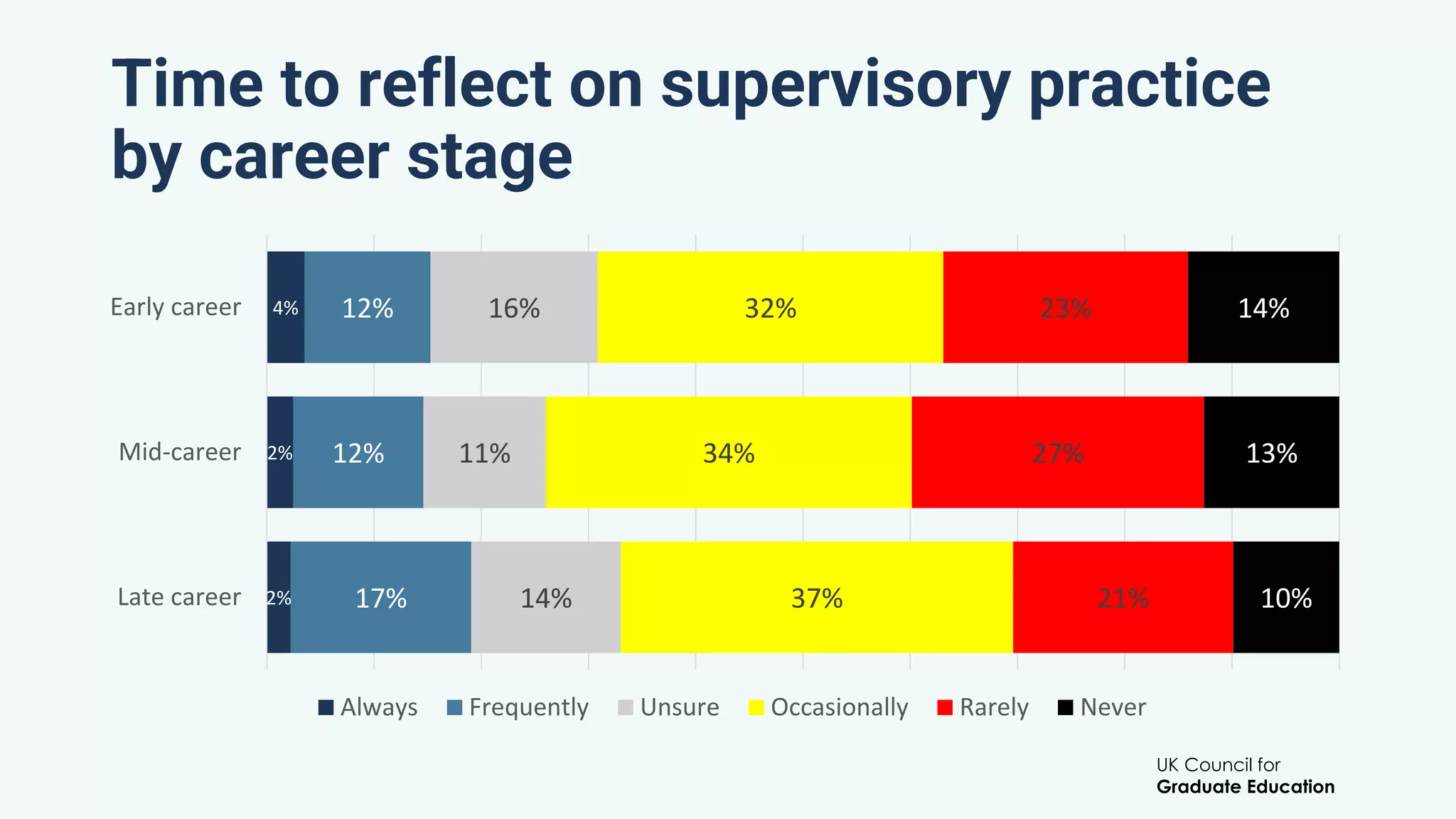
Time to reflect on supervisory practice
by career stage
2%
2%
4%
17%
12%
12%
14%
11%
16%
37%
34%
32%
21%
27%
23%
10%
13%
14%
Late career
Mid-career
Early career
Always Frequently Unsure Occasionally Rarely Never
UK Council for
Graduate Education
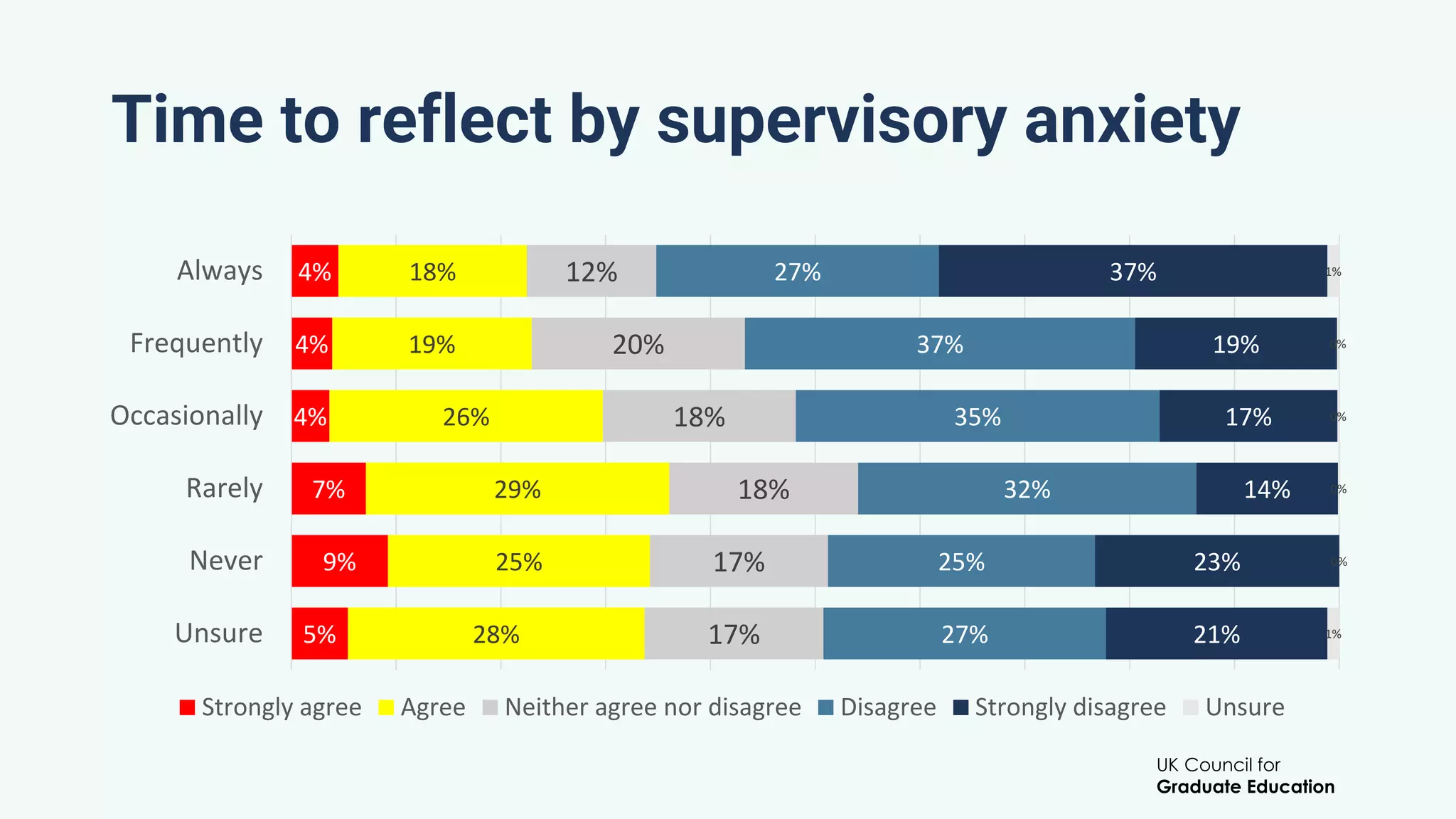
Time to reflect by supervisory anxiety
5%
9%
7%
4%
4%
4%
28%
25%
29%
26%
19%
18%
17%
17%
18%
18%
20%
12%
27%
25%
32%
35%
37%
27%
21%
23%
14%
17%
19%
37%
1%
0%
0%
0%
0%
1%
Unsure
Never
Rarely
Occasionally
Frequently
Always
Strongly agree Agree Neither agree nor disagree Disagree Strongly disagree Unsure
UK Council for
Graduate Education
Dr Kay Guccione
Head of Research Culture
& Researcher
Development
and founder member of
the Postdoc Fanclub
University of Glasgow
Recognising
Associate
Supervision
Supervision, a key determinant of
doctoral ‘success’ is an important and
complex interpersonal practice.
Research Staff (ECRs; post-docs) play a key,
if still somewhat un-recognised, role in the
development and support of PGRs
And are not always seen as educational
assets, or understood to possess supervision
skills or experience.
But they should be…
‘I never thought of this work as
supervision, but it definitely is!’
Thesis Mentor
Pedagogical framing for Thesis Mentoring
PGR mentees: Writing is a difficult practice. One-to-one coaching (Godskesen
and Kobayashi, 2015) can provide a space for critical reflection on writing
difficulties, supporting resolution, positive progress, and reducing drop out.
Research Staff mentors: Calls for doctoral supervisor training to be ‘writing-
centred’ (Guerin et al, 2017; Caley, 2020) and simultaneously for researcher
development to be experienced-based (McAlpine et al., 2013; Guccione et al.,
2018), built through practice.
Design choices: Self-referred thesis writers, Solution Focused coaching
approach, confidential, cross disciplinary, complementarity, mentor/ee training,
mentor toolkits, 8 meetings, 16-weeks.
I get up and I sit down to work, I should
write but I don’t. I am writing up, but I’m not.
I hate writing, we are not friends.
I tell people I am at home writing up, I am
doing everything except writing because I
can’t face it. I feel sick about writing. I get
hot flushes about it [..]. I get panic attacks.
My body hurts from it.
Every day is the same, waiting for inspiration,
disappointment that I don’t know what or how
to write, going to bed and not sleeping
This is worse than being in labour, that was at
least over in 19h, this has been months, it’s so
much more pain.
I am not writing because my writing is poor
and it disgusts me when I see it.
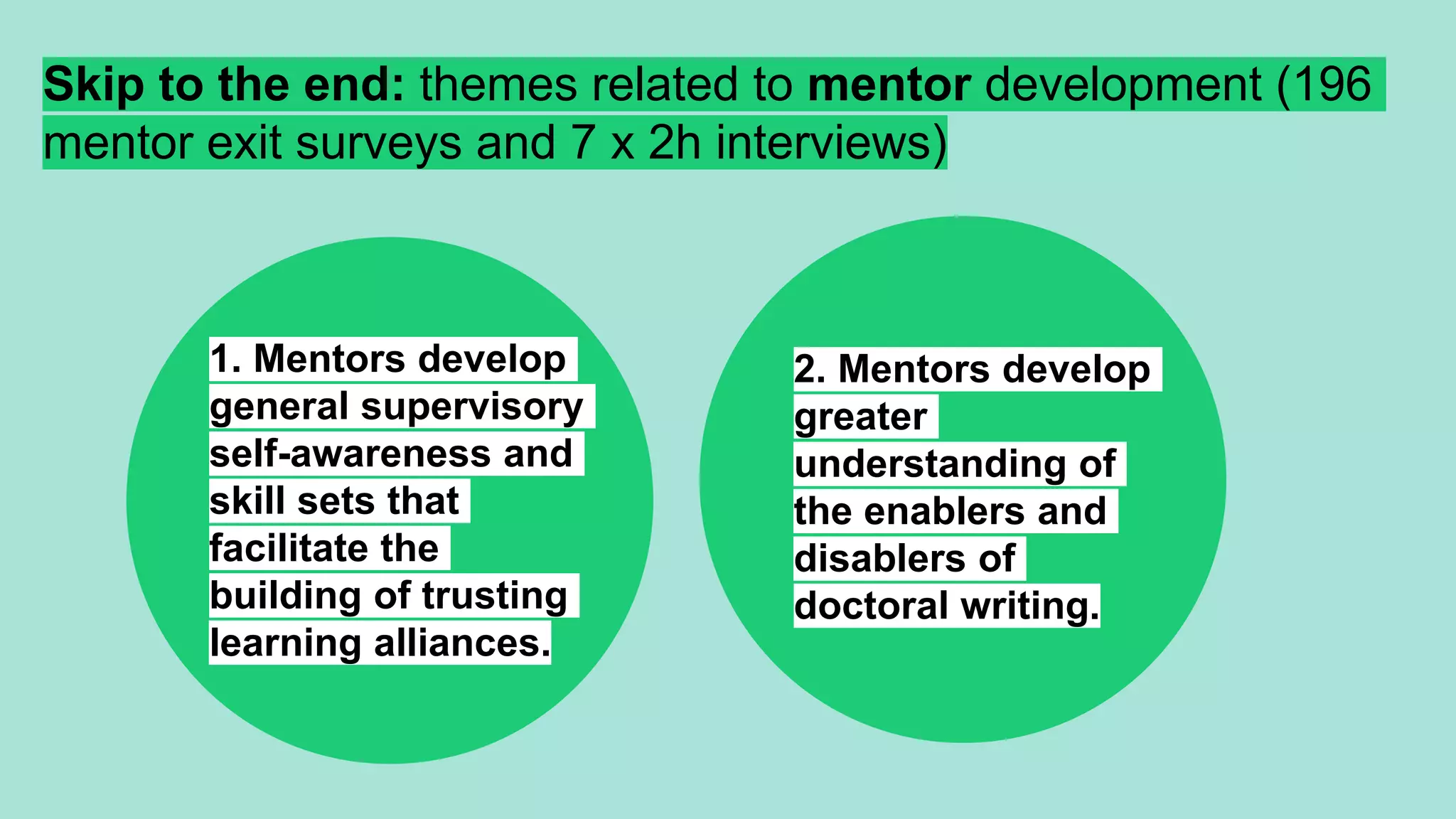
Skip to the end: themes related to mentor development (196
mentor exit surveys and 7 x 2h interviews)
1. Mentors develop
general supervisory
self-awareness and
skill sets that
facilitate the
building of trusting
learning alliances.
2. Mentors develop
greater
understanding of
the enablers and
disablers of
doctoral writing.
1. Mentors develop general supervisory self-
awareness and skill sets that facilitate the
building of trusting learning alliances
Research Staff described how they had learned to build trust
and to form an alliance with their mentees.
• Working with clear role descriptions, shared understanding,
boundaries and limitations;
• Open listening and empathy in paying attention to the
mentee’s objectives and expectations;
• Co-creating solutions to writing blocks and barriers.
“I would make sure they
are alright. Like in themselves as
well as their work…once you feel
relaxed with someone it makes
talking about the work easier. Not
necessarily that I think you need to
be friends with people that you’re
supervising but you, I think it’s just
like, people management skills, isn’t
it? That if you take an interest in a
person, I think they are more willing
to give you something back, to open
up and talk about it.”
“He was looking for a
proof reader. So I had to be very
clear with him that that wasn’t what I
was there for, but we did investigate
some ways in which he could take
action to [go and find] that. In terms
of planning, I could have given him
an answer, I was very conscious in
myself to reign myself in a bit, like,
I’m not going to tell you how I’d do
this. I’m going to let you talk it out. At
the end of it he charged out of my
office and went ‘right I’m off to do
this!’”
2. Mentors develop greater understanding of
the enablers and disablers of doctoral writing
Research Staff described how they had developed a greater
awareness of the role of the supervisor in:
• Encouraging early and frequent writing and embedding a
sense of drafting and refinement as a continuous or cyclical
doctoral process;
• Giving feedback that builds confidence as well as competence
in writing;
• Building students’ self-awareness and problem-solving skills by
taking time to engage in a critical reflective dialogue.
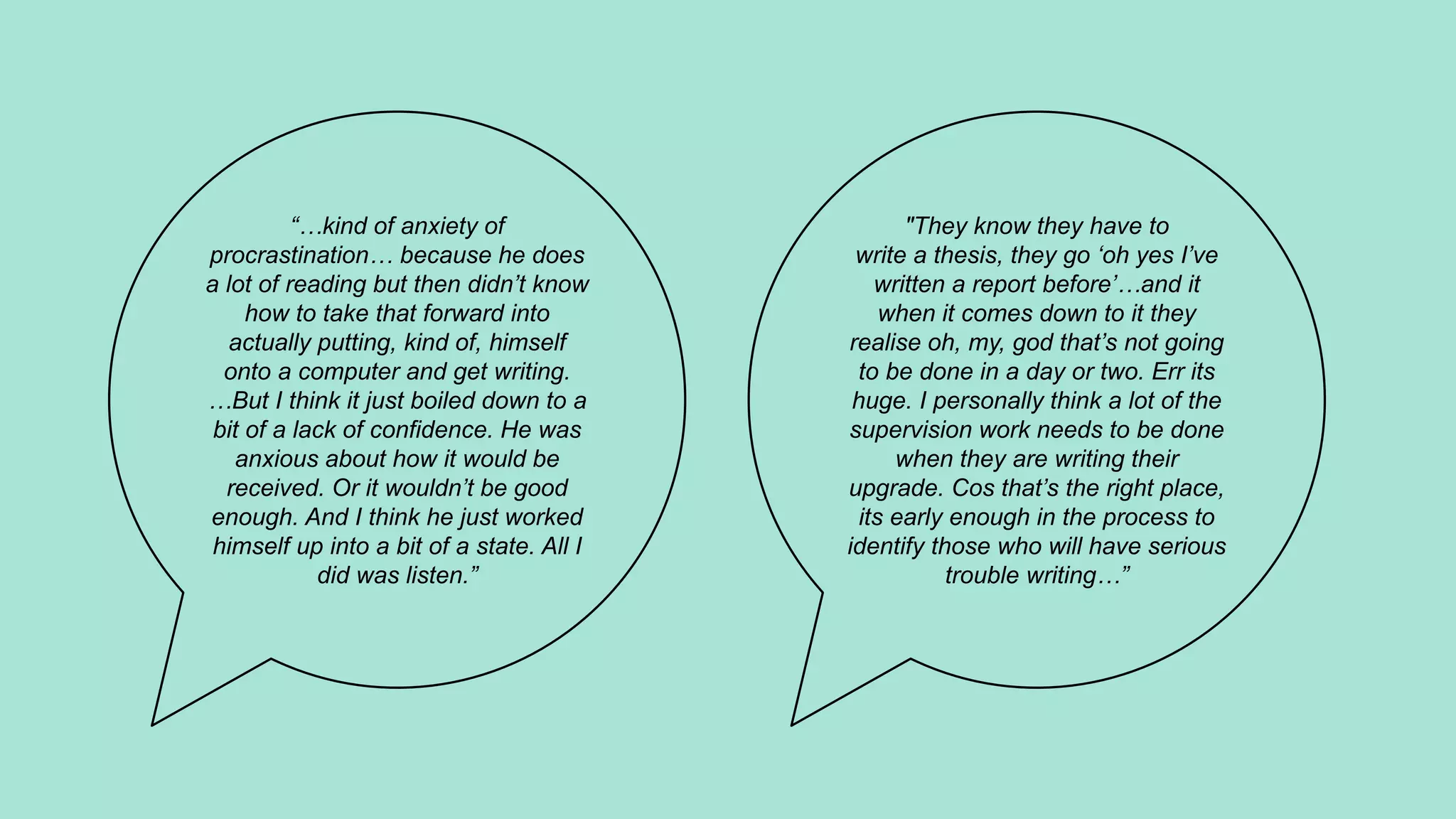
"They know they have to
write a thesis, they go ‘oh yes I’ve
written a report before’…and it
when it comes down to it they
realise oh, my, god that’s not going
to be done in a day or two. Err its
huge. I personally think a lot of the
supervision work needs to be done
when they are writing their
upgrade. Cos that’s the right place,
its early enough in the process to
identify those who will have serious
trouble writing…”
“…kind of anxiety of
procrastination… because he does
a lot of reading but then didn’t know
how to take that forward into
actually putting, kind of, himself
onto a computer and get writing.
…But I think it just boiled down to a
bit of a lack of confidence. He was
anxious about how it would be
received. Or it wouldn’t be good
enough. And I think he just worked
himself up into a bit of a state. All I
did was listen.”
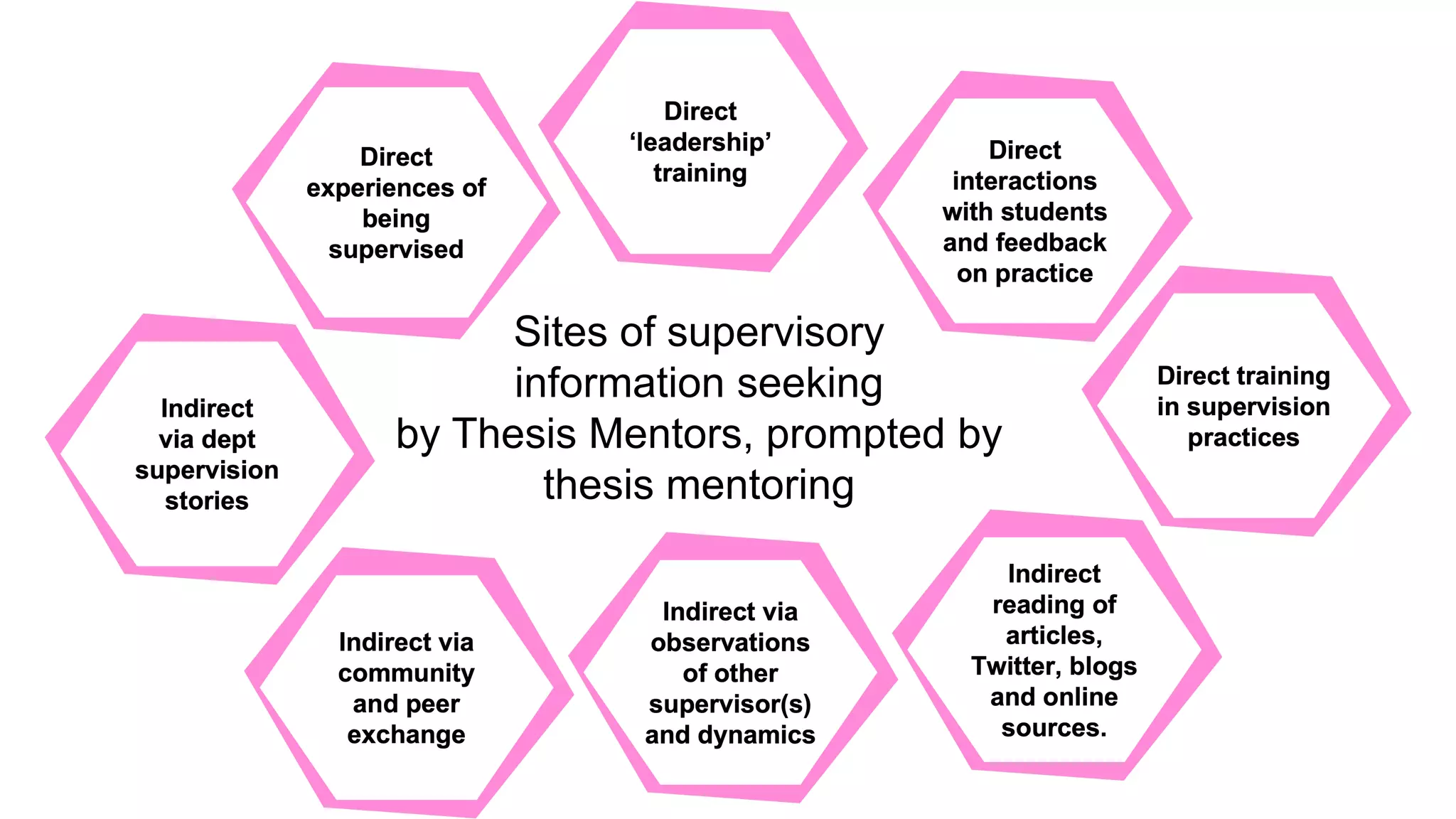
Sites of supervisory
information seeking
by Thesis Mentors, prompted by
thesis mentoring
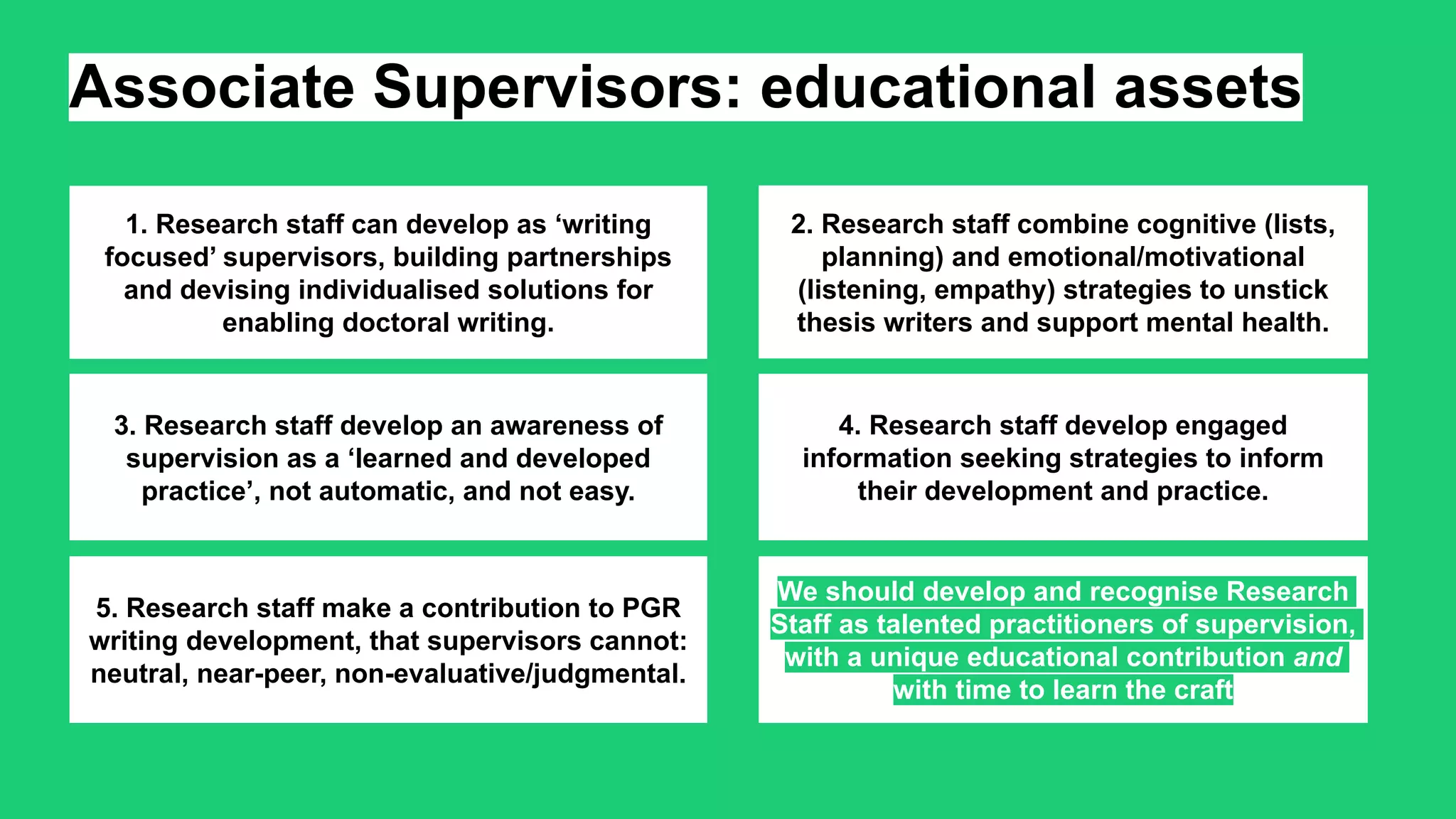
Associate Supervisors: educational assets
4. Research staff develop engaged
information seeking strategies to inform
their development and practice.
3. Research staff develop an awareness of
supervision as a ‘learned and developed
practice’, not automatic, and not easy.
2. Research staff combine cognitive (lists,
planning) and emotional/motivational
(listening, empathy) strategies to unstick
thesis writers and support mental health.
1. Research staff can develop as ‘writing
focused’ supervisors, building partnerships
and devising individualised solutions for
enabling doctoral writing.
We should develop and recognise Research
Staff as talented practitioners of supervision,
with a unique educational contribution and
with time to learn the craft
5. Research staff make a contribution to PGR
writing development, that supervisors cannot:
neutral, near-peer, non-evaluative/judgmental.
Other ducks in the
row…
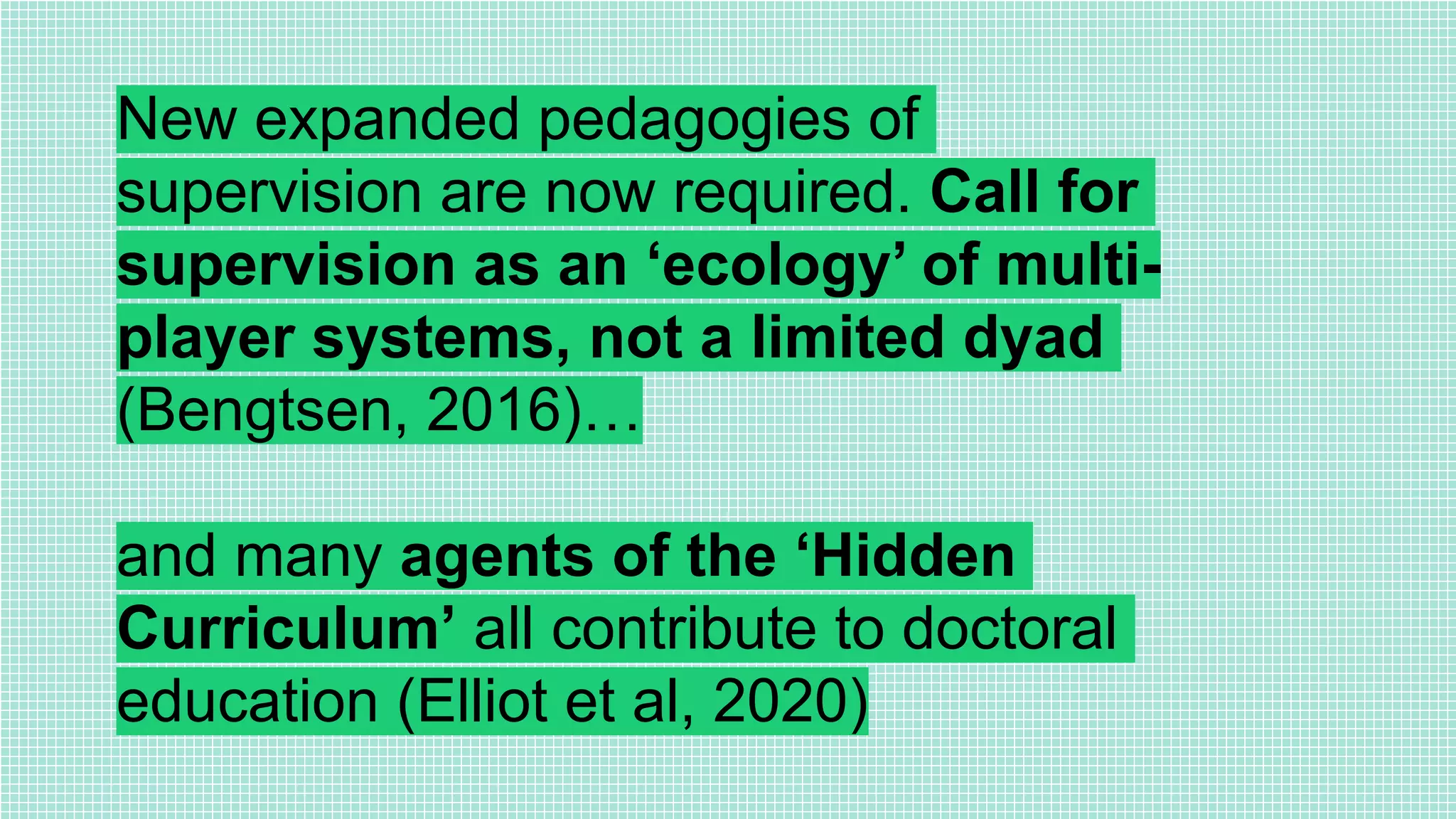
New expanded pedagogies of
supervision are now required. Call for
supervision as an ‘ecology’ of multi-
player systems, not a limited dyad
(Bengtsen, 2016)…
and many agents of the ‘Hidden
Curriculum’ all contribute to doctoral
education (Elliot et al, 2020)
And a number of
strategic drivers ask
this of us…
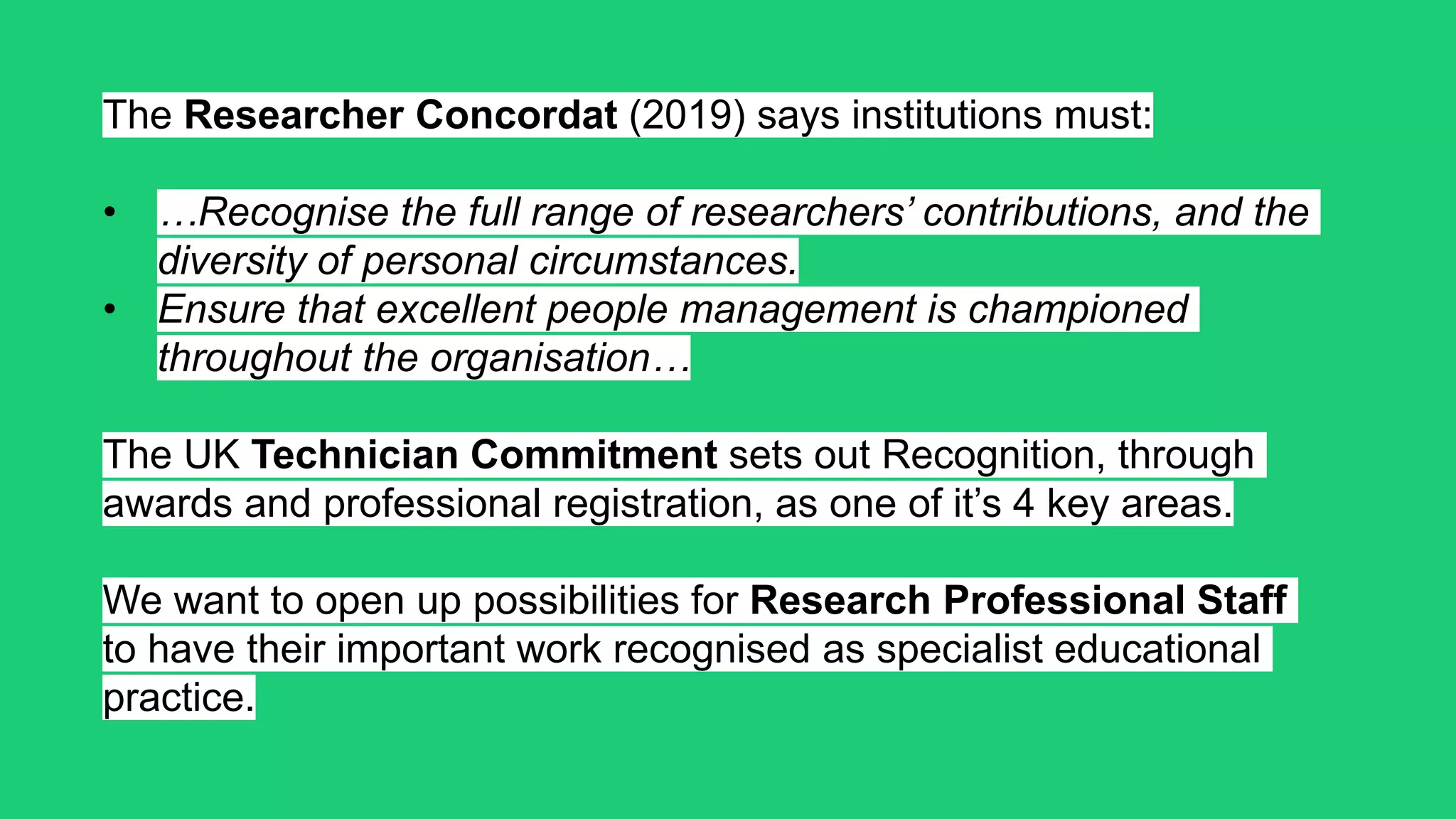
The Researcher Concordat (2019) says institutions must:
• …Recognise the full range of researchers’ contributions, and the
diversity of personal circumstances.
• Ensure that excellent people management is championed
throughout the organisation…
The UK Technician Commitment sets out Recognition, through
awards and professional registration, as one of it’s 4 key areas.
We want to open up possibilities for Research Professional Staff
to have their important work recognised as specialist educational
practice.
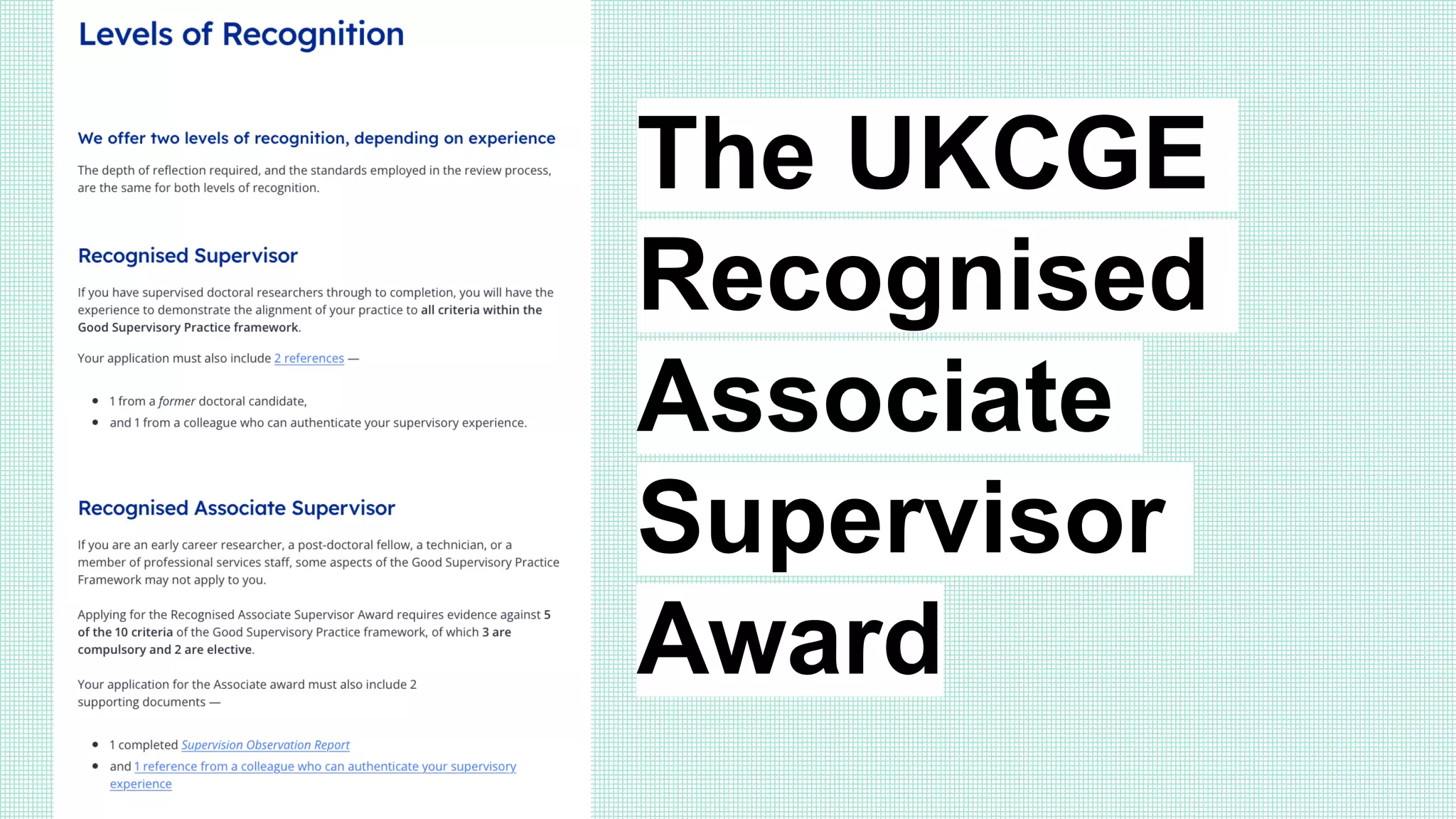
The UKCGE
Recognised
Associate
Supervisor
Award
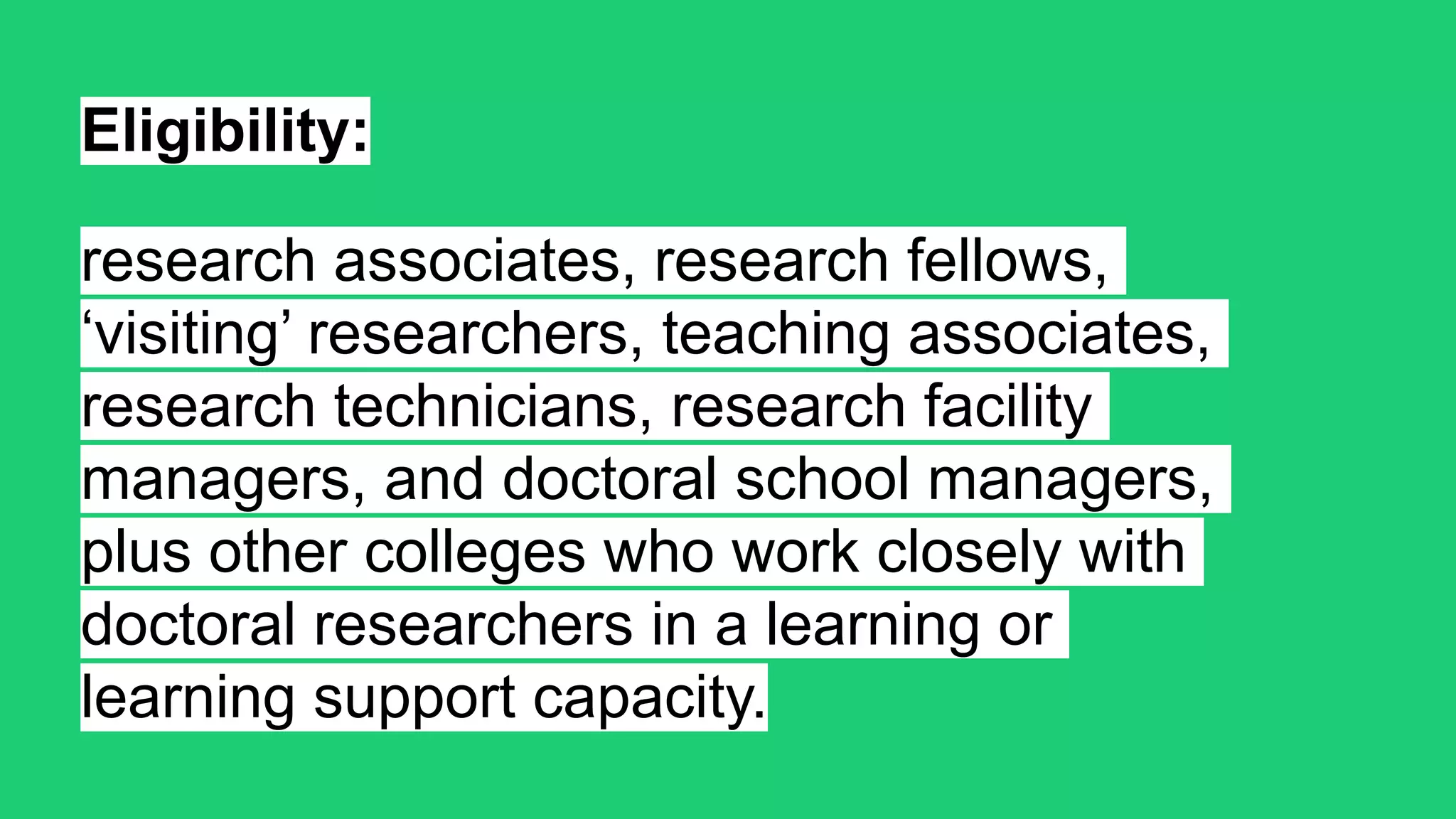
Eligibility:
research associates, research fellows,
‘visiting’ researchers, teaching associates,
research technicians, research facility
managers, and doctoral school managers,
plus other colleges who work closely with
doctoral researchers in a learning or
learning support capacity.
• Same standards of practice
• Retrospective recognition
• But also developmental in itself
• Not linked to a specific role
• Not linked to a number of completions
• Promotion? Institution choice
Hat tip to Dr Elizabeth
Adams, to Dr Owen
Gower, Prof. Stan
Taylor and to the
many researchers at
the University of
Sheffield who gave
their time as mentors.
As for the ‘full’ Recognised Research
Supervisor Award, the Associate Award:
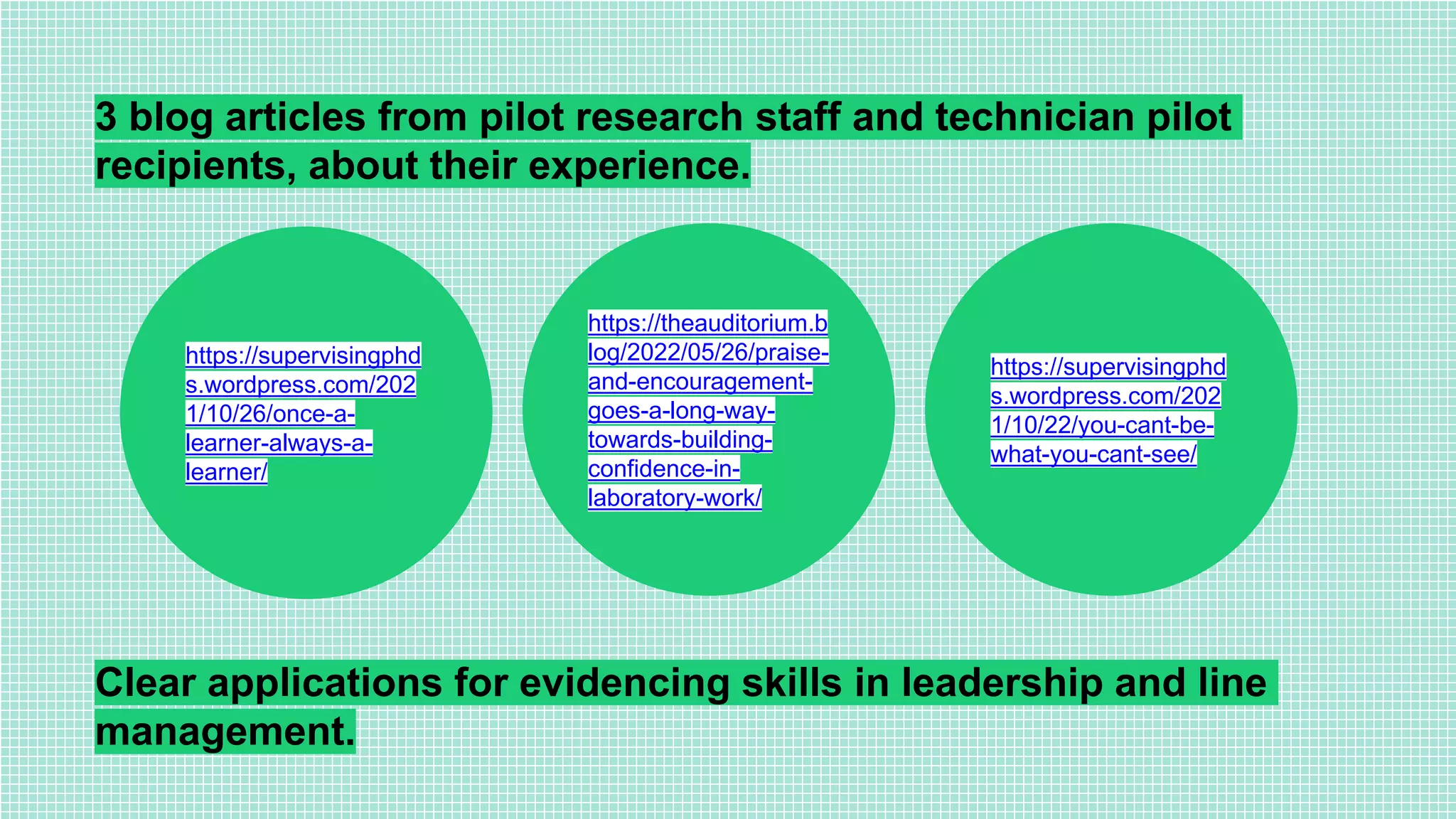
3 blog articles from pilot research staff and technician pilot
recipients, about their experience.
Clear applications for evidencing skills in leadership and line
management.
https://supervisingphd
s.wordpress.com/202
1/10/26/once-a-
learner-always-a-
learner/
https://theauditorium.b
log/2022/05/26/praise-
and-encouragement-
goes-a-long-way-
towards-building-
confidence-in-
laboratory-work/
https://supervisingphd
s.wordpress.com/202
1/10/22/you-cant-be-
what-you-cant-see/
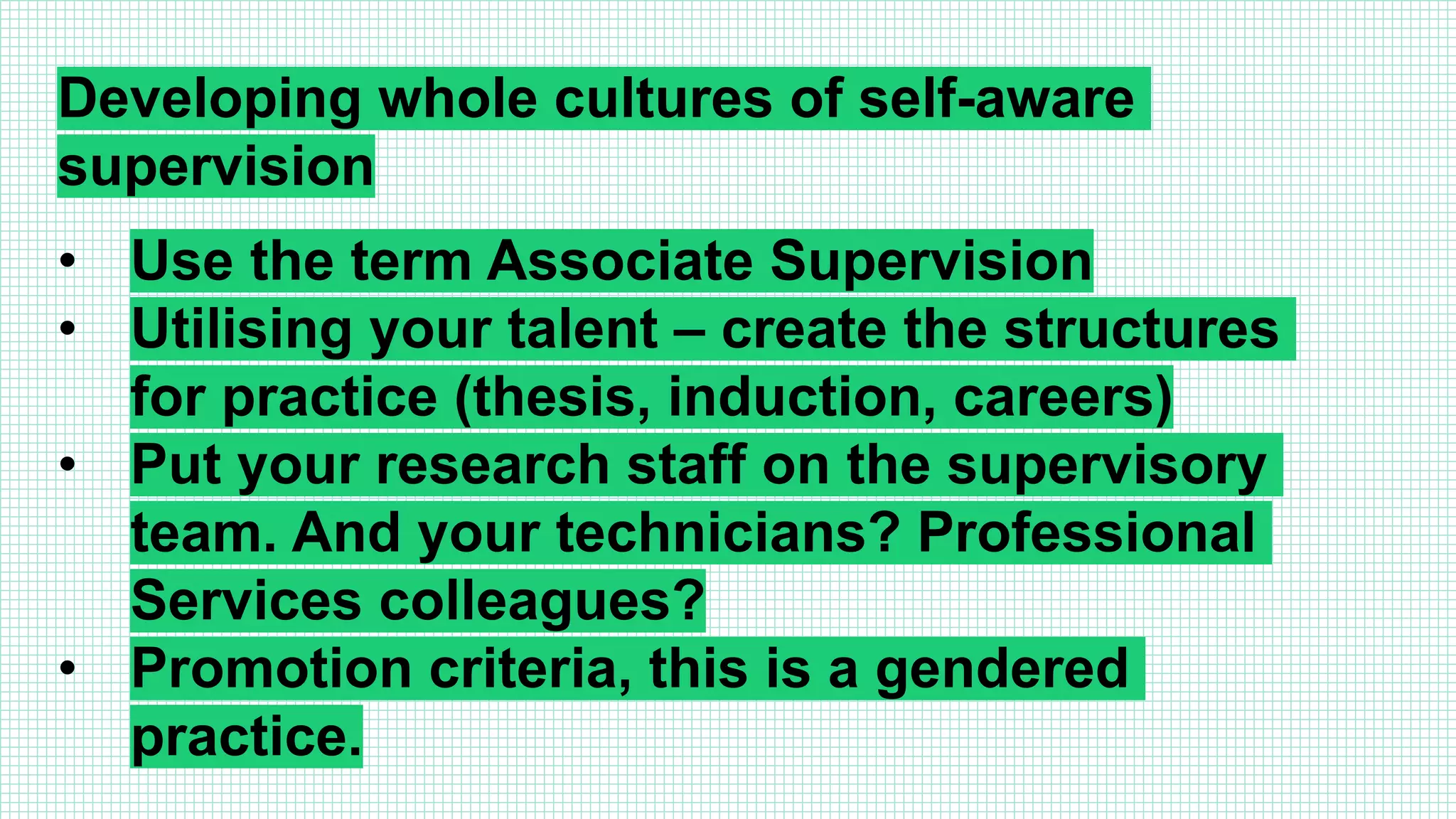
Developing whole cultures of self-aware
supervision
• Use the term Associate Supervision
• Utilising your talent – create the structures
for practice (thesis, induction, careers)
• Put your research staff on the supervisory
team. And your technicians? Professional
Services colleagues?
• Promotion criteria, this is a gendered
practice.
Include Associate Supervisors in supervisor
communities and conversations
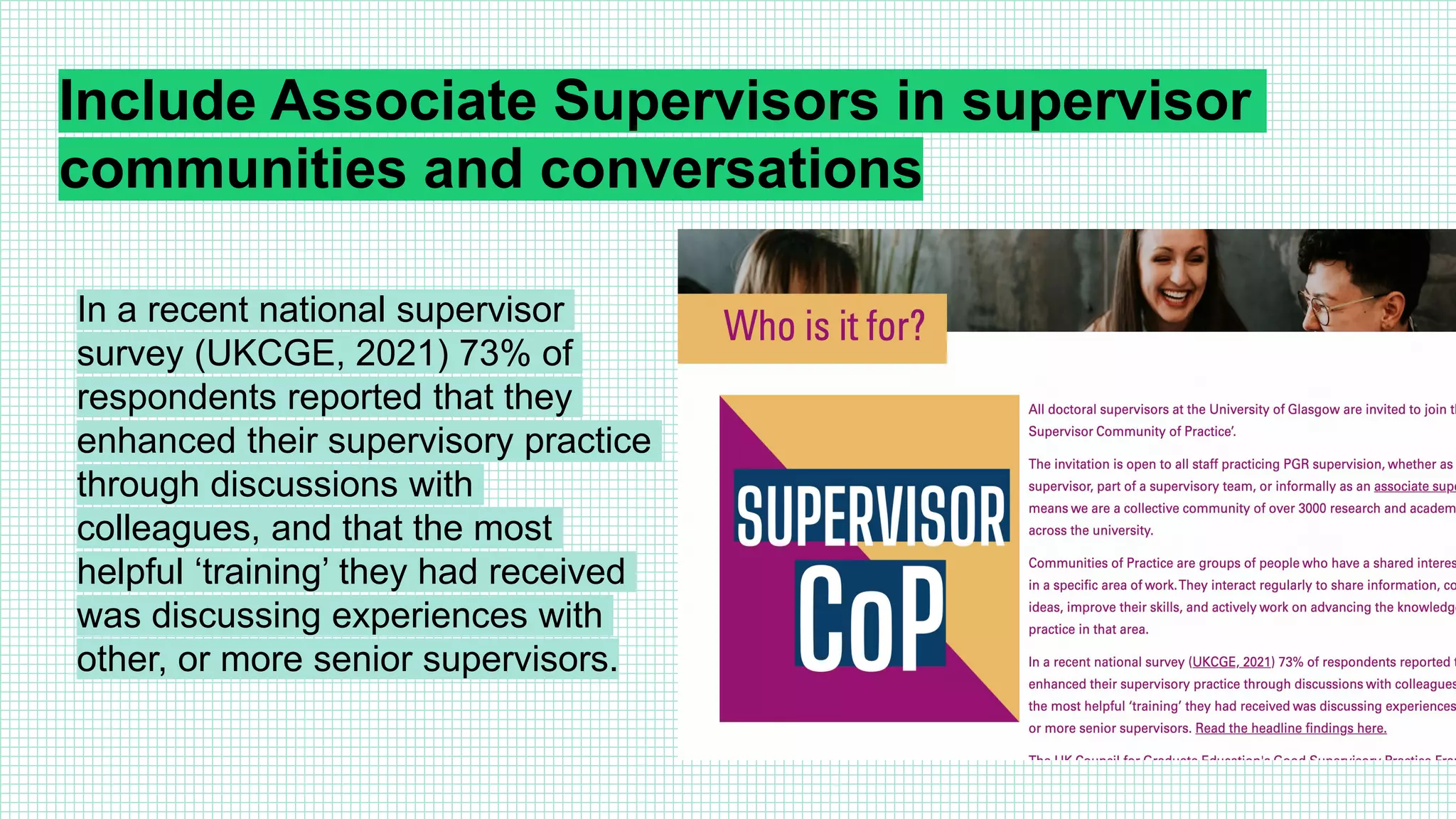
In a recent national supervisor
survey (UKCGE, 2021) 73% of
respondents reported that they
enhanced their supervisory practice
through discussions with
colleagues, and that the most
helpful ‘training’ they had received
was discussing experiences with
other, or more senior supervisors.
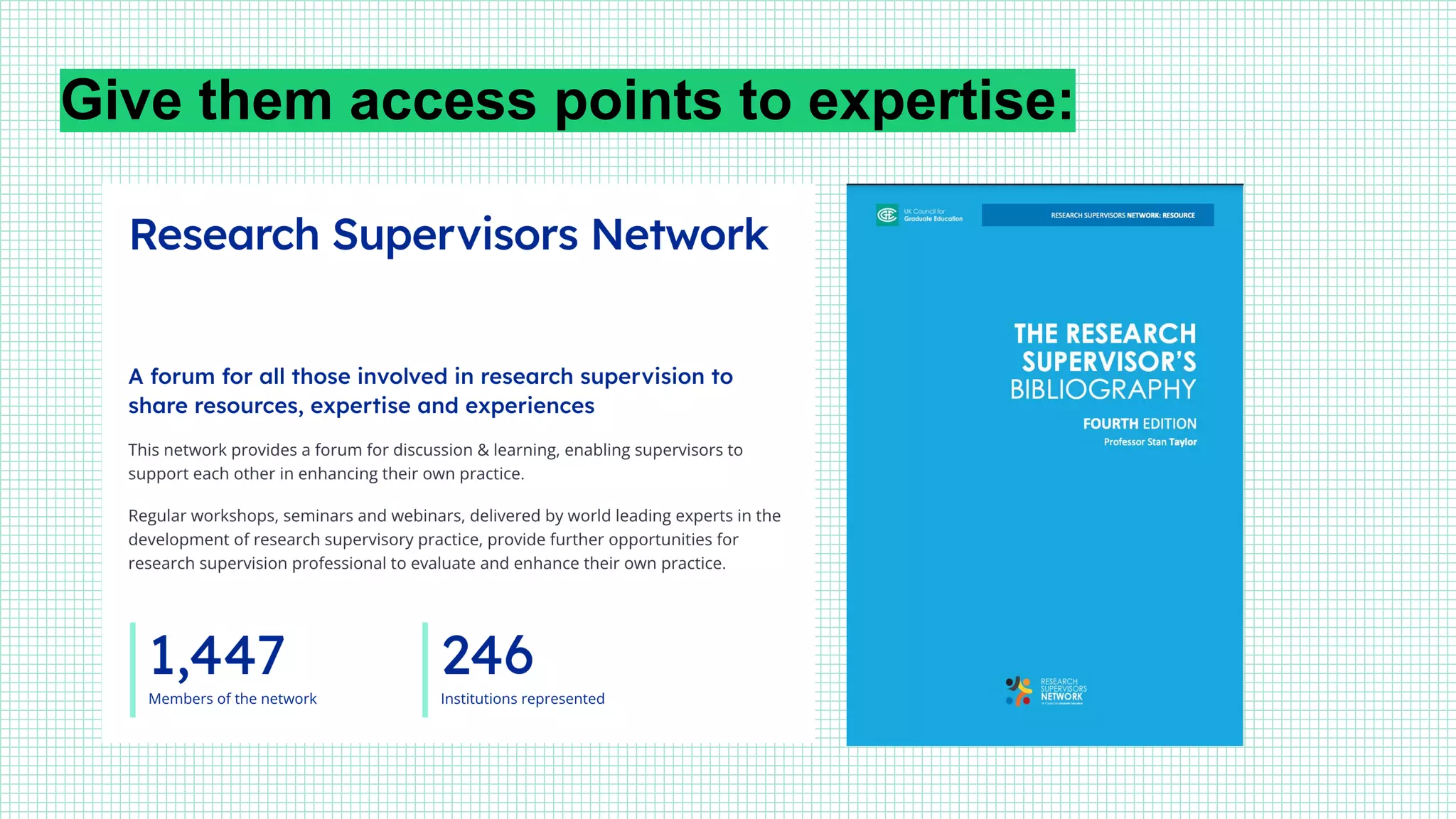
Give them access points to expertise:
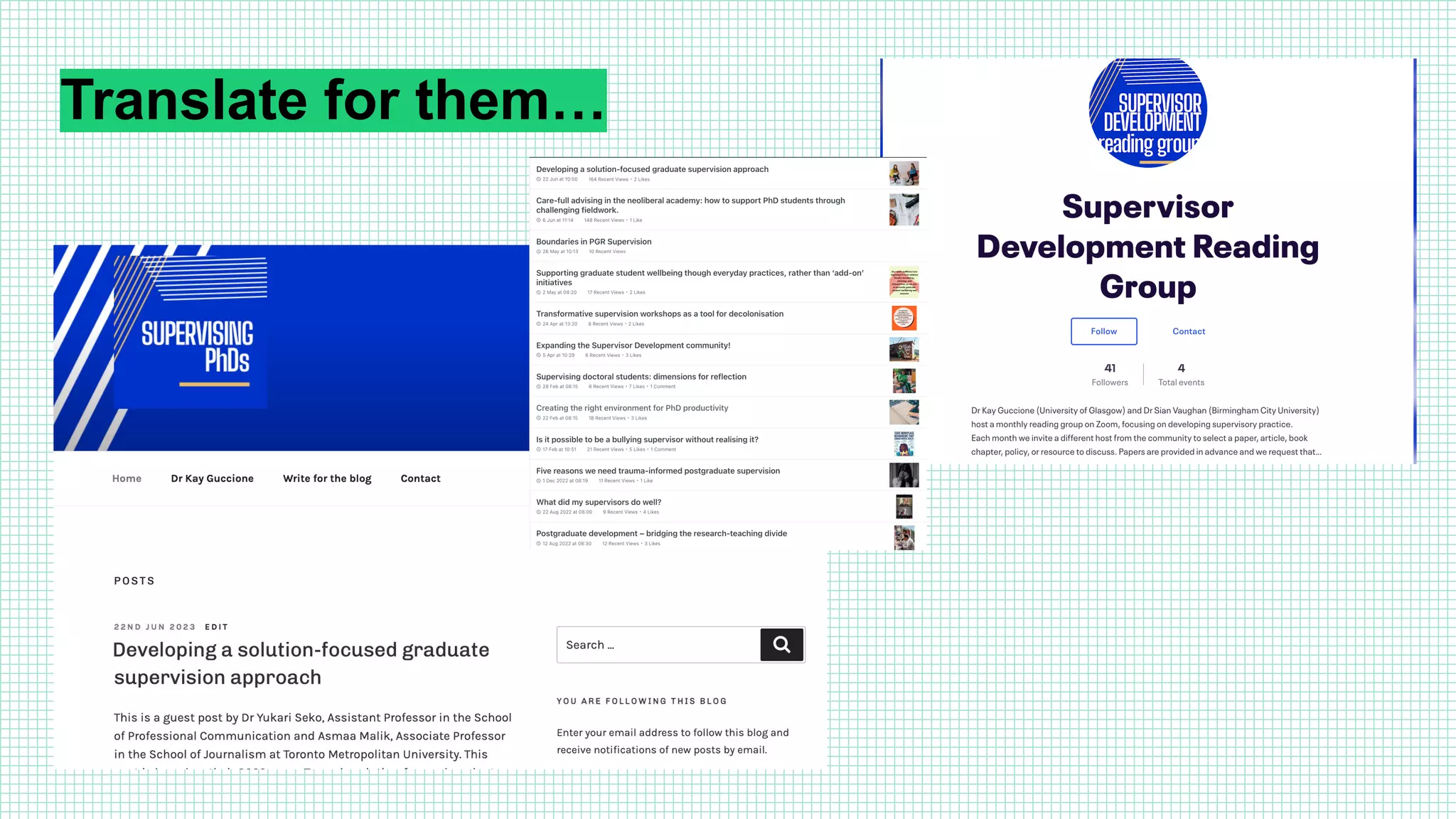
Translate for them…
‘I never
thought of
this work as
supervision,
but it
definitely
is!’

AC23 - RSRP.pdf

  • 1.
    UK Council for GraduateEducation Research Supervision Recognition Programme Dr Owen Gower, Director UK Council for Graduate Education
  • 2.
    UK Council for GraduateEducation Aims of the Research Supervision Recognition Programme 1. Develop and publish a Good Supervisory Practice Framework that sets benchmarks for supervision and articulates the increasingly complex roles performed by research supervisors. 2. Offer guidance for those who wish to develop their pedagogical practices through structured self-reflection on their supervisory experiences 3. Offer opportunities for good supervisory practice to be recognised through peer-review and a national award 4. Create a comprehensive, scholarly resource library which makes the extensive body of research into doctoral supervision accessible to all those involved in research supervision
  • 3.
    UK Council for GraduateEducation Update on Progress • Supervisors from 54 institutions have submitted applications for peer-review • 260 applications in total (with 80% success) • Good Supervisory Practice Framework is now embedded in many institutional supervisor development training programmes • New website now has searchable abstracts of all scholarship on doctoral pedagogy: www.supervision.ukcge.ac.uk
  • 4.
    UK Council for GraduateEducation “You don’t learn from experience, you learn from reflecting on experience” John Dewey (probably)
  • 5.
    UK Council for GraduateEducation Supervisory anxiety by career stage 3% 6% 7% 21% 28% 28% 18% 18% 18% 34% 32% 29% 24% 15% 17% 0% 0% 1% Late career Mid-career Early career Strongly agree Agree Neither agree nor disagree Disagree Strongly disagree Unsure
  • 6.
    UK Council for GraduateEducation Time to reflect on supervisory practice by career stage 2% 2% 4% 17% 12% 12% 14% 11% 16% 37% 34% 32% 21% 27% 23% 10% 13% 14% Late career Mid-career Early career Always Frequently Unsure Occasionally Rarely Never
  • 7.
    UK Council for GraduateEducation Time to reflect by supervisory anxiety 5% 9% 7% 4% 4% 4% 28% 25% 29% 26% 19% 18% 17% 17% 18% 18% 20% 12% 27% 25% 32% 35% 37% 27% 21% 23% 14% 17% 19% 37% 1% 0% 0% 0% 0% 1% Unsure Never Rarely Occasionally Frequently Always Strongly agree Agree Neither agree nor disagree Disagree Strongly disagree Unsure
  • 8.
  • 9.
    Dr Kay Guccione Headof Research Culture & Researcher Development and founder member of the Postdoc Fanclub University of Glasgow Recognising Associate Supervision
  • 10.
    Supervision, a keydeterminant of doctoral ‘success’ is an important and complex interpersonal practice. Research Staff (ECRs; post-docs) play a key, if still somewhat un-recognised, role in the development and support of PGRs And are not always seen as educational assets, or understood to possess supervision skills or experience.
  • 11.
  • 12.
    ‘I never thoughtof this work as supervision, but it definitely is!’ Thesis Mentor
  • 13.
    Pedagogical framing forThesis Mentoring PGR mentees: Writing is a difficult practice. One-to-one coaching (Godskesen and Kobayashi, 2015) can provide a space for critical reflection on writing difficulties, supporting resolution, positive progress, and reducing drop out. Research Staff mentors: Calls for doctoral supervisor training to be ‘writing- centred’ (Guerin et al, 2017; Caley, 2020) and simultaneously for researcher development to be experienced-based (McAlpine et al., 2013; Guccione et al., 2018), built through practice. Design choices: Self-referred thesis writers, Solution Focused coaching approach, confidential, cross disciplinary, complementarity, mentor/ee training, mentor toolkits, 8 meetings, 16-weeks.
  • 14.
    I get upand I sit down to work, I should write but I don’t. I am writing up, but I’m not. I hate writing, we are not friends. I tell people I am at home writing up, I am doing everything except writing because I can’t face it. I feel sick about writing. I get hot flushes about it [..]. I get panic attacks. My body hurts from it. Every day is the same, waiting for inspiration, disappointment that I don’t know what or how to write, going to bed and not sleeping This is worse than being in labour, that was at least over in 19h, this has been months, it’s so much more pain. I am not writing because my writing is poor and it disgusts me when I see it.
  • 15.
    Skip to theend: themes related to mentor development (196 mentor exit surveys and 7 x 2h interviews) 1. Mentors develop general supervisory self-awareness and skill sets that facilitate the building of trusting learning alliances. 2. Mentors develop greater understanding of the enablers and disablers of doctoral writing.
  • 16.
    1. Mentors developgeneral supervisory self- awareness and skill sets that facilitate the building of trusting learning alliances Research Staff described how they had learned to build trust and to form an alliance with their mentees. • Working with clear role descriptions, shared understanding, boundaries and limitations; • Open listening and empathy in paying attention to the mentee’s objectives and expectations; • Co-creating solutions to writing blocks and barriers.
  • 17.
    “I would makesure they are alright. Like in themselves as well as their work…once you feel relaxed with someone it makes talking about the work easier. Not necessarily that I think you need to be friends with people that you’re supervising but you, I think it’s just like, people management skills, isn’t it? That if you take an interest in a person, I think they are more willing to give you something back, to open up and talk about it.” “He was looking for a proof reader. So I had to be very clear with him that that wasn’t what I was there for, but we did investigate some ways in which he could take action to [go and find] that. In terms of planning, I could have given him an answer, I was very conscious in myself to reign myself in a bit, like, I’m not going to tell you how I’d do this. I’m going to let you talk it out. At the end of it he charged out of my office and went ‘right I’m off to do this!’”
  • 18.
    2. Mentors developgreater understanding of the enablers and disablers of doctoral writing Research Staff described how they had developed a greater awareness of the role of the supervisor in: • Encouraging early and frequent writing and embedding a sense of drafting and refinement as a continuous or cyclical doctoral process; • Giving feedback that builds confidence as well as competence in writing; • Building students’ self-awareness and problem-solving skills by taking time to engage in a critical reflective dialogue.
  • 19.
    "They know theyhave to write a thesis, they go ‘oh yes I’ve written a report before’…and it when it comes down to it they realise oh, my, god that’s not going to be done in a day or two. Err its huge. I personally think a lot of the supervision work needs to be done when they are writing their upgrade. Cos that’s the right place, its early enough in the process to identify those who will have serious trouble writing…” “…kind of anxiety of procrastination… because he does a lot of reading but then didn’t know how to take that forward into actually putting, kind of, himself onto a computer and get writing. …But I think it just boiled down to a bit of a lack of confidence. He was anxious about how it would be received. Or it wouldn’t be good enough. And I think he just worked himself up into a bit of a state. All I did was listen.”
  • 20.
    Sites of supervisory informationseeking by Thesis Mentors, prompted by thesis mentoring
  • 21.
    Associate Supervisors: educationalassets 4. Research staff develop engaged information seeking strategies to inform their development and practice. 3. Research staff develop an awareness of supervision as a ‘learned and developed practice’, not automatic, and not easy. 2. Research staff combine cognitive (lists, planning) and emotional/motivational (listening, empathy) strategies to unstick thesis writers and support mental health. 1. Research staff can develop as ‘writing focused’ supervisors, building partnerships and devising individualised solutions for enabling doctoral writing. We should develop and recognise Research Staff as talented practitioners of supervision, with a unique educational contribution and with time to learn the craft 5. Research staff make a contribution to PGR writing development, that supervisors cannot: neutral, near-peer, non-evaluative/judgmental.
  • 22.
    Other ducks inthe row…
  • 23.
    New expanded pedagogiesof supervision are now required. Call for supervision as an ‘ecology’ of multi- player systems, not a limited dyad (Bengtsen, 2016)… and many agents of the ‘Hidden Curriculum’ all contribute to doctoral education (Elliot et al, 2020)
  • 24.
    And a numberof strategic drivers ask this of us…
  • 25.
    The Researcher Concordat(2019) says institutions must: • …Recognise the full range of researchers’ contributions, and the diversity of personal circumstances. • Ensure that excellent people management is championed throughout the organisation… The UK Technician Commitment sets out Recognition, through awards and professional registration, as one of it’s 4 key areas. We want to open up possibilities for Research Professional Staff to have their important work recognised as specialist educational practice.
  • 26.
  • 27.
    Eligibility: research associates, researchfellows, ‘visiting’ researchers, teaching associates, research technicians, research facility managers, and doctoral school managers, plus other colleges who work closely with doctoral researchers in a learning or learning support capacity.
  • 28.
    • Same standardsof practice • Retrospective recognition • But also developmental in itself • Not linked to a specific role • Not linked to a number of completions • Promotion? Institution choice Hat tip to Dr Elizabeth Adams, to Dr Owen Gower, Prof. Stan Taylor and to the many researchers at the University of Sheffield who gave their time as mentors. As for the ‘full’ Recognised Research Supervisor Award, the Associate Award:
  • 29.
    3 blog articlesfrom pilot research staff and technician pilot recipients, about their experience. Clear applications for evidencing skills in leadership and line management. https://supervisingphd s.wordpress.com/202 1/10/26/once-a- learner-always-a- learner/ https://theauditorium.b log/2022/05/26/praise- and-encouragement- goes-a-long-way- towards-building- confidence-in- laboratory-work/ https://supervisingphd s.wordpress.com/202 1/10/22/you-cant-be- what-you-cant-see/
  • 30.
    Developing whole culturesof self-aware supervision • Use the term Associate Supervision • Utilising your talent – create the structures for practice (thesis, induction, careers) • Put your research staff on the supervisory team. And your technicians? Professional Services colleagues? • Promotion criteria, this is a gendered practice.
  • 31.
    Include Associate Supervisorsin supervisor communities and conversations In a recent national supervisor survey (UKCGE, 2021) 73% of respondents reported that they enhanced their supervisory practice through discussions with colleagues, and that the most helpful ‘training’ they had received was discussing experiences with other, or more senior supervisors.
  • 32.
    Give them accesspoints to expertise:
  • 33.
  • 34.
    ‘I never thought of thiswork as supervision, but it definitely is!’