Topic Maps, Douglas
Engelbart, and Everything

                     Jack Park
               GivingSpace Meeting
                 September, 2002
© Jack Park, 2002   http://creativecommons.org/licenses/by/3.0/
Abstract
 We look at Topic Maps in the context online
  community development. The talk intends to
  develop a context based on the evolution of
  tools capable of supporting and augmenting
  what Douglas Engelbart calls the Capabilities
  Infrastructure of Networked Improvement
  Communities.


 20020915              ©Jack Park 2002
Plan
   Motivational Stuff
        Context, Scary stuff, etc…
   Introduction to Topic Maps
   Introduction to Douglas Engelbart
   Augmented Story Telling
   Towards an Architecture for Augmented
   Story Telling
 20020915                 ©Jack Park 2002
Reality Check
 “I'm only a child and I don't have all the solutions, but I want you to
 realise, neither do you!
                  You don't know how to fix the holes in our ozone layer.
                  You don't know how to bring salmon back up a dead
                  stream.
                  You don't know how to bring back an animal now extinct.
                  And you can't bring back forests that once grew where
                  there is now desert.
 If you don't know how to fix it, please stop breaking it!”
             – Severn Suzuki, age 12, in a talk presented to the Earth Summit in Brazil, 1992


  20020915                                     ©Jack Park 2002
Motivation
   “…what we know and need today may
   be insufficient to solve tomorrow's
   problems” –W3C[http://www.w3.org/Consortium/Points/]


   “…We shall require a substantially new
   manner of thinking if mankind is to
   survive.” –Albert Einstein


 20020915                 ©Jack Park 2002
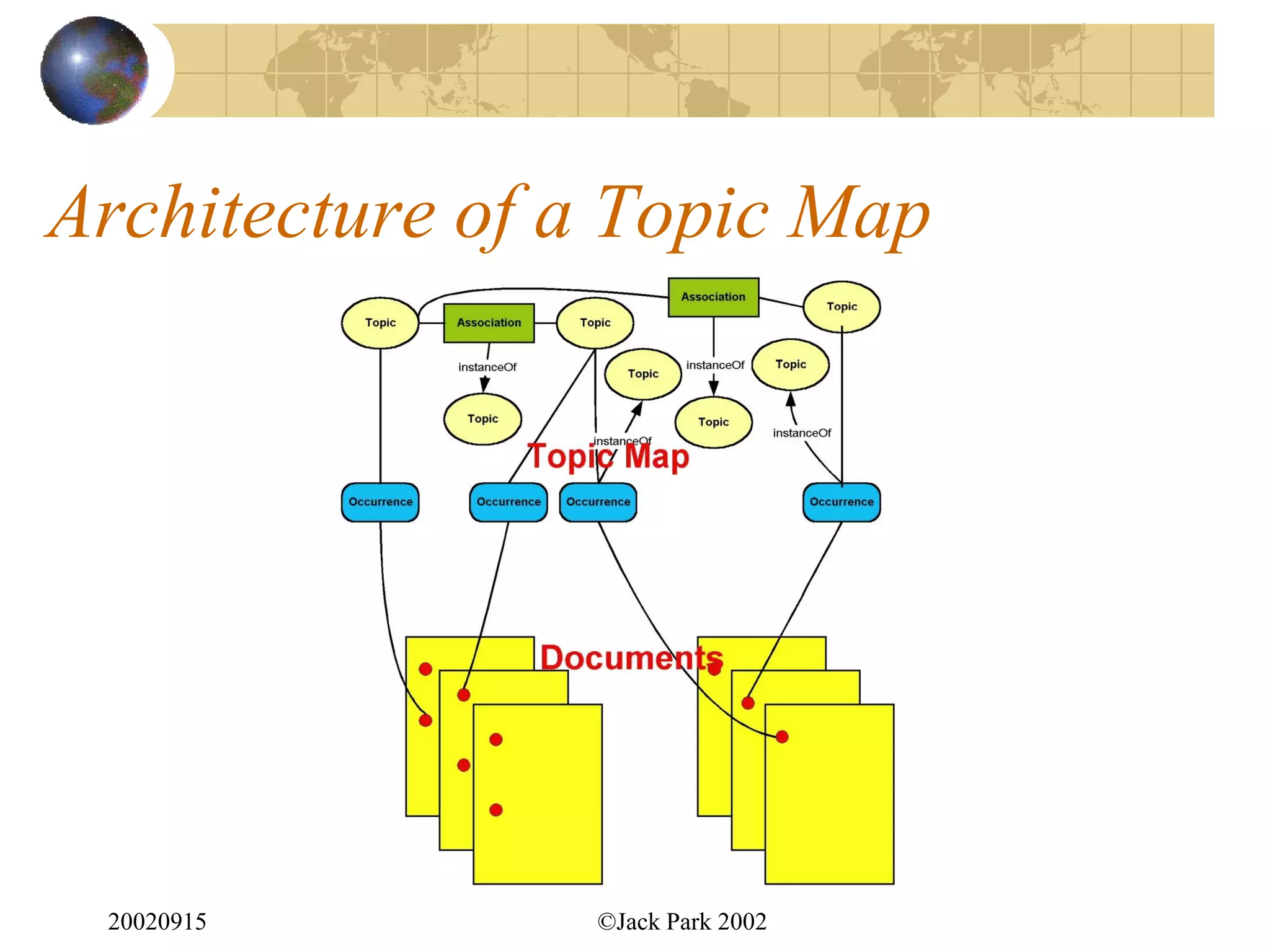
About Topic Maps
    Topic Maps
            Are like the index of a book
            Reside outside of the information resource
            (book, documents)
            Facilitate the construction of a relational
            knowledge base about information
            resources
            Facilitate indexing into information
            resources

 20020915                    ©Jack Park 2002
Elements of a Topic Map: Topic
    A Topic is a container for information
    that is related to a Subject
            One Topic per Subject
    Information related to a Topic includes
            Names
            Occurrences
            Roles played in Associations
             • Topics associated with other Topics

 20020915                      ©Jack Park 2002
Elements of a Topic Map:
Associations
    Associations express relationships
    between Topics.
    Associations are typed
            instanceOf (Topics)
    Associations point to members (Topics)
            Members can have roles (Topics)


 20020915                    ©Jack Park 2002
Elements of a Topic Map:
Occurrences
    Occurrences point to specific objects in
    information resources (documents)
    Occurrences can be typed
            instanceOf (Topics)


 20020915                    ©Jack Park 2002
Architecture of a Topic Map


 20020915       ©Jack Park 2002
Segue numero uno
    How do Topic Maps relate to Douglas
    Engelbart?
            Roles they play in organizing his
            Networked Improvement Communities
            Roles they play in story-telling activities
            within those (and other) communities


 20020915                      ©Jack Park 2002
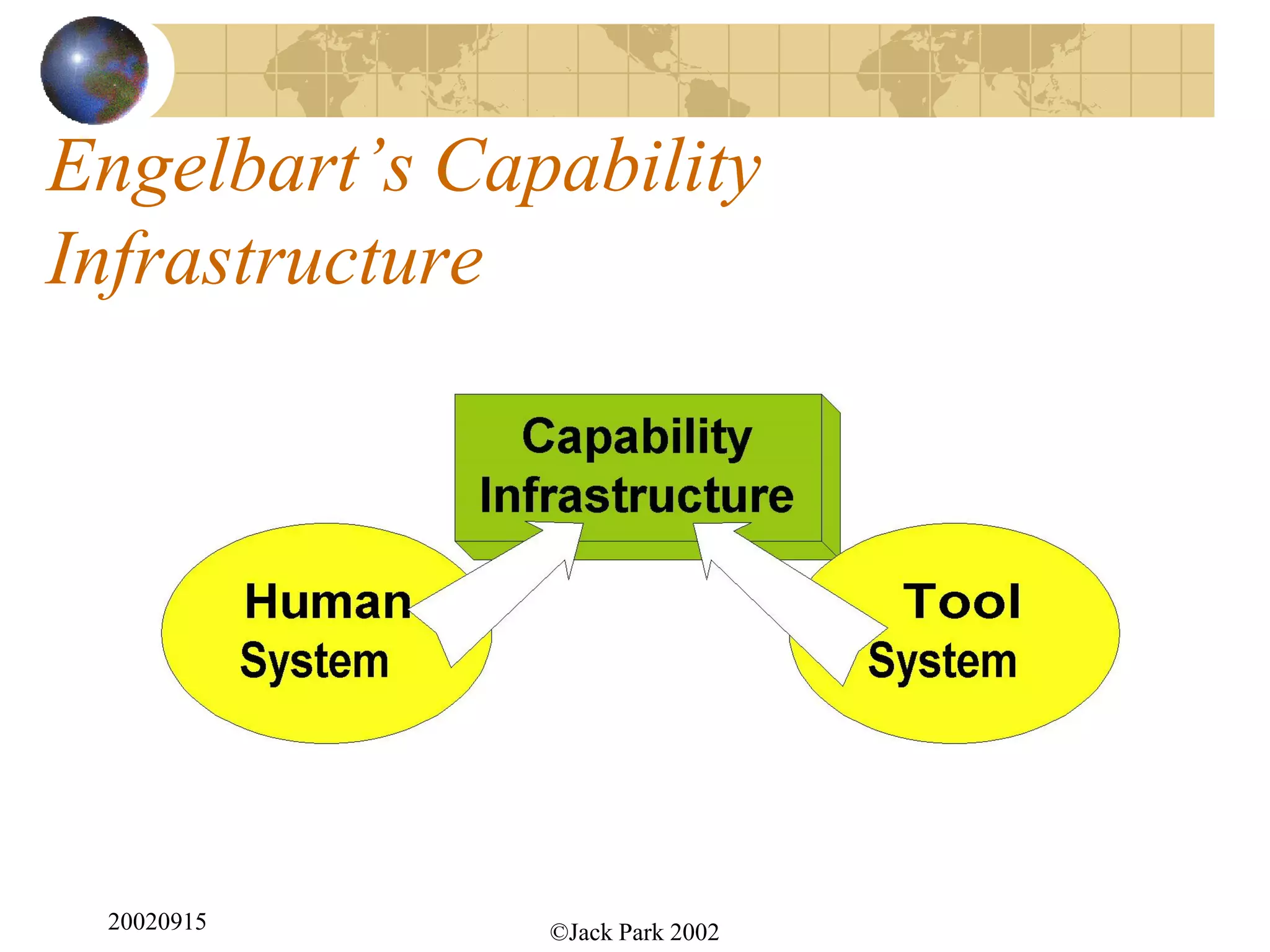
Engelbart’s Capability
Infrastructure


 20020915      ©Jack Park 2002
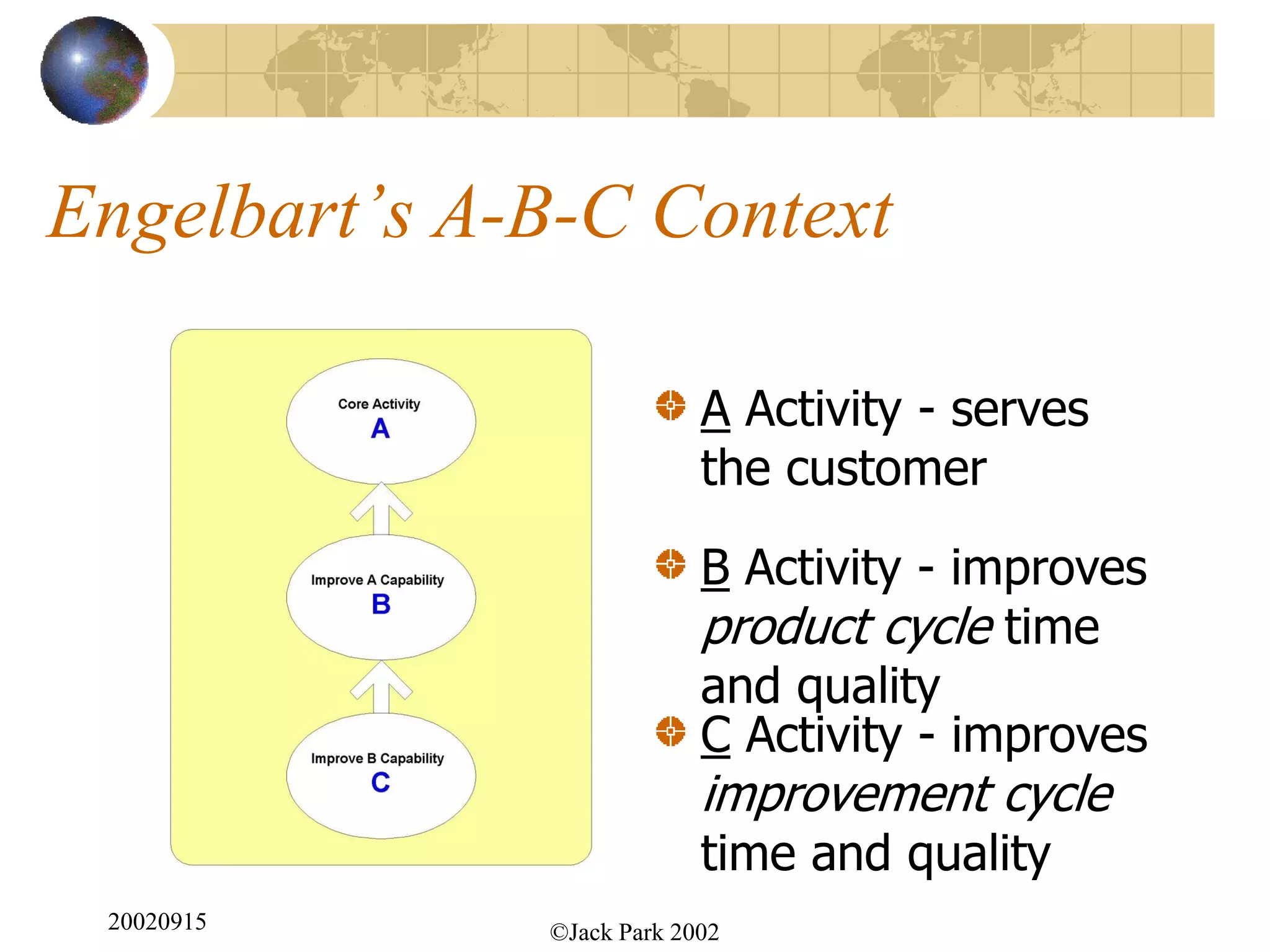
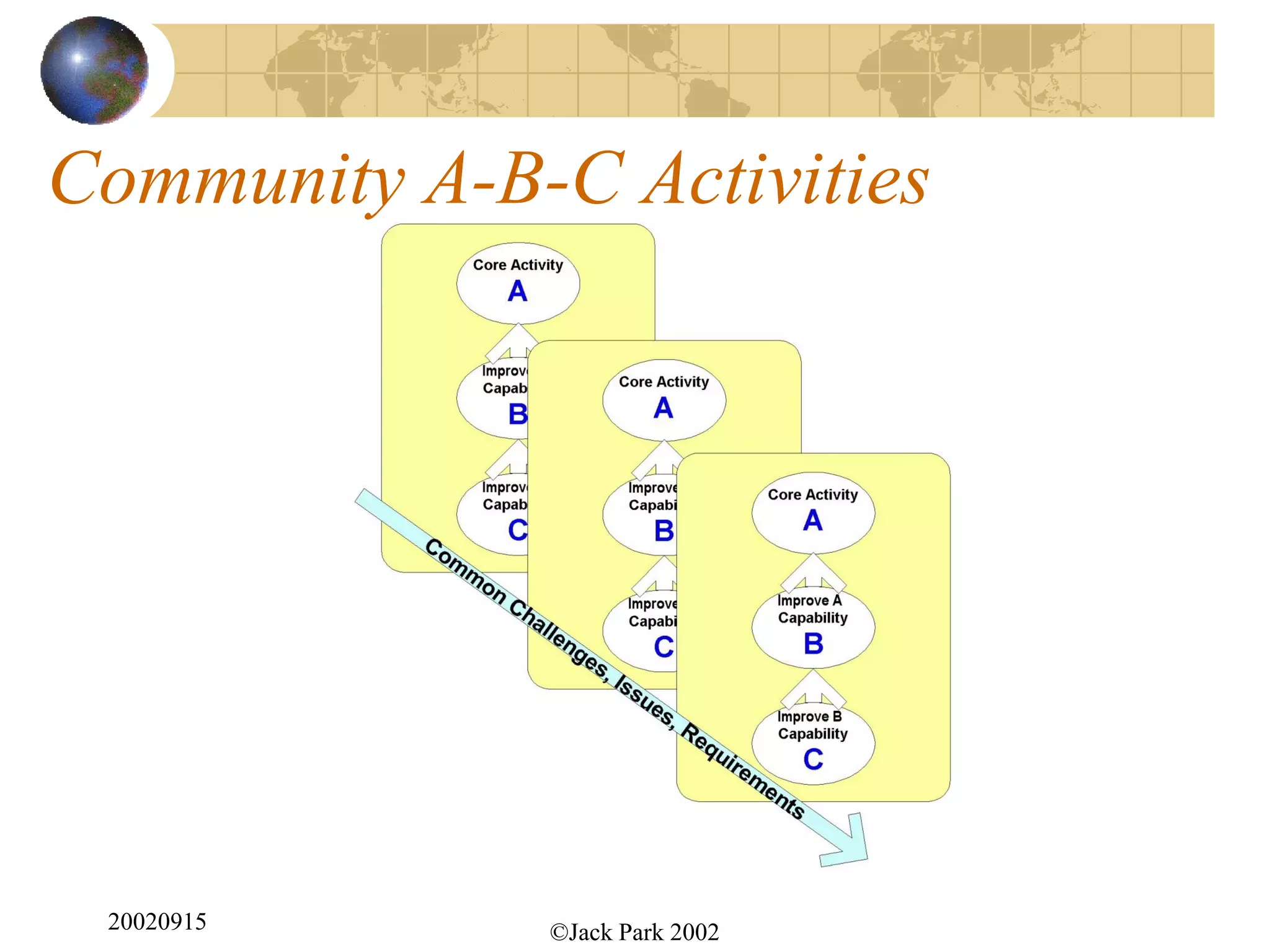
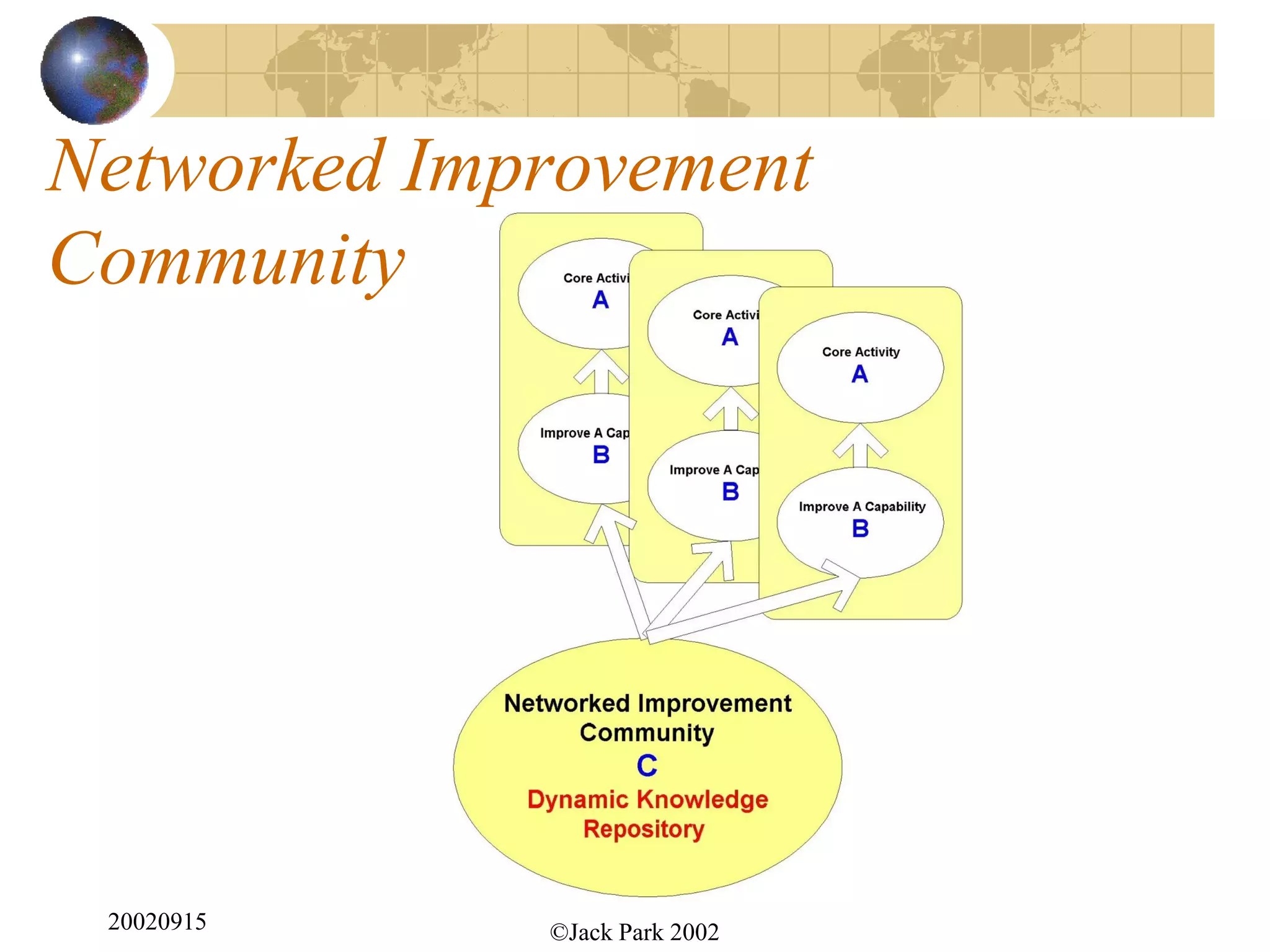
Engelbart’s A-B-C Context

                           A Activity - serves
                           the customer

                           B Activity - improves
                           product cycle time
                           and quality
                           C Activity - improves
                           improvement cycle
                           time and quality
 20020915     ©Jack Park 2002
Community A-B-C Activities


 20020915     ©Jack Park 2002
Networked Improvement
Community


 20020915    ©Jack Park 2002
Interlude: Knowledge and
Augmentation
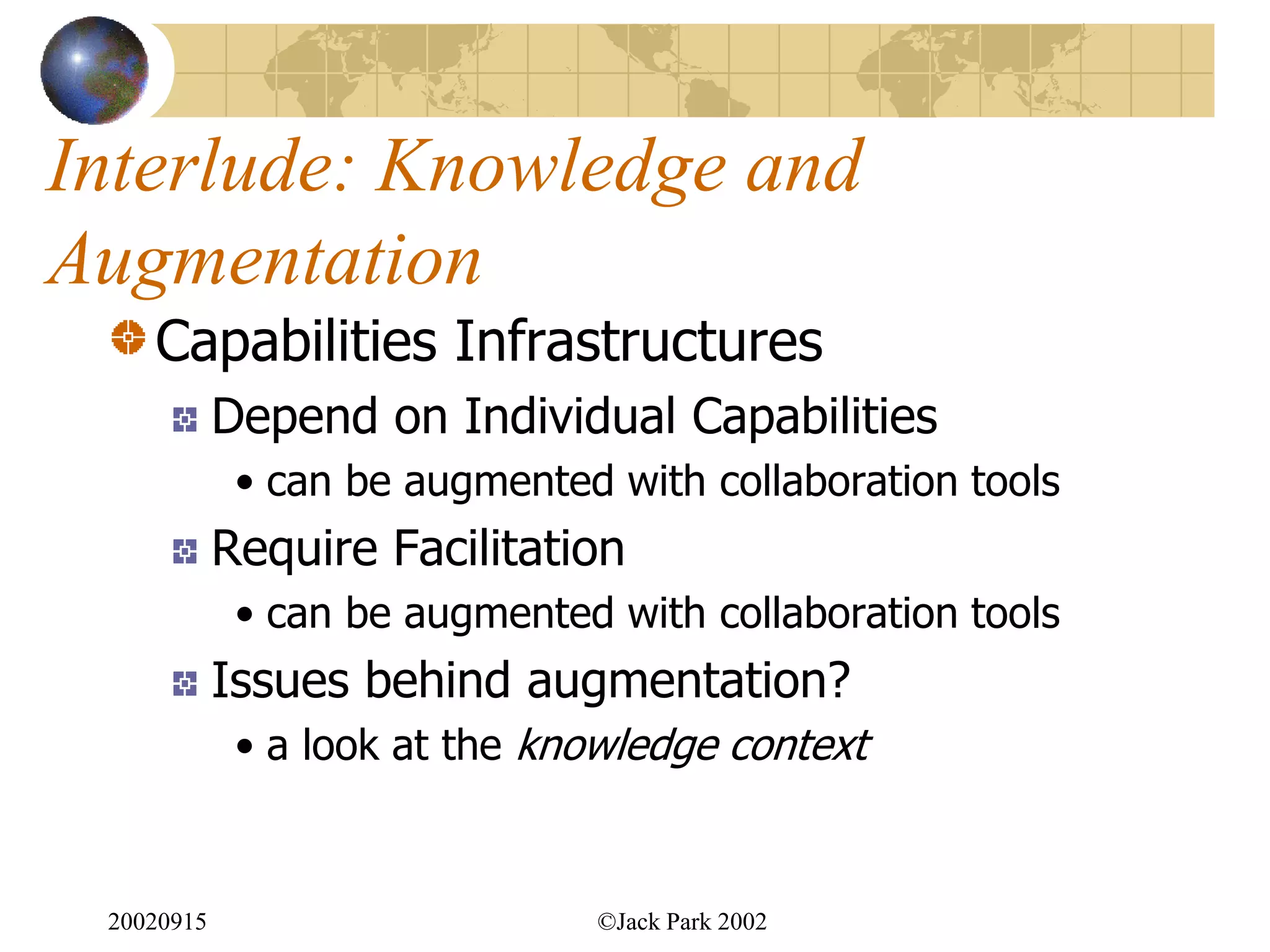
    Capabilities Infrastructures
            Depend on Individual Capabilities
             • can be augmented with collaboration tools
            Require Facilitation
             • can be augmented with collaboration tools
            Issues behind augmentation?
             • a look at the knowledge context


 20020915                      ©Jack Park 2002
What is Knowledge?
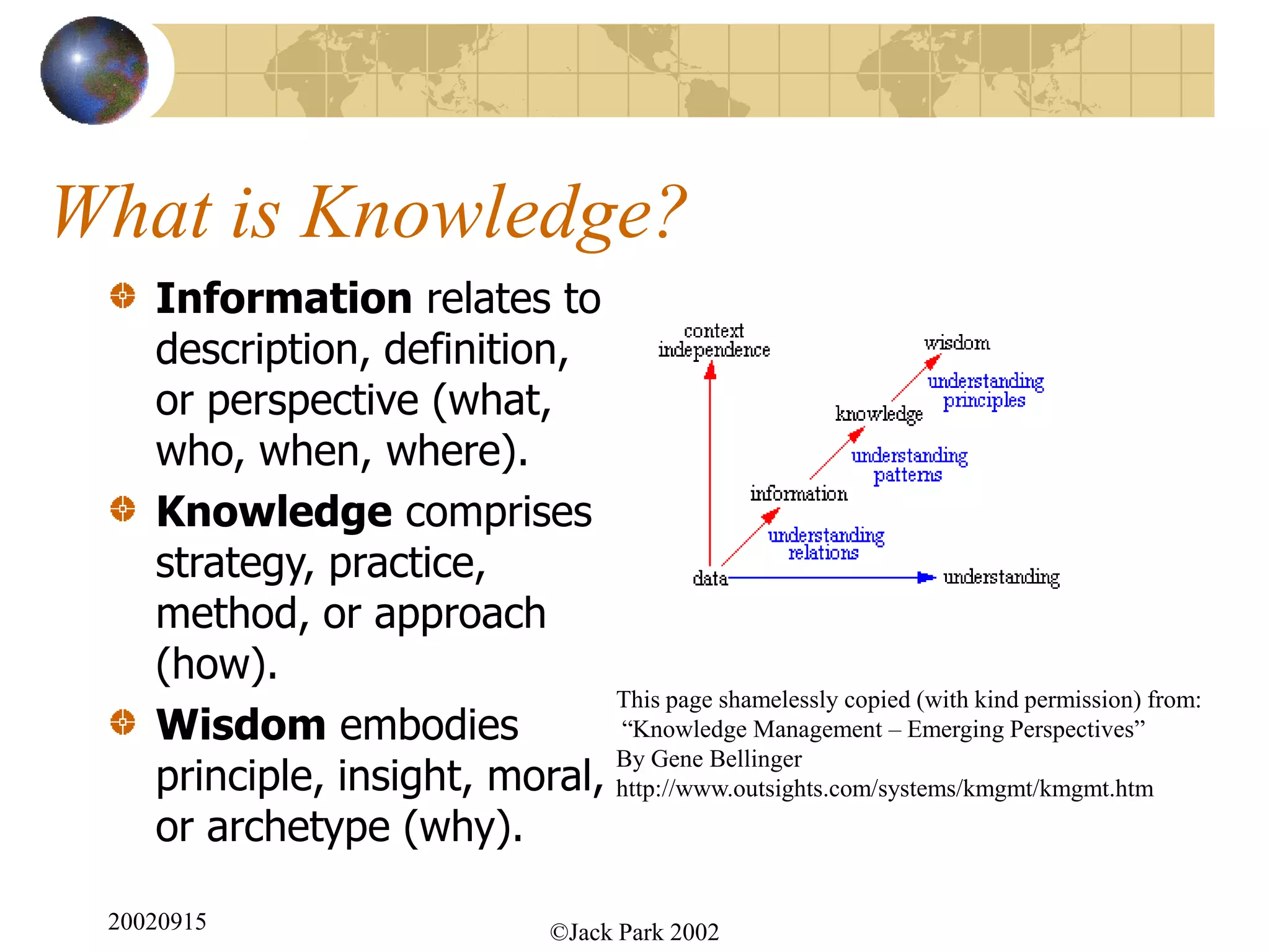
    Information relates to
    description, definition,
    or perspective (what,
    who, when, where).
    Knowledge comprises
    strategy, practice,
    method, or approach
    (how).
                               This page shamelessly copied (with kind permission) from:
    Wisdom embodies            “Knowledge Management – Emerging Perspectives”

    principle, insight, moral, http://www.outsights.com/systems/kmgmt/kmgmt.htm
                               By Gene Bellinger


    or archetype (why).

 20020915                          ©Jack Park 2002
Gowan’s Knowledge V –Building
Knowledge


            After: Joseph D. Novak.
            “The Pursuit of a Dream: Education Can be Improved”
            In: [Mintzes, et al. 1998]


 20020915                                        ©Jack Park 2002
Segue numero dos
    We know a bit about Topic Maps
    We know a bit about Improvement
    Communities
    We have heard of a DKR
    We know a bit about Knowledge
    Let‟s look at a practical knowledge
    activity:
            Story telling
 20020915                   ©Jack Park 2002
“All social change begins with a
conversation”*
    “From a casual conversation between
    two friends, a medical relief effort for
    Vietnamese children emerged. And it all
    began when „some friends and I started
    talking‟ ”

    Margaret J. Wheatley, “All Social Change begins with a conversation”,
    The Utne Reader: Society, found on the Web at http://www.utne.com,
    28 July, 2002

 20020915                         ©Jack Park 2002
Towards a Manifesto
  The reason our society must create a new language for
  learning communities that transcends school and classroom
  walls is that the dominance, attraction, and power of the
  current machine-based language of schooling is not capable
  of generating the organic patterns of the global learning
  community we now require. The very nature of the
  language, the potency of its field, and the meaning it
  constructs preempt its capacity to generate living patterns;
  only a living language can create living patterns and only
  living patterns can create living environments.
  –Stephanie Pace Marshal, “Creating Sustainable Learning Communities for the Twenty-First Century”,
  in F. Hesselbein, et al. (eds), 1997. The Organization of the Future. The Drucker Foundation.
  http://www.swaraj.org/shikshantar/resources_marshall.html


 20020915                                    ©Jack Park 2002
Edna St. Vincent Millay
            Upon this gifted age, in its dark hour,
            Rains from the sky a meteoric shower
            Of facts . . . they lie unquestioned,
            uncombined.
            Wisdom enough to leech us of our ill
            Is daily spun; but there exists no loom
            To weave it into fabric


 20020915                  ©Jack Park 2002
Towards a Point of View
    From the manifesto:
            “...only a living language can create living
            patterns and only living patterns can create
            living environments”
    From Edna St. Vincent Millay:
            “...but there exists no loom to weave it into
            fabric”
    The skill of writing is to create a context in
    which other people can think. –Edwin Schlossberg
 20020915                     ©Jack Park 2002
Augmented Story Telling rocks!
    Ta daa! A Point of View
    But, that‟s a lie     (maybe)
            We don‟t know that yet…
            We must get busy and prove it…
    Ok. Call it a working hypothesis and
    move on!


 20020915                   ©Jack Park 2002
Why Stories?
    “…stories are a powerful means to
    understand what happened (the
    sequence of events) and why (the
    causes and effects of those events).”             –
    John Seely Brown[Brown, 2000] page 106


 20020915                           ©Jack Park 2002
Why Stories on the Web?
    “With the proliferation of online interaction
    and composing of various digital online
    spaces for intercultural and global
    communication, computer-mediated
    communication and digital technologies have
    come to play a significant role in the process
    of globalization.”
 –Jilliana Enteen and Radhika Gajjala, 2002.”Teaching Globalization & Intercultural
      Communication: A Virtual Exchange Project,” KAIROS: 7.2, available on the Web
      at http://129.118.38.138/kairos/7.2/binder.html?sectiontwo/enteen


 20020915                              ©Jack Park 2002
Why Stories on the Web?
    “... emphasizing the analyses of culture and
    of meaning-making processes within such
    global technological environments allows the
    student to understand the contextual and
    situated nature of communication processes.
    This sensitizes the student to such
    encounters and, we hope, instills both
    sensitivity and confidence.
 –Jilliana Enteen and Radhika Gajjala, 2002.”Teaching Globalization & Intercultural
      Communication: A Virtual Exchange Project,” KAIROS: 7.2, available on the Web
      at http://129.118.38.138/kairos/7.2/binder.html?sectiontwo/enteen
 20020915                              ©Jack Park 2002
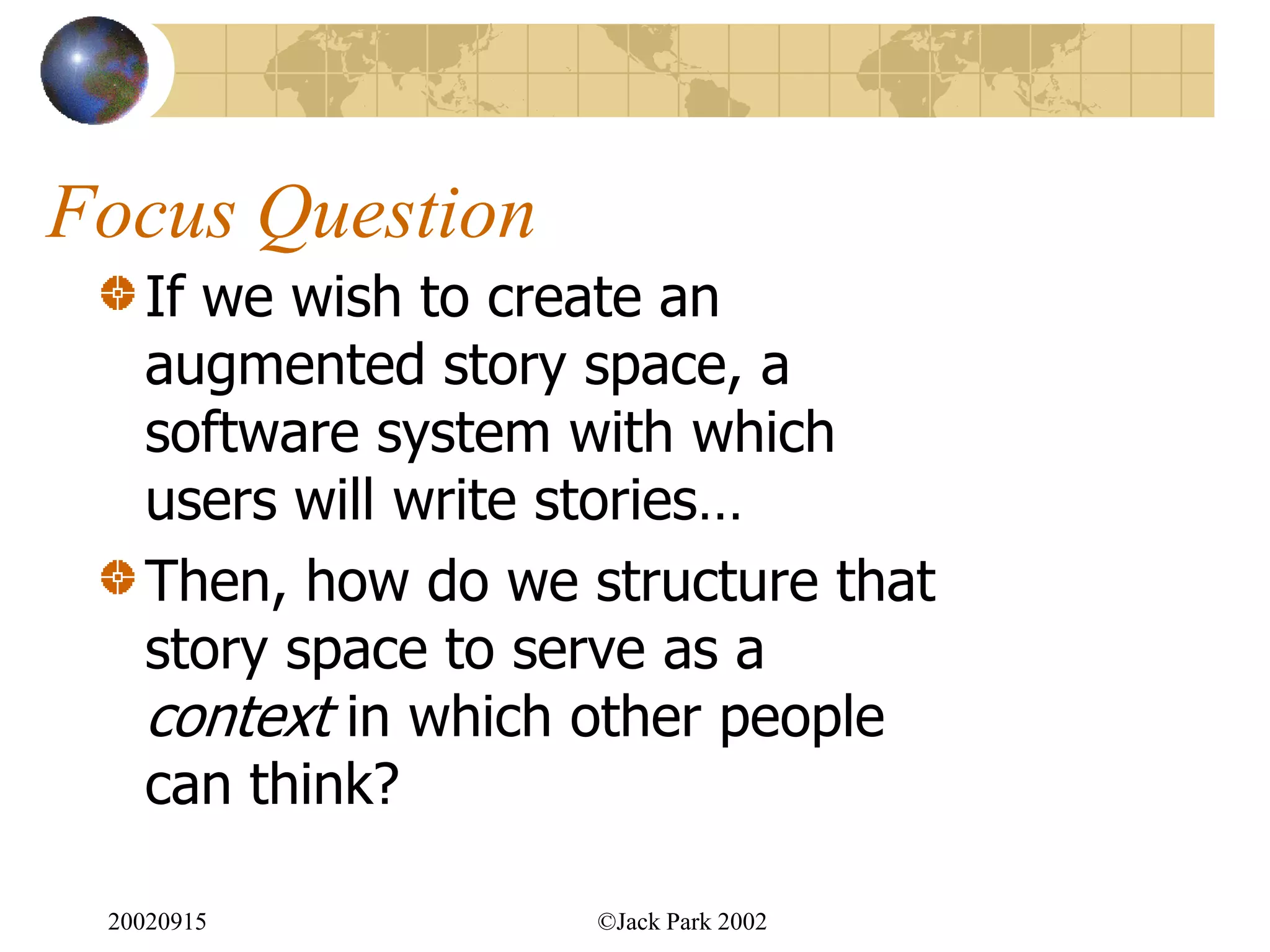
Focus Question
   If we wish to create an
   augmented story space, a
   software system with which
   users will write stories…
   Then, how do we structure that
   story space to serve as a
   context in which other people
   can think?

 20020915           ©Jack Park 2002
Two Story Spaces are Needed*
    Space where stories are told
            Primarily, statements of facts,
            observations, beliefs, “what I think”
    Space where dialog about the story
    occurs
            Arguments, additional findings
    Seamless integration between the two
            hyperlinks
  *[Bonk, 1998, p 58]
 20020915                     ©Jack Park 2002
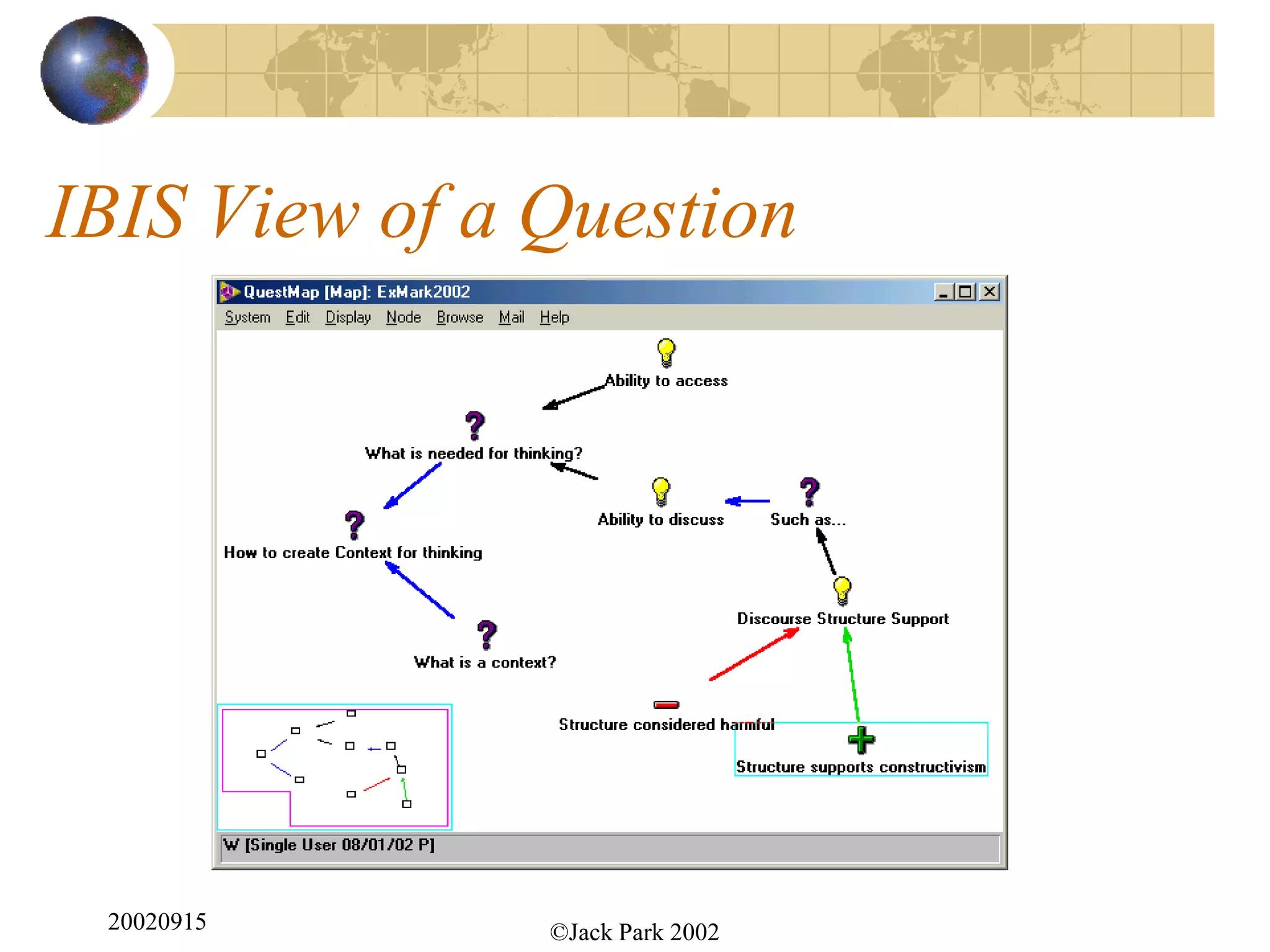
IBIS View of a Question


 20020915      ©Jack Park 2002
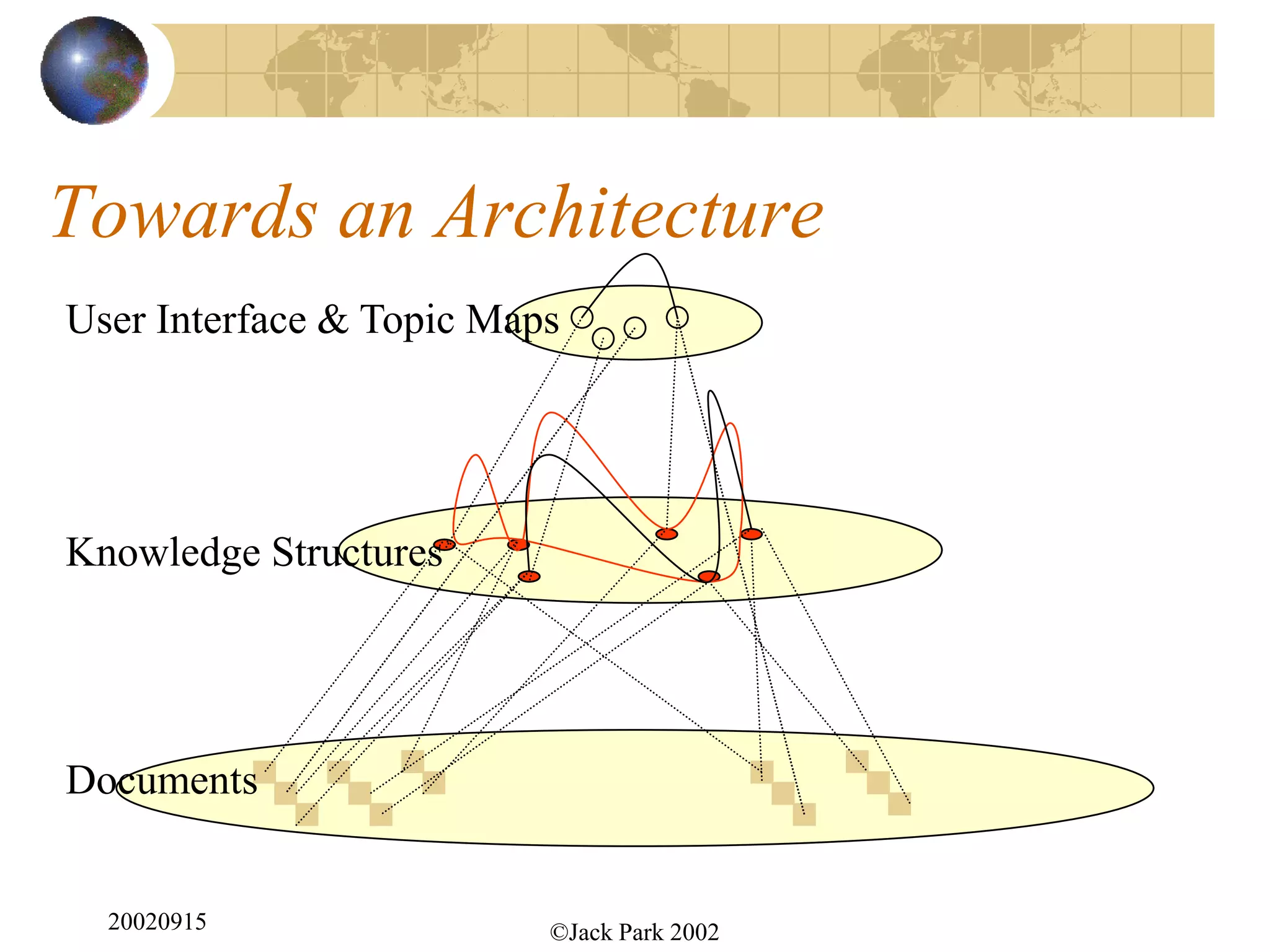
Towards an Architecture
User Interface & Topic Maps


Knowledge Structures


Documents


  20020915                ©Jack Park 2002
Important Markup Language
Examples
    Topic Maps
       Weaving the fabric
       http://www.topicmaps.org/
    Human Markup Language
       Enhance fidelity of human communications
       http://www.humanmarkup.org/
    Philanthropic Markup Language
       Move from transactions to transformations
       http://www.givingspace.org/

 20020915                 ©Jack Park 2002
Towards Augmented Story
Telling
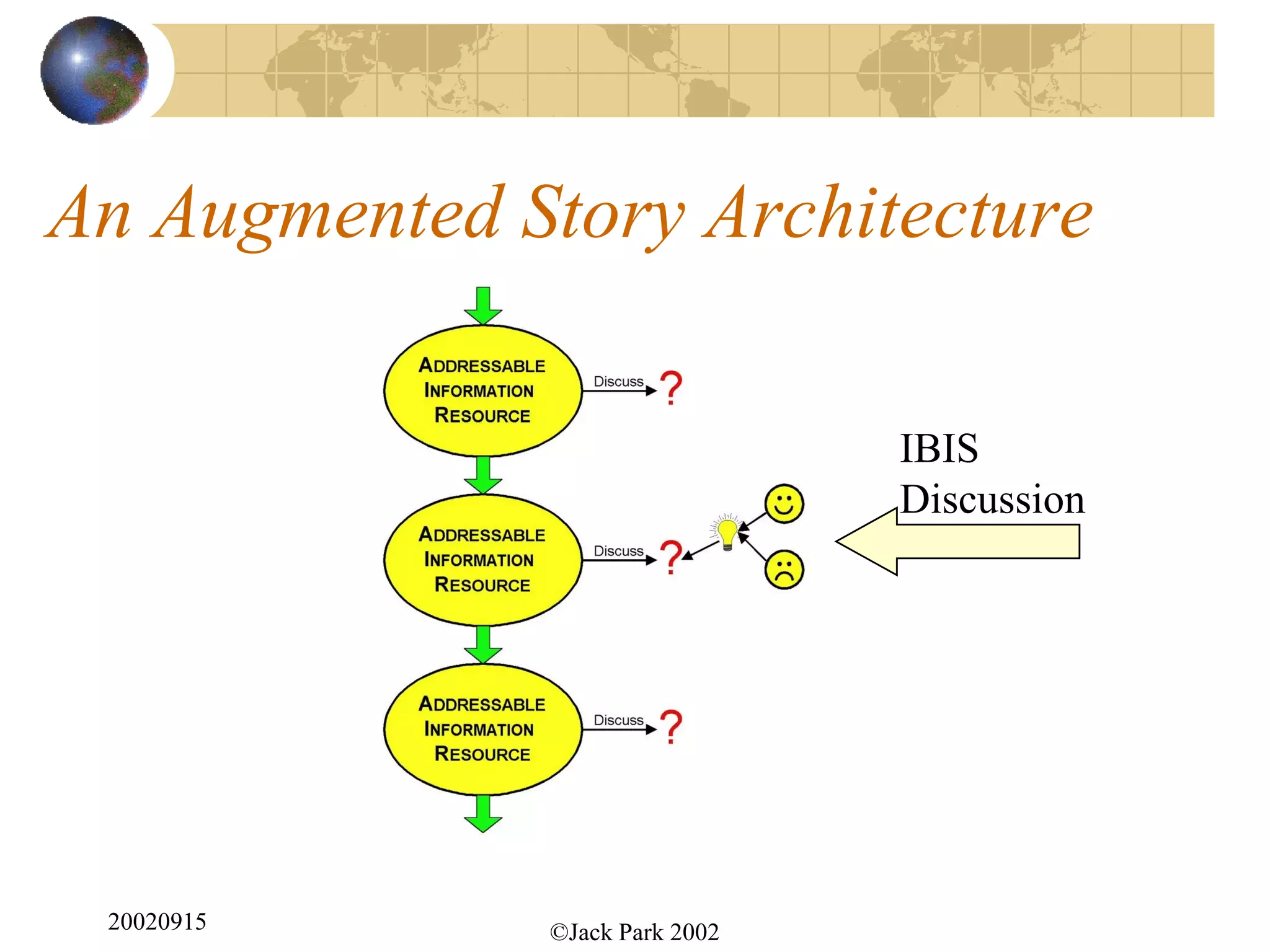
    A working hypothesis
            Chunk stories into
            AddressableInformationResources
             • Sentences, paragraphs, etc.
            Seamless integration of IBIS Discussion for
            each AddressableInformationResource
             • Automatically generated link, ready to use


 20020915                       ©Jack Park 2002
An Augmented Story Architecture

                                IBIS
                                Discussion


 20020915     ©Jack Park 2002
Where to go from here?
    More development along the lines of
    the Open Hyperdocument System.

    Let‟s Roll...


 20020915                ©Jack Park 2002
References
    [Alexander, 1977] Alexander, Christopher, Sara Ishikawa, and Murray Silverstein, 1977. A
    Pattern Language, New York, NY: Oxford University Press.
    [Bonk, 1998] Bonk, Curtis Jay, and Kira S. King (Editors), 1998. Electronic Collaborators:
    Learner-Centered Technologies for Literacy, Apprenticeship, and Discourse, Mahwah, NJ:
    Lawrence Erlbaum Associates
    [Brown, 2000] Brown, John Seely, and Paul Duguid, 2000. The Social Life of Information.
    Boston, MA: Harvard Business School Press
    [Clancey, 1997] Clancey, William J. 1997. Situated Cognition: On Human Knowledge and
    Computer Representations. Cambridge, UK: Cambridge University Press
    [Engelbart, 1992] Engelbart, Douglas C. 1992. Toward High-Performance Organizations: A
    Strategic Role for Groupware”. Available on the Web at
    http://www.bootstrap.org/augment/AUGMENT/132811.html
    [Engelbart, 2000] Engelbart, Doug, 2000. “Draft OHS-Project Plan”. Available on the Web at
    http://www.bootstrap.org/augment/BI/2120.html
    [Lakoff, 1999] Lakoff, George and Mark Johnson, 1999. Philosophy In The Flesh: The
    Embodied Mind And Its Challenge To Western Thought. New York, NW: Basic Books
    [Leuf & Cunningham, 2001] Leuf, Bo, and Ward Cunningham, 2001. The Wiki Way, Boston,
    MA: Addison-Wesley
    [Maturana & Verala, 1987] Maturana, Humberto R. and Francisco J. Verala, 1987. The Tree
    of Knowledge: The Biological Roots of Human Understanding, Boston, MA: New Science
    Library.


 20020915                                  ©Jack Park 2002
References continued
    [Mintzes, et al. 1998] Mintzes, Joel J., James H. Wandersee, and Joseph D. Novak, Editors,
    1998, Teaching Science for Understanding: A Human Constructivist View. Boston, MA:
    Academic Press.
    [Ryan, 2001] Ryan, Marie-Laure, 2001. Narrative as Virtual Reality. Baltimore, MD: The
    Johns Hopkins University Press
    [Park, 2001] Park, Jack, 2001. “Bringing Knowledge Technologies to the Classroom,” Paper
    presented at Knowledge Technologies 2001, Austin Texas, March 4-2. Available on the web
    at http://www.thinkalong.com/JP/ParkKT2001.pdf
    [Park, 2002] Park, Jack [Editor] and Sam Hunting [Technical Editor], 2002. XML Topic
    Maps. Boston, MA: Addison-Wesley.


 20020915                                  ©Jack Park 2002
Colophon
    This presentation would not exist
    without:
            The XTM Authoring Group
            Support from Adam Cheyer and Hugo
            Daley at VerticalNet
            Valuable comments from Henry Van Eyken,
            Mei Lin Fung, Sam Hunting, Tom
            Munnecke, and Bill Leikam
            Massive inspiration from Douglas Engelbart
 20020915                    ©Jack Park 2002

Topic Maps, Douglas Engelbart, and Everything

  • 1.
    Topic Maps, Douglas Engelbart,and Everything Jack Park GivingSpace Meeting September, 2002 © Jack Park, 2002 http://creativecommons.org/licenses/by/3.0/
  • 2.
    Abstract We lookat Topic Maps in the context online community development. The talk intends to develop a context based on the evolution of tools capable of supporting and augmenting what Douglas Engelbart calls the Capabilities Infrastructure of Networked Improvement Communities. 20020915 ©Jack Park 2002
  • 3.
    Plan Motivational Stuff Context, Scary stuff, etc… Introduction to Topic Maps Introduction to Douglas Engelbart Augmented Story Telling Towards an Architecture for Augmented Story Telling 20020915 ©Jack Park 2002
  • 4.
    Reality Check “I'monly a child and I don't have all the solutions, but I want you to realise, neither do you! You don't know how to fix the holes in our ozone layer. You don't know how to bring salmon back up a dead stream. You don't know how to bring back an animal now extinct. And you can't bring back forests that once grew where there is now desert. If you don't know how to fix it, please stop breaking it!” – Severn Suzuki, age 12, in a talk presented to the Earth Summit in Brazil, 1992 20020915 ©Jack Park 2002
  • 5.
    Motivation “…what we know and need today may be insufficient to solve tomorrow's problems” –W3C[http://www.w3.org/Consortium/Points/] “…We shall require a substantially new manner of thinking if mankind is to survive.” –Albert Einstein 20020915 ©Jack Park 2002
  • 6.
    About Topic Maps Topic Maps Are like the index of a book Reside outside of the information resource (book, documents) Facilitate the construction of a relational knowledge base about information resources Facilitate indexing into information resources 20020915 ©Jack Park 2002
  • 7.
    Elements of aTopic Map: Topic A Topic is a container for information that is related to a Subject One Topic per Subject Information related to a Topic includes Names Occurrences Roles played in Associations • Topics associated with other Topics 20020915 ©Jack Park 2002
  • 8.
    Elements of aTopic Map: Associations Associations express relationships between Topics. Associations are typed instanceOf (Topics) Associations point to members (Topics) Members can have roles (Topics) 20020915 ©Jack Park 2002
  • 9.
    Elements of aTopic Map: Occurrences Occurrences point to specific objects in information resources (documents) Occurrences can be typed instanceOf (Topics) 20020915 ©Jack Park 2002
  • 10.
    Architecture of aTopic Map 20020915 ©Jack Park 2002
  • 11.
    Segue numero uno How do Topic Maps relate to Douglas Engelbart? Roles they play in organizing his Networked Improvement Communities Roles they play in story-telling activities within those (and other) communities 20020915 ©Jack Park 2002
  • 12.
  • 13.
    Engelbart’s A-B-C Context A Activity - serves the customer B Activity - improves product cycle time and quality C Activity - improves improvement cycle time and quality 20020915 ©Jack Park 2002
  • 14.
    Community A-B-C Activities 20020915 ©Jack Park 2002
  • 15.
  • 16.
    Interlude: Knowledge and Augmentation Capabilities Infrastructures Depend on Individual Capabilities • can be augmented with collaboration tools Require Facilitation • can be augmented with collaboration tools Issues behind augmentation? • a look at the knowledge context 20020915 ©Jack Park 2002
  • 17.
    What is Knowledge? Information relates to description, definition, or perspective (what, who, when, where). Knowledge comprises strategy, practice, method, or approach (how). This page shamelessly copied (with kind permission) from: Wisdom embodies “Knowledge Management – Emerging Perspectives” principle, insight, moral, http://www.outsights.com/systems/kmgmt/kmgmt.htm By Gene Bellinger or archetype (why). 20020915 ©Jack Park 2002
  • 18.
    Gowan’s Knowledge V–Building Knowledge After: Joseph D. Novak. “The Pursuit of a Dream: Education Can be Improved” In: [Mintzes, et al. 1998] 20020915 ©Jack Park 2002
  • 19.
    Segue numero dos We know a bit about Topic Maps We know a bit about Improvement Communities We have heard of a DKR We know a bit about Knowledge Let‟s look at a practical knowledge activity: Story telling 20020915 ©Jack Park 2002
  • 20.
    “All social changebegins with a conversation”* “From a casual conversation between two friends, a medical relief effort for Vietnamese children emerged. And it all began when „some friends and I started talking‟ ” Margaret J. Wheatley, “All Social Change begins with a conversation”, The Utne Reader: Society, found on the Web at http://www.utne.com, 28 July, 2002 20020915 ©Jack Park 2002
  • 21.
    Towards a Manifesto The reason our society must create a new language for learning communities that transcends school and classroom walls is that the dominance, attraction, and power of the current machine-based language of schooling is not capable of generating the organic patterns of the global learning community we now require. The very nature of the language, the potency of its field, and the meaning it constructs preempt its capacity to generate living patterns; only a living language can create living patterns and only living patterns can create living environments. –Stephanie Pace Marshal, “Creating Sustainable Learning Communities for the Twenty-First Century”, in F. Hesselbein, et al. (eds), 1997. The Organization of the Future. The Drucker Foundation. http://www.swaraj.org/shikshantar/resources_marshall.html 20020915 ©Jack Park 2002
  • 22.
    Edna St. VincentMillay Upon this gifted age, in its dark hour, Rains from the sky a meteoric shower Of facts . . . they lie unquestioned, uncombined. Wisdom enough to leech us of our ill Is daily spun; but there exists no loom To weave it into fabric 20020915 ©Jack Park 2002
  • 23.
    Towards a Pointof View From the manifesto: “...only a living language can create living patterns and only living patterns can create living environments” From Edna St. Vincent Millay: “...but there exists no loom to weave it into fabric” The skill of writing is to create a context in which other people can think. –Edwin Schlossberg 20020915 ©Jack Park 2002
  • 24.
    Augmented Story Tellingrocks! Ta daa! A Point of View But, that‟s a lie (maybe) We don‟t know that yet… We must get busy and prove it… Ok. Call it a working hypothesis and move on! 20020915 ©Jack Park 2002
  • 25.
    Why Stories? “…stories are a powerful means to understand what happened (the sequence of events) and why (the causes and effects of those events).” – John Seely Brown[Brown, 2000] page 106 20020915 ©Jack Park 2002
  • 26.
    Why Stories onthe Web? “With the proliferation of online interaction and composing of various digital online spaces for intercultural and global communication, computer-mediated communication and digital technologies have come to play a significant role in the process of globalization.” –Jilliana Enteen and Radhika Gajjala, 2002.”Teaching Globalization & Intercultural Communication: A Virtual Exchange Project,” KAIROS: 7.2, available on the Web at http://129.118.38.138/kairos/7.2/binder.html?sectiontwo/enteen 20020915 ©Jack Park 2002
  • 27.
    Why Stories onthe Web? “... emphasizing the analyses of culture and of meaning-making processes within such global technological environments allows the student to understand the contextual and situated nature of communication processes. This sensitizes the student to such encounters and, we hope, instills both sensitivity and confidence. –Jilliana Enteen and Radhika Gajjala, 2002.”Teaching Globalization & Intercultural Communication: A Virtual Exchange Project,” KAIROS: 7.2, available on the Web at http://129.118.38.138/kairos/7.2/binder.html?sectiontwo/enteen 20020915 ©Jack Park 2002
  • 28.
    Focus Question If we wish to create an augmented story space, a software system with which users will write stories… Then, how do we structure that story space to serve as a context in which other people can think? 20020915 ©Jack Park 2002
  • 29.
    Two Story Spacesare Needed* Space where stories are told Primarily, statements of facts, observations, beliefs, “what I think” Space where dialog about the story occurs Arguments, additional findings Seamless integration between the two hyperlinks *[Bonk, 1998, p 58] 20020915 ©Jack Park 2002
  • 30.
    IBIS View ofa Question 20020915 ©Jack Park 2002
  • 31.
    Towards an Architecture UserInterface & Topic Maps Knowledge Structures Documents 20020915 ©Jack Park 2002
  • 32.
    Important Markup Language Examples Topic Maps Weaving the fabric http://www.topicmaps.org/ Human Markup Language Enhance fidelity of human communications http://www.humanmarkup.org/ Philanthropic Markup Language Move from transactions to transformations http://www.givingspace.org/ 20020915 ©Jack Park 2002
  • 33.
    Towards Augmented Story Telling A working hypothesis Chunk stories into AddressableInformationResources • Sentences, paragraphs, etc. Seamless integration of IBIS Discussion for each AddressableInformationResource • Automatically generated link, ready to use 20020915 ©Jack Park 2002
  • 34.
    An Augmented StoryArchitecture IBIS Discussion 20020915 ©Jack Park 2002
  • 35.
    Where to gofrom here? More development along the lines of the Open Hyperdocument System. Let‟s Roll... 20020915 ©Jack Park 2002
  • 36.
    References [Alexander, 1977] Alexander, Christopher, Sara Ishikawa, and Murray Silverstein, 1977. A Pattern Language, New York, NY: Oxford University Press. [Bonk, 1998] Bonk, Curtis Jay, and Kira S. King (Editors), 1998. Electronic Collaborators: Learner-Centered Technologies for Literacy, Apprenticeship, and Discourse, Mahwah, NJ: Lawrence Erlbaum Associates [Brown, 2000] Brown, John Seely, and Paul Duguid, 2000. The Social Life of Information. Boston, MA: Harvard Business School Press [Clancey, 1997] Clancey, William J. 1997. Situated Cognition: On Human Knowledge and Computer Representations. Cambridge, UK: Cambridge University Press [Engelbart, 1992] Engelbart, Douglas C. 1992. Toward High-Performance Organizations: A Strategic Role for Groupware”. Available on the Web at http://www.bootstrap.org/augment/AUGMENT/132811.html [Engelbart, 2000] Engelbart, Doug, 2000. “Draft OHS-Project Plan”. Available on the Web at http://www.bootstrap.org/augment/BI/2120.html [Lakoff, 1999] Lakoff, George and Mark Johnson, 1999. Philosophy In The Flesh: The Embodied Mind And Its Challenge To Western Thought. New York, NW: Basic Books [Leuf & Cunningham, 2001] Leuf, Bo, and Ward Cunningham, 2001. The Wiki Way, Boston, MA: Addison-Wesley [Maturana & Verala, 1987] Maturana, Humberto R. and Francisco J. Verala, 1987. The Tree of Knowledge: The Biological Roots of Human Understanding, Boston, MA: New Science Library. 20020915 ©Jack Park 2002
  • 37.
    References continued [Mintzes, et al. 1998] Mintzes, Joel J., James H. Wandersee, and Joseph D. Novak, Editors, 1998, Teaching Science for Understanding: A Human Constructivist View. Boston, MA: Academic Press. [Ryan, 2001] Ryan, Marie-Laure, 2001. Narrative as Virtual Reality. Baltimore, MD: The Johns Hopkins University Press [Park, 2001] Park, Jack, 2001. “Bringing Knowledge Technologies to the Classroom,” Paper presented at Knowledge Technologies 2001, Austin Texas, March 4-2. Available on the web at http://www.thinkalong.com/JP/ParkKT2001.pdf [Park, 2002] Park, Jack [Editor] and Sam Hunting [Technical Editor], 2002. XML Topic Maps. Boston, MA: Addison-Wesley. 20020915 ©Jack Park 2002
  • 38.
    Colophon This presentation would not exist without: The XTM Authoring Group Support from Adam Cheyer and Hugo Daley at VerticalNet Valuable comments from Henry Van Eyken, Mei Lin Fung, Sam Hunting, Tom Munnecke, and Bill Leikam Massive inspiration from Douglas Engelbart 20020915 ©Jack Park 2002