




Group Therapy for Parents of
Children With Difficult Behavior
1: Welcome /
Understanding Difficult Behavior (Part One)
Housekeeping
 Introductions
 Confidentiality Agreements
 Billing Slips
 Bathrooms
 Questions
 Other
Session Format
 Brief Review / Update
 New Information Presented
 Discussion
Assumptions
 Everybody pretty much does the best they can with
what they’ve got.
 Parents
 Kids
 Professionals (Teachers, Counselors, Doctors, Etc.)
 Behavioral Problems start when the demands of the
environment overwhelm the kid’s ability to cope or
adapt.
Assumptions
 Our perception of what causes a problem behavior
always guides what we do about it.
 “He’s got a disorder…”
 “She’s just a brat…”
 “I’m a bad parent…”
 “He had too much sugar/caffeine/insert foodstuff here…”
Caution!
 We’re about to start talking about various kinds of
problems/disorders
 Beware “Med Student Syndrome” – When talking about
various disorders, it’s easy to image you have them all!
 Remember – Let the doctors and specialists do the
diagnosing!
 Also Remember – It’s ok to ask your doctor or therapist
(or other professional) about these things, and/or to call
their attention to something that worries you. They, after
all, are here to Help!
Introducing the Inflexible/Explosive Child…
 Dr. Ross Greene of Harvard has spent a lot of time
working with this population—and has written a
book: Parenting the Explosive Child (highly
recommended). He tells us:
 If the child could change, the child would change.
 The child’s (mis)behavior is best understood as the result
of lagging cognitive skills or abilities.
 If we can help them get the skills that they need, these
kids’ behavior will improve.
 BUT – before we can intervene to teach any skills, we
need to understand what skills they lack, and what
cognitive deficits they have to deal with!
Cognitive Deficits— “Thinking Problems” –
Typical of the Inflexible/Explosive Child
 Easily and quickly overwhelmed when a situation
demands adaptability
 Trouble thinking through ways to resolve frustrating
conflicts
 Lower frustration tolerance and more intense
feelings of frustration than most others of his/her age
 Tends to think in concrete, black-and-white terms
 Trouble with “Executive Functions”
 Trouble with Sensory Processing
Executive Functions?
Yes! Executive Functions!
Shifting Cognitive Set (“Shifting Gears”):
The ability to shift from one mind-set to another. An
explosive child has trouble shifting from their own
agenda to their parent’s agenda through
understanding and adaptation. In a similar way,
some adults are known to have similar problems
shifting from a “work” mindset, where they are the
boss, to a “home” mindset, where they have to
respond more empathetically and sensitively to other
family members.
Executive Functions?
Yes! Executive Functions!
Organization and Planning:
The anticipation of problems and the selecting,
monitoring, and adjustment of strategies in response
to problems. A child who wants to watch television a
few more minutes before coming in to dinner must
efficiently – within a few seconds – organize and
plan a coherent response to a parent who is
expecting rapid compliance. This is why some
parents say that their explosive child do just fine
unless something doesn’t go their way.
Executive Functions?
Yes! Executive Functions!
Working Memory:
The ability to “hold that thought” until the brain has a
chance to think something through. If children are
unable to hold a thought long enough to think
through possible solutions to the problem (“My Mom
wants me to come in for dinner, but I want to watch
television for a few more minutes”), they are likely to
respond with their first impulse (“No, I’m not coming
and you can’t make me!). This, of course, only
makes the situation worse.
Executive Functions?
Yes! Executive Functions!
Separation of Affect (“Putting Aside Feelings”):
The ability to “shelve” an emotional response long
enough to think through various solutions to
problems. The inability to separate affect from
thought can help to explain the rigid, self-centered
thinking patterns, lack of empathy and social tact,
and the inability of these miserable children to
achieve insight into their condition. The reasoned
statement, “I got angry today after Ms. Robinson
called me in from recess early so I could catch up on
some missed assignments” becomes “Ms. Robinson
is a mean teacher. I hate her and I never want to go
back to her class” without the ability to separate
affect.
Sensory Processing Problems
 In order to accurately perceive the world:
1. Your senses have to pick up the “signal” (or, if you like,
the “stimulus”).
2. Your nerves have to carry the signal to your brain
3. Your brain has to accurately decode/make sense of the
signal
 Of course, problems can occur at any point in this
process!
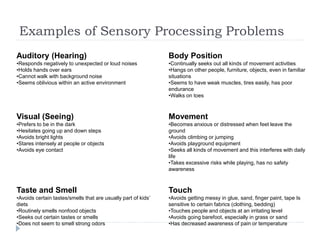
Examples of Sensory Processing Problems
Auditory (Hearing)
•Responds negatively to unexpected or loud noises
•Holds hands over ears
•Cannot walk with background noise
•Seems oblivious within an active environment
Body Position
•Continually seeks out all kinds of movement activities
•Hangs on other people, furniture, objects, even in familiar
situations
•Seems to have weak muscles, tires easily, has poor
endurance
•Walks on toes
Visual (Seeing)
•Prefers to be in the dark
•Hesitates going up and down steps
•Avoids bright lights
•Stares intensely at people or objects
•Avoids eye contact
Movement
•Becomes anxious or distressed when feet leave the
ground
•Avoids climbing or jumping
•Avoids playground equipment
•Seeks all kinds of movement and this interferes with daily
life
•Takes excessive risks while playing, has no safety
awareness
Taste and Smell
•Avoids certain tastes/smells that are usually part of kids’
diets
•Routinely smells nonfood objects
•Seeks out certain tastes or smells
•Does not seem to smell strong odors
Touch
•Avoids getting messy in glue, sand, finger paint, tape Is
sensitive to certain fabrics (clothing, bedding)
•Touches people and objects at an irritating level
•Avoids going barefoot, especially in grass or sand
•Has decreased awareness of pain or temperature
What about ADHD, ODD, and the Rest of
the Alphabet Soup?
 Problems with Executive Functions are (arguably)
the defining characteristic of ADHD, and are
associated with many other behavioral disorders
diagnosed in kids.
 Sensory Processing Disorders can be mistaken for
ADHD
 Sensory Processing Disorders often Co-Occur WITH
ADHD, Autistic Spectrum Disorders, and other
behavioral disorders
We’ll talk more about the commonly diagnosed
behavioral disorders next time!
Further Reading / Resources
 Books
 Armstrong, Thomas. (2010). Neurodiversity: Discovering
the Extraordinary Gifts of Autism, ADHD, Dyslexia, and
Other Brain Differences. Cambridge, MA: Da Capo
Lifelong Books.
 Ayres, A. Jean. (2005). Sensory Integration and the
Child—Understanding Hidden Sensory Challenges: 25th
Anniversary Edition. Los Angeles, CA: Western
Psychological Services.
 Greene, Ross. (2010). The Explosive Child: A New
Approach for Parenting Easily Frustrated, Chronically
Inflexible Children. New York: Harper Paperbacks.
Further Reading / Resources
 Websites
 Ross Greene / Collaborative Problem Solving
 http://www.livesinthebalance.org/
 http://www.ccps.info/
 Sensory Integration / Sensory Processing
 http://www.sensory-processing-disorder.com/
 http://www.sinetwork.org/

Grp thxparents sess01

  • 1.
    Group Therapy forParents of Children With Difficult Behavior 1: Welcome / Understanding Difficult Behavior (Part One)
  • 2.
    Housekeeping  Introductions  ConfidentialityAgreements  Billing Slips  Bathrooms  Questions  Other
  • 3.
    Session Format  BriefReview / Update  New Information Presented  Discussion
  • 4.
    Assumptions  Everybody prettymuch does the best they can with what they’ve got.  Parents  Kids  Professionals (Teachers, Counselors, Doctors, Etc.)  Behavioral Problems start when the demands of the environment overwhelm the kid’s ability to cope or adapt.
  • 5.
    Assumptions  Our perceptionof what causes a problem behavior always guides what we do about it.  “He’s got a disorder…”  “She’s just a brat…”  “I’m a bad parent…”  “He had too much sugar/caffeine/insert foodstuff here…”
  • 6.
    Caution!  We’re aboutto start talking about various kinds of problems/disorders  Beware “Med Student Syndrome” – When talking about various disorders, it’s easy to image you have them all!  Remember – Let the doctors and specialists do the diagnosing!  Also Remember – It’s ok to ask your doctor or therapist (or other professional) about these things, and/or to call their attention to something that worries you. They, after all, are here to Help!
  • 7.
    Introducing the Inflexible/ExplosiveChild…  Dr. Ross Greene of Harvard has spent a lot of time working with this population—and has written a book: Parenting the Explosive Child (highly recommended). He tells us:  If the child could change, the child would change.  The child’s (mis)behavior is best understood as the result of lagging cognitive skills or abilities.  If we can help them get the skills that they need, these kids’ behavior will improve.  BUT – before we can intervene to teach any skills, we need to understand what skills they lack, and what cognitive deficits they have to deal with!
  • 8.
    Cognitive Deficits— “ThinkingProblems” – Typical of the Inflexible/Explosive Child  Easily and quickly overwhelmed when a situation demands adaptability  Trouble thinking through ways to resolve frustrating conflicts  Lower frustration tolerance and more intense feelings of frustration than most others of his/her age  Tends to think in concrete, black-and-white terms  Trouble with “Executive Functions”  Trouble with Sensory Processing
  • 9.
    Executive Functions? Yes! ExecutiveFunctions! Shifting Cognitive Set (“Shifting Gears”): The ability to shift from one mind-set to another. An explosive child has trouble shifting from their own agenda to their parent’s agenda through understanding and adaptation. In a similar way, some adults are known to have similar problems shifting from a “work” mindset, where they are the boss, to a “home” mindset, where they have to respond more empathetically and sensitively to other family members.
  • 10.
    Executive Functions? Yes! ExecutiveFunctions! Organization and Planning: The anticipation of problems and the selecting, monitoring, and adjustment of strategies in response to problems. A child who wants to watch television a few more minutes before coming in to dinner must efficiently – within a few seconds – organize and plan a coherent response to a parent who is expecting rapid compliance. This is why some parents say that their explosive child do just fine unless something doesn’t go their way.
  • 11.
    Executive Functions? Yes! ExecutiveFunctions! Working Memory: The ability to “hold that thought” until the brain has a chance to think something through. If children are unable to hold a thought long enough to think through possible solutions to the problem (“My Mom wants me to come in for dinner, but I want to watch television for a few more minutes”), they are likely to respond with their first impulse (“No, I’m not coming and you can’t make me!). This, of course, only makes the situation worse.
  • 12.
    Executive Functions? Yes! ExecutiveFunctions! Separation of Affect (“Putting Aside Feelings”): The ability to “shelve” an emotional response long enough to think through various solutions to problems. The inability to separate affect from thought can help to explain the rigid, self-centered thinking patterns, lack of empathy and social tact, and the inability of these miserable children to achieve insight into their condition. The reasoned statement, “I got angry today after Ms. Robinson called me in from recess early so I could catch up on some missed assignments” becomes “Ms. Robinson is a mean teacher. I hate her and I never want to go back to her class” without the ability to separate affect.
  • 13.
    Sensory Processing Problems In order to accurately perceive the world: 1. Your senses have to pick up the “signal” (or, if you like, the “stimulus”). 2. Your nerves have to carry the signal to your brain 3. Your brain has to accurately decode/make sense of the signal  Of course, problems can occur at any point in this process!
  • 14.
    Examples of SensoryProcessing Problems Auditory (Hearing) •Responds negatively to unexpected or loud noises •Holds hands over ears •Cannot walk with background noise •Seems oblivious within an active environment Body Position •Continually seeks out all kinds of movement activities •Hangs on other people, furniture, objects, even in familiar situations •Seems to have weak muscles, tires easily, has poor endurance •Walks on toes Visual (Seeing) •Prefers to be in the dark •Hesitates going up and down steps •Avoids bright lights •Stares intensely at people or objects •Avoids eye contact Movement •Becomes anxious or distressed when feet leave the ground •Avoids climbing or jumping •Avoids playground equipment •Seeks all kinds of movement and this interferes with daily life •Takes excessive risks while playing, has no safety awareness Taste and Smell •Avoids certain tastes/smells that are usually part of kids’ diets •Routinely smells nonfood objects •Seeks out certain tastes or smells •Does not seem to smell strong odors Touch •Avoids getting messy in glue, sand, finger paint, tape Is sensitive to certain fabrics (clothing, bedding) •Touches people and objects at an irritating level •Avoids going barefoot, especially in grass or sand •Has decreased awareness of pain or temperature
  • 15.
    What about ADHD,ODD, and the Rest of the Alphabet Soup?  Problems with Executive Functions are (arguably) the defining characteristic of ADHD, and are associated with many other behavioral disorders diagnosed in kids.  Sensory Processing Disorders can be mistaken for ADHD  Sensory Processing Disorders often Co-Occur WITH ADHD, Autistic Spectrum Disorders, and other behavioral disorders We’ll talk more about the commonly diagnosed behavioral disorders next time!
  • 16.
    Further Reading /Resources  Books  Armstrong, Thomas. (2010). Neurodiversity: Discovering the Extraordinary Gifts of Autism, ADHD, Dyslexia, and Other Brain Differences. Cambridge, MA: Da Capo Lifelong Books.  Ayres, A. Jean. (2005). Sensory Integration and the Child—Understanding Hidden Sensory Challenges: 25th Anniversary Edition. Los Angeles, CA: Western Psychological Services.  Greene, Ross. (2010). The Explosive Child: A New Approach for Parenting Easily Frustrated, Chronically Inflexible Children. New York: Harper Paperbacks.
  • 17.
    Further Reading /Resources  Websites  Ross Greene / Collaborative Problem Solving  http://www.livesinthebalance.org/  http://www.ccps.info/  Sensory Integration / Sensory Processing  http://www.sensory-processing-disorder.com/  http://www.sinetwork.org/