BEHAVIORAL DISORDER
Laxmi Dahal, M. Sc. Nursing
B-19
12/8/2022 1
INTRODUCTION
• All young children can be b from time to time, which is
perfectly normal. However, some children have extremely
difficult and challenging behaviours that are outside the
norm for their age.
• While low-intensity naughty, defiant and impulsive
behaviour from time to time, losing one’s temper,
destruction of property, and deceitfulness/stealing in the
preschool children are regarded as normal.
12/8/2022 2
Introduction
• Extremely difficult and challenging behaviours
outside the norm for the age and level of development,
such as unpredictable, prolonged, and/or destructive
tantrums and severe outbursts of temper loss are
recognized as behaviour disorders.
• The most common disruptive behaviour disorders
include oppositional defiant disorder (ODD),
conduct disorder (CD) and attention deficit
hyperactivity disorder (ADHD).
12/8/2022 3
Introduction
• These three behavioural disorders share some
common symptoms, so diagnosis can be difficult and
time consuming.
• A child or adolescent may have two disorders at the
same time. Other exacerbating factors can include
emotional problems, mood disorders, family
difficulties and substance abuse.
• Challenging behaviours and emotional difficulties are
more likely to be recognized as “problems” rather than
“disorders” during the first 2 years of life.
12/8/2022 4
Causes
1. Genetics
• A child’s behavior is a product of his temperament.
• Temperament is controlled by genetics, according to
the North Carolina State University Cooperative
Extension.
• The researchers describe three types of
temperament--easy, sensitive and feisty. The group
claims that 15 percent of children are born feisty.
12/8/2022 5
Genetics…
• These are the children who tend to have behavior
problems.
• Behavioral issues may also be a result of biological
factors like visual impairments, speech disorders and
motor disabilities, explains the National Association for
the Education of Young Children.
12/8/2022 6
Financial Strains
• A report by the National Association of Social
Workers suggests that children in impoverished families
often exhibit behavior problems. These children tend to
be hyperactive and aggressive. Their out-of-control
behaviors can lead to poor performance in school and
delinquency.
• One reason for this connection is negative feelings
and lack of attention from parents who are
experiencing economic stress. The longer the poverty
persists, the more troublesome the behavior will be.
12/8/2022 7
Environmental Causes
• When children are in an unsuitable environment,
they are prone to act out. NAEYC lists an overcrowded
child care facility or a household with insufficient toys
or activities as examples of unsuitable settings for
children.
• Lack of playthings or attention can lead to jealousy
and then hostility between children.
12/8/2022 8
Cry for Help
• Sometimes children use bad behavior as their
call for help. For example, if the youngest child in
a family feels powerless against her older
siblings, she may act out.
• She may feel that biting, for example, is a way
to get parental attention when older siblings are
dominant.
12/8/2022 9
Poor Parenting
• Scott reports that various aspects of parenting may
contribute to violent behavior in children.
• He lists five parenting flaws in particular: poor
supervision; erratic, harsh discipline; parental
disharmony; rejection of the child; and limited
involvement in the child's activities. Parents who exhibit
this behavior engage in a parent-child interaction pattern
that inadvertently encourages and rewards aggressiveness
in their children.
12/8/2022 10
The Media
• There is debate over the role of the media—especially
violence on television, in movies and in video games—in
causing violence in children and teens.
• Some research has found a correlation between media
violence and real-world violence. For example, a 2010
study led by researchers from Columbia University and
Mount Sinai Medical Center in New York found that
adolescents who viewed more than one hour of
television a day were more likely to commit violent acts
as adults.
12/8/2022 11
Warning signs
 Harming or threatening themselves, other people or
pets
 Damaging or destroying property
 Lying or stealing
 Not doing well in school, skipping school
 Early smoking, drinking or drug use
 Early sexual activity
 Frequent tantrums and arguments
 Consistent hostility toward authority figures
12/8/2022 12
PERVASIVE
DEVELOPMENTAL
DISORDERS
12/8/2022 13
12/8/2022 14
Definition
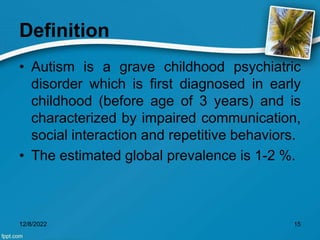
• Autism is a grave childhood psychiatric
disorder which is first diagnosed in early
childhood (before age of 3 years) and is
characterized by impaired communication,
social interaction and repetitive behaviors.
• The estimated global prevalence is 1-2 %.
12/8/2022 15
Causes
• Genetic factor
• Biochemical factor
• Medical factors
• Prenatal factors
• Physiological factors
• Psychological factors
12/8/2022 16
Genetic factor
• Higher concordance in monozygotic than
dizygotic twins
• Strong familial inheritance
12/8/2022 17
Biochemical factor
• 1/3rd of patients with autistic disorder have
elevated plasma serotonin
12/8/2022 18
Medical factors
• Associated with early developmental
problems (e.g. meningitis, encephalitis),
congenital rubella and cytomegalovirus
12/8/2022 19
Prenatal factors
• Maternal bleeding after first trimester
• Meconium in the amniotic fluid
12/8/2022 20
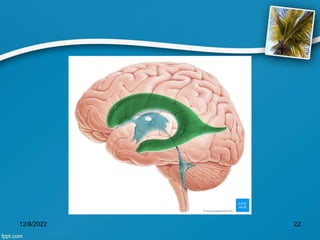
Physiological factors
• Brain imaging and autopsies studies
revealed a varieties of developmental
brain abnormality,
• Neuro-anatomical studies have shown an
enlargement of lateral ventricles
12/8/2022 21
12/8/2022 22
Psychological factors
• Parental rejection
• Deviated personality
• Broken families
• Family stress
• Improper stimulation
• Defective communication pattern
• Lack of warmth and affection
• Sibling conflicts
12/8/2022 23
Clinical features
Impairment on:
1. Social interaction
2. Communication
3. Behavior, interests and activities
4. Others
12/8/2022 24
Social interaction
• An early sign of autism and persists into
adulthood
• The absence or deficient social skills may
change over time in line with the
developmental level of child
12/8/2022 25
Social interaction…
Infancy:
• Indifference to affection or physical contact
e.g. cuddles with parents and siblings
• Absent social smile
• Lack of eye contact
• Lack of attachment to parents
• Absence of separation anxiety on being left in
an unfamiliar environment
• Dislikes being touched or kissed
• Failure to respond to parent’s voice
12/8/2022 26
Social interaction…
Early childhood:
• Lack of imitation of actions (e.g. clapping)
• Not showing or pointing out toys or other
objects of interest
• Appearing to be in their own world or
preferring solitary (single) activities
• Unable to make friends
• Anger or fear without apparent reason and
absence of fear in the presence of danger
12/8/2022 27
Social interaction…
Later childhood:
• Inability to join in with the play of other
children or inappropriate attempts at joints
play (this may show as aggressive or
disruptive behavior)
• Lack of awareness of classroom norms (e.g.
criticizing teacher, unwilling to cooperate in
classroom activities)
• Easily overwhelmed by social and other
stimulation
• Failure to form relationship to others
12/8/2022 28
Communication
• Failure of a child to develop language is first sign
that makes parents seek medical help
• Impaired communication affects the verbal as well
as non verbal skills
Infancy:
• Lack of communication sounds such as babbling,
pointing or other gesture by the age of 12 months
• Delayed speech: failure to speak single words by
the age of 18 months
• No two word spontaneous patterns by the age of
24 months
12/8/2022 29
Communication
Early childhood:
• Impaired language development
• Unusual use of language
• Repeating words or phrases
• Poor response to name
• Lack of response to verbal cues
• Deficit non verbal communication e.g. lack of
pointing and difficulty following a point and
failure to smile socially
12/8/2022 30
Communication…
Late childhood:
• Abnormal language development, including
muteness, abnormalities in pitch and rhythm
of speech
• Persistent echolalia
• Incorrect use of pronouns (e.g. referring to
self as you, or she is children over 3 years
old)
• Limited use of language or communication
• Abstract thinking is impaired
12/8/2022 31
Behaviors, interests and
activities
• Limited interest and are often preoccupied
with one particular interest or activity
• Some children have attachment may
develop to inanimate objects (stick, piece
of cloth, cup, toy etc) that they will take
with the everywhere or hold on to. Trying
to take this away, will cause distress and
in some cases very agitated or aggressive
behavior
12/8/2022 32
Behaviors, interests…
• Abnormalities in posture such as tiptoe
walking, odd body postures are also often
observed
• Tried to keep touching different body parts
e.g. they might put their hands on their
head or slap their head with both hands
• Attachment may develop to inanimate
objects
12/8/2022 33
12/8/2022 34
Others
• More than 50% of these children have
moderate to profound MR with and IQ of
less than 50
• Epilepsy is common in these children
12/8/2022 35
Diagnosis
• History
• Observation
12/8/2022 36
Diagnostic criteria
• Impaired social interaction (at least two
have to be observed in the child):
a. Difficulties with social interaction for
example eye contact, facial expression, body
posture and gestures
b. Lack of peer relationships appropriate for
the developmental level of the child
c. Not seeing to share achievement, interest
and pleasure
d. Not being able to participate in or return
social or emotional interactions
12/8/2022 37
Diagnostic criteria…
• Impaired communication (at least 1):
a. late or absent developmental of spoken
language for which the child doesn’t try to
compensate with gesture
b. Absence of social imitative play
c. Repetitive, stereotyped or very
individual use of language
12/8/2022 38
Diagnostic criteria…
• Repetitive restricted and stereotyped
activities, behavior (at least one):
a. Preoccupation with abnormal interests that
are restricted and stereotyped (such as
spinning things)
b. Rigidity sticking to routines or rituals that
don’t appear to have a function or aim
c. Stereotyped, repetitive motor mannerisms
such as hand flapping
d. Persistently preoccupation with parts of
objects
12/8/2022 39
Treatment
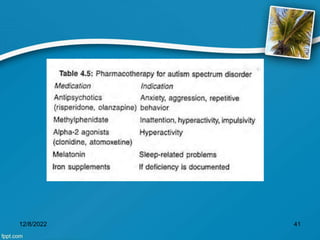
• Pharmacological treatment:
- Antipsychotic drugs
- Antidepressant drugs
- Antiepileptic drugs
• Behavioral therapy
• Special schooling
• Social therapy
12/8/2022 40
12/8/2022 41
Nursing interventions
• Work with the child on a one to one basis
• Protect the child when self mutilate
behavior occurs. Devices such as helmet,
padded mitten or arm cover may be used
• Assign limited number of caregivers to the
child. Ensure that warmth, acceptance and
availability are conveyed
12/8/2022 42
Nursing intervention
• Provide child with familiar objects such as
familiar toys
• Support child’s attempts to interact with
others
• Give positive reinforcement for eye contact
with something acceptable to the child
(e.g. food and familiar objects), gradually
replace with social reinforcement (i.e.
touch, hug)
12/8/2022 43
Nursing…
• Fulfill the child’s need until communication
can be established
• Slowly encourage him to express his
needs verbally
• Give positive reinforcement when eye
contact is used to convey non verbal
expression or to when child tries to speak
• Teach simple self care skills by using
behavior modification techniques
12/8/2022 44
Nursing…
• Provide language training
• Assist the child during self care activities
such as feeding, dressing etc
• The child should be helped to name own
body parts
• Encourage appropriate touching of and
being touched by others
12/8/2022 45
Prognosis
• Approx. 10-20% improve with age 4-6
years and live near normal life
• Approx. 10-20% live at home and go
special school
• Approx. 60% improve little and need
residential care
12/8/2022 46
ADHD
Introduction
It is generally considered to be developmental
disorder, largely neurological in nature, characterized
by a persistent pattern of inattention/ and hyperactivity,
as well as forgetfulness, poor impulse control or
impulsivity and distractibility, more frequent and severe
than is typical of children at as a similar level of
development.
12/8/2022 47
Introduction
• Symptoms are not due to gross
neurological impairment, sensory
impairment, language or motor
impairment, mental retardation, emotional
disturbance.
• Boys are 2-3 times more likely to have
ADSD than girls.
12/8/2022 48
Etiology
• Genetic
• Pre-peri and post natal factors
• Environmental factors
• Psychological factors
• Organic factors
• Deficiency of neurotransmitters,
dopamine and nor-epinephrine
12/8/2022 49
DSM-IV Diagnostic Criteria
• Inattention Symptoms (at least 6 symptoms
required)
–Fails to give close attention to details or
makes careless mistakes in schoolwork,
work, etc.
–Difficulty sustaining attention
–Does not seem to listen when spoken to
directly
–Does not follow through on instructions
and fails to finish schoolwork, chores, etc.
12/8/2022 50
Inattention Symptoms
–Difficulty organizing tasks and activities
–Avoids tasks requiring sustained mental
effort
–Loses things necessary for tasks or
activities
–Easily distracted by extraneous stimuli
–Forgetful in daily activities
12/8/2022 51
• Hyperactivity-Impulsivity Symptoms (at
least 6 symptoms required)
–Difficulty playing or engaging in
activities quietly
–Always "on the go" or acts as if "driven
by a motor”
–Talks excessively
–Blurts out answers
12/8/2022 52
Hyperactivity-Impulsivity Symptoms
–Difficulty waiting in lines or awaiting turn
–Interrupts or intrudes on others
–Runs about or climbs inappropriately
–Fidgets with hands or feet or squirms in
seat
–Leaves seat in classroom or in other
situations in which remaining seated is
expected
12/8/2022 53
Other symptoms
- Symptoms present before age 7
- Clinically significant impairment in social or
academic/occupational functioning
- Some symptoms that cause impairment
are present in 2 or more settings (e.g.,
school/work, home, recreational settings)
- Not due to another disorder (e.g., Autism,
Mood Disorder, Anxiety Disorder)
12/8/2022 54
Management
1. Pharmacotherapy:
– Stimulants like: Dextroamphetamine (10-40
mg/day) and Methylphenidate (10-60
mg/day).
– These drugs can cause stimulation of
inhibitory influences on the cerebral cortex,
thus decrease hyperactivity.
– When stimulant medication is not available,
can be used low dose of Clonidine,
Imparamine, Venilafaxine, Chlorpromazine.
12/8/2022 55
Management
2. Psychological therapies
- Behavior modification techniques
- Social skills training
- Supportive psychotherapy
- Family therapy
12/8/2022 56
Management
• Develop trusting relationship with the child and
convey acceptance of the child separated from
unaccepted behaviour.
• Ensure the safe environment and provide
supervision for potentially dangerous situations.
• Reduce environmental distraction.
• Ensure the child’s attention by calling his/her
name and establishing eye contact before giving
instructions.
12/8/2022 57
Management
• Ask the patient to repeat instructions before
beginning a task.
• Establish goals that allow patient to complete a
part of the task, rewarding each step.
• Provide assistance on a one basis beginning
with simple concrete instruction.
• Gradually decrease the amount of assistance.
12/8/2022 58
Management
• Offer positive reinforcement for successful
attempts made.
• Give immediate positive feedback for acceptable
behavior.
• Provide quite environment, classroom and small
group activities.
• Assess parental skill level, considering
intellectual, emotional and physical strengths
and limitation.
12/8/2022 59
Management
• Then provide information and materials related
to the child’s disorder, as well as demonstrate
effective parenting techniques. For eg. Give
instructional materials in written and verbal form
with step by step examination.
• Educate child and family on regular activities
and behavioral response.
• Co-ordinate overall treatment plan with schools,
collateral personnel the child and the family.
12/8/2022 60
12/8/2022 61
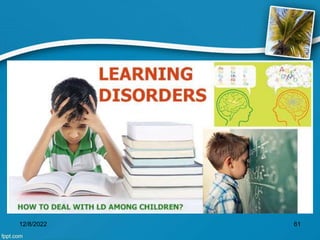
Specific Learning Disability
• Specific learning disability is defined as a persistent
impairment in reading (dyslexia), writing (dysgraphia)
and/ or arithmetic (dyscalculia) skills in an individual
with preserved cognition, vision, hearing and adequate
opportunities.
• It affects 5-15% of school going children.
12/8/2022 62
Introduction
• Dyslexia accounts for 80% of all specific learning
disabilities.
• These disorders are probably caused by functionally
disrupted networks in the cerebral cortex with intact
anatomy.
12/8/2022 63
Diagnosis
• reading slowly and incorrectly,
• skipping lines while reading aloud,
• making repeated spelling mistakes,
• untidy /illegible hand-writing with poor sequencing,
• inability to perform even simple mathematics,
incoherent to the child's intelligence level.
12/8/2022 64
Diagnosis
• The DSM 5 diagnosis of SLD requires fulfilling a
predefined number of criteria in reading, writing and
arithmetic skills and these impairments should persist
despite interventions targeting the specific disability
for at least 6 months.
12/8/2022 65
Criteria A
• Ongoing difficulties in the school-age years learning
and using at least one academic skill (e.g. reading
accuracy/fluency; spelling accuracy; written
expression competence and fluency; mastering
number facts). These difficulties have persisted and
failed to improve as expected, despite the provision of
targeted intervention for at least six months. This
intervention should be recognised as evidence-based
and ideally delivered by an experienced and qualified
person.
12/8/2022 66
Criteria B
• The difficulties experienced by the individual will be
assessed using standardised achievement tests* and
found to be at a level significantly lower than most
individuals of the same age. Sometimes individuals
are identified with a learning disability even though
they are performing within the average range. This is
only the case when it can be shown that the individual
is achieving at this level due to unusually high levels
of effort and ongoing support.
12/8/2022 67
Criteria C
• The difficulties experienced by the individual usually
become apparent in the early years of schooling. The
exception to this is where problems occur in upper-
primary or secondary school once the demands on
student performance increase significantly. For
example – when students have to read extended
pieces of complex text or write at a more
sophisticated level under timed conditions.
12/8/2022 68
Criteria D
• Specific learning disorders will not be diagnosed if
there is a more plausible explanation for the
difficulties being experienced by the individual. For
example – if the individual has: an intellectual
disability; a sensory impairment; a history of chronic
absenteeism; inadequate proficiency in the language
of instruction; a psychosocial condition; or, not
received appropriate instruction and/or intervention.
12/8/2022 69
Management
• Management revolves around remedial education
with active participation from both school and parents.
12/8/2022 70
Tic Disorder and stereotypies
• Tics are abrupt onset, fast paroxysmal non-rhythmic
motor or vocal manifestations which may be simple or
complex. The age of onset is 4-6 years with peak at 10-
12 years and significant attenuation by 18-20 years. The
prevalence is around 10-15% with higher rate in boys.
12/8/2022 71
Tic Disorder and stereotypies
• Tourette Syndrome is characterized by onset before
18 years of age, presence of both motor and vocal tics
and persistence beyond 1 year, including the warning
phase, tics can be associated with neurological
ailments like Huntington and Wilson disease, or with
parainfectious illness, e.g. pediatric autoimmune
neuropsychiatric disorders associated with
streptococcal infection (PANDAS).
12/8/2022 72
Tic Disorder and stereotypies
• It is important to differentiate stereotypies from tics.
Although stereotypies may have similar vocal and
motor manifestations, classically they are rhythmic
and distractable, and usually remain stable over a
time period, unlike tics which may evolve temporally,
stereotypies usually have an early onset (before 3
years of age) and, along with neurodevelopmental
disorders, may affect normal children, as well.
12/8/2022 73
Management
• The essential component is behavioral therapy.
Medications like haloperidol and clonidine are
considered in situations where the tics are socially and
functionally disabling despite adequate behavioral
therapy.
12/8/2022 74
12/8/2022 75
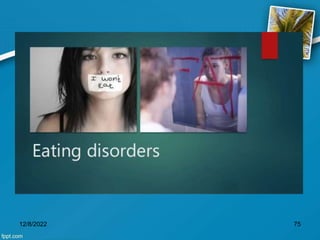
EATING DISORDERS
Introduction
 Eating disorders are treatable medical illnesses in
which certain maladaptive patterns of eating observed
and involves serious disturbances in eating behavior
includes extreme and unhealthy reduction of food
intake or severe or over eating; as well as distress
feelings or extreme concern about body shapes,
weight and body image.
12/8/2022 76
Anorexia Nervosa
Definition:
• ‘It is an eating disorder, where people involuntarily
refuse to eat’.
• Anorexia nervosa often simply called ‘anorexia’ is an
eating disorder characterized by an abnormally low
body weight, an intense fear of gaining weight and a
distorted perception of weight. People with anorexia
place a high value on controlling their weight and
shape, using extreme efforts that tend to significantly
interfere with their lives.
•
12/8/2022 77
Prevalence
• The incidence of anorexia nervosa appears to have
increased in recent decades.
• It is at least 10 times more frequent in women than in
men.
Types:
1. Restricting type
2. Binge/ purging type
12/8/2022 78
Types
a. Restricting Type:
 People with this type of anorexia nervosa place
severe restrictions on the quantity and type of food
they consume.
 This could include counting calories, skipping meals,
restricting certain foods (such as carbohydrates) and
following obsessive rules, such as only eating foods
of a particular colour.
 These behaviours may be accompanied by excessive
exercise.
12/8/2022 79
Types
b. Binge Eating/ Purging Type:
 People with this type of anorexia also place
restrictions on the food they eat. But it's accompanied
by binge eating or purging. Binge eating involves
feeling out of control and eating a large amount of
food.
 A person then 'compensates' for this eating by purging
the food through vomiting, misusing laxatives,
diuretics or enemas.
12/8/2022 80
Causes
i. Genetics:
• Among female siblings of patients with established
anorexia nervosa, 6-10% suffers from the condition
compared to 1-2% found in the general population of
same age.
i. A disturbance in hypothalamic function.
ii. Social factors:
• There is a high prevalence of anorexia nervosa among
female students and in occupational groups
particularly concerned with weight (for example
dancers). Influence of mass media, beauty contests
are other important social causes.
12/8/2022 81
Cause
i. Individual psychological factors:
• A disturbance of body image, a struggle for control
and a sense of identity are important factors in the
causation of anorexia nervosa. Traits of low self-
esteem and perfectionism are often found.
i. Causes within the family:
• Disturbance in family relationships, over-protection,
family members having an unusual interest in food
and physical appearance.
12/8/2022 82
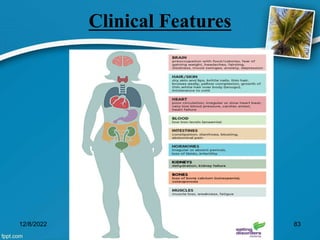
Clinical Features
12/8/2022 83
Diagnosis
 Complete physical examination including
laboratory tests to rule out endocrine, metabolic and
central nervous system abnormalities; mal-absorption
syndrome and other disorders that cause physical
wasting.
 Complete blood testing: hemoglobin levels, platelet
count, cholesterol level, total protein, sodium,
potassium, chloride, calcium and fasting blood
glucose and serum amylase levels and blood urea
nitrogen.
12/8/2022 84
Diagnosis
 ECG readings irregular
 Differential diagnosis to rule out other psychiatric
disorders like substance abuse, anxiety disorder,
body dysmorphic disorder, mood disorders,
schizophrenia.
12/8/2022 85
Treatment
 Team approach (medical providers, mental health
professionals, dietitians) will be used to treat eating disorders.
 Medical care: anorexia nervosa causes many complications,
hence frequent monitoring of vital signs, hydration levels,
electrolyte levels and other physical conditions are needed;
and symptomatic treatment is planned.
 Treat dehydration, electrolyte imbalance, hypotension,
psychiatric problems, sometimes hospitalization may be
required in severe anorexia nervosa cases or its complications.
12/8/2022 86
Treatment
a. Pharmacotherapy:
 Neuroleptics
 Appetite stimulants
 Antidepressants
a. Psychological therapies:
i. Individual psychotherapy
ii. Behavior therapy
iii.Family therapy
iv.Group therapy
v. Nutrition therapy vi. Interpersonal therapy
12/8/2022 87
Complications
 Anemia
 Heart problems, such as mitral valve prolapse, abnormal heart
rhythms or heart failure
 Bone loss (osteoporosis), increasing the risk of fractures
 Loss of muscle
 In females, absence of a period
 In males, decreased testosterone
 Gastrointestinal problems, such as constipation, bloating or
nausea
 Electrolyte abnormalities, such as low blood potassium,
sodium and chloride
 Kidney problems
12/8/2022 88
Bulimia Nervosa
Definition:
Bulimia nervosa, also known as simply bulimia, is an
eating disorder characterized by binge eating followed
by purging. Binge eating refers to eating a large amount
of food in a short amount of time. Purging refers to the
attempts to get rid of the food consumed. This may be
done by vomiting or taking laxatives.
12/8/2022 89
Types of Bulimia
• Purging type –it accounts for the majority of cases of
those suffering from this eating disorder. In this form,
individuals will regularly engage in self-induced
vomiting or abuse of laxatives, diuretics, or enemas
after a period of bingeing.
 Non-Purging type – In this form of bulimia nervosa,
the individual will use other inappropriate methods of
compensation for binge episodes, such as excessive
exercising or fasting. In these cases, the typical forms
of purging, such as self-induced vomiting, are not
regularly utilized.
12/8/2022 90
Causes of Bulimia
• The exact cause of bulimia nervosa is currently
unknown; though it is thought that multiple factors
contribute to the development of this eating disorder,
including genetic, environmental, psychological, and
cultural influences. Some of the main causes for
bulimia include:
 Stressful transitions or life changes
 History of abuse or traumaegative body image
 Poor self-esteem
 Professions or activities that focus on
appearance/performance
12/8/2022 91
Physical signs and symptoms
 Constant weight fluctuations
 Electrolyte imbalances, which can result in cardiac
arrhythmia, cardiac arrest, or ultimately death
 Broken blood vessels within the eyes
 Enlarged glands in the neck and under the jaw line
 Oral trauma, such as lacerations in the lining of the
mouth or throat from repetitive vomiting
 Chronic dehydration
 Inflammation of the esophagus
 Chronic gastric reflux after eating or peptic ulcers
 Infertility
12/8/2022 92
Signs and symptoms of binge eating
and purging
 Disappearance of large amounts of food
 Eating in secrecy
 Lack of control when eating
 Switching between periods of overeating and fasting
 Frequent use of the bathroom after meals
 Having the smell of vomit
12/8/2022 93
Diagnosis
 Physical examination: auscultation of heart and lung
sounds, anthropometric measurements:-height,
weight, body mass index.
 Monitor vital signs
 Check the skin for dryness or other problems
 Assist for laboratory tests: e.g. X-ray, ECG, complete
blood picture, urine analysis
 Psychological evaluation: assess the mental status,
eating habits,
12/8/2022 94
Prevention
• Although there's no sure way to prevent bulimia, but
can steer someone toward healthier behavior or
professional treatment before the situation worsens.
 Foster and reinforce a healthy body image in your
children, no matter what their size or shape. Help
them build confidence in ways other than their
appearance.
 Have regular, enjoyable family meals.
 Never criticize or tease any child for his/her weight or
large body frame.
12/8/2022 95
Prevention
 Never keep a nick name to the child.
 Avoid talking about weight at home. Focus instead on
having a healthy lifestyle.
 Discourage dieting, especially when it involves
unhealthy weight-control behaviors, such as fasting,
using weight-loss supplements or laxatives, or self-
induced vomiting.
12/8/2022 96
Treatment of Bulimia Nervosa
• Since negative body image and poor self-esteem are
often the underlying factors at the root of bulimia, it is
important that therapy is integrated into the recovery
process. Treatment for bulimia nervosa usually
includes:
 Discontinuing the binge-purge cycle: The initial
phase of treatment for bulimia nervosa involves
breaking this harmful cycle and restoring normal
eating behaviors.
12/8/2022 97
Treatment
 Improving negative thoughts: The next phase of
bulimia treatment concentrates on recognizing and
changing irrational beliefs about weight, body shape,
and dieting.
 Resolving emotional issues: The final phase of
bulimia treatment focuses on healing from emotional
issues that may have caused the eating
disorder. Treatment may address interpersonal
relationships and can include cognitive behavior
therapy, dialectic behavior therapy, and other related
therapies.
12/8/2022 98
Complications
 Gastric rupture during periods of binge-eating.
 Dental caries, erosion of tooth enamel, parotitis, and
gum infections.
 Dehydration or electrolyte imbalances.
 Chronic, irregular bowel movements and constipation
from laxative use.
 Increased risk of suicide and psychoactive substance
abuse.
12/8/2022 99
PICA
Introduction
• The eating disorder that involves repeated or chronic
ingestion of non-nutritive substances, which may
include plaster, charcoal, clay, wool, ashes, paint and
earth/soil.
• Although tasting or mouthing of objects is normal in
infants and toddlers, pica after the 2nd year of life
needs investigation.
12/8/2022 100
Predisposing factors
• Mental retardation and lack of parental nurturing
(psychological and nutritional)
• Family disorganization
• Poor supervision
• More prevalent in the lower socioeconomic
• More common in children with autism and other
brain-behavior disorder such as Kleine Levin
Syndrome
• Children with pic are at an increased risk for
12/8/2022 101
Pre disposing factors
• Lead poisoning
• Iron deficiency anemia
• Parasitic infections
12/8/2022 102
Management
• No specific rather supportive treatment.
• Iron is often prescribed, without any definite evidence of
benefit.
• Thumb-sucking.
• It indicates that a pleasurable sensation is derived by the child
from this self stimulation.
• This is manifestation of the feeling of insecurity.
• Parental guidance.
• Parents should be advised not to show excessive anxiety about
thumb-sucking until at least the child is 4 years old.
12/8/2022 103
Breath-Holding Spells
• Breath-holding spells are reflex events typically
initiated by a provocation that causes anger, frustration
or pain making the child cry.
• The crying stops at full expiration, and the child
becomes apneic and cyanotic or pale.
• In some cases, the child may become unconscious
and hypotonic.
• In prolonged events, brief tonic-clonic movements
may happen.
12/8/2022 104
Breath-holding spells
• Breath-holding spells are rare before 6 months of age,
peak at 2 years and abate by 5 years of age.
• The differential diagnoses include seizures and
cardiac arrhythmias.
• The history of a provoking event and stereotyped
pattern of events help in distinguishing breath-
holding spells from seizures.
• In relevant clinical scenarios, seizures and cardiac
arrhythmias including long QT syndrome should be
ruled out.
12/8/2022 105
Management
• The essential component of management is parental
reassurance.
• The family should be advised to be consistent in
handling the child, to remain calm during the event,
turn him sideways so that secretions can drain and
avoid picking the child up (since this decreases blood
flow to the brain).
• The family should avoid exhibiting undue concern
nor give into the child's demands, if the spell was
provoked by anger or frustration.
12/8/2022 106
Thumb Sucking
• This entity is normal in infants and toddlers.
• It peaks by 18-21 months of age and usually
disappears by the age of 4 years.
• Its persistence in older children is socially
unacceptable and can lead to dental malalignment.
• In children below 4 years, parents should be
reassured.
• Beyond 4 years of age, the child should be motivated
to refrain from this habit. Both positive 'and negative
reinforcements can be used.
12/8/2022 107
Thumb sucking
• In this age group, parents should be reassured as most
of them show resolution.
• If it persists beyond or appears after 5 years of age,
opinion of psychologist and speech therapist should
be sought.
12/8/2022 108
COMMUNICATION
DISORDERS
12/8/2022 109
Stuttering
• Stuttering is a defect in speech characterized by
hesitation or spasmodic repetition of some syllables
with pauses.
• There is difficulty in pronouncing the initial
consonants caused by spasm of lingual and palatal
muscles.
• It can affect up to 5% of children between 2 and 5
years of age.
12/8/2022 110
12/8/2022 111
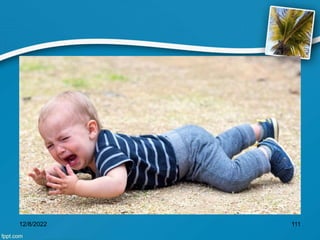
Temper Tantrums
Introduction
• Temper tantrums or "acting-out" behaviors are
natural during early childhood. It is normal for children
to want to be independent as they learn they are separate
people from their parents.
• Temper tantrums are unpleasant and disruptive
behaviors or emotional outbursts. They often occur in
response to unmet needs or desires.
12/8/2022 112
Introduction
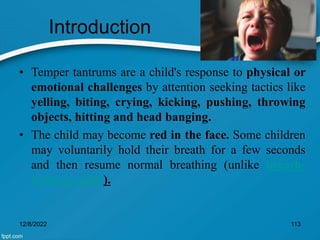
• Temper tantrums are a child's response to physical or
emotional challenges by attention seeking tactics like
yelling, biting, crying, kicking, pushing, throwing
objects, hitting and head banging.
• The child may become red in the face. Some children
may voluntarily hold their breath for a few seconds
and then resume normal breathing (unlike breath-
holding spells).
12/8/2022 113
Introduction
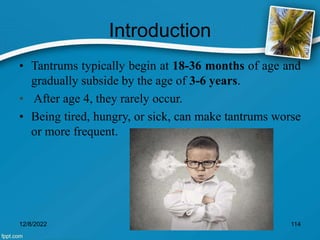
• Tantrums typically begin at 18-36 months of age and
gradually subside by the age of 3-6 years.
• After age 4, they rarely occur.
• Being tired, hungry, or sick, can make tantrums worse
or more frequent.
12/8/2022 114
Why tantrum happens?
A child might lash out regularly because of:
• ADHD
• Anxiety
• A learning disability
• Sensory processing issues
• Autism
12/8/2022 115
PREVENTING TEMPER
TANTRUMS
• Use an upbeat tone when asking your child to do
something. Make it sound like an invitation, not an
order. For example, "If you put your mittens and hat
on, we will be able to go to your play group."
• DO NOT battle over unimportant things like which
shoes your child wears or whether they sit in the
high-chair or booster seat.
• Safety is what matters, such as not touching a hot
stove, keeping the car seat buckled, and not playing in
the street.
12/8/2022 116
Prevention
• Offer choices when possible. For example, let your
child pick what clothes to wear and what stories to
read.
• A child who feels independent in many areas will be
more likely to follow rules when it is a must. DO
NOT offer a choice if one does not truly exist.
12/8/2022 117
Management
• Distraction and 'time out' techniques are useful.
• Providing a safe setting. Many children have
difficulty stopping tantrums on their own.
• A time-out technique, in which the child must sit
alone in a dull place (a corner or room [other than
the child’s bedroom] that is not dark or scary and has
no television or toys) for a brief period, is a good
approach to altering unacceptable behavior.
12/8/2022 118
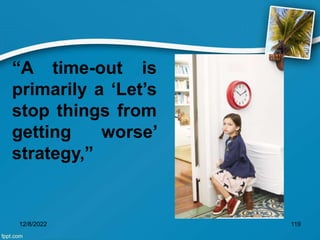
“A time-out is
primarily a ‘Let’s
stop things from
getting worse’
strategy,”
12/8/2022 119
Time-out technique
The technique can be applied when a child misbehaves in a way
that is known to result in a time-out. Usually, verbal reprimands
and reminders should precede the time-out.
• The misbehavior is explained to the child, who is told to sit in
the time-out chair or is led there if necessary.
• The child should sit in the chair 1 minute for each year of age
(maximum, 5 minutes).
• A child who gets up from the chair before the allotted time is
returned to the chair, and the time-out is restarted. Talking and
eye contact are avoided.
12/8/2022 120
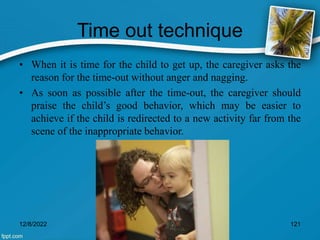
Time out technique
• When it is time for the child to get up, the caregiver asks the
reason for the time-out without anger and nagging.
• As soon as possible after the time-out, the caregiver should
praise the child’s good behavior, which may be easier to
achieve if the child is redirected to a new activity far from the
scene of the inappropriate behavior.
12/8/2022 121
Management
DISTRACTION
• In most cases, addressing the source of the tantrum
only prolongs it. It is therefore preferable to redirect
the child by providing an alternative activity on
which to focus. The child may benefit from being
removed physically from the situation.
• Parents are counseled to handle this behavioral
problem strategically, by staying calm, firm and
consistent so that the child is unable to take
advantage from such behavior.
12/8/2022 122
Oppositional Defiant Disorder
• Oppositional defiant disorder is a repetitive and
persistent pattern of opposing, defiant, disobedient and
disruptive behavior towards authority figures persisting
for at least 6 months.
• Many children are later diagnosed with conduct
disorders.
• Diagnostic criteria for labeling the condition have
been developed.
12/8/2022 123
ODD
• Oppositional defiant disorder results from interplay of
factors in the child's characteristics, parental
interactions and environmental factors.
• Family history of mental health problems such as
depression, ADHD or antisocial personality is often
seen.
• The management should focus on alleviating risk
factors or stresses that might contribute to
oppositional behavior. Use of stimulant medication is
effective in patients with ADHD.
12/8/2022 124
12/8/2022 125
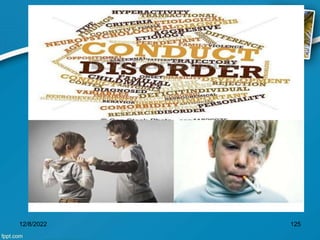
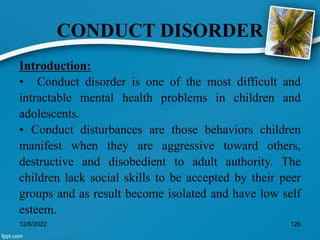
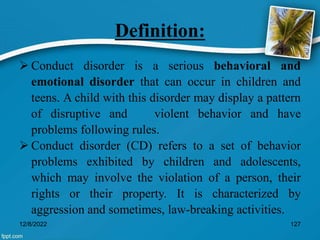
CONDUCT DISORDER
Introduction:
• Conduct disorder is one of the most difficult and
intractable mental health problems in children and
adolescents.
• Conduct disturbances are those behaviors children
manifest when they are aggressive toward others,
destructive and disobedient to adult authority. The
children lack social skills to be accepted by their peer
groups and as result become isolated and have low self
esteem.
12/8/2022 126
Definition:
 Conduct disorder is a serious behavioral and
emotional disorder that can occur in children and
teens. A child with this disorder may display a pattern
of disruptive and violent behavior and have
problems following rules.
 Conduct disorder (CD) refers to a set of behavior
problems exhibited by children and adolescents,
which may involve the violation of a person, their
rights or their property. It is characterized by
aggression and sometimes, law-breaking activities.
12/8/2022 127
Prevalence
Conduct Disorder usually appears in early or middle
childhood or even in adolescence.
In U.S. prevalence rates for conduct disorder (CD) are
estimated at 2-9%, 5 out of every 100 teenagers.
12/8/2022 128
Classification of conduct disorder
There are two types of conduct disorder:
a.Early onset where the child shows at least one
characteristic before the age of 10 (this is often
associated with ADHD)
b.Adolescent-onset type where the child doesn’t show
any of the characteristics before the age of 10. This is
the most common type. It is not specific to ADHD, but
may occur with ADHD.
12/8/2022 129
Classification
• The severity depends on how many problems the
child has and his effect on others.
 Mild: has just enough conduct problems to make the
diagnosis, causes only minor harm to others.
 Moderate: several conduct problems, causes
moderate harm to others.
 Severe: many conduct problems, causes considerable
harm to others.
12/8/2022 130
Risk factors
• Parents who do not set limits on a child’s behavior
 Parents who do not follow through with
consequences for unacceptable behavior (for
example, a parent may threaten to withdraw
television for a night but then not follow through
when the child’s behavior doesn’t change)
 Lack of parental monitoring of a child’s or
adolescent’s whereabouts
 Unhappy family life with many arguments
 Poverty
12/8/2022 131
Risk factors
 Large family
 Aggressive parenting, particularly from the father
 Marital conflict
 Domestic violence
 Parents with a mental health problem
 Parents who are involved in law-breaking behavior
 Child abuse
 Living in an institutionalized care.
12/8/2022 132
Causes of Conduct Disorder
• The exact cause of conduct disorder is not known, but
it is believed that a combination of biological, genetic,
environmental, psychological, and social factors play a
role.
1. Biological
- defects or injuries to certain areas of the brain
- neurotransmitters
- mental illnesses, such as attention-
deficit/hyperactivity disorder (ADHD), learning
disorders, depression, substance abuse, or an anxiety
disorder,
12/8/2022 133
Causes
2. Genetics:
- family members with mental illnesses, including
mood disorders, anxiety disorders, substance use
disorders and personality disorders
- inherited
3. Environmental:
- dysfunctional family life, childhood abuse, traumatic
experiences, Poor social skills, a family history of
substance abuse, and inconsistent discipline by parents
12/8/2022 134
Causes
4. Cognitive deficit
5. Social: Low socioeconomic status
6. Poor parenting skills: Scott (1998) showed that five aspects
of how parents bring up their children have been found
repeatedly to have a long-term association with conduct
disorders. These are:
- Poor supervision;
- Erratic harsh discipline;
- Parental disharmony;
- Rejection of the child;
- Low parental involvement in the child’s activities.
12/8/2022 135
Symptoms
a. Aggression to people and animals
 Often bullies, threatens or intimidates others.
 Often initiates physical fights.
 Has used a weapon that could cause serious physical
harm to others (e.g. a bat, brick, broken bottle, knife
or gun).
 Is physically cruel to people or animals.
 Steals from a victim while confronting them (e.g.
assault, mugging, purse-snatching).
 Forces someone into sexual activity.
12/8/2022 136
Symptoms
b. Destruction of property
 Deliberately engages in fire-setting with the intention to cause
damage.
 Deliberately destroys someone else’s property (other than by
arson).
c. Deceitfulness, lying or stealing
 Has broken into someone else’s building, house, or car.
 Lies to obtain goods or favors or to avoid obligations.
 Steals items without confronting a victim (e.g. shoplifting
without breaking and entering, forgery).
12/8/2022 137
Symptoms
a. Serious violations of rules
 Often stays out at night despite parental objections before the
age of 13.
 Runs away from home – at least twice overnight or once for a
longer period.
 Often truant from school before the age of 13.
In addition, many children with conduct disorder are irritable,
have low self-esteem, and tend to throw frequent temper
tantrums. Some may abuse drugs and alcohol. Children with
conduct disorder often are unable to appreciate how their
behavior can hurt others and generally have little guilt or remorse
about hurting others.
12/8/2022 138
Diagnosis of Conduct Disorder
 Mental illnesses in children are diagnosed based on
signs and symptoms that suggest a particular
problem.
 If symptoms of conduct disorder are present,
evaluation is started by performing a complete
medical history and psychiatric history.
 A physical exam and laboratory tests (for example,
neuro imaging studies, blood tests) may sometimes be
appropriate if there is concern that a physical illness
might be causing the symptoms.
12/8/2022 139
Diagnosis
 Look for signs of other disorders that often occur
along with conduct disorder, such as ADHD and
depression.
 If physical cause for the symptoms is difficult to find,
he or she will likely refer the child to a child and
adolescent psychiatrist or psychologist, mental health
professionals who are specially trained to diagnose
and treat mental illnesses in children and teens.
 Psychiatrists and psychologists use specially designed
interview and assessment tools to evaluate a child for
a mental disorder.
12/8/2022 140
Prevention
Although it may not be possible to prevent conduct
disorder, recognizing and acting on symptoms when
they appear can minimize distress to the child and
family, and prevent many of the problems associated
with the condition. In addition, providing a nurturing,
supportive, and consistent home environment with a
balance of love and discipline may help reduce
symptoms and prevent episodes of disturbing behavior.
•
12/8/2022 141
Treatment
• Conduct Disorder is highly resistant to treatment.
 Psychotherapy: Psychotherapy (a type of counseling) is
aimed at helping the child learn to express and control anger in
more appropriate ways.
o A type of therapy called cognitive-behavioral therapy aims
to reshape the child's thinking (cognition) to improve
problem solving skills, anger management, moral reasoning
skills, and impulse control.
o Family therapy may be used to help improve family
interactions and communication among family members.
o A specialized therapy technique called parent management
training (PMT) teaches parents ways to positively alter
their child's behavior in the home.
12/8/2022 142
Treatment
Medications:
- no medication formally approved to treat conduct disorder,
- various drugs may be used to treat some of its distressing
symptoms, as well as any other mental illnesses that may be
present, such as ADHD or major depression.
- In the short term, stimulant medicine has proven effective in
controlling the specific symptoms of inattention, impulsivity,
and hyperactivity.
- Note that substance abuse occurs in a high number of
children with CD independent of whether they are treated with
psychoactive medication.
•
12/8/2022 143
Treatment
 Anticonvulsants like valporate are considered to be
the second group of medications to be used in
nonspecific aggression.
 Lithium, α2-agonists such as clonidine, divalproex
may diminish aggressive acting out in selected
individuals.
12/8/2022 144
Juvenile Delinquency
• Children who show oppositional defiant behavior
or conduct disorders and come into conflict with the
juvenile justice system are called juvenile delinquents.
• also known as "juvenile offending", is the act of
participating in unlawful behavior as a minor or
individual younger than the statutory age of majority.
• Juvenile crimes can range from status offenses (such
as underage smoking/drinking), to property
crimes and violent crimes.[3]
12/8/2022 145
Introduction
• The term refers to a person under 18 years of age
who is brought to the attention of the juvenile justice
system for committing a criminal act or displaying
other illegal behaviors, like the use of alcohol or
illicit drugs.
12/8/2022 146
Types
Ferdinand presented two categories of juvenile
offenders as under:
(1) Neurotic Offenders- They are the offenders whose
delinquency is the result of powerful unconscious
impulses which often produces guilt which in turn,
motivates them to act out their delinquency in their
community so that they will be caught and punished.
The delinquent act is sometimes considered symbolic.
For example, if they steal, it is done for love and not for
a material gain.
12/8/2022 147
Types
(2) Character Disorder Offenders - This type of
offenders feel very little guilty when they commit the
acts of delinquency.
Because of a lack of positive identification models in
their environment, they have failed to develop self-
control and do what they want to do when they feel like
doing it. They come from disorganized families and
have had a barren environment in their childhood. They
are self-centered and feel to be aloof and have difficulty
in forming meaningful relationships.
12/8/2022 148
CAUSES
• There is no single cause of Juvenile delinquency but
there are many and varied causes.
Biological
Socio-Environmental (Family Structure and Broken
Homes, Child's Birth Order in the Family/Family Size and Type ,
Parent-Child Relationship , Behaviour of Step and alcoholic
Parents )
Psychological, Physiological and personal (intellect
person)
12/8/2022 149
Characteristic
• Delinquents have been found to cluster into behavior
dimension sub-groups.
• Under-socialised aggressive, which is seen to
involve destructive and aggressive behaviour similar
to conduct disorder,
• A second grouping is the socialised-aggressive
dimension which describes juveniles who associate
with delinquent peers.
12/8/2022 150
Characteristic
• A third dimension is that of immaturity-
attention deficit which is hyperactivity, and
the last dimension is anxiety withdrawal.
12/8/2022 151
Prevention and management
There may be two kinds of programmes for preventing
the juvenile delinquency;
(i) Individual Programme: Individual programme
involves the prevention of delinquency through
counseling, psychotherapy and proper education.
(ii) Environmental programme: Environmental
programme involves the employment of techniques with
a view to changing the socio-economic context likely to
promote delinquency.
12/8/2022 152
(i) Individual Programme
(a) Clinical programme: The objective of this clinic is
to provide aids through Psychiatrists Clinical
Psychologists and Psychiatric Social workers to
help the Juveniles delinquents in understanding their
personality problems.
Taft and England have listed the function of clinics as
follows
To participate in discovery of pre delinquents.
To investigate cases selected for study and treatment.
To treat cases itself or to refer cases to other agencies
for treatment.
12/8/2022 153
Individual programme
To interest other against in Psychiatrically oriented
types of treatment of behavioral disorders in children.
To reveal the community unmet needs of children.
To cooperate in training of students intending to
specialize in treatment of behavioural problems.
(b) Educational program
©Mental Hygiene
(d) Parent education
(e) Recreational programmes
12/8/2022 154
(ii) Environmental programme
(a) Community Programmes
(b) Publicity
(c) Parental love and affection
(d) Family environment
12/8/2022 155
Role of Police
• The police have an important role in apprehending
and protection of juvenile delinquents.
• The police is a separate agency from the Juvenile
Court and it is also guided and directed by the
policies and philosophies of the Juvenile Court with
which the police has to work.
12/8/2022 156
Enforcement of Law
• Constant surveillance is one of the ways in which
law and order is maintained and delinquency and
crime is substantially reduced in amount and
seriousness.
• The regulatory activities are protective as well as
preventive.
• Regular inspection and investigating may reduce the
crime and delinquency in the places.
• If supervision by the police reduces or eliminates the
illegal activities of adults, juvenile delinquency will
also be decreased substantially particularly on public
places
12/8/2022 157
Aftercare and Rehabilitation
programmes
• Most of the children released from special schools
and other such institutions find themselves in need of
great help for their rehabilitation in the community.
• They immediately require some shelter and a
reasonable support and proper guidance for their
settlement in the society and return in the main
stream.
• Few other neglected and uncontrollable children also
require some temporary help till they are taken back
by their parents / guardians
12/8/2022 158
REFERENCES
1. The Most Common Behavior Disorders in Children [Internet]. Healthline.
2020 [cited 11 October 2020]. Available from:
https://www.healthline.com/health/parenting/behavioral-disorders-in-
children
2. Behavioural disorders in children [Internet]. Betterhealth.vic.gov.au.
2020 [cited 11 October 2020]. Available from:
https://www.betterhealth.vic.gov.au/health/healthyliving/behavioural-
disorders-in-children
3. Behavior or Conduct Problems in Children | CDC [Internet]. Centers for
Disease Control and Prevention. 2020 [cited 11 October 2020].
Available from:
https://www.cdc.gov/childrensmentalhealth/behavior.html
4. Everything You Need to Know About ADHD [Internet]. Healthline. 2020
[cited 11 October 2020]. Available from:
https://www.healthline.com/health/adhd#:~:text=Attention%20deficit%20
hyperactivity%20disorder%20(ADHD,and%20children%20can%20have
%20ADHD.
5. Ghai O, Paul V, Bagga A. Essential Pediatrics. 7th ed. CBS
Publisher&Distributers; 2008.
12/8/2022 159

Behavioral Disorder.ppt

  • 1.
    BEHAVIORAL DISORDER Laxmi Dahal,M. Sc. Nursing B-19 12/8/2022 1
  • 2.
    INTRODUCTION • All youngchildren can be b from time to time, which is perfectly normal. However, some children have extremely difficult and challenging behaviours that are outside the norm for their age. • While low-intensity naughty, defiant and impulsive behaviour from time to time, losing one’s temper, destruction of property, and deceitfulness/stealing in the preschool children are regarded as normal. 12/8/2022 2
  • 3.
    Introduction • Extremely difficultand challenging behaviours outside the norm for the age and level of development, such as unpredictable, prolonged, and/or destructive tantrums and severe outbursts of temper loss are recognized as behaviour disorders. • The most common disruptive behaviour disorders include oppositional defiant disorder (ODD), conduct disorder (CD) and attention deficit hyperactivity disorder (ADHD). 12/8/2022 3
  • 4.
    Introduction • These threebehavioural disorders share some common symptoms, so diagnosis can be difficult and time consuming. • A child or adolescent may have two disorders at the same time. Other exacerbating factors can include emotional problems, mood disorders, family difficulties and substance abuse. • Challenging behaviours and emotional difficulties are more likely to be recognized as “problems” rather than “disorders” during the first 2 years of life. 12/8/2022 4
  • 5.
    Causes 1. Genetics • Achild’s behavior is a product of his temperament. • Temperament is controlled by genetics, according to the North Carolina State University Cooperative Extension. • The researchers describe three types of temperament--easy, sensitive and feisty. The group claims that 15 percent of children are born feisty. 12/8/2022 5
  • 6.
    Genetics… • These arethe children who tend to have behavior problems. • Behavioral issues may also be a result of biological factors like visual impairments, speech disorders and motor disabilities, explains the National Association for the Education of Young Children. 12/8/2022 6
  • 7.
    Financial Strains • Areport by the National Association of Social Workers suggests that children in impoverished families often exhibit behavior problems. These children tend to be hyperactive and aggressive. Their out-of-control behaviors can lead to poor performance in school and delinquency. • One reason for this connection is negative feelings and lack of attention from parents who are experiencing economic stress. The longer the poverty persists, the more troublesome the behavior will be. 12/8/2022 7
  • 8.
    Environmental Causes • Whenchildren are in an unsuitable environment, they are prone to act out. NAEYC lists an overcrowded child care facility or a household with insufficient toys or activities as examples of unsuitable settings for children. • Lack of playthings or attention can lead to jealousy and then hostility between children. 12/8/2022 8
  • 9.
    Cry for Help •Sometimes children use bad behavior as their call for help. For example, if the youngest child in a family feels powerless against her older siblings, she may act out. • She may feel that biting, for example, is a way to get parental attention when older siblings are dominant. 12/8/2022 9
  • 10.
    Poor Parenting • Scottreports that various aspects of parenting may contribute to violent behavior in children. • He lists five parenting flaws in particular: poor supervision; erratic, harsh discipline; parental disharmony; rejection of the child; and limited involvement in the child's activities. Parents who exhibit this behavior engage in a parent-child interaction pattern that inadvertently encourages and rewards aggressiveness in their children. 12/8/2022 10
  • 11.
    The Media • Thereis debate over the role of the media—especially violence on television, in movies and in video games—in causing violence in children and teens. • Some research has found a correlation between media violence and real-world violence. For example, a 2010 study led by researchers from Columbia University and Mount Sinai Medical Center in New York found that adolescents who viewed more than one hour of television a day were more likely to commit violent acts as adults. 12/8/2022 11
  • 12.
    Warning signs  Harmingor threatening themselves, other people or pets  Damaging or destroying property  Lying or stealing  Not doing well in school, skipping school  Early smoking, drinking or drug use  Early sexual activity  Frequent tantrums and arguments  Consistent hostility toward authority figures 12/8/2022 12
  • 13.
  • 14.
  • 15.
    Definition • Autism isa grave childhood psychiatric disorder which is first diagnosed in early childhood (before age of 3 years) and is characterized by impaired communication, social interaction and repetitive behaviors. • The estimated global prevalence is 1-2 %. 12/8/2022 15
  • 16.
    Causes • Genetic factor •Biochemical factor • Medical factors • Prenatal factors • Physiological factors • Psychological factors 12/8/2022 16
  • 17.
    Genetic factor • Higherconcordance in monozygotic than dizygotic twins • Strong familial inheritance 12/8/2022 17
  • 18.
    Biochemical factor • 1/3rdof patients with autistic disorder have elevated plasma serotonin 12/8/2022 18
  • 19.
    Medical factors • Associatedwith early developmental problems (e.g. meningitis, encephalitis), congenital rubella and cytomegalovirus 12/8/2022 19
  • 20.
    Prenatal factors • Maternalbleeding after first trimester • Meconium in the amniotic fluid 12/8/2022 20
  • 21.
    Physiological factors • Brainimaging and autopsies studies revealed a varieties of developmental brain abnormality, • Neuro-anatomical studies have shown an enlargement of lateral ventricles 12/8/2022 21
  • 22.
  • 23.
    Psychological factors • Parentalrejection • Deviated personality • Broken families • Family stress • Improper stimulation • Defective communication pattern • Lack of warmth and affection • Sibling conflicts 12/8/2022 23
  • 24.
    Clinical features Impairment on: 1.Social interaction 2. Communication 3. Behavior, interests and activities 4. Others 12/8/2022 24
  • 25.
    Social interaction • Anearly sign of autism and persists into adulthood • The absence or deficient social skills may change over time in line with the developmental level of child 12/8/2022 25
  • 26.
    Social interaction… Infancy: • Indifferenceto affection or physical contact e.g. cuddles with parents and siblings • Absent social smile • Lack of eye contact • Lack of attachment to parents • Absence of separation anxiety on being left in an unfamiliar environment • Dislikes being touched or kissed • Failure to respond to parent’s voice 12/8/2022 26
  • 27.
    Social interaction… Early childhood: •Lack of imitation of actions (e.g. clapping) • Not showing or pointing out toys or other objects of interest • Appearing to be in their own world or preferring solitary (single) activities • Unable to make friends • Anger or fear without apparent reason and absence of fear in the presence of danger 12/8/2022 27
  • 28.
    Social interaction… Later childhood: •Inability to join in with the play of other children or inappropriate attempts at joints play (this may show as aggressive or disruptive behavior) • Lack of awareness of classroom norms (e.g. criticizing teacher, unwilling to cooperate in classroom activities) • Easily overwhelmed by social and other stimulation • Failure to form relationship to others 12/8/2022 28
  • 29.
    Communication • Failure ofa child to develop language is first sign that makes parents seek medical help • Impaired communication affects the verbal as well as non verbal skills Infancy: • Lack of communication sounds such as babbling, pointing or other gesture by the age of 12 months • Delayed speech: failure to speak single words by the age of 18 months • No two word spontaneous patterns by the age of 24 months 12/8/2022 29
  • 30.
    Communication Early childhood: • Impairedlanguage development • Unusual use of language • Repeating words or phrases • Poor response to name • Lack of response to verbal cues • Deficit non verbal communication e.g. lack of pointing and difficulty following a point and failure to smile socially 12/8/2022 30
  • 31.
    Communication… Late childhood: • Abnormallanguage development, including muteness, abnormalities in pitch and rhythm of speech • Persistent echolalia • Incorrect use of pronouns (e.g. referring to self as you, or she is children over 3 years old) • Limited use of language or communication • Abstract thinking is impaired 12/8/2022 31
  • 32.
    Behaviors, interests and activities •Limited interest and are often preoccupied with one particular interest or activity • Some children have attachment may develop to inanimate objects (stick, piece of cloth, cup, toy etc) that they will take with the everywhere or hold on to. Trying to take this away, will cause distress and in some cases very agitated or aggressive behavior 12/8/2022 32
  • 33.
    Behaviors, interests… • Abnormalitiesin posture such as tiptoe walking, odd body postures are also often observed • Tried to keep touching different body parts e.g. they might put their hands on their head or slap their head with both hands • Attachment may develop to inanimate objects 12/8/2022 33
  • 34.
  • 35.
    Others • More than50% of these children have moderate to profound MR with and IQ of less than 50 • Epilepsy is common in these children 12/8/2022 35
  • 36.
  • 37.
    Diagnostic criteria • Impairedsocial interaction (at least two have to be observed in the child): a. Difficulties with social interaction for example eye contact, facial expression, body posture and gestures b. Lack of peer relationships appropriate for the developmental level of the child c. Not seeing to share achievement, interest and pleasure d. Not being able to participate in or return social or emotional interactions 12/8/2022 37
  • 38.
    Diagnostic criteria… • Impairedcommunication (at least 1): a. late or absent developmental of spoken language for which the child doesn’t try to compensate with gesture b. Absence of social imitative play c. Repetitive, stereotyped or very individual use of language 12/8/2022 38
  • 39.
    Diagnostic criteria… • Repetitiverestricted and stereotyped activities, behavior (at least one): a. Preoccupation with abnormal interests that are restricted and stereotyped (such as spinning things) b. Rigidity sticking to routines or rituals that don’t appear to have a function or aim c. Stereotyped, repetitive motor mannerisms such as hand flapping d. Persistently preoccupation with parts of objects 12/8/2022 39
  • 40.
    Treatment • Pharmacological treatment: -Antipsychotic drugs - Antidepressant drugs - Antiepileptic drugs • Behavioral therapy • Special schooling • Social therapy 12/8/2022 40
  • 41.
  • 42.
    Nursing interventions • Workwith the child on a one to one basis • Protect the child when self mutilate behavior occurs. Devices such as helmet, padded mitten or arm cover may be used • Assign limited number of caregivers to the child. Ensure that warmth, acceptance and availability are conveyed 12/8/2022 42
  • 43.
    Nursing intervention • Providechild with familiar objects such as familiar toys • Support child’s attempts to interact with others • Give positive reinforcement for eye contact with something acceptable to the child (e.g. food and familiar objects), gradually replace with social reinforcement (i.e. touch, hug) 12/8/2022 43
  • 44.
    Nursing… • Fulfill thechild’s need until communication can be established • Slowly encourage him to express his needs verbally • Give positive reinforcement when eye contact is used to convey non verbal expression or to when child tries to speak • Teach simple self care skills by using behavior modification techniques 12/8/2022 44
  • 45.
    Nursing… • Provide languagetraining • Assist the child during self care activities such as feeding, dressing etc • The child should be helped to name own body parts • Encourage appropriate touching of and being touched by others 12/8/2022 45
  • 46.
    Prognosis • Approx. 10-20%improve with age 4-6 years and live near normal life • Approx. 10-20% live at home and go special school • Approx. 60% improve little and need residential care 12/8/2022 46
  • 47.
    ADHD Introduction It is generallyconsidered to be developmental disorder, largely neurological in nature, characterized by a persistent pattern of inattention/ and hyperactivity, as well as forgetfulness, poor impulse control or impulsivity and distractibility, more frequent and severe than is typical of children at as a similar level of development. 12/8/2022 47
  • 48.
    Introduction • Symptoms arenot due to gross neurological impairment, sensory impairment, language or motor impairment, mental retardation, emotional disturbance. • Boys are 2-3 times more likely to have ADSD than girls. 12/8/2022 48
  • 49.
    Etiology • Genetic • Pre-periand post natal factors • Environmental factors • Psychological factors • Organic factors • Deficiency of neurotransmitters, dopamine and nor-epinephrine 12/8/2022 49
  • 50.
    DSM-IV Diagnostic Criteria •Inattention Symptoms (at least 6 symptoms required) –Fails to give close attention to details or makes careless mistakes in schoolwork, work, etc. –Difficulty sustaining attention –Does not seem to listen when spoken to directly –Does not follow through on instructions and fails to finish schoolwork, chores, etc. 12/8/2022 50
  • 51.
    Inattention Symptoms –Difficulty organizingtasks and activities –Avoids tasks requiring sustained mental effort –Loses things necessary for tasks or activities –Easily distracted by extraneous stimuli –Forgetful in daily activities 12/8/2022 51
  • 52.
    • Hyperactivity-Impulsivity Symptoms(at least 6 symptoms required) –Difficulty playing or engaging in activities quietly –Always "on the go" or acts as if "driven by a motor” –Talks excessively –Blurts out answers 12/8/2022 52
  • 53.
    Hyperactivity-Impulsivity Symptoms –Difficulty waitingin lines or awaiting turn –Interrupts or intrudes on others –Runs about or climbs inappropriately –Fidgets with hands or feet or squirms in seat –Leaves seat in classroom or in other situations in which remaining seated is expected 12/8/2022 53
  • 54.
    Other symptoms - Symptomspresent before age 7 - Clinically significant impairment in social or academic/occupational functioning - Some symptoms that cause impairment are present in 2 or more settings (e.g., school/work, home, recreational settings) - Not due to another disorder (e.g., Autism, Mood Disorder, Anxiety Disorder) 12/8/2022 54
  • 55.
    Management 1. Pharmacotherapy: – Stimulantslike: Dextroamphetamine (10-40 mg/day) and Methylphenidate (10-60 mg/day). – These drugs can cause stimulation of inhibitory influences on the cerebral cortex, thus decrease hyperactivity. – When stimulant medication is not available, can be used low dose of Clonidine, Imparamine, Venilafaxine, Chlorpromazine. 12/8/2022 55
  • 56.
    Management 2. Psychological therapies -Behavior modification techniques - Social skills training - Supportive psychotherapy - Family therapy 12/8/2022 56
  • 57.
    Management • Develop trustingrelationship with the child and convey acceptance of the child separated from unaccepted behaviour. • Ensure the safe environment and provide supervision for potentially dangerous situations. • Reduce environmental distraction. • Ensure the child’s attention by calling his/her name and establishing eye contact before giving instructions. 12/8/2022 57
  • 58.
    Management • Ask thepatient to repeat instructions before beginning a task. • Establish goals that allow patient to complete a part of the task, rewarding each step. • Provide assistance on a one basis beginning with simple concrete instruction. • Gradually decrease the amount of assistance. 12/8/2022 58
  • 59.
    Management • Offer positivereinforcement for successful attempts made. • Give immediate positive feedback for acceptable behavior. • Provide quite environment, classroom and small group activities. • Assess parental skill level, considering intellectual, emotional and physical strengths and limitation. 12/8/2022 59
  • 60.
    Management • Then provideinformation and materials related to the child’s disorder, as well as demonstrate effective parenting techniques. For eg. Give instructional materials in written and verbal form with step by step examination. • Educate child and family on regular activities and behavioral response. • Co-ordinate overall treatment plan with schools, collateral personnel the child and the family. 12/8/2022 60
  • 61.
  • 62.
    Specific Learning Disability •Specific learning disability is defined as a persistent impairment in reading (dyslexia), writing (dysgraphia) and/ or arithmetic (dyscalculia) skills in an individual with preserved cognition, vision, hearing and adequate opportunities. • It affects 5-15% of school going children. 12/8/2022 62
  • 63.
    Introduction • Dyslexia accountsfor 80% of all specific learning disabilities. • These disorders are probably caused by functionally disrupted networks in the cerebral cortex with intact anatomy. 12/8/2022 63
  • 64.
    Diagnosis • reading slowlyand incorrectly, • skipping lines while reading aloud, • making repeated spelling mistakes, • untidy /illegible hand-writing with poor sequencing, • inability to perform even simple mathematics, incoherent to the child's intelligence level. 12/8/2022 64
  • 65.
    Diagnosis • The DSM5 diagnosis of SLD requires fulfilling a predefined number of criteria in reading, writing and arithmetic skills and these impairments should persist despite interventions targeting the specific disability for at least 6 months. 12/8/2022 65
  • 66.
    Criteria A • Ongoingdifficulties in the school-age years learning and using at least one academic skill (e.g. reading accuracy/fluency; spelling accuracy; written expression competence and fluency; mastering number facts). These difficulties have persisted and failed to improve as expected, despite the provision of targeted intervention for at least six months. This intervention should be recognised as evidence-based and ideally delivered by an experienced and qualified person. 12/8/2022 66
  • 67.
    Criteria B • Thedifficulties experienced by the individual will be assessed using standardised achievement tests* and found to be at a level significantly lower than most individuals of the same age. Sometimes individuals are identified with a learning disability even though they are performing within the average range. This is only the case when it can be shown that the individual is achieving at this level due to unusually high levels of effort and ongoing support. 12/8/2022 67
  • 68.
    Criteria C • Thedifficulties experienced by the individual usually become apparent in the early years of schooling. The exception to this is where problems occur in upper- primary or secondary school once the demands on student performance increase significantly. For example – when students have to read extended pieces of complex text or write at a more sophisticated level under timed conditions. 12/8/2022 68
  • 69.
    Criteria D • Specificlearning disorders will not be diagnosed if there is a more plausible explanation for the difficulties being experienced by the individual. For example – if the individual has: an intellectual disability; a sensory impairment; a history of chronic absenteeism; inadequate proficiency in the language of instruction; a psychosocial condition; or, not received appropriate instruction and/or intervention. 12/8/2022 69
  • 70.
    Management • Management revolvesaround remedial education with active participation from both school and parents. 12/8/2022 70
  • 71.
    Tic Disorder andstereotypies • Tics are abrupt onset, fast paroxysmal non-rhythmic motor or vocal manifestations which may be simple or complex. The age of onset is 4-6 years with peak at 10- 12 years and significant attenuation by 18-20 years. The prevalence is around 10-15% with higher rate in boys. 12/8/2022 71
  • 72.
    Tic Disorder andstereotypies • Tourette Syndrome is characterized by onset before 18 years of age, presence of both motor and vocal tics and persistence beyond 1 year, including the warning phase, tics can be associated with neurological ailments like Huntington and Wilson disease, or with parainfectious illness, e.g. pediatric autoimmune neuropsychiatric disorders associated with streptococcal infection (PANDAS). 12/8/2022 72
  • 73.
    Tic Disorder andstereotypies • It is important to differentiate stereotypies from tics. Although stereotypies may have similar vocal and motor manifestations, classically they are rhythmic and distractable, and usually remain stable over a time period, unlike tics which may evolve temporally, stereotypies usually have an early onset (before 3 years of age) and, along with neurodevelopmental disorders, may affect normal children, as well. 12/8/2022 73
  • 74.
    Management • The essentialcomponent is behavioral therapy. Medications like haloperidol and clonidine are considered in situations where the tics are socially and functionally disabling despite adequate behavioral therapy. 12/8/2022 74
  • 75.
  • 76.
    EATING DISORDERS Introduction  Eatingdisorders are treatable medical illnesses in which certain maladaptive patterns of eating observed and involves serious disturbances in eating behavior includes extreme and unhealthy reduction of food intake or severe or over eating; as well as distress feelings or extreme concern about body shapes, weight and body image. 12/8/2022 76
  • 77.
    Anorexia Nervosa Definition: • ‘Itis an eating disorder, where people involuntarily refuse to eat’. • Anorexia nervosa often simply called ‘anorexia’ is an eating disorder characterized by an abnormally low body weight, an intense fear of gaining weight and a distorted perception of weight. People with anorexia place a high value on controlling their weight and shape, using extreme efforts that tend to significantly interfere with their lives. • 12/8/2022 77
  • 78.
    Prevalence • The incidenceof anorexia nervosa appears to have increased in recent decades. • It is at least 10 times more frequent in women than in men. Types: 1. Restricting type 2. Binge/ purging type 12/8/2022 78
  • 79.
    Types a. Restricting Type: People with this type of anorexia nervosa place severe restrictions on the quantity and type of food they consume.  This could include counting calories, skipping meals, restricting certain foods (such as carbohydrates) and following obsessive rules, such as only eating foods of a particular colour.  These behaviours may be accompanied by excessive exercise. 12/8/2022 79
  • 80.
    Types b. Binge Eating/Purging Type:  People with this type of anorexia also place restrictions on the food they eat. But it's accompanied by binge eating or purging. Binge eating involves feeling out of control and eating a large amount of food.  A person then 'compensates' for this eating by purging the food through vomiting, misusing laxatives, diuretics or enemas. 12/8/2022 80
  • 81.
    Causes i. Genetics: • Amongfemale siblings of patients with established anorexia nervosa, 6-10% suffers from the condition compared to 1-2% found in the general population of same age. i. A disturbance in hypothalamic function. ii. Social factors: • There is a high prevalence of anorexia nervosa among female students and in occupational groups particularly concerned with weight (for example dancers). Influence of mass media, beauty contests are other important social causes. 12/8/2022 81
  • 82.
    Cause i. Individual psychologicalfactors: • A disturbance of body image, a struggle for control and a sense of identity are important factors in the causation of anorexia nervosa. Traits of low self- esteem and perfectionism are often found. i. Causes within the family: • Disturbance in family relationships, over-protection, family members having an unusual interest in food and physical appearance. 12/8/2022 82
  • 83.
  • 84.
    Diagnosis  Complete physicalexamination including laboratory tests to rule out endocrine, metabolic and central nervous system abnormalities; mal-absorption syndrome and other disorders that cause physical wasting.  Complete blood testing: hemoglobin levels, platelet count, cholesterol level, total protein, sodium, potassium, chloride, calcium and fasting blood glucose and serum amylase levels and blood urea nitrogen. 12/8/2022 84
  • 85.
    Diagnosis  ECG readingsirregular  Differential diagnosis to rule out other psychiatric disorders like substance abuse, anxiety disorder, body dysmorphic disorder, mood disorders, schizophrenia. 12/8/2022 85
  • 86.
    Treatment  Team approach(medical providers, mental health professionals, dietitians) will be used to treat eating disorders.  Medical care: anorexia nervosa causes many complications, hence frequent monitoring of vital signs, hydration levels, electrolyte levels and other physical conditions are needed; and symptomatic treatment is planned.  Treat dehydration, electrolyte imbalance, hypotension, psychiatric problems, sometimes hospitalization may be required in severe anorexia nervosa cases or its complications. 12/8/2022 86
  • 87.
    Treatment a. Pharmacotherapy:  Neuroleptics Appetite stimulants  Antidepressants a. Psychological therapies: i. Individual psychotherapy ii. Behavior therapy iii.Family therapy iv.Group therapy v. Nutrition therapy vi. Interpersonal therapy 12/8/2022 87
  • 88.
    Complications  Anemia  Heartproblems, such as mitral valve prolapse, abnormal heart rhythms or heart failure  Bone loss (osteoporosis), increasing the risk of fractures  Loss of muscle  In females, absence of a period  In males, decreased testosterone  Gastrointestinal problems, such as constipation, bloating or nausea  Electrolyte abnormalities, such as low blood potassium, sodium and chloride  Kidney problems 12/8/2022 88
  • 89.
    Bulimia Nervosa Definition: Bulimia nervosa,also known as simply bulimia, is an eating disorder characterized by binge eating followed by purging. Binge eating refers to eating a large amount of food in a short amount of time. Purging refers to the attempts to get rid of the food consumed. This may be done by vomiting or taking laxatives. 12/8/2022 89
  • 90.
    Types of Bulimia •Purging type –it accounts for the majority of cases of those suffering from this eating disorder. In this form, individuals will regularly engage in self-induced vomiting or abuse of laxatives, diuretics, or enemas after a period of bingeing.  Non-Purging type – In this form of bulimia nervosa, the individual will use other inappropriate methods of compensation for binge episodes, such as excessive exercising or fasting. In these cases, the typical forms of purging, such as self-induced vomiting, are not regularly utilized. 12/8/2022 90
  • 91.
    Causes of Bulimia •The exact cause of bulimia nervosa is currently unknown; though it is thought that multiple factors contribute to the development of this eating disorder, including genetic, environmental, psychological, and cultural influences. Some of the main causes for bulimia include:  Stressful transitions or life changes  History of abuse or traumaegative body image  Poor self-esteem  Professions or activities that focus on appearance/performance 12/8/2022 91
  • 92.
    Physical signs andsymptoms  Constant weight fluctuations  Electrolyte imbalances, which can result in cardiac arrhythmia, cardiac arrest, or ultimately death  Broken blood vessels within the eyes  Enlarged glands in the neck and under the jaw line  Oral trauma, such as lacerations in the lining of the mouth or throat from repetitive vomiting  Chronic dehydration  Inflammation of the esophagus  Chronic gastric reflux after eating or peptic ulcers  Infertility 12/8/2022 92
  • 93.
    Signs and symptomsof binge eating and purging  Disappearance of large amounts of food  Eating in secrecy  Lack of control when eating  Switching between periods of overeating and fasting  Frequent use of the bathroom after meals  Having the smell of vomit 12/8/2022 93
  • 94.
    Diagnosis  Physical examination:auscultation of heart and lung sounds, anthropometric measurements:-height, weight, body mass index.  Monitor vital signs  Check the skin for dryness or other problems  Assist for laboratory tests: e.g. X-ray, ECG, complete blood picture, urine analysis  Psychological evaluation: assess the mental status, eating habits, 12/8/2022 94
  • 95.
    Prevention • Although there'sno sure way to prevent bulimia, but can steer someone toward healthier behavior or professional treatment before the situation worsens.  Foster and reinforce a healthy body image in your children, no matter what their size or shape. Help them build confidence in ways other than their appearance.  Have regular, enjoyable family meals.  Never criticize or tease any child for his/her weight or large body frame. 12/8/2022 95
  • 96.
    Prevention  Never keepa nick name to the child.  Avoid talking about weight at home. Focus instead on having a healthy lifestyle.  Discourage dieting, especially when it involves unhealthy weight-control behaviors, such as fasting, using weight-loss supplements or laxatives, or self- induced vomiting. 12/8/2022 96
  • 97.
    Treatment of BulimiaNervosa • Since negative body image and poor self-esteem are often the underlying factors at the root of bulimia, it is important that therapy is integrated into the recovery process. Treatment for bulimia nervosa usually includes:  Discontinuing the binge-purge cycle: The initial phase of treatment for bulimia nervosa involves breaking this harmful cycle and restoring normal eating behaviors. 12/8/2022 97
  • 98.
    Treatment  Improving negativethoughts: The next phase of bulimia treatment concentrates on recognizing and changing irrational beliefs about weight, body shape, and dieting.  Resolving emotional issues: The final phase of bulimia treatment focuses on healing from emotional issues that may have caused the eating disorder. Treatment may address interpersonal relationships and can include cognitive behavior therapy, dialectic behavior therapy, and other related therapies. 12/8/2022 98
  • 99.
    Complications  Gastric ruptureduring periods of binge-eating.  Dental caries, erosion of tooth enamel, parotitis, and gum infections.  Dehydration or electrolyte imbalances.  Chronic, irregular bowel movements and constipation from laxative use.  Increased risk of suicide and psychoactive substance abuse. 12/8/2022 99
  • 100.
    PICA Introduction • The eatingdisorder that involves repeated or chronic ingestion of non-nutritive substances, which may include plaster, charcoal, clay, wool, ashes, paint and earth/soil. • Although tasting or mouthing of objects is normal in infants and toddlers, pica after the 2nd year of life needs investigation. 12/8/2022 100
  • 101.
    Predisposing factors • Mentalretardation and lack of parental nurturing (psychological and nutritional) • Family disorganization • Poor supervision • More prevalent in the lower socioeconomic • More common in children with autism and other brain-behavior disorder such as Kleine Levin Syndrome • Children with pic are at an increased risk for 12/8/2022 101
  • 102.
    Pre disposing factors •Lead poisoning • Iron deficiency anemia • Parasitic infections 12/8/2022 102
  • 103.
    Management • No specificrather supportive treatment. • Iron is often prescribed, without any definite evidence of benefit. • Thumb-sucking. • It indicates that a pleasurable sensation is derived by the child from this self stimulation. • This is manifestation of the feeling of insecurity. • Parental guidance. • Parents should be advised not to show excessive anxiety about thumb-sucking until at least the child is 4 years old. 12/8/2022 103
  • 104.
    Breath-Holding Spells • Breath-holdingspells are reflex events typically initiated by a provocation that causes anger, frustration or pain making the child cry. • The crying stops at full expiration, and the child becomes apneic and cyanotic or pale. • In some cases, the child may become unconscious and hypotonic. • In prolonged events, brief tonic-clonic movements may happen. 12/8/2022 104
  • 105.
    Breath-holding spells • Breath-holdingspells are rare before 6 months of age, peak at 2 years and abate by 5 years of age. • The differential diagnoses include seizures and cardiac arrhythmias. • The history of a provoking event and stereotyped pattern of events help in distinguishing breath- holding spells from seizures. • In relevant clinical scenarios, seizures and cardiac arrhythmias including long QT syndrome should be ruled out. 12/8/2022 105
  • 106.
    Management • The essentialcomponent of management is parental reassurance. • The family should be advised to be consistent in handling the child, to remain calm during the event, turn him sideways so that secretions can drain and avoid picking the child up (since this decreases blood flow to the brain). • The family should avoid exhibiting undue concern nor give into the child's demands, if the spell was provoked by anger or frustration. 12/8/2022 106
  • 107.
    Thumb Sucking • Thisentity is normal in infants and toddlers. • It peaks by 18-21 months of age and usually disappears by the age of 4 years. • Its persistence in older children is socially unacceptable and can lead to dental malalignment. • In children below 4 years, parents should be reassured. • Beyond 4 years of age, the child should be motivated to refrain from this habit. Both positive 'and negative reinforcements can be used. 12/8/2022 107
  • 108.
    Thumb sucking • Inthis age group, parents should be reassured as most of them show resolution. • If it persists beyond or appears after 5 years of age, opinion of psychologist and speech therapist should be sought. 12/8/2022 108
  • 109.
  • 110.
    Stuttering • Stuttering isa defect in speech characterized by hesitation or spasmodic repetition of some syllables with pauses. • There is difficulty in pronouncing the initial consonants caused by spasm of lingual and palatal muscles. • It can affect up to 5% of children between 2 and 5 years of age. 12/8/2022 110
  • 111.
  • 112.
    Temper Tantrums Introduction • Tempertantrums or "acting-out" behaviors are natural during early childhood. It is normal for children to want to be independent as they learn they are separate people from their parents. • Temper tantrums are unpleasant and disruptive behaviors or emotional outbursts. They often occur in response to unmet needs or desires. 12/8/2022 112
  • 113.
    Introduction • Temper tantrumsare a child's response to physical or emotional challenges by attention seeking tactics like yelling, biting, crying, kicking, pushing, throwing objects, hitting and head banging. • The child may become red in the face. Some children may voluntarily hold their breath for a few seconds and then resume normal breathing (unlike breath- holding spells). 12/8/2022 113
  • 114.
    Introduction • Tantrums typicallybegin at 18-36 months of age and gradually subside by the age of 3-6 years. • After age 4, they rarely occur. • Being tired, hungry, or sick, can make tantrums worse or more frequent. 12/8/2022 114
  • 115.
    Why tantrum happens? Achild might lash out regularly because of: • ADHD • Anxiety • A learning disability • Sensory processing issues • Autism 12/8/2022 115
  • 116.
    PREVENTING TEMPER TANTRUMS • Usean upbeat tone when asking your child to do something. Make it sound like an invitation, not an order. For example, "If you put your mittens and hat on, we will be able to go to your play group." • DO NOT battle over unimportant things like which shoes your child wears or whether they sit in the high-chair or booster seat. • Safety is what matters, such as not touching a hot stove, keeping the car seat buckled, and not playing in the street. 12/8/2022 116
  • 117.
    Prevention • Offer choiceswhen possible. For example, let your child pick what clothes to wear and what stories to read. • A child who feels independent in many areas will be more likely to follow rules when it is a must. DO NOT offer a choice if one does not truly exist. 12/8/2022 117
  • 118.
    Management • Distraction and'time out' techniques are useful. • Providing a safe setting. Many children have difficulty stopping tantrums on their own. • A time-out technique, in which the child must sit alone in a dull place (a corner or room [other than the child’s bedroom] that is not dark or scary and has no television or toys) for a brief period, is a good approach to altering unacceptable behavior. 12/8/2022 118
  • 119.
    “A time-out is primarilya ‘Let’s stop things from getting worse’ strategy,” 12/8/2022 119
  • 120.
    Time-out technique The techniquecan be applied when a child misbehaves in a way that is known to result in a time-out. Usually, verbal reprimands and reminders should precede the time-out. • The misbehavior is explained to the child, who is told to sit in the time-out chair or is led there if necessary. • The child should sit in the chair 1 minute for each year of age (maximum, 5 minutes). • A child who gets up from the chair before the allotted time is returned to the chair, and the time-out is restarted. Talking and eye contact are avoided. 12/8/2022 120
  • 121.
    Time out technique •When it is time for the child to get up, the caregiver asks the reason for the time-out without anger and nagging. • As soon as possible after the time-out, the caregiver should praise the child’s good behavior, which may be easier to achieve if the child is redirected to a new activity far from the scene of the inappropriate behavior. 12/8/2022 121
  • 122.
    Management DISTRACTION • In mostcases, addressing the source of the tantrum only prolongs it. It is therefore preferable to redirect the child by providing an alternative activity on which to focus. The child may benefit from being removed physically from the situation. • Parents are counseled to handle this behavioral problem strategically, by staying calm, firm and consistent so that the child is unable to take advantage from such behavior. 12/8/2022 122
  • 123.
    Oppositional Defiant Disorder •Oppositional defiant disorder is a repetitive and persistent pattern of opposing, defiant, disobedient and disruptive behavior towards authority figures persisting for at least 6 months. • Many children are later diagnosed with conduct disorders. • Diagnostic criteria for labeling the condition have been developed. 12/8/2022 123
  • 124.
    ODD • Oppositional defiantdisorder results from interplay of factors in the child's characteristics, parental interactions and environmental factors. • Family history of mental health problems such as depression, ADHD or antisocial personality is often seen. • The management should focus on alleviating risk factors or stresses that might contribute to oppositional behavior. Use of stimulant medication is effective in patients with ADHD. 12/8/2022 124
  • 125.
  • 126.
    CONDUCT DISORDER Introduction: • Conductdisorder is one of the most difficult and intractable mental health problems in children and adolescents. • Conduct disturbances are those behaviors children manifest when they are aggressive toward others, destructive and disobedient to adult authority. The children lack social skills to be accepted by their peer groups and as result become isolated and have low self esteem. 12/8/2022 126
  • 127.
    Definition:  Conduct disorderis a serious behavioral and emotional disorder that can occur in children and teens. A child with this disorder may display a pattern of disruptive and violent behavior and have problems following rules.  Conduct disorder (CD) refers to a set of behavior problems exhibited by children and adolescents, which may involve the violation of a person, their rights or their property. It is characterized by aggression and sometimes, law-breaking activities. 12/8/2022 127
  • 128.
    Prevalence Conduct Disorder usuallyappears in early or middle childhood or even in adolescence. In U.S. prevalence rates for conduct disorder (CD) are estimated at 2-9%, 5 out of every 100 teenagers. 12/8/2022 128
  • 129.
    Classification of conductdisorder There are two types of conduct disorder: a.Early onset where the child shows at least one characteristic before the age of 10 (this is often associated with ADHD) b.Adolescent-onset type where the child doesn’t show any of the characteristics before the age of 10. This is the most common type. It is not specific to ADHD, but may occur with ADHD. 12/8/2022 129
  • 130.
    Classification • The severitydepends on how many problems the child has and his effect on others.  Mild: has just enough conduct problems to make the diagnosis, causes only minor harm to others.  Moderate: several conduct problems, causes moderate harm to others.  Severe: many conduct problems, causes considerable harm to others. 12/8/2022 130
  • 131.
    Risk factors • Parentswho do not set limits on a child’s behavior  Parents who do not follow through with consequences for unacceptable behavior (for example, a parent may threaten to withdraw television for a night but then not follow through when the child’s behavior doesn’t change)  Lack of parental monitoring of a child’s or adolescent’s whereabouts  Unhappy family life with many arguments  Poverty 12/8/2022 131
  • 132.
    Risk factors  Largefamily  Aggressive parenting, particularly from the father  Marital conflict  Domestic violence  Parents with a mental health problem  Parents who are involved in law-breaking behavior  Child abuse  Living in an institutionalized care. 12/8/2022 132
  • 133.
    Causes of ConductDisorder • The exact cause of conduct disorder is not known, but it is believed that a combination of biological, genetic, environmental, psychological, and social factors play a role. 1. Biological - defects or injuries to certain areas of the brain - neurotransmitters - mental illnesses, such as attention- deficit/hyperactivity disorder (ADHD), learning disorders, depression, substance abuse, or an anxiety disorder, 12/8/2022 133
  • 134.
    Causes 2. Genetics: - familymembers with mental illnesses, including mood disorders, anxiety disorders, substance use disorders and personality disorders - inherited 3. Environmental: - dysfunctional family life, childhood abuse, traumatic experiences, Poor social skills, a family history of substance abuse, and inconsistent discipline by parents 12/8/2022 134
  • 135.
    Causes 4. Cognitive deficit 5.Social: Low socioeconomic status 6. Poor parenting skills: Scott (1998) showed that five aspects of how parents bring up their children have been found repeatedly to have a long-term association with conduct disorders. These are: - Poor supervision; - Erratic harsh discipline; - Parental disharmony; - Rejection of the child; - Low parental involvement in the child’s activities. 12/8/2022 135
  • 136.
    Symptoms a. Aggression topeople and animals  Often bullies, threatens or intimidates others.  Often initiates physical fights.  Has used a weapon that could cause serious physical harm to others (e.g. a bat, brick, broken bottle, knife or gun).  Is physically cruel to people or animals.  Steals from a victim while confronting them (e.g. assault, mugging, purse-snatching).  Forces someone into sexual activity. 12/8/2022 136
  • 137.
    Symptoms b. Destruction ofproperty  Deliberately engages in fire-setting with the intention to cause damage.  Deliberately destroys someone else’s property (other than by arson). c. Deceitfulness, lying or stealing  Has broken into someone else’s building, house, or car.  Lies to obtain goods or favors or to avoid obligations.  Steals items without confronting a victim (e.g. shoplifting without breaking and entering, forgery). 12/8/2022 137
  • 138.
    Symptoms a. Serious violationsof rules  Often stays out at night despite parental objections before the age of 13.  Runs away from home – at least twice overnight or once for a longer period.  Often truant from school before the age of 13. In addition, many children with conduct disorder are irritable, have low self-esteem, and tend to throw frequent temper tantrums. Some may abuse drugs and alcohol. Children with conduct disorder often are unable to appreciate how their behavior can hurt others and generally have little guilt or remorse about hurting others. 12/8/2022 138
  • 139.
    Diagnosis of ConductDisorder  Mental illnesses in children are diagnosed based on signs and symptoms that suggest a particular problem.  If symptoms of conduct disorder are present, evaluation is started by performing a complete medical history and psychiatric history.  A physical exam and laboratory tests (for example, neuro imaging studies, blood tests) may sometimes be appropriate if there is concern that a physical illness might be causing the symptoms. 12/8/2022 139
  • 140.
    Diagnosis  Look forsigns of other disorders that often occur along with conduct disorder, such as ADHD and depression.  If physical cause for the symptoms is difficult to find, he or she will likely refer the child to a child and adolescent psychiatrist or psychologist, mental health professionals who are specially trained to diagnose and treat mental illnesses in children and teens.  Psychiatrists and psychologists use specially designed interview and assessment tools to evaluate a child for a mental disorder. 12/8/2022 140
  • 141.
    Prevention Although it maynot be possible to prevent conduct disorder, recognizing and acting on symptoms when they appear can minimize distress to the child and family, and prevent many of the problems associated with the condition. In addition, providing a nurturing, supportive, and consistent home environment with a balance of love and discipline may help reduce symptoms and prevent episodes of disturbing behavior. • 12/8/2022 141
  • 142.
    Treatment • Conduct Disorderis highly resistant to treatment.  Psychotherapy: Psychotherapy (a type of counseling) is aimed at helping the child learn to express and control anger in more appropriate ways. o A type of therapy called cognitive-behavioral therapy aims to reshape the child's thinking (cognition) to improve problem solving skills, anger management, moral reasoning skills, and impulse control. o Family therapy may be used to help improve family interactions and communication among family members. o A specialized therapy technique called parent management training (PMT) teaches parents ways to positively alter their child's behavior in the home. 12/8/2022 142
  • 143.
    Treatment Medications: - no medicationformally approved to treat conduct disorder, - various drugs may be used to treat some of its distressing symptoms, as well as any other mental illnesses that may be present, such as ADHD or major depression. - In the short term, stimulant medicine has proven effective in controlling the specific symptoms of inattention, impulsivity, and hyperactivity. - Note that substance abuse occurs in a high number of children with CD independent of whether they are treated with psychoactive medication. • 12/8/2022 143
  • 144.
    Treatment  Anticonvulsants likevalporate are considered to be the second group of medications to be used in nonspecific aggression.  Lithium, α2-agonists such as clonidine, divalproex may diminish aggressive acting out in selected individuals. 12/8/2022 144
  • 145.
    Juvenile Delinquency • Childrenwho show oppositional defiant behavior or conduct disorders and come into conflict with the juvenile justice system are called juvenile delinquents. • also known as "juvenile offending", is the act of participating in unlawful behavior as a minor or individual younger than the statutory age of majority. • Juvenile crimes can range from status offenses (such as underage smoking/drinking), to property crimes and violent crimes.[3] 12/8/2022 145
  • 146.
    Introduction • The termrefers to a person under 18 years of age who is brought to the attention of the juvenile justice system for committing a criminal act or displaying other illegal behaviors, like the use of alcohol or illicit drugs. 12/8/2022 146
  • 147.
    Types Ferdinand presented twocategories of juvenile offenders as under: (1) Neurotic Offenders- They are the offenders whose delinquency is the result of powerful unconscious impulses which often produces guilt which in turn, motivates them to act out their delinquency in their community so that they will be caught and punished. The delinquent act is sometimes considered symbolic. For example, if they steal, it is done for love and not for a material gain. 12/8/2022 147
  • 148.
    Types (2) Character DisorderOffenders - This type of offenders feel very little guilty when they commit the acts of delinquency. Because of a lack of positive identification models in their environment, they have failed to develop self- control and do what they want to do when they feel like doing it. They come from disorganized families and have had a barren environment in their childhood. They are self-centered and feel to be aloof and have difficulty in forming meaningful relationships. 12/8/2022 148
  • 149.
    CAUSES • There isno single cause of Juvenile delinquency but there are many and varied causes. Biological Socio-Environmental (Family Structure and Broken Homes, Child's Birth Order in the Family/Family Size and Type , Parent-Child Relationship , Behaviour of Step and alcoholic Parents ) Psychological, Physiological and personal (intellect person) 12/8/2022 149
  • 150.
    Characteristic • Delinquents havebeen found to cluster into behavior dimension sub-groups. • Under-socialised aggressive, which is seen to involve destructive and aggressive behaviour similar to conduct disorder, • A second grouping is the socialised-aggressive dimension which describes juveniles who associate with delinquent peers. 12/8/2022 150
  • 151.
    Characteristic • A thirddimension is that of immaturity- attention deficit which is hyperactivity, and the last dimension is anxiety withdrawal. 12/8/2022 151
  • 152.
    Prevention and management Theremay be two kinds of programmes for preventing the juvenile delinquency; (i) Individual Programme: Individual programme involves the prevention of delinquency through counseling, psychotherapy and proper education. (ii) Environmental programme: Environmental programme involves the employment of techniques with a view to changing the socio-economic context likely to promote delinquency. 12/8/2022 152
  • 153.
    (i) Individual Programme (a)Clinical programme: The objective of this clinic is to provide aids through Psychiatrists Clinical Psychologists and Psychiatric Social workers to help the Juveniles delinquents in understanding their personality problems. Taft and England have listed the function of clinics as follows To participate in discovery of pre delinquents. To investigate cases selected for study and treatment. To treat cases itself or to refer cases to other agencies for treatment. 12/8/2022 153
  • 154.
    Individual programme To interestother against in Psychiatrically oriented types of treatment of behavioral disorders in children. To reveal the community unmet needs of children. To cooperate in training of students intending to specialize in treatment of behavioural problems. (b) Educational program ©Mental Hygiene (d) Parent education (e) Recreational programmes 12/8/2022 154
  • 155.
    (ii) Environmental programme (a)Community Programmes (b) Publicity (c) Parental love and affection (d) Family environment 12/8/2022 155
  • 156.
    Role of Police •The police have an important role in apprehending and protection of juvenile delinquents. • The police is a separate agency from the Juvenile Court and it is also guided and directed by the policies and philosophies of the Juvenile Court with which the police has to work. 12/8/2022 156
  • 157.
    Enforcement of Law •Constant surveillance is one of the ways in which law and order is maintained and delinquency and crime is substantially reduced in amount and seriousness. • The regulatory activities are protective as well as preventive. • Regular inspection and investigating may reduce the crime and delinquency in the places. • If supervision by the police reduces or eliminates the illegal activities of adults, juvenile delinquency will also be decreased substantially particularly on public places 12/8/2022 157
  • 158.
    Aftercare and Rehabilitation programmes •Most of the children released from special schools and other such institutions find themselves in need of great help for their rehabilitation in the community. • They immediately require some shelter and a reasonable support and proper guidance for their settlement in the society and return in the main stream. • Few other neglected and uncontrollable children also require some temporary help till they are taken back by their parents / guardians 12/8/2022 158
  • 159.
    REFERENCES 1. The MostCommon Behavior Disorders in Children [Internet]. Healthline. 2020 [cited 11 October 2020]. Available from: https://www.healthline.com/health/parenting/behavioral-disorders-in- children 2. Behavioural disorders in children [Internet]. Betterhealth.vic.gov.au. 2020 [cited 11 October 2020]. Available from: https://www.betterhealth.vic.gov.au/health/healthyliving/behavioural- disorders-in-children 3. Behavior or Conduct Problems in Children | CDC [Internet]. Centers for Disease Control and Prevention. 2020 [cited 11 October 2020]. Available from: https://www.cdc.gov/childrensmentalhealth/behavior.html 4. Everything You Need to Know About ADHD [Internet]. Healthline. 2020 [cited 11 October 2020]. Available from: https://www.healthline.com/health/adhd#:~:text=Attention%20deficit%20 hyperactivity%20disorder%20(ADHD,and%20children%20can%20have %20ADHD. 5. Ghai O, Paul V, Bagga A. Essential Pediatrics. 7th ed. CBS Publisher&Distributers; 2008. 12/8/2022 159