GROWTH
ASSESSMENT
Laxmi Dahal
Lecturer
4/28/2023 1
Definition of Growth
•Growth: increase in size of organs and
body.
•It is quantitative change and refers to
physical maturation of the body.
4/28/2023 2
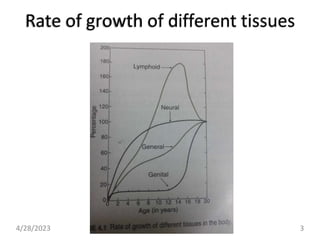
Rate of growth of different tissues
4/28/2023 3
Growth can be measured in terms
of:
A. Physical anthropometry
B. Assessment of tissue growth
C. Bone age
D. Dental age
4/28/2023 4
A. Physical anthropometry
Age dependent anthropometry-
1. Weight
2. Length or Height
3. Head circumference
4. Chest circumference
4/28/2023 5
Age independent anthropometry
1. Mid Upper arm circumference(1-5 yrs)
2. Weight for height
3. Weight for age
4. Height for age
5. Body mass index
4/28/2023 6
WEIGHT
Measurement:
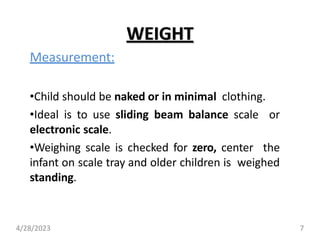
•Child should be naked or in minimal clothing.
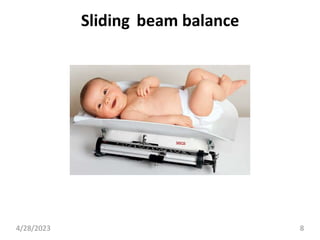
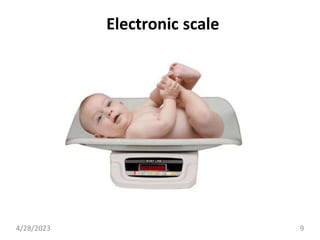
•Ideal is to use sliding beam balance scale or
electronic scale.
•Weighing scale is checked for zero, center the
infant on scale tray and older children is weighed
standing.
4/28/2023 7
Sliding beam balance
4/28/2023 8
Electronic scale
4/28/2023 9
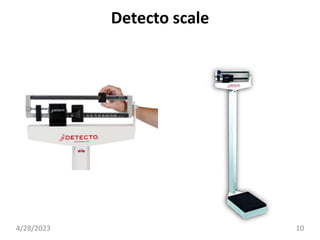
Detecto scale
4/28/2023 10
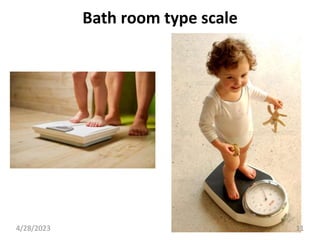
Bath room type scale
4/28/2023 11
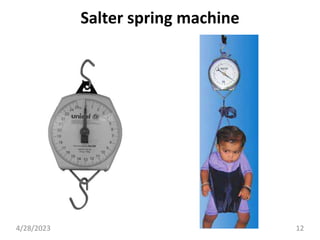
Salter spring machine
4/28/2023 12
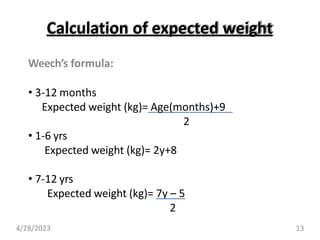
Calculation of expected weight
Weech’s formula:
• 3-12 months
Expected weight (kg)= Age(months)+9
2
• 1-6 yrs
Expected weight (kg)= 2y+8
• 7-12 yrs
Expected weight (kg)= 7y – 5
2
4/28/2023 13
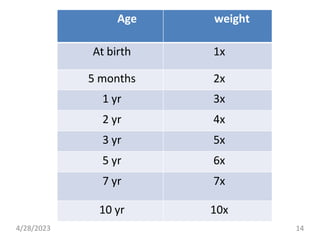
Age weight
At birth 1x
5 months 2x
1 yr 3x
2 yr 4x
3 yr 5x
5 yr 6x
7 yr 7x
10 yr 10x
4/28/2023 14
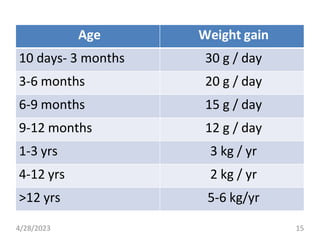
Age Weight gain
10 days- 3 months 30 g / day
3-6 months 20 g / day
6-9 months 15 g / day
9-12 months 12 g / day
1-3 yrs 3 kg / yr
4-12 yrs 2 kg / yr
>12 yrs 5-6 kg/yr
4/28/2023 15
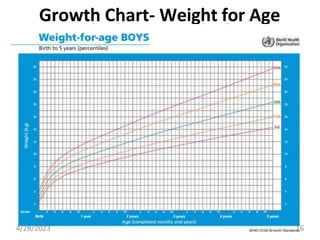
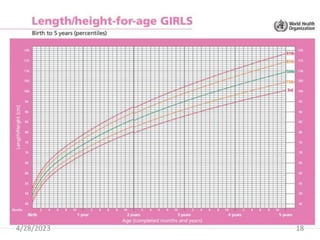
Growth Chart- Weight for Age
4/28/2023 16
4/28/2023 17
4/28/2023 18
4/28/2023 19
4/28/2023 20
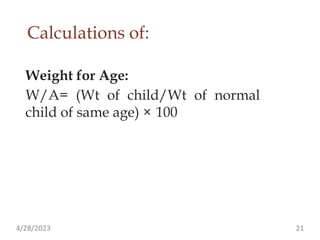
Calculations of:
Weight for Age:
W/A= (Wt of child/Wt of normal
child of same age) × 100
4/28/2023 21
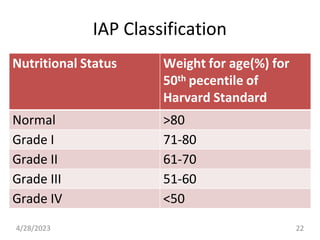
IAP Classification
Nutritional Status Weight for age(%) for
50th pecentile of
Harvard Standard
Normal >80
Grade I 71-80
Grade II 61-70
Grade III 51-60
Grade IV <50
4/28/2023 22
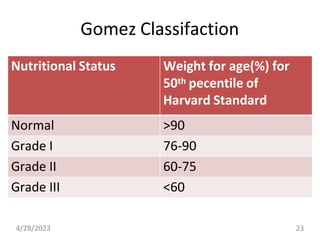
Gomez Classifaction
Nutritional Status Weight for age(%) for
50th pecentile of
Harvard Standard
Normal >90
Grade I 76-90
Grade II 60-75
Grade III <60
4/28/2023 23
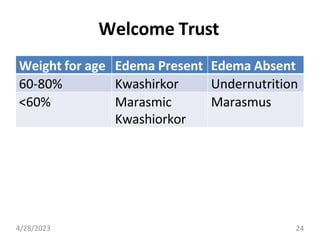
Welcome Trust
Weight for age Edema Present Edema Absent
60-80% Kwashirkor Undernutrition
<60% Marasmic
Kwashiorkor
Marasmus
4/28/2023 24
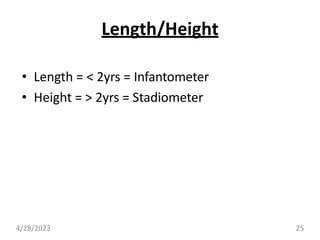
Length/Height
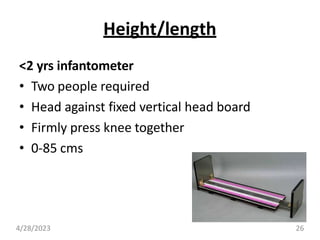
• Length = < 2yrs = Infantometer
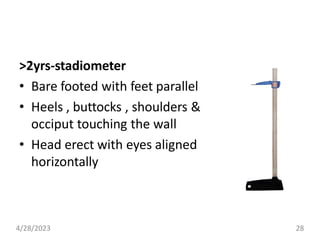
• Height = > 2yrs = Stadiometer
4/28/2023 25
Height/length
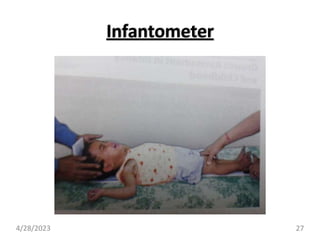
<2 yrs infantometer
• Two people required
• Head against fixed vertical head board
• Firmly press knee together
• 0-85 cms
4/28/2023 26
Infantometer
4/28/2023 27
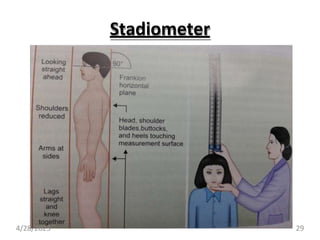
>2yrs-stadiometer
• Bare footed with feet parallel
• Heels , buttocks , shoulders &
occiput touching the wall
• Head erect with eyes aligned
horizontally
4/28/2023 28
Stadiometer
4/28/2023 29
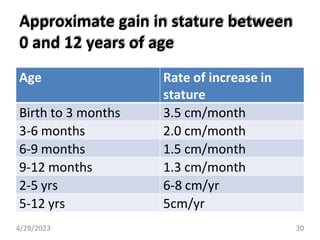
Approximate gain in stature between
0 and 12 years of age
Age Rate of increase in
stature
Birth to 3 months 3.5 cm/month
3-6 months 2.0 cm/month
6-9 months 1.5 cm/month
9-12 months 1.3 cm/month
2-5 yrs 6-8 cm/yr
5-12 yrs 5cm/yr
4/28/2023 30
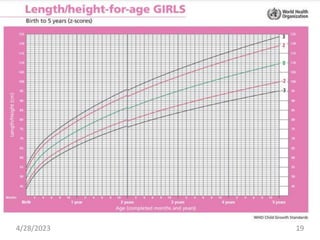
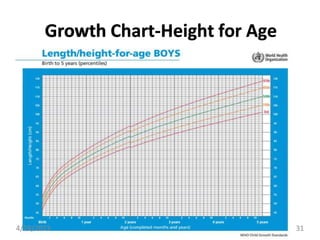
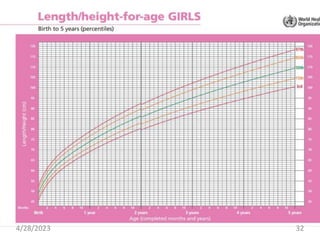
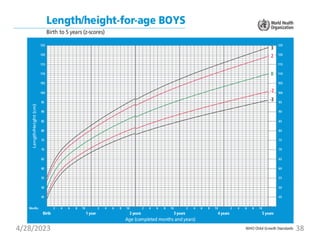
Growth Chart-Height for Age
4/28/2023 31
4/28/2023 32
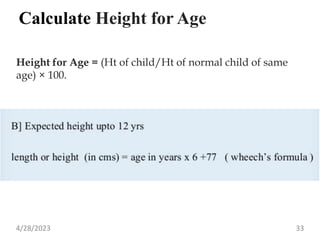
Calculate Height for Age
Height for Age = (Ht of child/Ht of normal child of same
age) × 100.
4/28/2023 33
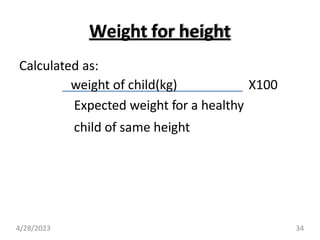
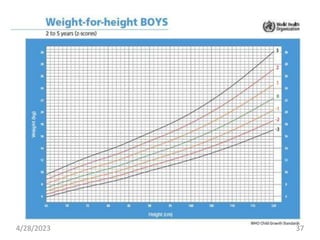
Weight for height
Calculated as:
weight of child(kg) X100
Expected weight for a healthy
child of same height
4/28/2023 34
4/28/2023 35
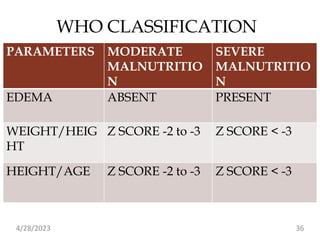
WHO CLASSIFICATION
PARAMETERS MODERATE
MALNUTRITIO
N
SEVERE
MALNUTRITIO
N
EDEMA ABSENT PRESENT
WEIGHT/HEIG
HT
Z SCORE -2 to -3 Z SCORE < -3
HEIGHT/AGE Z SCORE -2 to -3 Z SCORE < -3
4/28/2023 36
4/28/2023 37
4/28/2023 38
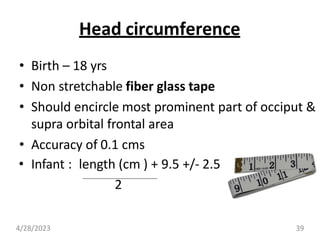
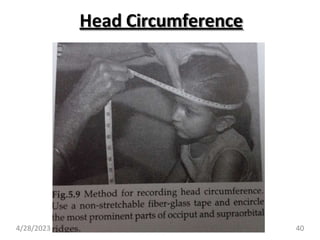
Head circumference
• Birth – 18 yrs
• Non stretchable fiber glass tape
• Should encircle most prominent part of occiput &
supra orbital frontal area
• Accuracy of 0.1 cms
• Infant : length (cm ) + 9.5 +/- 2.5
2
4/28/2023 39
Head Circumference
4/28/2023 40
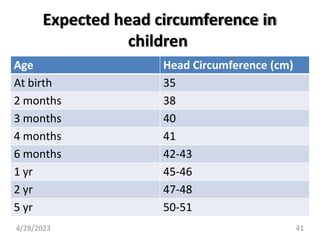
Expected head circumference in
children
Age Head Circumference (cm)
At birth 35
2 months 38
3 months 40
4 months 41
6 months 42-43
1 yr 45-46
2 yr 47-48
5 yr 50-51
4/28/2023 41
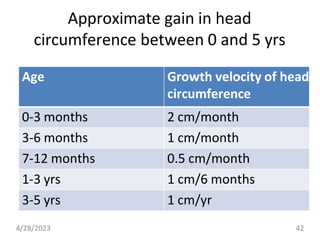
Approximate gain in head
circumference between 0 and 5 yrs
Age Growth velocity of head
circumference
0-3 months 2 cm/month
3-6 months 1 cm/month
7-12 months 0.5 cm/month
1-3 yrs 1 cm/6 months
3-5 yrs 1 cm/yr
4/28/2023 42
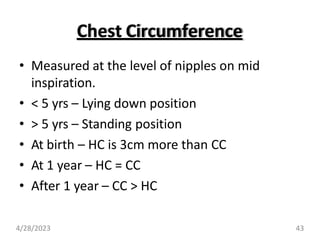
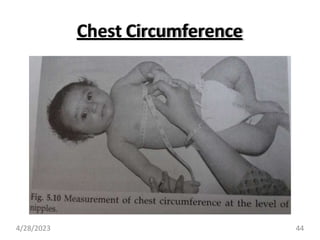
Chest Circumference
• Measured at the level of nipples on mid
inspiration.
• < 5 yrs – Lying down position
• > 5 yrs – Standing position
• At birth – HC is 3cm more than CC
• At 1 year – HC = CC
• After 1 year – CC > HC
4/28/2023 43
Chest Circumference
4/28/2023 44
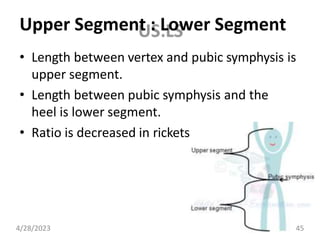
Upper Segment : Lower Segment
• Length between vertex and pubic symphysis is
upper segment.
• Length between pubic symphysis and the
heel is lower segment.
• Ratio is decreased in rickets.
4/28/2023 45
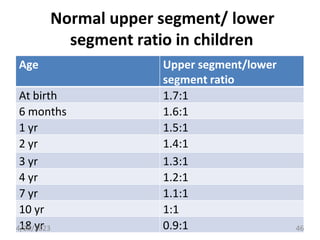
Normal upper segment/ lower
segment ratio in children
Age Upper segment/lower
segment ratio
At birth 1.7:1
6 months 1.6:1
1 yr 1.5:1
2 yr 1.4:1
3 yr 1.3:1
4 yr 1.2:1
7 yr 1.1:1
10 yr 1:1
18 yr 0.9:1
4/28/2023 46
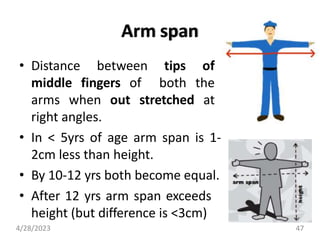
Arm span
• Distance between tips of
middle fingers of both the
arms when out stretched at
right angles.
• In < 5yrs of age arm span is 1-
2cm less than height.
• By 10-12 yrs both become equal.
• After 12 yrs arm span exceeds
height (but difference is <3cm)
4/28/2023 47
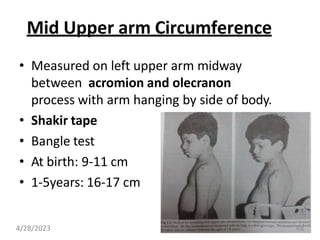
Mid Upper arm Circumference
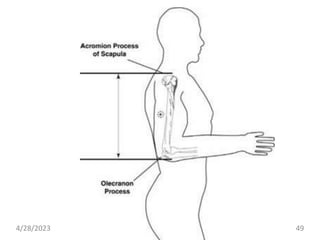
• Measured on left upper arm midway
between acromion and olecranon
process with arm hanging by side of body.
• Shakir tape
• Bangle test
• At birth: 9-11 cm
• 1-5years: 16-17 cm
4/28/2023 48
4/28/2023 49
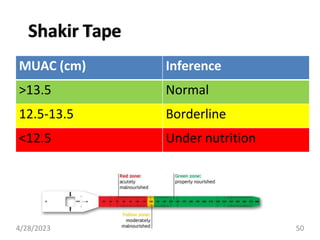
Shakir Tape
MUAC (cm) Inference
>13.5 Normal
12.5-13.5 Borderline
<12.5 Under nutrition
4/28/2023 50
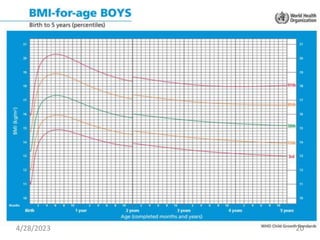
Body Mass Index
•Calculated as:
weight(kg)
[Height(m)]2
•Nutritional intervention is required if BMI
<15 or less then 5th percentile in children.
4/28/2023 51
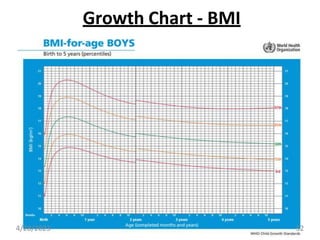
Growth Chart - BMI
4/28/2023 52
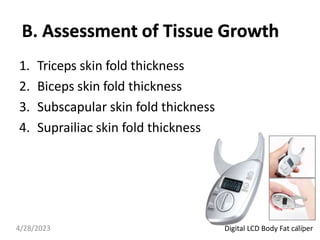
B. Assessment of Tissue Growth
1. Triceps skin fold thickness
2. Biceps skin fold thickness
3. Subscapular skin fold thickness
4. Suprailiac skin fold thickness
Digital LCD Body Fat caliper
4/28/2023 53
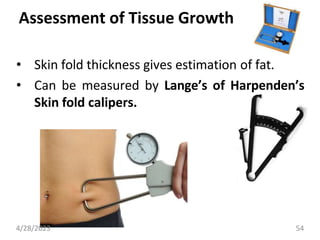
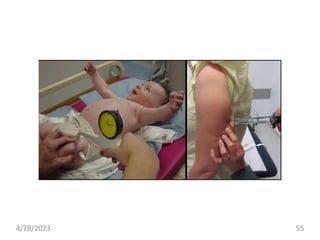
Assessment of Tissue Growth
• Skin fold thickness gives estimation of fat.
• Can be measured by Lange’s of Harpenden’s
Skin fold calipers.
4/28/2023 54
4/28/2023 55
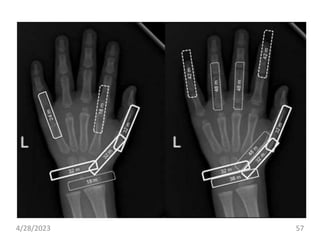
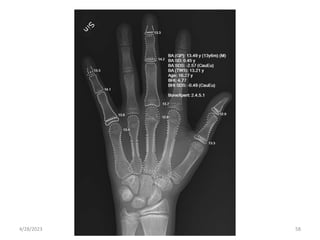
C. Bone Age
• evaluate growth and maturity and to diagnose and
manage pediatric disorders.
• For 1-8 yrs, bone age is determined by examining
carpal bones in X-ray of left wrist.
• No. of osification centres in wrist = Age(yrs)+1
Age X-ray
New born Knee, Ankle
3-9 months Shoulder
3 yrs Wrist
12-16 yrs Elbow, Hip
4/28/2023 56
4/28/2023 57
4/28/2023 58
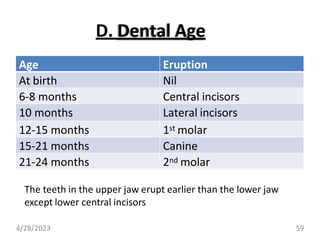
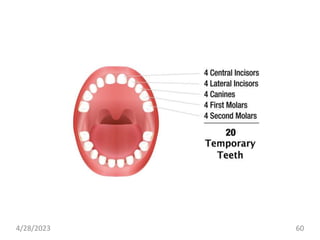
D. Dental Age
Age Eruption
At birth Nil
6-8 months Central incisors
10 months Lateral incisors
12-15 months 1st molar
15-21 months Canine
21-24 months 2nd molar
The teeth in the upper jaw erupt earlier than the lower jaw
except lower central incisors
4/28/2023 59
4/28/2023 60
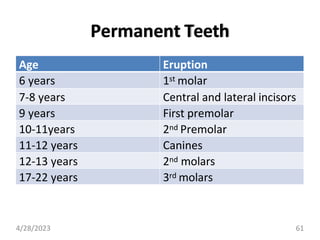
Permanent Teeth
Age Eruption
6 years 1st molar
7-8 years Central and lateral incisors
9 years First premolar
10-11years 2nd Premolar
11-12 years Canines
12-13 years 2nd molars
17-22 years 3rd molars
4/28/2023 61
THANK YOU
4/28/2023 62

growth assessment.pptx

Editor's Notes

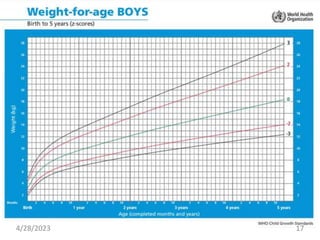
  • #18 Z score: It is the child’s height minus the median height for the age and sex of the child divided by relevant standard deviation.
  • #23 Indian academy of pediatrics
  • #46 Chromosomal abnormalities, turner’s syndrome, klinifilter syndrome
  • #49 Comparative studies have shown that MUAC is subject to fewer errors than Weight-for-Height (Myatt et al, 2006). The mid upper arm circumference (MUAC) of children aged 6 – 59 months  
  • #57 pediatric endocrinology but also in orthodontics and pediatric orthopedics. because the hand and wrist possess many bones and taking radiographs of the hand and wrist is easy. One reason is that most people are right-handed, and therefore, the right hand is more likely to be injured than the left hand (1). Another reason is that it was determined that physical measurements should be performed on the left side rather than the right side of the body at the conferences of physical anthropologists in the early 1900s
  • #58 The hand and wrist bones consist of the radius, ulna, 19 short bones (5 metacarpals and 14 phalanges) and 7 carpals. Bones are formed by endochondral ossification in the radius, ulna and short bones and by intramembranous ossification in the carpal bones. The maturation rates of the carpals vary among individuals. The completion of maturation occurs earlier in the carpals compared with the long and short bones, and intramembranous ossification is less dependent on GH than endochondral ossification. Therefore, the carpals are not suitable for bone age assessment.