Areas of growth and
development
BY
Dr.D.Vijayarani
Associate Professor of Home Science
V.V.Vanniaperumal College for Women
Virudhunagar
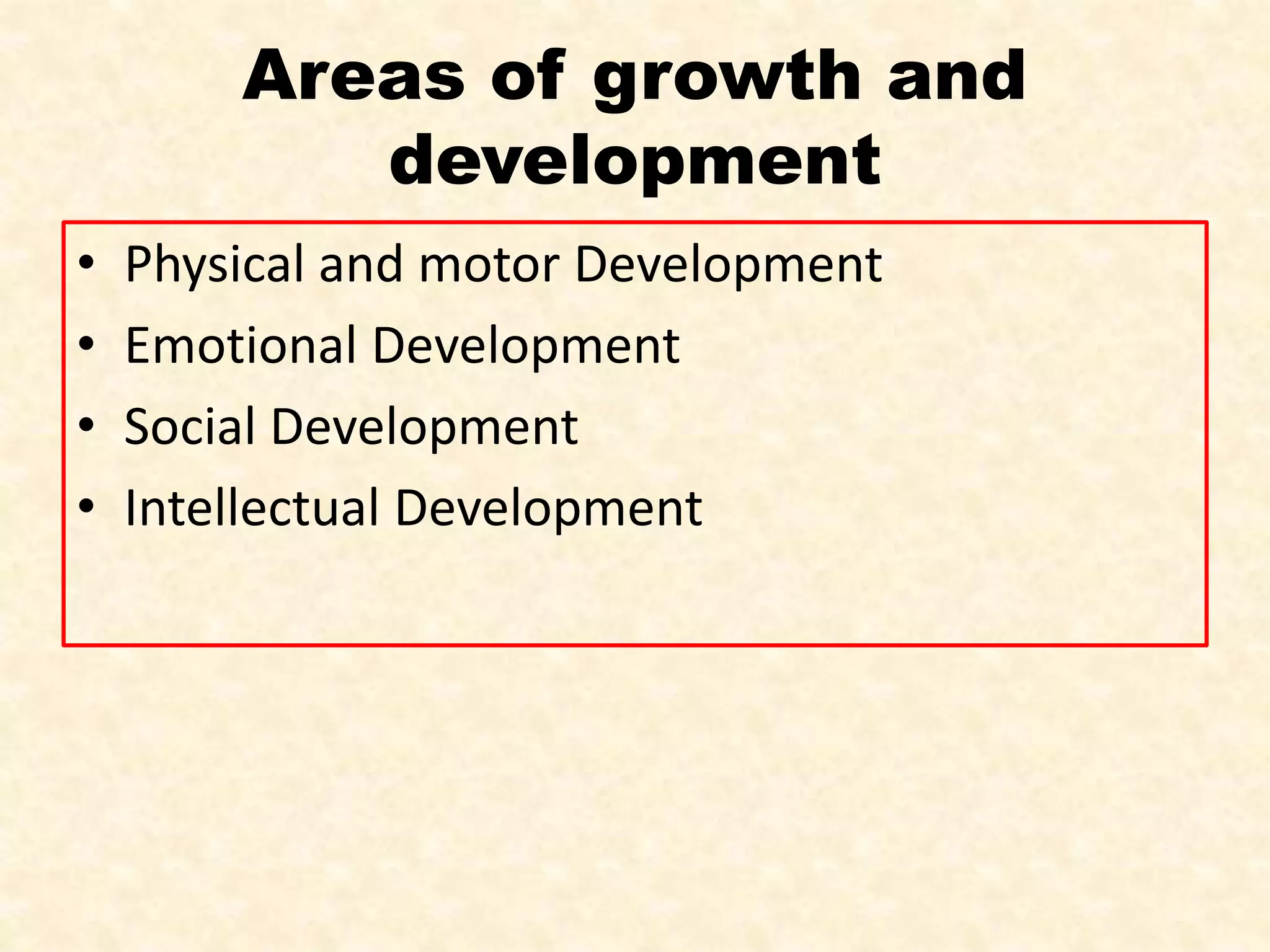
Areas of growth and
development
• Physical and motor Development
• Emotional Development
• Social Development
• Intellectual Development
Physical Development
• Development of internal as well as
external organs
• Increase in bodily tissues
• Changes in height, weight, body
proportions, bone growth, muscular
development and development of nervous
system
Motor Development
• Control over the body, particularly muscles
and physical coordination
• Advancements and refinements of motor
skills, children's abilities to use and control
their bodies.
• Control over gross movements and finer
co ordinations
Gross motor skills
• Development and control of the whole body
and the larger muscles
Gross motor skills
Fine motor skills
• Development and control of smaller
muscles of the hands, fingers and feet
• For e.g. grasping, throwing, drawing,
fastening buttons and threading beads
Emotional Development
• Emotional development is about an
individual’s feelings for and about other
people, objects, situations and
experiences
• It is a process that a child develops from
dependence to a fully functioning adult
• Positive emotions- love, joy,
elation,affection etc.
• Negative emotions -fear, anger, jealousy,
anxiety etc.
Social Development
• Acquisition of the ability to behave in
accordance with social expectations
Intellectual Development
• Ability to learn and solve problems
• Intellectual development is all about
learning. It is about how individuals
organise their minds, ideas and
thoughts to make sense of the world
they live in
• Characterised by such abilities as Verbal
comprehension, Word fluency, Numerical
ability, Imagination, Problem solving,
Creativity, Concepts, Memory,
Concentration, Reasoning etc..
Moral Development
• Learn the differences between
right and wrong
• Development of conscience
• Learn to control their own
behaviour
Growth and development

Growth and development

  • 1.
    Areas of growthand development BY Dr.D.Vijayarani Associate Professor of Home Science V.V.Vanniaperumal College for Women Virudhunagar
  • 2.
    Areas of growthand development • Physical and motor Development • Emotional Development • Social Development • Intellectual Development
  • 3.
    Physical Development • Developmentof internal as well as external organs • Increase in bodily tissues • Changes in height, weight, body proportions, bone growth, muscular development and development of nervous system
  • 4.
    Motor Development • Controlover the body, particularly muscles and physical coordination • Advancements and refinements of motor skills, children's abilities to use and control their bodies. • Control over gross movements and finer co ordinations
  • 5.
    Gross motor skills •Development and control of the whole body and the larger muscles
  • 6.
  • 7.
    Fine motor skills •Development and control of smaller muscles of the hands, fingers and feet • For e.g. grasping, throwing, drawing, fastening buttons and threading beads
  • 9.
    Emotional Development • Emotionaldevelopment is about an individual’s feelings for and about other people, objects, situations and experiences • It is a process that a child develops from dependence to a fully functioning adult • Positive emotions- love, joy, elation,affection etc. • Negative emotions -fear, anger, jealousy, anxiety etc.
  • 11.
    Social Development • Acquisitionof the ability to behave in accordance with social expectations
  • 13.
    Intellectual Development • Abilityto learn and solve problems • Intellectual development is all about learning. It is about how individuals organise their minds, ideas and thoughts to make sense of the world they live in
  • 14.
    • Characterised bysuch abilities as Verbal comprehension, Word fluency, Numerical ability, Imagination, Problem solving, Creativity, Concepts, Memory, Concentration, Reasoning etc..
  • 15.
    Moral Development • Learnthe differences between right and wrong • Development of conscience • Learn to control their own behaviour