A Term Paper Presentation on

By : Jyoti Ghimire
(Biswakarma)
Roll No : 20
M.Sc. Forestry (2013-2015)
Presentation Outline
1.Introduction
2.Global context
3.Pattern of felling
4.kinds of shelterwood system
5.Advantages
6.Difficulties
7.Conclusions
8.Recommendation
Introduction
• In shelterwood system, the old stand is removed
in a series of cuttings to promote the
establishment of a new even-aged stand under
the shelter of the old one.
• The central theme to shelterwoods is that the
overstorey leave-trees are left on site to protect
the
regenerating
understorey
until
the
understorey no longer requires the protection.
(www.forestrynepal.org/notes/silviculture-systems/7)
Global Context
• The shelterwood system evolved during early
19th century from Britain.
• First investigated by von Huber in Bavaria
(Spurr 1956)
• Applied for forest products regulation in
▫ North American continent ( Canada, USA)
▫ British Columbia, India
▫ Strip sheltewood practiced in silver fir in
European virgin forest .
▫ In Nepal, partially followed in Kapilvastu.
Pattern of felling

There are 4 phases of cutting in the shelterwood
method
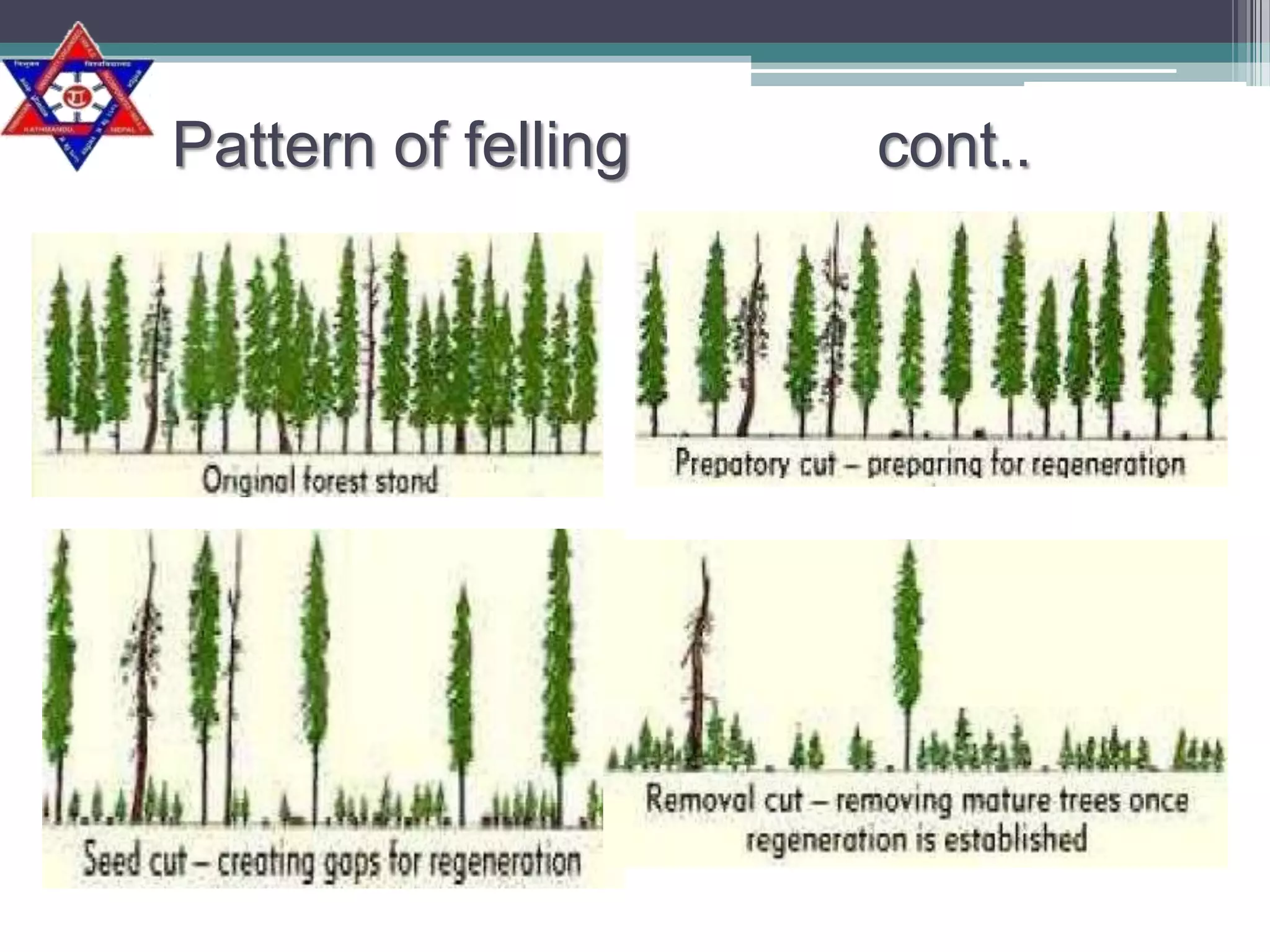
• Preparatory cutting
• Seed cutting
• Removal cutting
Pattern of felling

cont….

• Preparatory cuttings
The purpose of this cut is to remove species
that are not desired so that they do not
contribute seeds to the establishment cut. If
this is not a problem, the preparatory cut is
not necessary.
Pattern of felling

cont..

• Seed cut
It opens up the stand, allowing sunlight to
reach the forest floor, where it stimulates the
germination and growth of seedlings.
• Removal cut
The removal cut harvests all the mature
trees. By giving the saplings full sunlight, the
removal cut encourages the rapid growth of a
new forest.
Pattern of felling

cont..
Kinds of shelterwood
• Uniform
system shelter wood system
The canopy is uniformly opened up over the
whole area of a compartment to obtain
uniform regeneration under the shelter of
remaining old crop.
• Strip shelter wood system
Regeneration felling is done in the form of
strips successively from one side of the
compartment, progressing against the
direction of wind. Developed by Wagner
(1921), Eberhard (1914).
Kinds of shelterwood system
cont…
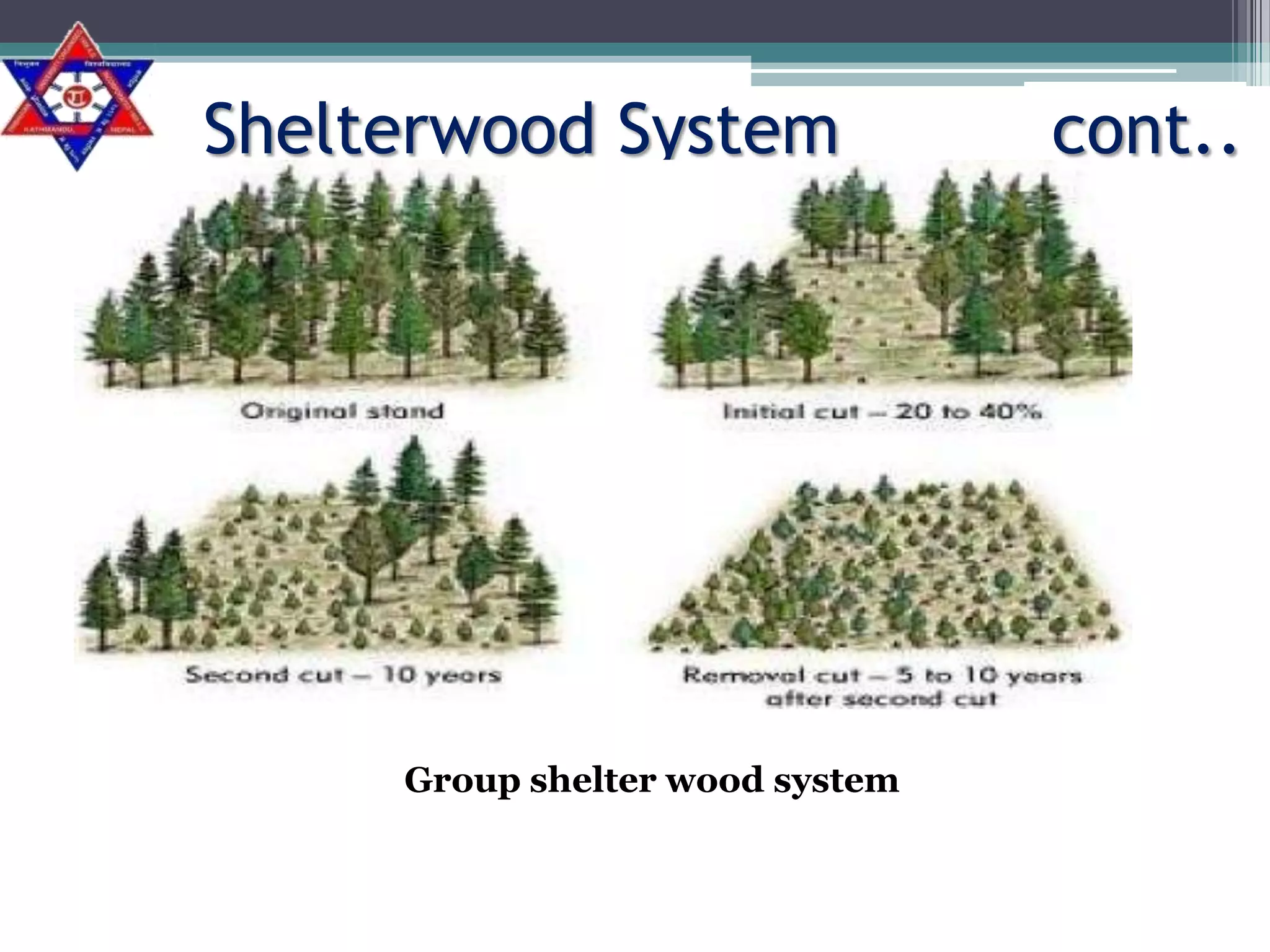
Group shelter wood system

• Smallest circle for final felling, medium
circle for secondary felling, and largest
circle for seeding felling are carried out in
scattered groups
• It was tried in Deodar, Kail and Sal forests
in India but was not successful due to
management problems.
Kinds of shelterwood

cont…

• One cut shelter wood system
Regeneration felling is done in one operation.
It is applied only when advance regeneration
is well.
• Irregular shelter wood system
Regeneration felling is on the pattern of
group system but as the regeneration period
is long, the crop produced is uneven aged or
irregular.
Shelterwood System

Uniform shelter wood system

Strip shelter wood system
Shelterwood System

Group shelter wood system

cont..
Shelterwood System

One cut shelter wood system

cont..
Shelterwood System

Irregular shelter wood system

cont..
Advantages of the Shelterwood
• Soil is not completely denuded so there is little risk
of soil deterioration and erosion.
• The young crop is protected against adverse
climatic factors such as cold, frost, etc.
• Suitable system for the regeneration of both light
demander and shade bearer spps.
• From aesthetic point of view, the system is
superior to clear felling.
Difficulties in the Shelterwood
• As the over wood is removed in more than
one operation, there is much damage to the
young crop.
• Silviculture workers require greater skills than
those required in clear cutting:
• The isolated seed bearers are susceptible to
wind damage.
Conclusion

The shelterwood system protect and shelter
the developing regeneration. The trees which
are growing vigorously are retained to
provide shelter, Seed, rapid diameter
increment and value increment and
protection of site against deterioration.
Recommendation
•Silvicultural system are not as easy as they sound
because it requires a long term vision and
intervention objectives of a owner/state of forest.
•In Nepal, it can be praciticed as a major
contributor of national GDP, various benefits and
for research purpose.
Shelterwood system   jyoti ghimire

Shelterwood system jyoti ghimire

  • 1.
    A Term PaperPresentation on By : Jyoti Ghimire (Biswakarma) Roll No : 20 M.Sc. Forestry (2013-2015)
  • 2.
    Presentation Outline 1.Introduction 2.Global context 3.Patternof felling 4.kinds of shelterwood system 5.Advantages 6.Difficulties 7.Conclusions 8.Recommendation
  • 3.
    Introduction • In shelterwoodsystem, the old stand is removed in a series of cuttings to promote the establishment of a new even-aged stand under the shelter of the old one. • The central theme to shelterwoods is that the overstorey leave-trees are left on site to protect the regenerating understorey until the understorey no longer requires the protection. (www.forestrynepal.org/notes/silviculture-systems/7)
  • 4.
    Global Context • Theshelterwood system evolved during early 19th century from Britain. • First investigated by von Huber in Bavaria (Spurr 1956) • Applied for forest products regulation in ▫ North American continent ( Canada, USA) ▫ British Columbia, India ▫ Strip sheltewood practiced in silver fir in European virgin forest . ▫ In Nepal, partially followed in Kapilvastu.
  • 5.
    Pattern of felling Thereare 4 phases of cutting in the shelterwood method • Preparatory cutting • Seed cutting • Removal cutting
  • 6.
    Pattern of felling cont…. •Preparatory cuttings The purpose of this cut is to remove species that are not desired so that they do not contribute seeds to the establishment cut. If this is not a problem, the preparatory cut is not necessary.
  • 7.
    Pattern of felling cont.. •Seed cut It opens up the stand, allowing sunlight to reach the forest floor, where it stimulates the germination and growth of seedlings. • Removal cut The removal cut harvests all the mature trees. By giving the saplings full sunlight, the removal cut encourages the rapid growth of a new forest.
  • 8.
  • 9.
    Kinds of shelterwood •Uniform system shelter wood system The canopy is uniformly opened up over the whole area of a compartment to obtain uniform regeneration under the shelter of remaining old crop. • Strip shelter wood system Regeneration felling is done in the form of strips successively from one side of the compartment, progressing against the direction of wind. Developed by Wagner (1921), Eberhard (1914).
  • 10.
    Kinds of shelterwoodsystem cont… Group shelter wood system • Smallest circle for final felling, medium circle for secondary felling, and largest circle for seeding felling are carried out in scattered groups • It was tried in Deodar, Kail and Sal forests in India but was not successful due to management problems.
  • 11.
    Kinds of shelterwood cont… •One cut shelter wood system Regeneration felling is done in one operation. It is applied only when advance regeneration is well. • Irregular shelter wood system Regeneration felling is on the pattern of group system but as the regeneration period is long, the crop produced is uneven aged or irregular.
  • 12.
    Shelterwood System Uniform shelterwood system Strip shelter wood system
  • 13.
  • 14.
    Shelterwood System One cutshelter wood system cont..
  • 15.
  • 16.
    Advantages of theShelterwood • Soil is not completely denuded so there is little risk of soil deterioration and erosion. • The young crop is protected against adverse climatic factors such as cold, frost, etc. • Suitable system for the regeneration of both light demander and shade bearer spps. • From aesthetic point of view, the system is superior to clear felling.
  • 17.
    Difficulties in theShelterwood • As the over wood is removed in more than one operation, there is much damage to the young crop. • Silviculture workers require greater skills than those required in clear cutting: • The isolated seed bearers are susceptible to wind damage.
  • 18.
    Conclusion The shelterwood systemprotect and shelter the developing regeneration. The trees which are growing vigorously are retained to provide shelter, Seed, rapid diameter increment and value increment and protection of site against deterioration.
  • 19.
    Recommendation •Silvicultural system arenot as easy as they sound because it requires a long term vision and intervention objectives of a owner/state of forest. •In Nepal, it can be praciticed as a major contributor of national GDP, various benefits and for research purpose.