Good Evening & Welcome
Team Leadership
Karl Duff
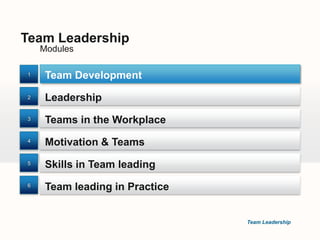
Team Development
Teams in the Workplace
Skills in Team leading
Leadership
Motivation & Teams
Team leading in Practice
Team Leadership
Modules
Team Leadership
1
2
3
4
5
6
• Research the elements and stages of
team development, to include different
kinds of teams, a multi-team
environment, the chararcteristics of an
effective team and the need for different
roles for individuals.
Learning outcome
Unit 1. Team Development
Team Leadership
1. Types of teams
2. Characteristics of effective teams
3. How a team develops
4. Different roles in teams
1. Team Development
Team Leadership
Summary
1. How does a team differ from a group?
2. What different kinds of teams are there?
3. What does a team need to be
successful?
4. What characteristics do effective teams
have?
5. How does a team develop?
1. Team Development
What is a team?
Team Leadership
• Formality
• Structure
• Goals
• Roles
• Recruitment
• Leadership
1. Team Development
1. Teams vs. groups
Team Leadership
• Functional
• Working groups
• Cross-functional
• Project
• Virtual
• Management
1. Team Development
2. Team types
Team Leadership
• Leadership
• Resources
• Communication
• Goals
1. Team Development
3. Elements of a successful team
Team Leadership
1. Leadership
2. A clear goal
3. Results driven structure
4. Competent team members with right number and mix
5. Unified commitment
6. A collaborative climate
7. High standards of excellence
8. External support
1. Team Development
4. Characteristics of effective teams
Team Leadership
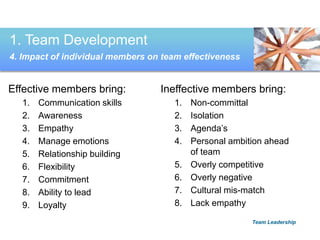
Effective members bring:
1. Communication skills
2. Awareness
3. Empathy
4. Manage emotions
5. Relationship building
6. Flexibility
7. Commitment
8. Ability to lead
9. Loyalty
1. Team Development
4. Impact of individual members on team effectiveness
Team Leadership
Ineffective members bring:
1. Non-committal
2. Isolation
3. Agenda’s
4. Personal ambition ahead
of team
5. Overly competitive
6. Overly negative
7. Cultural mis-match
8. Lack empathy
1. Team Development
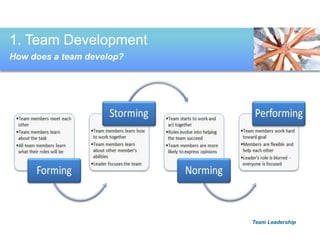
How does a team develop?
Team Leadership
1. Team Development
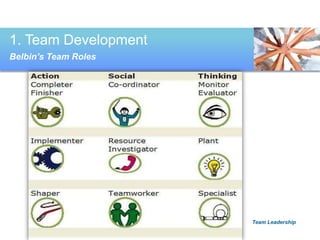
Belbin’s Team Roles
Team Leadership

Team development

  • 1.
    Good Evening &Welcome Team Leadership Karl Duff
  • 2.
    Team Development Teams inthe Workplace Skills in Team leading Leadership Motivation & Teams Team leading in Practice Team Leadership Modules Team Leadership 1 2 3 4 5 6
  • 3.
    • Research theelements and stages of team development, to include different kinds of teams, a multi-team environment, the chararcteristics of an effective team and the need for different roles for individuals. Learning outcome Unit 1. Team Development Team Leadership
  • 4.
    1. Types ofteams 2. Characteristics of effective teams 3. How a team develops 4. Different roles in teams 1. Team Development Team Leadership Summary
  • 5.
    1. How doesa team differ from a group? 2. What different kinds of teams are there? 3. What does a team need to be successful? 4. What characteristics do effective teams have? 5. How does a team develop? 1. Team Development What is a team? Team Leadership
  • 6.
    • Formality • Structure •Goals • Roles • Recruitment • Leadership 1. Team Development 1. Teams vs. groups Team Leadership
  • 7.
    • Functional • Workinggroups • Cross-functional • Project • Virtual • Management 1. Team Development 2. Team types Team Leadership
  • 8.
    • Leadership • Resources •Communication • Goals 1. Team Development 3. Elements of a successful team Team Leadership
  • 9.
    1. Leadership 2. Aclear goal 3. Results driven structure 4. Competent team members with right number and mix 5. Unified commitment 6. A collaborative climate 7. High standards of excellence 8. External support 1. Team Development 4. Characteristics of effective teams Team Leadership
  • 10.
    Effective members bring: 1.Communication skills 2. Awareness 3. Empathy 4. Manage emotions 5. Relationship building 6. Flexibility 7. Commitment 8. Ability to lead 9. Loyalty 1. Team Development 4. Impact of individual members on team effectiveness Team Leadership Ineffective members bring: 1. Non-committal 2. Isolation 3. Agenda’s 4. Personal ambition ahead of team 5. Overly competitive 6. Overly negative 7. Cultural mis-match 8. Lack empathy
  • 11.
    1. Team Development Howdoes a team develop? Team Leadership
  • 12.
    1. Team Development Belbin’sTeam Roles Team Leadership

Editor's Notes

  • #8 All teams are groups but not all groups are teams
  • #10 A clear elevating goal — they have a visionResults driven structure — visions have a business goalCompetent team members with right number and mixUnified commitment — they are a team, not a groupA collaborative climate — aligned towards a common purposeHigh standards of excellence — they have group normsPrincipled leadership — the central driver of excellenceExternal support — they have adequate resources
  • #11 A clear elevating goal — they have a visionResults driven structure — visions have a business goalCompetent team members with right number and mixUnified commitment — they are a team, not a groupA collaborative climate — aligned towards a common purposeHigh standards of excellence — they have group normsPrincipled leadership — the central driver of excellenceExternal support — they have adequate resources
  • #12 Forming: politeness, positive, anxious and eager. Leaders play prominent role – communication is keyStorming: questioning & discovery stage – figure out their roles, question the role of others, test your leadership, critique the relevancy of the goals. Stage at which many teams fail.Norming: gradual move and sometimes may fall back to Storming, your leadership is respected, others show leadership, members help and constructively criticise each other, norms are formed, performance is held to a standard, start to see PROGRESS towards goals.Performing: results and meeting your outcomes, if somebody leaves or joins it’s not a major issue.Adjourning: the end of the teamWhen teams are brought together to work together if they are at different stages of deveopment this may lead to conflict.
  • #13 • Plant – creative, imaginative, unorthodox. Solves difficult problems. • Resource investigator – extrovert, enthusiastic, exploratory. Explores opportunities. Develops contacts. • Co-ordinator – mature, confident, a good chairperson. Clarifies goals, promotes decision making. • Shaper – dynamic, challenging. Has drive and courage to overcome obstacles. • Monitor evaluator – sober, strategic, discerning. Sees all options. • Teamworker – co-operative, mild, perceptive, diplomatic. Listens, builds, averts friction. • Implementer – disciplined, reliable, conservative. Turns ideas into practical action. • Completer – painstaking, conscientious, anxious. Searches out errors and omissions, delivers on time. • Specialist – single-minded, self-starting, dedicated. Provides knowledge and skill in rare supply.