Created By:
Mihir Joshi
1
GROUP DECISION SUPPORT
SYSTEMS (GDSS)
 About GDSS
 Components of GDSS
 Model of GDSS
 Advantages and Disadvantages
2
AGENDA
 Group Decision Support Systems (GDSS) are a class
of electronic meeting systems, a collaboration
technology designed to support meetings and group
work .
 GDSS are distinct from computer supported
cooperative work (CSCW) technologies as GDSS are
more focused on task support, whereas CSCW tools
provide general communication support.
 Group Support Systems has come to mean computer
software and hardware used to support group
functions and processes.
3
DEFINITION/LINGO
 CSCW is an acronym for Computer Supported Cooperative
Work. It is the scientific discipline that motivates and
validates groupware design. CSCW is technology independent
which means technology is not the major driving force behind
the discipline. Instead, CSCW is socially dependent. It looks at
the way people interact and collaborate with each other, and
attempts to develop guidelines for developing technology to
assist in the communication process.
 Groupware is the hardware and software which supports and
augments group work. Groupware applications are not meant
to replace people in an interactive situation.
4
DEFINITION/LINGO
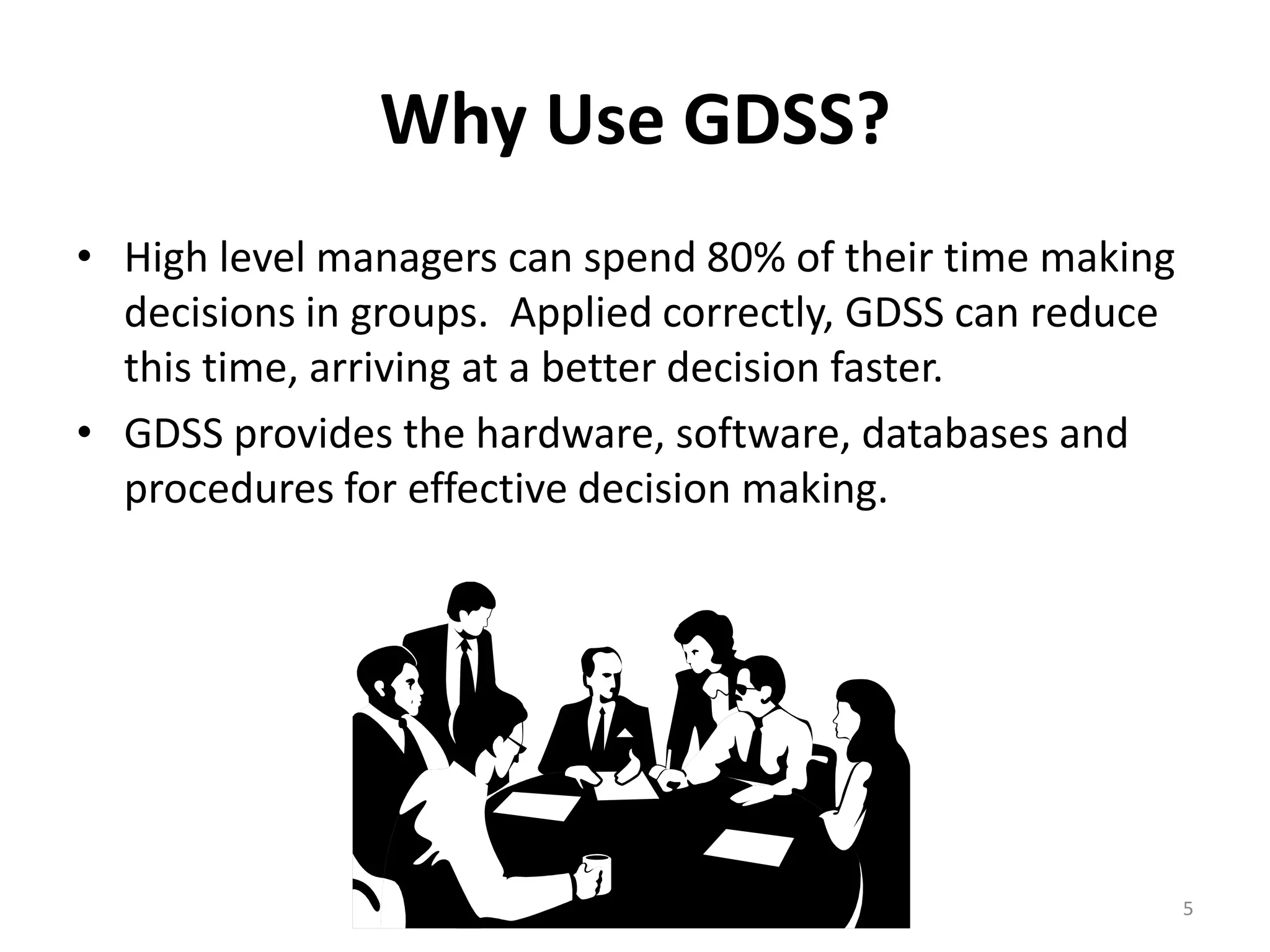
High level managers can spend 80% of their
time making decisions in groups. Applied
correctly, GDSS can reduce this time, arriving at
a better decision faster.
GDSS provides the hardware, software,
databases and procedures for effective decision
making.
5
WHY USE GDSS?
6
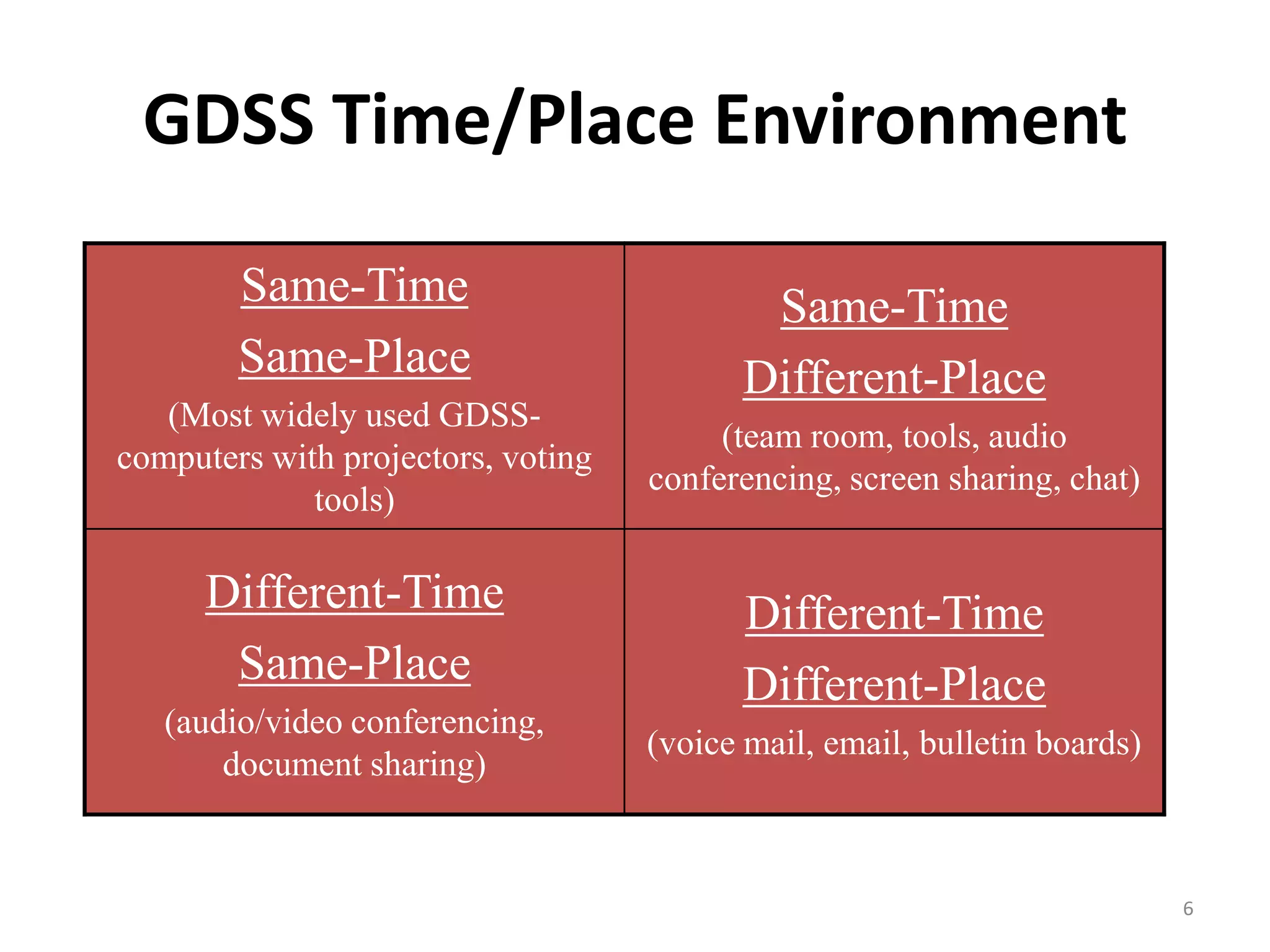
GDSS TIME/PLACE ENVIRONMENT
Same-Time
Same-Place
(Most widely used GDSS-
computers with projectors, voting
tools)
Same-Time
Different-Place
(team room, tools, audio
conferencing, screen sharing, chat)
Different-Time
Same-Place
(audio/video conferencing,
document sharing)
Different-Time
Different-Place
(voice mail, email, bulletin boards)
 There are four fundamental types of components that compose GDSS:
 Software
 The software part may consist of the following components:
databases and database management capabilities, user/system
interface with multi-user access, specific applications to facilitate
group decision-makers activities, and modeling capabilities.

 Hardware
 The hardware part may consist of the following components: I/O
devices, PCs or workstations, individual monitors for each participant
or a public screen for group, and a network to link participants to
each other.

 People
 The people may include decision-making participants and /or
facilitator. A facilitator is a person who directs the group through the
planning process.

 Procedures
 This refers to the methods that have been used in holding
meetings.
7
COMPONENTS OF GDSS
8
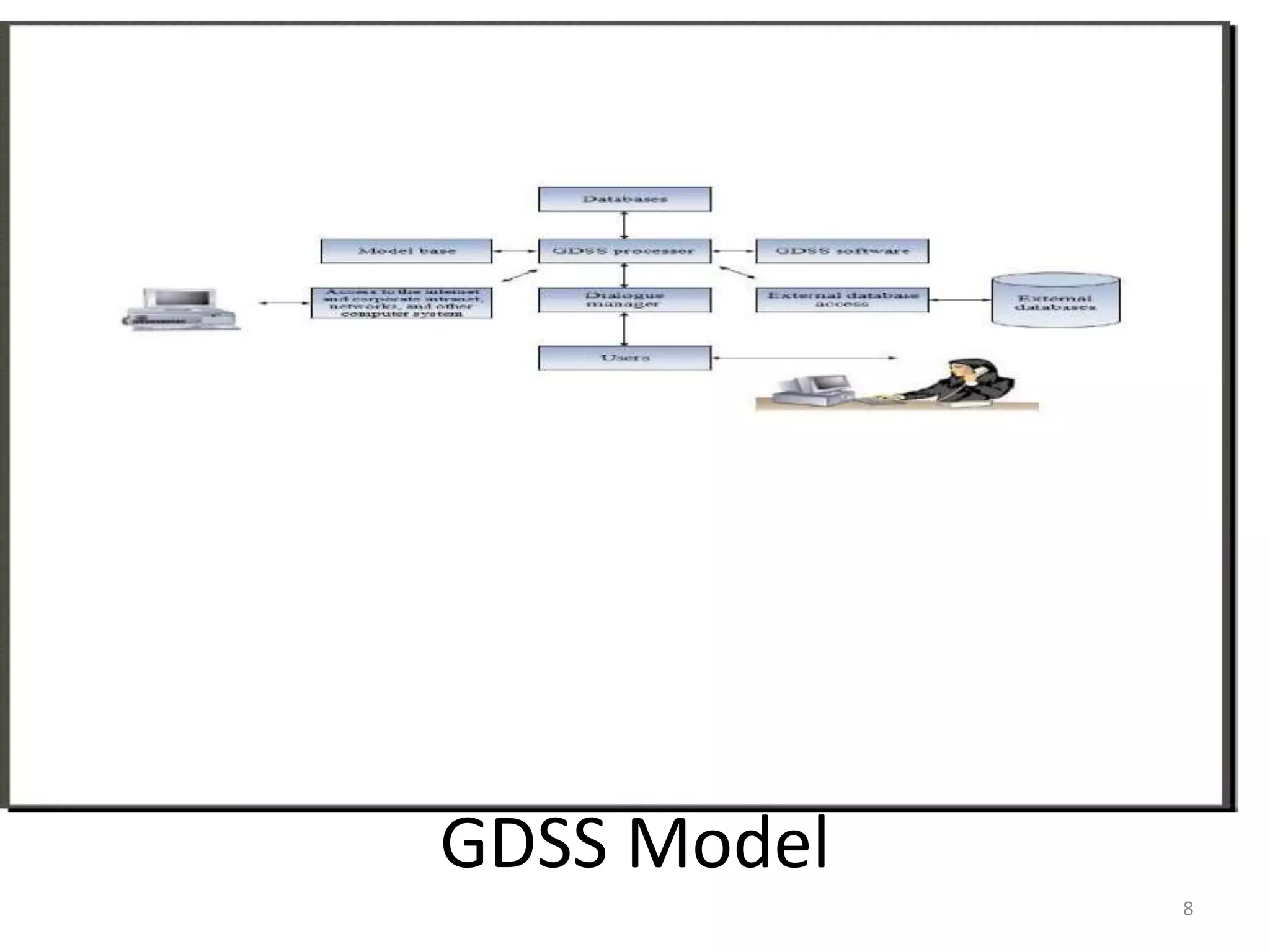
GDSS MODEL
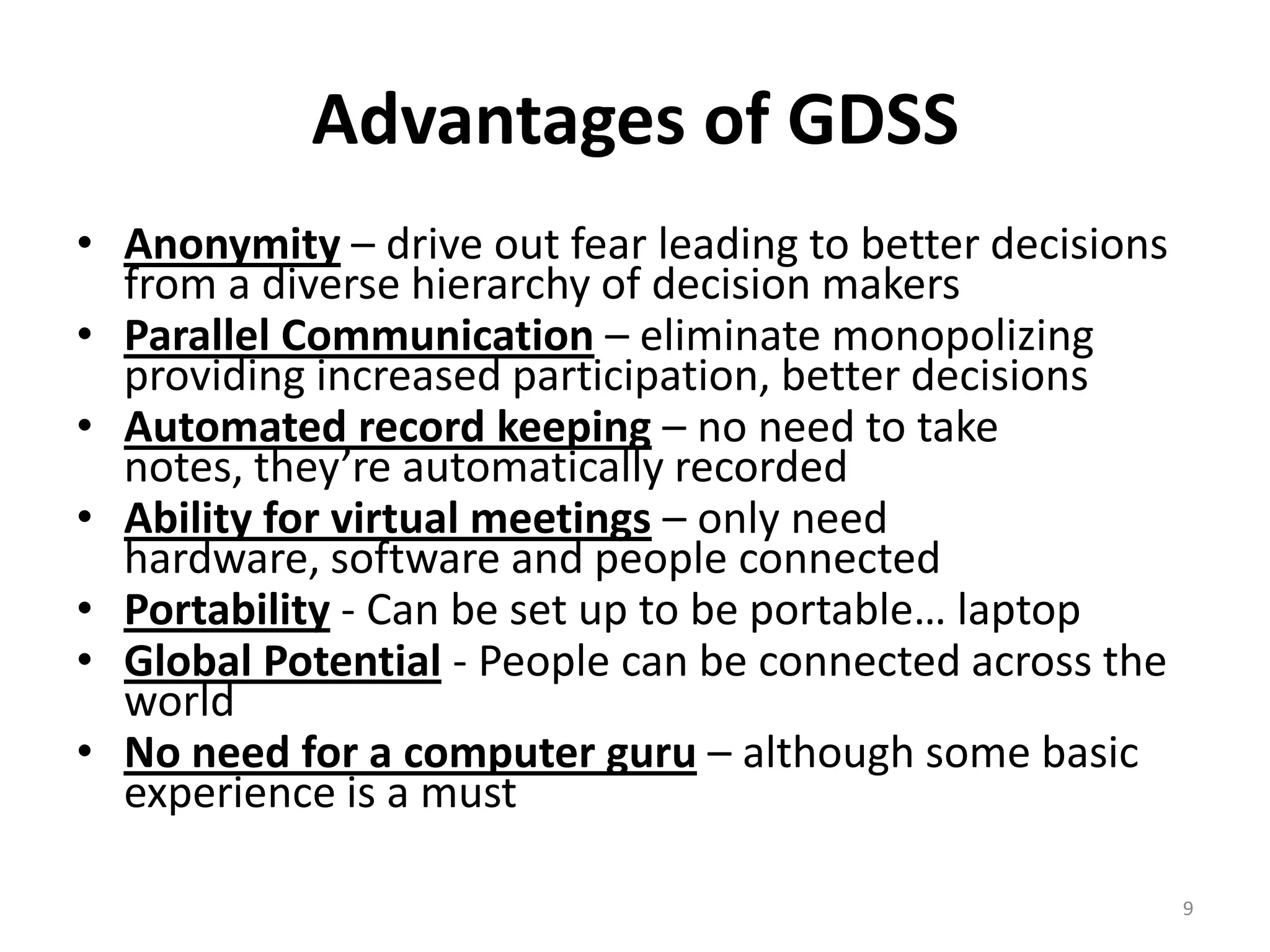
 Anonymity – drive out fear leading to better decisions from a
diverse hierarchy of decision makers
 Parallel Communication – eliminate monopolizing providing
increased participation, better decisions
 Automated record keeping – no need to take notes, they’re
automatically recorded
 Ability for virtual meetings – only need hardware, software
and people connected
 Portability - Can be set up to be portable… laptop
 Global Potential - People can be connected across the world
 No need for a computer guru – although some basic
experience is a must
9
ADVANTAGES OF GDSS
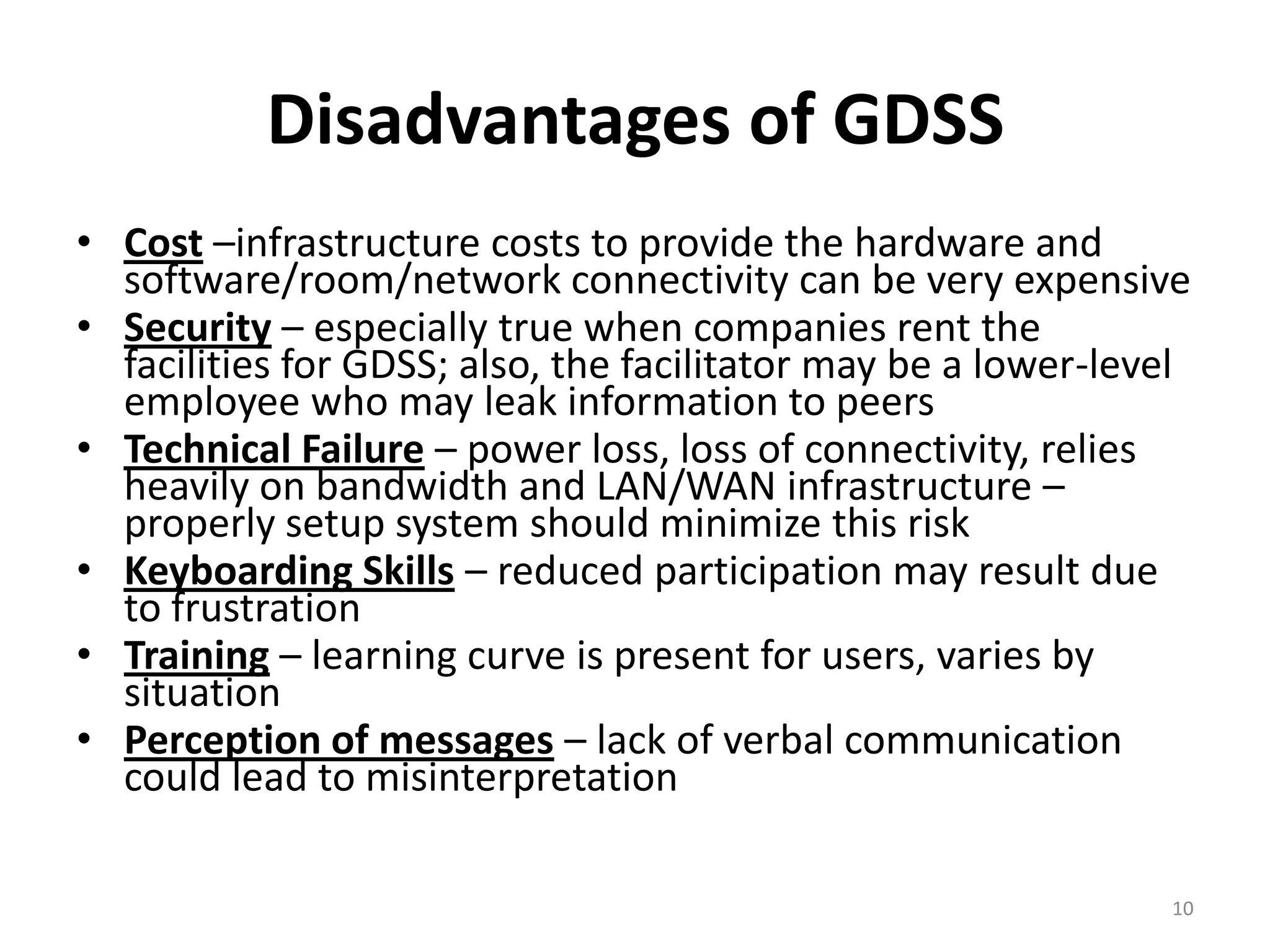
 Cost –infrastructure costs to provide the hardware and
software/room/network connectivity can be very expensive
 Security – especially true when companies rent the facilities
for GDSS; also, the facilitator may be a lower-level employee
who may leak information to peers
 Technical Failure – power loss, loss of connectivity, relies
heavily on bandwidth and LAN/WAN infrastructure – properly
setup system should minimize this risk
 Keyboarding Skills – reduced participation may result due to
frustration
 Training – learning curve is present for users, varies by
situation
 Perception of messages – lack of verbal communication could
lead to misinterpretation
10
DISADVANTAGES OF GDSS
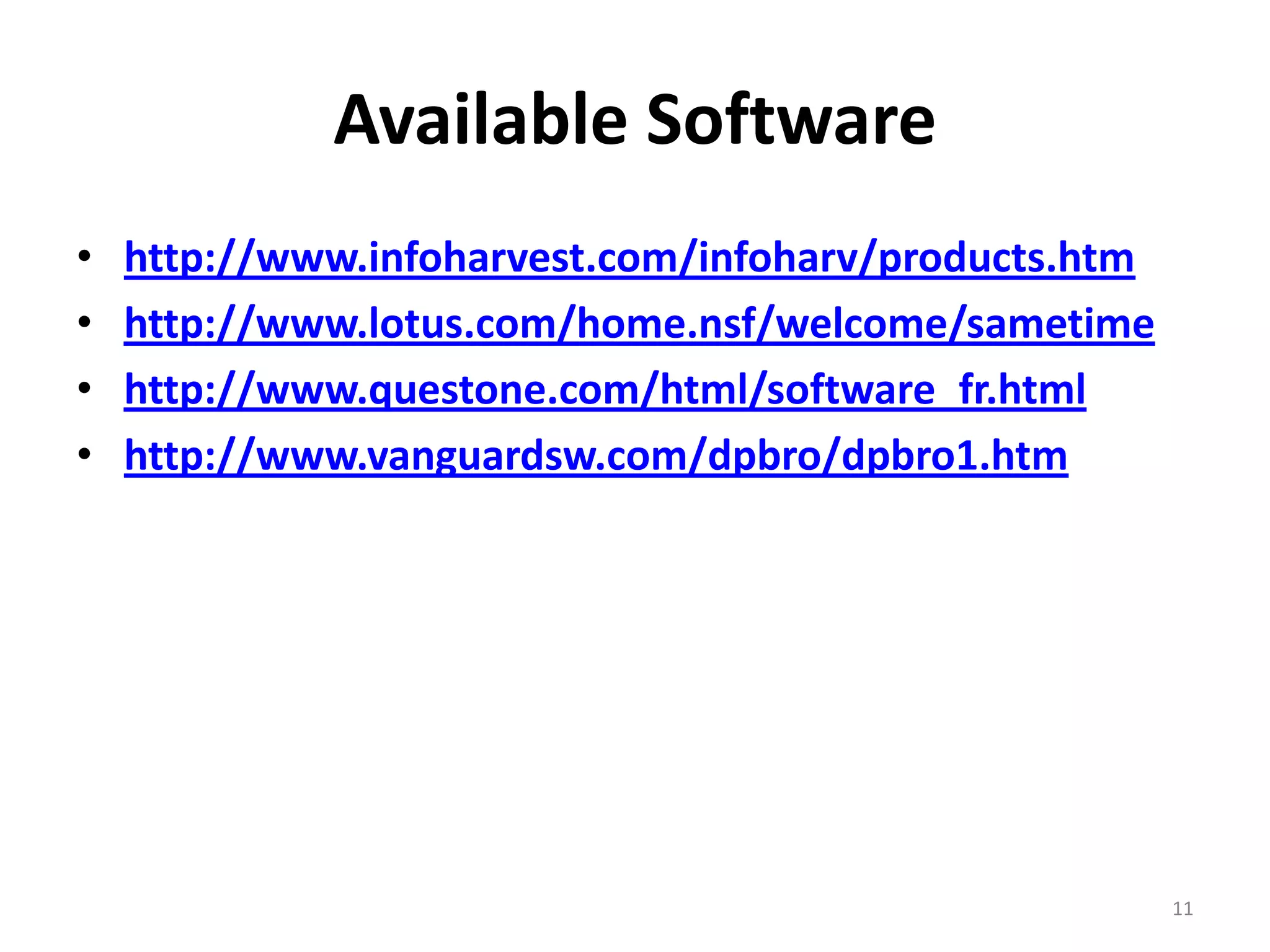
http://www.infoharvest.com/infoharv/products.h
tm
http://www.lotus.com/home.nsf/welcome/samet
ime
http://www.questone.com/html/software_fr.html
http://www.vanguardsw.com/dpbro/dpbro1.htm
11
AVAILABLE SOFTWARE
12
ARIGATU!!

Group decision support systems (gdss)

  • 1.
    Created By: Mihir Joshi 1 GROUPDECISION SUPPORT SYSTEMS (GDSS)
  • 2.
     About GDSS Components of GDSS  Model of GDSS  Advantages and Disadvantages 2 AGENDA
  • 3.
     Group DecisionSupport Systems (GDSS) are a class of electronic meeting systems, a collaboration technology designed to support meetings and group work .  GDSS are distinct from computer supported cooperative work (CSCW) technologies as GDSS are more focused on task support, whereas CSCW tools provide general communication support.  Group Support Systems has come to mean computer software and hardware used to support group functions and processes. 3 DEFINITION/LINGO
  • 4.
     CSCW isan acronym for Computer Supported Cooperative Work. It is the scientific discipline that motivates and validates groupware design. CSCW is technology independent which means technology is not the major driving force behind the discipline. Instead, CSCW is socially dependent. It looks at the way people interact and collaborate with each other, and attempts to develop guidelines for developing technology to assist in the communication process.  Groupware is the hardware and software which supports and augments group work. Groupware applications are not meant to replace people in an interactive situation. 4 DEFINITION/LINGO
  • 5.
    High level managerscan spend 80% of their time making decisions in groups. Applied correctly, GDSS can reduce this time, arriving at a better decision faster. GDSS provides the hardware, software, databases and procedures for effective decision making. 5 WHY USE GDSS?
  • 6.
    6 GDSS TIME/PLACE ENVIRONMENT Same-Time Same-Place (Mostwidely used GDSS- computers with projectors, voting tools) Same-Time Different-Place (team room, tools, audio conferencing, screen sharing, chat) Different-Time Same-Place (audio/video conferencing, document sharing) Different-Time Different-Place (voice mail, email, bulletin boards)
  • 7.
     There arefour fundamental types of components that compose GDSS:  Software  The software part may consist of the following components: databases and database management capabilities, user/system interface with multi-user access, specific applications to facilitate group decision-makers activities, and modeling capabilities.   Hardware  The hardware part may consist of the following components: I/O devices, PCs or workstations, individual monitors for each participant or a public screen for group, and a network to link participants to each other.   People  The people may include decision-making participants and /or facilitator. A facilitator is a person who directs the group through the planning process.   Procedures  This refers to the methods that have been used in holding meetings. 7 COMPONENTS OF GDSS
  • 8.
  • 9.
     Anonymity –drive out fear leading to better decisions from a diverse hierarchy of decision makers  Parallel Communication – eliminate monopolizing providing increased participation, better decisions  Automated record keeping – no need to take notes, they’re automatically recorded  Ability for virtual meetings – only need hardware, software and people connected  Portability - Can be set up to be portable… laptop  Global Potential - People can be connected across the world  No need for a computer guru – although some basic experience is a must 9 ADVANTAGES OF GDSS
  • 10.
     Cost –infrastructurecosts to provide the hardware and software/room/network connectivity can be very expensive  Security – especially true when companies rent the facilities for GDSS; also, the facilitator may be a lower-level employee who may leak information to peers  Technical Failure – power loss, loss of connectivity, relies heavily on bandwidth and LAN/WAN infrastructure – properly setup system should minimize this risk  Keyboarding Skills – reduced participation may result due to frustration  Training – learning curve is present for users, varies by situation  Perception of messages – lack of verbal communication could lead to misinterpretation 10 DISADVANTAGES OF GDSS
  • 11.
  • 12.