An Overview of Decision
Support Systems
Capabilities of a Decision Support
System (1)
• Support for problem-solving phases
– Intelligence, design, choice, implementation,
monitoring
• Support for different decision frequencies
– Ad hoc DSS: Concerned with decisions that come up
once in every 5 years (e.x., where should a company
open a new distribution center?)
– Institutional DSS: Concerned with decisions that
repeat (e.x., what should the company invest in?
Capabilities of a Decision Support
System (2)
• Support for different problem structures
– Highly structured problems: Known facts and
relationships
– Semi-structured problems: Facts unknown or
ambiguous, relations vague
– E.x.Which person to hire for a position?
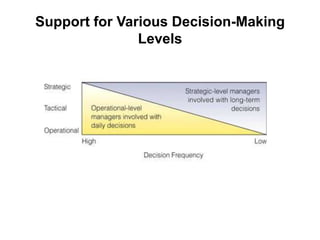
• Support for various decision-making levels
– Operational level: Daily decisions
– Tactical level: Planning and control
– Strategic level: Long-term decisions
Support for Various Decision-Making
Levels
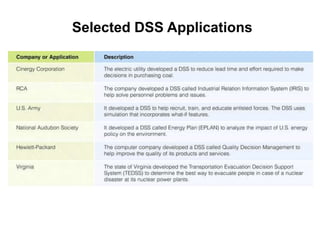
Selected DSS Applications
Comparison of DSSs and MISs
Components of a DSS
Conceptual Model of a DSS
The Database
• Data in databases, data marts, warehouses
• Use data mining to help with the decisions
• Ex. Who should an airline target for flights from
Istanbul to Ankara?
The Model Base
• Decision makers perform quantitative analysis
on data
• Model base contains a list of models for
mathematical computations
• Model management system: Allows access to
such models
The Model Base
Group Decision Support
Systems
Configuration of a DSS
Characteristics of a GDSS (1)
• Special design:
– Effective communication
– Group decision making
• Ease of use
• Flexibility
– Accommodate different perspectives
• Anonymous input
– Individuals’ names are not exposed
• Parallel communication
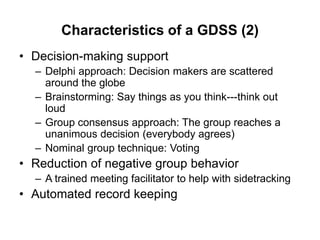
Characteristics of a GDSS (2)
• Decision-making support
– Delphi approach: Decision makers are scattered
around the globe
– Brainstorming: Say things as you think---think out
loud
– Group consensus approach: The group reaches a
unanimous decision (everybody agrees)
– Nominal group technique: Voting
• Reduction of negative group behavior
– A trained meeting facilitator to help with sidetracking
• Automated record keeping
Examples of GDSS Software
• Lotus Notes
– Store, manipulate, distribute memos
• Microsoft Exchange
– Keep individual schedules
– Decide on meeting times
• NetDocuments Enterprise
– Two people can review the same document
together
GDSS Alternatives
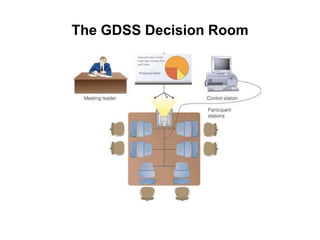
The GDSS Decision Room
Executive Support Systems
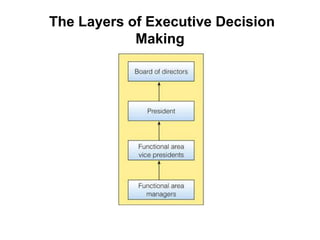
The Layers of Executive Decision
Making
Executive Support Systems (ESS) in
Perspective
• Tailored to individual executives
– Not to managers in other levels
• Easy to use
• Drill down capabilities
• Support need for external data
• Can help when uncertainty is high
• Future-oriented
• Linked to value-added processes
Capabilities of an ESS (1)
• Support for defining an overall vision
– Organization’s product lines and services
• Support for strategic planning
– Predict future trends
– Analyze merger possibilities
• Support for strategic organizing & staffing
– Choice of departments
– Pay raises
Capabilities of an ESS (2)
• Support for strategic control
– Monitor and manage the overall organization
• Support for crisis management
– Put together a contingency plan
Summary
• Decision-making phase - includes intelligence, design,
and choice
• Problem solving - also includes implementation and
monitoring
• Decision approaches - optimization, satisficing, and
heuristic
• Management information system - an integrated
collection of people, procedures, databases, and devices
that provide managers and decision makers with
information to help achieve organizational goals
Summary
• Decision support system (DSS) - an organized
collection of people, procedures, software, databases,
and devices working to support managerial decision
making
• Group decision support system (GDSS) - also called
a computerized collaborative work system, consists of
most of the elements in a DSS, plus software needed to
provide effective support in group decision-making
settings
• Executive support systems (ESSs) - specialized
decision support systems designed to meet the needs of
senior management

chap06-py-part2.ppt

  • 1.
    An Overview ofDecision Support Systems
  • 2.
    Capabilities of aDecision Support System (1) • Support for problem-solving phases – Intelligence, design, choice, implementation, monitoring • Support for different decision frequencies – Ad hoc DSS: Concerned with decisions that come up once in every 5 years (e.x., where should a company open a new distribution center?) – Institutional DSS: Concerned with decisions that repeat (e.x., what should the company invest in?
  • 3.
    Capabilities of aDecision Support System (2) • Support for different problem structures – Highly structured problems: Known facts and relationships – Semi-structured problems: Facts unknown or ambiguous, relations vague – E.x.Which person to hire for a position? • Support for various decision-making levels – Operational level: Daily decisions – Tactical level: Planning and control – Strategic level: Long-term decisions
  • 4.
    Support for VariousDecision-Making Levels
  • 5.
  • 6.
  • 7.
  • 8.
  • 9.
    The Database • Datain databases, data marts, warehouses • Use data mining to help with the decisions • Ex. Who should an airline target for flights from Istanbul to Ankara?
  • 10.
    The Model Base •Decision makers perform quantitative analysis on data • Model base contains a list of models for mathematical computations • Model management system: Allows access to such models
  • 11.
  • 12.
  • 13.
  • 14.
    Characteristics of aGDSS (1) • Special design: – Effective communication – Group decision making • Ease of use • Flexibility – Accommodate different perspectives • Anonymous input – Individuals’ names are not exposed • Parallel communication
  • 15.
    Characteristics of aGDSS (2) • Decision-making support – Delphi approach: Decision makers are scattered around the globe – Brainstorming: Say things as you think---think out loud – Group consensus approach: The group reaches a unanimous decision (everybody agrees) – Nominal group technique: Voting • Reduction of negative group behavior – A trained meeting facilitator to help with sidetracking • Automated record keeping
  • 16.
    Examples of GDSSSoftware • Lotus Notes – Store, manipulate, distribute memos • Microsoft Exchange – Keep individual schedules – Decide on meeting times • NetDocuments Enterprise – Two people can review the same document together
  • 17.
  • 18.
  • 19.
  • 20.
    The Layers ofExecutive Decision Making
  • 21.
    Executive Support Systems(ESS) in Perspective • Tailored to individual executives – Not to managers in other levels • Easy to use • Drill down capabilities • Support need for external data • Can help when uncertainty is high • Future-oriented • Linked to value-added processes
  • 22.
    Capabilities of anESS (1) • Support for defining an overall vision – Organization’s product lines and services • Support for strategic planning – Predict future trends – Analyze merger possibilities • Support for strategic organizing & staffing – Choice of departments – Pay raises
  • 23.
    Capabilities of anESS (2) • Support for strategic control – Monitor and manage the overall organization • Support for crisis management – Put together a contingency plan
  • 24.
    Summary • Decision-making phase- includes intelligence, design, and choice • Problem solving - also includes implementation and monitoring • Decision approaches - optimization, satisficing, and heuristic • Management information system - an integrated collection of people, procedures, databases, and devices that provide managers and decision makers with information to help achieve organizational goals
  • 25.
    Summary • Decision supportsystem (DSS) - an organized collection of people, procedures, software, databases, and devices working to support managerial decision making • Group decision support system (GDSS) - also called a computerized collaborative work system, consists of most of the elements in a DSS, plus software needed to provide effective support in group decision-making settings • Executive support systems (ESSs) - specialized decision support systems designed to meet the needs of senior management