The Rise of the National
Monarchies
(FRANCE, ENGLAND, SPAIN, AND PORTUGAL)
BESA, MICHELLE
BILLENA, JOAN MICAH
CARREON, ELLA FELIZA
MENDOZA, JUSTIN
SISON, ZYRA MILKY
TALAVERO, LYCA MAE
BSE II SOCIAL STUDIES
During the High Middle Ages, Europe witnessed
the development of strong nation-states with powerful,
ruling, secular (non-religious) kings. Many circumstances
allowed for this to happen. The prosperity and peace
brought by the time period encouraged the rise of such
rulers. Also, many Europeans wanted to see strong
national governments to help protect them. The growth of
trade and towns during the late Middle Ages led to many
of these changes as well. This rise of monarchies led to
the decline of feudalism throughout the land that makes
up modern day France, England, Germany, and Spain.
KINGDOM OF FRANCE
In 987, Hugh Capet, a French noble, was chosen as the
new king of France. At the time, France consisted of many feudal
territories. As king, Capet ruled only a small area between the
Seine and Loire rivers. Capet, who died in 996, was the first of a
line of Capetian kings who ruled France for some 300 years. For
100 years after his death, however, these kings were weak and
did little to increase royal power.
KING HUGH CAPET OF FRANCE
In 1108, Louis VI,
known as “Louis the Fat,”
became king an increased
the power of the
monarchy. He got rid of
disloyal nobles and put
loyal persons of lower
birth in their place. He
stopped the raids of
lawless vassals and
granted charters to many
towns, thus winning the
loyalty of the
townspeople. KING LOUIS “THE FAT”
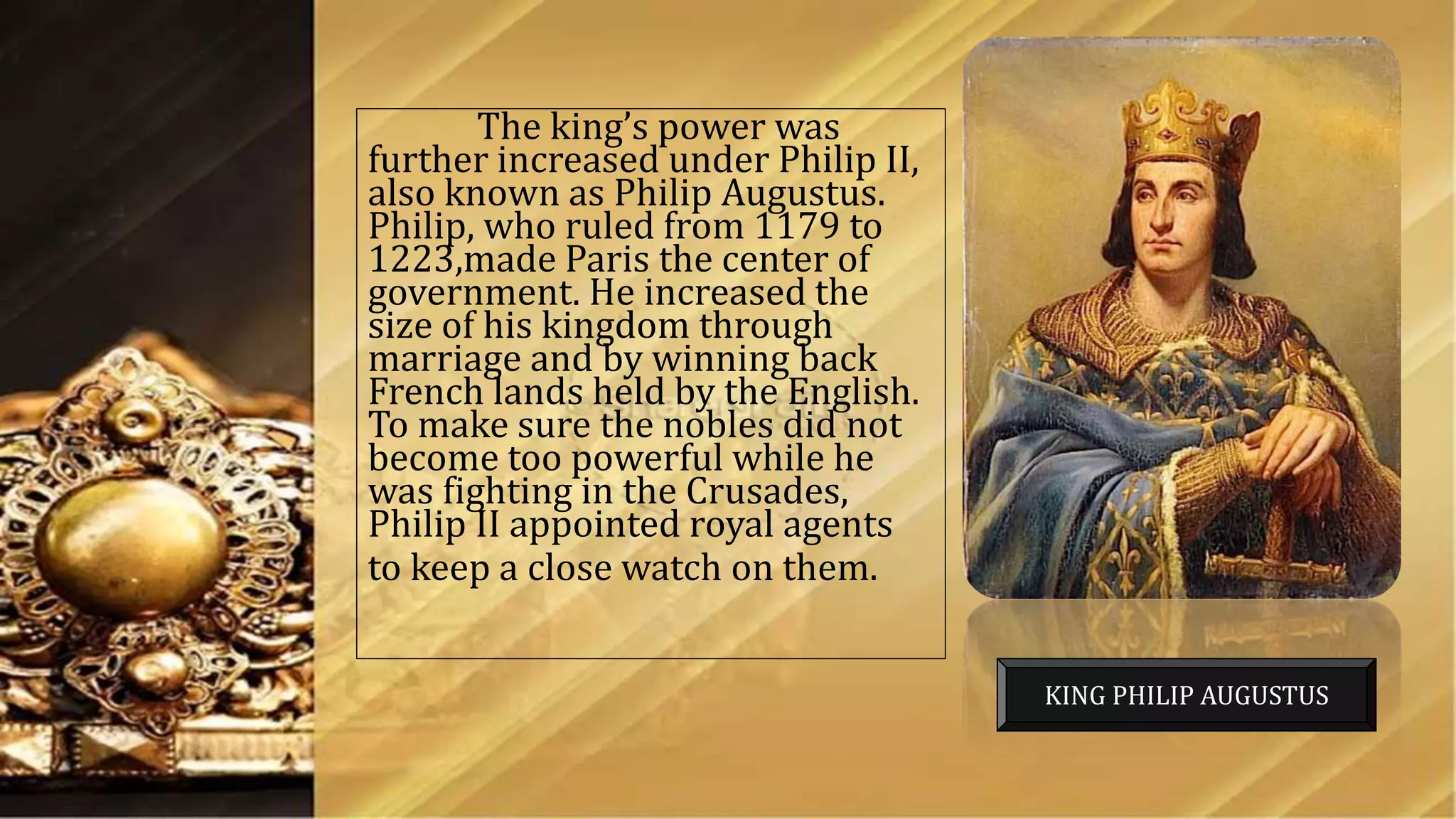
The king’s power was
further increased under Philip II,
also known as Philip Augustus.
Philip, who ruled from 1179 to
1223,made Paris the center of
government. He increased the
size of his kingdom through
marriage and by winning back
French lands held by the English.
To make sure the nobles did not
become too powerful while he
was fighting in the Crusades,
Philip II appointed royal agents
to keep a close watch on them.
KING PHILIP AUGUSTUS
In 1226, Philip’s grandson
became King Louis IX. He brought
peace to France and helped unite the
French people. He ordered the nobles
to stop feuding and forbade them to
settle disputes by fighting duels. Most
nobles minted their own money. Louis
IX made it illegal to use coins made
anywhere else but the royal mint. He
set up a royal court to which anyone
could bring disputes.
KING LOUIS IX
Philip IV, Louis’s grandson, ruled from
1285 to 1314. Known as “Philip the Fair,” Philip IV
believed the interests of the state came first. So,
he seized the English fortresses in France that he
felt were necessary for his kingdom’s security. He
also went to war with the Flemish when they
refused to let France control their cloth trade.
Philip believed a kingdom could not exist without
taxes. So, he made sure that taxes were collected
regularly. He also taxed the clergy, who had not
been taxed before. To help him run the country,
Philip IV formed the Estates-General, an assembly
of nobles, clergy, and townspeople. This marked
the beginning of a national government in France.
By the time Philip IV died in 1314, France was
united under one ruler.
KING PHILIP “THE FAIR”
KINGDOM OF ENGLAND
In 1042, the witenagemot made Edward the Confessor, an Anglo-Saxon prince, king
of England. Edward gave money to the poor and sponsored the building in London of
Westminster Abbey, the church in which later English kings and queens were crowned. He
spent so much time in religious work, however, that he failed to carry out his royal duties. As a
result, the nobles increased their hold on the country. The most powerful noble was Harold
Godwinson. When Edward died in 1066 without an heir, Harold became the new king.
KING EDWARD “THE
CONFESSOR”
KING HAROLD GODWINSON
Henry II restored order and
forced the nobles to give him
their loyalty. He also used the law
to gain more power, and he
worked to reform English courts.
A central royal court was set up in
London with trained lawyers as
judges. Circuit judges, or judges
who traveled throughout the
country, brought the king’s law to
all parts of England. They made it
the common law of the land, thus
helping to unite the country.
KING HENRY II
Henry also set up juries to
settle quarrels about land.
After a while, two kinds of
juries came into being. One
was the grand jury, or a group
of people who present to
judges the names of people
suspected of crimes. The other
was the trial jury, or a group of
people who decide whether a
person accused of a crime is
innocent or guilty. The trial
jury took the place of the
medieval trial by ordeal.
Henry II believed that everyone, even
church officials, should be tried in the
king’s courts. Thomas à Becket, Henry’s
close friend and the Archbishop of
Canterbury, did not agree. Becket wanted
Church officials to be free of royal control.
The quarrel between the king and the
archbishop ultimately led to the murder of
Becket by four of Henry’s knights. After the
murder, Henry II made peace with the
Church by allowing some of the clergy to
be tried in Church courts.
THOMAS Á BECKET
Magna Carta and Parliament When Henry II died in 1189, his oldest
son Richard became king. Richard, however, was more interested in
his French lands than in ruling England. He spent most of his time
fighting in the Near East on the Crusades. When Richard died in
1199, his brother John became king of England. John lost most of his
lands in France to the French king.
KING RICHARD I
When he increased England’s taxes and began to ignore the law, the
country’s nobles became angry. They refused to obey him unless he
agreed to give them certain rights. In 1215, John met the nobles in the
meadow of Runnymede, where they forced him to sign the Magna Carta,
or Great Charter.
The Magna Carta took away some of the king’s power
and increased that of the nobles. A king could no
longer collect taxes unless the Great Council agreed.
Freemen accused of crimes had the right to a trial by
their peers, or equals. The Magna Carta was viewed as
an important step toward democracy. It brought to
government the new idea that even a king is not
above the law.
John died in 1216, and his son became King Henry III. Henry,
however, was a weak ruler who allowed the feudal lords in the Great
Council to rule England. In 1264, Simon de Montfort, Henry’s
brother-in-law, came to power. He gave the people a voice in
government by letting them have representatives in the Great
Council.
Eight years later, the new king,
Edward I, went even further. He
called for a meeting of
representatives to advise him
and to help him make laws. This
gathering, known as Parliament,
gave the people a greater share
in the ruling of England.
Parliament later broke into two
separate groups. Nobles and
clergy met as the House of
Lords, while knights and
townspeople met as the House
of Commons.
KINGDOM OF SPAIN
While the western European monarchies were increasing their power, Spain
was under the control of the Moors. When the Moors conquered Spain in 711, they
brought with them learning and luxury. Most Spaniards, however, were Christians
and opposed Muslim rule. They banded together to drive the Moors out of the
country. By the 1200s, the Moors controlled only the small southern kingdom of
Granada.
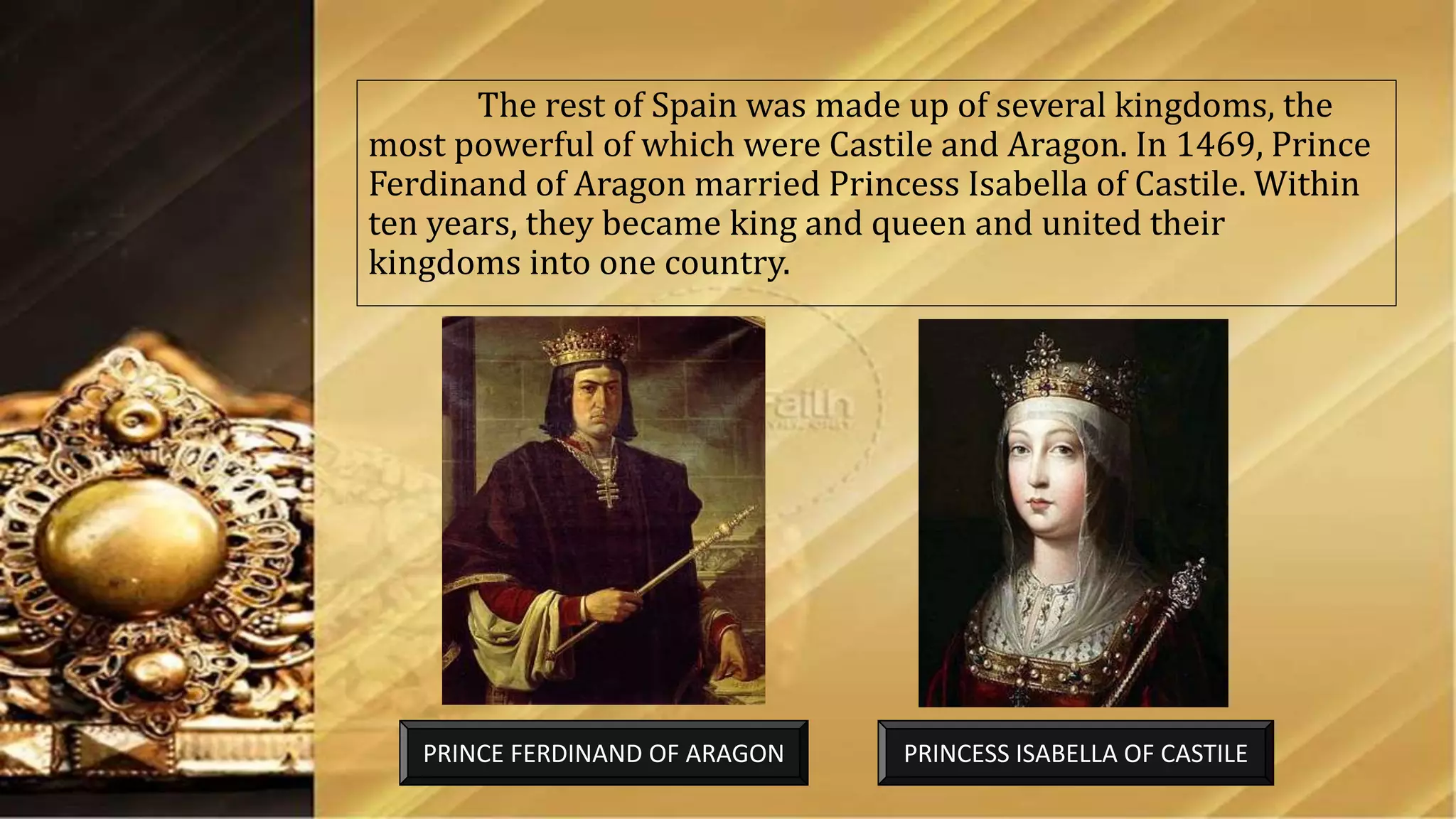
The rest of Spain was made up of several kingdoms, the
most powerful of which were Castile and Aragon. In 1469, Prince
Ferdinand of Aragon married Princess Isabella of Castile. Within
ten years, they became king and queen and united their
kingdoms into one country.
PRINCE FERDINAND OF ARAGON PRINCESS ISABELLA OF CASTILE
Ferdinand and Isabella accomplished this
in different ways. To control the nobles, the king
and queen took away some of their privileges. To
keep order in the land, they sent royal officials
called Corregidores to govern the towns. They also
set up special courts in the countryside.
The most important way in which they
unified Spain, however, was through religion.
Ferdinand and Isabella were known as the
“Catholic Monarchs.” They believed that to be truly
united, all Spaniards should be Catholic. They
turned their attention first to the Jews. The Jews
had lived freely under the Moors. However, as
Christians took over more of Spain, they killed
thousands of Jews. To save themselves, many Jews
converted.
Ferdinand and Isabella believed these new Christians were practicing their
old religion in secret. So, they set up the Spanish Inquisition. The Spanish
Inquisition tried and tortured thousands of people charged with heresy.
More than 2,000 people were burned to death. Still, most Jews refused to
change their faith. So, in 1492, Ferdinand and Isabella told the remaining
Jews to convert or leave the country. Most left the country.
Next, the king and queen turned their attention to the
Moors. In 1492, the last of the Moors had surrendered Granada
to armies of Ferdinand and Isabella. The treaty signed at the
time promised the Moors freedom of religion. Nevertheless, in
1502 the Catholic Monarchs ordered the remaining Moors to
convert or leave. Most left Spain for northern Africa.
Although now a united Catholic monarchy, Spain was
weaker than it had been before. This was because most of its
artisans, merchants, bankers, doctors, and educators had been
either Jews or Moors. After these people left, there were few
trained Spaniards to take their place.
KINGDOM OF PORTUGAL
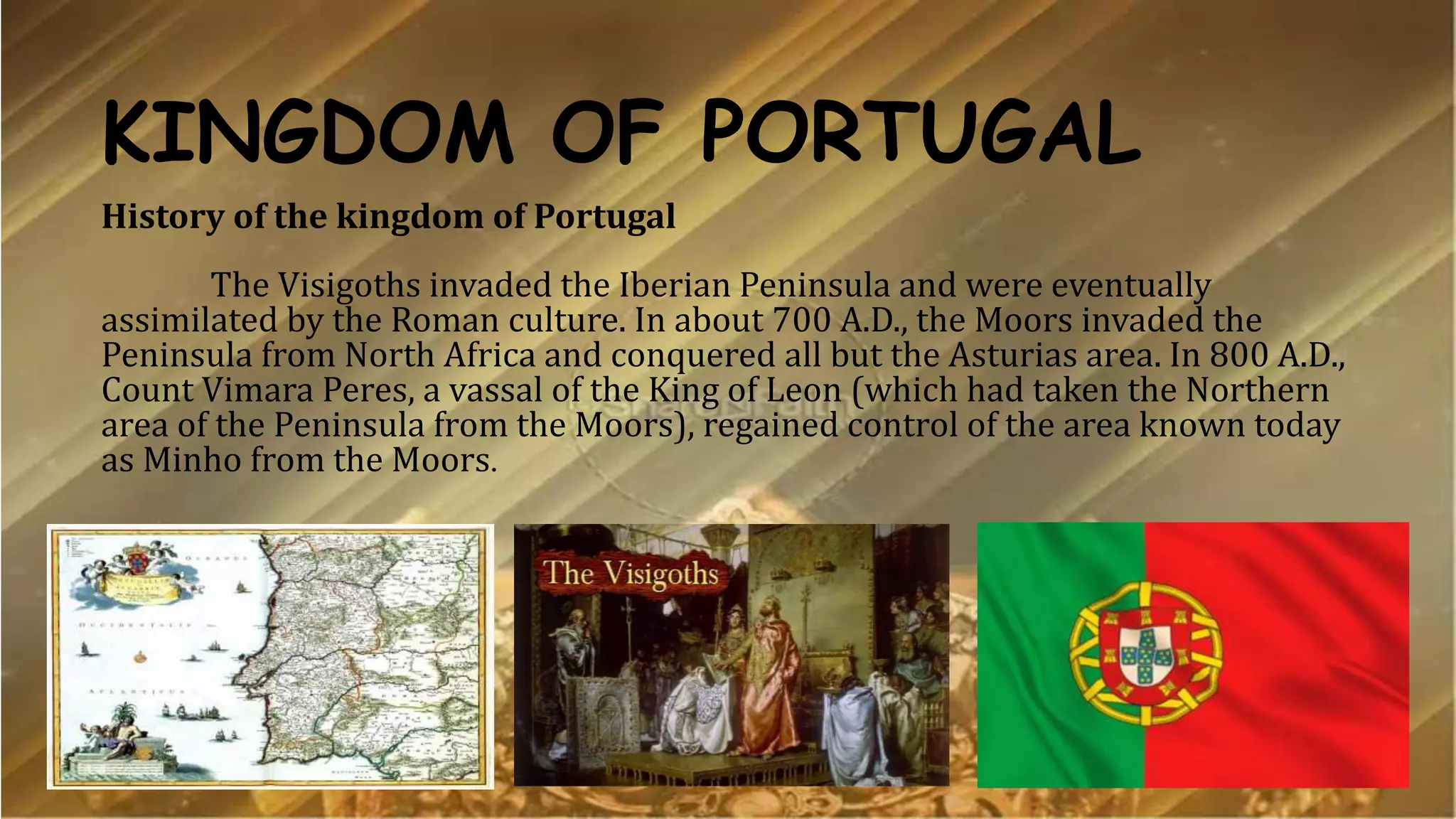
History of the kingdom of Portugal
The Visigoths invaded the Iberian Peninsula and were eventually
assimilated by the Roman culture. In about 700 A.D., the Moors invaded the
Peninsula from North Africa and conquered all but the Asturias area. In 800 A.D.,
Count Vimara Peres, a vassal of the King of Leon (which had taken the Northern
area of the Peninsula from the Moors), regained control of the area known today
as Minho from the Moors.
The area was named Portucale (Portugal) after the important trading city of
Portus Cale which is today’s Porto (Oporto) city. Portus Cale (Porto) is located on
the estuary of the Douro river. Count Peres founded the town of Vimaranes after
his name, and today Vimaranes (Guimaraes) is considered the cradle city of
Portugal. Portucale (Portugal) was an autonomous county of the Kingdom of
Leon. In 1070, due to its desire to become independent, it lost its autonomy
ending the rule of the House of Vimara Peres.
CITY OF PORTO (PORTUS CALE)
In 1093 A.D., Henry of Burgundy was count of Portugal. Henry
helped King Alfonso VI of Castile conquer Galicia from the Moors.
As a reward, he was given the hand of Teresa de Leon. Thus
Henry became Count of Portugal, a fiefdom of the Kingdom of
Leon. Henry and Teresa had several sons, but the only one to
survive childhood was Afonso Henriques. When Henry died,
Afonso Henriques (also known as Afonso I) set out to take control
of the county.
HENRY OF BURGUNDY TERESA DE LEON
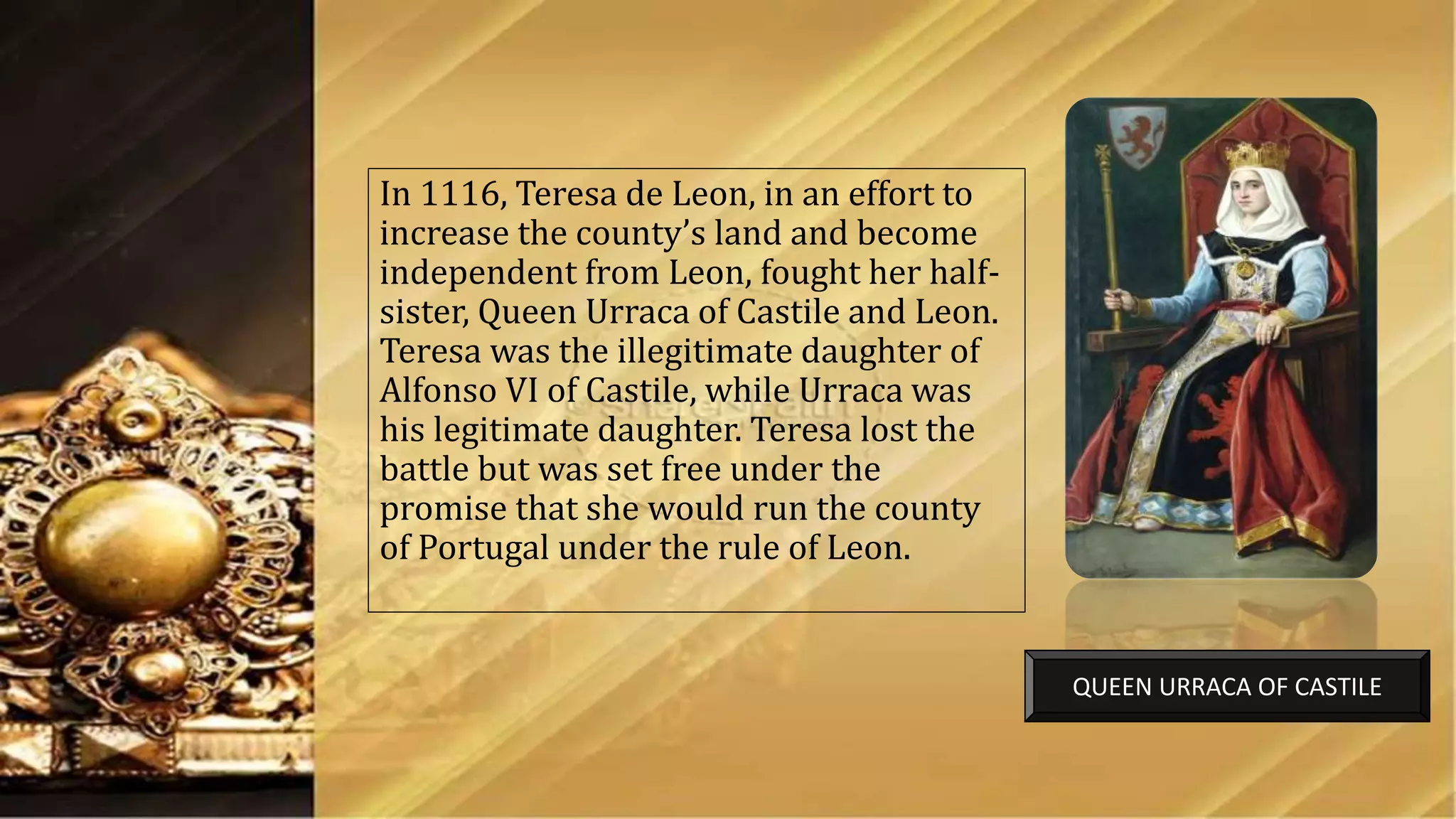
In 1116, Teresa de Leon, in an effort to
increase the county’s land and become
independent from Leon, fought her half-
sister, Queen Urraca of Castile and Leon.
Teresa was the illegitimate daughter of
Alfonso VI of Castile, while Urraca was
his legitimate daughter. Teresa lost the
battle but was set free under the
promise that she would run the county
of Portugal under the rule of Leon.
QUEEN URRACA OF CASTILE
Afonso I did not like the Count of Trave, a Galician, and
considered his mother to be under his influence. Afonso I, with
the help of the Archbishop of Braga and other nobles, decided to
take the kingdom away from Teresa. June 24, 1128 in the Battle
of Sao Mamede, Afonso Henriques defeated the forces led by his
mother and her lover Fernado Peres, count of Trave, who was, at
the time, the regent of the county of Portugal. Teresa died in
prison in 1130
In October 5, 1143 Portugal was officially recognized as a
country, and the first king of Portugal was Dom Afonso
Henriques (Afonso I).
RISE OF THE KINGDOM
The Kingdom of Portugal flourished in the 15-16th century. At this
time, Portuguese navigators, in the course of numerous trips and voyages,
make a number of important geographical discoveries. Over time, the country
turns into a major colonial empire.
From 1580 to 1640, Portugal was united with Spain into a single
monarchy - the Iberian Union. Both empires are beginning to gradually lose
their power, yielding positions to the Netherlands, France and England.

GROUP 4- THE RISE OF THE NATIONAL MONARCHIES.pptx

  • 1.
    The Rise ofthe National Monarchies (FRANCE, ENGLAND, SPAIN, AND PORTUGAL) BESA, MICHELLE BILLENA, JOAN MICAH CARREON, ELLA FELIZA MENDOZA, JUSTIN SISON, ZYRA MILKY TALAVERO, LYCA MAE BSE II SOCIAL STUDIES
  • 2.
    During the HighMiddle Ages, Europe witnessed the development of strong nation-states with powerful, ruling, secular (non-religious) kings. Many circumstances allowed for this to happen. The prosperity and peace brought by the time period encouraged the rise of such rulers. Also, many Europeans wanted to see strong national governments to help protect them. The growth of trade and towns during the late Middle Ages led to many of these changes as well. This rise of monarchies led to the decline of feudalism throughout the land that makes up modern day France, England, Germany, and Spain.
  • 3.
    KINGDOM OF FRANCE In987, Hugh Capet, a French noble, was chosen as the new king of France. At the time, France consisted of many feudal territories. As king, Capet ruled only a small area between the Seine and Loire rivers. Capet, who died in 996, was the first of a line of Capetian kings who ruled France for some 300 years. For 100 years after his death, however, these kings were weak and did little to increase royal power. KING HUGH CAPET OF FRANCE
  • 4.
    In 1108, LouisVI, known as “Louis the Fat,” became king an increased the power of the monarchy. He got rid of disloyal nobles and put loyal persons of lower birth in their place. He stopped the raids of lawless vassals and granted charters to many towns, thus winning the loyalty of the townspeople. KING LOUIS “THE FAT”
  • 5.
    The king’s powerwas further increased under Philip II, also known as Philip Augustus. Philip, who ruled from 1179 to 1223,made Paris the center of government. He increased the size of his kingdom through marriage and by winning back French lands held by the English. To make sure the nobles did not become too powerful while he was fighting in the Crusades, Philip II appointed royal agents to keep a close watch on them. KING PHILIP AUGUSTUS
  • 6.
    In 1226, Philip’sgrandson became King Louis IX. He brought peace to France and helped unite the French people. He ordered the nobles to stop feuding and forbade them to settle disputes by fighting duels. Most nobles minted their own money. Louis IX made it illegal to use coins made anywhere else but the royal mint. He set up a royal court to which anyone could bring disputes. KING LOUIS IX
  • 7.
    Philip IV, Louis’sgrandson, ruled from 1285 to 1314. Known as “Philip the Fair,” Philip IV believed the interests of the state came first. So, he seized the English fortresses in France that he felt were necessary for his kingdom’s security. He also went to war with the Flemish when they refused to let France control their cloth trade. Philip believed a kingdom could not exist without taxes. So, he made sure that taxes were collected regularly. He also taxed the clergy, who had not been taxed before. To help him run the country, Philip IV formed the Estates-General, an assembly of nobles, clergy, and townspeople. This marked the beginning of a national government in France. By the time Philip IV died in 1314, France was united under one ruler. KING PHILIP “THE FAIR”
  • 8.
    KINGDOM OF ENGLAND In1042, the witenagemot made Edward the Confessor, an Anglo-Saxon prince, king of England. Edward gave money to the poor and sponsored the building in London of Westminster Abbey, the church in which later English kings and queens were crowned. He spent so much time in religious work, however, that he failed to carry out his royal duties. As a result, the nobles increased their hold on the country. The most powerful noble was Harold Godwinson. When Edward died in 1066 without an heir, Harold became the new king. KING EDWARD “THE CONFESSOR” KING HAROLD GODWINSON
  • 9.
    Henry II restoredorder and forced the nobles to give him their loyalty. He also used the law to gain more power, and he worked to reform English courts. A central royal court was set up in London with trained lawyers as judges. Circuit judges, or judges who traveled throughout the country, brought the king’s law to all parts of England. They made it the common law of the land, thus helping to unite the country. KING HENRY II
  • 10.
    Henry also setup juries to settle quarrels about land. After a while, two kinds of juries came into being. One was the grand jury, or a group of people who present to judges the names of people suspected of crimes. The other was the trial jury, or a group of people who decide whether a person accused of a crime is innocent or guilty. The trial jury took the place of the medieval trial by ordeal.
  • 11.
    Henry II believedthat everyone, even church officials, should be tried in the king’s courts. Thomas à Becket, Henry’s close friend and the Archbishop of Canterbury, did not agree. Becket wanted Church officials to be free of royal control. The quarrel between the king and the archbishop ultimately led to the murder of Becket by four of Henry’s knights. After the murder, Henry II made peace with the Church by allowing some of the clergy to be tried in Church courts. THOMAS Á BECKET
  • 12.
    Magna Carta andParliament When Henry II died in 1189, his oldest son Richard became king. Richard, however, was more interested in his French lands than in ruling England. He spent most of his time fighting in the Near East on the Crusades. When Richard died in 1199, his brother John became king of England. John lost most of his lands in France to the French king. KING RICHARD I
  • 13.
    When he increasedEngland’s taxes and began to ignore the law, the country’s nobles became angry. They refused to obey him unless he agreed to give them certain rights. In 1215, John met the nobles in the meadow of Runnymede, where they forced him to sign the Magna Carta, or Great Charter.
  • 14.
    The Magna Cartatook away some of the king’s power and increased that of the nobles. A king could no longer collect taxes unless the Great Council agreed. Freemen accused of crimes had the right to a trial by their peers, or equals. The Magna Carta was viewed as an important step toward democracy. It brought to government the new idea that even a king is not above the law.
  • 15.
    John died in1216, and his son became King Henry III. Henry, however, was a weak ruler who allowed the feudal lords in the Great Council to rule England. In 1264, Simon de Montfort, Henry’s brother-in-law, came to power. He gave the people a voice in government by letting them have representatives in the Great Council.
  • 16.
    Eight years later,the new king, Edward I, went even further. He called for a meeting of representatives to advise him and to help him make laws. This gathering, known as Parliament, gave the people a greater share in the ruling of England. Parliament later broke into two separate groups. Nobles and clergy met as the House of Lords, while knights and townspeople met as the House of Commons.
  • 17.
    KINGDOM OF SPAIN Whilethe western European monarchies were increasing their power, Spain was under the control of the Moors. When the Moors conquered Spain in 711, they brought with them learning and luxury. Most Spaniards, however, were Christians and opposed Muslim rule. They banded together to drive the Moors out of the country. By the 1200s, the Moors controlled only the small southern kingdom of Granada.
  • 18.
    The rest ofSpain was made up of several kingdoms, the most powerful of which were Castile and Aragon. In 1469, Prince Ferdinand of Aragon married Princess Isabella of Castile. Within ten years, they became king and queen and united their kingdoms into one country. PRINCE FERDINAND OF ARAGON PRINCESS ISABELLA OF CASTILE
  • 19.
    Ferdinand and Isabellaaccomplished this in different ways. To control the nobles, the king and queen took away some of their privileges. To keep order in the land, they sent royal officials called Corregidores to govern the towns. They also set up special courts in the countryside. The most important way in which they unified Spain, however, was through religion. Ferdinand and Isabella were known as the “Catholic Monarchs.” They believed that to be truly united, all Spaniards should be Catholic. They turned their attention first to the Jews. The Jews had lived freely under the Moors. However, as Christians took over more of Spain, they killed thousands of Jews. To save themselves, many Jews converted.
  • 20.
    Ferdinand and Isabellabelieved these new Christians were practicing their old religion in secret. So, they set up the Spanish Inquisition. The Spanish Inquisition tried and tortured thousands of people charged with heresy. More than 2,000 people were burned to death. Still, most Jews refused to change their faith. So, in 1492, Ferdinand and Isabella told the remaining Jews to convert or leave the country. Most left the country.
  • 21.
    Next, the kingand queen turned their attention to the Moors. In 1492, the last of the Moors had surrendered Granada to armies of Ferdinand and Isabella. The treaty signed at the time promised the Moors freedom of religion. Nevertheless, in 1502 the Catholic Monarchs ordered the remaining Moors to convert or leave. Most left Spain for northern Africa. Although now a united Catholic monarchy, Spain was weaker than it had been before. This was because most of its artisans, merchants, bankers, doctors, and educators had been either Jews or Moors. After these people left, there were few trained Spaniards to take their place.
  • 22.
    KINGDOM OF PORTUGAL Historyof the kingdom of Portugal The Visigoths invaded the Iberian Peninsula and were eventually assimilated by the Roman culture. In about 700 A.D., the Moors invaded the Peninsula from North Africa and conquered all but the Asturias area. In 800 A.D., Count Vimara Peres, a vassal of the King of Leon (which had taken the Northern area of the Peninsula from the Moors), regained control of the area known today as Minho from the Moors.
  • 23.
    The area wasnamed Portucale (Portugal) after the important trading city of Portus Cale which is today’s Porto (Oporto) city. Portus Cale (Porto) is located on the estuary of the Douro river. Count Peres founded the town of Vimaranes after his name, and today Vimaranes (Guimaraes) is considered the cradle city of Portugal. Portucale (Portugal) was an autonomous county of the Kingdom of Leon. In 1070, due to its desire to become independent, it lost its autonomy ending the rule of the House of Vimara Peres. CITY OF PORTO (PORTUS CALE)
  • 24.
    In 1093 A.D.,Henry of Burgundy was count of Portugal. Henry helped King Alfonso VI of Castile conquer Galicia from the Moors. As a reward, he was given the hand of Teresa de Leon. Thus Henry became Count of Portugal, a fiefdom of the Kingdom of Leon. Henry and Teresa had several sons, but the only one to survive childhood was Afonso Henriques. When Henry died, Afonso Henriques (also known as Afonso I) set out to take control of the county. HENRY OF BURGUNDY TERESA DE LEON
  • 25.
    In 1116, Teresade Leon, in an effort to increase the county’s land and become independent from Leon, fought her half- sister, Queen Urraca of Castile and Leon. Teresa was the illegitimate daughter of Alfonso VI of Castile, while Urraca was his legitimate daughter. Teresa lost the battle but was set free under the promise that she would run the county of Portugal under the rule of Leon. QUEEN URRACA OF CASTILE
  • 26.
    Afonso I didnot like the Count of Trave, a Galician, and considered his mother to be under his influence. Afonso I, with the help of the Archbishop of Braga and other nobles, decided to take the kingdom away from Teresa. June 24, 1128 in the Battle of Sao Mamede, Afonso Henriques defeated the forces led by his mother and her lover Fernado Peres, count of Trave, who was, at the time, the regent of the county of Portugal. Teresa died in prison in 1130 In October 5, 1143 Portugal was officially recognized as a country, and the first king of Portugal was Dom Afonso Henriques (Afonso I).
  • 27.
    RISE OF THEKINGDOM The Kingdom of Portugal flourished in the 15-16th century. At this time, Portuguese navigators, in the course of numerous trips and voyages, make a number of important geographical discoveries. Over time, the country turns into a major colonial empire. From 1580 to 1640, Portugal was united with Spain into a single monarchy - the Iberian Union. Both empires are beginning to gradually lose their power, yielding positions to the Netherlands, France and England.