REVIEW:
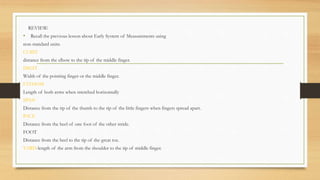
• Recall the previous lesson about Early System of Measurements using
non-standard units.
CUBIT
distance from the elbow to the tip of the middle finger.
DIGIT
Width of the pointing finger or the middle finger.
FATHOM
Length of both arms when stretched horizontally
SPAN
Distance from the tip of the thumb to the tip of the little fingers when fingers spread apart.
PACE
Distance from the heel of one foot of the other stride.
FOOT
Distance from the heel to the tip of the great toe.
YARD-length of the arm from the shoulder to the tip of middle finger.
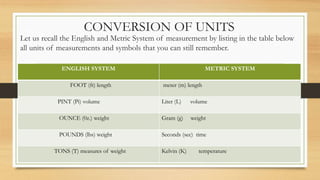
CONVERSION OF UNITS
Let us recall the English and Metric System of measurement by listing in the table below
all units of measurements and symbols that you can still remember.
ENGLISH SYSTEM METRIC SYSTEM
FOOT (ft) length meter (m) length
PINT (Pi) volume Liter (L) volume
OUNCE (0z.) weight Gram (g) weight
POUNDS (lbs) weight Seconds (sec) time
TONS (T) measures of weight Kelvin (K) temperature
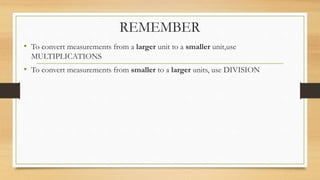
REMEMBER
• To convert measurements from a larger unit to a smaller unit,use
MULTIPLICATIONS
• To convert measurements from smaller to a larger units, use DIVISION
CONVERSION OF UNITS FROM METRIC TO METRIC
• To convert Metric to Metric ,we can use the idea of using the conversion factors as
presented in the conversion factors as presented in the conversion of units in the
English System or you can use a simpler method by using the metric converter as
shown in the illustration as follows.
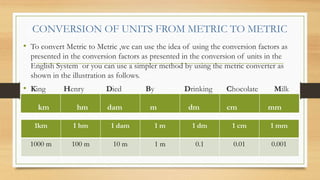
• King Henry Died By Drinking Chocolate Milk
km hm dam m dm cm mm
1km 1 hm 1 dam 1 m 1 dm 1 cm 1 mm
1000 m 100 m 10 m 1 m 0.1 0.01 0.001
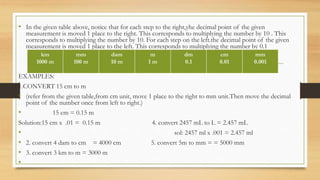
• In the given table above, notice that for each step to the right,yhe decimal point of the given
measurement is moved 1 place to the right. This corresponds to multiplying the number by 10 . This
corresponds to multiplying the number by 10. For each step on the left.the decimal point of the given
measurement is moved 1 place to the left. This corresponds to multiplying the number by 0.1
EXAMPLES:
1.CONVERT 15 cm to m
• (refer from the given table,from cm unit, move 1 place to the right to mm unit.Then move the decimal
point of the number once from left to right.)
• 15 cm = 0.15 m
Solution:15 cm x .01 = 0.15 m 4. convert 2457 mL to L = 2.457 mL
• sol: 2457 ml x .001 = 2.457 ml
• 2. convert 4 dam to cm = 4000 cm 5. convert 5m to mm = = 5000 mm
• 3. convert 3 km to m = 3000 m
•
km
1000 m
mm
100 m
dam
10 m
m
1 m
dm
0.1
cm
0.01
mm
0.001
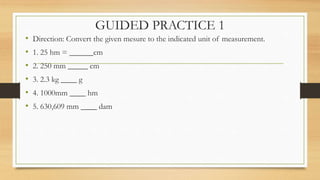
GUIDED PRACTICE 1
• Direction: Convert the given mesure to the indicated unit of measurement.
• 1. 25 hm = ______cm
• 2. 250 mm _____ cm
• 3. 2.3 kg ____ g
• 4. 1000mm ____ hm
• 5. 630,609 mm ____ dam
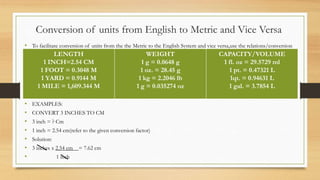
Conversion of units from English to Metric and Vice Versa
• To facilitate conversion of units from the the Metric to the English System and vice versa,use the relations/conversion
factors below
• EXAMPLES:
• CONVERT 3 INCHES TO CM
• 3 inch = ? Cm
• 1 inch = 2.54 cm(refer to the given conversion factor)
• Solution:
• 3 inches x 2.54 cm = 7.62 cm
• 1 inch
LENGTH
1 INCH=2.54 CM
1 FOOT = 0.3048 M
1 YARD = 0.9144 M
1 MILE = 1,609.344 M
WEIGHT
1 g = 0.0648 g
1 oz. = 28.45 g
1 kg = 2.2046 lb
1 g = 0.035274 oz
CAPACITY/VOLUME
1 fl. oz = 29.5729 ml
1 pt. = 0.47321 L
1qt. = 0.94631 L
1 gal. = 3.7854 L
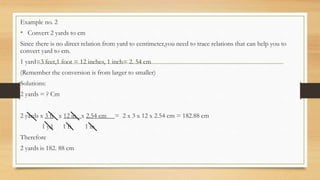
Example no. 2
• Convert 2 yards to cm
Since there is no direct relation from yard to centimeter,you need to trace relations that can help you to
convert yard to cm.
1 yard=3 feet,1 foot = 12 inches, 1 inch= 2. 54 cm
(Remember the conversion is from larger to smaller)
Solutions:
2 yards = ? Cm
2 yards x 3 ft x 12 in x 2.54 cm = 2 x 3 x 12 x 2.54 cm = 182.88 cm
1 yd 1 ft 1 in
Therefore
2 yards is 182. 88 cm
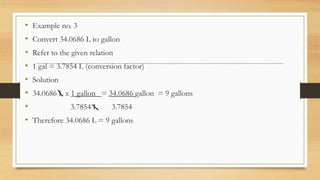
• Example no. 3
• Convert 34.0686 L to gallon
• Refer to the given relation
• 1 gal = 3.7854 L (conversion factor)
• Solution
• 34.0686 L x 1 gallon = 34.0686 gallon = 9 gallons
• 3.7854 L 3.7854
• Therefore 34.0686 L = 9 gallons

CONVERSION OF UNITS For observation.pptx

  • 2.
    REVIEW: • Recall theprevious lesson about Early System of Measurements using non-standard units. CUBIT distance from the elbow to the tip of the middle finger. DIGIT Width of the pointing finger or the middle finger. FATHOM Length of both arms when stretched horizontally SPAN Distance from the tip of the thumb to the tip of the little fingers when fingers spread apart. PACE Distance from the heel of one foot of the other stride. FOOT Distance from the heel to the tip of the great toe. YARD-length of the arm from the shoulder to the tip of middle finger.
  • 3.
    CONVERSION OF UNITS Letus recall the English and Metric System of measurement by listing in the table below all units of measurements and symbols that you can still remember. ENGLISH SYSTEM METRIC SYSTEM FOOT (ft) length meter (m) length PINT (Pi) volume Liter (L) volume OUNCE (0z.) weight Gram (g) weight POUNDS (lbs) weight Seconds (sec) time TONS (T) measures of weight Kelvin (K) temperature
  • 4.
    REMEMBER • To convertmeasurements from a larger unit to a smaller unit,use MULTIPLICATIONS • To convert measurements from smaller to a larger units, use DIVISION
  • 5.
    CONVERSION OF UNITSFROM METRIC TO METRIC • To convert Metric to Metric ,we can use the idea of using the conversion factors as presented in the conversion factors as presented in the conversion of units in the English System or you can use a simpler method by using the metric converter as shown in the illustration as follows. • King Henry Died By Drinking Chocolate Milk km hm dam m dm cm mm 1km 1 hm 1 dam 1 m 1 dm 1 cm 1 mm 1000 m 100 m 10 m 1 m 0.1 0.01 0.001
  • 8.
    • In thegiven table above, notice that for each step to the right,yhe decimal point of the given measurement is moved 1 place to the right. This corresponds to multiplying the number by 10 . This corresponds to multiplying the number by 10. For each step on the left.the decimal point of the given measurement is moved 1 place to the left. This corresponds to multiplying the number by 0.1 EXAMPLES: 1.CONVERT 15 cm to m • (refer from the given table,from cm unit, move 1 place to the right to mm unit.Then move the decimal point of the number once from left to right.) • 15 cm = 0.15 m Solution:15 cm x .01 = 0.15 m 4. convert 2457 mL to L = 2.457 mL • sol: 2457 ml x .001 = 2.457 ml • 2. convert 4 dam to cm = 4000 cm 5. convert 5m to mm = = 5000 mm • 3. convert 3 km to m = 3000 m • km 1000 m mm 100 m dam 10 m m 1 m dm 0.1 cm 0.01 mm 0.001
  • 9.
    GUIDED PRACTICE 1 •Direction: Convert the given mesure to the indicated unit of measurement. • 1. 25 hm = ______cm • 2. 250 mm _____ cm • 3. 2.3 kg ____ g • 4. 1000mm ____ hm • 5. 630,609 mm ____ dam
  • 10.
    Conversion of unitsfrom English to Metric and Vice Versa • To facilitate conversion of units from the the Metric to the English System and vice versa,use the relations/conversion factors below • EXAMPLES: • CONVERT 3 INCHES TO CM • 3 inch = ? Cm • 1 inch = 2.54 cm(refer to the given conversion factor) • Solution: • 3 inches x 2.54 cm = 7.62 cm • 1 inch LENGTH 1 INCH=2.54 CM 1 FOOT = 0.3048 M 1 YARD = 0.9144 M 1 MILE = 1,609.344 M WEIGHT 1 g = 0.0648 g 1 oz. = 28.45 g 1 kg = 2.2046 lb 1 g = 0.035274 oz CAPACITY/VOLUME 1 fl. oz = 29.5729 ml 1 pt. = 0.47321 L 1qt. = 0.94631 L 1 gal. = 3.7854 L
  • 11.
    Example no. 2 •Convert 2 yards to cm Since there is no direct relation from yard to centimeter,you need to trace relations that can help you to convert yard to cm. 1 yard=3 feet,1 foot = 12 inches, 1 inch= 2. 54 cm (Remember the conversion is from larger to smaller) Solutions: 2 yards = ? Cm 2 yards x 3 ft x 12 in x 2.54 cm = 2 x 3 x 12 x 2.54 cm = 182.88 cm 1 yd 1 ft 1 in Therefore 2 yards is 182. 88 cm
  • 12.
    • Example no.3 • Convert 34.0686 L to gallon • Refer to the given relation • 1 gal = 3.7854 L (conversion factor) • Solution • 34.0686 L x 1 gallon = 34.0686 gallon = 9 gallons • 3.7854 L 3.7854 • Therefore 34.0686 L = 9 gallons