Building SentencesProfessor: Specht-Jarvis, Roland H.Group 3Adib KhanXiaojie YuYizhiGuoBurimIbrahimiGabrielle Rheaume
Importance of Sentence StructureSimple Sentences: These are basic sentences.	Ex: I go to school.		  I love food.They are correct and we can use them anywhere. But excessive use of them makes writings MUNDANE!
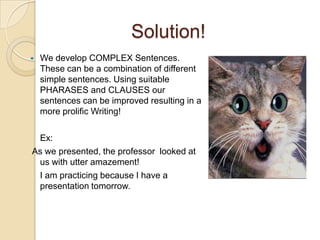
Solution!We develop COMPLEX Sentences.  These can be a combination of different simple sentences. Using suitable PHARASES and CLAUSES our sentences can be improved resulting in a more prolific Writing!	Ex:  As we presented, the professor  looked at us with utter amazement!	I am practicing because I have a presentation tomorrow.
Different Types of Sentences.CompoundLoosePeriodicDeclarativeExclamatoryInterrogativeImperative
Sentence StructureThree types:1. The simple sentence2. The compound sentence3. The complex sentence
The Simple SentenceContains only a single clause.Example: The ice melts quickly.Can not distinguish by lengthThe most natural sentence structure also the most common sentence in the spoken language. Effective for grabbing attention or for summing up.Transitional phrases can be added to connect them to the surrounding sentences.
The Compound SentenceConsists of two or more independent sentence (or simple sentences) joined by co-ordinating conjunctions.Example: Canada is a rich country, but still it has many poor people.Very natureConnect ideas and to avoid pausing (and allowing an adult to interrupt)Most effective to create a sense of balance or contrast between two (or more) equally-important pieces of information
Two Special CasesCompound-complex sentenceConsists at least one complex sentenceExample: The package arrived in the morning, but the courier left before I could check the contents.Compound sentence involves punctuationExample: The sun rises in the east; it sets in the west.
The Complex SentenceContains one independent clause and at least one dependent clause; clauses are not equal.Example: Although my friend invited me to a party, I do not want to go.Clause with the subordinating conjunction is an incomplete, or a dependent clause.Makes clear which ideas are most important.
Review questions I ate the sushi and left the restaurant.	Simple, compound predicate rather than a compound subjectWhen the train arrives and if Ms. Langlois is on it, she will be served with a subpoena.	Complex, only one independent clause in the sentenceSusanne wanted to be here, but she cannot come because her car is in the shop.	Compound-complex sentence, contains two independent clauses, also dependent clause
The order of a sentenceThe Loose Sentence - The writer puts the main point at           the beginning of a long sentenceThe Periodic Sentence - The writer puts the main point at the end of  a long sentence.
The Loose Sentence Example 1 I am willing to pay slightly higher taxes for  the privilege of living in Canada, considering the free health care, the cheap tuition fees, the low crime rate, the comprehensive social programs, and the wonderful winters.Example 2I go back to my country every summer, because I want to see my family and my friends.
The Periodic SentenceExample 1Considering the free health care, the cheap tuition fees, the low crime rate, the comprehensive social programs, and the wonderful winters, I am willing to pay slightly higher taxes for the privilege of living in Canada.Example 2    Because I want to see my family and my friends, I    go back home every summer.
The purpose of sentenceThe Declarative Sentence The Interrogative Sentence The Rhetorical Question The Exclamatory SentenceThe Imperative Sentence
   1.The Declarative Sentence   The most common type, simply states a fact or argument :   I am going home.Ottawa is the capital of Canada. 2.The Interrogative Sentence   Asks a direct question :When are you going to work?
	3.The Rhetorical Question   A question which you do not actually expect the reader to answer : How much longer must our people endure this injustice? 4.The Exclamatory Sentence   Simply a more forceful version of a declarative sentence :What a wonderful day this is!
5.The Imperative Sentence   Tells someone to do something :Go to work at 7:30, tomorrow morning.
Mixed ConstructionsThese sentences have parts that do not sensibly fit together, they have a mix-match of grammar or logic.Examples:The squirrel that came down our chimney it did much damage. (INCORRECT)The squirrel that came down our chimney did much damage. (CORRECTED)
Hearing screams, Serena ran over to the pool that her daughter was swimming in it. (INCORRECT)Hearing screams, Serena ran over to the pool that her daughter was swimming in. (CORRECTED)--You can’t start writing a sentence with one grammatical plan and switch to another without warning.
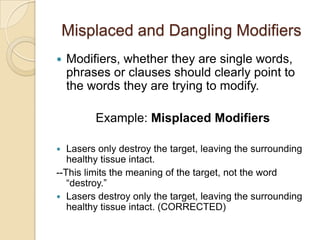
Misplaced and Dangling ModifiersModifiers, whether they are single words, phrases or clauses should clearly point to the words they are trying to modify.Example: Misplaced ModifiersLasers only destroy the target, leaving the surrounding healthy tissue intact. --This limits the meaning of the target, not the word “destroy.”Lasers destroy only the target, leaving the surrounding healthy tissue intact. (CORRECTED)
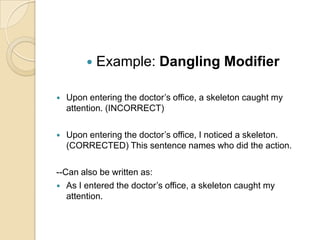
Example: Dangling ModifierUpon entering the doctor’s office, a skeleton caught my attention. (INCORRECT)Upon entering the doctor’s office, I noticed a skeleton. (CORRECTED) This sentence names who did the action.--Can also be written as:As I entered the doctor’s office, a skeleton caught my attention.
References"Building Sentences." Universitéd'Ottawa - University of Ottawa. Web. 25 Jan. 2010. <http://www.uottawa.ca/academic/arts/writcent/hypergrammar/bldsent.html>. Hacker, Diana. The Bedford Handbook. Boston: Bedford/St. Martin's, 2005. Print. (Pg 163 – 178)

Group 3 Presentation

  • 1.
    Building SentencesProfessor: Specht-Jarvis,Roland H.Group 3Adib KhanXiaojie YuYizhiGuoBurimIbrahimiGabrielle Rheaume
  • 2.
    Importance of SentenceStructureSimple Sentences: These are basic sentences. Ex: I go to school. I love food.They are correct and we can use them anywhere. But excessive use of them makes writings MUNDANE!
  • 3.
    Solution!We develop COMPLEXSentences. These can be a combination of different simple sentences. Using suitable PHARASES and CLAUSES our sentences can be improved resulting in a more prolific Writing! Ex: As we presented, the professor looked at us with utter amazement! I am practicing because I have a presentation tomorrow.
  • 4.
    Different Types ofSentences.CompoundLoosePeriodicDeclarativeExclamatoryInterrogativeImperative
  • 5.
    Sentence StructureThree types:1.The simple sentence2. The compound sentence3. The complex sentence
  • 6.
    The Simple SentenceContainsonly a single clause.Example: The ice melts quickly.Can not distinguish by lengthThe most natural sentence structure also the most common sentence in the spoken language. Effective for grabbing attention or for summing up.Transitional phrases can be added to connect them to the surrounding sentences.
  • 7.
    The Compound SentenceConsistsof two or more independent sentence (or simple sentences) joined by co-ordinating conjunctions.Example: Canada is a rich country, but still it has many poor people.Very natureConnect ideas and to avoid pausing (and allowing an adult to interrupt)Most effective to create a sense of balance or contrast between two (or more) equally-important pieces of information
  • 8.
    Two Special CasesCompound-complexsentenceConsists at least one complex sentenceExample: The package arrived in the morning, but the courier left before I could check the contents.Compound sentence involves punctuationExample: The sun rises in the east; it sets in the west.
  • 9.
    The Complex SentenceContainsone independent clause and at least one dependent clause; clauses are not equal.Example: Although my friend invited me to a party, I do not want to go.Clause with the subordinating conjunction is an incomplete, or a dependent clause.Makes clear which ideas are most important.
  • 10.
    Review questions Iate the sushi and left the restaurant. Simple, compound predicate rather than a compound subjectWhen the train arrives and if Ms. Langlois is on it, she will be served with a subpoena. Complex, only one independent clause in the sentenceSusanne wanted to be here, but she cannot come because her car is in the shop. Compound-complex sentence, contains two independent clauses, also dependent clause
  • 11.
    The order ofa sentenceThe Loose Sentence - The writer puts the main point at the beginning of a long sentenceThe Periodic Sentence - The writer puts the main point at the end of a long sentence.
  • 12.
    The Loose SentenceExample 1 I am willing to pay slightly higher taxes for the privilege of living in Canada, considering the free health care, the cheap tuition fees, the low crime rate, the comprehensive social programs, and the wonderful winters.Example 2I go back to my country every summer, because I want to see my family and my friends.
  • 13.
    The Periodic SentenceExample1Considering the free health care, the cheap tuition fees, the low crime rate, the comprehensive social programs, and the wonderful winters, I am willing to pay slightly higher taxes for the privilege of living in Canada.Example 2 Because I want to see my family and my friends, I go back home every summer.
  • 14.
    The purpose ofsentenceThe Declarative Sentence The Interrogative Sentence The Rhetorical Question The Exclamatory SentenceThe Imperative Sentence
  • 15.
    1.The Declarative Sentence The most common type, simply states a fact or argument : I am going home.Ottawa is the capital of Canada. 2.The Interrogative Sentence Asks a direct question :When are you going to work?
  • 16.
    3.The Rhetorical Question A question which you do not actually expect the reader to answer : How much longer must our people endure this injustice? 4.The Exclamatory Sentence Simply a more forceful version of a declarative sentence :What a wonderful day this is!
  • 17.
    5.The Imperative Sentence Tells someone to do something :Go to work at 7:30, tomorrow morning.
  • 18.
    Mixed ConstructionsThese sentenceshave parts that do not sensibly fit together, they have a mix-match of grammar or logic.Examples:The squirrel that came down our chimney it did much damage. (INCORRECT)The squirrel that came down our chimney did much damage. (CORRECTED)
  • 19.
    Hearing screams, Serenaran over to the pool that her daughter was swimming in it. (INCORRECT)Hearing screams, Serena ran over to the pool that her daughter was swimming in. (CORRECTED)--You can’t start writing a sentence with one grammatical plan and switch to another without warning.
  • 20.
    Misplaced and DanglingModifiersModifiers, whether they are single words, phrases or clauses should clearly point to the words they are trying to modify.Example: Misplaced ModifiersLasers only destroy the target, leaving the surrounding healthy tissue intact. --This limits the meaning of the target, not the word “destroy.”Lasers destroy only the target, leaving the surrounding healthy tissue intact. (CORRECTED)
  • 21.
    Example: Dangling ModifierUponentering the doctor’s office, a skeleton caught my attention. (INCORRECT)Upon entering the doctor’s office, I noticed a skeleton. (CORRECTED) This sentence names who did the action.--Can also be written as:As I entered the doctor’s office, a skeleton caught my attention.
  • 22.
    References"Building Sentences." Universitéd'Ottawa- University of Ottawa. Web. 25 Jan. 2010. <http://www.uottawa.ca/academic/arts/writcent/hypergrammar/bldsent.html>. Hacker, Diana. The Bedford Handbook. Boston: Bedford/St. Martin's, 2005. Print. (Pg 163 – 178)