HAZARDOUS BUILDING
MATERIAL
GROUP MEMBER:
AR-005_RABIA MEHDI
AR-010_HAFSA SAJJAD
AR-014_WANIYA ALI
AR-029_LAIBA
AR-034_UNZILA HANIF
CONTENT
 INTRODUCTION
 HAZARDOUS BUILDING MATERIAL
 EFFECTS OF HAZARDOUS BUILDING MATERIALS
 EXAMPLES OF HAZARDOUS BUILDING MATERIALS
 WHERE TO FIND?
 ELABORATION OF EXAMPLES OF HAZARDOUS BUILDING
HAZARDOUS MATERIALS
 ALTERNATIVES
 CONCLUSION
 REFERENCE
INTRODUCTION
Naturally occurring substances
 Brush
 Ice and snow
 Mud and clay
 Sand
 Stone or rock
 Thatch
 Wood and timber Minerals
 Etc……
Building material is any material which is used for construction purposes.
 Fired bricks
 Cement composites
 Concrete
 Fabric
 Foam
 Glass
 Gypcrete
 Metal
 Plastic
 Papers and membranes
 Ceramics
 Etc……
HAZARDOUS BUILDING MATERIAL
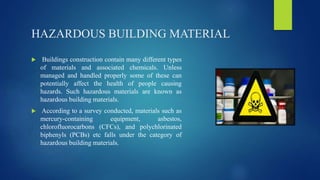
 Buildings construction contain many different types
of materials and associated chemicals. Unless
managed and handled properly some of these can
potentially affect the health of people causing
hazards. Such hazardous materials are known as
hazardous building materials.
 According to a survey conducted, materials such as
mercury-containing equipment, asbestos,
chlorofluorocarbons (CFCs), and polychlorinated
biphenyls (PCBs) etc falls under the category of
hazardous building materials.
EFFECTS OF HAZARDOUS BUILDING MATERIALS
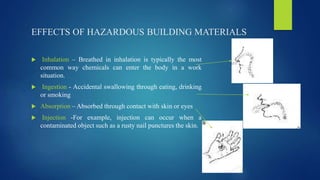
 Inhalation – Breathed in inhalation is typically the most
common way chemicals can enter the body in a work
situation.
 Ingestion - Accidental swallowing through eating, drinking
or smoking
 Absorption – Absorbed through contact with skin or eyes
 Injection -For example, injection can occur when a
contaminated object such as a rusty nail punctures the skin.
EXAMPLES OF HAZARDOUS BUILDING MATERIALS
1. Asbestos
2. Mercury
3. Lead
4. Silica
5. Cadmium
6. Hexavalent chromium
7. Carbon Monoxide
8. Polychlorinated biphenyls (PCB)
9. Chlorofluorocarbons
10. Man made mineral fibers (MMMF)
EFFECTS AND USES OF HAZARDOUS
BUILDING MATERIALS:
1. ASBASTOS
DEFINITION:
Asbestos is a group of six naturally occurring silicate minerals made up of thin,
microscopic fibers.
WIDELY USE FOR MANY REASONS BECAUSE:
 Resistant to heat, electricity, and chemicals
 Sound absorbent
 Has a high tensile strength
EFFECTS:
 Causes permanent lung damage.
 Cancer of the gastrointestinal tract, kidney and throat.
 Scarring of the lung lining.
EFFECTS AND USES OF HAZARDOUS
BUILDING MATERIALS:
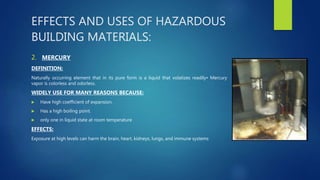
2. MERCURY
DEFINITION:
Naturally occurring element that in its pure form is a liquid that volatizes readily• Mercury
vapor is colorless and odorless.
WIDELY USE FOR MANY REASONS BECAUSE:
 Have high coefficient of expansion.
 Has a high boiling point.
 only one in liquid state at room temperature
EFFECTS:
Exposure at high levels can harm the brain, heart, kidneys, lungs, and immune systems
EFFECTS AND USES OF HAZARDOUS
BUILDING MATERIALS:
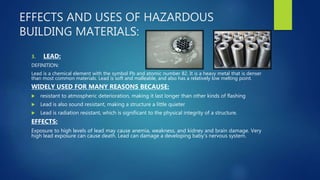
3. LEAD:
DEFINITION:
Lead is a chemical element with the symbol Pb and atomic number 82. It is a heavy metal that is denser
than most common materials. Lead is soft and malleable, and also has a relatively low melting point.
WIDELY USED FOR MANY REASONS BECAUSE:
 resistant to atmospheric deterioration, making it last longer than other kinds of flashing
 Lead is also sound resistant, making a structure a little quieter
 Lead is radiation resistant, which is significant to the physical integrity of a structure.
EFFECTS:
Exposure to high levels of lead may cause anemia, weakness, and kidney and brain damage. Very
high lead exposure can cause death. Lead can damage a developing baby's nervous system.
EFFECTS AND USES OF HAZARDOUS BUILDING
MATERIALS:
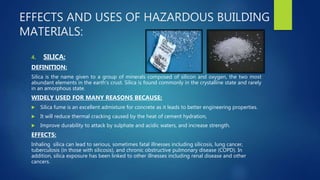
4. SILICA:
DEFINITION:
Silica is the name given to a group of minerals composed of silicon and oxygen, the two most
abundant elements in the earth's crust. Silica is found commonly in the crystalline state and rarely
in an amorphous state.
WIDELY USED FOR MANY REASONS BECAUSE:
 Silica fume is an excellent admixture for concrete as it leads to better engineering properties.
 It will reduce thermal cracking caused by the heat of cement hydration,
 Improve durability to attack by sulphate and acidic waters, and increase strength.
EFFECTS:
Inhaling silica can lead to serious, sometimes fatal illnesses including silicosis, lung cancer,
tuberculosis (in those with silicosis), and chronic obstructive pulmonary disease (COPD). In
addition, silica exposure has been linked to other illnesses including renal disease and other
cancers.
EFFECTS AND USES OF HAZARDOUS
BUILDING MATERIALS:
5. CADMIUM:
DEFINITION:
Cadmium is a chemical element with the symbol Cd and atomic number 48. This soft, silvery-
white metal is chemically similar to the two other stable metals in group 12, zinc and mercury.
Cadmium occurs as a minor component in most zinc ores and is a byproduct of zinc production.
WIDELY USED FOR MANY REASONS BECAUSE:
 Provide adhesion, corrosion resistance and lubricity.
 It also provides freedom from stick-slip, which allows consistent torquing of plated threads.
 It has good solderability and works great as a paint base or a final finish.
EFFECTS:
Acute inhalation exposure (high levels over a short period of time) to cadmium can result in flu-
like symptoms (chills, fever, and muscle pain) and can damage the lungs. Chronic exposure (low
level over an extended period of time) can result in kidney, bone and lung disease.
EFFECTS AND USES OF HAZARDOUS
BUILDING MATERIALS:
6. HEXAVALENT CHROMIUM
DEFINITIONl:
Hexavalent chromium is chromium in any chemical compound that contains the element in the
+6 oxidation state. Virtually all chromium ore is processed via hexavalent chromium, specifically
the salt sodium dichromate.
WIDELY USED FOR MANY REASONS BECAUSE:
 Industrial uses of hexavalent chromium compounds include chromate pigments in dyes,
paints, inks, and plastics;
 chromates added as anticorrosive agents to paints, primers, and other surface coatings; and
chromic acid electroplated onto metal parts to provide a decorative or protective coating.
EFFECTS:
Adverse health effects from hexavalent chromium exposures include nasal and sinus cancers,
kidney and liver damage, nasal and skin irritation and ulceration, and eye irritation and damage.
EFFECTS AND USES OF HAZARDOUS
BUILDING MATERIALS:
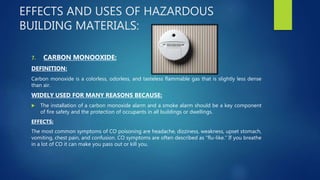
7. CARBON MONOOXIDE:
DEFINITION:
Carbon monoxide is a colorless, odorless, and tasteless flammable gas that is slightly less dense
than air.
WIDELY USED FOR MANY REASONS BECAUSE:
 The installation of a carbon monoxide alarm and a smoke alarm should be a key component
of fire safety and the protection of occupants in all buildings or dwellings.
EFFECTS:
The most common symptoms of CO poisoning are headache, dizziness, weakness, upset stomach,
vomiting, chest pain, and confusion. CO symptoms are often described as “flu-like.” If you breathe
in a lot of CO it can make you pass out or kill you.
EFFECTS AND USES OF HAZARDOUS
BUILDING MATERIALS:
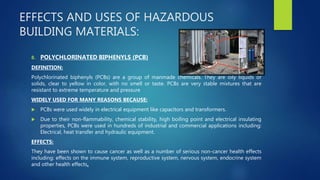
8. POLYCHLORINATED BIPHENYLS (PCB)
DEFINITION:
Polychlorinated biphenyls (PCBs) are a group of manmade chemicals. They are oily liquids or
solids, clear to yellow in color, with no smell or taste. PCBs are very stable mixtures that are
resistant to extreme temperature and pressure
WIDELY USED FOR MANY REASONS BECAUSE:
 PCBs were used widely in electrical equipment like capacitors and transformers.
 Due to their non-flammability, chemical stability, high boiling point and electrical insulating
properties, PCBs were used in hundreds of industrial and commercial applications including:
Electrical, heat transfer and hydraulic equipment.
EFFECTS:
They have been shown to cause cancer as well as a number of serious non-cancer health effects
including: effects on the immune system, reproductive system, nervous system, endocrine system
and other health effects.
EFFECTS AND USES OF HAZARDOUS
BUILDING MATERIALS:
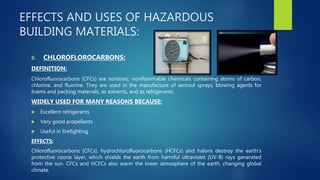
9. CHLOROFLOROCARBONS:
DEFINITION:
Chlorofluorocarbons (CFCs) are nontoxic, nonflammable chemicals containing atoms of carbon,
chlorine, and fluorine. They are used in the manufacture of aerosol sprays, blowing agents for
foams and packing materials, as solvents, and as refrigerants.
WIDELY USED FOR MANY REASONS BECAUSE:
 Excellent refrigerants
 Very good propellants
 Useful in firefighting
EFFECTS:
Chlorofluorocarbons (CFCs), hydrochlorofluorocarbons (HCFCs) and halons destroy the earth's
protective ozone layer, which shields the earth from harmful ultraviolet (UV-B) rays generated
from the sun. CFCs and HCFCs also warm the lower atmosphere of the earth, changing global
climate.
EFFECTS AND USES OF HAZARDOUS
BUILDING MATERIALS:
10. MAN MADE MINERAL FIBERS:
DEFINITION:
These fibers are generally made from glass, ceramic, rockwool, and slagwool, and are usually used
for temperature and sound insulation.
WIDELY USED FOR MANY REASONS BECAUSE:
 Man-made mineral fibers are produced using inorganic materials and are widely used as
thermal and acoustic insulation.
 These basically include continuous fiberglass filaments, glass wool (fiberglass insulation),
stone wool, slag wool and refractory ceramic fibers.
EFFECTS:
Whenever install or remove these materials, one is exposed to tiny fibers that can get lodged in
your lungs. They are often irritating to the skin and can damage your eyes. Some types of these
fibers, particularly the fibers classed as refractory ceramic fibers may require specialized personal
protective equipment when working with them.
ALTERNATIVES
MERCURY:
 Reducing consumption of raw materials and products generating mercury
releases
 Substitution by non-mercury alternatives
 End-of-pipe techniques(coal containing)
 Waste management
LEAD:
 Ecomass Compounds (line of patented, nontoxic, high-density
thermoplastic composite materials) achieve the density of lead without any
toxic concerns.
 Aluminum based
ALTERNATIVES
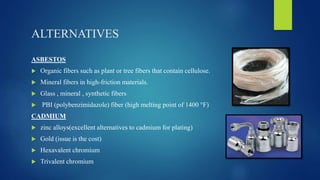
ASBESTOS
 Organic fibers such as plant or tree fibers that contain cellulose.
 Mineral fibers in high-friction materials.
 Glass , mineral , synthetic fibers
 PBI (polybenzimidazole) fiber (high melting point of 1400 °F)
CADMIUM
 zinc alloys(excellent alternatives to cadmium for plating)
 Gold (issue is the cost)
 Hexavalent chromium
 Trivalent chromium
ALTERNATIVES
CFCs
 HCFCs contribute to the destruction of stratospheric ozone, but to
a much lesser extent than CFCs.
POLYCHLORINATED BIPHENYLS (PCB)
 PCTs, alkyl-substituted chlorodiphenyls and PCNs
 Biphenyl
 Mineral oil
CARBON MONOXIDE
 No need for reinforced concrete, steel
 Hand presses make building tiles from local earth
 Natural insulation and ventilation
CONCLUSION
It is very important to identify hazardous materials in advance of construction
to prevent against accidental exposure, for both occupants and workers, as
well as assists in managing project costs. Once the hazards are properly
identified, the method for management or removal can be determined and
completed before construction.
Certain federal , state and local laws and regulations are there for hazardous
materials. It is important to contact local and state agencies to ensure
environmental safety for the people who may be affected by the project.
REFRENCE
 Google image
 https://www.traditionalbuilding.com/product-report/hazardous-building-materials
 https://www.randrmagonline.com/articles/87019-hazardous-building-materials-
101#:~:text=Hazardous%20building%20materials%20include%20asbestos,of%20
any%20age%20or%20condition.
 https://www.pcimag.com/articles/95782-cadmium-plating-alternatives
 https://fibercontrolinc.com/what-are-the-asbestos-substitutes-in-building-
construction
 https://www.youtube.com/watch?v=wQ0XqF4ZCcw
 https://www.youtube.com/watch?v=dTS7qaYRSf8

Hazardous building material 9000

  • 1.
    HAZARDOUS BUILDING MATERIAL GROUP MEMBER: AR-005_RABIAMEHDI AR-010_HAFSA SAJJAD AR-014_WANIYA ALI AR-029_LAIBA AR-034_UNZILA HANIF
  • 4.
    CONTENT  INTRODUCTION  HAZARDOUSBUILDING MATERIAL  EFFECTS OF HAZARDOUS BUILDING MATERIALS  EXAMPLES OF HAZARDOUS BUILDING MATERIALS  WHERE TO FIND?  ELABORATION OF EXAMPLES OF HAZARDOUS BUILDING HAZARDOUS MATERIALS  ALTERNATIVES  CONCLUSION  REFERENCE
  • 5.
    INTRODUCTION Naturally occurring substances Brush  Ice and snow  Mud and clay  Sand  Stone or rock  Thatch  Wood and timber Minerals  Etc…… Building material is any material which is used for construction purposes.  Fired bricks  Cement composites  Concrete  Fabric  Foam  Glass  Gypcrete  Metal  Plastic  Papers and membranes  Ceramics  Etc……
  • 6.
    HAZARDOUS BUILDING MATERIAL Buildings construction contain many different types of materials and associated chemicals. Unless managed and handled properly some of these can potentially affect the health of people causing hazards. Such hazardous materials are known as hazardous building materials.  According to a survey conducted, materials such as mercury-containing equipment, asbestos, chlorofluorocarbons (CFCs), and polychlorinated biphenyls (PCBs) etc falls under the category of hazardous building materials.
  • 7.
    EFFECTS OF HAZARDOUSBUILDING MATERIALS  Inhalation – Breathed in inhalation is typically the most common way chemicals can enter the body in a work situation.  Ingestion - Accidental swallowing through eating, drinking or smoking  Absorption – Absorbed through contact with skin or eyes  Injection -For example, injection can occur when a contaminated object such as a rusty nail punctures the skin.
  • 8.
    EXAMPLES OF HAZARDOUSBUILDING MATERIALS 1. Asbestos 2. Mercury 3. Lead 4. Silica 5. Cadmium 6. Hexavalent chromium 7. Carbon Monoxide 8. Polychlorinated biphenyls (PCB) 9. Chlorofluorocarbons 10. Man made mineral fibers (MMMF)
  • 9.
    EFFECTS AND USESOF HAZARDOUS BUILDING MATERIALS: 1. ASBASTOS DEFINITION: Asbestos is a group of six naturally occurring silicate minerals made up of thin, microscopic fibers. WIDELY USE FOR MANY REASONS BECAUSE:  Resistant to heat, electricity, and chemicals  Sound absorbent  Has a high tensile strength EFFECTS:  Causes permanent lung damage.  Cancer of the gastrointestinal tract, kidney and throat.  Scarring of the lung lining.
  • 10.
    EFFECTS AND USESOF HAZARDOUS BUILDING MATERIALS: 2. MERCURY DEFINITION: Naturally occurring element that in its pure form is a liquid that volatizes readily• Mercury vapor is colorless and odorless. WIDELY USE FOR MANY REASONS BECAUSE:  Have high coefficient of expansion.  Has a high boiling point.  only one in liquid state at room temperature EFFECTS: Exposure at high levels can harm the brain, heart, kidneys, lungs, and immune systems
  • 11.
    EFFECTS AND USESOF HAZARDOUS BUILDING MATERIALS: 3. LEAD: DEFINITION: Lead is a chemical element with the symbol Pb and atomic number 82. It is a heavy metal that is denser than most common materials. Lead is soft and malleable, and also has a relatively low melting point. WIDELY USED FOR MANY REASONS BECAUSE:  resistant to atmospheric deterioration, making it last longer than other kinds of flashing  Lead is also sound resistant, making a structure a little quieter  Lead is radiation resistant, which is significant to the physical integrity of a structure. EFFECTS: Exposure to high levels of lead may cause anemia, weakness, and kidney and brain damage. Very high lead exposure can cause death. Lead can damage a developing baby's nervous system.
  • 12.
    EFFECTS AND USESOF HAZARDOUS BUILDING MATERIALS: 4. SILICA: DEFINITION: Silica is the name given to a group of minerals composed of silicon and oxygen, the two most abundant elements in the earth's crust. Silica is found commonly in the crystalline state and rarely in an amorphous state. WIDELY USED FOR MANY REASONS BECAUSE:  Silica fume is an excellent admixture for concrete as it leads to better engineering properties.  It will reduce thermal cracking caused by the heat of cement hydration,  Improve durability to attack by sulphate and acidic waters, and increase strength. EFFECTS: Inhaling silica can lead to serious, sometimes fatal illnesses including silicosis, lung cancer, tuberculosis (in those with silicosis), and chronic obstructive pulmonary disease (COPD). In addition, silica exposure has been linked to other illnesses including renal disease and other cancers.
  • 13.
    EFFECTS AND USESOF HAZARDOUS BUILDING MATERIALS: 5. CADMIUM: DEFINITION: Cadmium is a chemical element with the symbol Cd and atomic number 48. This soft, silvery- white metal is chemically similar to the two other stable metals in group 12, zinc and mercury. Cadmium occurs as a minor component in most zinc ores and is a byproduct of zinc production. WIDELY USED FOR MANY REASONS BECAUSE:  Provide adhesion, corrosion resistance and lubricity.  It also provides freedom from stick-slip, which allows consistent torquing of plated threads.  It has good solderability and works great as a paint base or a final finish. EFFECTS: Acute inhalation exposure (high levels over a short period of time) to cadmium can result in flu- like symptoms (chills, fever, and muscle pain) and can damage the lungs. Chronic exposure (low level over an extended period of time) can result in kidney, bone and lung disease.
  • 14.
    EFFECTS AND USESOF HAZARDOUS BUILDING MATERIALS: 6. HEXAVALENT CHROMIUM DEFINITIONl: Hexavalent chromium is chromium in any chemical compound that contains the element in the +6 oxidation state. Virtually all chromium ore is processed via hexavalent chromium, specifically the salt sodium dichromate. WIDELY USED FOR MANY REASONS BECAUSE:  Industrial uses of hexavalent chromium compounds include chromate pigments in dyes, paints, inks, and plastics;  chromates added as anticorrosive agents to paints, primers, and other surface coatings; and chromic acid electroplated onto metal parts to provide a decorative or protective coating. EFFECTS: Adverse health effects from hexavalent chromium exposures include nasal and sinus cancers, kidney and liver damage, nasal and skin irritation and ulceration, and eye irritation and damage.
  • 15.
    EFFECTS AND USESOF HAZARDOUS BUILDING MATERIALS: 7. CARBON MONOOXIDE: DEFINITION: Carbon monoxide is a colorless, odorless, and tasteless flammable gas that is slightly less dense than air. WIDELY USED FOR MANY REASONS BECAUSE:  The installation of a carbon monoxide alarm and a smoke alarm should be a key component of fire safety and the protection of occupants in all buildings or dwellings. EFFECTS: The most common symptoms of CO poisoning are headache, dizziness, weakness, upset stomach, vomiting, chest pain, and confusion. CO symptoms are often described as “flu-like.” If you breathe in a lot of CO it can make you pass out or kill you.
  • 16.
    EFFECTS AND USESOF HAZARDOUS BUILDING MATERIALS: 8. POLYCHLORINATED BIPHENYLS (PCB) DEFINITION: Polychlorinated biphenyls (PCBs) are a group of manmade chemicals. They are oily liquids or solids, clear to yellow in color, with no smell or taste. PCBs are very stable mixtures that are resistant to extreme temperature and pressure WIDELY USED FOR MANY REASONS BECAUSE:  PCBs were used widely in electrical equipment like capacitors and transformers.  Due to their non-flammability, chemical stability, high boiling point and electrical insulating properties, PCBs were used in hundreds of industrial and commercial applications including: Electrical, heat transfer and hydraulic equipment. EFFECTS: They have been shown to cause cancer as well as a number of serious non-cancer health effects including: effects on the immune system, reproductive system, nervous system, endocrine system and other health effects.
  • 17.
    EFFECTS AND USESOF HAZARDOUS BUILDING MATERIALS: 9. CHLOROFLOROCARBONS: DEFINITION: Chlorofluorocarbons (CFCs) are nontoxic, nonflammable chemicals containing atoms of carbon, chlorine, and fluorine. They are used in the manufacture of aerosol sprays, blowing agents for foams and packing materials, as solvents, and as refrigerants. WIDELY USED FOR MANY REASONS BECAUSE:  Excellent refrigerants  Very good propellants  Useful in firefighting EFFECTS: Chlorofluorocarbons (CFCs), hydrochlorofluorocarbons (HCFCs) and halons destroy the earth's protective ozone layer, which shields the earth from harmful ultraviolet (UV-B) rays generated from the sun. CFCs and HCFCs also warm the lower atmosphere of the earth, changing global climate.
  • 18.
    EFFECTS AND USESOF HAZARDOUS BUILDING MATERIALS: 10. MAN MADE MINERAL FIBERS: DEFINITION: These fibers are generally made from glass, ceramic, rockwool, and slagwool, and are usually used for temperature and sound insulation. WIDELY USED FOR MANY REASONS BECAUSE:  Man-made mineral fibers are produced using inorganic materials and are widely used as thermal and acoustic insulation.  These basically include continuous fiberglass filaments, glass wool (fiberglass insulation), stone wool, slag wool and refractory ceramic fibers. EFFECTS: Whenever install or remove these materials, one is exposed to tiny fibers that can get lodged in your lungs. They are often irritating to the skin and can damage your eyes. Some types of these fibers, particularly the fibers classed as refractory ceramic fibers may require specialized personal protective equipment when working with them.
  • 19.
    ALTERNATIVES MERCURY:  Reducing consumptionof raw materials and products generating mercury releases  Substitution by non-mercury alternatives  End-of-pipe techniques(coal containing)  Waste management LEAD:  Ecomass Compounds (line of patented, nontoxic, high-density thermoplastic composite materials) achieve the density of lead without any toxic concerns.  Aluminum based
  • 20.
    ALTERNATIVES ASBESTOS  Organic fiberssuch as plant or tree fibers that contain cellulose.  Mineral fibers in high-friction materials.  Glass , mineral , synthetic fibers  PBI (polybenzimidazole) fiber (high melting point of 1400 °F) CADMIUM  zinc alloys(excellent alternatives to cadmium for plating)  Gold (issue is the cost)  Hexavalent chromium  Trivalent chromium
  • 21.
    ALTERNATIVES CFCs  HCFCs contributeto the destruction of stratospheric ozone, but to a much lesser extent than CFCs. POLYCHLORINATED BIPHENYLS (PCB)  PCTs, alkyl-substituted chlorodiphenyls and PCNs  Biphenyl  Mineral oil CARBON MONOXIDE  No need for reinforced concrete, steel  Hand presses make building tiles from local earth  Natural insulation and ventilation
  • 22.
    CONCLUSION It is veryimportant to identify hazardous materials in advance of construction to prevent against accidental exposure, for both occupants and workers, as well as assists in managing project costs. Once the hazards are properly identified, the method for management or removal can be determined and completed before construction. Certain federal , state and local laws and regulations are there for hazardous materials. It is important to contact local and state agencies to ensure environmental safety for the people who may be affected by the project.
  • 23.
    REFRENCE  Google image https://www.traditionalbuilding.com/product-report/hazardous-building-materials  https://www.randrmagonline.com/articles/87019-hazardous-building-materials- 101#:~:text=Hazardous%20building%20materials%20include%20asbestos,of%20 any%20age%20or%20condition.  https://www.pcimag.com/articles/95782-cadmium-plating-alternatives  https://fibercontrolinc.com/what-are-the-asbestos-substitutes-in-building- construction  https://www.youtube.com/watch?v=wQ0XqF4ZCcw  https://www.youtube.com/watch?v=dTS7qaYRSf8