Nazmul Huda Shuvo
ID: 1321044
Dept. of TE, KUET.
1April 25, 2017
Gray Scale for Color Change and Gray Scale for staining
The Gray Change and Gray Stain scales are each based on a gray set of visual paint chips.
Both scales measure color-fastness of textile dyes. Gray Scale for color change indicates the
amount of fading or color alteration with environmental exposure or washing, and gray scale
for staining indicates the amount of staining of adjacent materials that occurs with washing
of a specimen. Both scales are based on relative small differences between a product standard
and lot sample of any color in comparison to these two gray scales (5 = no difference; 1 = most
difference).
Gray Scale for Color Change
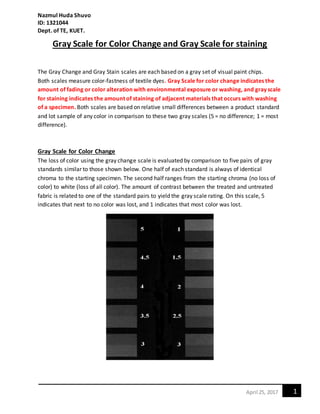
The loss of color using the gray change scale is evaluated by comparison to five pairs of gray
standards similar to those shown below. One half of each standard is always of identical
chroma to the starting specimen. The second half ranges from the starting chroma (no loss of
color) to white (loss of all color). The amount of contrast between the treated and untreated
fabric is related to one of the standard pairs to yield the gray scale rating. On this scale, 5
indicates that next to no color was lost, and 1 indicates that most color was lost.
Nazmul Huda Shuvo
ID: 1321044
Dept. of TE, KUET.
2April 25, 2017
Gray Scale for Staining
The transference of color from the test specimen to an adjacent specimen is evaluated in a
manner very similar to that of gray change. Again, five standard pairs are used. One half of each
standard is white, and the second half ranges from white (no staining) to a gray with the
chroma value of the test specimen (great deal of staining). A value of 5 corresponds to virtually
no staining, whereas 1 indicates poor color-fastness. The bottom half of each pair shows the
starting color of the adjacent fabric. The top half shows the color of the treated adjacent fabric.
Nazmul Huda Shuvo
ID: 1321044
Dept. of TE, KUET.
3April 25, 2017
The Blue Wool Standards
By using the Blue Wool standards it is possible to estimate the lightfastness of a dyed fabric or
paint. This measurement does no more than grade the material on a scale from 1 (fugitive) to 8
(of good lightfastness); it cannot give us a very good idea of how much exposure to light the
material will stand in any situation.
The Blue Wool standards have been adopted since as ISO International Organisation for
Standardisation) Recommendation R 105 and British Standards BS1006 (1961), so that sample
cards are readily available. Each card contains 8 specially prepared blue dyeings on wool. They
are so chosen that standard number 2 takes roughly twice as long to be perceptibly faded as
standard 1, standard 3 roughly twice as long as standard 2, and so on through to standard 8.
To rate the lightfastness of our material we expose it together with a card of Blue Wool
standards, and from time to time check both our material and the standards for first signs of
fading. This can most easily be done if one half of each patch of colour is covered with an
opaque card throughout the test.
Attempts have been made to measure how much light exposure is required to fade the
standards. They have met with little success, since rates of fading are related to other factors
besides the light, such as proportion of UV, humidity, etc.. The light may appear to be the same
but the standards may be found to fade at quite a different rate, although they keep more or
less in rank.
Nazmul Huda Shuvo
ID: 1321044
Dept. of TE, KUET.
4April 25, 2017
9-Step Chromatic Transference Scale
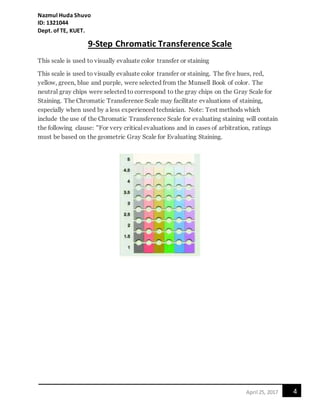
This scale is used to visually evaluate color transfer or staining
This scale is used to visually evaluate color transfer or staining. The five hues, red,
yellow, green, blue and purple, were selected from the Munsell Book of color. The
neutral gray chips were selected to correspond to the gray chips on the Gray Scale for
Staining. The Chromatic Transference Scale may facilitate evaluations of staining,
especially when used by a less experienced technician. Note: Test methods which
include the use of the Chromatic Transference Scale for evaluating staining will contain
the following clause: "For very critical evaluations and in cases of arbitration, ratings
must be based on the geometric Gray Scale for Evaluating Staining.

Grey scale, blue wool

  • 1.
    Nazmul Huda Shuvo ID:1321044 Dept. of TE, KUET. 1April 25, 2017 Gray Scale for Color Change and Gray Scale for staining The Gray Change and Gray Stain scales are each based on a gray set of visual paint chips. Both scales measure color-fastness of textile dyes. Gray Scale for color change indicates the amount of fading or color alteration with environmental exposure or washing, and gray scale for staining indicates the amount of staining of adjacent materials that occurs with washing of a specimen. Both scales are based on relative small differences between a product standard and lot sample of any color in comparison to these two gray scales (5 = no difference; 1 = most difference). Gray Scale for Color Change The loss of color using the gray change scale is evaluated by comparison to five pairs of gray standards similar to those shown below. One half of each standard is always of identical chroma to the starting specimen. The second half ranges from the starting chroma (no loss of color) to white (loss of all color). The amount of contrast between the treated and untreated fabric is related to one of the standard pairs to yield the gray scale rating. On this scale, 5 indicates that next to no color was lost, and 1 indicates that most color was lost.
  • 2.
    Nazmul Huda Shuvo ID:1321044 Dept. of TE, KUET. 2April 25, 2017 Gray Scale for Staining The transference of color from the test specimen to an adjacent specimen is evaluated in a manner very similar to that of gray change. Again, five standard pairs are used. One half of each standard is white, and the second half ranges from white (no staining) to a gray with the chroma value of the test specimen (great deal of staining). A value of 5 corresponds to virtually no staining, whereas 1 indicates poor color-fastness. The bottom half of each pair shows the starting color of the adjacent fabric. The top half shows the color of the treated adjacent fabric.
  • 3.
    Nazmul Huda Shuvo ID:1321044 Dept. of TE, KUET. 3April 25, 2017 The Blue Wool Standards By using the Blue Wool standards it is possible to estimate the lightfastness of a dyed fabric or paint. This measurement does no more than grade the material on a scale from 1 (fugitive) to 8 (of good lightfastness); it cannot give us a very good idea of how much exposure to light the material will stand in any situation. The Blue Wool standards have been adopted since as ISO International Organisation for Standardisation) Recommendation R 105 and British Standards BS1006 (1961), so that sample cards are readily available. Each card contains 8 specially prepared blue dyeings on wool. They are so chosen that standard number 2 takes roughly twice as long to be perceptibly faded as standard 1, standard 3 roughly twice as long as standard 2, and so on through to standard 8. To rate the lightfastness of our material we expose it together with a card of Blue Wool standards, and from time to time check both our material and the standards for first signs of fading. This can most easily be done if one half of each patch of colour is covered with an opaque card throughout the test. Attempts have been made to measure how much light exposure is required to fade the standards. They have met with little success, since rates of fading are related to other factors besides the light, such as proportion of UV, humidity, etc.. The light may appear to be the same but the standards may be found to fade at quite a different rate, although they keep more or less in rank.
  • 4.
    Nazmul Huda Shuvo ID:1321044 Dept. of TE, KUET. 4April 25, 2017 9-Step Chromatic Transference Scale This scale is used to visually evaluate color transfer or staining This scale is used to visually evaluate color transfer or staining. The five hues, red, yellow, green, blue and purple, were selected from the Munsell Book of color. The neutral gray chips were selected to correspond to the gray chips on the Gray Scale for Staining. The Chromatic Transference Scale may facilitate evaluations of staining, especially when used by a less experienced technician. Note: Test methods which include the use of the Chromatic Transference Scale for evaluating staining will contain the following clause: "For very critical evaluations and in cases of arbitration, ratings must be based on the geometric Gray Scale for Evaluating Staining.