A Presentation on
Culture Method of
Mullet
 Introduction :
 Aquacultural potentials for mullet is greater than
those for species. It’s hardly and respond well to
management in confined environments. The mullet
tolerates colder temperatures. It’s has excellent
consumer acceptance in the areas where cultured. It’s
herbivorous, feeding primarily on benthic and
planktonic organisms that can be cheaply produced.
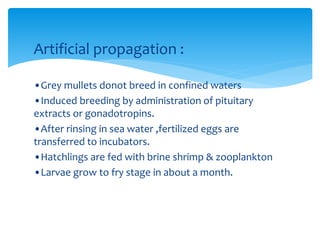
Kingdom: Animalia
Phylum: Chordata
Class: Actinopterygii
Order: Mugiliformes
Family: Mugilidae
Genus: Mugil
Species: M. cephalus
Binomial name : Mugil cephalus
Systematic Position
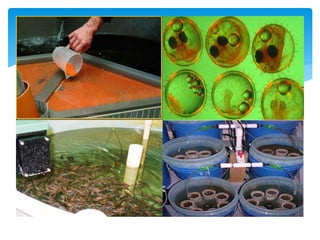
Artificial propagation :
•Grey mullets donot breed in confined waters
•Induced breeding by administration of pituitary
extracts or gonadotropins.
•After rinsing in sea water ,fertilized eggs are
transferred to incubators.
•Hatchlings are fed with brine shrimp & zooplankton
•Larvae grow to fry stage in about a month.
There are two types of culture method of Grey
Mullet
1. Mono culture
2. Poly culture with carp & tilapia
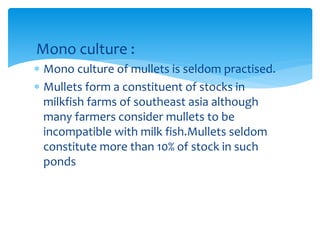
Mono culture :
 Mono culture of mullets is seldom practised.
 Mullets form a constituent of stocks in
milkfish farms of southeast asia although
many farmers consider mullets to be
incompatible with milk fish.Mullets seldom
constitute more than 10% of stock in such
ponds
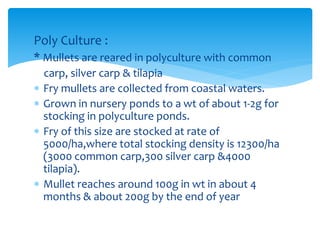
Poly Culture :
* Mullets are reared in polyculture with common
carp, silver carp & tilapia
 Fry mullets are collected from coastal waters.
 Grown in nursery ponds to a wt of about 1-2g for
stocking in polyculture ponds.
 Fry of this size are stocked at rate of
5000/ha,where total stocking density is 12300/ha
(3000 common carp,300 silver carp &4000
tilapia).
 Mullet reaches around 100g in wt in about 4
months & about 200g by the end of year

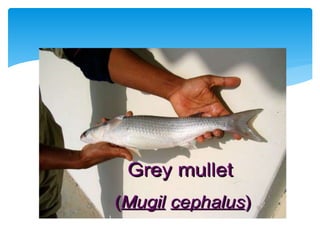
culture method of mullet ( Mugil cephalus )

  • 1.
    A Presentation on CultureMethod of Mullet
  • 2.
     Introduction : Aquacultural potentials for mullet is greater than those for species. It’s hardly and respond well to management in confined environments. The mullet tolerates colder temperatures. It’s has excellent consumer acceptance in the areas where cultured. It’s herbivorous, feeding primarily on benthic and planktonic organisms that can be cheaply produced.
  • 4.
    Kingdom: Animalia Phylum: Chordata Class:Actinopterygii Order: Mugiliformes Family: Mugilidae Genus: Mugil Species: M. cephalus Binomial name : Mugil cephalus Systematic Position
  • 5.
    Artificial propagation : •Greymullets donot breed in confined waters •Induced breeding by administration of pituitary extracts or gonadotropins. •After rinsing in sea water ,fertilized eggs are transferred to incubators. •Hatchlings are fed with brine shrimp & zooplankton •Larvae grow to fry stage in about a month.
  • 7.
    There are twotypes of culture method of Grey Mullet 1. Mono culture 2. Poly culture with carp & tilapia
  • 8.
    Mono culture : Mono culture of mullets is seldom practised.  Mullets form a constituent of stocks in milkfish farms of southeast asia although many farmers consider mullets to be incompatible with milk fish.Mullets seldom constitute more than 10% of stock in such ponds
  • 9.
    Poly Culture : *Mullets are reared in polyculture with common carp, silver carp & tilapia  Fry mullets are collected from coastal waters.  Grown in nursery ponds to a wt of about 1-2g for stocking in polyculture ponds.  Fry of this size are stocked at rate of 5000/ha,where total stocking density is 12300/ha (3000 common carp,300 silver carp &4000 tilapia).  Mullet reaches around 100g in wt in about 4 months & about 200g by the end of year