

ADVANCED MARICULTURE
Mullet Fish Farming
Magoti Ernest Ndaro
Dept. Of Animal, Aquaculture and Range
Science
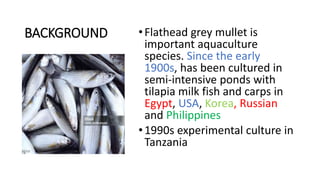
BACKGROUND •Flathead grey mullet is
important aquaculture
species. Since the early
1900s, has been cultured in
semi-intensive ponds with
tilapia milk fish and carps in
Egypt, USA, Korea, Russian
and Philippines
•1990s experimental culture in
Tanzania
Habitat and
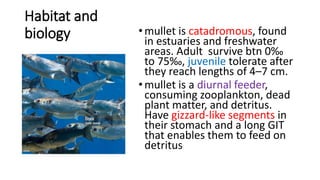
biology • mullet is catadromous, found
in estuaries and freshwater
areas. Adult survive btn 0‰
to 75‰, juvenile tolerate after
they reach lengths of 4–7 cm.
• mullet is a diurnal feeder,
consuming zooplankton, dead
plant matter, and detritus.
Have gizzard-like segments in
their stomach and a long GIT
that enables them to feed on
detritus..
GLOBAL PRODUCTION TREND OF MULLET FISH
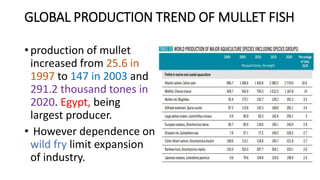
• production of mullet
increased from 25.6 in
1997 to 147 in 2003 and
291.2 thousand tones in
2020. Egypt, being
largest producer.
• However dependence on
wild fry limit expansion
of industry.
TREND OF MULLET FISH PRODUCTION IN
TANZANIA
• In 1990s WIOMSA funded a project for EIM of finfish,
shellfish and seaweeds including milkfish, rabbit fish, mullet
and Zanzibar tilapia
• After the workshop, pond finfish culture spread to Tanzania
coastal. In 2006, farm at Bagamoyo produced 1 MT/ha/yr,
earning 2000 USD and the highest production of 7.5
MT/ha/yr at Ndumbwe Mtwara in 2011.
• However, mullet farming has not taken off on a commercial
scale by private operators.
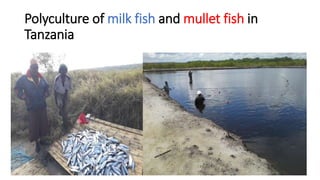
Polyculture of milk fish and mullet fish in
Tanzania
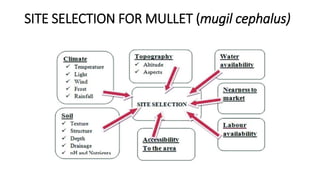
SITE SELECTION FOR MULLET (mugil cephalus)
SOURCE OF SEEDS FOR MULLET FISH
wild source
• During the autumn and winter adults migrate to the sea to
spawn. Fecundity is 0.5–2.0 million/female
• Hatching take 48 hours after fertilization, releasing larvae
approximately 2.4 mm long.
• When the larvae are 16–20 mm, they migrate to inshore
waters and estuaries, where they can be collected for
aquacultural purposes during late August to early
December.
CONT.…
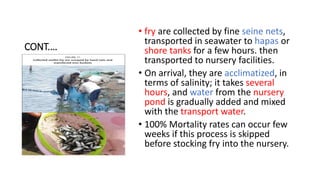
• fry are collected by fine seine nets,
transported in seawater to hapas or
shore tanks for a few hours. then
transported to nursery facilities.
• On arrival, they are acclimatized, in
terms of salinity; it takes several
hours, and water from the nursery
pond is gradually added and mixed
with the transport water.
• 100% Mortality rates can occur few
weeks if this process is skipped
before stocking fry into the nursery.
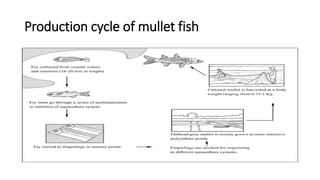
Production cycle of mullet fish
HATCHERY PRODUCTION
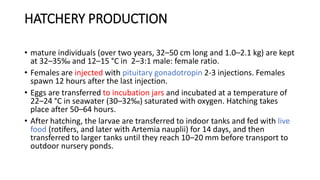
• mature individuals (over two years, 32–50 cm long and 1.0–2.1 kg) are kept
at 32–35‰ and 12–15 °C in 2–3:1 male: female ratio.
• Females are injected with pituitary gonadotropin 2-3 injections. Females
spawn 12 hours after the last injection.
• Eggs are transferred to incubation jars and incubated at a temperature of
22–24 °C in seawater (30–32‰) saturated with oxygen. Hatching takes
place after 50–64 hours.
• After hatching, the larvae are transferred to indoor tanks and fed with live
food (rotifers, and later with Artemia nauplii) for 14 days, and then
transferred to larger tanks until they reach 10–20 mm before transport to
outdoor nursery ponds.
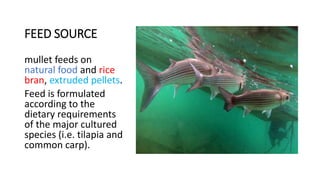
FEED SOURCE
mullet feeds on
natural food and rice
bran, extruded pellets.
Feed is formulated
according to the
dietary requirements
of the major cultured
species (i.e. tilapia and
common carp).
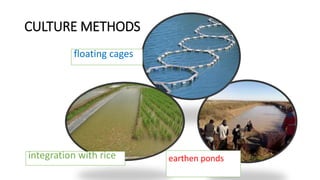
CULTURE METHODS
earthen ponds
floating cages
integration with rice
HARVESTING
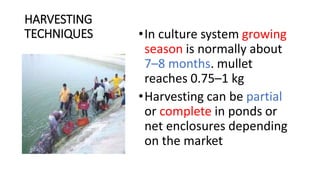
TECHNIQUES •In culture system growing
season is normally about
7–8 months. mullet
reaches 0.75–1 kg
•Harvesting can be partial
or complete in ponds or
net enclosures depending
on the market
Challenges
•depends largely on
collection of wild
fries
•limited export
potential
Potential for mullet culture
Tanzania
•Adaptability
•Feeding habits
•Demand
CONCLUSION
For future expansion of flathead grey mullet
farming in Tanzania education and training
campaign is required to raise awareness among
people living in costal areas.
~ thank you ~

mullet fish farming PPT.pptx

  • 1.
    ADVANCED MARICULTURE Mullet FishFarming Magoti Ernest Ndaro Dept. Of Animal, Aquaculture and Range Science
  • 2.
    BACKGROUND •Flathead greymullet is important aquaculture species. Since the early 1900s, has been cultured in semi-intensive ponds with tilapia milk fish and carps in Egypt, USA, Korea, Russian and Philippines •1990s experimental culture in Tanzania
  • 3.
    Habitat and biology •mullet is catadromous, found in estuaries and freshwater areas. Adult survive btn 0‰ to 75‰, juvenile tolerate after they reach lengths of 4–7 cm. • mullet is a diurnal feeder, consuming zooplankton, dead plant matter, and detritus. Have gizzard-like segments in their stomach and a long GIT that enables them to feed on detritus..
  • 4.
    GLOBAL PRODUCTION TRENDOF MULLET FISH • production of mullet increased from 25.6 in 1997 to 147 in 2003 and 291.2 thousand tones in 2020. Egypt, being largest producer. • However dependence on wild fry limit expansion of industry.
  • 5.
    TREND OF MULLETFISH PRODUCTION IN TANZANIA • In 1990s WIOMSA funded a project for EIM of finfish, shellfish and seaweeds including milkfish, rabbit fish, mullet and Zanzibar tilapia • After the workshop, pond finfish culture spread to Tanzania coastal. In 2006, farm at Bagamoyo produced 1 MT/ha/yr, earning 2000 USD and the highest production of 7.5 MT/ha/yr at Ndumbwe Mtwara in 2011. • However, mullet farming has not taken off on a commercial scale by private operators.
  • 6.
    Polyculture of milkfish and mullet fish in Tanzania
  • 7.
    SITE SELECTION FORMULLET (mugil cephalus)
  • 8.
    SOURCE OF SEEDSFOR MULLET FISH wild source • During the autumn and winter adults migrate to the sea to spawn. Fecundity is 0.5–2.0 million/female • Hatching take 48 hours after fertilization, releasing larvae approximately 2.4 mm long. • When the larvae are 16–20 mm, they migrate to inshore waters and estuaries, where they can be collected for aquacultural purposes during late August to early December.
  • 9.
    CONT.… • fry arecollected by fine seine nets, transported in seawater to hapas or shore tanks for a few hours. then transported to nursery facilities. • On arrival, they are acclimatized, in terms of salinity; it takes several hours, and water from the nursery pond is gradually added and mixed with the transport water. • 100% Mortality rates can occur few weeks if this process is skipped before stocking fry into the nursery.
  • 10.
  • 11.
    HATCHERY PRODUCTION • matureindividuals (over two years, 32–50 cm long and 1.0–2.1 kg) are kept at 32–35‰ and 12–15 °C in 2–3:1 male: female ratio. • Females are injected with pituitary gonadotropin 2-3 injections. Females spawn 12 hours after the last injection. • Eggs are transferred to incubation jars and incubated at a temperature of 22–24 °C in seawater (30–32‰) saturated with oxygen. Hatching takes place after 50–64 hours. • After hatching, the larvae are transferred to indoor tanks and fed with live food (rotifers, and later with Artemia nauplii) for 14 days, and then transferred to larger tanks until they reach 10–20 mm before transport to outdoor nursery ponds.
  • 12.
    FEED SOURCE mullet feedson natural food and rice bran, extruded pellets. Feed is formulated according to the dietary requirements of the major cultured species (i.e. tilapia and common carp).
  • 13.
    CULTURE METHODS earthen ponds floatingcages integration with rice
  • 14.
    HARVESTING TECHNIQUES •In culturesystem growing season is normally about 7–8 months. mullet reaches 0.75–1 kg •Harvesting can be partial or complete in ponds or net enclosures depending on the market
  • 15.
    Challenges •depends largely on collectionof wild fries •limited export potential Potential for mullet culture Tanzania •Adaptability •Feeding habits •Demand
  • 16.
    CONCLUSION For future expansionof flathead grey mullet farming in Tanzania education and training campaign is required to raise awareness among people living in costal areas. ~ thank you ~