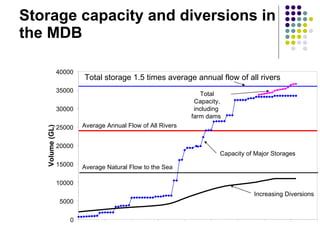
Storage capacity and diversions in the MDB 0 5000 10000 15000 20000 25000 30000 35000 40000 1920 1930 1940 1950 1960 1970 1980 1990 2000 2010 Volume (GL) Capacity of Major Storages Total Capacity, including  farm dams  Average Annual Flow of All Rivers Average Natural Flow to the Sea Increasing Diversions Total storage 1.5 times average annual flow of all rivers
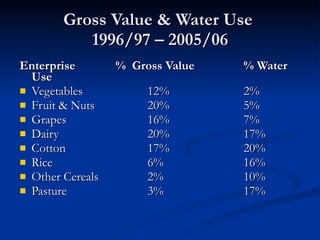
Gross Value & Water Use  1996/97 – 2005/06 Enterprise %  Gross Value % Water Use Vegetables 12% 2% Fruit & Nuts 20% 5% Grapes 16% 7% Dairy 20% 17% Cotton 17% 20% Rice 6% 16% Other Cereals 2% 10% Pasture 3% 17%
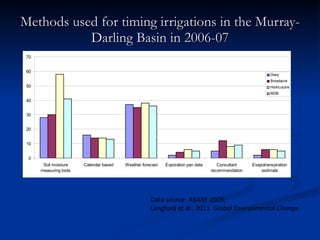
Methods used for timing irrigations in the Murray-Darling Basin in 2006-07 Data source: ABARE 2009; Langford et al., 2011.  Global Environmental Change
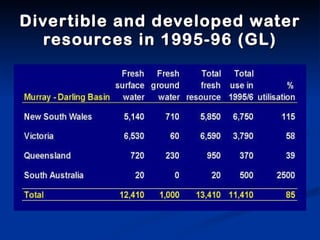
Divertible and developed water resources in 1995-96 (GL)
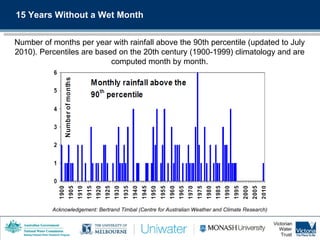
15 Years Without a Wet Month Number of months per year with rainfall above the 90th percentile (updated to July 2010). Percentiles are based on the 20th century (1900-1999) climatology and are computed month by month. Acknowledgement: Bertrand Timbal (Centre for Australian Weather and Climate Research)
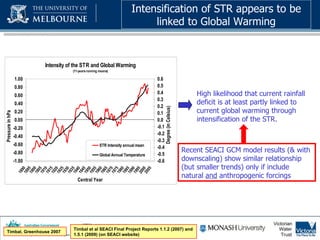
Timbal, Greenhouse 2007 Intensification of STR appears to be linked to Global Warming High likelihood that current rainfall deficit is at least partly linked to current global warming through intensification of the STR. Timbal et al SEACI Final Project Reports 1.1.2 (2007) and 1.5.1 (2009) (on SEACI website) Recent SEACI GCM model results (& with downscaling) show similar relationship (but smaller trends) only if include natural  and  anthropogenic forcings
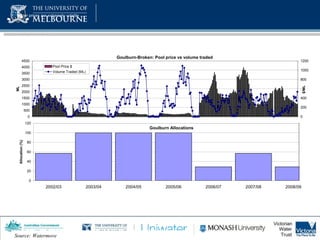
Water prices are extremely volatile … Source: Watermove
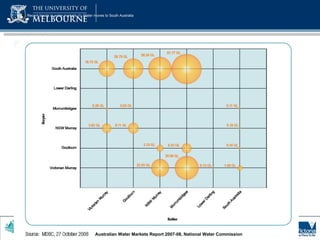
Recent trends in water markets (I): Water moves to South Australia Very little entitlement trade – all allocation … give statistic Australian Water Markets Report 2007-08, National Water Commission
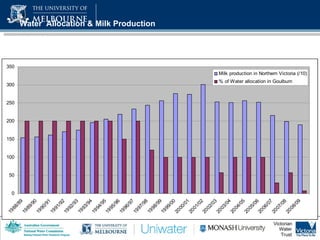
Water  Allocation & Milk Production
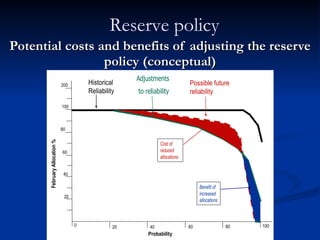
Potential costs and benefits of adjusting the reserve policy (conceptual) Reserve policy
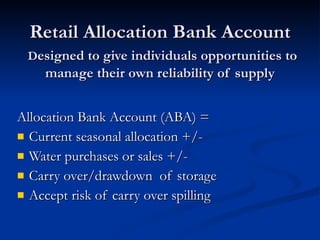
Retail Allocation Bank Account   D esigned to give individuals opportunities to manage their own reliability of supply Allocation Bank Account (ABA) = Current seasonal allocation +/- Water purchases or sales +/- Carry over/drawdown  of storage Accept risk of carry over spilling
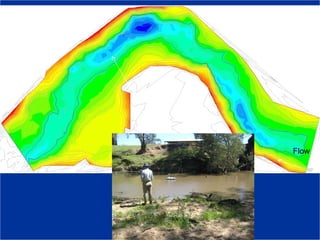
Flow
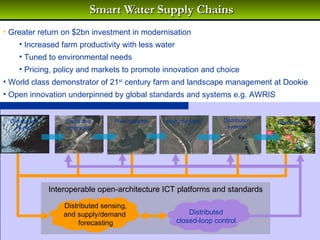
Smart Water Supply Chains Greater return on $2bn investment in modernisation Increased farm productivity with less water Tuned to environmental needs Pricing, policy and markets to promote innovation and choice World class demonstrator of 21 st  century farm and landscape management at Dookie Open innovation underpinned by global standards and systems e.g. AWRIS Interoperable open-architecture ICT platforms and standards Dams and reservoirs River systems Main channels Distribution systems On-farm Distributed sensing, and supply/demand  forecasting Distributed closed-loop control Climate and Runoff
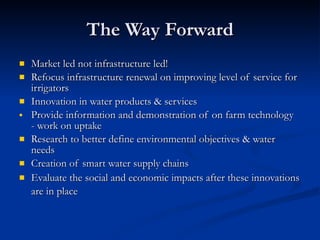
The Way Forward Market led not infrastructure led! Refocus infrastructure renewal on improving level of service for irrigators Innovation in water products & services Provide information and demonstration of on farm technology  - work on uptake Research to better define environmental objectives & water needs Creation of smart water supply chains Evaluate the social and economic impacts after these innovations are in place

Water theme plenary - John Langford

  • 1.
  • 2.
    Storage capacity anddiversions in the MDB 0 5000 10000 15000 20000 25000 30000 35000 40000 1920 1930 1940 1950 1960 1970 1980 1990 2000 2010 Volume (GL) Capacity of Major Storages Total Capacity, including farm dams Average Annual Flow of All Rivers Average Natural Flow to the Sea Increasing Diversions Total storage 1.5 times average annual flow of all rivers
  • 3.
    Gross Value &Water Use 1996/97 – 2005/06 Enterprise % Gross Value % Water Use Vegetables 12% 2% Fruit & Nuts 20% 5% Grapes 16% 7% Dairy 20% 17% Cotton 17% 20% Rice 6% 16% Other Cereals 2% 10% Pasture 3% 17%
  • 4.
    Methods used fortiming irrigations in the Murray-Darling Basin in 2006-07 Data source: ABARE 2009; Langford et al., 2011. Global Environmental Change
  • 5.
    Divertible and developedwater resources in 1995-96 (GL)
  • 6.
    15 Years Withouta Wet Month Number of months per year with rainfall above the 90th percentile (updated to July 2010). Percentiles are based on the 20th century (1900-1999) climatology and are computed month by month. Acknowledgement: Bertrand Timbal (Centre for Australian Weather and Climate Research)
  • 7.
    Timbal, Greenhouse 2007Intensification of STR appears to be linked to Global Warming High likelihood that current rainfall deficit is at least partly linked to current global warming through intensification of the STR. Timbal et al SEACI Final Project Reports 1.1.2 (2007) and 1.5.1 (2009) (on SEACI website) Recent SEACI GCM model results (& with downscaling) show similar relationship (but smaller trends) only if include natural and anthropogenic forcings
  • 8.
    Water prices areextremely volatile … Source: Watermove
  • 9.
    Recent trends inwater markets (I): Water moves to South Australia Very little entitlement trade – all allocation … give statistic Australian Water Markets Report 2007-08, National Water Commission
  • 10.
    Water Allocation& Milk Production
  • 11.
    Potential costs andbenefits of adjusting the reserve policy (conceptual) Reserve policy
  • 12.
    Retail Allocation BankAccount D esigned to give individuals opportunities to manage their own reliability of supply Allocation Bank Account (ABA) = Current seasonal allocation +/- Water purchases or sales +/- Carry over/drawdown of storage Accept risk of carry over spilling
  • 13.
  • 14.
    Smart Water SupplyChains Greater return on $2bn investment in modernisation Increased farm productivity with less water Tuned to environmental needs Pricing, policy and markets to promote innovation and choice World class demonstrator of 21 st century farm and landscape management at Dookie Open innovation underpinned by global standards and systems e.g. AWRIS Interoperable open-architecture ICT platforms and standards Dams and reservoirs River systems Main channels Distribution systems On-farm Distributed sensing, and supply/demand forecasting Distributed closed-loop control Climate and Runoff
  • 15.
    The Way ForwardMarket led not infrastructure led! Refocus infrastructure renewal on improving level of service for irrigators Innovation in water products & services Provide information and demonstration of on farm technology - work on uptake Research to better define environmental objectives & water needs Creation of smart water supply chains Evaluate the social and economic impacts after these innovations are in place

Editor's Notes

  • #3 Storage capacity 50% more than the average annual run-off of all rivers. Key Messages – storage capacity 50% greater than the average flow of all rivers – carryover storages essential to deal with climate variability
  • #12 ADD AFTER: The proposals – reserve policy (pg 76) Benefits: Allocations earlier in the season Less risk of zero allocation years Supports fully functioning water market Costs: Slightly fewer years with full allocations Slightly reduced yield