








2
Chapter 4
Chapter 4 1.4 Double Envelopes
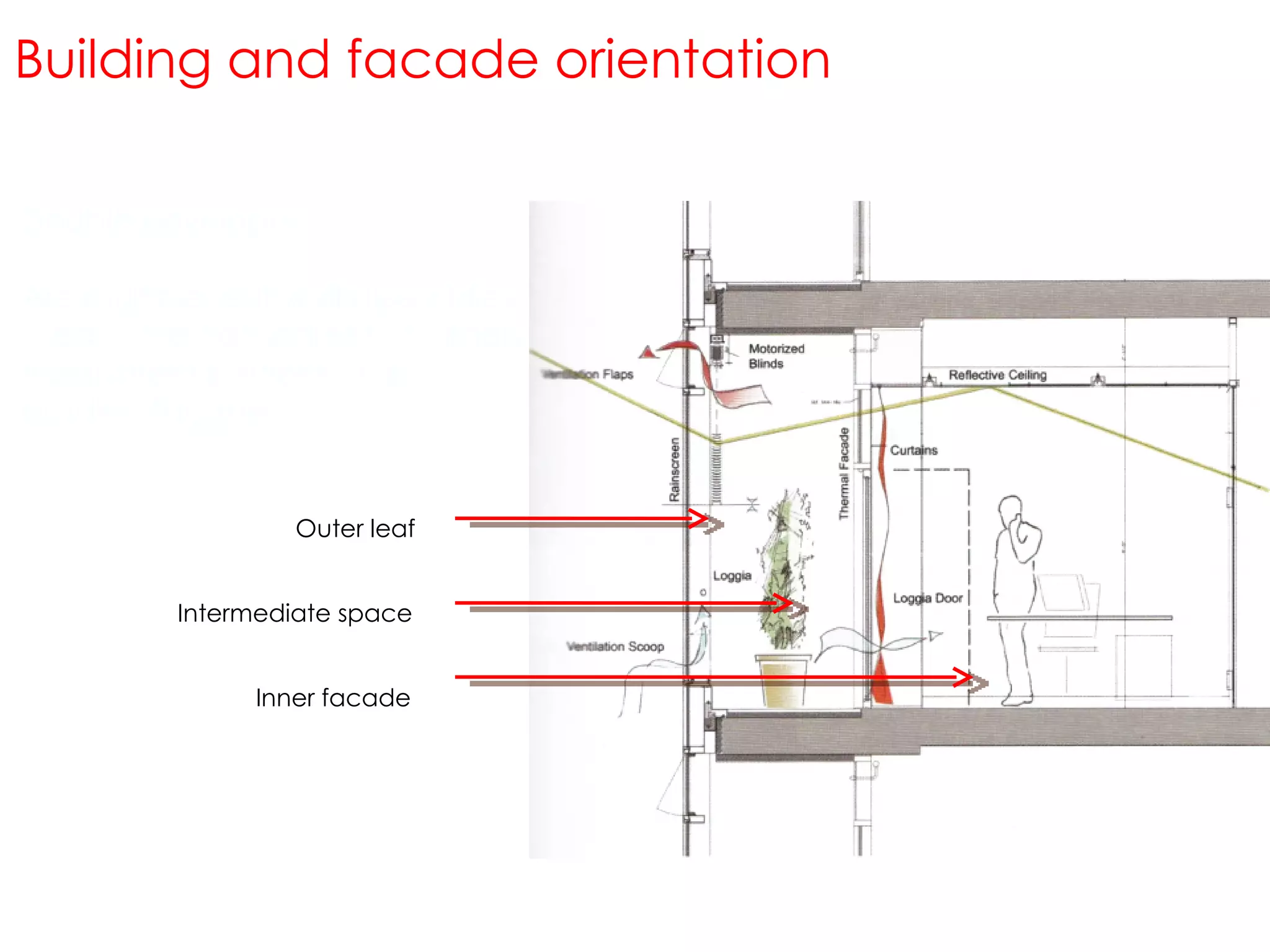
Building and facade orientation Double envelopes: Are multiple leaf wall assemblies  used in the transparent or largely transparent portions of a building façade  Outer leaf  Intermediate space  Inner facade
Design Intent Maximize daylighting while controlling solar gain Reducing the need for mechanical cooling Increase the use of natural ventilation Increase acoustic isolation, especially in urban areas.
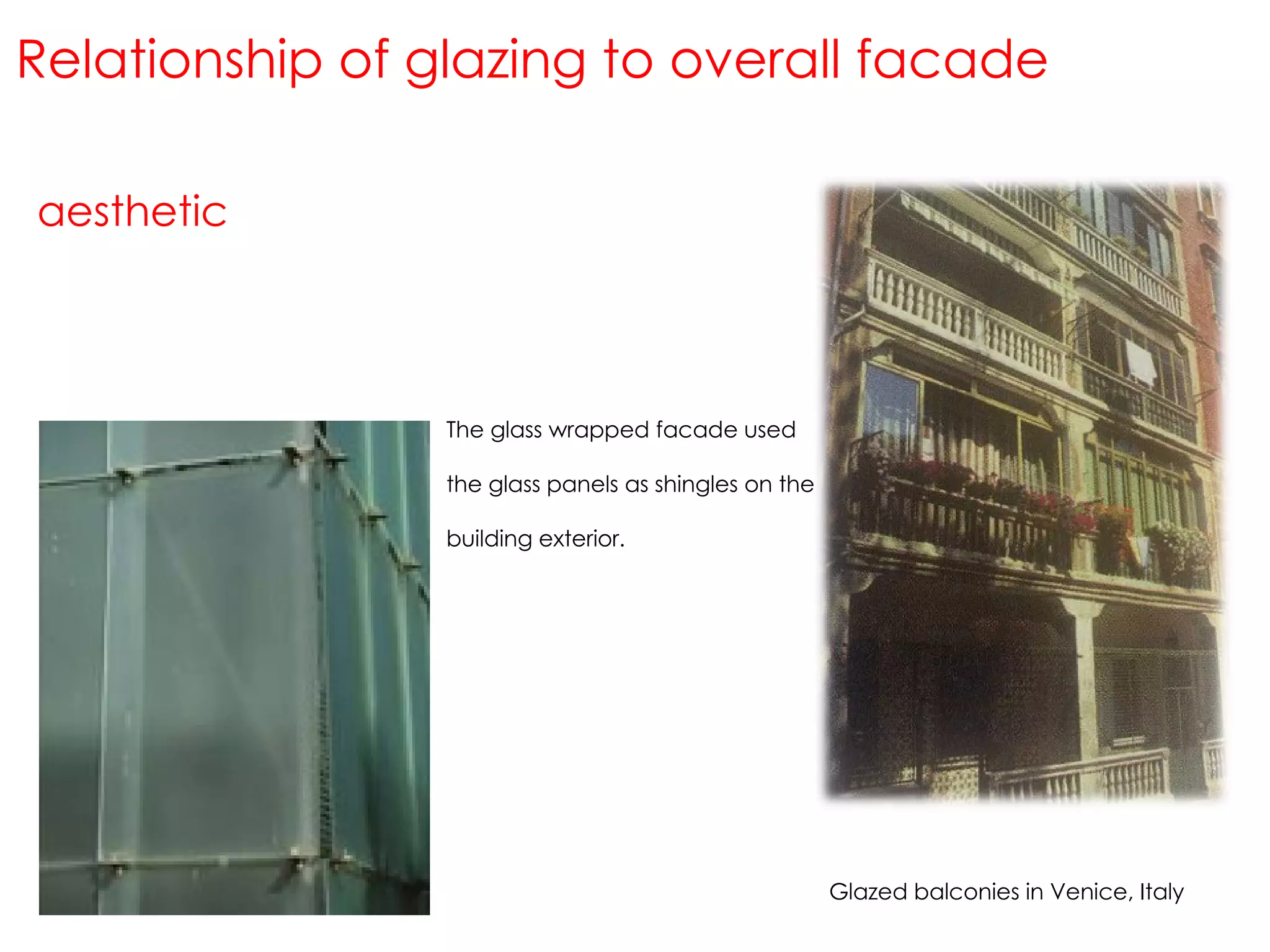
aesthetic Relationship of glazing to overall facade The glass wrapped facade used the glass panels as shingles on the building exterior.  Glazed balconies in Venice, Italy
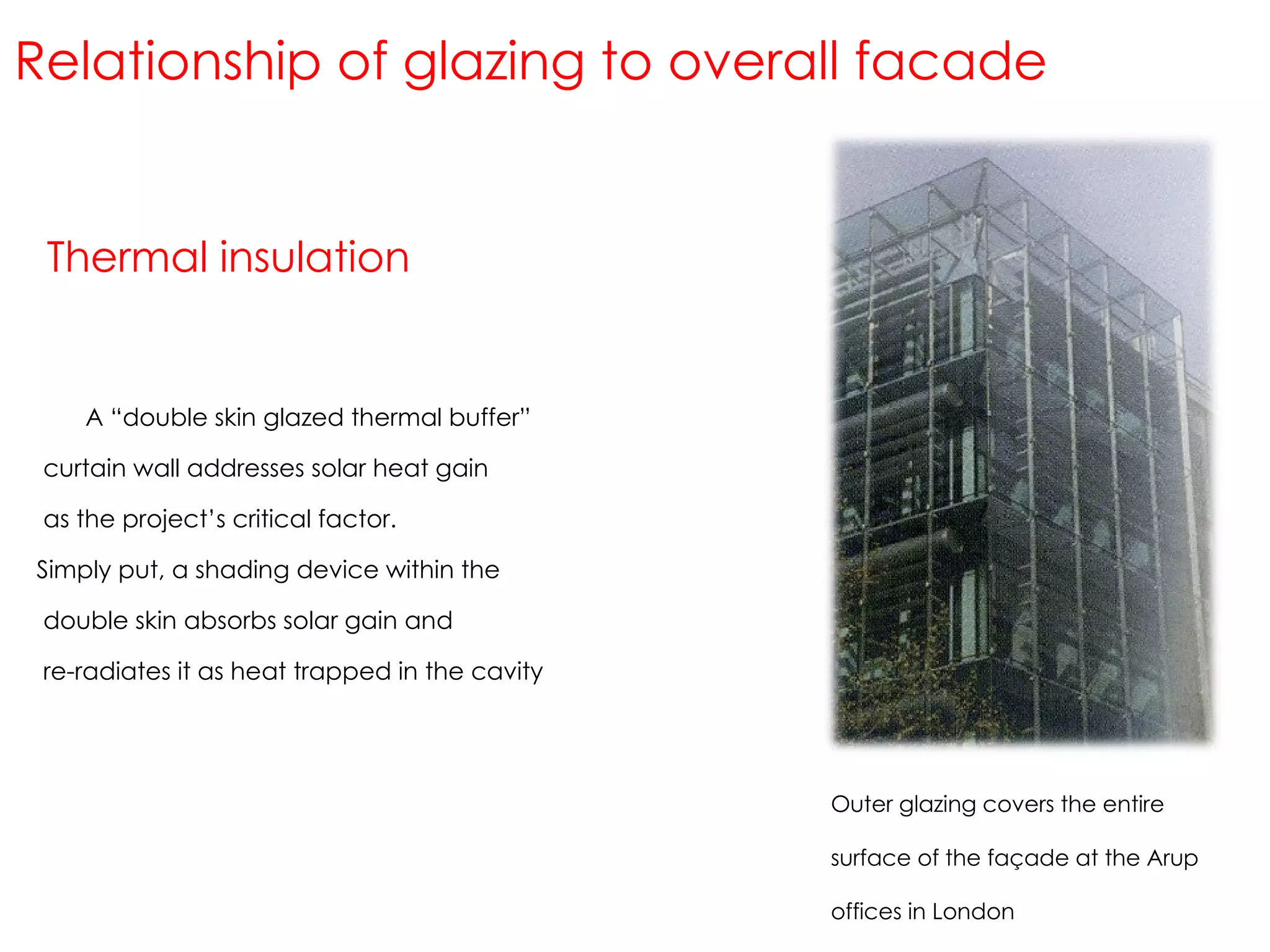
Thermal insulation Relationship of glazing to overall facade Outer glazing covers the entire surface of the façade at the Arup offices in London A “double skin glazed thermal buffer” curtain wall addresses solar heat gain as the project’s critical factor. Simply put, a shading device within the double skin absorbs solar gain and re-radiates it as heat trapped in the cavity
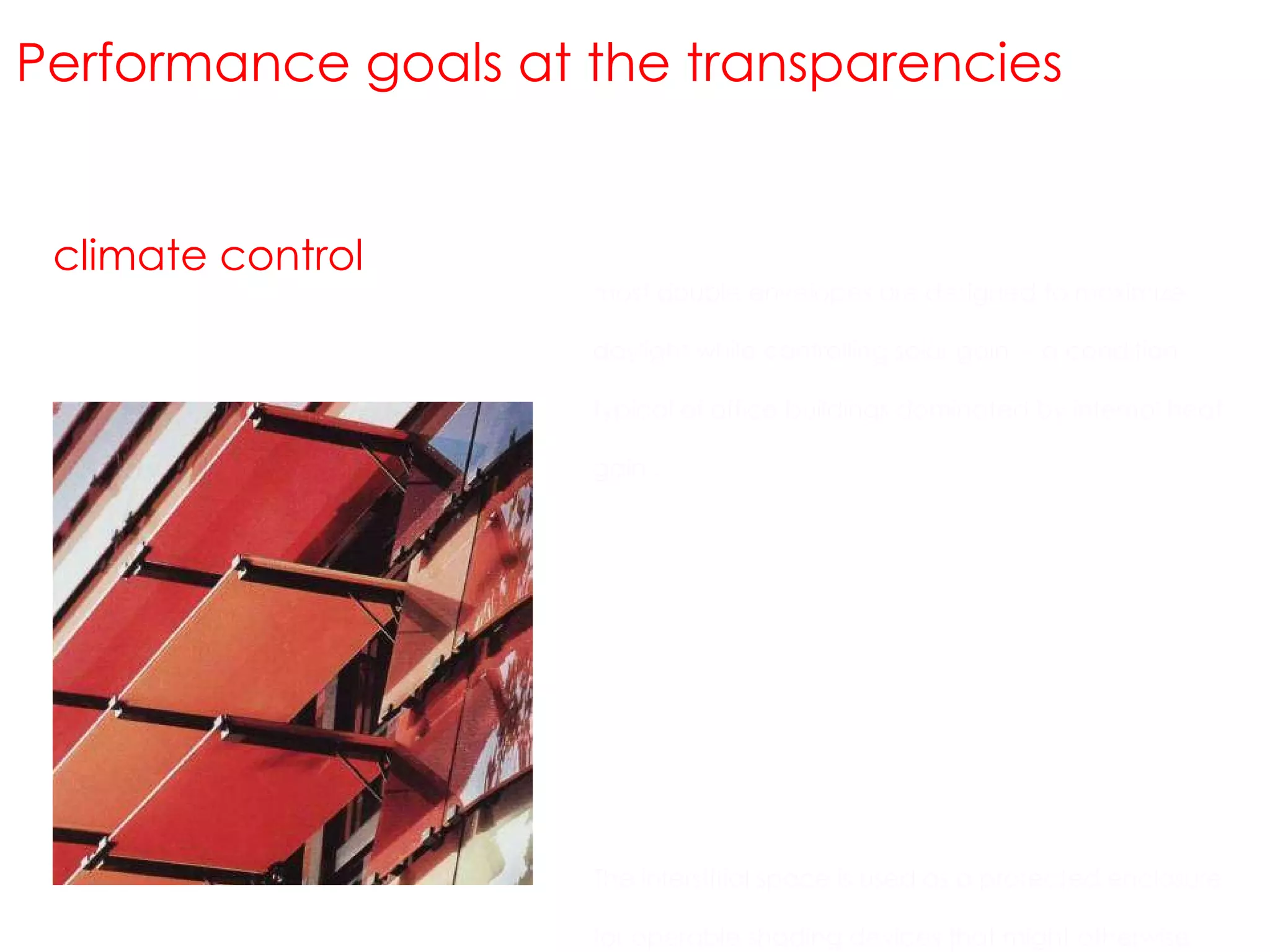
climate control Performance goals at the transparencies most double envelopes are designed to maximize daylight while controlling solar gain –  a condition typical of office buildings dominated by internal heat gain . The interstitial space is used as a protected enclosure for operable shading devices that might otherwise suffer from wind damage and weather exposure.
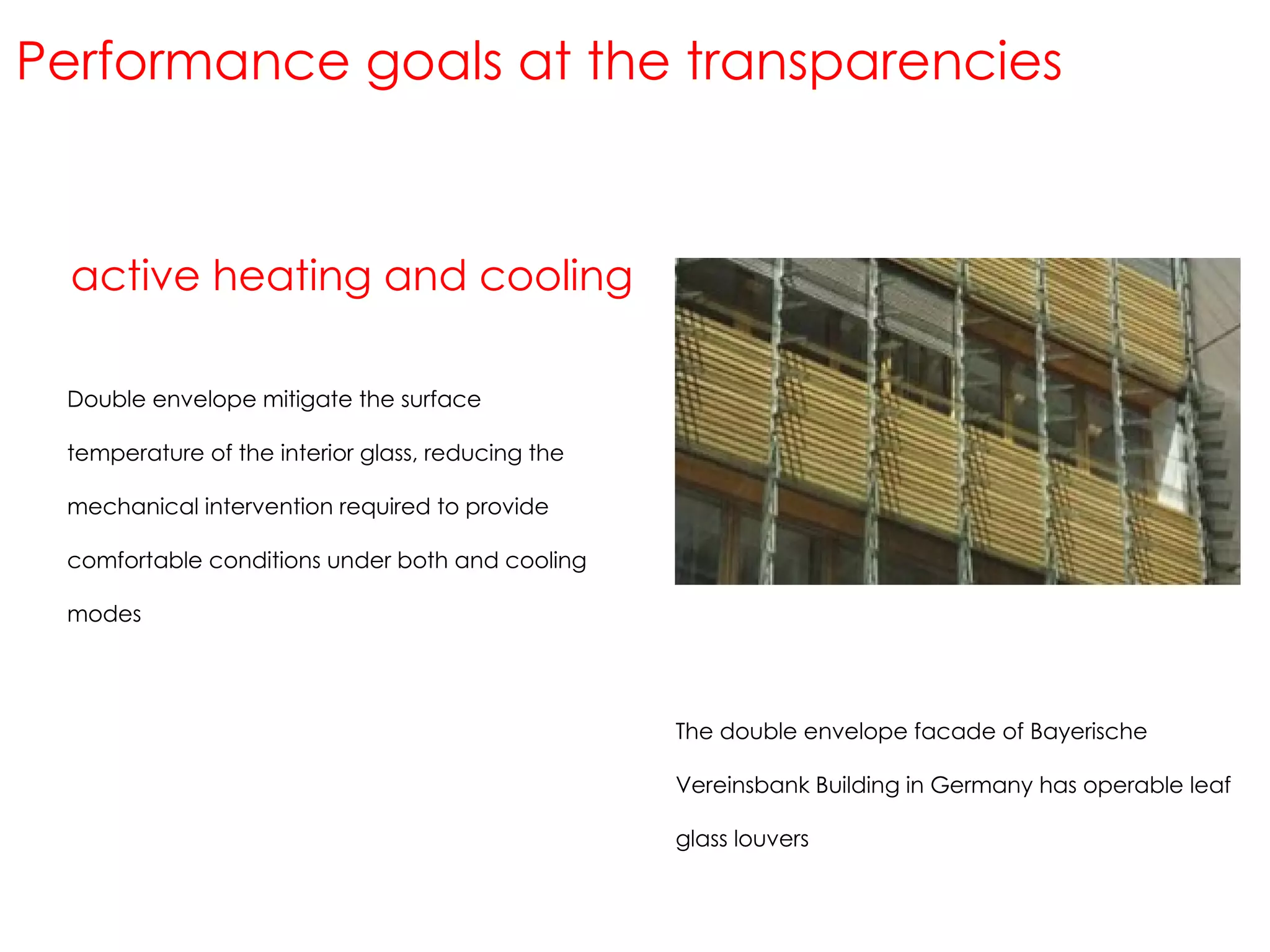
active heating and cooling Performance goals at the transparencies Double envelope mitigate the surface temperature of the interior glass, reducing the mechanical intervention required to provide comfortable conditions under both and cooling modes  The double envelope facade of Bayerische Vereinsbank Building in Germany has operable leaf glass louvers
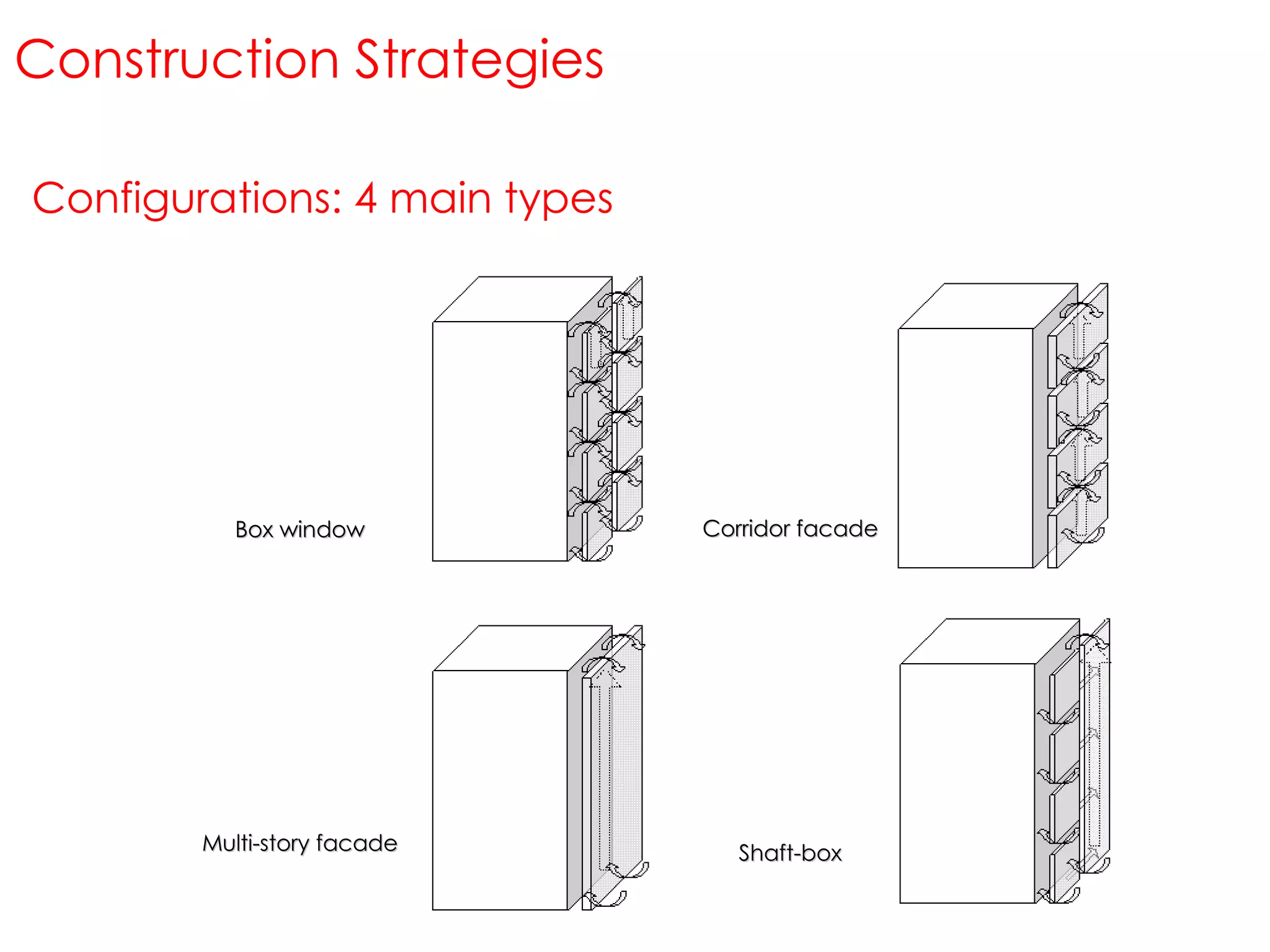
Configurations: 4 main types Construction Strategies Box window Corridor facade Multi-story facade Shaft-box
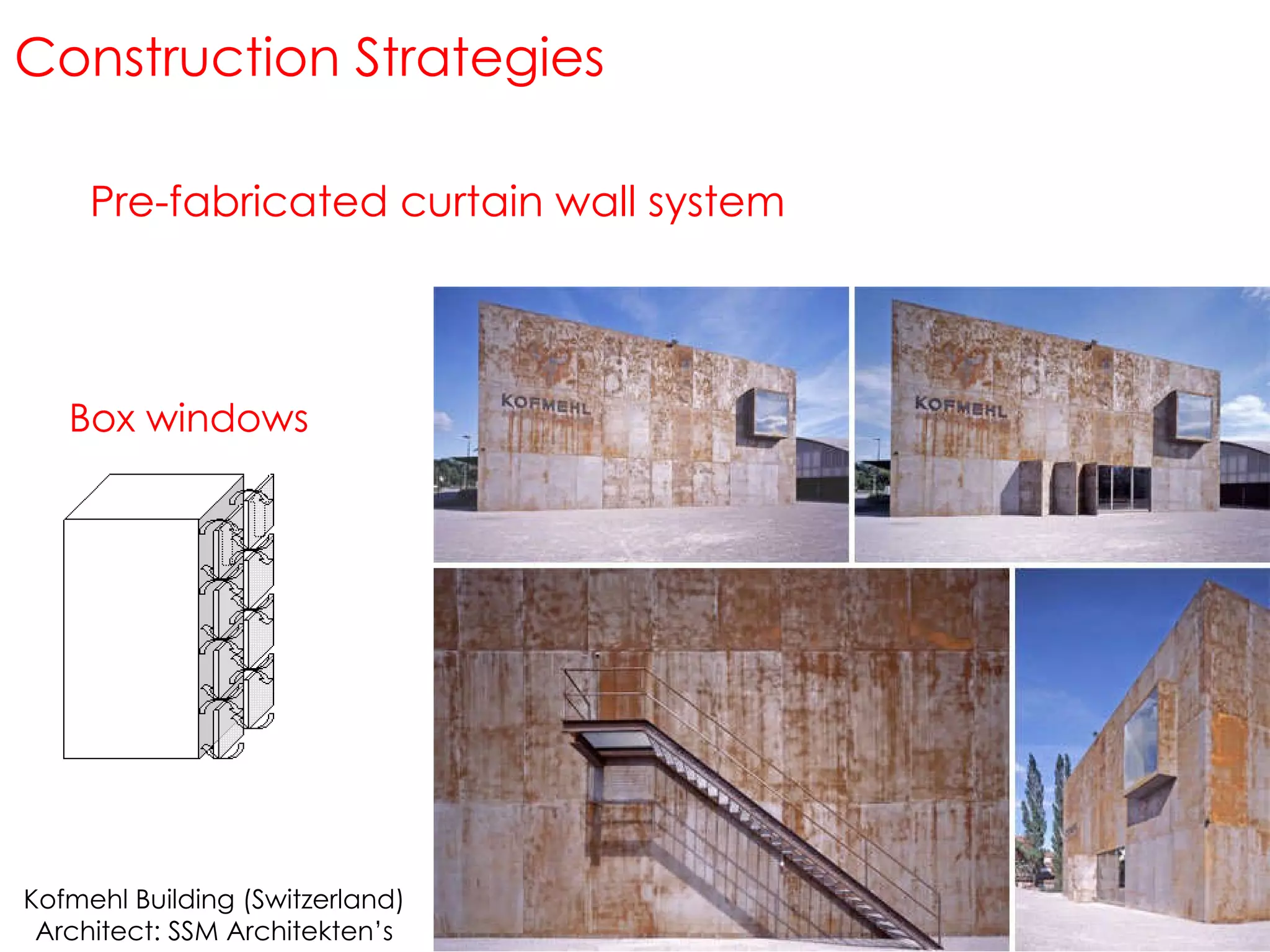
Box windows Pre-fabricated curtain wall system Construction Strategies Kofmehl Building (Switzerland) Architect: SSM Architekten’s
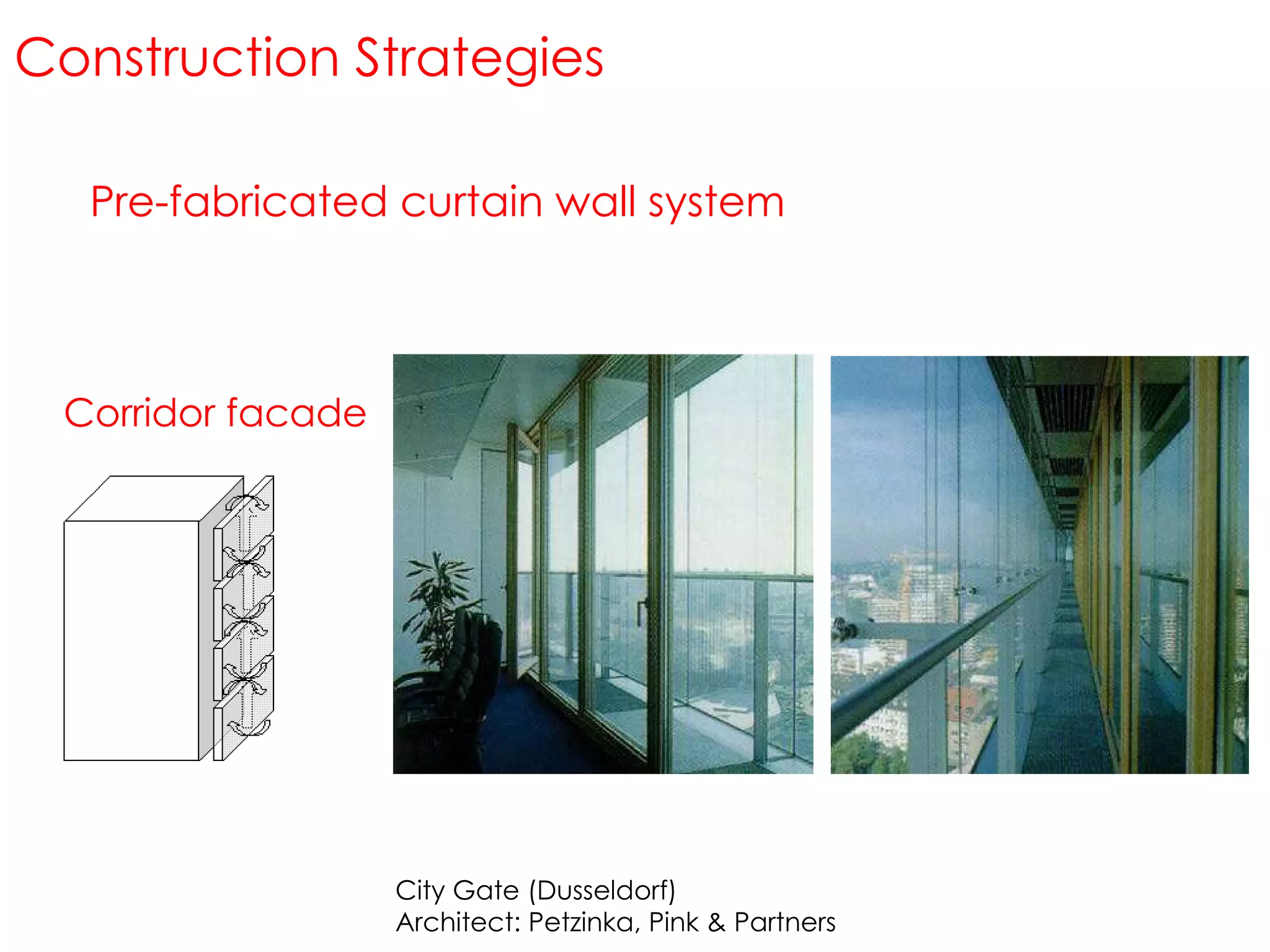
Corridor facade Construction Strategies City Gate (Dusseldorf) Architect: Petzinka, Pink & Partners Pre-fabricated curtain wall system
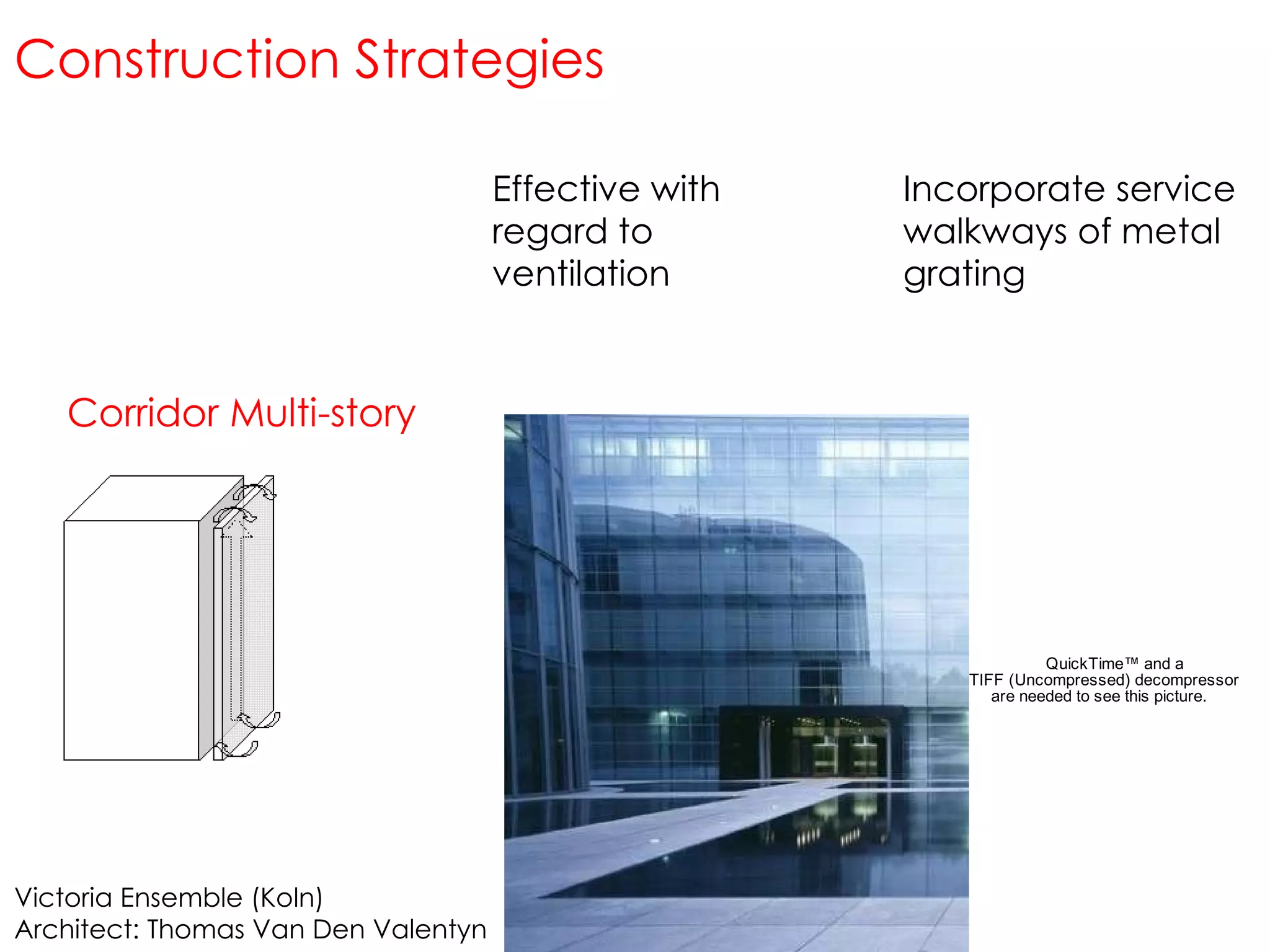
Effective with regard to ventilation Incorporate service walkways of metal grating Construction Strategies Corridor Multi-story Victoria Ensemble (Koln) Architect: Thomas Van Den Valentyn
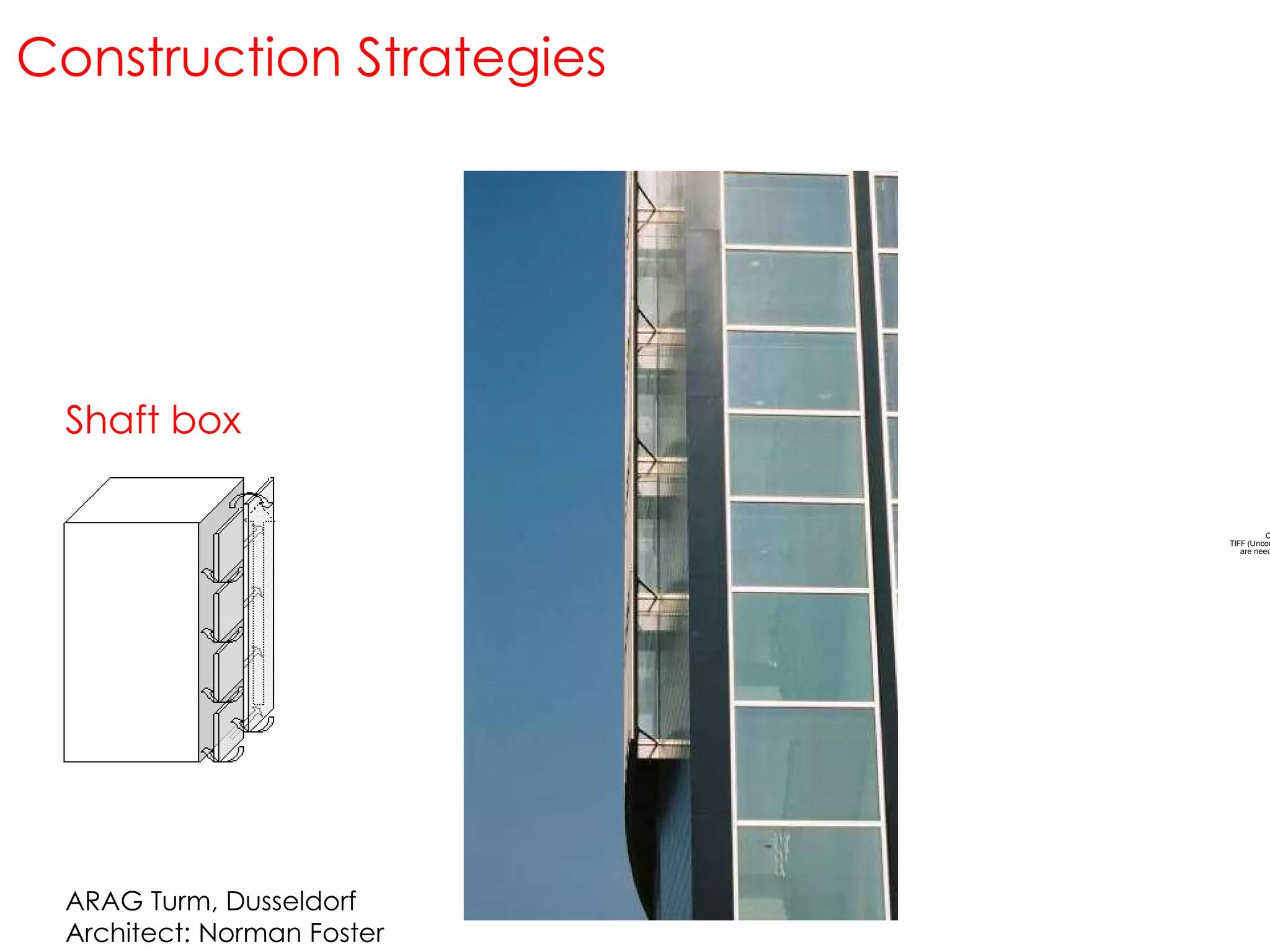
Shaft box Construction Strategies ARAG Turm, Dusseldorf Architect: Norman Foster
LEED Rating Energy and Atmosphere (35 points) Fundamental Commissioning of Building Energy Systems Minimum Energy Performance Fundamental Refrigerant Management Indoor Environmental Quality (15 points) Minimum Indoor Air Quality Performance Environmental Tobacco Smoke (ETS) Control Innovation and Design Process (6 points) Construction Strategies
Utilization Maintenance Requirements Efficiency of the façade can only be assessed in the context of the climate conditions of the site Each double façade must be tailored to the occupant’s function
Europe: Operable inner glazing leaf Control over outdoor air in the workspace North America: Interior hinge plate glass “ exhaust window” Maintenance Requirements
Factors to consider include: Facade cost Floor space available Compatible structural system Total building energy flows Size and complexity of mechanical plant Cost of long-term maintenance Double envelopes should be considered along with another strategy Considerations
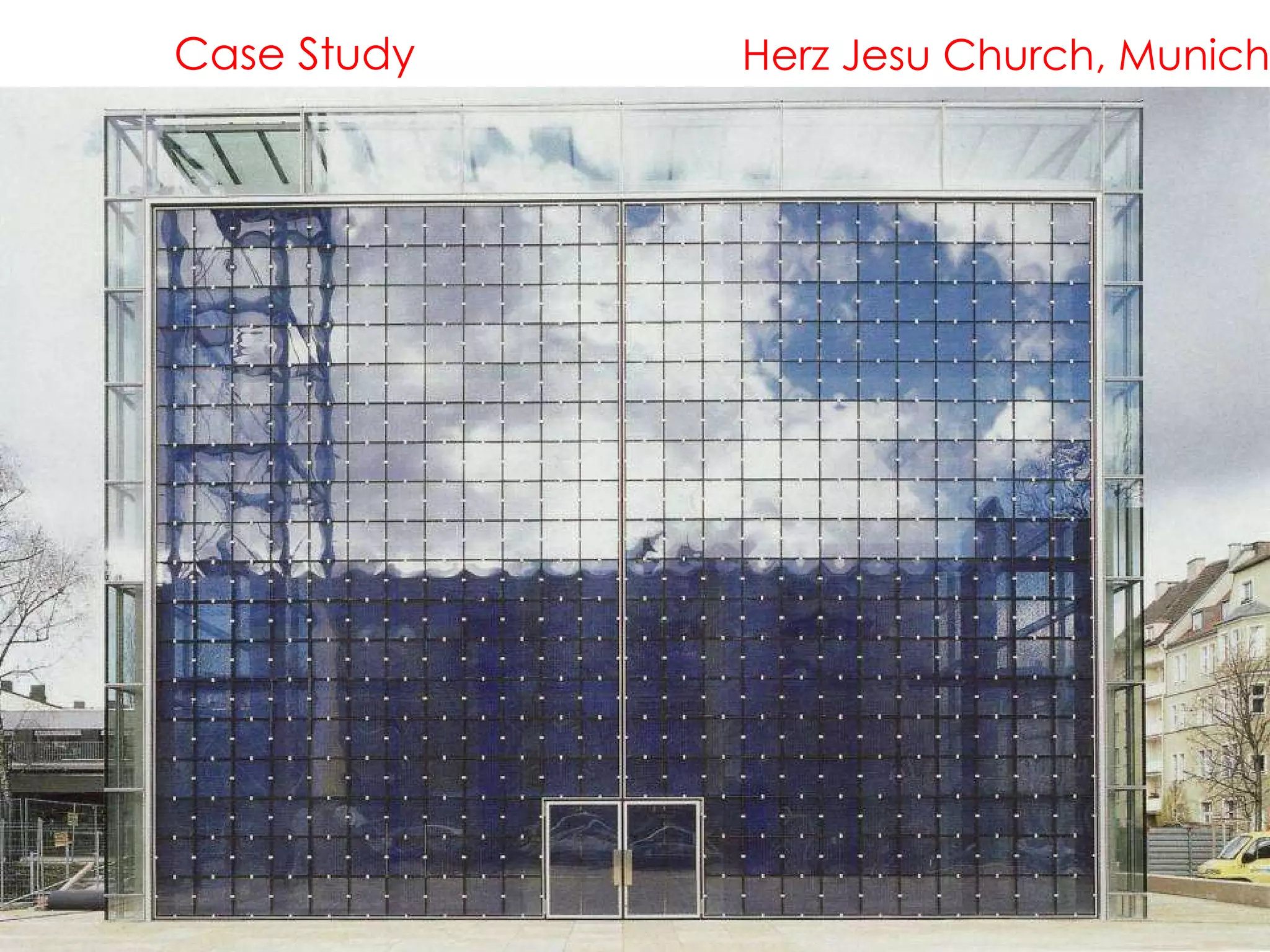
Case Study Herz Jesu Church, Munich
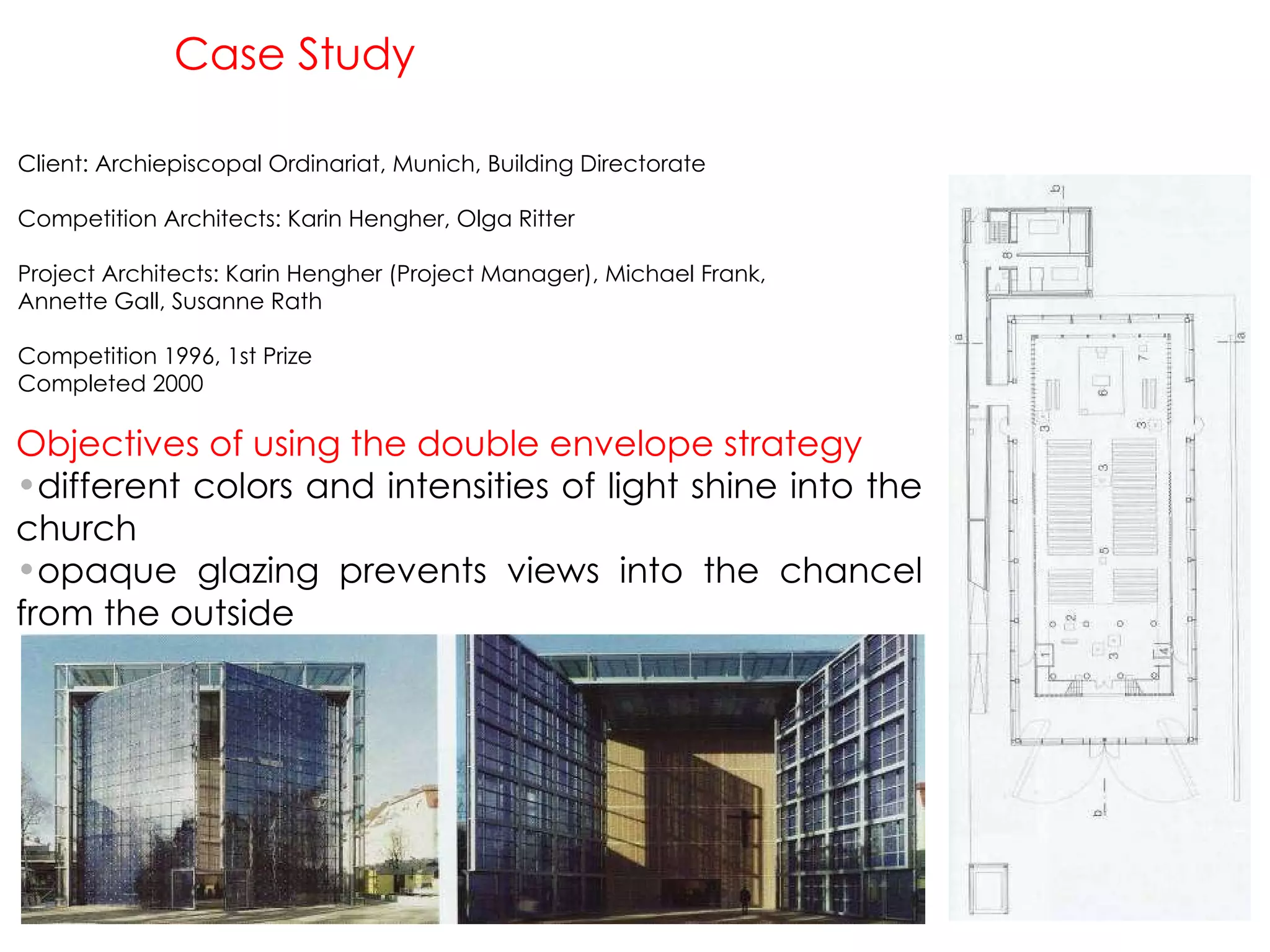
Case Study Client: Archiepiscopal Ordinariat, Munich, Building Directorate Competition Architects: Karin Hengher, Olga Ritter Project Architects: Karin Hengher (Project Manager), Michael Frank, Annette Gall, Susanne Rath Competition 1996, 1st Prize Completed 2000 Objectives of using the double envelope strategy different colors and intensities of light shine into the church opaque glazing prevents views into the chancel from the outside
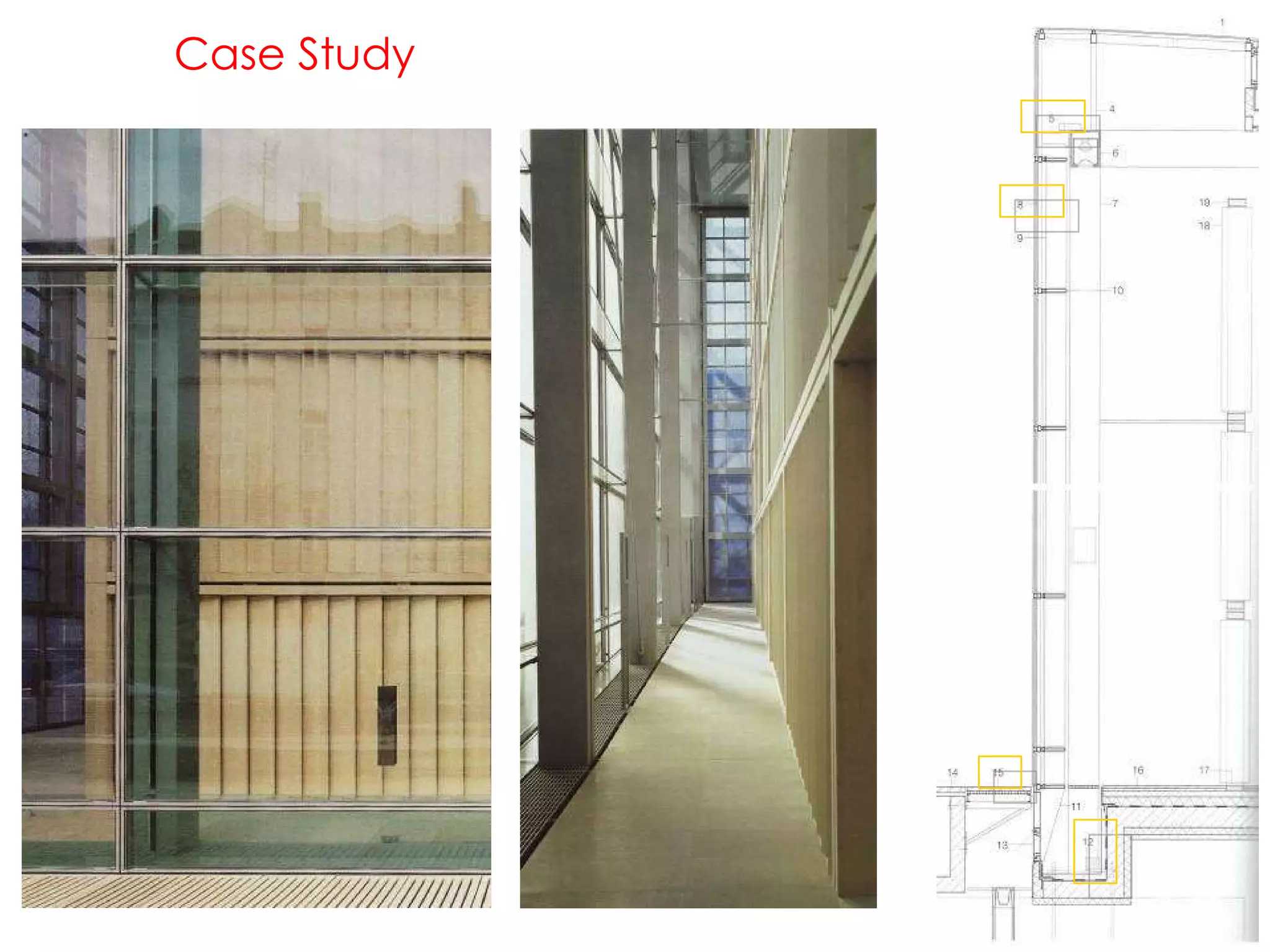
Case Study
Any Questions? If you are interested in this strategy you might want to consider the following literature: On the Typology, Costs, Energy Performance, Environmental Quality and Operational Characteristics of Double Skin Facades in European Buildings. Available:  http://www.earthscan.co.uk/Portals/0/Files/Sample%20Chapters/9781844073894.pdf Double Skin Facades, Maria Wall Available:  http://www2.ebd.lth.se/ebdhome/avd_ebd/main/personal/Harris/main/Double%20Skin %20Facades.htm Case Studies: Double FaçadeAvailable:  http://www.architecture.uwaterloo.ca/ faculty_projects/terri/sustain_casestudies/ut4.pdf Case Studies: Double Facades in Germany Available:  http://www.bbri.be/activefacad es/new/index.cfm?cat=5_example_building&sub=8_germany
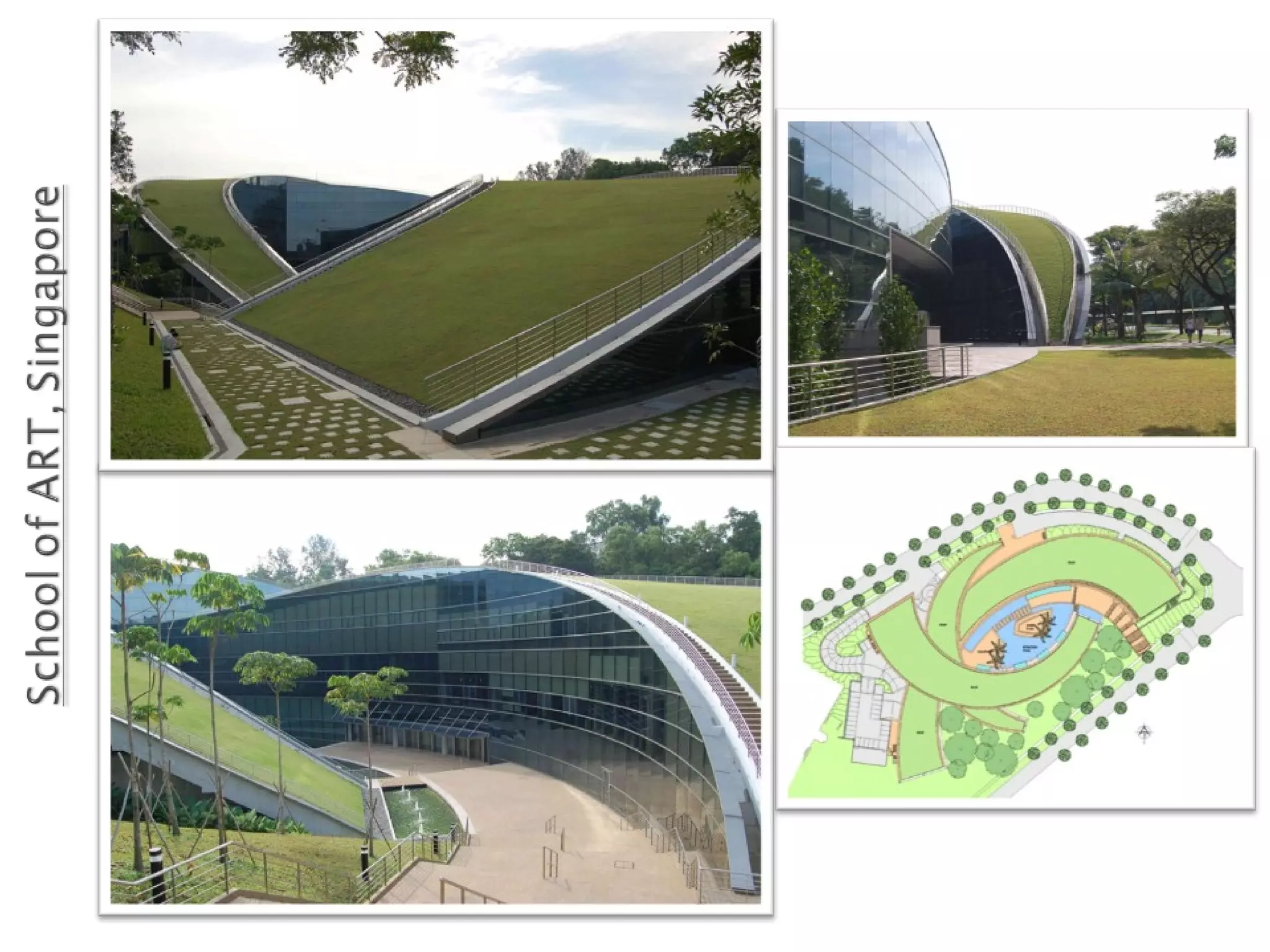
Chapter 4 1.5 Green Roofs
 
 
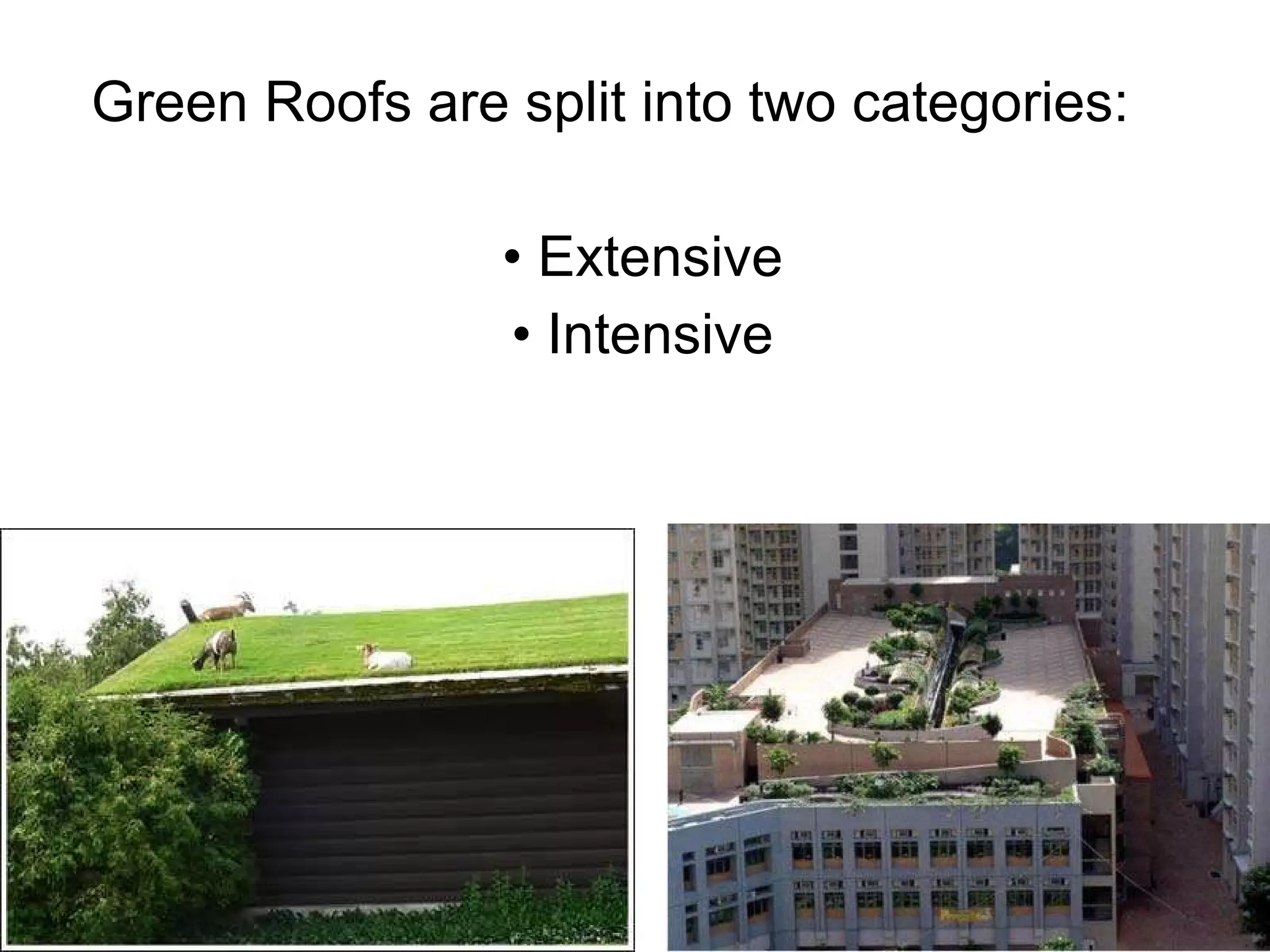
Green Roofs are split into two categories: Extensive Intensive
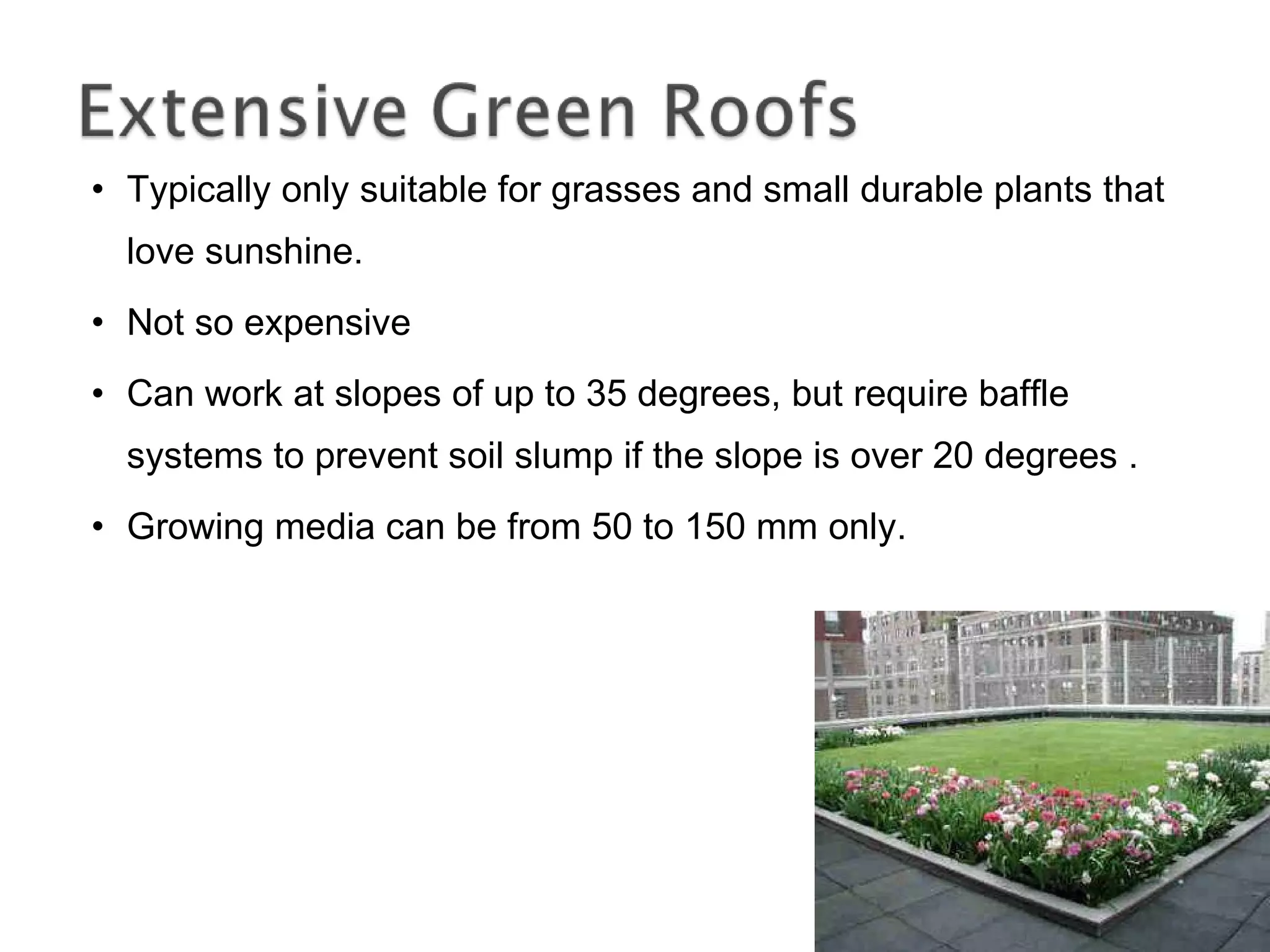
Typically only suitable for grasses and small durable plants that love sunshine. Not so expensive Can work at slopes of up to 35 degrees, but require baffle systems to prevent soil slump if the slope is over 20 degrees . Growing media can be from 50 to 150 mm only.
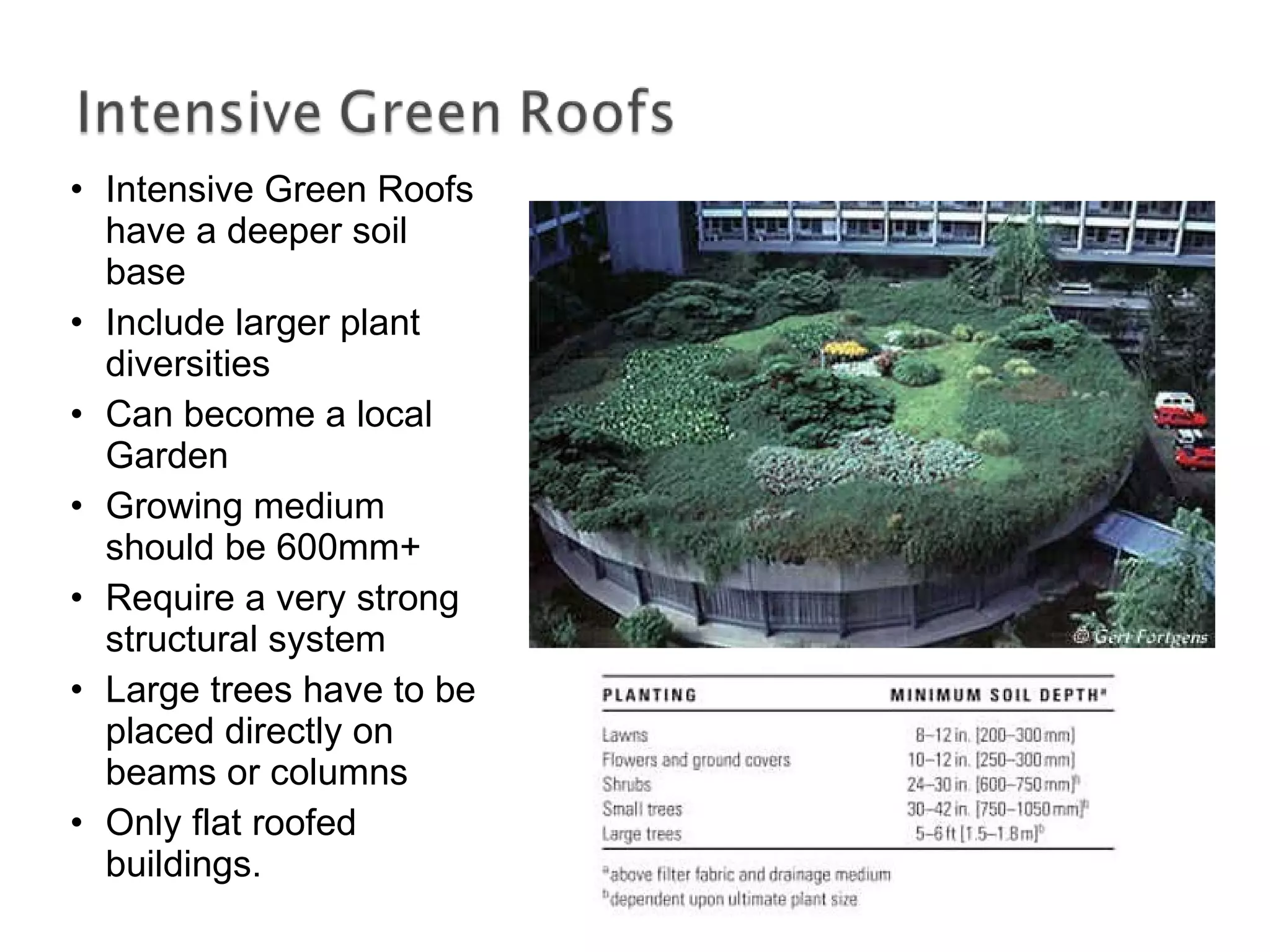
Intensive Green Roofs have a deeper soil base Include larger plant diversities Can become a local Garden Growing medium should be 600mm+ Require a very strong structural system Large trees have to be placed directly on beams or columns Only flat roofed buildings.
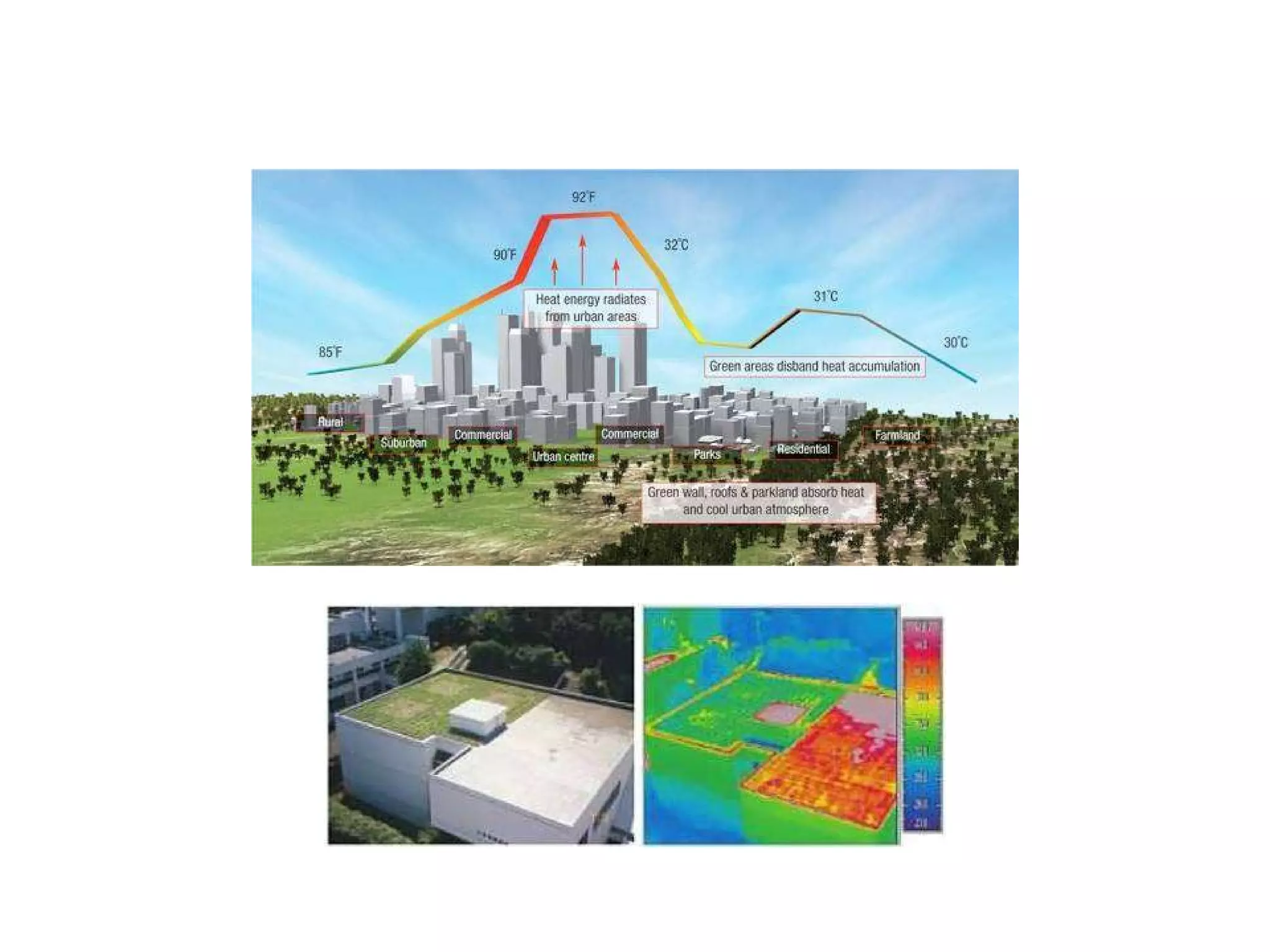
Retain Storm Water and absorb it for recycling. Increase Thermal Resistance of a Building Reduce Urban Heat Island Effect Provide Pleasant Green accessible spaces for building occupiers.
 
 
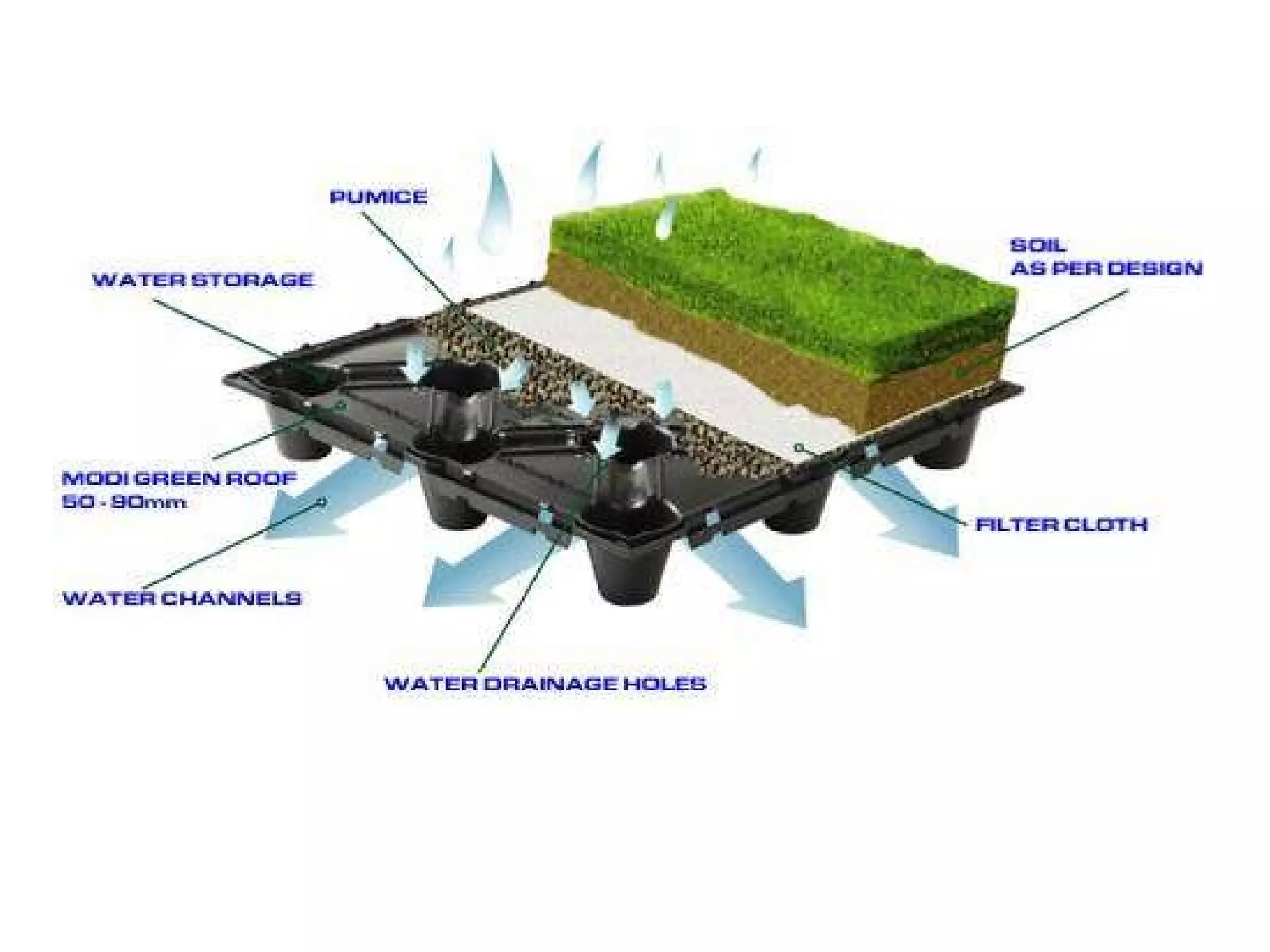
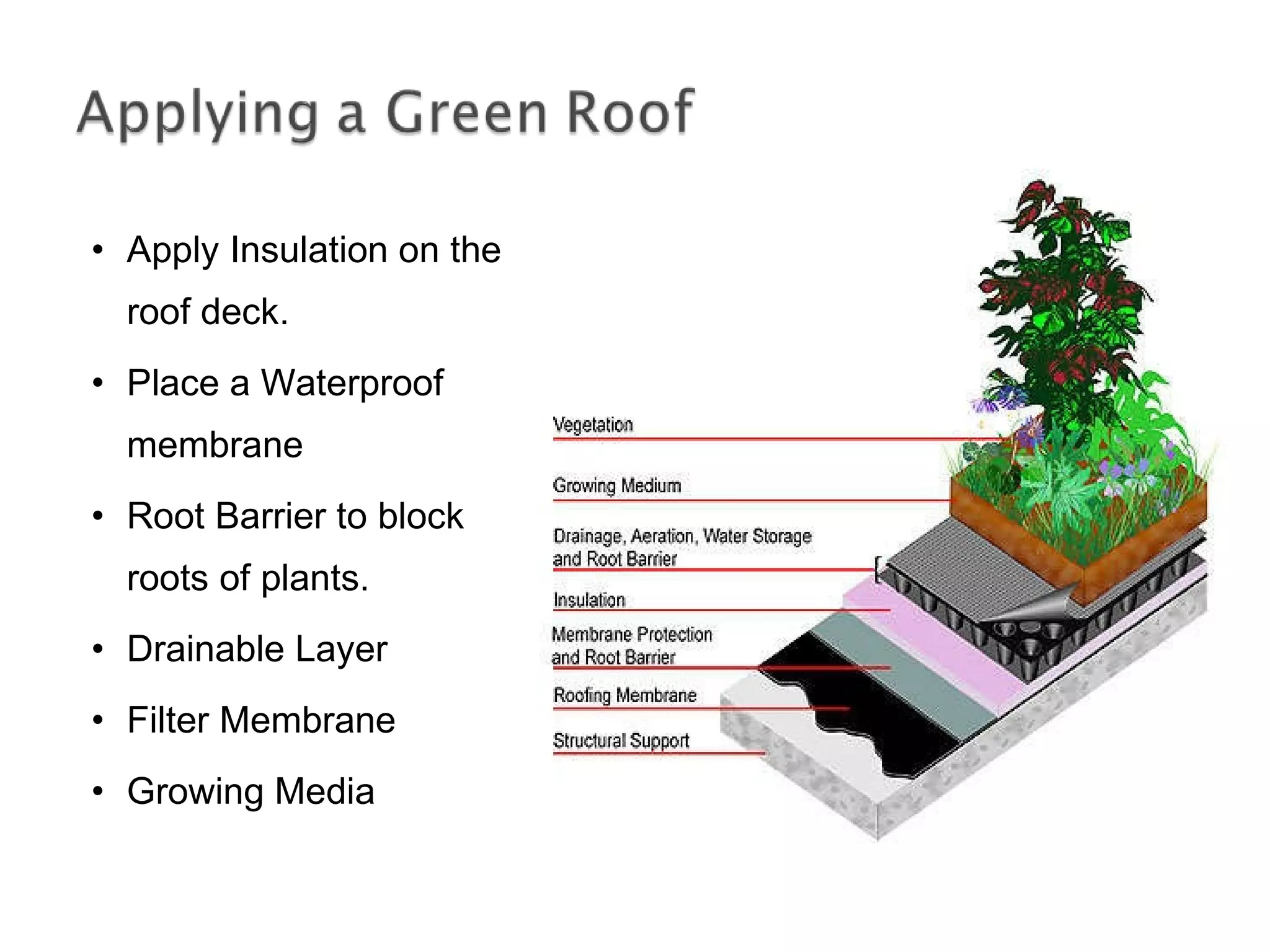
Apply Insulation on the roof deck. Place a Waterproof membrane Root Barrier to block roots of plants. Drainable Layer Filter Membrane Growing Media
Green Roofs require appropriate solar exposure. Architect should consider the shading patterns produced by neighboring buildings and design the green roof accordingly. Integration with the building’s functions should be thought of. Type of Vegetation to use.
Determine the desired functions of the Green Roofs. Determine if an Intensive or an Extensive Roof is required Determine the amount of sun and shade that the proposed green roof area will receive during the year. Choose the types of plantation desired, taking into consideration rainfall, sun exposure and wind speeds Determine soil depth required depending on plantations chosen Estimate the dead weight of the green roof and therefore choose an appropriate structural system Consider incorporation of accesses for maintenance and irrigation
Green Roofs are quite expensive Require a very sound structural system Need constant maintenance and care for plants and growing medium Roofs have to be well insulated against drainage and leakage


Chapter 4 2.1 Daylight Factor
Daylight Factor
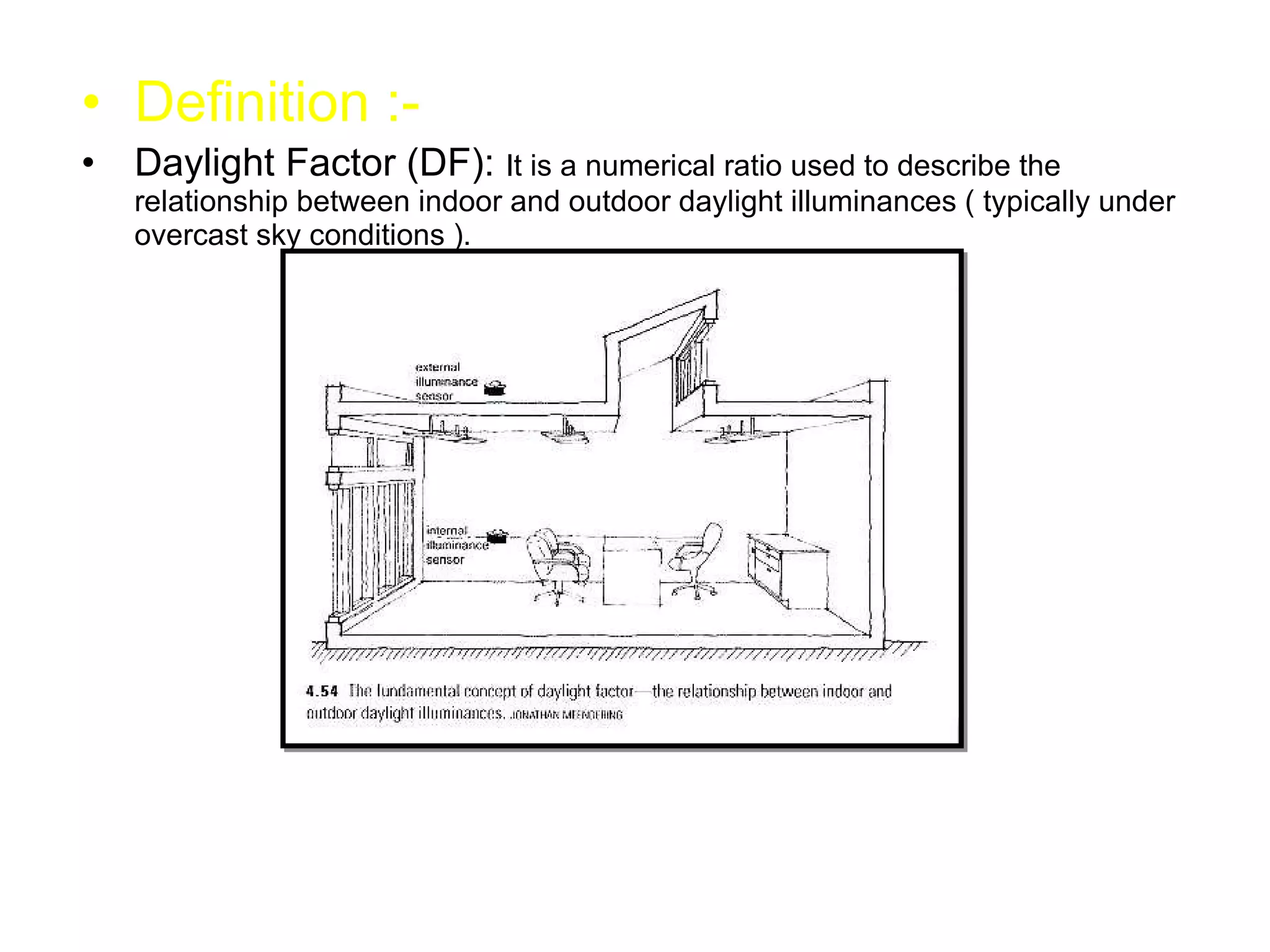
Definition :- Daylight Factor (DF):  It is a numerical ratio used to describe the relationship between indoor and outdoor daylight illuminances ( typically under overcast sky conditions ).
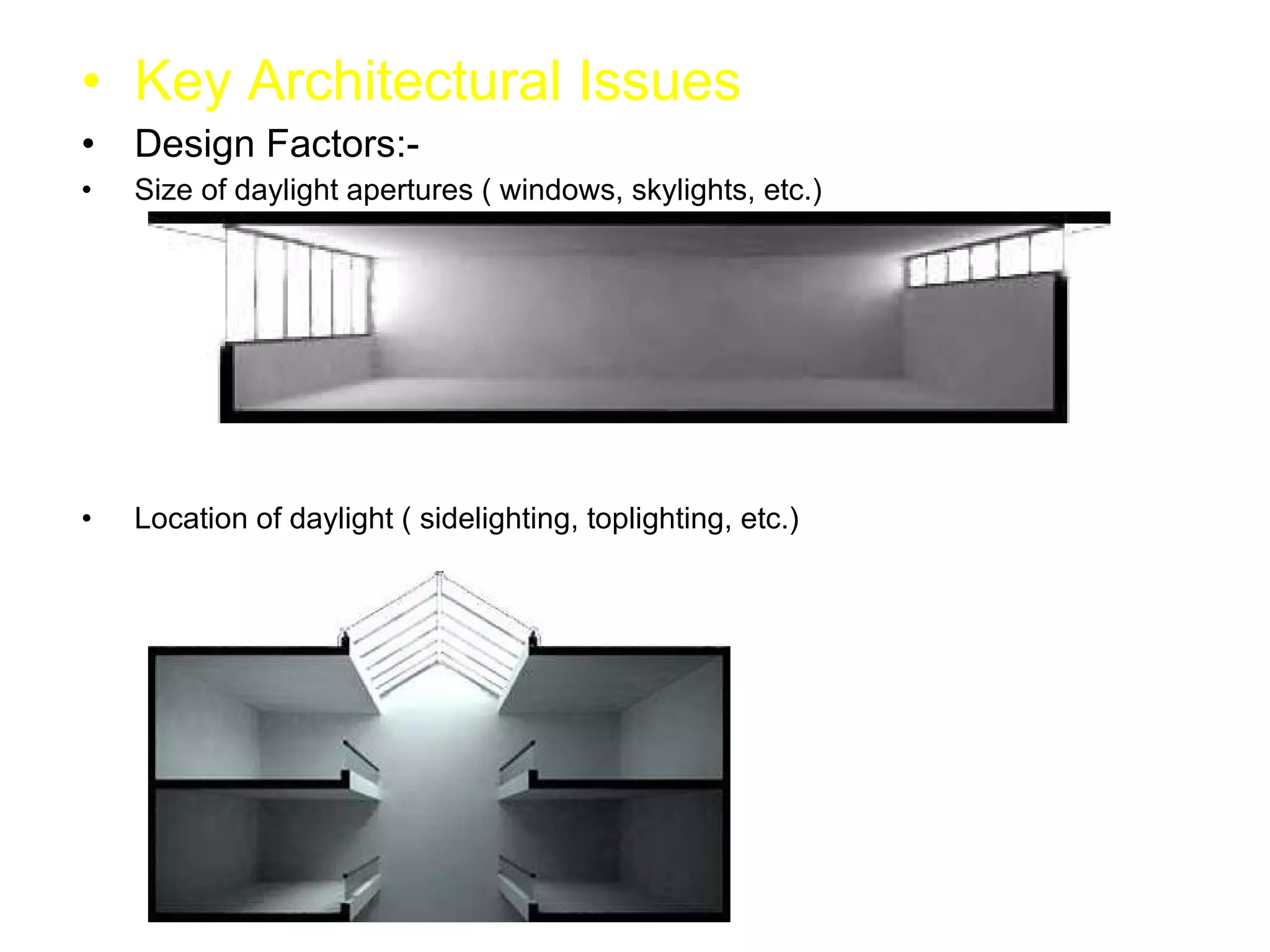
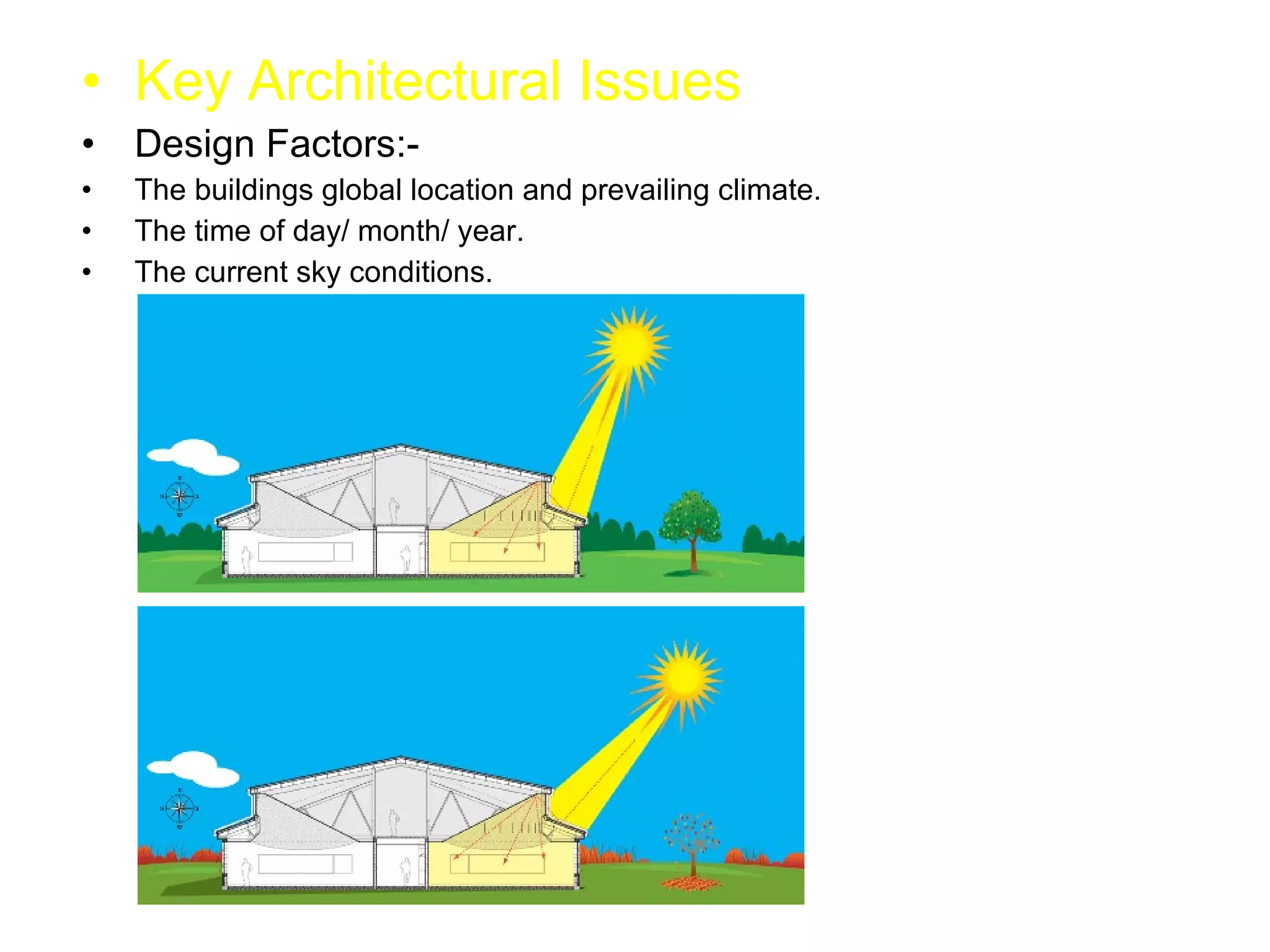
Key Architectural Issues Design Factors:- Size of daylight apertures ( windows, skylights, etc.) Location of daylight ( sidelighting, toplighting, etc.)
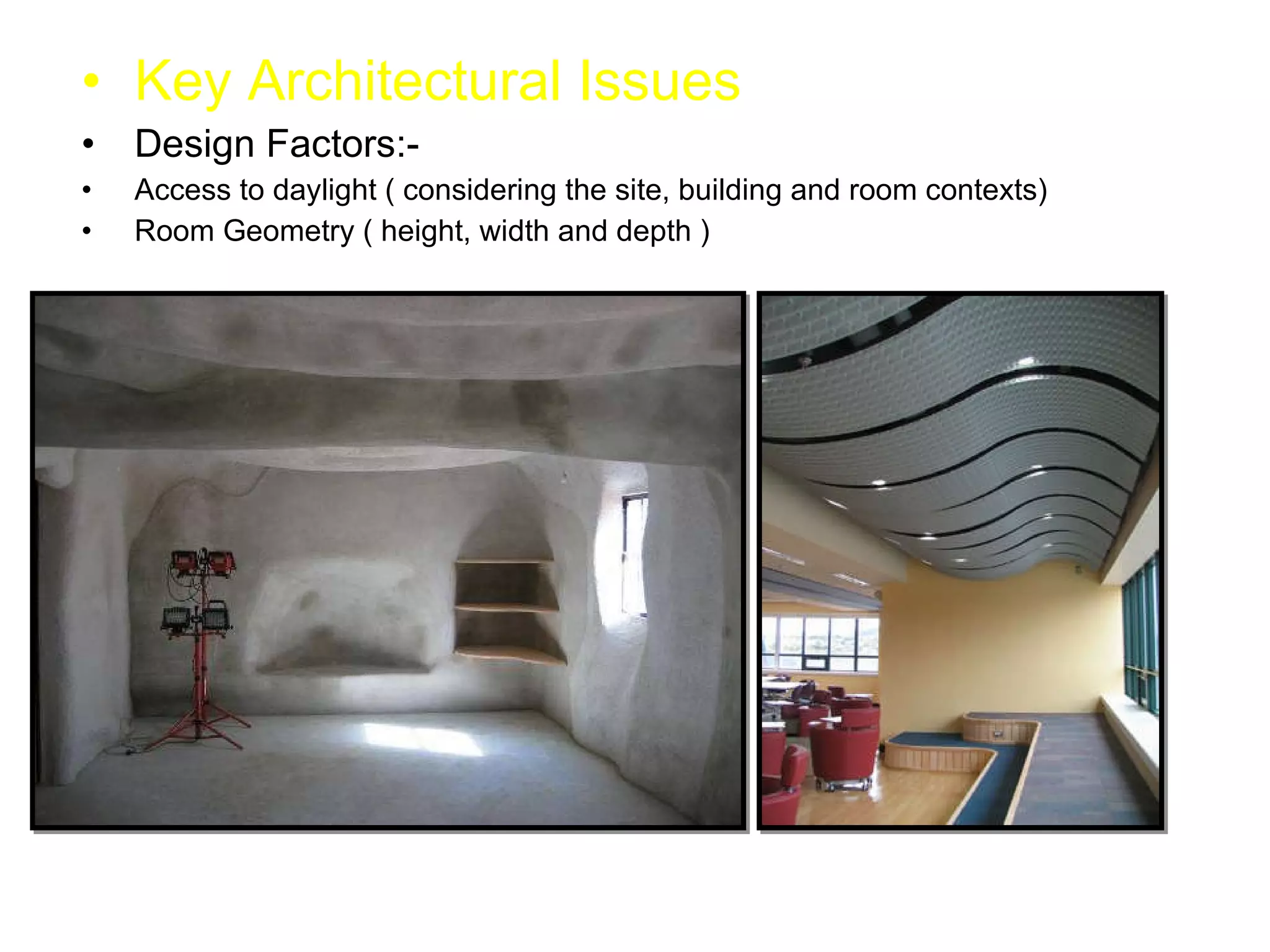
Key Architectural Issues Design Factors:- Access to daylight ( considering the site, building and room contexts) Room Geometry ( height, width and depth )
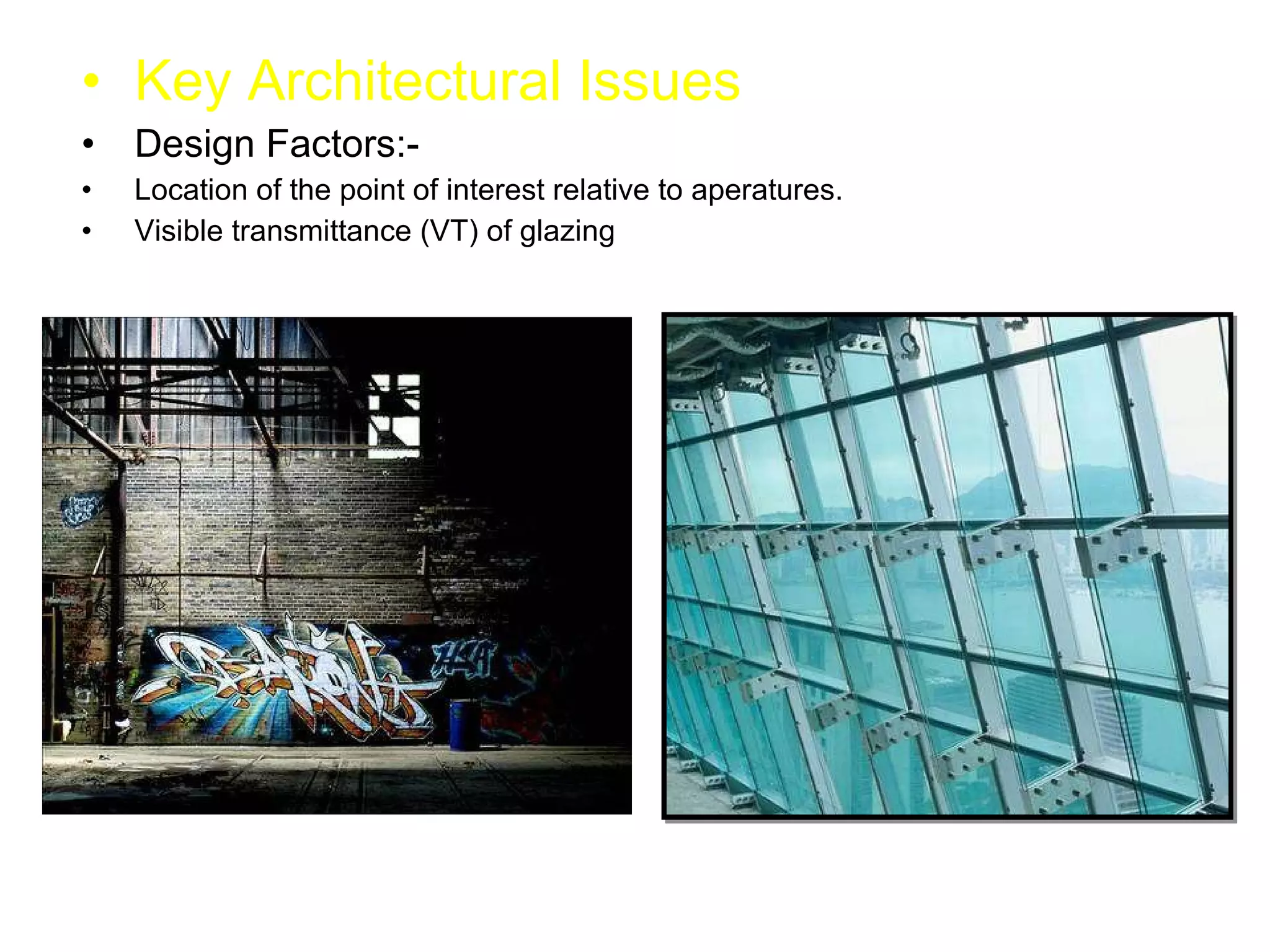
Key Architectural Issues Design Factors:- Location of the point of interest relative to aperatures. Visible transmittance (VT) of glazing
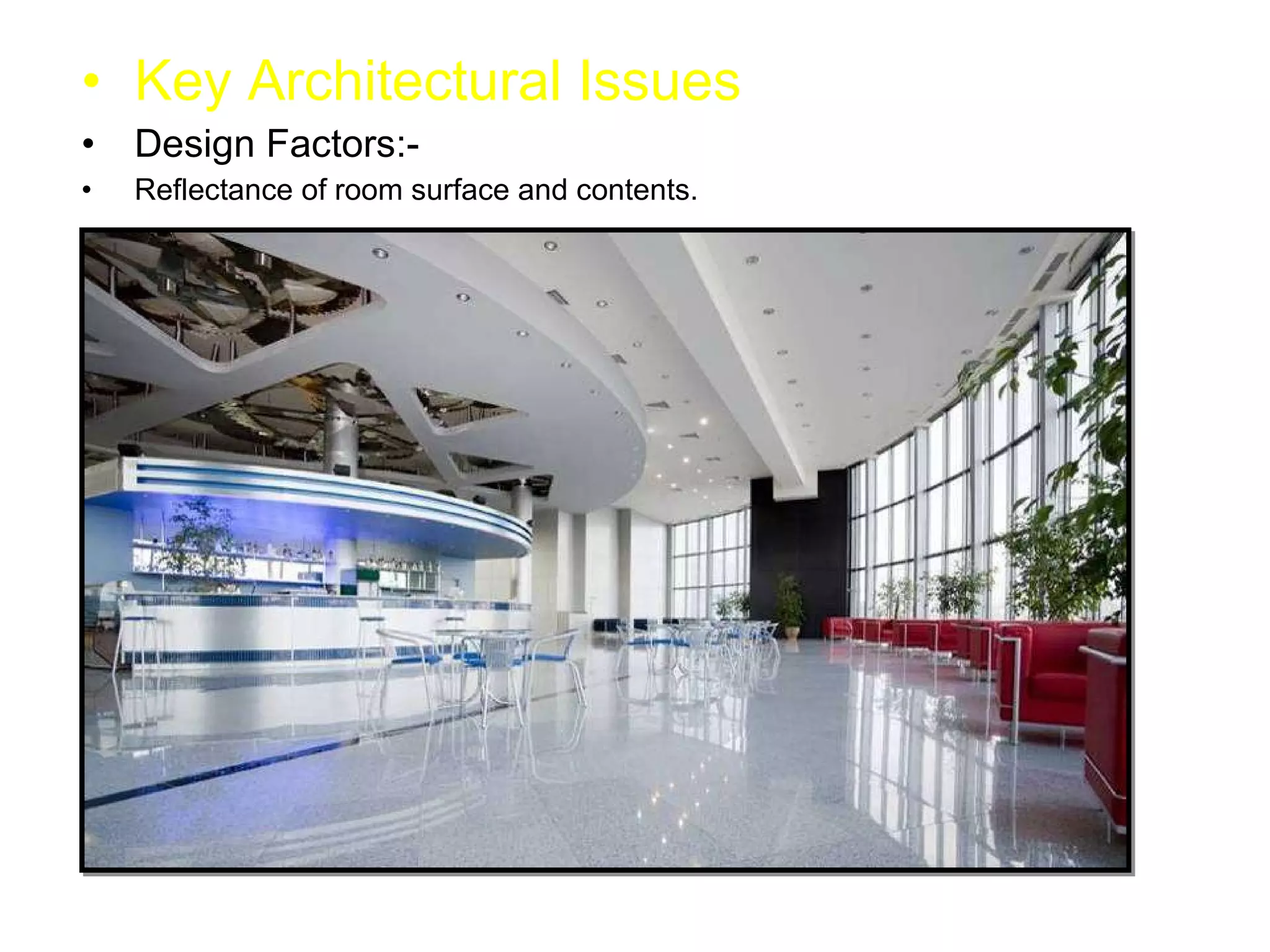
Key Architectural Issues Design Factors:- Reflectance of room surface and contents.
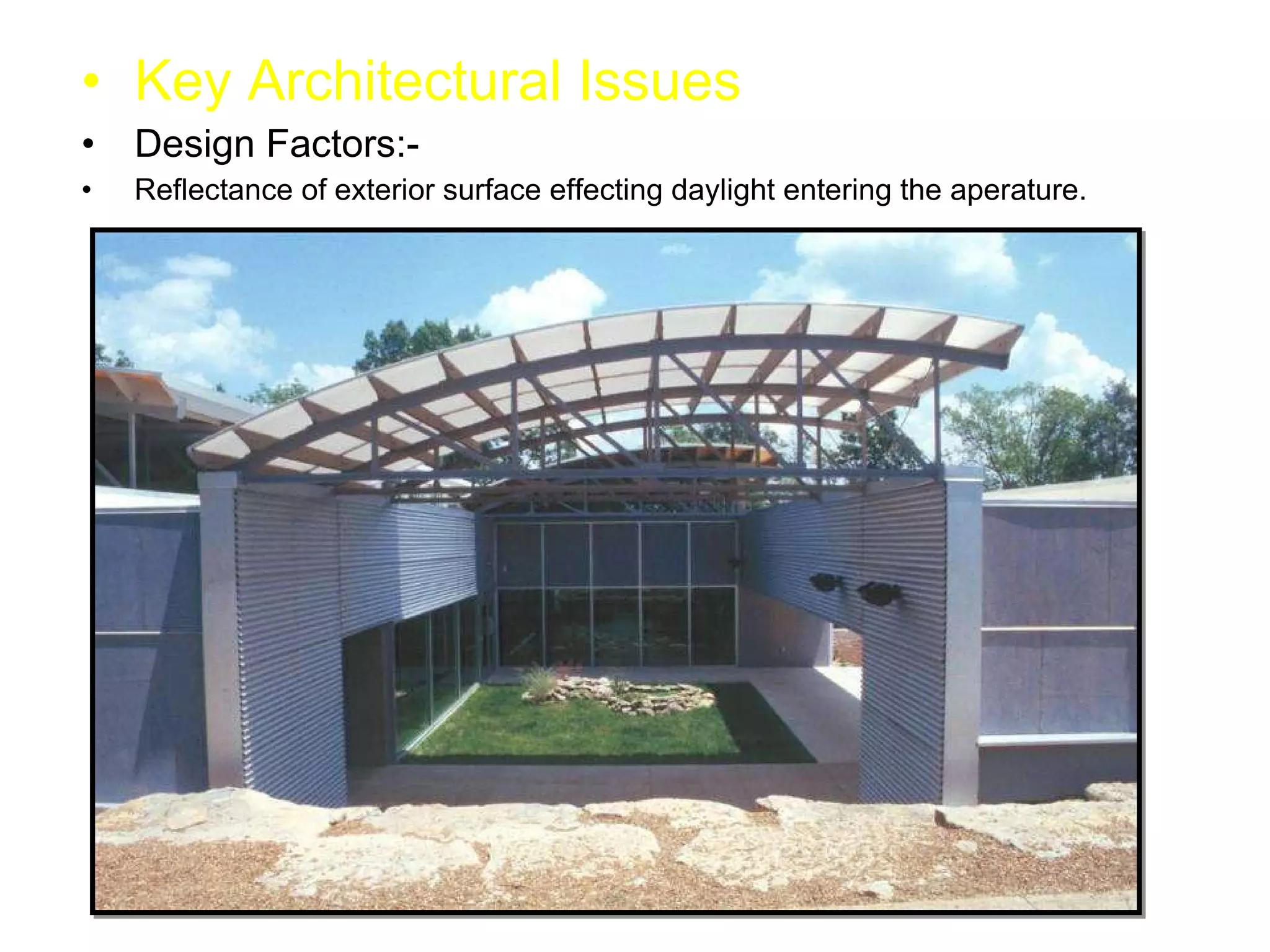
Key Architectural Issues Design Factors:- Reflectance of exterior surface effecting daylight entering the aperature.
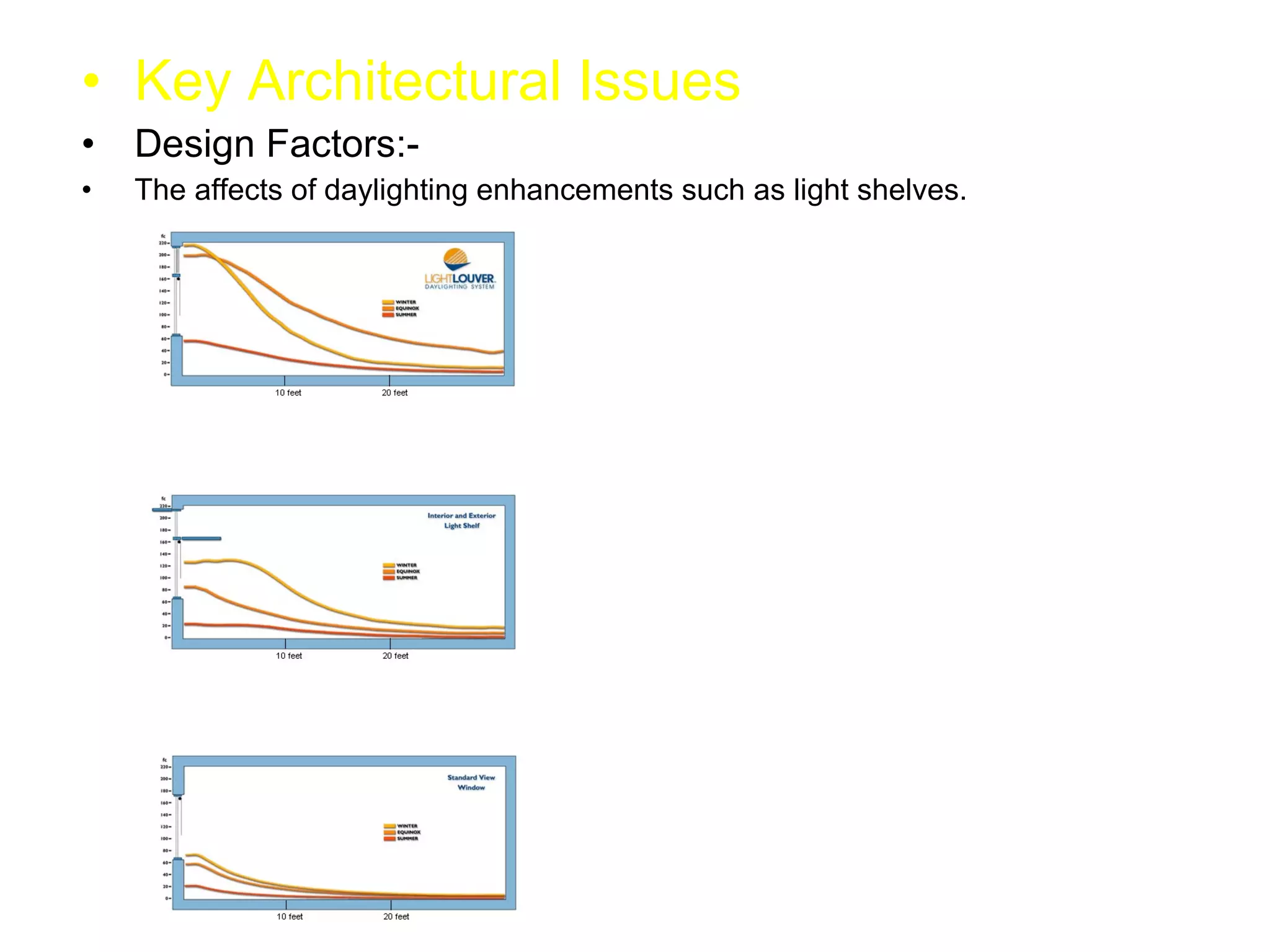
Key Architectural Issues Design Factors:- The affects of daylighting enhancements such as light shelves.
Key Architectural Issues Design Factors:- The buildings global location and prevailing climate. The time of day/ month/ year. The current sky conditions.
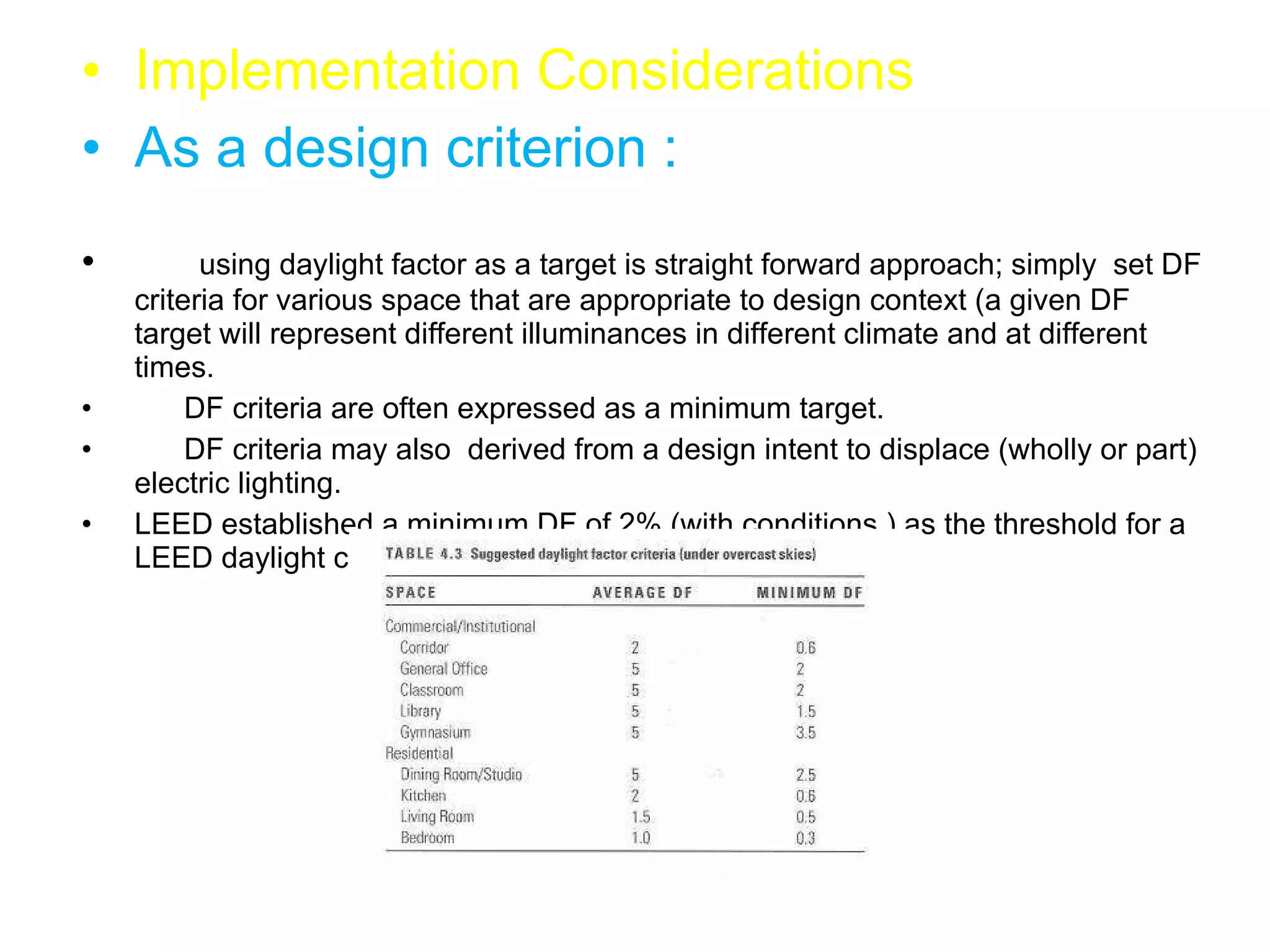
Implementation Considerations As a design criterion :  using daylight factor as a target is straight forward approach; simply  set DF criteria for various space that are appropriate to design context (a given DF target will represent different illuminances in different climate and at different times. DF criteria are often expressed as a minimum target. DF criteria may also  derived from a design intent to displace (wholly or part) electric lighting. LEED established a minimum DF of 2% (with conditions ) as the threshold for a LEED daylight credit.
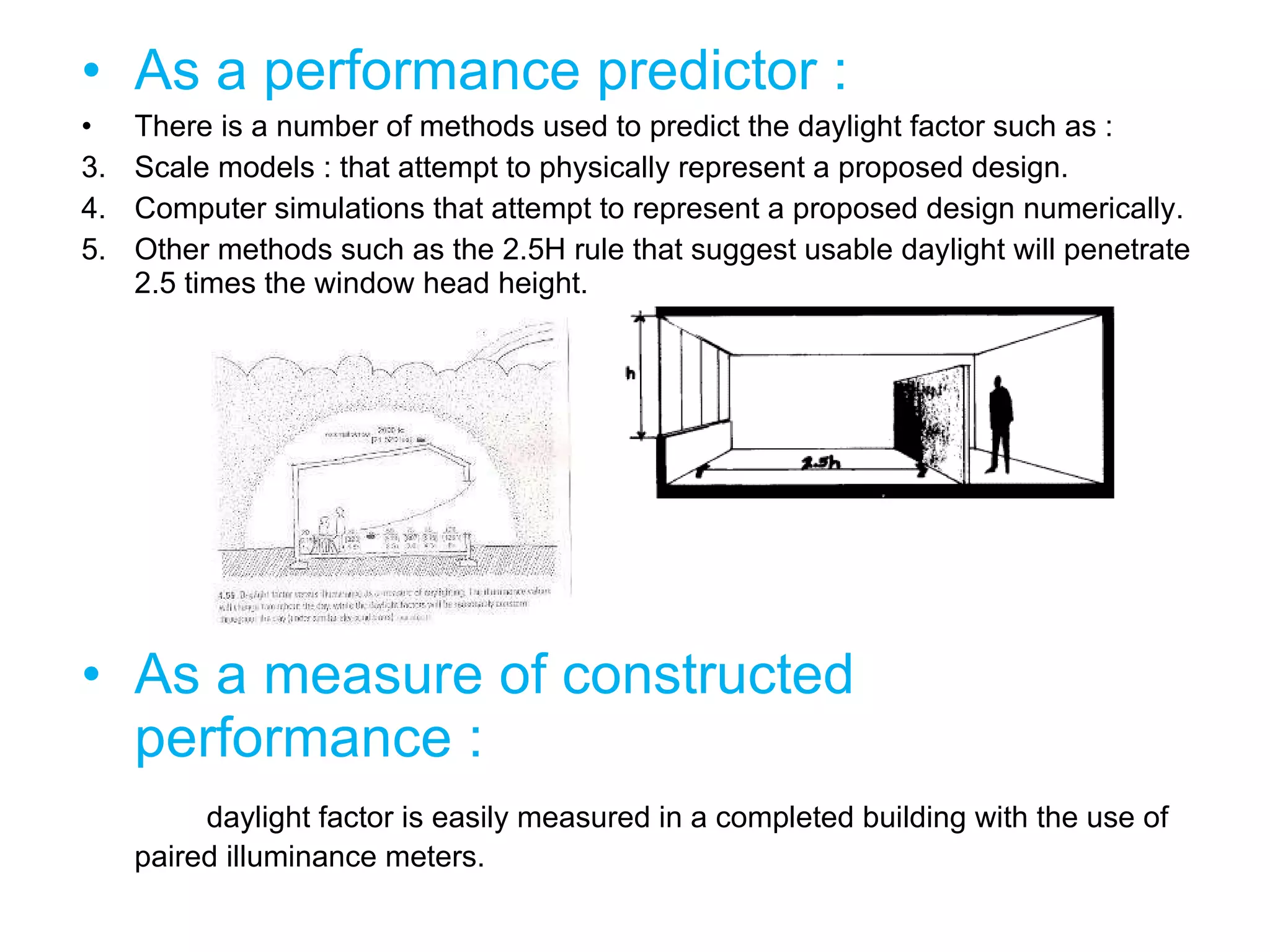
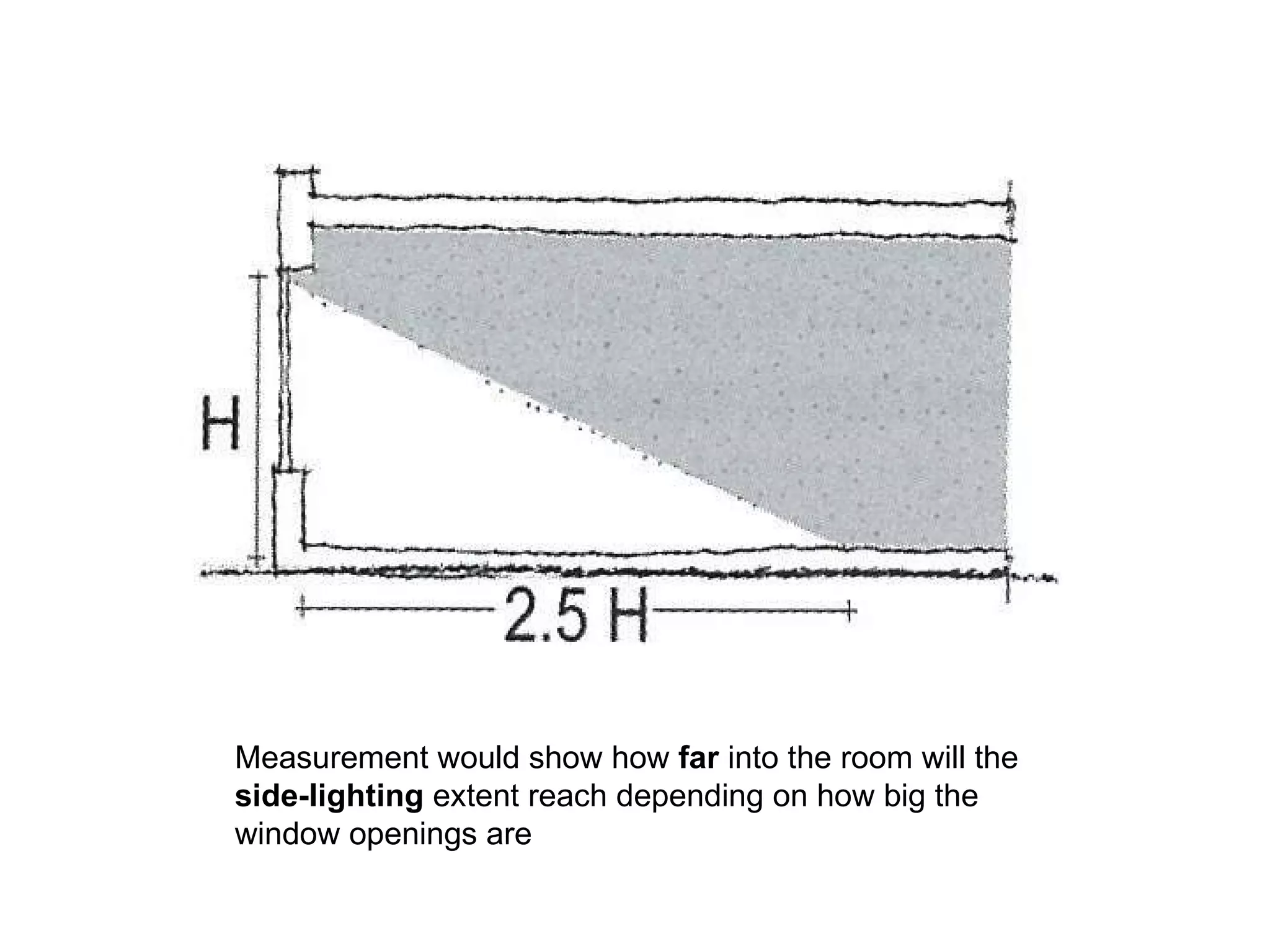
As a performance predictor : There is a number of methods used to predict the daylight factor such as : Scale models : that attempt to physically represent a proposed design. Computer simulations that attempt to represent a proposed design numerically. Other methods such as the 2.5H rule that suggest usable daylight will penetrate 2.5 times the window head height. As a measure of constructed performance : daylight factor is easily measured in a completed building with the use of paired illuminance meters.
Design Procedure Establish daylight factor criteria for the various spaces in the building being designed. Select the daylight approach or combination of approaches most likely to provide performance to match the criteria established in step 1. Size daylight apertures using available schematic design guidance or trail and error. Model the daylighting performance ( including daylight factors ) of the proposed daylighting system. Adjust selected daylighting design parameters ( aperture size, glazing transmittance, surface reflectance, light shelves, etc. ) as necessary to achieve established daylight factor criteria. Revalidate daylighting design modified parameters; iterate as necessary to meet design criteria.
Chapter 4 2.2 Daylight Zoning
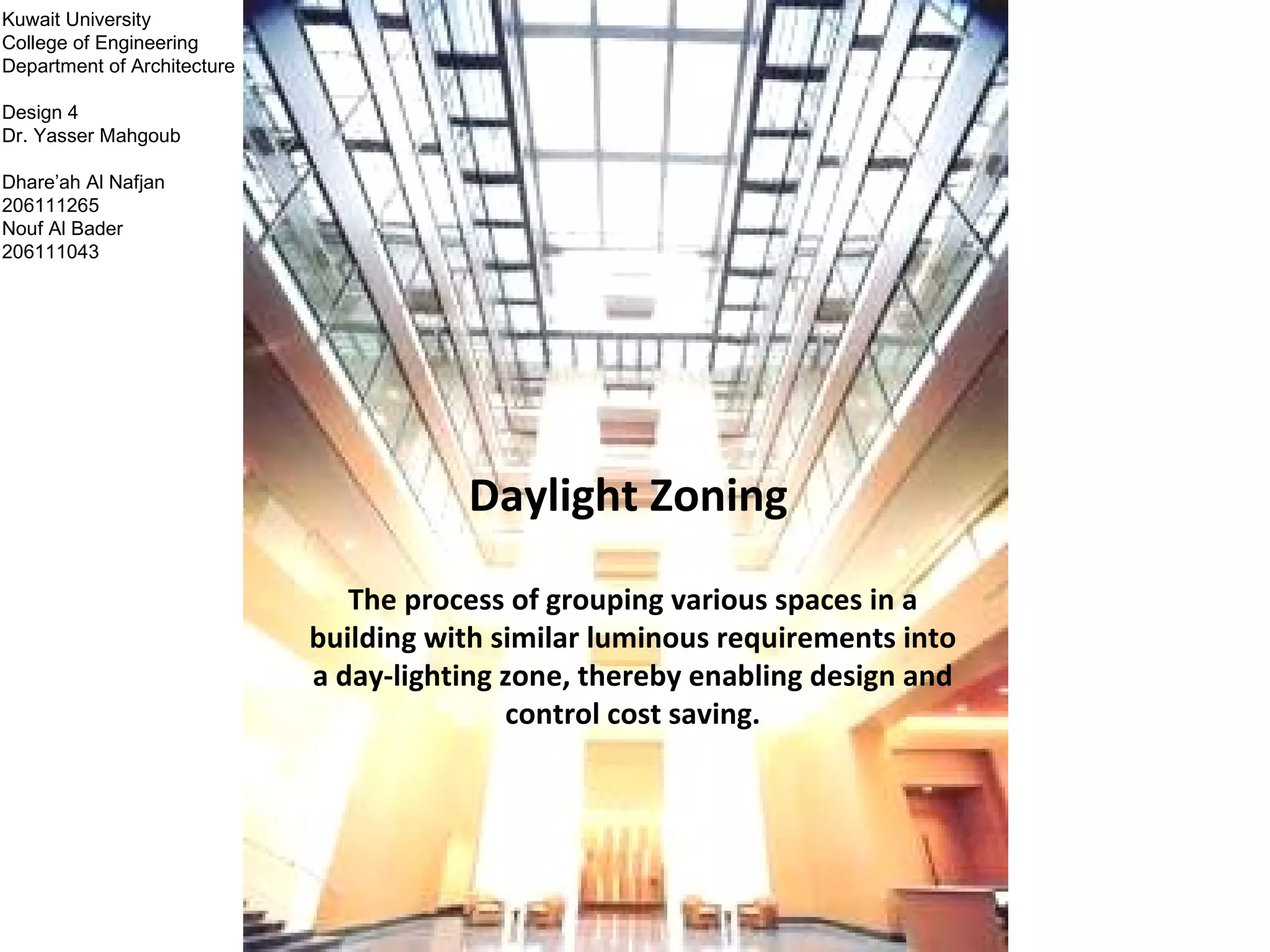
Daylight Zoning The process of grouping various spaces in a building with similar luminous requirements into a day-lighting zone, thereby enabling design and control cost saving. Kuwait University College of Engineering  Department of Architecture Design 4 Dr. Yasser Mahgoub Dhare’ah Al Nafjan  206111265 Nouf Al Bader  206111043
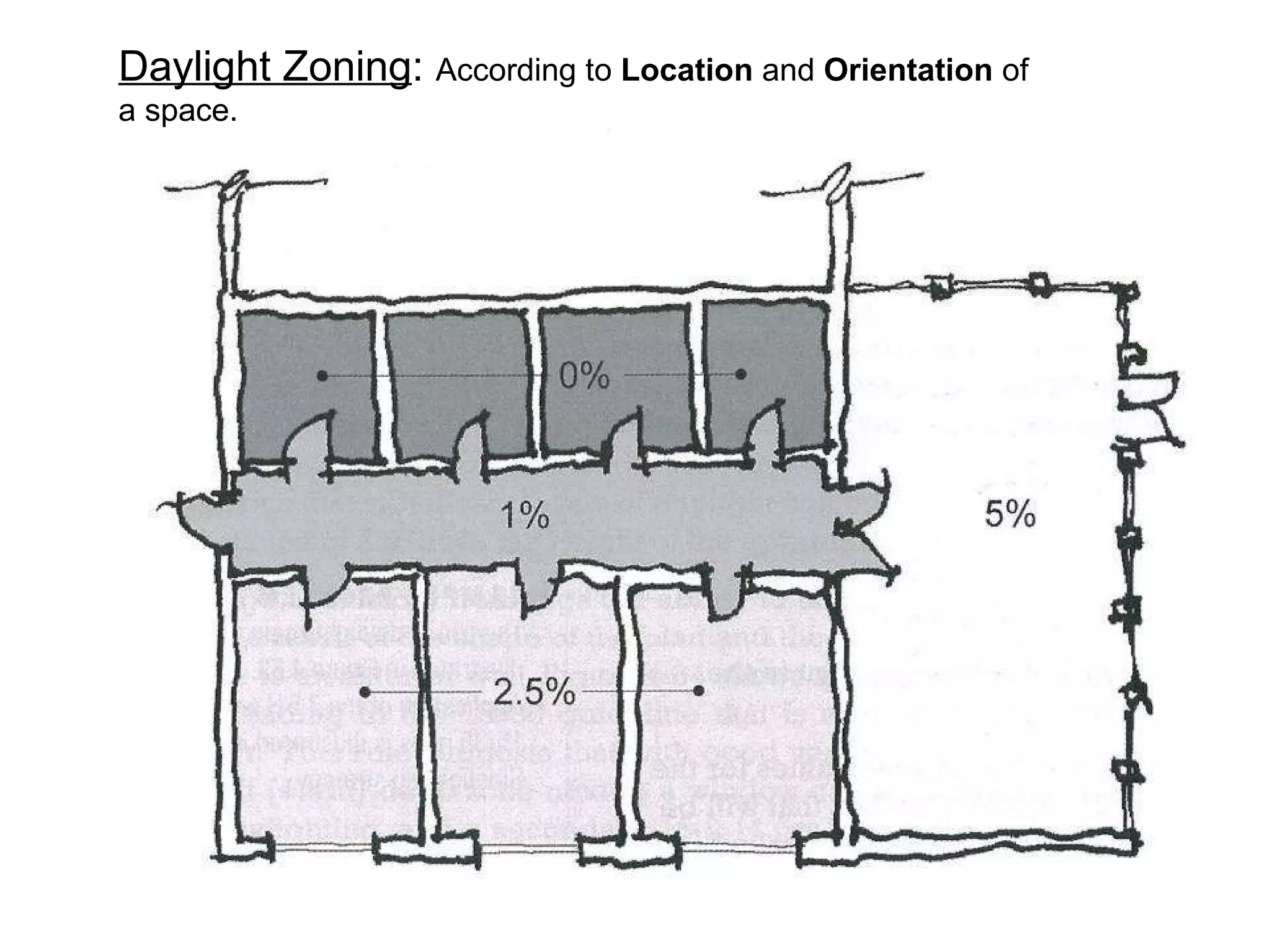
Daylight Zoning :  According to  Location  and  Orientation  of a space.
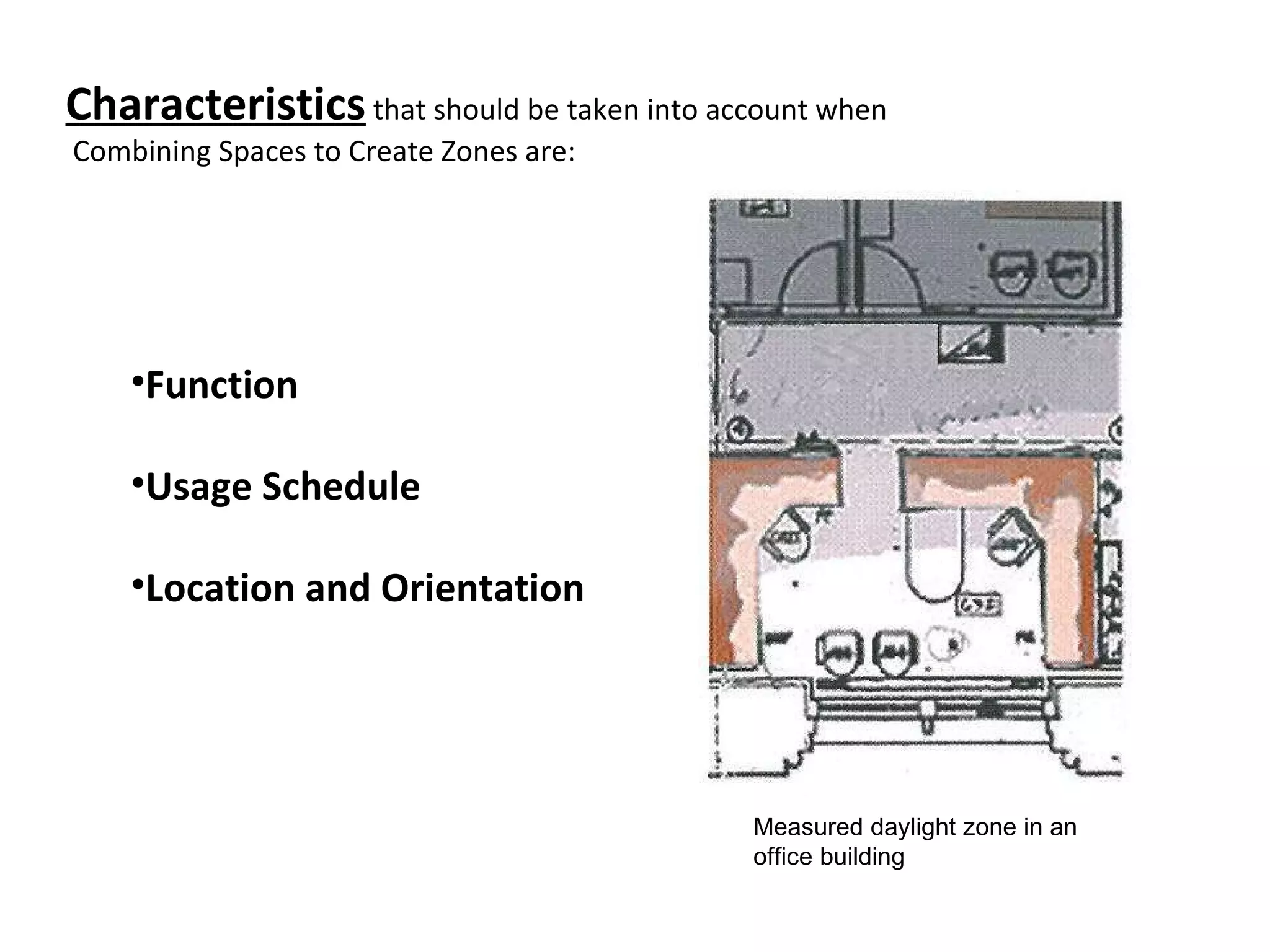
Function Usage Schedule Location and Orientation Characteristics  that should be taken into account when Combining Spaces to Create Zones are: Measured daylight zone in an office building
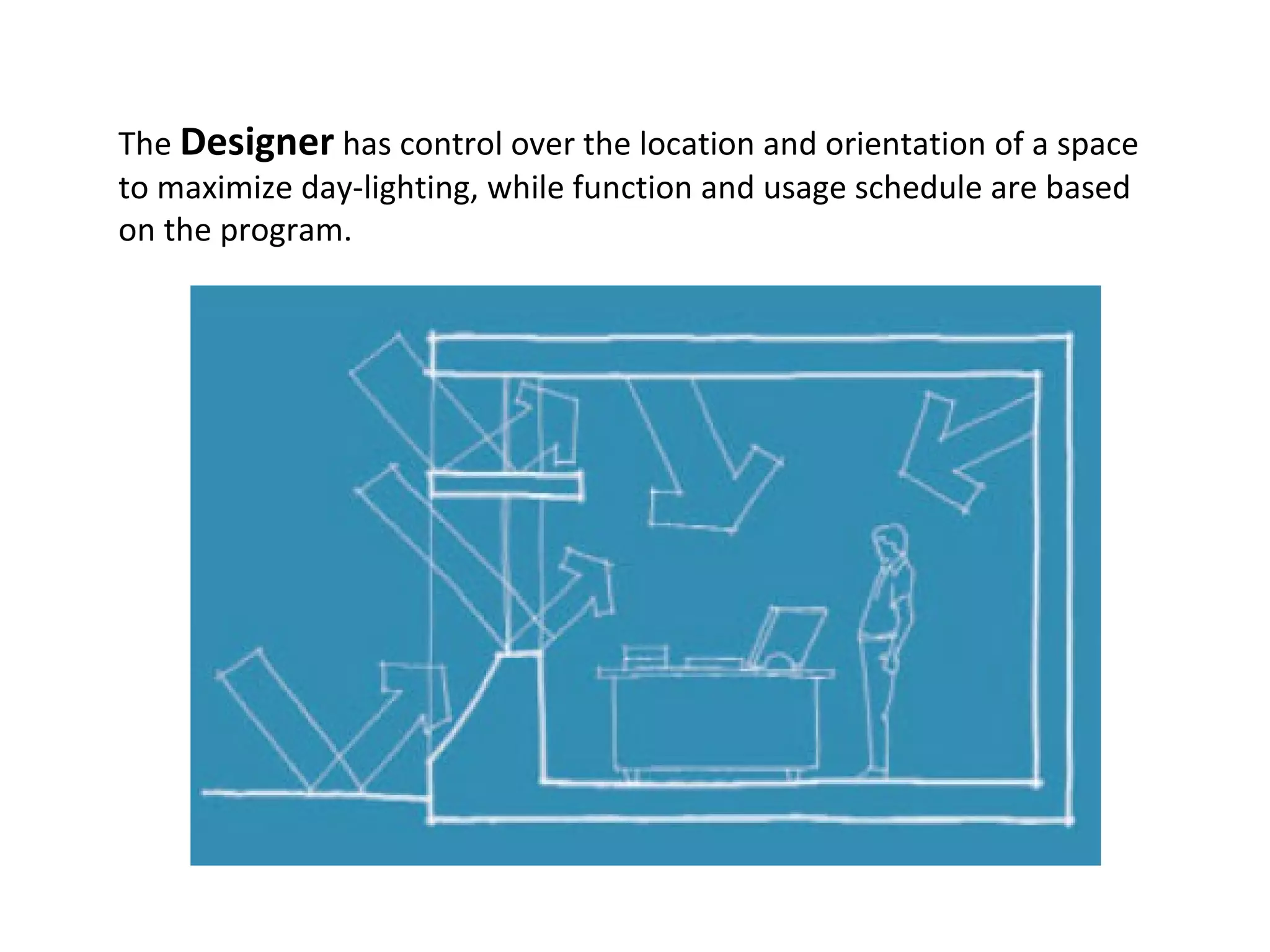
The  Designer  has control over the location and orientation of a space to maximize day-lighting, while function and usage schedule are based on the program.
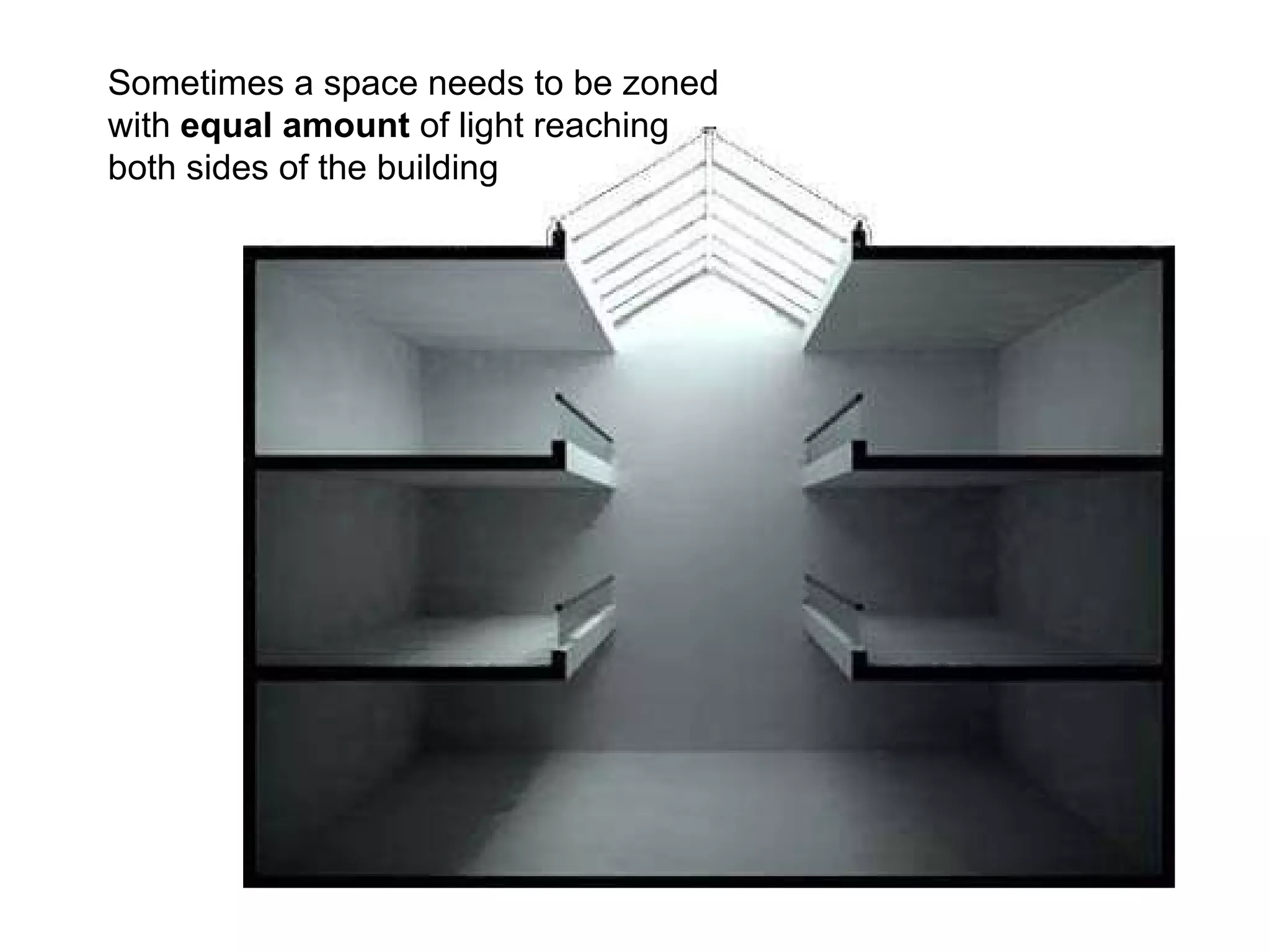
Sometimes a space needs to be zoned with  equal amount  of light reaching both sides of the building
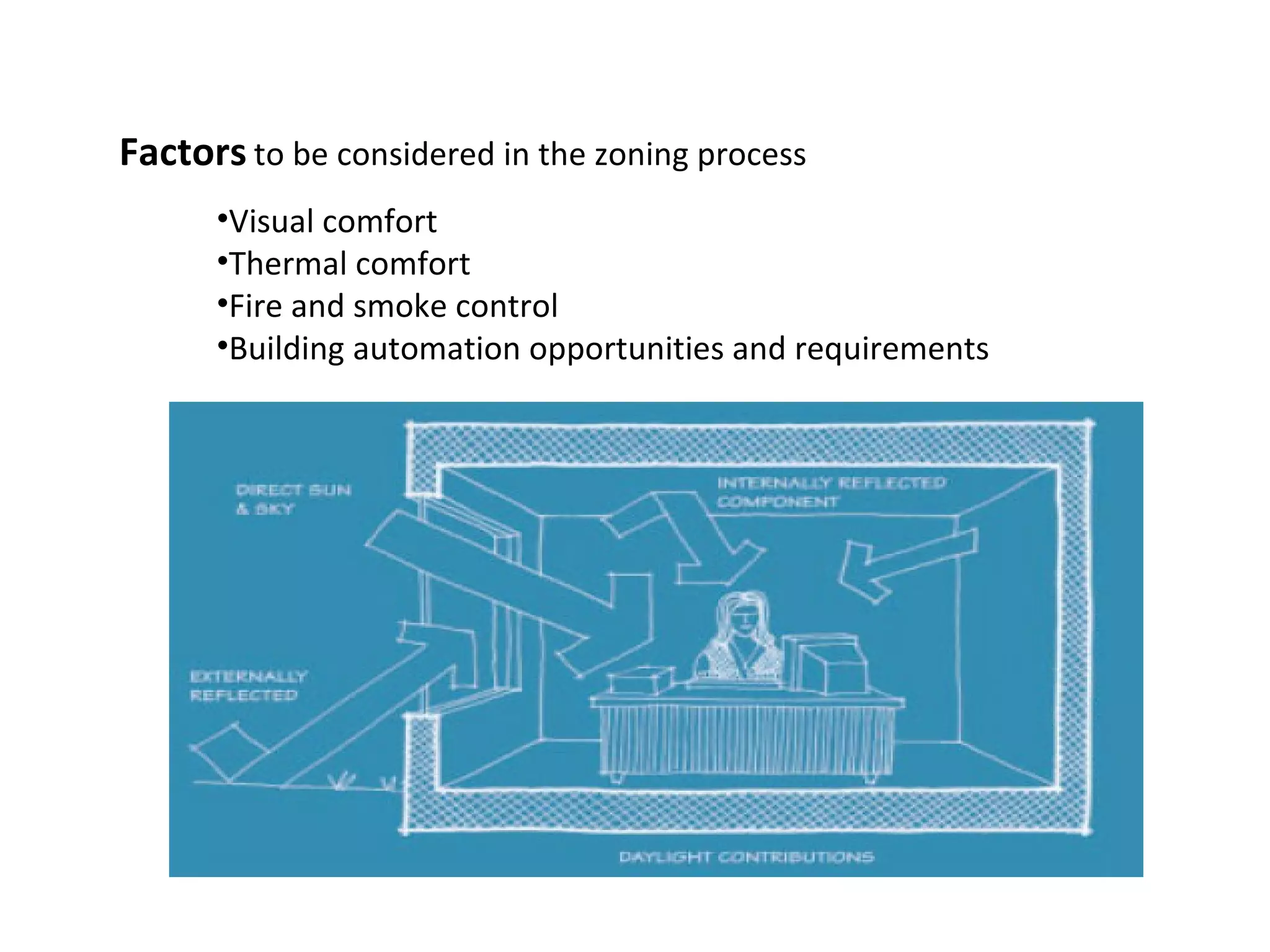
Factors   to be considered in the zoning process Visual comfort Thermal comfort Fire and smoke control Building automation opportunities and requirements
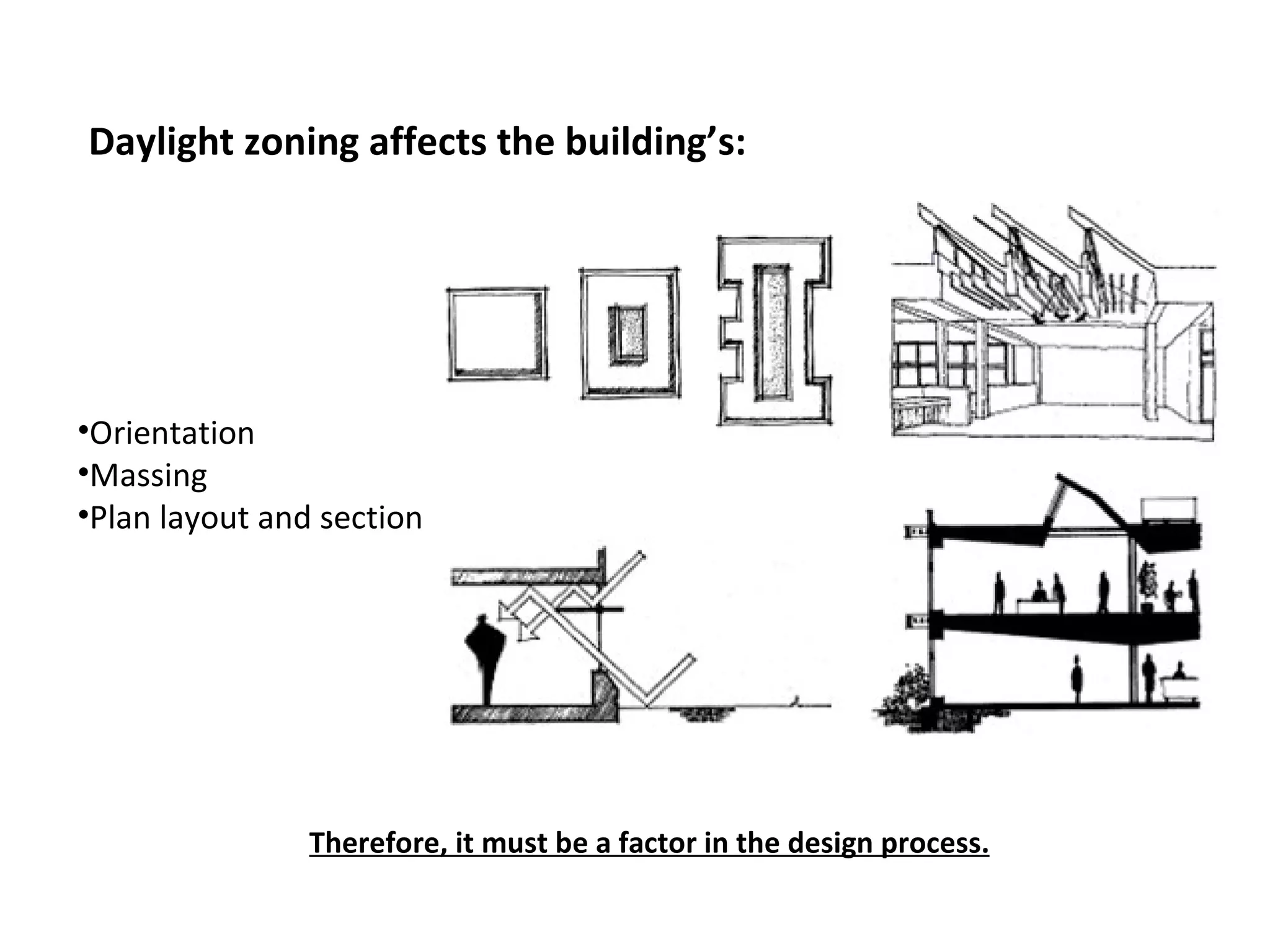
Daylight zoning affects the building’s: Orientation Massing  Plan layout and section Therefore, it must be a factor in the design process.
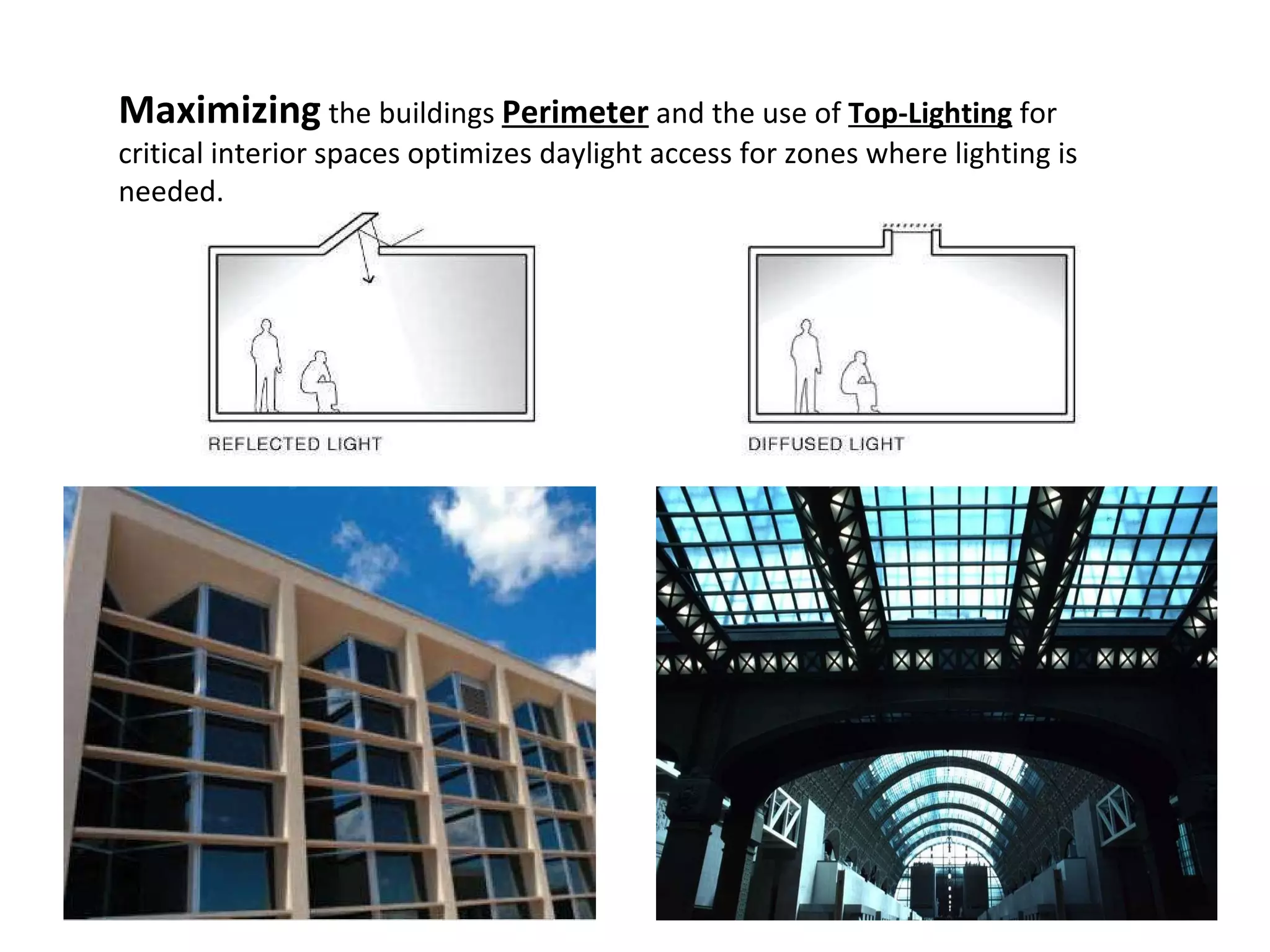
Maximizing  the buildings  Perimeter  and the use of  Top-Lighting  for critical interior spaces optimizes daylight access for zones where lighting is needed.
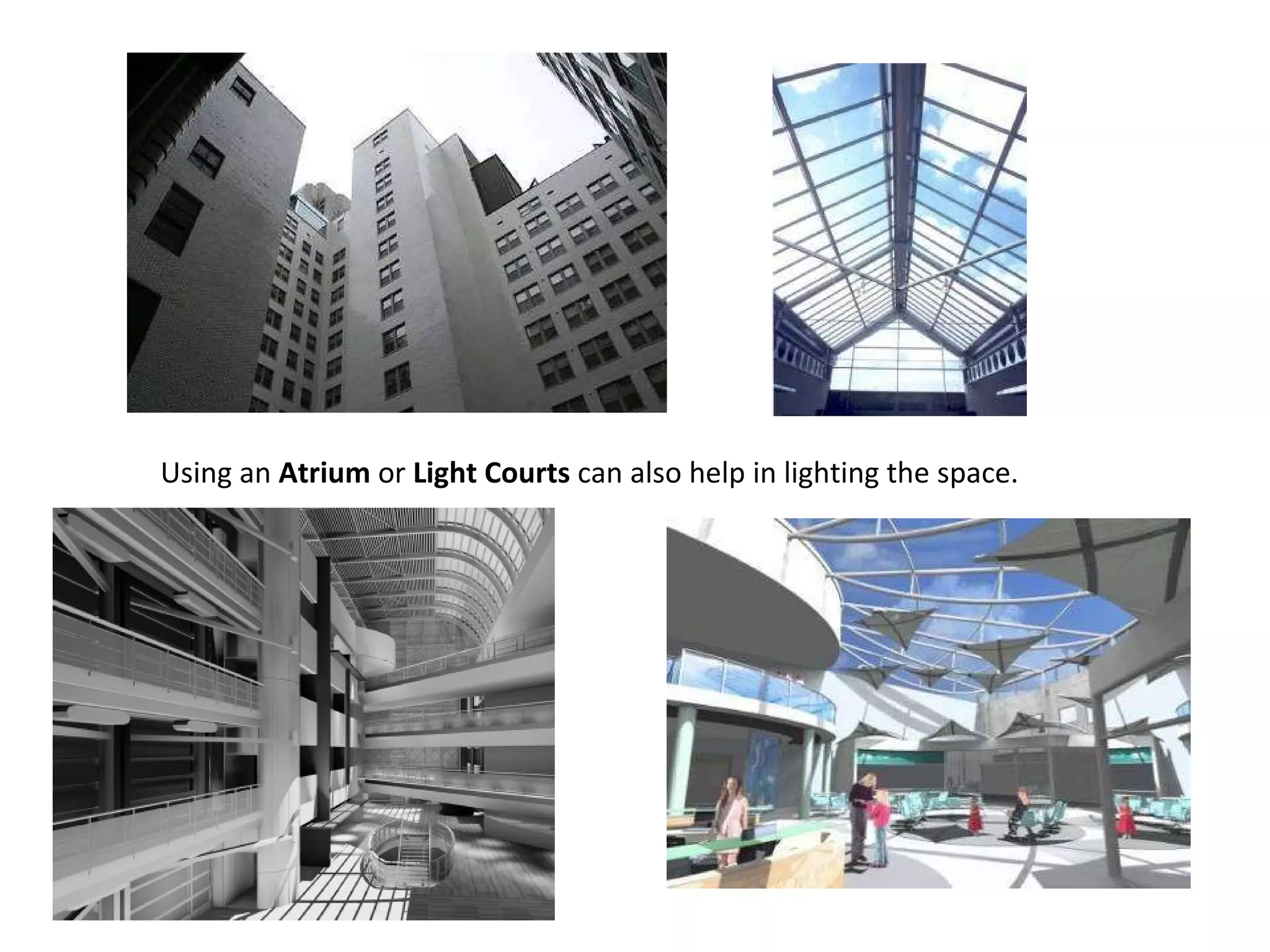
Using an  Atrium  or  Light Courts  can also help in lighting the space.
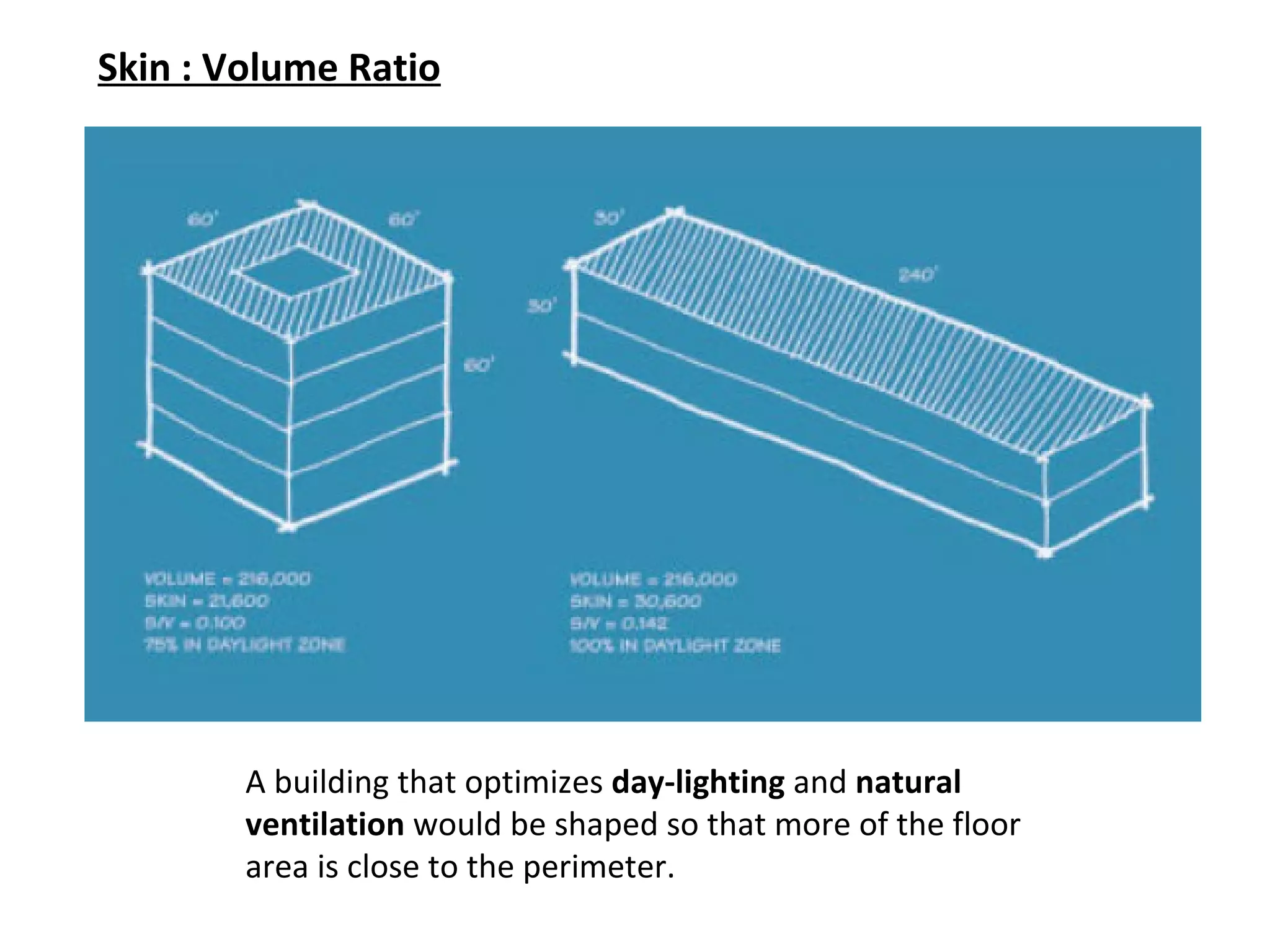
Skin : Volume Ratio A building that optimizes  day-lighting  and  natural ventilation  would be shaped so that more of the floor area is close to the perimeter.
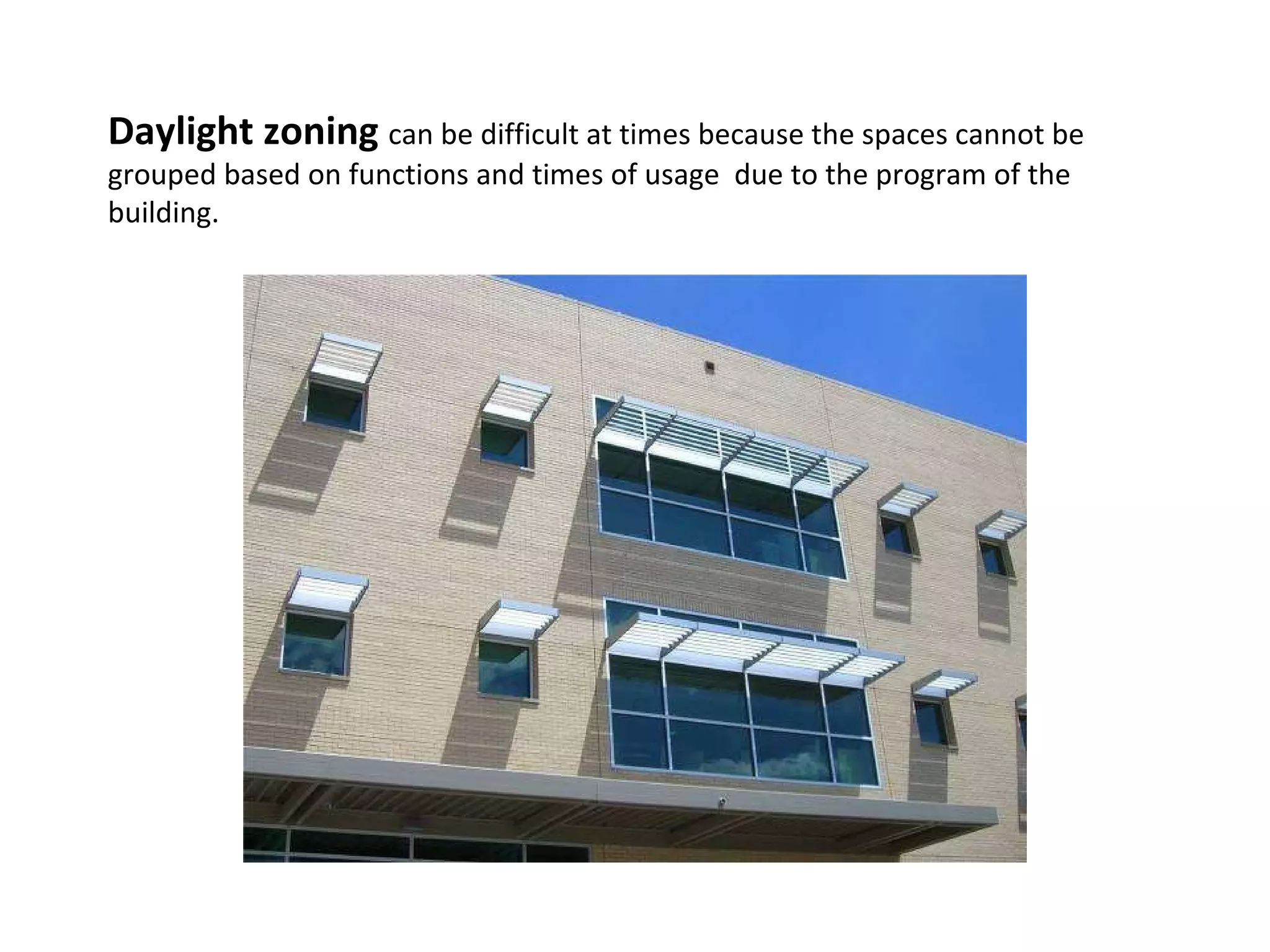
Daylight zoning  can be difficult at times because the spaces cannot be grouped based on functions and times of usage  due to the program of the building.
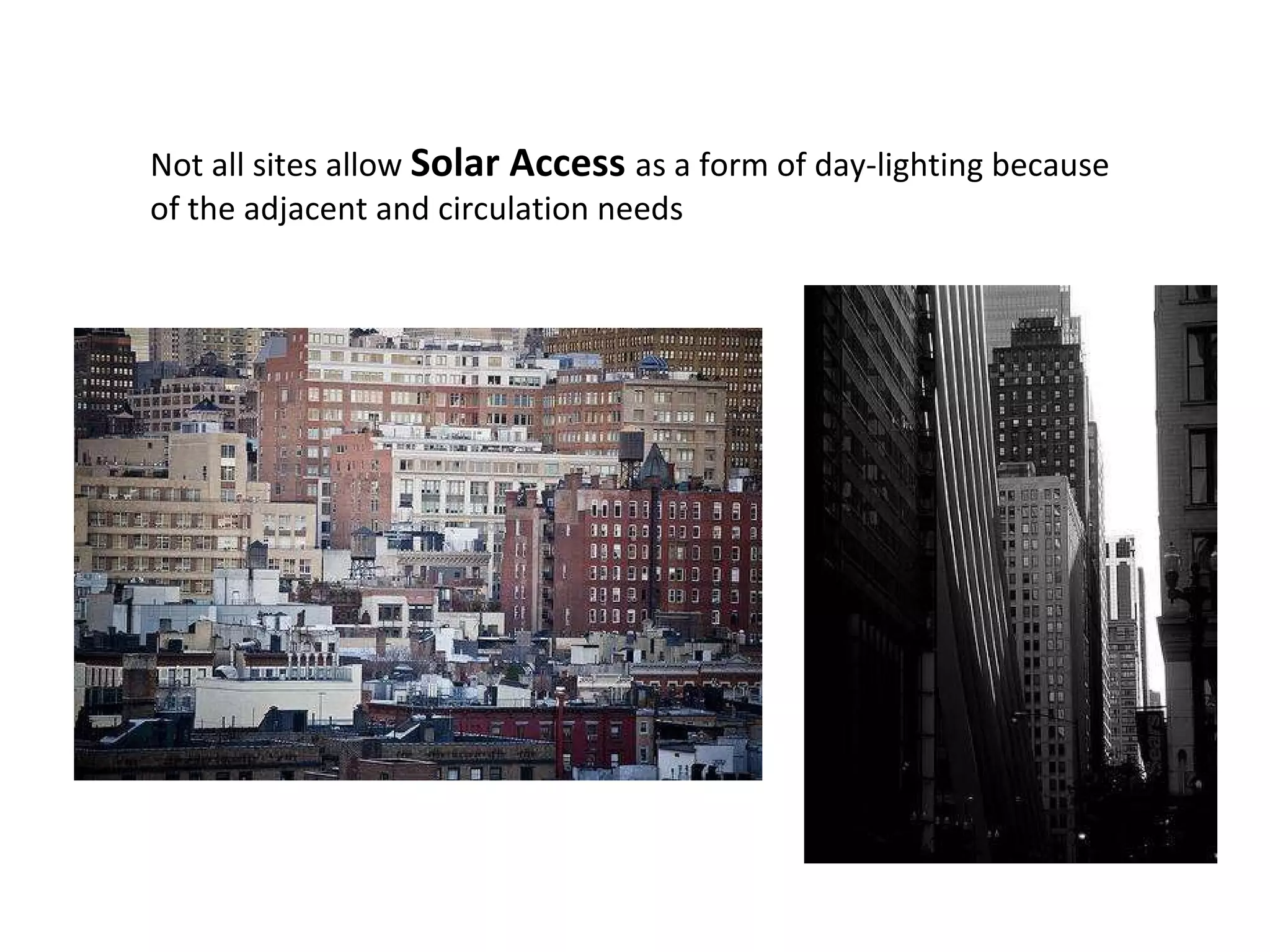
Not all sites allow  Solar Access  as a form of day-lighting because of the adjacent and circulation needs
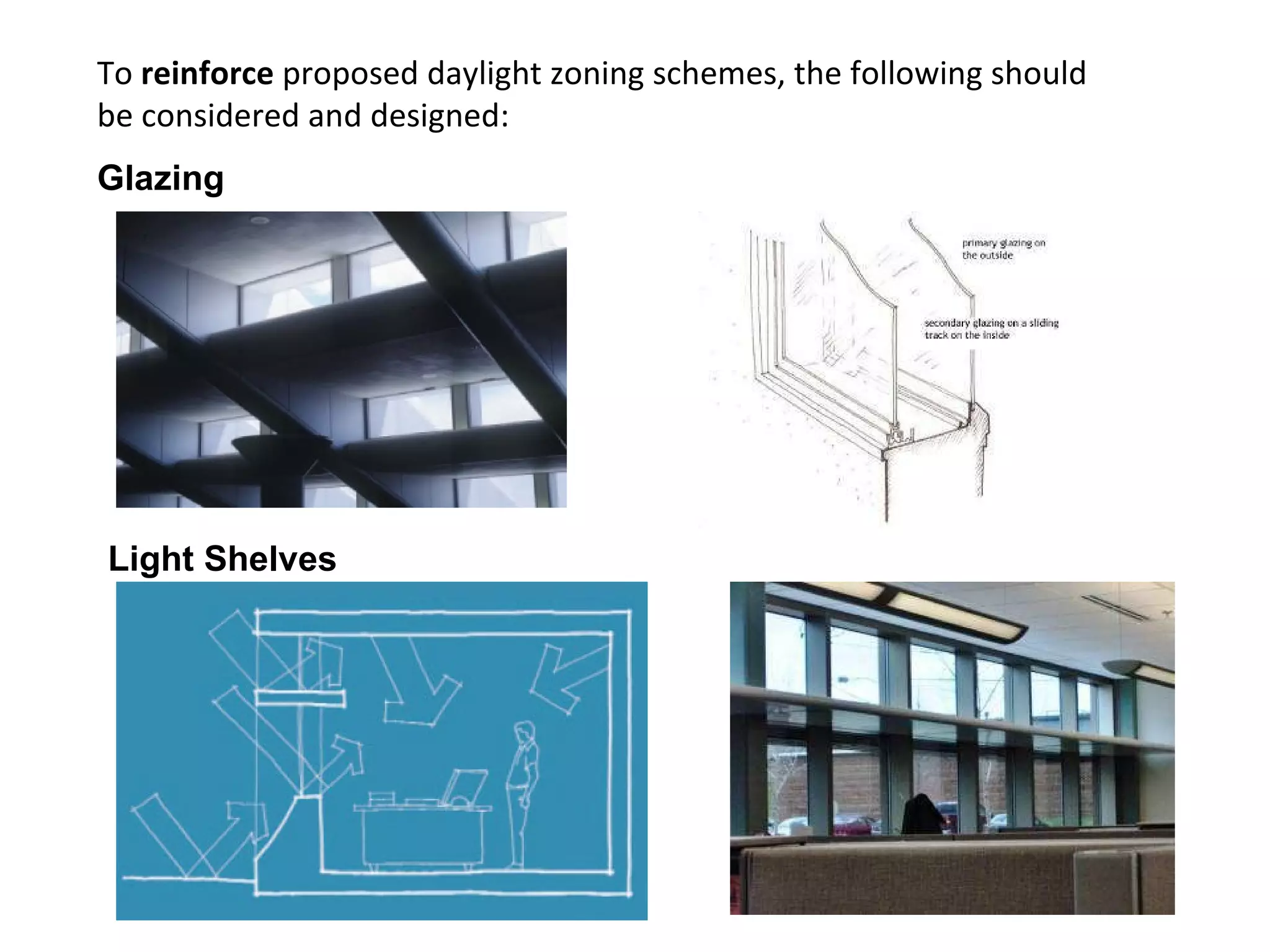
To  reinforce  proposed daylight zoning schemes, the following should be considered and designed: Glazing Light Shelves
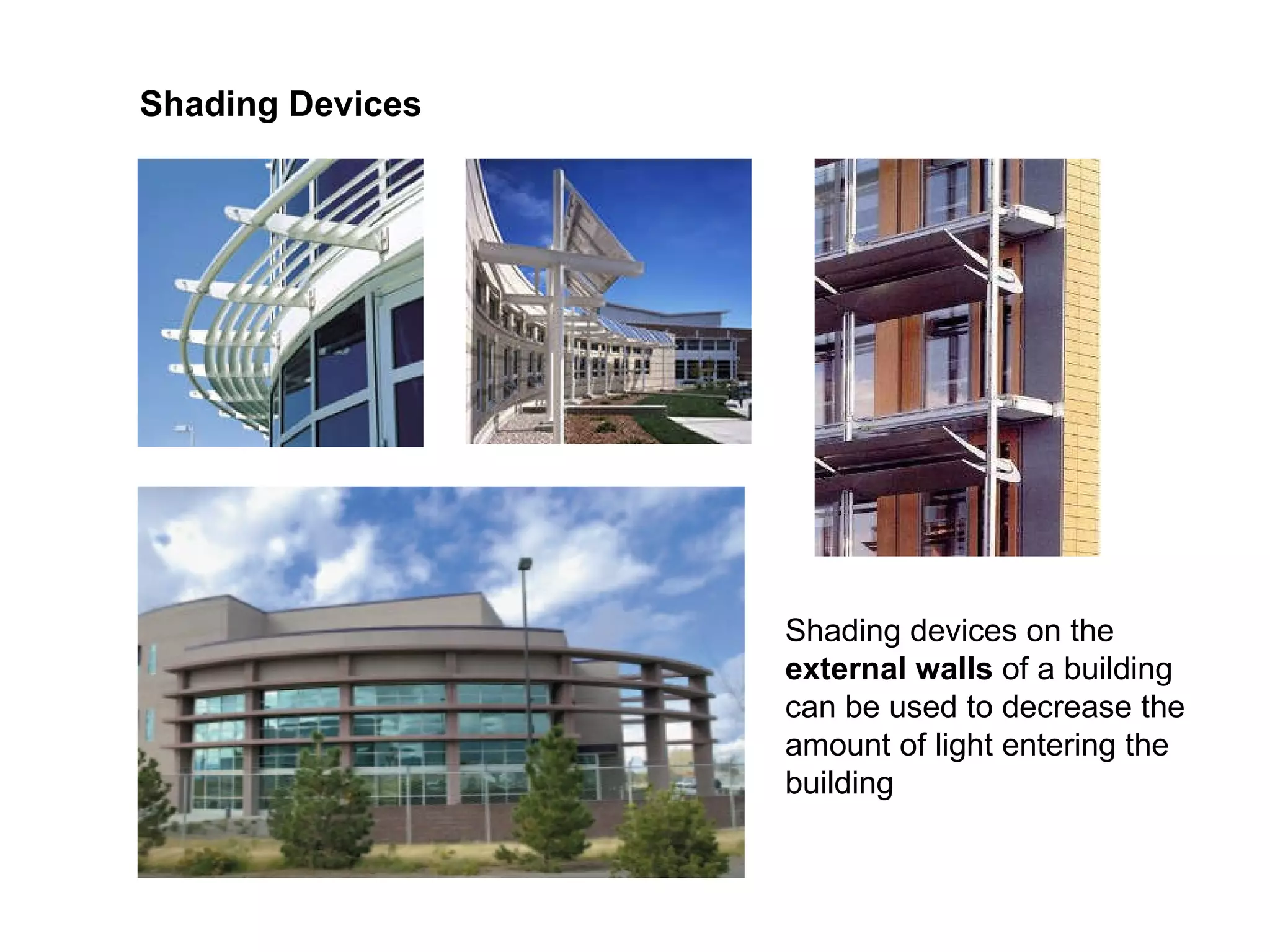
Shading devices on the  external walls  of a building can be used to decrease the amount of light entering the building Shading Devices
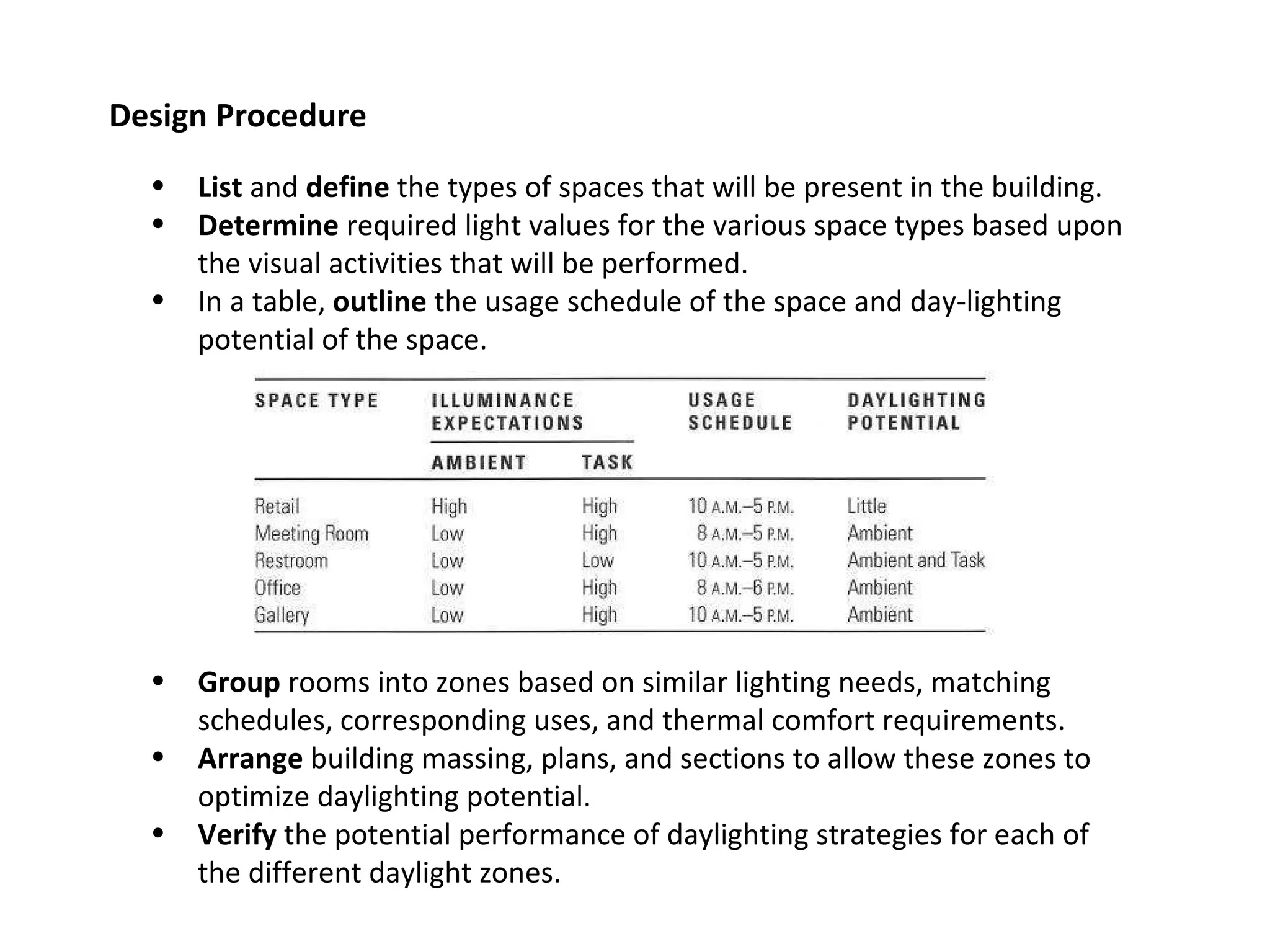
Design Procedure List  and  define  the types of spaces that will be present in the building. Determine  required light values for the various space types based upon the visual activities that will be performed. In a table,  outline  the usage schedule of the space and day-lighting potential of the space. Group  rooms into zones based on similar lighting needs, matching schedules, corresponding uses, and thermal comfort requirements.  Arrange  building massing, plans, and sections to allow these zones to optimize daylighting potential. Verify  the potential performance of daylighting strategies for each of the different daylight zones.
Measurement would show how  far  into the room will the  side-lighting  extent reach depending on how big the window openings are
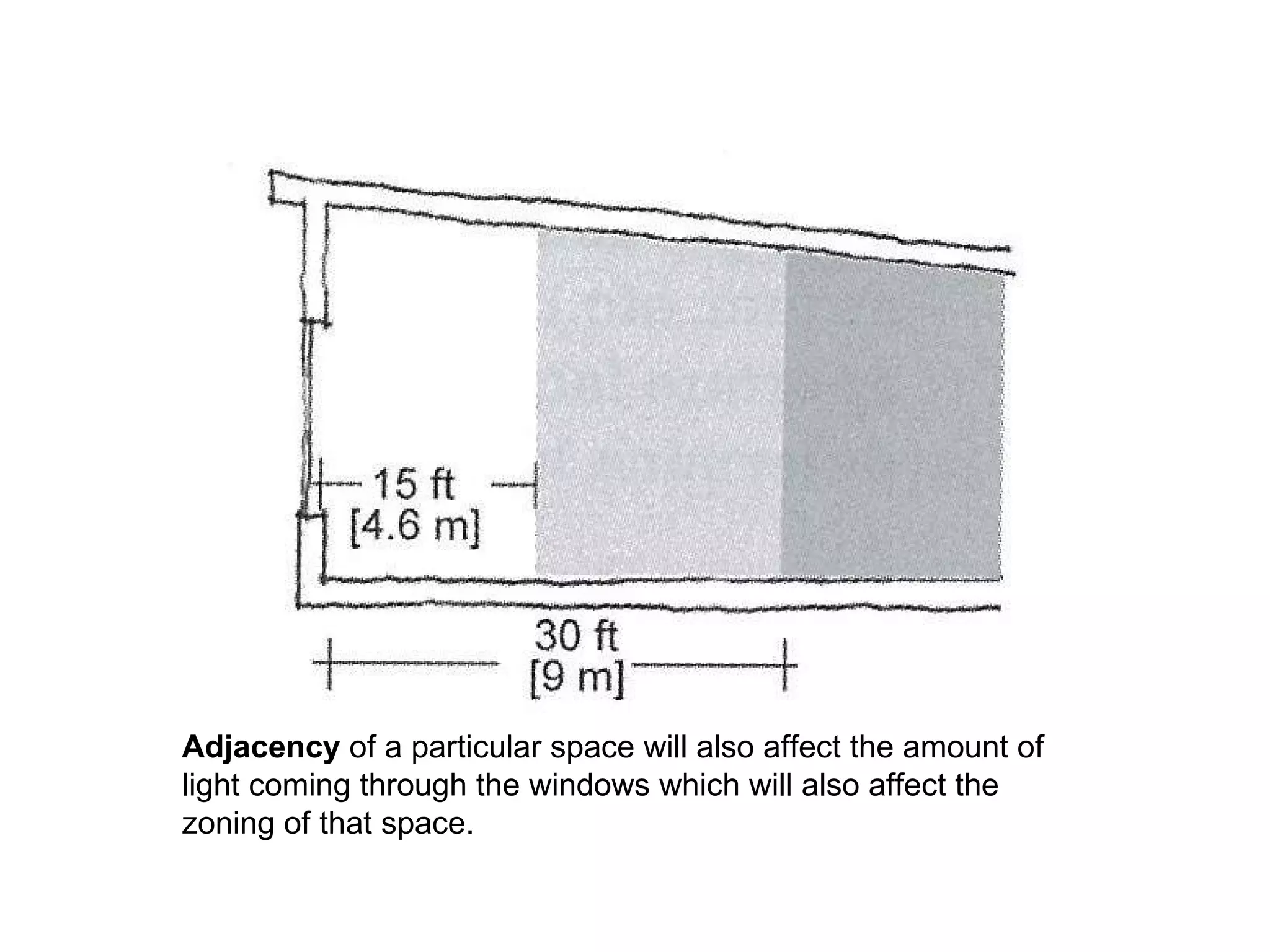
Adjacency  of a particular space will also affect the amount of light coming through the windows which will also affect the zoning of that space.
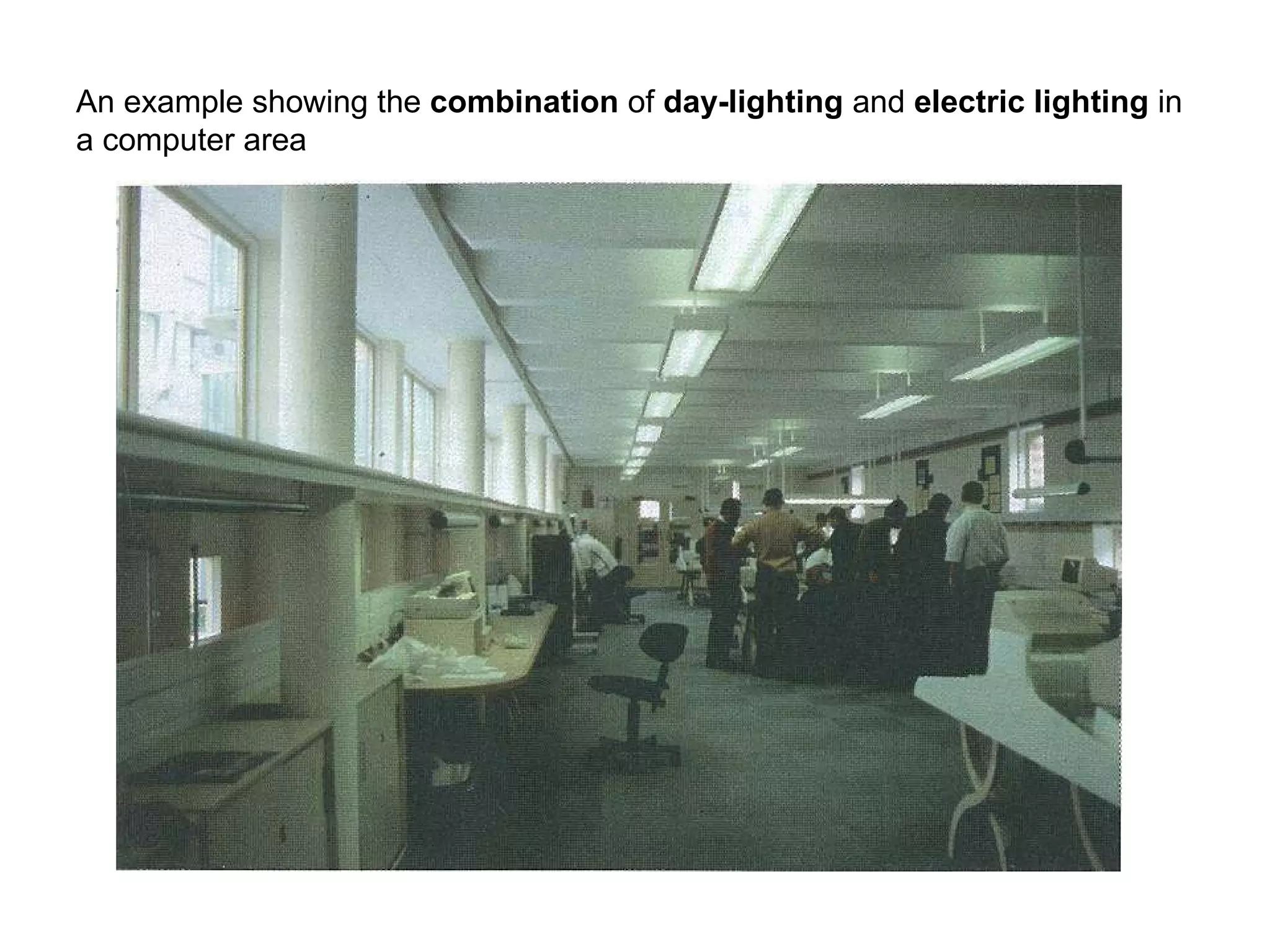
An example showing the  combination  of  day-lighting  and  electric lighting  in a computer area
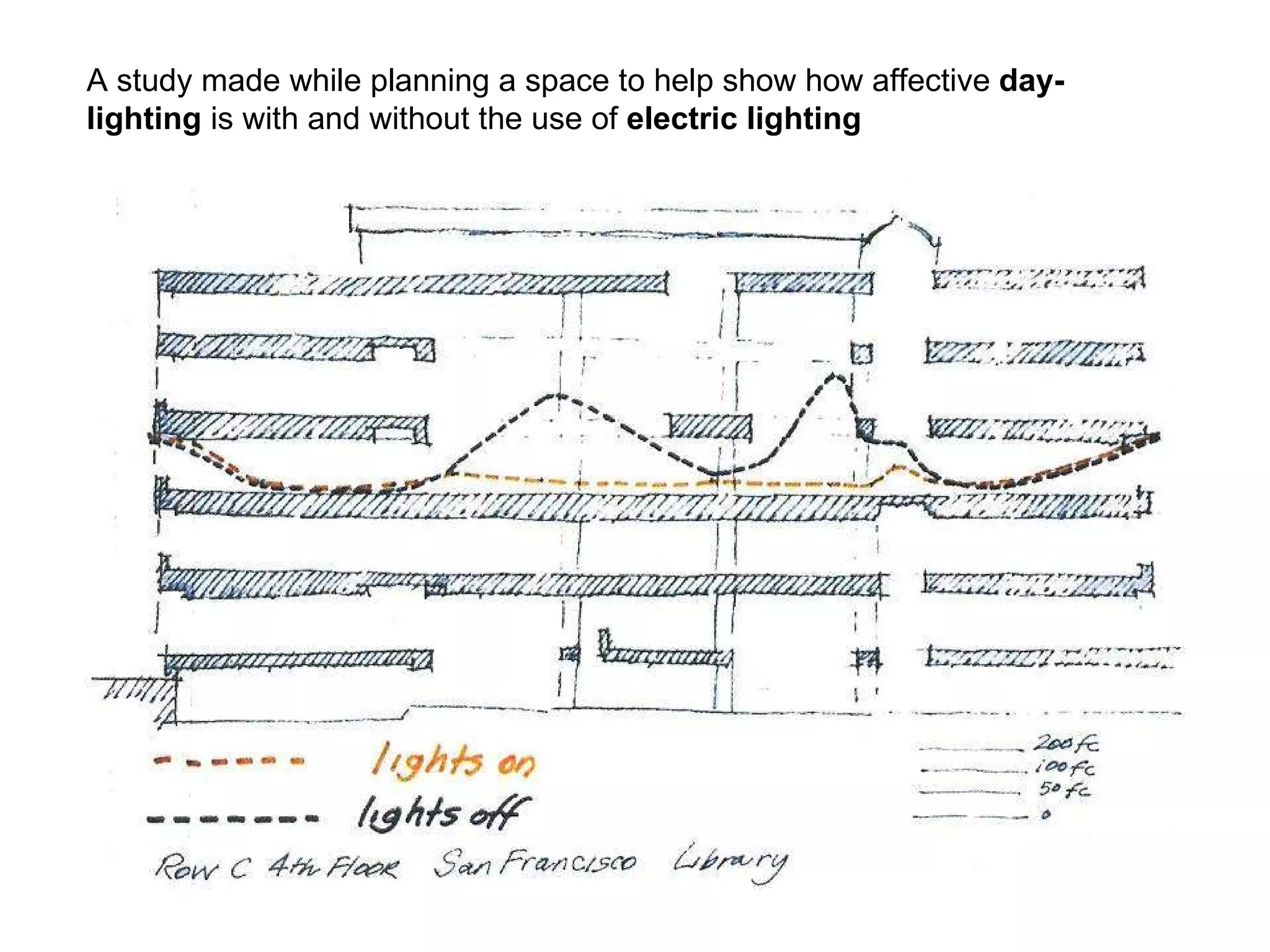
A study made while planning a space to help show how affective  day-lighting  is with and without the use of  electric lighting
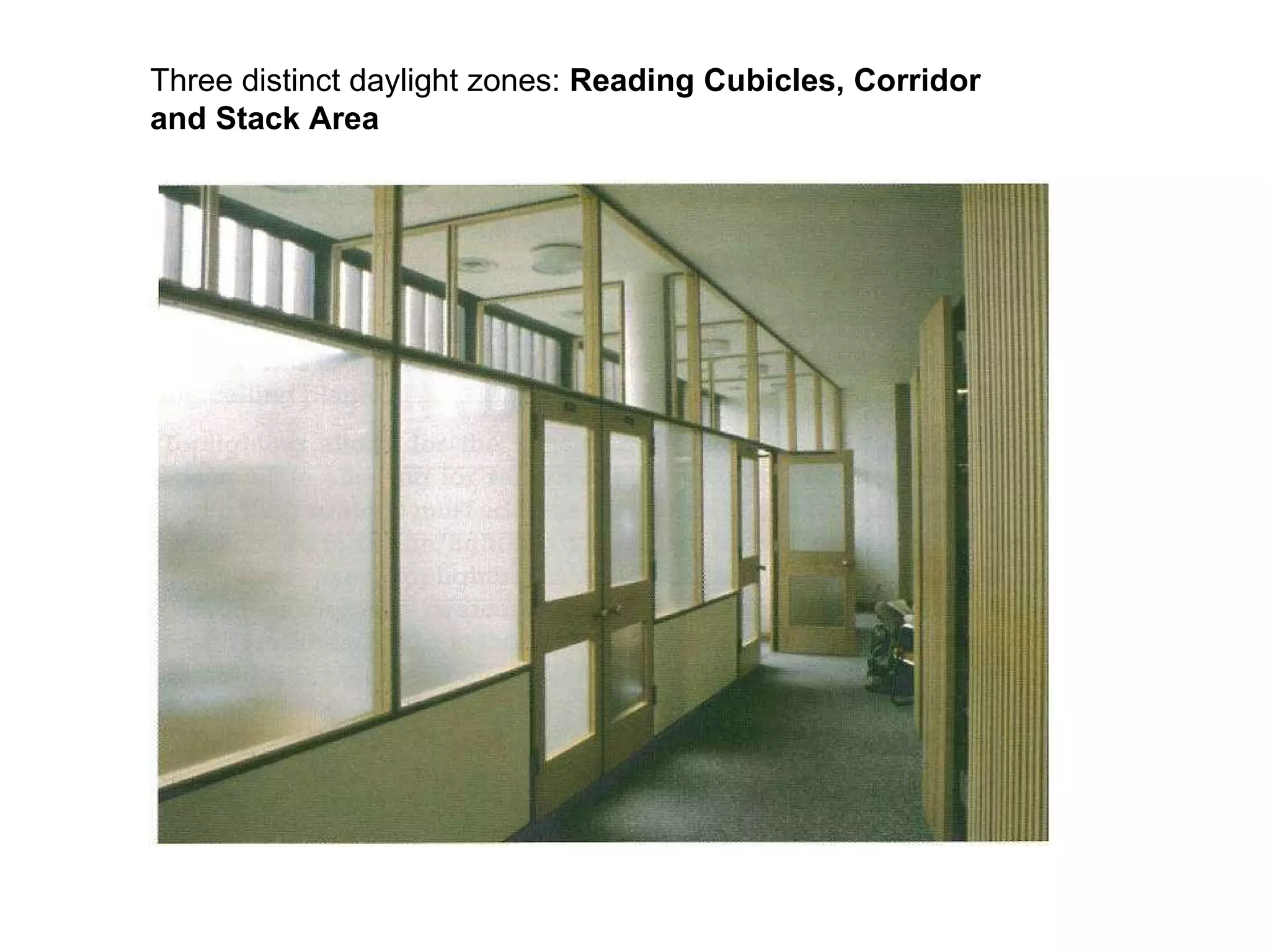
Three distinct daylight zones:  Reading Cubicles, Corridor and Stack Area
Chapter 4 2.3 Toplighting
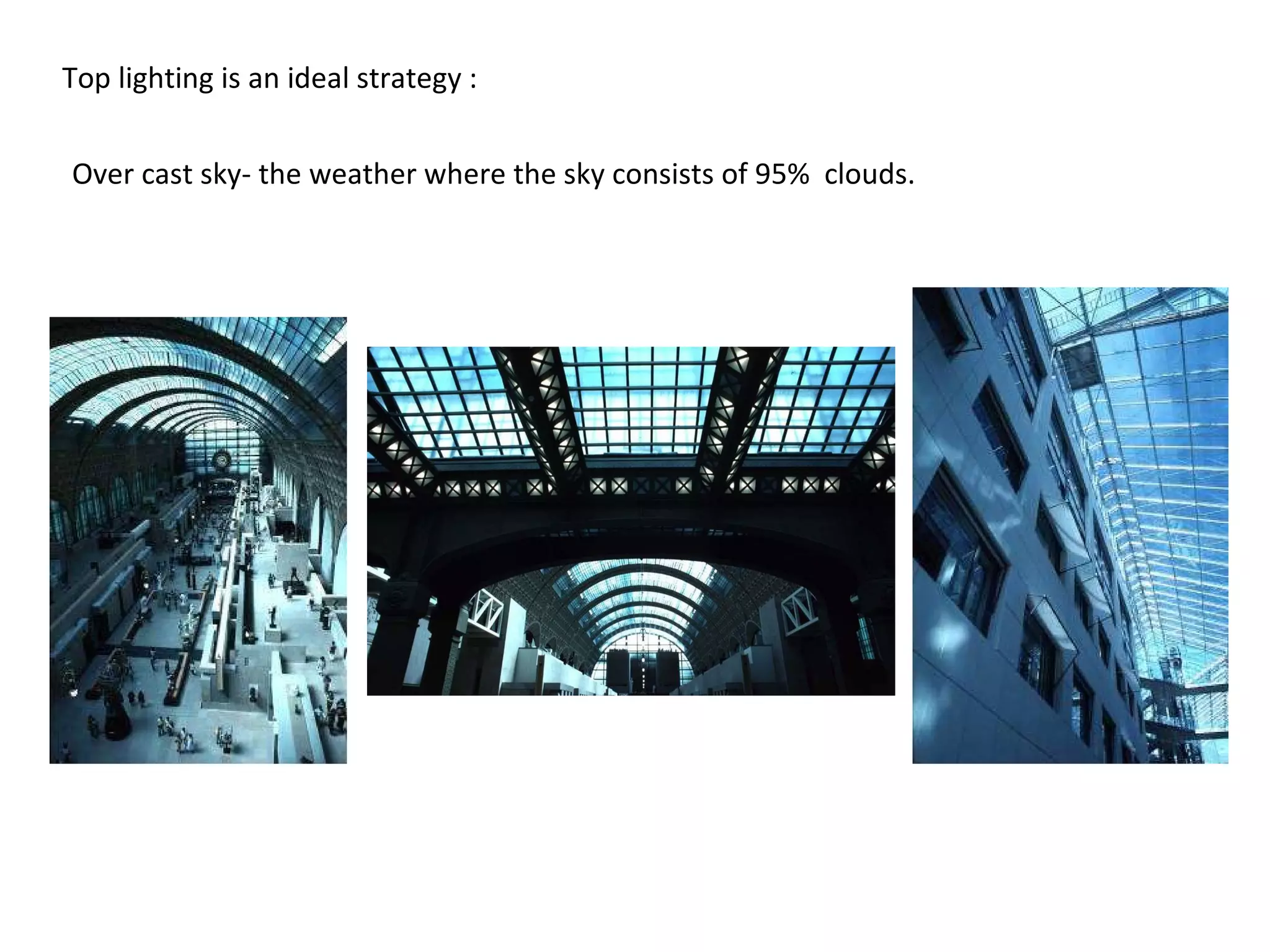
Top Lighting Is a day light strategy that uses openings  located at the roof plane as the point of admission for the surrounding daylight. TopLighted cault  in  musee de orsay ,Paris
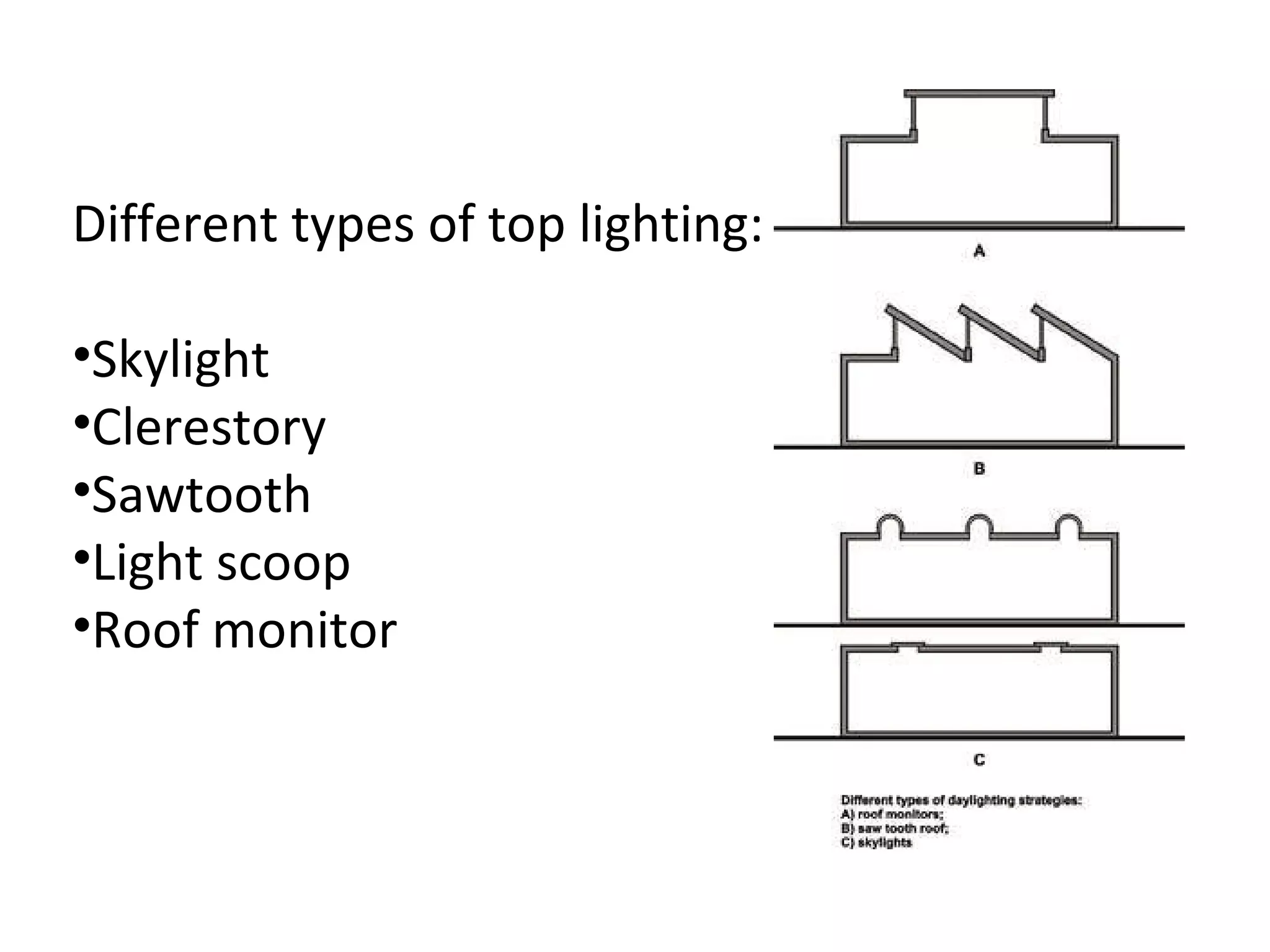
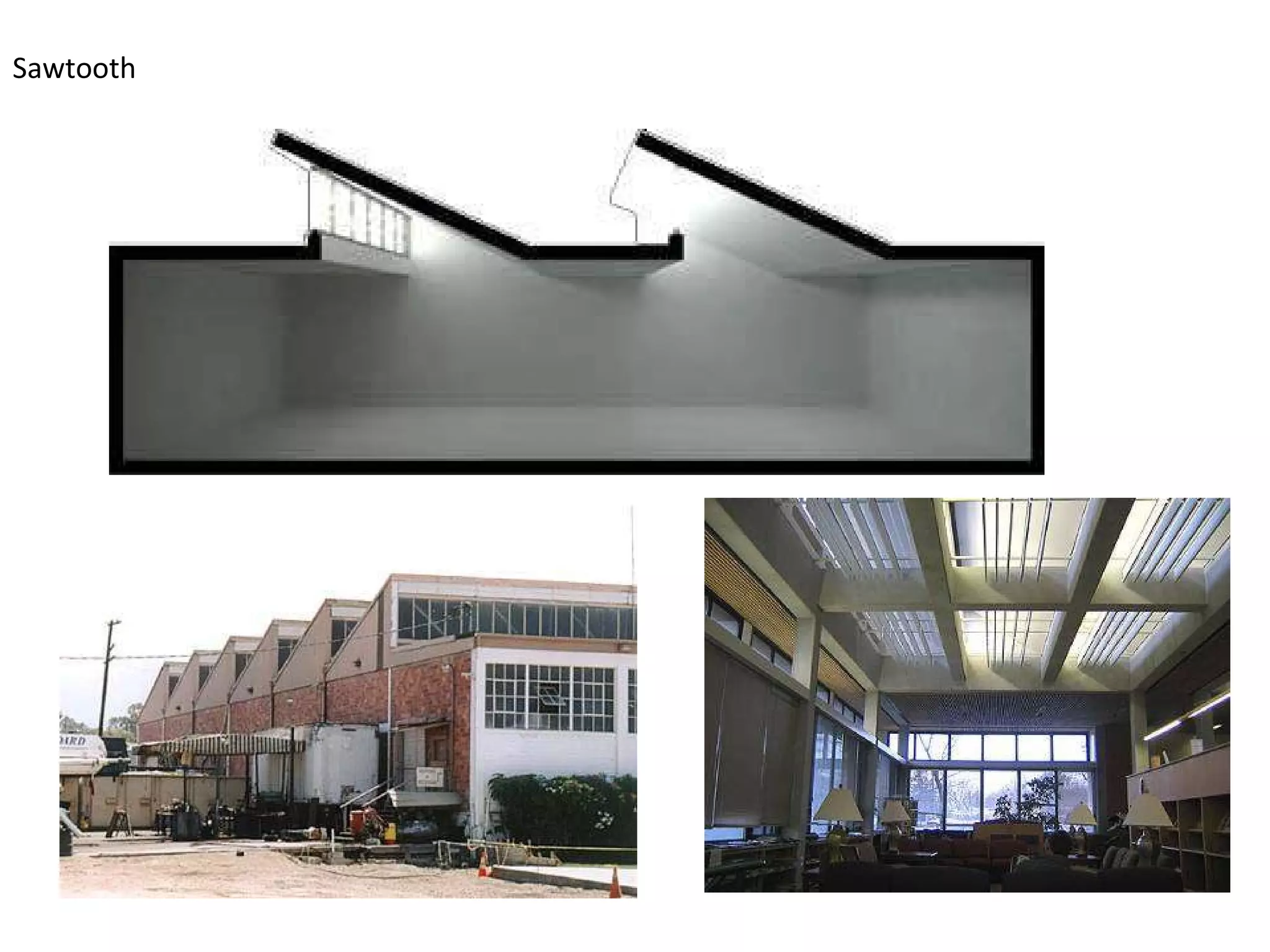
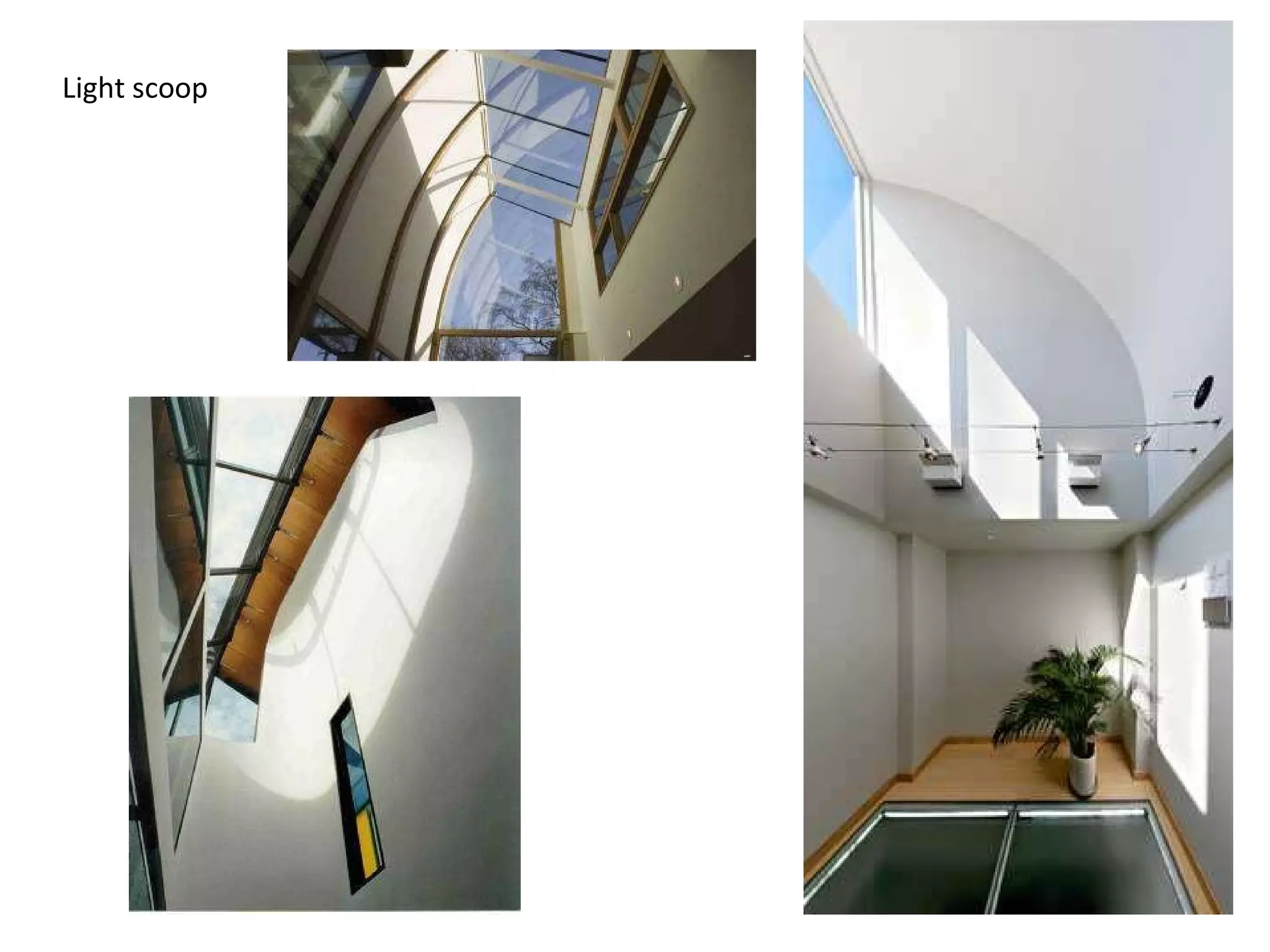
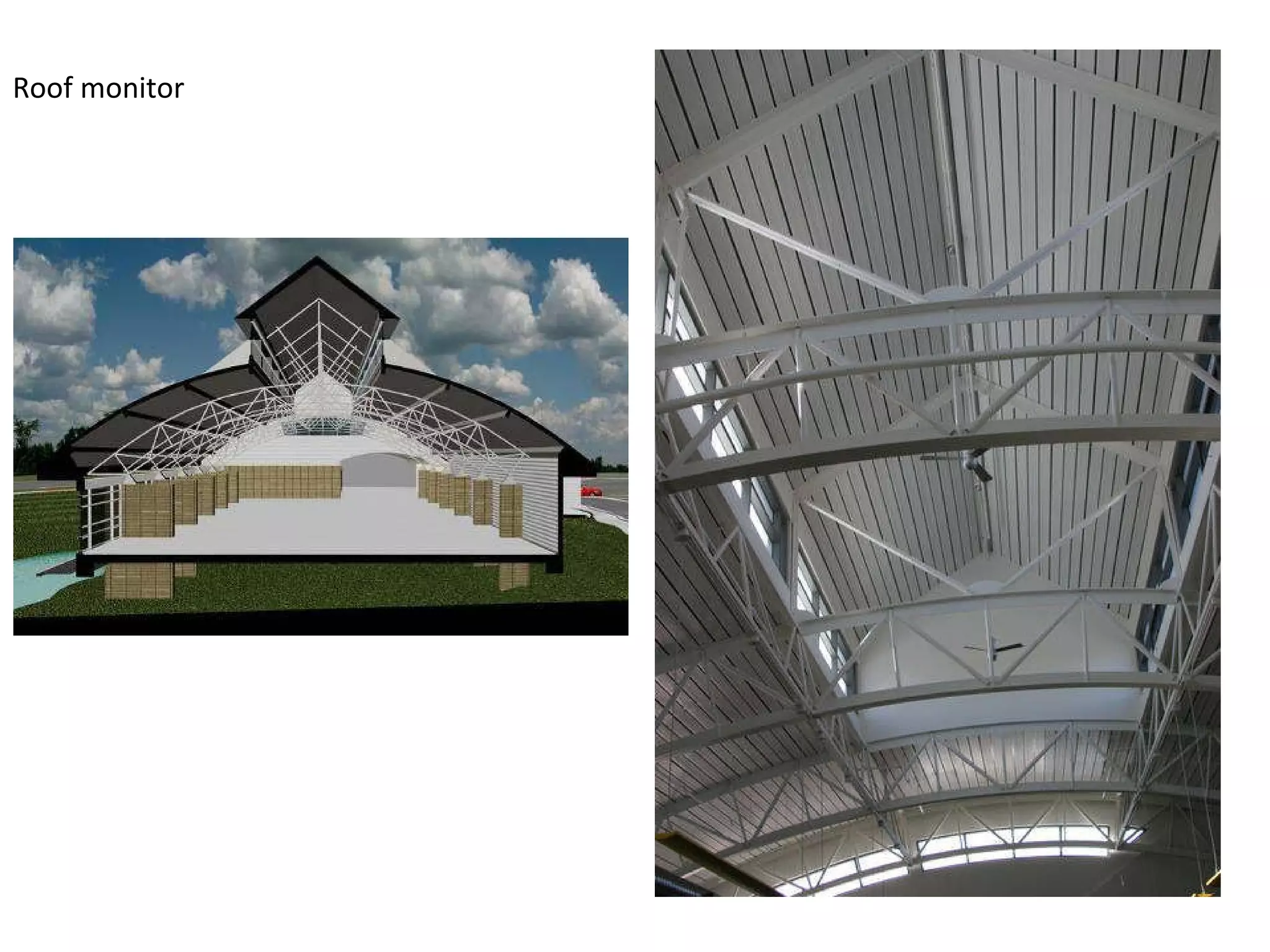
Different types of top lighting: Skylight  Clerestory Sawtooth Light scoop Roof monitor
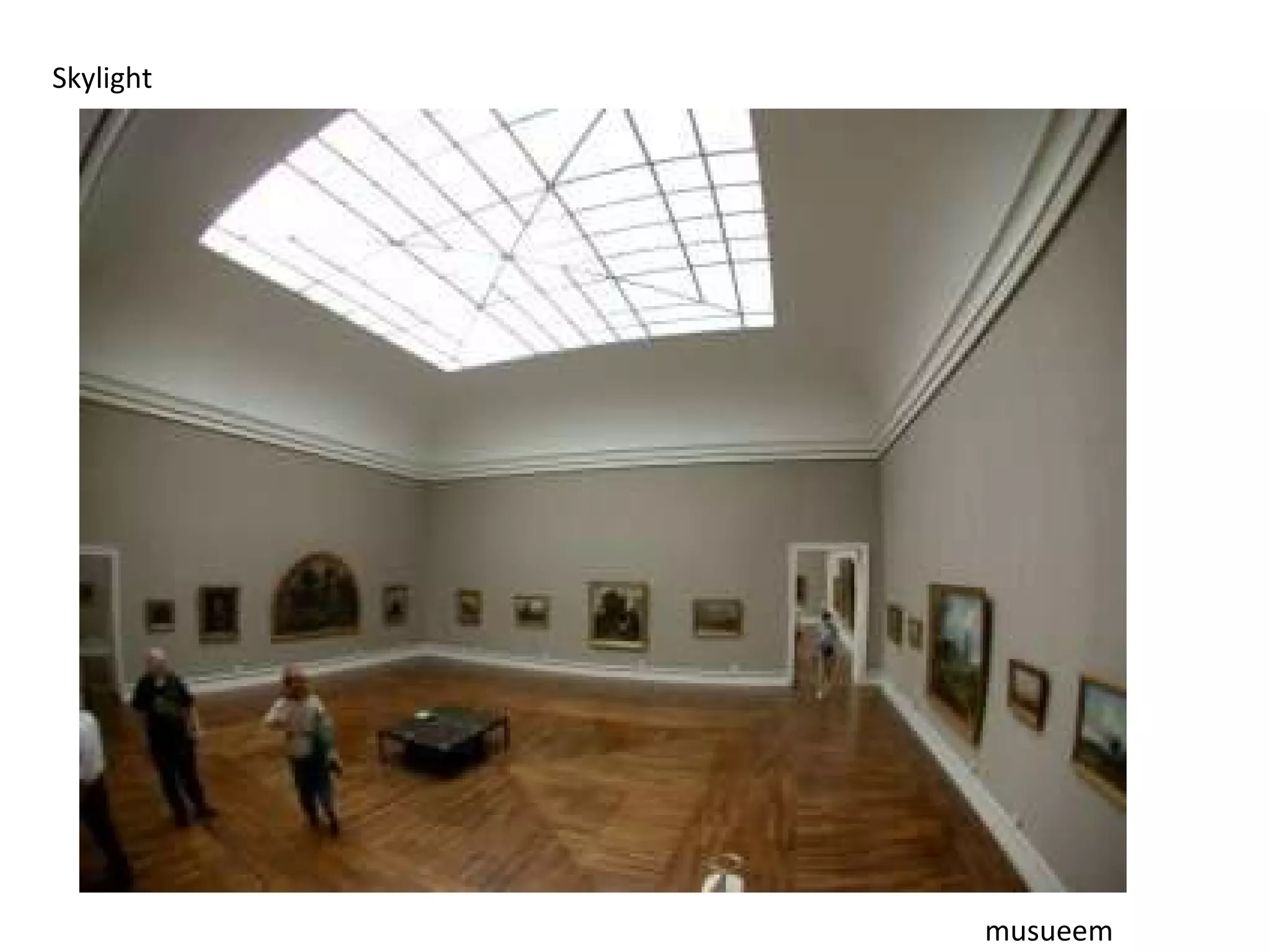
Skylight musueem
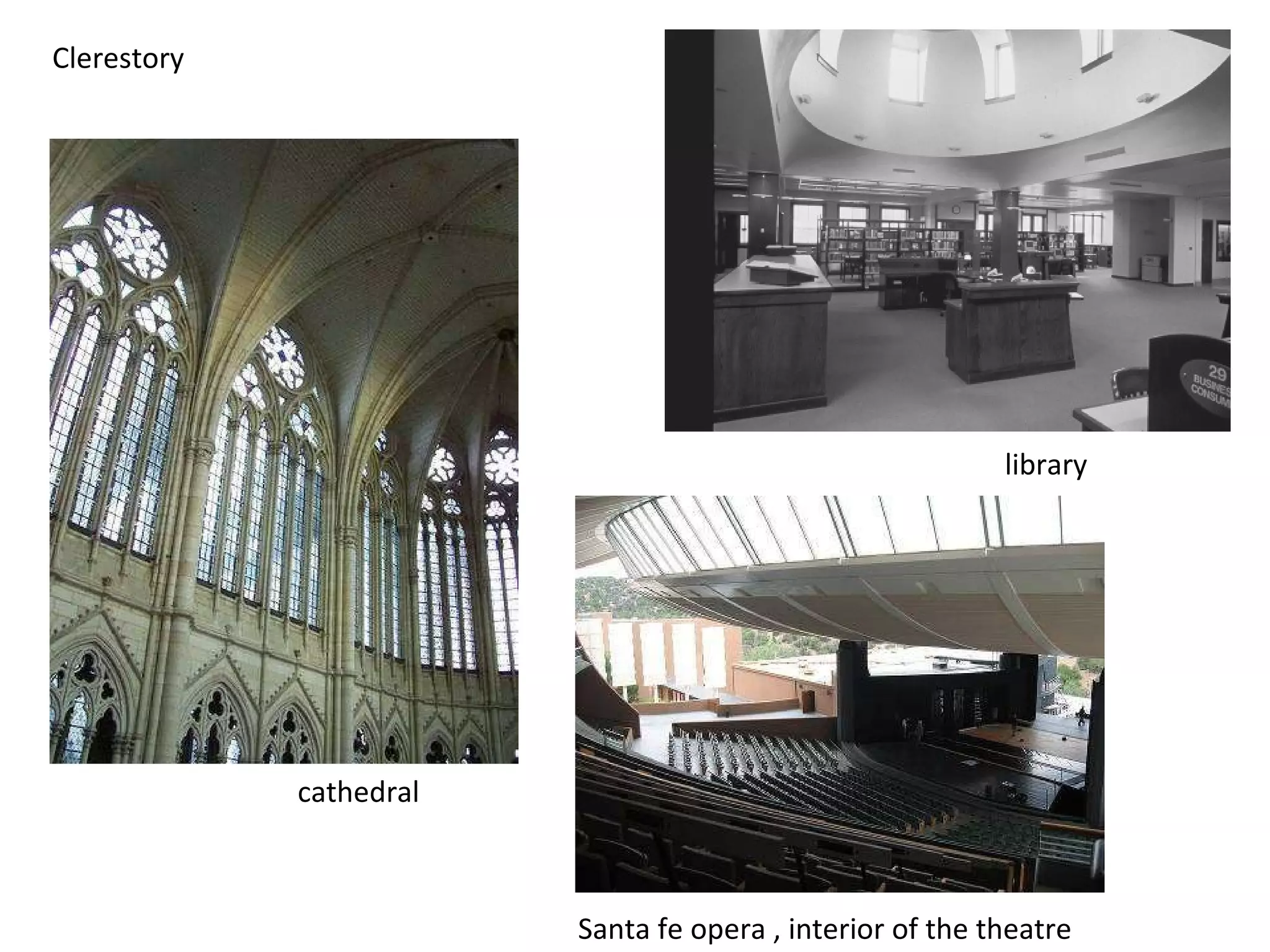
Clerestory library cathedral  Santa fe opera , interior of the theatre
Sawtooth
Light scoop
Roof monitor
Over cast sky- the weather where the sky consists of 95%  clouds.  Top lighting is an ideal strategy :
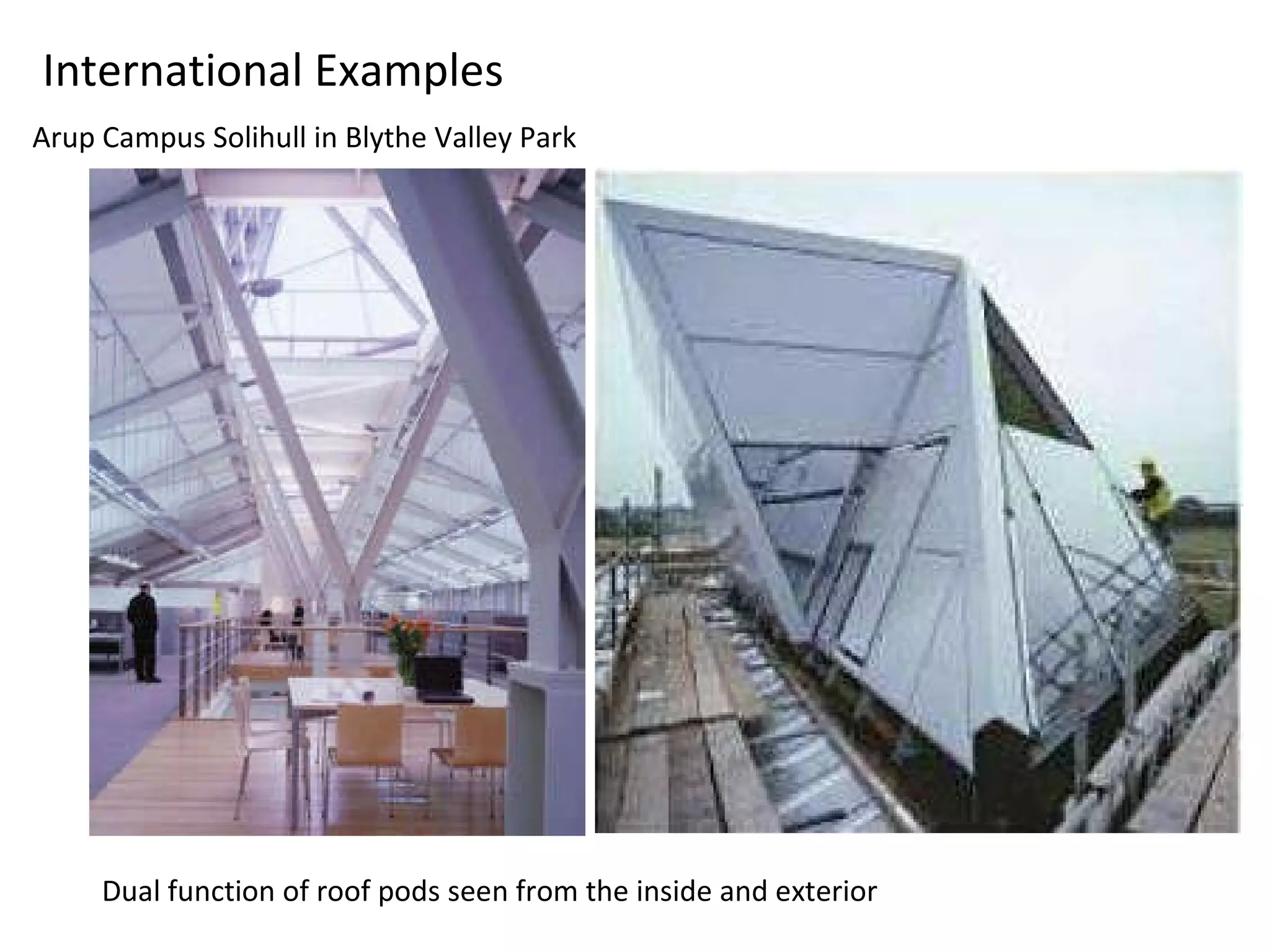
International Examples Arup Campus Solihull in Blythe Valley Park Dual function of roof pods seen from the inside and exterior
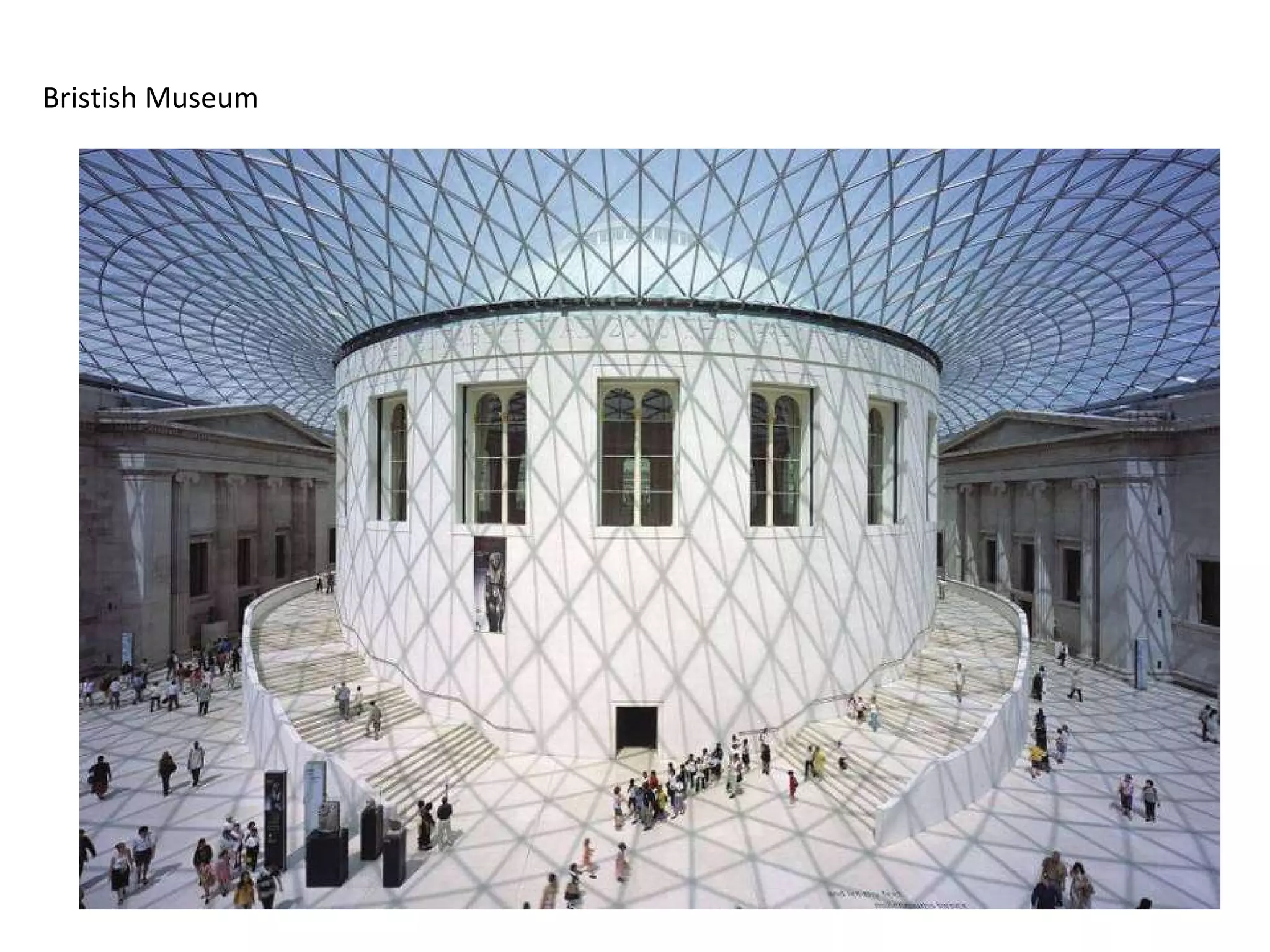
Bristish Museum
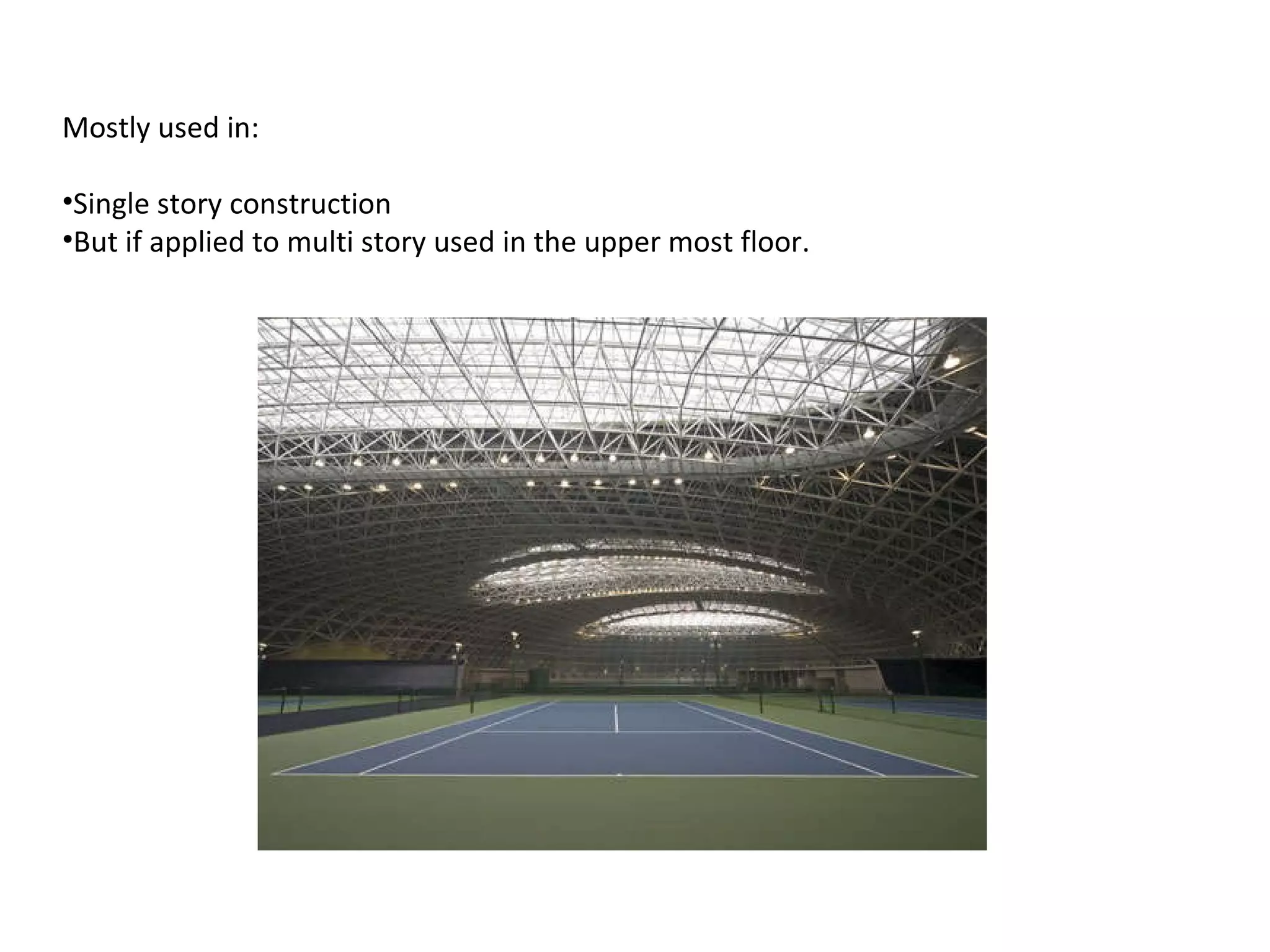
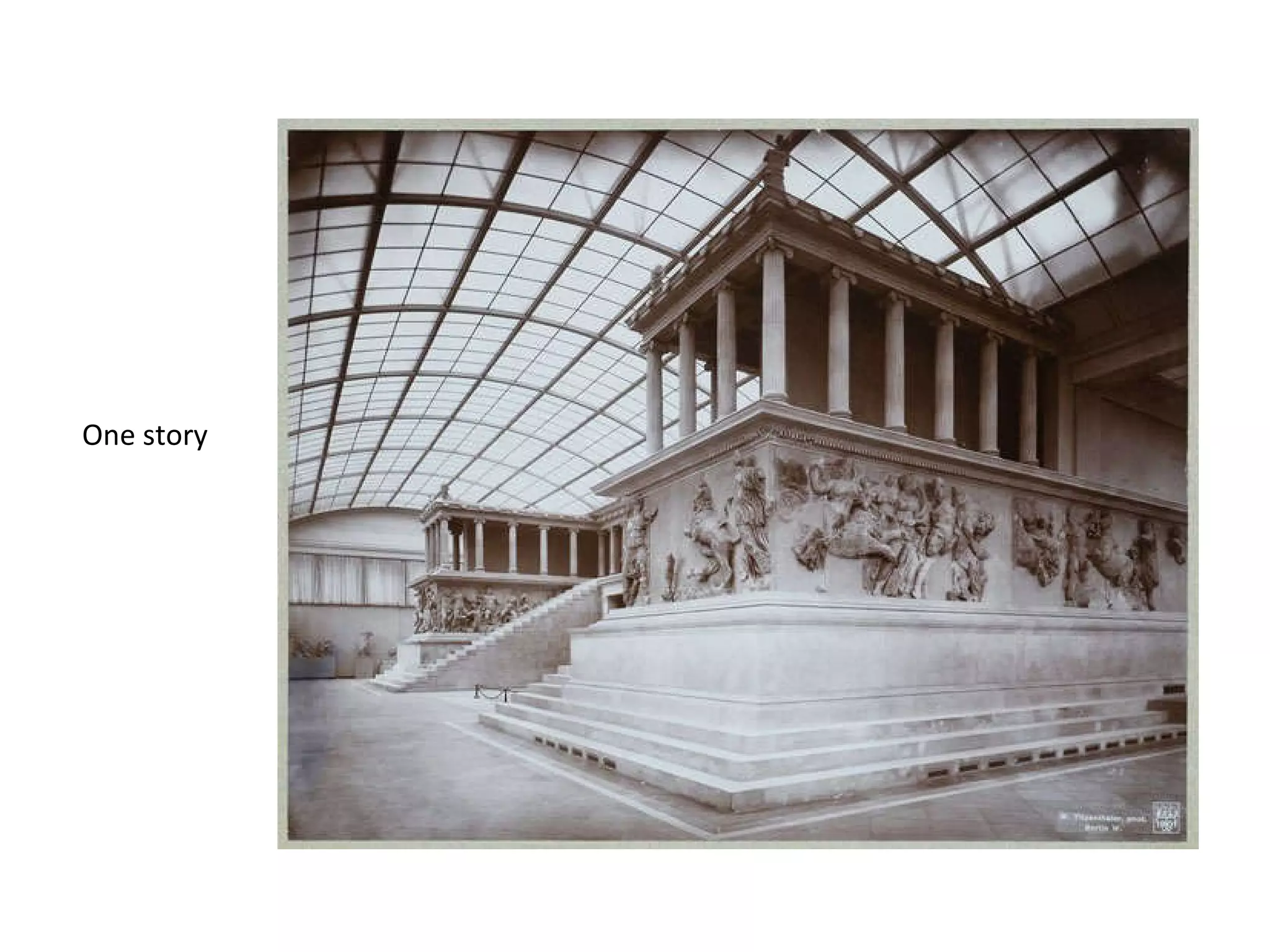
Mostly used in: Single story construction  But if applied to multi story used in the upper most floor.
One story
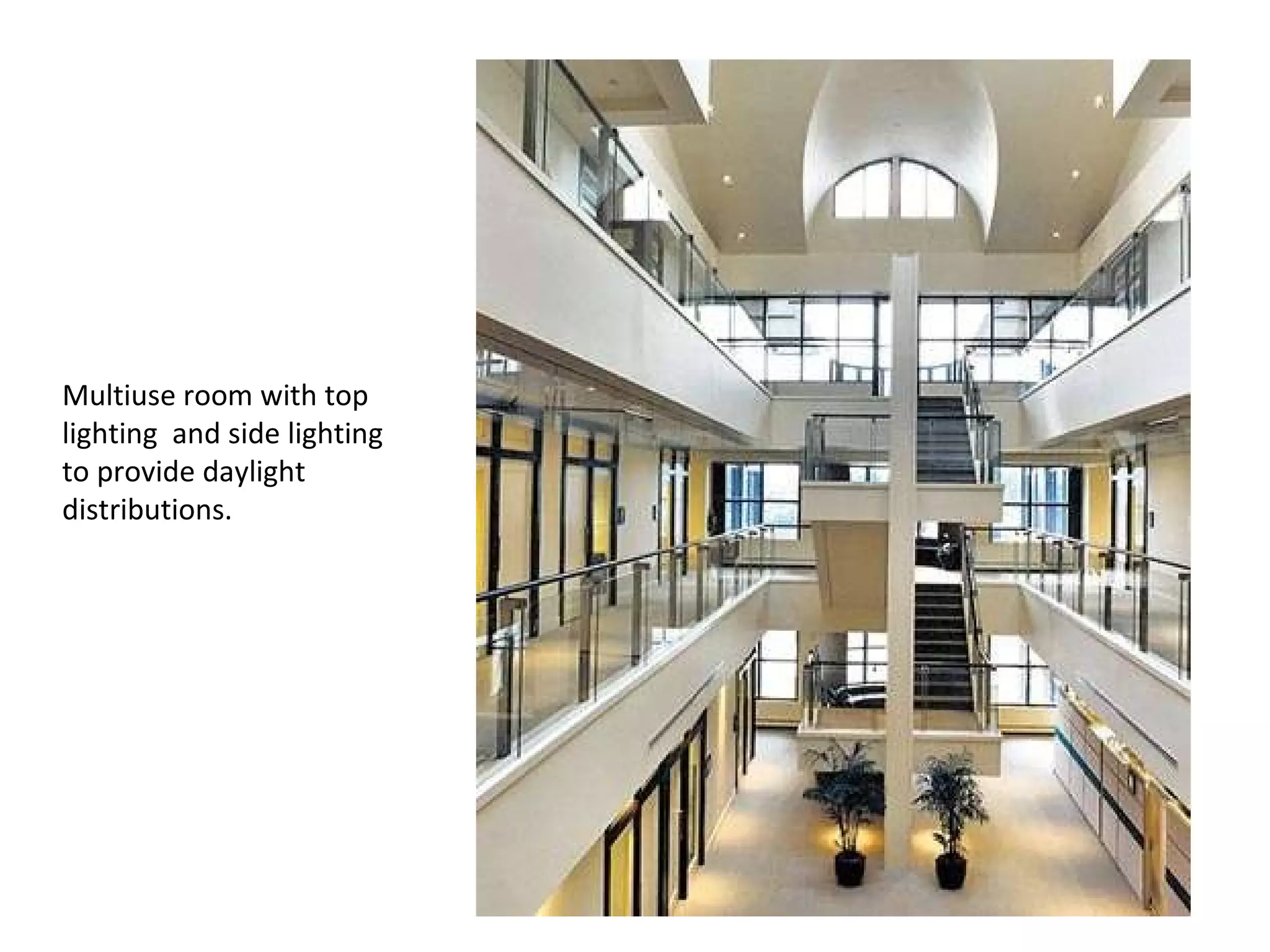
Multiuse room with top lighting  and side lighting to provide daylight distributions.
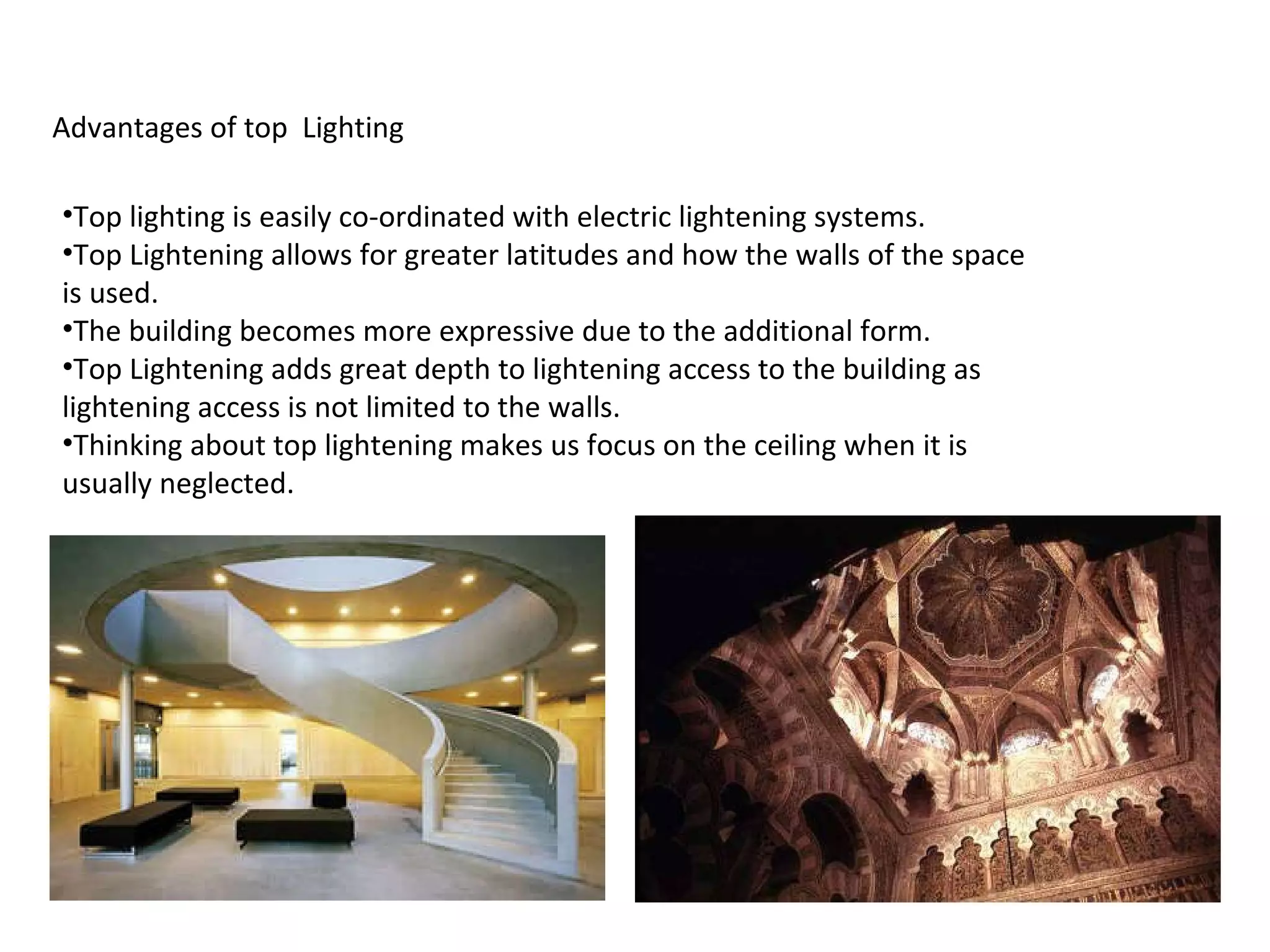
Advantages of top  Lighting Top lighting is easily co-ordinated with electric lightening systems. Top Lightening allows for greater latitudes and how the walls of the space is used. The building becomes more expressive due to the additional form. Top Lightening adds great depth to lightening access to the building as lightening access is not limited to the walls. Thinking about top lightening makes us focus on the ceiling when it is usually neglected.
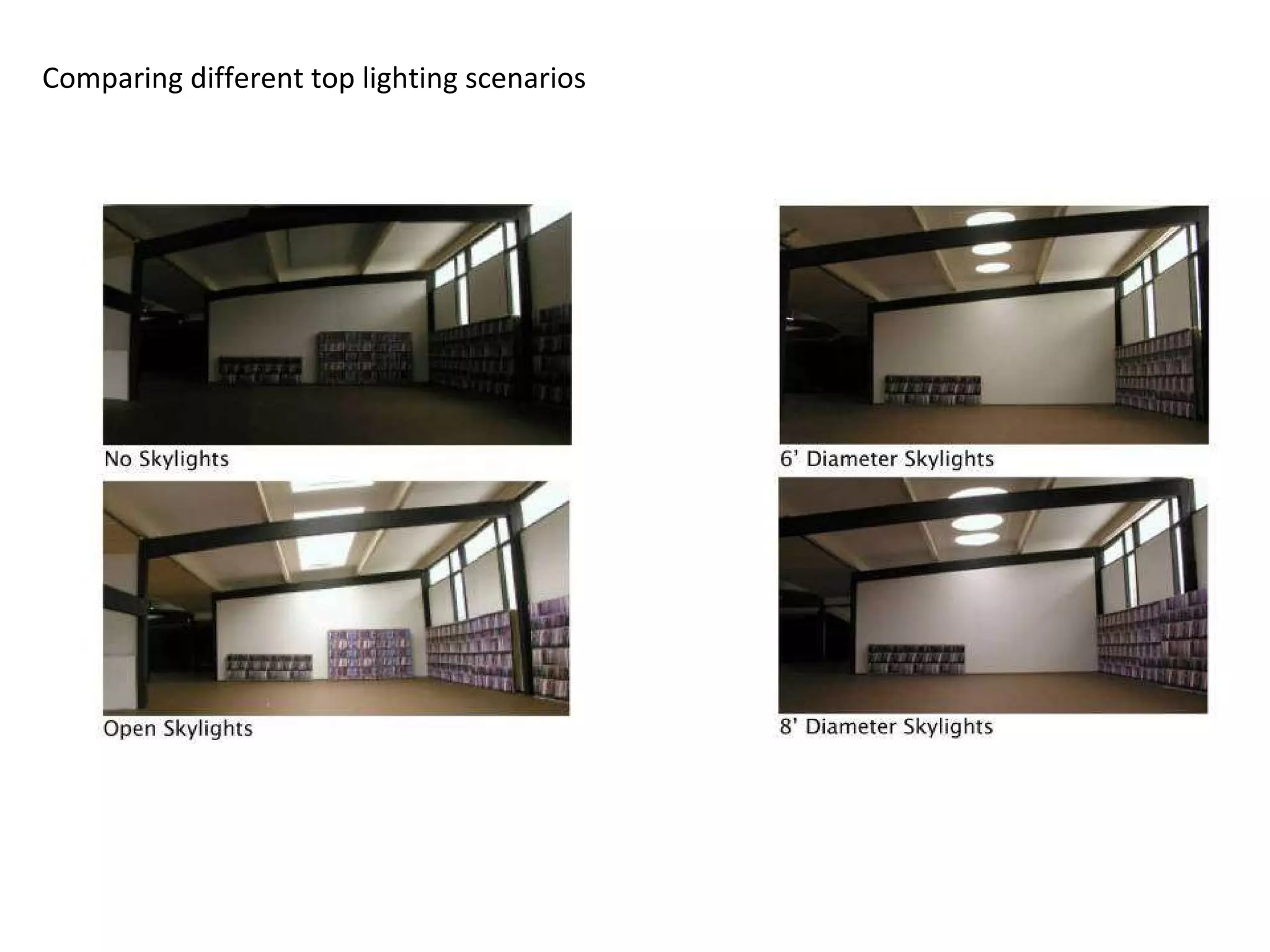
Comparing different top lighting scenarios
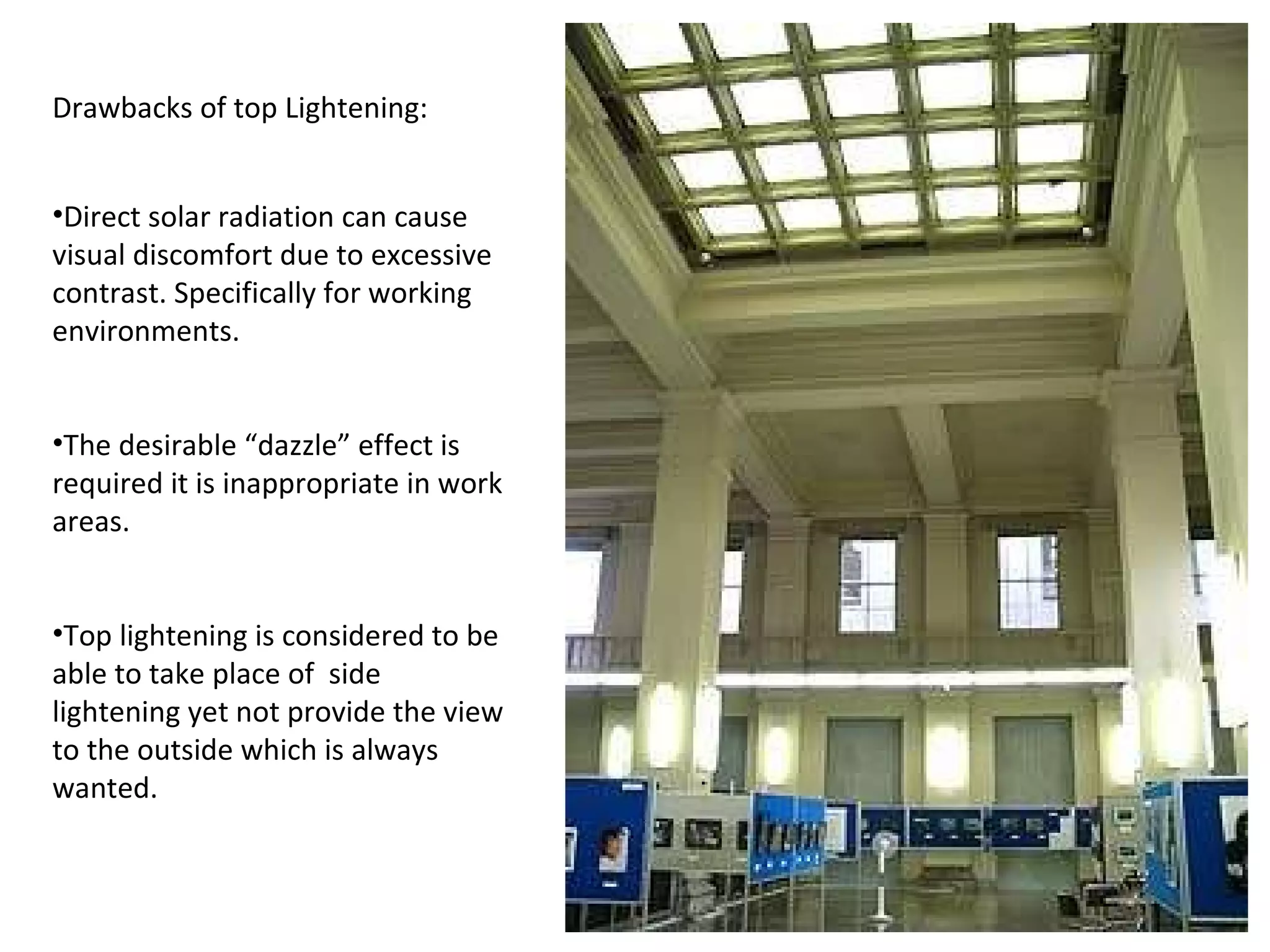
Drawbacks of top Lightening: Direct solar radiation can cause visual discomfort due to excessive contrast. Specifically for working environments. The desirable “dazzle” effect is required it is inappropriate in work areas. Top lightening is considered to be able to take place of  side lightening yet not provide the view to the outside which is always wanted.
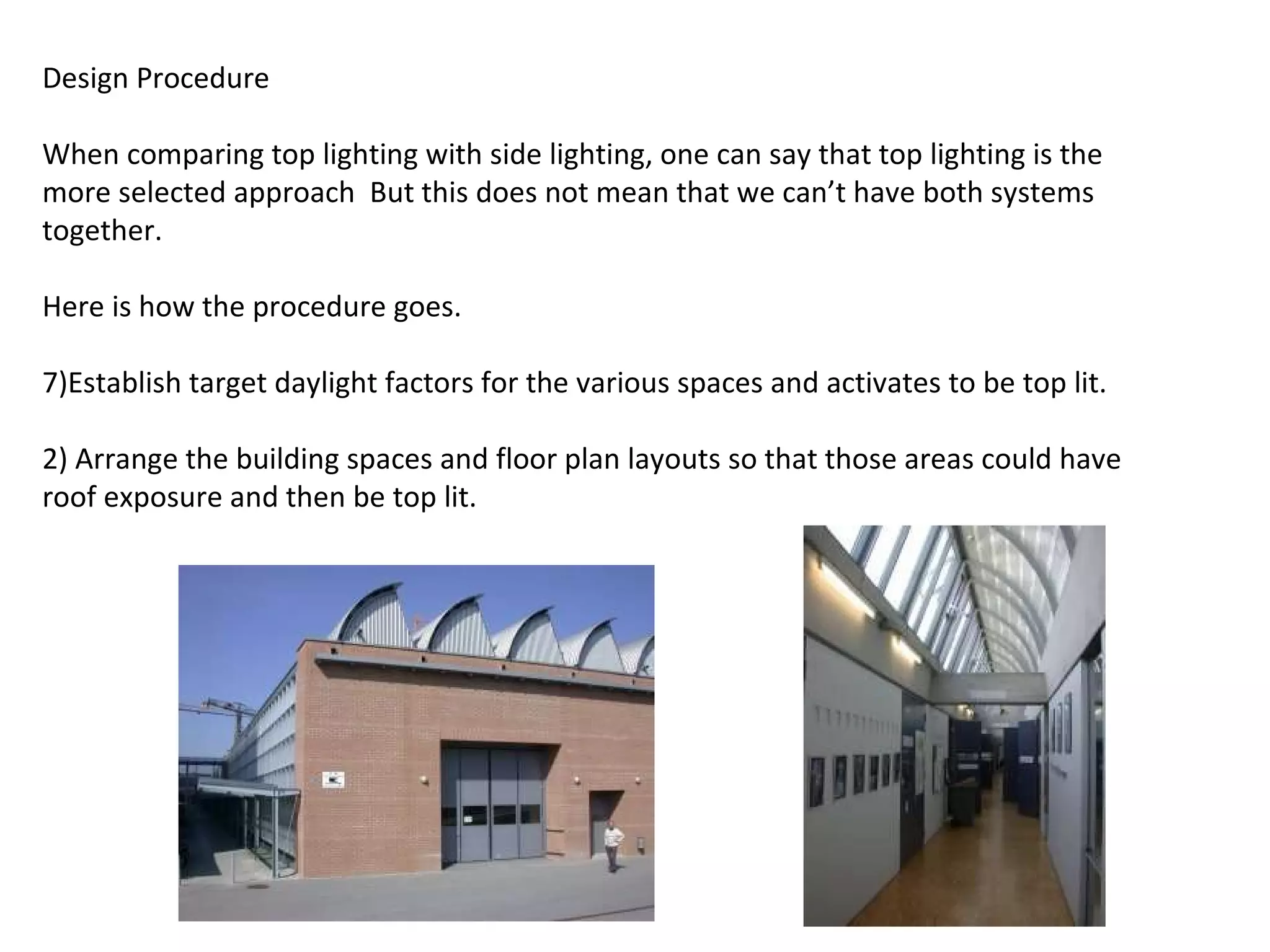
Design Procedure   When comparing top lighting with side lighting, one can say that top lighting is the more selected approach  But this does not mean that we can’t have both systems together.   Here is how the procedure goes.   Establish target daylight factors for the various spaces and activates to be top lit. 2) Arrange the building spaces and floor plan layouts so that those areas could have roof exposure and then be top lit.
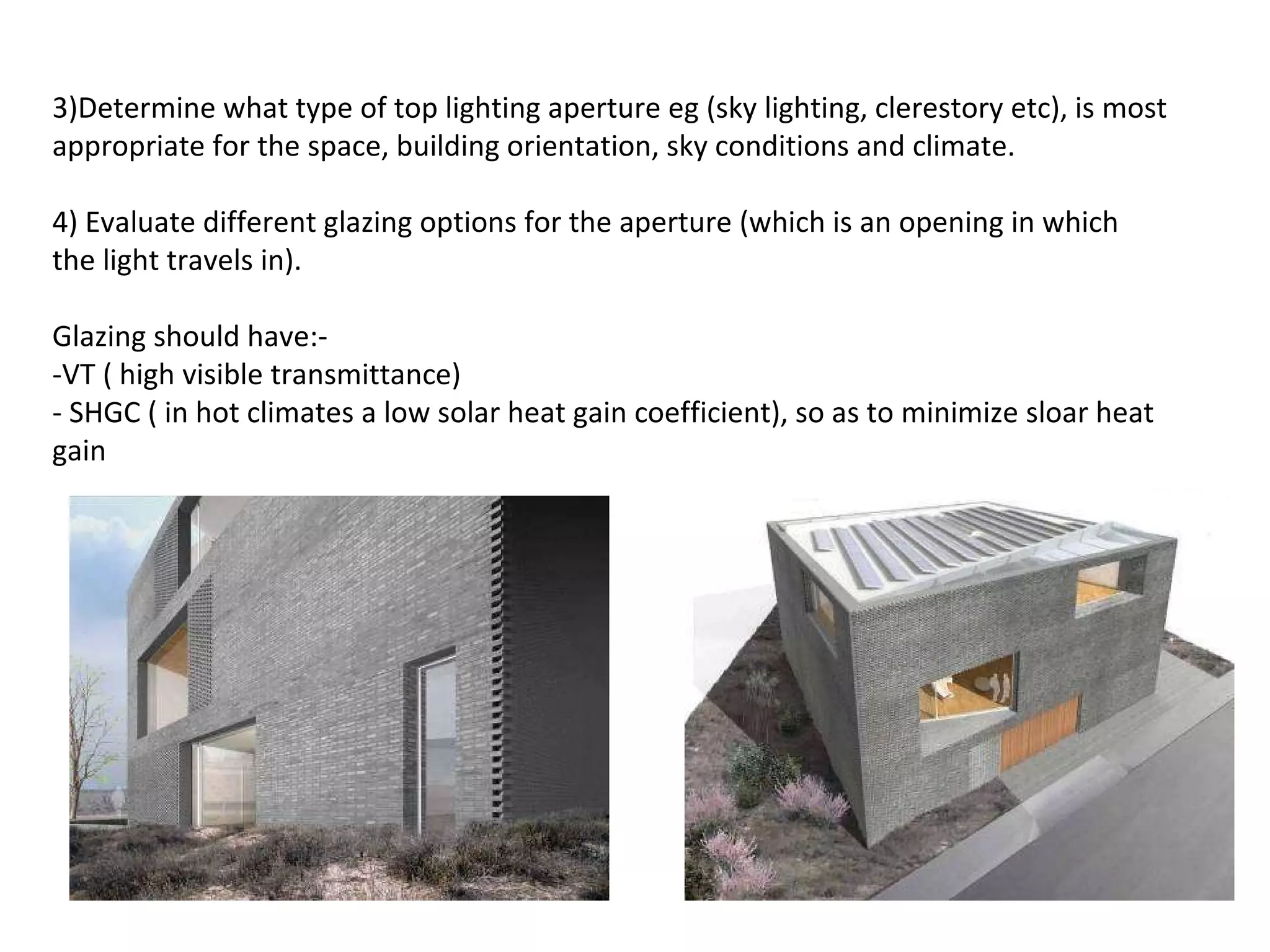
3)Determine what type of top lighting aperture eg (sky lighting, clerestory etc), is most appropriate for the space, building orientation, sky conditions and climate. 4) Evaluate different glazing options for the aperture (which is an opening in which the light travels in).    Glazing should have:-  -VT ( high visible transmittance) - SHGC ( in hot climates a low solar heat gain coefficient), so as to minimize sloar heat gain  
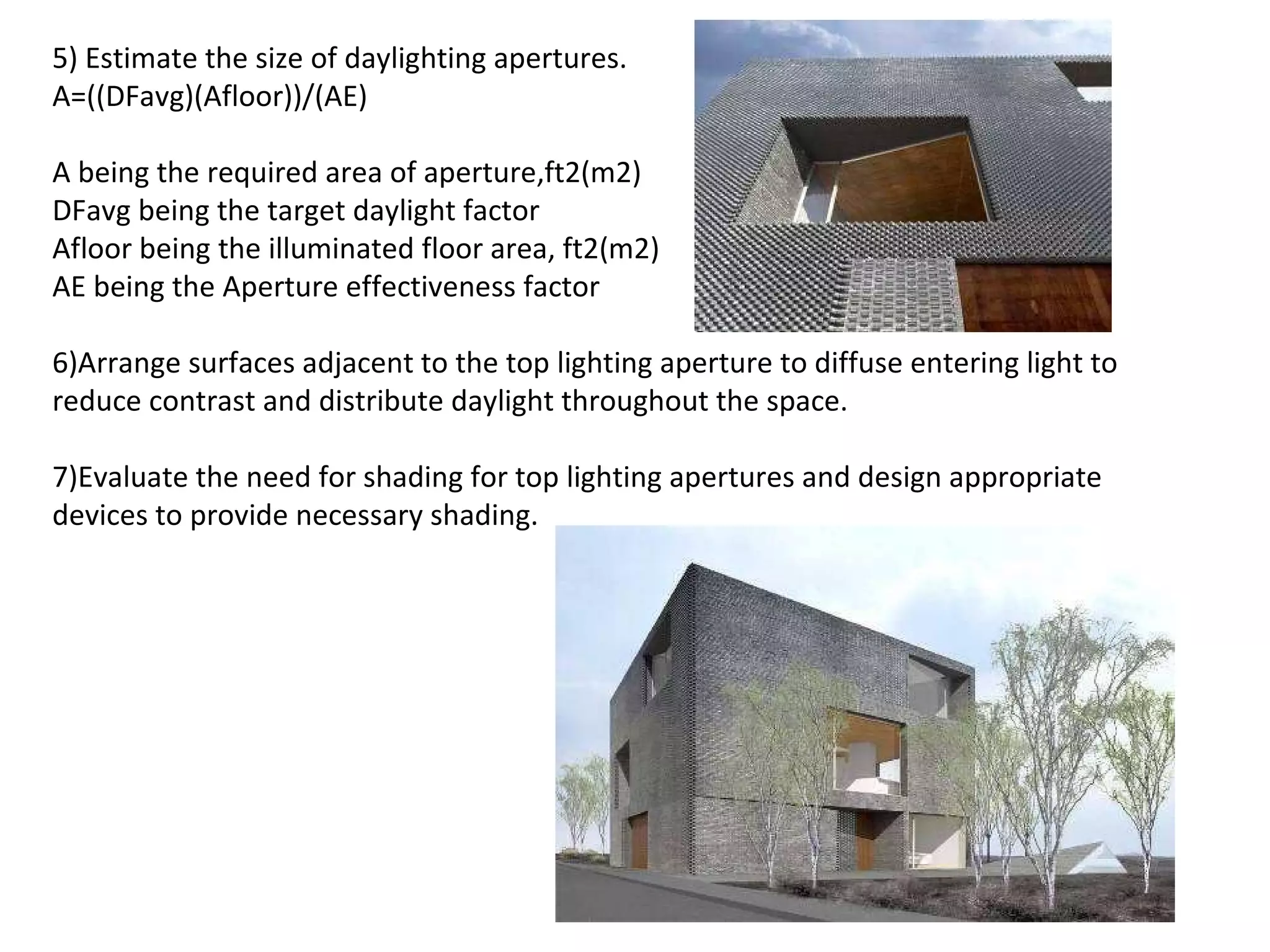
5) Estimate the size of daylighting apertures.  A=((DFavg)(Afloor))/(AE)   A being the required area of aperture,ft2(m2) DFavg being the target daylight factor Afloor being the illuminated floor area, ft2(m2) AE being the Aperture effectiveness factor   6)Arrange surfaces adjacent to the top lighting aperture to diffuse entering light to reduce contrast and distribute daylight throughout the space. 7)Evaluate the need for shading for top lighting apertures and design appropriate devices to provide necessary shading.
 

Green Studio Handbook - Part 2

  • 1.
  • 2.
  • 3.
    Chapter 4 1.4Double Envelopes
  • 4.
    Building and facadeorientation Double envelopes: Are multiple leaf wall assemblies used in the transparent or largely transparent portions of a building façade Outer leaf Intermediate space Inner facade
  • 5.
    Design Intent Maximizedaylighting while controlling solar gain Reducing the need for mechanical cooling Increase the use of natural ventilation Increase acoustic isolation, especially in urban areas.
  • 6.
    aesthetic Relationship ofglazing to overall facade The glass wrapped facade used the glass panels as shingles on the building exterior. Glazed balconies in Venice, Italy
  • 7.
    Thermal insulation Relationshipof glazing to overall facade Outer glazing covers the entire surface of the façade at the Arup offices in London A “double skin glazed thermal buffer” curtain wall addresses solar heat gain as the project’s critical factor. Simply put, a shading device within the double skin absorbs solar gain and re-radiates it as heat trapped in the cavity
  • 8.
    climate control Performancegoals at the transparencies most double envelopes are designed to maximize daylight while controlling solar gain – a condition typical of office buildings dominated by internal heat gain . The interstitial space is used as a protected enclosure for operable shading devices that might otherwise suffer from wind damage and weather exposure.
  • 9.
    active heating andcooling Performance goals at the transparencies Double envelope mitigate the surface temperature of the interior glass, reducing the mechanical intervention required to provide comfortable conditions under both and cooling modes The double envelope facade of Bayerische Vereinsbank Building in Germany has operable leaf glass louvers
  • 10.
    Configurations: 4 maintypes Construction Strategies Box window Corridor facade Multi-story facade Shaft-box
  • 11.
    Box windows Pre-fabricatedcurtain wall system Construction Strategies Kofmehl Building (Switzerland) Architect: SSM Architekten’s
  • 12.
    Corridor facade ConstructionStrategies City Gate (Dusseldorf) Architect: Petzinka, Pink & Partners Pre-fabricated curtain wall system
  • 13.
    Effective with regardto ventilation Incorporate service walkways of metal grating Construction Strategies Corridor Multi-story Victoria Ensemble (Koln) Architect: Thomas Van Den Valentyn
  • 14.
    Shaft box ConstructionStrategies ARAG Turm, Dusseldorf Architect: Norman Foster
  • 15.
    LEED Rating Energyand Atmosphere (35 points) Fundamental Commissioning of Building Energy Systems Minimum Energy Performance Fundamental Refrigerant Management Indoor Environmental Quality (15 points) Minimum Indoor Air Quality Performance Environmental Tobacco Smoke (ETS) Control Innovation and Design Process (6 points) Construction Strategies
  • 16.
    Utilization Maintenance RequirementsEfficiency of the façade can only be assessed in the context of the climate conditions of the site Each double façade must be tailored to the occupant’s function
  • 17.
    Europe: Operable innerglazing leaf Control over outdoor air in the workspace North America: Interior hinge plate glass “ exhaust window” Maintenance Requirements
  • 18.
    Factors to considerinclude: Facade cost Floor space available Compatible structural system Total building energy flows Size and complexity of mechanical plant Cost of long-term maintenance Double envelopes should be considered along with another strategy Considerations
  • 19.
    Case Study HerzJesu Church, Munich
  • 20.
    Case Study Client:Archiepiscopal Ordinariat, Munich, Building Directorate Competition Architects: Karin Hengher, Olga Ritter Project Architects: Karin Hengher (Project Manager), Michael Frank, Annette Gall, Susanne Rath Competition 1996, 1st Prize Completed 2000 Objectives of using the double envelope strategy different colors and intensities of light shine into the church opaque glazing prevents views into the chancel from the outside
  • 21.
  • 22.
    Any Questions? Ifyou are interested in this strategy you might want to consider the following literature: On the Typology, Costs, Energy Performance, Environmental Quality and Operational Characteristics of Double Skin Facades in European Buildings. Available: http://www.earthscan.co.uk/Portals/0/Files/Sample%20Chapters/9781844073894.pdf Double Skin Facades, Maria Wall Available: http://www2.ebd.lth.se/ebdhome/avd_ebd/main/personal/Harris/main/Double%20Skin %20Facades.htm Case Studies: Double FaçadeAvailable: http://www.architecture.uwaterloo.ca/ faculty_projects/terri/sustain_casestudies/ut4.pdf Case Studies: Double Facades in Germany Available: http://www.bbri.be/activefacad es/new/index.cfm?cat=5_example_building&sub=8_germany
  • 23.
    Chapter 4 1.5Green Roofs
  • 24.
  • 25.
  • 26.
    Green Roofs aresplit into two categories: Extensive Intensive
  • 27.
    Typically only suitablefor grasses and small durable plants that love sunshine. Not so expensive Can work at slopes of up to 35 degrees, but require baffle systems to prevent soil slump if the slope is over 20 degrees . Growing media can be from 50 to 150 mm only.
  • 28.
    Intensive Green Roofshave a deeper soil base Include larger plant diversities Can become a local Garden Growing medium should be 600mm+ Require a very strong structural system Large trees have to be placed directly on beams or columns Only flat roofed buildings.
  • 29.
    Retain Storm Waterand absorb it for recycling. Increase Thermal Resistance of a Building Reduce Urban Heat Island Effect Provide Pleasant Green accessible spaces for building occupiers.
  • 30.
  • 31.
  • 32.
    Apply Insulation onthe roof deck. Place a Waterproof membrane Root Barrier to block roots of plants. Drainable Layer Filter Membrane Growing Media
  • 33.
    Green Roofs requireappropriate solar exposure. Architect should consider the shading patterns produced by neighboring buildings and design the green roof accordingly. Integration with the building’s functions should be thought of. Type of Vegetation to use.
  • 34.
    Determine the desiredfunctions of the Green Roofs. Determine if an Intensive or an Extensive Roof is required Determine the amount of sun and shade that the proposed green roof area will receive during the year. Choose the types of plantation desired, taking into consideration rainfall, sun exposure and wind speeds Determine soil depth required depending on plantations chosen Estimate the dead weight of the green roof and therefore choose an appropriate structural system Consider incorporation of accesses for maintenance and irrigation
  • 35.
    Green Roofs arequite expensive Require a very sound structural system Need constant maintenance and care for plants and growing medium Roofs have to be well insulated against drainage and leakage
  • 36.
  • 37.
  • 38.
  • 39.
    Chapter 4 2.1Daylight Factor
  • 40.
  • 41.
    Definition :- DaylightFactor (DF): It is a numerical ratio used to describe the relationship between indoor and outdoor daylight illuminances ( typically under overcast sky conditions ).
  • 42.
    Key Architectural IssuesDesign Factors:- Size of daylight apertures ( windows, skylights, etc.) Location of daylight ( sidelighting, toplighting, etc.)
  • 43.
    Key Architectural IssuesDesign Factors:- Access to daylight ( considering the site, building and room contexts) Room Geometry ( height, width and depth )
  • 44.
    Key Architectural IssuesDesign Factors:- Location of the point of interest relative to aperatures. Visible transmittance (VT) of glazing
  • 45.
    Key Architectural IssuesDesign Factors:- Reflectance of room surface and contents.
  • 46.
    Key Architectural IssuesDesign Factors:- Reflectance of exterior surface effecting daylight entering the aperature.
  • 47.
    Key Architectural IssuesDesign Factors:- The affects of daylighting enhancements such as light shelves.
  • 48.
    Key Architectural IssuesDesign Factors:- The buildings global location and prevailing climate. The time of day/ month/ year. The current sky conditions.
  • 49.
    Implementation Considerations Asa design criterion : using daylight factor as a target is straight forward approach; simply set DF criteria for various space that are appropriate to design context (a given DF target will represent different illuminances in different climate and at different times. DF criteria are often expressed as a minimum target. DF criteria may also derived from a design intent to displace (wholly or part) electric lighting. LEED established a minimum DF of 2% (with conditions ) as the threshold for a LEED daylight credit.
  • 50.
    As a performancepredictor : There is a number of methods used to predict the daylight factor such as : Scale models : that attempt to physically represent a proposed design. Computer simulations that attempt to represent a proposed design numerically. Other methods such as the 2.5H rule that suggest usable daylight will penetrate 2.5 times the window head height. As a measure of constructed performance : daylight factor is easily measured in a completed building with the use of paired illuminance meters.
  • 51.
    Design Procedure Establishdaylight factor criteria for the various spaces in the building being designed. Select the daylight approach or combination of approaches most likely to provide performance to match the criteria established in step 1. Size daylight apertures using available schematic design guidance or trail and error. Model the daylighting performance ( including daylight factors ) of the proposed daylighting system. Adjust selected daylighting design parameters ( aperture size, glazing transmittance, surface reflectance, light shelves, etc. ) as necessary to achieve established daylight factor criteria. Revalidate daylighting design modified parameters; iterate as necessary to meet design criteria.
  • 52.
    Chapter 4 2.2Daylight Zoning
  • 53.
    Daylight Zoning Theprocess of grouping various spaces in a building with similar luminous requirements into a day-lighting zone, thereby enabling design and control cost saving. Kuwait University College of Engineering Department of Architecture Design 4 Dr. Yasser Mahgoub Dhare’ah Al Nafjan 206111265 Nouf Al Bader 206111043
  • 54.
    Daylight Zoning : According to Location and Orientation of a space.
  • 55.
    Function Usage ScheduleLocation and Orientation Characteristics that should be taken into account when Combining Spaces to Create Zones are: Measured daylight zone in an office building
  • 56.
    The Designer has control over the location and orientation of a space to maximize day-lighting, while function and usage schedule are based on the program.
  • 57.
    Sometimes a spaceneeds to be zoned with equal amount of light reaching both sides of the building
  • 58.
    Factors to be considered in the zoning process Visual comfort Thermal comfort Fire and smoke control Building automation opportunities and requirements
  • 59.
    Daylight zoning affectsthe building’s: Orientation Massing Plan layout and section Therefore, it must be a factor in the design process.
  • 60.
    Maximizing thebuildings Perimeter and the use of Top-Lighting for critical interior spaces optimizes daylight access for zones where lighting is needed.
  • 61.
    Using an Atrium or Light Courts can also help in lighting the space.
  • 62.
    Skin : VolumeRatio A building that optimizes day-lighting and natural ventilation would be shaped so that more of the floor area is close to the perimeter.
  • 63.
    Daylight zoning can be difficult at times because the spaces cannot be grouped based on functions and times of usage due to the program of the building.
  • 64.
    Not all sitesallow Solar Access as a form of day-lighting because of the adjacent and circulation needs
  • 65.
    To reinforce proposed daylight zoning schemes, the following should be considered and designed: Glazing Light Shelves
  • 66.
    Shading devices onthe external walls of a building can be used to decrease the amount of light entering the building Shading Devices
  • 67.
    Design Procedure List and define the types of spaces that will be present in the building. Determine required light values for the various space types based upon the visual activities that will be performed. In a table, outline the usage schedule of the space and day-lighting potential of the space. Group rooms into zones based on similar lighting needs, matching schedules, corresponding uses, and thermal comfort requirements. Arrange building massing, plans, and sections to allow these zones to optimize daylighting potential. Verify the potential performance of daylighting strategies for each of the different daylight zones.
  • 68.
    Measurement would showhow far into the room will the side-lighting extent reach depending on how big the window openings are
  • 69.
    Adjacency ofa particular space will also affect the amount of light coming through the windows which will also affect the zoning of that space.
  • 70.
    An example showingthe combination of day-lighting and electric lighting in a computer area
  • 71.
    A study madewhile planning a space to help show how affective day-lighting is with and without the use of electric lighting
  • 72.
    Three distinct daylightzones: Reading Cubicles, Corridor and Stack Area
  • 73.
    Chapter 4 2.3Toplighting
  • 74.
    Top Lighting Isa day light strategy that uses openings located at the roof plane as the point of admission for the surrounding daylight. TopLighted cault in musee de orsay ,Paris
  • 75.
    Different types oftop lighting: Skylight Clerestory Sawtooth Light scoop Roof monitor
  • 76.
  • 77.
    Clerestory library cathedral Santa fe opera , interior of the theatre
  • 78.
  • 79.
  • 80.
  • 81.
    Over cast sky-the weather where the sky consists of 95% clouds. Top lighting is an ideal strategy :
  • 82.
    International Examples ArupCampus Solihull in Blythe Valley Park Dual function of roof pods seen from the inside and exterior
  • 83.
  • 84.
    Mostly used in:Single story construction But if applied to multi story used in the upper most floor.
  • 85.
  • 86.
    Multiuse room withtop lighting and side lighting to provide daylight distributions.
  • 87.
    Advantages of top Lighting Top lighting is easily co-ordinated with electric lightening systems. Top Lightening allows for greater latitudes and how the walls of the space is used. The building becomes more expressive due to the additional form. Top Lightening adds great depth to lightening access to the building as lightening access is not limited to the walls. Thinking about top lightening makes us focus on the ceiling when it is usually neglected.
  • 88.
    Comparing different toplighting scenarios
  • 89.
    Drawbacks of topLightening: Direct solar radiation can cause visual discomfort due to excessive contrast. Specifically for working environments. The desirable “dazzle” effect is required it is inappropriate in work areas. Top lightening is considered to be able to take place of side lightening yet not provide the view to the outside which is always wanted.
  • 90.
    Design Procedure  When comparing top lighting with side lighting, one can say that top lighting is the more selected approach But this does not mean that we can’t have both systems together.   Here is how the procedure goes.   Establish target daylight factors for the various spaces and activates to be top lit. 2) Arrange the building spaces and floor plan layouts so that those areas could have roof exposure and then be top lit.
  • 91.
    3)Determine what typeof top lighting aperture eg (sky lighting, clerestory etc), is most appropriate for the space, building orientation, sky conditions and climate. 4) Evaluate different glazing options for the aperture (which is an opening in which the light travels in).   Glazing should have:- -VT ( high visible transmittance) - SHGC ( in hot climates a low solar heat gain coefficient), so as to minimize sloar heat gain  
  • 92.
    5) Estimate thesize of daylighting apertures. A=((DFavg)(Afloor))/(AE)   A being the required area of aperture,ft2(m2) DFavg being the target daylight factor Afloor being the illuminated floor area, ft2(m2) AE being the Aperture effectiveness factor   6)Arrange surfaces adjacent to the top lighting aperture to diffuse entering light to reduce contrast and distribute daylight throughout the space. 7)Evaluate the need for shading for top lighting apertures and design appropriate devices to provide necessary shading.
  • 93.

Editor's Notes

  • #8 In terms of thermal insulation the double envelope is known as This means that The shading device within the double envelope absorbs the solar gain and re-radiates it in the cavity
  • #9 As we hav mention double envelobe are used to maxmize daylight while controling solar gains which is tipical in office blding \ And int his pictures these operable shading devices
  • #10 Since the double envelope reduces the temp of the interior skin, it reduces the overall mechanical intervention (cooling equipment) in turn lessens energy use Night time ventilation: During the hot summer days, the interior spaces can easily be overheated. In this case, it may be energy saving to pre-cool the offices during the night using natural ventilation. The indoor temperatures will then be lower during the early morning hours providing thermal comfort and improved air quality for the occupants.
  • #12 Box windows: self contained with air intake and exhaust ports for cavity ventilation. (natural convection) , punched in , great for privacy and high noise level
  • #13 the surface temperature of the inner glass is kept close to room temperature, leading to increased occupant comfort in the perimeter zone, near the facade. This type of facade is recommended for cold climates, because of the increased comfort during the cold season and the possible recovery of solar energy.
  • #14 Done to maximize usable floor area The outer glass leaf is suspended beyond the edge of the primary structure. Fire escape: The glazed space of a Double Skin Facade may be used as a fire escape.
  • #15 Cavity is ventilated through large openings at the base and parapet. (natural convection) Lighter as opposed to heavy 80’s shading systems
  • #16 Architects should keep in mind the points that they can get for implementing green strategies These are the three main categories, double envelope strategies can achieve in
  • #17 We should keep in mind the maintenance requirements of the double envelope: In utilization we must be aware that the…. Other maintenance requirements include Maintaining ventilation controls Cleaning inside the cavity
  • #18 If this operable glass can provide access to each façade unit, the depth can be greatly reduced for efficient maintenance and material considerations. North America: fixed insulating glass on the outer leaf with a hinged plate of glass added to create a thin double envelope. Heat absorbed is removed by drawing out the stale air.
  • #19 Large-scale vs significant floor area underutilized: Cost comparisons must take into account the maintenance factor Acoustic insulation: In view of some authors the sound insulation can be one of the most important reasons to use a Double Skin Façade Effective double envelope applications are sometimes actually Poor energy performers
  • #21 Corridor multi-story Transparency/ architectural design: In almost all the literature, the desire of the architects to use larger glazed facades is mentioned.
  • #22 Vent/smoke extract (2) Height-adjustable façade suspension (5) Use of double glazing (8) Convector (12) Cover fresh air intake (15)