DR.HAFIZ KOSAR
GREEN HOUSE EFFECT &
ENVIRONMENTAL AWARENESS
1
The greenhouse effect, discovered by Joseph
Fourier, is caused by the presence of gases like
carbon dioxide in the atmosphere, which traps
longer wavelengths of infrared light, causing
Earth's average temperature to rise by 25 degrees
Celsius.
Green House Effect
GREENHOUSE GASES, INCLUDING CHLOROFLUOROCARBONS
(CFCS), ARE GASES THAT CONTRIBUTE TO THE GREENHOUSE
EFFECT. THEY ALLOW THE SUN'S ENERGY TO REACH EARTH'S
SURFACE BUT LIMIT HEAT LOSS. RISING ATMOSPHERIC
CONCENTRATIONS OF THESE GASES COULD LEAD TO HIGHER
TEMPERATURES AND SIGNIFICANT CLIMATE CHANGE. THE NEXT
50 YEARS MAY SEE ALTERED WEATHER PATTERNS, RISING SEA
LEVELS, AND DESERT SHIFTS. HUMAN ACTIVITY IS DEPENDENT ON
CLIMATE, IMPACTING FOOD PRODUCTION, WATER SUPPLIES,
CONSTRUCTION, ENERGY USAGE, TRANSPORTATION, AND FLOOD
PROTECTION.
Green House Gases
Greenhouse gases, which allow solar radiation to warm Earth during the day,
contribute to its average temperature of 15 degrees Celsius. The increase in carbon
dioxide concentration from 280 ppm (PPM means parts-per million and Percent
means per hundred) in 1800 to 359 ppm in 1994 is attributed to increased use of
fossil fuels, decreasing forest cover, and methane release from agricultural
practices. If these levels continue to rise, global temperatures may reach 1 to 4
degrees Celsius higher by the mid21st century.
Causes
The planet's temperature has only risen by 34 degrees since the last ice age, but
greenhouse warming could cause partial melting of polar and alpine ice caps,
raising sea levels, and potentially submerging large areas like the Maldives and
Bangladesh. Food supplies will be affected by higher atmospheric carbon dioxide
concentration, climatic change, and the world's socioeconomic system. Increased
carbon dioxide may increase crop yields by up to 50%, but climatic change could
outweigh the benefits.
Causes....
Future Impact
Greenhouse warming is expected to cause severe stress on natural ecosystems, desert
expansion, melting polar ice caps, ocean thermal expansion, more extreme weather
events, and displacement of traditional agricultural areas. Rising sea levels are the
most significant hazard, with glaciers melting and sea water expanding. This change
will increase the frequency and severity of extreme events, affecting human health and
living standards. The most vulnerable will experience the most severe impacts,
necessitating concrete action to control pollution sources and mitigate potential
impacts.
Human activities, including urbanization,
industrialization, and social structures, are posing
ecological problems due to excessive use and
misuse of natural resources. This imbalance affects
energy budgets and climate change. To maintain
ecological balance, mass awareness, afforestation,
deforestation prevention, judicious resource use,
pollution control, and environmentally respectful
development is crucial, achieved through mass
media, green marches, and environmental weeks.
Environmental Awareness
Environmental education is an approach to
learning and not only a subject of study. It creates a
way of thinking and by this the individual and
community gathers knowledge and awareness
regarding immediate environment. They get
knowledge, skill experience and a mindset to act
singly and in groups to solve the environmental
problem. We have to follow and practice the slogan,
“think globally and act locally.
Meaning of Environmental
Awareness
Environmental education is crucial for
controlling pollution, conserving
resources, and maintaining ecological
balance. NGOs play a vital role in
educating people, particularly secondary
school children. It covers various aspects
of the environment, including
atmosphere, earth, water, plants,
animals, natural resource management,
air, soil, and geological formations. It
aims to create awareness, develop
habits, promote values, and guide
problem-solving and decision-making. It
leads to positive attitudes and
commitment of environment protection.
It can be achieved by:
Salient Features of Environmental
Awareness
Gaining an understanding of the composition and
operation of the inanimate natural system, as well
as how it interacts with living things.
Realizing that all living things, including humans,
animals, plants, and microbes, are interrelated and
a part of nature.
Salient Features of Environmental
Awareness
Understanding the importance of protecting the
natural systems that support life.
Understanding that local environmental changes
have an impact on the environment globally.
Salient Features of Environmental
Awareness....
The growth of concern for the wellbeing of the
planet's ecosystem and all living things.
Researching and taking part in regional and
worldwide environmental issues.
Environmental Problems
In 1980, a large ozone hole emerged in Antarctica, accounting for 25%50% of the ozone
layer. Over the past 18 years, ozone depletion has worsened, with 1993's October levels
dropping below one-third of average levels. Environmental issues include
overpopulation, pollution, and poverty.
.
Environmental Problems....
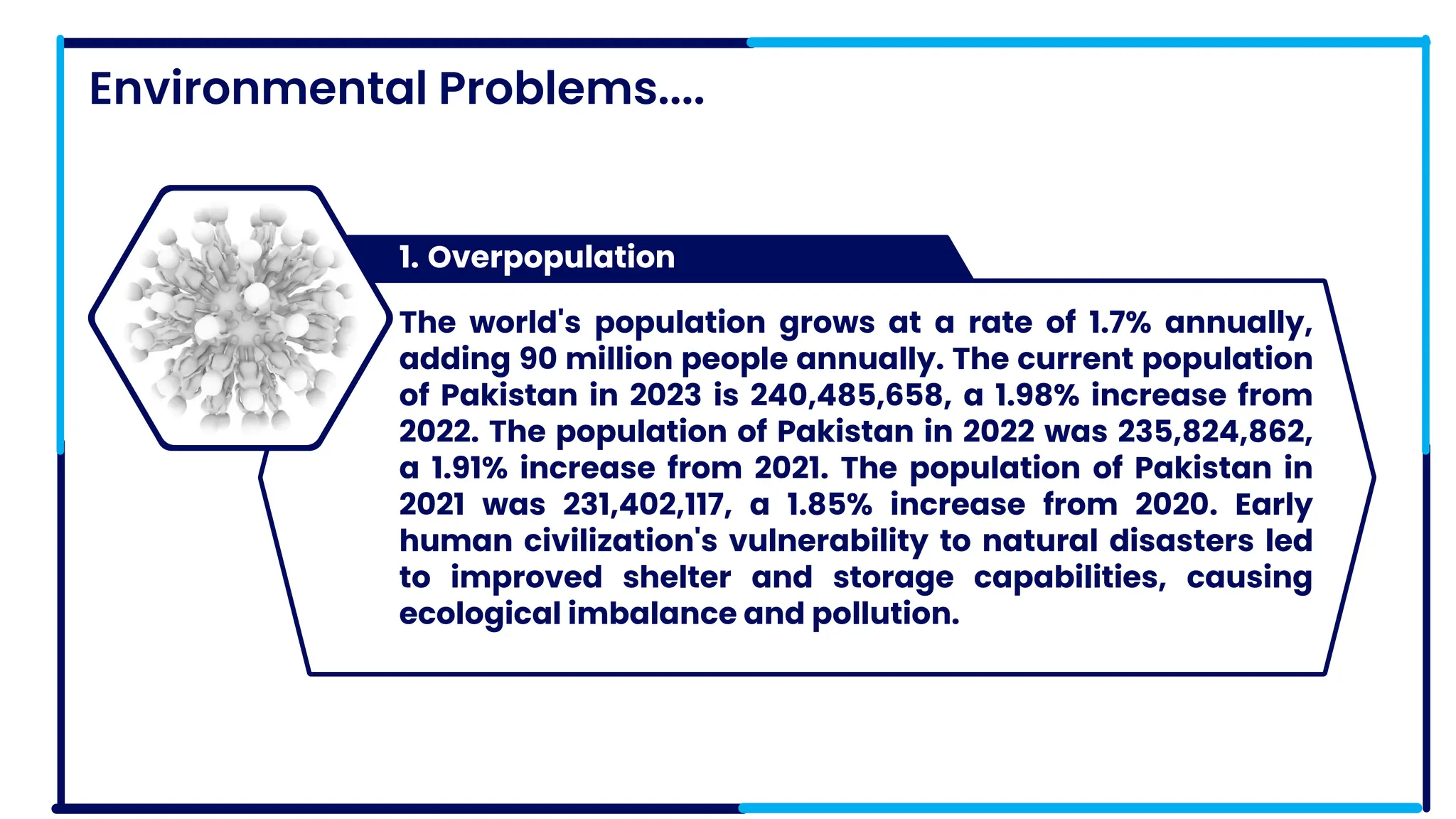
1. Overpopulation
The world's population grows at a rate of 1.7% annually,
adding 90 million people annually. The current population
of Pakistan in 2023 is 240,485,658, a 1.98% increase from
2022. The population of Pakistan in 2022 was 235,824,862,
a 1.91% increase from 2021. The population of Pakistan in
2021 was 231,402,117, a 1.85% increase from 2020. Early
human civilization's vulnerability to natural disasters led
to improved shelter and storage capabilities, causing
ecological imbalance and pollution.
Environmental Problems....
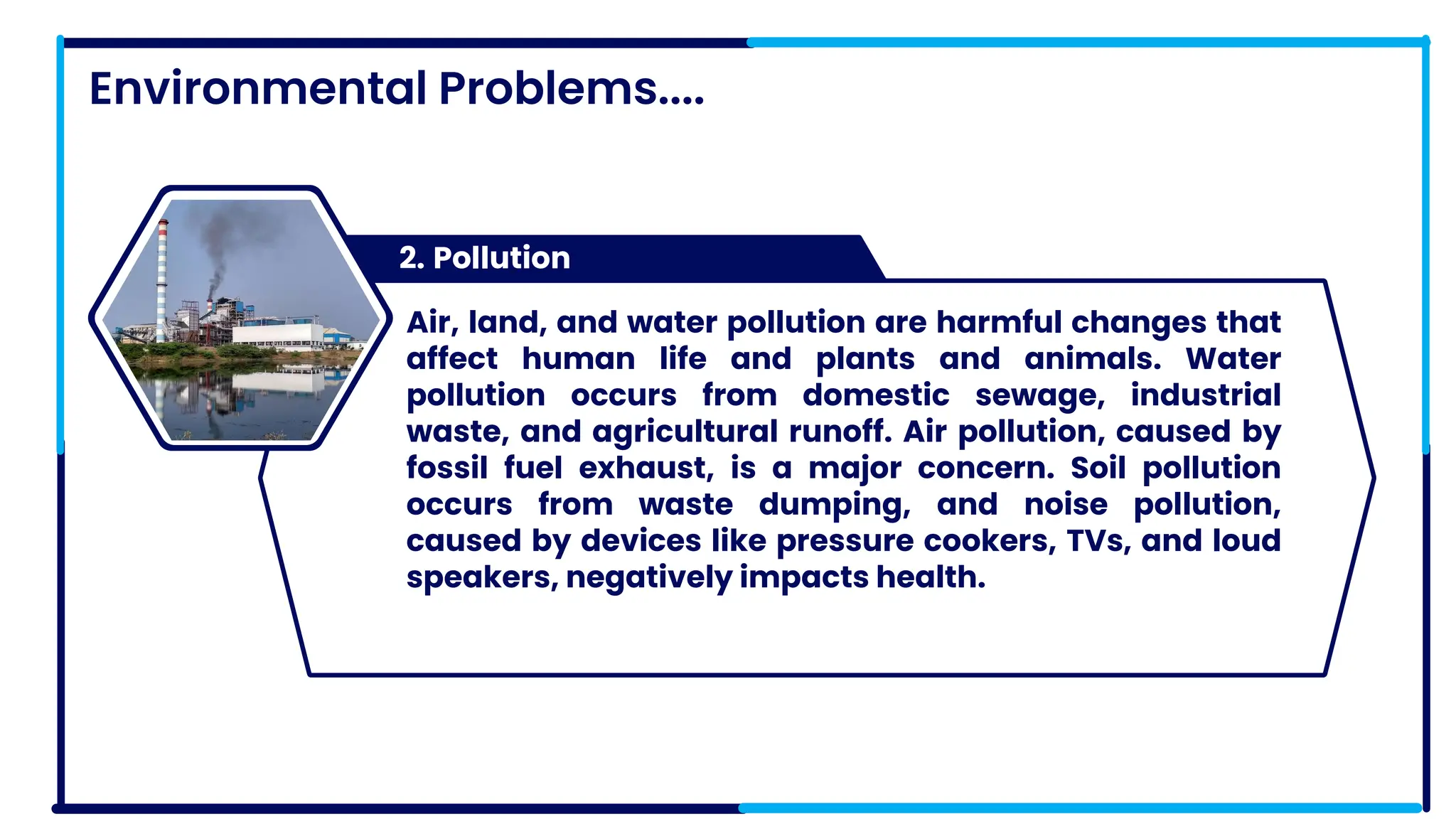
2. Pollution
PRODUCT 3
Air, land, and water pollution are harmful changes that
affect human life and plants and animals. Water
pollution occurs from domestic sewage, industrial
waste, and agricultural runoff. Air pollution, caused by
fossil fuel exhaust, is a major concern. Soil pollution
occurs from waste dumping, and noise pollution,
caused by devices like pressure cookers, TVs, and loud
speakers, negatively impacts health.
Environmental Problems....
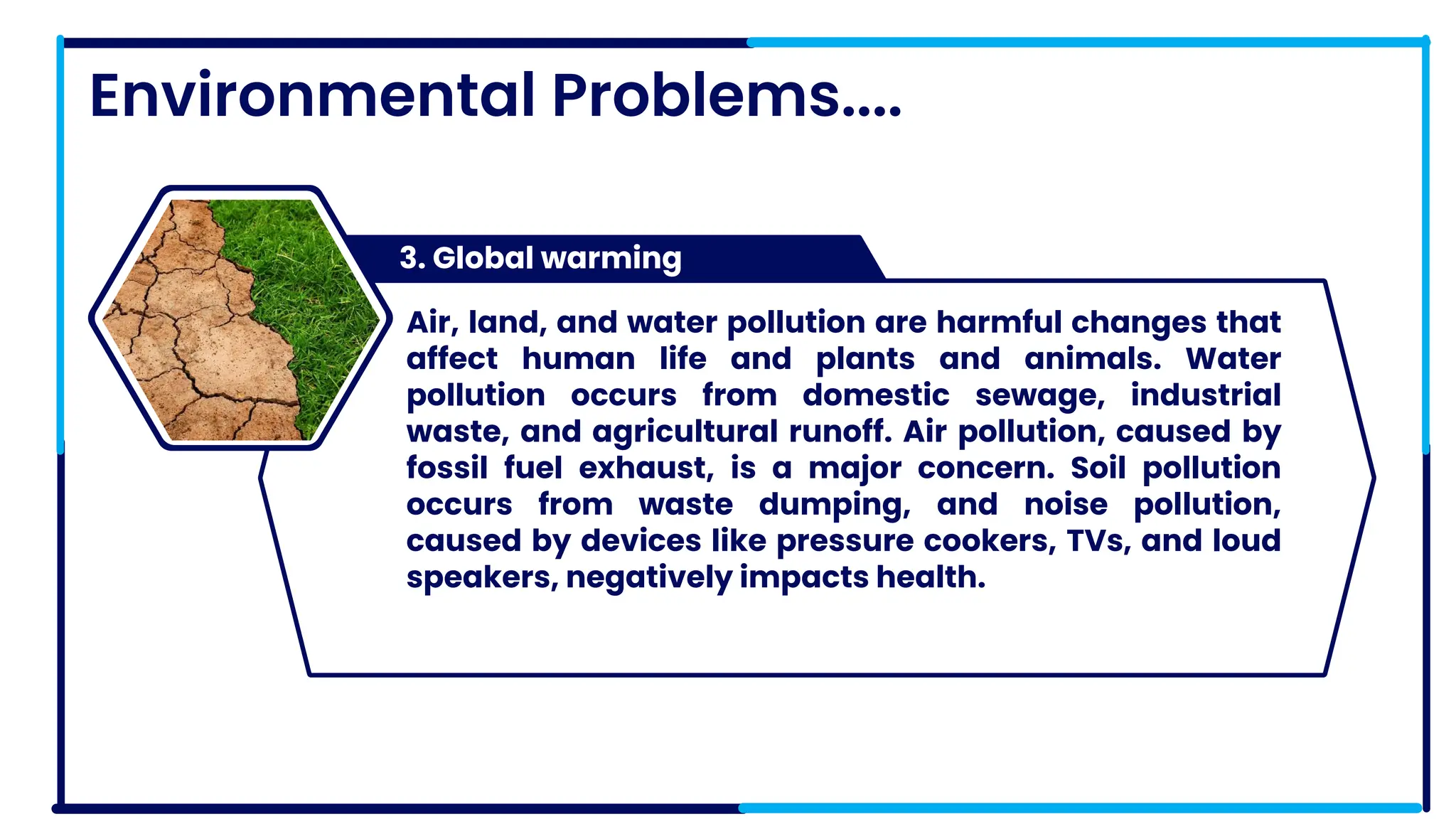
3. Global warming
PRODUCT 3
Air, land, and water pollution are harmful changes that
affect human life and plants and animals. Water
pollution occurs from domestic sewage, industrial
waste, and agricultural runoff. Air pollution, caused by
fossil fuel exhaust, is a major concern. Soil pollution
occurs from waste dumping, and noise pollution,
caused by devices like pressure cookers, TVs, and loud
speakers, negatively impacts health.
Environmental Problems....
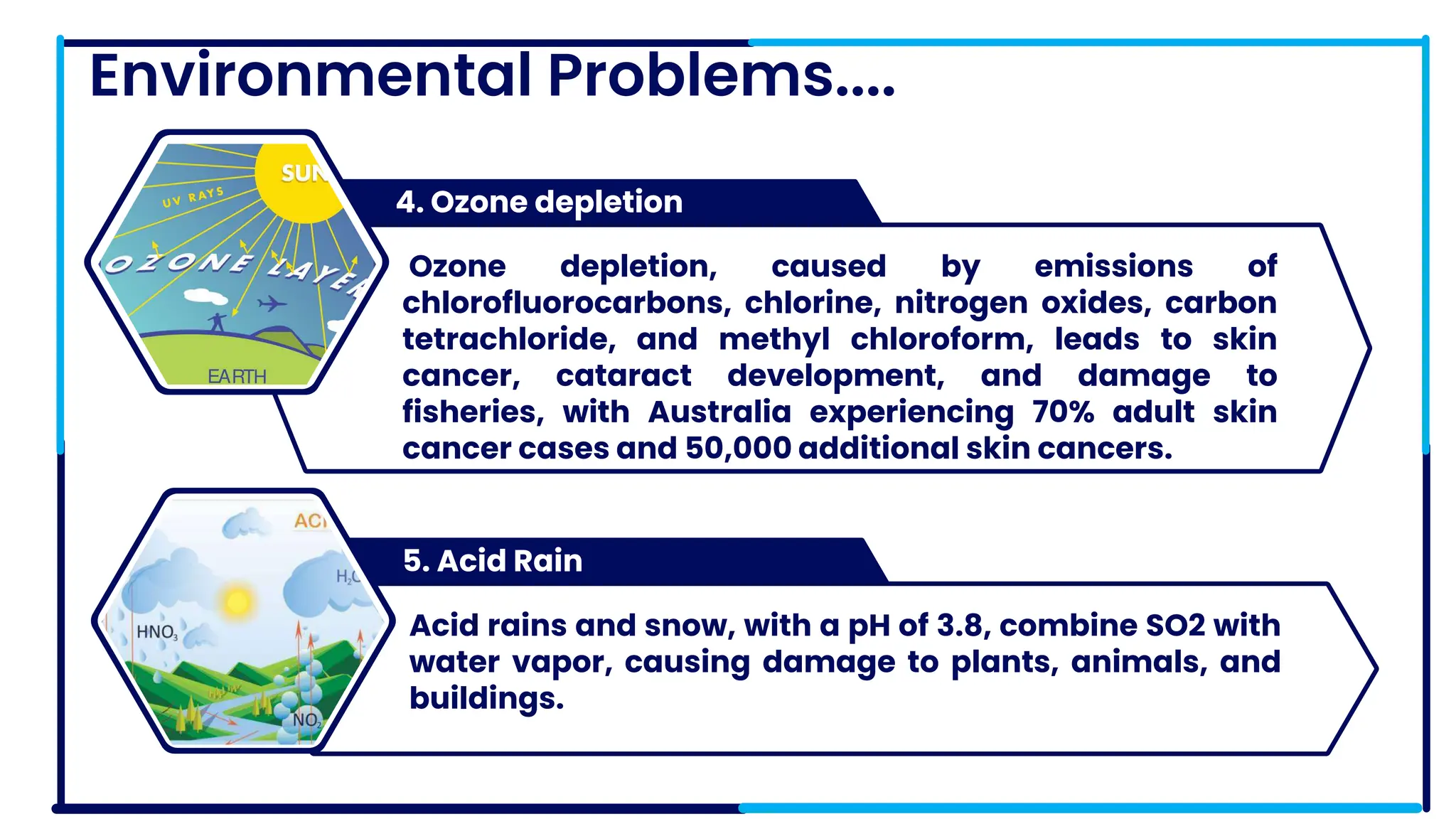
4. Ozone depletion
PRODUCT 3
Ozone depletion, caused by emissions of
chlorofluorocarbons, chlorine, nitrogen oxides, carbon
tetrachloride, and methyl chloroform, leads to skin
cancer, cataract development, and damage to
fisheries, with Australia experiencing 70% adult skin
cancer cases and 50,000 additional skin cancers.
5. Acid Rain
Acid rains and snow, with a pH of 3.8, combine SO2 with
water vapor, causing damage to plants, animals, and
buildings.
Environmental Problems....
6.Loss of biodiversity
PRODUCT 3
7.Depletion and degradation of natural Resources
As a group, corals include some of the world's most rapidly
declining species. Their decreasing numbers are caused by
mass bleaching, disease, and die-offs, due to rising ocean
temperatures and ocean acidification.
Deforestation, industrialization, urbanization, and
population increase threaten natural resources like
land, air, water, and wildlife. To conserve these
resources, stop deforestation, promote afforestation,
and increase forest cover.
Environmental Problems....
8.Radioactive fallout
Nuclear waste poses a threat to human, water, air, land,
plants, and animals, causing ecological crisis and
severe damage to the biosphere.
THANK YOU
CONTACT US:
hafeezkausar.hashmi@gmail.com
https://www.facebook.com/kausar0791
https://www.linkedin.com/in/dr-hafiz-kosar-
284484186/
+92-314-3205571

Green House Effect.pdf

  • 1.
    DR.HAFIZ KOSAR GREEN HOUSEEFFECT & ENVIRONMENTAL AWARENESS
  • 3.
    1 The greenhouse effect,discovered by Joseph Fourier, is caused by the presence of gases like carbon dioxide in the atmosphere, which traps longer wavelengths of infrared light, causing Earth's average temperature to rise by 25 degrees Celsius. Green House Effect
  • 4.
    GREENHOUSE GASES, INCLUDINGCHLOROFLUOROCARBONS (CFCS), ARE GASES THAT CONTRIBUTE TO THE GREENHOUSE EFFECT. THEY ALLOW THE SUN'S ENERGY TO REACH EARTH'S SURFACE BUT LIMIT HEAT LOSS. RISING ATMOSPHERIC CONCENTRATIONS OF THESE GASES COULD LEAD TO HIGHER TEMPERATURES AND SIGNIFICANT CLIMATE CHANGE. THE NEXT 50 YEARS MAY SEE ALTERED WEATHER PATTERNS, RISING SEA LEVELS, AND DESERT SHIFTS. HUMAN ACTIVITY IS DEPENDENT ON CLIMATE, IMPACTING FOOD PRODUCTION, WATER SUPPLIES, CONSTRUCTION, ENERGY USAGE, TRANSPORTATION, AND FLOOD PROTECTION. Green House Gases
  • 5.
    Greenhouse gases, whichallow solar radiation to warm Earth during the day, contribute to its average temperature of 15 degrees Celsius. The increase in carbon dioxide concentration from 280 ppm (PPM means parts-per million and Percent means per hundred) in 1800 to 359 ppm in 1994 is attributed to increased use of fossil fuels, decreasing forest cover, and methane release from agricultural practices. If these levels continue to rise, global temperatures may reach 1 to 4 degrees Celsius higher by the mid21st century. Causes
  • 6.
    The planet's temperaturehas only risen by 34 degrees since the last ice age, but greenhouse warming could cause partial melting of polar and alpine ice caps, raising sea levels, and potentially submerging large areas like the Maldives and Bangladesh. Food supplies will be affected by higher atmospheric carbon dioxide concentration, climatic change, and the world's socioeconomic system. Increased carbon dioxide may increase crop yields by up to 50%, but climatic change could outweigh the benefits. Causes....
  • 7.
    Future Impact Greenhouse warmingis expected to cause severe stress on natural ecosystems, desert expansion, melting polar ice caps, ocean thermal expansion, more extreme weather events, and displacement of traditional agricultural areas. Rising sea levels are the most significant hazard, with glaciers melting and sea water expanding. This change will increase the frequency and severity of extreme events, affecting human health and living standards. The most vulnerable will experience the most severe impacts, necessitating concrete action to control pollution sources and mitigate potential impacts.
  • 8.
    Human activities, includingurbanization, industrialization, and social structures, are posing ecological problems due to excessive use and misuse of natural resources. This imbalance affects energy budgets and climate change. To maintain ecological balance, mass awareness, afforestation, deforestation prevention, judicious resource use, pollution control, and environmentally respectful development is crucial, achieved through mass media, green marches, and environmental weeks. Environmental Awareness
  • 9.
    Environmental education isan approach to learning and not only a subject of study. It creates a way of thinking and by this the individual and community gathers knowledge and awareness regarding immediate environment. They get knowledge, skill experience and a mindset to act singly and in groups to solve the environmental problem. We have to follow and practice the slogan, “think globally and act locally. Meaning of Environmental Awareness
  • 10.
    Environmental education iscrucial for controlling pollution, conserving resources, and maintaining ecological balance. NGOs play a vital role in educating people, particularly secondary school children. It covers various aspects of the environment, including atmosphere, earth, water, plants, animals, natural resource management, air, soil, and geological formations. It aims to create awareness, develop habits, promote values, and guide problem-solving and decision-making. It leads to positive attitudes and commitment of environment protection. It can be achieved by: Salient Features of Environmental Awareness
  • 11.
    Gaining an understandingof the composition and operation of the inanimate natural system, as well as how it interacts with living things. Realizing that all living things, including humans, animals, plants, and microbes, are interrelated and a part of nature. Salient Features of Environmental Awareness
  • 12.
    Understanding the importanceof protecting the natural systems that support life. Understanding that local environmental changes have an impact on the environment globally. Salient Features of Environmental Awareness.... The growth of concern for the wellbeing of the planet's ecosystem and all living things. Researching and taking part in regional and worldwide environmental issues.
  • 13.
    Environmental Problems In 1980,a large ozone hole emerged in Antarctica, accounting for 25%50% of the ozone layer. Over the past 18 years, ozone depletion has worsened, with 1993's October levels dropping below one-third of average levels. Environmental issues include overpopulation, pollution, and poverty. .
  • 14.
    Environmental Problems.... 1. Overpopulation Theworld's population grows at a rate of 1.7% annually, adding 90 million people annually. The current population of Pakistan in 2023 is 240,485,658, a 1.98% increase from 2022. The population of Pakistan in 2022 was 235,824,862, a 1.91% increase from 2021. The population of Pakistan in 2021 was 231,402,117, a 1.85% increase from 2020. Early human civilization's vulnerability to natural disasters led to improved shelter and storage capabilities, causing ecological imbalance and pollution.
  • 15.
    Environmental Problems.... 2. Pollution PRODUCT3 Air, land, and water pollution are harmful changes that affect human life and plants and animals. Water pollution occurs from domestic sewage, industrial waste, and agricultural runoff. Air pollution, caused by fossil fuel exhaust, is a major concern. Soil pollution occurs from waste dumping, and noise pollution, caused by devices like pressure cookers, TVs, and loud speakers, negatively impacts health.
  • 16.
    Environmental Problems.... 3. Globalwarming PRODUCT 3 Air, land, and water pollution are harmful changes that affect human life and plants and animals. Water pollution occurs from domestic sewage, industrial waste, and agricultural runoff. Air pollution, caused by fossil fuel exhaust, is a major concern. Soil pollution occurs from waste dumping, and noise pollution, caused by devices like pressure cookers, TVs, and loud speakers, negatively impacts health.
  • 17.
    Environmental Problems.... 4. Ozonedepletion PRODUCT 3 Ozone depletion, caused by emissions of chlorofluorocarbons, chlorine, nitrogen oxides, carbon tetrachloride, and methyl chloroform, leads to skin cancer, cataract development, and damage to fisheries, with Australia experiencing 70% adult skin cancer cases and 50,000 additional skin cancers. 5. Acid Rain Acid rains and snow, with a pH of 3.8, combine SO2 with water vapor, causing damage to plants, animals, and buildings.
  • 18.
    Environmental Problems.... 6.Loss ofbiodiversity PRODUCT 3 7.Depletion and degradation of natural Resources As a group, corals include some of the world's most rapidly declining species. Their decreasing numbers are caused by mass bleaching, disease, and die-offs, due to rising ocean temperatures and ocean acidification. Deforestation, industrialization, urbanization, and population increase threaten natural resources like land, air, water, and wildlife. To conserve these resources, stop deforestation, promote afforestation, and increase forest cover.
  • 19.
    Environmental Problems.... 8.Radioactive fallout Nuclearwaste poses a threat to human, water, air, land, plants, and animals, causing ecological crisis and severe damage to the biosphere.
  • 20.