GREEN ARCHITECTURE
 TOPIC – GREEN BUILDING ARCHITECTURE.
 OBJECTIVES –
Green buildings are designed to reduce the overall impact on human health and the
natural environment by the following ways :
A) using energy , water and other resources efficiently.
B) by reducing waste , pollution and environmental degradation.
 IMPORTANCE OF GREEN BUILDINGS –
The growth and development of our communities has a large impact on our
natural environment .The manufacturing ,design ,construction and operation of the
buildings in which we live and work are responsible for the consumption of many of
our natural resources.
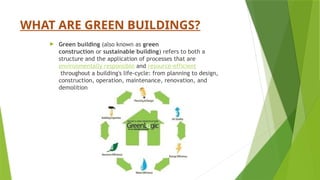
WHAT ARE GREEN BUILDINGS?
 Green building (also known as green
construction or sustainable building) refers to both a
structure and the application of processes that are
environmentally responsible and resource-efficient
throughout a building's life-cycle: from planning to design,
construction, operation, maintenance, renovation, and
demolition
GREEN ARCHITECTURE AND GREEN DESIGN
Green Architecture defines an understanding of environment-friendly
architecture under all classifications, and contains some universal consent ,
it may have many of these characteristics:
• Ventilation systems designed for efficient heating and cooling.
• Energy-efficient lighting and appliances.
• Water–saving plumbing fixtures.
• Landscapes planned to maximize passive solar energy.
• Minimal harm to the Natural Habitat.
• Locally obtained woods and stones
• Efficient use of space.
BENEFITS OF GREEN BUILDINGS
• A green building uses less energy , water and other natural resources create less
waste and green house gases and is healthy for people during living or working inside
as compared to a standard building.
• Another benefit for green building is clean environment , water , and healthy living.
WHY GREEN BUILDINGS ?
It is about creating buildings that optimize on the local ecology , use of local materials
and most importantly they are built to cut power , water and material requirements.
Thus , if these things are kept in mind, then we will realize that our traditional
architecture was in fact ,very green . Today, we have forgotten that how to make
natural environment , instead copying it developed countries.
These buildings are major energy consuming sector in the economy. About 35 to 40% of
total energy is used by buildings during construction. The major consumption of energy
in buildings is during construction and later in lighting and air conditioning systems . This
consumption must be minimized. Possibly , this should be limited to about 80-100 watts
per sqm.
CONSIDERATION FOR GREEN BUILDING
 Green building involves consideration in four main areas : SITE
DEVELOPMENT , MATERIAL SELECTION AND MINIMIZATION , ENERGY
EFFICIENCY AND INDOOR AIR QUALITY.
• Consider site development to reduce the impact of development on
the natural environment. For example orient the buildings to take
advantage of Solar access , shading and wind patterns that will lessen
heating and cooling loads.
• Carefully select materials that are durable, contain recycled content ,
and comfortable environment. Take advantage of solar access , shading
and wind patterns that will lessen heating and cooling loads.
• Design for high indoor air quality to promote occupant health and comfort.
• Minimize the waste in construction and demolition processes by recovering
materials and reusing or recycling those.
The Principles Of Green Buildings
 The Green building design process begins with an intimate understanding of the
site in all its beauties and complexities . Designers can create features in their
buildings that mimic functions of particular eco-systems. Creating new habitat
on structures in urbanized areas is especially important to Support bio diversity
and healthy ecosystem.
 The Following points summarize key principles and strategies which are
associated with the five major elements of green building design which are
Five major elements of Green Building design :
Sustainable site design
Energy efficiency
Materials efficiency
Water efficiency
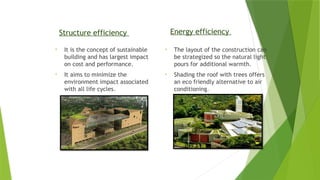
Structure efficiency
• It is the concept of sustainable
building and has largest impact
on cost and performance.
• It aims to minimize the
environment impact associated
with all life cycles.
Energy efficiency
• The layout of the construction can
be strategized so the natural light
pours for additional warmth.
• Shading the roof with trees offers
an eco friendly alternative to air
conditioning.
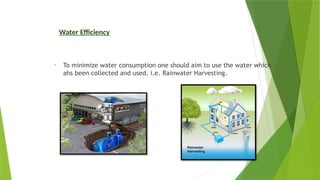
Water Efficiency
• To minimize water consumption one should aim to use the water which
ahs been collected and used. i.e. Rainwater Harvesting.
Materials Efficiency
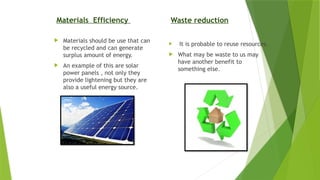
 Materials should be use that can
be recycled and can generate
surplus amount of energy.
 An example of this are solar
power panels , not only they
provide lightening but they are
also a useful energy source.
Waste reduction
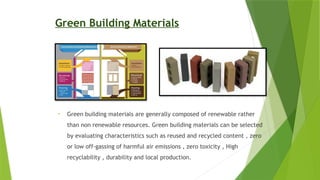
 It is probable to reuse resources.
 What may be waste to us may
have another benefit to
something else.
Green Building Materials
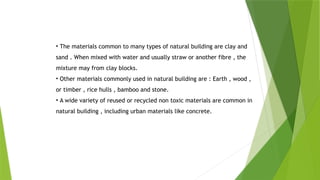
• Green building materials are generally composed of renewable rather
than non renewable resources. Green building materials can be selected
by evaluating characteristics such as reused and recycled content , zero
or low off-gassing of harmful air emissions , zero toxicity , High
recyclability , durability and local production.
• The materials common to many types of natural building are clay and
sand . When mixed with water and usually straw or another fibre , the
mixture may from clay blocks.
• Other materials commonly used in natural building are : Earth , wood ,
or timber , rice hulls , bamboo and stone.
• A wide variety of reused or recycled non toxic materials are common in
natural building , including urban materials like concrete.
Material selection
 The application of stable, attractive, and environmentally responsible
building materials is a key ingredient of any high-performance building
effort. The utilization of natural and healthy materials contributes to the
wellbeing of the occupants and to a feeling of connection with the bounty
of the natural world. Many building materials have considerable
environmental effects from pollutant releases, habitat destruction, and
depletion of natural resources.
 This will happen during extraction and acquisition of raw materials,
production and manufacturing processes, and transportation. In addition,
some construction materials may harm human health by exposing workers
and building occupants to toxic and hazardous chemicals. Consequently,
recognition and selection of environmentally preferable materials for use in
construction activities at pre-building phase present an opportunity to
restrict such environmental and human health impacts.
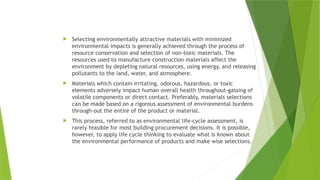
 Selecting environmentally attractive materials with minimized
environmental impacts is generally achieved through the process of
resource conservation and selection of non-toxic materials. The
resources used to manufacture construction materials affect the
environment by depleting natural resources, using energy, and releasing
pollutants to the land, water, and atmosphere.
 Materials which contain irritating, odorous, hazardous, or toxic
elements adversely impact human overall health throughout-gassing of
volatile components or direct contact. Preferably, materials selections
can be made based on a rigorous assessment of environmental burdens
through-out the entire of the product or material.
 This process, referred to as environmental life-cycle assessment, is
rarely feasible for most building procurement decisions. It is possible,
however, to apply life cycle thinking to evaluate what is known about
the environmental performance of products and make wise selections.
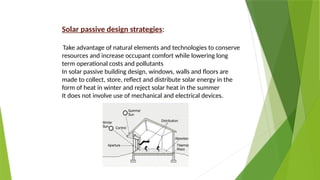
Solar passive design strategies:
Take advantage of natural elements and technologies to conserve
resources and increase occupant comfort while lowering long
term operational costs and pollutants
In solar passive building design, windows, walls and floors are
made to collect, store, reflect and distribute solar energy in the
form of heat in winter and reject solar heat in the summer
It does not involve use of mechanical and electrical devices.
Construction techniques
• Incorporate energy -efficient design into buildings to create an efficient and
comfortable environment
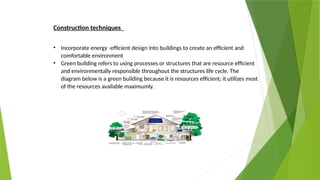
• Green building refers to using processes or structures that are resource efficient
and environmentally responsible throughout the structures life cycle. The
diagram below is a green building because it is resources efficient; it utilizes most
of the resources available maximumly.
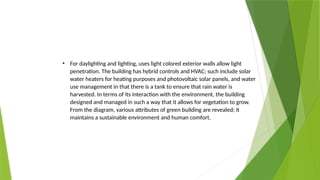
• For daylighting and lighting, uses light colored exterior walls allow light
penetration. The building has hybrid controls and HVAC; such include solar
water heaters for heating purposes and photovoltaic solar panels, and water
use management in that there is a tank to ensure that rain water is
harvested. In terms of its interaction with the environment, the building
designed and managed in such a way that it allows for vegetation to grow.
From the diagram, various attributes of green building are revealed; it
maintains a sustainable environment and human comfort.
Architectural design strategies:
 Eco park within the courtyard
 Large openings in building form on South and North sides.
 Conservation of natural soil and trees.
 Orientation of building should be planned to reduce ingress of solar
radiation.
 Large openings on North and South faces.
 Green areas developed on smaller terraces.
 Shaded landscape areas to reduce ambient temperature.
 providing adequate parking in the basement and not in the
surrounding
 Natural ventilation due to stack effect
 Building punctures are designed to aid cross ventilation
 Building Structure
 The architectural emphasis was on the use of local building material &
local stone cladding to cut the cost of transportation and to reduce heat
transmission.
 Carbon emission neutrality and energy efficiency was ensured with
features like orientation optimization, overhang sizing, skylights for
daylight, insulation on walls/roofs, LED & efficient lighting, 100%
external lighting on solar PV cells and glass for UPVC windows.
 The building also used 30% fly ash in concrete, fly ash bricks. Geothermal
cooling was implemented by introducing an alternate cooling system
which could recycle cool air from below the earth's surface (below 4
meters) into the building complexes.
 This, coupled with solar chimneys reduced the dependence on air
conditioners. Solar Panels were installed for outdoor lighting and heating
water. The building also installed self-contained solid waste management
system.

GREEN ARCHITECTURE STUDY ANALYSISppt.pptx

  • 1.
    GREEN ARCHITECTURE  TOPIC– GREEN BUILDING ARCHITECTURE.  OBJECTIVES – Green buildings are designed to reduce the overall impact on human health and the natural environment by the following ways : A) using energy , water and other resources efficiently. B) by reducing waste , pollution and environmental degradation.  IMPORTANCE OF GREEN BUILDINGS – The growth and development of our communities has a large impact on our natural environment .The manufacturing ,design ,construction and operation of the buildings in which we live and work are responsible for the consumption of many of our natural resources.
  • 2.
    WHAT ARE GREENBUILDINGS?  Green building (also known as green construction or sustainable building) refers to both a structure and the application of processes that are environmentally responsible and resource-efficient throughout a building's life-cycle: from planning to design, construction, operation, maintenance, renovation, and demolition
  • 3.
    GREEN ARCHITECTURE ANDGREEN DESIGN Green Architecture defines an understanding of environment-friendly architecture under all classifications, and contains some universal consent , it may have many of these characteristics: • Ventilation systems designed for efficient heating and cooling. • Energy-efficient lighting and appliances. • Water–saving plumbing fixtures. • Landscapes planned to maximize passive solar energy. • Minimal harm to the Natural Habitat. • Locally obtained woods and stones • Efficient use of space.
  • 4.
    BENEFITS OF GREENBUILDINGS • A green building uses less energy , water and other natural resources create less waste and green house gases and is healthy for people during living or working inside as compared to a standard building. • Another benefit for green building is clean environment , water , and healthy living. WHY GREEN BUILDINGS ? It is about creating buildings that optimize on the local ecology , use of local materials and most importantly they are built to cut power , water and material requirements. Thus , if these things are kept in mind, then we will realize that our traditional architecture was in fact ,very green . Today, we have forgotten that how to make natural environment , instead copying it developed countries. These buildings are major energy consuming sector in the economy. About 35 to 40% of total energy is used by buildings during construction. The major consumption of energy in buildings is during construction and later in lighting and air conditioning systems . This consumption must be minimized. Possibly , this should be limited to about 80-100 watts per sqm.
  • 5.
    CONSIDERATION FOR GREENBUILDING  Green building involves consideration in four main areas : SITE DEVELOPMENT , MATERIAL SELECTION AND MINIMIZATION , ENERGY EFFICIENCY AND INDOOR AIR QUALITY. • Consider site development to reduce the impact of development on the natural environment. For example orient the buildings to take advantage of Solar access , shading and wind patterns that will lessen heating and cooling loads. • Carefully select materials that are durable, contain recycled content , and comfortable environment. Take advantage of solar access , shading and wind patterns that will lessen heating and cooling loads. • Design for high indoor air quality to promote occupant health and comfort. • Minimize the waste in construction and demolition processes by recovering materials and reusing or recycling those.
  • 6.
    The Principles OfGreen Buildings  The Green building design process begins with an intimate understanding of the site in all its beauties and complexities . Designers can create features in their buildings that mimic functions of particular eco-systems. Creating new habitat on structures in urbanized areas is especially important to Support bio diversity and healthy ecosystem.  The Following points summarize key principles and strategies which are associated with the five major elements of green building design which are Five major elements of Green Building design : Sustainable site design Energy efficiency Materials efficiency Water efficiency
  • 7.
    Structure efficiency • Itis the concept of sustainable building and has largest impact on cost and performance. • It aims to minimize the environment impact associated with all life cycles. Energy efficiency • The layout of the construction can be strategized so the natural light pours for additional warmth. • Shading the roof with trees offers an eco friendly alternative to air conditioning.
  • 8.
    Water Efficiency • Tominimize water consumption one should aim to use the water which ahs been collected and used. i.e. Rainwater Harvesting.
  • 9.
    Materials Efficiency  Materialsshould be use that can be recycled and can generate surplus amount of energy.  An example of this are solar power panels , not only they provide lightening but they are also a useful energy source. Waste reduction  It is probable to reuse resources.  What may be waste to us may have another benefit to something else.
  • 10.
    Green Building Materials •Green building materials are generally composed of renewable rather than non renewable resources. Green building materials can be selected by evaluating characteristics such as reused and recycled content , zero or low off-gassing of harmful air emissions , zero toxicity , High recyclability , durability and local production.
  • 11.
    • The materialscommon to many types of natural building are clay and sand . When mixed with water and usually straw or another fibre , the mixture may from clay blocks. • Other materials commonly used in natural building are : Earth , wood , or timber , rice hulls , bamboo and stone. • A wide variety of reused or recycled non toxic materials are common in natural building , including urban materials like concrete.
  • 12.
    Material selection  Theapplication of stable, attractive, and environmentally responsible building materials is a key ingredient of any high-performance building effort. The utilization of natural and healthy materials contributes to the wellbeing of the occupants and to a feeling of connection with the bounty of the natural world. Many building materials have considerable environmental effects from pollutant releases, habitat destruction, and depletion of natural resources.  This will happen during extraction and acquisition of raw materials, production and manufacturing processes, and transportation. In addition, some construction materials may harm human health by exposing workers and building occupants to toxic and hazardous chemicals. Consequently, recognition and selection of environmentally preferable materials for use in construction activities at pre-building phase present an opportunity to restrict such environmental and human health impacts.
  • 13.
     Selecting environmentallyattractive materials with minimized environmental impacts is generally achieved through the process of resource conservation and selection of non-toxic materials. The resources used to manufacture construction materials affect the environment by depleting natural resources, using energy, and releasing pollutants to the land, water, and atmosphere.  Materials which contain irritating, odorous, hazardous, or toxic elements adversely impact human overall health throughout-gassing of volatile components or direct contact. Preferably, materials selections can be made based on a rigorous assessment of environmental burdens through-out the entire of the product or material.  This process, referred to as environmental life-cycle assessment, is rarely feasible for most building procurement decisions. It is possible, however, to apply life cycle thinking to evaluate what is known about the environmental performance of products and make wise selections.
  • 14.
    Solar passive designstrategies: Take advantage of natural elements and technologies to conserve resources and increase occupant comfort while lowering long term operational costs and pollutants In solar passive building design, windows, walls and floors are made to collect, store, reflect and distribute solar energy in the form of heat in winter and reject solar heat in the summer It does not involve use of mechanical and electrical devices.
  • 15.
    Construction techniques • Incorporateenergy -efficient design into buildings to create an efficient and comfortable environment • Green building refers to using processes or structures that are resource efficient and environmentally responsible throughout the structures life cycle. The diagram below is a green building because it is resources efficient; it utilizes most of the resources available maximumly.
  • 16.
    • For daylightingand lighting, uses light colored exterior walls allow light penetration. The building has hybrid controls and HVAC; such include solar water heaters for heating purposes and photovoltaic solar panels, and water use management in that there is a tank to ensure that rain water is harvested. In terms of its interaction with the environment, the building designed and managed in such a way that it allows for vegetation to grow. From the diagram, various attributes of green building are revealed; it maintains a sustainable environment and human comfort.
  • 17.
    Architectural design strategies: Eco park within the courtyard  Large openings in building form on South and North sides.  Conservation of natural soil and trees.  Orientation of building should be planned to reduce ingress of solar radiation.  Large openings on North and South faces.
  • 18.
     Green areasdeveloped on smaller terraces.  Shaded landscape areas to reduce ambient temperature.  providing adequate parking in the basement and not in the surrounding  Natural ventilation due to stack effect  Building punctures are designed to aid cross ventilation
  • 19.
     Building Structure The architectural emphasis was on the use of local building material & local stone cladding to cut the cost of transportation and to reduce heat transmission.  Carbon emission neutrality and energy efficiency was ensured with features like orientation optimization, overhang sizing, skylights for daylight, insulation on walls/roofs, LED & efficient lighting, 100% external lighting on solar PV cells and glass for UPVC windows.  The building also used 30% fly ash in concrete, fly ash bricks. Geothermal cooling was implemented by introducing an alternate cooling system which could recycle cool air from below the earth's surface (below 4 meters) into the building complexes.  This, coupled with solar chimneys reduced the dependence on air conditioners. Solar Panels were installed for outdoor lighting and heating water. The building also installed self-contained solid waste management system.