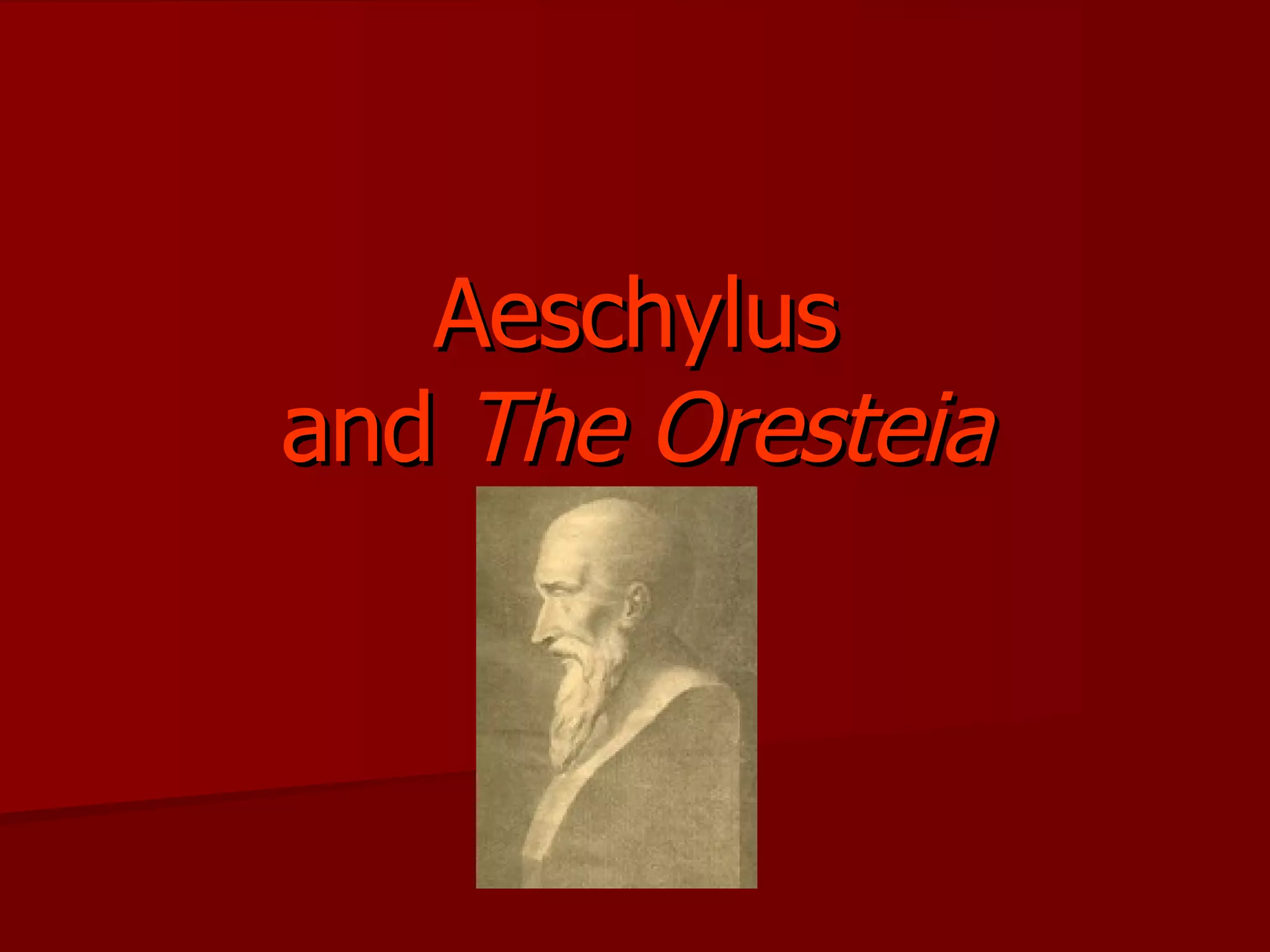
Aeschylus and  The   Oresteia
Background Born in 525 or 524 B.C. Died in 456 B.C. Considered the Second Father of Theater Wrote 90 plays – 7 survive
Background  Plays were mostly written for festivals Won 13 times for 52 plays Typical to produce 4 plays  Trilogy of Tragedies One Satyr Drama  Comic Relief Satyrs are followers of Dionysus Half man/Half goat Wild creatures constantly engaged in mischief
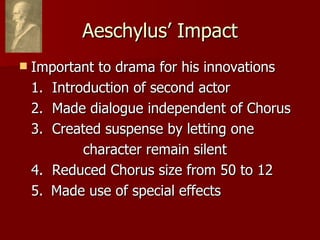
Aeschylus’ Impact Important to drama for his innovations 1.  Introduction of second actor 2.  Made dialogue independent of Chorus 3.  Created suspense by letting one  character remain silent 4.  Reduced Chorus size from 50 to 12 5. Made use of special effects
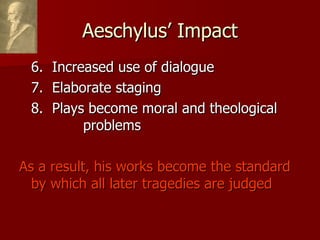
Aeschylus’ Impact 6.  Increased use of dialogue 7.  Elaborate staging 8.  Plays become moral and theological  problems As a result, his works become the standard by which all later tragedies are judged
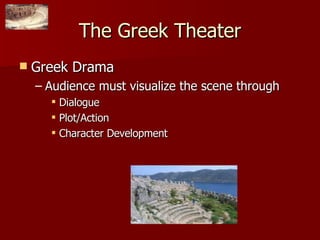
The Greek Theater Greek Drama Audience must visualize the scene through Dialogue Plot/Action Character Development
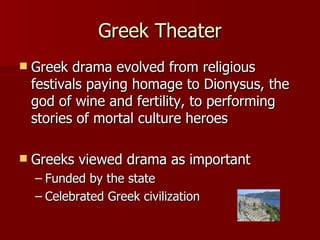
Greek Theater Greek drama evolved from religious festivals paying homage to Dionysus, the god of wine and fertility, to performing stories of mortal culture heroes Greeks viewed drama as important Funded by the state Celebrated Greek civilization
The Greek Theater Two or three male actors played all parts Gods were used in Greek theater Purpose?  To set matters right among mortals To rescue characters from complications beyond their abilities Gods were lowered from roof of skene by mechanical devices Known as  deus ex machina (god out of a machine)
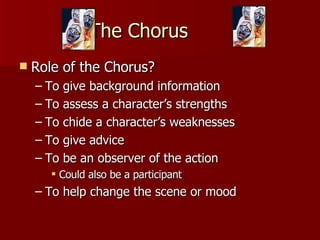
The Chorus  Role of the Chorus? To give background information To assess a character’s strengths To chide a character’s weaknesses To give advice To be an observer of the action Could also be a participant To help change the scene or mood
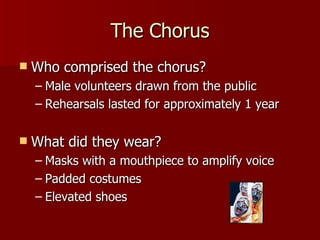
The Chorus Who comprised the chorus? Male volunteers drawn from the public Rehearsals lasted for approximately 1 year What did they wear? Masks with a mouthpiece to amplify voice Padded costumes Elevated shoes
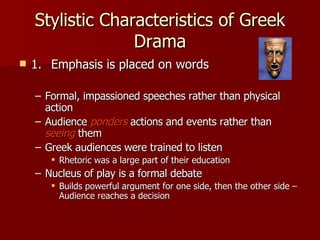
Stylistic Characteristics of Greek Drama 1. Emphasis is placed on words Formal, impassioned speeches rather than physical action Audience  ponders  actions and events rather than  seeing  them Greek audiences were trained to listen Rhetoric was a large part of their education Nucleus of play is a formal debate Builds powerful argument for one side, then the other side – Audience reaches a decision
Stylistic Characteristics of Greek Drama 2. Plays were divided into 5 main parts 1.   Prologue  (prologos) Opening Speech, established the main line of the story 2.   Parados Formal entrance of the Chorus Chorus gives perspective on what audience has learned in the prologue 3.   Episodia  (episodes) Characters engage in dialogues Often heated debates over conflicts in the play
Stylistic Characteristics of Greek Drama 4.  Stasimon  (Choral Ode) Follows each episode Chorus responds to and interprets preceding dialogue Chanted or sung as chorus moves rhythmically Strophes and Antistrophes 5.  Exodus Last scene Follows final episode and stasimon Resolution Characters leave stage
Stylistic Characteristics of Greek Drama 3.  Irony contributes to the final impact of  the tragic experience Dramatic Irony Character’s actions and words are understood by the audience, but not by himself Tragic Irony Involves twists & turns of fate The harder the hero tries to avoid catastrophe, the faster  it hits
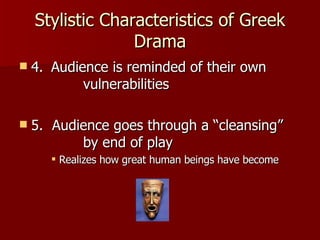
Stylistic Characteristics of Greek Drama 4. Audience is reminded of their own  vulnerabilities 5.  Audience goes through a “cleansing”  by end of play Realizes how great human beings have become
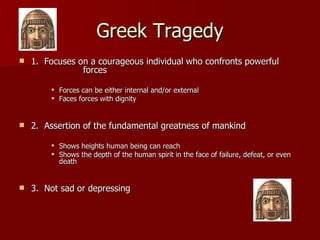
Greek Tragedy 1.  Focuses on a courageous individual who confronts powerful  forces Forces can be either internal and/or external Faces forces with dignity 2.  Assertion of the fundamental greatness of mankind Shows heights human being can reach Shows the depth of the human spirit in the face of failure, defeat, or even death 3.  Not sad or depressing
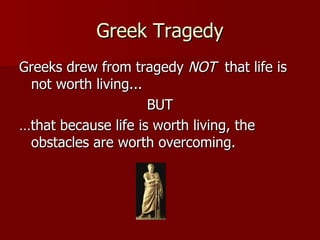
Greek Tragedy Greeks drew from tragedy  NOT   that life is not worth living... BUT …that because life is worth living, the obstacles are worth overcoming.
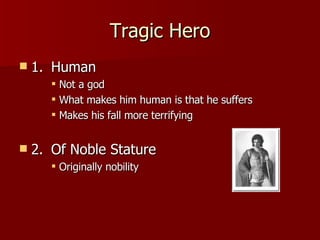
Tragic Hero 1. Human Not a god What makes him human is that he suffers Makes his fall more terrifying 2. Of Noble Stature Originally nobility
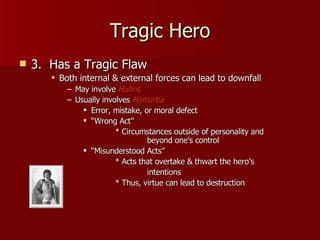
Tragic Hero 3.  Has a Tragic Flaw Both internal & external forces can lead to downfall May involve  Hubris Usually involves  Hamartia Error, mistake, or moral defect “ Wrong Act”  * Circumstances outside of personality and  beyond one’s control “ Misunderstood Acts”  * Acts that overtake & thwart the hero’s    intentions * Thus, virtue can lead to destruction
Tragic Hero 4. Faces conflict Does not cringe or flee  Does not accept fate meekly Objects with vehemence, logic, defiance 4. Recognizes who/what he is at the end Recognizes what is happening Moment change occurs ( peripeteia ) leads to recognition

Aeschylus

  • 1.
    Aeschylus and The Oresteia
  • 2.
    Background Born in525 or 524 B.C. Died in 456 B.C. Considered the Second Father of Theater Wrote 90 plays – 7 survive
  • 3.
    Background Playswere mostly written for festivals Won 13 times for 52 plays Typical to produce 4 plays Trilogy of Tragedies One Satyr Drama Comic Relief Satyrs are followers of Dionysus Half man/Half goat Wild creatures constantly engaged in mischief
  • 4.
    Aeschylus’ Impact Importantto drama for his innovations 1. Introduction of second actor 2. Made dialogue independent of Chorus 3. Created suspense by letting one character remain silent 4. Reduced Chorus size from 50 to 12 5. Made use of special effects
  • 5.
    Aeschylus’ Impact 6. Increased use of dialogue 7. Elaborate staging 8. Plays become moral and theological problems As a result, his works become the standard by which all later tragedies are judged
  • 6.
    The Greek TheaterGreek Drama Audience must visualize the scene through Dialogue Plot/Action Character Development
  • 7.
    Greek Theater Greekdrama evolved from religious festivals paying homage to Dionysus, the god of wine and fertility, to performing stories of mortal culture heroes Greeks viewed drama as important Funded by the state Celebrated Greek civilization
  • 8.
    The Greek TheaterTwo or three male actors played all parts Gods were used in Greek theater Purpose? To set matters right among mortals To rescue characters from complications beyond their abilities Gods were lowered from roof of skene by mechanical devices Known as deus ex machina (god out of a machine)
  • 9.
    The Chorus Role of the Chorus? To give background information To assess a character’s strengths To chide a character’s weaknesses To give advice To be an observer of the action Could also be a participant To help change the scene or mood
  • 10.
    The Chorus Whocomprised the chorus? Male volunteers drawn from the public Rehearsals lasted for approximately 1 year What did they wear? Masks with a mouthpiece to amplify voice Padded costumes Elevated shoes
  • 11.
    Stylistic Characteristics ofGreek Drama 1. Emphasis is placed on words Formal, impassioned speeches rather than physical action Audience ponders actions and events rather than seeing them Greek audiences were trained to listen Rhetoric was a large part of their education Nucleus of play is a formal debate Builds powerful argument for one side, then the other side – Audience reaches a decision
  • 12.
    Stylistic Characteristics ofGreek Drama 2. Plays were divided into 5 main parts 1. Prologue (prologos) Opening Speech, established the main line of the story 2. Parados Formal entrance of the Chorus Chorus gives perspective on what audience has learned in the prologue 3. Episodia (episodes) Characters engage in dialogues Often heated debates over conflicts in the play
  • 13.
    Stylistic Characteristics ofGreek Drama 4. Stasimon (Choral Ode) Follows each episode Chorus responds to and interprets preceding dialogue Chanted or sung as chorus moves rhythmically Strophes and Antistrophes 5. Exodus Last scene Follows final episode and stasimon Resolution Characters leave stage
  • 14.
    Stylistic Characteristics ofGreek Drama 3. Irony contributes to the final impact of the tragic experience Dramatic Irony Character’s actions and words are understood by the audience, but not by himself Tragic Irony Involves twists & turns of fate The harder the hero tries to avoid catastrophe, the faster it hits
  • 15.
    Stylistic Characteristics ofGreek Drama 4. Audience is reminded of their own vulnerabilities 5. Audience goes through a “cleansing” by end of play Realizes how great human beings have become
  • 16.
    Greek Tragedy 1. Focuses on a courageous individual who confronts powerful forces Forces can be either internal and/or external Faces forces with dignity 2. Assertion of the fundamental greatness of mankind Shows heights human being can reach Shows the depth of the human spirit in the face of failure, defeat, or even death 3. Not sad or depressing
  • 17.
    Greek Tragedy Greeksdrew from tragedy NOT that life is not worth living... BUT …that because life is worth living, the obstacles are worth overcoming.
  • 18.
    Tragic Hero 1.Human Not a god What makes him human is that he suffers Makes his fall more terrifying 2. Of Noble Stature Originally nobility
  • 19.
    Tragic Hero 3. Has a Tragic Flaw Both internal & external forces can lead to downfall May involve Hubris Usually involves Hamartia Error, mistake, or moral defect “ Wrong Act” * Circumstances outside of personality and beyond one’s control “ Misunderstood Acts” * Acts that overtake & thwart the hero’s intentions * Thus, virtue can lead to destruction
  • 20.
    Tragic Hero 4.Faces conflict Does not cringe or flee Does not accept fate meekly Objects with vehemence, logic, defiance 4. Recognizes who/what he is at the end Recognizes what is happening Moment change occurs ( peripeteia ) leads to recognition