Welcome
To Our
Presentation
Presentation Topic:
History of Greek
Civilization
Presented By
Group : L
Students Name & ID no:
Md. Anikuzzaman(16638),
Tanvir Rayhan(161647),
Jannatun Ferdous Sinthia(161649),
Nishana Afrin Nishu(161624).
1st year, 1st term,
Sociology discipline,
Khulna University.
The Greek Civilization
Introduction:
Among all the peoples of the ancient world
,the one whose culture most clearly
exemplified the spirit of western society was
the Greek.
The Greek tragic poet Sophocles proposed, to
which we might be respond: “Wonders are
many in the ancient West and the greatest of
these were the Greeks.”
The Greek Civilization
Rise of the Greek civilization:
The civilization of ancient Greece emerged
into the light of world history in the 8th
century BC. Though Greece fell to the Romans
in 146BC, as a culture lasted longer still,
continuing to the end of the ancient world.
The Greek Civilization
The Periods of Ancient Greece:
The history of Greece during classical
antiquity may thus be subdivided into the
following periods.
 The Dark Ages (1150-800B.C)
 The Archaic Period(800-500B.C)
 The Classical Period(500-323B.C)
 The Hellenistic Period(323-146)
 The Roman Greece(146B.C-330A.D)
 The period of
Christianization(330A.D-529A.d)
The Greek Civilization
Timeline of Ancient Greece:
 776 BC: Traditional date of the first Olympic
games.
 750BC: Greek cities start planting colonies.
 594BC : Solon gives Athens a new constitution
and start of the rise of democracy.
 490-479BC: The Persian Wars, Sparta lead the
Greeks in defending their land against Persian
Empire.
The Greek Civilization
Timeline of Ancient Greece:
 447BC : Athens at the height of its glory.
 431-404 BC: The second Peloponnesian War and
Sparta becomes leading power.
 338BC: Roman king Philip II defeats the Greek
city states and imposes his dominion on them.
The Greek Civilization
Geography of Greek civilization:
The ancient Greeks were a seafaring people.
They traded with other countries around the
Mediterranean. Many cities created
settlements overseas known as colonies.
Greek cities were founded around the black
sea, north Africa, Italy, Sicily, France and
Spain.
The Greek Civilization
The Greek Dark Ages:
The fall of the Mycenaean civilization resulted in
catastrophic change for the land of Greece. Culture
reverted to simpler forms. It ushered in a period usually
called the Dark Ages.
In Dark Ages political patterns were very simple and
village communities were autonomous. Every
household raised its own food, manufactured its own
clothings and even produced most of its tools.
The Greek Civilization
Culture of Greeks:
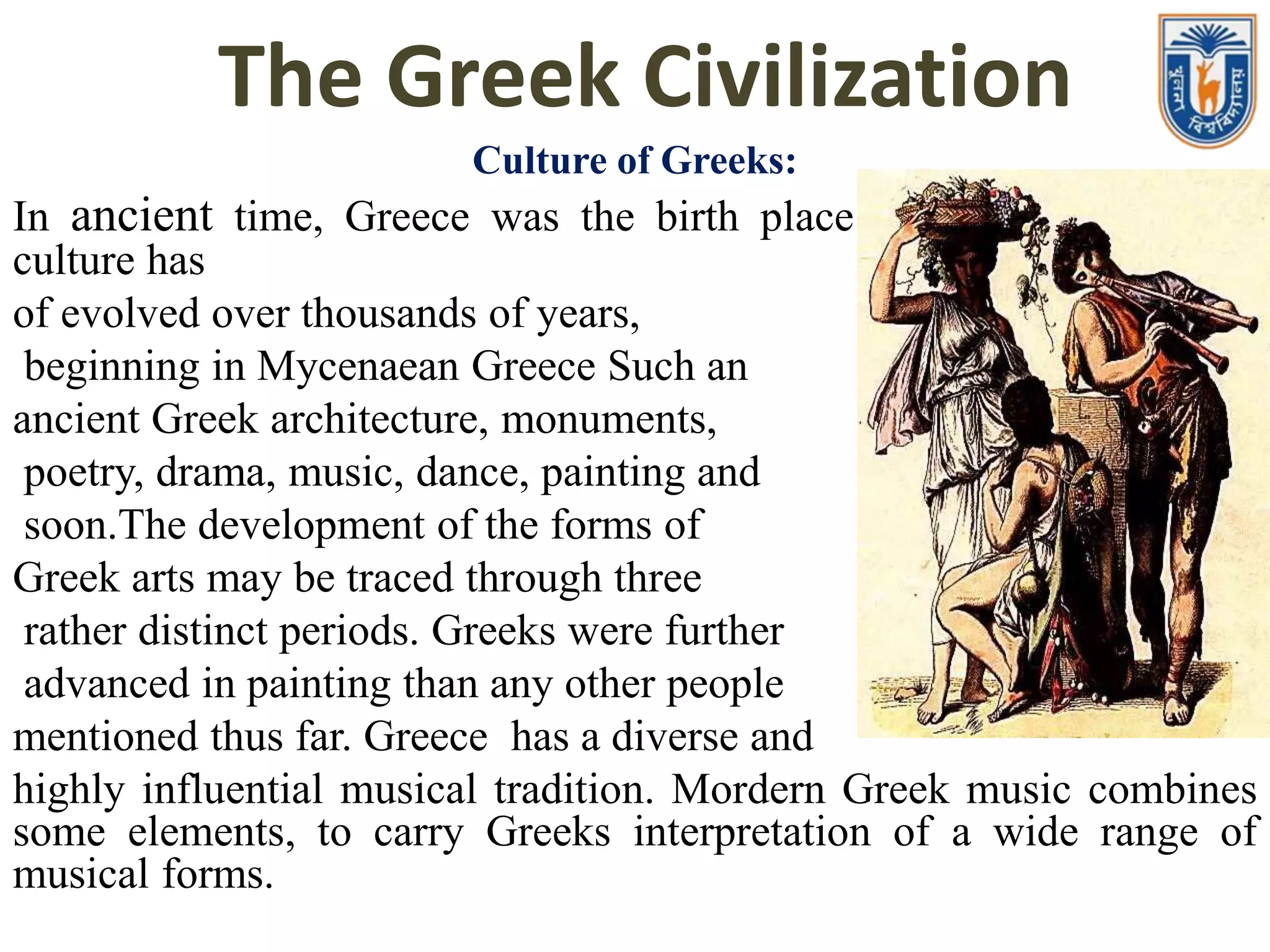
In ancient time, Greece was the birth place western culture. The
culture has
of evolved over thousands of years,
beginning in Mycenaean Greece Such an
ancient Greek architecture, monuments,
poetry, drama, music, dance, painting and
soon.The development of the forms of
Greek arts may be traced through three
rather distinct periods. Greeks were further
advanced in painting than any other people
mentioned thus far. Greece has a diverse and
highly influential musical tradition. Mordern Greek music combines
some elements, to carry Greeks interpretation of a wide range of
musical forms.
The Greek Civilization
• Social and Economic life:
Economic and social structure of classical
Greece, including the colonies it sent out around
the Mediterranean. Greece depending clearly on
farming. The economy of ancient Greece was
large by defined by the region’s dependence on
imported goods. Greece lacked a consolidated,
centralized economy in the modern sense of the
word.
The Greek Civilization
Religion of Greeks:
To the Greeks religion meant chiefly a polytheistic
system.Greeks did not except that their religion would
endow them with goodness of heart or grant them
everlasting rewards.Greek religion lacked of
commandments,dogmas or sacraments. Since 110A.D
Chiristianity came to the greeks. After few centuries
orthodox Chiristianity made itself the religion of the
Greeks.
The Greek Civilization
Religion
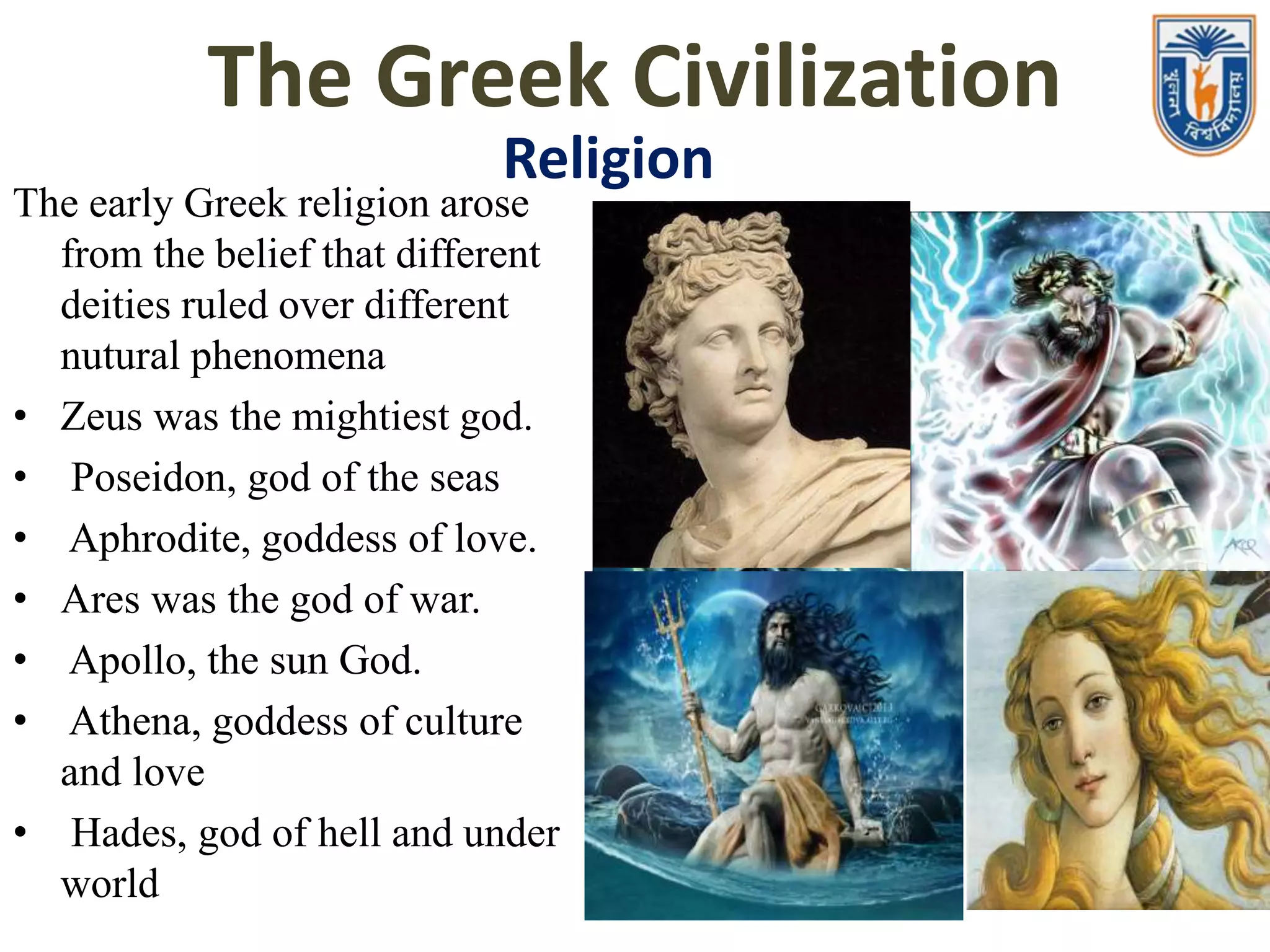
The early Greek religion arose
from the belief that different
deities ruled over different
nutural phenomena
• Zeus was the mightiest god.
• Poseidon, god of the seas
• Aphrodite, goddess of love.
• Ares was the god of war.
• Apollo, the sun God.
• Athena, goddess of culture
and love
• Hades, god of hell and under
world
The Greek Civilization
Education
Most Greek cities did not have publicly founded schools.Therefore
education was a private affair.
The boy would attend a small school run by a private teacher,who would
have a few pupils in his charge. Here , the boy would learn to
read,write,sing ,play music and do arithmetic.
A teacher with his two Charges
After 12 boys focused on physical education like sports,throwing,
wresling. After school boys under went military training.
The Greek Civilization
Philosophy
The Greeks invented philosop-
hy.It was beginig around 6th
Bc,century BC.By 5th century
Bc Greek thinkers advocating
The idea that reason is the
best way to reaching truth.
Greek philosophy reached high
point in the careers of three
Thinkers who lived in Athens;
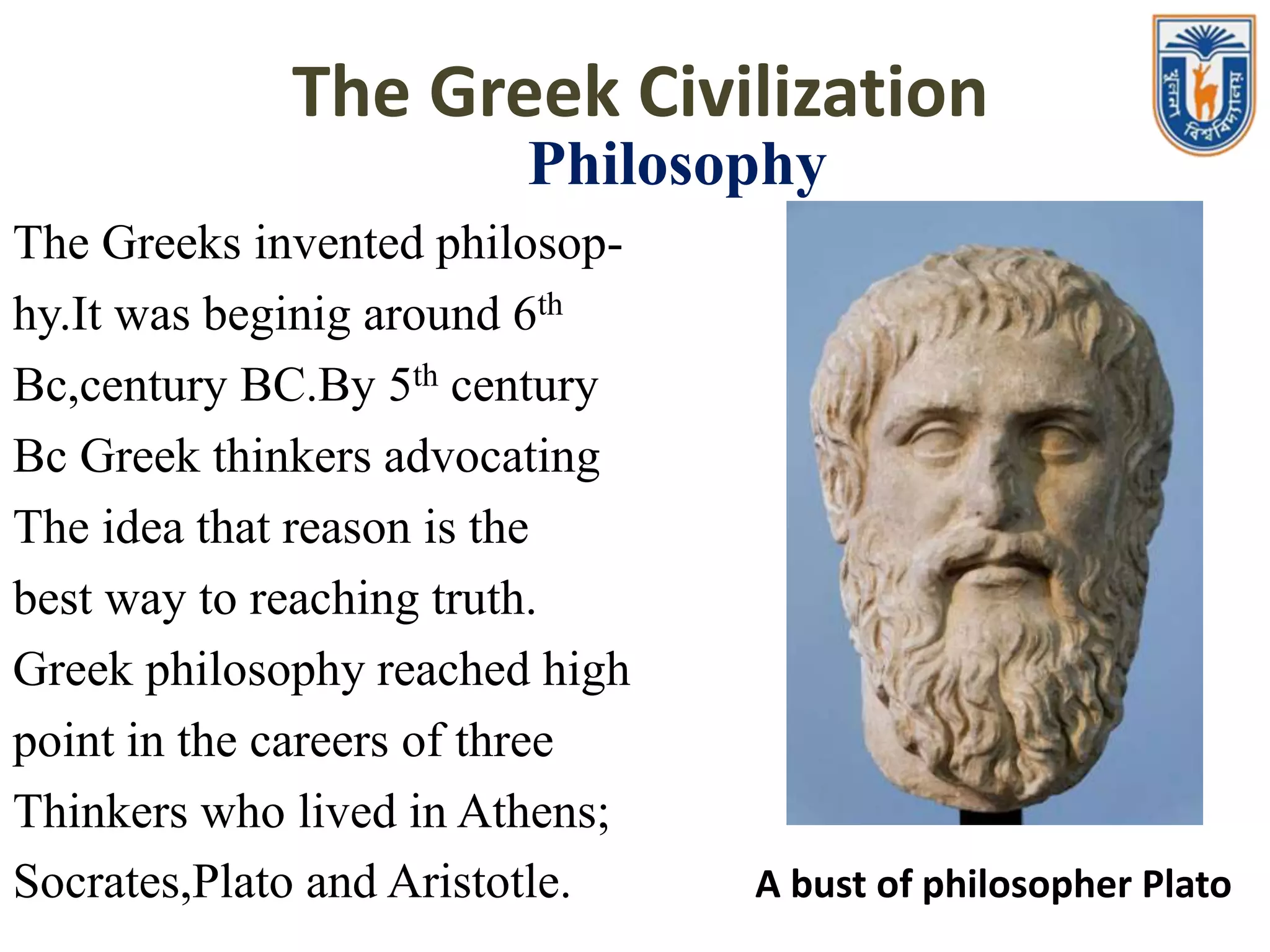
Socrates,Plato and Aristotle. A bust of philosopher Plato
The Greek Civilization
Emergence of the City-States
About 800 B.C.E the village communities,which
rested mainly on tribal or clan, started growing into
larger units centered on towns. Most often the towns
were built on hills and were more than fortifications
with marketplaces and permanent residents. Thus
emerged the city-states, consisiting usually of a single
city and all its surrounding trritory.
The Greek Civilization
Government and Politics
Citizens were the free members of the community.
 Adult male citizens would regularly meet togather
in public assembly.
Every citizen could take a part to decide matters of
importance for the city-state.
 In all state, a small group of aristocrats initially had
a controlling position.
 Public officials and soldiers were largely
unpaid,srving their cities voluntarily.
 Taxes were levied in times of emergency.
The Greek Civilization
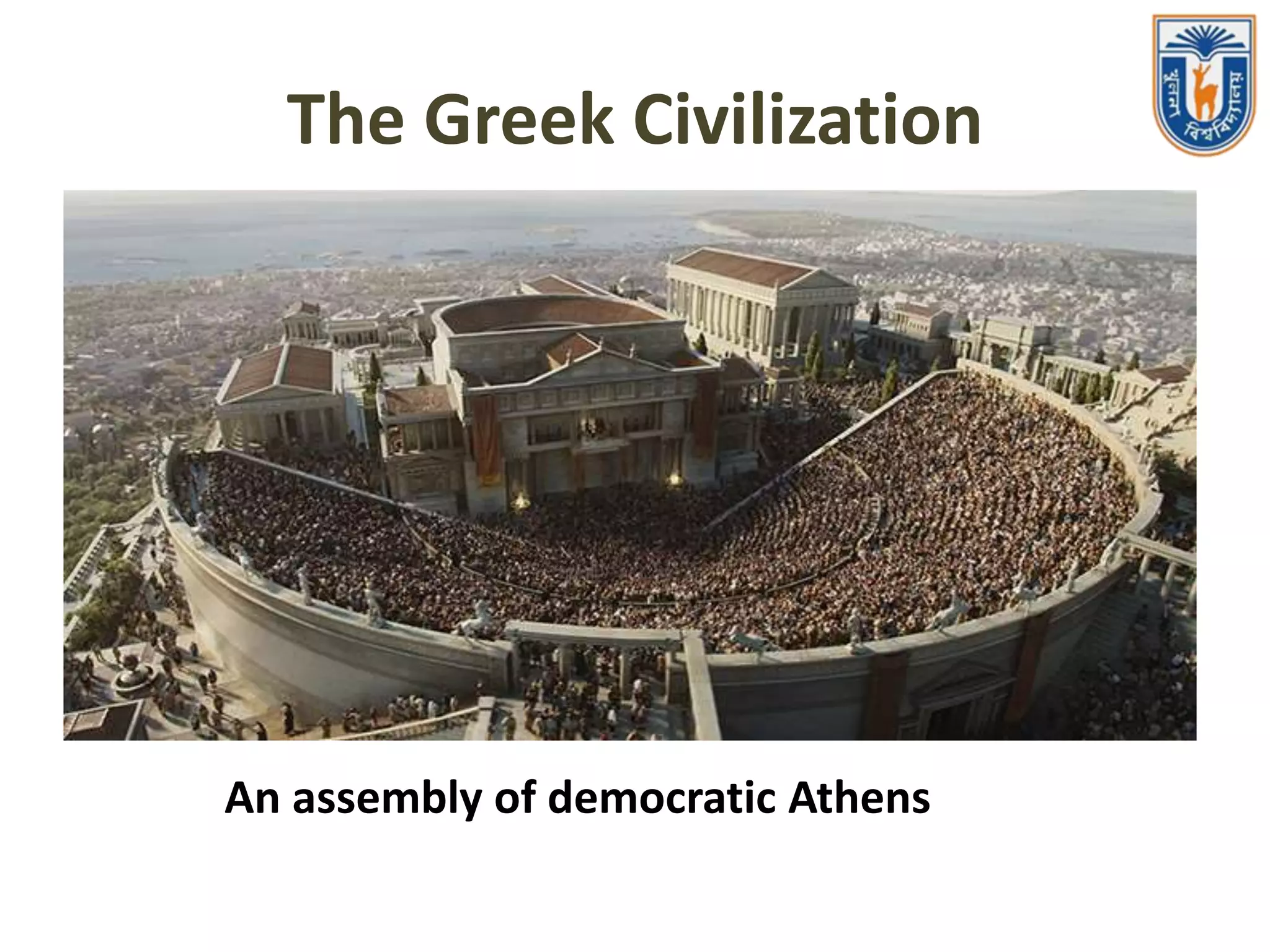
An assembly of democratic Athens
The Greek Civilization
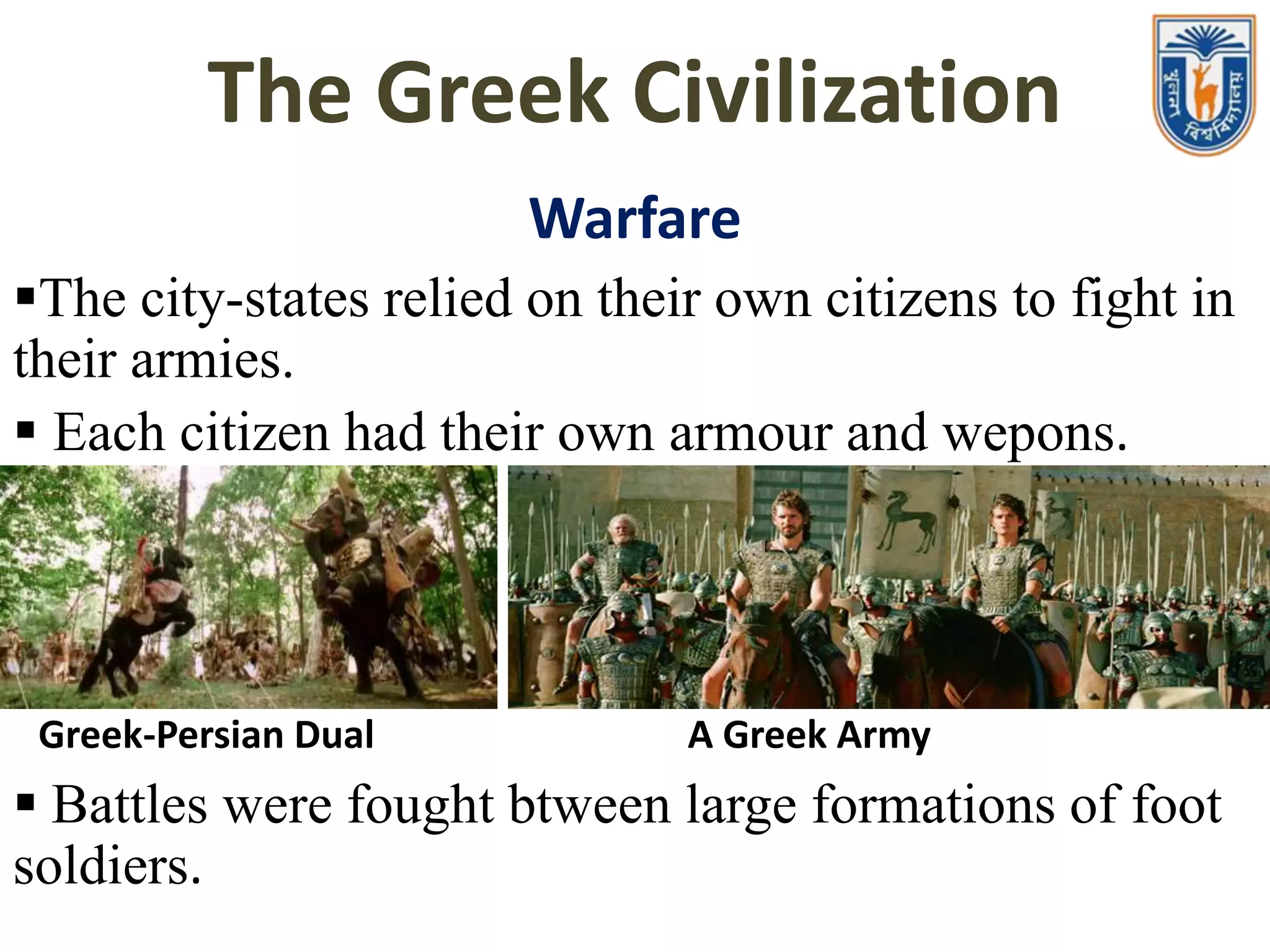
Warfare
The city-states relied on their own citizens to fight in
their armies.
 Each citizen had their own armour and wepons.
Greek-Persian Dual A Greek Army
 Battles were fought btween large formations of foot
soldiers.
The Greek Civilization
Warfare
 The scale of Greek warfare increased somewhat in
the 6th century BC.
 City-states formed alliances.
 Large armies were fielded.
 Campaigns grew longer.
 Blocades and sieges became common.
 Naval warfare became more important in several
city-states.
The Greek Civilization
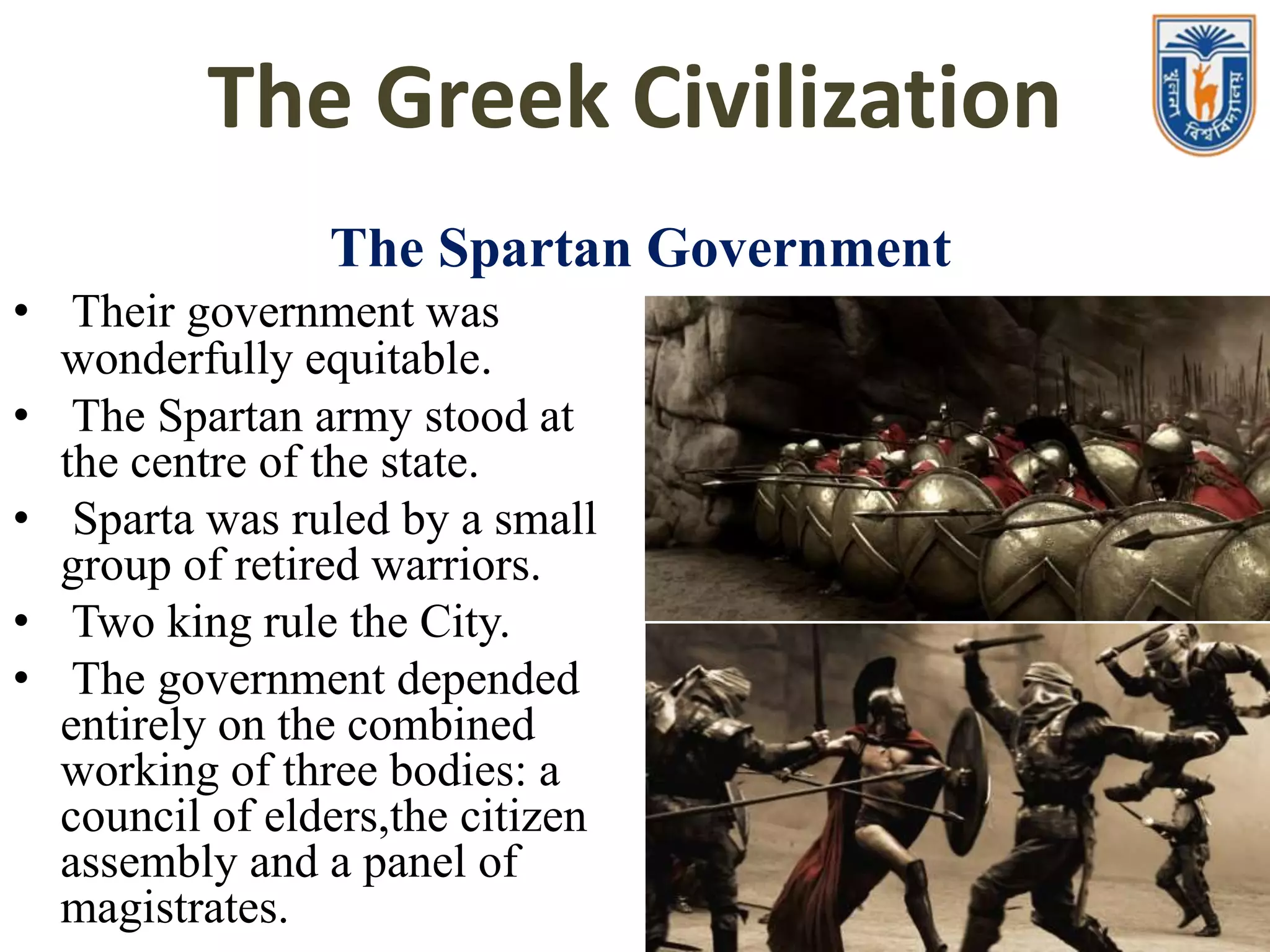
The Spartan Government
Sparta was highly trained foot Army. They always influenced
Greek politics. After the 2nd Peloponnesian war they became
the rulers of Greece.
Sparta Army
The Greek Civilization
The Spartan Government
• Their government was
wonderfully equitable.
• The Spartan army stood at
the centre of the state.
• Sparta was ruled by a small
group of retired warriors.
• Two king rule the City.
• The government depended
entirely on the combined
working of three bodies: a
council of elders,the citizen
assembly and a panel of
magistrates.
The Greek Civilization
Modern Greece
The ancient Greece fall to the Romans between 146-
31 BC. Then the Byzantine,eastern Roman empire had
rule over the greece.After fall of Constantinople
Greece gradually became part of the Ottoman empire.
In 1821, Greeks rose up 1st time against the Ottomans.
In 1833 Greece became free from Ottoman control and
emerge as a independent kingdom.
BIbliography
Ralph Philip Lee , . Lerner Robert Etalon,Wood Alan
T; World Civilization-Their History and Culture,9th
edition.
Swain James Edgar, A History of World Civilization.
 WWW.timemaps.com/civilization-ancient-greeks
https://en.m.wikipedia.org
 www.worldencyclopedia.org
http://greece.greekreporter.com
https://www.ancientgreece.co.uk
Thank You All
Do you have any Question?

Greek Civilization 2.pptx

  • 1.
  • 2.
  • 3.
    Presented By Group :L Students Name & ID no: Md. Anikuzzaman(16638), Tanvir Rayhan(161647), Jannatun Ferdous Sinthia(161649), Nishana Afrin Nishu(161624). 1st year, 1st term, Sociology discipline, Khulna University.
  • 5.
    The Greek Civilization Introduction: Amongall the peoples of the ancient world ,the one whose culture most clearly exemplified the spirit of western society was the Greek. The Greek tragic poet Sophocles proposed, to which we might be respond: “Wonders are many in the ancient West and the greatest of these were the Greeks.”
  • 7.
    The Greek Civilization Riseof the Greek civilization: The civilization of ancient Greece emerged into the light of world history in the 8th century BC. Though Greece fell to the Romans in 146BC, as a culture lasted longer still, continuing to the end of the ancient world.
  • 8.
    The Greek Civilization ThePeriods of Ancient Greece: The history of Greece during classical antiquity may thus be subdivided into the following periods.  The Dark Ages (1150-800B.C)  The Archaic Period(800-500B.C)  The Classical Period(500-323B.C)  The Hellenistic Period(323-146)  The Roman Greece(146B.C-330A.D)  The period of Christianization(330A.D-529A.d)
  • 9.
    The Greek Civilization Timelineof Ancient Greece:  776 BC: Traditional date of the first Olympic games.  750BC: Greek cities start planting colonies.  594BC : Solon gives Athens a new constitution and start of the rise of democracy.  490-479BC: The Persian Wars, Sparta lead the Greeks in defending their land against Persian Empire.
  • 10.
    The Greek Civilization Timelineof Ancient Greece:  447BC : Athens at the height of its glory.  431-404 BC: The second Peloponnesian War and Sparta becomes leading power.  338BC: Roman king Philip II defeats the Greek city states and imposes his dominion on them.
  • 11.
    The Greek Civilization Geographyof Greek civilization: The ancient Greeks were a seafaring people. They traded with other countries around the Mediterranean. Many cities created settlements overseas known as colonies. Greek cities were founded around the black sea, north Africa, Italy, Sicily, France and Spain.
  • 12.
    The Greek Civilization TheGreek Dark Ages: The fall of the Mycenaean civilization resulted in catastrophic change for the land of Greece. Culture reverted to simpler forms. It ushered in a period usually called the Dark Ages. In Dark Ages political patterns were very simple and village communities were autonomous. Every household raised its own food, manufactured its own clothings and even produced most of its tools.
  • 13.
    The Greek Civilization Cultureof Greeks: In ancient time, Greece was the birth place western culture. The culture has of evolved over thousands of years, beginning in Mycenaean Greece Such an ancient Greek architecture, monuments, poetry, drama, music, dance, painting and soon.The development of the forms of Greek arts may be traced through three rather distinct periods. Greeks were further advanced in painting than any other people mentioned thus far. Greece has a diverse and highly influential musical tradition. Mordern Greek music combines some elements, to carry Greeks interpretation of a wide range of musical forms.
  • 14.
    The Greek Civilization •Social and Economic life: Economic and social structure of classical Greece, including the colonies it sent out around the Mediterranean. Greece depending clearly on farming. The economy of ancient Greece was large by defined by the region’s dependence on imported goods. Greece lacked a consolidated, centralized economy in the modern sense of the word.
  • 15.
    The Greek Civilization Religionof Greeks: To the Greeks religion meant chiefly a polytheistic system.Greeks did not except that their religion would endow them with goodness of heart or grant them everlasting rewards.Greek religion lacked of commandments,dogmas or sacraments. Since 110A.D Chiristianity came to the greeks. After few centuries orthodox Chiristianity made itself the religion of the Greeks.
  • 16.
    The Greek Civilization Religion Theearly Greek religion arose from the belief that different deities ruled over different nutural phenomena • Zeus was the mightiest god. • Poseidon, god of the seas • Aphrodite, goddess of love. • Ares was the god of war. • Apollo, the sun God. • Athena, goddess of culture and love • Hades, god of hell and under world
  • 17.
    The Greek Civilization Education MostGreek cities did not have publicly founded schools.Therefore education was a private affair. The boy would attend a small school run by a private teacher,who would have a few pupils in his charge. Here , the boy would learn to read,write,sing ,play music and do arithmetic. A teacher with his two Charges After 12 boys focused on physical education like sports,throwing, wresling. After school boys under went military training.
  • 18.
    The Greek Civilization Philosophy TheGreeks invented philosop- hy.It was beginig around 6th Bc,century BC.By 5th century Bc Greek thinkers advocating The idea that reason is the best way to reaching truth. Greek philosophy reached high point in the careers of three Thinkers who lived in Athens; Socrates,Plato and Aristotle. A bust of philosopher Plato
  • 19.
    The Greek Civilization Emergenceof the City-States About 800 B.C.E the village communities,which rested mainly on tribal or clan, started growing into larger units centered on towns. Most often the towns were built on hills and were more than fortifications with marketplaces and permanent residents. Thus emerged the city-states, consisiting usually of a single city and all its surrounding trritory.
  • 20.
    The Greek Civilization Governmentand Politics Citizens were the free members of the community.  Adult male citizens would regularly meet togather in public assembly. Every citizen could take a part to decide matters of importance for the city-state.  In all state, a small group of aristocrats initially had a controlling position.  Public officials and soldiers were largely unpaid,srving their cities voluntarily.  Taxes were levied in times of emergency.
  • 21.
    The Greek Civilization Anassembly of democratic Athens
  • 22.
    The Greek Civilization Warfare Thecity-states relied on their own citizens to fight in their armies.  Each citizen had their own armour and wepons. Greek-Persian Dual A Greek Army  Battles were fought btween large formations of foot soldiers.
  • 23.
    The Greek Civilization Warfare The scale of Greek warfare increased somewhat in the 6th century BC.  City-states formed alliances.  Large armies were fielded.  Campaigns grew longer.  Blocades and sieges became common.  Naval warfare became more important in several city-states.
  • 24.
    The Greek Civilization TheSpartan Government Sparta was highly trained foot Army. They always influenced Greek politics. After the 2nd Peloponnesian war they became the rulers of Greece. Sparta Army
  • 25.
    The Greek Civilization TheSpartan Government • Their government was wonderfully equitable. • The Spartan army stood at the centre of the state. • Sparta was ruled by a small group of retired warriors. • Two king rule the City. • The government depended entirely on the combined working of three bodies: a council of elders,the citizen assembly and a panel of magistrates.
  • 26.
    The Greek Civilization ModernGreece The ancient Greece fall to the Romans between 146- 31 BC. Then the Byzantine,eastern Roman empire had rule over the greece.After fall of Constantinople Greece gradually became part of the Ottoman empire. In 1821, Greeks rose up 1st time against the Ottomans. In 1833 Greece became free from Ottoman control and emerge as a independent kingdom.
  • 27.
    BIbliography Ralph Philip Lee, . Lerner Robert Etalon,Wood Alan T; World Civilization-Their History and Culture,9th edition. Swain James Edgar, A History of World Civilization.  WWW.timemaps.com/civilization-ancient-greeks https://en.m.wikipedia.org  www.worldencyclopedia.org http://greece.greekreporter.com https://www.ancientgreece.co.uk
  • 28.
    Thank You All Doyou have any Question?