Brain-Based Teaching Strategies
that Support Long-Term Retention
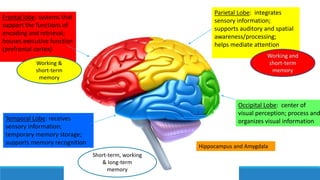
Parietal Lobe: integrates
sensory information;
supports auditory and spatial
awareness/processing;
helps mediate attention
Frontal lobe: systems that
support the functions of
encoding and retrieval;
houses executive function
(prefrontal cortex)
Temporal Lobe: receives
sensory information;
temporary memory storage;
supports memory recognition
Occipital Lobe: center of
visual perception; process and
organizes visual information
Working &
short-term
memory
Short-term, working
& long-term
memory
Hippocampus and Amygdala
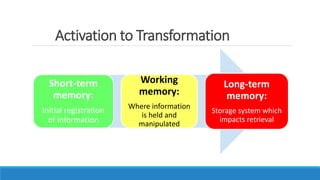
Activation to Transformation
Short-term
memory:
Initial registration
of information
Working
memory:
Where information
is held and
manipulated
Long-term
memory:
Storage system which
impacts retrieval
Information Processing
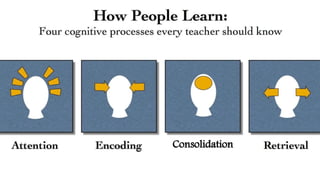
Consolidation
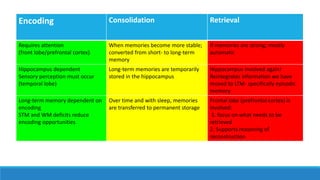
Encoding Consolidation Retrieval
Requires attention
(front lobe/prefrontal cortex)
When memories become more stable;
converted from short- to long-term
memory
If memories are strong; mostly
automatic
Hippocampus dependent
Sensory perception must occur
(temporal lobe)
Long-term memories are temporarily
stored in the hippocampus
Hippocampus involved again!
Reintegrates information we have
moved to LTM- specifically episodic
memory
Long-term memory dependent on
encoding
STM and WM deficits reduce
encoding opportunities
Over time and with sleep, memories
are transferred to permanent storage
Frontal lobe (prefrontal cortex) is
involved:
1. focus on what needs to be
retrieved
2. Supports reasoning of
reconstruction
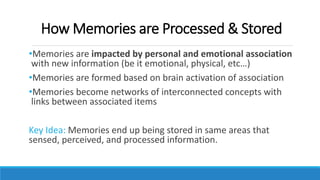
How Memories are Processed & Stored
•Memories are impacted by personal and emotional association
with new information (be it emotional, physical, etc…)
•Memories are formed based on brain activation of association
•Memories become networks of interconnected concepts with
links between associated items
Key Idea: Memories end up being stored in same areas that
sensed, perceived, and processed information.
Affective Strategies Before
Instructional Strategies
• Memories are impacted by the emotional connection that students have to the
classroom environment
•Long-term memory is enhanced when teachers Connect Content to authentic
Context (Three C’s)
•Vital to activate an emotional connection to an instructional strategy
• Example 1: Pretty Little Liars
• Example 2: Sports Center Top 10
• Example 3: Dropping a bowling ball vs marble out of the window
• Example 4: Pre- and post- unit engineering challenges
• Example 5: students’ activities outside their classroom life
•Catch students using strategies effectively and offer praise
Instructional Strategies to Support LTM
1. Give teacher-prepared handouts prior to and during class lectures.
WHY?
•The handouts for class lectures could consist of a brief outline or a partially completed
graphic organizer that the student would complete during the lecture.
•Having this information both enables students to identify the salient information that is
given during the lectures and to correctly organize the information in their notes.
•Both of these activities enhance memory of the information as well.
•This is visible teaching.
Instructional
Strategies
to Support LTM
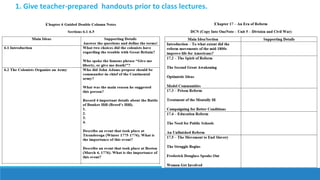
1. Give teacher-prepared
handouts prior to class lectures.
EXAMPLE- VIPs
(Very Important Papers)
1. Give teacher-prepared handouts prior to class lectures.
Instructional Strategies to Support LTM
2. Prime the memory prior to teaching/learning
WHY?
•Cues that prepare students for the task to be presented are helpful. This is often
referred to as priming the memory.
•Students will get an idea of what is expected by discussing the vocabulary and the
overall topic beforehand.
•Allow them to focus on the salient information and engage in more effective depth of
processing.
•Advance organizers also serve this purpose.
Instructional
Strategies
to Support LTM
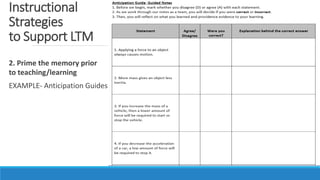
2. Prime the memory prior
to teaching/learning
EXAMPLE- Anticipation Guides
Instructional Strategies to Support LTM
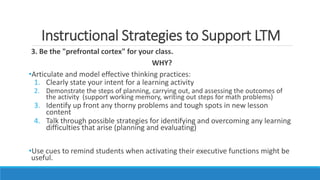
3. Be the "prefrontal cortex" for your class.
WHY?
•Articulate and model effective thinking practices:
1. Clearly state your intent for a learning activity
2. Demonstrate the steps of planning, carrying out, and assessing the outcomes of
the activity (support working memory, writing out steps for math problems)
3. Identify up front any thorny problems and tough spots in new lesson
content
4. Talk through possible strategies for identifying and overcoming any learning
difficulties that arise (planning and evaluating)
•Use cues to remind students when activating their executive functions might be
useful.
Instructional Strategies
to Support LTM
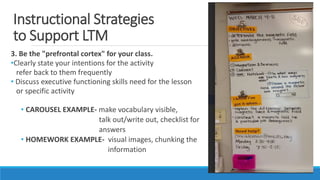
3. Be the "prefrontal cortex" for your class.
•Clearly state your intentions for the activity
refer back to them frequently
• Discuss executive functioning skills need for the lesson
or specific activity
• CAROUSEL EXAMPLE- make vocabulary visible,
talk out/write out, checklist for
answers
• HOMEWORK EXAMPLE- visual images, chunking the
information
Instructional Strategies to Support LTM
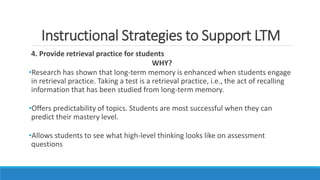
4. Provide retrieval practice for students
WHY?
•Research has shown that long-term memory is enhanced when students engage
in retrieval practice. Taking a test is a retrieval practice, i.e., the act of recalling
information that has been studied from long-term memory.
•Offers predictability of topics. Students are most successful when they can
predict their mastery level.
•Allows students to see what high-level thinking looks like on assessment
questions
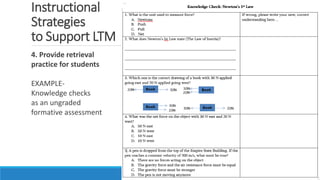
Instructional
Strategies
to Support LTM
4. Provide retrieval
practice for students
EXAMPLE-
Knowledge checks
as an ungraded
formative assessment
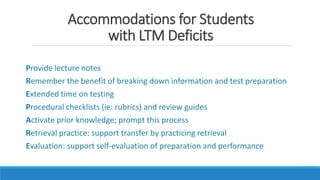
Accommodations for Students
with LTM Deficits
Provide lecture notes
Remember the benefit of breaking down information and test preparation
Extended time on testing
Procedural checklists (ie: rubrics) and review guides
Activate prior knowledge; prompt this process
Retrieval practice: support transfer by practicing retrieval
Evaluation: support self-evaluation of preparation and performance
Teacher Resources
Eat. Sleep. Teach.
http://www.eatsleepteach.com/2015/0
6/maximise-retention-of-students-long-
term-memory-part-1/
Brain-Based Teaching Strategies that
Support Long-Term Retention
Mead Ploszay, MICDS Learning Specialist
◦ mploszay@micds.org
Callie Bambenek, MICDS 8th Grade Science
◦ cbambenek@micds.org

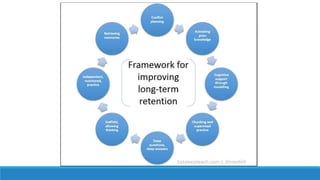
Brain-based strategies for enhancing retention

  • 1.
    Brain-Based Teaching Strategies thatSupport Long-Term Retention
  • 2.
    Parietal Lobe: integrates sensoryinformation; supports auditory and spatial awareness/processing; helps mediate attention Frontal lobe: systems that support the functions of encoding and retrieval; houses executive function (prefrontal cortex) Temporal Lobe: receives sensory information; temporary memory storage; supports memory recognition Occipital Lobe: center of visual perception; process and organizes visual information Working & short-term memory Short-term, working & long-term memory Hippocampus and Amygdala
  • 3.
    Activation to Transformation Short-term memory: Initialregistration of information Working memory: Where information is held and manipulated Long-term memory: Storage system which impacts retrieval
  • 4.
  • 6.
    Encoding Consolidation Retrieval Requiresattention (front lobe/prefrontal cortex) When memories become more stable; converted from short- to long-term memory If memories are strong; mostly automatic Hippocampus dependent Sensory perception must occur (temporal lobe) Long-term memories are temporarily stored in the hippocampus Hippocampus involved again! Reintegrates information we have moved to LTM- specifically episodic memory Long-term memory dependent on encoding STM and WM deficits reduce encoding opportunities Over time and with sleep, memories are transferred to permanent storage Frontal lobe (prefrontal cortex) is involved: 1. focus on what needs to be retrieved 2. Supports reasoning of reconstruction
  • 7.
    How Memories areProcessed & Stored •Memories are impacted by personal and emotional association with new information (be it emotional, physical, etc…) •Memories are formed based on brain activation of association •Memories become networks of interconnected concepts with links between associated items Key Idea: Memories end up being stored in same areas that sensed, perceived, and processed information.
  • 8.
    Affective Strategies Before InstructionalStrategies • Memories are impacted by the emotional connection that students have to the classroom environment •Long-term memory is enhanced when teachers Connect Content to authentic Context (Three C’s) •Vital to activate an emotional connection to an instructional strategy • Example 1: Pretty Little Liars • Example 2: Sports Center Top 10 • Example 3: Dropping a bowling ball vs marble out of the window • Example 4: Pre- and post- unit engineering challenges • Example 5: students’ activities outside their classroom life •Catch students using strategies effectively and offer praise
  • 9.
    Instructional Strategies toSupport LTM 1. Give teacher-prepared handouts prior to and during class lectures. WHY? •The handouts for class lectures could consist of a brief outline or a partially completed graphic organizer that the student would complete during the lecture. •Having this information both enables students to identify the salient information that is given during the lectures and to correctly organize the information in their notes. •Both of these activities enhance memory of the information as well. •This is visible teaching.
  • 10.
    Instructional Strategies to Support LTM 1.Give teacher-prepared handouts prior to class lectures. EXAMPLE- VIPs (Very Important Papers)
  • 11.
    1. Give teacher-preparedhandouts prior to class lectures.
  • 12.
    Instructional Strategies toSupport LTM 2. Prime the memory prior to teaching/learning WHY? •Cues that prepare students for the task to be presented are helpful. This is often referred to as priming the memory. •Students will get an idea of what is expected by discussing the vocabulary and the overall topic beforehand. •Allow them to focus on the salient information and engage in more effective depth of processing. •Advance organizers also serve this purpose.
  • 13.
    Instructional Strategies to Support LTM 2.Prime the memory prior to teaching/learning EXAMPLE- Anticipation Guides
  • 14.
    Instructional Strategies toSupport LTM 3. Be the "prefrontal cortex" for your class. WHY? •Articulate and model effective thinking practices: 1. Clearly state your intent for a learning activity 2. Demonstrate the steps of planning, carrying out, and assessing the outcomes of the activity (support working memory, writing out steps for math problems) 3. Identify up front any thorny problems and tough spots in new lesson content 4. Talk through possible strategies for identifying and overcoming any learning difficulties that arise (planning and evaluating) •Use cues to remind students when activating their executive functions might be useful.
  • 15.
    Instructional Strategies to SupportLTM 3. Be the "prefrontal cortex" for your class. •Clearly state your intentions for the activity refer back to them frequently • Discuss executive functioning skills need for the lesson or specific activity • CAROUSEL EXAMPLE- make vocabulary visible, talk out/write out, checklist for answers • HOMEWORK EXAMPLE- visual images, chunking the information
  • 16.
    Instructional Strategies toSupport LTM 4. Provide retrieval practice for students WHY? •Research has shown that long-term memory is enhanced when students engage in retrieval practice. Taking a test is a retrieval practice, i.e., the act of recalling information that has been studied from long-term memory. •Offers predictability of topics. Students are most successful when they can predict their mastery level. •Allows students to see what high-level thinking looks like on assessment questions
  • 17.
    Instructional Strategies to Support LTM 4.Provide retrieval practice for students EXAMPLE- Knowledge checks as an ungraded formative assessment
  • 19.
    Accommodations for Students withLTM Deficits Provide lecture notes Remember the benefit of breaking down information and test preparation Extended time on testing Procedural checklists (ie: rubrics) and review guides Activate prior knowledge; prompt this process Retrieval practice: support transfer by practicing retrieval Evaluation: support self-evaluation of preparation and performance
  • 20.
    Teacher Resources Eat. Sleep.Teach. http://www.eatsleepteach.com/2015/0 6/maximise-retention-of-students-long- term-memory-part-1/
  • 21.
    Brain-Based Teaching Strategiesthat Support Long-Term Retention Mead Ploszay, MICDS Learning Specialist ◦ mploszay@micds.org Callie Bambenek, MICDS 8th Grade Science ◦ cbambenek@micds.org