Presented by:
Ashwani Kumar
1
 Graphene quantum dots are carbonaceous
material prepared from graphene
 They are usually crystalline semiconductor
 Graphene quantum dots are with zero
dimension
 These are too small in diameter in between 1-
20 nm
 These are small enough to cause exciton
confinement
 GQD have molecule like character so it is
easier to handle
2
Zhang et al. Energy Environ. Sci., 2012, 5, 8869
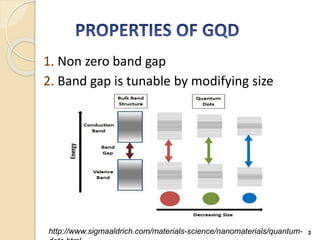
1. Non zero band gap
2. Band gap is tunable by modifying size
3http://www.sigmaaldrich.com/materials-science/nanomaterials/quantum-
3. Quantum confinement:
In a semiconductor crystallite whose
diameter is smaller than the size of its
exciton Bohr radius, the excitons are
squeezed, leading to quantum
confinement
4. Absorption spectra of GQD show peak in
between 230-370 nm due to different
type of transitions
4
Zhang et al. Molecules, 2003, 8, 207-222
5. Photoluminescence
 Photoluminescence is emission of light after
absorption of photon
 GQD with different size are able to absorb light,
when they release that energy it produce light
of different color
 Color of light produced depend upon the size of
quantum dot
5
Bacon et al. Part. Part Syst. Charact. 2014, 31, 415-428
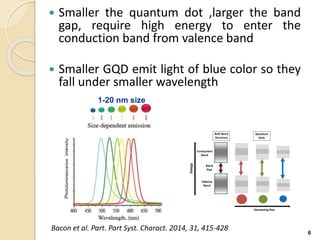
 Smaller the quantum dot ,larger the band
gap, require high energy to enter the
conduction band from valence band
 Smaller GQD emit light of blue color so they
fall under smaller wavelength
6
Photoluminescenceintensity
1-20 nm size
Bacon et al. Part. Part Syst. Charact. 2014, 31, 415-428
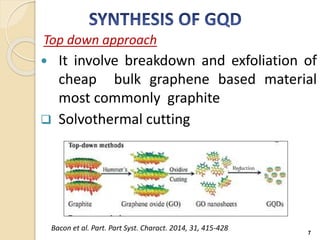
Top down approach
 It involve breakdown and exfoliation of
cheap bulk graphene based material
most commonly graphite
 Solvothermal cutting
7
Bacon et al. Part. Part Syst. Charact. 2014, 31, 415-428
Reduction
SOLVOTHERMAL CUTTING
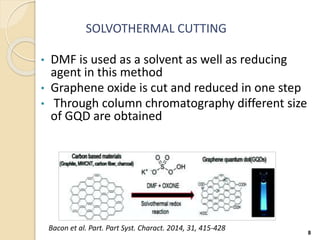
• DMF is used as a solvent as well as reducing
agent in this method
• Graphene oxide is cut and reduced in one step
• Through column chromatography different size
of GQD are obtained
8
Bacon et al. Part. Part Syst. Charact. 2014, 31, 415-428
BOTTOM UP APPROACH
 It involve the synthesis of quantum dots
from polycyclic aromatic compound or
molecule with aromatic structure such as
fullerene
Cage opening of fullerenes
9
Bacon et al. Part. Part Syst. Charact. 2014, 31, 415-428
CAGE OPENING OF FULLERENES
 In this method Ruthenium is used for
opening the cage structure of fullerenes
 Ruthenium surface interact strongly with C60
molecule
 Therefore fullerene get embedded on the
surface of Ruthenium and get fragmented at
elevated temperature
 Then it produce carbon cluster which undergo
diffusion and aggregation to form GQD
10
Bacon et al. Part. Part Syst. Charact. 2014, 31, 415-428
11
• Bioimaging
• Photovoltaic cells
• Light emitting diodes
• Fuel Cells
• Photocatalysis
Bacon et al. Part. Part Syst. Charact. 2014, 31, 415-428
12
• Photocatalyst is a substance which shows
the catalytic activity using energy from light
without undergoing any changes in itself
• Pure GQD have poor catalytic properties
due to large exciton binding energy (0.8 eV)
• GQD is tunable in wide energy range by
size and functionalization at edge site which
allow for construction of GQD-semiconductor
heterojunction
Pan et al. ACS Sustainable Chem. Eng. 2015, 3, 2405-2413
13
• ZnO is an n-type semiconductor material with
a wide direct band gap
• ZnO is non toxic in nature and is highly
photosensitive
• It is stable upon exposure to high energy
radiation.
• The combination of ZnO and GQD could be
promising heterojunction for many
photocatalytic application
Yuan et al. Dalton Trans., 2015, 44, 10997-11003
14
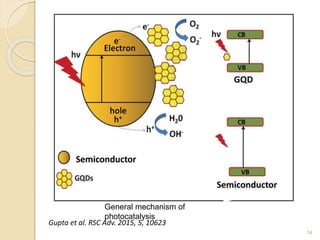
Gupta et al. RSC Adv. 2015, 5, 10623
General mechanism of
photocatalysis
 GQD can be successfully loaded onto
semiconductor to form efficient
heterojunction for photocatalytic
applications
 The GQD sensitized photocatalyst is a
promising photo catalytic material that
has good potential for many applications.
15
Thank you
16

Graphene quantum dots Synthesis and Properties

  • 1.
  • 2.
     Graphene quantumdots are carbonaceous material prepared from graphene  They are usually crystalline semiconductor  Graphene quantum dots are with zero dimension  These are too small in diameter in between 1- 20 nm  These are small enough to cause exciton confinement  GQD have molecule like character so it is easier to handle 2 Zhang et al. Energy Environ. Sci., 2012, 5, 8869
  • 3.
    1. Non zeroband gap 2. Band gap is tunable by modifying size 3http://www.sigmaaldrich.com/materials-science/nanomaterials/quantum-
  • 4.
    3. Quantum confinement: Ina semiconductor crystallite whose diameter is smaller than the size of its exciton Bohr radius, the excitons are squeezed, leading to quantum confinement 4. Absorption spectra of GQD show peak in between 230-370 nm due to different type of transitions 4 Zhang et al. Molecules, 2003, 8, 207-222
  • 5.
    5. Photoluminescence  Photoluminescenceis emission of light after absorption of photon  GQD with different size are able to absorb light, when they release that energy it produce light of different color  Color of light produced depend upon the size of quantum dot 5 Bacon et al. Part. Part Syst. Charact. 2014, 31, 415-428
  • 6.
     Smaller thequantum dot ,larger the band gap, require high energy to enter the conduction band from valence band  Smaller GQD emit light of blue color so they fall under smaller wavelength 6 Photoluminescenceintensity 1-20 nm size Bacon et al. Part. Part Syst. Charact. 2014, 31, 415-428
  • 7.
    Top down approach It involve breakdown and exfoliation of cheap bulk graphene based material most commonly graphite  Solvothermal cutting 7 Bacon et al. Part. Part Syst. Charact. 2014, 31, 415-428 Reduction
  • 8.
    SOLVOTHERMAL CUTTING • DMFis used as a solvent as well as reducing agent in this method • Graphene oxide is cut and reduced in one step • Through column chromatography different size of GQD are obtained 8 Bacon et al. Part. Part Syst. Charact. 2014, 31, 415-428
  • 9.
    BOTTOM UP APPROACH It involve the synthesis of quantum dots from polycyclic aromatic compound or molecule with aromatic structure such as fullerene Cage opening of fullerenes 9 Bacon et al. Part. Part Syst. Charact. 2014, 31, 415-428
  • 10.
    CAGE OPENING OFFULLERENES  In this method Ruthenium is used for opening the cage structure of fullerenes  Ruthenium surface interact strongly with C60 molecule  Therefore fullerene get embedded on the surface of Ruthenium and get fragmented at elevated temperature  Then it produce carbon cluster which undergo diffusion and aggregation to form GQD 10 Bacon et al. Part. Part Syst. Charact. 2014, 31, 415-428
  • 11.
    11 • Bioimaging • Photovoltaiccells • Light emitting diodes • Fuel Cells • Photocatalysis Bacon et al. Part. Part Syst. Charact. 2014, 31, 415-428
  • 12.
    12 • Photocatalyst isa substance which shows the catalytic activity using energy from light without undergoing any changes in itself • Pure GQD have poor catalytic properties due to large exciton binding energy (0.8 eV) • GQD is tunable in wide energy range by size and functionalization at edge site which allow for construction of GQD-semiconductor heterojunction Pan et al. ACS Sustainable Chem. Eng. 2015, 3, 2405-2413
  • 13.
    13 • ZnO isan n-type semiconductor material with a wide direct band gap • ZnO is non toxic in nature and is highly photosensitive • It is stable upon exposure to high energy radiation. • The combination of ZnO and GQD could be promising heterojunction for many photocatalytic application Yuan et al. Dalton Trans., 2015, 44, 10997-11003
  • 14.
    14 Gupta et al.RSC Adv. 2015, 5, 10623 General mechanism of photocatalysis
  • 15.
     GQD canbe successfully loaded onto semiconductor to form efficient heterojunction for photocatalytic applications  The GQD sensitized photocatalyst is a promising photo catalytic material that has good potential for many applications. 15
  • 16.