Leading the teaching of literacy
3 years of literacy teaching

 1st Year   2nd Year        3rd Year
  Jolly
 Phonics    Jolly Grammar
            Jolly Readers
The Grammar Handbooks

 1) Grammar

 2) Spelling

 3) Vocabulary & Comprehension

 4) Phonic knowledge revision
    and extension
The Grammar Handbook format

• 1 spelling and 1 grammar lesson for 36 weeks

• Punctuation, vocabulary and alphabet work

• Similar format to The Phonics Handbook

• Photocopiable resources and extension materials

• Use as part of a broader literacy programme
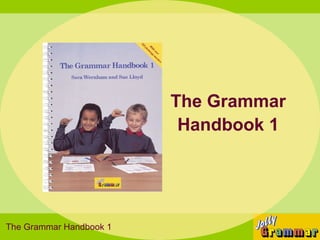
The Grammar
                          Handbook 1


The Grammar Handbook 1
Grammar
             Sentence structure

             Punctuation

             Parts of speech

             Verb tenses


The Grammar Handbook 1
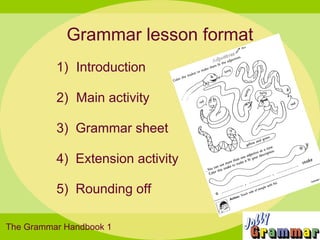
Grammar lesson format
          1) Introduction

          2) Main activity

          3) Grammar sheet

          4) Extension activity

          5) Rounding off

The Grammar Handbook 1
Areas of spelling covered
             Vowel digraphs
             Alternative spellings of vowel sounds
             Plural endings
             Short vowels and consonant doubling
             Tricky words
             Consonant blends


The Grammar Handbook 1
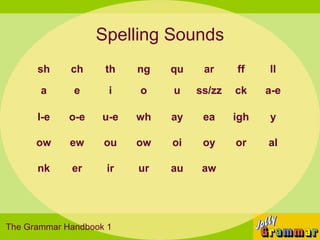
Spelling Sounds
      sh     ch     th    ng   qu    ar     ff    ll

       a      e      i    o    u    ss/zz   ck    a-e

      I-e    o-e    u-e   wh   ay    ea     igh   y

      ow     ew     ou    ow   oi    oy     or    al

      nk     er     ir    ur   au    aw


The Grammar Handbook 1
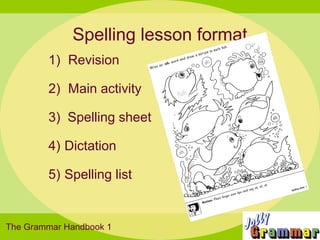
Spelling lesson format
        1) Revision

        2) Main activity

        3) Spelling sheet

        4) Dictation

        5) Spelling list


The Grammar Handbook 1
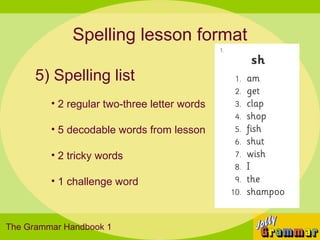
Spelling lesson format

      5) Spelling list
         • 2 regular two-three letter words

         • 5 decodable words from lesson

         • 2 tricky words

         • 1 challenge word


The Grammar Handbook 1
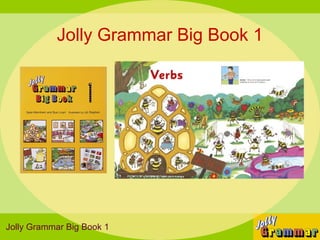
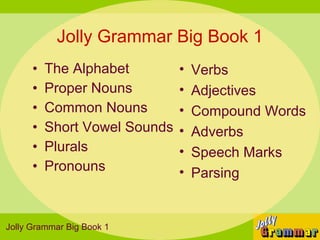
Jolly Grammar Big Book 1


Jolly Grammar Big Book 1
      •   The Alphabet         •   Verbs
      •   Proper Nouns         •   Adjectives
      •   Common Nouns         •   Compound Words
      •   Short Vowel Sounds   •   Adverbs
      •   Plurals              •   Speech Marks
      •   Pronouns             •   Parsing


Jolly Grammar Big Book 1
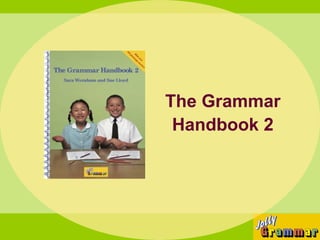
The Grammar
 Handbook 2
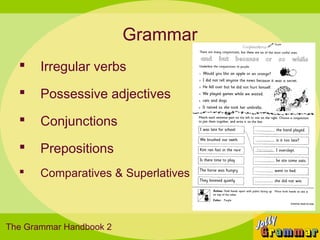
Grammar
      Irregular verbs
      Possessive adjectives
      Conjunctions
      Prepositions
      Comparatives & Superlatives


The Grammar Handbook 2
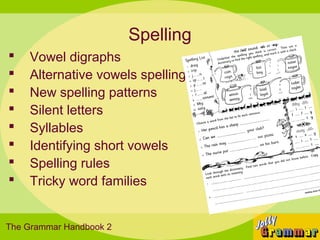
Spelling
   Vowel digraphs
   Alternative vowels spellings
   New spelling patterns
   Silent letters
   Syllables
   Identifying short vowels
   Spelling rules
   Tricky word families


The Grammar Handbook 2
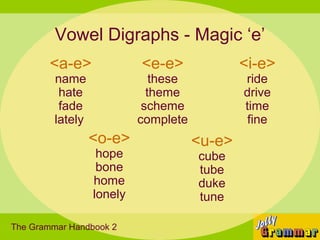
Vowel Digraphs - Magic ‘e’
        <a-e>              <e-e>              <i-e>
         name                 these           ride
          hate               theme            drive
          fade              scheme            time
         lately            complete            fine
                  <o-e>               <u-e>
                   hope               cube
                   bone               tube
                  home                duke
                  lonely              tune

The Grammar Handbook 2
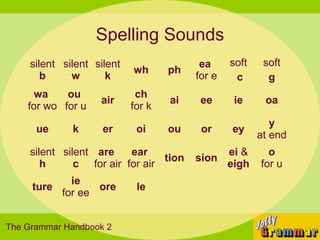
Spelling Sounds
     silent silent silent                 ea     soft    soft
                            wh      ph
        b     w       k                  for e    c       g
     wa     ou               ch
                    air             ai    ee      ie     oa
    for wo for u            for k
                                                           y
      ue      k      er      oi     ou    or     ey
                                                        at end
     silent silent are    ear                    ei &     o
                                 tion    sion
        h      c for air for air                 eigh   for u
              ie
     ture          ore       le
            for ee


The Grammar Handbook 2
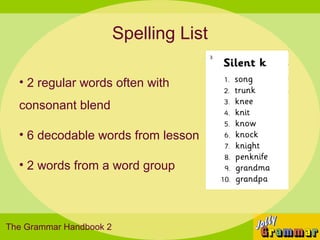
Spelling List

  • 2 regular words often with
  consonant blend

  • 6 decodable words from lesson

  • 2 words from a word group


The Grammar Handbook 2
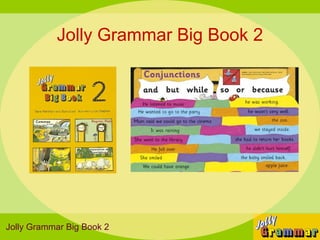
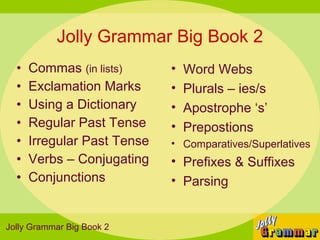
Jolly Grammar Big Book 2


Jolly Grammar Big Book 2
  •   Commas (in lists)      •   Word Webs
  •   Exclamation Marks      •   Plurals – ies/s
  •   Using a Dictionary     •   Apostrophe ‘s’
  •   Regular Past Tense     •   Prepostions
  •   Irregular Past Tense   • Comparatives/Superlatives
  •   Verbs – Conjugating    • Prefixes & Suffixes
  •   Conjunctions           • Parsing


Jolly Grammar Big Book 2
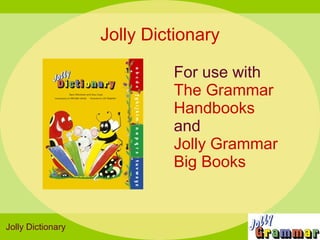
Jolly Dictionary

                            For use with
                            The Grammar
                            Handbooks
                            and
                            Jolly Grammar
                            Big Books


Jolly Dictionary
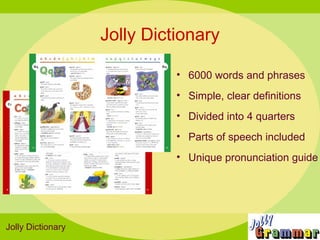
Jolly Dictionary

                             • 6000 words and phrases
                             • Simple, clear definitions
                             • Divided into 4 quarters
                             • Parts of speech included
                             • Unique pronunciation guide


Jolly Dictionary
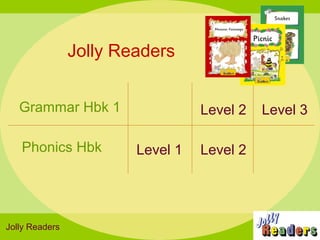
Jolly Readers


   Grammar Hbk 1                  Level 2   Level 3

   Phonics Hbk          Level 1   Level 2


Jolly Readers
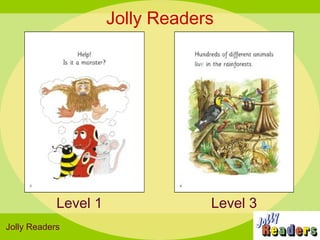
Jolly Readers


            Level 1               Level 3
Jolly Readers
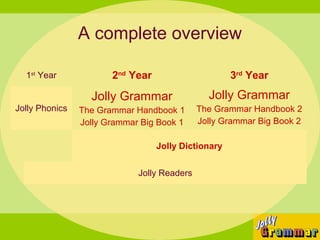
A complete overview

  1st Year             2nd Year                      3rd Year

                  Jolly Grammar                Jolly Grammar
Jolly Phonics   The Grammar Handbook 1       The Grammar Handbook 2
                Jolly Grammar Big Book 1     Jolly Grammar Big Book 2

                                  Jolly Dictionary


                             Jolly Readers
Leading the teaching of literacy

grammar

  • 1.
  • 2.
    3 years ofliteracy teaching 1st Year 2nd Year 3rd Year Jolly Phonics Jolly Grammar Jolly Readers
  • 3.
    The Grammar Handbooks 1) Grammar 2) Spelling 3) Vocabulary & Comprehension 4) Phonic knowledge revision and extension
  • 4.
    The Grammar Handbookformat • 1 spelling and 1 grammar lesson for 36 weeks • Punctuation, vocabulary and alphabet work • Similar format to The Phonics Handbook • Photocopiable resources and extension materials • Use as part of a broader literacy programme
  • 5.
    The Grammar Handbook 1 The Grammar Handbook 1
  • 6.
    Grammar  Sentence structure  Punctuation  Parts of speech  Verb tenses The Grammar Handbook 1
  • 7.
    Grammar lesson format 1) Introduction 2) Main activity 3) Grammar sheet 4) Extension activity 5) Rounding off The Grammar Handbook 1
  • 8.
    Areas of spellingcovered  Vowel digraphs  Alternative spellings of vowel sounds  Plural endings  Short vowels and consonant doubling  Tricky words  Consonant blends The Grammar Handbook 1
  • 9.
    Spelling Sounds sh ch th ng qu ar ff ll a e i o u ss/zz ck a-e I-e o-e u-e wh ay ea igh y ow ew ou ow oi oy or al nk er ir ur au aw The Grammar Handbook 1
  • 10.
    Spelling lesson format 1) Revision 2) Main activity 3) Spelling sheet 4) Dictation 5) Spelling list The Grammar Handbook 1
  • 11.
    Spelling lesson format 5) Spelling list • 2 regular two-three letter words • 5 decodable words from lesson • 2 tricky words • 1 challenge word The Grammar Handbook 1
  • 12.
    Jolly Grammar BigBook 1 Jolly Grammar Big Book 1
  • 13.
    Jolly Grammar BigBook 1 • The Alphabet • Verbs • Proper Nouns • Adjectives • Common Nouns • Compound Words • Short Vowel Sounds • Adverbs • Plurals • Speech Marks • Pronouns • Parsing Jolly Grammar Big Book 1
  • 14.
  • 15.
    Grammar  Irregular verbs  Possessive adjectives  Conjunctions  Prepositions  Comparatives & Superlatives The Grammar Handbook 2
  • 16.
    Spelling  Vowel digraphs  Alternative vowels spellings  New spelling patterns  Silent letters  Syllables  Identifying short vowels  Spelling rules  Tricky word families The Grammar Handbook 2
  • 17.
    Vowel Digraphs -Magic ‘e’ <a-e> <e-e> <i-e> name these ride hate theme drive fade scheme time lately complete fine <o-e> <u-e> hope cube bone tube home duke lonely tune The Grammar Handbook 2
  • 18.
    Spelling Sounds silent silent silent ea soft soft wh ph b w k for e c g wa ou ch air ai ee ie oa for wo for u for k y ue k er oi ou or ey at end silent silent are ear ei & o tion sion h c for air for air eigh for u ie ture ore le for ee The Grammar Handbook 2
  • 19.
    Spelling List • 2 regular words often with consonant blend • 6 decodable words from lesson • 2 words from a word group The Grammar Handbook 2
  • 20.
    Jolly Grammar BigBook 2 Jolly Grammar Big Book 2
  • 21.
    Jolly Grammar BigBook 2 • Commas (in lists) • Word Webs • Exclamation Marks • Plurals – ies/s • Using a Dictionary • Apostrophe ‘s’ • Regular Past Tense • Prepostions • Irregular Past Tense • Comparatives/Superlatives • Verbs – Conjugating • Prefixes & Suffixes • Conjunctions • Parsing Jolly Grammar Big Book 2
  • 22.
    Jolly Dictionary For use with The Grammar Handbooks and Jolly Grammar Big Books Jolly Dictionary
  • 23.
    Jolly Dictionary • 6000 words and phrases • Simple, clear definitions • Divided into 4 quarters • Parts of speech included • Unique pronunciation guide Jolly Dictionary
  • 24.
    Jolly Readers Grammar Hbk 1 Level 2 Level 3 Phonics Hbk Level 1 Level 2 Jolly Readers
  • 25.
    Jolly Readers Level 1 Level 3 Jolly Readers
  • 26.
    A complete overview 1st Year 2nd Year 3rd Year Jolly Grammar Jolly Grammar Jolly Phonics The Grammar Handbook 1 The Grammar Handbook 2 Jolly Grammar Big Book 1 Jolly Grammar Big Book 2 Jolly Dictionary Jolly Readers
  • 27.

Editor's Notes

  • #3 Jolly Learning has produced three years of literacy teaching materials. Jolly Grammar is for the next two years after Jolly Phonics. All three years provide comprehensive reading and writing teaching, while the Jolly Readers give the children a solid start in literature and lots of reading practice. Jolly Grammar is designed to help children express themselves better, bring variety to their writing and improve their spelling in a structured way. The teaching continues the fun, multi-sensory methodology first introduced in Jolly Phonics with two main teaching resources that follow a similar format to The Phonics Handbook.
  • #4 The Grammar Handbooks introduce the basic rudiments of grammar. They also systematically teach spelling and improve vocabulary and comprehension. Other areas such as punctuation and dictionary skills are also included. This 2-year programme is also designed to extend the children’s phonic knowledge, building on the understanding they have from the previous year.
  • #5 Each Grammar Handbook provides spelling and grammar lessons for a full school year, ie. one spelling lesson and one grammar lesson per week. Punctuation, vocabulary development and alphabet work are covered in both spelling and grammar lessons, so that when mixed together the two compliment each other. These Handbooks have an easy-to-use format, similar to The Phonics Handbook, providing teaching notes and a worksheet for each lesson as well as a large amount of photocopiable resources and fun grammar and spelling materials. The teaching of grammar and spelling is expected to be part of a broader literacy programme. If two days’ literacy sessions are devoted to Jolly Grammar each week, this leaves three for other areas, such as comprehension, group/silent reading, independent and creative writing, and handwriting practice.
  • #6 Let’s take a look at the teaching content covered in the first of the Grammar Handbooks.
  • #7 The benefits to children of learning grammar are cumulative. The children become more aware that they are writing for a purpose: that their words are intended to be read and understood. They learn that writing is easier to understand if it is grammatically correct, accurately spelt and well-punctuated. They understand that if the words used are interesting too, their writing can give real pleasure. Grammar can be quite a difficult topic to teach children as grammar involves remembering rules. How can we expect young children to remember so many rules? While there is a place for reciting and memorising, children remember the fun activities performed in class the most. The Grammar Handbooks are full of fun and exciting activities to help children remember these rules. In this first year the children begin to develop an understanding of how language works. They learn that we speak and write in sentences, and that punctuation helps to organise the sentences. The teaching shows the children that the words we use fall into categories (ie. parts of speech). As well as showing the children what each part of speech does, the teaching shows them how they can manipulate the grammar to make their writing fun and interesting. The Grammar Handbook 1 introduces nouns, pronouns, adjectives, verbs and adverbs. The children also learn that verbs indicate whether something is happening in the past, present or future. Similar to the teaching in Jolly Phonics, there is an action for most of the grammar points. They also have their own colour. The actions and colours make the teaching lively and help the children to remember each area. The colours follow the Montessori colour-coding system. For example, the action for a proper noun is to touch one’s forehead with the index and middle fingers. The colour for nouns is black. The action for verbs is to clench fists and move arms backwards and forwards at sides, as if running. The colour for verbs is red.
  • #8 The term ‘grammar’ is broadly used with children of this age. Definitions of the parts of speech, and what constitutes a sentence, have necessarily been simplified to age-appropriate ‘working definitions’. As the children grow older, the definitions can be expanded and refined. Each lesson in The Grammar Handbooks is designed to be about an hour long. There is a photocopiable activity sheet for children to complete, accompanied by a page of teacher’s lessons notes. The lesson notes follow the same format: An activity to introduce the grammar concept to the children. This often involves eliciting or revising existing knowledge from the children and showing examples. The main activity gets the children working with the new target grammar point, often with an action. For example, the action for adjectives is, “Touch the side of your head with a fist”. The grammar sheet gives the children written practice of the new grammar concept. An extension activity provides extra practice. A rounding off activity helps to revise and consolidate what has been learned during the lesson.
  • #9 Some children are able to learn to spell through their reading. These children will have a good memory for words. However, the majority of children will benefit from learning how to spell systematically using their knowledge of phonics to help them, ie. learning to spell by listening to sounds in words, and writing the letters to represent these sounds. They also need to learn which alternative vowel spelling to use and the key tricky words. Children need to be aware that accurate spelling is as important as grammar and that they go hand in hand. There is no magic wand that can be waved to make them good at spelling. In addition to knowing the letter sounds and alternative spellings thoroughly, a certain amount of dedication and practice is needed. The spelling lessons in The Grammar Handbook 1 cover: Vowel digraphs Alternative spellings of vowel sounds Plural endings Short vowels and consonant doubling Tricky words Consonant blends
  • #10 Here is a complete list of all the sounds and spellings covered in The Grammar Handbook 1. The spelling lessons revise and extend the work on digraphs and short vowels introduced in The Phonics Handbook. There is a focus on writing practice and the alternative pronunciations of vowel sounds.
  • #11 1) Each lesson starts with a short burst of revision of a previous spelling lesson. 2) The main focus of most of the spelling lessons is a digraph, one being featured each week. 3) The focus of each spelling sheet reflects the main teaching point, whether it is a digraph, a trigraph, or the short vowels. 4) As a weekly exercise, dictation is useful in a number of ways. It gives the children regular practice in listening for sounds in the words they write, and is a good way of monitoring their progress. It helps the children develop in their independent writing, and encourages the slower writers to increase their speed. Each dictation list consists of six words and three simple sentences. These all revise the spelling introduced that week. [ 5) Spelling list on next slide ]
  • #12 Each week the children are given ten spellings to learn for a test. The words have been carefully selected to enable every child to have some success, with the majority achieving full marks. Words 1 and 2 in each spelling list are regular 2- or 3-letter words, and the third is also regular, but with a consonant blend. Words 4,5,6,7 and 10 generally feature the spelling of the week, and are usually regular. Number 10 is a longer or challenge word. Words 8 and 9 are tricky words. Although these tricky words have been covered in the previous year, the children frequently reminding about the spelling of these irregular or difficult key words. In The Grammar Handbook 1, the tricky words are systematically covered again, starting with the first two word ‘I’ and ‘the’.
  • #13 The Jolly Grammar Big Books complement the teaching in The Grammar Handbooks and are an ideal way of presenting new concepts to the children. They provide a focus, in the form of big illustrated pages. Words can be added to the pictures by writing on a clear plastic sheet. In addition, the action and colour for each part of speech is given.
  • #14 These are the areas of grammar covered in the Jolly Grammar Big Book 1. There are also teaching notes and ideas given for each of these inside the book.
  • #15 Let’s move on now to the third year of learning to read and write with The Grammar Handbook 2. The Grammar Handbook 2 follows in a similar manner to The Grammar Handbook, introducing new elements of grammar, spelling patterns, vocabulary and comprehension, but also develops dictionary and thesaurus skills.
  • #16 The Grammar Handbook 2 aims both to extend the children’s knowledge, and to deepen their understanding. Their knowledge of sentences is refined and they are introduced to new concepts, such as irregular verbs, new parts of speech, conjunctions, prepositions, and comparatives and superlatives. The children also learn to punctuate with greater variety and precision.
  • #17 The aim of the spelling work in The Grammar Handbook 2 is to introduce groups of words which use new spelling patterns, and to revise the alternative spellings of vowel sounds. Silent letters, syllables, identifying the short vowels, spelling rules and tricky word families are also covered in this Handbook.
  • #18 Here is an example of the areas covered in the vowel digraph work. Digraphs with a magic ‘e’ because it modifies the sound of the first. Digraphs with a magic ‘e’ can be thought of as ‘hop-over e’ digraphs. Following the general rule, “When two vowels go walking, the first does the talking”, the sound they make here with ‘hop-over e’ is that of the first vowel’s name; the ‘magic e’ is silent. Children like to show with a hand how magic from the ‘e’ hops over the preceding consonant and changes the short vowel to a long one.
  • #19 Here is a complete list of all the sounds and spellings covered in The Grammar Handbook 2. The main vowel digraphs and their alternatives are revised, such as ‘ea’ in ‘dead’, along with certain word patterns such as ‘ight’ in ‘night’ and silent letters such as ‘b’ in ‘comb’.
  • #20 Similar to The Grammar Handbook 1, The Grammar Handbook 2 spelling lessons include a spelling list for the children to learn for a test. Words 1 and 2 are regular and usually feature a consonant blend. Words 3 to 8 feature the spelling of the week. Number 8 is often a longer word. Words 9 and 10 are from the ‘word families’ introduced. Many of these are tricky words. Children who are having difficulty learning all ten words can just learn the first 5 instead.
  • #21 There is also a Jolly Grammar Big Book to complement the teaching in The Grammar Handbook 2. This page shows a lesson on conjunctions and how 2 sentences can be joined together by a conjunction (or joining word).
  • #22 These are the areas of grammar covered in the Jolly Grammar Big Book 2. There are also teaching notes and ideas given for each of these inside the book.
  • #23 When children have been taught to read using a phonic method, such as Jolly Phonics, they are generally capable of reading words that they may not know. Being able to use a dictionary enables children to find out the meanings of those words and pronounce them correctly. It helps them to become truly independent readers and writers. Both The Grammar Handbooks and the Jolly Grammar Big Books have dictionary lessons to be used together with the Jolly Dictionary. In The Grammar Handbook 1, the children are introduced to the order of the alphabet and to using the dictionary. The Grammar Handbook 2 improves the children’s alphabet skills, by teaching to look beyond the initial letter of each word. The children are also encouraged to use the dictionary to look up meanings and spellings. The Grammar Handbook 2 also introduces thesauruses. The children practise finding alternatives to commonly-overused words, for example ‘nice’.
  • #24 The Dictionary contains over 6,000 words and phrases suitable for young children. The definitions have been carefully written so that children find them easy to read and understand. The Jolly Dictionary has a 2,000-word defining vocabulary, which means that the words in the definitions were restricted to 2,000 chosen ones, helping to keep a strict control on which words are used. To help them find words, the Jolly Dictionary is divided into 4 approximately-equal parts. Knowing these groups saves the children time when using the Dictionary. Before looking up a word, they decide which group its initial letter falls into, and then narrow their search to that section of the dictionary. In keeping with the work in The Grammar Handbooks, the parts of speech for each word are given (with corresponding colour coding). There is also a pronunciation guide. Instead of using the International Phonetic Alphabet, which is too complicated for young children to use, it uses the joined digraphs familiar from Jolly Phonics and a few new symbols for clarity.
  • #25 The Jolly Readers are interesting storybooks designed for children who are just ready to read. They will have learned the 42 letter sounds initially taught in Jolly Phonics and be able to blend these sounds to read simple words (including words not seen before). All the Jolly Readers have been graded in terms of their phonic difficulty. Unlike many phonic readers with heavily controlled vocabulary such as ‘the cat sat on the mat’, the Jolly Readers have many more words with digraphs. This means the stories have more natural language and are therefore more interesting. Here is a rough guide to the Jolly Readers levels and their corresponding handbooks. Most children will have been able to start the readers in the first term and some may have completed all 3 levels by the end of the first year.
  • #26 Here are couple of example pages from the Jolly Readers. You will notice that words like ‘monster’ are regular, easy to blend and therefore suitable for the first level. On the page from Level 3, you will notice the word ‘live’ has a faint ‘e’. This is to show children that this letter is not pronounced. You can also see words like ‘rainforest’ with the digraph ‘ai’ are also possible after having learned with Jolly Phonics.
  • #27 Here you can see how all the products I’ve mentioned fit in together.