CnvrnRrDGE
UNIVERSITY PRESS
ChrisRedston
C A M B R I D G E U N I V E R S I T Y P R E S S
Cambridge,New York, Melbourne, Madrid, CapeTown, Singapore,SaoPaulo,Delhi
Cambridge University Press
The Edinburgh Building, CambridgeCB2 8RU, UK
www.cambridge.org
Information on this title: www.cambridge.orgl97805217I27 50
@ Cambridge University Press2009
This publication is in copl'right. Subjectto statutory exception
and to the provisions of relevantcollectivelicensing agreements,
no reproduction of any part may take placewithout the written
permission of CambridgeUniversity Press.
First published 2009
Printed in the United Kingdom at the University Press,Cambridge
A cataloguerecordJor thispublicationis availablefrom the British Library
ISBN978-0-52L-7L275-0 Teacher'sBook
ISBN978-0-521-71273-6Studenr'sBook with CD-ROM/Audio CD
ISBN978-0-521-71274-3Workbook with Key
ISBN978-0-521-7L277-4ClassAudio CDs
It is normally necessaryfor written permission for copying to be obtained in adyance
from a publisher. The CD-ROM/Audio CD: User Instructions in the Introduction,
and the ClassActivities worksheets, Vocabulary Plus worksheets and ProgressTests
at the back of this book are designed to be copied and distributed in class.The normal
requirements are waived here and it is not necessaryto write to Cambridge University
Pressfor permission for an individual teacher to make copies for use within his or her
own classroom. Only those pageswhich carry the wording'@ Cambridge University Press'
may be copied.
Cambridge University Presshas no responsibility for the persistenceor accuracy of
URLs for external or third-party Internet websitesreferred to in this publication, and
doesnot guarantee that any content on such websitesis, or will remain, accurate or
appropriate. Information regarding prices, train times and other factual information
given in this work are correct at the time of going to print but Cambridge University
Pressdoes not guaranteethe accuracy of such information thereafter.
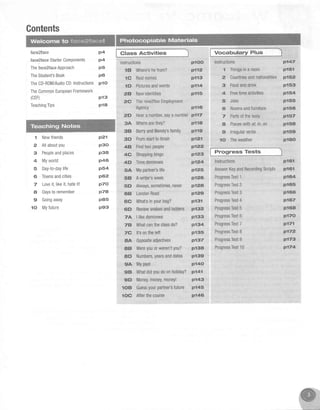
Contents
{aceRface
fnce2fsceStaderComponents
Thefaecgf;ic#Approach
TheStudent'sBook
TheCD-R0M/AudioCD:Instructions
TheCommonEuropeanFramework
(cEF)
TeachingTips
p4
p4
ps
p6
plo
Class Activities Vocabulary Plus
1 Newfriends
2 Allaboutyou
3 Peopleandplaces
4 Myworld
5 Dayto-daylife
6 Townsandcities
7 Loveit,likeit,hateit!
a Daystoremember
9 Goingaway
10 Myfuture
instructions
1B Where'shefrom?
lC Realnames
1D Picturesandwords
2B Newidentities
2.Q Thenine2fiveEmPloYment
Agency
2D Heara number,saya number
3A WherearetheY?
BarryandWendy'sfamily
Fromstadtofinish
Findtwopeople
Shoppingbingo
Timedomtnoes
Mypadner'slife
Awriter'sweek
Always,som€times,never
LondonRoad
What'sinyourbag?
Reviewsnakesandladders
Ilikedominoes
Whatcantheclassda?
It'sontheleft
0ppositeadjectives
Wereyouorweren'tyou?
Numbers,yearsanddates
Mypast
Progress Tests
lnstructions
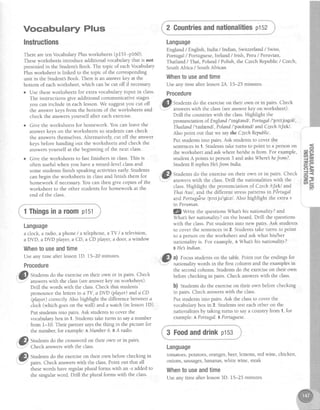
1 Thingsina room
2 Countriesandnationalities
3 Foodanddrink
4 Freetimeactivities
5 Jobs
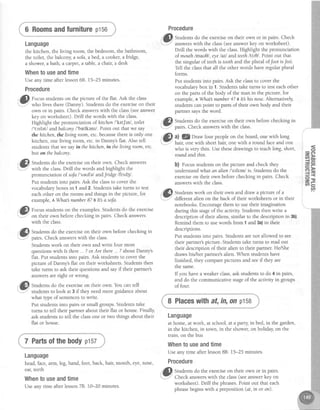
6 Roomsandfurniture
7 Partsofthebody
a Placeswithat,in,on
I lrregularverbs
'lO Theweather
Instructions
AnswerKeyandRecordingScripts
ProgressTest1
ProgressTest2
ProgressTest3
ProgressTest4
ProgressTest5
ProgressTest6
ProgressTest7
ProgressTest8
ProgressTest9
ProgressTest10
p13
pla
plOO
pll2
p'|13
p114
p'll5
plle
tr117
p118
p119
pl21
p122
r'12S
p124
p125
p126
pl2A
pl29
pl31
p132
p133
pl34
pI35
p137
pl3A
pI39
p'l4()
p-141
p1rt3
p'|45
pl46
p747
p151
pl52
pl53
pl54
p't55
pl56
pt57
pl58
pl5s
pl6()
p161
pl6l
pI64
pt65
pl65
plE7
pl6A
p17O
p171
p172,
p173
P174
p21
p30
p3A
p46
p54
p62
p_70
p7A
pa5
p93
3B
3D
4B
4C
4D
5A
5B
5D
6B
5C
ED
7A:
7B
7e
8A
AE
AD
9A
9E} WhatdidyoudoonholidaY?
9D Money,money,moneyl
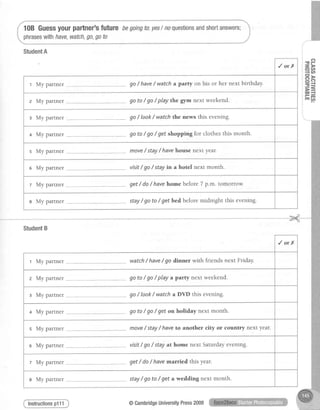
1oB Guessyourpartner'sfuture
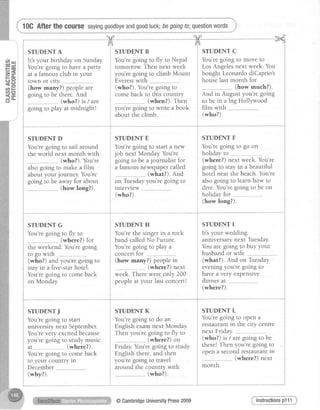
lOC Afterthecourse
Mfe!*mrme tm ffmffiffiffiffmmwH
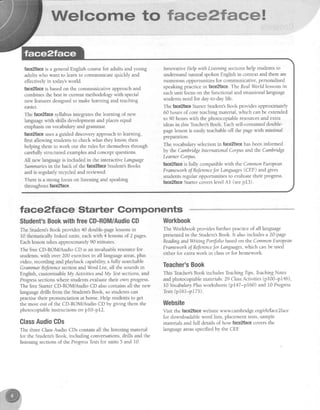
face2faceis a generalEnglish coursefor adults and young
adults who want to learn to communicate quickly and
effectivelyin todaysworld.
face2faceis basedon the communicative approachand
combinesthe bestin current methodologywith special
new featuresdesignedto make learning and teaching
easler.
The faceffacesyllabusintegratesthe learning of new
Ianguagewith skills developmentand placesequal
emphasison vocabularyand grammar.
faceZfaceusesa guided discoveryapproachto learning,
first allowing studentsto check what they know, then
helping them to work out the rules for themselvesthrough
carefullystructured examplesand conceptquestions.
All new languageis included in the interactiveLanguage
Summanesin the back of the face2faceStudent'sBooks
and is regularly recycledand reviewed.
There is a strong focus on listening and speaking
throughout face2face.
tac,e?face Starter Components
$tudent'sBooktruithfreeCD-ROM/AudioCD
The Student'sBook provides40 double-pagelessonsin
l0 thematically linked units, eachwith 4 lessonsof 2 pages.
Eachlessontakesapproximately90 minutes.
The free CD-ROM/Audio CD is an invaluableresourcefor
students,with over 200 exercisesin all languageareas,plus
video, recording and playback capability,a fu searchable
GrammarReJerencesection andWordList, all the soundsin
English, customisableMy ActivitiesandMy Testsections,and
Progresssectionswhere studentsevaluatetheir own progress.
The freeStarterCD-ROM/Audio CD alsocontainsall the new
languagedrills from the Student'sBook, so studentscan
practisetheir pronunciation at home. Help studens to get
the most out of the CD-ROM/Audio CD by giung them the
photocopiableinstructionson p10-p12.
ClassAudiaGDs
The three ClassAudio CDs contain all the listening material
for the Student'sBook, including conversations,drills and the
Iisteningsectionsof the ProgressTestsfor units 5 and 10.
Innovative Helpwith Listaing sectionshelp studentsto
understandnatural spokenEnglishin contextand thereare
numerous opportunities for communicative,personalised
speaking practice in faee?face.The RealWorld lessonsin
eachunit focuson the functional and situationallanguage
studentsneedfor day-to-daylife.
The face2hceSarter Student'sBook providesapproximately
60 hours of core teachingmaterial,which canbe extended
to 90 hours with the photocopiableresourcesand extra
ideasin.this Teacher'sBook. Eachself-containeddouble-
pagelessonis easilyteachableoff the pagewith minimal
preparation.
The vocabularyselectionin face2facehasbeeninformed
by the Cambidge lntemational Corpusand the Carnbndge
LearnerCorpus.
taceZfaceis fully compatiblewith the CommonEuropean
FrameworhoJReferencefor Languages(CEF) and gives
studentsregular opportunities to evaluatetheir progress.
faceZfaceSarter coverslevelAl (seep13).
Workhook
The Workbook providesfurther practice of all language
presentedin the Student'sBook. It alsoincludes a 2}-page
ReadingandWnting Portfolio basedon the CommonEuropean
Frameworhof Referarcefor Languages,which canbe used
either for extra work in classor for homework.
Teacher'sBook
This Teacher'sBook includes TeachingTips,TeachingNotes
and photocopiablematerials:29 ClassActivities(p100-p146),
l0 YocabularyPlusworkshees (p1'17-p160) and I0 Progress
Tesfs(p16l-p175).
Website
Visit the {ace2facewebsite www.cambrid ge.or{ elt/face2face
for downloadableword lists, placementtests,sample
materialsand full detailsof how face2facecoversthe
Ianguageareasspecifiedby the CEE
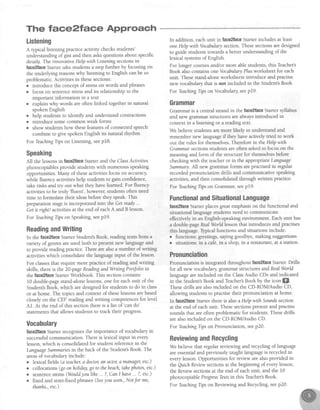
The tac,e?face Approach
Listening
A typical listening practiceactivity checksstudents'
understandingof gist and then asksquestionsabout specific
detailg.The innovative Helpwith Listeningsectionsin
face2faceSurter take studentsa stepfurther by focusing on
the underlying reasonswhy listening to English can be so
problematic.Activities in thesesections:
o introduce the concept of stresson words and phrases
o focus on sentencestressand is relationship to the
important information in a text
o explain why words are often linked together in natural
spoken English
. help studentsto identify and understandcontractions
. infioduce somecommon weak forms
o show studentshow thesefeaturesof connectedspeech
combine to give spoken English its natural rhythm.
For TeachingTipson Listening, seepl8.
Speaking
All the lessonsin face2faceStarter and the Class Activities
photocopiablesprovide studentswith numerous speaking
opportunities. Many of theseactivities focus on acctracy,
while fluency activities help students to gain confidence,
take risks and try out what they have leamed. For fluency
activitiesto be truly'fluenf, however,studentsoften need
time to formulate their ideasbefore they speak.This
preparationstageis incorporatedinto the Getready...
Getit nght! activitiesat the end of eachA and B lesson.
For TeachingTipson Speaking,seepI9.
ReadingandWriting
In the face2faceSarter Student'sBook, readingtexts from a
variety of genresareusedboth to presentnew languageand
to provide reading practice. There arealso a number of writing
activitieswhich consolidatethe languageinput of the lesson.
For classesthat require more practice of readingand writing
skills, thereis the 20-pageReadtngandWntingPortfolio in
the face2faceSmrterWorkbook. This sectioncontains
10 double-pagestand-alonelessons,one for eachunit of the
Student'sBbok, which aredesignedfor studentsto do in class
or at home. The topics and content of theselessonsarebased
closely on the CEF reading and writing competencesfor level
A1. At the end of this sectionthereis a list of 'cando'
statementsthat allows studentsto track their progress.
Uocabulary
lace?taceStarter recognisesthe importance of vocabulary in
successfulcommunication. There is lexical input in every
lesson,which is consolidatedfor student referencein the
LanguageSummanesin the back of the Student'sBook. The
areasof vocabularyinclude:
o lexical fields (a teacher,a doctotran actor,amanaget,etc.)
o collocations(goonholiday,go to thebeach,tahephotos,etc.)
. sentencestems(Wouldyoulihe... ?,Canlhave ... ?, etc.)
o fixed and semi-fixedphrases(Seeyou soon.,Notfor me,
thanhs.,etc.)
In addition, eachunit in face2faceSarter includes at least
oneHelp withVocabularysection.Thesesectionsaredesigned
to guide students towards a better understanding of the
lexical systemsof English.
For longer coursesand/ormore ablestudents,this Teacher's
Book also containsoneYocabularyPlusworksheet for each
unit. Thesestand-aloneworksheetsintroduce and practise
new vocabulary that is not included in the Student'sBook.
For TeachingTipson Vocabularyseepl9.
Grammar
Grammar is a central strand in the face2faceStarter syllabus
and new grammar structures are always introduced in
context in a listening or a readingtext.
We believe students are more likely to understand and
remember new languageif they have actively tried to work
out the rules for themselves.Therefore in the Help with
Grammarsectionsstudentsareoften askedto focus on the
meaning and form of the structure for themselvesbefore
checking with the teacher or in the appropriate Language
Summary.All new grammar forms arepractisedin regular
recorded pronunciation drills and communicative speaking
activities,and then consolidatedthrough written practice.
For TeachingTipson Grammaq seepl9.
FunctionalandSituationalLanguage
face2faceSarter placesgreatemphasison the functional and
situational languagestudentsneedto communicate
effectively in an English-speaking environment. Each unit has
a double-pageRealWorld lessonthat introduces and practises
this language.Typicalfunctions and situationsinclude:
o functions: greetings,sayinggoodbye,making suggestions
o situations:in a caf€,in a shop, in a restaurant,at a station.
Pronunciation
Pronunciationis inte$ated throughout face2faceStarter.Drills
for all new vocabulary grammar structures andRealWorld
languageareincluded on the ClassAudio CDs and indicated
in the Student'sBook and Teacher'sBook by the icon ffi.
Thesedrills arealsoincluded on the CD-ROM/Audio CD,
allowing studentsto practisetheir pronunciation at home.
In faee2faceSarter thereis alsoa Help with Soundssection
at the end ofeach unit. Thesesectionspresentand practise
soundsthat areoften problematic for students.Thesedrills
arealsoincluded on the CD-ROM/Audio CD.
For TeachingTipson Pronunciation, seep20.
ReviewingandRecycling
We believe that regular reviewing and recycling of language
are essentialand previously taught languageis recycled in
everylesson.Opportunities for review arealsoprovided in
the QuichRevionsectionsat the beginmng of everylesson,
the Reviausectionsat the end of eachunit, and the l0
photocopiableProgressTestsin this Teacher'sBook.
For kachingTips on Reviewingand Recycling,seep20.
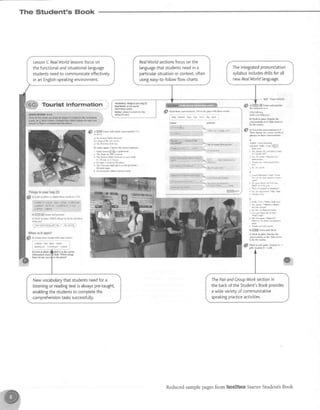
HelpwithGrammarsectionsaskstudents
to focusontherulesof formandusefor
themselvesbeforecheckingwiththe
teacheror intheLanguageSummary.
LessonsAandBineachunit
introduceandpractisenew
vocabularyandgrammarin
realisticcontexts.
Menuboxeslistthe
languagetaughtand
reviewedin eachlesson.
The Student's Book
a) V.rd *nr.ffi !J b pi.tm A{
r T f t d c @ i u d e F *
2 tftrR rR 'e. Ffle ia thr pa d
r l]ld.m.lotd@hinlhrgk
6A Vo@b{tary and Grammd
$
ar tr* n rrw" *ren(^rhil hh lllt in
rft Fls wm  or m.
r llR( l: , he&ttful rivor
; Tlan rvo ri$m
? tfitN a hs shlbn
4 Tlew .- $tn.lor $dRs
t fteft d nie sLns. rhr nrdoo
fher. rvo lilr{rar h0r.}
'lire
aho* ruehmnlialld
Il!<a -----r ldrdtlrbs roLodotr
dP si #m Rd d ltsr6 ro susn. h rk lllr
Bl Raad abwr Adh {Fdn ri(k (/) fte tm
mrilccs co|Etd€ IsL* !6nrscs
r ktlisjnlM trglrnd
r h r v$r beanrihilcity /
3 su(n Bdr$ ro rhc Thcmre !illh spa c{ery Fidxi
4 Tt lanri Ars$n ftntrc b i rhErrc
5 therc aic Lfri$ ro Lond.r .eery !0 frinru
6 llaltr do$Dl bii.nnatrtmrr
f i^*t"t*r'"t"n**o"**
. t p , . , , p a l o r o f d d b u i d i 4 s , n , h e L e n n e d r d & , e , F
i smcv€rynic Ftu Mh is tamdur lor its hotspn.S,smcv€rynic Ftu Mh ( tamdurlof itshotsPn.s,
ud to! .an swir in tfu hil water st thnTheilE. Ba$
sF I go the.e ryery 5udry li'r gftll n the rrnhr o{
B.t! th.fa{G he thedns and5oneeerypd milwumt,
liduCiBthe tunranBaSi andthelEnatulen Centq
dhd thc fdmolsEnglbhffiteiThrc ar?dbDd lot or
goid €derdns andhoteb 8ndrkel a big ne
shoppiitentre Gltd snllhoaa TkGorciain! to
Lo.doi dery h.liar hftL od th€.e! anatpd in sdtol,
on! 15milassay { think BdthIr d 6rc.r pbce io tre.
l'i ril in the me t]ilh 3 (. fr) n o'r
Ihr. it r hignwshoNrx8Ntrtr
Ilm , .n dryo[ in tlrisrol
Ilrrc live r}flrtes
Th.n' com wry ni.. Fdr
l frm i l0l of old liuildils
Sffi km and ctsh Nbh llM se
s tlft! rnd llrre ilry
ftere'k.:a e;utlal.&€'
ture rre iturir 1*i *l^dm*.
6) S* Li$tm,sh ,fti F ctu
a) Chffi llle()rcl Bodr
r rhtrc:rolJoae FIiIioo.
2 l'htwa&!/ftapnrb.
3 TleErK!1i@e goduK.ums
4 ther! n /rome b$ sFridn
ft.ft ar. eore / a k"ufrttl brildiilEs
thnr! , / r, old thcutc
fh{re $c ,n / , lot o/ vei} gosd r$t.!mrB
Thec areJoDel, nicu huldk
frrk id pab Ctmf,Rre ffituE, ffith
*nknes as 0u for Se ldwn or ah,vori
st[ i$rsfts Rbmr . tM o. dty yil
krow (Wl th( tdM or.iry" touh h
ntr). U* dtdrc ir. rtum drc trd wd$
/r t *rererdnelsdrt(eJptrli
ftE ats i loi 6t ri{e esFurd*
TJ1ert':ta blq lnppitq &dit
al Wmk h FniE ftil yDur Fsvt ,lml
lou i$n o. ciry in I
lr) Tcil thc r[$s tvo thns tuut rr
lnftnerb @n or dtt.
t-f,*
Itl' 'it..r
s#i;#i:Siiiiliiiiiii
Fia*esins tnwnsr city{1}
S
a) ilad thsc {ords !o pksm li
p$ote of &1h, a tsdw.xy ft
Theffi iconindicatesadrittora
practiceactivitydesignedto improve
students'pronunciation.Theintegrated
pronunciationsyllabusincludesdrills
fora[[newvocabularyrandgrammar.
Contro[[edDracticeexercises
checkstudentshaveunderstood
the meaningandform of new
tanguage.
Newgrammarstructuresare
alwayspresentedincontextin
a listeningora readingtext.
Reducedsamplepagesfrom face2faceSarter Student'sBook
or city (2)
lt linking{l)
The Student's Book
6B Vocabulaw and Grflmer
rk piduR.nd rhc pLc6 (a <tu,
hatrls. <rr ) Mr fight Nad.ms b S sdkt
gtuilcd aboil nb(s ffi his/hc h(re U*
&
alriU iDthcpr6Mh3mr or isn!
1 TheF a $btion nd.here
2 Ther€ rhls{.dr$rN,nils ncilhere
blSiU ib ilE gW $nh i!. aro tont ormnt
B/rcQU6@l{1 :SqIANffi_,
::::*Y*,-rESil*ri@ anv !tuni :
tt tl€e *
el hk {Edn ut llt sGMs inbi nd 3h}
k .hMc the corRt word h #F nle
s s;e uscea6litry h nepN6 and q(sridG
Are there any
Plaeminahsn orcity{z}
S
al silch (hEc *ff& to
r oei r .'pgaq*
"
{4@j'"tdi* :. .
i i*M . i dpfiniiffibt "
..-sn!,*i. q's!4d''.
- .**ii*ilan'rftfi -
: -
_ ' : ! ' '
-
bl ff$m {8 risreD'nd Frurjse
!lWork in paitsTei Yourl)annti
iwh"r''pn"d)
i-,ii;;;il
tue{e|}nostssryftsme
@
ul {3$r*lo l* uhos d susn
d I.r lr@. remr, sr0n ro.nfir
cdtesdm ht 6M lhn4s h dre
otu drq'dk.bdr thm.
r6im sd bffi
b, Ustrs Wh Ckx rhe smot
r sunn@/c@^ttaa[sn*in
h$ Ilar
2 The6 aG rorel 3 loro,rsholrsl)
3 Theela caehpointetrh!
upeilnatkt I p$ afli.e
{ l;ani./6€dilet ro d1ec.rrre
5 thiE iR b$es h lht tcilr. ol
&rh oln lH / @nry niDul4t
6 Tture arc smc nlcr retuuidls
fts Wn tuule I in tb <:e6ile
4l W* in Fh CmM.rBsK
*s#PIr j
tfi.:gj:re *sgj,ld huildinss
. rhe,t-so.-dB nrsdB
5 1$rhq.lj lnr-rmcr
6 trrc thidny ntetd c{l4l
ip @ s* tuuo.'a p"M & frtnG h 4 0d
ksM4s$s.
]k'Us,qd,,iw.,irre'
@
o! lrficmlffir *out d'.6 Dar sdsi ns
r (/) ns{tcnlrBc!
&reL eope.nr.br
2 dl2shnppin8ctrtrc
rtu/e !.t'r t thopping ce@.
3 (/) a erktt
4 {/q ilnr nn*rurnr
7 (D f,nyniceqtG
3 ( / ' . , l n . i r l l b i l u * '
b) *brk h Fh. conp3f,e ans'!rs
@
wo'l o tt'e *" piK Srildcnt A *
l8d sruddr B
.r p9l.
Islr.ma lil[l4ftdrtrry,7
btuaMaNsfrurtunet
s) wdrk h l)als A![ yN qftsdDor lun I
Mkc nots on )d! pdncB secE Givt
nrnN nrfornndon about pLa.6 rFJ yoilt hNne
ilJiiilii
"'
li,ii;i'r i'vJiiiii- ii.riiiiiJ'r
I nPn,rourh0nEl miBtesawt
!) sbrk h ftw pai6 TnlL ahnt pltrcc5 fta.
y@. fiEt pannd hmc
i;;,;,;..'**;ilM*)
I hr lhereffitry Meb. J
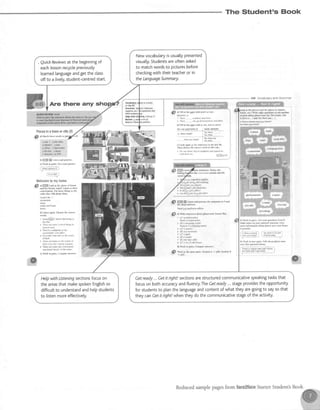
Newvocabularyisusua[tyPresented
visually.Studentsareoften asked
to match wordsto picturesbefore
checkingwith theirteacheror in
theLanguageSummary.
. QuickReviewsat thebeginningof
eachlessonreryclepreviousty
learnedlanguageandgettheclass
offto a [ive[v,student-centredstart.
HelpwithListenrngsectionsfocuson
theareasthatmakespokenEnglishso
difficuttto understandandhelpstudents
to listenmoreeffectively.
Aetready...Getitright!sectionsarestructuredcommunicativespeakingtask that
focusonbothaccuracyandfluency.TheGetready...stageprovidestheopportunit),
forstudentsto planthelanguageandcontentof whattheyaregoingto saysothat
theycanGetitright!whentheydothecommunicativestageoftheactivity'
The Student's Book
Tourist
ThifiSsiKyo0rtlag{a}
#
a} I ftk il phoh A. uar(h rhccr words ro l-rt
{u€ru!,{i.tpyls .lll*, ,w-nuy:;"ta;,";ii
al@dr 666d rg,teM o-a
. c6ffia d Bry
b} €ffi m Listen .nd p'!.risc
cJ Bar[ tu Frki tic dlings in fr) do y@ hale
I r';;;;;;;;;;;q;;i ;".^r,'v*
"i"iii. ).,.'*'''-*'.,'...'.'''..',.
lej:henis it epsil?
@
al chftk rh** sods *ilh -vour rtrn(i
dtdtrkt frce 6pen d6d
{*s}.h (F*i)pn a!R'
S s) $TgF 16!0 sd mil.h Mrlrurhnr r-1
rl {ne ((mrD hrL{ Murilnl
5) I mlt ol rhr {ul cens<
4 th llrrn& txfl SFI
b! Lb$r a8nin ClMs. tc mtR answff
1 lslxl Hilr@/arybbM*
a thmaFarul&/dry4d.
i The Ras$&rhsM'k{nr i! D,xil honr
9 / t 0 d m t o s r 6 F D
{ lt}cry/.Ioidd Mrn&}s
5 Th€ ThorMr hh SF isin rctsFsld/
&f aa65M
f - , : i r , i . i r : r r r l
lbnl ri! r.B, I i1/
1i! t^f0n.l
$fr$ htbs lR.nin tuih! FsPrml
q s i r : , h | ' . i d n i . r l l , r r .
ftrf) lr
r!,l rirled or lF.odlrlrr
N!, n t 1?er e!!! '
+ttr!! ilE fhemae Fith 5PaJl
' l ! i r l r ( M r t r l i , e N j
inr !.o :lt!, 5t !n iiie ' t ' . ,
* ! . i r n r  F h e r . n B
ri!;b!l irdl i i!q
llililliil rr I I
S elcorrtum.wrmrar.
'-
flm.he il'..oml md! or
p|rc to tuse silemriotu
ei$ Cood norniBs.
Asr^s urtlo r/CM / d;})
r rb, pl.r* Dd rou Mrc il tMp
t rolrfrr LrKi
A 16,of(Br ruedp,a'el
r Tnankyou ts.enu(htt/
B
r ftld 6rrer,r6n r niqh. whfn
k/ i€ ihe ,a!e ileskn crnrrc
^ I3D!<tr,tomrb93ra!r
Tfttl/to5)Apm
r r9rit/A do(d cn sudfl)si
a No,[ioFm(ecryrk6y1dry
c
A Hclb kn r tturMp
Ful
T lb pl!:Ml,ful/M!
drr bs curiili
^ tr!r$ldMan$m5tdr
i Crn tru$w ru o ftb
a i&dours iIfunn/
kit! likutBDninolG
r Thrrkvotrv.ry,-dn.h
4gffimmm"wt
clhktuInlx Mhfie
luveNtuh&) tk tlms
ro h lh( t@Gt
6l wba h !.s p,$. srudmr A '
-
DQ. Srdcnl B - p96.
6C Feal World
S)Wx* h pa8 be tu
rwuhtoA,T*roturo
IcsaMr li@ /lt@ mlnut{! aM,
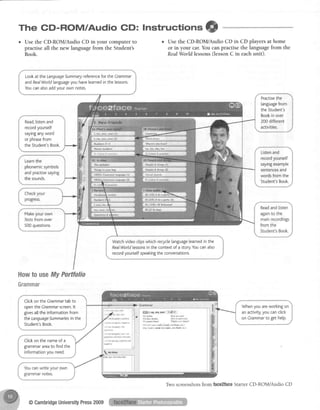
LessonC RealWorldlessonsfocuson
the functionalandsituationa[[anguage
studentsneedto comrnunicateeffectively
in an Engtish-speakingenvironment.
Theintegratedpronunciation
syllabusincludesdri[tsforall
newReaIWorld language.
RealWorldsectionsfocuson the
languagethat studentsneedin a
Darticularsituationor context,often
usingeasy-to-fo[[owflow charts.
,S n"ua t* oono.erlos Fill h rhe $lx
pith ther *ord5
i
jdp mhu6 tue rup nu.h dry qs
Newvocabularythatstudentsneedfora
listeningor readingtextisalwayspre-taught,
enablingthestudentsto completethe
comprehensiontask successfutly.
ThePairandCrouoWorksectionin
thebackoftheStudent'sBookprovides
awidevarietyof communicative
speakingpracticeactivities.
Reducedsamplepagesfrom face2laceStarterStudent'sBook
The Student's Book
kbubry dotbaqduE
i€k thins inyoor b4{l}
.nd (2); l€qlency adv€d$
d' a)ff$Ptbrcn m'k
"-*. S
6) vsv Lngftd ttFt NmE
-
NotbehNwrryth(Iilhud
-'
sM$ilh/d! Wo*inParN
hfu lctm. flft'do *. 5al th6c lmes?
h! 8* Itu 'Fh $d pd* Lietn asein nd Inrcth
$
al bk ar rhc pbrw- Mbh tu wtrde lo ddh6 l-I4
ns r. ie bcn'.rdh !.F#;'!iiiiii; q:i;,':
rk i&$ or,m'16q' d@?;iii$fi..b&1{::.;:
b)fiSm*W Li'tcu!dpffiri*
c)Wo* h pdrs T$l yN pdnfl:
,Siy;--i {Strtr
S fiffi W u"*
"t
Prdixfic* tohG
Ut* xi*t** wll$'ew*
Kfe md ffir*
wf Nffi @ee
6 Review L r , . . J r . . q c c i r r r , ' . i ) u . ! , ' 6 t p
4 l o ' r r r w i l d s l ' { . L i h e .
_ _
*
' + + ' : ' i i
4
2 rh.'e 5'rFitur].1' TFEEFE{"wg@
i . r h . n n , , ,p r r , f r ; r , r , 2 . , n " , r , , , g , y . , u , . , , , t "
a rh.k 'JJlritrlrri_'- :l rr rnr[sb
e 'LPe ,r,{ nitu. rn I
' , . . J r . . g c c i r r r , r i ) u . ! , ' G { i p , , l i l r r r r w { , d 5 1 ' { . L i h e .* ' + + ' : ' r r
i h i ' r l ' ' L . a l " '
. . , " ' , . 1 . , . . " ' ,
"
L   ' t l r r p " r " ' r i n P a "
' isl ]$llrrnttt
t l l d l r n L k g r ' s r r h l  r ' ,
r : q r r k h t l r l ^ ' L i t r t ' I n i d r
.
",",u 11':'
i,;."':'ffi
S u)ffilS L..I
"ssn'.
sc phdh btcn md
rL ilr Npk h In. dddF !€al lmn
tltkh@hmldd$sdl,i.lsmtrPtt
$ a)st* o** *a elour doy0:
|Mllywatr, $h.trms w6i |h-"'*t sEr.
hklbwhts,
b) trhk h gmuFs Comprre lisrs
s il,*':l",ffil
d! nr Lht l(ir,!
r . o f r L , f t i
4 r a l i _ !
u r ! t ) n r
? 11 riN irg
d3 -,Lhrlr rhttdrnrt""td,
r lr,uc r/@)a ior I rkl
hjuitrXl n) ljrfl
I I lrr.tr. Urxr/r trr. lrii5
r ll!.i( l//. lqi rhrlr.!
{ Ih.r.itrr/a d.Jtoil hntl;
! {h.h !/a:.rlrdilill
6 Ih.tf! fl/tJ,r ri{ur
hl l.lt in piD IE {hc
r.nrflr.N ilxir' tf Inisrl
I h.! .b(.k !n p1O
#
' t
" . r , ' ! / - ' ' ' ! r r ! t r i '
1 Urri r r3rn
, tlll}r I i
l l.i[n r)
a Llnaf
r ift+krb r
. r(f inirr li
t rtf,t
r rhrre Nil ni[r. rF I
rtil(r,rdl :l lGibLaeulddNiliJas4or.d
dh mb, ftr& }{'
6 . tuP hEh,ab! ll twsawomwmom
h)trSffiffi
f rhry'..i^[Mt
@ uorl rn paix-
"d- il ,. *v,*n o
"r
*q
7 . , - d { m . L _ . d ! s M r l r n r : l
b.,u. : il lcm #'cj nldmndr ata bi*
s [r-* :l r{n,mLd Ld[i.
b
fflSSpur
lanr huno:' jl 'ca ul mraon",nl ou"+
f l  b * h F B . A * m d l l r m d h M d M s m s
arsrm"lrx-ro r*u" |
il6PtrPl
c o m . c r 5 b r ( . G w . h , l o i u n i l a , , r " u n . t d t . r o J r
:l 'shl gi!il!!
LessonDVocabularyinContext
lessonspresentandPractisenew
vocabularythroughvisualcontexts
andreadingtexts.
TheRevlewsectionsproviderevisionof key
languagefrom the unit.Theseactivitiescan
bedonein classor for homeworkandwi[[
helpstudentspreParefor the ProgressTest
forthe unit(seep161-p'175of thisbook).
HelpwithSoundssectlonsPresent
andDractisesoundsthat areoften
problematicfor learnersof Engtish.
dl a) hl.{ fre rho$ fsr$omhurd. Rmmhrft
-
pc''plt Mh'6. their clalhe{ ill rlE slnur'.
bl $brk n F'E tudcJF. cltr yd bd* srudtnr B.
6kwhfl sbur dc Fonlc ddbffi.Ih$ rhss,oler
Therearepracticeactivities
immediatelyafterthe Presentation
of vocabularyto helpconsolidate
the new language.
HelpwithVocabulaDlsectionsask
studentsto focusontheformand
useof newvocabularythemselves
beforecheckingwiththeteacheror
inthe LanguageSummary.
BasedontherequirementsoftheCommon
EuropeanFrameworkof Referencefor
Languages(seep13),theProgressPortfolios
a[[owstudentsto monitortheirown
languagedevelopmentbycheckingwhat
theycanrememberfromtheunit.Students
arethendirectedto theCD-ROMforfurther
practiceof areastheyareunsureabout.
The CD-ROM/Audio GD: lnstruction= ffi
o Usethe CD-ROIWAudioCD in your computerto
practiseall the new languagefrom the Student's
Book.
o Usethe CD-ROIv{/AudioCD in CD playersat home
or in your car.Youcanpractise the languagefrom the
RealWorldlessons(lessonC in eachunit).
Lookat theLanguageSummaryrreferencefortheCrammar
andRealWorldlanguageyouhavelearnedinthelessons.
Youcanatsoaddvourownnotes.
Practisethe
[anguagefrom
theStudent's
Bookinover
200different
activities.
Read,listenand
recordyourself
sayinganyword
orphrasefrom
theStudent'sBook
Listenand
recordyourself
sayingexample
sentencesand
wordsfromthe
Student'sBook.
' - - . c 1 _
Learnthe
phonemicsymbots
andpractisesaying
thesounds.
Fl.5JRt.9 At n Fdy
Hl lllR:,18 #.r{ffiei
Makeyour own
Iesfsfrom over
500questions.
Watchvideoclipswhichreryclelanguagelearnedinthe
RealWorldlessonsinthecontextof astory.Youcanalso
recordyourselfspeakingtheconversations.
Howto Hsellty Porttolio
Grammar
Clickon the Crammartabto
openthe Gnmmar sueen.lt
givesatlthe informationfrom
the LanguageSummariesin the
Student'sBook.
Whenyouareworkingon
anactivity,youcanclick
onGrammarto gethetp.
. ? ? he {!!osuh4: neq.tile
.1 I tr 1:in$laf)r wh
Clickon the nameof a
grammarareato findthe
informationyou need.
Two screenshotsfrom face2faceStarterCD-ROM/Audio CD
@CambridgeUniversityPress2009
The CD-ROM/Audio GD
Phonemes
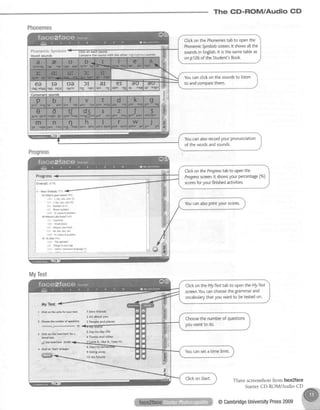
ClickonthePhonemestabto openthe
PhonemicSymbolsscreen.lt showsa[[the
soundsinEngtish.lt isthesametableas
onp126oftheStudent'sBook.Vowel sounds Connparettp sund with th€ sther higtdtshtFdsaunds
Youcanclickon the soundsto listen
to andcomoarethem.
Youcanalsorecordyourpronunciation
ofthewordsandsounds.
CtickontheProgresstabto oPenthe
Progressscreen.lt showsyourpercentage(%)
scoresforyourfinishedactivities.
Youcanalsoprintyourscores.
MyTest
Three screenshotsfrom face2faee
StarterCD-ROM/Audio CD
@CambridgeUniversityPress2009
The CD-ROM/Audio CD
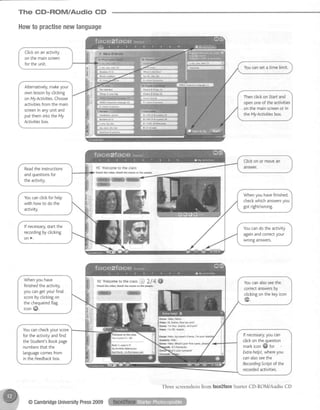
Howto practisenewlanguage
Ctickon an activity
on the mainscreen
for the unit.
Alternatively,makeyour
ownlessonbycticking
onMyActivities.Choose
activitiesfromthemain
screeninanyunitand
putthemintotheMy
Activitiesbox.
Thenclickon Starfand
openoneof the activities
on the mainscreenor in
the My Activitiesbox.
tC Welcomet0 th€ cldss
Wa!.h the frd6- hkh the mms to the Fpl€-
w
ffi
Readtheinstructions
andquestionsfor
theactivity.
Whenyou havefinished,
checkwhichanswersyou
got right/wrong.
Youcanclickfor help
with howto do the
activity.
lf necessarlr,startthe
recordingbycticking
on>.
Youcando the activity
againandcorrectyour
wrong answers.
Whenyou have
finishedthe activity,
you cangetyour final
scoreby clickingon
the chequeredflag
iconffi.
lc We{cometothe€tasstJ 3.14 ffi
w'kh the dd€o. ltutd' tha Effi to th€ p€6pte-
Youcanalsoseethe
correctanswersDy
clickingonthekeyicon
ffi
Emffi Hetbo. Hels.
H€les Hi. Ema f{sw are yN?
EhH l'mffne, thanks AndyEil?
H€l€* l'mOX, thank5,
Efiffi Hetlo, hlyflffie's EEma. l'mpur
strdens He{to.
Efrm Het{E. ffiat's vDsr fiEt nare.
Youcancheckyour score
for the activityandfind
the Student'sBookpage
numbersthat the
languagecomesfrom
in the Feedbackbox.
lf necessary,youcan
clickonthequestion
markicon@ for
Extrahelp!,whereyou
canalsoseethe
RecordingScriptof the
recordedactivities.
@CambridgeUniversityPress2009
Three screenshotsfrom face2faceShrter CD-ROM/Audio CD
The Gommon European Framework (CEF) *44'*ffin@BF
WhatistheGommcnEuropeanFramework(GEF)?
Sincethe early1970s,a seriesof Council of Europeinitiatives
hasdevelopeda description of the languageknowledge and
skills.that peopleneedto live, work and survive in any
country or environment where the main languageof
communication is different form their own language.
Waystage19901, Threshold1990'zandVantage3detail the
knowledge and skills required at different levels of ability
The contentsof theselanguagespecificdocumentsservedas
the basisfor the more generalCommonEuropeanFrameworh
of Referencefor Languages:Learning,teaching,assessment
(CEF)4which was officially launchedby the Council of
Europe in 2001 and includes setsof 'can do' statementsor
'.o-p"t"tt."t'. A relateddocument, TheEuropeanLanguage
Portfolio,encourageslearnersto assesstheir progressby
matching their competencesagainstthe'can do' statements.
The faceZfaceserieshasbeendevelopedto include
comprehensivecoverageof the requirementsof the CEE The
tableaboveright shows how faceffacerelatesto the CEF and
the examinationswhich canbe taken at eachlevel through
University of CambridgeESOLExaminations (Cambridge
ESOL),which is a member of ALTE (The Associationof
LanguageTestersin EuroPe).
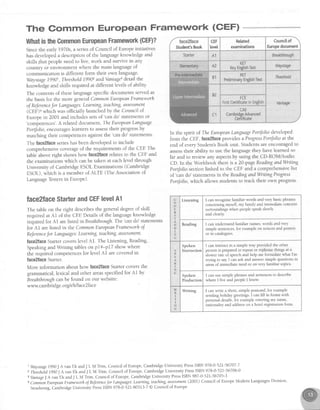
face2laceStarterandCEFlevelA1
The table on the right describesthe generaldegreeof skill
required at AI of the CEE Detailsof the languageknowledge
requiredfor Al arelistedin Breahthrough.The
'cando' statements
for Al arelisted in the CommonEuropeanFrameworhoJ
ReJerenceJor Lcmguages:Leaming.teaching,assessment.
faceZlaceSmrtercoverslevel A1. The Listening, Reading,
Speakingand Writing tableson pI4-pI7 show where
the required competencesfor level Al arecoveredin
{ace2laceStarter.
More information about how face2faceStartercoversthe
grammatical,lexical and other areasspecifiedfor Al by
Breahthroughcanbe found on our website:
www.cambrid ge.orgl elt/face2face
1 Waystage1990J Avan Ek andJ L M Trim, Council of Europe,CambridgeUniversityPressISBN978-0-52L-56707-7
2 thieshild lgg0 J Avan Ek andJ L M Trim, Councilof Europe,CambridgeUniversityPressISBN978-0-521-56706-0
3VantageJA vanEk andJ L M Tiim, Council of Europe,CambridgeUniversityPressISBN987-0-52L-56705-3
acomion EuropeanFrnneworhoJReJeratceJorLaflguages:Leaming teachingassessment(2001)council of EuropeModernLanguagesDivision,
strasbourg,cambridgeUniversityPressISBN978-0-521-80313-7@Council ofEurope
In the spirit of TheEuropeanLanguagePortfolio developed
from the CEF,face2faceprovidesa ProgressPortJolioat the
end of everyStudent'sBook unit. Studentsareencouragedto
assesstheir ability to use the languagethey havelearnedso
far and to review any aspectsby using the CD-ROM/Audio
CD In the Workbook thereis a 2}-pageReadingmdWriting
Portfoliosectionlinked to the CEF and a comprehensivelist
of 'can do' statementsin the ReadingandWntingProgress
Portfolio,which allows studentsto track their own progress.
FCE
FintCertificatein English
U
N
E
R
S
T
I
N
G
Listening I can recognise familiar words and very basic phrases
concerning myself, my family and immediate concrete
surroundings when people speak slowly
and clearly
Reading I can understand familiar names,words and very
simple sentences,for example on notices and posters
or 1ncatalogues
s
P
E
K
I
G
Spoken
Interaction
I can interact in a simple way provided the other
person is preparedto repeator rephrasethings at a
slower rate of speechand help me formulate what I'm
trying to say I can ask and answer simple questions in
areasof immediate need or on very familiar topics
Spoken
Production
I can use simple phrasesand sentencesto describe
where I live and people I know
w
I
T
I
N
G
Writing I can write a short, simple postcard,for example
sending holiday greetings I can fill in forms with
personal deuils, for example entering my name,
nationality and addresson a hotel registration form
The CEF
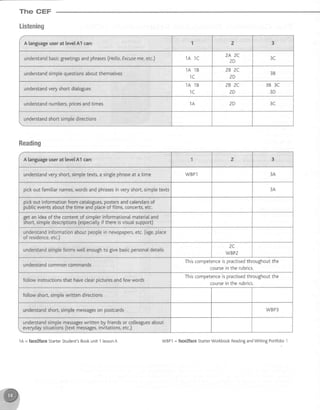
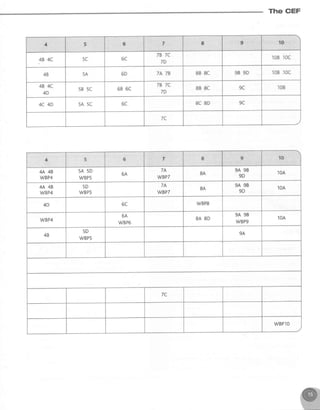
!-lstening
A tanguageuserat [eve[Al can: I 2 3
understandbasicgreetingsandphrases(Hello,Excuseme,etc.) 1 A 1C
2A 2C
2D
3C
understandsimptequestionsaboutthemselves
1A 1B
,IC
28 2C
2D
3B
understandveryshortdialogues
1 A 1 B
,IC
28 2C
2D
38 3C
3D
understandnumbers,Dricesandtimes 1 A 2D 3C
understandshortsimD[edirections
A languageuserat levelAl can: 1 2 3
understandveryshort,simpletexts,asinglephraseat a time WBPl 3A
pickoutfamiliarnames,wordsandphrasesinveryshort,simptetexts J A
pickoutinformationfromcatalogues,postersandcalendarsof
pub{iceventsaboutthetimeandplaceof films,concerts,etc.
get an ideaof the contentof simpterinformationalmaterialand
short,simptedescriptions(especialtyif thereisvisualsupport)
understandinforrnationaboutpeoplein newspapers,etc.(age,place
of residence,etc.)
understandsimpleformswe[[enoughto givebasicpersonaldetails
2C
WBP2
understandcommoncommands
Thiscompetenceis practisedthroughoutthe
coursein the rubrics.
fotlowinstructionsthathaveclearoicturesandfewwords
Thiscompetenceispractisedthroughoutthe
courseintherubrics.
followshort,simplewrittendirections
understandshort,simplemessageson postcards WBP3
understandsimplemessageswrittenbyfriendsorcolteaguesabout
everydaysituations(textmessages,invitations,etc.)
Reading
WBP1= tace2faceStarterWorkbookReadingandWritingPortfolio11A= lace2faccStarterStudent'sBookunit1lessonA
The CEF
5 6 'l108
4A 48
WBP4
5A 5D
WBP5
6A
7A
WBPT
8A
9A 98
9D
10A
4A 48
WBP4
5D
WBP5
7A
WBPT
8A
9A 98
9D
10A
4D 6C WBPS
WBP4
6A
WBP6
8A 8D
9A 98
WBP9
10A
48
5D
WBP5
9A
7C
WBPlO
The CEF
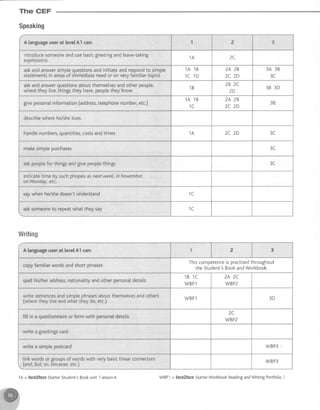
$peaking
A [anguageuserat levelAl can: 1 2 3
introducesomeoneandusebasicgreetingand[eave-taking
exDressrons
1 A 2C
askandanswersimplequestionsandinitiateandrespondto simple
statementsinareas'ofimmediateneedoronveryfa'mitiartopics'
1A 1B
,IC'ID
2A 2B
2C 2D
3A 38
3C
askandanswerquestionsaboutthemselvesandotherpeopte,
wherethey[ive,thingstheyhave,peop[etheyknow
1B
28 2C
2D
38 3D
givepersonaIinformation(address,tetephonenumber,etc.)
1A 1B
1C
2A 28
2C 2D
3B
describewherehe/shelives
handlenumbers,quantities,costsandtimes 1A 2C 2D 3C
makesimplepurchases 3C
askpeopleforthingsandgivepeoplethings 3C
indicatetimebysuchphrasesasnextweek,inNovember,
onMonday,etc.
saywhenhe/shedoesn'tunderstand 1 C
asksomeoneto repeatwhat they say
'lc
Writing
A languageuseratlevelAl can:
'l
2 3
copyfamiliarwordsandshortphrases
Thiscompetenceis practisedthroughout
the Student'sBookandWorkbook.
spe[[his/heraddress,nationalityandotherpersonaIdetaits
'lB
1C
WBPl
2A 2C
WBP2
writesentencesandsimplephrasesaboutthemselvesandothers
(wherethey liveandwhat they do,etc.)
WBP'I 3D
filtin a questionnaireor formwith personaldetails
2C
WBP2
write a greetingscard
writea simplepostcard WBP3.
linkwordsorgroupsofwordswithverybasiclinearconnectors
(and,but,so,because,etc.)
WBP3
1A= faceZfaceStarterStudent'sBookunit1lessonA WBP1= faceZfaee StarterWorkbookReadingandWritingPortfotio
'1
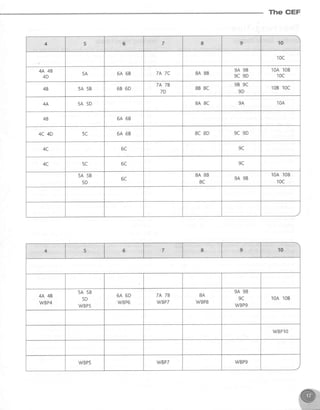
The CEF
4 5 7 8 9 10
10c
4A 48
4D
5A 64 68 7A 7C 8A 8B
9A 98
9C 9D
10A10B
10c
48 5A 58 68 6D
7A 78
7D
88 8C
98 9C
9D
10B10c
4A 5A 5D 8A 8C 9A 10A
48 6A 68
4C 4D 5C 6A 68 8C 8D 9C 9D
4C 6C 9C
4C 5C 6C 9C
54 58
5D
6C
8A 8B
8C
9A 98
10A10B
i0c
4 5 6 7 8 9
4A 48
WBP4
5A 58
5D
WBP5
64 6D
WBP6
7A 78
WBPT
8A
WBPS
9A 98
9C
WBPg
10A10B
WBPlO
WBP5 WBPT WBP9
Teaching Tips
TeachingStarterGlasses
TeachingStarterclassescan often be challengingaswell as
rewarding.Starterstudens can lack confidenceand might
not havestudied a languageformally before.Here aresome
tips to help you teachStarterclasses.
o Eachlessonin the Student'sBook is carefullystagedand
takesstudentsstep-by-stepfrom presentationto practice.
Go slowly and methodically through the material exercise
by exercise,making sure that studentsunderstandeach
point beforemoving on.
. Keepyour instructions in classshort, clearand to the
point. Studentscan often get lost if the teachertalks too
much in English. It is perfectly acceptableto use
imperativesto give instructions (Loohat acercise3. Worhin
pairs., etc.).Teachthe words and phrasesin Classroom
Instructions, SBp127 early in the course.
o Most exercisesin the Student'sBook have an example
aheadyfilled in. Use these examples to check that the class
knows what to do before asking studens to work on their
own or in pairs.
o Take time to demonstrate communicative activities with
the class.At Starterlevel, demonstrationis often a more
effective way to give instructions than describing what to
do. You can demonstrateactivitiesyourself or by using a
confident student asyour partner.
o Do a lot of drilling. This helps to build students'
confidenceand allows them time to practisenew language
in a controlled way All new vocabulary grarnrn r andReal
Worldlanguage is included on the ClassAudio CDs to
provide clearmodels of new language.Seethe tips on
drilling on p20.
. Using the board is particularly important with Starter
studens. In the TeachingNotes (p2l-p99) thrsiconl@
indicatesa point in the lessonwhere it may be useful for .
you to usethe board.
o When using the board, try to involve students in what you
arewriting by asking questions(Whatl thenut word?,
Wherel the stress?,etc.). Give studentstime to copy what
you havewritten and leaveuseful languageon the board
so that students can refer to it during the lesson.
o Show studentstheLanguageSummaneson SBp100-pll9
early on in the course and encouragethem to refer to
thesein classand when doing homework.
o Starter students need a lot of revision and recycling
throughout the course.Seethe tips on reviewing and
recycling on p20.
o It is, of course,very useful to know the students'first
language.If you have a monolingual class,you rnaywant
to use the students' language to give or check instructions
for speakingactivities,or to dealwith students'queries.
However, try to speak to the classin English asmuch as
possible, as this will help establish the classroom asan
English-speaking environment.
o Rememberthat at Starterlevel, encouragementand praise
arevery important, particularly for weaker studens.
TeachingMixedLevels
In Starterclassesteachersare often facedwith a mixture of
real beginnersand'false'beginners. Here aresometips to
help you deal with teaching low-level mixed-ability classes.
o Work at the paceof the averagestudent. Try not to let the
fastestor sloweststudentsdictate the pace.
o To prevent stronger students from dominating, nominate
the quieter onesto answereasierquestions.
o Ask stronger and more confident students to demonstrate
activitiesfor the whole class.
o Allow time for students to check answersin pairs or
groupsbefore checkingwith the whole class.
o Encouragestrongerstudentsto help weaker ones;for
example, if a student has finished an activiql ask him/her
to work with a slower student.
o Give students time to think by asking them to write down
answersrather than calling them out. This helps prevent
the more able students from dominating the class.
o When monitoring during pair and group work, go to the
weaker students first to check that they have understood
the instructions and are doing the activity correctly
o Planwhich studens aregoing to work togetherin pair
and group work. Vary the interaction so that stronger
studentssometimeswork with weaker students,and at
other times (for example,during freer speakingactivities)
studentswork with other studentsof the samelevel.
o Dont feel that you have to wait for everyonein the class
to finish an exercise.It is usually best to stop an activity
when most of the classhasfinished.
. Vary the amount and tlpe of correction you give according
to the level of the student, in order to push stronger
students and to avoid overwhelming those who are less
confident. Rememberto praisesuccessfulcommunication
aswell ascorrectlanguage.
o Give weaker students extra homework from the Workbook
or the CD-ROM/Audio CD to help them catchup with
areasof languagethe rest of the classis confident with.
Listening
o For most Starterstudents,listening to spokenEnglish is
usually very challenging. Be sensitive to the difficulties
that students might be having and play a recording several
times if necessary
o At this level, activities where students listen and tead at
the sametime arevery useful, asthey allow srudents to
'tune in' to spokenEnglish and make the connection
between what they hear and the written word. Make full
useof the'listen and read'activitiesin the Student'sBook
in your classes.For other listening activities,you can ask
studentsto read the RecordingScrips (SBpl20-p125)
when they listen and check their answers.
o Before asking students to listen to a recordinS, establish
the context, the charactersand what information you want
them to listen for.
Teaching Tips
o Give studens time to read the comprehensionquestionsin
the Student'sBook and deal with any problems in these
questionsbeforeplaying a recording.
o Make full useof the Help with Listaing sectionsin the
Student'sBook, which help studentsto understandnatural
spoken English.
. Eniourage studentsto listen againto the classroom
recordingson their CD-ROIWAudio CD at home. These
canbe found in the ClassAudio sectionfor eachunit.
Note that studentscan only listen to theseclassroom
recordingson a computer,not on a CD player.
$peaking
PairandGroupWork
r Make full useof all the communicative speakingactivities
in the Student'sBook, particularly the Getready... Getit
rightl sections.Theseallow studentsto work out what
languageto usebefore they do the communicative stage
of the activity, which will help them to retain the accuracy
that hasbeenbuilt up during the lesson.
. Help studentswith the languagethey needto do speaking
usks by drawing their attention to the'transactional
language'in the speechbubbles.
r Tiy to ensurethat studentswork with a number of
different partnersduring a class.If your studentscan't
swapplaces,ask them to work with studentsbehind
or in front of them aswell ason either side of them.
o It is often useful to provide a model of the tasksyou
expectstudentsto do. For example,beforeaskingstudens
to talk about their family in pairs,you can talk about your
family with the whole classto give studens a model of
what they areexpectedto do.
. Go around the classand monitor students while they are
speakingin their pairs or groups.At this stageyou can
provide extra languageor ideasand correctany language
or pronunciation which is impeding communication.
o When giving feedbackon speaking,rememberto praise
good communication aswell asgood English, and focus
on the result of the task aswell asthe languageused.
o Use the ClassActivities(pf 00-pla6) to provide extra
communicative speakingpracticein class.
Correction
o When you hear a mistake,it is often useful to correctit
immediately and ask the student to say the word or phrase
againin the correct form, particularly if the mistake relates
to the languageyou havebeenworking on in the lesson.
o Alternatively,when you point out a mistake to a student
you can encouragehim/her to correctit himselflherself
before giving him/her the correct version.
o Another approachto correction during a freer speaking
acdviry is to note down any mistakesyou hear,but not
correct them immediately At the end of the activity write
the mistakeson the board. Studentscan then work in pairs
and correct the mistakes. Alternatively, you can discuss the
mistakes with the whole class.
Uocabulary
o Most of the new vocabularyin face2faceStarteris
presentedpictorially and studentsareusually askedto
match words to pictures themselves.If all your classare
realbeginners,considerintroducing new vocabulary
yourself first by bringrng in pictures,flashcards,objects,
etc. and teachingthe words one by one.You can then use
the first exercisein the Student'sBook aspractice.
o Point out the stressmarks (.) on all new words and
phrasesin the vocabularyboxesin the lessonsand the
LanguageSummanes.Note that theseshow only the main
stresson words and phrases.
o Make full useof t}reHelp with Vocabularysectionsin the
Student'sBook. Thesefocus on lexical grammar and help
studentsto understandthe underlying patternsof how
vocabularyis usedin sentences.You can either go through
eachpoint with the whole classor ask studentsto do the
exercisesthemselvesbefore you check answerswith the
class,asshown in the kaching Notesfor eachlesson.
o Make studentsawareof collocationsin English (e.g.start
worh, hm'edittner,go to thebeach,etc.) by pointing them
out when they occur and encouragingstudens to record
them asone phrasein their notebooks.
o Reviewand recyclevocabularyat everyopportunity in
class,using the Revians,the LanguageSummanesand the
Class Activities.
o Use the photocopiableVocabularyPlusworksheets
(p147-p160). Theseworksheetsintroduce and practise
extra vocabulary which is not included in the Student's
Book. They canbe usedfor self-studyin classor as
homework, or asthe basisof a classroomlesson.There is
oneVocabularyPlusworksheet for eachunit in the
Student'sBook.
Grammar
o Make full use of.theHelp with Grammar sectionsin the
Student'sBook. Thesehighlight the rules for form and use
of eachgrammar point. You can either go through each
point with the whole class,or ask studens to do the
exercisesthemselvesbefore you check answerswith the
class,asshown in the TeachingNotesfor eachlesson.
o Sentencesin the grammar tablesin the Srudent'sBook are
often colour-coded.When using thesetables,use the pink
and blue words to highlight the underlying grammatical
patternsof the new language.
o Teachyour studentsuseful grammaticalterms (e.g.noun,
verb, PresentSimple,etc.) when the opportunity arises.
This helps studentsbecomemore independentand allows
them to use grammar referencebooks more effectively
However, try not to overload students with terminology
at this level.
o If you know the students'first language,highlight
grammatical differencesbetween their language and
English. This raisestheir awarenessof potential problems
if they try to translate. It is also useful to highlight
grammaticalsimilarities when a structure in English
is the sameasin the students'own language.
Teaching Tips
Pronunciation
Drilling
o Make full use of the pronunciation drills on the Class
Audio CDs. Thesedrills are marked with the icon ffi in
the Student'sBook and give standardBritish native-speaker
models of the languagetaught.
. Note that there areaheadysufficient pausesbuilt into
theserecordeddrills for studentsto repeatchorally
without you having to pausethe recording.If studentsare
finding a particular word or sentencedifficult to
pronounce,you canpausethe recording and ask each
student to repeatindividually before continuing.
o Point out that all the recorded drills are alsoon the ftcezface
CD-ROM/Audio CD. Encouragestudentsto usethesefor
pronunciation practice on their computer at home.
o For variegl you canmodel and drill the sentencesyourself
insteadof using the recordings.When you model a phrase
or sentence,make sure that you speakat normal speed
with natural stressand contractions.Repeatthe target
language two or three times before asking the whole class
to repeatafter you in a
'choral drill'.
o After choral drilling it is usually helpful to do some
individual drilling. Start with the strongest students and
drill around the classin random order.
o As the aim of drilling is accuracy,you should correct
studentswhen they make a misuke. However,avoid
making the studentsfeeluncomfortable and dont spend
too long with one student.
r After drilling new language,you can ask two students to
practise alternate lines of a conversation from where they
are sitting, with the rest of the classlistening. This
'open
pairs' techniqueis very useful to check students'
pronunciation before they go on to practisein 'closed
pairs'.It can alsobe used after studentshaveworked in
closedpairs to check their performanceof the task.
o Praisestudentsfor good,/comprehensiblepronunciation
and acknowledgeweak students'improvement, evenif
their pronunciation is not perfect.
o Studens can alsolisten to the audio component of the
CD-ROM/Audio CD on their CD players.This contains
RealWorld drills from eachlessonC in the Student'sBook.
Helpingstudentswithstressandintonation
o Point out the stressmarks on all new vocabularyin the
vocabularyboxesand the LanguageSummanes.Note that
only the main stressin each new word or phrase is shown.
For example,in the phrase Jinishw6rh, the main stresson
worhis shown, but the secondarystresson.lfinishis not.
We feel this simplified system is the most effective way to
help studentsstresswords and phrasescorrectly
. When drilling new vocabularypay particular attention to
words that sound different from how they are spelt. Words
that students often find difficult to pronounce are
highlighted in the TeachingNotesfor each lesson.
o When you write words or sentenceson the board, mark
the stressin the correctplaceor ask the studentsto tell
vou which svllables or words are stressed.
o When you model sentencesyourself, it may be helpful to
over-emphasisethe stresspattern to help studentshear the
stress.You can also
'beaCthe stresswith your hand or fist.
o Emphasisethat intonation is an important part of meaning
in English and often showshow we feel.For example,a
falling intonation on the word pleasecansound very
impolite to a native English speaker.
o Encouragestudentsto copy the intonation pattern of
model sentenceson the recordeddrills, particularly in the
RealWorld sectionsin lessonC of eachunit.
Helpingstudentswithsounds
o Make full useof the Help with Sotmdssectionsat the end
of eachunit in the Student'sBook. Thesefocus on sounds
in English that most learnersfind difficult to pronounce.
o If studentsarehaving problems making a particular sound,
you can demonstratethe shapeof the mouth and the
position of the tongue in front of the class(or draw this on
the board). Often studentscan'tsaythesesoundssimply
becausethey dont know the mouth position required. The
mouth positions for all soundsin the Help with Sounds
sectionscanbe found in ttreTeachingNotesfor eachunit.
r Draw students'attention to the English soundswhich are
the samein their own language(s)aswell ashighlighting
the ones that are different.
o Encouragestudentsto use the pronunciation activitiesin
eachunit of the CD-ROM/Audio CD at home. Students
can alsousethe phonemessectionof the CD-ROM/Audio
CD to practiseindividual sounds.
ReviewingandRecycling
o Use the Quich Reviewsat the beginning of eachlesson.
They areeasyto setup and should take no more than five
to ten minutes. They area good way of getting the classto
speakimmediately aswell asreviewing what students have
learnedin previouslessons.
o Exploit t}reReviozvsectionsat the end of eachunit. They
canbe done in classwhen studentshave finished the unit,
or setfor homework. Note that the Reviortexercisesare
organisedin lessonorder,so that individual exercisescan
be used asfillers at the beginning or end of a lesson.
o After a mid-lessonbreak, ask studentsto write down in
one minute all the words they can remember from the
first part of the lesson.Thesequick 'What havewe just
learned?'activities^re very important for helping students
transfer information from their short-term memory to
their long-term memory
o Encouragestudentsto use the face2faceCD-ROM/Audio
CD to review eachlessonat home. Also encourage
students to review new languageby reading the Language
Summaryfor the lesson.
o Sethomework after everyclass.The face2faceStartei
Workbook hasa sectionfor eachlessonin the Student's
Book, which reviews all the key language taught in that
particular lesson.
o Give students aProgressTest(p161-p175) aftercompleting
eachunit of the Student'sBook. Thesecanbe done in class
or given for homework.
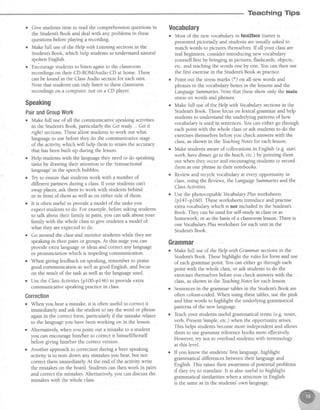
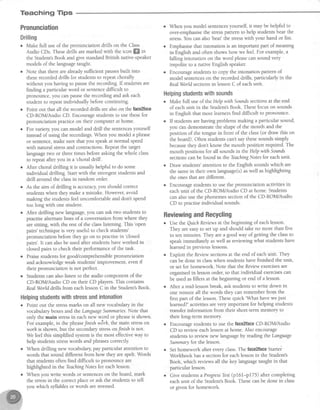
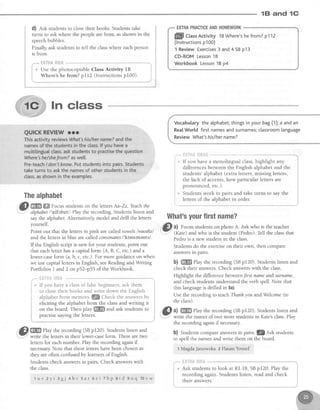
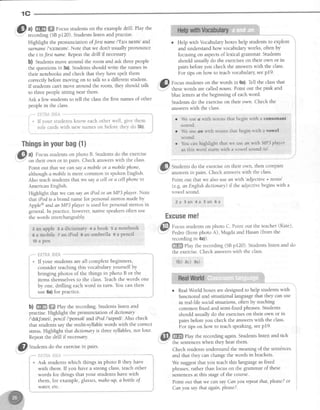
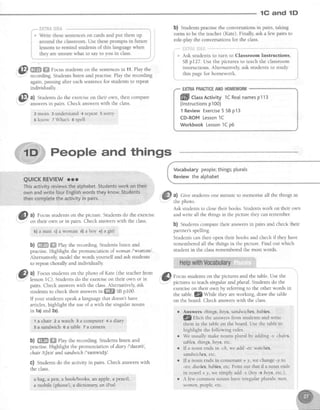
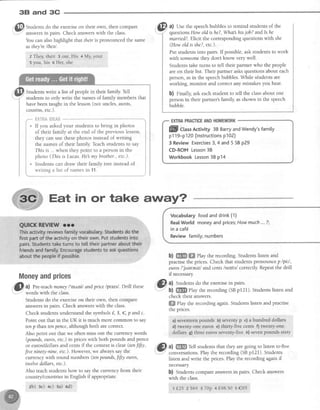
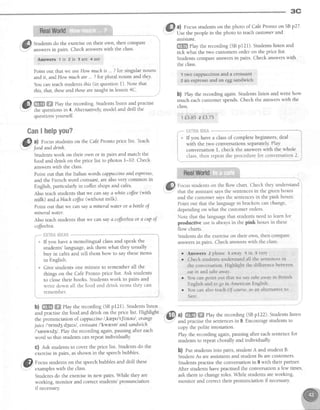
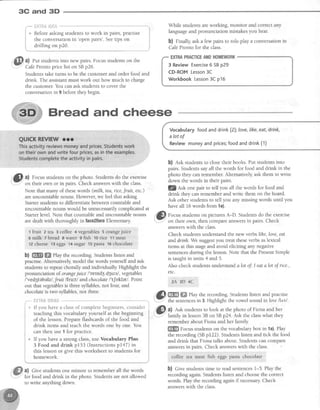
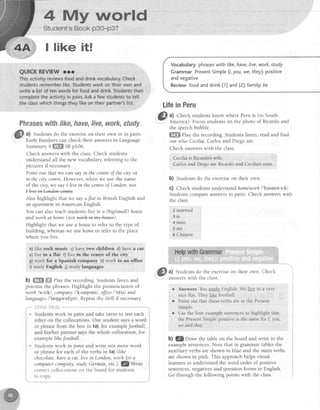
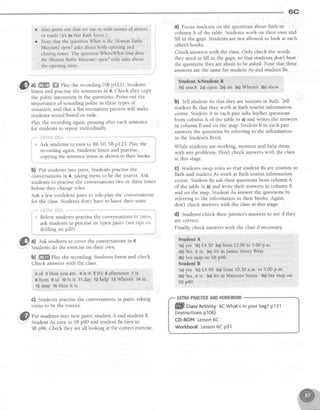
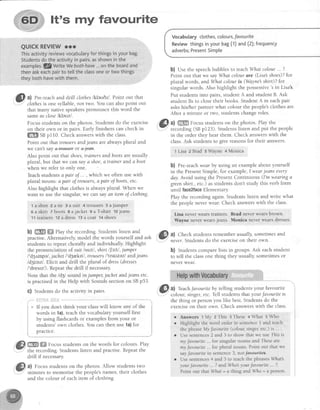
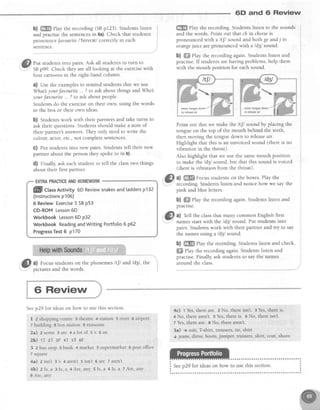
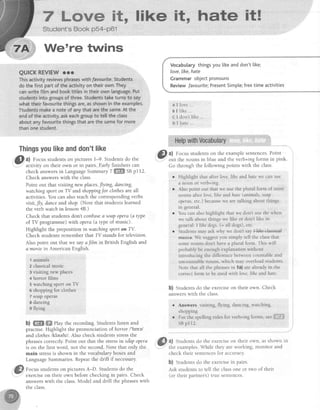
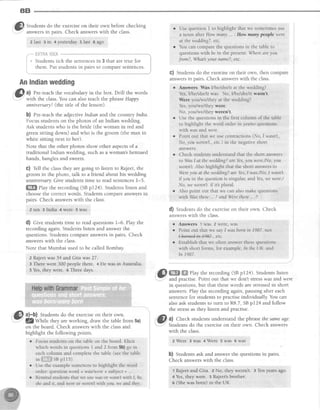
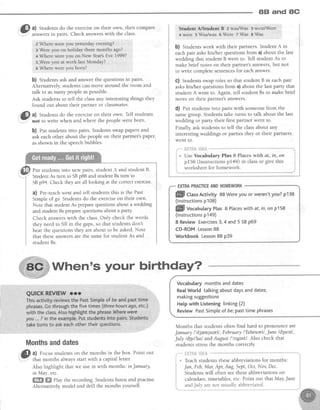
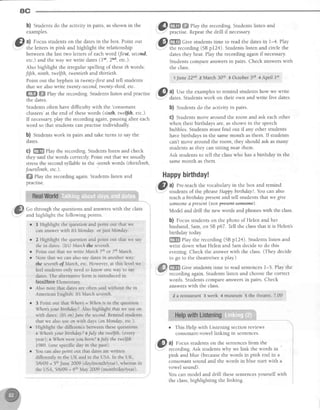
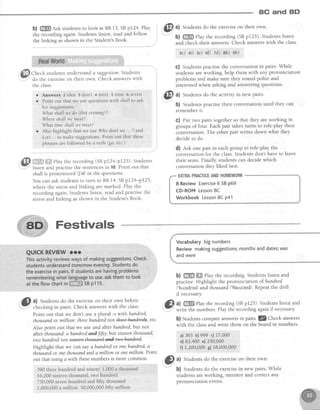
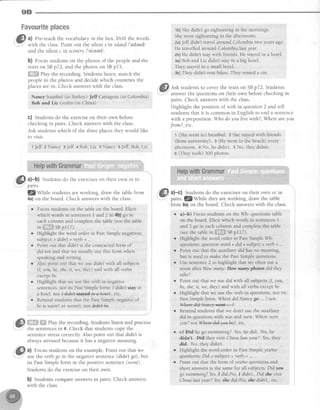
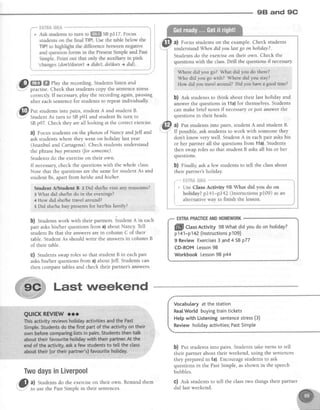
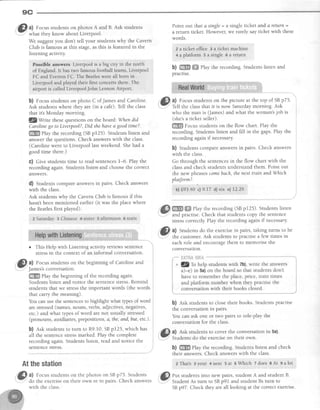
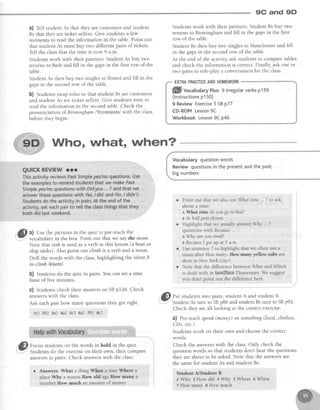
I Nernr frlends
Student's Book p6-p13
What's your name?
Hello!
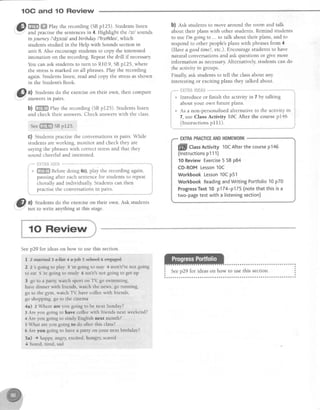
@ ll
#ffi Focusstudentson conversationI in the photo.
conversation.Play the recording againifnecessary
Check that studentsunderstandthe sentencesin the
conversation.Point out that when giving our name,we
cansayI'm .. or My namel .. . You can also teachAndyou.
asan alternativeto Youtoo.
ffi (= pronunciation activity) Play the recording again,
pausing after eachsentencefor studentsto repeat.
Alternatively model eachsentenceyourself and ask
studentsto repeatchorally and individually For tips on
drilling, seep20.
b) Demonstratethe activity yourself by role-playing the
conversationwith a confident student. Then ask students
to practisethe conversationwith four other students,
either by moving around ihe room or by talking to
studentssitting near them Studentsshould use their own
first names.
* Beforeaskingstudentsto practisethe conversation
in pairs, choosetwo confident studentsand ask
them to practisethe conversationfor the class.
Studentsdon't have to leavetheir seats.Correct
students'pronunciation asnecessary,then ask
them to practisethe conversationagain.Repeat
this
'openpairs'procedurewith other students
this techniqueworks well with your class,
when appropriatein future lessons.
G) Focusstudentson the speechbubbles.Studentstake
turns to introduce themselvesto the class.
.""""-"ilF.ifi&$fli:*. *****
i. * @ Draw a plan of the classseatingarrangenients
i or the board and write in the students'namesas
i they introduce themselvesto the class.Leavethe
i plan on the board for students to refer to during
i the lesson.
; M;;.",;;";;;;;;;;,* il;;Play the recording.Studentslisten and read.
Checkstudentsunderstandall the sentencesin the
conversation.Point out that Hi = Hello andI'mfine =
I'm OK.Youcanalsopoint out that Hi is moreinformal
thanHello.
ffi fhy the recording ag4in,pausingafter eachsentence
for studentsto repeat.Alternatively model eachsentence
yourself and ask studentsto repeatchora and
individually
use
Vocabularynumbers0-12
Grammarl,my,you,your
RealWorld sayinghe[[o;introducingpeople;
phonenumbers;sayinggoodbye
b) Demonstratethe activity yourself by role-playing the
conversationwith a confident student. Then ask students
to practisethe conversationwith four other students,
either by moving around the room or by talking to
studentssitting near them. Studentsshould use their
own first names.
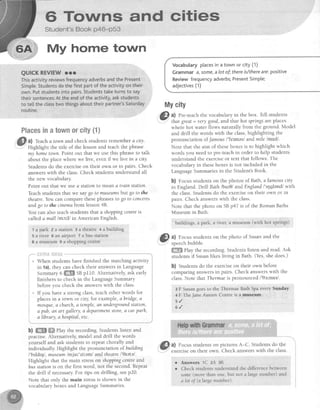
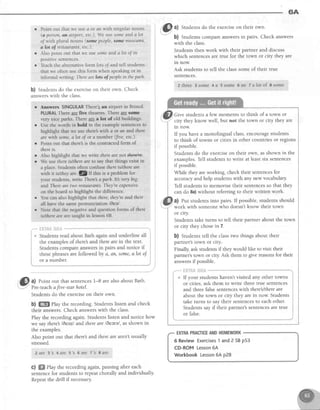
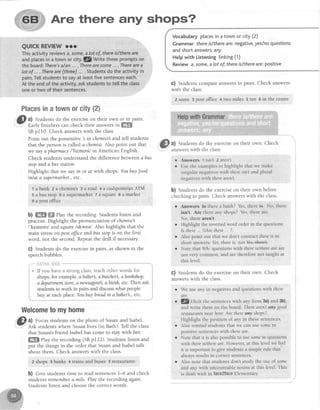
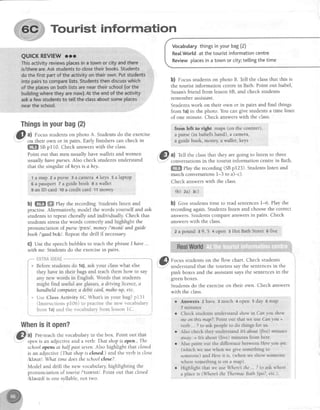
o Help with Grammar boxeshelp studentsto examine
examplesof new languageand discoverthe rules of
meaning,form and usefor themselvesStudents
should usually do the exerciseson their own or in
pairs beforeyou check the answerswith the class.For
tips on how to teachgrammar,seep19.
a)-b) Studentsdo the exerciseson their own or in pairs.
Check answerswith the class
. a ) 2 1 3 M y
. b) 2 you 3 your
r Highlight the differencebetweenl/my and
you/your.
r Point out that we usel/you + verb (I read,you
Iisten,etc.) andmy/your+ noun (my name,your
book,etc).
slf i
:it i
I
I
Also point out that we always use a capital l when
we refer to ourselves.
You can also teil students that there is no polite
form of you in English.
Students may ask you about the meaning of
'm,
are
and 3 in the example sentences Tell the class they
are par[ of the verb be,brt treat the new ]anguage
as fixed phrases at thrs stageof the course. Note
that the verb be is taught systematically in units 2
and 3.
|ii{l},iAtI?br&
Highlight the LanguageSummary referenceffi
in the Help with Grammar box and then ask
students to turn to LanguageSummary 1, SB
p100-p10f . Ask studentsto find ffi and give
them time to read the information. Point out that
all the new languagein eachunit is included in
I the l-anguageSummaries. i
I
1A
lntroducingpeople
Cil a) ffiffi Focusstudentson conversation3 in thephoto.
,.Y' Playtherecording.Studentslistenandreadthe
conversanon.
Check studentsunderstandthat we use this is ... to
introduce people.
ffi elay the recording again,pausing after eachsentence
for studentsto repeat.Alternatively,model eachsentence
yourself and ask studens to repeatchora and
individually
b) fut studentsinto groups of three.Studentspractise
conversation3 in their grouPs.
Ask a few groups to role-play their conversationsfor the
class.Alternatively,ask studentsto move around the room
and introduce people to eachother.
Numbers0-12
@ ll W W
Teachthe word'number.Play the recording.
'.- Studens listen and repeatthe numbers.Alternatively,
model the words yourself and ask studentsto repeat
chorally and individually
Highlight the pronunciation of zero l'ztereul and eight
/ert/. Repeatthe drill ifnecessary
b) Demonstratethe activity by sayingfour numbers and
asking studentsto write them down. Check they havethe
correctanswers.Studens then do the exercisein pairs'
1 *c,
#HTftei#C&
Studentswork in pairs and count alternately from
0 to 12. They can then count backwards
alternatelyfrom 12 to 0.
Phonenumbers
@ qt ffi Pre-teach phoneru'tmber.Play the recording.
.I Studentslisten and read the questionsand answers.
Check studentsunderstandmobilenumberandhome
numberby referring to the photos.
Point out the TFF!on how to say0 and double digis
(44, etc.)in phone numbers. Note that we can alsouse
zeroin phone numbers.
ffi ehy the recording again,pausingafter eachsentence
for studentsto repeatindividually
b) Studensdo the exercisein pairs.
,r@1 a) ffiffi rhy the recording (SBpt20). Studentslisten and
'.-:.-" -nr" the numbers. Play the recording againif necessary
b) Studentscompareanswersin pairs.fZ glrr p
answerswith the classby eliciting the phone numbers
and writing them on the board.
You can alsousethe recording to teachthe phrases
Yes,thatl nght. Thanhs.and Thanhyou.
ffiffi1$!pocus studentson the sentencesin 3. PIaythe
recording.Studentslistenandpractise.Note that in most
recordeddrills there arealreadysufficient pausesfor
studentsto repeatchorally without you pausing the
recording yourself.
a) Studentsdo the exerciseon their own, then compare
answersrn palrs
b) iii;}jj:$Play the recording Studentslisten and check
their answers.Check answerswith the class.
A
sUE Hello, my name'sSue.What's your name?
t,tARto Hello, I'm Mario
sUE Nice to meet you.
MARIOYou too.
B
ADAM Hi, Meg.
MEc Hi, Adam How are you?
ADAM I'm fine, thanks- And you?
MEc I'm OK, thanks
G) Students practise the conversations in pairs Ask a few
pairs to role-play the conversations for the class.
^ 020 7599 6320
B07655421769
c 00 34 9L 53267 53
o There is a Get ready ... Get it right! activity at the
end of everyA and B lesson.The Get ready ... stage
helps studentsto collect their ideasand preparethe
languagethey need to completethe task.The Get it
rightl stagegivesstudentsthe opportunity to use the
languagethey havelearnedin the lessonin a
communicative (and often personalised)context.
Thesetwo-stageactivitieshelp studens to become
more fluent without losing the accuracythey have
built up during the controlled practicestagesof the
lesson.For tips on how to teachspeaking,seepl9.
Put studentsinto pairs,student A and student B.
StudentAs turn to SBp86 and student Bsturn to
SBp92. Check they areall looking at the correctexercise.
a) Focus studentson the you column in the table'
Studentspractisesayingthe numbers on their own.
b) Studentsdo the exercisewith their partner.They are
not allowed to look at eachother'sbooks.
C) Studentscomparetablesand check their partner has
written the phone numbers correctly
i
I
I1
l
I
J
,*-- fiH?'frS,lE?fl&***** *****
.-^*.i
] * Studentsmove around the room and ask other i
!".., --_."*"""""""..-
1A and lEl
Gountries
@
Cn..t students.remembernumbers 1-12. Focus students
'
- on the map of the world. Pre-teachcount(yandmap.
Studentsdo the exerciseon their own or in pairs. Check
answerswith the class.
Point out that we use capitalletters for countries (ftaly,
Brazil, etc.).Also point out theinthe USAand theUK.
Note that the IISA is alsocalled the US,theStates,the
Ilnited Statesor Amenca.Also note that the UK refersto
England, Scotland,Walesand Northern lreland, and that
we can saythe UK or Bntain l'brftenl . The term Great
Bitain refersto the island that containsEngland, Scotland
and Wales,not the country
t the USA 2 lvlexico3 Brazil + theUK 5 Germany
6Spain 7ltab1sTrkqlf cE€ypt loRspsia:11China
tZ Australia
_""*tr]{TR&}#f,S
+ When students have finished the matching
activity in 1, they can check their answersin
LanguageSummary I m SBp100.
@ ro m"hy,h";;;-; i; ;";;;
Highlight the pronunciation of Egtpt l'itd3tptl , Australia
/os'trerlie/ andTurhey I'tz'.kil. Repeatthe drill if necessary
@
Stuaens do the activity in pairs.While they areworking,
...--- move around the room and correctany pronunciation
mistakes that you hear.
Where's she from?
II
Goodbye!
a) ffiffi Focusstudentson conversation4 in the photo.
Play the recording. Srudens listen and read the conversation.
Check studens understandthe words and sentencesin
the conversation.Point out that Bye= Goodbye.
You can teachSeeyou tomoftow.andSeeyou next class.as
alternativesto Seeyou soon.
ffi fhy the recording again,pausingafter eachsentence
for studentsto repeat.Alternatively,model and drill the
sentencesyourself.
b) Studentsmove around the room and saygoodbyeto
otherstudents,o{ saygoodbyeto studentssitting nearthem.
EXIRAPRACTICEANDHOMEWORK
1 Review Exercises1 and2 SBp13
CD-ROM Lesson1A
Workbook Lesson14 p3
Vocabularycountries
Grammarhe,his,she,her
Rea[World Whereareyoufrom?
Helpwith Listeningwordstress
Reviewphonenumbers:l,my,you,your
o HeIp with Listening boxesaredesignedto help
studentsunderstandnatural spoken English. They
often focus on phonological aspectsof spoken
English which make listening problematic for
students.For tips o4 how to teachlistening,seep18.
o This Help with Listening sectionintroduces
studenb to the concept of word stress.
. . 4 , -
"n/t fi?ffi9 Fnn,rc ct,rriants on the word box in 1 and point
ury'"'*-':*'our now sress rs marked in the Student'sBook (*).
Play the recording.Studens listen and notice the
word stress.
Use the countries to teachsyllableand point out the
number of syllablesin eachcountry Qtaly = 111vss
syllables,Brazil = two syllables,etc.).
Also highlightthatSpain doesn'thavea stressmark
becauseit is a one-syllableword.
1B
Whereareyoufrorn?
Gl tl ffffi Focusstudentson the photo of Stefanand Emel.
-
Phy the recording.Studentslisten to the conversationand
fill in the gaps.Check answerswith the class.
EMEL Where areyou from, Stefan?
$TIFANI'm fro'm Russia. And You?
EMEL I'mfrorn.Trrrkey.
b) ffi ffi elay the recording (SBpl20). Studentslisten
and practise.Repeatthe drill ifnecessary
c) Focusstudentson the speechbubbles.Check students
know the countriesJapan,FranceandColombia,and
which country Moscowis in (Russia). Pre-teachcity.
Also hlghlight that we sayI'mJrom + city'.I'mfrom
Moscow.,etc.
Drlll Japdn,Colmbia and Mlscow, highlighting the stress
with the class.
Studentstake turns to tell the classwhich country they
arefrom.
."^,"ii;F.iifr&ii3fr,"1ll"-.-***
* lg If you have a multilingual class,write all the
students'countrieson the board. Mark the stress
on each countryl Model and drill any new
countries with the class.
* If your students are all from the samecountry or
city, ask them to say which city, town or district
they are from instead.
d) Studentspractisethe conversationin groups.
Alternatively,studentsmove around the room and practise
the conversationwith six other students.
What'shisname?
. Gl a) Srudentsdo the exerciseon their own. Check answers
-' wrtn tne class.
*a) rd) +c)
b) ffi ffi rlay the recording.Studentslisten and
practise.Check that studentspronounce the contractions
(What, He, etc.)correctly Repeatthe drill if necessary
a)-b) Studentsdo the exerciseson their own or in pairs.
Check answerswith the class.
r Studentsmay ask you about the meaning of 3 in
the examplesentences.Tell that classthat 3 = is
and is part of the verb be,blutencourage
students to treat the new languageas fixed
phrasesat this stageof the course.Note that
the verb bs is taught systematically in units 2
and 3.
ffi at Focusstudens on photos l-6 of famouspeople
*
Use the photos to teacht'amous,actor andactress.
Don't askstudentsaboutthe namesor countriesof the
famouspeopleat this stage.Studentsdo the activity
ln parrs.
b) #}ffi;l Play the recording (SBp120). Studentslisten and
check their answers.
JTtr/Checkanswerswith the classby eliciting the
sentencesand writing them on the board.
2 His name'sDaniel Craig.Heb from the UK.
3 Her name'sNicole Kidman. She'sfrom Australia.
4 His name'sWill Smith. He'sfrom the USA.
5Her name'sPen€lopeCruz. She'sfrom Spain.
6 His name'sJackieChan.He'sfrom China.
ffi Ur. the speechbubbles to show that we can answerWhat3
w
hername?by sayingHer namelJulietteBinoche.or just
JulietteBinoche andWhere'sshet'rom?by saying Shefrom
France orjust France.
Studentsdo theexercisein new pairs.
Put studentsinto pairs, student A and student B.
StudentAs turn to SBp87 and student Bs turn to SB
p93. Check they areall looking at the correct exercise.
a) Focus,studentson the photo. Give studentsa few
moments to readthe namesand countries of the people
Studentswork with their partner.StudentA in each
pair asksabout people t, 3 and 5, asshown in the
speechbubbles,and writes the answersin the
correctplacesin his/her book. While studentsare
working, move around the room and c.hecktheir
questionsfor accuracy
Note that the nameshavebeenchosenasthey ^re easy
for most nationalities to spell.However,if the English
script is new to your students,you may chooseto do
this Get ready... Get it right! activity afteryou have
done lessonIC, where the alphabetand the question
How doyou spellthat? aretaught and practised.
b) StudentB in eachpair asksabout people 2,4 and 6,
asshown in the speechbubbles,and writes the answers
in the correctplacesin his/her book. When they have
finished, studentscan comparebooks with their
partnersand check their answers.
C) Give studentsone minute to memorisethe people's
namesand countries.
a
a
a
a ) z H i s 3 h e 4 H e
b) zHer gshe +She
Highlight the difference between helhis and
she/her.
Point out that we usehelshe+ verb (he3,etc.)
and his/her + noun (his name, etc.).
Also highlight the difference in pronunciation
betweenhe fhitzl andhis lhtzl.
1E|and 1G
d) est studentsto closetheir books. Studentstake
turns to askwhere the peoplearefrom, asshown in the
speechbubbles.
Finally, ask studentsto tell the classwhere eachperson
is from.
-"*. fi.H"tfi.{}*sii -,--""*
j
"
U." the photocopiable Class Activity IB i
j wheret he from? pl12 (Instructions pt00) t,
t
t"_"*""_*".* .-'**_..,.._.-.-___"""""**.r
EXTRAPMCTICEANDHOMEWORK
flflll ctassActivitylBWhere'shefrom?p112
(lnstructionsp10O)
1 ReviewExercises3 and4 SBp13
CD-ROMLesson1B
WorkbookLesson1Bp4
In class
Thealphabet
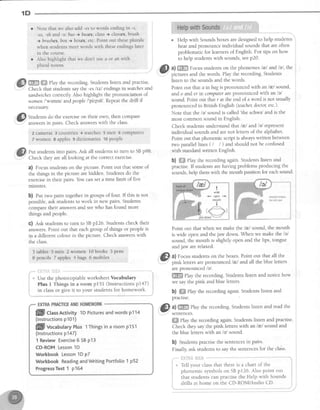
&l m ffi Focus,,,rl"no onthelettersAa-zz-Teachthe
-" alphabet/'relfebet/. Play the recording.Studentslisten and
saythe alphabet.Alternatively model and drill the letters
yourself.
Point out that the lettersin pink are caTledvowelslvauelzl
and the lettersin blue are calledconsonants/'konsenents/.
If the English script is new for your students,point out
that eachletter hasa capital form (A, B, C, etc.) and a
lower-caseform (a,b, c, etc.). For more guidanceon when
we usecapitallettersin English, seeReadingand Writing
Portfolios I and2 on p52-p55 of the Workbook.
Vocabularythealphabet;thingsinyourbag(i); a andan
Rea[World firstnamesandsurnames;classroomlanguage
ReviewWhat'shis/hername?
If you havea monolingual class,highlight any
differencesbetween the English alphabet and the
students'alphabet(extra letters,missingletters,
the lack of accents,how particular lettersare
pronounced,etc.).
Students work in pairs and take turns to say the
letters of the alohabet in order.
What'syourfirstname?
,Cl ul Focusstudentson photo A. Ask who is the teacher
: (Kate) and who is the student (Pedro).Tell the classthat
Pedrois a new student in the class.
Studentsdo the exerciseon their own, then compare
answersrn parrs-
b) ffiffi Play the recording (SBpf 20). Studentslisten and
check their answers.Check answerswith the class.
Highlight the differencebetween/irst nameandsurnamq
and check studentsunderstand the verb spell.Note that
this languageis drilled in 5a).
Usethe recording to teachThanhyou andWelcome(to
the class).
@^l
fiffi rhy the recording (sB pI20)' Studentslisten and
".,,.."".wnte the namesof two more studentsin Kate'sclass.Play
the recording againif necessary
b) Studens compareanswersin pairs.lflZ lsbstudents
to spell the namesand write them on the board.
t MagdaJanowska 2 HasanYousef
t
r *
t
j
it
E
t
i
l *
i _
iI
I
i
eliciting the alphabet from the classand writing it
on the board. Then play ffiffi and ask students to
! practise saying the letters. I
! J
," m Phy the recording (SBp120).Students listen and
i'.Y'' write the lettersin their lower-caseform. There are two
lettersfor eachnumber. PIaythe recording againif
necessaryNote that theseletters havebeenchosenas
they are often confusedby leamersof English.
Studentscheck answersin pairs. Check answerswith
the class.
** HHT',SAX#f,&*^
I
i * Ifyon havea classof falsebeginners,ask them
{ to close their books and write down the English
{ alphabet from memory. lQ dneck the answersby
"* nsTffi&$fffie-
Ask students to
recording again.
their answers.
t.I
i
I
look at Rl.I8, SBpI20. Playthe
Students listen, read and check
1 u v 2 y i 3 g j 4 b v 5 a r 5 e i z b p a t d g u q 1 0 v w
1C
@
tt
@ @_r"-.us
studentson the exampledrill. Play the
recording(SBpl20). Studentslistenand practise.
Highlight the pronunciation offrst name l'fsi's nelm/ and
surname/'ssrnerrn/.Note thatwe dont usuallypronounce
the t infrsf name.Repeatthe drill if necessary
b) Studentsmove around the room and ask threepeople
the questionsin 3a).Studentsshould write the namesin
their notebooksand check that they havespelt them
correctly beforemovrng on to talk to a different student.
If studentscant move around the room, they should talk
to threepeoplesitting near them.
Ask a few studentsto tell the classthe first namesof other
peoplein the class.
i * lf your studentsknow eachother well, give them
i role cardswith new names on before they do 5b).
t**,"--,--
.-"-""""--,-'-
. Help with Vocabularyboxeshelp studentsto explore
and understandhow vocabularyworks, often by
focusing on aspectsof lexical grammar' Studens
should usually do the exerciseson their own or in
pairs beforeyou check the answerswith the class.
For tips on how to teachvocabulary seep19'
i{Sfi Focusstudentson the words in 6a).Tell the classthat
""-'
,n"t" words are callednouns.Point out the pink and
blue letters at the beginning of eachword.
Studentsdo the exerciseon their own. Check the
answerswith the class.
tb) 2c) :a)
o RealWorld boxesaredesignedto help studens with
functional and situational languagethat they can use
in real-life socialsituations,often by teaching
common fixed and semi-fixedphrases.Students
should usually do the exerciseson their own or in
pairs beforeyou check the answerswith the class.
For tips on how to teachspeaking,seep19
ffi
play the recording again.Studentslisten and tick
the sentenceswhen they hear them.
Checkstudentsunderstandthe meaningof the sentdnces
and that they can changethe words in brackes.
We suggestthat you teachthis languageasfixed
phrases,rather than focus on the grammar of these
sentencesat this stageof the course.
Point out that we can sayCanyou repeatthat,please?or
Canyou say that again,please?.
"@ t,.,O"rrts do the exercisein pairs.
il;i;{m,ti{,}Fi"i
Ask students which things in photo B they have
with them. If you havea strong class,teachother
words for things that your students have with
them, for example, glasses,mahe-up,abottle of
w^ter, ef-c.
Thingsinyourbag(1)
G| ^l Focusstudentson photo B. Studens do the exercise
-
on their own or in pairs. Check answerswith the class'
Point out that we cansaya mobileor a mobilephone,
although amobile is more common in spokenEnglish.
Also teachstudentsthat we saya cell or a cellphonein
American English.
Highlight that we can sayan iPod or an MP3 player. N ote
that iPodis a brand name for personalstereosmadeby
Apple@andan MP3 player is usedfor personalstereosin
general.ln practice,however,native speakersoften use
the words interchangeably.
z an apple 3 a dictionary + a book 5 a notebook
e a mobile z an iPod I an umhrella 9 a pencil
10a pen
,.*- t;H?fr*,iilt{ --"-***"
* If your studentsareall completebeginners,
consider teaching this vocabulary yourself by
bringing photos of the things in photo B or the
items themselvesto the class.Teachthe words one
by one, drilling eachword in turn. You can then
use6a)for practice.
b) ffiffi ffi fhy the recording.Studentslisten and
practise.Highlight the pronunciation of dictionary
/'drkJenri/, prncil l'penseVandiPod l'atpodl. Also check
that studentssaythe multi-syllable words with the correct
stress Highlight that dictionaryis threesyllables,not four.
Repeatthe drill if necessary.
We use a with nouns that begin with a consonant
sound.
We use an with nouns thal begin u-ith a vowel
sound
r Yotrcan highlight that we use dh lryith MP3pLayer l
' asthis word starts with a vowel sound /ey'' .
"4
i!&li Studentsdo the exerciseon their own, then compare
answersin pairs. Check answerswith the class.
Point out that we alsousean with'adjective + noun'
(e.g.an Engtishdictionary) if the adjectivebeginswith a
vowel sound.
2 a 3 a n 4 a 5 a n 6 a
Excuseme!
.:ffi
@I Focnr studentson photo C. Point out the teacher(Kate),
Y' Pedro (from photo A), Magdaand Hasan(from the
recording in 4a)).
ffi elay the recording (SBpI20). Studentslisten and do
the exercise.Check answerswith the class.
lG and lD
b) Studentspractisethe conversationsin pairs, taking
turns to be the teacher(Kate). Finally, ask a few pairs to
role-olav the conversationsfor the class.
,* Ask students to turn to Classroom Instructions,
SBp127. Use the pictures to teachthe classroom
instructions.Alternatively,ask studentsto study
this pagefor homework.
EXTRAPRACTICEANDHOMEWORK
ffi Ct"sActivity 1CReatnamesp113
(lnstructionsp1O0)
1 ReviewExercise5 SBp13
CD-ROMLesson1C
WorkbookLesson1Cp6
a) Give studentsone minute to memoriseall the things in
the photo
Ask studentsto closetheir books.Studentswork on their own
andwrite all the thingsin the picture theycanremember
b) Studentscomparetheir answersin pairs and check their
partner'sspelling.
Studentscan then open their books and check if they have
rememberedall the things in the picture. Find out which
student in the classrememberedthe most words.
@ m.m F^ocusstudentson the sentencesin 11.Play the
again,pausingafter eachsentencefor studentsto repeat
individually
@'
ul Studentsdo the exerciseon their own, then compare
.-I- answersin oairs. Check answerswith the class.
2 mean 3 understand -4 repeat 5 sorry
6 k n o w z W h a rs s s p e l l
People and things
QUICKREVIEWrrr
Thisactivityreviewsthealphabet.Studentsworkontheir
ownandwritefourEngtishwordstheyknow.Students
thencompletetheactivityin pairs.
&t l)
Focusstudents on the photo of Kat" (*:':*::
P- @ ro.,r, srudenrson rhe pictures and the tabre.Use the-
lessonI C). Srudentsdo the exerciseon their own or in q , , .. , , .,
pairs.Checkanswerswith the class.Alternatively'ask
plcturesto teacnsffigutaranaptural')tuoen6 oo tne
studentsto checkit'r.,,"unr*.rrl;-ffi SBpI00.
exerciseon their own by referringto the otherwords in
rryoursrudentsspeakalanguagethatdoesn'thave
'::#:;"?^H::t:X",Lffi
[",f'f,:
jj:X thetable
@
at Focusstudentson the picture. Studentsdo the exercise
: on their own or in pairs. Check answerswith the class.
b) a man c) a woman d) a boy e) a girl,
b) ffi ffi ehy therecording.Studentslistenand
practise.Highlightthepronunciationof womanl'wamenl
Alternatively,modelthewordsyourselfandaskstudents
to repeatchorallyandindividually
articles,highlight the useof a with the singularnouns
in la) and2a)
1 a chair 2 awatch 3 a cornputer 4a diary
5 a sand$/ich g a table Fa camera
b) ffi ffi rhy the recording.Studentslisten and
practise.Highlight the pronunciation of diary l'datertJ,
chair ltI eel andsandwich/'senwldg/.
c) Studentsdo the activity in pairs. Check answerswith
the class.
abag, a pen, a booklbooks, an apple,a pencil,
a mobile (phone), a dictionary,an iPod
r Answers things,boys,sandwiches,babies.
l$f,tirrtthe answersfrom studentsand write
them in the tableon theboard.Usethe tableto
highlight the following rules.
r We usuallymakenounsplural by adding-s:chairs,
tables,things,boys,etc.
e If a noun endsin -ch,we add-es:watches,
sandwiches,etc
r If a noun endsin consonant+ y, we change-y to
-tes:diaries,bnbies,etc.Pointout that if a noun ends
in vowel+ y, we simply add-s (boy+ boys,etc.).
o A lew common nouns haveirregular plurals: nreit,
women,people,etc"
Vocabularypeople;things;plurals
Reviewthealphabet
dil Studentsdo theexerciseon theirown,thencompare-
: answersin pairs.Checkanswerswith theclass.
2 cameras 3 countries 4 watches
7 women 8 apples 9 dictionaries
Put studentsinto pairs Ask all studentsto turn to SBp98
Check they areall looking at the correct exercise.
a) Focusstudentson the picture. Point out that someof
the things in the picture arehidden. Studens do the
exercisein their pairs.You canset a time limit of five
minutes.
b) eut two pairs togetherin groups of four. If this is not
possible,ask studens to work in new pairs Students
comparetheir answersand seewho hasfound more
things and people.
C) Ask studentsto turn to SBp126. Studentscheck their
answers.Point out that eachgroup of things or peopleis
in a different colour in the picture. Check answerswith
the class.
3 tables 5 men 2 wornen IO books 3 pens
Epencils Tapples 4bags 6mobiles
f:.El'ii*iliF,A
Usethe photocopiableworksheetVocabulary
Plus I Things in a room p15I (lnstructions pl47)
in classor give it to your studentsfor homework.
o
HelpwithSounds
1D
ffiffi ffi Play the recording.Studentslisten and practise.
Check that studentssaythe -esltzl endingsin watchesand
sandwichescorrectly Also highlight the pronunciation of
women/'wrmrn/ andpeoplel'pitpeU.Repeatthe drill if
necessary
Help with Soundsboxesaredesignedto help students
hear and pronounce individual sounds that are often
problematic for learnersof English. For tips on how i
to help studentswith sounds,seep20.
@ ul ffi Focus stud.entson the phonerneslal andlel, the
v'' pictures and the words. Play the recording.Students
iisten to the soundsand the words.
Point out that d in bagis pronouncedwith an /r/ sound, ,
and o and er in computerarepronounced with an /e/ :
sound.Point out thatr at the end of a word is not usually :
pronouncedin British English (teacherdoctor,etc.)'
Note that the /e/ soundis called'theschwa'andis the
most common sound in English.
Check studentsunderstand thatlnl andlel represent :
individual soundsand arenot letters of the alphabet' :
Point out that phonemic script is alwayswritten between :
two parallel lines ( / I ) andshould not be confused I
with standardwritten English.
b) ffiffiPlay the recording again.Studens listen and
practise.If studentsarehaving problems producing the
sounds,help them with the mouth position for eachsound. '
Point out that when we make thelnl sound, the mouth
is wide open and thejaw down. When we make the /e/
sound, the mouth is slightly open and the lips, tongue
andjaw arerelaxed.
ffl a) Focusstudentson the boxes.Point out that all the
a-l pink letters arepronounced lnl andall the blue letters
arepronounced /e/.
ffi elay the recording.Studentslisten and notice how i
we saythe pink and blue letters. l
b) WffiPlay the recording again.Studentslisten and .
practrse.
@
al ffi llay therecording.Studentslistenandreadthe
sentences.
ffi elay the recording again.Studentslisten and practise.
Check they saythe pink letterswith an /eelsound and
the blue letterswith an /e/ sound.
b) Studentspractisethe sentencesin pairs.
Fina ask studentsto saythe sentencesfor the clals.
r*'" ixii'{FiillF:?fiS-"*-**
t
i t* Tell vour classthat there is a chart of the
j phonemic symbolson SBp126. Also point out
j that studentscan practisethe Help with Sounds
j drilts at home on the CD-ROM/Audio CD.
Note that we also add -es to words ending in -.s,
-ss,-sh and -x: bus ) buses,class+ clqsses,brush
+ brushes,box ) boxes, etc Point out [hese plurals
when students meet words with these endings later
in the course.
Also highlight that we don't use a or an with
plural nouns.
5 men 6 compu[ers
10people
l i
Pppe!-$:'-.'4,,s$ r
, t
# i
i
relaxedtonque, i
rrpsand Jaw I
I
j
1
1
1
flflll cUssActivity1DPicturesandwordsp114
(lnstructionsp101)
flflll vocaUularyPlusl Thingsinaroomp151
(lnstructionsp147)
1 ReviewExercise6 SBp13
CD-ROMLesson1D
WorkbookLesson1DpZ
WorkbookReadingandWritingPortfolio1 p52
ProgressTest1 p164
Fleadlng and
Wrlting Fortfolis
o There is a 20-pageReadingand Writing Portfolio in the
StarterWorkbook. This sectioncontains l0 double-page
stand-alonelessons,one for eachunit of the Student's
Book, which are designedfor studentsto do in classor at
home. The topics and content of theselessonsarebased
closelyon the CEF readingand writing competencesfor
level Al. At the end of this sectionthereis a list of 'cando'
statementsthat allows studentsto track their progress.
o Reading and Writing Portfolio I (Workbook p52) canbe
usedafteryou havecompletedunit I of the Student'sBook
TipsforusingtheReadinEandWritingPorffoliainclass
o Use the photos and illustrations to establishcharacters
and context in eachlesson.
o Go through the examplesin eachexercisewith the class
to check that studentsunderstandwhat to do.
o Ask studentsto compareanswersin pairs or groupsbefore
checking answerswith the class.The answersarein the
Answer Key in the middle of the Workbook (pilviii).
o Go through the Help with Writing sectionswith the class
and usethe examplesto highlight the relevantpoints
Note that all the examplesin the Help with Writing
sectionscome from the presentationtexts.
Reading and Writing Portfolio and 1 Review
If you havea monolingualclass,considercomparingthe rules
for writing in Englishwith thoseof the studens' Ianguage.
The final activityof eachlessonasksthe studentsto do some
personalisedwriting, usingwhat theyhavelearnedfrom the
lesson.Theseactivitiesareprecededby apreparationstage,
in which studentsareaskedto decidewhat they aregoingto
wdte by filling in a table,making notes,etc
Ask studentsto do the final writing activity on separate
piecesofpaper and collect them in at the end of the class.
If you set the final writing activity for homework, collect
the students'work at the beginning of the next class.
When marking students'work, make sureyou comment on
examplesof correctEnglish, aswell ashighlighting errors.
Rememberto praisesuccessfulcommunication and
interestingideasaswell ascorrectlanguage.
Consider askingstudentsto write a seconddraft of their
work, incorporating your correctionsand suggestions.
Thesecanbe put up around the classroomfor other
studentsto read.
Rememberthat writing in a new languageis a difficult skill
to acquire,particularly if the studens' first languageis very
different from English.At Starterlevel, it is important to
encourageand praisestudentsso that they view writing as
a valuableand interestingpart of the learning process.
At the end of eachlesson,ask studentsto tick the things
they can do in the Reading and Writing Progress Portfolio
(Workbookp72).
The Reviewsectionreviewsthe key languagetaught in the
unit. It includes coinmunicative and personalised
speakingstagesaswell ascontrolled grammar,vocabulary
and writing practice.
o This sectionis designedto be usedin classafter students
have finished lessonD. Individual exercisescan alsobe
usedas
'fillers' if you havea few minutes left at the end of
a lesson The EXTRAPRACTICEANDH0MEW0RKboxeslist which
exercisesarerelevantto eachlesson.
r The icons refer to the relevantsectionsin the Language
Summaryfor eachunit. Studentscan refer to theseif they
needhelp when doing the exercises.
o For tips on reviewing and recycling,seep20.
l a ) z y o u r 3 m y 4 y o u 5 Y o u6 y o u 7 I S y o u 9 l
2 5 five 4 four 6 six 2 iwo 1 one 7 seven 12 twelve
9 nine 3 three 8 eight lI eleven
3 ZRussia3Mexico 4Germany sChina oBrazil zTurkey
a Spain
4a) zHis 3he 4He 6Her TsheSShe
5 zanapple3adictionary4anumbrella5amobile
6 a notebook t apencil I an iPod 9 a pen 10a book
6a) + man, sandwich,girl, computer,table,rroman
I diary,baby,chair,camera
r ProgressPortfolio boxesencouragestudentsto
reflect on what they havelearnedand help them
decidewhich areasthey needto study again.
o Note that the I can...statementsreflect
communicative competencesasset out in the
CommonEuropeanFrameworh of ReferenceJor
Langtages(CEF) for level A1. For more information
on the CEII seep13-p17.
?) Studentswork through the list of I can...statements
on their own and tick the things they feel they can do.
They can refer to LanguageSummary f SBp100-p10l
if they wish.
Studentscan alsowork in pairs or groupsand compare
which statementsthey have ticked.
b) Studentswork on their own or in pairs/groupsand
decidewhich areasthey needto study again Encourage
studentsto usethe CD-ROM/Audio CD lessonslA-D
to help them improve in theseareas.For photocopiable
instructions for the CD-ROlWAudio CD, seep10-p12.
There is alsofurther practice on all key languagetaught
in the Student'sBook in the lace2laseSarter Workbook.
P Al! about y*rt"l
Student's Book p14-P21
She's British
QUICKREVIEWcrr
Thisactivityreviewsplurals.Studentsworkontheirown
andwritefivesingularwords.Putstudentsintopairs'
StudentscompletetheactivitywiththeirPartner'
ffimtimsem*frt&ms
a) est studentswhich lettersin the alphabetarevowels
(a, e,i, o, u).
Studentsdo the exerciseon their own, then compare
answersin pairs. Check answerswith the class.
ZBrazlI 3 Russia + the USA 5 GermanY,
6 Eglpt z Australia s Mexico e Turkey
totheUK tt Spaintz China
*
b) Pre-teachnationality and elicit the plural form
(nationalities).Studentsdo the activity on their own or
ln parrs.
lZ Checkanswerswith the classby writing the countries
and nationalities on the board.
Highlight that nationalities often end in -n, -an, -ian, -ish
and-ese.
You can alsopoint out that we usually describepeople
from Brazil. Colombia. etc.asSouthAmencan,not
Amencan(which we only useto refer to peoplefrom
the USA).
b)8 c)l d)3 e)4 f)il 9)6 h)Z 010 t9 k)12 U7
dl ul ffi ffi Playtherecording.Studentslistenand
Y'' nractisethe countries and nationalities.Note that students
ihould sayboth words together(Italy,Italian,etc.)'Repeat
the drill if necessary
Point out that the samesyllableis stressedin most
nationalities (Brazil, Brazilfan, etc.).
Highlight the different stresspatterns initaly s ltdlian,
fupt ) Egj,ptianandChfna ) Chindse.
b) Studens do the exercisein pairs, asshown in the
speechbubbles.
Cl gWritel'mt'rom + country andl'm + nationalityon
the board. Elicit examplesfor eachstructure (I'mJrom
Italy. I'm ltalian, etc.).
Focusstudentson the speechbubblesand teachthe
nationalitiesJapqnese,FrenchandColombian Model and
drill thesewords with the class,highlighting the different
stresspattern inJapdn + Japantse.
Ask studentsto tell the classtheir nationalities.
Vocabularynationalities
Grammarbe (singutar):positiveandnegative
Reviewplurals;countries;my,your,his,her
lQlf you havestudentswho have different nationalities
from those akeadytaught in the lesson,write them on
the board and drill the words with the class.
il]i"i"ititti!ililt
lf you have a monolingual class,teachthe English i
words for the countries that border the students' l
own country and any other countries that are of i
particular importanceto them. Also teach :
,t rd"rrt, the iorresponding nationalities. i
Use Yocabulary Plus 2 Countries and i
nationalities p152 (Instructions pl47) in class ;
or give it to your studentsfor lomework. i
Aroundthsworld
a) Pre-teacha car. Focttsstudentson photos A-D.
Studensdo theexercisein Pairs.
b) ffi Play the recording. Studentslisten and check
their answers.Check answerswith the class.
A British BChinese CBrazilian DAmerican
Pre-teachpositive.Tell the classthat all positive verb
forms in the Student'sBook aremarked with a (+) sign.
Studentsdo the exerciseon their own, then compare
answersin pairs. Check answerswith the class.
Note that the verb beis particularly problematic for
studentswhoselanguagesdon't have an equivalentverb
If possible,check if your studems'language(s)have the
verbbe,asthis will help you understandwhy students
might be making mistakes.
l #
a
a
Answers 1'm 3s 4's 5's
Check students understand the subject pronouns I,
you, he,sheand it Point out that we use it for things
Point out that'm,'re and 3 are parts of the verb be.
Check students understand which part of be goes.
with each subject Pronoun.
Highlight that'm,
're
and  are the contracted forms
of am, are and is. Point out that contractions are
very common in spoken and written English. Tel
sfudents to use contracted forrns when speaking and
wriring, particularly after I, you, he, she and it
2A
1{&Wffi Focus studentson the example.Play the
r.Y'' recording (SBp120). Studentslisten and practisethe
sentencesin 4. Check that studentspronounce the
contractionscorrectly Repeatthe drill if necessary.
|@a)
Studentsdo the exerciseon their own
b) Studentsdo the exercisein pairs. Check answerswith
the class.Ask studentsto give reasonsfor their answers.
1's,photoC z'm,'m, photoA 3's,photoD
4's.photoA s's,photoB 5'm, photoD
"'Ql. Pre-teachnegative.Tell the classthat all negativeverb
'
i' forms in the Student'sBook aremarked with a (-) sign
Studentsdo the exerciseon their own, then compare
answersin pairs. Check answerswith the class.
,*. ; I"ril;" i: ::: ......
1
* Ask studentsto turn to LanguageSummary2,
SBp102-p103.Point out the vocabularysection
ffi and the grammar sections ffffi and ffi
from lesson24. Give studens a few moments to
read the sections.Remind studentsthat all the
new languagefrom eachlessonis included in the
LanguageSummaries. i;^^^-,^^-"*-.*n'
@ m ffi Focusstudentson the exampledrill. Play the
-
recording (SBpI20). Studentslisten and practisethe
sentencesin 7. Check that studentspronounce the
contracuonscorrectly Repeatthe drill ifnecessary
Trueorfalse?
Gl, al Pre-teachthe vocabularyin the box, using examples
1"F' that studentsarelikely to know. Point out that we usually
saythecapital, nol thecapitalcity (Londonis thecapitalof
theUK., etc.).
Note that the aim of theseboxesis to highlight which
words you needto pre-teachto help studentsunderstand
the exerciseor text that follows. The vocabularyin these
boxesis not included in the l-anguageSummariesin the
Student'sBook.
b) Focusstudentson photos I and2, and the
correspondingexamples.Use theseto teachstudentstrue,
false and rick Drill thesewords with the class.Also point
out that we usethe pronoun He in the correctsentencein
question 2, rather than repeatingTiger Woods
Studentsdo the exercisein parrs
c) Studentscheck their answersin the Answer Key on
SBp126. Check answersby askingstudentsto answerone
question eacharound the class.Ask if any studentsgot all
the answerscorrect.
3 CameronDiaz isn't Spanish.ShebAmerican.
+ /
5 , /
5 Big Ben isnt in New York. It's in London.
7 Kylie Minogue isnt American. She'sAustralian.
e Robbie Williams isnt an Australian sinser. He's a
British singer.
s./
to Holllwood isn't in San Francisco. It's in Los
Angeles.
Focus studentson the examples.Ask studens if they
think the sentencesare tnre or false.The first sentence
is true (JK Rowling is British). The secondsentenceis
false(Lacosteis a French company).
Put studentsinto new pairs.Studenswork with their
partnerandwrite threetrue sentencesand threefalse
sentences.Ifnecessarydirectstudentsto 9b)for examples
of the typesof sentencethey canwdte. While they are
working, monitor and checktheir sentencesfor accuracy
a) Use the speechbubbles to teachI thinh that ... as
a way to give your opinion, and the answersYes,you're
nght. andNo, you'rewrong.Drill thesesentenceswith
the class.
Put rwo pairs togetherso that they areworking in
groups of four. Studentstake turns to readtheir
sentencesto the other pair, who must guessif the
sentencesaretme or false.Tell studentsto keep a record
of how many sentencesthey guesscorrectly While they
areworking, monitor and correct any grammar or
pronunciation mistakesyou hear.
b) finally ask eachpair to tell the classtwo of their
true sentences.
EXTRAPRACTICEANDHOMEWORK
ffill vocabutaryPlus2 Countriesandnationalitiesp152
(lnstructionsp147)
2 ReviewExercises1 and2 SBp21
CD-ROMLesson2A
WorkbookLesson2Ap8
r Answers 1
'rn
not 3 isn't 4 isn't 5 isnt
r Point out that we use not to make a verb form
neSatrve
r Also highlight that aren't is the contracted form of
are not and isnt is the contracted form of is not.
Remind students to use contracted forms when
speaking and r.witing
. 'lg
Tell students that we can also sayyou're not,
he'snot, she not and it3 not, aradwrite these forms
on the board for students to copy,
o Point out that 4'ecan't say I-a+#+.
....
::l':'...i':'..-..,
*,28;;riWhat's your iob?'j.,'i
...
"...,:::iij"
QUICKREVIEWror
Thisactivityreviewscountriesandnationalities.Students
dotheactivityin pairs,asintheexample.Remindstudents
that theycancheckcountriesandnationalitiesinifljjii:iii
SBp102.Askeachpairto te[[theclasstwo peopleor
thingstheytatkedabout.
#mhm
a) Pre-teachajob.Focus studentson picturesa)-i).
Studentsdo the exerciseon their own or in pairs. Early
finishers can check their answersi" ffiffi SBpr02. Check
answerswith the class.
Point out that we sayan actor/awaiterlor men and cn
actress/awaitressfor women (although nowadaysan actor
is often used for both men and women). All the other
words canbe usedfor both men and women. You can also
teachstudens a poltcemananda'policewoman.
Also highlight that we alwaysuse4 or anwith jobs:He a
doctor notl+eAeeter. This is particularly important if
your studentsdon't havearticlesin their language(s).
Draw students'attention to the TEP!in 1a)and point out
that only the main stressis shown in the vocabulary
boxesand LanguageSummaries.We feel this is the
simplestand most effectiveway to make surestudentsput
the main stressin the correctplace.For example,the
main stressin tfrxi driver is on the first syllable of tai, not
on the first syllableof driver (which is alsostressed).
a)a shop assistantb)an actodanactressc)a teacher
dI e taxi driver e)a doctor f) a musician
g) a police officer h) a manager i) a waiter/a waitress
b) ffi ffi fhy the recording.Studens listen and
practise.Alternatively,model eachsentenceyourself and
ask studentsto repeatchorally and individually Highlight
the pronunci ation of managerI'ma,ntd3elandmusician
/mjur'zrJen/. Also highlightthe lel sound at the end of
most of thejobs, for example,doctorl'drktel , actor
l'a,ktel, shopassistant/'Jop e,srstent/,etc.
c) Use the speechbubbles to teachWhathis job? and
Whather job?. Drill the questionsand answerswith the
class.Teachand drill the question Mhatyour job?.
Note that Whatdoyou do?is alsoa common question
when asking aboutjobs. However,we feel at this stageof
the courseit is important to keep languageassimple as
possible.We suggestthat you wait until studentslearn the
PresentSimple (in unit 4 of the Student'sBook) before
teachingthis question.
Put studentsinto pairs. Studentstake turns to point to
pictures a)-i) and ask questionsabout the people.Remind
studentsof the phraseI don'thnow beforethey begin.
Vocabularyjobs
Grammarbe(singular):questionsandshortanswers
Reviewcountriesandnationalities;be(singutar):positive
andnegative
.-"*i:lirE,,11i]fril**--**
r,i If your studentsareall completebeginners,you
may chooseto presentthe vocabularyyourself
first. Prepareflashcardsfor the jobs and hold them
up in front of the classasyou teachthe words'
1a)can then be used ascontrolled practice.
* lg If you have a strong class,teach the English
words for students'jobs and write them on the
board. You can also teachI'm ahousewiJe/
househusband,I'm unemployedandl'm retired
lrltatedl . Check students remember What yout
job?. Studentsthen move around the room and ask
eachother what their iobs are.
Fhotosoffriends
,&l a) Pre-teachthe vocabularyin the box' Drill the words
' --:
*i4r the class.Point out thatmarned, singleandbeautiiul
areall adjectivesand areusedwith the verb be(Im
married He single.Itbeautiful., etc.).
b) ffi Focus studentson the photo of Amy and Ben on
SBp17 and point out photos 1-4 of Amy's friends on the
computer screen.Play the recording (SBp120). Students
listen and match the namesin the box to photos l-4.
Check answerswith the class.
1Karl 3 Steve 3 Claire 4 Daniela
C) elay the recording again.Studentslisten and complete
the table.Check answerswith the class.
Steve Claire Daniela
Itaty
a doctor a muslclan a teacner an afiress
country
Kar[
,'6-" {:il i *.J"1 ltiii:f,i
--""^"
I * Ask studentsto
i recordingagain.
i theiranswers.
look at R2.6,SBpI20. Playthe
Studentslisten, readand check
*"ri"i'Hel*il*
i#) Pre-teach a questionPoint out that all questionforms in
, V ]
t.---..'
the Student's Book are marked with a question mark (?).
Students do the exercise on their own, then compare
answers in pairs. Check answers with the class.
28
@
^l
W,ffi
Play the recording.Studentslisten and
-
practisethe questionsin 3.
Check studentspronounce the contractionsWherel and
What correctly Point out that areis usually pronounced
/e/ in questions,for example, Wherearelel youfrom?.
Repeatthe drill if necessarypausing the recording after
eachquestionfor studens to repeatindividually
b) est studentsto cover the tablein 2c)' Focusstudents
on the speechbubblesand drill the questionswith the
class.Studentsdo the exercisein pairs.
lsheamusician?
i.."@
t) Srudens do the exerciseon their own'
za) sb) +a) 5 Students?,answers 6 Siudents' answers
b) students compareanswersin pairs. Check answers
with the class.
, @ @.W
Play the recording.Studentslisten and practise'
': Check that studentspronounce the contractionscorrectly
Play the recording againif necessarypausing after each
question or short answerfor studentsto repeat
individuaI11l
a) Studentsdo the exerciseon their own. Check answers
with the class.
2 I s 3 A r e 4 A r e s l s 6 A r e 7 l s 8 I s
b) Studentsdo the exercisein pairs. Remind studentsto
usethe correctshort answers.
Put studentsinto new pairs, student A and student B.
StudentAs tum to SBp87 and student Bs turn to SB
p93. Check they areall looking at the correct exercise'
a) Focus studentson the six photos. Tell the classthat
the peopleareall friendsof Ben (the man in the photo
on SBp17).
Studens work on their own andwriteyes/no questions
to check the information in blue, asin the example.
Studentsarenot allowed to look at eachother'sbooks at
any stageof the activity.While they areworking,
monitor and check their questionsfor accurac;z
,""-"figi+tAiiiiile**"-^*** """'i
+ Ask students to check their yeslno questions
with another student from the samegroup
{ before they work with their partner in b).
,l
b) Check studentsunderstand that someof the
information in blue is correct and someis incorrect.
Studentswork with their partners.StudentA in each
pair askshis/her questionsfrom a) and either ticks the
correctinformation or changesthe incorrect information
for eachperson Encouragestudent Bsto use the correct
short answersduring the activity While they are
working, monitor and check studentsaredoing the
activity correctly.
C) Studentsswaproles and student B in eachpair asks
his/her questionsfrom a).
d) fut studentsin pairs with another student of the
samegroup. Studentscompareanswersby saying
sentencesabout the people,asin the example.
Finally askstudentsto tell the classabout eachperson
rn tum.
r lrnswers 2 are 3's 4 's 5
's 6
's
7
's
o Highlight the word order in questions with be:
question word + amfcrre/l+ person or thing + ..-
o Remind students that we use Where to ask about
a place and What to ask about a thing.
o Point out that
'/here
=Wrcre is and What's =
'
What is Encourage students to use contracted
lorms when speaking and writing.
r Point out that we don't contract dm or are in
questions: Wheream I? nott#hedmP,Where are
y ouf rom? not l4e+d+eao*J+et#, etc.
o Establish that we can also make questions with
How'. How ere you?, etc.
ll&li Studentsdo the exerciseon their own, then compare
V:''
.I'" answersin nairs. Check answerswith the class.
Answerss"e,iihfl#SBp103.
Highlight the inverted word order in yes/no
questionswith be:Am L.. ?,Are you ... ?,Is he ... ?,
etc
Point out that we don't usually answer these
questions with just Yes.or No., as this can sound
impolite.
Note that we don't use contractions in positive
short answers'.Yes,you Qre.noLwe ,
Yes,I am. not Yes;lm, Yes,he is. not ks,_#eb , etc.
Point out that we can also say No, you're not.,
No. he3 not., No, she not. and No, itb not.
Also highlight that we don't usually use the
uncontracted form in negative short answers:
No, you aren't. notNo;1e**re'nat., etc.
a
a
ffi CtassActivity28 Newidentitiesp115
(lnstructionsp101)
2 ReviewExercises3,4 and5 SBP21
CD-ROMLesson28
Workbook Lesson28 p9
EXTRAPRACTICEANDHOMEWORK
Personal information
Goodmorning!
. !,f,a) Check studentsremembermarried and single.Point
-7.
.l1 out thatBrown, KingandRoberts arecommon surnamesin
the UK.
Studentsdo the exerciseon their own. Check answers
with the class.Point out that Ms canbe used for married
and singlewomen.
, lc) ?a) sb)
b) ffi ffi Focusstudentson the example.Play the
recording (SBp120). Studentslisten and practise.
Highlight the pronunciation of Mr I'mrste/,Mrs l'mtstzl
and Ms lmezl. Repeatthe drill if necessary
O "l
Focusstudentson picturesA-D. Ask studentswho the
--
man is in all tour pictures(Mr Brown).
Studentsdo the exerciseon their own or in pairs.
frHTffi&g#il.i1
If you have a classof completebeginners,teach
the words morning, afternoon,etening and night
before doing 2a).
b) ffi Play the recording (SBp121). Studentslisten and
check their answers.Check answerswith the class.
Point out that Goodmorning,Goodafternoonand Good
eveningmeanHelloand that GoodnightmeansGoodbye.
Highlight that Goodmorning,Goodnight, etc.aremore
formal thanHelloftIi arrdGoodbyeBye.Also point out
that we respondto Goodmorning,etc.by repeatingthe
samephrase.
Usepicture C to teach sir lss:,/(a polite way to addressa
man you don't know) and the femaleequivalent,madam
I'me,denrl.UsepictureD to teachThanhyoutery much.
ffi fhy the recording again,pausrngafter eachsentence
or phrasefor studentsto repeatchorally and individually
Check that studentssound polite and interested.
A Goodmorning BGoodafternoon(x 2)
c Goodevening(x 2) D Goodnight (x 2)
G) Studentspractisethe conversationsin pairs.Ask a few
pairs to role-play their conversationsfor the class.
Vocabularytitles;greetings
RealWorldemaiIaddresses;personalinformation
questions
Reviewjobs;be (singutar):questions
Focusstudentson the email addressand the speech
bubble. Point out that we saydot ( . ) and at (@) in email
addresses.
,"|f,}, al Focusstudentson the businesscard,mobile phone
IU
.": and email. Studentswork in pairs and try to sayemail
addressesl-4.
b) ffi Play the recording.Studentscheck their answers.
,'&,al ffiW ffi Focusstudentson the exampledrill. Play the
"- recording(SBpl21). Studenslistenandpractise.Check
they say@,.com,.net and .co.uhcorcectly.Repeatthe drill
if necessary
b) Focusstudentson the speechbubbles.Drill the
question What your emarladdress?.
Ask studens to write down their email addressesand give
them time to work out how to saythem in English. If
necessaryteachstudentsthat we alsosay hyphen( - ),
underscore( - ) and capitala, capitalb, etc.(A, B, etc.) in
email addresses.AIso check studentsknow how to say
the part of their email addressthat indicatestheir country
(.uh,.es,ja, etc.).
Studentsmove around the room and ask threepeoplefor
their email addresses.Alternatively,they can ask three
peoplesitting near them. Studentswrite eachperson's
email address,then check that they havewritten it
correctly
gH?ffi&t##A
In some classesit may not be appropriate for
students to give each other their real email
addresses.If this is the casein your class,write
fictitious email addresseson cards and give them
to your students before doing 5b).
l.i
It.-
Lookingforajob
,GI a) Focusstudentson the photo of Tony and Amy (from
".1" lesson2B). Pre-teachemploymartegency(a company that
helpspeoplefind jobs). TelI the classthat Tony works for
an employ-rnentagencycallednine2five and that Amy is
looking for ajob. Give studentstime to readthe form.
ffi elay the recording (SBp12l). Studentslisten to the
interview and complete the form. Play the recording again
if necessary
2C and 2D
b) Studentscompareanswersin pairs. Check answers
with the class.
Highlight Mll 6JZin Amy'saddressand teachapostcode
(US:a zip code).
surname :Foley married/single singlg nationahty
British address9 whedon (Road) (Manchester)Ml1
6JZ mobile number 07866 642339 email address
amvfolel@hotmail. co.uk
'c,Ask studentsto look at R2.13,SBp121. Play the !
recordingagain.Studentslisten, readand :
underline all the personal information questions.
.i
trffi ffi Play the recording (SBp121). Studentslisten
and practise.Establishthat intonation is very important
in English and the correctintonation pattern can help
studentsto sound polite.
Play the recording again Studentslisten and practise,
copyrngthe polite intonation pattern. Drill the language
with individual studentsif necessary.
@
ut Put studentsinto pairs. If possible,ask studentsto
..- work with someonethey don't know very well.
Studens take turns to interview their partner and fill in
the form. Remind studentsto usethe questionsin 7 when
they are the interviewer,and to begin eachconversation
wilh Goodmoming.Welcometo thenine2fiteEmployment
Ag ry.My name... . Niceto meetyou. etc.
Also remind studentsof the questionsHow doyou spell
that? andCanyou repeatthat,pleaseTbeforethey begin.
.".*"tiili,I#rl'Bfiliiie .^-^**
i ,
] * If your studentsknow eachother well, or if you i
' :::*:1:,*"J1:::;::T,"**1'Jffi';1T;":o*"
Answers 2s 3Ar e 4' s 5' s 6' s 7' s
Point out that we use Are in question 3 becauseits
a yeslno question with you. All the other questions
are What your .. ? followed by a noun
Remind students of the questionWhat your hame
number? You can also teach S/hat3your worknltmber?
if you think this will be useful for your students
a
a
uuWhen students have finished 9a),put them into
new pairs. Students ask questions with he/his
and shelherabout the person his/her partner has
j ust interviewed. Alternatively, Class Activity
1 2C The nine2five Employment Agency pl16
i can also be used to practise he/his and shelher
j questions(seeProcedureB, Instructions p102).
feel it is inappropriate for your students to give
eachother their personaldetails,use Class
Activity 2C The nine2five Employment Agency
pl16 insteadof doing 9a)(seeProcedureA,
lnstructionspI01).
b) Studens work in their pairs and check that all the
information on their partner'sform is correct.
Finally you can ask one or two pairs to role-play their
conversationsfor the class.
EXTRAPRACTICEANDHOMEWORK
Vocabulary numbers13-100
RealWorld Howold ... ?
Help with Listening numberswith -feen and-ty
Review numbers0-12
40 forry 50 fifty 60 sixty 70 seventy
80 eighty 90 ninety 100a hundred
il qRemind studentsof word stressby writing some
multi-syllable words on the board and asking the class
which syllableis stressed.
ffiffi ffiffiPlay the recording.Studentslisten and practise.
Highlight the pronunciation of thirty l'9s'^ttlandforty
I'fcttt/.
I
I
Il
How old is she?
,,.$} ffi ffi elay the recording.Studens listen and practise
I Y" the numbers. Note that stressis dealt with in 3a)-c).
Point out the irregular spelling of.thirteenandJifteen.
@
q, Studentsdo the exerciseon their own or in pairs.
Point out that we can also sayonehundred,but that
ahundredis more common.
ffill CtassActivity 2CThenine2fiveEmployment
Agencyp116(lnstructionsp101)
2 Review Exercise6 SBp21
CD-ROM Lesson2C
Workbook Lesson2C p11
2D
o This Help with Listening sectionhelps studentsto
hear the differencebetweennumbers that end in
-teenand thosethat end in -ty.
a) ffi Play the recording.Studentslisten and notice
the stresson the numbers. Point out that we usually
stressthe -teensyllablein numbers 13-19 and the first
syllablein numbers 20-100.
We appreciatethat this stressrule for numbers ending
in -teenis somewhatsimplistic, asthereare timeswhen
we naturally stressthe first syllable (for example,when
counting or when the number is followed by a noun).
However,we feelthat at this level it is more helpful to
give studentsa clearrule that will avoid confusion and
be correctmost of the time (for example,when talking
about ageslater in the lesson).
b) Studentsdo the exerciseon their own before
checking answersin pairs.
c) ffi Play the recording.Studens listen and check
their answers.
lQIf necessaryvtite the numbers on the board and
ask studentswhich syllableis stressedin eachnumber.
s€vent&n oTo*ty dfty tltind*n
thirty ninetfen s€ventlr rfiftden
ffiffiffiffi ehyboth recordingsagain.Students
listen and practise.Alternatively,model the numbers
yourself in order and ask studentsto repeatchorally and
individually Check that studentsstressthe numbers
correctly
Note that the th sound /0/ (asin thirty, thirteen,etc.) is
dealtwith in the Help with Soundssectionat the end of
unit 4.
@
tt Focus,studentson the examples.Point out that we
usea hyphen ( - ) in thesenumbers.
Studentsdo the exerciseon their own, then compare
answersrn palrs.
lQ Check the answersby writing the numbers
(23, etc.) on the board and askingstudentshow to write
the words (twenty-three,etc.).
Point out that we usually stressthe final syllablein
compound numbers (twenty-ne, twenty-tw6, etc.).
Write a few numbersbetween3l and 99 on the board
and ask studentshow we saythem.
23 twenty*three 2.4twenty:four 25 twenty-ftve
26 twenty-six 27 twenly,ssven 28 twenty-eight
: 29 twenty-nine
b) Studentswork in pairs and take turns to saythe
numbers.
Check students'pronunciation by going round the class
and asking them to sayone number each.
til a) Studentswork on their own and write four numbers.
v.
b) Studentsdo the exercisein new pairs.
f*- {;glfi& itlir& **--**" "-"""-'-----i
i * Ur" Class Activity 2D Hear a number, say a i
! number p117 (Instructionsp102). I_***.''_-,:*_*_ ,,.,...,.***"*'*.-,''_^"_^^."""."*";'
,'&.l,al Focusstudentson the photo.Ask if studentsrecognise
v :
Tonv (the interviewerfrom lesson2C).
Studens do the exerciseon their own or in pairs. Check
answerswith the class.
Model and drill the vocabularywith the class.
'1ahouse zalat 3aeat 4adog 5agirl
b) ffi Tell studens they are going to listen to five
conversations.Play the recording (SBp121). Students
listen and fill in the gapswith the correctnumbers. Play
the recording againif necessary
students compareanswersin pairs. check answerswith
the class.
Note that in the UK and many other countries,we often
think of one
'human year'asbeing equivalentto seven
'dog years'.
'r'13zIo0 39 42I 57(or49''dogyears')
,'&i} a) Studentsdo the exerciseon their own or in pairs
v:.
Point out that we useHow oldis/are...?to askaboutage
(not Hew-+aayaews-2 or rffia+-age-is/a+'e--J).
Highlight that we usethe verbbe to talk about age,not
hava I'm twurty-srx.nm+@.
Also highlight that we don't usually sayyearsold for
people:Emily! nine.,I'mthirty.,etc.,and we don't say
ln+UeWeers.
Explain that in the UK and other English-speaking
countries,askingpeoplehow old they areis often
consideredimpolite, particularly if you don't know them
very well.
You can alsoteachthe noun age letd3l, but point out that
we don't saYWat-age+re1ea2'
2 is a old 4 at€ 5I'rn
b) ffi ffi Focusstudentson the speechbubblesin 8a).
Play the recording.Studentslisten and practise.
'$| Focusstudentson the photo. Ask them to cover7 and 8.
-
Studentsdo the activityin pairs.
Put studentsinto new pairs.Ask all studentsto tum to
SBp98. Check they areall looking at the correctexercise.
2D and 2 Review
a) Focusstudentson the photo. You can tell the classthat
Chris is the author of faceZfaceStarter.The photo is of his
girlfriend Adela'sfamily and their friends. Note that Maja
is pronounced lmatjel .
Highlight the agesin the boxesand check students
understandthat thesearethe correct agesof the girls,
women, men and dogsin the photo. Usethe speech
bubbles to remind studentsthat we sayI thinh... when
giving our opinion.
Studentsdo the activity in pairs.You canask studentsto
compareanswersin groupsof four.
b) Studentscheck their answerson SBp126. Check
answerswith the classby askingstudentshow old each
personin the photo is.
Finally, find out which pair got the most answerscoffect.
Marn *5 Mary 76 Christopher 70 John 65
Chris 46 Stef43 Martin 38 Adela41 Alex 37
Lola I FreddieI Dagmar72 Maja 6 Lily 3
@ al ffi Focusstudentson the phonemesltl and,litl ,
-
the pictures and the words. Play the recording.Students
listen to the soundsand the words. Point out that i in
six is pronounced with an /r/ sound andeein nineteenis
pronounced with an /ill sound.
b) ffiffiPlay the recording again.Studentslisten and
practise.lf studentsarehaving problems,help them
with the mouth position for eachsound.
Point out that ltl is a short sound and lll is a long sound
(asindicatedby the r s1'rnbol).Also highlight that the
mouth is wide when saying the li'^lsound.You can tell
studentsthat the letter e is alsopronounced /ill.
a) ffi Focusstudentson the boxes.Point out that the
pink vowels arepronounced ltl and the blue vowels are
pronounced lll . Play the recording.Studentslisten and
notice how we saythe pink and blue vowels.
b) ffi Play the recording again.Studentslisten and
practise.
a) Focusstudentson the words in the box. Go through
the exampleswith the class.Studentsdo the exerciseon
their own.
l!/wtrtte studentsareworking, write the words on the
board readyfor checking in 3c).
b) Studentscompareanswersin pairs.Tell studentsto
saythe words to eachother when comparing answers.
C) ffi Play the recording.Studentslisten and check
their answers.
fZ g1r"ry the answersby eliciting the correctsound for
eachof the vowels in bold and writing it on the board
under the vowel, asshown in the Answer Key
ffi fhy the recording again.Studentslisten and practise
the words. Check they pronounce the vowels in bold
correctly
Finally, ask studentsto saythe words for the class.
sandwiches teacher think married isn't read
hl litl ltl ltl lil l|'J
musician assistant me Spanish Japanesesixteen
M lil fi"n lil ft"| litl
@
wrde
mouth
,9)
jaw down (a little)
flflll ctassActivity2DHearanumber,sayanumber
p117 (lnstructionsplOZ)
2 Review Exercise7 SBp21
CD-ROM Lesson2D
Workbook Lesson2D p12
Workbook ReadingandWriting Portfolio2 p54
ProgressTest2 p165
2 Review
Seep29 for ideason how to usethis section.
I Mexican Italian RussianGerman BtaziLianAmerican
Egyptian Spanish Turkish British Chinese
2 2 isn't,'s e'm not, 'm 4 s, isn't 5 arent,
're
3 actor doctor waitress musician manager taxi driver
police officer
4a) z Where areyou from? 3 What'syour joh?
+ Where'she from? 5 What'shis iob? 6 What'sher name?
7What'sherjob?
+b) a)3 b)4 c)6 al5 t)7 gl2
5a) z Are 3you 4 Are,your 5 Is 6 your
6a) z What'syour surname? 3 What'syour nationality?
+ What'syour address?s What'syour mobile number?
6 What'syour email address?
S People and ptaces
Student's Book p22-p29
Two cities
QUICKREVIEW rrr
Thisactivityreviewsnumbers1-100.Studentsdothe
activityin pairs.lf youhavea sma[[class,youcandothe
activitybyaskingstudentsto countinthreesandfours
roundtheclass.
Adjectives{1}
a) Pre-teachadjective.Focusstudentson the pictures and
the example.Teachoppositeand tell studentsthat each
pair of wordsin l-7 areopposites.
Studentsdo the exerciseon their own or in pairs. Early
finishers can check their answersin LanguageSummary3
ffiSffiffiSn p104. Check answerswith the class.
Note that nicers a very generalpositive adjectivethat can
meangood,fnendly, enjoyable,beautijul,delicious,etc. Its
oppositethereforedependson the context.
ae) 3c) +g) s0 sb) 7a) th)
b) ffi ffi ehy the recording.Studentslisten and
practise.Alternatively,model the words yourself and ask
studentsto repeatchora and individualliz Check that
studentscopy the word stresscorrectly Repeatthe drill if
necessary
'r After doing 1b),studentswork in pairs and take
turns to testeachother on the adjectives.One
student saysan adjective,for examplehot, and
his/her partner saysthe opposite, for exarnplecold.
Vocabularyadjectives(1);wordorderwith adjectives;
very
Grammarbe(pturat):positive,negative,questionsand
shortanswers
Helpwith Listeningcontractions
Reviewnumbers;be (singular)
b) Studentsdo the exerciseon their own. Check
answerswith the class.
r Answers 'tb) za)
o Hightight thatwe put verybeforeadjectives:
Itlwryhot.
c Point out thatwe sayIt3 (very)hotlcold.to talk
abouttheweather Highlight It at the beginningof
thesentenceandpoint out thatwe sayItb cold.not
tuM, etc.
@I Studentsdo the exerciseon their own, then compare
T answersin pairs. Check answerswith the class.Highlight
the word order in eachanswer
e He'sa very goodactor.
3 lt's an expensivecamera,
+ Hislriendsareverynice.
5Your dogsarevery friendly.
@
al
?*:u:
the examplesentenceson the boardand
go through the rules with the class,highlighting the
following points
r Adjectivesgo after be'.Yourwatchis nice.rrot
M.
r Adiectivesgo beforenouns: It'sanew car. ftot
It++-e*r-+erv.
r Also highlight that the adjectivecomesafter the
article a, and that we usean when the adjective
beginswith a vowel: It'san old car
r Adjectivesarenot plural with plural nouns.
They'regoodfiends. nor Thq4egeokJAands.
o AIso highlight the word orderin questions:
Areyou cold.?,Is hefnmdly?, etc.
Anemailtofriends
@ ll
Pre-teachthe vocabulary in the box. Model and drill
.: the words and ohraseswith the class.Point out that
rcstqurantlrestiont/ is two syllables,not three.
Also note that although thereis usua an accenton cafe
in English,we stressthe first syllable,not the second.
b) Pre-teachEmailby referring to email A. Point out that
the stressis on the first syllable,not the second.
Studentsreademail A and find out where Sa and Dan
are(in Moscow)
Teachthe new words and.but.hereandnow in the email.
Also highlightthatpeople is alwaysplural in English: the
peopleareJnendly not Wly
You can alsopoint out that we often end emailsto friends
or family withLove and then our name(s).
.iffl Co through the exampleswith the class.Studentsdo the
v
": exerciseon their own beforechecking in pairs. Check
answerswith the class.
311t'bvery cold in Moseow.4 / 5 5a11yand:Eanare
in a nertrhotel o / I The roorns are very big.
3A
@
Stra"ns do,the exerciseon their own or in pairs. Check
answerswith the class.
r Answers Meorein a new hotel. They're very big.
We aren't in the horel now. They aren't very
exnensive.
Point out that &reis the plural form of be (aswell
asthe singularToulorm).
Checkstudentsunderstandwe andrhey.Pointout
that we asethel for peopleand things.
TeIlstudentsthatloa is singular and plural: You're
d,student.You'restudents.Also remind students
that thereis no polite form of you in English.
Highlight that we're,you're andthey'reare
contractedforms of wedre,iou are and.theyare.
Also point out that we don't contractare afLera
nameor a noun: SallyandDan arein Moscow.nol
W. andTheroomsarenice.
notW
Checkstudentsunderstandthat areirtis the
contractedform of rre llot.
Tell studentsthat we canalso saywe'renot,you't's
not and they'renot
@ W ffi tlay the recording.Studentslisten and prac[ise
."I. the sentencesin 6. Check that studens pronounce
the contractionscorrectly Alternatively,model each
sentenceyourselfandaskstudentsto repeatchorally
and individually
You can alsopoint out that the pronunciation of you're
andyour is the same/jcll.
o This Help with Listening sectionhelps studens to
understandcontractionsin natural spokenEnglish.
B, ^l ffiffi Cive studentstime to readsentencesI-6. Tell
-" the classthat theywill heareachsentencetwice.Playthe
recording(SBpf21). Studentslistenandfill in the gaps'
Play the recording againifnecessary pausingafter each
sentence.Studens compareanswersin pairs.
14 Checkanswers with the classby writing the
sentenceson the board and askingstudentsto tell you
the missingwords.
t Spanlsh 2 good teacher 3 small hotel + doctor,
married 5 actor, musician e very old city
b) Check studentsunderstandcontractions(arenlt,we're,
etc.).Studentsdo the exercisein pairs.
fZ g11sgl<the answersby asking students to identify
the contractionsand underlining them on the board.
Ask studentswhich contractionsarenegative(aren'tand
islr't).
1 aren't,we're 2 You're 3 They're
4 He's,isn't 5 I'm, shes 6 lt's
C) Play the recording again.Studentslisten and notice
the contractions.
,*""-usTfl&6*fi&*-*"--
:
N* If yourstudentsneedmorepronunciation ii . ' f f i . r r . l
practice,useffiffi asa drill. Playtherecording i
againandaskstudentsto repeateachsentence i
,**-:::1r:-1-':***l:-" -----j
Wherearethey?
:,'p
Fo.nr studentson email B. Ask who the peoplein the
"l' photo are (Fiona and Nick). Studens do the exerciseon
their own, then compareanswersin pairs. Check answers
with the class.
2're 3s 4are Saren't6e Tare Sisn't 9's
@
S*9"1s do theexerciseon theirown.Checkanswers
wltn tne class.
rb) zb) 3a)
Studens do the exerciseon their own or in pairs by
referring to 10.Check answerswith the class.
Answers See{jffiffi SBpio5
Highlight the invertedword order in yes/no
questions:Are thqt ... ?,Areyou... ?,etc
Point out that we don't usually answerthese
questionswith just Yesor No.,asthis cansound
impolite
Highlight that we don't usecontractionsin positive
short answers'.Yes,you 6re.rrotkgle#re., etc.
Also highlight that we don't usethe uncontracted
form in negativeshort answers:No,you aren't.tLoL
Noyyea-*re.+et , etc.
Point out that we can alsosayNo, we'renot ,
No,you'renof. and No,they'renot.
Highlight the word order in Wh- questions Note
thatwe don'tcontractWhereare:Whereateyou?
notWlwe+eae*.
I
read the TIPS!and ask you any questions.
@ffi ry "=,jit
recording.Studentslistenandpractise.
Kepeat tne dnll ll necessary.
a
a
3A and 38
Ourfamily
p fo.rn studentson the photo of the Cooper family Point
.: out that Nick and Fiona were the married couple in New
Put studentsinto pairs, student A and student B.
:" StudentAs turn to SBp88 and student Bs turn to SB
p94. Check they areall looking at the correctexercise.
a) Studentsdo the exerciseon their own. Check
answerswith the class.Only check the answersso that
studens dont hear the questionsthey areabout to be
asked.Note that the answersare the samefor student
As and student Bs.
Strrdent A/Student B 2 Are 3 Are 4's 5Are 6 Is
b) Studentsdo the exerciseon their own. They can
make notes of the answersif necessary
G) Studentswork with their partners.StudentA in each
pair askshis/her questionsabout Sa and Dan from a).
Encouragestudent Bsto useshort answerswhere
appropriate (Yes,theyare., etc.).StudentA then tells
his/her partner how many of his/her answersarecorrect
York in lesson3,{.
ffiffi ehy the recording.Studentslisten and readspeech
bubbles 14. Playthe recording againif necessary
Note that studentsareoften askedto 'listen and read'in
the Student'sBook. At this level we feelit is very useful for
studentsto listen and read at the sametime, asthis helps
them to
'tune in to English, and to connectwhat they
hear with how it is written.
0) Focusstudentson the table.Go through the headings
with the class.Check they understandthe male d and
female I symbols in the column headingsand teachthe
meaningofboth.
Studentsdo the exerciseon their own or in pairs.
flZyr111" they areworking, draw the table (including
the examples)on the board.
Check answerswith the classby eliciting the missing
words and writing them in the correctplacesin the table.
d) Studens swaproles so that student Bsask their
questionsabout Fiona and Nick from a).
Finally,ask the classhow many studentsansweredall
the questionscorrectly
;rrri"."**o I
, so that they can be i
rdy ...Get it right! i
::111*
"
*-.-i
Vocabularyfamily
Grammarpossessive's;subjectPronouns(1,you,etc.)
andpossessiveadjectives(my,your,etc.)
Reviewadjectives;jobsiHowold...?
Point out that your parentsareyour mother and father
only, and that other family members are called relatives.
Also point out that dad andmum areinformal words for
Jatherandmother. You can alsoteachlcids,which is an
informal word for children,andaboyfriurd/a girlJnend.
Point out that the singular form of.parentsis a parent and
that the pluralof wifeiswives,notwlfu. Also highlight
that the plural of childis irregular (children).
b) ffi ffi rhy the recording.StudenLslisten and '
practisethe words. Highlight the pronunciation of parrnts
/'pearents/. Point out that the stresson all the two-syllable
words in the tableis alwayson the first syllable.Also
highlight the ltl sound in mother l'mn6el,mum lmt.'ml,
son/s,rn/, husbandl'httzband/andbrother /'br,r6e/. Note
that this sound is practisedfurther in the Help with
Soundssectionin this unit.
Brothers and sisters
pflll CtassActivity 34Wherearethey?p118
(lnstructionsp102)
3 ReviewExercises1 and2SBp29
CD-ROMLesson3A
WorkbookLesson3Ap13
3B
1
I
ilK[ft&t#fre$
If rrnrr harrp e c'laqq of comnlefe heginners. consider IIf you have a classof completebeginners,consider
teaching the family vocabulary yourself at the
beginning of the lesson.l@Draw the Cooper
family tree on the board (father: Nick, mother:
Fiona, son: Kevin, daughter:Anne). Then use the
'
relationships between the people to teach the
vocabulary in bold in the speechbubbles. You can
then use2 for practice.
*:uAlternatively, draw your own family tree and use
this to teach the family vocabulary.You can also
bring in photos of your family to show the class'
0urgrandchildren
@
^l Focus studentson the photo of Sid and Mary Tell the
classthat they areKevin and Anne'sgrandparents.
Studentswork on their own and complete the tablewith
the words in the box. Check answerswith the class.
€ m ffi ehy,n"....4r"* C* nrttl ,*dentslisten
Y and Dractisethe sentencesin 3. Check that students
pronotta" the possessive3 in eachsentencecorrectly
Studentsmight ask why we don't contract is in these
sentences(Itlichl Fional son.,etc.).You canpoint out that
writing
's
twice in short sentencessuch astheselooks
rather unnatural, but is still correct.
Poi that the singular of grandchildrenis a grandchild.
grandfather grandson
granddaughter
,i# grandparents grandchildren
b) ffi ffi rhy the recording.Studentslisten and
practise.Point out that the stresson thesewords is always
on the first syllable,and that we don't pronounce the d in
grand-: grandfather/'green,folde/, etc.
Gl tl ffi r.tt the classthey aregoing to listen to Mary talk
about her family Play the recording (SBp12l). Studens
listen and put the peoplein the order shetalks about
them. Check answerswith the class.
2 Fiona 3 Nick 4 Anne 5 Kevin
b) Cive studentstime to readquestions1-6. Play the
recording again.Studentslisten and answerthe questions.
Check answerswith the class.
? She'sa feacher.: Shels+3. 4 Heb a doctor'
5Yes,sheis. 6 He's12.
@?)
Focus.studentsott the four examplesentencesfrom
,
- the recording. Point out the words in blue and pink in
i thesesentences.Studentscomplete the table on their
i o* or in pairs
I qWhile studentsareworking, draw the table on the
i board so that you arereadyto check their answers'
i Check answerswith the class.
i r subjectpronouns:I, you, he, she,it, we, they
' . possessiveadjectiveslmy, your, his, her, its, oltr,
their
b) Focus studentson the box. Use the examplesto
check studentsunderstandthe differencebetweena vetb
anda noun.Do the exercisewith the class(listenand
read areverbs,family anddogarenouns).
G) Go through the rules with the class.Use the
examplesto highlight that we usesubjectpronouns
with verbs (l'm, etc.)and possessiveadjectiveswith
nouns (my sister,etc.).
Point out thatyou andyour areboth singular and plural
Also point out that verbsin English alwaysneeda
subject: Itl my bag.notk-my4a6., etc.
nt out
&-1. Studentsdo theexerciseon theirownbeforecomparing'-
'..-j' answersin pairs. Check answerswith the class.
2 son 3 mother + daughter s father 6 sister 7 parcntg
Go through the rule with the class.Highlight the
following points.
r We usea name or a noun for a person + 3 for the
possessive.For example,we sayFionais Nicit3
wife.not@,andltmY
sistercar. nul@. Use the
secondexampleto highlight that we use3 for
things we have,aswell asfor family relationships.
r Check studentsunderstand that we canuse 3with
other nouns for people: It my teachels caxHe the
doctals son.Itb hisfrimd's cqmera.,etc'
o Point out *rat 3canmeanis or the possessive:Sheb
my sister(3= is); Kwmis Nichbson.(3= possessive)
o Also higblight *rat when there are two names,the 3
goesafter the secondname only: They'teKevin and
Anneparcnts.ntw'
r Youcantell studentsthat when a nameendsin an
/s/ sound, the 3is pronouncedasan exlra syllable
lvl ,for exampleChisl I'krrsrzl,Luis/1u:'ilsrzi,etc.
o Note that for plural nouns, the apostrophe( : ) is
after the s: It my parents'house.
Focus students on the example. Students do the exercise
on their own. Check answers with the class.
2 Fiona is Nick's wife. 3 Kevin is Fiona's son.
4 Anne is Nick's daughter. 5 Kevin is Anne's brother'
6 Anne and Kevin are Nick and Fionas children-
3E| and 3G
,
@
S,.rd"ns.do the exerciseon their own, then compare
:,.1" 2nsw€rsin pairs. Check answerswith the class.
You can alsohighlight that thetris pronounced the same
asthey'rel6eal.
z They,their ,3our, His 4 ${y,your
s you, his 6 ller; she
IYI al Use the soeechbubbles to remind studens of the. t - '
: questionsHow old is he?,What hisjob? andls he
Studentswrite a list of peoplein their family Tell
studentsto only write the namesof family membersthat
havebeen taught in the lesson(not uncles,aunts,
cousins.etc.).
Put studentsinto pairs. If possible,ask studentsto work
with someonethey dont know very well.
Studentstake turns to tell their partner who the people
areon their list. Their partner asksquestionsabout each
person,asin the speechbubbles.While studentsare
working, monitor and correctany mistakesyou hear.
b) ninally ask eachstudent to tell the classabout one
person in their partner's family, asshown in the speech
bubble.
fiKTfrAfg}ilJl$
If you askedyour studentsto bring in photos '
of their family at the end of the previouslesson, f
they can use thesephotos instead of writing t
the names of their family Teachstudents to say i
This is ...when they point to a personin the I
photo (This is Lucas.He my brother.,etc.).
I
Students can draw their family tree instead of i' - ' - ' - - : t
I
writing a list of namesin 11. i
Eat in or take away?
marned?.Elicit the correspondingquestionswith shs
(Howoldis she?,etc.).
PilIillbUs Activity38BarryandWendy'sfamity
p119-p120(lnstructionsp102)
3 ReviewExercises3,4 and5 SBp29
CD-ROMLesson38
Workbook Lesson38 p14
Moneyandprices
dl
3l al Pre-teachmoneyl'mnnil andprice lpratsl. Drill these
wordswlth tne class.
Studens do the exerciseon their own, then compare
answersin pairs. Check answerswith the class.
Check studentsunderstandthe s).'rnbols{, $, €, p andc.
Point out that in the UK it is much more common to say
tenp than tenpence,although both are correct.
Also point out that we often miss out the currencywords
(powds, euros,etc.)in priceswith both pounds and pence
or euros/dollarsand centsif the context is clear (ten1i1tr,
Jiveninety-nine,etc.).However,we alwayssaythe
currency with round numbers (tenpounds,fifty euros,
twelvedollars, etc.).
Also teachstudentshow to saythe currency from their
country/countries in English if appropriate.
zb) 3e) +c) sa) od)
Vocabutaryfoodanddrink(1)
Rea[World moneyandprices;Howmuch...?;
in a caf6
Reviewfamily;numbers
b) ffi ffi elay the recording.Studens listen and
practisethe prices.Check that studentspronouncep lpitl,
eurosl'juereuzl andcants/sents/ correctly Repeatthe drill
if necessary
@
,l Studens do the exercisein pairs.
check their answers.
ffi flay the recording again.Studentslisten and practise
the prices.
a)seventeenpounds b)seventyp c)a hundreddollars
d) twenfy-orireeuros e) thirty-ftve cents f) twenqtonq
datrlars,g) threeeuros oeventy-fl1.e,h) sevenpound*stxty
,,1& u) m Teil studentsthat they aregoing to listen to'five
i.-I-''' conversations.Play the recording (SBpf 21). Students
listen and write the prices.Play the recording againif
necessary
b) Studentscompareanswersin pairs. Check answers
with the class.
1{.25 z $64 3 7Op 4 f,48.50 s €95
3C
Studentsdo the exerciseon their own, then compare
answersin pairs. Check answerswith the class'
Amwerc lis 2is 3arc 4are
Point out that we useHow much is... ?for singular nouns
and it, and How muchare ... ?for plural nouns and they.
You can teachstudentsthis (in question 1). Note that
this,that, theseandthosearetaught in lesson4C'
@ W ffi elay the recording.Studentslisten and practise
:' the questionsin 4. Alternatively,model and drill the
questionsyourself.
GanI helpyou?
,ffl a) Focusstudentson the Caf€Pronto price list. Teach
w
'.4' foodanddnnh.
Studentswork on their own or in pairs and match the
food and drink on the price list to photos 1-10. Check
answerswith the class.
Point out that the Italian words cappuccinoandespresso,
and the French word croissanf,arealsovery common in
English, particularly in coffeeshopsand caf€s.
Also teachstudentsthat we can sayawhite colt'ee(with
milk) and ablach coffee(vithout milk).
Point out that we can saya mineral wqter ot abottle of
mineral water.
Also teachstudentsthat we can saya coft'ee/teaor a cupoJ
coffee/tea.
fi.H'"i"{iai#i*iii
lf you have a monolingual classand speak the
students' language,ask them what they usually
buy in cafesand tell them how to say theseitems
in Enslish.
* Give students one minute to remember all the
things on the Cafe Pronto price list. Ask students
to closetheir books. Studentswork in pairs and
i write down all the food and drink items thdy can i
i r - - l
I rememDer.
;l-1--,,,,."-*"-""---,,,,,,
b) ffi ffi rlay the recording (SBpI21). Studentslisten
and practisethe food and drink on the price list' Highlight
the pronunciation of cappuccino/,krepu'tJi:neul, orange
juice I'ornd3 dguls/, croissant/'kweso/ andsandwich
/'senwrd3/. Play the recording again,pausing after each
word so that studentscanrepeatindividually
c) Ask studentsto cover the price list. Studentsdo the
exercisein pairs, asshown in the speechbubbles.
@
ro.,-,, studentson thespeechbubblesanddrill these
exampleswith theclass.
Studentsdo the exercisein new pairs.While they are
working, monitor and correctstudents'pronunciation
if necessary
f*-i +
0) Focusstudentson the photo of Caf€Pronto on SBp27'
Use the peoplein the photo to teachcustometand
qssistqnt.
ffi elay the recording (SBp121). Studentslisten and
tick what the two customersorder on the price list.
Studentscompareanswersin pairs. Check answerswith
the class.
1 two cappuecinosand a croissant
2 an espr€ssoand an eggsandwich
b) elay the recording again.Studentslisten and write how
much eachcustomerspends.Check the answerswith the
class.
1f5.85 2f3.75
.'*. i:Hifi* l*ire **-***"
,a If you have a classof complete beginners, deal
with the two conversations separately.Play
conversationI, check the answerswith the whole
i class,then repeatthe procedurefor conversation2. i
Focus students on the flow chart. Check they understand
that the assistant says the sentences in the green boxes
and the customer says the sentences in the pink boxes.
Point out that the language in brackets can change,
depending on what the customer orders.
Note that the language that students need to learn for
productive use is always in the pink boxes in these
flow charts.
Students do the exercise on their own, then compare
answers in pairs Check answers with the class.
r Answers 2 please 3 away 4 in s verY
o Check s[udents understand all the sentencesin
the conversation. Highlight the difference between
eqt in and tahe away,
r You can point out that we say tahe away in British
English and to go in American English'
r You can also teach Of course. as an alternative to
Sure.
a) ffi ffi elay the recording (SBp122). Studens listen
and practisethe sentencesin 9. Encouragestudentsto
copy the polite intonation.
Play the recording again,pausing after eachsentencefor
studentsto repeatchorally and individually
b) nut studentsinto pafus,student A and student B'
StudentAs areassistantsand student Bsare customers.
Studentspractisethe conversationin I with their partner.
After studens havepractisedthe conversationa few times,
ask them to changeroles.While studentsareworking,
monitor and correct their pronunciation if necessary
3C and 3D
i":s-f{iJ"ii;il.c
Beforeasking students to work
the conversationin
'open pairs'
drilling on p20.
*".--^.-'-''..""^","**,n
a) Put studentsinto new pairs. Focusstudentson the
Caf€Pronto price list on SBp26.
Studentstake turns to be the customerand order food and
drink. The assistantmust work out how much to charge
the customer.You can ask studentsto cover the
conversationin 9 beforethey begin.
While studentsareworking, monitor and correct any
languageand pronunciation mistakesyou hear.
b) Finally, ask a few pairs to role-play a conversationin
CafeProntofor the class.
EXTRAPRACTICEANDHOMEWORK
3 ReviewExercise6 SBp29
CD-ROMLesson3C
WorkbookLesson3Cp16
Vocabularyfoodanddrink(2);love,like,eat,drink,
alot of
Reviewmoneyandprices;foodanddrink(1)
b) est studentsto closetheir books. Put studentsinto
pairs. Studentssayall the words for food and drink in the
photo they can remember.Altematively,ask them to write
down the words in their pairs.
@ lskone pair to tell you all the words for food and
drink they can rememberand write them on the board.
Ask other studentsto tell you any missingwords until you
haveall 16 words from 1a).
@
fo.rrc students,onpictures A-D. Studens do the exercise
.- on their own, then compareanswersin pairs. Check
answerswith the class.
Check studentsunderstandthe new verbslihe. love.eat
anddnnh. We suggestyou treat theseverbsaslexical
items at this stageand avoid eliciting any negative
sentencesduring the lesson.Note that the PresentSimple
is taught in units 4 and5.
Also checkstudentsunderstandalot of'.I eatalot of ice.,
etc.
2A 3D 4C
@ W ffi nlay the recording.Studens [istenandpractise
- the sentencesin 3.Highlight the vowel sound in lovell'rvl.
@ ^l Ask studentsto look at the photo of Fiona and her
family in lesson38 on SBp24. Ask the classwhat they
rememberabout Fiona and her family
ffi Fo.nt studentson the vocabularybox in 1a).Play
the recording (SBp122). Studentslisten and tick the food
and drink that Fiona talks about. Studens can compare
answersin pairs. Check answerswith the class.
coffee tea meatrfish
:eggs
p€sta ihocolate
b) Cive studentstime to readsentences1-5. Play the
recording again.Studentslisten and choosethe correct
words. Play the recording againif necessaryCheck
answerswith the class.
in pairs,practise
Seetips on
Bread and cheese
O
^l Focusstudentson the photo. Studentsdo the exercise
...-. on their own or in pairs. Check answerswith the class.
Note that many of thesewords (milh, tea,nce,fruit, etc.)
areuncountable nouns. However,we feel that asking
Starterstudentsto differentiatebetweencountableand
uncountable nouns would be unnecessarilycomplicatedat
Starterlevel. Note that countableand uncountable nouns
aredealt with thoroughly in faceZfaceElementary
1 fruit 2 tea 3 coffee 4 v€getables 5 orangejuice
o milk z bread s water 9 fish to rice 11meat
,lechees* 13€ggsl4sugar Is,pasta te choeolate
b) ffi ffi ehy the recording.Studentslisten and
practise.Alternatively,model the words yourself and ask
studentsto repeatchorally and individually Highlight the
pronunciation of.orangejuice l'ortnd3 d3u:s/, vegetables
I'ved3tabelzl,Jruit lfrurtl andchocolate/'tJoklet/. Point
out that vegetablesis threesy'lables,not four, and
chocolateis two svllables.not three.
il lT::fflfl;.;;""d;",*;;;;;;*."1teaching this vocabulary yourself at the beginning
of the lesson. Prepareflashcardsof the food and
drink items and teach the words one by one. You
can then use 1 for practice.
* Ifyou have a strong class,useVocabulary Plus
3 Food and drink p153 (Instructions p147) rn
this lesson or give this worksheet to students for
homework.
a) Give studentsone minute to rememberall the words
for food and drink in the photo. Studentsarenot allowed
to write anything down.
@
3D and 3 Review
Use the recording to remind studentsthat we sayblach
colJee(without milk) andwhite cofJee(vnthmllk).
zLea 3 fish +eggs 5 chocolafe
. ffl a) Studentsdo the exerciseon their own. They canuse
-
i vocabularyfrom 1a)or their own ideas'Point out that
they can useany of the new verbsin sentences5 and 6'
While studentsareworking, check their sentencesfor
acsJracyand help with any new vocabulary
b) feach the phraseMe too.Studentscomparesentences
in groups.Studentssaywhich of their partners'sentences
arealso true for them, for example:a Ilovebread and
cheese.BMe too!.
Finally,ask eachgroup to tell the classabout food and
drink they love, like, etc.,for exarnple:Jan andllovebread
and cheese.
@al ffi Focusstudentson the phonemeslnl andl,tl,
-
the pictures and the words. Play the recording.Studens
listen to the soundsand the words. Point out that o in
coffeeis pronounced with an /o/ sound and u in umbrella
is pronounced with an /d sound.
b) ffi Play the recording again.Studentslisten and
practise.If studentsarehaving problemsproducing
the sounds,help them with the mouth position for
eachsound
Point out that we round the lips when we say/o/. AIso
highlight that the lips arerelaxedwhen we say lttl.
&L al Focus studentson the boxes.Point out that the pink
.Y;' vowels areDronounced lol andthe blue vowels are
prono,rrra"d/rrl.
{ffi$ play the recording. Studentslisten and notice how
we saythe pink and blue vowels.
b) ffi Play the recording again.Studentslisten and
pracuse.
0) Go through the examplewith the class.Studentsdo
the exerciseon their own.
b) Studentscompareanswersin pairs. Encourage
studentsto sayall the words when comparing answers'
c) ffi Play the recording.Studentslisten and check
their answers.
Note that all the words with an /o/ sound aresaidby
a man and all the words with an /,r/ sound aresaidby
a woman.
ffi ehy the recording again.Studentslisten and
practisethe words. Check they saythe vowels in bold
correctl;r
Finally, ask studentsto sayeachgroup of threewords
for the class.If necessarycorrect their pronunciation
and ask them to say the words again.
"-*' *gTfiSXSFri-'**-****
* Remind students that there is a chart of the
phonemic symbolson SBpt26 and that they can
practise the Help with Sounds drills at home on
the CD-ROM/Audio CD.
lipsrounded
(a little)
a
lipsforward
llil]il|ctas Activity 3DFromstartto finishp121
(lnstructionsp103)
ffill vocabutaryPtus3 Foodanddrinkp153
(lnstructionsp147)
CD-ROMLesson3D
WorkbookLesson3D p17
WorkbookReadingandWritingPortfolio3 p56
ProgressTest3 p166
3 Review
Seep29 for ideason how to use this section.
la) zbig 3new 4cheap5uglY ocold
lb) zsmall 3old +expensive5beautiful6hot
2a) z's 3 isn't 4's 5 are 6're 7 ate 8 aren't
2b) z Is the schoolcheap?3 Is the teachergood?
+ Are the studentsfriendly? s Vhere'sthe horel?
6 Are the rooms very big?
2c) t In London. 2 No, it isn't. 3 Yes,hey'sheis.
4 Yes,they are. 5 Near the school 6 No, they aren't.
3 Zwife:daughter 4son 5sister 6brother Tfather
8 mother
4 2 possessive 3 is 4 is 5 is, possessrve6 1s,possessrve
5 2 yo u r 3 h is 4 h e r 5 its 6 o u r T th e ir
6a) 3d) ai) sc) 6h) 7a) e0 se)
4 My vtrnrtd
I like it!
Phraseswithfike,have,live,work,study
a) Studentsdo the exerciseon their own or in pairs.
Early finishers can check their answersin Language
Summary4ffiffimSBp106.
Check answerswith the class.Check students
understand all the new vocabulary,referring to the
picturesi[ necessary
Point out that we can say in the centreof thecity or
in the city centre.However, when we use the name
of the city, we say I live in the centreof London.not
+lAwA+e*de*+mtre.
Also highlight that we sayaflat in British English and
an apaftment in American English.
You can also teachstudentslive in a (biglsmall)house
and worh at home(not werh
'-+r+-my-hease).
Highlight that we usea houseto refer to the type of
building, whereaswe use hometo refer to the place
where you live
b) like rock music c) have two chtldren d) have a car
e) live in a flat f) live in the cenfre of the city
g)work for a Spanish company h)work in an olfite
i) study English j) study langucges
b) ffi ffi ehy the recording. Students listen and
practisethe phrases Highlight the pronunciation of
worh lws'^kl, company/'k,rmpeni/, ofJiceI'oftsl and
languagesl'lr;4gwtd3tz/. Repeatthe drill if necessary.
. . - -
: ' Y l i : ; i i - ! :i : l j
examplelihelootball.
* Students work in pairs and write one more word
or phrasefor eachof the verbs inla) (lihe
chocolate,havea cat, live in London,worhJor a
computercompany,studyGerman,etc.).fZy7rt1"
correctcollocationson theboardfor students i
to copy. i
Vocabularyphraseswith /rke,have,Iive,work,study
GrammarPresentSimple(1,you,we,they):positive
andnegative
Reviewfoodanddrink(1)and(2);famity;be
LifeinPeru
&tr al Check studentsknow where Peru is (in South
r-. .'
-l America). Focusstudentson the photo of Ricardoand
the speechbubble.
ffi fhy the recording. Students listen, read and find
out who Cecilia,Carlosand Diego are.
Check answerswith the class.
Cecilla is R,icardo'swife.
Carlosand DiegoareRicardo:andCecilia'ssons-
b) Students do the exerciseon their own.
c) Check studentsunderstandhomeworh/'heumwsrk/.
Students compare answersin pairs. Check answerswith
the class.
2 married
3 i s
4 Dine
5 are
6 Chinese
d) Studentsdo the exerciseon their own Check
answerswith the class
r Answers Youstudy English.We live in a very
nice flat. They like football
Point out that theseverbsarein the Present
Simple.
Usethe four examplesentencesto highlight that
the PresentSimplepositive is the samefor I, you,
we andthey.
b) g Draw the table on the board and write in the
examplesentences.Note that in grammar tablesthe
auxiliary verbs are shown in blue and the main verbs
are shown in pink. This approach helps visual
learners to understand the word order of positive
sentences,negativesand question forms in English.
Go through the following points with the class.
4A
Use rhe examples to highlight the word order:
I/youlwe/they + don't + verb + ..
Point out that don't is the contracted form of
do not and that we usually use this form when
writing and speaking.
Establish that the auxiliary do has no meaning,
but is used to make the negative form of the
Present Simple with I/y ou/we/they.
Also point out that we use don't in negativeswith
I, you, we, they for all verbs except be' Ifnecessary
write these sentenceson the board for comparison
I'm not a teach(r Youaren'tFrenth.Wearen'Iin this
class.They aren'tJrom the USA.
With a strong class you can teach students that
I, you, we and thel in the example sentences are
called'the subject', and that in positive sentences
the subject always comes before the verb.
However, we suggest you simply call the infinitive
'the
verb' at this level to avoid overioading
students with grammatical terms.
#HTilJXi{3fi&
Put studentsinto pairs,A and B. Ask student As
to look at the text about Ricardoand student Bs
to look at the text about Sandra.Students
underline all the phrasesfrom la) they can
find in their texts. Students then work with
their partner, swap books and check their
partner's answers.
G) tt Check students und.erstandwhat to do by focusing
Y on the example and asking individual students which
sentenceis true for them.
Studentsdo the exerciseon their own.
b) Studentswork in pairs and say their sentencesto
each other. Students also decide how many of their
sentencesare the same.
Ask eachpair to tell the classtwo sentencesthat are
true for both students, for example, Wedonl worh in
an ffice., Welihe Italianfood., etc.
Focus students on the examplesand check they
rememberfalse.
Students do the exerciseon their own. While they are
working, check their sentencesfor accuracy and help
with any new vocabulary.
t'--" il,v'-?firii*fl'{i *---'"*-"-"'
i . gDemonstrate the activity by writing three j
I -*,,^ ^^A +l-^^ f^1.^ .^-t^-^ac olrnrrt rrnrr nn fhe l
i true and threefalsesentencesabout you on the
! board using languagefrom 1a).Studentswork
I i" pairs and guesswhich sentencesare false'
i Students can then do 7 on their own.
" t
Drill the sentencesin the speechbubbles to remind
students of the language they need to do the exercise.
Put studentsinto new pairs,A and B. StudentAs say
their sentencesfrom 7. StudentBs decideif they are
true or false.
When they havefinished, studentschangeroles.
Finally, ask each student to tell the classone of their
partner'strue sentences.
EXTRAPRACTICEANDHOMEWORK
4 Review Exercises1 and 2 SBp37
CD-ROM Lesson4A
Workbook Lesson4A p18
l*
I
I
Il
t
G) Studentsdo theexerciseon their own. Check
answerswith the class.
t ,]/,,;n'ac.rtsstudehtson ihe tableon theboard'
nlitlt -hi"h wordeirrsentencesI and2 from3c)
@ m ffi ehy therecording.Studentslistenand
practise.Checkthatstudentspronouncedonl ldeuntl
correctlyin eachsentence.Repeatthedrill if necessary
LifeinAustralia
@ tl Focusstudentson the photo of Sandraand the
-
speechbubble. Studentsdo the exerciseon their own
before checking in pairs. Check students understand
that a (+) sign indicatesa positive sentenceand'a (-)
sign indicates a negative sentencebefore they begin.
b) ffi Play the recording. Students listen and check
their answers. Check answerswith the class.
2 live
3 have
4 don't have
5 don't live
6 work
7 study
a like
My free time
Freetimeactivities
a) feach the phrasefree time activities (things you do
when you're not working or studying). Point out that
the singular of activitiesis an activity.
Studentsdo the exerciseon their own or in pairs.
Alternatively, use the pictures to teach the vocabulary
yourself, then use the matching activity for practice.
Check answerswith the class.
Highlight the different phraseswith go: go to concerts,
go to the cinema,go shopping,go out with friends. Point
out the in go to the cinema (not go+e-einme).
Also highlight the capital letters in TY andDVD and
point out that TV stands for television.
You can also tell studentsthat we can sayeatout or go
out to eat.
1watch TV or DVDs 2 go shopping 3go to the cinema
4 go out with friends 5 eat out 6 play termis
7 go to concerts I play coruputergames
b) ffi ffi ehy the recording. Studentslisten and
practise. Check that students stressthe phrasescorrectly.
Note that only the main stressin words and phrasesis
shown in vocabulary boxes and the LanguageSummary
Play the recording again,pausingafter eachphrasefor
studentsto repeatindividually
*- {"bl:'$t*.il}iii! *-"- - """."-"""" -"}
+' If you havea strong class,considerusing i
Vocabulary Plus 4 Free time activities pI54 1
(InstructionspI48)atthisstageofthelesson
Vocabularyfreetime activities
GrammarPresentSimpte(1,you,we,they):questions
andshortanswers
Hetpwith Listeningquestionswithdoyou
Reviewphraseswith ,ke,have,live,work,study
Anonlineinterview
@ tl Focusstudentson the web pageon SBp33 and the
: ohoto of rock starsMike and Kim Black.Ask what their
Land is called (BadDay) and what q?e of music they play
(rock music).
ffi elay the recording. Students listen, read and find
three things that Mike and Kim do in their free time.
Check answerswith the class.
listen to (a lot of rock) music, go out wifh friends,
watch TV (a lo1),go to concerts,eatout (a lot)
b) Students do the exerciseon their own, then compare
answersin pairs. Check answerswith the class.
ET 3F 4F 5F 6T 7F
e With a strong class,teach the following new
words and phrasesin the interview'. roch star, also,
fantastic,listento (rochmusic),of course,Havea
niceday!.
@ 1)
Focusstudentson the examplesentences.Point out
,l' the preposition in the first sentence(I play tennisin my
free time.).
Use the secondsentenceto teachthe meaningof a lot
(I watch TV a lot.).
Also highlight the negative form of the PresentSimple
in the third sentence(I ilon't go to concerts.).
Studentswork on their own and write four sentences
about their freetime using phrasesfrom the lesson.
b) Studentscomparesentencesin pairs.
Ask a few studentsto tell the classtheir sentences
ffi at f.Z1ru* the table on the board and write in the
w
examplequestions.Go through the following points
with the class
. Usethe examplesto highlight the word order:
questionword + do + I/youlwe/they+ verb +
r Establishthat the auxiliary do hasno meaning,but
is usedto makethe questionform of the Present
Simplewith I, you, we,they.
o Also point out that we usethe auxiliary dowith all
verbsexceptbe.If necessary,write the following
queslionswithbe on the boardfor comparison:
WhereamI? Whereareyoufrom? Wherearewe?
Wherearetheyfrom?
b) Studentsdo the exerciseon their own. Check
answerswith the class.
. tZ Focusstudentson the tableon the board.
Elicit which words in questionsI and 2 from 4h)
go in eachcolumn andcompletethe uble (seethe
tableinff*iii|$ssptoT).
4B
. Use thesequestionsto further highlight the word
order in Wh- questions.Point out lhat Present
Simplequ€stionsarethe samefor I, you, we and
they.
o Usequestion2 to highlight that we sometimesuse
. a noun afterWhat ... : Whatfood doyou lilte?,
Whmtffi'ursicdoyoulike?, etc.
r You canalsoteachstudentsthe questionWhst do
you do?= What'syouriob?.
G) Studentsdo the exerciseon their own or in pairs.
Check answerswith the class.
r Answers Do you like London? Yes,I do. No, I
don't. Do you 8o to concerts?Yes,we do. No,
we don't. Do they like Mexican food? Yes,they
do. No, theydon't
r Highlight the word order in t}l.eyeslnaquestions:
Do+ I/you/welthey+ verb+... .
r Pointout thatwe usedoor don'tin the short
answers,but we don't repeatthe verb: Yes,I do
not Yeg-l-I4#eor YesJ4el+he.
&3 a) Go through the examplewith the class.Point out
that all the ouestionsareabout Mike and Kim Black.
Studentsao tn. exerciseon their own. Check answers
with the class.
You can point out that in question3 do is both the
auxiliary and the main verb.
2 Do, have 3 do, do 4 Do, go 5 Do, eat 6 Do, like
b) Studentsdo the exercisein pairs.Remind students
to use the correctshort answerswhere appropriate.
They can check their answerson the web pageabout
Mike and Kim Black if necessary.
o This Help with Listening helps students understand
PresentSimplequestionswith doyou . . ?.
@
^l Sffi ro^cus.students on sentences1-4. Play the
: recording.Studentslisten, read and notice how we say
doyou in PresentSimplequestions.
Highlight the pronunciation of doyou /dje/ and point
out that thesewords are often pronounced in this
'weak form' in natural spoken English. While it is not
essentialfor students at this level to use the weak form
themselves,it is important that they understand it
when they are askedquestionsin the PresentSimple.
Note that doyou can alsobe pronouncedld3el, but we
rarely use the strong form /du jul/. The alternative
weak form ld3el is practised in faceZfaceElementary
b) ffiffi Play the recording (SBp122). Studentslisten
and write the questions.Beforeyou begin, point out
that studentswill hear eachquestiontwice. Play the
recording again if necessary.
G) Studentscomparesentencesin pairs.
lQ Check answersby eliciting each question and
writing it on the board. You can leave thesequestions
on the board so that they can be usedin 7b)
Encourage students to use weak forms when speaking
and highlight them when appropriate in future classes.
1 Do you go to the cinerna? e What food do laq like?
a Where do you go shopprng? 4 Do you play
comPutergames?
,@
ul ffi$flSehy the recording (SBp122). Studentslisten
I' and practise.Encouragestudentsto copy the
pronunciation of doyou in the questions.Play the
recordingagain,pausingafter eachquestionand short
answer for students to repeat individually
b) fut studentsinto pairs,studentA and student B.
Student As ask the questions in 6a).Student Bs ask the
questions in 6b) that are on the board. Remind
students to give their own answers.
Avoid doing any whole-class feedback at the end of
the activity, asthis would require he and sheforms of
the PresentSimple.Theseforms are taught in unit 5.
Put studentsinto new pairs, studentA and student B.
If possible,put studentsin pairs with somebodythey
don't know very well.
StudentAs turn to SBp86 and studentBs turn to SB
p92. Check they are all looking at the correctexercise.
a) Focusstudentson the questionsin column A of
the table. Students do the exerciseon their own.
Avoid checking the questions with the whole classso
that studentsdon't hear the questionsthat they are
about to be asked.
Student A 2 Do you watch DrDs? 3 Do you llve in
a houseor a flat? 4 Do you like ltalian food? s Do
you havea computer?
Student B b)Do you play tennis or football? c)Do
you work in an office? d) Do you like Chinesefood?
e)Do you have a dog or a cat?
b) Studentswork on their own and guesstheir
partner's answersto the questions in column A of the
table.Studentsshould put a tick or a crossin column
B of the table. Students are not allowed to talk to their
partner at this stageof the activity.
G) Studentswork with their partner. Student As ask
questions1-5 and put a tick or a crossfor eachof
their partner's answersin column C of the table.
Remind student Bs to use Yes,I do. or No, I don't.
when answering the questions. When student A has
finished asking the questions, hey'shetells his/her
partner how many of his/her guesseswere correct.
48 and 4C
d) Studentsswaproles so that student B asks
questionsa)-e).
Finally, students tell the classhow many of their
guesseswere correct.Again, avoid doing any class
feedback on the answersthemselves,as this would
require students to use he and sheforms of the
PresentSimple.
Buying things
EXIRAPRACTICEANDHOMEWORK
ffill CUssActivity48 Findtwo peoptep122
(lnstructionsp103)
ffiIl VocabularyPlus4 Freetimeactivitiesp154
(lnstructionsp148)
4 ReviewExercises3 and4 SBp37
CD-ROMLesson48
WorkbookLesson48 p19
Vocabulary things to buy;this,that, these,those
RealWorld in a shop
Review free time activities;money and prices;
Howmuch... ?
ffi play the recording. Students listen and fill in the
gapswith the correctprices.Play the recordingagain
if necessary.
Students compare answersin pairs. Check answerswith
the class.
A fl+"75,
81SOp
,cf,6.95
or{3.59 l
HelBwithVocabutary
Students do the exerciseon their ow1.3ZWhile
they are working, draw the blank table on the board.
Check answerswith the classand highlight the
following points.classof c
: words y
lass.Hol
he word
class
3 WOI
lass.
' . a c u
esev
e clas
.sthe
pract
t*s&*
have i
rg the
to the
rdents
t f o r p
$ t o
stud
la) f
frHTT
If y.
teac
rterr
tell
use
l
i 4
I
I
t
I
qTH&I
'you
I
:achin
ems tt
:ll stur
sela)
Lplete
rselfb
p eacl
Englis
rpr
rs(
p(
En
tss oI com
rords your
rs.Hold u1
word in l
lce.
;;;;;,"""'':;;;lselfby bringingthe i
r eachitemin turn and I
inglish.Youcanthen iI
i
""""._j
b) ffi ffi ehy the recording. Students listen and
practise. Check they stressthe words correctly and
highlight the pronunciation of birthday I'bstfldetl,
chocolates/'tJoklets/ and tissuesl'It[ru.zl. Point out
thatbdttenesI'bntrvl is usually pronounced astwo
syllables,not three.Note that the stressonmagazine
can also be on the first syllable.
Point out that the plural of box is boxesand that the
singular of batteriesis a battery.
C) Students do the activity in pairs.
[l Focusstudentson photos A-D. Ask where the people
Y are(in a shop). Check studentsremembercustomer
and shop assistant.
Focus students on the table on the board. Check
students understand here and there.Elicit which
words go in each column and complete the table
(seethetablein i$1iffi$snptool.
Point out that we use this/these for something close
to us and that/those for something further away
Check students unders[and that we use this/tlmt
for singular nouns and theselthosefor plural nouns.
Point out that this, that, these,thosego before be in
sentences: Those are nice.
Also highlight that this, that, these,fhose go after
bein questions: How much qre these?.
@ WW l9:"t-t,"dents
on the exampledrill. Play the
.= recording (SBpI22). Studentslisten and practise.
Highlight the /I/ sound in this /6Is/ and the /irl sound
in these/6irzl, which students studied in the Help with
Soundssectionin unit 2. Repeatthe drill if necessary
Thingstobuy
3
^l Focus studentson pictures 1-10. Studentsdo the
"Y exerciseon their own or in pairs. Check answerswith
the class
Check students understand birthday and teach the
phraseHappy birthday asshown on the card (picture 6).
2 tissues 3 a map 4 a newspaFer 5 a posteard
6 ahirthday card. r batteries I chewing gum
9 sweets 1oa box of chocolates
4C
ififl Students do the exerciseon their own, then compare
.*--- utrc-"ts in pairs. Check answerswith the class.
1 these
2 That
3 those
4.this
Anythingelse?
@
al Focus strrdentson photos A and B.Give students
,- time to read the conversations.Avoid dealing with any
new languageat this stage.
ffi ehy the recording. Students listen and fill in the
8aps.
b) Students compare answersin pairs. Check answers
with the class.
2 tissues
3 f,5.45
4 postcards
5 two
5 fll0.65
ffi a) Focusstudentson the flow chart. Point out that
the languagein bracketscan change,dependingon
what thecustomerwantsto buy.
Studentsdo the exerciseon their own by referring
to the conversationsin 6a).Check answerswith
the class.
o Answers 2 much 3 have 4 else 5 are 6 lot
o Checkstudentsunderstandthe new words/phrases:
Yes,they'reoler there.,They're6ap) each.and
Hereyou are.
o Pointout that we sayThanhsalot. or Thanksvery
nruch Also remind studentsof other waysto say
thank you: Thanks.,Thanhyou. andThanhyou
tery much.Youcanpoinl out that Thcuthsis more
informal than Thanhyou.
b) Studentsdo the exerciseon their own. Check
answerswith the class.
r Answers 1 Do you haveany (mapsof London)?
z Can I have(thatbox of chocolates),please?
3 How much is (this map)? How much are
(thesepostcards)?
r Checkstudenlsunderstandthe phrasesDoyou
have. ?,Canlhate . ? andHowmuch .. ?.Point
out thatwe useCanI hcve.. 7 to askfor things.
r We suggestyou teachany asp^rt of the phraseDo
youhaveany, ?andpoint out that this phraseis
followedby a plural noun (nrcps,etc.).Note that
a/an,someandany arestudiedin unit 6
@Wffi
rhy,the recording (SBpI22)' Studentslisten
7.
'
uttd practisethe sentencesin 7a).Encouragestudentsto
copy the polite intonation and highlight the
pronunciation of London/'l,rndeni.If necessary,play the
recording again, pausing after each sentencefor
students to repeat individually.
.tlr. ^
,'Gl Studentspractise the conversationsin 6a)in pairs, taking
; Yj turns to be the customer.Encouragethe customersto use
polite intonation when asking for things.
..."""".flH?t?si**&.,".,"..,,"--""""-
i i
i * Ask eachpair to chooseconversationA or B I
from 6a).Studentsdecidewho is the customer
and who is the shop assistant.Studentspractise
the conversation until they can remember it.
Ask studentsto closetheir books and practise
the conversationagain.Ask two or threepairs
to role-plav their conversations for the class.
ro;;; *".;,;;;;"*;;;;; ;;; ;;"y
p88 and studentBs turn to'Sn pe+. Check they areall
looking al the correclexercise.
?) Pre-teachspend(money).Ask studentsto look at
photosa)-d). Allow studentstime to readthe information
abouttheir rolesandpoint out the promptsin the box.
Studentsrole-play the conversationin their pairs.
Student A in each pair starts the conversation by saying
Excuseme.Do you haveany batteries?.
b) Studentsswaprolesso that student B is the customer
and student A is the shop assistantin eachpair. Again,
draw students'attention to the prompts in the box
before they begin.
At the end of the activity, ask students how much they
spent(studentA: f 17-.90,studentB: f 12.50).
@.^l
Studentsdo the activity in new pairs.While they are
.: working, check their conversationsfor accuracyand
correctany mistakes.
b) Students practise their conversationsuntil they have
memorisedthem
C) Put two pairs together so that they are working in
groups of four. Pairs then take turns to role-play their
conversations.Students listen to the other pair's
conversation and find out what the customer buys and
how much he/shespends.Studentscan ask the other
pair to repeat the conversation if necessary.
Finally, ask two or three pairs to role-play their
conversations for the class.
flfll ctassActivity4CShoppingbingop123
(lnstructionsp104)
4 ReviewExercise5 SBp37
CD-ROMLesson4C
WorkbookLesson4Cp21
,i: "ttt--':
'i '
. .,.
iri,,,4H'*;;Days and times
":..."
......,;.:i"'
QUICKRFVIEWrrr
Thisactivityreviewsthingsto buy,Askstudentsto ctose
theirbook. Studentsworkin pairsandwriteialistof
thingsin theshopin lesson4C.Studentschecktheirideas
in 1a)on SBp34.Studentsthendiscusswhichof these
thingstheyhavewith them.
a) ffi #ffi Focus students on the days of the week.
Play the recording.Studentslisten and practise.
Alternatively,model and drill the daysyourself. Point out
thatWednesdayl'wenzdet/is two syllables,not three.
Point out that the stresson eachday is on the first syllable.
b) Studentsdo the exercisein pairs.
C) Students do the exercisein the samepairs. Check
answerswith the class.Teachand drill today, tomorrow
andtheweehend.Note that weehendcan be stressedon
either the first or the second syllable.
'3lI: al Students do the exercisein pairs. Alternatively, teach
Yt the words yourself first and use this exercisefor practice.
b) ffi Play the recording. Students listen and check
their answers.
ffi eky the recordingagain.Studentslisten and
practise. Highlight the pronunciation of minute l'mtnrll
and the silent h inhour lauel
Teachstudentsthat 30 minutes= halfanhour,15 minutes
= quarterof an hour and 18 months = a year anda half.
You can alsopoint out that we say two andahalf hours
not t+ve4ears-a+&+4alf .
zaminute 3anhour +aday 5aweek 6amonth
C) Students do the exerciseon their own before
checking in pairs. Check answerswith the class.
b) minutes c) hourg d)week el year f) months
?) Pre-teachtime andhighlight the differencebetween
a clochanda watch.
Studentsdo the exerciseon their own or in pairs.
Check answerswith the class.Point out that we can
sayquarterpasL/Lo...or q quarLerpasL/to... .
n six o'clock F quarter past six D qualter to seYen
b) Tell students that we can say times in two ways.
Studentsdo the exerciseon their own or in pairs.
Check answerswith the class.
Also highlight that we can say (a) quarter past (srx) or
stxfiJteen, but not f+f+ema*tlstx).
six rhirtv C six fort'v.five D six fifteen B
Vocabutarydaysof theweektimewords
Rea[World te[[ingthetime;talkingaboutthetime
Reviewthingsto buy;numbers0-100
i:xriii* iilt&
If you havea classof completebeginners,consider
teaching the time yourself first by using a large
clock with movable hands. 3Z Alternatively,you
can draw clock faceson the board.You can then
use3 and 4 for practice.
@
St.ra"tttsd.o,th5exerciseon their own or in pairs. Check
answerswith l"heclass.
Tell students that we can also say thesetimes as srxten,
sixtwenty-t'ive,etc. Although this alternative form is
probably easierfor students to use than the pastlto form,
it is important that they understand both ways of telling
the time when they hear them.
Point out that we saysrxohfive for 6.05, notsix-f*e ot
You can alsohighlight that in American English 6.05 =
firte aJtersix, 6.10 = tenafter six, etc.
2a) 3h) +b) rs) 60 7e) sd)
@ mffi ehy the recording.Studentslisten and practise
- the times in 3a)and 4. Note that the times arerecorded
in logical order (six o'cloch,Jite pastsix, etc.).
Highlight the pronunciation of quarter I'kc'^telandhalJ
/hqrf/. Also highlight that we don't pronounce the f in
ffuepast lpotsl srx,etc.,and that we use the weak form
of to in fi,'teto ltel stx,etc. Repeatthe drill if necessar;u
{S' a) ffi rett students that they are going to listen to
l'' five conversations.Play the recording (SBpf22).
Students listen and write the times.
b) Studentscompareanswersin pairs.Play the
recordingagain,pausingafter eachconversationto
check students'answers.
1 twentyto three z half pasteight
3 six o'clock 4 quarter to twelve 5 two thirly
g ul Focusstudentson pictures I and 2. Studentsdo the
exercFeon tnelr own.
b) ffiffi Play the recording. Students listen and check
their answers.
ffi elay the recording again, pausing after each sefitence
and asking students to repeat individually Encourage
students to copy the polite intonation in the questions'
Check students understand that we use What time is it,
please?to ask the time. You can also teach and drill the
alternativequestionWhat thetime,please?.
Also point out that we use4f for times: lt! qthalf pasteight.
; ,i'
t
4D and 4 Review
Teachstudentsthat we usea.m.fot times 0'00-12.00
andp.m. for times L2.00-24.00.
1 WoMANExcuseme.What time is lr, please?
MANlt's tt$rentyto three.
2 WOMAN,Whattime is your Fnglish class?
MANlt's at half past eight,
r@i[:'""1i:'il'#""H'ff;:;T:ffi:*;:ii:l1r"
SBp95. Checkthey areall looking at the correctexercise.
0) Focusstudentson the film times.Use the speech
bubblesto teachWhat timeis . . on?and the response
It on at... . You can point out that we alsouse these
phrasesto talk about TV programmes.
Students take turns to ask the times of the films and fill
in the gapson the timetable.Studentsarenot allowed
to look at their partner'sbook.
b) Students compare times with their partner and check
that they are correct.
EXTRAPRACTICEANDHOMEWORK
II[][l ct"s Activity 4DTimedominoesp124
(lnstructionsp104)
CD-ROMLesson4D
WorkbookLesson4Dp22
WorkbookReadingandWritingPortfolio4 p58
ProgressTest4 p167
a) Tell students that there are two different ways to
pronounce fh. Focus studentson the phonemes/0/
and 16l, the pictures and the words.
ffi etuy the recording. Students listen to the sounds
and the words. Point out that th in threeis
nronounced with a /0/ sound and th in mother is
pronouncedwith a /6/ sound.
b) ffi PIay the recording again. Students listen and
practise.If studentsarehaving problemsproducing
the sounds,help them with the mouth position for
eachsound.
Point out that the mouth position is the samefor
both sounds,with the tonguejust behind the top and
bottom teeth. However, when we say the /0/ sound,
there is no voice from the throat and you can feel the
air from your mouth on your hand. When we say the
/6/ sound, thereis voice from the throat.
You can ask your students to place their fingers and
thumb on their throats. When they say the /d/ sound,
they will feel vibration in the throat.
Another useful tip is to ask them to place their index
finger on their lips, asif they were making a shhh
sound.When sayingboth th sounds,the tip of the
tongue should touch the side of the finger.
a) ffi Focusstudentson the boxes.Play the
recording.Studentslisten and notice how we sayth
in both setsof words.
b) ffiffiPlay the recording again. Students listen and
practise.
lEl a) ffffi play the recording. Students listen and read
: -'..:.' the sentences.
ffi ehy the recording again. Students listen and
practise. Repeatthe drill if necessary.
b) Studentspractisethe sentencesin pairs.
Finally, ask students to say the sentencesfor the class.
If necessary,correct their pronunciation and ask them
to say the sentencesagain.
4 Review
Seep29 for ideason how to use this section.
I 2study 3work 4have 5like e live Tstudy 81ive
t have 10work
3 go shopping,watchDVDs,play computergames,
eatout, watch T{ go to the cinema,go out with friends,
play tennis
4a) z Where do they live in the UK? 3 Do they havea
housein the USA? + Whar music do they like? s What do
they do in their free rime? e Do they go to concerts?
z What food do theylike? I Do they go to the cinema?
4b) Seeweb page on SBp33.
5a) 2sweets 3batteries 4postcard 5newspaper
6 magazine 7 birthday card 8 chewing gum 9 tis.sues
to box of chocolates
5 Fay*to-day life
Book p38-p45
A Wpical day
QUICKREVIEWrrr
Thisactivityreviewswaysof tellingthetime.Students
workon theirownandwritesixtimes.Studentscomptete
theactivityin pairs.Askstudentsto saythetimeswith
pastot to if possible.Earlyfinisherscantaketurnsto say
eachtime in two ways.
ffimE€yress,*tfrxtes
If your studentsare at school or university,teachthem
the phrasesstart/finish school,startlfinish unittersityand CafOltS f{l$tine
start/Jinishclassesasalternativesto stqrtUinishworh. .-.
zhaverrreakrasr3reavehome4srarrwork @tli.tJ:;T:'*,'ffi:ll,ll?*'il''fiii:rY""**ltst:i
s havelunch o finish work z get home unfuersity/,ju:nr'vsrsetil and po*intout the different
Bhavedinner 9 go ro bed ro Jleep stresspatterns in middhy and midnight.
a) Focus studentson pictures 1-10 of Carol'sroutine.
Teachthe phrasedaily routine/,derli rul'ti:n/.
Students do the exerciseon their own or in pairs. Early
finishers can check their answersin LanguageSummary5
ffi Sg p108. Check answerswith the class.
Point out that we usually sayha'vebreahfast/lunch/dinner
not eqtbreahJast/lunch/dinner.Also point out that gel
homemeansarnve home,and that we say go to bednot
Highlight that worh is a noun rn start worh andfinish
worh, not a verb.
"'*
i:.ri?fijitiltilS*"**'*"' '-----"*--:
i * teach the words/phrasesin 1a)yourself first by i
i t"llitrg the students about your daily routine. You
i:::T"::"1:):::*1l1ll__- - j
b) ffi ffi llay the recording. Students listen and
practise.Alternatively,model the sentencesyourself
and ask students to repeat chorally and individually.
Highlight the pronunciation of breahJast/'brekfest/,
lunch llt'n[/ andworh lws"kl. You can also compare the
vowel soundsinleave lh"vl andlive lltvl, which students
studied in the Help with Soundssectionin unit 2.
Repeatthe drill if necessary.
Note that only the main stressin each phrase is shown
in vocabularyboxesand in the LanguageSummaries
c) Check students remember morning, afternoon,
etening and night.
Students do the exerciseon their own or in pairs
Check answerswith the class.Note that somephrases
may match with more than one time of day.
Vocabularydailyroutines
GrammarPresentSimple(he,she,rt):positiveand
negative
Reviewtellingthetime;PresentSimpte(1,you,we,theyl:
freetimeactivities
morning have breakfast, leavehome, start work
afternoon have lunch, finish work, (get home)
evening get home, have dinner, (go to bed)
night go to bed,sleep
a) Focusstudentson the speechbubbles.Remind
studentsthat we useat with times. Check students
understandat thesametime.TelTstudentsto talk about
their routine in the week, not at the weekend.
Studentsdo the activity in pairs.Beforestudentsbegin,
tell them to make a note of things they both do at the
sametlme.
b) Students tell the classthings that they and their
partner do at the sametime, asin the speechbubble.
b) Focusstudentson pictures 1-10 on SBp38 and the
photo of Carol on SBp39. Check studentsunderstand
that the picturesare of Carol'sroutine.
Students read the text and fill in the gapswith the
correct times. Tell students to write the times in
numbers,not words, asshown in the example.
c) ffiffi Play the recording. Students listen and check
their answers.Check answerswith the class.
b)7.45c)8.15 d)9.00 ell2.45
f) 5.30 e)6.15 h)7.30
a) lgFocus studentson the examplesentencesin
the Student'sBook or write them on the board. Point
out that the verbs in blue are in the PresentSimple.
Ask studentsto completethe rule.
Check studentsunderstandthat in PresentSimple
positive sentenceswithhe, sheand if we add -s or -es
to the verb.
5A
b) Focus studentson the table Point out that the first
column of the tableshows the spelling rules for the
he, she,if positive form of the PresentSimple,and that
the secondcolumngivessomeexamp[es.
Studentsdo the exerciseon their own by referring
back to the verbsin bold in the text about Carol.
f.Ult7t1'ti1"students are working, draw the table from
4b)on the board. Check answerswith the class.
. lg Focusstudentson the tableon the board.
Elicit which verbsgo in eachrow and complete
the table(seethe tablein ffi# ss pr09).
r Go through the spelling rules with the classby
askingstudentsto tell you the endingson each
verb in the secondcolumn Underline these
endingson the board.
r Point out that haveis irregular and that we say
has,not harcs.
r Usethe examplesand the context to highlight
that we usethe PresentSimpleto talk about
daily routines.
o Note thatverbsendingin -ss,-sh,-x or -zz (miss,
wish,frx, buzz, erc.)alsoadd -esin the he,she,it
form of the PresentSimple,However,asstudents
haven'tmet any of thesevertrsyet, we suggestthat
you highlight thesehe,she,Ltlotms in future
lessonsasand when they occur-
C) Focus studentson the sentencesin the table' Go
through the following points with the class.
b) ffi ffi ehy the recording (SBp122). Students
listen and practise.Note that studentsshould repeat
both the verb and its he,she, it form together(lihe, lihes,
etc.), not separately.
Ask students which he,she,it forms have the sound ltzl
at the end (finishes /fln[vl , studiesI'sttvdtzl, watches
I'wot[tzl). Highlight the endings of thesewords on the
board. Repeatthe drill if necessary.
Tom'sroutine
,'Jl, a) Focus studentson the photo of Tom.Ask the class
I who he is (Carol'sbrother). Studentsdo the exerciseon
their own.
b) Students compare answersin pairs. Check answers
with the class.Highlight that answers14,15 and L6 arc
plural forms and therefore do not end in -s or -es.
2 doesn'twork 3 getsup 4 doesnt have 5 has 6 goes
TleavesSstarts gfinishes lgdoesnft'eat,11!4s
i
1egets 13watches 14donlt work ts have 16talk
*, Put studentsinto pairs,student A and student B.
Student As write two true and two false
sentencesabout Carol. StudentBswrite two true i
and two falsesentencesabout Tom.Ask students i
to close their books. Students take turns to say i
their sentencesto each other. Students say if i
their partner'ssentencesare true or false. :
Use the sentences to highlight the word order:
he/she/it+ doesn't+ verb + ... .
Point out that doesn'tis the contracted form of
does not and that we usually use this form when
writing and speaking.
Also highlight that there is no -s or -es on the
main verb in Present Simple negatives: Shedoesn't
lihemornings not@
Use the THFIto highlight that the negative is the
same for he, she and itl.He doesn'thate d car.
It doesn'tstdrt todcry.
Also point out that we use doesn'tin negatives with
he, she,it for all verbs except be. If necessary write
these sentences on the board for comparison: He
isn't a doctor Sheisn't Itdlirn It isn't expensive.
t
Put studentsinto new pairs, studentA and student B.
StudentAs turn to SBp89 andstudentBsturn to SBp95.
Check they areall looking at the correctexercise.
a) Focusstudentson column A of the table.Students
do the exerciseon their own, asin the example.
If necessarycheck the answerswith the class.Only
check the words they need to fill in the gaps,so that
studentsdon't hear the questionsthey are about to
be asked.
Studrut A z Do, watch s Do, have + Do, drink
5 Do, sleep
Student I b)Do, have c) Do, go d) Do, work
e)Do, eat
b) Studentswork with their partners. Student As ask
questions1-5 and put a tick or a crossin column B
of the table. Remind student Bs to use short answers
(Yes,I do. and No, I don't.). StudentBs can give more
informationif possible.
G) Studentsswaprolesso that student B in eachpair is
asking his/her partner questions a)-e). Remind student
Bs to put ticks and crossesin column B of the table.
l9 mffi lhythe recording.Studentslisten and
-'
practise.Check that studentspronounce doesn't
/drzentl correctly. Repeatthe drill if necessar;r
,,@
t) Students do the exerciseon their own, then compare
answersln parrs.
lQ Check the answersby writing eachverb on the board
and then writing thehe, she,it form next to it.
2 plays 3 starts 4 finishes 5 has 6 studies 7 loves
I goes g eats '!0watches 11
'drtnks l2 reads
5A and 5E|
d) Student As work in pairs with another student A
and student Bswork in pairs with another student B
Studentstake turns to tell their new partner about
their partner in b) and c). Check that studentsuse the
he, sheforms of the verbs.
Finally, ask each student to tell the classone or two
things about their first partner.
Timephrase$withan,in,at
Where does she work?
EXTRAPRACTICEANDHOMEWORK
ffill cUssActivity 54 My partner'stifep125
(lnstructionsp104)
5 ReviewExercises1 and2SBp45
CD-ROMLesson5A
WorkbookLesson5Ap23
Vocabularytime phraseswithon,in,at
GrammarPresentSimple(he,she,it):questionsand
shortanswers
Hetpwith Listeningsentencestress(1)
Reviewdailyroutines
?) Students do the exerciseon their own before
checkingin pairs. Check answerswith the class.
1ar Zat,in 3on 4at,on 5in 6on
b) Students do the exerciseon their own.
G) Students do the exercisein pairs. Before they begin,
remind studentsof the phraseMe too.
Ask eachpair to tell the classsentencesthat are true for
both of them.
LunchonMonday
JA
ff,l a) Focusstudentson the photo. Ask studentswhat
,.5' thev rememberabout Carol and Tom from lesson54.
Don't tell studentsanything about Nadine lna'ditnl
at this stage.
Give studentstime to readsentencesl-5. Check
studentsunderstandotherpeoplein question 5.
ffi elay the recording (SBp122). Studentslisten and
choosethe correctwords in the sentences.Students
compare answersin pairs. Check answerswith the class
2 doesnt#ork : Italian 4 Germany 5 two
b) Cive students time to read questions 1-6. Play
the recording again. Students listen and answer
the questions.
G) Students compare answersin pairs. Check answers
with the class.
t In the rnobile phone shopwith Carol.
3 Shesa studentat the universil"y.
+ Shelivesnearthe university.
5 Yes,shedoes.
j
'@,,^l
Focus studentson the tables.Point out the
-' prepositionson, in, at and the examples.
Studentsdo the exerciseon their own or in pairs.Early
finishers can check their answersin ffiffi SBp108.
JZygyt11" students are working, draw the tables on the
board. Check answerswith the classby saying each
phrasein the box and askingstudentswhich column of
the tableit goesin.
Use the tablesto highlight the following patterns: we
use o?1with daysof the week (Sunday,etc.) and parts of
particular days(Tuesdaymorning,etc.); we use in with
the morning, the afternoon and the evening(but we say af
night not i+++e-nigh+);we use af with times (six o'cloch,
midday, etc.).Also point out that we sayin theweehand
at theweehend.
You can also highlight that in American and Australian
English we say on the wee'kend.
Remind students that midday = 12.00 and midnight =
24.00.
Tell the classthat when we talk about our routines,we
can use the singular or plural form of days,parts of
days and the weehend:I play Jootball on Friday/Fridays.
He goesto the cinemaon Wednesdayneninglevenings.
They eat out at the weehend/weehends.
b) ffiffi llay the recording.Studentslisten and
practise.Point out that we say the weak form of at letl
with time phrases.Repeatthe drill if necessary.
i-"- tjgTff*i#rj&*"*****
* Studentswork in pairs and test eachother on the
prepositions.One student saysa word or phrase
from the box in 1a),for example Monday, and
his/her partner saysthe phrase with the coffect
i preposition, for example on Monday
6 She plays tennis and she goes to the clnema a lot.
5B
@
^l lSZDraw the table on the board and write in the
examplequestions.Highlight the following points.
Use the example questions to highlight the worc-
order: question word + does+ht/shelit + verb +
Highlight that the auxiliary doeshas no meaning,
but is used to make rhe question form of the
Present Simple with lre, she and it.
o Point out that thereis no -s on the main verb in
PresentSimplequestions:WheredoesNadine
w o r h . . ? t o t W .
o Also poiRt out that PresentSimplequestionsare
the samefor he,sheandit.
r Highlight that we usethe auxiliary doeswith aII
verbsexceptbe:Whereis he?,etc.
b) Studentsdo the exerciseon their own. Check
answerswith the class.
. lg Focusstudentson the tableon theboard
Elicit which words in questionsI and 2 from 4b)
go in eachcolumn and completethe table (seethe
tableinffiffij,septoo).
o Usetheseexamplequestionsto further highlight
the word order-
r You canalsoteachthe questionWhatdoeshe/she
do?= Watb hisherjob?
G) Studentsdo the exerciseon their own or in pairs.
Check answerswith the class.
o Answers Does he know Nadine? Yes,he does
No, he doesn't.Doesshelike Manchester?
Yes.shedoes. No. shedoesn't.
r Highlight the word order in theyeslnoquestions:
Does+ he/shelit+ verb + .., .
r Point out that thereis no -sor -eson the main
verb in PresenlSimplequestions:Doessheworh at
homtJnotM.
r Alsopoint out thatwe usedoesor doesn'tin the
shortanswers,but we don'trepeatthe verb:Yes,
shedoes.not*s,-*e*hes. or Yeq+heAees4kt.
d) Studentsdo the exerciseon their own Check
answerswith the class
. We usedoesin questionswith he,sheand it.
o Meusedo in questionswith I, you, we andthey.
ffi ffi Play the recording. Students listen and
practise.Check that studentspronounce doesldttzl
correctly in the questions. Play the recording again if
necessarypausing after each question or short answer
for students to repeat individually.
o This Help with Listening section introduces students
to sentencestressand highlights that we stressthe
important words.
a) ffiffi PIay the recording. Students listen and notice
the sentencestress.Point out that we stressthe
important words (the words that carry the meaning).
b) elay the recordingagain.Studentslisten and read
the sentences.Ask the classif doesis stressedin
questions(it isn't).
Note that students whose languageshave different
stresspatterns from English can often find it difficult to
tune in to the way words are stressed.We suggestyou
use every opportunity to work on sentencestresswith
your classwhen drilling and doing listening activities.
sg?s,&i*s*
With a strong class,use the questions in 6a)to
point out what typesof word we usually stress,
such asquestionwords (Where,etc.),names
(Tom,etc.),verbs (live,etc.) and nouns (weeh,
etc.).You can alsohighlight grammaticalwords
such asarticles(the,a/an),prepositions(with,
etc.) and pronouns (she,etc.) that areusually
unstressedin natural spokenEnglish. i
a) ffi ffi fhy the recording again. Students listen
and practise.Check they copy the sentencestress
correctly Repeatthe drill if necessary.
b) Students do the exercisein pairs, asshown in the
speechbubbles. While students are working, monitor
and check they are saylng the questions with the correct
stress.
@ Stuaerrtswork in the samepairs, studentA and
: student B. StudentAs turn to SBp89 and student Bs
turn to SBp95. Check they are all looking at the correct
exerc$e.
a) Check students understand that the woman in the
pictures is Nadine. Studentsdo the exerciseon their
own.
Check answerswith the classif necessaryOnly check the
words they needto fill in the gaps,so that the students
don't hear the questionsthey areabout to be asked.Note
that the answersarethe samefor student A and student B.
Student A./StudentB 2 does/Doesshe,on
3 Does/doesshe,on 4 Does/doesshe,at 5 Doesshe,on
l
i*I
l
t
t
I
1
I
t
58 and 5G
b) Studentswork with their partner. Student A in each
pair asksquestions1-5. StudentB looks at pictures
a)-e) and answershis/her partner's questions. Remind
studentsto useshort answers(Yes,shedoes.,No, she
doesn't.)where appropriate.
Studrnt A i 8.45 2 Sheplays tennis. 3 No" shedoesnt.
4 Yes,shedoes. 5Yes,sheidoes.
C) Studentsswaprolesso that student B in eachpair
asksquestions1-5. StudentA looks at pictures a)-e)
and answershis/her partner's questions.
Stualglt B 1 t1.30 2 Yes,shedoes. 3 Shegoesto
the cinema.,4 8.00 5 No, shedoesnt.
a) Put studentsinto new pairs,student A and
student B. If possible,ask studentsto work with
someone they don't know very well.
Pre-teachbestfnend. Studentstell their partner their
bestfriend'sname and if this friend is male or female.
Note that this stageis included so that studentswill
know whether to write questionswithhe or shein 9b).
b) Students do the exerciseon their own. Before they
begin, point out that they canwrite questionsabout
the topics in the box and the things in the photos, or
use their own ideas.
The New Moon
What'sonthemenu?
iltt
.'E al Focus studentson the New Moon restaurantmenu.
1-.
..7 Teachstudentsthe meaning of muw /'menjul/ and
moon,andcheck they rememberrestaurqnt/'restront/.
Model and drill thesewords with the class.Point out
that restaurantis two syllables,not three.
Studentswork on their own or in pairs and match the
food and drink on the menu to photos l-10. Early
finishers can check their answersin ffi SBpf 08.
Check answerswith the class.
Check students understand all the new vocabulary.
a) Students work with their partner. Student A in
eachpair asks all his/her questions about his/her
partner'sbest friend. Encourage students to ask more
questions if possible. When helshe has finished,
students swap roles so that student B asksall his/her
questlons.
b) Flnally, ask each student to tell the classtwo
things about their partner'sbest friend.
Vocabularyfoodanddrink(3)
RealWorldin a restaurant
Hetpwith Listeningsentencestress(2)
ReviewPresentSimple;te[[ingthetime;
moneyandprices;Howmuch...?
Use the menu to teachmain coursel'metnkctsl
anddessertldt'zsttl. You can alsoteachstarter,which
is eatenbeforethe main course.
Highlight the difference between still mineral water
(without bubbles) andsparhlingmineralwqter (with
bubbles).In restaurantsin the UK it is alsovery
common to ask for tap wqter, which is always clean,
drinkable and free!
t burger and chips 2 mushroom ptzza 3 vegetable'
Iasagne + chicken salad 5 fruit salad 6 chocolateice
cream,strawber,ryice cream,vanilla ice cream 7 apple
pie and cream I Coke,omngejuice s a bottle of still
mineral water, a bottle of sparkling mineral water
10coffee.tea
ffi Ct"tr Activity 58A writer'sweekp126-p127
(lnstructionsp105)
ffil VocaUularyPtus5 Jobsp155(lnstructionsp148)
5 ReviewExercises3 and4 SBp45
CD-ROMLesson58
WorkbookLesson58 p24
ate
,*wr_-. 5C
b) ffi ffi ehy the recording (SBpI22). Students
listen and practise.Highlight the pronunciation of
chichen I't[tknl , tegetable I'ved3IebeU,lasagne l7e'zr;njel,
burger /bz'^gel, chocolateI't[Dkletl and orangejuice
/'orrndgd5urs/ Also point out that we canstresseither
word in ice cream.Repeatthe drill if necessary.
r*- i:!;iiiiil iii*$
---***"*- "-
i * If you havea monolingual class,teachstudents
i how to say common main courses,dessertsand
i drinks that are found in restaurantsin the
i students'country.
,'Xffil Use the speechbubbles to remind students that we use
''.7"
How ^urh ...7 to ask aboutprices.
Students do the activity in pairs. Tell students to ask
about three different combinations of food and drink.
Areyoureadytoorder?
A
Gl a) Focusstudentson the restaurantphoto. Ask
i-Y' studentswho the waiter is (Tom, from lessons5,{ and
58) and what they know about him. Check students
remembercustomer
ffiffi Focusstudentson the menu. Play the recording.
Students listen and tick the food and drink the
customers order. Play the recording again if necessary.
Note that the conversationis reproducedin the Real
World sectionin 4a)SBp43. However,we suggestyou
don't draw students' attention to this and treat this stage
as a
'pure' listening. Alternatively, you can ask students
to cover4 beforeplaying the recording.
Note that studentslisten to this conversationagainin 5,
when they focus on sentencestress.
b) Pre-teachthebill. Studentscompareanswersin pairs
and then work out the customers'bill.
Check answerswith the class.You can also teach (leave)
a tlp at this point in the lesson.
The customers ordered the chicken salad, the vegetable
lasagne,a Coke, a bottle of sparkiing mineral water, the
apple pie and two coffees. The bill is f23 40.
# al Focus studentson the flow chart. Studentsdo the
w
exerciseon their own. Check answerswith the class.
r Answers chickensalad,vegetablelasagne,a Coke,
a bottle of (sparkling)mineral water,applepie,
coffees
o Point out that we canusefheor c when we order
food'.CanIhave thelachichensalad,please?.
b) Studentsdo the exerciseon their own before
checkingin pairs. Check answerswith the class.
Answers 1 Can I have (the chicken salad),
please? And can I have (the vegetablelasagne)?
2 And can we have (a bottle of mlneral water)?
Can we have the bill, please? E What would you
like to drink? Would you like a dessert?
Check students understand that we use Can l/we
have.. ? to ask for things and Wouldyoalihe .. z
to ask people what they want.
At this levei, we suggestyou teach Can l/we haw -. ?
andWouldyoulihc . ? as fixed phrases,rather
than explore the grammar of can and.would.
o This Help with Listening section reviews sentence ,
stressin the context of a real-life conversation
@ W
Focusstudentson the conversationin 4a).Play i
= the recordingagain.Studentslisten and notice the :
sentencestress.Remind students that we stressthe i
important words (the words that carry the meaning). :
Note that while
'listening and noticing' might seema
rather passiveactivity, we feel this t)?e of task helps ,
students to tune in to the rhythm of the language, ;
which will increasestudents'confidenceand their :
*lUO ty understa.nd
""*,..:ltken
English,
,@ ul ffiffi Play the recording.Studentslisten and
-
practise.Check that studentscopy the sentencestress
correctly and that they sound polite when practising
questionswith Canllwe have... ?andWouldyoulihe... ?.
Play the recording again if necessary,pausing after each
sentencefor students to repeat individually.
b) fut studentsinto groupsof three.lfyou have extra
students,haveone or two pairs and ask one student in
eachpair to play both customers.
Studentspractisethe conversationin 4a)in their groups.
Students take turns to be the waiter/waitress.
GI ^l Studentsdo the activity in the samegroups.Before
.- they begin, remind studentsto uselanguagefrom 4a)
and the food and drink on the menu. Also ensure that
both customersspeakin eachconversation.
b) Students in each group decide who is the
waiter/waitress and who are the customers. Students
practise their conversation until they remember it.
C) Each group role-plays their conversation for the
class.Studentslistento the othergroups'conversations
and find out what they order. Finally, the classcan
decide which group's conversation was the best.
5 ReviewExercise5 SBp45
CD-ROMLesson5C
WorkbookLesson5Cp26
EXTRAPRACTICEANDHOMEWORK
A day off
a) Focus studentson the diagramand point out the
100o/oand 0o/oat eachend. Use the diagram to teach the
meaning of always,sometimesandnever.Point out that
net,erhasa negativemeaning.
Students write usually and not usually on the line.
Check answerswith the class.Note that the word order
of frequency adverbsis dealt with in 4.
always usually sometimes nof usufilly neYer
b) Teachstudents the meaning of everyday by using
an exampleabout yourself,for example,I watch TV
everyday Students do the exerciseon their own. Check
answerswith the class.
Point out that we useeverywith time words: etery day,
everyweeh,etc. Highlight that we sayeveryday not
Establishthat we can also useeveryin other phrases,for
example, everymotning, everyaftemoon,everyevening,
everynight, everyMonday,everyFriday etening,etterystx
weehs,everyJour years, etc.
2 eyery week 3 every month 4 every year
c) ffi ffi elay the recording. Students listen and
practise. Highlight the pronunciation of usually I' jw3eltl
and point out that everyis two syllables, not three.
?) Teachthe words in the vocabulary box. Model and
drill the new words with the class,highlighting the
pronunciation of early l'g;ltl, tired ltarcdl andbusy I'btzll .
b) Focus studentson the photos of Peteand Maggie
and the speechbubbles. Tell the classthat they are
going to read and listen to Peteand Maggie'sSunday
routines. Teachthe phrase a day off (= a daywhen you
don't work or study), which is the title of the lesson.
ffi ehy the recording. Students read, listen and find
out what Peteand Maggiealwaysdo togetheron
Sundays.Check the answer with the class(Peteand
Maggiealwayshave dinner at the New Moon restaurant
on Sundays).
Point out that Peteand Maggieare the customersin the
photo in lesson5C (SBp42)
Vocabularyfrequencyadverbsandphraseswithevery
Reviewfoodanddrink(3);PresentSimple;
time phraseswithon,in,at
b) Students compare answersin pairs. Check answers
with the class.
Somestudents may include sentenceswith everyas
examplesof things that Peteand Maggiealwaysdo.
If so, praisestudentsfor their understandingof the
language,and check that the rest of the class
understands that I play Jootball everySundaymoming =
I alwaysplayJootballon Sundaymorning.
Pete always getsup early.He never hasbreakfast.He
sometimessleepsfor an hour or t$"o (in the afternoon).
He usually watches foottrall on TV
Maggie always hasbreakfastin bed. Shenever getsup
before midday Sheusually phones her friends in the
afternoon. Shesometimes goesand seesher parents-
:(Sheand Petealwayshavedinner at the l{ew Moon
restaurant.)
'&LqWhile studentsaredoing 3b),write the examples
..Y" from the rules in 4 on the board and highlight the
words in blue and pink. Alternatively, focus students
on the rules in the Student'sBook. Go through the
following points with the class.
. Frequencyadverbsgo after the verb be'.I'm always
tiredon Sundays.It's not usually verybusy
r Frequencyadverbsgo beforeotherverbs:Inever
hwe brealzt'astI don usuallygo out.
r Highlight that with other verbswe sayI don't
usually...,He doesn'tusually. . , etc.not ktof
vftelb-,@,etc.
Phrases with ettery are usually at the end of the
sentence:I worh every Satrday ,I play Jootball
ewry Sundaymotning
Also point out that we can use the plural form of
days, parts of days or the weehendwhen we are
talking about daily routines and habits:
I'm always tired on SundaylSundays.
I play tamis in the afternoon/afternoorts.
I go out a lot at the weehendlweehends.,etc.
Remind students we don't use a plural noun after
etery: etery Saturday, etc. not ete+y$atatdqs, etc.
Also note that there is a lot of flexibility regarding
the position of these adverbs (for example,
sometimescan go at the beginning of a sentence,
but always can't). However, at this level we feei
that students only need the si.mplified rules given
in the Student'sBook
i{}
t) Students do the exerciseon their own
5D and 5 Review
@ Zl
Studentsd_:_lhtexerciseon their own, asshown in
Y the example.While they areworking, monitor and
check the word order in students'sentences.
,'^' frF;?H,elilh,;i,-"***--
i * Studentslook at the texts about Peteand Maggie i
J againand underline all the examplesof
i frequency adverbsand phraseswith every.
i Studentswork in pairs, compareanswersand
b) Studentscomparesentencesin pairs.Ask studentsto
tell the classone or two of their sentences.
a) Students do the exerciseon their own. Remind
studentsto write about their Sundayroutine only.
b) fut studentsinto pairs.Studentstake turns to say
their sentences.Their partner guessesif the sentences
are true or false.
Finally, ask students to tell the classone or two of their
partnerslrue sentences.
* 'l!/Demonstrate this activity first by writing two
true sentencesand two falsesentencesabout
your Sundayroutine on the board in random
order.Studentsguesswhich sentencesare true
and which arefalse.
EXTRAPRACTICEANDHOMEWORK
ffill CtassActivity 5DAtways,sometimes,neverp128
(lnstructionsp105)
CD-ROMLesson5D
WorkbookLesson5Dp27
WorkbookReadingandWritingPortfolio5 p60
ProgressTest5 p168-p169(notethatthisisa
two-pagetestwith a listeningsection)
@
tl Focus students on the phonemes lwl and,lvl, the
picturesand the words.
$ffi play the recording. Students listen to the sounds
and the words.
b) ffi Play the recording again. Students listen and
practise.If studentsarehaving problems,help them
with the mouth position for eachsound.
Highlight that we round the lips to make the /d
sound, then relax and open them aswe push air out
of the mouth
Point out that we make the /v/ sound by placing the
top teeth on the bottom lip and pushing air through
the space.Also highlight that both of thesesoundsare
voiced (thereis vibration in the throat).
a) ffi Focusstudentson the boxes.Play the
recording.Studentslisten and notice how we sayw
and v in thesewords.
b) WffiPlay the recording again. Students listen and
practise.
a) ffffi Play the recording. Students listen and read
the conversation.
ffi ehy the recording again, pausing after each
sentencefor studentslo repeatchorally and
individually.
b) Studentspractisethe conversationin pairs.
Finally, ask a few pairs to role-play the conversation
for the class.
t)rio,*rra I
top teeth on bottom lip
5 Review
Seep29 for ideas on how to use thi.s section
la) zhave 3leave 4start 5have 5fimsh zget Shave
9 g o
2a) 2 works 3 doesn't like 4 goes 5 studies 6 watches
7 doesn't have I has
3a) z Where does he work?
3 Does he like his.lob?
4 What does he do in his free time?
5 Does he have any children?
6 Does his wife like cats?
4 z i ] f , 3 o n 4 a t 5 i n 6 a t 7 i n g a t 9 i n 1 0 o n 1 1a t 1 2 a t
5a) 't Areyou ready to order? ZWhat would you like to
drink? s Would you like a dessert?a)Not for me, thanks.
b)A Cokefor me, please. c)'{es Can I have the lasagne,
please?
5b) rc) zb) 3a)
1 S"" p29 for ideason how to use this section. :
6 Towns and cities
Student's Book p46-p53
My home town
QUICKREVIEWrrr
Thisactivityreviewsfrequencyadverbsandthe Present
Simpte.Studentsdothefirstpartof theactivityontheir
own.Putstudentsintopairs.Studentstaketurnsto say
theirsentences.At theendof theactivity,askstudents
to tetlthectasstwo thingsabouttheirpartner'sSaturday
routine.
Placesinatownorcity{1}
a) teach a town and check students remember a city.
Highlight the title of the lesson and teach the phrase
my hometown.Point out that we use this phraseto talk
about the placewhere we live, evenif we live in a city
Studentsdo the exerciseon their own or in pairs. Check
answerswith the class.Check studentsunderstandall
the new vocabulary.
Point out that we usea stationto mean a train station.
Teachstudentsthat we saygo to museumsbutgo to the
theatre.You can comparethesephrasesto go to concerts
andgo to the cinemafrom lesson48.
You can also teach students that a shoppingcentreis
called a mall lmc:cl in American English.
1 apark eastation3atheatre+ahuilding
5 a river 6 an airport 7 abas station
I a museum I a shopping centre
i:.!i!'!ii3i,li:iLi1;i
When students have finished the matching activity
in 1a),they can check their answersin Language
Summary6 m SBp110. Alternatively,ask early
finishers to check in the LanguageSummary
before you check the answerswith the class.
If you have a strong class,teachother words for
placesin a town or city,for example,abridge, a
mosque,a church,a temple,an undergroundstation,
a pub, an art gallery, a departmentstore,a car parh,
a library.a hospital,etc.
b) ffi ffi ehy the recording. Students listen and
practise. Alternatively, model and drill the words
yourself and ask studentsto repeatchorally and
individually. Highlight the pronunciation of building
/'brldrrj/,museum/mjul'zi:em/ andtheatre l'9tetel.
Highlight that the main stresson shoppingcentreand
bus stationis on the first word, not the second. Repeat
the drill if necessary.For tips on drilling, seep20.
Note that only the main stressis shown in the
vocabularyboxesand LanguageSummaries.
i 1 4
I
I
I

I
I
t &
,
!
!
Vocabulary placesin a town or city (1)
Grammar a,some,a lot of;thereis/thereare:positive
Review frequencyadverbs;PresentSimple;
adjectives(1)
$,lycity
A
@l a) Pre-teachthe vocabularyin the box. Tell students
.I' that great= verygood,and that hot springsareplaces
whete hot water flows naturally from the ground. Model
and drill the words with the class,highlighting the
pronunciationof t'amous/'fermes/andmile lmafll.
Note that the aim of theseboxesis to highlight which
words you needto pre-teachin order to help students
understandthe exerciseor text that follows' The
vocabularyin theseboxesis not included in the
LanguageSummariesin the Student'sBook
b) t'ocus studentson the photos of Bath, a famouscity
in England.DrlllBath,/bor0/ and England/'r4glend/with
the class.Studentsdo the exerciseon their own or in
pairs. Check answerswith the class.
Note that the photo on SBp47 is of the RomanBaths
Museumin Bath.
buildings, a park, a river, a museum(with hot springs)
, @
u) Focus studentson the photo of Susanand the
. sDeecnDuDDre.
M pUy the recording.Studentslisten and read' Ask
studentsif Susanlikes living in Bath. (Yes,shedoes.)
b) Students do the exerciseon their own before
comparing answersin pairs. Check answerswith the
class Note that Thermaeis pronounced/'Oslme/.
3 F Susangoesto the Thermae Bath Spaevery Sunday'
+F TheJaneAusten Centreis a museurn. :
s l
6 ' /
a) Focus students on pictures A-C. Students do the
exercise on their own. Check answers with the class
r Answers 1C 2A 38
r Check students understand the difference between
some (more than one, but not a large number) and
a lot of (a large number).
6A
i ot u number.
,,Gl a) Point out that sentences1-8 are alsoabout Bath.
; ! z _ -
Students do the exerciseon their own.
b) ffiffi Play the recording. Students listen and check
their answers.Check answerswith the class.
Play the recording again. Students listen and notice how
we say there leezl and thereare l6eerel, asshown in
the examples.
Also point out that there and thereare aren't usually
stressed.
zarc 3 s 4are 5' s 6ar e 7' s Bar e
c) WffiPlaytherecordingagain,pausingaftereach
sentencefor studentsto repeatchorallyandindividually'
Repeatthedrill if necessary.
"^"ltll a) Students do the exerciseon their own.
-.
b) Students compare answersin pairs. Check answers
with the class.
Students then work with their partner and discuss
which sentencesare true for the town or city they are
rn now.
Ask students to tell the classsome of their true
sentences.
2 th re e 3 so me 4 a 5 so me 6 a n T a lo to f Ssome
Give students a few moments to think of a town or
city they know well, but not the town or city they are
ln now.
If you havea monolingual class,encouragestudents
to think of towns or citiesin other countriesor regions
if possible.
Students do the exerciseon their own, asshown in the
examples.Tell students to write at least six sentences
if possible.
While they areworking, check their sentencesfor
accuracyand help studentswith any new vocabulary
Tell students to memorise their sentencesso that they
can do 8a)without referring to their written work.
a) Put studentsinto pairs. If possible,studentsshould
work with someonewho doesn't know their town
or crty.
Students take turns to tell their partner about the town
or city they chosein 7.
b) Students tell the classtwo things about their
partner's town or city.-
Finally,ask studentsif they would like to visit their
partner's town or ciry Ask them to give reasonsfor their
answersif possible.
* fiK?fi&l*h&
If your students haven't visited any other towns
or cities, ask them to write three true sentences
and three false sentenceswith thereUthereare
about the town or city they are in now. Students
take turns to say their sentencesto each other.
Students say if their partner's sentencesare true
or false.
r Point out that we usea or arrwith singularnouns
(a person,sn airport, etc) We usesomeanda lot
o/ with plural nouns (somepeople,sQmemuseLlms,
alot of restaurants,etc,).
o Also point out that we usesomeandalot of in
positive sentences.
r'Teach the alternativeform lofsoJandtell students
that we often usethis form when speakingor in
informalwniting:Therearelots of peoplein thepatk
b) Studentsdo the exerciseon their own. Check
answerswith the class
a
a
"*
flHT#&t*il&t
6 ReviewExercises1 and2SBp53
CD-ROMLesson6A
WorkbookLesson6Ap28
EXTRAPRACTICEANDHOMEWORK
Are there any shops?
Vocabularyplacesin a townor city (2)
Grammar thereis/thereare:rlegative,yeslnoquestions
andshortanswers;any
Hetpwith Listeningtinking(1)
Reviewa,some,alot of;thereislthereare:positive
c) Students compare answersin pairs. Check answers
with the class.
? $ome a post office 4 t1vomiles 5 ten 6 in the centre
a) Studentsdo the exerciseon their own Check
answerswith the class.
r Answers 1 isn't 2 aren't
o Usethe examplesto highlight that we make
singular negativeswith thereisnt and plural
negativeswith therearen't
b) Studentsdo the exerciseon their own before
checkingin pairs. Check answerswith the class
Placesinatownorcity(4
8lt ftldenls
do the exerciseon their own or in,pairs.
tarly trnrcnerscan check their answersin ffi
SBpl10. Check answerswith the class.
Point out the possessive'sin chemist3and tell students
that the personis calleda chemist.Also point out that
we sayapharmacy/'fqlmesi/ in American English.
Check studentsunderstandthe differencebetweenabus
stop and abus station.
Highlight that we sayin or af with shops:Youbuyfood
inlat a supermarhet.,etc.
'l abank z a chemiltb 3 a road 4 a cashpoint/anATM
5 a bus stop 6asupermarket 7 asquare g a market
9 a postoffice
b) ffi ffi ehy the recording. Students listen and
practise. Highlight the pronunciation of chemist
/'kemlsts/ and square/skwee/ Also highlight that the
main stresson postffice andbus stopis on the first
word, not the second.Repeatthe drill if necessary
G) Studentsdo the exercisein pairs, asshown in the
speechbubbles.
Welcometomyhome
@ ^l Focusstudentson the photo of Susanand Isabel.
Y Rsk students where Susanlives (in Bath). Tell the class
that Susan'sfriend Isabel has come to stay with her.
ffi fhy the recording (SBp122). Studentslisten and
put the things in the order that Susanand Isabel talk
about them Check answerswith the class.
Zshops a banks 4 trafulsand huses 5restaurants,
b) Cive studentstime to readsentences1-6 and check
students remember a mile. Play the recording again.
Studentslisten and choosethe correctwords.
i-"""f,"qTfiAl*flfi. ***** *****"****-1
i * If you have a strong class,teachother words for 1, G) Students do the exerciseon their own. Check
answerswith the class.
Answers Is there a bank? Yes. there is. No, there
isn't Are there any shops? Yes, there are.
No, there aren't.
Highlight lhe inverted word order in the questions:
Is there , . ?/Arethere... ?.
AIso point out that we don't contract thercis in
short answers'. Yes,there is. not *sJ+*lt3.
Note that Wh- questions with there is/there qre are
not very common, and are therefore not taught at
this level.
We use any in negatives and questions with there
are.
Q/nlicrt the sentences with any from 3a) and 3b),
and write them on the board: There aren't any good
restlurants neqr here.Are there any shops?
Highlight the posirion ol any in these sentences
Also remind studentsthal we can usesontein
positive sentenceswith thereare.
Note that it is also possitrle to use somein questions
with there is/thereare. However, at this level we feel
it is important to give students a simple r-ulethat
always results in correct sentences.
Also note that students don't srudy the use of some
and any with uncountable nouns at this level. Thrs
is dealt with in faee3faee Elementary
6B
o This Help with Listening section introduces
consonant-vowel linking in sentences.
.@ fo.nt studentson sentencesl-6. Point out the
."= consonantsin blue and the vowels in pink.
ffis
pUy the recording. Students listen and notice the
linking between the consonant sounds and the vowel
sounds. Play the recording again if necessaryz
Use the examplesto highlight that when a word ends
in a consonant sound and the next word begins with
a vowel sound, we usually link them together so that
they sound like one word. Point out that it is the
initial and final sounds that are important, not the
spelling. For example, therggre links together, even
though there endsin the letter e.
dD m ffi elay the record'ing(SBp123). Studentslisten
-
and practisethe sentencesin 4 and the short answers.
Check students copy the stressand linking correctly.
Play the recording again, pausing after each sentencefor
students to repeat individually.
G) al Tellstudentsthatpromprsl-8 areabout placesnear
7' Susan'sflat. Use the examplesto point out that a tick
meansstudentsmust write a positive sentenceand a
crossmeans they must write a negative sentence'
Students do the exerciseon their own.
b) Students compare answersin pairs. Check answers
with the class.
a There'sa market. 4 Theqearen'tany museums-
5 There'sa park. e Therei*nt:a square; 7 Therearen't
any nice caf€s,I Therearea lot ofold houses.
'1fl Str-,d.ntswork in the samepairs, studentA and student
.I n. StudentAs turn to SBp86 and student Bs turn to SB
p92. Check they are all looking at the correct exercise.
a) Students do the exerciseon their own. Check
answerswith the class.Only check the words they need
to fill in the gaps,so that studentsdon't hear the'
questionsthey are about to be asked.Note that these
answersare the samefor student As and student Bs.
Student A6tud€nt B 2 Are;erry 3 Is, a +Are, any 5 Is, a
b) Studentswork with their partners. Student A in each
pair asksquestions l-5 from a). Student Bs answer
the questions without looking at the Student'sBook'
When student A has asked all five questions, hey'she
sayshow many answerswere correct. Point out that
the answersto student Ab questions are in brackets
in a) before they begin.
G) Students swap roles so that student Bs are asking
their questions l-5 from a).
At the end of the activity, find out how many students
answeredall five questions correctly.
Focus studentson the picture and point out the
placesin the bubblesaboveand below the house.
Students do the exerciseon their own. Remind
studentsto useIs theres ... ?,Are thereany... ?and
the placesin the bubbles in their questions.
a) Focusstudentson the speechbubblesand teach
the phrase Itl (five) minutestway. = It's (five) minutes
from my home.
Put studentsinto pairs. lf possible,ask studentsto work
with someonethey don't know very well. Studentstake
turns to ask their questionsfrom 8. Remind students
to make notes on their partner'sanswers,asthey will
need this information in 9b) Studentscanput ticks and
crossesnext to eachquestionto indicatea positiveor
negativeanswer,and write down any other interesting
information they hear.
Tell students to begin each conversation with Whete
doyou live?beforc asking their questions from 8.
Remind students to use correct short answers (Yes,
thereis.,No, thereisn'f.,etc.) where appropriateand
to give more information if possible.
Early finishers can ask eachother about the other
placeson the picture they haven't aheadytalked about.
b) nut students into new pairs. Students take turns
to tell their new partner about placesnear their first
partner's home. Remind students to refer to their
notes from 9a).Tell students to begin each
conversation by saying where their first partner lives.
Finally, ask students to tell the classone or two
sentencesabout placesnear their first partner'shome.
;;ff]:;fil*.;;;*"".;;;ffi;land placesnear their home for homework. These
descriptionscanbe collectedin next classand
displayed around the classroom for other
studentsto read.
* Use Vocabulary Plus 6 Rooms and furniture
p156 (Instructions p149) in classor give it to
students for homework. Note that this
worksheet also practises thereis/thereare.
*--_-*^^-*
EXTRAPRACTICEANDHOMEWORK
flflll CtassActivity68 LondonRoadp129-p130
(lnstructionsp106)
ffi vocabularyPtus6 Roomsandfurniturep156
(lnstructionsp149)
6 ReviewExercises3 and4 SBp53
CD-ROMLesson68
WorkbookLesson68 p29
Tourist information
Vocabularythingsinyourbag(2)
RealWorldat thetouristinformationcentre
Reviewplacesin a townor city;tellingthetime
b) focus studentson photo B. Tell the classthat this is
the tourist information centrein Bath. Point out Isabel,
Susan'sfriend from lesson 68, and check students
remember essistant.
Studentswork on their own or in pairs and find things
from 1a)in the photo. You can give studentsa time limit
of one minute. Check answerswith the class.
frorn left to dCht rnaps (on,the counter),
a purse (in Isabel'shand), a camerar
a guide bock; rnoney,a wallet, keys
@
^l Tell the classthat they are going to listen to three
'.I' conversationsin the tourist information centrein Bath.
ffi etuy the recording (SBp123). Studentslisten and
match conversationsI-3 to a)-c).
Check answerswith the class.
th) za) 3c)
b) Cive students time to read sentences1-6. Play the
recordingagain.Studentslisten and choosethe correct
answers.Studentscompareanswersin pairs. Check
answerswith the class.
I a pound 3 9,'5 4 open 5 Hot BathStreet o five
.G I Focus studentson the flow chart. Check students
r.--"."-'understandthat the tourists say the sentencesin the
pink boxes and the assistantsaysthe sentencesin the
greenboxes.
Students do the exerciseon their own. Check answers
with the class.
o Answers 2have 3 much 4 open 5 day 6 map
7 minutes
Thingsinyourbag{2}
I
3l a) Focus studentson photo A. Studentsdo the exercise
-
-- on their own or in pairs. Early finishers can check in
ffi ss p110. Check answerswith the class.
Point out that men usually havewalletsand women
usually have purses.Also check students understand
that the singular of heysis ahey
lamap 2apursegacarnera4keys5alaptop
6 a passport 7 a guidebook e a wallet
I an lD card ,toa credit card 11money
b) ffi ffi ehy the recording. Students listen and
practise.Alternatively,model the words yourself and ask
students to repeat chorally and individually. Check that
students stressthe words correctly and highlight the
pronunciation of purse lps'^sl, money/'m,rnil and guide
booh l'gardbuk/. Repeatthe drill if necessary
C) Use the speechbubblesto teachthe phraseIhave ...
with me. Studentsdo the exercisein pairs.
i * Ur" Class Activity 6C What's in your bag?p131 !
| (Instructions pl06) to practisethe new vocabulary i
i fro- 1a)and the vocabularyfrom lessonlC. i
Whenisit open?
31, al Pre-teachthe vocabularyin the box. Point out that
schoolopens at half past seven.Also highlight that closed
is an adjective(Thqt shopis closed.)and the verb is close
lkleuzl What time doesthe schoolclose?.
Model and drill the new vocabulary highlighting the
pronunciation of tounst /'tuerrst/. Point out that closed
lkleazd/ is one syllable, not two.
Check students understand show in Canyou show
me on this map?.Point out that we use Can you +
verb .. ? to ask people to do things for us.
Also check they understand It about (fire) minutes
crwcLy.= It's about (five) minutes from here
Also point out the dilference between Here you are.
(which we use when we Sive something to
someone) and Here it is (when we show someone
where something is on a map)
Highlight that we use Where the ,. ? to ask where
a place is (Where the ThennaeBath Spa?, etc.).
6C
@ lt {ffi ffi Playtherecording(sBp123).Students
: listen and practisethe sentencesin 4. Check they copy
the polite intonation in the questions.Point out the
importance of sounding polite in these types of
situation, and that a flat intonation pattern will make
studentssound bored or rude.
Play the recording again, pausing after each sentence
for students to repeat individually.
I * Ask studentsto turn to R6.I0, SBpI23. Play the
i recording again.Studentslisten and practise,
j coppng the sentencestressasshown in their books.
b) eut studentsinto pairs.Studentspractisethe
conversationsin 4, taking turns to be the tourist. Ask
studentsto practisethe conversationstwo or three times
beforethey changeroles.
Ask a few confident pairs to role-play the conversations
for the class.Students don't have to leave their seats.
ilg'?FtF.i*fi* .-*-*
Beforestudentspractisethe conversations
askstudent-sto practisein 'openpairs'(see
drilling on p20).
a) Ask studentsto cover the conversationsin 4.
Students do the exerciseon their own.
b) ffi Play the recording. Students listen and check.
Check answerswith the class.
2 of 3 Hereyou are. 4 is it slfs 6 afternoon 7 i5
I from I to 10Is it 11'day ra help r3 Wherefs t+ in
15map 16Hereit is.
C) Studentspractisethe conversationsin pairs, taking
turns to be the tourist.
Put studentsinto new pairs,student A and student B.
Student As turn to SBp90 and student Bs turn to
SBp96. Check they areall looking at the correct exercise.
a) Focusstudentson the questionsabout Bath in
column A of the table.Studentswork on their own and
fill in the gaps.Studentsarenot allowed to look at each
other'sbooks.
Check answerswith the class.Only check the words
they need to fill in the gaps,so that students don't hear
the questionsthey areabout to be asked.Note that these
answersare the samefor student As and student Bs.
StudentA/Student B
rb) much 2a)open ?b)on 3alWhere's lb) show
b) Tell student As that they are tourists in Bath. Tell
student Bs that they work at Bath tourist information
centre.StudentA in eachpair askshis/her questions
from column A of the table in a) and writes the answers
in column B and on the map. StudentB in eachpair
answers the questions by referring to the information
in the Student'sBook.
While students are working, monitor and help them
with any problems. Don't check answerswith the class
at this stage.
C) Students swap roles so that student Bs are tourists in
Bath and studentAs work at Bath tourist information
centre.StudentBs ask their questionsfrom column A
of the table in a) and write their answersin column B
and on the map. Student As answer the questions by
referring to the information in their books. Again.
don't check answerswith the classat this stage.
d) Students check their partner's answersto seeif they
are correct.
Finally, check answerswith the classif necessary.
StudqtA
ta) yes 1b)t4,50 ra}:ffom I?.00 to 5-00p,m.
2b)Yes,it is. 3al,l/s inJames StreetWest.
3b)Seemapon SBp96.
Student B
la) yes 1b)f4.99 zal from 10.30a.m. to 5.00 p,m,
2b)Yes,it is, 3a)It's in Manvels Street lh) Seemap on
5Bp90.
EXTBAPRACTICEANDHOMEWORK
ffi CUtrActivity 6CWhat'sinyourbag?p131
(lnstructionsp106)
CD-ROMLesson6C
WorkbookLesson6Cp31
Also point out that we use in with names of streets
or roads (It in HDt Bath Street.).
Note that the question When is the (Raman Baths
Museum) opat? asks about both opening and
closing times. The question When/What time does
the (Roman Baths Museum) open? only asks about
the opening time.
{ 1
rn Dalrs. lL . 1
tips on
j
l
'*j
It's my favourite
QUICKREVIEWrrr
Ihis activityreviewsvocabularyfor thingsinyourbag.
Studentsdotheactivityin pairs,asshowninthe
examples.QWrite Webothhave...ontheboardand
thenaskeachpairto te[[theclassoneortwothings
theybothhavewith them.
6l al Pre-teachand drill clotheslkleulzl. Point out that
: clothesis one syllable,not two. You can alsopoint out
that many native speakerspronounce this word the
sameas closelklauzl.
Focusstudentson the photos. Studentsdo the exercise
on their own or in pairs. Early finishers can check in
ffi SSpll0. Check answerswith the class.
Point out that trousersandjeans are always plural and
we can't sayH+e#ffi or e'fa+.
Also point out that shoes,trainersandbootsareusually
plural, but that we can saya shoe,a trainer andaboot
when we refer to only one.
Teachstudentsa pair oJ... , which we often usewith
plural nouns: a pair of trousers,a pair oJboots,etc.
Also highlight that clothesis always plural. when we
want to use the singular, we can sayan item of clothing.
tashirt 2atk 3 asuit 4tlousers 5ajumper
6askirt TbootsSajacket9a?shirt loieans
11trainers 12a dress 13a coat 14shoes
b) ffi ffi fhy the recording. Students listen and
practise Alternatively, model the words yourself and ask
students to repeat chorally and individually. Highlight
the pronunciation of suit lsuttl, shirt llsttl ,jurnper
l'd3nmpel,jachetl'd3r,krtl , trousersI'trauzezl andjeans
ld3i;nzl. Elicit and drill the plural of dress(dresses
I'drestzl). Repeatthe drill if necessar;r
Note that the ld3l sound in jurnper,jachet andjecmsetc.
is practisedin the Help with Soundssectionon SBp53.
G) Students do the activity in pairs.
* If you don't think your classwill know any of the
words in 1a),teachthe vocabularyyourself first
by using flashcardsor examplesfrom your or
students'own clothes.You can then use 1a)for
practlce.
,ffi*;;;;; ;;;,",*,"".,,,",the recording.Studentslisten and practise.Repeatthe
drill if necessary.
a) Focus studentson the photos. Allow studentstwo
minutes to memorise the people'snames, their clothes
and the colour of eachitem of clothing.
Vocabularyctothes,colours,favourite
Reviewthingsinyourbag(1)and(2);frequency
adverbs;PresentSimpte
b) Use the speechbubbles to teachWhqt colour... ?.
Point out that we sayWhat colour an'e(Lisal shoes)?fot
plural words, and What colour is (Waynesshirt)? fot
singular words. Also highlight the possessive
's
in Lisa3.
Put studentsinto pairs,student A and student B. Ask
student Bs to closetheir books. StudentA in eachpair
askshis/her partner what colour the people'sclothesare'
After a minute or two, studentschangeroles.
,@^l
ffi Fo.rrc studentson the photos. Play the
----" recording (SBpf 23). Studentslisten and put the people
in the order they hear them. Check answerswith the
class.Ask studentsto give reasonsfor their answers.
lLisa ZBrad sShyne 4Monica
b) Pre-teachwear by using an exampleabout yourself
in the PresentSimple,for example,I wearjeansevery
day. Avoid using the Present Continuous (I'm wearing a
greenshirt., etc.) asstudentsdon't study this verb form
until faceZfaceElementary.
Play the recording again.Studentslisten and write what
the peopleneverwear.Check answerswith the class.
Lisa never wears rainers, Brad ilever wearsbrown,
Mayneneverwearsjeans. Monica neverwearsdtesses.
@
ul Check studentsrememberusually,sometimesand
" never. Sntdentsdo the exerciseon their own.
b) Studentscomparelists in groups.Ask eachstudent
to tell the classone thing they usually, sometimes or
never wear.
@
tt. Teach.t'avounteby telling students your favourite
the thing or personyou like best. Students do the
exerciseon their own. Check answerswith the class
Answers 1My zThis:These 4What 5Who
Highlight the word order in sentence I and teach
the phrase My .fatourite (colour singe4 etc.) is ... .
Use sentences2 and 3 ro show that we use This is
ntyJatourite .. for singular nouns and Theseare
my .fat,ourite.. for plural nouns. Point out that we
sayfavouite in sentence3. not/+ve*ri+es.
Use sentences 4 and 5 to teach the phrases lVftat's
your fat'ourite .. ? and tilho your favourite - ?,
Point out thatWhat = a thing and W'ho = a person.
a
a
6D and Ci Review
b) ffi Play the recording (SBp123). Studentslisten
and practisethe sentencesin 6a).Check that students
pronounce.favouriteI'f etvreII correctlyin each
sen::nce
Put studentsinto pairs.Ask all studentsto turn to
SBp99. Check they areall looking at the exercisewith
four cartoonsin the right-hand column.
a) Use the examplesto remind studentsthat we use
What yourfavourite... ? to ask about things andWho
yourJavourite. . ? to ask about people.
Students do the exerciseon their own, using the words
in the box or their own ideas.
b) Studentswork with their partners and take turns to
ask their questions.Studentsshould make a note of
their partner's answers.They only need to write the
colour, actor,etc.,not completesentences.
C) Put studentsinto new pairs. Studentstell their new
partner about the person they spoke to in b).
d) Finally, ask each student to tell the classtwo things
about their first partner.
EXTRAPRACTICEANDHOMEWORK
ffill CtassActivity6D Reviewsnakesandtaddersp132
(lnstructionsp106)
6 ReviewExercise5 SBp53
CD-ROMLesson5D
WorkbookLesson6D p32
WorkbookReadingandWritingPortfolio6 p62
ProgressTest5 p170
ffi ehy the recording.Studentslisten to the sounds
and the words. Point out that ch in cheeseis
pronounced with a /tJ/ sound and both ge andj in
orangejuice arepronouncedwith a /d3l sound.
b) ffi Play the recording again. Students listen and
practise. If students are having problems, help them
with the mouth position for eachsound.
Point out that we make the /tfl sound by placing the
tongue on the top of the mouth behind the teeth,
then moving the tongue down to releaseair.
Highlight that this is an unvoiced sound (there is no
vibrationin the throat).
Also highlight that we use the samemouth position
to make ttreld3l sound, but that this sound is voiced
(there is vibration from the throat).
a) ffi Focusstudentson the boxes.Play the
recording Students listen and notice how we say the
pink and blue letters.
b) #ffi Play the recording again. Studentslisten and
practrse.
a) Tell the classthat many common English first
names start with the ld3l sound. Put students into
pairs. Studentswork with their partner and try to say
the namesusing a /d3l sound.
b) #ffi PIay the recording. Studentslisten and check.
ffi elay the recording again. Students listen and
practise.Finally,ask studentsto saythe names
around the class.a) Focus students on the phonemes lt[l and ld3l,
oicturesand the words.
the
movetongue down
to releaseair
6 Review
Seep29 for ideas on how to use this section.
I 2 shopping centre 3 theatre 4 station 5 river 6 airport
7 building 8 bus station 9 museum
2a) 2 some 3 are 4 a lot of 5's 6 an
2b) 1T zT 3F 4T sT 6F
3 2 bus stop e bank 4 market 5 supermarket 6 post office
7 square
4a) zisn't 3's 4aren't 5isn't 6are Taren't
4b) zIs, a 3Is, a 4Are, any 5Is, a 5Is, a 7Are, any
I Are, any
4c) t Yes,thereare. 2 No, thereisn't. 3Yes,thereis.
4 No, therearen't.5 Yes,thereis. 6 No, thereisn't.
7 Yes,thereare. 8 No, therearen't.
5a) I suit, T:shirt,trousers,tie, shirt
J jeans,dress,boots,jumper,trainers,skirt, coat,shoes
7 Lnwe it
Student's Book p54-p61
We're twins
QUICKREVIEWrro
Thingsyoulikeanddon'tlike
@
^l focus studentson pictures 1-9. Studentsdo the
activity on their own or in pairs.-Early finishers can
check answersin LanguageSummary Z ffi SBprr2.
Check answerswith the class.
Point out thatvisitingnew places,Jing, dancing,
watchingsporton TV and shoppingJorclothesare all
activities. You can also teach the corresponding verbs
visit,fly, danceand shop.(Note that students learned
the verb watchin lesson4B.)
Check that students don't confuse a soqpopera (a qpe
of TV programme) with opera (a type of music).
Highlight the preposition in watching sport on TV.
Check students remember that TV stands for television.
AIso point out that we sayafilm in British English and
a moviein American Enelish.
1 animals
Z classicalmusic
r visiting new places
+ horror filrns
5 watching sport on TV
6 shopping for clothes
7 soapopetas
,e dancing
o flying
b) ffiffi ffi rhy the recording. Students listen and
practise. Highlight the pronunciation of horror l'horel
and clothes lkleuilzl. Also check students stressthe
phrasescorrectly. Point out that the stressin so*apopera
is on the first word, not the second.Note that only the
main stressis shown in the vocabulary boxes and
LanguageSummaries.Repeatthe drill if necessary.
Focusstudentson picturesA-D. Studentsdo the
exerciseon their own before checking in pairs. Check
answerswith the c-lass.Model and drill the phraseswith
the class.
Vocabularythingsyoulikeanddon'ttike;
Iove,like,hate
Grammarobjectpronouns
ReviewfavouritelPresentSimple;freetimeactivities
love ..
like
don't llke . .
hate
&l a) Focusstudentson the examplesentences.Point
,.-;' out the nouns in blue and the verb+ing forms in pink
Go through the following points with the class.
A
B
D
Highlight that after lote, Iihe and,hate we can use
a noun or verb+ing
Also point out that we use the plural form of most
nouns after love, lihe andhate (animals, soap
operas,etc.) becausewe are talking about things
in general.
You can also highlight that we don't use the when
we talk about things we like or don't like in
general: I lihe dogs.(= all dogs), etc.
Students may ask why we don't say +l+hedass+ed
milsies We suggest you simply tell the class that
some nouns don't have a plural form. This will
probably be enough explanation without
introducing the difference belween countable and
uncountable nouns, which may overload students
Note that all the phrases in la) are already in the
correct form to be used with love, like and hote.
b) Students do the exercise on their own. Check
answers with the class.
e Answers visiting, flying, dancing, watching,
shopping
. For-thespellingrulesfor verb+ingforms,seeffiffiffi
SBpl12.
@
^t students u" ; .;;;";; ;"; ;;n, asshown in
.Y the examples.While they are working, monitor and
check their sentencesfor accuracy.
b) Studentsdo the exercisein pairs.
Ask students to tell the classone or two of their
(or their partners) true sentences.
7A
If you have a strong class,ask studentsto turn to
the SPELLINGOFVERB+/NGFORMSsectionitt ffi
SBpl12. Go through the spellingrules with the
class.fZ Write thesephraseson the board:
go to thecinema,play computergemes,eqtout, live
in this town/city, studyEnglish,get up early,haw
breahJastinbed, sleepin theaJternoonStudents
work on their own and write sentencesabout
themselveswith love,lihe andhate and the phrases
on the board. Studentscomparesentencesin pairs.
Wenreverydifferent
@
at Pre-teachthe words in the box. Note that in English
- we use tujinsto refer to two peoplewho were born at
the sametime, whether they are identical twins or not'
Point out that different and the sameareopposites.
Model and drill the words with the class.Highlight that
differentis two syllables, not three.
b) est studentsif they know any twins. If so, ask
students to tell the classabout them. If you know any
twins, you can tell the classabout them beforeasking
studentsto do the same.
@a) Focusstudentson the photo ofJack andJenny,and
the speechbubbles. You can highlight the ldzl sound in
Jach ld3a.kl andJenny I'd3enil, which students studied
in the Help with Soundssectionin unit 6.
ffi elay the recording. Students listen, read and find
two things thatJack andJenny both like.
Check answerswith the class.
They both like watching TV They troth like having a lwin'
b) Students do the exerciseon their own before
checkingin pairs. Check answerswith the class.
ZJenny SJenny 4Jack sJack 6Jenny
,|ff a) 3Z'11vu* the table on the board and write in the
examplesentences.Go through the following points
with the class
l
t ,
I
i
i
b) Focus studentson the texts aboutJack andJenny
and point out the objectpronouns in blue. Studentsdo
the exerciseon their own or in pairs.
f,-Zy1611" they are working, draw the table from 7b)
on the board. Check answerswith the class.
r Object Fronourrs me, (you), him, her,it, us, them
o Usethe examplesentencesto higllight the typical
word orderin sentences:subject+ verb+ object.
o Highlight I in pink in the first sentenceand
remind studentsthat this is a subjectpronoun.
r Highlight themin blue in thesecondsentence.
Teachstudentsthat this is cailedan obiect
pronoun.
Pointout that subjectpronounsgo beforetheverb
and objectpronouns go after the verb in
sentences.lf possible,comparethis structureto
thatof your students'own language(s).
Drlll subject/'s,rbd3ekt/andobjectl'obd5ekt1wlth
the class,highlightingfie ldSl soundin both worcls.
@^l
Studentsdo the exerciseon their own'
b) ffi PIaythe recording (SBp123). Studentslisten
and check their answers. Check answerswith the class.
Highlight that we usuallyuseDoyoulihe... ? to ask for
people'sopinions,not Doyoulove... ?or Doyouhate... ?.
You can point out that when we say that we like or hate
famouspeople,we usually mean that we like or hate
their music, acting,etc.,not the peoplethemselves.
Also use question 3 to highlight that we use it to refer to
a word,iphrasewith verb+ing (shoppingt'or clothes,etc.).
Note that while Yes,I do andNo, I don't.are alsocorrect
answersto Do youlihe . . ? questions,they are not as
common asyou might expect. This exercisetherefore
aims to provide students with a variety of more
common ways to respondto theset)?es of question.
ffi fhy the recording again,pausingafter eachquestion
and answerfor studentsto repeatchorally and
individually Studentscan also turn to R7.3,SBp123
and follow the stresspatternsasthey practise.Repeat
the drill if necessary.
2 her
3 i r
+ him
5 them
6 m e
C) Students do the exercisein pairs. Remind students
to give their own answersbefore they begin.
a) Studentsdo the exerciseon their own, asshown in
the example.
l@WUtte they are working, write the following
possibleanswerson the board: Yes,helshelovesit/them.,
No, he/shehatesit/them.,Yes,helshedoes.,and No, hel
shedoesnl.
b) Studentswork in pairs and ask their questions.
Remind students to answer the questions with one of
the short answerforms on the board.
l
i
'|
lii:i'ifli.+ii;li.:,*
Studentsdo 9a)in pairs.Ask studentsto make a
note of the answersto their questions.Put two
pairs togetherin groups of four and ask them to
closetheir books. Eachpair takesturns to ask
their questions.The pair who answersmore
questionscorrectlywins.
7A and 78
Put studentsinto new pairs,student A and student B
StudentAs turn to SBp90 and student Bs turn to SB
p96. Check they areall looking at the correctexercise.
?) Studentsdo the exerciseon their own, asshown in
the example.Note that someof the picturesrepresent
vocabularyfrom 1a),while other picturesrepresent
vocabularytaught in earlierlessons.
Student A
2 Do you like horror films?
3 Do you like plapng tennis?
4 Do you like flying?
5 Do you like rock music?/
Do you like going to concerts?
6 Do you like strawberryicecream?
Student B
b)Do you like visiting new places?
c)Do you like cats?
d) Do you like watching sport on TV?
e)Do you like classicalmusic?
f) Do you like coffee?
Gan you drive?
Abilities
O
,l Focusstudentson pictures I-10. Studentsdo the
.": exerciseon their own or in pairs. Early finishers can
check their answersin ffi SBpI12. Check answers
with the class.
Point out that we can say ride abihe or ride abicycle.
Note that we sayplay bashetballnot play$ashet. Also
highlight that we sayplay bashetballbutplay the piano
andplay the guitar.
b) Students do the exerciseon their own. They are not
allowed to talk to their partners during this stageof
the activity.
G) Studentswork with their partners. Student A in
eachpair askshis/her questions from a) and puts a tick
or a crossin column C of the table.
After student As have asked their questions, they tell
their partners how many of their guessesin column B
of the table are coffect.
d) Studens swaproles and repeatthe activity,with
student B in eachpair askinghis/her questionsfrom a).
e) Finally,ask eachstudent to tell the classtwo things
about his/her partner. Check studentsusethe he,she
forms lilces,doesntlihe, lovesandhatesin their sentences.
EXTRAPRACTICEANDHOMEWORK
Vocabutary abilities
Grammar canfor ability
Help with Listening can or can't
Review thingsyou likeanddon't like;PresentSimplequestions
b) ffi ffi llay the recording. Students listen and
practise.Repeatthe drill if necessary.
G) Pre-teachmimeby miming one of the activities
from 1a).
Put studentsinto pairs. Studentstake turns to mime
activities from 1a)for their partner to guess.
I can'tswim!
.
@
no.rrs students.onpicturesA-D. Studentsdo the
.- exerciseon their own before checking in pairs. Check
answerswith the class.Use picture C to teachHelp!.
1 C
zh
3B
4D
1ski
z ride a bike
3 drive
4 swrm
5 speakGerman
6 play the piano
7 sing
I play the guitar
9 play basketball
10cook
llflll ctassActivity7AI tikedominoesp133
(lnstructionsp107)
7 ReviewExercises1,2 and3 SBp61
CD-ROMLesson7A
Workbook Lesson7Ap33
7B
*ig ffii;ffitr*lffi;;ti};{;t;ff;;ffi;ii:;;;;ilri;*;l-HerF
withthechirdren
'li
l8l' a) Pre-teachaupair l,eu'peel.Focus studentson the
r@i:::'.::*"T'.::l*,rt5:l*:^:'if:i:iL-"*o' ,
-'
rn::::r.'l'1"'l::y::",::::."-g:'::i:,:"1"draw them on the board. Go through the following
points with the class.
r 'We
use cfln or can'tto talk about ability.
o Use the first table to highlight the word order rn
positive sentences:subject + can + verb + ...
r Use the second table to highlight the word order
in negative sentences:subject + can't + verb + ... .
o Point out that can an . cdn't are the same for I, you,
he, she,it, we and they
o We sometimes use (t,ery) well with ccir: They can
ski(very) well.not@.
. We say ihe canpilay the piano notShe-ea*#alay
dfte?+efre.
o Remind students that we also use ccn for offers
(Can I helpyou?) and requests (Can I havethe bill,
please?,Can you show me on this mapT).
Maria becauseshe wants an au pair to help her with her
two children, Ella and Daniel.
ffiffi elay the recording (SBpr23). Studentslisten to
the interview Ask students if Maria gets the job (she
does).
b) Clve students time to read prompts l-9. Play the
recording again. Students listen and tick the things
Maria can do and put a crossnext to the things she
can'tdo.
G) Students compare answersin pairs. Check answers
with the class.
z { t l ( + / , s { 6 1 7 x s l e {
o This Help with Listening section focuseson how
we say can and canTin sentences.
--
E:l al ffiffi Focus students on the four sentencesand
t7 .1 .-1:Y
Students listen and notice how we say can lkenl and
can't lko.lnll.
Ask studentslf canis stressed(it isn't). Point out that
can is usually pronounced in its weak form in positive
sentencesand that the vowel sound is a schwalel.
Asklf can'tis stressed(it is). Point out that can'tis
stressedbecauseit is negative.
Play the recording again if necessary.
You can also teach students that can'tis pronounced
lkr;ntl in AmericanEnglish.
b) W Play the recording (SBpr23). Studentslisten
and decide if they hear can or can't.Tell students to
write their answersfor each question as they listen.
Play the recording again, pausing after each sentence
to check students'answers.
1 car' 2 can't ! can 4 can't 5 can't 6 can
ffi ffiffiPlay the recording again. Students listen and
practise.Check that studentspronounce can and cqn't
correctly Repeatthe drill if necessarypausing after each
sentencefor students to Dractiseindividuallv
.''ft,1J Students do the exerciseon their own, then compare
;u.'',,I-.'" answersin pairs. Check answerswith the classand go
through the following pornts.
r Focus students on the first column of the table.
Highlight the inverted word order of yes/no
questlons: Can + subject + verb + ... .
r Point out that we don't use do or doesin questions
with can: Can you cooh?nol@.
o Focus students on the second column of the table.
Check that students have completed the short
answers correctly: Yes,I can. No, I canot.Yes,he
can. No, shecan't.
o Remind students that c6n and can't are the same
for all subjects (1,you, he, etc.) in yes/no questions
and short answers.
r Note that we also make Wh- questions with can:
How mcnry languagescan yDu speah?,tilhich
instrument c6n lau play?, etc. However, these are
less common t}ran yes/no questions with ccn and
are therefore taught in faee*facs Elementary
&l a) Students do the exerciseon their own. Students can
b) Studentsdo the exercisein pairs.Ask eachstudent
to tell the classone or two of their true sentences.
Focusstudentson the examples.Highlight that we
usually use the weak form of can lkenl in yeslno
questions and that we always use the strong form of
can knnJ in short answers.
Note that we can also use the strong form of can in
yeslno questions:Can lkr,nl you cooh?.
78 and 7C
ffi ffiffiPlay the recording. Students listen and practise
the questions and short answersin 8. Encourage them
to copy the weak and strong forms of can and remind
students that can'tis always stressed.Repeatthe drill
if necessary.
.@ nrt studentsinto pairs,student A and student B.
7
Sr.rd"rr,As tum ,otn pOt and student Bstum to SBp97.
Check they areall looking at the correct exercise.
a) Focusstudentson the photos of EIla and Daniel.
Check studentsunderstandthat they areMrs Jones's
children.
Students do the exerciseon their own, asshown in the
example.Point out that all the pictures correspondto
vocabularyin 1a).
If necessary,check answerswith the class.Note that all
the answersare the samefor student As and student Bs,
apartfrom the person'sname.
z Can Ella/Daniel play the piano? 3 Can Ella/,Daniel
play the guitar? 4 Can EllaDantal ride a'bike?
I ean Ella/Darriel ski? 5 Can Ella/Daniel swim?
7 Can Ella/Danielplay tennis?I CanElla,/Daniel
play basketball?
b) Students do the activity in their pairs. Remind
studentsto use the correctshort answers(Yes,he/she
can. andNo,he/shecan't) when answeringtheir
partner'squestions.Studentsarenot allowed to look at
their partner'sbook.
G) Students compare tableswith their partner and find
out what both children can do. Check answerswith the
class.(Thev canboth ride a bike and swim.)
Studentswork on their own and make a list of things
shown in the example.Eachstudent must find out
how many things on their list they can both do.
b) rinally, ask students to tell the classsome of the
things they canboth do, using Wecanboth ... .
EXTMPRACTICEANDHOMEWORK
ffill CtassActivityTBWhatcantheclassdo?p134
(lnstructionsp107)
ffi-l vocabularyPtus7 Partsof the bodyp157
(lnstructionsp149)
7 ReviewExercise4 SBp61
CD-ROMLesson78
WorkbookLesson78 p34
Directions
Where'sthecaf6?
Gl al Ask studentsto closetheir books. Studentswork on
(a restaurant,a caJe,etc.).
b) eut students into groups of three or four. Students
compare lists to find out if they have the sameplaces.
Q nsb one group to tell you their words and write
them on the board. Ask other groups to tell you any
other words they have and add them to the list on
the board.
Check that students have rememberedall the
vocabularyin ffi andffi SBpI10. Drill all the
wordschorallywith theclass.
Vocabularyprepositionsof place
Rea[World askingfor andgivingdirections
Reviewabitities;can;placesina townor city(1)and(2)
@) ro.rrc studentson pictures a)-0. Check students
Y understand that the building with the cup and saucer
is a caf€and the building w.ith a pound sign is a bank
Students do the exerciseon their own or in pairs.
Check answerswith the class.
Point out that we can say in or on with streetsand
roads (The cafeis in/on King Street.,etc.).
Use pictures e) and f) to highlight the difference
between next to and near.
Also check students understand leJt and right, and
highlight that we say It3 on the left/right. not l+3-en
WrEk.
z{) :e) 4d) sa) 6b)
7C
@
tl
W@
?lay the recording.Studentslisten and
- practise.Highlight the pronunciation of opposite
/opezttl and the weak form of to ltel in next to
b) Orill the sentencesin the speechbubbles.Students
do the exercisein pairs.
It'soverthere
@ *;::t ruH:;*i:J*?,1*
askwh''lhe
Ask what Maria'sjob is now (she'san au pair) and tell
students that she now lives with the Jones family in a
small town calledHampton.
Focus studentson the map of Hampton on SBp59'
Studentswork in pairs and decide what places L-12 are
on the map. Check answerswith the class.
'tamuseum2atheafie gacafd +ahotel
5 a supermarket 5 a chemist's7 a bank
a a park 9 a cinema 1oa post of{ice
11a restaurant12a station
b) Students do the exercisein the samepairs, as shown
in the soeechbubbles.Remind studentsto use the
preposiiionsof placein 2 in their sentences.Ask
studentsto sayat leastfive sentenceseach.
'."* illcili*iaii'1i''il*--'**""-
i * Ask students to wdte down four sentences t
i describing where placeson the map are before i
j they do the speaking activity in 4b)in their pairs. i
L,,""."".,.""""".".""--,,," ,,,^.-.-*.*"",---"*-"""-"-*,.""."...r
,,GEl a) Focusstudentson the photo of Maria askingfor
v
dir".tions. Tell studentsthal sheis at the # ott th" -up'
Point out that the answersto both gapsin conversations
B and C are the same.
Students do the exerciseon their own before comparing
answersln parrs.
b) ffi Play the recording. Students listen and check
their answers.Check answerswith the class.
You can also use the conversations to teach the phrases
Oh, yes.I canseeit. and You'rewelcome. Also highlight
three different ways to say thank you in the
conversations:Thanhs.Thanhyou verymuch. and
Thanhsa lot. (not +ha+1+nou-e1a+.).
z museum 3 museum q bank s bank
:@sffi:i,'Jii"ffiHgiirT*,'ffi,ii'#';fili;' -
students to conversationsA-C in 5a).
Students do the exerciseon their own before checking
in pairs. Check answerswith the class
o Answers 2 here 3 road 4 turn 5 to 6 on 7 over
r Point out the use of the and a in the questions
Whe:re the (musetun)? and Is there a (banh) near
here7.This is becausein the first question, we
know there is only one museum in the town and
we only want to know its location. In the second
question we want to know if there is a bank near
here or not (i.e. if a bank exists). However, at this
level it is probably easier just to teach Whereb
the . ? and Is thtre a . (near here)?asflxed phrases.
o Check students understand the new phrases go
along, tarnleJt/nght and ltb ot,erthere.
o Point out that we can say on the rightlleft ot on
your right/l{t when giving directions.
r Note that native speakers say go along, go up or go
down to mean the same thing. If your students are
studying in an English-speaking country you can
teach thesealternatives.
ffi
ffiF a) f}l$ff':i:.ii:Playtherecording(SBpl2a).Students
w ,
listen and practise.Check that studentssound polite
and copy the sentencestresscorrectly.Play the
recordingagain,pausingafter eachsentencefor
studentsto repeatindividually
b) Studentsdo the exercisein pairs.Make sure that all
studentstake turns to be Maria.
While students are working, check they are sounding
polite and help them with any pronunciation problems.
You can ask one or two pairs to role-play their
conversations for the class.Students don't have to leave
their seats.
a) Studentsdo the exerciseon their own. Remind them
to refer to the map When choosing the correct words.
b) ffi Play the recording.Studentslisten and check
their answers.Check answerswith the class.
2 here 3 righi + on 5 near 6 Where's 7 over
I next to I near 10along 11right tz hotel
C) Students practise the conversations in pairs, taking
turns to ask for directions.
fi) ent studentsinto new pairs. Studentstake turns to ask
V
fo, directions to placeson the map. When studentsare
listening to their partner's directions, they should follow
the route and make sure the directionsare correct.
Before they begin, remind students that they must start
every conversation from # on the map.
Finally, ask a few pairs to role-play one of their
conversations for the class.
ffi- CtassActivity7Clt'sontheteftp135-p135
(lnstructionsp108)
CD-ROMLesson7C
WorkbookLesson7Cp36
,;rlliii:,,l,lirlirrr,.,,
,ill,7D",:*I love the lnterne
'
":!11!!'"
f,l a) Use the lessontitle to teachthelntemeL Focusstudents-
: on the Internet questionnaire.Studentsdo the exercise
on their own or in pairs. Check answerswith the class.
Go through the new vocabulary with the classand teach
any words students don't know. You can use the pictures
i" ffi SBprt3 to help conveymeaning.
Point out that we can say receiveemailsor get emails,and
that receiveis more formal t}:ranget. Note that we always
usereceivein the phrasesendand receiveemails,but we
usually useget in conversation, for example, I get lots of
t
emailseveryday , etc.
Highlight the prepositions in listen to the radio and chat
to friends andfamily.
Also teachstudentsthat online= connectedto the Internet.
2 theatre 3 watch 4listen s friends
0 sell z holidays I music
b) ffiffi ffi ehy the recording (SBp124). Students
listen and practise.Note that eachphraseis said
separatelyon the recording (sendemails,receiveemails,
etc.). Highlight the pronunciation of receive/rr'silv/,
videosl'vtdieuzl,listen /'hsen/ andJlights/flarts/. Point
out the silent t inlisten. Repeatthe drill if necessary.
Pre-teachwebsite.Focusstudentson the websitelogos.
Check studentsrememberhow to say. (= dot) in website
addresses.Highlight the phraseYoucan... in the speech
bubble.Studentsdo the activityin pairs.
Check students'ideaswith the class.Point out that we
can use at with most websites,but we sayon eBay not
a+-eBq. We can also say we downloadmusicfrom or buy
tichetsfrom a particular website.
Possible answsrr You carrbook fiights or holi46tr
"tt4buy concert or theatre tickets at lastminute.cem. You
canwatch TV programrnesat ikcom, You can listen to
the radio at reflhfidio: You cansend and receiveernails,'
chat to ftiends and Familyand v,ratchvideos at hhoo!.
Youcan trook flights or holidays at Cheapflfgfuts,to:lk.
You can buy and sell things on eBay. You canbuy
concsrt or theafre tickets at tickehf,ste{.
&t. al Focusstudentson the examples.Point out that we say
lislento the radiobut listcnto music.
Students do the activity in new pairs. While students are
working, monitor and help them with any new vocabulary.
b) Students compare lists with another pair to find out
if they have the samethings.
J.1Z g6"rU students' ideasby eliciting phrasesfrom the
classand writing correctphraseson the board for other
students to copy.
Possille cnstrer$
sendand receivephotos
truy cinema $ckets
buy clothes
buy food
buy DVDs *nd CDs
book arestaurant
dournloadvideos
meetnew people
play computer games
read the news
bank online
searchfor inflormation
5
ffiTfie B#il$.**"'-"
f * Ask students to write down their three favourite i
I websites.Studentscomparetheir ideasin groups i
L*3*T-:*: *:L-1":--1i-::*:*Ul3*.- --
"B al Focusstudentson the photo. Tell studentsthat the
Y interviewer is asking Alice about things she does online.
ffi Focusstudentson the Internet questionnaire.Play
the recording (SBpf 24). Studentslisten and put a tick
or a crossin column B of the questionnaire.Students
compareanswersin pairs. Check answerswith the class.
1 1 2 / z l + l ( s l 6 { 7 ) ( s x
b) Cive studentstime to readquestions1-6. Check that
students know the websitesYouTubeand Amazon and
that they remember what an iPod is.
Play the recording again. Students listen and answer the
questions.Studentscompareanswersin pairs. Check
answerswith the class.
Vocabularythingspeoptedoonline
Reviewthereis/thereareican',PresentSimplequestions
1Yes,shedoes.(Abouta hundred.) z YouTube.
3 in NewYork. + DVDs. 5 Yes,sheis. 6 No, shedoesn't-
7D and 7 Review
&l a) Focus studentson the speechbubbles.Use the first
',,Y,
answer to highlight that we usually sayget emailsin
spokenEnglish.not receiveemails.
Point out the questionform Do you ... online?in the
secondquestion.Note that studentscan use this
question'formula'for phrases2-7 on the questionnaire,
bui that for phrase 8 we would simply sayDo you
downloadmusic?nuw.
lQelicit the questionsstudentsneedto ask for phrases
l-8 on the questionnaireand write them on the board.
Drill thesequestions chorally and individually.
Put studentsinto pairs. If possible,ask studentsto work
with someone they don't know very well. Students take
turns to interview their partner. Studentsput a tick or a
crossfor each of their partner's answersin column C on
the questionnaire.
b) Studentswork in new pairs and take turns to tell
eachother about their partnersin 5a).Beforethey begin,
remind studentsto use he,sheforms of the verbs:Gloria
sendsand receivesa lot of emails.Shedoesn'tbuy concett
or theatretichets, etc.
c) Finally, ask students to tell the classtwo things about
their first partner.
@
^1. Focus students on the phonemes lsl andlf , tkre
picturesand the words.
ffiffi play the recording. Students listen to the sounds
and the words. Point out that s in suit is pronounced
with a /s/ sound and sh in shirt is pronouncedwith a
/fl sound.
b) ffi Play the recording again. Students listen and
practise.If studentsare having problems,help them
with the mouth position for eachsound.
Point out that when we make the isl sound, the lips
arerelaxed,the tongue is near the back of the teeth,
and thereis somecontactbetweenthe tongue and the
teeth at the sides of the mouth. Also highlight that /s/
is an unvoicedsound (thereis no vibration in the throat).
Also point out that when we make the {/ sound, the
lips are more rounded and pushed forward slightly.
The end of the tongue is curved back behind the teeth
and we push air through the gap. Highlight that /[/ is
alsoan unvoiced sound.
You can alsotell studentsthat /ssss/is the sound a
snakemakes,and that ll[[| is the sound peoplemake
when they want someoneto be quiet.
a) ffi Focusstudentson the boxes.Play the
recording.Studentslisten and notice how we say the
pink and blue consonants.
b) ffiffiPlay the recording again. Students listen and
practise.
a) Give students time to read the poem and help
studentswith any vocabularyproblems.
*ffi play the recording. Students listen and read the
poem. Highlight that the pink consonants are
pronounced lsl and the blue consonantsare
pronouncedf/.
ffi llay the recording again, pausing after each line
for students to practise chorally and individually.
b) Studentswork in pairs and take turns to say lines
of the poem.
Finally, ask one or two students to say the poem for
the class.
7 Review Exercise5 SBp61
CD-ROM Lesson7D
Workbook Lesson7D p37
Workbook ReadingandWriting Portfotio7 p64
ProgressTest7 p171
7 Review
Seep29 for ideason how to use this section.
Ia) z animals 3 horror films 4 dancing 5 flying
6 classicalmusic 7watching sport on TV
8 visiting new places 9 shoppingfor clothes
2 2 don'Llike 3 doesn'tlike 4 hates 5 likes 6 hate 7 loves
8 love
3 2 She,us 3 he,me 4I, her 5 We, them 6 him
5a) zf+iends 3rad+) 4the-+adre sf+re+ds 6effifti+s
z fl+gh+s s €ha+
A ffiays to remember
Student'sBook p62-p69
I was there!
QUICKREVIEWrrr
Thisactivityreviewsadjectivesfromlesson3A.
Studentsdothe firstpartof theactivityontheirown
beforecomparinganswersin pairs.Studentscancheck
theiranswersin LanguageSummary3 iil:li;:iilSBp104.
Studentsthensayonesentenceforeachadjective,as
shownin theexamoles.
Adjectives{2}
$
tt Focus studentson pictures a)-h). Studentsdo the
: exerciseon their own or in pairs. Early finishers can
check their answersi" ffi SBpr14. Check answers
with the class.
Point out that we can use shortor long for amount of
time (It3 a short/longfilm., etc.)and for physicallength
(It a short/longdress.,etc.).
Use the pictures in e) to point out that the book (which
is arrowed in eachpicture) is interestingor boring, not
the person.Note that boredis taught in lesson10C.
Point out that we useold/younefor peopleor animals,
and oldlnew for things, buildings, etc.
With a strong classyou can also teachsad (= unhappy),
hqrd (= dfficult) andwonderful(=fantastic).
z0 :e) +h) sd) 6c) zg) sb)
b) ffi ffi ehy the recording. Students listen and
practise.Alternatively,model and drill the adjectives
yourself. Highlight the pronunciation of awt'ul l'c^fell
and great lgrefil . Also point out that interestingis three
syllables,not four. Repeatthe drill if necessary.
Threeafirazinsdays
|&L al Pre-teachthe vocabularyin the box. Note that c
.1'' match refers to a football match.You can also teach New
Year! Day Modei and drill thesewords chorally and
individually with the class.
b) Focusstudentson the photos and speechbubblesat
the bottom of SBp62-p63.
ffi elay the recording. Students listen, read and
decide what the people'sarr.azingdays were.
Vocabularyadjectives(2)
CrammarPastSimpleof be:positiveandnegative
Reviewadjectives(1)tfavourite
Melanie the Beatles'last concertin SanFrancisco
in 1966 Tania New Year'sEvein Sydneyin 1999
Pascalthe World Cup Final in Parisin I99B
G) Studenrsread the texts in the speechbubblesagain
and choosethe correctwords in sentences1-6
Check answerswith the class.
z half an hour g parents 4 fantastic 5 Brazil 6 three
.Gl a) Give studentstime to readthe sentences.Ask
-
: studentsit the sentencesarein the presentor the past
(the past). Check studentsunderstandthat was,were,
wasn't and weren'tare all past forms of the verb be.
b) Students do the exerciseon their own before
checking in pairs. fZwhtle they are working, draw
the table from 3b)on the board. Check answerswith
the class
r Focus students on the table on the board. Elicit
which words go in each column and complete the
table(seethetablein litillffiiiSBpl15).
Point out thar wasn't = was not a[d werenI = wet'e
not. Remind students that we usually use
contracted forms when speaking and writing.
Highlight that we use wds or Nasn'twith I, he, she
and it, and were or werenltwith you, we and they.
Also point out that the past of there Ls/thereare is
there was/tlrcre were Elicit the negative fbrms
(therewasn't and thereueren't).
Check answerswith the class.If studentsask you about
the meaning of was or wereat this stage,simply say they
are the past of the verb be.Note that theseverb forms
arestudied in 3.
If necessary,teachstudentshow to say the yearsin the
texts (1966, 1999 and 1998). Note that yearsare
practisedin lesson88.
f""""flEifiil s*il&---**
*' Students read the texts in the speechbubbles
againand underline all the examplesof was,
were,wasn'tor weren't.Students compare answers
rn parrs.
@
gW ffi Playthe recording(SBpl24).,Studentslisten
was lwezl and werelwel in positive sentences.Point out
thatwas andwere are not usually stressed,but that
wasn't and weren'tare always stressedbecausethey are
negativewords.
8A and 8El
Play the recording again,pausingaftet eachsentence
for students to repeat individually' Alternatively, ask
studentsto turn to R8.3,SBpL24, which hasthe stress
marked on all sentences.Play the recording again.
Studentslisten and Practise.
i@
ul .students do the exerciseon their own'
b) rut students into pairs. students compare answers
and decidewho sayseachsentence,Melanie,Taniaor
Pascal.Check answerswith the class'
Zwerent (Melanje) 3 were (Tania) + was (Melanie)
5 were (Tania) 6 was {Pascal) 7 Werenit(Pasca})
I were, wasn't (Tania) g wasnt, rvas (Melanie)
Put students into groups of three. Ask all students
lu'to trrn to SBp99. Check they are all looking at the
correct exercrse.
a) Ask students to think about their lives when they
were ten. Go through the words and phrasesin the
box. Check students rernemberJavourite and point
out the phrasegoodat (sports,languages,etc-)-
Studentswork on their own and write six sentences
about their lives when they were ten, using was, were
and ideasfrom the box or their own. While students
are working, check their sentencesfor accuracy and
help them with any new vocabulary they neec'
fiH9'fr&$#tre "-*-***-1
l!/lntroduce this activity by writing sentences I
about your own life when you were ten on the I
board as examples. i
Happy anniversaryl
b) Studentswork in their groups and take turns to
say their sentences,asshown in the speechbubbles.
Students decide if any of the other students' sentences
are true for them.
c) Fnally, ask studens to tell the classtwo interesting
things about other students in their group.
Vocabularyyearsandpasttime phrases
GrammarPastSimpleof be:questionsandshort
answers;wasborn/wereborn
Reviewadjectives;PastSimpleof be:positiveand
negative
'@.al Focus studentson picturesA-D of Joe.Studentsdo
I the exerciseon their own. Check answerswith the class.
Point out that we saylast night, last weeh,last weehend,
lastmonth,lastyear,last Monday,last Tuesday,etc.
Also highlight that we sayyesterdaymorning,yesterday
afternoon,yesterdayevening,but last night, not fist@
ffi#.
Teachstudents that ago mearrs'beforenow'. Check
students' understanding by asking them what time it
was threehours ago,what day it was four daysago,etc.
Use the example sentencesto highlight that we usually
put past time phrases(last weeh,fout hoursago,
yesterdayaJternoon,etc.) at the end of the sentence.
ZD]3C 48
b) ffi ffi rlay the recording. Students listen and
practisesentencesI-4. Point out that we don't usually
Dronounce the t in last weeh/lqls wi:k/, etc. and that the
it..tt ott yesterdayis on the first syllable, not the last.
YearsandpasttimePhrases
I al Studentsdo the exerciseon their own or in pairs.
..7-| Check answerswith the class.
Point out that for the years2000-2009, we usually say
two thousand,two thousandand one,etc.For the years
2OIO-2099, we usually saytwenty ten, twenty eleven,etc.
Also highlight that we use in with yeats:in 1980, etc.
ae) ga) 4f) sd) 6b)
b) ffi ffi elay the recording Students listen and
practise. Check students stressthe years correctly.
Repeatthe drill if necessarY.
G) Students do the exercisein pairs. Check answers
with the class.
2012twenty twelve.1977nineteenseventy-seven,
2018twenty eighteea;1815 eighteen:fift"&, ,' ,
'
1990 nineteerrninety, 2003 trvs'thoOt*u4 *t6 1hree
ffill CtassActivity 8AOppositeadjectivesp137
(lnstructionsp108)
8 Review Exercises1 andZ SBP69
CD-ROM Lesson8A
Workbook Lesson8A p38
AB
,'@
St,ra"r-ttsdo the exerciseon their own before checking
l'' answersin pairs. Check answerswith the class.
2 last Ein 4 yesterday 5 last 5 ago
@ a)-O) Students do the exerciseon their own.
-"
lgWhile they areworking, draw the table from 5a)
on the board. Check answerswith the classand
highlight the following points.
Use question I to highlight that we sometimes use
a noun after How m6ny ... : How many people were
at the wedding?, etc.
You can compare the ques[ions in the table to
questions withbe in the present: Where dre you
from?, Whats your name?, etc.
*xTfi& {tJil&*"* -*:
Students tick the sentencesin 3 that are true for i
them.Put studentsin pairsto comparesentences. !
AnIndianwedding
@'O.Pre-teach
thc vocabularyin the box. Drill the words
..:- with the class.You can also teach the phrase Happy
anniversary!(the title of the lesson).
b) Pre-teachthe adjective Indian and the cowtry India.
Focusstudentson the photos of an Indian wedding.
Ask students who is the bride (the woman in red and
green sitting down) and who is the groom (the man in
white sitting next to her).
Note that the other photos show other aspectsof a
traditional Indian wedding, such as a woman's hennaed
hands,banglesand sweets
C) Tell the classthey are going to listen to Rajeet,the
groom in the photo, talk to a friend about his wedding
anniversary.Give students time to read sentences1-5.
ffi play the recording (SBpl2a). Studentslisten and
choosethe correct words. Students comDareanswersin
pairs. Check answerswith the class.
2 ten 3 India 4 were 5 was
d) Cive students time to read questions 1-6. Play the
recording again. Students listen and answer the
questions.Studentscompareanswersin pairs. Check
answerswith the class.
Note that Mumbai used to be calledBombay.
2 Rajeetwas34 and Gita was27.
3 Therevgere300 peoplethere. 4 He wasin Australia.
5 Yes.they were. 6 Three da1's.
I
; a
I
t
r Focus students on the table on the board. Elicit
which words in questions I and 2 from 5b) go in
each column and comlrlete the table (seethe table
in ii..'.'i:'gSBpl t5).
r Use the example sentences to highlight the word
order: question word + was/were+ subject + ... .
r Remind students that we use wds or wesn'twith I. he.
sheand it, and were or werenl with you, we and they
G) Studentsdo the exerciseon their own, then compare
answersin pairs Check answerswith the class.
o Answers Was Vhelshe/ltat the wedding?
Yes,I/he/she/itwas. No, lhelshe/it wasn't
Were you/wdthey at the wedding?
Yes,youlwelthey were.
No, you/we/theyweren't.
r Usethe questionsin the first column of the table
t9 highlight the word order in yeslnoquestions
with was andwere.
r Pointout thatwe usecontractions(No,I wasnt,
No,you werqn't.,etc.)in lhe negativeshort
answers.
r Checkstudentsunderstandrhat the short answers
to WhsI atthe wedding?areYes,l,ouwere./No,you
weren't.AIsohighlight that the short answersto
Wereyou at thewedding?areYes,I was/No,I wasn't.
if you in the questionis singular,and Yes,we wae./
No,weweren't.if its plural
r Aisopoint out that we canalsomakequestions
with Whsthere.. ?andWerethere,.,7.
d) Studentsdo the exerciseon their own Check
answerswith the class.
r Answers 1was 2 werel was
. Point out lhatwe sayI wasbom in 1987.not
1$ere41*1981.. etc.
o Establishthat we often answerthesequestions
with short forms, for example,In theUR. and
In 1987.
@ ryffi
elay^therecording(SBpl2a).Studentslisten
: and practise.Point out that we don't stresswas andwere
in questions,but that thesewords arestressedin short
answers.Play the recording again, pausingafter each
sentencefor students to practise individually. You can
alsoask studentsto turn to R8.7,SBp124 and follow
the stressas they listen and practise.
8t. al Check students understand the phrase the sameage.
Students do the exerciseon their own. Check answers
with the class.
2 Were 3 was 4 Were 5 was 5 was
b) Students ask and answer the questions in pairs.
Check answerswith the class.
t ,Rajeetand Gita. e No,'they werent. 3 Tenyearsago.
+,Yes,thcy were. 5 Rajeetbbrother.
6 (Shewasborn) in the UK.
8B and 8G
li a) Students do the exerciseon their own, then compare- -
7 answersin pairs. Check answerswith the class.
2Where,wgre you yesterdayeveniug?
3 Were you on holida;' ihree montfu ago?
+Wherewereyou on New Year'sEve1999?
S,Wereyou at work lastMondaY?
5 Where were yor.rborn?
b) Students ask and answer the questions in pairs.
Alternatively, students can move around the room and
talk to asmany people aspossible.
Ask students to tell the classany interesting things they
found out about their partner or classmates'
. Gl a) Studentsdo the exerciseon their own. Tell students
l'.Y" not to write when and where the people were born'
b) fut students into pairs. Students swap papers and
ask eachother about the people on their partner'spaper,
asshown in the speechbubbles.
Put studentsinto new pairs,student A and studentB'
Student As turn to SBp88 and student Bs turn to
SBp94. Check they areall looking at the correctexercise.
?) Pre-teachwent and tell students this is the Past
Simple of go. Students do the exerciseon their own.
Note that student As preparequestionsabout a wedding
and studentBspreparequestionsabouta party.
Check answerswith the class.Only check the words
they need to fill in the gaps,so that students don't
hear the questions they are about to be asked.Note
that theseanswersare the samefor student As and
student Bs.
Monthsanddates
i@li":l'ff;'ll,T;,"1iiJ#,i"ii:i?lii.?TPoin'[ou'[
Also highlight that we use ir, with months: in January,
in May, etc.
ffi ffi Play the recording. Studens listen and practise.
Alternatively,model and drill the months yourself.
Stud€nt AJstuderrt
'D
:'z.wa IIIas' 3 were/'Wcre.
4were s$/a#was 6Were 7 ffi3 g1ry-at
b) Students work with their partners. Student A in
each pair askshis/her questions from a) about the last
wedding that student B went to. Tell student As to
make brief notes on their partner's answers,but not
to write complete sentencesfor eachanswer.
c) Students swap roles so that student B in each pair
askshis/her questions from a) about the last party that
student A went to. Again, tell studentBs to make brief
notes on their partner's answers.
d) eut students into pairs with someone from the
samegroup. Students take turns to talk about the last
wedding or party their first partner went to.
Finally, ask students to tell the classabout any
interesting weddings or parties they or their partners
went to.
EXTBAPRACTICEANDHOMEWORK
Vocabularymonthsanddates
RealWorld tatkingaboutdaysanddates;
makingsuggestions
Helpwith Listeninglinking(2)
ReviewPastSimpleof be;pasttime phrases
Months that students often find hard to pronounce are
January /'d3anjueril, February lTebruerl ,June ld3w'nl,
JuIy ld3u'larl and August /c"gestl. Also check that
students stressthe months correctly.
*HTSAtSf;S*
Teachstudents theseabbreviations for months:
Jan, Feb,Mar Apr Aug, Sept,Oct, Nov,Dec.
Studentswill often seetheseabbreviations on
calendars,timetables,etc. Point out that May,June
When's your birthdaY?
l.
ffi CUrrActivity 88Wereyouor weren'tyou?p138
(lnstructionsp108)
ffif vocabutaryPtus8 Placeswith af,in,on p158
(lnstructionsp149)
8 ReviewExercises3,4 and5 SBp69
CD-ROMLesson88
Workbook Lesson88 p39
andJuly are not usually abbreviated.
ac
b) Students do the activity in pairs, asshown in the
examples.
@ ul Focusstudentson the datesin the box. Point out
-
the letters in pink and highlight the relationship
betweenthe last two lettersof eachword (frst, seconil,
etc.) and the way we write dates(ltt, 2'd, etc.).
Also highlight the irregular spelling of these th words:
fifth, ninth, tweffth,twentiethand thirtieth.
Point out the hlphen rn twenty-first and tell students
that we alsowrite twenty-second,twenty-third,etc.
ffi ffiffiPlay the recording. Students listen and practise
the dates.
Students often have difficulty with the 'consonant
clusters'at the end of thesewords (sirfh, twelfth, etc.).
If necessaryplay the recordingagain,pausingafter each
word so that students can practise individually
b) Students work in pairs and take turns to say the
dates.
C) ffi Play the recording. Studentslisten and check
they said the words correctly Point out that we usually
stressthe secondsyllable in the -teenthwords (thirtdenth,
fourt€enth.etc.).
ffi ehy the recording again. Students listen and
Dracttse.
@ m.W#?lay therecording.studentslistenand
- practise.Repeatthedrill if necessary.
. . f I , w ^ .
.st ffi Give students time to read the datesin l-4. Play
- -*
--; the recording (SBp124). Studentslisten and circle the
datesthey hear.PIaythe recordingagainif necessary.
Students compare answersin pairs. Check answerswith
the class.
r June 22"d ? March 30e ! October3d + April 1$
. 6il: a) Use the examplesto remind students how we write
: dates.Studentswork on their own and write five dates.
b) Studentsdo the activity in pairs.
C) Studentsmove around the room and ask eachother
when their birthdays are, as shown in the speech
bubbles.Studentsmust find out if any other students
have birthdays in the samemonth as them. If students
can't move around the room, they should ask asmany
students as they can sitting near them.
Ask students to tell the classwho has a birthday in the
samemonth as them.
Happybirthday!
(@ ^l Pre-teach.thevocabulary in the box and remind
teachabirthday presentand tell studentsthatwe give
someonea presentlfioL preseftt-soffieffie).
Model and drill the new words and phraseswith the class.
b) focus studentson the photo of Helen and her
husband,Sam,on SBp67. Tell the classthat it is Helen's
birthday today.
ffi flay the recording (SBp12a). Studentslisten and
write down what Helen and Samdecide to do this
evening. Check the answer with the class.(They decide
to go to the theatre/seea play)
ffiffi Gi.r" students time to read sentencesl-5. Play the
recordingagain.Studentslisten and choosethe correct
words. Studentscompareanswersin pairs. Check
answerswith the class.
2 a restaurant3 week 4 museum s the rheatre,7.00
o This Help with Listening section reviews
consonant-vowellinking in sentences.
@
at Focus studentson the sentencesfrom the
.---- recording. Ask students why we link the words in
'
pink and blue (becausethe words in pink end in a
consonantsound and the words in blue startwith a
vowel sound).
You can model and drill thesesentencesyourself with
the class,highlighting the linking.
:@)
Go through the questionsand answerswith the class
andhighlightthe followingpoints
r I Highlight the questionanclpoinr out that we
cananswerwith ltt Monday. or jtst Monday.
r 2 Highlight the questionand point out that we say
thein dates:(Itl) Marchthe seventh-
a
a
Point out that we write Matrh 7f,'or 7thMarch.
Note that we can also say dates in another way:
the seventhof March, etc. However, at this level we
feel students only need to know one way to say
dates. The alternative form is introduced in
facefface E1ementary.
Also note that dates are often said without the in
American English: It March seventh
3 Point out that When = When is in the question
When your birthday?. Also highlight that we use orr
with dates: (Itb on).lune the second.Remind students
that we also use on with days (on Monday, etc.).
Highlight the difference between these questions:
t When'syour birthday? eJuly the twelfth. (every
year); n When wereyoubotn? eJuly the twelfth
1989 (one specific day in the past)
You can also point out that dates are written
di.fferently in the UK and in the USA. ln the UK,
5/6/09 = 5thJune 2009 (day/month/year), whereas in
the USA, 5/6l}q = 6'h May 2009 (month/day/year).
8C and 8D
b) ffi Askstudentsto look at R8.13,SBpI24' Play
therecordingagain.Studentslisten,readandfollow
thelinking asshownin the Student'sBook.
"#.
d$$JCheck studenrsunderstanda suggestion.Students
w
do the exerciseon their own. Check answerswith
the class.
r Answers 2 idea 3 don't + meet 5 dme 6 seven
. Pointout that we usequestionswith shallto ask
for suggestions:
What shallwedo (this mening)?
',Nhereshallwemeet?
What time shallwemeet?
o Also highlightthat we use44rydon'twe... 7and
Let .. to make suggestions.Point out that these
phrasesarefollowedby averb (go,etc')
@ a.i:rqHi:r:.,:1Play the recording (SBpr24-p125)' Students
Y listen and Dractisethe sentencesin 10.Point out that
shallis pronouncedllaU in the questions.
You can ask studentsto turn to R8.14,SBpl24-p125,
where the stressand linking are marked. Play the
recording again Studentslisten, readand practisethe
stressand linking asshown in the Student'sBook
tYl al Studentsdo the exerciseon their own.
! v !
b) ffi elay the recording (SBpr25). Studentslisten
and check their answers. Check answerswith the class.
3c) 4i) se) 60 7d) shi eb)
G) Students practise the conversation in pairs. While
students are working, help them with any pronunciation
problems and make sure they sound polite and
interested when asking and answering questions.
@'^l
Studentsdo the activity in new pairs'
b) Students practise their conversation until they can
rememberit.
C) Put two pairs together so that they are working in
groups of four. Each pair takes turns to role-play their
conversation.The other pair writes down what they
decideto do.
d) est one pair in eachgroup to role-playthe
conversation for the class.Students don't have to leave
their seats.Finally, students can decide which
conversation they liked best.
8 Review Exercise5 SBp69
CD-ROM Lesson8C
Workbook Lesson8C p41
Vocabularybignumbers
Reviewmakingsuggestions;monthsanddates;was
andwere
b) ffi ffi elay the recording. Students listen and
practise. Highlight the pronunciation of hundred
/'h,rndred/ and thousand l'lauzend/. Repeatthe drill
if necessary.
@?.m'"';LiTJTi"f',i::::J.i,'"?;:lf:ifJi::il*
b) Studentscompareanswersin pairs.lZ Checkanswers
with the classand write them on the board in numbers.
a)365 b)999 c) 17t000
d) 62,400 4 210,000
f) I,200,000 g) 18,000,000
{p;
tl Studensdo the exerciseon their own.
390 threehundredandninety 1,000a thousand
f 6,200sixteenthousand,two hundred
750,000sevenhundredandfifty thousand
1,000,000a million 50,000,000fifty million
,''Gl, a) Students do the exerciseon their own before
.Y-' checkingin pairs. Check answerswith the class'
Point out that we don't use a plural -s with hundred'
thousand or million'. three hundted not th+ee4a+d+ek, etc.
Also point out that we use and after hundred,but not
after thousand'.ahundred and fifty,but stxteenthousqnd,
twohundrednotM'
Highlight that we can sayahundredot onehundred,a
thousandor onethousandanda million or onemillion Point
out that usrng4 with thesenumbers is more common.
b) Students do the exercisein new pairs. While
students are working, monitor and correct any
pronunciation effors.
8D and 8 Review
a)30,000b) 125,000c) 150,000
d) 1,500e)177,500f) 70,000,000
ffilF a) Studentsread the article againand answerthe
v
questions.Studentscompareansersin pairs.Check
answerswith the class.
1 lt's on the last Wednesdayin August in Bunol, Spain
z They throw tomatoesat eachother- 3 lt's in July.
a They eatgarlic bread,garlic chicken,garlic chocolate
andgarlicice cream.5 lt wasinJune 1970.
6 lt'sin 2015.
b) est the classwhich two festivalsfrom the article
they would like to go to. Encouragestudentsto give
reasonsfor their choicesif possible.
a) Pre-teachthe vocabularyin the box. Drill the new
words with the class.
b) Use the photo in the article to introduce the topic of
festivals.Students read the article and try to fill in the
gapswith the numbers in the box.
c) ffi Play the recording. Students listen and check
their answers.Check answerswith the class.
EXTBAPRACTICEANDHOMEWORK
flflll classnctivity 8D Numbers,yearsanddatesp139
(lnstructionsp109)
CD-ROM Lesson8D
Workbook Lesson8D p42
Workbook ReadingandWriting Portfotio8 p66
ProgressTest8 p172
Point out that or in forty is pronounced with a /c/
sound and ur inburger is pronouncedwith a /sll
sound. Note that in British English we don't usually
pronounce the letter r after a yowel sound.
b) ffiffiPlay the recording again. Students listen and
practise.If studentsare having problemsproducing
the sounds,help them with the mouth position for
eachsound.
Point out that when we make the lctl sound, the lips
arevery rounded and pushed forward, the front of the
tongue is down and the jaw is also down. Also point
out that lc'^lis a long sound.
Highlight that when we make the lstl sound, the
mouth is slightly open and the lips, tongueand jaw
are in a relaxed position. Highlight that lst'l is also a
long sound. Note that this is the samemouth position
that we use for the schwa/e/,which is a short sound.
@
^l ffi t'ocus studentson the boxes.Play the
"- recording.Studentslisten and notice how we say the
pink and blue letters.
b) ffi Play the recording again. Students listen and
practlse.
,$) a) ffi etay the recording. Students listen and read
'..:.' the sentences.
ffi flay the recording again Students listen and
practisethe sentences.Check they pronounce the
pink letterswith an /c/ sound and the blue letters
with an /sr/ sound.
b) Studentspractisethe sentencesin pairs.
Finally,ask studentsto say the sentencesfor the class.
,,S) u) Focusstudentson the phonemeslctl andlsl , the
'..Y' picturesand the words.
W
ptuy the recording.Studentslisten to the sounds
and the words.
lipsvery
rounded
/r",.1
<-<.>
liDsforward
A Review
Seep29 for ideason how to use this section.
la) + wrong, terrible, long, great,happy
J boring, full, easy
lb) wrong + right, terrible + great/fantastic/amazing,
long i short, great+ awfuVterrible,happy ) unhappy
boring -t interesting,full + empty,easy+ difficult
2 2 weren't,$/ere 3 v/asn't,was 4 were 5 wasnt
6 weren't,were
4a) b)last c)yesterdayd) last e)in f) ago
4b) 1a) zc) :d) 4b) 50 6e)
5a) z Wereyou in this country iast year? 3 Where was
your father born? 4 Wereyou in this classtwo months ago?
5Where wereyou on your last birthday? 6 When wasyour
first English class?
6a) z Why : think 4let's 5 good o Where 7 meet
g shall I oast
i Seeo29 for ideason how to use this section. :
g Gning atnray
Student's Book p7O-P77
Amazing journeys
Transport
@ ll
Studentswork on their own and tick the words lbey
' - know. Students then turn to LanguageSummary S ffi
SBpf f 6 and check the meaning of the other words.
Check answerswith the class.
Highlight that we usually saytaxi in British English and
cqbin American English. Note that cabis alsoused in
the UK. Also remind students that abihe = abicycle-
You can also teach 6 scootetaJetry and a tram if they
arerelevantto your students.
b) ffi ffi ehy the recording. Students listen and
practlse.
c) Focusstudentson sentencesl-4. Students
underline the verbs in the sentences.Check answers
with the class(go,come,travel,walh).
Use the sentencesto highlight the difference between
come(travel from another placeto where you arenow)
andgo (travel to another place awayfrom where you
arenow). Also check studentsunderstandthe new
verb walh.
Point out that we sayby car,by bus,etc' Note that we
sayonfoot notbyJeet. However, this phrase is rarely
used nowadays and we are more likely to use the'verb
walh (I usuallywalh to school.,etc.).
Also teach students that go by plane =fly, go by car =
drive andgo by bihe= cycle.
Model and drill sentencesl-4 with the class.Highlight
the difference in pronunciation between the vowel
soundsinwalh lwc'^klandworh /wslk/ in sentence4,
which students studied in the Help with Sounds section
in unit 8.
Vocabularytransport
GrammarPastSimple:positive(regularand
irregularverbs)
Helpwith ListeningPresentSimpleor PastSimple
Reviewyears,monthsanddates
i@ t"t"t:"f;i:.do
theexerciseontheirown'asshownin
b) Studentswork in pairs and take turns to say their
sentences.Ask eachpair to tell the classany sentences
that are the samefor both students.
BangkoktoBrighton
-
Gl a) Pre-teachthe vocabularyin the box. Note that a
- tuh-tuhis a small motorised taxi commonly used in
Asian countries,asshown in the photo.
Drill the words chorally and individually, highlighting
the pronunciation of tuh-tuh/'tuk tuk/, Thailand
I'tatlr;nd/ andjourney l'd3s"nl .
b) Focus students on the newspaper article and ask
them to cover the text. Studentslook at the photo and
discusswhat they think the article is about. This can be
done in pairs or with the whole class.
Ask students to share their ideaswith the class.
l@Write all students'ideason the board,but don't say
if they are right or wrong at this stage.
G) Students read the article to find out if their ideasin
3b)are correct.
3Zy6g'rs studentson the ideason the board and ask
which are correct.Tick the correctideasand crossout
the wrong ideas.
Check students know-that Banghohis the capital of
Thailand and that Brighton I'brattenl is a city in
England.
Tell students not to worry about the pink and blue
words in the text at this stage.If studentsask about
them, simply say that they are all verbs in the past'
'f) Stua"nts do the exerciseon their own. Point out that
-
studentsshould write dates,placesand numbers in the
table,not completesentences.
Students compare their answersin pairs by saying the
dates,placesand numbers to eachother. Check answers
with the class.You can alsoask studentsif they would
like to do the samejourney.
b) May 28th2006
c)Bangkok, Thailand
d) Brighton, England
o) 12,500
i) 12
e)98
h) f50,000
9A
a)-C) Focus students on the Past Simple forms in
blue and pink in the article. Point out that the words
in blue are Past Simple forms of regular verbs and the
words in pink are Past Simple forms of irregular verbs.
Students do the exercises on their own or in pairs,
rhen check their answerr r" iilljl$HSB pl17
Check answers with the class, highlighting the
following points.
e a) To make the Past Simple of regular verbs, we
usually add -ed to the verb: w6nteil, starteil, etc.
r For regular verbs that end in ^e (lihe, awive, etc.),
we add -d to the verb: Liked,trriveil, erc.
o Point out that the Past Simple of travel is travelleil
and the Past Simple ol study is studieil. This rs
becausetravel ends in consonant + vowel +
consonant and study ends in consonant + y.
However, at this level we suggest that you don't
overburden students with spelling rules as they are
not asked to use any other P,astSimple forms of
this tlpe in faee*fc*c Starter. Students study these
spelling rules in fe*e*{aae Elementary.
o Check students understand the meaning of the
new verbs wqnt, tisit and anive.
o b) 2 came 3 got 4 gave 5 went ohad I left 8 met
9 told 10wrote
r Check students understand the meaning of rhe
new verbs give, leave, meet ar'd tell.
b) ffiffi ffi ehy therecording(SBpr25).Students
listen and practise.Note that studentsshould repeat
both the verb and its PastSimpleform together(visit,
visited,etc.), not separately.
fZ 6tp students which PastSimple forms end in /Id/
and underline them on the board (visited, hated,wanted,
started). Point out that the -ed ending in thesewords is
said as an extra syllable becausethe verbs end in t (visit,
etc.). This is also true of verbsthat end in d (needed
lnitdtdl, endedlendtdl, etc.), but this has not been
highlighted asstudentshaven'tmet any of theseverbsyet.
Also note that students often have difficulty
pronouncing the 'consonantclusters'at the end of
regular PastSimple forms (watched lwot[tl, worhed
lwz;kt"l,Jinisheil I'fnt[tl , etc.), and often mistakenly say
these-ed endings as extra syllables.
Play the recordingagain,pausingafter eachpair of
words for students to repeat individually.
C) Focusstudentson the irregular PastSimpleforms
in 5b).
ffiffi ffiffiPlay the recording. Students listen and
practise.Note that only the PastSimpleforms are
included on the recording.Highlight the lctl sound in
bought/bcrt/, which studentsstudied in the Help with
Soundssectionin unit 8. Repeatthe drill if necessary
,"-''' {il4"lif€,illi";i:;:r'''-'*****
c' Studentswork in pairs and take turns to test each
other on the regular and irregular PastSimple
forms from the lesson.One student saysa verb,
for example buy, and his/her partner saysthe Past
Simple form, for example bought.
o This Help with Listening section helps students
to hear the difference between PresentSimple
and PastSimpleverb forms.
&1. al Focusstudentson sentences1-3. Point out that
-
:. the verbs in blue are in the PresentSimple and the
verbsin pink arein the PastSimple.
ffi& elay the recording.Studentslisten and notice
the different pronunciation of theseverb forms. Play
the recording again if necessary.
b) ffi Play the recording (SBp125). Studentslisten
and decide which they hear first, the PresentSipple
or the PastSimple,asshown in the example.Play
the recording again if necessary.Check answerswith
the class.
? PresentSimpte (live)
3 PastSimple (arrived)
4 PresentSinrple {talk)
5 PresentSimple{wan0
e PastSimple (played)
Point out that lhere areno spelling rules for
irregular verbs.
Also highlight that the PastSimpleof both regular
andirregularverbsis the samefor all subjects
(1,you, he,she, it, we, they).
e Remind students that the Past Simple of be is was
ot were
r Highlight the lists of regular verbs and irregular
verbsin ffi*$Ssepll7. Encouragestudentsto
learntheirregularPastSimpleformsathome.
,, l:':':l ll :'l:ti: """ "'-
a If your students are finding the lessondifficult,
go through 5a)and 5b)with the whole class
yourself, highlighting the points in Sa)-c)above
You can then point out the verb lists itt ffiffi
SBpl17.
a) loint out that verbs 1-12 are all regularverbs.
Students do the exerciseon their own before checking
rn parrs.
fZ 61t"rp answerswith the classby writing them on
the board so studentscan check their spelling.Include
the answer to question I (visited).
1visited 2watched 3 played 4 hated 5walked 6worked
7 lived s vranted-gloved 1otalked tl started tz finished
@
9A and 9E|
AroundtheworldbYbike
rt
,i[}; a) Focusstudentson the photo of Mark Beaumont.
. - l
'..Y'
teach the phrasetravelaroundtheworld. Ask how Mark
travelled aiound the world (by bike).
Students do the exerciseon their own.
b) Students compare answersin pairs. Check answerswith
the class.Also point out the regular vetb cycle/'sarkeV
in the example.
2 had gle{tr +'stailed 5 iravelled 6 viritqd '
7 met g wrote I got ro finished: 11went
12told ''3:was t*ralsed' : ' ,
Put students into groups of three. Ask all students
to turn to SBp99. Check they are all looking at the
correctexercrse.
a) Students do the exerciseon their own. Remind
students to put the verbs in brackets in the Past
Simple. If necessarygo through the prompts with the
classbefore they begin.
My last holiday
Holidayaetivities
,5I a) Studentswork on their own and tick the phrases
i'.7""
th"y know, then do the exercisei" ffi SBp116. They
can then check answersin pairs' Check answerswith
the class.
Point out that we saygo onholiday in British English
atedgo on vacationin American English.
Check studentsunderstandgo sightseeing(visit the famous
buildings in a town, city or country) and travelaround
(travel from placeto placein a town, city or country).
Highlight the different words and phrasesthat follow go:
go onholiday,go to thebeach,go sightseang,go swimming,
gofor a walh.
Also tell students that we can say tent a car or hire a car.
b) Studentswork on their own and.practisesaying
their sentencesuntil they can remember them.
C) Studentswork in their groups and take turns
to tell each other about the last time they visited a
different town or city, using the sentencesthey have
memorised.
Students may start asking each other questions about
the placesthey visited, but don't worry if theseare
inaccurateat this point. Note that PastSimple
questionsare taught in lesson98.
d) Finally, ask each student to tell the classtwo
things about the place they visited.
;*" ilHTfiSl#fl& ***
i * Irt odrr.e the activity by telling the classabout i
I the last time you visited a town or city. j
Vocabularyhotidayactivities
GrammarPastSimple:negative,questionsand
shortanswers
ReviewPastSimple:positive;frequencyadverbs
b) ffi ffi elay the recording. Students listen and
practise. Highlight the pronunciation of beachlbiltf
and sightseeitrg/'saltsirq/. Repeatthe drill if necessary.
Note that only the main stressis shown in the
vocabularyboxesand LanguageSummaries'
c) g Elicit the PastSimple forms of the verbs in la)
and write them on the board. Point out that taheis
irregular. Drill thesewords with the class,highlighting
the extra syllable in rented l'renttd/.
stay + stal'edirent + rented travel + travelled
have -t had
, Elal Check students remember always, usually and
-
.I sometimes.Studentsdo the exerciseon their own, asin
the examples.
b) Students do the exercisein pairs. Ask students to tell
the classwhich of their sentencesare also true for their
partner (Nico andl alwaysgo to thebeach.,etc')'
ffi CtassActivity 9AMypastp140(lnstructionsp109)
9 ReviewExercises1 and2 SBP77
CD-ROMLesson9A
WorkbookLesson9Ap43
zg) ak) +d) si) aa) rc) 69 sb) 10j) 11h)
9B
FmwmurltepBaces
a) Pre-teachthe vocabularyin the box Drill the words
with the class.Point out the silent s in island I'atlendl
and the silent c in scenery/'sirneri,/
b) Focusstudentson the photos of the peopleand the
textson SBp72, and the photoson SBp73.
ffiffi elay the recording.Studentslisten, match the
people to the photos and decidewhich countriesthe
placesarein. Check answerswith the class.
Nancy Istanbul(in Turkey)Jeff Cartagena(in Colombia)
Bob and Liz Guilin (in China)
C) Studentsdo the exerciseon their own before
checkingin pairs Check answerswith the class.
Ask studentswhich of the threeplacesthev would like
to visit.
t Jeff z Nancy 3Jeff 4 Bob,Liz 5 Nancy 5Jeff,Bob,Liz
HelpwithGrammar
#l a)-b) Studentsdo the exerciseson theirown or in
parrs.
fZsylllL students are working, draw the table from
4a) on the board. Check answers with the class.
o Focus students on the table on the board. Elicit
which words in sentences I and.2 in 4b) go in
each column and complete the table (see the table
inff*ffi SBpl l7)
r Highlight the word orderin PastSimplenegatives:
subject+ didn't+ verb + ... .
. Pointout thatdidnt is the contractedform of
did not and that we usually usethis form when
speakingandwriting.
o Also point out that we asedidn'twith all subjects
(1,you, he,she,it, we,they) andwith all verbs
exceptbe
r Highlight that we usethe verb in negative
sentences,not its PastSimpleform: I didn'tstayin
a hotel. not L4idt{t+lqreill*-a4et*, etc.
r Remindstudentsthat the PastSimplenegatrveof
beis wasnl or werent,not diAn+k.
*"ffi:ffilB# Play the recording. Students listen and practise
the sentencesin 4. Check that studentscopy the
sen[encestresscorrectly Also point out that didn'tis
alwaysstressedbecauseit hasa negativemeaning.
a) Focusstudentson the example.Point out that we
use the verb go in the negativesentence(didn't go),btt
its PastSimplelorm in the positive sentence(went).
Studentsdo the exerciseon their own.
b) Studentscompareanswersin pairs. Check answers
with the class.
1b)Shedidn't go sightseeingin the mornings.
Shewent sightseeingin the afternoons.
2a)Jeff didn't travel around Colombia two yearsago.
He travelledaround Colombialast year.
zb)He didn'tstaywith friends.He stayedin a hotel-
3a)Bob andLiz didnt stayin a big hotel
They stayedin a small hotel.
3b)They didnt rent bikes.They renteda car.
ffi Ask studentsto cover the texts on SBp72 Students
w"
pairs. Check answerswith the class
Highlight the position of with in question2 and tell
studentsthat it is common in English to end a sentence
with a preposition: Whodoyou lfuewith?, Wheredreyou
Jrom?, etc.
1 (Shewent to) Istanbul. 2 Shestayedwith friends
(from university) 3 (He went to the beach)every
afternoon + No, he didn't. s No, theydidn't.
6 (Theytook) 300 photos.
HelpwithGrammar
. , . l . , . . . . .
ffi a)-c) Stuclentsdo theexerciseson theirown or in
*
pairs. f.Z1tt11-r11"rhey are working, draw the table
from 8a)on the board Check answerswith the class
r a)-b) Focusstudentson the Wh-questionstable
on the board. Elicit which words in sentences1
and2 go in eachcolumnandcompletethe table
(seethetablein6it#ffisnplrT).
o Highlight the word order in Past Simple Wh-
questions: question word + did + subject + verb +... .
r Point out that the auxiliary didhas no meaning,
but is used to make the Past Simple questions.
r Use sentence 2 to highlight that we o{ten use a
noun after How many'. How mnny photos did they
tahe?.
r Point out that we use didwith all subjects (1,you,
he, she, it, we, they) and with all verbs except br.
o Highlight that we use the verb in questions, not its
Past Simple form Where didNancy go . ? not
W,
r Remind studentsthat we don't usethe auxiliary
did in questionswith wasand were:Wherewere
you? not Where4i*Tou'he2, etc.
r c) Did he go swimming? Yes,he did. No, he
didn't Did they visit China last year? Yes, they
did. No. they didn't.
Highlight the word order in Past Simple yeslno
questions: Did + subject + verb + ... .
Point out that the form of yes,/noquestions and
short answers is the same for all subjects Didyou
go swimmingT Yes,I did /No, I didn't., Did she visit
Chinalast year? Yes,she did.ftlJo,she didn't , etc
98 and 9C
a) Focusstudentson the example.Check students
understandWhendidyoulast go onholiday?.
Students do the exerciseon their own. Check the
questionswith the class.Drill the questionsif necessary
Where did you,go? Whacald you do ttrereA'
Who did you go with? Wlrere itid you sta;'?
How dld you,uayel araund? Didyou:have a goodtirue?
b) est students to think about their last holiday and
answer the questions in 11a)for themselves.Students
can make brief notesif necessaryor just answerthe
questions in their heads.
a) Put studentsinto pairs, student A and student B.
If possible,ask studentsto work with someonethey
don't know very well. Student A in eachpair askshis
or her partner all the questionsfrom 11a).Students
then swap roles so that student B asksall his or her
questlons.
b) Finally, ask a few students to tell the classabout
their partner's holiday.
EXTRAPMCTICEANDHOMEWORK
Vocabularyat thestation
RealWorld buyingtraintickets
Hetpwith Listeningsentencestress(3)
Reviewholidayactivities;PastSimple
b) fut students into pairs. Students take turns to tell
their partner about their weekend, using the sentences
they preparedin 1a).Encouragestudentsto ask
questions in the PastSimple, asshown in the speech
bubbles.
C) Ask students to tell the classtwo things their partner
"'@ m ffi llay the recording. students listen and
Y practise.Check that studentscopy the sentencestress
correctly. If necessary,play the recording again, pausing
after each sentencefor students to repeat individually.
"@ t.r, studentsinto pairs, studentA and student B.
: StudentAs turn to SBp9I and student Bs turn to
SBp97. Checkthey areall looking at the correctexercise.
?) Focus studentson the photos of Nancy andJeff and
ask students where they went on holiday last year
(Istanbul and Cartagena).Check studentsunderstand
the phrasebuypresents(for someone).
Studentsdo the exerciseon their own.
If necessarycheck the questions with the whole class.
Note that the questionsare the samefor student As and
student Bs,apart fromhelshe andhis/het.
Student A/$tude*{ S z,Did shelhe vigit ar$l rnweu,rns?
3 What did sheltredo ln:the evenings?
4 How did shdhe travelaround?
s Did shelhe buy presentsfor her/his family?
b) Studentswork with their partners.6tud"rrt A in each
pair askshis/her questions from a) about Nancy. Tell
student Bs that the answersare in column C of their
table. Student As should write the answersin column B
of their table.
C) Studentsswaprolesso that studentB in eachpair
askshis/her questions from a) aboutJeff. Students can
then compare tables and check their partner's answers'
Last weekend
TwodaysinLiverpool
f_
i
t
ffill CtassActivity 98Whatdidyoudoon hotiday?
p141-p142 (lnstructionsp109)
9 ReviewExercises3 and4 SBp77
CD-ROMLesson98
WorkbookLesson98 p44
,'5* al Students do the exerciseon their ownr Remind them
-Y to usethe PastSimple in their sentences. did last weekend
9C
@ A.Focus studentson photos A and B. Ask students
.- what they know aboutLiverpool.
We suggestyou don't tell your students why the Cavern
Club is famous at this stage,as this is featured in the
listening activity.
Psssihle answers Liverpool is a big city in the north
of England. lt has two farnous {ootball teams,Livelpool
FC and Everton FC, The Eeatleswere all bsrn in
Liverpool and played their filst concerts there: The
ai,rport is called LiverpoolJohn Lenrron Airport.
b) Focusstudentson photo C of Jamesand Caroline.
Ask students where they are (in a cafe).Tell the class
that it's Monday morning.
SZwrite thesequestionson the board: Whendid
Carolinego to Liverpool?,Did shehavea goodtime?.
ffi rlay the recording (SBpr25). Studentslisten and
answer the questions. Check answerswith the class.
(Carolinewent to Liverpool last weekend.Shehad a
good time there.)
C) Give students time to read sentencesl-6. Play the
recordingagain.Studentslistertand choosethe correct
answers.
d) Studentscompareanswersin pairs. Check answers
with the class.
Ask students why the Cavern Club is famous if this
hasn'tbeenmentioned earlier (it was the placewhere
the Beatlesfirst played).
2 Saturdav 3 Chinese 4 si.ster 5 afternoon 6 train
o This Help with Listening activity reviewssentence
stressin the context of an informal conversation.
Gl, al Focusstudentson the beginning of Carolineand
r-
lamessconversauon.-gm
fUy the beginning of the recording again.
Studentslisten and notice the sentencestress.Remind
students that we stressthe important words (the words
that carry the meaning).
You canusethe sentencesto highlight what qpes of word
arestressed(names,nouns, verbs,adjectives,negatives,
etc.) and what typesof word arenot usually stressed
(pronouns, auxiliaries,prepositions,a, the,and,but, etc.).
b) nst studentsto turn to R9.10,SBp125, which has
all the sentencestressmarked. Play the complete
recording again. Students listen, read and notice the
sentencestress.
Point out that a single= a single ticket and a return =
a return ticket. However, we rarely sayticlcetwith these
words.
? a ticket office Ea ticket machine
* aplatfonn s a single 6 a return
b) ffi ffi ehy the recording. Students listen and
pracuse.
.GI al Focusstudentson the picture at the top of SBp75.
r-.Y-;' L1 the classthat it is now Saturdaymorning. Ask
who the man is (James)and what the woman'sjob is
(she'sa ticket seller).
ffi Focus students on the flow chart. PIay the
recording. Students listen and fill in the gaps.Play the
recording again if necessary
b) Studentscompareanswersin pairs. Check answers
with the class.
Go through the sentencesin the flow chart with the
classand check studentsunderstandthem. Point out
the new phrasescomebach,thenext train andWhich
platform?.
bl 993.40cl 9.17 d)six:e)1?.29
ffi ffi Playtherecording(SBp125).Studentslisten
andpractise.Checkthatstudentscopythesentence
stresscoffectly Playtherecordingagainif necessary.
Atthestation
@ Zl
Focusstudentson the photos on SBp75. Students
- do the exerciseon their own or in pairs. Check answers
with the class.
3L a) Studentsdo the exercisein pairs, taking turns to be
.5"' the customer.Ask studentsto practisea few times in
eachrole and encourasethem to memorisethe
conversatlon.
b) est studentsto closetheir books. Studentspractise
the conversationin pairs.
You can ask one or two pairs to role-play the
conversationfor the class.
,'&B a) Ask students to cover the conversation in 5a).
'..Y' Students do the exerciseon their own.
b) ffi Play the recording. Students listen and check
their answers.Check answerswith the class.
zThat's3)rour4next 5at SWhich Tdoes8At galot
..1$| rut studentsinto new pairs,student A and student B.
:..Y-'' StudentAs turn to SBp91 and student Bs turn to
SBp97. Check they areall looking at the correct exercise.
9C and 9D'
a) fett student As that they are customersand student
Bs that they are ticket sellers. Give students a few
moments to read the information in the table.Point out
that studentAs must buy two differentpairs of tickets.
Tell the classthat the time is now 9 a.m.
Students work with their partners. Student As buy two
retuins to Bath and fill in the gapsin the first row of the
table.
Student As then buy two singles to Bristol and fill in the
gapsin the secondrow of the table.
b) Studentsswaproles so that student Bs are customers
and student As are ticket sellers.Give studentstime to
read the information in the secondtable.Check the
pronunciation of Birmingham l'bs',mtqem/with the class
before they begin.
Studentswork with their partners.StudentBs buy two
returns to Birmingham and fill in the gapsin the first
row of the table.
Student Bs then buy two singles to Manchester and fill
in the gapsin the secondrow of the table.
At the end of the activity,ask studentsto comparetables
and check the information is correct Finally, ask one or
two pairs to role-play a conversation for the class.
ENRAPRACTICEANDHOMEWORK
Vocabularyquestionwords
Reviewquestionsin the presentandthe past;
bignumbers
a
Point out thatwe alsouseWhattime 7to ask
abouta time:
a What time doyou go to bed?
YAt halfpasteleven.
Highlight that we usually answerWhy ... ?
questionswithBecause :
eWhy areyou tired?
BBecauseI gotup at 5 a.m
Usesentence7 to highlightthat we oftenusea
noun after How many',Haw manyyellow cabssre
thereinNew YorkCity7.
Note that the differencebetweenWhat and'Which
is dealtwith in ftc*gZfaeeElementary.We suggest
vou don't Doint out the differencehere.
'@ focus studentson the words in bold in the quiz.
.: Students do the exerciseon their own, then compare
answersin pairs. Check answerswith the class.
o Answers What a thing When a time Where a
placeWhy a reasonHow old ageIIow many a
number IIow much aRamount of moneY
S) f", studentsinto pairs,student A and studentB.
-"
StudentAs turn to SBp86 and student Bs turn to SBp92.
Check they areall looking at the correctexercise.
0) Pre-teachspend(money)on something(food, clothes,
CDs,etc.).
Studentswork on their own and choosethe correct
words.
Check the answerswith the class.Only check the
question words so that students don't hear the questions
they are about to be asked.Note that the answersare
the samefor student As and student Bs.
Studeut A/Student B
2 ffho s How old + why 5 Where 6 When
7 How manrr I How rrruch
ffill vocabutaryPlus9 lrregularverbspl59
(lnstructionsp150)
9 Review Exercise5 SBp77
CD-ROM Lesson9C
Workbook Lesson9C p46
Who, whot, when?
Gl a) Use the pictures in the quiz to pre-teachthe
,Y."" vocabularyin the box. Point out that we saythe moon.
Note that sinlcis used asa verb in this lesson(a boat or
ship sinks). Also point out climbis a verb and a noun.
Drill the words with the class,highlighiing the silent b
in climb lklatrnl.
b) Studentsdo the quiz in pairs.You can set a time
limit of five minutes
C) Studentscheck their answerson SBp126. Check
answerswith the class.
Ask each pair how many questions they got right'
rc) zb) Ea) +a) sc) 6a):Yb) 8c)
9D and 9 Review
b) Students work in pairs and take turns to ask and
answerthe questionsin a).Encouragestudentsto ask
more follow-up questionsif possible.
Ask a few students to tell the classone or two thinqs
they found out about their partner.
0) Studentswork on their own and write four
questions,using the questionwords in 2. These
questionscanbe in the PresentSimpleor the Past
Simple.
b) eut studentsinto new pairs. lf possible,ask students
to work with someone they don't know very well.
Students then take turns to ask their questions.
C) Finally, ask students to tell the classtwo things they
found out about their partner.
,...""ii:ii,liii* ii3:i:r:i
* Studentswork in pairs and write four questions :
to ask you. Allow students to ask you the questions i
and try to give honest answersif possiblel j
--'-""--i
Point out that we make the /1/sound by touching
the roof of the mouth behind the top teethwith the
tongue,so that the air passeseither side of the
tongue.Also highlight that lU is a voiced sound (there
is vibration in the throat).
We make the /r/ sound by pointing the tip of the
tongue upwardsand backwards,but the tongue does
not touch the roof of the mouth. Thereis somecontact
between the sidesof the tongue and the teeth. /ri is
also'avoiced sound (thereis vibration in the throat)
.a
.GFL ol Sffi F^^". .tudents on the boxes. Play the
lU'"t qj"fry '
:'"'. "'
i' recording.Studentslisten and notice how we say
the pink and blue consonants.
b) ffiffiPlay the recording again. Students listen and
practise.
G,l a) Tell the classthat sometimeswe don't saythe letter
v
.- r in standard British English, particularly after certain
vowel soundslike /e/ andlctl , or at the end of a word.
Highlight that we alwayspronounce rr (doubler).
Also point out that in standard American English the
letter r is alwayspronounced.
Focusstudentson the examplesin the box. Point out
that we say the r in Jriend, but not the r in first.
Students do the exerciseon their own or in pairs.
b) $ffiffi ffi elay the recording. Students listen and
check their answers.
Play the recordingagain.Studentslisten and practise.
iI
EXTMPRACTICEANDHOMEWORK
ffill ctassActivity 9DMoney,money,money!
p143-p144 (lnstructionsp110)
CD-ROMLesson9D
WorkbookLesson9D p47
Workbook ReadingandWritingPortfolio9 p68
ProgressTest9 p173
a) Focus students on the phonemes lll andhl, the
picturesand the words.
ffi ehy the recording.Studentslisten to the sounds
and the words. Point out that I in leaveis pronounced
with a /V sound and rr in anive is pronounced with a
/r/ sound.
b) ffiffiPlay the recording again. Students listen and
practise.If studentsare having problems,help them
with the mouth position for eachsound.
ao.to{
,n.utf,"
x, /..parK rlgnt
terrible
,/ )( ,/ ,.green mormn8 raolo
t, ,rl,o-o#o*
)(
sport
great
i
*-3
9 Review
Seep29 for ideas on how to use this section.
la) train, taxi, boat, bike, plane, bus, motorbike
2a) left, watched, had, started, bought, played, went
regular watched, started, played
2b) zleft 3 started thad s bought 6 went 7 watched
8 played
3a) rent a car, stay in a hotel, take photos, go swimming
go for a walk, go to ".trebeach, stay with friends, go sightseeing
4a) 1Did you getup early today? 2 What did you do last
Sunday?3 Did you go shoppinglast weekend? + What did
you havefor breakfasttoday?
5a) 2tickets 3next 4There'ssplatform e Platform
7 affrve
t0 My fultu"are
Student's Book P78-P85
Life changes
QUICKREVIEW rrr
Thisactivityreviewsquestionswordsandquestion
forms.l!/Write thesequestionwordsonthe board:
Who,What,When,Were,Why,Howold,Howmany,How
rnuch.Studentsdothefirstpartof theactivityontheir
own.Putstudentsintopairs.Studentstaketurnsto ask
theirquestions.Encouragethemto askfo[[ow-up
questionsif possib[e.Attheendoftheactivity,aska
fewstudentsto telltheclassonethingtheyfound
outabouttheirpartner.
Futureplan$
,@l a) Focus studentson the diagramand highlight the
- example start.Point out that we can saystart school,
start universityor statt a newjob.
Students do the exerciseon their own or in pairs before
checkingin LanguageSummary 10 m SBp118.
Check answerswith the class
Point out that in this lesson,start/leaveschoolor
universityareused to mean
'start or finish our education
at that place',rather than the time that peoplebegin
classesor leavethe building aspart of their daily
routine. Also highlight that we saystart school,etc.not
star+iM, etc
Point out the difference between starta newjob and looh
for a newjob.
Also highlight that we saydo a (computet) coutse/an
exam,nd@.Elicit
other tlpes of course people do, for exarnple,do an
Englishcourse,do afilm course, etc. Note that we can
alsosay tahean exam.
Check that students understand the difference between
get engagedand get married.
Establish that movehousemeans'go and live in a
different house or flat', and that we saymovehousenot
fuormewfiat.
Point out that we alsosay loohfor ahouse/aflat not
Wfnt
Highlight that we can also saymoveto + city or country:
moveto London,moveto the USA, etc.
leave school or university/your job
do a (computer) coursey'anexaar
move house/toanother city or country
get engagedlmarried
look for a houseo a fIaIJa(new) job
Vocabularyfutureplans;futuretimephrases
Grammarbegoingfo:positiveandnegative
Reviewquestionwords
b) ffi ffi rhy the recording. Students listen and
practise.Note that eachphraseis said separatelyon the
recording (start school,start university,etc.).Highlight
the pronunciation of university/,ju:nr'vslsetil, course
/kcrs/and engaged/rn'geldSd/.Repeatthe drill if
necessarypausingafter eachphrasefor studentsto
repeat individually.
G) Students do the activity in pairs, asshown in the
speechbubbles.Remind studentsthat we can
sometimes use more than one verb with some nouns
(start school,leaveschool,etc.).
Aworldlanguage
a) Focus studentson the photos of the four people
and the texts. Tell the classthat thesepeople all study
English in different parts of the world.
{ffiffi rlay the recording. Students listen, read and
decidewhere eachpersonstudiesEnglish.Students
compareanswersin pairs. Check answerswith the class.
If students ask you the meaning of
'm/'re/isgoing to in
the texts, you can simply say that thesesentencesare
about the future and that students are going to study
begoing to later in the lesson.
Sabrina studies Engllsh at schsol. Carnen studies
English online. Luca studies English at university.
WitrigYu sfudiesEnglish at a languageschoolin London.
b) Students do the exerciseon their own.
C) Students compare answersin pairs. Check answers
with the class
2 Sabrina 3 Wing Yu 4 Carmen
5 Sabrina 6 Wing ltu 7 Luca
+ Put studentsinto pairs,studentA and student B.
Student As read the texts about Sabrina and
Carmen and underline all the phrasesfrom 1a)
they can find. Student Bs do the samefor the texts
about Luca and Wing Yu. Students compare i
answerswith their partners. ;-!
@
10A
ffiJ a)-b) Focusstudentson the bullet point. Point out
fhat we usebegoingto + verb to talk about future
plans You can use the sentencesin 2b)to help students
understandwhat we mean by
'a future plan'
Note that while there arevarious differentways to
expressthe future in English,we feel that begoingto is
the most useful for Starterstudentsand is most likely
lo be correctin the majority of situations,particularly
when talking about plans for the future
Studentsdo the exerciseson their own or in oairs
Early finisherscan check rn S*ll,*rSBpI19. 7Zty1111"
studentsareworking, draw the table from 3a)on the
board Check answerswith the class.
o Focusstudentson the tableon theboard.Elicit
which words in sentencesL atd 2 in 3b) go in
eachcolumn andcompletethe table(seethe table
tniiiiffffi;sBp1le).
o Ask students when the people decided to do these
things,
'now'
or
'before
now' (before now)
o Ask students which sentences are negative (W'e
aren't going to stay here. and I'm not going to start
univer sity this y ear.).
r Highlight the word order: subject + be (+ not) +
going to + verb + ..
o Point out that be changesaccording to the subject
and whether the sentenceis positive or negative:
(+) I'm, you're, he, she's,it's, we're, they're
(:-) I'm not, you arenT, helshelit isn't, we/they aren't.
Note that we can also use the alternative negative
forms you're not, heb not, etc
r Also highlight that with the verb go we usually say
I'm go,ingto the cinema not I'm goitlg to go to the
cinema.,but that both sentencesare correct.
n -
. ft,f, Focus students on the example. Highlight the sentence
--
stressand the weak form of to ltel.
ffi ffi Play the recording. Students listen and practise
the sentencesin 3. Check studentscopy the sentence
stressand the weak form of to correctly. Play the
recording again, pausing after each sentencefor
students to practise individually
E al Studentsdo the exerciseon their own.
b) Studentscompareanswersin pairs, then match the
sentencesto the peoplein the photos. Check answers
with the class.
Point out that we write Our sonsare... in question1b),
notW+e- , astre comesaftera noun (sons).
1b)aregoingto look for (Carmen) 2a)aren't/'re not
goingto have 2b)isn't/'s not goingto leave(Luca)
3a)'sgoing to stay 3b)'re going to visit (Wing Yu)
,*a)'m goingto do +b)
'm
not goingto look for (Sabrina)
Futuretimephrases
'lk0
a) Students do the exerciseon their own before
' -
- checkingin pairs. Check answerswith the class.
Point out that we saytonight not t@h and that
we can saytomorrow morning, tomorrow aftemoon,
tomorrow eveningand tomorrow night.
Highlight that we lusenext in thesephrases:
next weehend,next weeh,next month, nextyeqr.
Point out that we alsousein with months (in December,
etc.) and years(in 2025, etc.)to refer to the future. We
can also :usenext with months (nextJune, etc.) and days
(nextMonday, etc.).
Highlight that we also use on with days(on Monday,etc.)
to refer to the future.
Tell students that it is very common to use a future time
phrAsein sentencesor questionswithbe goingto.
?e)
3{)
4d)
sc)
6a)
b) Students do the activity on their own, asshown in
the example.While studentsareworking, monitor and
check their sentencesfor accuracy.
c) Studentswork in pairs and take turns to tell each
other their sentences.Encouragestudentsto give more
information if possible.
Ask eachstudent to tell the classone of their sentences.
Students do the exerciseon their own. Tell students
tell eachother their plans,using their phrasesfrom 7.
Studentsmake a note of any plans that are the same
for more than one student in the group.
b) Finally, ask students to tell the classabout their
group'splans,asshown in the speechbubble.
[]i liii i*i.'l
{I
l B
I
i
Studentswrite about their future
those of their family and friends,
j
Dlans. anq i
florhomework. i
10ReviewExercises1and2 SBp84
CD-ROMLesson10A
WorkbookLesson10Ap48
What are you going to do?
Vocabularyphraseswith have,watch,go,goto
Grammarbegoingfo:questionsandshortanswers
Reviewfutureplans;begoingfo:positiveandnegative
Possible answers
have breakfast,lunch, children, a brother, a sister,
a cat,a computeT
watch a DVD, a video,a TV programme,a soapopera,
a horrorfilm. football.tennis
go sightseeing,home,on holiday,for a walk, skiing,
out with friends
go to a concert,the theatre,a museum,the beach,
work, school,university,bed
Phraseswithhave,watch,go,gato
61. al Focus students on the four ovals and highlight the
-
"-: verbs have,watch,go and go to in each oval.
Students do the exerciseon their own or in pairs, then
check their answersi" ffiffi SBpl18.
Check answerswith the class.Point out the difference
between havea party (it's your party) and go to 4 pdrty
(it's anotherperson'sparty). Also point out that we don't
saymahe-+Aerty.
Highlight fhe in thesephrases:watch the news,go to the
cinema and go to the g1tm.
You can also tell the classthat we saythe newsto refer
to what is happening in the world and a tlpe of TV or
radio progrgmme. Also point out that the news takesa
singular verb: The newsis on at ten o'cloch.
Establish that we usually use go with verb+ing forms:
go shopping,go swimming, go running, etc.
You can also point out the double letters in the verb+ing
forms: shoprying,swimming, running. Note that this is
becausethe verbs shop,swim and run end in consonant
+ vowel + consonant(seeW SBp112).
have coffeewith friends.a p^rty
watch TY the news, sPort on TV
go shopptng, swimmrng, ruffling
go to tht cinema, the gjm, a P4rtlr
b) ffiffi! ffi elay the recording. Studentslisten ahd
practise. Repeatthe drill if necessarypausing after each
phrase for students to repeat individually.
C) Studentsdo the exercisein pairs.
@Wtltte students are working, draw a table with four
columns on the board. Writehave, watch,go andgo to
at the top of eachcolumn.
Elicit students'ideasand write correctphrasesin the
appropriatecolumn on the board for other studentsto
copy.Encouragestudentsto record collocationssuch as
theseas fixed phrasesin their notebooks.
t ;
***l
Write the phrases(but not the verbs) fromfrom the
Possible answers box above in random order on a
handout. Give eachstudent a copy of the handout.
Studentswork in pairs and decide which verb goes
with eachword or phrase.lS Check answersonwith each worcl or phrase. r,z LnecK answers on
,
the board as in 1c). :
@ ul Students do the exerciseon their own. Students can
' -
usephrasesfrom la) or thosein the table on the board.
b) Students do the exercisein pairs. Ask each student
to tell the classone of their true sentences.
Anewstart
,@ al Focusstudentson the photo on SBp81. Ask students
.Y where Darla, Liam and Wesleyare (in a caf€or bar).
ffi
play the recording (SBpf 25). Studentslisten and
decide what Darla, Liam and Wesley are going to do on
Saturday.
Check the answer with the class.(Thelre going to have
dinner togetherin a restaurant.)
b) Give students time to read questions 1-6. PIay the
recording again. Students listen and answer the
questions.Studentscompareanswersin pairs.
Check answerswith the class.
108
'l@.1 a)-c) Students do the exerciseson their own or in
'.-r' pairs. Early finishers can check their answersin ffi
SBp119. 32ty1111" studentsareworking, draw the
table from 4a)on the board.
Check answerswith the class.
G) Students do the activity in pairs. Remind students to
make notes on their partner's answersbefore they begin.
d) eut studentsinto new pairs.Studentstake turns to
talk about their paftner in 5c).
Ask students to tell the classtwo things they found out
about their partner in 5c).
Focus students on the prompts and go through the
examplewith the class.
Students do the exerciseon their own.
lf necessary,check and drill the questions with the
class.Also remind studentsthat for questionswith go,
we can sayAre you going to go shoppingon Saturday?
or Are you goingshoppingon Saturday?and that both
questionsare correct.Also point out the alternative
questionsAreyou goingto havea party nextweehend?
andAre you going to go to a psrty next weehend?.
Are you going to rvatch TV tonight?
Are you going to (go to) the cinemathis week?
Are you going to have coffeewith friends after class?
Are you going (to go) swimming or running next
weekend?
Are you going to (go to) the gy- next week?
Are you going to havdgo to a party next weekend?
.{r-eyou going to have finner with friends on
Saturdayevening?
0) Students move around the room and ask therr
questionsfrom 6, or ask asmany peopleasthey can
sitting near them. When they find a student who
answersyes, they write the person'sname next to the
question.Studentsthen ask one follow-up question,
asshown in the speechbubbles.Studentsshould
try and find a different person who answersyes for
eachquestion.
b) Finally, ask students to tell the classabout one
student'splans.
il?]"{fi,43#il&
When students have finished 7a),put them into
pairs.Studentstake turns to tell eachother what
they have found out about other students'plans.
."J
EXIRAPMCTICEANDHOMEWORK
. a)-b) Focus students on the table on the board
Elicit which words in questions I and 2 in 4b) go
in each column and complete the table (see the
tablein i.llil.fl.rsepl l9)
o Highlightthewordorderin Wh-questionswith
be goingto: question word + be + subject + going to
+ vetb + .,. .
o Check students understand thatWhen =Whens
andWhat' --Whatis.
o c) yeslno questions ls, Are, Are
short answers am, isn't, are, aren't
o Use the questions in the first column to highlight
that the word order in yes/no questions with
be going to is the same as for Wh- questions, but
without the question word.
o Highlight that we only use a form of the verb be in
the short answers, r'ot going to
r Also point out that the short answers are the same
as for yeslno questions with the verb be (Are you
British?, Is shea doctor?, etc.).
r Remind students that we can also say No, you're
nof.. No. he not.. etc.
i:{TF€&i{1fiJl
w Ask studentsto look at R10.5,SBp125.Play
the recording again. Students listen, read and
underline all the questionswithbe goingto.
Studentscan then compareanswersin pairs.
af' a) Students do the exerciseon their own.
-
b) ffi Play the recording (SBpf 25). Studentslisten
and check their answers.Check answerswith the class.
ffiffiFocus students on the example. Highlight the
sentencestressand the weak form of to ltel . Pl^y the
recordingagain.Studentslisten and practise.
Alternatively,ask studentsto turn to R10.6,SBpI25,
where the stressin the questions is marked. Play the
recording again.Studentslisten, read and copy the
sentencestressasshown in the Student'sBook.
2 What areyou goingto do alterclass?
3 When areyou going to.do you:rhornework?
AV/hat time areyou going to get up tomorrow?
5 Where ar€you going to have dinner tornorrow
evening?
e Where areyou going to go on holiday next year?
ffi Ctas Activity 10BCuessyourpartner'sfuture
p145(lnstructionsp111)
ffi-fillVocabularyPlus 10Theweatherp160
(lnstructionsp150)
10ReviewExercises3 and4 SBp84
CD-ROMLesson10B
Workbook Lesson10Bp49
Good luck!
l{owdoyoufeel?
l a) focus studentson pictures 1-8. Studentsdo the
exerciseon their own or in pairs, then check their
answersin ffi SBpI18. Check answerswith the class.
Point out that the oppositeofhappy is sador unhappy.
Use the TIFI to highlight that we use the verbs be or Jeel
with theseadjectives:I'm excited = I feel excited.,etc.
Dependingon your students'first language,you may
want to point out that excitedis a positive adjective,
and that we feel excitedbeforesomethinggood or
interestinghappens(a holiday, aparty,a concert,etc.).
We feel newous/'nsrves/beforesomethingwe are
worried about or don't want to do (an exam,speaking
in public,a drivingtest,etc.).
You can alsopoint out that the woman in picture 5 is
boredbecausethe man isboring (which studentslearned
in lesson8A). However,we suggestthat you don't focus
on the difference between -ed and -ing adjectives too
muchat this level.
With a strong classyou can also teachthirsty /'0slsti/
andfrightened I'frartendl. Note thatJrightenedis a
synonym of scared.
'l happy z sad I excited 4 artpry
5 bored 6 hungry 7 tired I seared
b) ffi ffi ehy the recording. Students listen and
practise. Alternatively, model and drill the words
yourself. Highlight the difference in pronunciation
between hungry /'h,Lpgril and angry l'nqgril . Also point
out that scaredlskeed/is one syllable, not two. Repeat
the drill if necessary.
G) Focus studentson the speechbubblesand highlight
the use of Who... ? in the question.Studentsdo the
actlvrtyrn parrs.
&l al Check studentsrememberalways,usually,sometimes
l-' and neter. Drlll thesewords with the classif necessary.
Students do the exerciseon their own.
b) Studentswork in pairs and take turns to say their
sentencesto each other. You can also ask students to
tick any sentencesthat are the same.
Ask studentsto tell the classone or two things about
their partner.
Vocabutaryadjectives(3):feetings
RealWorld sayinggoodbyeandgoodluck
Reviewbegoingfo;frequencyadverbs
$eeyousoon!
&l al Focus studentson photos A-C. Studentsdo the
' exerclseon tnelr own.
Check answerswith the class.
1B 2C 3,A.
b) ii}{trffiiPlaytherecording.Studentslistenandchoose
the correctwords Play the recordingagainif necessary
c) Studentscompareanswersin pairs. Check answers
with the class.
z holiday
3 two
4 course
s September
6job
7 exam
I day
a) Studentsdo the exerciseon their own, then check
answersrn palrs.
Check answerswith the class.
r Answers Havea good (holiday)! Thanks a Iot
Seeyou (in September).Yes,seeyou. Goodluck
with your (exam). Thanksvery much.
o Highlight the preposition in Goodluchwith your
exam.andtell studentswe canalsosayGoodluch
in your exam.
o ChecksludentsunderstandthatThanhsalot. and
Thankstery much.meanthe same
b) Studentsdo the exerciseon their own or in palrs.
Earlyfinisherscancheckanswersi" #ijjiFj!$BSBp119
Check answerswith the class
o Answers Havea goodjournefday/weekend,/
birthday/time! Seeyou in two weeks/next
month'/on Monday. Good iuck with your new
job/English testlnew school.
r Checkstudentsrememberjourney andremind
them that ajourney is in one direction only You
cancomparethis to a frip, which is when you
travel to a placeand comeback again.You can
alsoteachthephraseHavea goodtrtp!.
r YoucanalsoteachthephraseGoodluchwithyour
drfuingtest
1OC and 10 Review
s) mffi ehy the recording (sB p125). Studentslisten
-
and practisethe sentencesin 4. Highlight the /sll sounds
in joumey I'd3s;nl andbirthday /'bsl0der/,which
studentsstudied in the Help with Soundssection in
unit 8 Also encouragestudents to copy the interested
intonation on the recording. Repeatthe drill if necessary
You can ask studentsto turn to R10.9,SBp125, where
the stressis marked on all phrases.Play the recording
again.Studentslisten, readand copy the stressasshown
in the Student'sBook.
@
tt Students do the exerciseon their own, then compare
' answersln parrs.
b) ffiHffiffiffiPlaytherecording(SBp125).Studentslisten
andchecktheiranswers.Checkanswerswith theclass.
seuffi sBp125-
G) Studentspractisethe conversationsin pairs.While
students are working, monitor and check they are
saying the phraseswith correct stressand that they
sound cheerfuland interested.
fiIii{j; iili":,Ji*-"
- ffi Beforedoing 6c).play the recordingagain.
i pausingafter eachsentencefor studentsto repeat
i chorally and individually. Students can then
.
practiselhe conversationsin pairs.
b) esk studentsto move around the room and talk
about their plans with other students Remind students
to useI'm goingto ... to talk about their plans,and to
respond to other people'splans with phrasesfrom 4
(Havea goodtime!, etc.). Encouragestudentsto have
natural conversations and ask questions or give more
information asnecessary.Alternatively, students can do
the activity in groups.
Finally, ask students to tell the classabout any
interesting or exciting plans they talked about.
.,"--"--t?",'fii& Fft*Ai* *'*...."""*
,e Introduce or finish the activity in 7 by talking
about your own future plans.
* As a non-personalisedalternativeto the activity in
7, use Class Activity 10C After d1gssu15gn145
(Instructionsp111).
EXTRAPRACTICEANDHOMEWORK
ffill CtassActivity 10CAfterthecoursep146
(lnstructionsp111)
10ReviewExercise5 SBp84
CD-ROMLesson10C
WorkbookLesson10Cp51
WorkbookReadingandWritingPortfolio10p70
ProgressTest10 p174-p175(notethat thisisa
two-pagetestwith a listeningsection)
I
,,@
al Studentsdo the exerciseon their own. Ask students
' T not to write anything at this stage.
Seep29 for ideas on how to use this section.
f 2 mar+ied g a-fla+ + a.jeb 5 seheel e e+gaged
2 2 's going to play 3 'm going to suy 4 aren't/re not going
to eat 5
're
going to study 6 isn't/s not going to get up
3 go to a party, watch sport on T{ go swimming,
have dinner with friends, watch the news, go running,
go to the gym, watch T! have coffee with friends,
go shopping. go to the cinema
4a) z Where are you going to be next Sunday?
3 Are you going to have coffee with friends next weekend?
4 Are you going to study English next month?
s What are you going to do after this class?
6 Are you going to have a party on your next birthday?
5a) + happy, angry, excited, hungry scared
{ bored. tired. sad
o The aim of this activity is to review language that
studentshavelearnedthroughout the coursein a fun,
student-centredway.The activity takesabout 25-40
mrnutes.
Pre-teacha counter,throw a dice,land on 4 squdre,move
Jorwardlbachand havea rest.
Give studentstime to read the rules on SBp84 and
answer any questions they may have. Alternatively, go
through the instructions sectionby sectionwith the
class.If possible,demonstratehow to play the gameto
the whole classwhile you go through the instructions.
If you have a monolingual class,you can give the
instructions in the students'own language.
To check studentshaveunderstood,askwhat happens
when a student lands on a Grammar or Vocabulary
squarefor the first time (helsheanswersquestion I
only). Ask what happenswhen a secondstudent lands
on the samesquare(he/sheanswersquestion 2). Also
checkwhat happenswhen a third student lands on the
square(he/shecan stay therewithout answeringa
question).
Put studentsinto groupsof four and give a dice and
countersto eachgroup (or studentscan make their own
counters).
Ask a student with a watch in eachgroup to be the
time-keeperfor the group. HelSheshould time students
when they land on a Talk About squareand have to talk
about a topic for 15 seconds.
Studentstake turns to throw the dice and move around
the board
If a student thinks another student'sanswer[o a
question on a Grammar or Vocabularysquareis wrong,
he/shecan check in the LanguageSummariesin the
Student'sBook, or ask you to adjudicate.
While studentsareworking, monitor and help with any
problems.
The first student to get to FINISH is the winner. '
Studentscan continue playing until threestudentshave
finished.
If one group finishesearly,ask them to look at all the
squaresthey didn't land on and answerthe questions.
I 1 ' m , s 2 s , ' r e
3
'l men, chairs, sandwiches, people
2 women, watches, parents, children
5 r see,ii.ili;,isspl00 zs." ii;:iiiliSi!sBp102.
6 t What does he do in the evenings?
2 What did you do on Sunday?
8 t Are there any shops near your flat?
z What are you going to do tomorrow?
l0 1 was, wasn't 2 did, were
12 1 She doesn't ilke watching TV
2 We didn't go out last night.
13 t Seet,'.i,.:'Sefl02 z See,!illrli!!;a"driiir,;i;::iSBpl10
15 1some 2shopping
l7 t cold, expensive,beautiful, unfriendiy
2 short, interesting, empty, diffrcult
l8 1Yes,the1,21s No, they aren't./No, they're not
2 Yes,she does.No, she doesn't.
20 1 I didn't go out, I stayed at home
2 Karen always gets up early
23 1 at the u'eekend, at night, in the evening
2 on Fridal', at midday, in the morning
25 t half past seven/seventhirtv, Iive to four/three fifty-five,
eight o'clock/eight, (a) quarter past two/two fifteen
2 (a) quarter to seven/six forty-five, lwenty past eleven/
eleven twenty, twenty-five to five/four thirty-five,
half past twelve/twelve thirty
27 1 See;:.ii,,i:.liSnpLt:
2Seeiil.:ii:li:SBp106and:;:,;l:Ii:SBpl18
29 t have a part).,do a course, get married
2 get engaged,cio an exam, have coffee with friends
30 1 bought, travelied, got, met
2 ltrld,catrrt.visited.left
32 1See!i::::ti.liiiSBp104,lil;l:illillSBpl0,t u"aili,i,,iri;i:SBpl08.
z seeili:ll]iiiiiSBpl 16
34 1 Where did you go last Saturday?
z What food does your sister like?
35 1 go to the cinema, go shopping, play football
2 play tennis, go to concerts, go on holiday
36 1 my, She 2 He, them
38 1 Yes,there is. No, there isn't.
2 Yes,I did,ffes, we did. No, I didn't./No, we didn't.
Phetmcnpiable nffaterilals
Glass Activities
Instructions
Thereare29 ClassActivitiesworksheets(pI12-p146) These
worksheetsgive extra communicative speakingpracticeof
the key languagetaught in the Student'sBook. Eachactivity
matchesa lessonin the Student'sBook, for example,1B
Wherel heJrom?matcheslesson18, etc.There arethree
activitiesfor units 1-9 and two activitiesfor unit 10.
The ClassActivities canbe usedasextra practicewhen you
havefinished the relevantlesson,or asreview activitiesin
the next classor later in the course.
Many of the activitiesinvolve studentsworking in pairs or
groups.When you havean odd number of students,you can:
. ask two studentsto sharea role card or worksheet
o give extra cardsto strongerstudents
. var| the sizeof the groups.
At this level it is usually advisableto demonstratethe activity
to the classbeforestudentsbegin working in pairs or groups.
i 18 Where'shetrom?p112
Language
countries,What his/ her name?;Wherehe/ shefrom?
Activitytype,whento useandtime
Memory game.Useany time after lessonlB. f 0-20 minutes.
Preparation
Photocopy one worksheet for eachpair of students.Cut into
separateworksheets.
Procedure
. lg write Whdrbhisname?,V/herehefrom?, Whqt'sher
name?, Mhere'sshefrom? andI don'thnow. on the board
Check studentsrememberthe questionsby asking the
namesand countries of studentsin the class.Teachand
drllll donThnow.
o Put studentsinto pairs. Give a copy of worksheetA to
eachpair. Tell studentsthat they have two minutes to
rememberthe namesand countriesof all the peoplein
the picture. Studentsarenot allowed to make notes.
o Collect the worksheetsfrom eachpair (or ask studentsto
turn over their worksheets) Give a copy of worksheetB
to eachpair.
. Studentswork in the samepairs.They take turns to point
at a person on the worksheet and ask their partner the
person'sname and country,using the questionson the
board. Demonstratethis activity beforethey begin by
holding up a copy of worksheetB, pointing to a person
on the worksheetand askingthe classto tell you the
person'sname and country.
Glass Studentscontinue working in pairs until they have asked
about all the peopleon the worksheet. If they arefinding it
hard to rememberthe information, collect in worksheet B
and give out worksheet A again.Allow the classone
minute to look at worksheet A again,then collect the
worksheetsand redistribute worksheet B.
Finally, check the name and country of eachperson on
worksheetB with the whole class.
rilG Realnamesp113
Language
first namesand surnames;the alphabet How doyou spellthat?
Activitytype,whentouseandtime
Information gap.Useany time afterlessonlC. f 5-20 minutes.
Preparation
Photocopy oneworksheet for eachpair of student-s.Cut into
separateworksheets.
Procedure
Pre-teachreqlname,for exampleby showing the classa
photo of the singer Sting or writing his name on the board,
and asking the classif they think this is his real name. (His
realnameis GordonSumner.)
Put studentsinto pairs,A and B. Give eachstudent a copy
of the appropriateworksheet. Studentsarenot allowed to
look at their partner'sworksheet.
If you havea monolingual class,you can discusswhere the
peoplearefrom and what they do (seeanswerkey)
Q/Write Number1. What hisrealname?,Number2.
What her realname?,His/Her first name . , His/Her
sunrame , How doyou spellthat? and Canyou repeat
that,please?on the board. Drill thesesentenceswith the
classif necessary
Studentstake turns to ask their partner the realnamesof
four people on their worksheets,using the questionson the
board StudentA asksaboutpeopleI , 3, 5 and 7. StudentB
asksaboutpeople2,4,6 and8 Studentsmust spell
difficult namesto eachother. They arenot allowed to copy
them from their partner'sworksheet
Studentscompareworksheetsand check spelling.
Bono is the singerof the Irish rock band U2 and a well-
known anti-poverty campaigner.Elle Macpherson is an
Australian model, actressand businesswoman.Nicqlas
Cageis an American actor and the nephewof film
director FrancisFord Coppola,Winona Ryder is an
Americanactress.Steyieryonderis an American singer
and songwriter Elton John is a British singerand
songwriter.Demi Moore is an Americanactress.Fatboy
Slim is a British DJ and recordproducer-
c,n I
|ll crt ,
=z'
=ei
- C J r
<Ei
9,6..< 2 , I
c J l
1DPicturesandwordsptta
Language
people;thrngs;plurals
Activitytype,whento useandtime
Pelmanism.Useany time after lessonlD. 10-20 minutes.
Preparation
Photocopy oneworksheet for eachgroup of threestudents.
Cut into sets.Shuffleeachset.
Procedure
Put studentsinto groups of three.Give eachgroup a setof
cards.Ask them to spreadthe cardsout face-down on the
tablein front of them, with the small cardson the left and
the big cardson the right.
Studentstake turns to turn over one small card and one big
card.If a student thinks that the fwo cardsmatch, he/she
must sayand spell the plural form of the word. If the two
cardsmatch and plural form is correct,the student keeps
the pair of cardsand hasanother turn. If the student thinks
that the two cardsdont match, he/sheputs both cardsback
on the table face-down in exactly the same place.
If a student thinks that another student'scardsdon't match
or that the plural is not correct,he/shecan challenge
him/her. If studentscant agree,they can askyou to
adjudicate.If the cardsdon't match or the plural form is
incorrect, the student puts the cardsback and the turn
passesto the next student.
Demonstratethe activity to the whole classbeforestudents
begin working in groups.
The activity continuesuntil all the cardsarematchedup.
The student who collectsthe most cardsis the winner.
If a group finishesearly,studentscan take turns to testeach
other on the words by holding up a small card and asking
the other studentsto saythe word and is plural form.
28 Newidentitiesptts
Language
be(singular): Wh- questions;jobs; countries
Activitytype,whento useandtime
Mingle role play Useany time afterlesson28. 15-25 minutes.
Preparation
Photocopy one worksheet for everyten studentsin the class'
Cut into separaterole cards.
Procedure
o Give eachstudent a role card.If you havemore than ten
studentsin the class,give out duplicate role cards.If you
areusing more than one set of cards,try to give the first
role card to a femalestudent and the duplicate role card to
a male student. Studentsarenot allowed to look at each
other'scards.
Tell studentsthat the information on,their role card is their
new identiqz Point out that the nameswith a d sign are
for male students and those *ith u 9 sign are for female
students.
Studentslook at the pictures on their cardsand complete
the words for the country and thejob. Monitor and check
that studentshavewritten the correctwords. Give students
time to memorisetheir new name, country andjob.
Studentsmove around the room and introduce themselves
to eachother.Beforethey begin, tell studentsthat they
must try to rememberother people'snames,countries and
jobs, but they arenot allowed to write anything down. If
studentsarenot able to leavetheir seats,they should ulk
to asmany studentssitting near them asthey can.
Encouragestudentsto use the following languageduring
this suge of the activity: Hello/ Hi, my namel (Bob).,Wat
your name?, Niceto meetyou., Youtoo.,Whereareyou
from?,Imt'rom (theUK).,Whatl yourjob?,l'm a (tai
dnyer).|!/lf necessarywrite this languageon the board
beforestudentsbegin the activitlz
When studentshavefinished,put them into pairs. Students
take tums to ask their partner about the other studentsin
the room. Encouragestudens to usethesequestionsand
answerswhen working in pairs: WhatShis/ hername?,
Wherehe/ shefrom?, Wat his/ herjob7, He / Shela
(teacher)., I donThnow. l!/ lf necessarywrite this language
on the board during the mingle stageof the activitlz
Finally,ask eachstudent to tell the classabout another
student's new identity
2GThenine2fiveEmploymentAgencyptt0
Language
personalinformation questions
Activitytype,whentouseandtime
lnformation gap.
Procedure A: usein placeof exercise9a) in lesson2C.
Procedure B: useany time after lesson2C. 10-20 minutes.
Preparation
ProceduresA and B: photocopy one worksheet for eachpair
of students.Cut into separateworksheets.
ProcedureA
This procedureis suitablefor classeswhere the studentsknow
eachother well, or classeswhere you feelit is inappropriate
for studentsto revealtheir personaldetailsto eachother.
o After the classhasdone exercise8 in lesson2C (SBp19),
put studentsinto pairs,A and B.'Give eachstudent a copy
of the appropriateworksheet. Studentsarenot allowed to
look at eachother'sworksheets.
. Tell studentsthat they now live in London and that their
new personalinformation is on form I on their
worksheets.Note that Samand Alex arenamesfor men
and women in English, so both worksheetscanbe usedby
male and femalestudents.
o
z,>
28
=>
Eq
6=
z,=
U'Fn
n
an
Et (n
= 2 ,
>=
Eq
<8,
t t s
t6 tt
< t =
(J
. Students take turns to interview each other, using the
personalinformation questionswith you from exercise7
in lesson2C. Studens answerthe questionsusing the
information on their form, not their realpersonaldetails.
The interviewers can either fill in form 2 on the worksheet
or the form in the Student'sBook. Beforestudentsbegin,
remind them of the questionsHow doyou spellthat? and
Canyou repeatthat,please?.
o When studentshavefinished, they compareforms and
check their spelling.
ProcedureB
This procedureprovidespracticeof personalinformation
questionswith hisandher.
. lg Draw a blank nine2five Emplol'rnent Agency form on
the board and elicit the following questionsvuitF.he,she,
hisandher:Whathis/her firstname?,Nhatlshis/her
surname?,Ishe/ shemarned?,What his/ hernationality?,
'Whatls
his/ her address?, Wqt his/ her mobilenumber?,
Wathis /her emailaddress?.Drill thesequestionsw-ith
the class.
o Put studentsinto pairs,A and B. Give eachstudent a copy
of the appropriateworksheet. Studentsarenot allowed to
look at eachother'sworksheets.
o Tell the classthat Sam(form I on worksheetA) is a man
and Alex (form I on worksheet B) is a woman. StudentA
in eachpair askshis/her partner about Alex and writes
the personalinformation in form 2 on his/her worksheet,
using the questionson the board. Beforestudentsbegin,
remind them of the questionsHow doyou spellthat? and
Canyou repeatthat,please?.
o When student A hascompletedhis/her form, student B
askshiVher partner about Samand writes the personal
information in form 2 in his/her worksheet.
o When studentshavefinished, they compareforms and
check their spelling.
2DHearanumber,sayanumberp117
Language
numbers 0-100
Activitytype,whento useandtime
Hear/SayactivityzUseany time after lesson2D. 10-15 minutes.
Preparation
Photocopy one worksheet for everythreestudents.Cut into
separateworksheets.
Procedure
. Put studens into groups of three,A, B and C. Give each
student a copy of the appropriateworksheet. Ifyou have
extra students,have one or two groups of four and ask
two studentsto shareone worksheet.
o Explain that studentsmust listen to the numbers that the
other two studentsin the group say If the number is in
the HEAR column on their worksheet, they must say the
number next to it in the SAYcolumn.
Studentsdo the activity in their groups.StudentA in each
group starts by sayrngt'orty-one. Student B hearsJorty
-one
and saysfifteen. Student C hearsJtJteat and saysfifty , etc.
The activity continuesuntil the studentsreachFINISH.
Studens should crossout numbers on their worksheets
when they hear or saythem.
Demonstratethis activity by doing the first five numbers
with the whole classbeforeaskingstudentsto work in
their groups.
3AWherearethey?p11B
Language
be(plural): questionsand short answers;adjectives(I)
Activity.type,whentouseandtime
Information gap.Useany time afterlesson3A. 15-25 minutes.
Preparation
Photocopy one worksheet for eachpair of students.Cut into
separateworksheets.
Procedure
o Put studentsinto pairs,A and B. Give eachstudent a copy
of the appropriateworksheet. Studentsarenot allowed to
look at their partner'sworksheet.
o Focusstudentson the prompts in the first column on their
worksheets.l!|elicit the following questionsabout Tom
and Alice and write them on the board: Whereare Tomand
Alicefrom?, How old arethey?,Whqt aretheitjobs?,Are
theymarned?,'Wherearetheynow?, Are theyin a na,v
hotel?,Are theroomsvery big?,Are therestdutantscheap?.
Drill the questionswith the class.
. Studentswork with their partnersand take turns to ask
questionsabout the four couples.StudentA startsby
askingall the questionsabout Tom and Alice, then Student
B asksall the questionsabout Pacoand Ana. Remind
studentsto usecorrectshort answers(Yes,theyate. and
No, theyarcn't.)when answeringyes/ no questions.
Studentswrite the answerson their worksheets.Before
studentsbegin, remind them of the questionsHow doyou
spellthat? andCanyou repeatthat,please?.
o When studentshavefinished, they compareanswerswith
their partner and check their spelling.
38 BarryandWendy'sfamilyp119-p120
Language
family;possessive3;jobs; How old ... ?
Activitytype,whento useandtime
Information gap.Useany time afterlesson38. 15-25 minutes.
Preparation
Photocopy one student A worksheet and one student B
worksheet for eachpair of students.
Procedure
o Pre-teacha wnter andaJootballer.
o Put studentsinto pairs,A and B. Give eachstudent a copy
of the appropriateworksheet. Studentsarenot allowed to
look at eachother'sworksheets.
r Tell studentsthat their worksheet hassomenames,jobs
and agesof ten peoplein the samefamil;r Studentsmust
ask their partner questionsto complete the information
about eachpersonin the family
. lg Elicit the questionsfor l-7 from the whole classand
write them on the board:I What Barryjob? zHow oldis
he? 3 Whqt hiswiJesnctme?4 MhatsWendy's/ herjob?
s How old is she? 6'Mhattheir daughter'sname? t Whatl
her husbandname?.Drill thesequestionswith the class.
. Studentswork with their partnersand take turns to ask
questionsabout the people on their worksheet in number
order. Studentswrite the information on their worksheets
o When studentshave finished, they compareanswersand
check their spelling.
startto finishp121
Language
ReviewoflessonslA-3D
Activitytype,whento useandtime
Boardgame.Useany time after lesson3D. 20-30 minutes.
Preparation
Photocopy one board for eachgroup of three or four
students.You alsoneeda dice for eachgroup and a counter
for eachstudent (or studentscan make their own counters).
Procedure
e Put the classinto groups of three or four. Give eachgroup
a copy of the board, a dice and counters.
r Check studentsunderstandthesesquareson the board:
START,FINISH,THROWAGAIN, MOVE FORWARD
TWO / THREE SQUARES,MOVE BACK TWO / THREE
SQUARES.
. Studentstake turns to throw the dice and move arbund
the board.When a student lands on a square,he/shemust
answerthe question correctly in order to stay on the
square.If a student can'tanswet the question correctly,
he/shemust move back to his/her previous square.
o If a student thinks another student'sansweris wrong, they
can check in the LanguageSummariesin the Student's
Book or askyou to adjudicate.If the answeris wrong,
the student must move back to his/her previous square.
r If a student lands on a squarewhere the questionhas
aheadybeenanswered,hdshe must answerthe question
againto show that he/shehasbeenlistening!
r The gameendswhen one student reachesthe FINISH
square.If somegroups finish early,they can go through
the squaresin number order and take turns to answerthe
questionsagain.
1 five, fourteen, forty, sixty-three, ninety-nine 2 Brazilian,
Spanish, American 4 I'm not from the UK. He isn't
Russian. / He's not Russian. They aren't students /
They're not students. 5 What's your name? Where's he
from? How old are they? 6 see $iiili.i"$SBp102. 8 women,
girls, babies, children 9 Yes,I am , Yes,he is., Yes,they
are. 10an apple, a book, a pencil, an iPod 11A Ben, this
is Carol. BHello, Carol Nice to m€et you. c You too
12SeeSBp2.6 13Se" fllii#ili'SBp104. 1s three pounds
seventy-five, fifty p/pence, sixty-four dollars, eight euros
fifty, ninety-nine cents 16 China, Germany, Russia 17Itb
an old car. Their dog is very nice. 18cold, big, expensive
20 Where are you from? Whatb your job? Are you
married? zr s". iiilS*H.-.l$SBp100 22 No, she isnt. / No,
she'snot., No, I'm not., No, they aren't / No, they're not
24unfriendll',old,beautifuizsSeeri{}'j..{.Fiu"alli;:iliiilHse
p104. 26 eleven, twenty-seven, fifty-four, seventy-six,
a/one hundred zl Is she your sister? This is our cat Are
they actors? zo things, people, watches,men 30 ltalian,
Turkish, Mexican g1 She isn't German. I She'snot
German We aren't from Egypt / We're not from Eglpt
You aren't a teacher. /You're not a teacher. 32 oh two oh,
seven six double nine, three oh double seven; oh one six
double seven, three double two oh nine eight; c dot page
at webmail dot com 33 How do you spell that? Can you
repeat that, please?What does
'bag'mean?
o
=.>
-rt al,
I Ctr
=>
E9
=<
==(1, rn
a
i 3DFrom
, 48 Findtwopeopleptzz
Language
freetime activities;PresentSimple (1,you, we, they):
yes/ no questionsand short answers
Activitytype,whento useandtime
'Find someonewho' activitv Useanv time after lesson48.
15-25 minutes.
Preparation
Photocopy one worksheet for eachstudent.
Procedure
o Give a copy of the worksheet to eachstudent. Students
work on their own and choosethe correctverb for each
phrasein the first column. Check answerswith the whole
class(seeanswerkey).
o Elicit questionswith Do you .. ?for prompts 1-12. Drill
thesequestionsif necessary
Tell studentsthat they must find two peoplein the class
who answeryes to eachquestion and write their names
in the secondand third columns on their worksheets.
Demonstratethis stageof the activity by askingindividual
studentsquestion I and writing the namesof two students
who answeryes on your copy of the worksheet
Studentsmove around the room and ask eachother
questionsI-12. When they find a student who answers
yesto a question, they should wdte his/her name in the
secondor third column on the worksheet.They must try
to find two studentswho answeryes to eachquestion
When they havefinished, ask studentsto tick all the
questionsfor which two studentshaveansweredyes.
Put studentsinto pairs. Studentstake turns to make
sentencesabout eachpair of studentson their worksheets,
for example,MarcoandCarolinawatch TV a lot., Yi Ling
andHenrigo to rochconcerts.,etc.Studentsshouldnot
make sentencesabout any prompt for which only one
student hasansweredyes,asthesewould require the
helsheforrn of the PresentSimple.
Finally,ask studentsto tell the classtwo things they have
found out about their class.
lwatch zgoLo rplay 4go 5eat 69o Tplay agoto
9 work 1olive 1'1have 12like
4CShoppingbingoptzs
Language
things to buy; food and drink (2)
Activitytype,whento useandtime
Bingo game.Useany time after lesson4C. 10-15 minutes.
Preparation
Photocopy one worksheet for everyfour students.Cut into
separatebingo cards.
Procedure
o Give one bingo card to eachstudent in random order.Try
to avoid giving the samebingo card to two studentssitting
next to eachother.
o Give studentsa flewminutes to check they know the
words for all the pictures on their cards.Studentscan
check in ffi sn pI04 and ffiffi Snp106. Studens are
not allowed to write the words on their cards.While they
areworking, monitor and help studentswith any words
they dont know.
o Readout thesethings to the whole classin this order:
a magazine,cheese,a map, orangejuice, cofJee,fruit, a
birthdaycard,milh, battenes,tissues,tea,cha,uinggurn, eggs,
abox of chocolates,vegetables,sweets,sugar,a postcard,
bread,anauspaper,fish,meat(student C card is
completed), rice (student B card is completed), pasta
(studentA and student D cardsare completed).
o When studentshear the word for a picture on their card,
they put a crossthrough it.
o When a student hascrossedout all the pictures on his/her
card,hey'sheshouts Bingo!.The first student to shout
Bingo,lwins the game.
o If necessarycheck studentsunderstandhow to play the
gamebeforeyou begin. Note that studens must crossout
all the pictures on the card,not just one line or one
column.
o If you want to play the gameagain,distribute new cards
and read out the words in random order.
Language
telling the time
Activitytype,whento useandtime
Dominoes.Useany time after lesson4D. 15-20 minutes.
Preparation
Photocopy one set of dominoesfor eachpair of students.
Cut into setsand shuffle eachset.
Procedure
o Put studentsinto pairs. Give one set of dominoesto each
pair. Studentsshareout the dominoes equally Studentsare
not allowed to look at their partner'sdominoes.If you
havean extra student,have one group of threeand ask
them to shareone set of dominoesequallybetweenthem.
One student puts a domino on the table.HiVHer partner
puts another domino at either end of the first domino so
that the time in words on one domino matchesthe digital
clock on the other domino. Studentsmust saythe time
aloud when they match the dominoes.Studentsthen
continue taking tums to put dominoesat either end of
the domino chain.
If a student thinks that a pair of dominoesdoesn'tmatch,
he/she can challenge his/her partner. If the match is
incorrect, the student must takeback his/her domino and
the turn passesto his/her partner.Ifstudents cant agree,
they should askyou to adjudicate.
If a student can'tput down a domino, the turn passesto
his/her partner.The gamecontinuesuntil one student has
put down all hiVher dominoes,or until neither student
canmake a correctmatch. The student who finishesfirst,
or who hasfewer dominoesremaining, is the winner.
5A Mypartner'slife pt2s
Language
PresentSimple (he,she,it): positive and negative;daily
routines; free time activities
Activitytype,whento useandtime
Personalisedinformation gap.Useany time after lesson5.{.
15-25 minutes.
Preparation
Photocopy one worksheet for eachpair of students.Cut into
separateworksheets.
Procedure
r Pre-teachin theweehandat theweehand.Highlight the
prepositionsin thesephrases.
o Put studentsinto pairs,A and B. If possible,put students
with someonethey dont know very well. Give each
student a copy of the appropriateworksheet.Studentswrite
their partner'snameat the top of their worksheet.Students
arenot allowed to look at their partner'sworksheet.
Q/Wrrte sentenceI from student Abworksheet on the
board and elicit the two possibleways to complete the
sentenceby using the positive or negativePresentSimple
form of the verb in brackets(getsup or doesn'tgetup).
Studentswork on their own and make sentencesthey think
are.trueabout their partner by putting the verb in brackets
into the correctpositive or negativeform of the Present
Simple.Studentsarenot allowed to speakto their partner
at this stageof the activiry
J.lZyorut studentson the sentenceon the board and elicit
the yes/ no question:Doyou getup beJore7.00in theweeh?'
Remind studentsof the short answersYes,I do.and No, I
don't.
Studentswork on their own and prepareyes/ no questions
witt'Do you. ?for eachsentenceon their worksheet.
Studentswork with their partner and take turns to ask
and answerquestions.Studentsput a tick in the second
column of their worksheet if their sentenceis correctand
a crossif their sentenceis incorrect The student with more
ticks is the winner.
Finally,studentscanwork in new pairs and tell their new
partner about the person they havejust talked to.
58 A writer'sweek p126-p127
Language
time phraseswith on, in, at;Prcsent Simple (he,she,it):
Wh- questions
Activitytype,whento useandtime
Information gap.Use any time after lesson58.
15-25 minutes.
Preparation
Photocopy one student A worksheet and one student B
worksheet for eachpair of students.
Procedure
r Pre-teacha writer,at home,abookshopandquiet
r Put studentsinto two groups,A and B. Give eachstudent
a copy of the appropriateworksheet.
r Focusstudentson the article on their worksheets.Ask
them to look at the headingand the photo and saywhat the
man'snameandjob is. (Oliver Richardson.He'sa writer.)
r Studentsread the article on their own and chooseon,in
or at in time phrases1-8. Tell the classnot to worry about
the gapsin the article at this stage.Check the answerswith
the class(seeanswerkey).
r Studentswork in pairswith anotherstudentfrom the same
goup. They readthe articleabout Oliver againand complete
questionsb)-{) at the bottom of their worksheets,asin the
examplein questiona). Checkanswersif necessary
. Put studentsinto pairs,with one student from group A and
one student from group B in eachpair. Studentsarenot
allowed to look at eachother'sworksheets.Studentstake
turns to ask their questionsand fill in the gapsin the
article.Tell student A to ask the first question.
When students have finished, they look at their partner's
worksheet and check therr answers.
Pre p o sitio n szin 3 a t 4 In 5 a t 6 a t 7 On 8rn
Student A b) What time does he get up in the week?
c) When does lngrid go to work? d) What time does
Oliver start work? e) Where does he have lunch?
f) What does he do on Saturday morning?
Student B b) When does he have breakfast? c) Where
does Ingrid work? d) What time does Oliver have
lunch? e) What does he do in the evening? f) What
does he do on Saturday afternoon?
; 5DAlways,sometimes,neverpl28
Language
frequencyadverbsand phraseswith every, PresentSimple
Activitytype,whento useandtime
Personalisedguessinggame.Use any time after lesson5D.
15-25 minutes.
Preparation
Photocopy oneworksheet for eachstudent.
Procedure
. Pre-teachsomethinganda TV programme.
o Give a copy of the worksheet to eachstudent. Tell students
to read the promps in box A and then write eight people,
things, placesand times in the empty boxes Point out that
studentsonly needto write words or phrasesfor eight of
the twelve prompts. Studentsshould write singlewords or
short phrases,for example, play tennis,nty sisterJuliana,
cheese,etc.,not completesentences.They canwrite their
words or phrasesin any box they want, but not in the same
order as the prompts JZDerntonstrate this beforestudents
begin by drawing eight boxeson the board and writing in
your own ideasin random order.
o When studentshavefinished, put them into pairs and ask
them to swapworksheets.
o Studentswork on their own and write eight sentences
beginning with You .. about their partner at the bottom
of their partner'sworksheet,basedon the people,things,
olacesand times that he/shehaswritten in the boxes.For
example,if a student haswritten play tennis,his/her partner
could write: Youneverplay tennisqt theweehend.ot You
sometimesplay tennisat theweehend.Studens arenot
allowed to talk to their partnersduring this stageof the
actiyity lQlou can demonstratethis stageof the activity
beforestudentsbegin by eliciting sentencesabout you for
the ideasin the boxes on the board.
. Studentswork in their pairs and take turns to saytheir
sentencesabout their partner.Their partner saysif the
sentencesaretrue or false.Studentstick their true sentences
The student with more true sentencesis the winner.
o Finally, ask eachstudent to tell the classone or two rue
things they havefound out about their partner.
c n l
L u ( n l
= 2 , 1
: r = l
! : C J ]
<El
a t t F l
c i c n ,
<.2, I
CJ
68 LondonRoadp129-p130
Language
thereis / thereare;placesin a town or city (I) and (2),
d, some,alot oJ,any
Activitytype,whento useandtime
Spotthe difference.Useany time afterlesson68. 15-25
mrnutes.
Preparation
Photocopy one student A worksheet and one student B
worksheet for eachpair of students.
Procedure
r Put studenb into pairs,A and B. Give eachstudent a copy
of the appropriateworksheet
r Tell the classthat there areten differencesbetweenthe
pictures.Studentsmust work togetherto find the ten
differencesby askingquestionsor sa)'lngsentenceswith
thereis / thereare.Studentsarenot allowed to look at each
other'sworksheets.
l!/If necessarywrite theseprompts on the board before
giving out the worksheets:Therea (caJe)in my picture,
Therearetwo (people)at thebusstop.,Therearesome
(cqrs).,ls therea (banh)in your picture?,Yes,thereis.,No,
thereisnl.,Are thereany (children)?,Yes,thereare.,No, there
aren't Model and drill the sentenceswith the class.
Studentswork with their partnersand take turns to ask
questionsor saysentencesabout their picture. When
studentsfind a difference,they should mark it on their
plcture.
When studentshavefinished, they compareworksheets
and check their differences.
Finally,ask studentsto tell the classone differencethey
havefound.
l AThere'sa chemisr's.BTheresapostoffice.z AThere
isn't a cashpoint/ an AIM. BThere'sa cashpoint/ an
AIM. 3 A Therearea lot of / sqmepeoplein the caf€.
EThere arent any peoplein the cafe. 4 A There'sa
theatre.BThere'samuseum. 5AThere'sacat.BThere
isrit a cat. 6 A Thereare two women at the bus stop,
BThereare two men at thebus stop. 7 A There arent
any children. BTherearesome/ four children (near the
bank). eA There'sa dog. BTherearetwo dogs.
9 A Therearetwo cars.BTherearethreecars.
ro A Thereba bus. BThereisn't a bus.
Preparation
Photocopy one worksheet for everyfour students Cut into
separatebingo cards.
Procedure
Give one bingo card to eachstudent in random order Tiy
to avoid giving the samebingo card to two studentssitting
next to eachother.Tell studenrsthat eachcardshowswhat
they havein their bags.
Give studentsa few minutes to check they know the words
for all the things in the bag on their cards.Studentscan
checkinffiffi snpi00,ffi SBp100andffi SBpr10.
Studentsarenot allowed to write the words on their cards.
Readout thesethings to the whole classin this order:
purse,pen,lrcys,creditcard,passport,dictionory,iPod,
money,pencil,cdmera,guidebooh,wallet, mobilephone,
notebooh,Iaptop,map,ID card,umbrella(studentD card
is completed),apple(student A card is completed),
sandwich(student C card is completed),watch (student B
cardis completed).
When studentshear the word for something in the bag on
their bingo card, they put a crossthrough it on their card.
When a student hascrossedout all the things in the bag
on his/her bingo card,hdshe shoub Bingol The first
student to shout Bingol wins the game.
If you want to play the gameagain,distribute new cards
and read out the words in random order.
i"6DReviewsnakesandladdersptsz
Language
Reviewoflessons 4A-6D
Activitytype,whentouseandtime
Boardgame.Useany time after lesson6D. 20-30 minutes.
Preparation
Photocopy one board for eachgroup of threestudents.
You alsoneeda dice for eachgroup and a counter for each
student (or studentscan make their own counters).
Procedure
o Put the studentsinto groupsof three.Ifyou haveextra
studenls,haveone or two groupsof four. Give each
group a copy of the snakesand laddersboard,a dice
and counters
Studentstake turns to throw the dice and move around
the board.When a student lands on a square,hdshe must
answerthe question correctly in order to stay on the
square.lf a student cant answerthe question correctly
he/shemust move back to his/her previoussquare.
If a student landson the bottom of a ladder,he/shemust
answerthe questioncorrectlybeforehey'sheis allowed to go
up it. HdShe doesnot haveto answerthe questionat the
top of the ladder If helshelands on the headof a snake,
hey'shemust alwaysgo down the snaketo its tail. HdShe
doesnot haveto answerthe questionat the snake'stail.
i; 6GWhat'sinyourbag?p131
..lr
Language
thingsin your bag(l) and (2)
Activitytype,whento useandtime
Bingo game.Useany time after lesson6C. 10-15 minutes
If a student thinks another student's answer is wrong, they
can check in the Language Summaries in the Student's
Book, or ask you to adjudicate. If the answer is wrong,
the student must move back to hisher previous square.
The first student to reach the FINISH square is the winner.
If some groups finish early, they can go through the squares
in irumber order and answer the questions in their groups
r see *;1;ll3$SBp110. 2 in the week, at night' on Monday
I s"" dlll|,iji SBp106. 4 half past six / six thlrty, quarter to
eight / seven forty-five, quarter past three / three fifteen,
nine o'clock / nine 5 always, usua sometimes, not
usually, nevet 6 Monday Tuesday Wednesday Thursday
Friday, Saturday,Sunday 7 Does he like coffee?What
music do you like? I I don't like football. He doesn't have
a car. 9 I never have lunch. He works every day 10have
breakfast, leave home, go to bed 11 1 minute = 60
seconds, I day = 24 hours, I year = 12 months 14 studies,
warches, leaves,goes rs see tUlii;li$^"d liili:flii':SBpll0.
16Yes,there are / No, there aren't. Yes,there is. / No, there
isn't. 18Can you show me on this map? zo Yes,I (we) do /
No, I (we) don't. Yes,she does. / No, she doesn't. 22 I live
here. She likes it. ze Seeiiil;:3:f[lSBpI10. 24 Are there arry
caf6s?There are some shops 26 study languages,have a
car, live in a flat 27 SeeSBp42, 28 in the morning, at
midnight, on Sunday morning 29 does, finishes, likes, has
30Where does your son live? Do you have a car? 31 ten
past four, five Loone, twenty to three, tw'enty past eleven
33 There isn't a market. There aren't any restaurants.
If a student can'tput down a domino, the turn passesto
his/her partner.The gamecontinuesuntil one student has
put down all his/her dominoes,or until neither student
canmake a coffect match. The student who finishesfirst, I
or who hasfewer dominoesremaining, is the winner i
If a pair finishesearly,studentscan take turns to ask each :
other the questionswith you on the dominoesand answer a
for themselves.
78 Whatcantheclassdo?p134
;il**can for ability; abilities
Activitytype,whento useandtime
Classsurvey Useany time after lesson78. 10-15 minutes.
Preparation
Procedure A: photocopy one worksheet for everytwelve
studentsin the class.Cut into separatecards
Procedure B: photocopy one worksheet for everyfour
studentsin the class.Cut into separatecards.Keep eachset
of cardsseparate.
ProcedureA
This procedureis suitablefor smaller classesand for classes
where studentscan move around the room.
o Pre-teachamusicalinstruma'LLamotorbihe,metres,
bachgammon,chess,golf, ahorse andrun by using photos,
board illustrations, mime, examplesor translation.
o Give one card to eachstudent If you havemore than
twelve studentsin the class,give out duplicate cards.Tell
the classthat they must find out the number of students
who can do the activity on the cardby talking to every
personin the class.
o Studentswork on their own and make a questionwith
you to askother students.Tell studentsthat they make
this questionvith Canyou... + the phrasein bold on their
card.For example,a student with cardA should askCan
youplay amusicalinstrument?,etc.
. Studentsmove around the room and ask their questions.
Studentsshould talk to all the studentsin the classif
possible.Beforethey begin, tell studentsto keep a record
of how many people sayyes anldno to their question on
the back of their cardsor in their notebooks.
o When they havefinished, studentscompletethe sentence
on their cardby writing a number in the gap.Finally,ask
eachstudent to tell the classthe result of their surveyby
readingthe sentencefrom their card.For example,a
student with cardA might say.Four studentsin the class
canplay a musicalinstrument.
ProcedureB
This procedureis suitablefor largerclassesand for classes
where studentscan'tmove around the room.
o Pre-teachthe new vocabularyasin procedureA.
r Put studentsinto groups of four. If you haveextra
students,have one or two groups of five.
(3
z,>
28
= D
H9
5=
z,=
a m
ttt
'i 7A llikedominoesp133i
Language
things you like and don't like; lihe, love,hate;objectpronouns
Activitytype,whento useandtime
Dominoes.Useany time after lesson74. 15-20 minutes
Preparation
Photocopy one set of dominoesfor eachpair of students.
Cut into setsand shuffle eachset.
Procedure
o Put studentsinto pairs. Give one set of dominoes to each
pair. Studentsshareout the dominoes equally Studentsare
not allowed to look at their partner'sdominoes' If you
havean extra student, have one group of threeand ask
them to shareone set of dominoesbetweenthem.
o Studentswork with their partners.One student puts a
domino on the table.His/Her partner puts another domino
at either end of the first domino so that the question and
the short answeron the two dominoesmatch. Students
must saythe question and answeraloud when they match
the dominoes.Studentsthen continue taking turns to put
dominoesat either end of the domino chain.
o lf a student thinks that a pair of dominoesdoesn'tmatch,
hdshe can challengehis/her partner. If the match is
incorrect, the student must takeback his/her domino and
the turn passesto his/her partner.
cn
t! gD
tr=
>=
Eq<8,
AE<.2,
(J
o Give eachgroup a set of 12 cards.Ask studens to share
the cardsequallybetweenthem.
Give studentstime to preparetheir questionswith Can
you ... ?asin procedureA.
Studens take turns to ask the other peoplein the group
their questions.Beforethey begin, tell studens to keep a
record of how many people sayyes andno to eachquestion
on the back of their cardsor in their notebooks.
When they havefinished, ask eachstudent to tell the class
one or two things they havefound out about their group.
For example,a student with cardA might say'.Four students
in our groupcanplay a musicalinsttument.
Language
asking for and giving directions;prepositionsofplace
Activitytype,whentouseandtime
Information gap.Useany time after lesson7C. 15-25 minutes.
Preparation
Photocopy one student A worksheet and one student B
worksheet for eachpair of students.
Procedure
. Put studentsinto pairs,A and B. Give eachstudent a copy
of the appropriateworksheet. Studentsarenot allowed to
look at eachother'sworksheets.
o Tell the studentsthat they areat * on the map. Students
must ask their partner for directions to placesl-5 in the
box at the top of their worksheets.Also explain that the
placesshadedin grey (the park, the shopping centre,the
station and the supermarket)are on both maps.
. qBefore they begin, elicit the questionsthey need to ask
for the first placeon eachworksheet and write them on the
board, underlining the ands'.F-xcuseme.Wherethecinerna?
andExcuseme.Is thereabanh near here?.Point out that
studentsshould use.Wherelthe... ?for placeswith theon
their worksheets,and ls therea ... nearhere?for placeswith
a on their workshees.
. lg If necessarywrite the following prompts on the board
to help studentsdunng the activity: Go alongthis roadand
turnleft/nght.,That (NewStreet).,The...is ontheleJt/
nght,nextto ..., The...is on theleft/ nght,opposite...,Itl
overthere,nearthe....
r Srudentswork with their partner and take turns to ask
directions to the placesat the top of their worksheets.
StudentA asksthe first question.Encouragestudentsto
refer to the placesshadedin grey on both mapsif possible.
Also remind them to thank their partner each time he/she
givesdirections.Studentsarenot allowed to look at each
other'sworksheetsat this stageof the activiry.
r When a student thinks he/shehasidentified the correct
location, he/sheshould write the placeon the map.
, When studentshavefinished, they compareworksheets
and seeif they have-identifiedthe placescorrectly
8A Oppositeadjectivespt3z
Language
adjectives(1) and (2)
Activitytype,whentouseandtime
Pelmanism.Useany time after lesson8A. 10-20 minutes.
Preparation
Photocopy one worksheet for eachgroup of threestudents
Cut into sets.Shuffleeachset.
Procedure
Put studentsinto groups of three.Give eachgroup a set of
cards.Ask them to spread the cards out face-down on the
table in front of them, with the small carfu on the left and
the big cardson the right.
Studens take turns to turn over one small card and one
big card.If a student thinks that the adjectiveson the
two cardsare opposites,he/shesaysa sentencefor each
adjective.If the student is correct,he/shekeepsthe pair
of cardsand hasanother turn. If the student thinks that the
two words arenot opposites,he/sheputs both cardsback
on the table face-down in exactly the same place.
If a student thinks that another student'scardsaren'ta
pair of oppositeadjectivesor one of hiVher sentencesis
incorrect, he/shecan challengehim/her. If studentscan't
agree,they can askyou to adjudicate.If the cardsaren't
a pair of oppositeadjectivesor one of the sentencesis
incorrect, the student puts the cardsback and the turn
passesto the next student.
The activity continuesuntil all the oppositeadjectivesare
matchedup. The studentwho collecs the most cardswins.
If a group finishesearly,studens can testeachother on the
adjectivesby taking turns to hold up a card and asking the
other studentsto say the oppositeadjective.
8B Wereyouorweren'tyou?p138
Language
past time phrases;PastSimple of be;wasborn/ wereborn
Activitytype,whento useandtime
'Find someonewho' activitv Useanv time after lesson88.
15-25 minutes.
Preparation
Photocopy one worksheet for eachstudent.
Procedure
o Teachstudentshow we saythe 1980s(thenineteeneighties).
Also check studentsrememberabus, a train anddiffetent.
o Give a copy of the worksheet to eachstudent. Students
work on their own and choosethe correctword for each
time phrasein the first column. Studens can compare
answersin pairs beforeyou check answerswith the whole
class(seeanswerkey).
7Glt'sontheleft p135-p136
Elicit questionswith Wereyou... ?for prompts l-12. Drill
thesequestionsif necessary.
Tell studentsthat they must find one personin the class
who answersyes to eachquestion and write his/her name
in the secondcolumn on their worksheets.Demonstrate
this stageof the activity by askingindividual students
question I and writing the name of a student who answers
yes on your copy of the worksheet.
Studentsmovearoundthe room and askquestions1-12.
When they find a student who answersyes to a question,
they should write his/her name in the secondcolumn on
the worksheet. Encouragestudentsto talk to asmany
peopleaspossible.If studentsarenot ableto leavetheir
seats,they should ask asmany studentssitting near them
asthey can.
When they havefinished, put studentsinto pairs. Students
take turns to tell their partnerswhat they have found out
aboutthe class.
Finally ask studentsto tell the classtwo things they have
found out about their class.
1yesterdayz last 3 in 4 ago 5 last 6 yesterday7 ago
8 in 9 last 10ago 11yesterday1Uago
8DNumbers,yearsanddatesp139
Language
big numbers;years;months and dates
Activitytype,whento useandtime
Hear/Sayactivity.Useany time after lesson8D. 10-15
mlnutes.
Preparation
Photocopy one worksheet for everythreestudents.Cut into
separateworksheets.
Procedure
o Put the studentsinto groups of three,A, B and C. Give
eachstudent a copy of the appropriateworksheet. If you
have extra studens, have one or two groupsof four and
ask two studentsto shareone worksheet.
Explain that studentsmust listen to the big numbers,years
and datesthat the other two studentsin the group say If
the number,year or dateis in the HEAR column on their
worksheet, they must saythe number, yearot datenext to
it in the SAYcolumn.
Studentsdo the activiry in their groups.StudentA in each
group startsby sayingthreehundredandsaty-five. Student
C hearsthreehrmdredandsrxty-fiveand saysApnl the fitst.
StudentB hearsApnl the first and saysnineteenaghty, etc.
The activity continuesuntil the studentsreachFINISH-
Studens should crossout the numbers,yearsor dateson
their worksheetswhen they hear or saythem.
Demonsffate this activiry by doing the first five numbers,
yearsor datestogetherwith the whole classbeforeasking
studens to work in their groups.
9AMypastp140
Language
PastSimple:positive (regular and irregular verbs)
Activitytype,whento useandtime
Personalisedguessinggame.Useany time after lesson9,{.
15*25 minutes.
Preparation
Photocopy one worksheet for eachstudent.
Procedure
Give a copy of the worksheet to eachstudent.Tell students
to read the prompts in the box and then write eight people,
things, placesand times in the circles.Point out that
studentsonly need to write words or phrasesfor eight of
the twelve prompts. Studentsshould write singlewords or
short phrases,for example, Madnd, nryJnrnd Antonio,a
new suit,etc.,not completesentences.They canwrite their
words or phrasesin any circle they want, but not in the
sameorder asthe prompB.qDemonstrate this before
students begin by drawing eight circles on the board and
writing in your own ideasin random order.
When studentshave finished, put them into pairs and ask
them to swapworksheets.
Studentswork on their own and write eight sentences
beginning with I thinhyou ... about their partner at the
bottom of their partner'sworksheet,basedon the people,
things, placesand times that he/shehaswritten in the
circles.For example,if a student haswritten Madnd,
his/her partner could write: I thinhyoulived in Madrid whsn
you wereten.,I thinhyou wentto Madndlastyear or I thinh
you visitedMadnd lastmonth.Studentsarenot allowed
to talk to their partners during this stageof the activiqr
lQUou can demonstratethis stageof the activity before
studens begin by eliciting sentencesabout you for the
ideasin the circleson the board.
Srudens work in their pairs and take rurrls to say their
sentencesabout their partner. Their partner saysif the
sentencesaretrue or false.Studentstick their true sentences.
The student with more true sentencesis the winner'
Finally,ask eachstudent to tell the classone or two true
things they have found out about their partner.
9B Whatdidyoudoonholiday?p141-p142
Language
PastSimple:questionsand short answers;holiday activities
Activitytype,whentouseandtime
'Find someonewho' activity with role cards.Use any time
after lesson98. 20-30 minutes.
Preparation
Photocopy one worksheet for eachstudent and one set of
role cardsfor everyten studentsin the class.Cut the role
cardsinto seDaratecards.Shufflethe cards.
i C D
i et,
ah4.2,
C.)
a
Procedure
Pre-teachtheAmericqnPresident,a dolphin,an elephant,
hilometres,aJootballer,afootball team andAfnca. Check
studentsremembera tuh-tuh andcycle(verb). Also check
studentsknow where Dubai, Cairo,CapeTbwnand New
Zealandare.Drill the new vocabularywith the class.
Give eachstudent a copy of the worksheet. Tell the class
that they all went on holiday last year and that sentences
1-10 on the worksheet give information about the students'
holidays.Focusstudentson sentences1 and 2 fZpliri,
the correctyes/ no questionsfor eachsentenceand write
them on the board (seeanswerkey).
Studentswork on their own or in pairs and write questions
for sentences3-l}.fzWhile studentsareworking, write
theseprompts on the board:
AWheredidyou go onholidaylo,styear?
BI wentto ...
n D i d y o u . . .?
BYes.I did./I'{o.I didn't.
Check questions3-10 with the class(seeanswerkey). Drill
the questionswith the classif necessary
Give eachstudent a role card If you havemore than ten
studentsin the class,distribute exlra role cards.Ifyou have
fewer than ten studentsin the class,do not give out the
extra role cards.Give studentsa few minutes to read their
role cardsand askyou any questions.Studentsarenot
allowed to look at eachother'srole cards.
Tell the classthey must find out which student in the class
did the things on the worksheet.l!/Focus studentson
the prompts on the board and drill the question Wheredid
you go onholidayldstyear?with the class.Point out that
studentsmust askwhere eachpersonwent on holiday
beforethey askanyDidyou... ?questionson their
worksheet.
Studentsthen move around the room and ask eachother
questionsabout where they went and what they did on
their last holiday When studentsfind someonewho did
one of the things on the worksheet, they write his/her
name in the secondcolumn. Encouragestudentsto
continue talking about their holidays for aslong as
possible,using the information on the cardsand their
own ideas The aim of the activity is to find one person
who did eachof the things on the worksheet
When studentshavefinished, they can compareanswers
and discusswhat elsethey havefound out about each
person'sholiday
Finally,ask eachstudent to tell the classabout one person's
holiday
1Did you meetthe American President?z Did you buy
a tuk-tuk? 3 Did you stayin a seven-starhotel? 4 Did
you go swimming with dolphins? s Did you cycle 13,000
kilometres? 6 Did you play football with somefamous
foottrallers?7 Did you travelaround on an elephant?
I Did you take15,000photos?9 Did you staywith
Daniel Craig? to Did you walk 4,00Omiles?
I 9D Money,money,money!p143-p144.;r
Language
Reviewof lessons7A-gD
Activitytype,whento useandtime
Boardgame.Useany time after lesson9D. 20-30 minutes.
Preparation
Photocopyoneboard,onesetof Vocabularycardsand one
set of Grammar cardsfor eachgroup of four students.Cut
the Vocabularycardsand Grammar cardsinto sets Shuffle
eachset.Eachgroup alsoneedsa dice and counters (or
studentscanmaketheirown counters).
Procedure
o Put studentsinto groupsoffour. Give eachgroup a copy of
the board, a set of Vocabularycardsand a setof Grammar
cards,dice and counters.Studens placethe cardsface-
down in two separatepiles in the middle of the board.
o Tell studentsthat they collect f 1,000everytime they pass
the STARTsquare.Studentswill needa pen and paper to
keep a record of how much money they haveduring the
game.Tellstudentsthat they all startwith f2,000. Check
studentsunderstandwhat to do if they land on the Throw
again!, Missa turn! or Doubleyour money!squares.
o Studentstake turns to throw the dice and move around
the board.When a student lands on a Vocabularycard or
Grammar card square,he/sheturns over the top card of
the appropriatepile and readsout the question to the
group He/Shemust then answerthe questionhimselfl
herself.If he/sheanswersit correctly,helshewins the
amount of money on the square.He/Shethen puts the
card at the bottom of the appropriatepile.
. Studentsalwaysstayon the squarethey landed on,
whether they win money or not Studentsdon't have to
leavethe gameif they havea negativeamount of mone;z
They should keep playrng to try and win more money.
r The gamecan continue aslong asyou wish. Alternatively,
studentscan continue playnnguntil they'veansweredall
the Grammar and Vocabularycards.The student with the
most money when the gamefinishesis the winner.
Vocabulary cards 1visiting new places,shopping for
clothes,watchingsport on TV z nineteeneighty-seven,
nineteen ninety-eight, two thousard and nine, fwenty
twelve(two thousandand welve) 3 short,right, easy,
interesting +What, Who, Where,When / What time
5 How much wasyour car?How many peoplewerethere?
otake photos, rprfi a car,stay in a hotel z SeeffiffHffi
SBp114. 8 ride a bike, play the guitar,speakGerman
s unhappy,terrible / awful, empty,old 10go to the beach,
go sightseeing,go for awalk 11eighthundredand fifty
thousand,sevenmillion, fifteen thousand,four hundred
andfifty 12Students'answers13April the first, May the
second,Junethe third,July the fourth tt chatto friends,
book a holiday downloadmusic '15S"effi SBplf 6.
16lt'sin New Road.It'son the right. It'snear the caf€.
Language
begoing to: yes/no questionsand short answers;phraseswith
have,watch,go,go to
Activitytype,whento useandtime
Personalisedinformation gap.Use any time after lesson10B.
I5-25 minutes.
Preparation
Photocopy oneworksheet for eachpair of students' Cut into
separateworksheets.
Procedure
. Put studentsinto pairs,A and B. If possible,put students
with someonethey don't know very well Give each
student a copy of the appropriateworksheet Studentsare
not allowed to look at their partner'sworksheet
. lgWrite sentenceI from student Abworksheet on the
board and elicit the correct verb (have) Highlight the
collocation havea party.
r Studentswork on their own and choosethe correctverb in
eachsentenceon their worksheets.Tell studentsto look at
the word or phrasein bold after the verbswhen making
their choice. Check answerswith the class(seeanswer
key). Note that the answersare the samefor both the
student A and student B worksheets.
o Studentswork on their own and make sentencesthey
think are true about their partner by filling in the gaps
with 3goilrgto or isnl goingto. Studens arenot allowed
to speakto their partner at this stageof the activity.
. lgFocus studentson the sentenceon the board and
elicit the yes/ no question vuithyou: Areyou goingto have
q party onyour nextbirthday? Remind studentsof the
short answersYes,I am. andNo, I'mnot.
o Studentswork on their own and prepareyes/ no questions
witt. Areyou... ?for eachsentenceon their worksheet.
. Studentswork with their partner and take turns to ask
and answerquestions.Studentsput a tick in the second
column of their worksheet if their sentenceis correctand
a crossif thefusentenceis incorrect. The student with
more ticks is the winner.
o Finally,studentscanwork in new pairs and tell their new
partner about the person they havejust talked to.
thave 2goto 3watch+go Smove6stay Tget Sgoto
"r
':
f lnfr Aflar lho nnrrrca nl;lA t+
Language
sayrnggoodbyeand good luck;be goingto; questionwords
Activitytype,whento useandtime
Mingle Useinsteadof exercise7 in lesson10C, or any time
afterlessonf 0C. 15-20 minutes.
Preparation
Photocopyone worksheet for everytwelve studentsin the
class.Cut into separaterole cards.
Procedure
o Pre-teacha club (a placewhere you go to listen to music
and dance),sail (v), ajoumalistl'd3:lnehst/, dive(go into
the seawith scubaequipment to look at fish) andNepal
lne'pc;U. Drill the new vocabularywith the class.
o Give eachstudent a role card. If you havemore than
twelve students,give out duplicate role cards.Studentsare
not allowed to look at eachother'scards.
r Tell studentsthat the role cardssaywhat they aregoing
to do at the end of their English course.Ask studentsto
read the information and write their own answersfor the
questionwords in bold on their cardsin the gaps.Be
preparedto help any studentswith ideasduring this stage
of the activity Give studentstime to read their role cards
and ask them to rememberthe information.
. lgWrite theseprompts on the board:What areyou going
to doafterthecourse?,'I'mgoingto .. , Hqvea good..., See
you .. , Goodluchwith your... . Drill the questionwith the
classand elicit somephrasesfor sayinggoodbyeand good
luck (Havea goodholiday!,Seeyou in December:,Goodluch
with your emm., etc.).
o Studentsmove around the room asking eachother
about their plans after the course.Encouragestudents
to continue each conversationby asking more questions
and telling each other the information on their cards.
Also tell students to finish eachconversation with a
phrasebeginning widnHavea good... , Seeyou ... or
Goodluchwith your . . If studentsarenot ableto leave
their seats,they should ask asmany students sitting near
them as they can
o Beforethey begin, tell the classthat they must remember
other students'plans. Studentsarenot allowed to make
notes at any time during the activity
o When studentshave finished, put them into pairs or small
groups.Studentswork in their pairs/groupsand seehow
much they canrememberabout the plans of the other
studentsin the class.
r Finally ask eachstudent to tell the classabout another
student'splans for after the course.
Grammar cards t had, travelled, went, left z Yes,I (we)
can / No. I (we) can't. Yes,he was. / No, he wasn't.
3 Where did you go on holiday last year? 4 Where were
you? Where did you go? 5 We weren't Iate for ciass.I
fidn't watch TV last night. e They know us- She loves
h+r, 7 came, got, wrote, told 8 Yes,he did. / No, he didn't.
Yes,she can. / No, she cant. 9 What did your children do
yesterday afternoon? 10What did he say?What was his
name? 11Students' answers 12I was born in 1987 Where
wasJo born? t: Yes,I (we) did. /No, I (we) didn't. Yes,
they were. / No, they weren't. t+ boughr, met, gave, took
15I wasn't at home at2 p.m. He fidn't go to the beach'
16I bought a new computer four months ago.
C?
z,>
2A
=>
E9
=<
z,=(,)m
3
q 108Guessyourpartner'sfuturep145.;i
;[fik
@CambridgeUniversityPress2009
{ t C Realnames firstnamesandsurnames;thealphabet;Howdoyouspellthat? .j!a"*,,,*"".*.-.-.*^*
StudentA
@CambridgeUniversityPress2009
'@, acameraababy9.5.=<i
trAi
HEc n F :
cno a
<-;
d-,
aman
awoman
awatch
asandwich
abag
apen
apencil
adictionary
anotebook
aboy
agirl
achair
atable
acomputer
@CambridgeUniversityPress2009
i Zg Newidentitiesbe(singula4:t4lh-questions;jobs;countries
Ol
|E
.Y
xIU
I
Ol
o
c
c
60
o
J
Ot
G
IE
I
tb
o
(E
o
@CambridgeUniversityPress2009in1ffii:iil',j':#;ilIH;
2C Thenine2fiveEmploymentAgencypersonalinformationquestions
K
StudentB
@CambridgeUniversityPress2009
rr'q4ia,*"-*:rad*r-r'
***'%0,
{,.ZOHeara number,saya numbernumbers0-100*,$***,-,.,"",,*.****
START
FINISH
arethey? be(plural):questionsandshortanswers;adjectives(1)
'i
4sF E
=g
EB
Etcnts
tne
< E
Jtr.
CJ
TomandAlice PacoandAna lanandSonia Kangand Li
PERSONALDETAILS
country? Spanish Chinese
age? T' Paco:57
Ana:54
l a n ' Kang:35
Li:32Alire Sonia:
job? Tom: Paco:taxidriver
Ana:manager
lan: Kang:doctor
Li:actressAlice: Sonia
married?
NOW
where? BuenosAires Athens
in a new hotel? x x
roomsverybig? x
restaurantscheap?
StudentB
TomandAlice PacoandAna lanand Sonia KangandLi
PERSONALDETAILS
country? Australian British
age? Tom:34
Alice:31
Paco: lan:24
Sonia:26
Kano:
A ri:
job? Tom:waiter
Alice:teacher
Paro: lan:musician
Sonia:waitress
Kano:
Ana: Li:
married?
NOW
where? Tokyo Melbourne
in a new hotel? x
roomsverybig? x
restaurantscheap? x
Instructionsp102@CambridgeUniversityPress2009
38 BarryandWendy'sfamilyfamiy;possessive's;jobs;Howold'.. ?
StudentA
lnstructionsp102
,sP1->
t o a
i 4 u ,
iEEF=
Hd
(o
'>r-
c.l
N
(-
(J
(o
c.)P
(J
a
=(-
L
v
P
c(u
P
. 9
tn
a
(o
o_
(-
a
h
U
ts
a)
.9
o-
O)
,F,iD
Hru
@CambridgeUniversitYPress2009
gsl
=Si
tr*
= c ) :
c n l - ,
CI)O:
< - i
dt'
38 BarryandWendy'sfamilyfamily;possessive'qjobs;Howold... ?
StudentB
Instructionsp102
'o
(E
I
d.
CJ
z
N
a
P
r'
ts
t
c
c
(u
t_l
$
N
@CambridgeUniversityPress2009
i 3DFromstarttofinishReviewoflessons1A-3D;
-oF
- D
o a n
1 U '
P>
xo= - l
F=
Hd
Saythe missingwords.
do you spetlthat?
_,._____you repeatthat,
o[ease?
Whatdoes'bag' ?
FINI5H
Saythe phone
numbersandthe
emaiIaddress.
o2076993077
01677322098
c.page@webmait.com
Makethese sentences
negative (-).
She'sCerman.
We'refrom Egypt.
You'rea teacher.
Saytfrenationalities.
Italy,Turkey,Mexico
Saythese numbers.
1 1 , 2 7 , 5 4 , 7 6 , 1 0 0
Sayten words
for food and drink.lssheyou/ yoursister?
Thisisuze/ ourcat.
Arethey/ their actors?
ffi
the correcMOVEBACK
THREE5QUARES
rr@
Sayandspell
the plurats.
thing,person,
watcn,man
Saythe opposites.
friendly,newugty
THROWA6AIN!
@ffi
Saythe negative (-)
short answers.
lssheBritish?
Areyou a student?
Arethey from Cairo?
Saythe alphabet.
Saythe missingwords.
Where.--.----youfrom?
What yourjob?
________youmarried?
Saythe prices.
f.3.75,50p,564.00,
€8.50,99c
Saythe countries.
Chinese,Cerman,
Russian
Saythe opposites.
hot,sma[[,cheap
Make sentenceswith
these words.
an / lt's / car/ old .
dog / is I niceI very/
Their.
ffi
MOVEBACK
TWOSQUARE
/
ffi'$ U /
el
Sayeightfamity
words.Arethey
mate(d),femate(9)
or both(9 d)?
Sayfive things on
the Caf6 Pronto
price [ist.
Saythe missingwords.
A Ben,________isCarol.
B Helto,Carot.Niceto
vou.
C You
Choosea or an.
aoole, book,
oencil, iPod
Saythe missingwords.
_______,yourname?
hefrom?
., otdarethey?
Saysixjobs.
THROWA6AIN!
woman,gir[,
baby,chitd
Saythe positive(+)
shortanswers.
Areyoua student?
lshefromMexico?
Aretheyfriendly?
Makethesesentences
negative(-).
l'mfromtheUK.
He'sRussian.
They'restudents.
Saythe nationalities.
Brazi[,Spain,
theUSA
Saythesenumbers.
5,14,40,63,99START
( lnstructionsp103) @CambridgeUniversityPress2009
E=F lll
= < (
EB
Et( n F
( n Q
<-J 4
CJ
{ aB Findtwo peoplefreetimeactivities;PresentSimple(1,you,we,they):yes/ noquestionsandshortanswers..."'
Do you . Name Name
t live/ play / watch TV a lot?
2 go / go to / workrock concerts?
z play/ go/ Iivetennis?
+ like/ go / have out with friends after class?
s watchI eat/ /ike out a lot?
6 go / go to / haveshoppingwith friends?
7 work/ Iive/ play computer games?
8 go / go to / watch the cinemaa lot?
g like/ work/ havein an office?
10 watch/ Iike/ live tn a ilat?.
11 have/go/playacarT
iz go / work/ Iikefootball?
Instructionsp103@CambridgeUniversityPress2009
ffi ffi W
ii$dd*}!y"*{#hr@!!4
fl +C Shoppingbingothingstobuy,foodanddrink(2)j
'a*",","-**.,"*"-,-"*^,
q p
:;; aiil;;iStudentA StudentB
StudentC
C"
u,
U'
(?
=
F
v,
ra'
ro
j o
i c f
r C f
: T ,
>
. W
r m
StudentD
ffi
fr {ttrsr$rusItf--.==:-:_'T-:TT1
1"=i*l.effi=ieI
li€tuii .#trJ
ffi
#
s*
fi (llra$flos Iil----:=::-T:Y:"="1
f ..i!S:g#g:,r{ |
|
-+ gf.i:{E'liifl rg:i:ij I
l1€**S: ffiJ
ffi
w
@CambridgeUniversityPress2009
halfpasttwotwentypasttwelve
E=F c o
=<,
tr*
HE( n F
C D O :
< - l
J o - :
C J i
i +0 TimedominoestellingthetimeJ
""*"""""***"Pt'
i.i-r
ii
@CambridgeUniversityPress2009
5A My partner'slife PresentSimple(he,she,/f):positiveandnegative;dailyroutines;freetimeactivities
StudentA
Mw.narfner?s name
/orX
t He / She - --..-before7.00 in the week. (get up)
z He/She breakfastafter 10.30at the weekend.(have)
home before9.00 in the week. (leave)z He/She
+ He / She dinner after 9.00 at the weekend.(have)
s He / She .,- to bedbefore1i.30 in the week. (go)
o He/She computer games.(play)
t He / She -.-- -.,out in the week' (eat)
e He/She -..,.-.to the cinema a lot. (go)
f,
T' r-
- >
aa,
{ e n
=>
- 6
= -,1
F5E =
irr#
StudentB
M rfrrPr's nelne
/orX
a) He / She "-. after 10.30at the weekend.(get up)
b) He / She breakfastbefore8.00 in the week. (have)
c) He / She .,-, home after 6.30 in the week' (get)
a) He / She dinner with his / her family in the week. (have)
to bed after 11,00at the weekend.(go)e) He / She
f) He / She tennis. (ptay)
c) He / She ",,.,.TV in the morning. (watch)
to concerts. (go)tr) He / She
lnstructionsp104 @CambridgeUniversityPress2009
week timephraseswith0n,in,af;PresentSimple(he,she,
Oliver Richardsonwrites')
. He livesin London with
his wife, Ingrid, and their seven-year-old
son.Charlie.
Oliver works at home rndton t@ t at
the week he getsup at u) . He
hasbreakfastat7.30 with his family.After
breakfastCharliegoesto schooland then
Ingrid goesto work at')--.--
Sheworks in abookshop.
Oliver startswork at d)-----------------
'I
like writing zonI in / at the morning
becauseitt veryquiet at homei'he says.He haslunch at 1.30in ")
andhe finisheswork 3onI int at 6.30.4On/ tn/ At theeveningOliver watchesTV and he goesto
bed 5on/ inI at midnight.
Oliver doesn'rwork 6on/ in/ at the weekend."saturdayand Sundayarefamily daysi'hesays.
7On/ ln/ At Saturdaymorning he r) with Ingrid, andhe goesto the
cinemawith his son 8on/ in / at the afternoon. "I haveavery good lifei' saysOliver.
a1Whatd o e s Oliverw r i t e ?
u) Whattimed - heg-- upinthew---?
c) When d ___ Ingridg _ to w--- ?
a1Whattimed _ Olivers-- w---?
e) Whered--- heh--- I- _ - - ?
t; What d___ he d_ on Saturdaym
Instructionsp105@CambridgeUniversityPress2009
58 A writer's week timephraseswith0n,in,af;PresentSimple(he,she,it):Wh-questions
StudentB
Oliver Richardsonwrites children'sbooks.
He livesin')
Oliver Ricl I Y Y t
l-P
at b)
in a small cafeandhe finisheswork
with hiswife,lngrid, and their seven-year-old
son,Charlie.
Oliver works at home and tonl@/ at the
weekhe getsup at7.00. He hasbreakfast
with his family. After
breakfastCharlie goesto schooland then
Ingrid goesto work at 8.30.Sheworks in
c)
Oliver startswork at8.45."I like writing
zon/ inI at themorning becauseit'svery
quiet at homei'he says.He haslunch at d)--..
ton/ int at 6.30.aOn/ tn/ At theeveningOliver and he goesto bed
son/ in/ at midnight.
Oliver doesn'rwork 6on/ in/ at theweekend."saturdayand Sundayarefamily daysl'hesays'
7on/ In/ At Saturdaymorning he goesshoppingwith Ingrid, and he t)
, wirh his son lon I in/ at the afternoon. "I haveavery good lifej' saysOliver.
a) Whered o e s Oliverl i v e?
u) Whend--- heh--- b- ---?
c) Whered--- Ingridw--- ?
a) Whattimed - Oliverh--- l----?
e) Whatd--- hed- inthee- --g?
fl What d--- he d- on Saturdaya
Instructionsp105 @CambridgeUniversityPress2009
:
I
;
u t i
6 i
<i
G I
o i
C J i
o i
F l
cri
-)
o - i
l
i
l
cn
|tI
=
CJ
v,
ct
CJ
5D Always,sometimes,neverfrequencyadverbsandphraseswithevery;PresentSimple
A
Write eight of these people, things, places and
times in the boxes. Don't write them in this order.
. a person you email every week
. something you don't usually eat or drink
. a free time activity you never do at the weekend
. a place you go to every month
o the time you usually get up in the week
o something you eat or drink every day
. a person you sometimes seeat the weekend
o a TV programme you always watch
. aplace you go to every week
r the time you usually get up at the weekend
o a TV programme you never watch
. a free time activity you sometimes do at the weekend
Look at your partner's answersin the boxes.Write eight sentencesabout your partner.
Use ideas from box A.
t You
2 You
g You
+ You
s You
e You
z You
e You
Insfrnctiomp105@CambridgeUniversityPress2009
StudentA
68 LondonRoad thereisI thereare;placesinatownorcity(1)and(2);a,some,alotof,any
c?
T ' F
->
oa-l U,
PD
xo
={
>=E E {
! - m... g'it
@CambridgeUniversityPress2009
68 LondonRoad thereisI thereare;placesinatownorcity(1)and(2);a,some,alotof,any
StudentB
@CambridgeUniversityPress2009
€"6CWhat'sinyourutgzthinss,r-u.*o*;ffia-',
StudentD
)##
@CambridgeUniversityPress2009
Reviewsnakes
l4ut
= J
F O
=S-r
tr (5
= c )
( n F
uto
<-J O -
CJ
F[NilsH
Make these
sentences
negative (-).
There's a market.
There are some
restaurants.
Make questions.
your lWhere /
does/ son / live ?
Dolalcarl
you / have?
Saythesetimes
wilhpast or to.
4.10,72.55,
2.40,11..20
Match the words
and phrases.
study a car
have in a flat
live languages
On, in or at?
the morning
midnight
Sunday morning
Say five things
on the menu at
the New Moon
restaurant.
Spell the he,she,it
form of theseverbs.
do, finistu like, have
Someor any?
Are there ----...-
caf6s?
Thereare
shops.
Sayeight words
for clothes.
Make these
sentences
positive (+).
I don t live here.
She doesn't like it.
Saythe (+) and
(-) short answers.
Do you live here?
Doesshehavea cat?
Sayeight places
in a town or city.
Say the (+) and (-)
short answers.
Are thereany shops?
Is there abank?
Make a question.
o n / m a p l y o u l
Can/me l*nsl
Sayfour
sentences
about your
daily routine.
Saythree sentences
withfaaourite
about vou.
Spell the he,she,
it forn of these
verbs.
study,watch,
leave,go
Sayfour sentences
withthere is I there
are aboutyour
town or city.
1minute:60 ....
L day= 24.....
1year: 12 .......
Match the words
and phrases.
have bed
leave breakfast
go to home
Puttheseadverbs
in order.
usually, nevet
not usually,
sometimes,
Saythe days
of the week.
@
Make these
sentences
negative(-).
I like football.
He hasa car.
Make questions.
he / Does/
coffee/ like ?
zVhat/ do llke I
you / music ?
Make sentences.
h a v e / I l l u n c h l
never .
everylHe I
works I day.
Saythesetimes
in two ways.
6.30,7.45,
3.15,9.00
Sayfive
freetime
activities.
oOn,in or af?
the week
night
Monday
Saysix colours.
@CambridgeUniversityPress2009
andladdersReviewoflessons4A-6D
Instructionsp106
.!f6r'-*qh*k#'"c4.ee
-**"*-"r,
 7A I like dominoesthingsyoulikeanddon'tlike;like,love,hate;objectpronouns,*
"*-.""""_*_."_-
Yes,shetikesheralot.
Doesyourhusband
likesoapoperas?
Doyourparentslike
visitingnewplaces?
; ( ?
i ! t -
i - l >
DoyoulikeWillSmith?
Doesyourbrother
likedancing?
Doesyourdaughter
likeMadonna?
DoyoulikeCameron
Diaz?
Doesyourwifelike
Chinesefood?
Doyourgrandchildren
likeltalianfood?
Doyoulikehorror
films?
Doyoulikeplaying
computergames?
Doyourdaughters
likeDanielCraig?
@CambridgeUniversityPress2009
{, 78 Whatcantheclassdo?canforability;abilities,}*"-",-*"*,
A
studentsconployo
musicolinstrument.
D
studentsconcooko
losogne.
G
studentscondrive.
J
studentsconsoy
'goodbye'in fourlonguoges.
P==g
tr*
?Et n F
t t o
<-J O -
c)
-X- >4,/A /Aning lnc i
studentsconrideo i studentsconsoy'hello' in
motorbike.
i studentsconswimo i
i r t r
i hunoredmeres.
i
H
studentsconploygolf.
*m
*
studentscon run for
twenty minulres.
ffi v
' | ,.1&-*'
@CambridgeUniversityPress2009
fourlonguoges.
studentsconploy
bockgommon.
studentsconrideo horse.
studentscon ploy chess,
7G lt'SOnthe left askingforandgivingdirections;prepositionsofplace
StudentA
You are at # on the map. Ask your partner for directions to theseplaces.
t the cinema Z apostoffice 3 themarket 4 alestaurant 5 a chemist's
Instructionsp108
(?
T ' F
->
oa
1 V '
P>xc'':t
= - l
F=ED .I
tuu
o
I
'(-
f
o
v
o
ffi-tt--
@CambridgeUniversityPress2009
7G lt's onthe left askingforandgivingdirections;prepositionsofplace
!4 ur
= J
F 6
=S
-r
-o
= c )
(n j-
cno
<-J O -
C.)
StudentB
You are at & on the map. Ask your partner for directions to theseplaces.
t a bank z the theatre 3 the museum + a hotel s a caf€.
o
A
-z-
f
o
v
o
ffi-#
chemist's
@CambridgeUniversi$Press2009
8A Oppositeadiectivesadlectives(1)and(2)
66
boring
(p (D
^dllAFr.
SF-
T} 6al t [t  
o
D
v,
v,
C;,
=
f,
s4
i !
i -
o
i o
i C ?
i c ,
l !
i >
: E
i m
i
i
1..
small
ecLsy
Instructionsp108
tloEDgffin[
@CambridgeUniversityPress2009
Wereyouorweren'tyou?pasttimephrases;PastSimpleolbe;wasbornI wereborn j
!r{ t.Ll
= J
t- Gl
=<
- - &
ti c:
tn a-
c n a
< E
J a -
(J
Were you NAME
1 at home yesterday/ last/ ago evening?
2 ... on holidayyesterday/ last/ agomonth?
3 born on/ in/ at December?
4 in this town or city five yearsyesterday/ last/ ago?
5 with somefriendsyesterdayI last/ agoSunday?
6 in a restaurantyesterday/ last/ ago evening?
7 in this classtwo months yesterday/ Iast/ ago ?
8 born on/ in/ at the 1980s?
9 at workyesterday/ Iast/ agoFriday?
10 ... on a bus or a train two hours yesterday/ last/ ago ?
11 in a cafeat 10.30yesterdayI last/ agomorning?
12 ... in a different town or city two weeks yesterday/ last/ ago ?

@
Instructionsp108@CambridgeUniversityPress2009
8D NUmberS,yearsanddateSbignumbers;years;monthsanddates
Instructionsp109
c':,
Tt t-
E>
0 ct,
- l A
February
L4th
July
z''d
May
LTth
September
8.nfrU,ilfr0
November
6th
December
2'th
March
3"dFINISHJune
20th
February
L4th
afr,Nffi,frUfrOctober
gth
January
3Oth
October
gth
August
lgth
April
1rt
February
4th
15t,Uilfr
15fr,8U0J4nuary
13th
April
1"t
DecemberMay
!7th
ifr,nfrfrFebruary
4th
March
3"d
LII,L{Dfr
START
June
20th
January
13th
E,EOfr,frENJanuary
3Oth
July
z''d
@CambridgeUniversitYPress2009
E=F E
==
tr*.
HE:U) t-
at,o
< - i
d"l
9A My p?St PastSimple:positive(regularandinegularverbs)
Write eigfrt of these people, things, places and
times in the circles. Dont write them in this order.
o a personyou talked to on the phone last night
o somethingyou bought last month
o the town or city you lived in when you were ten
o the time you left home today
o a placeyou went to lastyear
a a person you wrote an email to yesterday
o the time you had dinner last night
o somethingyou had when you were a child
o the time you got up last Sunday
o a person you met for the first time this year
o a placeyou visited last month
a something a friend gaveyou for your last birthday
Look at your partner'sanswersin the circles. Write eight sentencesabout your partner.
Use ideas from the box.
1 I think you
@CambridgeUniversityPress2009
98 Whatdidyoudo on holiday?PastSimple:questionsandshortanswers;holidayactivities
On holiday last year NAME
r This personmet the American President.
A,,^-+i^-. Did vntt
)
Y
z This personbought a tuk-tuk.
A"ocrinn. Did ttott
2
Y
r This personstayedin a seven-starhotel.
flrracfinrr.
?
x
+ This personwent swimming with dolphins.
A"ac+inn.
?
Y
s This personcycled13,000kilometres.
A " o c f i n n .
?
Y
o This personplayedfootball with somefamousfootballers.
frrocfinn.
2
Y
z This persontravelledaround on an elephant.
(lrrac.finn. ' ?
e This persontook 15,000Photos.
(lrrpc.finn.
)
s This personstayedwith Daniel Craig.
flrracfinn.
<
ro Thispersonwalked4,000miles.
A'rac+inn.
2
<q!Jrrv
-P- D
OU'
1V'
P>;i c':,
=-{
F=E D {
fr4
lnstructionsp109 @CambridgeUniversityPress2009
P=:=<'
tr*
HEttl l- :
ctta )
< - l
dt.
98 Whatdidyoudo on holiday?PastSimple:questionsandshortanswers;holidayactivities
i srunENTA i sruDENTB
i Vouwent on holiday to the USA last year. i Vouwent on holiday to Thailand last year.
j Vou stayedwith somefriends in Washington. i O" the secondday of your holid^y you
i Or the last day of your holiday yorrmet the i bought a yellow tuk-tuk. You travelled
i American Presidentat a party.You talked to i around the country in your tuk-tuk for
i him for ten minutes and he wasvery friendly. j six months and you had a fantastictime!
i
i i
---i----------
. l
i STUDENT C i STUDENT D
i Youwent on holiday to Dubai last year.You i Youwent on holiday to New Zealandlast
i ,
i stayedin a seven-starhotel calledthe Burj i year.You travelledaround the country by
i et Arab.It wasvery expensiveand the rooms i bus. The scenerywasbeautiful and you went
t _
j were very big. Therewere eight restaurants j for a lot of walks. On the last day you went
i and caf6sin the hotel, and the food was i swimming with dolphins. They werevery
i arrrazing! i friendly!
i STUDENT E
for charity. i the beach with the Brazllian lootball team!
STUDENTE i STUNNNTF
i
Youwent on holiday to Africa last year. i Youwent on holiday toBrazll lastyear.You
You cycledfrom SouthAfrica to Egypt.You i stayedin a hotel near the beachin Rio de
travelled 13,000kilometres and visited 10 i Janeiro.Youwent sightseeingeveryday and
countries.You arrived in Cairo 165 daysafter i yon alsowent swimming a lot. On the last
you left CapeTown and you raisedf 10,000 i duyof your holiday you played football on
STUDENT G
Youwent on holiday to India last year.First
you went to a friends wedding in Mumbai.
Then you travelledaround the country on
an elephantcalledRaja.Youwent to some
fantastic festivals- at one festival there were
2,000elephants!
STUDENT I
Youwent on holiday to Englandlastyear.
You stayedwith the actor,Daniel Craig.You
and Daniel arefriendsbecauseyour brother
was in aJamesBond film with him. You also
went sightseeingin London and you had a
greattlme.
STUDENT H
Youwent on holiday to Australialastyear.
Youstayedwith your brother in Sydneyand
then you rented a motorbike and travelled
around the country.You stayedin Australia
for eight months and you took 15,000
photos!
STUDENTJ
Youwent on holiday to China last year.
Youwere therefor nine months. Youwalked
4,000 miles along the GreatWall of China.
It was an arnazingjourney and you met a lot
of friendly people.You alsoraisedf20,000
for charity.
Instructionspl09@CambridgeUniversityPress2009
Everyperson
in the game
givesyou
f500!
Doubleyour
money!
7**"":
-av
.:{
rEd
Grammarcard
Theperson
on your right
givesyou
f 1,500!
Grammarcard
@
Thepersonon
your left gives
you f1,500!
,ptffiY
Crammarcard
Throwagain!
Grammarcard
@
Grammarcard
@
.ddr|!!E?s,f**e",!JJ@
i 9DMoney,money,money!ffi;**,;"i
,IP
rt>: oc/l
1 -lU,
iEEF=
Hf
lnstructionsp110 @CambridgeUniversityPress2009
Fg=g
= A
t;o
= C J
ct)tsg , Q
<-J a -
C-]
i_SOUoney,money,money!Reviewoflessons7A-9D,j
Grammarcards
G1
Say the Past Simple
of these verbs.
have, travel, go, leave
G6
Choose the correct words.
They/ Themknow we / us .
She/ Her loves he / him .
G3
Make a question with
these words.
Iastyear / on / did / go /
you / holiday / Where ?
G8
Say the (+) and (-)
short answers.
Did he phone you?
Can she cook?
Correct these sentences.
I borned in 1987.
Where did Jo born?
Make a sentence
with these words.
new / ago / bought / four /
I / a / m o n t h s / c o m p u t e r -
G5
Make these sentences
negative (-).
We were late for class.
I watched TV last night.
G9
Make a question
with these words.
children / afternoon / did /
yesterday / What / do / your ?
Fill in the gaps
wirh Aid or w4s.
What _______,he say?
What his name?
Say the (+) and (-)
short answers.
Did you seehim?
Were they tired?
Say the Past Simple
of these verbs.
buy, meet, give, take
Vocabularycards
G2
Say the (+) and (-)
short answers.
Can you swim?
Was he at home?
@CambridgeUniversityPress2009
StudentA
10B Guessyourpartner'sfuture begoingto:.yeslnoquestionsandshortanswers;
phraseswithhave,watch,go,goto
Instructionsp111
-P-.4
1 A
PD
=-{
F=
Hd
/orX
r My parrner ... go/ have/ watcha pafty on his or her next birthday.
z My partner go to / go / play the gym next weekend.
s My partner ... go / Iook / watch the news this evening.
+ My partner . go to / go / get shopping for clothesthis month.
s My partner ..-.--move/ stay/ havehousenext year.
e My partner visit/ go/ stayin a hotel next month.
t My partner get/ do/ havehome before7 p.*. tomorrow:
e My parrner stay/ go to / get bed beforemidnight this evening.
StudentB
/orX
r My parrner ,, watch/ have/ go dinner with friends next Friday.
z My partner go to / go / play a patty next weekend.
s My partner ,. go / look/ watch a DVD this evening.
+ My partner -. go to / go/ get on holiday next month.
s My partner move/ stay/ haveto another city or country next year.
s My partner visit/ go/ stay at home next Saturdayevening.
z My partner get/ do/ havemarried this year.
s My partner stay/ go to / get a wedding next month'
@CambridgeUniversityPress2009
10GAfterthe course sayinggoodbyeandgoodluck;begoingto;questionwords
( n o I
{ E i
do- i
STUDENT A
It's your birthday on Sunday
You'regoing to have a parly
at a famousclub in your
town or clty. ......
(how many?) peopleare
going to be there.And
(who?) ts / are
going to play at midnight!
STUDENT D
You'regoing to sail around
the world next month with
(who?). You're
also going to make a film -
about your journey. You're
going to be awayfor about
. (how long?).
STUDENT G
You'regoing to fly to
(where?) for
the weekend.You'regoing
(who?) and you're going to
stayin a five-starhotel.
You'regoing to comeback
on Monday.
STUDENTJ
You',regoing to start
university next September.
You'revery excitedbecause
you're going to study music
at-.--,,....-..-..--..(where?).
You'regoing to comeback
to your country ln
December
(why?).
STUDENT B
You'regoing to fly to Nepal
tomorrow Then next week
you're going to climb Mount
Everestwith ...
(who?). You'regoing to
comeback to this country
. (when?). Then
you're going to write a book
about the climb.
STUDENT C
You'regoing to move to
Los Angelesnext week.You
bought LeonardodiCaprio's
houselast month for
"..(how much?).
And in August you're going
to be in a big Holllwood
film with
(who?).
STUDENT E
You'regoing to start a new
job next Monday.You're
going to be ajournalist for
a famousnewspapercalled
(what?). And
on Tuesdayyou're going to
rntervlew
(who?).
STUDENT F
You'regoing to go on
holiday to ...........-..--..--.........
(where?) next week. You're
going to stayin a beautiful
hotel near the beach.You're
alsogoing to learn how to
dive. You'regoing to be on
holidayfor,,. ..
(how long?).
concertforto go with j concertfor ...
STUDENT H
You'rethe singerin a rock
band calledNo Future.
You'regoing to play a
(how many?) peoplein
(where?) next
week.Therewere only 200
peopleat your last concert!
STUDENT I
It'syour wedding
anniversary next Tuesday.
You are going to buy your
husbandor wife
(what?). And on Tuesday
eveningyou're going to
havea very expensive
dinner at ..--...-..--.........--
(where?).
STUDENT K
You'regoing to do an
English exam next Monday.
Then you're going to fly to
. (where?) on
Friday.You'regoing to study
English there,and then
you're going to travel
around the country with
(who?).
STUDENT L
You'regoing to open a
restaurantin the city centre
next Friday. ... .
(who?) rs/ aregoing to be
there! Then you're going to
opena secondrestaurantin
." (where?) next
month.
Instructionsp111@CambridgeUniversityPress2009
Vocabulary Plus
Instructions
There are ten VocabularyPlusworksheets(p15f-p160).
Theseworksheetsintroduce additional vocabulary that is not
preseniedin the Student'sBook. The topic of eachVocabulary
Plus worksheet is linked to the topic of the corresponding
unit in the Student'sBook. There is an answerkey at the
bottom of eachworksheet,which canbe cut off if necessary
r Use theseworksheets for extra vocabulary input in class.
The instructions give additional communicative stages
you can include in eachlesson.We suggestyou cut off
the answer keys from the bottom of the worksheets and
check the answersyourself after each exercise.
o Give the worksheets for homework. You can leave the
answer keys on the worksheets so students can check
the answersthemselves.Alternatively, cut off the answer
keys before handing out the worksheets and check the
answersyourself at the beginning of the next class.
o Give the worksheets to fast finishers in class.This is
often useful when you have a mixed-level classand
some students finish speaking activities early.Students
can begin the worksheets in classand finish them for
homework if necessary.You can then give copies of the
worksheet to the other students for homework at the
end of the class.
Language
a clock, aradio,a phone/a telephone,aTY /a television,
a DVD, a DVD player,a CD, a CD player,a door, a window
Whentouseandtime
Useany time after lessonID. 15-20 minutes.
Procedure
."i!p Suden" dg.rh: exerciseon their own or in pairs' Check
.'= answerswith the class(seeanswerkey on worksheet)'
Drill the words with the class.Check that students'
pronounce the lettersin aTV, aDVD (player) anda CD
(player) correctly. Also highlight the difference between a
cloclc(which goeson the wall) anda watch (in lessonlD).
Put studentsinto pairs.Ask studentsto cover the
vocabularybox in 1. Studentstake turns to saya number
from 1-I0. Their partner saysthe thing in the picture for
the number, for example:A Number6. eA radio.
. = t ,
;!1I Studens do the crosswordon their own or in pairs.
- ' ^ .
.'@ Stud"nts do the exerciseon their own beforechecking in
-" pairs. Check answerswith the class.Point out that all
thesewords haveregularplural forms with an -s addedto
the singular word. Drill the plural forms with the class.
2 Gountriesandnationalitiesptsz
Language
England/ English, India /Indian, Swizerland / Swiss,
Portugal/ Portuguese,Ireland / Irish, Peru/ Peruvian,
Thailand / Thai, Poland/ Polish, the CzechRepublic/ Czech,
SouthAfrica / SouthAfrican
Whento useandtime
Useany time after lesson2A. 15-25 minutes.
Procedure
@Sr,ra"n,s
dg,th5 exerciseon their own or in pairs. Check
",":" answerswith the class(seeanswerkey on worksheet).
Drill the countrieswith the class.Highlight the
pronunciation of.England/'Ingland/, Portugal I'pcttjugall ,
Thailand l'tatlr.ndl, Polqnd/'peulend./ andCzechlt[ekl.
Also point out that we saythe CzechRepublic.
Put studentsinto pairs.Ask studentsto cover the
sentencesin 1. Studentstake turns to point to a person on
the worksheet and askwhere hey'sheis from. For example,
student A points to person 3 and asksWherehefrom7.
StudentB repliesHe JromIndia.
. fi) St,rd"rrts do the exerciseon their own or in pairs. Check I
'
I' answerswith the class.Drill the nationalities with the i
class.Highlight the pronunciation of Czech lt[ekl and i
Thai ltatl, and the different stresspatternsinPirtugal i
andPortugiese/pcrtju'gil zl. Also highlight the extra v i
in Peruian.
lQWrite the questionsWhat his nationality?and
What'sher nqtionqlity?on the board. Drill the questions
with the class.Put students into new pairs. Ask students
to cover the sentencesin 2. Studentstake turns to point
to a person on the worksheet and ask what his/her
nationality is. For example,l, Mhat his nationality?
BHe Indian.
.t
,'Gl, al Focusstudentson the table.Point out the endingsfor
-
- nationality words in the first column and the examplesin
the secondcolumn. Studentsdo the exerciseon their own
beforechecking in pairs. Check answerswith the class.
b) Studentsdo the exerciseon their own beforechecking
in pairs. Check answerswith the class.
Put studentsinto pairs.Ask the classto cover the
vocabularybox in 2. Studentstesteachother on the
nationalitiesby taking turns to saya country from 1, for
example:APortugal. BPortuguese.
3 Foodanddrinkp153
Language
tomatoes,potatoes,oranges,beer,lemons, red wine, chicken,
onions, sausages,bananas,white wine, steak
Whentouseandtime
Useany time after lesson3D. 15-25 minutes.
o
a
I
i
1Thingsina roomptst
] Put studentsinto groups of three or four. Students
I comparesentencesin their groups.Finally ask students
Procedure
.
@
Stra"nts d.o,thgexerciseon their own or in pairs. Check
"..:' answerswith the class(seeanswerkey on worksheet).
Drill the words with the class.Highlight the pronunciation
of orangesI'ortnd3rzl,chicken l't[tktnl ,onions I'rnjenzl ,
sausages/'sosrdgrz/and steak/sterk/. Note that tomntoes
is pronounced /te'mqlteuz/ in British English and
Ite'meftauzl in American English.Also point out that the
singular of tomatoesis a tomato,not &+ffi^tee, and the
singular of potatoesis a potato,not efotetee.
Put studentsinto pairs.Ask the classto cover the
vocabularybox in 1. Studentstake turns to saya number.
Their partner sayswhat the food and drink is, for
example:ANumber 77.B Tomatoes.
, fl Studentsdo the exerciseon their own beforechecking in
" J
: palrs.Checkanswerswith the class.
to tell the classone or two of their sentences.
4 Freetimeactivitiespts+
Language
listen to music, go to the theatre,go clubbing, play golf, go
to museums,play cards,readbooks or magazines,go cycling
Whentouseandtime
Useany time after lesson48. 20-30 minutes.
Procedure
.Il Studens do the exerciseon their own or in pairs. Check
-''.---,''
answerswith the class(seeanswerkey on worlaheet). Drill
the phraseswith the class.Highlight the pronunciation of
listenl'ltsenl, theatrel'0tatel andcyclingl'saIklt4/. Point
out that we usually saygo to the theatrebut go to museums.
Checkstudentsunderstandthat when peoplego clr.tbbing,
they go to a club to listen to music and dance.You can also
highlight that we often usego + verb+tng(goshopping,etc.).
,'G
fp
Studentsdo the exerciseon their own beforechecking in
pairs.Checkanswerswith the class.
Put studentsinto pairs. Studentstake turns to saya word
or phrasein column B. Their partner saysthe complete
phrase,for example,n the theatre.Bgo to thetheatre.
"".*- ^
,'p
Srudentsdo the exerciseon their own. Put studentsinto
'": pairs. Studens take turns to say their sentences.Ask
@
ul Studentsdo the exerciseon their own beforechecking
.":- answersin nairs. Check answerswith the class.
b1 S,rra"no answerthe questionson their own. Remind
them of the short answersYes,I do. and No, I don't.befote
they begin. Put studentsinto new pairs. Studentstake
turns to ask eachother the questionsin 4a).Ask students
to tick any of the freetime activitiesthey both do. Finally
ask studentsto tell the classabout things they and their
Dartnerboth do in their freetime.
5 Jobsptss
Language
a nurse, an artist, ajournalist, a mechanic,a secretary
a chef,afarmer,aDJ
Whentouseandtime
Use any time after lesson58. 15-25 minutes.
Procedure
'tl ^
,lIl, Studentsdo the exerciseon their own or in pairs. Check
-"...- '
answerswith the class(seeanswerkey on worksheet).
Drill the words chorally and individually, focusing on
word stress.Payparticular attention to the pronunciation
of nurse lns'^sl,joumalist /'dSslneh stl, mechanic
/mr'kenIk/ andcheJlJefl. Also highlight that the stresson
a DJis on D, notJ. Note that a DJ standsfor a discjochey,
although this term is rarely used nowadays.Also note that
thereare two different ways to pronounce secret^ry
/'sekretri/ and/'sekreteri/.Youcanalsoteachstudents
that we sometimessaya PA lpi'^'etl(= a personalassistqnt)
insteadofasecretary.
Put studentsinto pairs.Ask the classto cover the
vocabularybox in 1. Studens take turns to point to a
picture and ask their partner what the person'sjob is, for
example:AWhatherjob? B Shelanurse.
.4r
"@
Focusstudentson the exampleand picture 7. Studentsdo
..,--1" the rest of the exercisein pairs.While studens are
working, be preparedto help them with any of the new
vocabularyin bold, or encouragethem to check the words
in their bilingual dictionaries.Check answerswith the
classand check any vocabularyin bold that studentsare
still unsure about. Drill the sentenceswith the class.
, jft'I Focusstudentson the pictures and the example.Point out
that studentsmust write their sentencesin picture order
1-8. Studentsdo the exerciseon their own before
checkingin pairs.Beforethey begin, remind studentsthat
they must use the he,she,it form of the verbsin 2 and tell
the classthat all theseverbsareregular.Check answers
with the class.
Ask studens to cover2 and3. Put studentsinto pairs.
Studentstake turns to ask their partner what people do in
thejobs in 1, for example: AWhat doesa mechanicdo?
BHe repairscars.
. ^ 6 ^
,G-* Studentsdo the crosswordon their own or in pairs. Check
v": answers with the class.
studentsto tell'the classone or two of their sentences.
6 Roomsandfurniturep156
Language
the kitchen, the living room, the bedroom, the bathroom,
the toilet, the balcony,a sofa,a bed, a cooker,a fridge,
a shower,a bath, a carpet,a table,a chaiq a desk
Whentouseandtime
Useany time after lesson68. 15-25 minutes.
Procedure
.ff fo.u, studentson the picture of the flat. Ask the class
;7" who lives there (Danny). Studentsdo the exerciseon their
own or in pairs. Check answerswith the class(seeanswer
key on worksheet). Drill the words with the class.
Highlight the pronunciation of hitchenl'krt[ml , toilet
l'tc1retl andbalcony /'balkeru/. Point out that we say
the hitchen,the living room, etc.becausethereis only one
kitchen, one living room, etc.in Danny'sflat. Also tell
studentsthat we sayin the hitchen,in thelivingroom, etc.
buton thebalcony.
.'l| Stuaentsdo the exerciseon their own. Check answers
'"j.' with the class.Drill the words and highlight the
pronunciation of sofa/'seufe/ andfridge lfnd3l .
Put studentsinto pairs.Ask the classto cover the
vocabularyboxesin 1 and?. Studens take turns to test
eachother on the rooms and thrngsin the picture, for
example,aIlhat number8? t It a sofa.
,if,Ji Focus studentson the examples.Studentsdo the exercise
-...-l on their own betorechecking in pairs. Check answers
with the class.
@
Stuaens do the exerciseon their own beforechecking in
" : pairs.Check answerswith the class.
Strd"rrs work on their own and write four more
questionswith Is there... ?or Are there... ?about Danny's
flat. Put studentsinto pairs.Ask studentsto cover the
picture of Danny'sflat on their worksheets.Studentsthen
take turns to ask their questions and sayif their partner's
answersareright or wrong.
, G ^
."1fl Studentsdo.the exerciseon their own. You can tell
..*-.r studentsto look at 3 if they needmore guidanceabout
what type of sentencesto write.
Put studentsinto pairs or small groups.Studentstake
turns to tell their partner about their flat or house.Finally,
ask studentsto tell the classone or two things about their
flat or house.
7 Partsofthebodyptsz
Language
head,face,arm, leg,hand, foot, back, hair, mouth, eye,nose,
ear,teeth
Whentouseandtime
Useany time after lesson78. 10-20 minutes.
Procedure
" t ^
ill, Studentsdo the exerciseon their own or in pairs. Check
-.'
-*r-"' answerswith the class(seeanswerkey on worksheet).
Drill the words with the class.Highlight the pronunciation
of mouth lmau0l, eyelatl and teeth/tir0/. Point out that
the singular of teethis toothand the plural ofJootisfeet.
Tell the classthat all the other words have regular plural
forms.
Put studentsinto pairs.Ask the classto cover the
vocabularybox in 1. Studentstake turns to testeachother
on the parts of the body of the man in the picture, for
example, a I/hat number4? BIt his nose.Alternatively,
studentscanpoint to parts of their own body and their
partner saysthe word.
"p Studens do the exerciseon their own beforechecking in
Y pairs. Check answerswith the class.
,@" ^l l@oraw four people on the board, onewith long
.Y hair, one with short hair, one with a round faceand one
who is very thin. Use thesedrawings to teachlong,short,
round and thin.
b) focus studentson the picture and check they
understand what qn alien l'etltenl is. Studentsdo the
exerciseon their own beforechecking in pairs. Check
answerswith the class.
.-l -
,r"-'n Stud.entswork on their own and draw a picture of a
: t 7 - , . -
"'---
dillerent alien on the back of their worksheets or in their
notebooks.Encouragethem to use their imagination
during this stageof the activity Students then write a
description of their aliens,similar to the description in 3b).
Remind them to usewords from 1 and 3a)in their
descriptions.
Put studentsinto pairs. Studentsarenot allowed to see
their partner'spicture.-Studentstake turns to read out
their description of their alien to their partner. He/She
draws hiVher partner'salien.When studens have
finished, they comparepictures and seeif they are
the same.
If you havea weaker class,ask studentsto do 4 in pairs,
and do the communicative stageof the activity in groups
of four.
8 Placeswithaf,in,on p158
Language
at home, at work, at school, at a parq; in bed, in the garden,
in the kitchen, in town, in the shower,on holiday on the
train, on the bus
Whentouseandtime
Useany time after lesson88. 15-25 minutes.
Procedure
"tr _
'1!| Studentsdo the exerciseon their own or in oairs.
r""*-;" Check answerswith the class(seeanswerkey on
worksheet). Drill the phrases.Point out that each
phrasebeginswith a preposition (at, in or on).
o
v,
Note that although it is sometimespossibleto useother
prepositionswith thesenouns, the phrasestaught on the
worksheet are the most common, and the most likely to
be usedwhen answeringa questionwith Where... ?
(Mhereareyou?, etc.). If you have done VocabularyPlus
worksheet 6 (Roomsand furniture), point out that we also
usein with otherrooms (in thebedroom,in thebathroom,
etc.)and in thephrasein thebath.Youcanalsopoint out
that we use itr witrr-towns, cities and countries:He in
NewYorh.,They'rein Gennany.and that we cansayal
q reslauranl/ cafeor in a reslaurant/ caJ|.
Ask studentsto cover the vocabularybox in 1. Students
do the exerciseon their own before checkrngin pairs.
Check answerswith the class.
Ask studentsto cover the sentencesin 2. Put studentsinto
pairs.Studentstake turns to ask and answerquestions
about the peoplein the pictures,for example:AWhete are
thepeoplein picture1?B Thqt'reat aparty.
Focusstudentson the nouns in bold in 2. Studentsdo the
exerciseon their own beforechecking in pairs.@Wtle
studentsareworking, draw the table on the board. Check
answerswith the classby sa)'lng 4 noun in bold from 2
and asking studentswhere it goesin the table.
Studentsdo the exerciseon their own. Put studentsinto
groups.Studentstake turns to saytheir sentencesto the
other peoplein the group. Studentscan ask follow-up
questionsif they wish. Finally,ask studentsto tell the
classone or two of their sentences.
Language
drive (drove), think (thought), sleep(slept),wake up (woke
up), see(saw),break (broke), lose (Iost), find (found), send
(sent), read (read hedl)
Whentouseandtime
Useany time after lesson9C. 15-25 minutes.
Procedure
,&l Studens do the exerciseon their own or in pairs. Check
-',- answerswith the class(seeanswerkey on worksheet).
Drill the words with the class.Highlight the pronunciation
of breah lbretU andlose Au:z/.Checkstudentsunderstand
the differencebetweenwaheup andgetup.
f) Stud.r,ts do the exerciseon thet own beforechecking in
- pairs. Check answerswith the class.Drill the PastSimple
iorms with the class.Highlight the pronunciation of
thought lltttl andsaw lsctl. Point out that the PastSimple
of readis pronounced kedl, but the spelling is the same.
Put studentsinto pairs.Ask studentsto cover the table
in 2. Studentstest eachother on the verbsin 1 and their
PastSimple forms, for example,n thinh. Ythought'
Gl al Focusstudents.onthe email. Studentsreadthe email
'..F''
and find out if Vicky had a good weekend. (Shedidnt.)
b) Studens do the exerciseon their own beforechecking
in pairs. Check answerswith the class.
,&l al Pre-teachan arrn. Studentsdo the exerciseon their
"-"-"'
o*rr. Check answerswith the class.
b) Studentswork on their own and tick the sentencesin
4a)that are tme for them.
Put studentsinto groups.Studentstake turns to tell each
other which sentencesare true for them. Encourage
studentsto continue the conversationif possible.Finally,
ask studentsto tell the classone or two sentencesthat are
true for them.
{ 10 Theweatherp16o.}
Language
dry wet, hoq warm, cold, sunny,cloudy,windy, foggy,
(26)'/ (26) degrees.
Whentouseandtime
Useany time after lessonl0B. 15-20 minutes.
Procedure
.ft) fo.,r, studentson the pictures.You can ask students
7
which countries the ciiies arein. Tell the classthat this is
the weatherin thesecities todalzStudens do the exercise
on their own or in pairs. Check answerswith the class
(seeanswerkey on worksheet). Drill the sentences
chorally and individually. Payparticular attention to the
pronunciation of cloudy/'klaudi/ anddegreesldt'gti'^zl.
With a strong classyou can alsoteach Itl raining-and Itb
snowing.However,asstudentshavenot studied the
PresentContinuous yet, we suggestyou teachtheseas
fixed phrasesat this level.
l$ Wnte the question What! theweathetlihe in Sydney?
on the board. Drill the questionwith the class.Elicit the
answer Ot warm.) and write it on the board. Point out
that we :uselihein the question,but not in the answer
(l#s#e-#ffiq.).
Put studentsinto pairs. Tell studentsto cover the
sentencesin 1. Studentstake turns to askwhat the
weatheris like in the placesin the pictures,for example,
n A/hat!theweqtherlihe in Barcelona?e Itl sunny.
ft) fo.rl, studentson the table.Check studentsunderstand
Y that this is the weatherforecastfor tomorrow Then focus
studentson sentenceI and point out that we usebegoing
to becausewe're talking about the future. Studentsdo the
exerciseon their own before checking in pairs. Check
answerswith the class.
"^
.ffl a) Studentsdo the exerciseon their own. Check anbwers
-
wltn tne CESS.
b) Studentsdo the exerciseon their own beforechecking
in oairs. Check answerswith the class.
@
1 Thingsinaroom
Look at the picture of a room. Match thesethings to 1-10.
i actockf arSaioI aphone/at6tephone!.ri/tt6levision! aDViI
i'aov6ptayer! ac6! aC6playerI adoor! awindow!
Write words from 1 in the crossword.
,"'& *?SJifioi'the
picture'writethepluralsof
tc/ocks
zd
3 w
sp
6 r
7 D
8 D
9 C
1 0 C
__ p
sradeldC)ot sqf 6 s(IACg sra,(eldCAC/sorpergsauoqdalatTsauoqdssuorsr^alal/sLIn
s^ropur.^a€sroopz$| cf 8 CAC1llroopf2 auoqdl .,r.ropur-a.rsorpery iaf,eldq1qE AJ7 nf,e1dq)f_L1co1ca l@
g^op,ti^v.ztoop'e'glradelde)u'6C)e'/-raduldqn6E'8CACE'tuorslalate/LLe
'EauoqdalateTauoqdv'gotpvtv@
@CambridgeUniversityPress2009
=e
d r F
= c )
C J +
O q -
@ Lookat thephotosandthe countries.FiIl in thegapsin sentencesl-10 r.|s
3,#f#:
nationalitiesin 2
with thesecountries.
l fr€h'td india SwTtzertandPSrtugatiretand Perfi g
I rnfluna pBtandtheczechnepfrblicsouthAfrica g
t*"""""..*."*_.",...."" ,.,.-..""-"**."$
1 He'sfrom Englan-d.. o She'sfrom ------------.,
z She'sfrom ---------..... -.-.--.-... 7 He'sfrom
e He'sfrom .-,.-.-------- e She'sfrom
a She'sfrom -------------- ----------. 9 He'sfrom
5 He'sfrom ------------,. ----------. 10 She'sfrom
Look again at the photos and the countries. Fill in the gapswith these
nationalities.
i Ing+ish indian Portugu*eseSwiss pStistr
'!
.-^-s c^,,+h lf i..^ Thri i.i"h Darflrriar
il;;;;#.1L-: f-,-" n^-i...:-- i
Czech SouthAfrican Thai lrish Perfrviani
I
: r v ! ! v t I
1 He's
z She's
3 He's
+ She's
s He's
Enolish
b) Write the nationalities for
thesecountries in the table in 3a).o She's ....
7 He's------------
e She's
9 He's ---..
1o She's
I{Juar{ 'rBIII
'qJazJ :raqlo lasauedef'asaur]q)i"sa-:uprlptl 'uErqruolo] 'uEJrJar[y 'ueqrzerg'uur,rma4'uEJrrJVq]nos :urrl- 'uD-'u-:qsuug 'qsl{rnJ,
,qsruud5'rlsrrl'qsrlod:rtsl-(qpuu(u@ q)az)OL uEr.{nrad6qsul 8 ssrlttsL lrqJ'g uerrrJvrllnosS asanbnuodt uPrpul€
qr{oazd ,llqndrgqraz3aqrgl nia46 puEIarII puzlrazlr/1sl,puEIrEr{J9Erl{vqrnoss lz8nrro4t EIpUI€ puzlodz@
Instructionspl47@CambridgeUniversityPress2009
+).
@
Wi
"
thewordsin 1in
c o -""":g-s,!*-!:9:"j!2rc:?"9:."""
H D fruit
r y T9S"l***-"i ____"__
C T drinks i
: ;
@ fi:::rete
thesentence
N A r Ilike
I T 2 Ilove
p O
3 Ieatalotof
+ I drink
aE
5 ln my countrypeople
J s
o ln my countrypeople
il;;:,; ;ilil,;;,,,.:;;;;,;.;;;;il,;,;;
ua>lJrqJ'Jaaq'{Eals 'aur,lrra1rq.u.'suoruo
f sBuEuI
q 'g sa8esnus'I suoruo '.gl ua{Jrr{J 't auu ' p3r '8
@CambridgeUniversityPress2009 q#ffi!
:. .1
i 3 Foodanddrink ii:. i"
@
f-ook at the picture. Match thesewords to t-12.
, tomltoes@ potStoes! dranges! beer! t6monsf-l redwine!
I
'chTcken
f BnionsI sdusagesf ban5nas! whitewine! steak!
TfP!oThe singular of tomatoesis a tomato. The singular of potatoes is a potato.
u Q
- C A
6 >
- B
oc
ffi nind the words in 1 in the puzzle (+.t
@owFS
H W E U F D E H R T
O R A N G E S I E E
N P S A V C X T Z A
I S A U S A G E S K
O I J S R E D W I N
N E A T R K O I N E
S T V E D U I N S B
D P O T A T O E S E
W E Q K J P L E G I t
B A N A N A S D O R
,ri^ rt;;-:;;;;
'saotulod'sJoluurotsalquta8a.l'ffi saolButol'u
'suoural
e ffi zt 4eJls
'€ aurAalrq.A'/ sEuEuEq
r'
Instructionsp147
fif Matchthesephrasesto picturesI-8.
):c,'
,@ u)
. , 1
Make questionswith thesewords.
cycling/ yol / go / in your freetime / Do ?
.-D-o-yo-ago*cycltnginyourfreetmeL
the theatre / you / Do / go to / a Iot ?
1 I
z I don't
I in the car / you / music / listen to / Do ?
+ clubbing/ Do / you / with your friends/ go ?
s play / in your freetime / you / golf / Do ?
you / museums / a lot / go to / Do ?
7 cards/ with your family / you / Do / play ?
you / books or rnagazines/ in English / read / Do ?
?
b) Answer the questions for you.
Instructionsp148
aqsrlSugur saurzuBBurro $looq pear nol oq g 2dlue; rnod qtrr* sprur duld nod oq I OoIe surnasnlu
ot oB nod oCI9 Zaurrlaar; rnod ui11o8 leld nod oq I ispuarrJ rnod qt1,t Surqqnlc oB nod oq t ZIEJaql ul rrsnru ol ualsrl nod oq g
itol E artuaql,qr or oa nod oq z @(i saurzu8eurpear';1oBduld'surnasmu ol oB 'sprecdqd's1oo_qpear'Surqqnp oB 'arleaql aqt or oB
€urledcoa[f sturlclo oB'TsautziSeuros{ooqpear'€sprerdeld'TsurnasnuroloS'yyo8'te1d'93urqqnPo3'larteaqlaqrotoS{p
{l
uut.h the verbs in A to the words / phrasesin B.
AB
listento 1 the theatre

go  muslc
go to cycling
go books
read cards
play clubbing
go to golf
play magazines
read museums
Complete thesesentencesabout your free time.
Use phrasesfrom 1 or your own ideas.
@CambridgeUniversityPress2009
Match thesejobs to pictures I-8.
nursep] anSrtistI ajo*urnalistI amech3nic! as6cretary! achef! afSrmer!
*"*-*****'1
:
aDJl I i
".."""""**_i
'!!) uatctt thesesentencesto the people in pictures 1-8' Check new
words in bold with your teacher or in a dictionary.
Write the jobs from 1 in the
crossword.
")lworkforaTVcompany.
t-;i"*.".
o
- O
- C ?
->
-w
oe
a
fik"p;r'.Q--"r
IT
@ Look again at pictures
Use the phrasesin 2.
r She.p-ainIspiclarcs
l-8. Write sentencesabout the people'
ffid-) _ _ . f f
L-
2He
s She
+He
s She
6He
7 She
8He
dl workina t')l food.
JarlcI asrnu 1
lretarrasg lspr?s JrueqJarut raruruJ€tslleurnolz tAt@'poogsaonpordallg raduds-a,r'auProJ$lro.ntaqsl'SJPJsrrEdaraH9
.letrdsoq Eur $lro.^aar{SS
'tuErnetsar? ur pooJ $looJ ag 7
'auoqd aqt sra.{suEpuE sJallal salrrlt aqs €
'olpPr aql uo ro sqnlr ur
.,rr,*,xnll'rl1;@;G-;6-i'trttJ alr it.' +GO, irqn'er-arrilEJE'itrin'gl-rzrarcasn'9
j"'nqra-e'2rsrleurnofe'1rsrrruue@
lnstructionsp148 @CambridgeUniversityPress2009
6 Roomsandfurniture
Look at the picture of Danny'sflat. Match thesewords to A-E
; 9 6 -
; thekitchen@ thetivingroom! theb6droom!$
tuan}},lj!ffivsq.l'.ffias
thebSthroomfl
t
thetditet! thebStconyI I4
= Q
6 6 F
=o
. 5 -
oo.
't,uaruarar{l'oN
s'q araql'satrt'l.usrararp'o516'aruaraqt
'sa1z@ 'uaqrlr-naqrura8pu; Epupr3lool EqaratlJS
,fL ,/g'u?rlrtr{aqr-urlafuecELuqaraqlg duorluqaqluosrreqf,o^alaruaraqlt /eG, Z{sapE'.gTrrur{re'Valqvtv'6radtetv
'Lqleq,? (g ralyoqsu '5 aSpp; e 'E ra{oor ? 'I paq t 69 I duorleq eql 'c
lalror aql 'J uroorqlEq ar{] 'Y ruoorp?q eql 'a uroor 3ur,r11aql @
Tick (/) the true sentences. Correct the wrong
sentences.
five
t There aref.strf rooms in Danny's flat.
z There'sa bed and a chair in the bedroom. /
s There's a sofa in the living room.
+ There aren't any chairs on the balcony
s There's a carpet in the kitchen.
o There'sa bath and a shower in the bathroom.
z There's a table in the kitchen.
s There's a cooker and a fridge in the living room.
":Py;:;:::;"i:;:;::f#;:H,-f;:trHH";
Therearefour roomsin my flat.
3 Is there a table in the bathroom?
4 Is there a desk in the bedroom?
5 Are there any chairs in the bathroom?
Instructionsp149
Danny ---
|
--=
@CambridgeUniversityPress2009
,,".,1Prf: ojthtiody_,
@
Uatctt thesewords to parts of the body t-13.
@
tt,Check theseadjectiveswith your teacheror in
a cllctronarv.l ] . . . . , . . . . " . .
, headI facep arm! t.gE hand!
i .tootE back! hair! mouthf
eyeE nose! ear! teeth!
TIPSIo The singular of teeth is tooth.
. The plural of foot is feet.
i :""9:T': '::loli: :
b) Look at the picture of an alien. Fill in the
gapswith the singular or plural form of words
from 1.
]<
E O
- e )
l . r >
r - r l
i o e
ll
a b i g l h e a d . , a r o u n d
: 3----,.-, -,--. He has short
and four small s-----------
r has a long 6---,,".------ and a very
, but he only has five
I
thepuzzle(+ o).
He has two very thin e'------------- and smal
10 ,-------. He also has very short
N S O B J
---'-'-------and'big tt------"- !
O Z Q A K
S F A C E 1@
Drawapictureofadifferentalien.Thenwrite
E O R K T
K O Y P W
F T L E G
LLspuEqotsrurE6rp?at8I{lnoIrIlasougsrEasluq' sada€ nuJz (l@ lcuq'loo]'asou
rea'arEJ
e @ Otqtaat'g rea't asou'7af,a'6qlnou 'Z
4aLI'1.I{ruq'€I looJ'Epuerl'9 bal'II
@CambridgeUniversitYPress2009
from 1 in
G H P
H A H
I I A
L R N
E A D
M I D
raa;zL s8al
'urrE'pE?q'
Findthewords
€__r__r, M
T R I O
E L E U
E A R T
T U D H
H Y A R
'qtnoru'qraat
1 3a1
@
'rIEr{
'nrT
r..
TIIJBI
Instructionsp149
8 Placeswithaf,in,on
'@ uut.h thesephrasesto pictures1-12.
i******"*""'"-'
j athome@ atwork! atschool! atap5rty! inbed! inthegSrdenIinthekii:chen!I
i.::::v:l -:**l*::tr--:ffi::-- "i"-::j::::f- : ::::::f-- -. * ---"i
TIPS!o We use in with towns, cities and countries: He's in New York. They're in Germany.
o We can say dt a restaurant / caft or in a restaurant / caf€.
Look again at pictures l-12.
Fill in the gaps witli. at, in
or on.
t They're at aparty.
2 He's bed.
+ She's--------the bus.
s They're--------the garden.
6 She's-,------home.
z He's--------the kitchen.
e She's....----work.
9 They're holiday.
to He's .....the shower.
11 They're--------the train.
12 She's--------town.
,'@ co-plete thesesentencesabout you. Use phrasesfrom 1.
..-.-three hours ago.
4 I was at seven this morning.'
5 I was yesterdayafternoon.
6 I was last SaturdaY evening.
lnstructionsp149
,.'@ W.t," the words / phrasesin bold in 2 in the table.
.
1 I ' m ,_-,._now.
2 I was an hour ago.
3 l w a s
o n i
ul?rl arJl'luprloq 'snq rqr uo :u.l.rol'rr.^Aotlsaqt 'urqrlrl aqt 'uaprz8 aqt
'paqq:{ro4a' aur oq' . loor lr sr n@q ZL woL t u rO! u o 6 tPB u r t wg u IS u o } lE e q Z Gl tsn q a q lu o 'II ulurlaqluo
'
'6 irpiloq ..o 'gi ,r^oqmqr
"l
'zr u^^orur './ uar{rrD1aqr ur 'g uapru8aqr uI 'z paq ur 'T
&red ? tE
'€
looqrs lu
'g
4roar'lu @
i,
@CambridgeUniversityPress2009
9 lrregularverbs
,"&
*n," theverbsin 1
verb
1
2
3
4
5
6
7
8
9
10
a) ReadVicky's email. Did she have a good weekend?
b) Read the email again. Put the verbs in brackets in the
PastSimple.
i@
t) Fill in the gaps with the Past Simple forms in 2.
r I ,Iest somemoneylastweek.
. 2 I ..- -....-.----.-a goodfilm on TV lastnight.
3 I - at7 a.m.thismorning.
4 | ..--..--........- an Englishmagazinelastmonth.
5 I . about I00 emailslastweek.
6 I for abouteighthourslastnight.
7 L . - . . t o s c h o o lt o d a y .
8 L... my arm when I was a child.
9 I .--. my last English lesson was easy.
10 I ". ------------.some old photos last month.
b) Tick (/) the sentences in 4a)that are true for you.
E O
qEO G
in the table.
PastSimple
thought/0c:t/
senr
broke
saw/sc:/
slept
wokeup
readlredl
drove
tost
found
punoJo!rq8noqt6a{orq8 a^orp/ rdalsgruasspeartrdna{odErEsz(E@-l.trtgl se.^as[
ro3T; punol€L rsolzt a{orq[[ .^apsottua.trep"qcre^8 pear1 dna>1or'r9rdalss tq8noqtv paf,vls€ t^:tpz(q@.pu,rJot asol5-
"-ipi
pr'rri a",rr"^i arryrs eest {E3rq€puasz€l'gpn t'e pues'0Ipuu'6asol'2{Earq'.Baas'7dna4u.r,r'fdaals'g{uqrO
@CambridgeUniversityPress2009
tu*i'ffi
&
*H::*
pictures'Matchsentences1-10to
."fI took at the weather around the world tomorrow.
v"
: Make sentencesfor the places.
Tomorrow'sweather
gFi
1
2
3
4
5
6
7
8
9
1 0
ln Bogotdit's going to be ---w-e--t---
In CapeTownit'sgoingto be ---
In Dubai it's going to
In Dublin it'sgoing
In Istanbul it's .
In Lima
ln Lisbon
In Milan ---
In Moscow
In Tokyo
1 It's warm.
z lt's hot.
3 lt's cold.
+ It's wet.
s lt's dry.
o It's sunny.
7 It's cloudy.
e lt's windy.
s lt's foggy.
1o lt's260.
5y-dney
a) Look at thesequestions.Fill in the gapswith
yesterdny,today and tomorrow.
t What'stheweatherlike ". .-" ?
z What was the weatherlike ?
I What'stheweathergoingto be like ...-.......- ?
b) Answer the questions for the town or city you
are in now.
1 lr.'s
2 Il-was
a It'sgoingto be -..-..--------TfP! o We write 26". We say twenty-six degrees.
,torrorrrol g dupratsal 7 f,vpot t P @
'duuns aq ot Eulo8 qrl ol4o1 uI oL
'PIor aq ol
Eu;oEqr1.&orsolNul6 o11lurl;eaaqolEuro8qr1 uelr'uIg'dEEo;aqo1 Eqots.l!uoqsr-IulI'trrrat loUZaqortulotql1uurr-IuI 9
dpnop aq o1Eulo8 s,trInqu?tsl u1 5 .{pur,r aq o1Suro8 sJI uIIqnC uI t loq aq or Suro8 qtl IEqnC uI € drP aq ot Suro8 qrl
ualo1ade3 qz6l dlr3olxal^Io[ oJsrf,uerc,tn56o8n.rq]g Surfrag] ,.to1rrrrg9 orrp]s ratsaqJuzllt uruag€ oln?d opszd,
Instructionsp150
iinen",f /7r74
-77/ffir,
@CambridgeUniversityPress2009
Progress Tests
lnstructions
knowledge of languagetaught in previousunits.
It is helpful for studentsto havedone the Reviewsectionat
the end of eachunit in the Student'sBook beforedoing a
ProgressTest.You can alsoencouragestudentsto revisefor
theiert by doing exercisesfor that unit on the CD-ROM and
in the Workbook, and by reviewing the relevantLanguage
Summaryin the back of the Student'sBook. Note that
ProgressTests5 and 10 alsocontain a listening section'
o Allow students25 minutes for ProgressTests1-4 and
6-9, and50 minutes for ProgressTests5 and I 0 You
may wish to adjust the time dependingon the level of
your class.
. Photocopyone testfor eachstudent.Studentsshoulddo
the testson their own. You can either check the answers
with the whole classat the end of the test,or collect in
the testsand correct them yourself. Keepa record of the
lest scoresto help you monitor individual students'
progressand for report writing at the end of the course'
. ProgressTestscan alsobe given ashomework'
Listeningtests
Thereis a listening sectionin ProgressTests5 and 10 only
The recordingscripts(R5.17and RlO 1l) for thesetestsare
in the Answer Key
Both R5.17and R10 l1 havetwo separatesections'Focuson
one section of the recording at a time. Allow studentstime
to read through the questionsfor that sectionin the Progress
Testbeforeyou start. PIaythat sectionof the recording
without stopping and allow studentstime to answer the
questions.Then play that sectionof the recording again
without stopping. Repeatthis procedurefor the other section'
AnswerKeyandRecordingScripts
ProgressTest1 pl64
I 2 y o u r 3 m Y 4 Y o u 5  b u 6 y o u 7 I e Y o u s I
2 b) eleven c) three d) eight e) twelve f) four
3 z Seeyou soon 3 home number + this is
5 to meet you o first llarne 7 your surname
4 zHis ahe 4He sHer 6she zShe
5 2Spain 3Australia+China sBrazil sRussia
6 2repeat 3sorry'+What's sspell e mean Tknow
7 z umbrella 3 iPod / MP3 player + apple s pen o bag
z pencil e mobile (Phone)
8 zwatches lpeople +babies5men 6women Ttables
I countries
ProgressTest2 p165
ProgressTest4 pl67
z Spanish 3 American + Chinese s Turkish 6 Brazilian
z British 8 Russian
2
'm not,
'm 3 isn't.,
's + aren't/'re not,
're 5 isn't/
's
not,
's
2 a musician 3 a police <lfficer 4 a doctor 5 a shop
assistant6 an actor 7 a waitress I a taxr driver
2 ' m 3 l s + i s n ' t / ' s n o t5 ' s 6 ' s 7 l s 8 i s g A r e 1 0 a m
11Am 12aren'l/ re nol
(2 marks each)
z What'syour surname?
3 Are you married?
+ What'syour natlonalitY?
s What'syour address?
o Whar'syour mobile number?
z What'syour email address?
6 b) forty-sk c) thirty-three d) fifteen e)fifty-eight
f)a/onehundred
ProgressTest3 p166
I zsma11runfriendly 4expensive5cold 6old
4
)
2 are 3aren't/'renot 4're (are) 5 aren't/'renot
e
' r e ( a r e )T i s n ' t / s n o t8 s ( i s ) g ' m n o t 1 o ' m ( a m )
t t s (is) 12isn't
z daughter 3 son 4 Pam's s sister 6 Steve'sz father
SJane s grandfatherto children 11grandparents
2 your g she + Our 5 He o their
z please 3 else 4 sandwich 5 away 6 in 7 that's
I much 9 welcome
2 cheeses rrlilk + chocolate s fiuit o bread z eggs
s vegetables9 tea 10meat 11fish tz water
z live 3 work 4 study 5work 6 have 7 don't have
e like g don't like
z play z go 4 go to 5 go to 6 eal z watch a play
M
3 2 What music do You like?
3 Do you like Chinesefood?
4 Where do their Parentslive?
s What do you do in Your free time?
6 Do your children studYlanguages?
z What food do they like?
4 zchewinggum 3batteries4tissues5amap
6 a newspaper 7 amagazrne a a birthday card
5 2 over there 3 How much 4 each 5 These 6 canl
have that z Anything else e that's all g Here you are
6a) z Wednesdaye Thursday + Saturday
b) a)week b) months c)hours d) seconds
7 b)ten past five c) (a) quarter past eight
d) (a) quarter to eleven e)ten to nine f) half past
four g) twenty to three h)seYeno'clock
E
w
-r=
9 S
= m
a, tn
* ('?
Hfr3Vr"
€ -'l
fi1 tt?
E " '
X
rn
cfi
!t'l ir.l
=-
6n
ffigCE CJ)
{ 5 u
c 3 4
GC
CL
+qif13*.
'n:,rS;9{
ProgressTest5 pl6B-p169
iii.,:i;iilSeepl6l for Listening Test-instructions.
I
CUSTOMERExcuseme. Do vou haveany postcards?
AsslsTANTYes,they'reover there.
c Oh, OK. How much arethey?
R They're 60p each.
c Thanks. And how much is this map?
A lts t) 9).
c OK. Can I have this map and eight postcards,please?
a Sure,anything else?
c Er . yes.CanI havethatbox of chocolate"nlo".o?
A The big box or the small box?
c The smallbox, please,
A OK, that's,um, f,L574, please
C Hereyou are.
I Thanks very much Bye
c Goodbye.
2
TOBYHi, Eric How areyou?
ERlcI'm fine, thanks,Toby And you?
T I'm OK, thanks Eric, this is my sisterVicky
E Hi, Vick;,:Nice to meet you.
VICKYYoutoo. Do you work with Toby?
E No, I don't. We're old friends from school.I work for
a computer company I'm a manager
v Oh, OK. Do you like your job?
E Yes,I do. But I'm alwaysvery busy.I start work at half
past eight and I get home at half pastseyenin the
evenlng
V Do you work at theweekend?
E I sometimeswork on Saturda;1,but never on Sundal:
v Sowhar do you do on Sunday?
E Well, I alwaysget up late and I usually go to the
crnemain the evening And what aboutyou?Where
do you work?
I (2 markseach)z 60p I f5.95 + eighr s small
6 LI5 74
2 (2 rnarkseach)zT 3T 4F sF 6T
3 z has 3 works 4 leave 5 starts 6 has 7 doesn'thave
e finishes 9 gets 10have tt watch 12go '13work
14don'twork 15watches 16doesn'tlike 17goes
4 zdo 3have4does5work 6doesTstartSDoes
gdoesn'tlodo 11havetzDo 13do 14Do 15don't
16Does 17doesn't
5 2 i n 3 o n 4 a t 5 i n 6 a t 7 i r l 8 a t 9 o n 1 0 a t
6 z CanI have : mushroom pizza 4 would you like
5 for me a a bortle of z sparkling 8 a dessert
g Notforme to forme 11haverhebill 12Of course
7 2burger 3chips asalad schicken 6strawberry
7 icccreams applcpie
8 z We plal' lsttit everyweek. 3 I'm sometimeslate for
ciass 4 We never go to concerts. 5 He'susua tired
on Mondays. e They eatout everyweek. z We don't
usually get up early
9 zSpain aWhere 4this sfor otheir zwirh spast
10 z I'rn sorry I don't understand 3 My brothers a
doctor. a What's your mobile number? s This is my
new car. 6 I go to the cinema aIot. t Shestudies
Englishat school. e What music do you like?
9 My father's name is Bill.
ProgressTest6 p170
I z there'sg There isn't + there's s There's 6 thereisn't
z There aren't 8 tireres 9 therearen't 10thereare
2 z thereis 3 ls there 4 therelsn't 5 Are there
6 there aren't 7 Are there 8 thereare
3 zasupermarket3amarket +abank 5achernists
6 a square
,l 2some 3a:ny4a 5alotof 6three
5 2awallet smoney 4acamera5acreditcard ekeys
7 a passport8 an ID card
6 zDoyouhave 3isit 4When sfrom 6to 7on Sday
g where's10show 11Here
7 2ajacket3askirt 4shoessajumper 6adress
T a c o a tS a s h i r t
ProgressTest7 p171
I 2 operas 3 watching + don't s visiting e likes, clothes
z films g classical,doesn't9 love
2 2 them 3 him 4 her s they,us
3 (Z markseach)2 Shecan'tcook 3 Shecanride
a bike. + Shecan'tplay the guitar. 5 Brian canswirn.
6 He can'tsing. 7 He can'tski. s He canplay basketball
4 2 A Canyour daughterspeakSpanish?s Yes,shecan.
3 A CanTina'sbrotherplay thepiano?BNo, he can't.
4 A Can you speakEnglish ver) well? BYes.I can.
(Yes,we can.)
z Wheres r right 4 on 5 opposite 5 Is 7 near 8 in
s left lo on 11next to
2 send : chat to 4 buy 5 watch o book
ProgressTest8 plz2
I 2empty aright 4short sterrible/awful oeasy
7 unhappy I interesting
2 zwas 3were 4were swasn',t6was Tweren',tSwere
gwasn't 10was11was 12weren't
3 z ,kre his brothers at the party? 3 they were 4 Was
his sisterthere? s shewasn't e Where were Ewan's
parents? 7 Was the food very good? a it was
4 zago 3in 4yesterdaysago 6last
5 z February :June 4 August 5 September6 November
6 z shall we 3 Let's a so s Why don't we o that's
7Where g at s shall
7 il 22d e)20,000,000rl 1666e)31't h)200,000
i)2018j) 950
Hmm. And what did you do in Paris?
Well, on Saturdaywe wenf shopping and had
dinner with friends.And on Sundaywe went
sightseeing.Parisis a very beautiful ciqz
Yes,it is, isnt it? I went there two yearsagowith
somefriends.We had a greattime.
And guesswhat - it's my birthday next weekend!
Nol What areyou goingto do?
We'regoing to visit my sister- and shelives in
Berlinl
oh.
(2markseach)zb) aa)+b) sb) 6b)
(2 marks each)z train 3 in a hotel + Sunday
5 two yearsago 6 her sister
(Z marks each)z
'm not going to look for
: 'rn going to start + s (is) going to get 5 aren't/
're not going to have 6 aregoing to move
z
'm going to start 8
're going |o look for
g isn'r/snot goingto look flor 10s goingto do
2 go 3 go to 4 have 5 go to 6 have 7 go 8 watch
(2 marks each)
z Are you going to do any examsnext month?
EWhere areyour parentsgoing to go on hoiiday?
4 Is your sistergolng to get engagednext year?
s When areyou gotng to move to the UK?
o Are you going to watch TV tonight?
I scared
z with my brother 3 Have a good time 4 Seeyou
next 5 Yes,seeyou 6 visit my parents 7 Havea
goodweekende goodluck with 9 verymuch
z I'm not from the USA. 3 I don't live in London'
+ They aren't/ They'renot from France. s I didn't
go out last night. a They weren't at work. z She
can'tswim. 8 He doesn'tlike coffee. g There isnt
a market. 10It wasnt expenslve.
2 some 3 lives 4 their s watching 6 were 7 ago
8 oppositee Why 10in 11this t2 bY
z Let'sgo to the beach. I Where were you born?
4I went on holiday last month. s Where did you
stay in London?o My birthdayson Decernber
30'h. z How many peoplewerc at the party?
s His grandparentsiveren't at the wedding.
g This is my favourite jacket 10I never listen to
the radio. t t What shall we do this weekend?
ProgressTest9 plzs
l' zplane 3boat 4motorbike 5bus 6bike/bicycle
2 2 h^d 3 visited 4 met 5 bought o didn't stay 7wanted
s left g travelled 10was 11were
.12got 13didn'tsleep
14stayed15went 16wrote
3 2goon 3rent 4go 5staywithogolor zgo etake
9 stayin 10travel
4 : Where did you go last weekend? + When did they
arrive at the party? 5 / 6 Did Suego out yesterdal'
evening?z /
5 2returns3When 4come 5On 6That'szyour
I next 9 does 10ln
6 z How much : When +Why s How many e What
7 How old e Who
ProgressTest10 p174-P175
,
'
.: , lge p16l for ListeningTestinstructrons'
I
TOURISTGoodmorning.
ASSIsTANTHello, canI helPYou?
T Yes,please.Do you have a map of the city cenlre?
n Yes,of course HereYouare
r Thank you. How much is it?
A lt'sfl50
T OK, thanks.Where'sthe theatre?
A Its in Market Street,opposite the cinema.
T Canyou show me on this maP?
n Yes,of course.Um, here it is. It's about 5 minutes away
r Thanks And whereb the museum?
A lt's in Park Road,near rheshrion'
T Oh les, I know. When is the museum open?
A lt's open lrom nine thirty a.m [o six p m.
T Is it ciosedon MondaYs?
n No, it isn't But it is closedon Sundays.
T OK, thank you very much
A You'rewelcome. GoodbYe
r Bye
2
BoBHi, Louise.Did you havea goodweekend?
LoulsEYes,I did, thanks lt was my husband'sbirthday on
Saturday
B Oh, what did Youdo?
L We went to Parisfor the u'eekend.
e Really?Did You flY?
t- No, we went by train. lt's only about two hours fiom
London.
B Oh, right. And where did You staY?
L Oh, we stayedin a very nice old hotel in the city
centre.
B
B
t
2
+
5
6 zbrrred:sad 4exciled stired 6a:ngry7 hungry
10
T'
3
F F
z.G1
crll:U
€n
ci u?
x#
-{s
98
ProgressTest1 25minutes
Fill in the gaps with I, m!, you or your.
BoB Hello, 1../..'mBob. What's name?
ANN Hello, name'sAnn.
BoB Nice to meet a
too.
Hi,Liz.
Hi, Kim. How are 6-______________?
7---------------'mfine, thanks. And 8
s--------....-__'mOK, thanks.
Write the numbers.
ANN 5
KIM
Ltz
KIM
Ltz
a)6 six
b)11
c)3
Fill in the gapswith thesewords and phrases.
i eeo'dbve homenumber th'isis firstname $t
- - - - - J
i
f to meetyou yoursurname Seeyousoon $
*-****-._""_J
sALLYt..8p_o_dbye_, Colin.
couN Bve.Sallv.2
SALLYYes.seevou.
PAUL Whats your 3____________
DAVE It's 020 7845 5447.
d ) 8
e) 12
rl 4
Tom, a LiIy
Hello. Lilv Nice s
You too.
6 R
me.
that. nlease?
. .... , I don't understand.
-
'merhaba'in
English?
How do vou 'comDuter'?
What does'diary' ?
I'm sorry,I don't
ANDY
TOM
LILY
KATE
MARIO
KATE
MARIO
What'syour 6
It'sMario.
What's7
- , Please?
It's Maldini.
f
#

ffian
5 man
2 watch 6 woman
3 Derson 7 table
4 babv 8 countrv
AnswerKeypl61
ln|4I
Fill in the gaps withhe,his, sheor her.
n What'st hrs name?
g z name'sPeter.
n Where's3 from?
g a 'sfrom the USA.
n Whats her name?
g s name'sLisa
n Where's6 from?
B 7.....----.."..-'sfrom the UK.
Name Scorel-lsol
Fill in the gapswith thesewords.
i fxeuse spetl mean know sorry repeat What's i
r""-""_****":"""",""***__*""*J
t
ffi€-P
@)
6
i@
*tt,e the plurals.
" 1 chair chairs
1"@
*n'e thecountries'
1 Tu"rkey
5
i''@
1 Excuse
2 Canyou
3 I',m
4
5
6
7
@CambridgeUniversityPress2009
ProgressTest2 25minutes Scorel-lsol J
*"""*""*-=;-r
Write the nationalities.
1 Germany Q-erma-n s TurkeY
z Spain 6 BtazTl
: ihe USA z the UK
+ China 8 Russia
FiII in the gapswith the correct positive (+) or
negative (-) form of be.
t Serge isn:t (-) ltalian. He "]s (+) from France.
(+)2 I (-) from the UK. I
from the USA.
3 Maila (-) from Brazil.She
from Colombia.
You ----------------(-) a teacher.You
a student.
It -.----------,-------(-) a German car. lt
aJapanesecar.
@.
ritt in the gapl in theseconversations.Use the
: correcl.lorm of be.
I Where l---ar-e---you from?
e I 2
A 3
- fromEgrut.
your teacher from the UK?
(+)
s No, shea-----------.----------.
n What his name?
B His name Henry
A 7...--... MrsJonesfrom London?
g Yes,she8--.-------------.----.
A s
a Yes I1o
you from Mexico?
A 11---..-----------..----I in this class?
g No, you t'.,---------..---------.
olease?
KARENIt'S KATCN.
r Thanks.2
r lt's Brown.
r OK.3
r No, l'm single.
T 4
K I'm Australian
T s
r lt's 67 ParkRoad,Manchester,MI7 3JT.
r OK, thanks. 6
r My mobilenumber?It's07899345768
F 7
r lt'skaren.brown@webmail.net.
r Thankyou.
Write the numbers.
a)20 .twenIJ. d) 15
e) 58
f) 100
(+)
@
*n." thejobs.Usea or 4n-
fu gi:ff:",ff:ffi"#'*"
the questions.
rouv Goodmorning.
Welcometo the nine2five
EmploymentAgencY.
1-Whatls.yp-ur.firstnane..
ale-aehe-r.
@
I ' l t C nbl46
c)33
AnswerKeyp161 @CambridgeUniversitYPress2009
!/)tu
ProgressTest3 25minutes
: friendly 6 new
Write the opposites of theseadjectives.
t good b_ad
z big
Name Scorel--|sol
@ Where'st/@Dbag?
6
Where areyou / your parents from?
Is she/ her an actress?
We/ Our teacher's name is Caroline.
He/ Hisisn't from Mexico.
Whats they/ their dog'sname?
Readthis conversationin a cafe.FilI in the gaps
with thesewords.
betp welcome that's else much i
sandwich away please in i
AsslsTANTCanIl he-lp---you?
cusToMERYes,two coffees,
n Anything' ?
c Yes,an egg -----, please.
I Eatin or takes ?
c Eat .----, please.
A OK, f.6.25,please.
c Thankvou very
A You're e
4 cheao
s hot
Choosethe correct words.
Write the words.
3
4
5
@
Eitt in th9 gapswith the correct positive (+) or
negative (-) form ol be.
Look at Roy andJane'sfamily. FilI in the gapsin
thesesentences. @
1
2
3
4
5
6
7
8
9
1 0
1 1
Janeis Roy'
Pamis Roy
Nick is their
Leo is
's
tt.ujfe.
andJane's
Pam is Nick's
husband.
srster.
is Pam's mother.
Jo is
LeoisJo's
niol
5
6
AnswerKeypl61
o#
"@o
Roy is Steve's 3 " 9
SteveandJo are Leo and Pam's.---. 4 -.---.- 10
Roy and Janeare SteveandJo's 1 1
@CambridgeUniversityPress2009
1 2
ProgressTest4 25minutes
.@ CU""se the correct verbs.
t @t
watchout with lriends
z play/ go comPutergames
3 goto/go shoPPing
4 goto/ go thecinema
""'-"T"'li-iffir'J,hz,';:;::,#:#?'Jl:;','@
Name Score[-lFo]
Read this conversation in a shop. FiIl in the gaps
with thesewords and Phrases.
I f*etre overthere each Hereyouare Howmuch f
I n'r.t. that'sall Anythingetse canI havethat I
L*** *.**.-.**".*"*-*r
cusroMER'.-Exsasg-me.Do you haveanypostcards?
sHoPAsstsrANTYes,they're
c Thanks aretheY?
sA They're 40po....
c OK.
And 6
sA Of course. .. . ?
c N o , 8 thanks
sA OK, thatsf8.59,please.
octq
ffi
o r-4
@
E
@
k0 <r.
w
- i;;;;;'tcards, please
box of chocolates?
5
6
7
I
go to / go concerts
eat/ play olut
play / watch TY
go/ playtennis
O
ml
ce
sA Thanksa lot. G-oodbye.
a) Write the days of the week.
1.MPndaY". , TuesdaY,2
Friday, -.,--, SundaY
b) Write the time words.
al7.day.s.= t ., ..--- c)l day=24 ... ..--
b) I year = L2 ..---..---...---.---..d) I minute = 60 --------..---------.
,"@ *ut
"
questionswith thesewords'
W.he.r.e..-doy-ou.vyark?
2 music / do / What / like / You ?
3 you / Chinesefood/ like / Do ?
+ Iive / do / Where / their Parents?
s do / What / in your freetime / yo:u/ do ?
6 your children/Do /languages/ study ?
AnswerKeyp161
El Comnletethetimes."v""ri'"---".
d . f.tue- ... -----.f.q------nine
b) .... .... - ...-.----...----five
c) ... .. . ...-. eight
d) ... ...- eleven
e) .. -... -. -------.--------nine
f) .- .. - -- ...-.------...--four
d -.. "..- -- ,.--------------three
h) ... ..
f-T7-lL--I-iJ j
z food / they/ What / like / do ?
@CambridgeUniversitYPress2009
ProgressTest5 5ominutes
,& W
Listen to a conversationin a shop. Choose
tlre corTectanswers.
t The rtrop @ / doesn'thaveanyposrcards.
2 The postcardsare50p/ 60p each.
3 The mapis f5.95 / f.5.99.
4 The customeibuyssx / eightpostcards.
5 The customerbuysa big/ smallbox of chocolates.
6 Thecustomerspendsf.15.24/ f75.74.
m
,ri}} Listen to Toby, Eric and Vicky. Are these sentences
','J,
true or false?
t Eric is Vicky's brother. __F__
2 Eric doesn't work with Toby.
3 Eric's a marrager for a computer company.
4 He gets home at 8.30 in the week. ________
5 He sometimes works on Sunday._____-_.
6 He usually goes to the cinema on Sunday
evenrng.
Name Scoref-Fod
work at 7.30.He always (have)
a coffeeand a cheesesandwichat about II.00,
but he ---.........(not have)lunch. He
.."- (finish) work at 4.30andusually
..- (ge0 homeat about5.00or 5.30.
Andy and Kathy (have)dinner at
Sundays. Andy usually
focjtball on Sunday afternoon, but Kathy
..______..__.(not like) football. She
.,......-..-(go) out with friends.
about 6.30. Then they 11___
TV and 12
Andy and Kathy 13_..
Saturday,but they 1a
When 2
breakfast?
Ar 6.30.
Wherea
ln a caf€ near their
What time 6
Ar 7.30.
No, he
When 10
(watch)
(go)to bedat 10.00.
(work) every
(not work) on
Andv and Kathv 3
Kathv s ?
flat.
Andv 7 work?
he have lunch?
(watch)
usually
m
!| Readabout Andy and Kathy in 3 again.Then filIin
i -" the gapsin thesequestions and answers.
n What time 1---_d-oe_.s-..Andy getup?
B Ar 6.00.
"@ nead about Andy's daily routine. Put the verbs in
B
A
B
A
B
A
B
A
B
A
B
A
B
A
B
.._(start)
@CambridgeUniversityPress2009
Andy and Kathy 11___
dinner?
At about6.30.
they work on Saturdays?
Yes,they 13__
1 4
No, they 1s__
1 6
they work on Sundays?
Kathy like football?
A s :
Andy is a taxi driver in London. He 1gp_tS-tlp
(get up) at 6.00 and he . (have)
breakfast at 6.30 with his wife, Kathy. She
(work) in a cafe near their flat.
Andy and Kathy _________-__(leave) home
No, she 17
:'@ Eiff in the gaps with on, in or at.
t _qn_-Sunday 6 ________
z ....-...the morning 7 ._......
3 ________Friday morning 8 ________
4 _...._..half past four 9 ._-_____
the week
night
the afternoon
the weekend
Friday evening
midday
AnswerKeypl62
at about7.00.Andy
1 0
"G) outt and Kerry are in a restaurant. Read the conversation'
' -"
Then fill in the gaps with these words and phrases'
wAITERAre you ready to t.ordef.- ?
KERRY Yes.2------...----- --.the lasagne,please?
DAN And can I have the 3---..--------.-- - , please?
w Certainly. What a---------. ----..-to drink?
r An orangejuice s---------..- --.... please'
o And can we have 6-------..--- ...,-mineral water?
w Still or ... .. ?
o Still, please.
w OK. Thanks verY much.
w Would you like . ...- ?
K e------.....---- .. , thanks.
o Fruit salad 1o---..-.--- -.-.---, please.And two
coffees,please.
Certainly.
E;cuse me. Can we 11 , please?
Thanksa lot.
Make sentenceswith thes,ewords.
1 early/ goes/ She/ to bed/ alwaYs.
She-.alway.sgpe..sIp b-e-d-ea.r..ly'
2 week/ playlWe / everY/ tennis .
3 I'm /for class/ sometimes / Iate .
4 to concerts/ never / go / We .
s usually/He's /on Mondays/ tired .
6 eat out / They / week / everY.
t early/ usually / We / getuP / don't .
'@ Ct-t..se fhe correcf words.
:'" t whatsyou /@first name, Please?
z My wife is from SPain/ SPanish.
E What/ Wheredo your brothers live?
4 How much is this/ thesewatch?
5 I work in / for a British company.
o This is a photo of they/ their children.
7 I go out with / for friends a lot.
w
D
w
D
o
Write the words.
4..___....--...___,.._.p--.-...-.
AnswerKeyp162
e lt's half past/ to eleven.
6
llll Correct these sentences.
. t -
s
t Hefrom theUSA.
I'm sorry I not understand.
My brother'sdoctor.
What your mobile number?
This is my carnew.
I go to cinemaa lot.
ShestudysEnglishat school.
What music you like?
My lathernameis Bil..
6 @
@ rn ql
t______..._______....._c__.--
@CambridgeUniversitYPress2009
ProgressTest6 25minutes
fS lttt
in the,,gapswith there,thereisnl,theredreor
t@tnere aTent.
Write the words.
,,-'&, Flll in the gaps with the correct form of there is /
.-"' thereare.
t 1 lS..the-re____a theatrein Wolverhampron?
g Yes,
I live in Wolverhampton, a city in England.
1Ihe-re-ar.e..(+) a lot of nice buildings and
. (+) a beautiful old theatre called
The Grand. (-) a river in the
centre, but a--------------- (+) a very nice park
called West Park. s------., (+) a station in
Wolverhampton, but .. (-) an
airport. I live in Albert Road, near West Park.
. _(-) any shops in my road, but
(+) a small supermarket five
minutes away.And (-) any
restaurantsin my road, but 10______________(+)
a lot of very goodrestaurantsin the centre
m
.ffi%w
1 a
2 a
3
4 a
DUrse 5 a
6
7 a
8 a n
It'sopensfrom/ to 9.30a.m.6from/ to 5.30p.m.
Is it closed7in/ on Mondays?
No, it's open everyEday/ days.
,,il[il Readthe conversation.Choosethe correct words
. v .
or pnrases.
AsslsrANr Hello. Can t t@'l)/ help.syou?
TouRtsT Yes,please.zDoyou have/ Youhavea map
of the city centre?
n Yes,of course. Here you are.
T How much 3rsit / it is?
I It's free.
t aWhen/ Whereis the City Museum open?
4 3
B No,
4 s
B No, 6-__
A 7
B Yes,8
1 abus
2 a s
3 a m
an airport?
any shops in Albert Road?
any good restaurants in the centre?
5
Fttn:ii:li:.
r l.i-;3*;a
ffi
jeans
ffiJffi
ffia
A
T
A
@
r And ewhere's/ there'sthe Royal Theatre?
A It's in Green Street.
r Can you lohelp/ showme on this map?
A Yes,of course. 11Here/ Whereit is.
r Thanks a lot.
Write the words.
StoD
Choose the correct words.
t There's@/ any bus station.
2 There aresome/ any hotels.
3 There aren'tanlany museums.
4 There isn't a / somecashpoint.
s There areany/ a /ot o/ shops.
s There area / fhreecinemas.
+ab
5 a c
o a 5
ffi
ffi
ffi
#
ffi,w
cn Lt
AnswerKeyp162@CambridgeUniversityPress2009
ProgressTest7 25minutes
Fill in the gapswith thesewords.
t .Uates love likes don't doesn't filmsn -hat€s love tlKes oon r coesn t rrtlrr5
i
: . 1
! watching visiting classicalclothes oPeras i.'.'*.-* "*.*...".',.i
t My sister hateS.flYing.
z My parentslovesoap-.--------.---
a I like ---sPofi on TV
---like dancing.
s Mike andJulie like "-------------new places'
o Gillie --. - . shopping for .-----------------
7 My sons don't like horror
I Zara likes .. . music, but she
like rock muslc.
, ;; ..- ."----.--... animals. We have five
cats and three dogs!
Scorel-lsol
"^
s with thesewords. Then comPlete'&l Muk" question
i.*-..-"' the short answers.
1 A swim/You/Can?
ea.nYous)!fln?-
g No, !can't"...
z n Spanish/ Can/ daughter/ your / speak?
B
3 A
B
4 A
Yes,--.-------------
piano/play / brother / Tina's/ the/ Can?
No, ______..------.-
well / speak / you / Can / very / English ?
T#.:',f,n,:x*:I3l;,"!*l*e
thecorrect
s Yes,
OLD STREET
roM Excuse
''you
!@
7Where's/There's the theatre?
MAN Go along thls road and turn 3left/ right. The
theatre is ain/ on the right, snextto / opposite
the museum.
ToM Thanks very much.
ToM Excuse me. 6/s/ Are thete a bank
Tnextto/ nearhere?
MAN Yes,there'sa bank 8at/ in Old Street.Go
along this road and turnsleft / right. The
bank is loon/ in the left, llnextto / opposite
ffiifr,:i".,iifi"ftT""l#ln;?lf:"j1t
@
ctto"se the correct words'
t @t Ue loveItalianfood.
1
2
3
4
5
6
7
8
z Do you know theY/ them?
g I don't understand he/ him.
+ Maria's nice. I llke she/ her alot.
s Do they/ them live near we/ us?
*
She
She
She .
Brian
He
He
He
AnswerKeyP162
the postoffice.
ToM Thanksa lot.
.^
Gl choose the correct words.
- u---------.: -
1@ry1o9/book music
2 send/ buYemalls
s chatto/ bookfriends
+ buY/ watchconcerttickets
s listen/ watchvideos
o book/sendflights
i m g t
@CambridgeUniversitYPress2009
,.'"&
*n,e theoppositeof theseadjectives.
z full
3 wrong
ProgressTest8 25minutes
+ long
5 amazing
o difficult
Name Scorel-lsol
".t
G.l Choose the correct words.'-
1 Pererwasat a wedding@t rgo
2 I wasin London two yearslast/ ago.
3 Our sonwasborn last/ in 2007.
4 Where wereyouyesterday/ Iastafternoon?
5 Kim wasat home an hour ago/ yesterday.
6 I wasn'tat work last/ yesterdayweek.
t happy
a boring
Read about Ewan's birthday party.
with was,were,wasn'tor weren't.
Hi Stephanie
How are you? My weekend 1...w_d.s....great! It
(+) Ewan's30thbirthday parry on
Saturday There 3__________-.......(+) about 50
people at the party. Ewan's three brothers
(+) there, but his sister
(-) there. She6_..___.____..__......(+) in
the USA, I think. Also his parents
(-) there, they 8...-__.______(+) in Spain. The l
music (-) very good, but the food i
(+) fantastic!It 1i.__......_.____(+) a j
good party, sorry you (-) theret
i
Love Pia
-****fTI
Make questionswith thesewords. Then fill in the
gapsin the short answers.
A pafty / birthday/ When / Ewan's/ was?
1llhen vrasEwanlsb.fihday pa.rty.?...
a On Saturday.
A his / at the party / Were/ brothers ?
g Yes,
n there/ his / Was/ sister?
4
s No,
A were/ Where/ parents/ Ewan's?
6
B In Spain.
n the food / good / very / Was ?
we meet?
EVE Let'smeet 8at/ to the bus station.
tAN What time eshall/ do we meet?
EVE About three o'clock.
tAN Great. Seevou there. Bve!
--r
Crl Write the years,datesand big numbers.-
a)nineteensevenry 1978
b)seventh 7th
c)threethousand 3_,App
d) twenty-second
e) twenty million
f) sixteen sixty-six
E)thirtv-first
h) two hundred thousand ..--._______
i) twentv eishteen
j) nine hundred and fifty
What zweshalL/ shallwe do this afternoon?
3Whydon't / Let'sgo to the park.
No, I don't thlnk4that/ so. We always go ro rhe
park.
OK. sWhydon'twe / Shallgo to that new
shopping centre?
Yes,6that's/ that a good idea. TWhere/ When shall
AnswerKeypl62
October,
"t'Lil Readthis nhone:v.
conversatron.
Choosethe correct
words or phrases.
tAN Hi, Eve.How
t. t z'-
1is/ Qg)you?
EVEI'm fine, thanks.
And you?
tAN I'm OK, thanks.
EVE
IAN
@
tD tJ't
G
t-T7l $/ Writethemonths.
t'Jan'uary
Fill in the gaps ,July,
B Yes, 8__
@CambridgeUniversityPress2009
ProgressTest9 25minutes scorel-lsol
,:TH:;"*fiff::il:::t;:'*:Eil::f3f"
r Didyor'#i#3d rv lastnight?
i
1 a
5 a
,@
3 a
2
3
4
5
6
7
@
nead this conversationat a station. Choosethe
correct words.
What did Dave do yesterday? /
Where you did go last weekend?
When did they arrived at the party?
Did your parents like the present?
Do Sue go out yesterday evening?
Where did vou meet vour wife?
Sarah's
the Past
Hi Mum and Dad
i
How areyou?SarahandIl arrived (arrive)
I
in Goalastnight.We z--..-----------.------------,(have) i
a fantastictime in Mumbai and Sarahand I j
(visit)someamazingmuseums.
i
We also (meet)somenicePeoPle i
and Sarah (buY)someclothes We
I
--.--(not stay)in Mumbaivery long j
becausewe 7---------.--------------,.---(want) to go to Goa.
i
We 8-----------..---------...----(leave)Mumbai at 5 a.m.
i
yesterdayandwe (travel)to Goa
i
by train.Ir 10...-..--..,........ (be) a l2-hour
I
journey andwe ". (be)very tired i
when we -.. G"0 to our hotel.Sarahl
------(not sleep)verywell, so this f
morning she1a-----,-.------ (stay)in bedand j
I 1s,.-----------,-.----- - (go) to thebeach :
LovePaul
PSI 16----,--.---- (write) you an emailfrom
Mumbai.Did you getit?
ff,
Choosethe correct words or phrases.
t go/6iid thebeach s gofor/ gofo a walk
z goon/ goto holiday 7 goon/go swimming
3 travel/ renta car e take/ rentphotos
3 A
B
4 A
B
5 A
B
6 A
B
7 A
B
8 A
B
+ go/ gofo sightseeing 9 staywith/ stayin a hotel
5 staywith/ stayin friends lo rent/ fravelaround
m
AnswerKeyp163
holiday in India.
Simple of the verbs
Read about Paul and
FilI in the gaps with
in brackets.
TlcKErSELLERHello. 1@ / Do Ihelp you?
cusroMER Two 2singles/ returnsto London, please.
TS 3When/ Wheredo you want to acome/ goback?
c sOn/ ln Sunday evening.
rs OK. 6That/ That'sf.54.60, please.Here are
Tyou/ your tickets.
c Thanks. What time's the snext/ near ttair'?
Ts There'sone at L0.23.
c What time edoes/ is it arrive loto/ in London?
rs At-12.15.
c Thanksalot.Bye. re
i,'@
fitt in the gapswith thesequestion words.
::ar"',!d"ie*"*)baaaa'iu^_iliniolawq*s:'ia!*
i lAlh"* Who What Why When
I
i Howmuch Howmany Howold $il...,.,,""""*-*.-
1 a Whefe-- are you from?
g I'm from Colombia.
2 A ..-......--...- is that green bag?
e lt's f,45.
did you buy your phone?
Sixmonthsago.
-.-wereyou latefor class?
BecauseI got up late.
---peoplewereat the party?
About a hundred.
did you do lastnight?
I went to the cinema.
is your daughter?
She'sthirteen.
---
'syour Englishteacher?
KateRobertson.
i m u )
@CambridgeUniversityPress2009
ProgressTest10 5ominutes Scorel--Fod
with the correct positive (+)
florm of begoing to and
| 1 lmsoinetp_leave_(+) school next month.
But I 2......_.__._ (-) a job
becauseI 3--------------------- (+)
university in September. And my brother
(+) married in
September.They s-,...------- ."-.-.. ,.-)
a big wedding, only about 25 people.
ffi Listen to a conversation in a tourist
information centre. Tick (/) the correct answers.
t When is the conversation?
a) In the morning. / b) In the afternoon.
2 How much is a rrrap of the city centre?
a)f1.00. b)f1.50.
Where'sthe theatre?
a) It'soppositethe cinema. b)It'snext to the cinema.
Where'sthe museum?
a) It'sin StationRoad. b)It'snearthe station.
s What time does the museum open?
a) Nine o'clock. b) Half past nine.
6 When is the museum closed?
a) On Mondays. b)On Sundays. [Inl
Listen to Bob and Louise talk about last weekend.
Choose the correct words.
,@ nittin thegaps
theseverbs.
ll, ttt It was Louise's
Saturday.
birthday on
2 Louise and her husband went to Parisby train/
plane.
3 They stayed in a hotel / withfriends.
a They went sightseeing on Saturday/ Sunday.
5 Bob went to Paris lastyear / twoyearsago.
6 Louise is going to visit her sister/ afriend next
weekend.
Amy and I6--------------------- (+)
to San Francisco in August becauseI
(+) a new job
there. We ......-..-. . (+)
a flat in the centre of the city. But Amy
(-) a job because
she 10.......--.--.- . (+) a computer
course.
Choosethe correct verbs.
/-_---- -.
1 WtcD / havethe news
z go/ gofo shopping
z go/gotoapafiy
+ have/ go dinner with friends
s go/ go fo the gym
6 have/ watcha party
z go/ go fo running
8 watch/ go sport on TV
AnswerKeypl63
5
@CambridgeUniversityPress2009
,@ rUut
"
questionswith thesewords.
1 after class/ you / are/ What / do / going to ?
--Wh.atare.yott.g-oJngtp-dpdfte-r-cldss-?
2 any exams / next month / going to / you / Are / do ?
3 your parents / on holiday / Where / go / are/ going to ?
4 get/ next year / ls / engaged/ going to / yot;r sister ?
5 move / going to / you / to the I)K / ate / When ?
6 going to / you / Are / tonight / TV / watch ?
Write the adjectives.
happ.y b
e
,.,@ uu, in thegapswith thesephrases'
i'l}
rnr"t
"
thesesentencesnegative(-).
t She'sadoctor.,S-he-isn.'tadgstpt,.-
W
M
K
W
ift€Felass Yes,seeyou with mybrother verymuch
Haveagoodweekend Haveagoodtime Seeyounext
visitmyparents goodluckwithf
vl>l L | | ly
Pol
sr I LJ
Svvu
ruln vY I Lr I
[*""*",*.*"*-*""
z I'm from the USA.
a I live in London.
+ They're from France.
5 I went out last night.
6 They were at work.
z Shecanswim.
e He likes coffee.
9 There's a market.
10 It was expensive.
p ct oosethe correct words.
: t I don't know they/ @
z There aresome/ anypeoplein thepark.
: My brother live/ livesin New York.
+ This isn't they're/ theirbag.
s I like watch/ watchingTY.
o Where was/ wereYoulast night?
7 I wasin Perutwo Yearslast/ ago.
8 The cafeis next/ opposifethe bank.
s What/ WhYareYoualwaYslate?
10 I play tennisin/ on the evening.
11 Is this/ fheseYourcamera?
12 He goesto work bY/ in car'
m ,,@ cot
"ct
theses-entences.
don't
1 ln€+haveacar.
What are you going to do
l'm going to have coffee 2
' afterelas"s.?
Are you going to go away at the weekend?
Yes,I'm going to 6
7
Thanksa lot. Oh, and
your newjob.
AnswerKeyp163
Let'sgo at the beach.
Where did you born?
I went to holiday last month.
Where did you stayed in London?
o My birthday's in December 30th.
7 How much people were at the PartY?
His grandparents wasn't at the wedding.
This is my jacket favourite.
1o I never listen the radio.
tt What we shall do this weekend?
ULI
JIN
ULI
JIN
ULI
MEC
PHIL
MEC
PHIL
MEG
I fnv,
Thanks s
@CambridgeUniversitYPress2009
Acknowledgements
Chris Redston would like to thank everyone at Cambridge University
Press for their continuing dedication and commitment to thet'a.e$ace
project. In particular he owes a huge debt of gratitude to Sue Ullstein
and Ruth Atkinson, the other two members of the
'starter
Team'.
Sue and Ruth both worked so tirelessly and with such enthusiasm on
every component that their names deserve to be on the cover of every
Starter book. He would also like to thank Dilys Silva and Karen
Momber for their in-house project management; Gillie Cunningham for
all her help and support since we started writing/ace2t'ace together srx
years ago, and everyone at pentacorbig for artwork and book design.
He would also like to thank the following people for their help and
support during the writing of the Starter level: Mark Skipper, Will Ord,
KatyJarrett, Dylan Evans, David Earle, Nick Tims, Jean Barmer, Mary
Breen, Margie Fisher, Joss Whedon, SMG, JJ Abrams, Tom Rowlands,
Ed Simons, Matt Stone, Trey Parker, Sarah Connor, his two sisters,
Anne and Carol, and of course his ever-supportive farher, Bill Redston
Finally, he would like to thank Adela Pickles for making him
extraordinarily happy (and for all the big cups of coffee!).
The author and publishers are grateful to the following contributors:
pentacorbig: cover and text design and page layout
Hilary Luckcock: picture research
The author and publishers acknowledge the following sources of
copy'right material and are grateful for the permissions granted.
While every effort has been made, it has not always been possible to
identify the sources of all the material used, or to trace all copyright
holders. Ifany omissions are brought to our notice, we will be happy
to include the appropriate acknowledgements on reprinting.
The Council of Europe for the table on pl3 from tlrreCommon European
Frameworh oJReferenceJor Ldnguages:Learning, teaching assessmentp26
(2001) Council ofEurope Modern Languages Division, Strasbourg,
Cambridge University Press.Copl'right of the text is held by the Council
of Europe exclusively @ Councii of Europe Reprinted with permissron
English Pronunciation in UseElementary by Jonathan Marks, Cambridge
University Press,2007 and English Pronuncidtion in Useby Mark
Hancock, Cambridge University Press,2003 for the diagrams on p28,
p37,p45, p53, p6f , p69,p77,p84,p92. Reprinted with permission
The publishers are grateful to the following for permission to reproduce
copyright photographs and material:
Key: I = left, c = cenfte, r = right, t = top, b = bottom
Alamy ImageV@BlendImages for pll8(Paco & Ana), /@Redchopsticks.com
LLC for pll8(Kang & Li), /@BlueMoon Stock for pl52(I), /@SundayPhoto
Europe a.s.for p152(2), /@Itani for p152(3), /@TetraImages ior pI52(4),
/@Dennie Cody for p152(6), /ORadius Images for p152(8), /@UpperCut
Imagesfor pp152(9), /@SundayPhotoEurope a.s.for pf52(I0), /@Justin
Kase Zsixz for p168(b), /@UpperCut Imagesfor pl72(r), /@Josephl-awrence
Name for pI74(0, /@OJO Images Ltd for pl74(b); CorbiV@Corbis RF for
p17f (r); Getty Imagesfor pll3(Fatboy Slim); Photolibrary/@Digital Vision
for pII8(Ian & Sonia), /@PhotoDisc for plI8(Tom & Alice), /@Thinkstock
for p126, /@Thinkstock for p127, /@Blend Images for p152(5), /@Ken
Weingart for p156, /@Age fotostock for p168(t), /@Pierre Bourrier for
pITl(1), /@Age fotostock for pl72(l); Punchstock/@Stockbyte for pl52(7),
/@moodboard for pI67; Rex Featured@Matt Baron/BEI for pIl3(Bono),
/@SipaPressfor pll3(E11e Macpherson), /@Charles Sykesfor pIl3(Nicolas
Cage),/@Matt Baron/BEI for pll3(Winona Ryder), /@David Fisher for
pll3(Stevie Wonder), /@Greg Allen for pIl3(EltonJohn), /@Alex
Berliner/BEl for pll3(Demi Moore); Tievor Clifford for pl65
The publishers would like to thank the following illustrators:
Dirty Vectors, Mark Duffin, F&L Productions, Andy Hammond
(lllustration), Graham Kennedy, Joanne Kerr (New Division)
Face 2 Face: Starter - Teachers Book (1st Edition)

Face 2 Face: Starter - Teachers Book (1st Edition)

  • 3.
  • 4.
    C A MB R I D G E U N I V E R S I T Y P R E S S Cambridge,New York, Melbourne, Madrid, CapeTown, Singapore,SaoPaulo,Delhi Cambridge University Press The Edinburgh Building, CambridgeCB2 8RU, UK www.cambridge.org Information on this title: www.cambridge.orgl97805217I27 50 @ Cambridge University Press2009 This publication is in copl'right. Subjectto statutory exception and to the provisions of relevantcollectivelicensing agreements, no reproduction of any part may take placewithout the written permission of CambridgeUniversity Press. First published 2009 Printed in the United Kingdom at the University Press,Cambridge A cataloguerecordJor thispublicationis availablefrom the British Library ISBN978-0-52L-7L275-0 Teacher'sBook ISBN978-0-521-71273-6Studenr'sBook with CD-ROM/Audio CD ISBN978-0-521-71274-3Workbook with Key ISBN978-0-521-7L277-4ClassAudio CDs It is normally necessaryfor written permission for copying to be obtained in adyance from a publisher. The CD-ROM/Audio CD: User Instructions in the Introduction, and the ClassActivities worksheets, Vocabulary Plus worksheets and ProgressTests at the back of this book are designed to be copied and distributed in class.The normal requirements are waived here and it is not necessaryto write to Cambridge University Pressfor permission for an individual teacher to make copies for use within his or her own classroom. Only those pageswhich carry the wording'@ Cambridge University Press' may be copied. Cambridge University Presshas no responsibility for the persistenceor accuracy of URLs for external or third-party Internet websitesreferred to in this publication, and doesnot guarantee that any content on such websitesis, or will remain, accurate or appropriate. Information regarding prices, train times and other factual information given in this work are correct at the time of going to print but Cambridge University Pressdoes not guaranteethe accuracy of such information thereafter.
  • 5.
    Contents {aceRface fnce2fsceStaderComponents Thefaecgf;ic#Approach TheStudent'sBook TheCD-R0M/AudioCD:Instructions TheCommonEuropeanFramework (cEF) TeachingTips p4 p4 ps p6 plo Class Activities VocabularyPlus 1 Newfriends 2 Allaboutyou 3 Peopleandplaces 4 Myworld 5 Dayto-daylife 6 Townsandcities 7 Loveit,likeit,hateit! a Daystoremember 9 Goingaway 10 Myfuture instructions 1B Where'shefrom? lC Realnames 1D Picturesandwords 2B Newidentities 2.Q Thenine2fiveEmPloYment Agency 2D Heara number,saya number 3A WherearetheY? BarryandWendy'sfamily Fromstadtofinish Findtwopeople Shoppingbingo Timedomtnoes Mypadner'slife Awriter'sweek Always,som€times,never LondonRoad What'sinyourbag? Reviewsnakesandladders Ilikedominoes Whatcantheclassda? It'sontheleft 0ppositeadjectives Wereyouorweren'tyou? Numbers,yearsanddates Mypast Progress Tests lnstructions 1 Thingsina room 2 Countriesandnationalities 3 Foodanddrink 4 Freetimeactivities 5 Jobs 6 Roomsandfurniture 7 Partsofthebody a Placeswithat,in,on I lrregularverbs 'lO Theweather Instructions AnswerKeyandRecordingScripts ProgressTest1 ProgressTest2 ProgressTest3 ProgressTest4 ProgressTest5 ProgressTest6 ProgressTest7 ProgressTest8 ProgressTest9 ProgressTest10 p13 pla plOO pll2 p'|13 p114 p'll5 plle tr117 p118 p119 pl21 p122 r'12S p124 p125 p126 pl2A pl29 pl31 p132 p133 pl34 pI35 p137 pl3A pI39 p'l4() p-141 p1rt3 p'|45 pl46 p747 p151 pl52 pl53 pl54 p't55 pl56 pt57 pl58 pl5s pl6() p161 pl6l pI64 pt65 pl65 plE7 pl6A p17O p171 p172, p173 P174 p21 p30 p3A p46 p54 p62 p_70 p7A pa5 p93 3B 3D 4B 4C 4D 5A 5B 5D 6B 5C ED 7A: 7B 7e 8A AE AD 9A 9E} WhatdidyoudoonholidaY? 9D Money,money,moneyl 1oB Guessyourpartner'sfuture lOC Afterthecourse
  • 6.
    Mfe!*mrme tm ffmffiffiffiffmmwH face2faceisa generalEnglish coursefor adults and young adults who want to learn to communicate quickly and effectivelyin todaysworld. face2faceis basedon the communicative approachand combinesthe bestin current methodologywith special new featuresdesignedto make learning and teaching easler. The faceffacesyllabusintegratesthe learning of new Ianguagewith skills developmentand placesequal emphasison vocabularyand grammar. faceZfaceusesa guided discoveryapproachto learning, first allowing studentsto check what they know, then helping them to work out the rules for themselvesthrough carefullystructured examplesand conceptquestions. All new languageis included in the interactiveLanguage Summanesin the back of the face2faceStudent'sBooks and is regularly recycledand reviewed. There is a strong focus on listening and speaking throughout face2face. tac,e?face Starter Components $tudent'sBooktruithfreeCD-ROM/AudioCD The Student'sBook provides40 double-pagelessonsin l0 thematically linked units, eachwith 4 lessonsof 2 pages. Eachlessontakesapproximately90 minutes. The free CD-ROM/Audio CD is an invaluableresourcefor students,with over 200 exercisesin all languageareas,plus video, recording and playback capability,a fu searchable GrammarReJerencesection andWordList, all the soundsin English, customisableMy ActivitiesandMy Testsections,and Progresssectionswhere studentsevaluatetheir own progress. The freeStarterCD-ROM/Audio CD alsocontainsall the new languagedrills from the Student'sBook, so studentscan practisetheir pronunciation at home. Help studens to get the most out of the CD-ROM/Audio CD by giung them the photocopiableinstructionson p10-p12. ClassAudiaGDs The three ClassAudio CDs contain all the listening material for the Student'sBook, including conversations,drills and the Iisteningsectionsof the ProgressTestsfor units 5 and 10. Innovative Helpwith Listaing sectionshelp studentsto understandnatural spokenEnglishin contextand thereare numerous opportunities for communicative,personalised speaking practice in faee?face.The RealWorld lessonsin eachunit focuson the functional and situationallanguage studentsneedfor day-to-daylife. The face2hceSarter Student'sBook providesapproximately 60 hours of core teachingmaterial,which canbe extended to 90 hours with the photocopiableresourcesand extra ideasin.this Teacher'sBook. Eachself-containeddouble- pagelessonis easilyteachableoff the pagewith minimal preparation. The vocabularyselectionin face2facehasbeeninformed by the Cambidge lntemational Corpusand the Carnbndge LearnerCorpus. taceZfaceis fully compatiblewith the CommonEuropean FrameworhoJReferencefor Languages(CEF) and gives studentsregular opportunities to evaluatetheir progress. faceZfaceSarter coverslevelAl (seep13). Workhook The Workbook providesfurther practice of all language presentedin the Student'sBook. It alsoincludes a 2}-page ReadingandWnting Portfolio basedon the CommonEuropean Frameworhof Referarcefor Languages,which canbe used either for extra work in classor for homework. Teacher'sBook This Teacher'sBook includes TeachingTips,TeachingNotes and photocopiablematerials:29 ClassActivities(p100-p146), l0 YocabularyPlusworkshees (p1'17-p160) and I0 Progress Tesfs(p16l-p175). Website Visit the {ace2facewebsite www.cambrid ge.or{ elt/face2face for downloadableword lists, placementtests,sample materialsand full detailsof how face2facecoversthe Ianguageareasspecifiedby the CEE
  • 7.
    The tac,e?face Approach Listening Atypical listening practiceactivity checksstudents' understandingof gist and then asksquestionsabout specific detailg.The innovative Helpwith Listeningsectionsin face2faceSurter take studentsa stepfurther by focusing on the underlying reasonswhy listening to English can be so problematic.Activities in thesesections: o introduce the concept of stresson words and phrases o focus on sentencestressand is relationship to the important information in a text o explain why words are often linked together in natural spoken English . help studentsto identify and understandcontractions . infioduce somecommon weak forms o show studentshow thesefeaturesof connectedspeech combine to give spoken English its natural rhythm. For TeachingTipson Listening, seepl8. Speaking All the lessonsin face2faceStarter and the Class Activities photocopiablesprovide studentswith numerous speaking opportunities. Many of theseactivities focus on acctracy, while fluency activities help students to gain confidence, take risks and try out what they have leamed. For fluency activitiesto be truly'fluenf, however,studentsoften need time to formulate their ideasbefore they speak.This preparationstageis incorporatedinto the Getready... Getit nght! activitiesat the end of eachA and B lesson. For TeachingTipson Speaking,seepI9. ReadingandWriting In the face2faceSarter Student'sBook, readingtexts from a variety of genresareusedboth to presentnew languageand to provide reading practice. There arealso a number of writing activitieswhich consolidatethe languageinput of the lesson. For classesthat require more practice of readingand writing skills, thereis the 20-pageReadtngandWntingPortfolio in the face2faceSmrterWorkbook. This sectioncontains 10 double-pagestand-alonelessons,one for eachunit of the Student'sBbok, which aredesignedfor studentsto do in class or at home. The topics and content of theselessonsarebased closely on the CEF reading and writing competencesfor level A1. At the end of this sectionthereis a list of 'cando' statementsthat allows studentsto track their progress. Uocabulary lace?taceStarter recognisesthe importance of vocabulary in successfulcommunication. There is lexical input in every lesson,which is consolidatedfor student referencein the LanguageSummanesin the back of the Student'sBook. The areasof vocabularyinclude: o lexical fields (a teacher,a doctotran actor,amanaget,etc.) o collocations(goonholiday,go to thebeach,tahephotos,etc.) . sentencestems(Wouldyoulihe... ?,Canlhave ... ?, etc.) o fixed and semi-fixedphrases(Seeyou soon.,Notfor me, thanhs.,etc.) In addition, eachunit in face2faceSarter includes at least oneHelp withVocabularysection.Thesesectionsaredesigned to guide students towards a better understanding of the lexical systemsof English. For longer coursesand/ormore ablestudents,this Teacher's Book also containsoneYocabularyPlusworksheet for each unit. Thesestand-aloneworksheetsintroduce and practise new vocabulary that is not included in the Student'sBook. For TeachingTipson Vocabularyseepl9. Grammar Grammar is a central strand in the face2faceStarter syllabus and new grammar structures are always introduced in context in a listening or a readingtext. We believe students are more likely to understand and remember new languageif they have actively tried to work out the rules for themselves.Therefore in the Help with Grammarsectionsstudentsareoften askedto focus on the meaning and form of the structure for themselvesbefore checking with the teacher or in the appropriate Language Summary.All new grammar forms arepractisedin regular recorded pronunciation drills and communicative speaking activities,and then consolidatedthrough written practice. For TeachingTipson Grammaq seepl9. FunctionalandSituationalLanguage face2faceSarter placesgreatemphasison the functional and situational languagestudentsneedto communicate effectively in an English-speaking environment. Each unit has a double-pageRealWorld lessonthat introduces and practises this language.Typicalfunctions and situationsinclude: o functions: greetings,sayinggoodbye,making suggestions o situations:in a caf€,in a shop, in a restaurant,at a station. Pronunciation Pronunciationis inte$ated throughout face2faceStarter.Drills for all new vocabulary grammar structures andRealWorld languageareincluded on the ClassAudio CDs and indicated in the Student'sBook and Teacher'sBook by the icon ffi. Thesedrills arealsoincluded on the CD-ROM/Audio CD, allowing studentsto practisetheir pronunciation at home. In faee2faceSarter thereis alsoa Help with Soundssection at the end ofeach unit. Thesesectionspresentand practise soundsthat areoften problematic for students.Thesedrills arealsoincluded on the CD-ROM/Audio CD. For TeachingTipson Pronunciation, seep20. ReviewingandRecycling We believe that regular reviewing and recycling of language are essentialand previously taught languageis recycled in everylesson.Opportunities for review arealsoprovided in the QuichRevionsectionsat the beginmng of everylesson, the Reviausectionsat the end of eachunit, and the l0 photocopiableProgressTestsin this Teacher'sBook. For kachingTips on Reviewingand Recycling,seep20.
  • 8.
    HelpwithGrammarsectionsaskstudents to focusontherulesof formandusefor themselvesbeforecheckingwiththe teacherorintheLanguageSummary. LessonsAandBineachunit introduceandpractisenew vocabularyandgrammarin realisticcontexts. Menuboxeslistthe languagetaughtand reviewedin eachlesson. The Student's Book a) V.rd *nr.ffi !J b pi.tm A{ r T f t d c @ i u d e F * 2 tftrR rR 'e. Ffle ia thr pa d r l]ld.m.lotd@hinlhrgk 6A Vo@b{tary and Grammd $ ar tr* n rrw" *ren(^rhil hh lllt in rft Fls wm or m. r llR( l: , he&ttful rivor ; Tlan rvo ri$m ? tfitN a hs shlbn 4 Tlew .- $tn.lor $dRs t fteft d nie sLns. rhr nrdoo fher. rvo lilr{rar h0r.} 'lire aho* ruehmnlialld Il!<a -----r ldrdtlrbs roLodotr dP si #m Rd d ltsr6 ro susn. h rk lllr Bl Raad abwr Adh {Fdn ri(k (/) fte tm mrilccs co|Etd€ IsL* !6nrscs r ktlisjnlM trglrnd r h r v$r beanrihilcity / 3 su(n Bdr$ ro rhc Thcmre !illh spa c{ery Fidxi 4 Tt lanri Ars$n ftntrc b i rhErrc 5 therc aic Lfri$ ro Lond.r .eery !0 frinru 6 llaltr do$Dl bii.nnatrtmrr f i^*t"t*r'"t"n**o"** . t p , . , , p a l o r o f d d b u i d i 4 s , n , h e L e n n e d r d & , e , F i smcv€rynic Ftu Mh is tamdur lor its hotspn.S,smcv€rynic Ftu Mh ( tamdurlof itshotsPn.s, ud to! .an swir in tfu hil water st thnTheilE. Ba$ sF I go the.e ryery 5udry li'r gftll n the rrnhr o{ B.t! th.fa{G he thedns and5oneeerypd milwumt, liduCiBthe tunranBaSi andthelEnatulen Centq dhd thc fdmolsEnglbhffiteiThrc ar?dbDd lot or goid €derdns andhoteb 8ndrkel a big ne shoppiitentre Gltd snllhoaa TkGorciain! to Lo.doi dery h.liar hftL od th€.e! anatpd in sdtol, on! 15milassay { think BdthIr d 6rc.r pbce io tre. l'i ril in the me t]ilh 3 (. fr) n o'r Ihr. it r hignwshoNrx8Ntrtr Ilm , .n dryo[ in tlrisrol Ilrrc live r}flrtes Th.n' com wry ni.. Fdr l frm i l0l of old liuildils Sffi km and ctsh Nbh llM se s tlft! rnd llrre ilry ftere'k.:a e;utlal.&€' ture rre iturir 1*i *l^dm*. 6) S* Li$tm,sh ,fti F ctu a) Chffi llle()rcl Bodr r rhtrc:rolJoae FIiIioo. 2 l'htwa&!/ftapnrb. 3 TleErK!1i@e goduK.ums 4 ther! n /rome b$ sFridn ft.ft ar. eore / a k"ufrttl brildiilEs thnr! , / r, old thcutc fh{re $c ,n / , lot o/ vei} gosd r$t.!mrB Thec areJoDel, nicu huldk frrk id pab Ctmf,Rre ffituE, ffith *nknes as 0u for Se ldwn or ah,vori st[ i$rsfts Rbmr . tM o. dty yil krow (Wl th( tdM or.iry" touh h ntr). U* dtdrc ir. rtum drc trd wd$ /r t *rererdnelsdrt(eJptrli ftE ats i loi 6t ri{e esFurd* TJ1ert':ta blq lnppitq &dit al Wmk h FniE ftil yDur Fsvt ,lml lou i$n o. ciry in I lr) Tcil thc r[$s tvo thns tuut rr lnftnerb @n or dtt. t-f,* Itl' 'it..r s#i;#i:Siiiiliiiiiii Fia*esins tnwnsr city{1} S a) ilad thsc {ords !o pksm li p$ote of &1h, a tsdw.xy ft Theffi iconindicatesadrittora practiceactivitydesignedto improve students'pronunciation.Theintegrated pronunciationsyllabusincludesdrills fora[[newvocabularyrandgrammar. Contro[[edDracticeexercises checkstudentshaveunderstood the meaningandform of new tanguage. Newgrammarstructuresare alwayspresentedincontextin a listeningora readingtext. Reducedsamplepagesfrom face2faceSarter Student'sBook
  • 9.
    or city (2) ltlinking{l) The Student's Book 6B Vocabulaw and Grflmer rk piduR.nd rhc pLc6 (a <tu, hatrls. <rr ) Mr fight Nad.ms b S sdkt gtuilcd aboil nb(s ffi his/hc h(re U* & alriU iDthcpr6Mh3mr or isn! 1 TheF a $btion nd.here 2 Ther€ rhls{.dr$rN,nils ncilhere blSiU ib ilE gW $nh i!. aro tont ormnt B/rcQU6@l{1 :SqIANffi_, ::::*Y*,-rESil*ri@ anv !tuni : tt tl€e * el hk {Edn ut llt sGMs inbi nd 3h} k .hMc the corRt word h #F nle s s;e uscea6litry h nepN6 and q(sridG Are there any Plaeminahsn orcity{z} S al silch (hEc *ff& to r oei r .'pgaq* " {4@j'"tdi* :. . i i*M . i dpfiniiffibt " ..-sn!,*i. q's!4d''. - .**ii*ilan'rftfi - : - _ ' : ! ' ' - bl ff$m {8 risreD'nd Frurjse !lWork in paitsTei Yourl)annti iwh"r''pn"d) i-,ii;;;il tue{e|}nostssryftsme @ ul {3$r*lo l* uhos d susn d I.r lr@. remr, sr0n ro.nfir cdtesdm ht 6M lhn4s h dre otu drq'dk.bdr thm. r6im sd bffi b, Ustrs Wh Ckx rhe smot r sunn@/c@^ttaa[sn*in h$ Ilar 2 The6 aG rorel 3 loro,rsholrsl) 3 Theela caehpointetrh! upeilnatkt I p$ afli.e { l;ani./6€dilet ro d1ec.rrre 5 thiE iR b$es h lht tcilr. ol &rh oln lH / @nry niDul4t 6 Tture arc smc nlcr retuuidls fts Wn tuule I in tb <:e6ile 4l W* in Fh CmM.rBsK *s#PIr j tfi.:gj:re *sgj,ld huildinss . rhe,t-so.-dB nrsdB 5 1$rhq.lj lnr-rmcr 6 trrc thidny ntetd c{l4l ip @ s* tuuo.'a p"M & frtnG h 4 0d ksM4s$s. ]k'Us,qd,,iw.,irre' @ o! lrficmlffir *out d'.6 Dar sdsi ns r (/) ns{tcnlrBc! &reL eope.nr.br 2 dl2shnppin8ctrtrc rtu/e !.t'r t thopping ce@. 3 (/) a erktt 4 {/q ilnr nn*rurnr 7 (D f,nyniceqtG 3 ( / ' . , l n . i r l l b i l u * ' b) *brk h Fh. conp3f,e ans'!rs @ wo'l o tt'e *" piK Srildcnt A * l8d sruddr B .r p9l. Islr.ma lil[l4ftdrtrry,7 btuaMaNsfrurtunet s) wdrk h l)als A![ yN qftsdDor lun I Mkc nots on )d! pdncB secE Givt nrnN nrfornndon about pLa.6 rFJ yoilt hNne ilJiiilii "' li,ii;i'r i'vJiiiii- ii.riiiiiJ'r I nPn,rourh0nEl miBtesawt !) sbrk h ftw pai6 TnlL ahnt pltrcc5 fta. y@. fiEt pannd hmc i;;,;,;..'**;ilM*) I hr lhereffitry Meb. J Newvocabularyisusua[tyPresented visually.Studentsareoften asked to match wordsto picturesbefore checkingwith theirteacheror in theLanguageSummary. . QuickReviewsat thebeginningof eachlessonreryclepreviousty learnedlanguageandgettheclass offto a [ive[v,student-centredstart. HelpwithListenrngsectionsfocuson theareasthatmakespokenEnglishso difficuttto understandandhelpstudents to listenmoreeffectively. Aetready...Getitright!sectionsarestructuredcommunicativespeakingtask that focusonbothaccuracyandfluency.TheGetready...stageprovidestheopportunit), forstudentsto planthelanguageandcontentof whattheyaregoingto saysothat theycanGetitright!whentheydothecommunicativestageoftheactivity'
  • 10.
    The Student's Book Tourist ThifiSsiKyo0rtlag{a} # a}I ftk il phoh A. uar(h rhccr words ro l-rt {u€ru!,{i.tpyls .lll*, ,w-nuy:;"ta;,";ii al@dr 666d rg,teM o-a . c6ffia d Bry b} €ffi m Listen .nd p'!.risc cJ Bar[ tu Frki tic dlings in fr) do y@ hale I r';;;;;;;;;;;q;;i ;".^r,'v* "i"iii. ).,.'*'''-*'.,'...'.'''..',. lej:henis it epsil? @ al chftk rh** sods *ilh -vour rtrn(i dtdtrkt frce 6pen d6d {*s}.h (F*i)pn a!R' S s) $TgF 16!0 sd mil.h Mrlrurhnr r-1 rl {ne ((mrD hrL{ Murilnl 5) I mlt ol rhr {ul cens< 4 th llrrn& txfl SFI b! Lb$r a8nin ClMs. tc mtR answff 1 lslxl Hilr@/arybbM* a thmaFarul&/dry4d. i The Ras$&rhsM'k{nr i! D,xil honr 9 / t 0 d m t o s r 6 F D { lt}cry/.Ioidd Mrn&}s 5 Th€ ThorMr hh SF isin rctsFsld/ &f aa65M f - , : i r , i . i r : r r r l lbnl ri! r.B, I i1/ 1i! t^f0n.l $fr$ htbs lR.nin tuih! FsPrml q s i r : , h | ' . i d n i . r l l , r r . ftrf) lr r!,l rirled or lF.odlrlrr N!, n t 1?er e!!! ' +ttr!! ilE fhemae Fith 5PaJl ' l ! i r l r ( M r t r l i , e N j inr !.o :lt!, 5t !n iiie ' t ' . , * ! . i r n r F h e r . n B ri!;b!l irdl i i!q llililliil rr I I S elcorrtum.wrmrar. '- flm.he il'..oml md! or p|rc to tuse silemriotu ei$ Cood norniBs. Asr^s urtlo r/CM / d;}) r rb, pl.r* Dd rou Mrc il tMp t rolrfrr LrKi A 16,of(Br ruedp,a'el r Tnankyou ts.enu(htt/ B r ftld 6rrer,r6n r niqh. whfn k/ i€ ihe ,a!e ileskn crnrrc ^ I3D!<tr,tomrb93ra!r Tfttl/to5)Apm r r9rit/A do(d cn sudfl)si a No,[ioFm(ecryrk6y1dry c A Hclb kn r tturMp Ful T lb pl!:Ml,ful/M! drr bs curiili ^ tr!r$ldMan$m5tdr i Crn tru$w ru o ftb a i&dours iIfunn/ kit! likutBDninolG r Thrrkvotrv.ry,-dn.h 4gffimmm"wt clhktuInlx Mhfie luveNtuh&) tk tlms ro h lh( t@Gt 6l wba h !.s p,$. srudmr A ' - DQ. Srdcnl B - p96. 6C Feal World S)Wx* h pa8 be tu rwuhtoA,T*roturo IcsaMr li@ /lt@ mlnut{! aM, LessonC RealWorldlessonsfocuson the functionalandsituationa[[anguage studentsneedto comrnunicateeffectively in an Engtish-speakingenvironment. Theintegratedpronunciation syllabusincludesdri[tsforall newReaIWorld language. RealWorldsectionsfocuson the languagethat studentsneedin a Darticularsituationor context,often usingeasy-to-fo[[owflow charts. ,S n"ua t* oono.erlos Fill h rhe $lx pith ther *ord5 i jdp mhu6 tue rup nu.h dry qs Newvocabularythatstudentsneedfora listeningor readingtextisalwayspre-taught, enablingthestudentsto completethe comprehensiontask successfutly. ThePairandCrouoWorksectionin thebackoftheStudent'sBookprovides awidevarietyof communicative speakingpracticeactivities. Reducedsamplepagesfrom face2laceStarterStudent'sBook
  • 11.
    The Student's Book kbubrydotbaqduE i€k thins inyoor b4{l} .nd (2); l€qlency adv€d$ d' a)ff$Ptbrcn m'k "-*. S 6) vsv Lngftd ttFt NmE - NotbehNwrryth(Iilhud -' sM$ilh/d! Wo*inParN hfu lctm. flft'do *. 5al th6c lmes? h! 8* Itu 'Fh $d pd* Lietn asein nd Inrcth $ al bk ar rhc pbrw- Mbh tu wtrde lo ddh6 l-I4 ns r. ie bcn'.rdh !.F#;'!iiiiii; q:i;,': rk i&$ or,m'16q' d@?;iii$fi..b&1{::.;: b)fiSm*W Li'tcu!dpffiri* c)Wo* h pdrs T$l yN pdnfl: ,Siy;--i {Strtr S fiffi W u"* "t Prdixfic* tohG Ut* xi*t** wll$'ew* Kfe md ffir* wf Nffi @ee 6 Review L r , . . J r . . q c c i r r r , ' . i ) u . ! , ' 6 t p 4 l o ' r r r w i l d s l ' { . L i h e . _ _ * ' + + ' : ' i i 4 2 rh.'e 5'rFitur].1' TFEEFE{"wg@ i . r h . n n , , ,p r r , f r ; r , r , 2 . , n " , r , , , g , y . , u , . , , , t " a rh.k 'JJlritrlrri_'- :l rr rnr[sb e 'LPe ,r,{ nitu. rn I ' , . . J r . . g c c i r r r , r i ) u . ! , ' G { i p , , l i l r r r r w { , d 5 1 ' { . L i h e .* ' + + ' : ' r r i h i ' r l ' ' L . a l " ' . . , " ' , . 1 . , . . " ' , " L ' t l r r p " r " ' r i n P a " ' isl ]$llrrnttt t l l d l r n L k g r ' s r r h l r ' , r : q r r k h t l r l ^ ' L i t r t ' I n i d r . ",",u 11':' i,;."':'ffi S u)ffilS L..I "ssn'. sc phdh btcn md rL ilr Npk h In. dddF !€al lmn tltkh@hmldd$sdl,i.lsmtrPtt $ a)st* o** *a elour doy0: |Mllywatr, $h.trms w6i |h-"'*t sEr. hklbwhts, b) trhk h gmuFs Comprre lisrs s il,*':l",ffil d! nr Lht l(ir,! r . o f r L , f t i 4 r a l i _ ! u r ! t ) n r ? 11 riN irg d3 -,Lhrlr rhttdrnrt""td, r lr,uc r/@)a ior I rkl hjuitrXl n) ljrfl I I lrr.tr. Urxr/r trr. lrii5 r ll!.i( l//. lqi rhrlr.! { Ih.r.itrr/a d.Jtoil hntl; ! {h.h !/a:.rlrdilill 6 Ih.tf! fl/tJ,r ri{ur hl l.lt in piD IE {hc r.nrflr.N ilxir' tf Inisrl I h.! .b(.k !n p1O # ' t " . r , ' ! / - ' ' ' ! r r ! t r i ' 1 Urri r r3rn , tlll}r I i l l.i[n r) a Llnaf r ift+krb r . r(f inirr li t rtf,t r rhrre Nil ni[r. rF I rtil(r,rdl :l lGibLaeulddNiliJas4or.d dh mb, ftr& }{' 6 . tuP hEh,ab! ll twsawomwmom h)trSffiffi f rhry'..i^[Mt @ uorl rn paix- "d- il ,. *v,*n o "r *q 7 . , - d { m . L _ . d ! s M r l r n r : l b.,u. : il lcm #'cj nldmndr ata bi* s [r-* :l r{n,mLd Ld[i. b fflSSpur lanr huno:' jl 'ca ul mraon",nl ou"+ f l b * h F B . A * m d l l r m d h M d M s m s arsrm"lrx-ro r*u" | il6PtrPl c o m . c r 5 b r ( . G w . h , l o i u n i l a , , r " u n . t d t . r o J r :l 'shl gi!il!! LessonDVocabularyinContext lessonspresentandPractisenew vocabularythroughvisualcontexts andreadingtexts. TheRevlewsectionsproviderevisionof key languagefrom the unit.Theseactivitiescan bedonein classor for homeworkandwi[[ helpstudentspreParefor the ProgressTest forthe unit(seep161-p'175of thisbook). HelpwithSoundssectlonsPresent andDractisesoundsthat areoften problematicfor learnersof Engtish. dl a) hl.{ fre rho$ fsr$omhurd. Rmmhrft - pc''plt Mh'6. their clalhe{ ill rlE slnur'. bl $brk n F'E tudcJF. cltr yd bd* srudtnr B. 6kwhfl sbur dc Fonlc ddbffi.Ih$ rhss,oler Therearepracticeactivities immediatelyafterthe Presentation of vocabularyto helpconsolidate the new language. HelpwithVocabulaDlsectionsask studentsto focusontheformand useof newvocabularythemselves beforecheckingwiththeteacheror inthe LanguageSummary. BasedontherequirementsoftheCommon EuropeanFrameworkof Referencefor Languages(seep13),theProgressPortfolios a[[owstudentsto monitortheirown languagedevelopmentbycheckingwhat theycanrememberfromtheunit.Students arethendirectedto theCD-ROMforfurther practiceof areastheyareunsureabout.
  • 12.
    The CD-ROM/Audio GD:lnstruction= ffi o Usethe CD-ROIWAudioCD in your computerto practiseall the new languagefrom the Student's Book. o Usethe CD-ROIv{/AudioCD in CD playersat home or in your car.Youcanpractise the languagefrom the RealWorldlessons(lessonC in eachunit). Lookat theLanguageSummaryrreferencefortheCrammar andRealWorldlanguageyouhavelearnedinthelessons. Youcanatsoaddvourownnotes. Practisethe [anguagefrom theStudent's Bookinover 200different activities. Read,listenand recordyourself sayinganyword orphrasefrom theStudent'sBook Listenand recordyourself sayingexample sentencesand wordsfromthe Student'sBook. ' - - . c 1 _ Learnthe phonemicsymbots andpractisesaying thesounds. Fl.5JRt.9 At n Fdy Hl lllR:,18 #.r{ffiei Makeyour own Iesfsfrom over 500questions. Watchvideoclipswhichreryclelanguagelearnedinthe RealWorldlessonsinthecontextof astory.Youcanalso recordyourselfspeakingtheconversations. Howto Hsellty Porttolio Grammar Clickon the Crammartabto openthe Gnmmar sueen.lt givesatlthe informationfrom the LanguageSummariesin the Student'sBook. Whenyouareworkingon anactivity,youcanclick onGrammarto gethetp. . ? ? he {!!osuh4: neq.tile .1 I tr 1:in$laf)r wh Clickon the nameof a grammarareato findthe informationyou need. Two screenshotsfrom face2faceStarterCD-ROM/Audio CD @CambridgeUniversityPress2009
  • 13.
    The CD-ROM/Audio GD Phonemes ClickonthePhonemestabtoopenthe PhonemicSymbolsscreen.lt showsa[[the soundsinEngtish.lt isthesametableas onp126oftheStudent'sBook.Vowel sounds Connparettp sund with th€ sther higtdtshtFdsaunds Youcanclickon the soundsto listen to andcomoarethem. Youcanalsorecordyourpronunciation ofthewordsandsounds. CtickontheProgresstabto oPenthe Progressscreen.lt showsyourpercentage(%) scoresforyourfinishedactivities. Youcanalsoprintyourscores. MyTest Three screenshotsfrom face2faee StarterCD-ROM/Audio CD @CambridgeUniversityPress2009
  • 14.
    The CD-ROM/Audio CD Howtopractisenewlanguage Ctickon an activity on the mainscreen for the unit. Alternatively,makeyour ownlessonbycticking onMyActivities.Choose activitiesfromthemain screeninanyunitand putthemintotheMy Activitiesbox. Thenclickon Starfand openoneof the activities on the mainscreenor in the My Activitiesbox. tC Welcomet0 th€ cldss Wa!.h the frd6- hkh the mms to the Fpl€- w ffi Readtheinstructions andquestionsfor theactivity. Whenyou havefinished, checkwhichanswersyou got right/wrong. Youcanclickfor help with howto do the activity. lf necessarlr,startthe recordingbycticking on>. Youcando the activity againandcorrectyour wrong answers. Whenyou have finishedthe activity, you cangetyour final scoreby clickingon the chequeredflag iconffi. lc We{cometothe€tasstJ 3.14 ffi w'kh the dd€o. ltutd' tha Effi to th€ p€6pte- Youcanalsoseethe correctanswersDy clickingonthekeyicon ffi Emffi Hetbo. Hels. H€les Hi. Ema f{sw are yN? EhH l'mffne, thanks AndyEil? H€l€* l'mOX, thank5, Efiffi Hetlo, hlyflffie's EEma. l'mpur strdens He{to. Efrm Het{E. ffiat's vDsr fiEt nare. Youcancheckyour score for the activityandfind the Student'sBookpage numbersthat the languagecomesfrom in the Feedbackbox. lf necessary,youcan clickonthequestion markicon@ for Extrahelp!,whereyou canalsoseethe RecordingScriptof the recordedactivities. @CambridgeUniversityPress2009 Three screenshotsfrom face2faceShrter CD-ROM/Audio CD
  • 15.
    The Gommon EuropeanFramework (CEF) *44'*ffin@BF WhatistheGommcnEuropeanFramework(GEF)? Sincethe early1970s,a seriesof Council of Europeinitiatives hasdevelopeda description of the languageknowledge and skills.that peopleneedto live, work and survive in any country or environment where the main languageof communication is different form their own language. Waystage19901, Threshold1990'zandVantage3detail the knowledge and skills required at different levels of ability The contentsof theselanguagespecificdocumentsservedas the basisfor the more generalCommonEuropeanFrameworh of Referencefor Languages:Learning,teaching,assessment (CEF)4which was officially launchedby the Council of Europe in 2001 and includes setsof 'can do' statementsor '.o-p"t"tt."t'. A relateddocument, TheEuropeanLanguage Portfolio,encourageslearnersto assesstheir progressby matching their competencesagainstthe'can do' statements. The faceZfaceserieshasbeendevelopedto include comprehensivecoverageof the requirementsof the CEE The tableaboveright shows how faceffacerelatesto the CEF and the examinationswhich canbe taken at eachlevel through University of CambridgeESOLExaminations (Cambridge ESOL),which is a member of ALTE (The Associationof LanguageTestersin EuroPe). face2laceStarterandCEFlevelA1 The table on the right describesthe generaldegreeof skill required at AI of the CEE Detailsof the languageknowledge requiredfor Al arelistedin Breahthrough.The 'cando' statements for Al arelisted in the CommonEuropeanFrameworhoJ ReJerenceJor Lcmguages:Leaming.teaching,assessment. faceZlaceSmrtercoverslevel A1. The Listening, Reading, Speakingand Writing tableson pI4-pI7 show where the required competencesfor level Al arecoveredin {ace2laceStarter. More information about how face2faceStartercoversthe grammatical,lexical and other areasspecifiedfor Al by Breahthroughcanbe found on our website: www.cambrid ge.orgl elt/face2face 1 Waystage1990J Avan Ek andJ L M Trim, Council of Europe,CambridgeUniversityPressISBN978-0-52L-56707-7 2 thieshild lgg0 J Avan Ek andJ L M Trim, Councilof Europe,CambridgeUniversityPressISBN978-0-521-56706-0 3VantageJA vanEk andJ L M Tiim, Council of Europe,CambridgeUniversityPressISBN987-0-52L-56705-3 acomion EuropeanFrnneworhoJReJeratceJorLaflguages:Leaming teachingassessment(2001)council of EuropeModernLanguagesDivision, strasbourg,cambridgeUniversityPressISBN978-0-521-80313-7@Council ofEurope In the spirit of TheEuropeanLanguagePortfolio developed from the CEF,face2faceprovidesa ProgressPortJolioat the end of everyStudent'sBook unit. Studentsareencouragedto assesstheir ability to use the languagethey havelearnedso far and to review any aspectsby using the CD-ROM/Audio CD In the Workbook thereis a 2}-pageReadingmdWriting Portfoliosectionlinked to the CEF and a comprehensivelist of 'can do' statementsin the ReadingandWntingProgress Portfolio,which allows studentsto track their own progress. FCE FintCertificatein English U N E R S T I N G Listening I can recognise familiar words and very basic phrases concerning myself, my family and immediate concrete surroundings when people speak slowly and clearly Reading I can understand familiar names,words and very simple sentences,for example on notices and posters or 1ncatalogues s P E K I G Spoken Interaction I can interact in a simple way provided the other person is preparedto repeator rephrasethings at a slower rate of speechand help me formulate what I'm trying to say I can ask and answer simple questions in areasof immediate need or on very familiar topics Spoken Production I can use simple phrasesand sentencesto describe where I live and people I know w I T I N G Writing I can write a short, simple postcard,for example sending holiday greetings I can fill in forms with personal deuils, for example entering my name, nationality and addresson a hotel registration form
  • 16.
    The CEF !-lstening A tanguageuserat[eve[Al can: I 2 3 understandbasicgreetingsandphrases(Hello,Excuseme,etc.) 1 A 1C 2A 2C 2D 3C understandsimptequestionsaboutthemselves 1A 1B ,IC 28 2C 2D 3B understandveryshortdialogues 1 A 1 B ,IC 28 2C 2D 38 3C 3D understandnumbers,Dricesandtimes 1 A 2D 3C understandshortsimD[edirections A languageuserat levelAl can: 1 2 3 understandveryshort,simpletexts,asinglephraseat a time WBPl 3A pickoutfamiliarnames,wordsandphrasesinveryshort,simptetexts J A pickoutinformationfromcatalogues,postersandcalendarsof pub{iceventsaboutthetimeandplaceof films,concerts,etc. get an ideaof the contentof simpterinformationalmaterialand short,simptedescriptions(especialtyif thereisvisualsupport) understandinforrnationaboutpeoplein newspapers,etc.(age,place of residence,etc.) understandsimpleformswe[[enoughto givebasicpersonaldetails 2C WBP2 understandcommoncommands Thiscompetenceis practisedthroughoutthe coursein the rubrics. fotlowinstructionsthathaveclearoicturesandfewwords Thiscompetenceispractisedthroughoutthe courseintherubrics. followshort,simplewrittendirections understandshort,simplemessageson postcards WBP3 understandsimplemessageswrittenbyfriendsorcolteaguesabout everydaysituations(textmessages,invitations,etc.) Reading WBP1= tace2faceStarterWorkbookReadingandWritingPortfolio11A= lace2faccStarterStudent'sBookunit1lessonA
  • 17.
    The CEF 5 6'l108 4A 48 WBP4 5A 5D WBP5 6A 7A WBPT 8A 9A 98 9D 10A 4A 48 WBP4 5D WBP5 7A WBPT 8A 9A 98 9D 10A 4D 6C WBPS WBP4 6A WBP6 8A 8D 9A 98 WBP9 10A 48 5D WBP5 9A 7C WBPlO
  • 18.
    The CEF $peaking A [anguageuseratlevelAl can: 1 2 3 introducesomeoneandusebasicgreetingand[eave-taking exDressrons 1 A 2C askandanswersimplequestionsandinitiateandrespondto simple statementsinareas'ofimmediateneedoronveryfa'mitiartopics' 1A 1B ,IC'ID 2A 2B 2C 2D 3A 38 3C askandanswerquestionsaboutthemselvesandotherpeopte, wherethey[ive,thingstheyhave,peop[etheyknow 1B 28 2C 2D 38 3D givepersonaIinformation(address,tetephonenumber,etc.) 1A 1B 1C 2A 28 2C 2D 3B describewherehe/shelives handlenumbers,quantities,costsandtimes 1A 2C 2D 3C makesimplepurchases 3C askpeopleforthingsandgivepeoplethings 3C indicatetimebysuchphrasesasnextweek,inNovember, onMonday,etc. saywhenhe/shedoesn'tunderstand 1 C asksomeoneto repeatwhat they say 'lc Writing A languageuseratlevelAl can: 'l 2 3 copyfamiliarwordsandshortphrases Thiscompetenceis practisedthroughout the Student'sBookandWorkbook. spe[[his/heraddress,nationalityandotherpersonaIdetaits 'lB 1C WBPl 2A 2C WBP2 writesentencesandsimplephrasesaboutthemselvesandothers (wherethey liveandwhat they do,etc.) WBP'I 3D filtin a questionnaireor formwith personaldetails 2C WBP2 write a greetingscard writea simplepostcard WBP3. linkwordsorgroupsofwordswithverybasiclinearconnectors (and,but,so,because,etc.) WBP3 1A= faceZfaceStarterStudent'sBookunit1lessonA WBP1= faceZfaee StarterWorkbookReadingandWritingPortfotio '1
  • 19.
    The CEF 4 57 8 9 10 10c 4A 48 4D 5A 64 68 7A 7C 8A 8B 9A 98 9C 9D 10A10B 10c 48 5A 58 68 6D 7A 78 7D 88 8C 98 9C 9D 10B10c 4A 5A 5D 8A 8C 9A 10A 48 6A 68 4C 4D 5C 6A 68 8C 8D 9C 9D 4C 6C 9C 4C 5C 6C 9C 54 58 5D 6C 8A 8B 8C 9A 98 10A10B i0c 4 5 6 7 8 9 4A 48 WBP4 5A 58 5D WBP5 64 6D WBP6 7A 78 WBPT 8A WBPS 9A 98 9C WBPg 10A10B WBPlO WBP5 WBPT WBP9
  • 20.
    Teaching Tips TeachingStarterGlasses TeachingStarterclassescan oftenbe challengingaswell as rewarding.Starterstudens can lack confidenceand might not havestudied a languageformally before.Here aresome tips to help you teachStarterclasses. o Eachlessonin the Student'sBook is carefullystagedand takesstudentsstep-by-stepfrom presentationto practice. Go slowly and methodically through the material exercise by exercise,making sure that studentsunderstandeach point beforemoving on. . Keepyour instructions in classshort, clearand to the point. Studentscan often get lost if the teachertalks too much in English. It is perfectly acceptableto use imperativesto give instructions (Loohat acercise3. Worhin pairs., etc.).Teachthe words and phrasesin Classroom Instructions, SBp127 early in the course. o Most exercisesin the Student'sBook have an example aheadyfilled in. Use these examples to check that the class knows what to do before asking studens to work on their own or in pairs. o Take time to demonstrate communicative activities with the class.At Starterlevel, demonstrationis often a more effective way to give instructions than describing what to do. You can demonstrateactivitiesyourself or by using a confident student asyour partner. o Do a lot of drilling. This helps to build students' confidenceand allows them time to practisenew language in a controlled way All new vocabulary grarnrn r andReal Worldlanguage is included on the ClassAudio CDs to provide clearmodels of new language.Seethe tips on drilling on p20. . Using the board is particularly important with Starter studens. In the TeachingNotes (p2l-p99) thrsiconl@ indicatesa point in the lessonwhere it may be useful for . you to usethe board. o When using the board, try to involve students in what you arewriting by asking questions(Whatl thenut word?, Wherel the stress?,etc.). Give studentstime to copy what you havewritten and leaveuseful languageon the board so that students can refer to it during the lesson. o Show studentstheLanguageSummaneson SBp100-pll9 early on in the course and encouragethem to refer to thesein classand when doing homework. o Starter students need a lot of revision and recycling throughout the course.Seethe tips on reviewing and recycling on p20. o It is, of course,very useful to know the students'first language.If you have a monolingual class,you rnaywant to use the students' language to give or check instructions for speakingactivities,or to dealwith students'queries. However, try to speak to the classin English asmuch as possible, as this will help establish the classroom asan English-speaking environment. o Rememberthat at Starterlevel, encouragementand praise arevery important, particularly for weaker studens. TeachingMixedLevels In Starterclassesteachersare often facedwith a mixture of real beginnersand'false'beginners. Here aresometips to help you deal with teaching low-level mixed-ability classes. o Work at the paceof the averagestudent. Try not to let the fastestor sloweststudentsdictate the pace. o To prevent stronger students from dominating, nominate the quieter onesto answereasierquestions. o Ask stronger and more confident students to demonstrate activitiesfor the whole class. o Allow time for students to check answersin pairs or groupsbefore checkingwith the whole class. o Encouragestrongerstudentsto help weaker ones;for example, if a student has finished an activiql ask him/her to work with a slower student. o Give students time to think by asking them to write down answersrather than calling them out. This helps prevent the more able students from dominating the class. o When monitoring during pair and group work, go to the weaker students first to check that they have understood the instructions and are doing the activity correctly o Planwhich studens aregoing to work togetherin pair and group work. Vary the interaction so that stronger studentssometimeswork with weaker students,and at other times (for example,during freer speakingactivities) studentswork with other studentsof the samelevel. o Dont feel that you have to wait for everyonein the class to finish an exercise.It is usually best to stop an activity when most of the classhasfinished. . Vary the amount and tlpe of correction you give according to the level of the student, in order to push stronger students and to avoid overwhelming those who are less confident. Rememberto praisesuccessfulcommunication aswell ascorrectlanguage. o Give weaker students extra homework from the Workbook or the CD-ROM/Audio CD to help them catchup with areasof languagethe rest of the classis confident with. Listening o For most Starterstudents,listening to spokenEnglish is usually very challenging. Be sensitive to the difficulties that students might be having and play a recording several times if necessary o At this level, activities where students listen and tead at the sametime arevery useful, asthey allow srudents to 'tune in' to spokenEnglish and make the connection between what they hear and the written word. Make full useof the'listen and read'activitiesin the Student'sBook in your classes.For other listening activities,you can ask studentsto read the RecordingScrips (SBpl20-p125) when they listen and check their answers. o Before asking students to listen to a recordinS, establish the context, the charactersand what information you want them to listen for.
  • 21.
    Teaching Tips o Givestudens time to read the comprehensionquestionsin the Student'sBook and deal with any problems in these questionsbeforeplaying a recording. o Make full useof the Help with Listaing sectionsin the Student'sBook, which help studentsto understandnatural spoken English. . Eniourage studentsto listen againto the classroom recordingson their CD-ROIWAudio CD at home. These canbe found in the ClassAudio sectionfor eachunit. Note that studentscan only listen to theseclassroom recordingson a computer,not on a CD player. $peaking PairandGroupWork r Make full useof all the communicative speakingactivities in the Student'sBook, particularly the Getready... Getit rightl sections.Theseallow studentsto work out what languageto usebefore they do the communicative stage of the activity, which will help them to retain the accuracy that hasbeenbuilt up during the lesson. . Help studentswith the languagethey needto do speaking usks by drawing their attention to the'transactional language'in the speechbubbles. r Tiy to ensurethat studentswork with a number of different partnersduring a class.If your studentscan't swapplaces,ask them to work with studentsbehind or in front of them aswell ason either side of them. o It is often useful to provide a model of the tasksyou expectstudentsto do. For example,beforeaskingstudens to talk about their family in pairs,you can talk about your family with the whole classto give studens a model of what they areexpectedto do. . Go around the classand monitor students while they are speakingin their pairs or groups.At this stageyou can provide extra languageor ideasand correctany language or pronunciation which is impeding communication. o When giving feedbackon speaking,rememberto praise good communication aswell asgood English, and focus on the result of the task aswell asthe languageused. o Use the ClassActivities(pf 00-pla6) to provide extra communicative speakingpracticein class. Correction o When you hear a mistake,it is often useful to correctit immediately and ask the student to say the word or phrase againin the correct form, particularly if the mistake relates to the languageyou havebeenworking on in the lesson. o Alternatively,when you point out a mistake to a student you can encouragehim/her to correctit himselflherself before giving him/her the correct version. o Another approachto correction during a freer speaking acdviry is to note down any mistakesyou hear,but not correct them immediately At the end of the activity write the mistakeson the board. Studentscan then work in pairs and correct the mistakes. Alternatively, you can discuss the mistakes with the whole class. Uocabulary o Most of the new vocabularyin face2faceStarteris presentedpictorially and studentsareusually askedto match words to pictures themselves.If all your classare realbeginners,considerintroducing new vocabulary yourself first by bringrng in pictures,flashcards,objects, etc. and teachingthe words one by one.You can then use the first exercisein the Student'sBook aspractice. o Point out the stressmarks (.) on all new words and phrasesin the vocabularyboxesin the lessonsand the LanguageSummanes.Note that theseshow only the main stresson words and phrases. o Make full useof t}reHelp with Vocabularysectionsin the Student'sBook. Thesefocus on lexical grammar and help studentsto understandthe underlying patternsof how vocabularyis usedin sentences.You can either go through eachpoint with the whole classor ask studentsto do the exercisesthemselvesbefore you check answerswith the class,asshown in the kaching Notesfor eachlesson. o Make studentsawareof collocationsin English (e.g.start worh, hm'edittner,go to thebeach,etc.) by pointing them out when they occur and encouragingstudens to record them asone phrasein their notebooks. o Reviewand recyclevocabularyat everyopportunity in class,using the Revians,the LanguageSummanesand the Class Activities. o Use the photocopiableVocabularyPlusworksheets (p147-p160). Theseworksheetsintroduce and practise extra vocabulary which is not included in the Student's Book. They canbe usedfor self-studyin classor as homework, or asthe basisof a classroomlesson.There is oneVocabularyPlusworksheet for eachunit in the Student'sBook. Grammar o Make full use of.theHelp with Grammar sectionsin the Student'sBook. Thesehighlight the rules for form and use of eachgrammar point. You can either go through each point with the whole class,or ask studens to do the exercisesthemselvesbefore you check answerswith the class,asshown in the TeachingNotesfor eachlesson. o Sentencesin the grammar tablesin the Srudent'sBook are often colour-coded.When using thesetables,use the pink and blue words to highlight the underlying grammatical patternsof the new language. o Teachyour studentsuseful grammaticalterms (e.g.noun, verb, PresentSimple,etc.) when the opportunity arises. This helps studentsbecomemore independentand allows them to use grammar referencebooks more effectively However, try not to overload students with terminology at this level. o If you know the students'first language,highlight grammatical differencesbetween their language and English. This raisestheir awarenessof potential problems if they try to translate. It is also useful to highlight grammaticalsimilarities when a structure in English is the sameasin the students'own language.
  • 22.
    Teaching Tips Pronunciation Drilling o Makefull use of the pronunciation drills on the Class Audio CDs. Thesedrills are marked with the icon ffi in the Student'sBook and give standardBritish native-speaker models of the languagetaught. . Note that there areaheadysufficient pausesbuilt into theserecordeddrills for studentsto repeatchorally without you having to pausethe recording.If studentsare finding a particular word or sentencedifficult to pronounce,you canpausethe recording and ask each student to repeatindividually before continuing. o Point out that all the recorded drills are alsoon the ftcezface CD-ROM/Audio CD. Encouragestudentsto usethesefor pronunciation practice on their computer at home. o For variegl you canmodel and drill the sentencesyourself insteadof using the recordings.When you model a phrase or sentence,make sure that you speakat normal speed with natural stressand contractions.Repeatthe target language two or three times before asking the whole class to repeatafter you in a 'choral drill'. o After choral drilling it is usually helpful to do some individual drilling. Start with the strongest students and drill around the classin random order. o As the aim of drilling is accuracy,you should correct studentswhen they make a misuke. However,avoid making the studentsfeeluncomfortable and dont spend too long with one student. r After drilling new language,you can ask two students to practise alternate lines of a conversation from where they are sitting, with the rest of the classlistening. This 'open pairs' techniqueis very useful to check students' pronunciation before they go on to practisein 'closed pairs'.It can alsobe used after studentshaveworked in closedpairs to check their performanceof the task. o Praisestudentsfor good,/comprehensiblepronunciation and acknowledgeweak students'improvement, evenif their pronunciation is not perfect. o Studens can alsolisten to the audio component of the CD-ROM/Audio CD on their CD players.This contains RealWorld drills from eachlessonC in the Student'sBook. Helpingstudentswithstressandintonation o Point out the stressmarks on all new vocabularyin the vocabularyboxesand the LanguageSummanes.Note that only the main stressin each new word or phrase is shown. For example,in the phrase Jinishw6rh, the main stresson worhis shown, but the secondarystresson.lfinishis not. We feel this simplified system is the most effective way to help studentsstresswords and phrasescorrectly . When drilling new vocabularypay particular attention to words that sound different from how they are spelt. Words that students often find difficult to pronounce are highlighted in the TeachingNotesfor each lesson. o When you write words or sentenceson the board, mark the stressin the correctplaceor ask the studentsto tell vou which svllables or words are stressed. o When you model sentencesyourself, it may be helpful to over-emphasisethe stresspattern to help studentshear the stress.You can also 'beaCthe stresswith your hand or fist. o Emphasisethat intonation is an important part of meaning in English and often showshow we feel.For example,a falling intonation on the word pleasecansound very impolite to a native English speaker. o Encouragestudentsto copy the intonation pattern of model sentenceson the recordeddrills, particularly in the RealWorld sectionsin lessonC of eachunit. Helpingstudentswithsounds o Make full useof the Help with Sotmdssectionsat the end of eachunit in the Student'sBook. Thesefocus on sounds in English that most learnersfind difficult to pronounce. o If studentsarehaving problems making a particular sound, you can demonstratethe shapeof the mouth and the position of the tongue in front of the class(or draw this on the board). Often studentscan'tsaythesesoundssimply becausethey dont know the mouth position required. The mouth positions for all soundsin the Help with Sounds sectionscanbe found in ttreTeachingNotesfor eachunit. r Draw students'attention to the English soundswhich are the samein their own language(s)aswell ashighlighting the ones that are different. o Encouragestudentsto use the pronunciation activitiesin eachunit of the CD-ROM/Audio CD at home. Students can alsousethe phonemessectionof the CD-ROM/Audio CD to practiseindividual sounds. ReviewingandRecycling o Use the Quich Reviewsat the beginning of eachlesson. They areeasyto setup and should take no more than five to ten minutes. They area good way of getting the classto speakimmediately aswell asreviewing what students have learnedin previouslessons. o Exploit t}reReviozvsectionsat the end of eachunit. They canbe done in classwhen studentshave finished the unit, or setfor homework. Note that the Reviortexercisesare organisedin lessonorder,so that individual exercisescan be used asfillers at the beginning or end of a lesson. o After a mid-lessonbreak, ask studentsto write down in one minute all the words they can remember from the first part of the lesson.Thesequick 'What havewe just learned?'activities^re very important for helping students transfer information from their short-term memory to their long-term memory o Encouragestudentsto use the face2faceCD-ROM/Audio CD to review eachlessonat home. Also encourage students to review new languageby reading the Language Summaryfor the lesson. o Sethomework after everyclass.The face2faceStartei Workbook hasa sectionfor eachlessonin the Student's Book, which reviews all the key language taught in that particular lesson. o Give students aProgressTest(p161-p175) aftercompleting eachunit of the Student'sBook. Thesecanbe done in class or given for homework.
  • 23.
    I Nernr frlends Student'sBook p6-p13 What's your name? Hello! @ ll #ffi Focusstudentson conversationI in the photo. conversation.Play the recording againifnecessary Check that studentsunderstandthe sentencesin the conversation.Point out that when giving our name,we cansayI'm .. or My namel .. . You can also teachAndyou. asan alternativeto Youtoo. ffi (= pronunciation activity) Play the recording again, pausing after eachsentencefor studentsto repeat. Alternatively model eachsentenceyourself and ask studentsto repeatchorally and individually For tips on drilling, seep20. b) Demonstratethe activity yourself by role-playing the conversationwith a confident student. Then ask students to practisethe conversationwith four other students, either by moving around ihe room or by talking to studentssitting near them Studentsshould use their own first names. * Beforeaskingstudentsto practisethe conversation in pairs, choosetwo confident studentsand ask them to practisethe conversationfor the class. Studentsdon't have to leavetheir seats.Correct students'pronunciation asnecessary,then ask them to practisethe conversationagain.Repeat this 'openpairs'procedurewith other students this techniqueworks well with your class, when appropriatein future lessons. G) Focusstudentson the speechbubbles.Studentstake turns to introduce themselvesto the class. .""""-"ilF.ifi&$fli:*. ***** i. * @ Draw a plan of the classseatingarrangenients i or the board and write in the students'namesas i they introduce themselvesto the class.Leavethe i plan on the board for students to refer to during i the lesson. ; M;;.",;;";;;;;;;;,* il;;Play the recording.Studentslisten and read. Checkstudentsunderstandall the sentencesin the conversation.Point out that Hi = Hello andI'mfine = I'm OK.Youcanalsopoint out that Hi is moreinformal thanHello. ffi fhy the recording ag4in,pausingafter eachsentence for studentsto repeat.Alternatively model eachsentence yourself and ask studentsto repeatchora and individually use Vocabularynumbers0-12 Grammarl,my,you,your RealWorld sayinghe[[o;introducingpeople; phonenumbers;sayinggoodbye b) Demonstratethe activity yourself by role-playing the conversationwith a confident student. Then ask students to practisethe conversationwith four other students, either by moving around the room or by talking to studentssitting near them. Studentsshould use their own first names. o Help with Grammar boxeshelp studentsto examine examplesof new languageand discoverthe rules of meaning,form and usefor themselvesStudents should usually do the exerciseson their own or in pairs beforeyou check the answerswith the class.For tips on how to teachgrammar,seep19. a)-b) Studentsdo the exerciseson their own or in pairs. Check answerswith the class . a ) 2 1 3 M y . b) 2 you 3 your r Highlight the differencebetweenl/my and you/your. r Point out that we usel/you + verb (I read,you Iisten,etc.) andmy/your+ noun (my name,your book,etc). slf i :it i I I Also point out that we always use a capital l when we refer to ourselves. You can also teil students that there is no polite form of you in English. Students may ask you about the meaning of 'm, are and 3 in the example sentences Tell the class they are par[ of the verb be,brt treat the new ]anguage as fixed phrases at thrs stageof the course. Note that the verb be is taught systematically in units 2 and 3. |ii{l},iAtI?br& Highlight the LanguageSummary referenceffi in the Help with Grammar box and then ask students to turn to LanguageSummary 1, SB p100-p10f . Ask studentsto find ffi and give them time to read the information. Point out that all the new languagein eachunit is included in I the l-anguageSummaries. i I
  • 24.
    1A lntroducingpeople Cil a) ffiffiFocusstudentson conversation3 in thephoto. ,.Y' Playtherecording.Studentslistenandreadthe conversanon. Check studentsunderstandthat we use this is ... to introduce people. ffi elay the recording again,pausing after eachsentence for studentsto repeat.Alternatively,model eachsentence yourself and ask studens to repeatchora and individually b) fut studentsinto groups of three.Studentspractise conversation3 in their grouPs. Ask a few groups to role-play their conversationsfor the class.Alternatively,ask studentsto move around the room and introduce people to eachother. Numbers0-12 @ ll W W Teachthe word'number.Play the recording. '.- Studens listen and repeatthe numbers.Alternatively, model the words yourself and ask studentsto repeat chorally and individually Highlight the pronunciation of zero l'ztereul and eight /ert/. Repeatthe drill ifnecessary b) Demonstratethe activity by sayingfour numbers and asking studentsto write them down. Check they havethe correctanswers.Studens then do the exercisein pairs' 1 *c, #HTftei#C& Studentswork in pairs and count alternately from 0 to 12. They can then count backwards alternatelyfrom 12 to 0. Phonenumbers @ qt ffi Pre-teach phoneru'tmber.Play the recording. .I Studentslisten and read the questionsand answers. Check studentsunderstandmobilenumberandhome numberby referring to the photos. Point out the TFF!on how to say0 and double digis (44, etc.)in phone numbers. Note that we can alsouse zeroin phone numbers. ffi ehy the recording again,pausingafter eachsentence for studentsto repeatindividually b) Studensdo the exercisein pairs. ,r@1 a) ffiffi rhy the recording (SBpt20). Studentslisten and '.-:.-" -nr" the numbers. Play the recording againif necessary b) Studentscompareanswersin pairs.fZ glrr p answerswith the classby eliciting the phone numbers and writing them on the board. You can alsousethe recording to teachthe phrases Yes,thatl nght. Thanhs.and Thanhyou. ffiffi1$!pocus studentson the sentencesin 3. PIaythe recording.Studentslistenandpractise.Note that in most recordeddrills there arealreadysufficient pausesfor studentsto repeatchorally without you pausing the recording yourself. a) Studentsdo the exerciseon their own, then compare answersrn palrs b) iii;}jj:$Play the recording Studentslisten and check their answers.Check answerswith the class. A sUE Hello, my name'sSue.What's your name? t,tARto Hello, I'm Mario sUE Nice to meet you. MARIOYou too. B ADAM Hi, Meg. MEc Hi, Adam How are you? ADAM I'm fine, thanks- And you? MEc I'm OK, thanks G) Students practise the conversations in pairs Ask a few pairs to role-play the conversations for the class. ^ 020 7599 6320 B07655421769 c 00 34 9L 53267 53 o There is a Get ready ... Get it right! activity at the end of everyA and B lesson.The Get ready ... stage helps studentsto collect their ideasand preparethe languagethey need to completethe task.The Get it rightl stagegivesstudentsthe opportunity to use the languagethey havelearnedin the lessonin a communicative (and often personalised)context. Thesetwo-stageactivitieshelp studens to become more fluent without losing the accuracythey have built up during the controlled practicestagesof the lesson.For tips on how to teachspeaking,seepl9. Put studentsinto pairs,student A and student B. StudentAs turn to SBp86 and student Bsturn to SBp92. Check they areall looking at the correctexercise. a) Focus studentson the you column in the table' Studentspractisesayingthe numbers on their own. b) Studentsdo the exercisewith their partner.They are not allowed to look at eachother'sbooks. C) Studentscomparetablesand check their partner has written the phone numbers correctly i I I1 l I J ,*-- fiH?'frS,lE?fl&***** ***** .-^*.i ] * Studentsmove around the room and ask other i !".., --_."*"""""""..-
  • 25.
    1A and lEl Gountries @ Cn..tstudents.remembernumbers 1-12. Focus students ' - on the map of the world. Pre-teachcount(yandmap. Studentsdo the exerciseon their own or in pairs. Check answerswith the class. Point out that we use capitalletters for countries (ftaly, Brazil, etc.).Also point out theinthe USAand theUK. Note that the IISA is alsocalled the US,theStates,the Ilnited Statesor Amenca.Also note that the UK refersto England, Scotland,Walesand Northern lreland, and that we can saythe UK or Bntain l'brftenl . The term Great Bitain refersto the island that containsEngland, Scotland and Wales,not the country t the USA 2 lvlexico3 Brazil + theUK 5 Germany 6Spain 7ltab1sTrkqlf cE€ypt loRspsia:11China tZ Australia _""*tr]{TR&}#f,S + When students have finished the matching activity in 1, they can check their answersin LanguageSummary I m SBp100. @ ro m"hy,h";;;-; i; ;";;; Highlight the pronunciation of Egtpt l'itd3tptl , Australia /os'trerlie/ andTurhey I'tz'.kil. Repeatthe drill if necessary @ Stuaens do the activity in pairs.While they areworking, ...--- move around the room and correctany pronunciation mistakes that you hear. Where's she from? II Goodbye! a) ffiffi Focusstudentson conversation4 in the photo. Play the recording. Srudens listen and read the conversation. Check studens understandthe words and sentencesin the conversation.Point out that Bye= Goodbye. You can teachSeeyou tomoftow.andSeeyou next class.as alternativesto Seeyou soon. ffi fhy the recording again,pausingafter eachsentence for studentsto repeat.Alternatively,model and drill the sentencesyourself. b) Studentsmove around the room and saygoodbyeto otherstudents,o{ saygoodbyeto studentssitting nearthem. EXIRAPRACTICEANDHOMEWORK 1 Review Exercises1 and2 SBp13 CD-ROM Lesson1A Workbook Lesson14 p3 Vocabularycountries Grammarhe,his,she,her Rea[World Whereareyoufrom? Helpwith Listeningwordstress Reviewphonenumbers:l,my,you,your o HeIp with Listening boxesaredesignedto help studentsunderstandnatural spoken English. They often focus on phonological aspectsof spoken English which make listening problematic for students.For tips o4 how to teachlistening,seep18. o This Help with Listening sectionintroduces studenb to the concept of word stress. . . 4 , - "n/t fi?ffi9 Fnn,rc ct,rriants on the word box in 1 and point ury'"'*-':*'our now sress rs marked in the Student'sBook (*). Play the recording.Studens listen and notice the word stress. Use the countries to teachsyllableand point out the number of syllablesin eachcountry Qtaly = 111vss syllables,Brazil = two syllables,etc.). Also highlightthatSpain doesn'thavea stressmark becauseit is a one-syllableword.
  • 26.
    1B Whereareyoufrorn? Gl tl ffffiFocusstudentson the photo of Stefanand Emel. - Phy the recording.Studentslisten to the conversationand fill in the gaps.Check answerswith the class. EMEL Where areyou from, Stefan? $TIFANI'm fro'm Russia. And You? EMEL I'mfrorn.Trrrkey. b) ffi ffi elay the recording (SBpl20). Studentslisten and practise.Repeatthe drill ifnecessary c) Focusstudentson the speechbubbles.Check students know the countriesJapan,FranceandColombia,and which country Moscowis in (Russia). Pre-teachcity. Also hlghlight that we sayI'mJrom + city'.I'mfrom Moscow.,etc. Drlll Japdn,Colmbia and Mlscow, highlighting the stress with the class. Studentstake turns to tell the classwhich country they arefrom. ."^,"ii;F.iifr&ii3fr,"1ll"-.-*** * lg If you have a multilingual class,write all the students'countrieson the board. Mark the stress on each countryl Model and drill any new countries with the class. * If your students are all from the samecountry or city, ask them to say which city, town or district they are from instead. d) Studentspractisethe conversationin groups. Alternatively,studentsmove around the room and practise the conversationwith six other students. What'shisname? . Gl a) Srudentsdo the exerciseon their own. Check answers -' wrtn tne class. *a) rd) +c) b) ffi ffi rlay the recording.Studentslisten and practise.Check that studentspronounce the contractions (What, He, etc.)correctly Repeatthe drill if necessary a)-b) Studentsdo the exerciseson their own or in pairs. Check answerswith the class. r Studentsmay ask you about the meaning of 3 in the examplesentences.Tell that classthat 3 = is and is part of the verb be,blutencourage students to treat the new languageas fixed phrasesat this stageof the course.Note that the verb bs is taught systematically in units 2 and 3. ffi at Focusstudens on photos l-6 of famouspeople * Use the photos to teacht'amous,actor andactress. Don't askstudentsaboutthe namesor countriesof the famouspeopleat this stage.Studentsdo the activity ln parrs. b) #}ffi;l Play the recording (SBp120). Studentslisten and check their answers. JTtr/Checkanswerswith the classby eliciting the sentencesand writing them on the board. 2 His name'sDaniel Craig.Heb from the UK. 3 Her name'sNicole Kidman. She'sfrom Australia. 4 His name'sWill Smith. He'sfrom the USA. 5Her name'sPen€lopeCruz. She'sfrom Spain. 6 His name'sJackieChan.He'sfrom China. ffi Ur. the speechbubbles to show that we can answerWhat3 w hername?by sayingHer namelJulietteBinoche.or just JulietteBinoche andWhere'sshet'rom?by saying Shefrom France orjust France. Studentsdo theexercisein new pairs. Put studentsinto pairs, student A and student B. StudentAs turn to SBp87 and student Bs turn to SB p93. Check they areall looking at the correct exercise. a) Focus,studentson the photo. Give studentsa few moments to readthe namesand countries of the people Studentswork with their partner.StudentA in each pair asksabout people t, 3 and 5, asshown in the speechbubbles,and writes the answersin the correctplacesin his/her book. While studentsare working, move around the room and c.hecktheir questionsfor accuracy Note that the nameshavebeenchosenasthey ^re easy for most nationalities to spell.However,if the English script is new to your students,you may chooseto do this Get ready... Get it right! activity afteryou have done lessonIC, where the alphabetand the question How doyou spellthat? aretaught and practised. b) StudentB in eachpair asksabout people 2,4 and 6, asshown in the speechbubbles,and writes the answers in the correctplacesin his/her book. When they have finished, studentscan comparebooks with their partnersand check their answers. C) Give studentsone minute to memorisethe people's namesand countries. a a a a ) z H i s 3 h e 4 H e b) zHer gshe +She Highlight the difference between helhis and she/her. Point out that we usehelshe+ verb (he3,etc.) and his/her + noun (his name, etc.). Also highlight the difference in pronunciation betweenhe fhitzl andhis lhtzl.
  • 27.
    1E|and 1G d) eststudentsto closetheir books. Studentstake turns to askwhere the peoplearefrom, asshown in the speechbubbles. Finally, ask studentsto tell the classwhere eachperson is from. -"*. fi.H"tfi.{}*sii -,--""* j " U." the photocopiable Class Activity IB i j wheret he from? pl12 (Instructions pt00) t, t t"_"*""_*".* .-'**_..,.._.-.-___"""""**.r EXTRAPMCTICEANDHOMEWORK flflll ctassActivitylBWhere'shefrom?p112 (lnstructionsp10O) 1 ReviewExercises3 and4 SBp13 CD-ROMLesson1B WorkbookLesson1Bp4 In class Thealphabet &l m ffi Focus,,,rl"no onthelettersAa-zz-Teachthe -" alphabet/'relfebet/. Play the recording.Studentslisten and saythe alphabet.Alternatively model and drill the letters yourself. Point out that the lettersin pink are caTledvowelslvauelzl and the lettersin blue are calledconsonants/'konsenents/. If the English script is new for your students,point out that eachletter hasa capital form (A, B, C, etc.) and a lower-caseform (a,b, c, etc.). For more guidanceon when we usecapitallettersin English, seeReadingand Writing Portfolios I and2 on p52-p55 of the Workbook. Vocabularythealphabet;thingsinyourbag(i); a andan Rea[World firstnamesandsurnames;classroomlanguage ReviewWhat'shis/hername? If you havea monolingual class,highlight any differencesbetween the English alphabet and the students'alphabet(extra letters,missingletters, the lack of accents,how particular lettersare pronounced,etc.). Students work in pairs and take turns to say the letters of the alohabet in order. What'syourfirstname? ,Cl ul Focusstudentson photo A. Ask who is the teacher : (Kate) and who is the student (Pedro).Tell the classthat Pedrois a new student in the class. Studentsdo the exerciseon their own, then compare answersrn parrs- b) ffiffi Play the recording (SBpf 20). Studentslisten and check their answers.Check answerswith the class. Highlight the differencebetween/irst nameandsurnamq and check studentsunderstand the verb spell.Note that this languageis drilled in 5a). Usethe recording to teachThanhyou andWelcome(to the class). @^l fiffi rhy the recording (sB pI20)' Studentslisten and ".,,.."".wnte the namesof two more studentsin Kate'sclass.Play the recording againif necessary b) Studens compareanswersin pairs.lflZ lsbstudents to spell the namesand write them on the board. t MagdaJanowska 2 HasanYousef t r * t j it E t i l * i _ iI I i eliciting the alphabet from the classand writing it on the board. Then play ffiffi and ask students to ! practise saying the letters. I ! J ," m Phy the recording (SBp120).Students listen and i'.Y'' write the lettersin their lower-caseform. There are two lettersfor eachnumber. PIaythe recording againif necessaryNote that theseletters havebeenchosenas they are often confusedby leamersof English. Studentscheck answersin pairs. Check answerswith the class. ** HHT',SAX#f,&*^ I i * Ifyon havea classof falsebeginners,ask them { to close their books and write down the English { alphabet from memory. lQ dneck the answersby "* nsTffi&$fffie- Ask students to recording again. their answers. t.I i I look at Rl.I8, SBpI20. Playthe Students listen, read and check 1 u v 2 y i 3 g j 4 b v 5 a r 5 e i z b p a t d g u q 1 0 v w
  • 28.
    1C @ tt @ @_r"-.us studentson theexampledrill. Play the recording(SBpl20). Studentslistenand practise. Highlight the pronunciation offrst name l'fsi's nelm/ and surname/'ssrnerrn/.Note thatwe dont usuallypronounce the t infrsf name.Repeatthe drill if necessary b) Studentsmove around the room and ask threepeople the questionsin 3a).Studentsshould write the namesin their notebooksand check that they havespelt them correctly beforemovrng on to talk to a different student. If studentscant move around the room, they should talk to threepeoplesitting near them. Ask a few studentsto tell the classthe first namesof other peoplein the class. i * lf your studentsknow eachother well, give them i role cardswith new names on before they do 5b). t**,"--,-- .-"-""""--,-'- . Help with Vocabularyboxeshelp studentsto explore and understandhow vocabularyworks, often by focusing on aspectsof lexical grammar' Studens should usually do the exerciseson their own or in pairs beforeyou check the answerswith the class. For tips on how to teachvocabulary seep19' i{Sfi Focusstudentson the words in 6a).Tell the classthat ""-' ,n"t" words are callednouns.Point out the pink and blue letters at the beginning of eachword. Studentsdo the exerciseon their own. Check the answerswith the class. tb) 2c) :a) o RealWorld boxesaredesignedto help studens with functional and situational languagethat they can use in real-life socialsituations,often by teaching common fixed and semi-fixedphrases.Students should usually do the exerciseson their own or in pairs beforeyou check the answerswith the class. For tips on how to teachspeaking,seep19 ffi play the recording again.Studentslisten and tick the sentenceswhen they hear them. Checkstudentsunderstandthe meaningof the sentdnces and that they can changethe words in brackes. We suggestthat you teachthis languageasfixed phrases,rather than focus on the grammar of these sentencesat this stageof the course. Point out that we can sayCanyou repeatthat,please?or Canyou say that again,please?. "@ t,.,O"rrts do the exercisein pairs. il;i;{m,ti{,}Fi"i Ask students which things in photo B they have with them. If you havea strong class,teachother words for things that your students have with them, for example, glasses,mahe-up,abottle of w^ter, ef-c. Thingsinyourbag(1) G| ^l Focusstudentson photo B. Studens do the exercise - on their own or in pairs. Check answerswith the class' Point out that we cansaya mobileor a mobilephone, although amobile is more common in spokenEnglish. Also teachstudentsthat we saya cell or a cellphonein American English. Highlight that we can sayan iPod or an MP3 player. N ote that iPodis a brand name for personalstereosmadeby Apple@andan MP3 player is usedfor personalstereosin general.ln practice,however,native speakersoften use the words interchangeably. z an apple 3 a dictionary + a book 5 a notebook e a mobile z an iPod I an umhrella 9 a pencil 10a pen ,.*- t;H?fr*,iilt{ --"-***" * If your studentsareall completebeginners, consider teaching this vocabulary yourself by bringing photos of the things in photo B or the items themselvesto the class.Teachthe words one by one, drilling eachword in turn. You can then use6a)for practice. b) ffiffi ffi fhy the recording.Studentslisten and practise.Highlight the pronunciation of dictionary /'drkJenri/, prncil l'penseVandiPod l'atpodl. Also check that studentssaythe multi-syllable words with the correct stress Highlight that dictionaryis threesyllables,not four. Repeatthe drill if necessary. We use a with nouns that begin with a consonant sound. We use an with nouns thal begin u-ith a vowel sound r Yotrcan highlight that we use dh lryith MP3pLayer l ' asthis word starts with a vowel sound /ey'' . "4 i!&li Studentsdo the exerciseon their own, then compare answersin pairs. Check answerswith the class. Point out that we alsousean with'adjective + noun' (e.g.an Engtishdictionary) if the adjectivebeginswith a vowel sound. 2 a 3 a n 4 a 5 a n 6 a Excuseme! .:ffi @I Focnr studentson photo C. Point out the teacher(Kate), Y' Pedro (from photo A), Magdaand Hasan(from the recording in 4a)). ffi elay the recording (SBpI20). Studentslisten and do the exercise.Check answerswith the class.
  • 29.
    lG and lD b)Studentspractisethe conversationsin pairs, taking turns to be the teacher(Kate). Finally, ask a few pairs to role-olav the conversationsfor the class. ,* Ask students to turn to Classroom Instructions, SBp127. Use the pictures to teachthe classroom instructions.Alternatively,ask studentsto study this pagefor homework. EXTRAPRACTICEANDHOMEWORK ffi Ct"sActivity 1CReatnamesp113 (lnstructionsp1O0) 1 ReviewExercise5 SBp13 CD-ROMLesson1C WorkbookLesson1Cp6 a) Give studentsone minute to memoriseall the things in the photo Ask studentsto closetheir books.Studentswork on their own andwrite all the thingsin the picture theycanremember b) Studentscomparetheir answersin pairs and check their partner'sspelling. Studentscan then open their books and check if they have rememberedall the things in the picture. Find out which student in the classrememberedthe most words. @ m.m F^ocusstudentson the sentencesin 11.Play the again,pausingafter eachsentencefor studentsto repeat individually @' ul Studentsdo the exerciseon their own, then compare .-I- answersin oairs. Check answerswith the class. 2 mean 3 understand -4 repeat 5 sorry 6 k n o w z W h a rs s s p e l l People and things QUICKREVIEWrrr Thisactivityreviewsthealphabet.Studentsworkontheir ownandwritefourEngtishwordstheyknow.Students thencompletetheactivityin pairs. &t l) Focusstudents on the photo of Kat" (*:':*:: P- @ ro.,r, srudenrson rhe pictures and the tabre.Use the- lessonI C). Srudentsdo the exerciseon their own or in q , , .. , , ., pairs.Checkanswerswith the class.Alternatively'ask plcturesto teacnsffigutaranaptural')tuoen6 oo tne studentsto checkit'r.,,"unr*.rrl;-ffi SBpI00. exerciseon their own by referringto the otherwords in rryoursrudentsspeakalanguagethatdoesn'thave '::#:;"?^H::t:X",Lffi [",f'f,: jj:X thetable @ at Focusstudentson the picture. Studentsdo the exercise : on their own or in pairs. Check answerswith the class. b) a man c) a woman d) a boy e) a girl, b) ffi ffi ehy therecording.Studentslistenand practise.Highlightthepronunciationof womanl'wamenl Alternatively,modelthewordsyourselfandaskstudents to repeatchorallyandindividually articles,highlight the useof a with the singularnouns in la) and2a) 1 a chair 2 awatch 3 a cornputer 4a diary 5 a sand$/ich g a table Fa camera b) ffi ffi rhy the recording.Studentslisten and practise.Highlight the pronunciation of diary l'datertJ, chair ltI eel andsandwich/'senwldg/. c) Studentsdo the activity in pairs. Check answerswith the class. abag, a pen, a booklbooks, an apple,a pencil, a mobile (phone), a dictionary,an iPod r Answers things,boys,sandwiches,babies. l$f,tirrtthe answersfrom studentsand write them in the tableon theboard.Usethe tableto highlight the following rules. r We usuallymakenounsplural by adding-s:chairs, tables,things,boys,etc. e If a noun endsin -ch,we add-es:watches, sandwiches,etc r If a noun endsin consonant+ y, we change-y to -tes:diaries,bnbies,etc.Pointout that if a noun ends in vowel+ y, we simply add-s (boy+ boys,etc.). o A lew common nouns haveirregular plurals: nreit, women,people,etc" Vocabularypeople;things;plurals Reviewthealphabet
  • 30.
    dil Studentsdo theexerciseontheirown,thencompare- : answersin pairs.Checkanswerswith theclass. 2 cameras 3 countries 4 watches 7 women 8 apples 9 dictionaries Put studentsinto pairs Ask all studentsto turn to SBp98 Check they areall looking at the correct exercise. a) Focusstudentson the picture. Point out that someof the things in the picture arehidden. Studens do the exercisein their pairs.You canset a time limit of five minutes. b) eut two pairs togetherin groups of four. If this is not possible,ask studens to work in new pairs Students comparetheir answersand seewho hasfound more things and people. C) Ask studentsto turn to SBp126. Studentscheck their answers.Point out that eachgroup of things or peopleis in a different colour in the picture. Check answerswith the class. 3 tables 5 men 2 wornen IO books 3 pens Epencils Tapples 4bags 6mobiles f:.El'ii*iliF,A Usethe photocopiableworksheetVocabulary Plus I Things in a room p15I (lnstructions pl47) in classor give it to your studentsfor homework. o HelpwithSounds 1D ffiffi ffi Play the recording.Studentslisten and practise. Check that studentssaythe -esltzl endingsin watchesand sandwichescorrectly Also highlight the pronunciation of women/'wrmrn/ andpeoplel'pitpeU.Repeatthe drill if necessary Help with Soundsboxesaredesignedto help students hear and pronounce individual sounds that are often problematic for learnersof English. For tips on how i to help studentswith sounds,seep20. @ ul ffi Focus stud.entson the phonerneslal andlel, the v'' pictures and the words. Play the recording.Students iisten to the soundsand the words. Point out that d in bagis pronouncedwith an /r/ sound, , and o and er in computerarepronounced with an /e/ : sound.Point out thatr at the end of a word is not usually : pronouncedin British English (teacherdoctor,etc.)' Note that the /e/ soundis called'theschwa'andis the most common sound in English. Check studentsunderstand thatlnl andlel represent : individual soundsand arenot letters of the alphabet' : Point out that phonemic script is alwayswritten between : two parallel lines ( / I ) andshould not be confused I with standardwritten English. b) ffiffiPlay the recording again.Studens listen and practise.If studentsarehaving problems producing the sounds,help them with the mouth position for eachsound. ' Point out that when we make thelnl sound, the mouth is wide open and thejaw down. When we make the /e/ sound, the mouth is slightly open and the lips, tongue andjaw arerelaxed. ffl a) Focusstudentson the boxes.Point out that all the a-l pink letters arepronounced lnl andall the blue letters arepronounced /e/. ffi elay the recording.Studentslisten and notice how i we saythe pink and blue letters. l b) WffiPlay the recording again.Studentslisten and . practrse. @ al ffi llay therecording.Studentslistenandreadthe sentences. ffi elay the recording again.Studentslisten and practise. Check they saythe pink letterswith an /eelsound and the blue letterswith an /e/ sound. b) Studentspractisethe sentencesin pairs. Fina ask studentsto saythe sentencesfor the clals. r*'" ixii'{FiillF:?fiS-"*-** t i t* Tell vour classthat there is a chart of the j phonemic symbolson SBp126. Also point out j that studentscan practisethe Help with Sounds j drilts at home on the CD-ROM/Audio CD. Note that we also add -es to words ending in -.s, -ss,-sh and -x: bus ) buses,class+ clqsses,brush + brushes,box ) boxes, etc Point out [hese plurals when students meet words with these endings later in the course. Also highlight that we don't use a or an with plural nouns. 5 men 6 compu[ers 10people l i Pppe!-$:'-.'4,,s$ r , t # i i relaxedtonque, i rrpsand Jaw I I j 1 1 1 flflll cUssActivity1DPicturesandwordsp114 (lnstructionsp101) flflll vocaUularyPlusl Thingsinaroomp151 (lnstructionsp147) 1 ReviewExercise6 SBp13 CD-ROMLesson1D WorkbookLesson1DpZ WorkbookReadingandWritingPortfolio1 p52 ProgressTest1 p164
  • 31.
    Fleadlng and Wrlting Fortfolis oThere is a 20-pageReadingand Writing Portfolio in the StarterWorkbook. This sectioncontains l0 double-page stand-alonelessons,one for eachunit of the Student's Book, which are designedfor studentsto do in classor at home. The topics and content of theselessonsarebased closelyon the CEF readingand writing competencesfor level Al. At the end of this sectionthereis a list of 'cando' statementsthat allows studentsto track their progress. o Reading and Writing Portfolio I (Workbook p52) canbe usedafteryou havecompletedunit I of the Student'sBook TipsforusingtheReadinEandWritingPorffoliainclass o Use the photos and illustrations to establishcharacters and context in eachlesson. o Go through the examplesin eachexercisewith the class to check that studentsunderstandwhat to do. o Ask studentsto compareanswersin pairs or groupsbefore checking answerswith the class.The answersarein the Answer Key in the middle of the Workbook (pilviii). o Go through the Help with Writing sectionswith the class and usethe examplesto highlight the relevantpoints Note that all the examplesin the Help with Writing sectionscome from the presentationtexts. Reading and Writing Portfolio and 1 Review If you havea monolingualclass,considercomparingthe rules for writing in Englishwith thoseof the studens' Ianguage. The final activityof eachlessonasksthe studentsto do some personalisedwriting, usingwhat theyhavelearnedfrom the lesson.Theseactivitiesareprecededby apreparationstage, in which studentsareaskedto decidewhat they aregoingto wdte by filling in a table,making notes,etc Ask studentsto do the final writing activity on separate piecesofpaper and collect them in at the end of the class. If you set the final writing activity for homework, collect the students'work at the beginning of the next class. When marking students'work, make sureyou comment on examplesof correctEnglish, aswell ashighlighting errors. Rememberto praisesuccessfulcommunication and interestingideasaswell ascorrectlanguage. Consider askingstudentsto write a seconddraft of their work, incorporating your correctionsand suggestions. Thesecanbe put up around the classroomfor other studentsto read. Rememberthat writing in a new languageis a difficult skill to acquire,particularly if the studens' first languageis very different from English.At Starterlevel, it is important to encourageand praisestudentsso that they view writing as a valuableand interestingpart of the learning process. At the end of eachlesson,ask studentsto tick the things they can do in the Reading and Writing Progress Portfolio (Workbookp72). The Reviewsectionreviewsthe key languagetaught in the unit. It includes coinmunicative and personalised speakingstagesaswell ascontrolled grammar,vocabulary and writing practice. o This sectionis designedto be usedin classafter students have finished lessonD. Individual exercisescan alsobe usedas 'fillers' if you havea few minutes left at the end of a lesson The EXTRAPRACTICEANDH0MEW0RKboxeslist which exercisesarerelevantto eachlesson. r The icons refer to the relevantsectionsin the Language Summaryfor eachunit. Studentscan refer to theseif they needhelp when doing the exercises. o For tips on reviewing and recycling,seep20. l a ) z y o u r 3 m y 4 y o u 5 Y o u6 y o u 7 I S y o u 9 l 2 5 five 4 four 6 six 2 iwo 1 one 7 seven 12 twelve 9 nine 3 three 8 eight lI eleven 3 ZRussia3Mexico 4Germany sChina oBrazil zTurkey a Spain 4a) zHis 3he 4He 6Her TsheSShe 5 zanapple3adictionary4anumbrella5amobile 6 a notebook t apencil I an iPod 9 a pen 10a book 6a) + man, sandwich,girl, computer,table,rroman I diary,baby,chair,camera r ProgressPortfolio boxesencouragestudentsto reflect on what they havelearnedand help them decidewhich areasthey needto study again. o Note that the I can...statementsreflect communicative competencesasset out in the CommonEuropeanFrameworh of ReferenceJor Langtages(CEF) for level A1. For more information on the CEII seep13-p17. ?) Studentswork through the list of I can...statements on their own and tick the things they feel they can do. They can refer to LanguageSummary f SBp100-p10l if they wish. Studentscan alsowork in pairs or groupsand compare which statementsthey have ticked. b) Studentswork on their own or in pairs/groupsand decidewhich areasthey needto study again Encourage studentsto usethe CD-ROM/Audio CD lessonslA-D to help them improve in theseareas.For photocopiable instructions for the CD-ROlWAudio CD, seep10-p12. There is alsofurther practice on all key languagetaught in the Student'sBook in the lace2laseSarter Workbook.
  • 32.
    P Al! abouty*rt"l Student's Book p14-P21 She's British QUICKREVIEWcrr Thisactivityreviewsplurals.Studentsworkontheirown andwritefivesingularwords.Putstudentsintopairs' StudentscompletetheactivitywiththeirPartner' ffimtimsem*frt&ms a) est studentswhich lettersin the alphabetarevowels (a, e,i, o, u). Studentsdo the exerciseon their own, then compare answersin pairs. Check answerswith the class. ZBrazlI 3 Russia + the USA 5 GermanY, 6 Eglpt z Australia s Mexico e Turkey totheUK tt Spaintz China * b) Pre-teachnationality and elicit the plural form (nationalities).Studentsdo the activity on their own or ln parrs. lZ Checkanswerswith the classby writing the countries and nationalities on the board. Highlight that nationalities often end in -n, -an, -ian, -ish and-ese. You can alsopoint out that we usually describepeople from Brazil. Colombia. etc.asSouthAmencan,not Amencan(which we only useto refer to peoplefrom the USA). b)8 c)l d)3 e)4 f)il 9)6 h)Z 010 t9 k)12 U7 dl ul ffi ffi Playtherecording.Studentslistenand Y'' nractisethe countries and nationalities.Note that students ihould sayboth words together(Italy,Italian,etc.)'Repeat the drill if necessary Point out that the samesyllableis stressedin most nationalities (Brazil, Brazilfan, etc.). Highlight the different stresspatterns initaly s ltdlian, fupt ) Egj,ptianandChfna ) Chindse. b) Studens do the exercisein pairs, asshown in the speechbubbles. Cl gWritel'mt'rom + country andl'm + nationalityon the board. Elicit examplesfor eachstructure (I'mJrom Italy. I'm ltalian, etc.). Focusstudentson the speechbubblesand teachthe nationalitiesJapqnese,FrenchandColombian Model and drill thesewords with the class,highlighting the different stresspattern inJapdn + Japantse. Ask studentsto tell the classtheir nationalities. Vocabularynationalities Grammarbe (singutar):positiveandnegative Reviewplurals;countries;my,your,his,her lQlf you havestudentswho have different nationalities from those akeadytaught in the lesson,write them on the board and drill the words with the class. il]i"i"ititti!ililt lf you have a monolingual class,teachthe English i words for the countries that border the students' l own country and any other countries that are of i particular importanceto them. Also teach : ,t rd"rrt, the iorresponding nationalities. i Use Yocabulary Plus 2 Countries and i nationalities p152 (Instructions pl47) in class ; or give it to your studentsfor lomework. i Aroundthsworld a) Pre-teacha car. Focttsstudentson photos A-D. Studensdo theexercisein Pairs. b) ffi Play the recording. Studentslisten and check their answers.Check answerswith the class. A British BChinese CBrazilian DAmerican Pre-teachpositive.Tell the classthat all positive verb forms in the Student'sBook aremarked with a (+) sign. Studentsdo the exerciseon their own, then compare answersin pairs. Check answerswith the class. Note that the verb beis particularly problematic for studentswhoselanguagesdon't have an equivalentverb If possible,check if your studems'language(s)have the verbbe,asthis will help you understandwhy students might be making mistakes. l # a a Answers 1'm 3s 4's 5's Check students understand the subject pronouns I, you, he,sheand it Point out that we use it for things Point out that'm,'re and 3 are parts of the verb be. Check students understand which part of be goes. with each subject Pronoun. Highlight that'm, 're and are the contracted forms of am, are and is. Point out that contractions are very common in spoken and written English. Tel sfudents to use contracted forrns when speaking and wriring, particularly after I, you, he, she and it
  • 33.
    2A 1{&Wffi Focus studentsonthe example.Play the r.Y'' recording (SBp120). Studentslisten and practisethe sentencesin 4. Check that studentspronounce the contractionscorrectly Repeatthe drill if necessary. |@a) Studentsdo the exerciseon their own b) Studentsdo the exercisein pairs. Check answerswith the class.Ask studentsto give reasonsfor their answers. 1's,photoC z'm,'m, photoA 3's,photoD 4's.photoA s's,photoB 5'm, photoD "'Ql. Pre-teachnegative.Tell the classthat all negativeverb ' i' forms in the Student'sBook aremarked with a (-) sign Studentsdo the exerciseon their own, then compare answersin pairs. Check answerswith the class. ,*. ; I"ril;" i: ::: ...... 1 * Ask studentsto turn to LanguageSummary2, SBp102-p103.Point out the vocabularysection ffi and the grammar sections ffffi and ffi from lesson24. Give studens a few moments to read the sections.Remind studentsthat all the new languagefrom eachlessonis included in the LanguageSummaries. i;^^^-,^^-"*-.*n' @ m ffi Focusstudentson the exampledrill. Play the - recording (SBpI20). Studentslisten and practisethe sentencesin 7. Check that studentspronounce the contracuonscorrectly Repeatthe drill ifnecessary Trueorfalse? Gl, al Pre-teachthe vocabularyin the box, using examples 1"F' that studentsarelikely to know. Point out that we usually saythecapital, nol thecapitalcity (Londonis thecapitalof theUK., etc.). Note that the aim of theseboxesis to highlight which words you needto pre-teachto help studentsunderstand the exerciseor text that follows. The vocabularyin these boxesis not included in the l-anguageSummariesin the Student'sBook. b) Focusstudentson photos I and2, and the correspondingexamples.Use theseto teachstudentstrue, false and rick Drill thesewords with the class.Also point out that we usethe pronoun He in the correctsentencein question 2, rather than repeatingTiger Woods Studentsdo the exercisein parrs c) Studentscheck their answersin the Answer Key on SBp126. Check answersby askingstudentsto answerone question eacharound the class.Ask if any studentsgot all the answerscorrect. 3 CameronDiaz isn't Spanish.ShebAmerican. + / 5 , / 5 Big Ben isnt in New York. It's in London. 7 Kylie Minogue isnt American. She'sAustralian. e Robbie Williams isnt an Australian sinser. He's a British singer. s./ to Holllwood isn't in San Francisco. It's in Los Angeles. Focus studentson the examples.Ask studens if they think the sentencesare tnre or false.The first sentence is true (JK Rowling is British). The secondsentenceis false(Lacosteis a French company). Put studentsinto new pairs.Studenswork with their partnerandwrite threetrue sentencesand threefalse sentences.Ifnecessarydirectstudentsto 9b)for examples of the typesof sentencethey canwdte. While they are working, monitor and checktheir sentencesfor accuracy a) Use the speechbubbles to teachI thinh that ... as a way to give your opinion, and the answersYes,you're nght. andNo, you'rewrong.Drill thesesentenceswith the class. Put rwo pairs togetherso that they areworking in groups of four. Studentstake turns to readtheir sentencesto the other pair, who must guessif the sentencesaretme or false.Tell studentsto keep a record of how many sentencesthey guesscorrectly While they areworking, monitor and correct any grammar or pronunciation mistakesyou hear. b) finally ask eachpair to tell the classtwo of their true sentences. EXTRAPRACTICEANDHOMEWORK ffill vocabutaryPlus2 Countriesandnationalitiesp152 (lnstructionsp147) 2 ReviewExercises1 and2 SBp21 CD-ROMLesson2A WorkbookLesson2Ap8 r Answers 1 'rn not 3 isn't 4 isn't 5 isnt r Point out that we use not to make a verb form neSatrve r Also highlight that aren't is the contracted form of are not and isnt is the contracted form of is not. Remind students to use contracted forms when speaking and r.witing . 'lg Tell students that we can also sayyou're not, he'snot, she not and it3 not, aradwrite these forms on the board for students to copy, o Point out that 4'ecan't say I-a+#+.
  • 34.
    .... ::l':'...i':'..-.., *,28;;riWhat's your iob?'j.,'i ... "...,:::iij" QUICKREVIEWror Thisactivityreviewscountriesandnationalities.Students dotheactivityinpairs,asintheexample.Remindstudents that theycancheckcountriesandnationalitiesinifljjii:iii SBp102.Askeachpairto te[[theclasstwo peopleor thingstheytatkedabout. #mhm a) Pre-teachajob.Focus studentson picturesa)-i). Studentsdo the exerciseon their own or in pairs. Early finishers can check their answersi" ffiffi SBpr02. Check answerswith the class. Point out that we sayan actor/awaiterlor men and cn actress/awaitressfor women (although nowadaysan actor is often used for both men and women). All the other words canbe usedfor both men and women. You can also teachstudens a poltcemananda'policewoman. Also highlight that we alwaysuse4 or anwith jobs:He a doctor notl+eAeeter. This is particularly important if your studentsdon't havearticlesin their language(s). Draw students'attention to the TEP!in 1a)and point out that only the main stressis shown in the vocabulary boxesand LanguageSummaries.We feel this is the simplestand most effectiveway to make surestudentsput the main stressin the correctplace.For example,the main stressin tfrxi driver is on the first syllable of tai, not on the first syllableof driver (which is alsostressed). a)a shop assistantb)an actodanactressc)a teacher dI e taxi driver e)a doctor f) a musician g) a police officer h) a manager i) a waiter/a waitress b) ffi ffi fhy the recording.Studens listen and practise.Alternatively,model eachsentenceyourself and ask studentsto repeatchorally and individually Highlight the pronunci ation of managerI'ma,ntd3elandmusician /mjur'zrJen/. Also highlightthe lel sound at the end of most of thejobs, for example,doctorl'drktel , actor l'a,ktel, shopassistant/'Jop e,srstent/,etc. c) Use the speechbubbles to teachWhathis job? and Whather job?. Drill the questionsand answerswith the class.Teachand drill the question Mhatyour job?. Note that Whatdoyou do?is alsoa common question when asking aboutjobs. However,we feel at this stageof the courseit is important to keep languageassimple as possible.We suggestthat you wait until studentslearn the PresentSimple (in unit 4 of the Student'sBook) before teachingthis question. Put studentsinto pairs. Studentstake turns to point to pictures a)-i) and ask questionsabout the people.Remind studentsof the phraseI don'thnow beforethey begin. Vocabularyjobs Grammarbe(singular):questionsandshortanswers Reviewcountriesandnationalities;be(singutar):positive andnegative .-"*i:lirE,,11i]fril**--** r,i If your studentsareall completebeginners,you may chooseto presentthe vocabularyyourself first. Prepareflashcardsfor the jobs and hold them up in front of the classasyou teachthe words' 1a)can then be used ascontrolled practice. * lg If you have a strong class,teach the English words for students'jobs and write them on the board. You can also teachI'm ahousewiJe/ househusband,I'm unemployedandl'm retired lrltatedl . Check students remember What yout job?. Studentsthen move around the room and ask eachother what their iobs are. Fhotosoffriends ,&l a) Pre-teachthe vocabularyin the box' Drill the words ' --: *i4r the class.Point out thatmarned, singleandbeautiiul areall adjectivesand areusedwith the verb be(Im married He single.Itbeautiful., etc.). b) ffi Focus studentson the photo of Amy and Ben on SBp17 and point out photos 1-4 of Amy's friends on the computer screen.Play the recording (SBp120). Students listen and match the namesin the box to photos l-4. Check answerswith the class. 1Karl 3 Steve 3 Claire 4 Daniela C) elay the recording again.Studentslisten and complete the table.Check answerswith the class. Steve Claire Daniela Itaty a doctor a muslclan a teacner an afiress country Kar[ ,'6-" {:il i *.J"1 ltiii:f,i --""^" I * Ask studentsto i recordingagain. i theiranswers. look at R2.6,SBpI20. Playthe Studentslisten, readand check *"ri"i'Hel*il* i#) Pre-teach a questionPoint out that all questionforms in , V ] t.---..' the Student's Book are marked with a question mark (?). Students do the exercise on their own, then compare answers in pairs. Check answers with the class.
  • 35.
    28 @ ^l W,ffi Play the recording.Studentslistenand - practisethe questionsin 3. Check studentspronounce the contractionsWherel and What correctly Point out that areis usually pronounced /e/ in questions,for example, Wherearelel youfrom?. Repeatthe drill if necessarypausing the recording after eachquestionfor studens to repeatindividually b) est studentsto cover the tablein 2c)' Focusstudents on the speechbubblesand drill the questionswith the class.Studentsdo the exercisein pairs. lsheamusician? i.."@ t) Srudens do the exerciseon their own' za) sb) +a) 5 Students?,answers 6 Siudents' answers b) students compareanswersin pairs. Check answers with the class. , @ @.W Play the recording.Studentslisten and practise' ': Check that studentspronounce the contractionscorrectly Play the recording againif necessarypausing after each question or short answerfor studentsto repeat individuaI11l a) Studentsdo the exerciseon their own. Check answers with the class. 2 I s 3 A r e 4 A r e s l s 6 A r e 7 l s 8 I s b) Studentsdo the exercisein pairs. Remind studentsto usethe correctshort answers. Put studentsinto new pairs, student A and student B. StudentAs tum to SBp87 and student Bs turn to SB p93. Check they areall looking at the correct exercise' a) Focus studentson the six photos. Tell the classthat the peopleareall friendsof Ben (the man in the photo on SBp17). Studens work on their own andwriteyes/no questions to check the information in blue, asin the example. Studentsarenot allowed to look at eachother'sbooks at any stageof the activity.While they areworking, monitor and check their questionsfor accurac;z ,""-"figi+tAiiiiile**"-^*** """'i + Ask students to check their yeslno questions with another student from the samegroup { before they work with their partner in b). ,l b) Check studentsunderstand that someof the information in blue is correct and someis incorrect. Studentswork with their partners.StudentA in each pair askshis/her questionsfrom a) and either ticks the correctinformation or changesthe incorrect information for eachperson Encouragestudent Bsto use the correct short answersduring the activity While they are working, monitor and check studentsaredoing the activity correctly. C) Studentsswaproles and student B in eachpair asks his/her questionsfrom a). d) fut studentsin pairs with another student of the samegroup. Studentscompareanswersby saying sentencesabout the people,asin the example. Finally askstudentsto tell the classabout eachperson rn tum. r lrnswers 2 are 3's 4 's 5 's 6 's 7 's o Highlight the word order in questions with be: question word + amfcrre/l+ person or thing + ..- o Remind students that we use Where to ask about a place and What to ask about a thing. o Point out that '/here =Wrcre is and What's = ' What is Encourage students to use contracted lorms when speaking and writing. r Point out that we don't contract dm or are in questions: Wheream I? nott#hedmP,Where are y ouf rom? not l4e+d+eao*J+et#, etc. o Establish that we can also make questions with How'. How ere you?, etc. ll&li Studentsdo the exerciseon their own, then compare V:'' .I'" answersin nairs. Check answerswith the class. Answerss"e,iihfl#SBp103. Highlight the inverted word order in yes/no questionswith be:Am L.. ?,Are you ... ?,Is he ... ?, etc Point out that we don't usually answer these questions with just Yes.or No., as this can sound impolite. Note that we don't use contractions in positive short answers'.Yes,you Qre.noLwe , Yes,I am. not Yes;lm, Yes,he is. not ks,_#eb , etc. Point out that we can also say No, you're not., No. he3 not., No, she not. and No, itb not. Also highlight that we don't usually use the uncontracted form in negative short answers: No, you aren't. notNo;1e**re'nat., etc. a a ffi CtassActivity28 Newidentitiesp115 (lnstructionsp101) 2 ReviewExercises3,4 and5 SBP21 CD-ROMLesson28 Workbook Lesson28 p9 EXTRAPRACTICEANDHOMEWORK
  • 36.
    Personal information Goodmorning! . !,f,a)Check studentsremembermarried and single.Point -7. .l1 out thatBrown, KingandRoberts arecommon surnamesin the UK. Studentsdo the exerciseon their own. Check answers with the class.Point out that Ms canbe used for married and singlewomen. , lc) ?a) sb) b) ffi ffi Focusstudentson the example.Play the recording (SBp120). Studentslisten and practise. Highlight the pronunciation of Mr I'mrste/,Mrs l'mtstzl and Ms lmezl. Repeatthe drill if necessary O "l Focusstudentson picturesA-D. Ask studentswho the -- man is in all tour pictures(Mr Brown). Studentsdo the exerciseon their own or in pairs. frHTffi&g#il.i1 If you have a classof completebeginners,teach the words morning, afternoon,etening and night before doing 2a). b) ffi Play the recording (SBp121). Studentslisten and check their answers.Check answerswith the class. Point out that Goodmorning,Goodafternoonand Good eveningmeanHelloand that GoodnightmeansGoodbye. Highlight that Goodmorning,Goodnight, etc.aremore formal thanHelloftIi arrdGoodbyeBye.Also point out that we respondto Goodmorning,etc.by repeatingthe samephrase. Usepicture C to teach sir lss:,/(a polite way to addressa man you don't know) and the femaleequivalent,madam I'me,denrl.UsepictureD to teachThanhyoutery much. ffi fhy the recording again,pausrngafter eachsentence or phrasefor studentsto repeatchorally and individually Check that studentssound polite and interested. A Goodmorning BGoodafternoon(x 2) c Goodevening(x 2) D Goodnight (x 2) G) Studentspractisethe conversationsin pairs.Ask a few pairs to role-play their conversationsfor the class. Vocabularytitles;greetings RealWorldemaiIaddresses;personalinformation questions Reviewjobs;be (singutar):questions Focusstudentson the email addressand the speech bubble. Point out that we saydot ( . ) and at (@) in email addresses. ,"|f,}, al Focusstudentson the businesscard,mobile phone IU .": and email. Studentswork in pairs and try to sayemail addressesl-4. b) ffi Play the recording.Studentscheck their answers. ,'&,al ffiW ffi Focusstudentson the exampledrill. Play the "- recording(SBpl21). Studenslistenandpractise.Check they say@,.com,.net and .co.uhcorcectly.Repeatthe drill if necessary b) Focusstudentson the speechbubbles.Drill the question What your emarladdress?. Ask studens to write down their email addressesand give them time to work out how to saythem in English. If necessaryteachstudentsthat we alsosay hyphen( - ), underscore( - ) and capitala, capitalb, etc.(A, B, etc.) in email addresses.AIso check studentsknow how to say the part of their email addressthat indicatestheir country (.uh,.es,ja, etc.). Studentsmove around the room and ask threepeoplefor their email addresses.Alternatively,they can ask three peoplesitting near them. Studentswrite eachperson's email address,then check that they havewritten it correctly gH?ffi&t##A In some classesit may not be appropriate for students to give each other their real email addresses.If this is the casein your class,write fictitious email addresseson cards and give them to your students before doing 5b). l.i It.- Lookingforajob ,GI a) Focusstudentson the photo of Tony and Amy (from ".1" lesson2B). Pre-teachemploymartegency(a company that helpspeoplefind jobs). TelI the classthat Tony works for an employ-rnentagencycallednine2five and that Amy is looking for ajob. Give studentstime to readthe form. ffi elay the recording (SBp12l). Studentslisten to the interview and complete the form. Play the recording again if necessary
  • 37.
    2C and 2D b)Studentscompareanswersin pairs. Check answers with the class. Highlight Mll 6JZin Amy'saddressand teachapostcode (US:a zip code). surname :Foley married/single singlg nationahty British address9 whedon (Road) (Manchester)Ml1 6JZ mobile number 07866 642339 email address amvfolel@hotmail. co.uk 'c,Ask studentsto look at R2.13,SBp121. Play the ! recordingagain.Studentslisten, readand : underline all the personal information questions. .i trffi ffi Play the recording (SBp121). Studentslisten and practise.Establishthat intonation is very important in English and the correctintonation pattern can help studentsto sound polite. Play the recording again Studentslisten and practise, copyrngthe polite intonation pattern. Drill the language with individual studentsif necessary. @ ut Put studentsinto pairs. If possible,ask studentsto ..- work with someonethey don't know very well. Studens take turns to interview their partner and fill in the form. Remind studentsto usethe questionsin 7 when they are the interviewer,and to begin eachconversation wilh Goodmoming.Welcometo thenine2fiteEmployment Ag ry.My name... . Niceto meetyou. etc. Also remind studentsof the questionsHow doyou spell that? andCanyou repeatthat,pleaseTbeforethey begin. .".*"tiili,I#rl'Bfiliiie .^-^** i , ] * If your studentsknow eachother well, or if you i ' :::*:1:,*"J1:::;::T,"**1'Jffi';1T;":o*" Answers 2s 3Ar e 4' s 5' s 6' s 7' s Point out that we use Are in question 3 becauseits a yeslno question with you. All the other questions are What your .. ? followed by a noun Remind students of the questionWhat your hame number? You can also teach S/hat3your worknltmber? if you think this will be useful for your students a a uuWhen students have finished 9a),put them into new pairs. Students ask questions with he/his and shelherabout the person his/her partner has j ust interviewed. Alternatively, Class Activity 1 2C The nine2five Employment Agency pl16 i can also be used to practise he/his and shelher j questions(seeProcedureB, Instructions p102). feel it is inappropriate for your students to give eachother their personaldetails,use Class Activity 2C The nine2five Employment Agency pl16 insteadof doing 9a)(seeProcedureA, lnstructionspI01). b) Studens work in their pairs and check that all the information on their partner'sform is correct. Finally you can ask one or two pairs to role-play their conversationsfor the class. EXTRAPRACTICEANDHOMEWORK Vocabulary numbers13-100 RealWorld Howold ... ? Help with Listening numberswith -feen and-ty Review numbers0-12 40 forry 50 fifty 60 sixty 70 seventy 80 eighty 90 ninety 100a hundred il qRemind studentsof word stressby writing some multi-syllable words on the board and asking the class which syllableis stressed. ffiffi ffiffiPlay the recording.Studentslisten and practise. Highlight the pronunciation of thirty l'9s'^ttlandforty I'fcttt/. I I Il How old is she? ,,.$} ffi ffi elay the recording.Studens listen and practise I Y" the numbers. Note that stressis dealt with in 3a)-c). Point out the irregular spelling of.thirteenandJifteen. @ q, Studentsdo the exerciseon their own or in pairs. Point out that we can also sayonehundred,but that ahundredis more common. ffill CtassActivity 2CThenine2fiveEmployment Agencyp116(lnstructionsp101) 2 Review Exercise6 SBp21 CD-ROM Lesson2C Workbook Lesson2C p11
  • 38.
    2D o This Helpwith Listening sectionhelps studentsto hear the differencebetweennumbers that end in -teenand thosethat end in -ty. a) ffi Play the recording.Studentslisten and notice the stresson the numbers. Point out that we usually stressthe -teensyllablein numbers 13-19 and the first syllablein numbers 20-100. We appreciatethat this stressrule for numbers ending in -teenis somewhatsimplistic, asthereare timeswhen we naturally stressthe first syllable (for example,when counting or when the number is followed by a noun). However,we feelthat at this level it is more helpful to give studentsa clearrule that will avoid confusion and be correctmost of the time (for example,when talking about ageslater in the lesson). b) Studentsdo the exerciseon their own before checking answersin pairs. c) ffi Play the recording.Studens listen and check their answers. lQIf necessaryvtite the numbers on the board and ask studentswhich syllableis stressedin eachnumber. s€vent&n oTo*ty dfty tltind*n thirty ninetfen s€ventlr rfiftden ffiffiffiffi ehyboth recordingsagain.Students listen and practise.Alternatively,model the numbers yourself in order and ask studentsto repeatchorally and individually Check that studentsstressthe numbers correctly Note that the th sound /0/ (asin thirty, thirteen,etc.) is dealtwith in the Help with Soundssectionat the end of unit 4. @ tt Focus,studentson the examples.Point out that we usea hyphen ( - ) in thesenumbers. Studentsdo the exerciseon their own, then compare answersrn palrs. lQ Check the answersby writing the numbers (23, etc.) on the board and askingstudentshow to write the words (twenty-three,etc.). Point out that we usually stressthe final syllablein compound numbers (twenty-ne, twenty-tw6, etc.). Write a few numbersbetween3l and 99 on the board and ask studentshow we saythem. 23 twenty*three 2.4twenty:four 25 twenty-ftve 26 twenty-six 27 twenly,ssven 28 twenty-eight : 29 twenty-nine b) Studentswork in pairs and take turns to saythe numbers. Check students'pronunciation by going round the class and asking them to sayone number each. til a) Studentswork on their own and write four numbers. v. b) Studentsdo the exercisein new pairs. f*- {;glfi& itlir& **--**" "-"""-'-----i i * Ur" Class Activity 2D Hear a number, say a i ! number p117 (Instructionsp102). I_***.''_-,:*_*_ ,,.,...,.***"*'*.-,''_^"_^^."""."*";' ,'&.l,al Focusstudentson the photo.Ask if studentsrecognise v : Tonv (the interviewerfrom lesson2C). Studens do the exerciseon their own or in pairs. Check answerswith the class. Model and drill the vocabularywith the class. '1ahouse zalat 3aeat 4adog 5agirl b) ffi Tell studens they are going to listen to five conversations.Play the recording (SBp121). Students listen and fill in the gapswith the correctnumbers. Play the recording againif necessary students compareanswersin pairs. check answerswith the class. Note that in the UK and many other countries,we often think of one 'human year'asbeing equivalentto seven 'dog years'. 'r'13zIo0 39 42I 57(or49''dogyears') ,'&i} a) Studentsdo the exerciseon their own or in pairs v:. Point out that we useHow oldis/are...?to askaboutage (not Hew-+aayaews-2 or rffia+-age-is/a+'e--J). Highlight that we usethe verbbe to talk about age,not hava I'm twurty-srx.nm+@. Also highlight that we don't usually sayyearsold for people:Emily! nine.,I'mthirty.,etc.,and we don't say ln+UeWeers. Explain that in the UK and other English-speaking countries,askingpeoplehow old they areis often consideredimpolite, particularly if you don't know them very well. You can alsoteachthe noun age letd3l, but point out that we don't saYWat-age+re1ea2' 2 is a old 4 at€ 5I'rn b) ffi ffi Focusstudentson the speechbubblesin 8a). Play the recording.Studentslisten and practise. '$| Focusstudentson the photo. Ask them to cover7 and 8. - Studentsdo the activityin pairs. Put studentsinto new pairs.Ask all studentsto tum to SBp98. Check they areall looking at the correctexercise.
  • 39.
    2D and 2Review a) Focusstudentson the photo. You can tell the classthat Chris is the author of faceZfaceStarter.The photo is of his girlfriend Adela'sfamily and their friends. Note that Maja is pronounced lmatjel . Highlight the agesin the boxesand check students understandthat thesearethe correct agesof the girls, women, men and dogsin the photo. Usethe speech bubbles to remind studentsthat we sayI thinh... when giving our opinion. Studentsdo the activity in pairs.You canask studentsto compareanswersin groupsof four. b) Studentscheck their answerson SBp126. Check answerswith the classby askingstudentshow old each personin the photo is. Finally, find out which pair got the most answerscoffect. Marn *5 Mary 76 Christopher 70 John 65 Chris 46 Stef43 Martin 38 Adela41 Alex 37 Lola I FreddieI Dagmar72 Maja 6 Lily 3 @ al ffi Focusstudentson the phonemesltl and,litl , - the pictures and the words. Play the recording.Students listen to the soundsand the words. Point out that i in six is pronounced with an /r/ sound andeein nineteenis pronounced with an /ill sound. b) ffiffiPlay the recording again.Studentslisten and practise.lf studentsarehaving problems,help them with the mouth position for eachsound. Point out that ltl is a short sound and lll is a long sound (asindicatedby the r s1'rnbol).Also highlight that the mouth is wide when saying the li'^lsound.You can tell studentsthat the letter e is alsopronounced /ill. a) ffi Focusstudentson the boxes.Point out that the pink vowels arepronounced ltl and the blue vowels are pronounced lll . Play the recording.Studentslisten and notice how we saythe pink and blue vowels. b) ffi Play the recording again.Studentslisten and practise. a) Focusstudentson the words in the box. Go through the exampleswith the class.Studentsdo the exerciseon their own. l!/wtrtte studentsareworking, write the words on the board readyfor checking in 3c). b) Studentscompareanswersin pairs.Tell studentsto saythe words to eachother when comparing answers. C) ffi Play the recording.Studentslisten and check their answers. fZ g1r"ry the answersby eliciting the correctsound for eachof the vowels in bold and writing it on the board under the vowel, asshown in the Answer Key ffi fhy the recording again.Studentslisten and practise the words. Check they pronounce the vowels in bold correctly Finally, ask studentsto saythe words for the class. sandwiches teacher think married isn't read hl litl ltl ltl lil l|'J musician assistant me Spanish Japanesesixteen M lil fi"n lil ft"| litl @ wrde mouth ,9) jaw down (a little) flflll ctassActivity2DHearanumber,sayanumber p117 (lnstructionsplOZ) 2 Review Exercise7 SBp21 CD-ROM Lesson2D Workbook Lesson2D p12 Workbook ReadingandWriting Portfolio2 p54 ProgressTest2 p165 2 Review Seep29 for ideason how to usethis section. I Mexican Italian RussianGerman BtaziLianAmerican Egyptian Spanish Turkish British Chinese 2 2 isn't,'s e'm not, 'm 4 s, isn't 5 arent, 're 3 actor doctor waitress musician manager taxi driver police officer 4a) z Where areyou from? 3 What'syour joh? + Where'she from? 5 What'shis iob? 6 What'sher name? 7What'sherjob? +b) a)3 b)4 c)6 al5 t)7 gl2 5a) z Are 3you 4 Are,your 5 Is 6 your 6a) z What'syour surname? 3 What'syour nationality? + What'syour address?s What'syour mobile number? 6 What'syour email address?
  • 40.
    S People andptaces Student's Book p22-p29 Two cities QUICKREVIEW rrr Thisactivityreviewsnumbers1-100.Studentsdothe activityin pairs.lf youhavea sma[[class,youcandothe activitybyaskingstudentsto countinthreesandfours roundtheclass. Adjectives{1} a) Pre-teachadjective.Focusstudentson the pictures and the example.Teachoppositeand tell studentsthat each pair of wordsin l-7 areopposites. Studentsdo the exerciseon their own or in pairs. Early finishers can check their answersin LanguageSummary3 ffiSffiffiSn p104. Check answerswith the class. Note that nicers a very generalpositive adjectivethat can meangood,fnendly, enjoyable,beautijul,delicious,etc. Its oppositethereforedependson the context. ae) 3c) +g) s0 sb) 7a) th) b) ffi ffi ehy the recording.Studentslisten and practise.Alternatively,model the words yourself and ask studentsto repeatchora and individualliz Check that studentscopy the word stresscorrectly Repeatthe drill if necessary 'r After doing 1b),studentswork in pairs and take turns to testeachother on the adjectives.One student saysan adjective,for examplehot, and his/her partner saysthe opposite, for exarnplecold. Vocabularyadjectives(1);wordorderwith adjectives; very Grammarbe(pturat):positive,negative,questionsand shortanswers Helpwith Listeningcontractions Reviewnumbers;be (singular) b) Studentsdo the exerciseon their own. Check answerswith the class. r Answers 'tb) za) o Hightight thatwe put verybeforeadjectives: Itlwryhot. c Point out thatwe sayIt3 (very)hotlcold.to talk abouttheweather Highlight It at the beginningof thesentenceandpoint out thatwe sayItb cold.not tuM, etc. @I Studentsdo the exerciseon their own, then compare T answersin pairs. Check answerswith the class.Highlight the word order in eachanswer e He'sa very goodactor. 3 lt's an expensivecamera, + Hislriendsareverynice. 5Your dogsarevery friendly. @ al ?*:u: the examplesentenceson the boardand go through the rules with the class,highlighting the following points r Adjectivesgo after be'.Yourwatchis nice.rrot M. r Adiectivesgo beforenouns: It'sanew car. ftot It++-e*r-+erv. r Also highlight that the adjectivecomesafter the article a, and that we usean when the adjective beginswith a vowel: It'san old car r Adjectivesarenot plural with plural nouns. They'regoodfiends. nor Thq4egeokJAands. o AIso highlight the word orderin questions: Areyou cold.?,Is hefnmdly?, etc. Anemailtofriends @ ll Pre-teachthe vocabulary in the box. Model and drill .: the words and ohraseswith the class.Point out that rcstqurantlrestiont/ is two syllables,not three. Also note that although thereis usua an accenton cafe in English,we stressthe first syllable,not the second. b) Pre-teachEmailby referring to email A. Point out that the stressis on the first syllable,not the second. Studentsreademail A and find out where Sa and Dan are(in Moscow) Teachthe new words and.but.hereandnow in the email. Also highlightthatpeople is alwaysplural in English: the peopleareJnendly not Wly You can alsopoint out that we often end emailsto friends or family withLove and then our name(s). .iffl Co through the exampleswith the class.Studentsdo the v ": exerciseon their own beforechecking in pairs. Check answerswith the class. 311t'bvery cold in Moseow.4 / 5 5a11yand:Eanare in a nertrhotel o / I The roorns are very big.
  • 41.
    3A @ Stra"ns do,the exerciseontheir own or in pairs. Check answerswith the class. r Answers Meorein a new hotel. They're very big. We aren't in the horel now. They aren't very exnensive. Point out that &reis the plural form of be (aswell asthe singularToulorm). Checkstudentsunderstandwe andrhey.Pointout that we asethel for peopleand things. TeIlstudentsthatloa is singular and plural: You're d,student.You'restudents.Also remind students that thereis no polite form of you in English. Highlight that we're,you're andthey'reare contractedforms of wedre,iou are and.theyare. Also point out that we don't contractare afLera nameor a noun: SallyandDan arein Moscow.nol W. andTheroomsarenice. notW Checkstudentsunderstandthat areirtis the contractedform of rre llot. Tell studentsthat we canalso saywe'renot,you't's not and they'renot @ W ffi tlay the recording.Studentslisten and prac[ise ."I. the sentencesin 6. Check that studens pronounce the contractionscorrectly Alternatively,model each sentenceyourselfandaskstudentsto repeatchorally and individually You can alsopoint out that the pronunciation of you're andyour is the same/jcll. o This Help with Listening sectionhelps studens to understandcontractionsin natural spokenEnglish. B, ^l ffiffi Cive studentstime to readsentencesI-6. Tell -" the classthat theywill heareachsentencetwice.Playthe recording(SBpf21). Studentslistenandfill in the gaps' Play the recording againifnecessary pausingafter each sentence.Studens compareanswersin pairs. 14 Checkanswers with the classby writing the sentenceson the board and askingstudentsto tell you the missingwords. t Spanlsh 2 good teacher 3 small hotel + doctor, married 5 actor, musician e very old city b) Check studentsunderstandcontractions(arenlt,we're, etc.).Studentsdo the exercisein pairs. fZ g11sgl<the answersby asking students to identify the contractionsand underlining them on the board. Ask studentswhich contractionsarenegative(aren'tand islr't). 1 aren't,we're 2 You're 3 They're 4 He's,isn't 5 I'm, shes 6 lt's C) Play the recording again.Studentslisten and notice the contractions. ,*""-usTfl&6*fi&*-*"-- : N* If yourstudentsneedmorepronunciation ii . ' f f i . r r . l practice,useffiffi asa drill. Playtherecording i againandaskstudentsto repeateachsentence i ,**-:::1r:-1-':***l:-" -----j Wherearethey? :,'p Fo.nr studentson email B. Ask who the peoplein the "l' photo are (Fiona and Nick). Studens do the exerciseon their own, then compareanswersin pairs. Check answers with the class. 2're 3s 4are Saren't6e Tare Sisn't 9's @ S*9"1s do theexerciseon theirown.Checkanswers wltn tne class. rb) zb) 3a) Studens do the exerciseon their own or in pairs by referring to 10.Check answerswith the class. Answers See{jffiffi SBpio5 Highlight the invertedword order in yes/no questions:Are thqt ... ?,Areyou... ?,etc Point out that we don't usually answerthese questionswith just Yesor No.,asthis cansound impolite Highlight that we don't usecontractionsin positive short answers'.Yes,you 6re.rrotkgle#re., etc. Also highlight that we don't usethe uncontracted form in negativeshort answers:No,you aren't.tLoL Noyyea-*re.+et , etc. Point out that we can alsosayNo, we'renot , No,you'renof. and No,they'renot. Highlight the word order in Wh- questions Note thatwe don'tcontractWhereare:Whereateyou? notWlwe+eae*. I read the TIPS!and ask you any questions. @ffi ry "=,jit recording.Studentslistenandpractise. Kepeat tne dnll ll necessary. a a
  • 42.
    3A and 38 Ourfamily pfo.rn studentson the photo of the Cooper family Point .: out that Nick and Fiona were the married couple in New Put studentsinto pairs, student A and student B. :" StudentAs turn to SBp88 and student Bs turn to SB p94. Check they areall looking at the correctexercise. a) Studentsdo the exerciseon their own. Check answerswith the class.Only check the answersso that studens dont hear the questionsthey areabout to be asked.Note that the answersare the samefor student As and student Bs. Strrdent A/Student B 2 Are 3 Are 4's 5Are 6 Is b) Studentsdo the exerciseon their own. They can make notes of the answersif necessary G) Studentswork with their partners.StudentA in each pair askshis/her questionsabout Sa and Dan from a). Encouragestudent Bsto useshort answerswhere appropriate (Yes,theyare., etc.).StudentA then tells his/her partner how many of his/her answersarecorrect York in lesson3,{. ffiffi ehy the recording.Studentslisten and readspeech bubbles 14. Playthe recording againif necessary Note that studentsareoften askedto 'listen and read'in the Student'sBook. At this level we feelit is very useful for studentsto listen and read at the sametime, asthis helps them to 'tune in to English, and to connectwhat they hear with how it is written. 0) Focusstudentson the table.Go through the headings with the class.Check they understandthe male d and female I symbols in the column headingsand teachthe meaningofboth. Studentsdo the exerciseon their own or in pairs. flZyr111" they areworking, draw the table (including the examples)on the board. Check answerswith the classby eliciting the missing words and writing them in the correctplacesin the table. d) Studens swaproles so that student Bsask their questionsabout Fiona and Nick from a). Finally,ask the classhow many studentsansweredall the questionscorrectly ;rrri"."**o I , so that they can be i rdy ...Get it right! i ::111* " *-.-i Vocabularyfamily Grammarpossessive's;subjectPronouns(1,you,etc.) andpossessiveadjectives(my,your,etc.) Reviewadjectives;jobsiHowold...? Point out that your parentsareyour mother and father only, and that other family members are called relatives. Also point out that dad andmum areinformal words for Jatherandmother. You can alsoteachlcids,which is an informal word for children,andaboyfriurd/a girlJnend. Point out that the singular form of.parentsis a parent and that the pluralof wifeiswives,notwlfu. Also highlight that the plural of childis irregular (children). b) ffi ffi rhy the recording.StudenLslisten and ' practisethe words. Highlight the pronunciation of parrnts /'pearents/. Point out that the stresson all the two-syllable words in the tableis alwayson the first syllable.Also highlight the ltl sound in mother l'mn6el,mum lmt.'ml, son/s,rn/, husbandl'httzband/andbrother /'br,r6e/. Note that this sound is practisedfurther in the Help with Soundssectionin this unit. Brothers and sisters pflll CtassActivity 34Wherearethey?p118 (lnstructionsp102) 3 ReviewExercises1 and2SBp29 CD-ROMLesson3A WorkbookLesson3Ap13
  • 43.
    3B 1 I ilK[ft&t#fre$ If rrnrr harrpe c'laqq of comnlefe heginners. consider IIf you have a classof completebeginners,consider teaching the family vocabulary yourself at the beginning of the lesson.l@Draw the Cooper family tree on the board (father: Nick, mother: Fiona, son: Kevin, daughter:Anne). Then use the ' relationships between the people to teach the vocabulary in bold in the speechbubbles. You can then use2 for practice. *:uAlternatively, draw your own family tree and use this to teach the family vocabulary.You can also bring in photos of your family to show the class' 0urgrandchildren @ ^l Focus studentson the photo of Sid and Mary Tell the classthat they areKevin and Anne'sgrandparents. Studentswork on their own and complete the tablewith the words in the box. Check answerswith the class. € m ffi ehy,n"....4r"* C* nrttl ,*dentslisten Y and Dractisethe sentencesin 3. Check that students pronotta" the possessive3 in eachsentencecorrectly Studentsmight ask why we don't contract is in these sentences(Itlichl Fional son.,etc.).You canpoint out that writing 's twice in short sentencessuch astheselooks rather unnatural, but is still correct. Poi that the singular of grandchildrenis a grandchild. grandfather grandson granddaughter ,i# grandparents grandchildren b) ffi ffi rhy the recording.Studentslisten and practise.Point out that the stresson thesewords is always on the first syllable,and that we don't pronounce the d in grand-: grandfather/'green,folde/, etc. Gl tl ffi r.tt the classthey aregoing to listen to Mary talk about her family Play the recording (SBp12l). Studens listen and put the peoplein the order shetalks about them. Check answerswith the class. 2 Fiona 3 Nick 4 Anne 5 Kevin b) Cive studentstime to readquestions1-6. Play the recording again.Studentslisten and answerthe questions. Check answerswith the class. ? She'sa feacher.: Shels+3. 4 Heb a doctor' 5Yes,sheis. 6 He's12. @?) Focus.studentsott the four examplesentencesfrom , - the recording. Point out the words in blue and pink in i thesesentences.Studentscomplete the table on their i o* or in pairs I qWhile studentsareworking, draw the table on the i board so that you arereadyto check their answers' i Check answerswith the class. i r subjectpronouns:I, you, he, she,it, we, they ' . possessiveadjectiveslmy, your, his, her, its, oltr, their b) Focus studentson the box. Use the examplesto check studentsunderstandthe differencebetweena vetb anda noun.Do the exercisewith the class(listenand read areverbs,family anddogarenouns). G) Go through the rules with the class.Use the examplesto highlight that we usesubjectpronouns with verbs (l'm, etc.)and possessiveadjectiveswith nouns (my sister,etc.). Point out thatyou andyour areboth singular and plural Also point out that verbsin English alwaysneeda subject: Itl my bag.notk-my4a6., etc. nt out &-1. Studentsdo theexerciseon theirownbeforecomparing'- '..-j' answersin pairs. Check answerswith the class. 2 son 3 mother + daughter s father 6 sister 7 parcntg Go through the rule with the class.Highlight the following points. r We usea name or a noun for a person + 3 for the possessive.For example,we sayFionais Nicit3 wife.not@,andltmY sistercar. nul@. Use the secondexampleto highlight that we use3 for things we have,aswell asfor family relationships. r Check studentsunderstand that we canuse 3with other nouns for people: It my teachels caxHe the doctals son.Itb hisfrimd's cqmera.,etc' o Point out *rat 3canmeanis or the possessive:Sheb my sister(3= is); Kwmis Nichbson.(3= possessive) o Also higblight *rat when there are two names,the 3 goesafter the secondname only: They'teKevin and Anneparcnts.ntw' r Youcantell studentsthat when a nameendsin an /s/ sound, the 3is pronouncedasan exlra syllable lvl ,for exampleChisl I'krrsrzl,Luis/1u:'ilsrzi,etc. o Note that for plural nouns, the apostrophe( : ) is after the s: It my parents'house. Focus students on the example. Students do the exercise on their own. Check answers with the class. 2 Fiona is Nick's wife. 3 Kevin is Fiona's son. 4 Anne is Nick's daughter. 5 Kevin is Anne's brother' 6 Anne and Kevin are Nick and Fionas children-
  • 44.
    3E| and 3G , @ S,.rd"ns.dothe exerciseon their own, then compare :,.1" 2nsw€rsin pairs. Check answerswith the class. You can alsohighlight that thetris pronounced the same asthey'rel6eal. z They,their ,3our, His 4 ${y,your s you, his 6 ller; she IYI al Use the soeechbubbles to remind studens of the. t - ' : questionsHow old is he?,What hisjob? andls he Studentswrite a list of peoplein their family Tell studentsto only write the namesof family membersthat havebeen taught in the lesson(not uncles,aunts, cousins.etc.). Put studentsinto pairs. If possible,ask studentsto work with someonethey dont know very well. Studentstake turns to tell their partner who the people areon their list. Their partner asksquestionsabout each person,asin the speechbubbles.While studentsare working, monitor and correctany mistakesyou hear. b) ninally ask eachstudent to tell the classabout one person in their partner's family, asshown in the speech bubble. fiKTfrAfg}ilJl$ If you askedyour studentsto bring in photos ' of their family at the end of the previouslesson, f they can use thesephotos instead of writing t the names of their family Teachstudents to say i This is ...when they point to a personin the I photo (This is Lucas.He my brother.,etc.). I Students can draw their family tree instead of i' - ' - ' - - : t I writing a list of namesin 11. i Eat in or take away? marned?.Elicit the correspondingquestionswith shs (Howoldis she?,etc.). PilIillbUs Activity38BarryandWendy'sfamity p119-p120(lnstructionsp102) 3 ReviewExercises3,4 and5 SBp29 CD-ROMLesson38 Workbook Lesson38 p14 Moneyandprices dl 3l al Pre-teachmoneyl'mnnil andprice lpratsl. Drill these wordswlth tne class. Studens do the exerciseon their own, then compare answersin pairs. Check answerswith the class. Check studentsunderstandthe s).'rnbols{, $, €, p andc. Point out that in the UK it is much more common to say tenp than tenpence,although both are correct. Also point out that we often miss out the currencywords (powds, euros,etc.)in priceswith both pounds and pence or euros/dollarsand centsif the context is clear (ten1i1tr, Jiveninety-nine,etc.).However,we alwayssaythe currency with round numbers (tenpounds,fifty euros, twelvedollars, etc.). Also teachstudentshow to saythe currency from their country/countries in English if appropriate. zb) 3e) +c) sa) od) Vocabutaryfoodanddrink(1) Rea[World moneyandprices;Howmuch...?; in a caf6 Reviewfamily;numbers b) ffi ffi elay the recording.Studens listen and practisethe prices.Check that studentspronouncep lpitl, eurosl'juereuzl andcants/sents/ correctly Repeatthe drill if necessary @ ,l Studens do the exercisein pairs. check their answers. ffi flay the recording again.Studentslisten and practise the prices. a)seventeenpounds b)seventyp c)a hundreddollars d) twenfy-orireeuros e) thirty-ftve cents f) twenqtonq datrlars,g) threeeuros oeventy-fl1.e,h) sevenpound*stxty ,,1& u) m Teil studentsthat they aregoing to listen to'five i.-I-''' conversations.Play the recording (SBpf 21). Students listen and write the prices.Play the recording againif necessary b) Studentscompareanswersin pairs. Check answers with the class. 1{.25 z $64 3 7Op 4 f,48.50 s €95
  • 45.
    3C Studentsdo the exerciseontheir own, then compare answersin pairs. Check answerswith the class' Amwerc lis 2is 3arc 4are Point out that we useHow much is... ?for singular nouns and it, and How muchare ... ?for plural nouns and they. You can teachstudentsthis (in question 1). Note that this,that, theseandthosearetaught in lesson4C' @ W ffi elay the recording.Studentslisten and practise :' the questionsin 4. Alternatively,model and drill the questionsyourself. GanI helpyou? ,ffl a) Focusstudentson the Caf€Pronto price list. Teach w '.4' foodanddnnh. Studentswork on their own or in pairs and match the food and drink on the price list to photos 1-10. Check answerswith the class. Point out that the Italian words cappuccinoandespresso, and the French word croissanf,arealsovery common in English, particularly in coffeeshopsand caf€s. Also teachstudentsthat we can sayawhite colt'ee(with milk) and ablach coffee(vithout milk). Point out that we can saya mineral wqter ot abottle of mineral water. Also teachstudentsthat we can saya coft'ee/teaor a cupoJ coffee/tea. fi.H'"i"{iai#i*iii lf you have a monolingual classand speak the students' language,ask them what they usually buy in cafesand tell them how to say theseitems in Enslish. * Give students one minute to remember all the things on the Cafe Pronto price list. Ask students to closetheir books. Studentswork in pairs and i write down all the food and drink items thdy can i i r - - l I rememDer. ;l-1--,,,,."-*"-""---,,,,,, b) ffi ffi rlay the recording (SBpI21). Studentslisten and practisethe food and drink on the price list' Highlight the pronunciation of cappuccino/,krepu'tJi:neul, orange juice I'ornd3 dguls/, croissant/'kweso/ andsandwich /'senwrd3/. Play the recording again,pausing after each word so that studentscanrepeatindividually c) Ask studentsto cover the price list. Studentsdo the exercisein pairs, asshown in the speechbubbles. @ ro.,-,, studentson thespeechbubblesanddrill these exampleswith theclass. Studentsdo the exercisein new pairs.While they are working, monitor and correctstudents'pronunciation if necessary f*-i + 0) Focusstudentson the photo of Caf€Pronto on SBp27' Use the peoplein the photo to teachcustometand qssistqnt. ffi elay the recording (SBp121). Studentslisten and tick what the two customersorder on the price list. Studentscompareanswersin pairs. Check answerswith the class. 1 two cappuecinosand a croissant 2 an espr€ssoand an eggsandwich b) elay the recording again.Studentslisten and write how much eachcustomerspends.Check the answerswith the class. 1f5.85 2f3.75 .'*. i:Hifi* l*ire **-***" ,a If you have a classof complete beginners, deal with the two conversations separately.Play conversationI, check the answerswith the whole i class,then repeatthe procedurefor conversation2. i Focus students on the flow chart. Check they understand that the assistant says the sentences in the green boxes and the customer says the sentences in the pink boxes. Point out that the language in brackets can change, depending on what the customer orders. Note that the language that students need to learn for productive use is always in the pink boxes in these flow charts. Students do the exercise on their own, then compare answers in pairs Check answers with the class. r Answers 2 please 3 away 4 in s verY o Check s[udents understand all the sentencesin the conversation. Highlight the difference between eqt in and tahe away, r You can point out that we say tahe away in British English and to go in American English' r You can also teach Of course. as an alternative to Sure. a) ffi ffi elay the recording (SBp122). Studens listen and practisethe sentencesin 9. Encouragestudentsto copy the polite intonation. Play the recording again,pausing after eachsentencefor studentsto repeatchorally and individually b) nut studentsinto pafus,student A and student B' StudentAs areassistantsand student Bsare customers. Studentspractisethe conversationin I with their partner. After studens havepractisedthe conversationa few times, ask them to changeroles.While studentsareworking, monitor and correct their pronunciation if necessary
  • 46.
    3C and 3D i":s-f{iJ"ii;il.c Beforeaskingstudents to work the conversationin 'open pairs' drilling on p20. *".--^.-'-''..""^","**,n a) Put studentsinto new pairs. Focusstudentson the Caf€Pronto price list on SBp26. Studentstake turns to be the customerand order food and drink. The assistantmust work out how much to charge the customer.You can ask studentsto cover the conversationin 9 beforethey begin. While studentsareworking, monitor and correct any languageand pronunciation mistakesyou hear. b) Finally, ask a few pairs to role-play a conversationin CafeProntofor the class. EXTRAPRACTICEANDHOMEWORK 3 ReviewExercise6 SBp29 CD-ROMLesson3C WorkbookLesson3Cp16 Vocabularyfoodanddrink(2);love,like,eat,drink, alot of Reviewmoneyandprices;foodanddrink(1) b) est studentsto closetheir books. Put studentsinto pairs. Studentssayall the words for food and drink in the photo they can remember.Altematively,ask them to write down the words in their pairs. @ lskone pair to tell you all the words for food and drink they can rememberand write them on the board. Ask other studentsto tell you any missingwords until you haveall 16 words from 1a). @ fo.rrc students,onpictures A-D. Studens do the exercise .- on their own, then compareanswersin pairs. Check answerswith the class. Check studentsunderstandthe new verbslihe. love.eat anddnnh. We suggestyou treat theseverbsaslexical items at this stageand avoid eliciting any negative sentencesduring the lesson.Note that the PresentSimple is taught in units 4 and5. Also checkstudentsunderstandalot of'.I eatalot of ice., etc. 2A 3D 4C @ W ffi nlay the recording.Studens [istenandpractise - the sentencesin 3.Highlight the vowel sound in lovell'rvl. @ ^l Ask studentsto look at the photo of Fiona and her family in lesson38 on SBp24. Ask the classwhat they rememberabout Fiona and her family ffi Fo.nt studentson the vocabularybox in 1a).Play the recording (SBp122). Studentslisten and tick the food and drink that Fiona talks about. Studens can compare answersin pairs. Check answerswith the class. coffee tea meatrfish :eggs p€sta ihocolate b) Cive studentstime to readsentences1-5. Play the recording again.Studentslisten and choosethe correct words. Play the recording againif necessaryCheck answerswith the class. in pairs,practise Seetips on Bread and cheese O ^l Focusstudentson the photo. Studentsdo the exercise ...-. on their own or in pairs. Check answerswith the class. Note that many of thesewords (milh, tea,nce,fruit, etc.) areuncountable nouns. However,we feel that asking Starterstudentsto differentiatebetweencountableand uncountable nouns would be unnecessarilycomplicatedat Starterlevel. Note that countableand uncountable nouns aredealt with thoroughly in faceZfaceElementary 1 fruit 2 tea 3 coffee 4 v€getables 5 orangejuice o milk z bread s water 9 fish to rice 11meat ,lechees* 13€ggsl4sugar Is,pasta te choeolate b) ffi ffi ehy the recording.Studentslisten and practise.Alternatively,model the words yourself and ask studentsto repeatchorally and individually Highlight the pronunciation of.orangejuice l'ortnd3 d3u:s/, vegetables I'ved3tabelzl,Jruit lfrurtl andchocolate/'tJoklet/. Point out that vegetablesis threesy'lables,not four, and chocolateis two svllables.not three. il lT::fflfl;.;;""d;",*;;;;;;*."1teaching this vocabulary yourself at the beginning of the lesson. Prepareflashcardsof the food and drink items and teach the words one by one. You can then use 1 for practice. * Ifyou have a strong class,useVocabulary Plus 3 Food and drink p153 (Instructions p147) rn this lesson or give this worksheet to students for homework. a) Give studentsone minute to rememberall the words for food and drink in the photo. Studentsarenot allowed to write anything down. @
  • 47.
    3D and 3Review Use the recording to remind studentsthat we sayblach colJee(without milk) andwhite cofJee(vnthmllk). zLea 3 fish +eggs 5 chocolafe . ffl a) Studentsdo the exerciseon their own. They canuse - i vocabularyfrom 1a)or their own ideas'Point out that they can useany of the new verbsin sentences5 and 6' While studentsareworking, check their sentencesfor acsJracyand help with any new vocabulary b) feach the phraseMe too.Studentscomparesentences in groups.Studentssaywhich of their partners'sentences arealso true for them, for example:a Ilovebread and cheese.BMe too!. Finally,ask eachgroup to tell the classabout food and drink they love, like, etc.,for exarnple:Jan andllovebread and cheese. @al ffi Focusstudentson the phonemeslnl andl,tl, - the pictures and the words. Play the recording.Studens listen to the soundsand the words. Point out that o in coffeeis pronounced with an /o/ sound and u in umbrella is pronounced with an /d sound. b) ffi Play the recording again.Studentslisten and practise.If studentsarehaving problemsproducing the sounds,help them with the mouth position for eachsound Point out that we round the lips when we say/o/. AIso highlight that the lips arerelaxedwhen we say lttl. &L al Focus studentson the boxes.Point out that the pink .Y;' vowels areDronounced lol andthe blue vowels are prono,rrra"d/rrl. {ffi$ play the recording. Studentslisten and notice how we saythe pink and blue vowels. b) ffi Play the recording again.Studentslisten and pracuse. 0) Go through the examplewith the class.Studentsdo the exerciseon their own. b) Studentscompareanswersin pairs. Encourage studentsto sayall the words when comparing answers' c) ffi Play the recording.Studentslisten and check their answers. Note that all the words with an /o/ sound aresaidby a man and all the words with an /,r/ sound aresaidby a woman. ffi ehy the recording again.Studentslisten and practisethe words. Check they saythe vowels in bold correctl;r Finally, ask studentsto sayeachgroup of threewords for the class.If necessarycorrect their pronunciation and ask them to say the words again. "-*' *gTfiSXSFri-'**-**** * Remind students that there is a chart of the phonemic symbolson SBpt26 and that they can practise the Help with Sounds drills at home on the CD-ROM/Audio CD. lipsrounded (a little) a lipsforward llil]il|ctas Activity 3DFromstartto finishp121 (lnstructionsp103) ffill vocabutaryPtus3 Foodanddrinkp153 (lnstructionsp147) CD-ROMLesson3D WorkbookLesson3D p17 WorkbookReadingandWritingPortfolio3 p56 ProgressTest3 p166 3 Review Seep29 for ideason how to use this section. la) zbig 3new 4cheap5uglY ocold lb) zsmall 3old +expensive5beautiful6hot 2a) z's 3 isn't 4's 5 are 6're 7 ate 8 aren't 2b) z Is the schoolcheap?3 Is the teachergood? + Are the studentsfriendly? s Vhere'sthe horel? 6 Are the rooms very big? 2c) t In London. 2 No, it isn't. 3 Yes,hey'sheis. 4 Yes,they are. 5 Near the school 6 No, they aren't. 3 Zwife:daughter 4son 5sister 6brother Tfather 8 mother 4 2 possessive 3 is 4 is 5 is, possessrve6 1s,possessrve 5 2 yo u r 3 h is 4 h e r 5 its 6 o u r T th e ir 6a) 3d) ai) sc) 6h) 7a) e0 se)
  • 48.
    4 My vtrnrtd Ilike it! Phraseswithfike,have,live,work,study a) Studentsdo the exerciseon their own or in pairs. Early finishers can check their answersin Language Summary4ffiffimSBp106. Check answerswith the class.Check students understand all the new vocabulary,referring to the picturesi[ necessary Point out that we can say in the centreof thecity or in the city centre.However, when we use the name of the city, we say I live in the centreof London.not +lAwA+e*de*+mtre. Also highlight that we sayaflat in British English and an apaftment in American English. You can also teachstudentslive in a (biglsmall)house and worh at home(not werh '-+r+-my-hease). Highlight that we usea houseto refer to the type of building, whereaswe use hometo refer to the place where you live b) like rock music c) have two chtldren d) have a car e) live in a flat f) live in the cenfre of the city g)work for a Spanish company h)work in an olfite i) study English j) study langucges b) ffi ffi ehy the recording. Students listen and practisethe phrases Highlight the pronunciation of worh lws'^kl, company/'k,rmpeni/, ofJiceI'oftsl and languagesl'lr;4gwtd3tz/. Repeatthe drill if necessary. . . - - : ' Y l i : ; i i - ! :i : l j examplelihelootball. * Students work in pairs and write one more word or phrasefor eachof the verbs inla) (lihe chocolate,havea cat, live in London,worhJor a computercompany,studyGerman,etc.).fZy7rt1" correctcollocationson theboardfor students i to copy. i Vocabularyphraseswith /rke,have,Iive,work,study GrammarPresentSimple(1,you,we,they):positive andnegative Reviewfoodanddrink(1)and(2);famity;be LifeinPeru &tr al Check studentsknow where Peru is (in South r-. .' -l America). Focusstudentson the photo of Ricardoand the speechbubble. ffi fhy the recording. Students listen, read and find out who Cecilia,Carlosand Diego are. Check answerswith the class. Cecilla is R,icardo'swife. Carlosand DiegoareRicardo:andCecilia'ssons- b) Students do the exerciseon their own. c) Check studentsunderstandhomeworh/'heumwsrk/. Students compare answersin pairs. Check answerswith the class. 2 married 3 i s 4 Dine 5 are 6 Chinese d) Studentsdo the exerciseon their own Check answerswith the class r Answers Youstudy English.We live in a very nice flat. They like football Point out that theseverbsarein the Present Simple. Usethe four examplesentencesto highlight that the PresentSimplepositive is the samefor I, you, we andthey. b) g Draw the table on the board and write in the examplesentences.Note that in grammar tablesthe auxiliary verbs are shown in blue and the main verbs are shown in pink. This approach helps visual learners to understand the word order of positive sentences,negativesand question forms in English. Go through the following points with the class.
  • 49.
    4A Use rhe examplesto highlight the word order: I/youlwe/they + don't + verb + .. Point out that don't is the contracted form of do not and that we usually use this form when writing and speaking. Establish that the auxiliary do has no meaning, but is used to make the negative form of the Present Simple with I/y ou/we/they. Also point out that we use don't in negativeswith I, you, we, they for all verbs except be' Ifnecessary write these sentenceson the board for comparison I'm not a teach(r Youaren'tFrenth.Wearen'Iin this class.They aren'tJrom the USA. With a strong class you can teach students that I, you, we and thel in the example sentences are called'the subject', and that in positive sentences the subject always comes before the verb. However, we suggest you simply call the infinitive 'the verb' at this level to avoid overioading students with grammatical terms. #HTilJXi{3fi& Put studentsinto pairs,A and B. Ask student As to look at the text about Ricardoand student Bs to look at the text about Sandra.Students underline all the phrasesfrom la) they can find in their texts. Students then work with their partner, swap books and check their partner's answers. G) tt Check students und.erstandwhat to do by focusing Y on the example and asking individual students which sentenceis true for them. Studentsdo the exerciseon their own. b) Studentswork in pairs and say their sentencesto each other. Students also decide how many of their sentencesare the same. Ask eachpair to tell the classtwo sentencesthat are true for both students, for example, Wedonl worh in an ffice., Welihe Italianfood., etc. Focus students on the examplesand check they rememberfalse. Students do the exerciseon their own. While they are working, check their sentencesfor accuracy and help with any new vocabulary. t'--" il,v'-?firii*fl'{i *---'"*-"-"' i . gDemonstrate the activity by writing three j I -*,,^ ^^A +l-^^ f^1.^ .^-t^-^ac olrnrrt rrnrr nn fhe l i true and threefalsesentencesabout you on the ! board using languagefrom 1a).Studentswork I i" pairs and guesswhich sentencesare false' i Students can then do 7 on their own. " t Drill the sentencesin the speechbubbles to remind students of the language they need to do the exercise. Put studentsinto new pairs,A and B. StudentAs say their sentencesfrom 7. StudentBs decideif they are true or false. When they havefinished, studentschangeroles. Finally, ask each student to tell the classone of their partner'strue sentences. EXTRAPRACTICEANDHOMEWORK 4 Review Exercises1 and 2 SBp37 CD-ROM Lesson4A Workbook Lesson4A p18 l* I I Il t G) Studentsdo theexerciseon their own. Check answerswith the class. t ,]/,,;n'ac.rtsstudehtson ihe tableon theboard' nlitlt -hi"h wordeirrsentencesI and2 from3c) @ m ffi ehy therecording.Studentslistenand practise.Checkthatstudentspronouncedonl ldeuntl correctlyin eachsentence.Repeatthedrill if necessary LifeinAustralia @ tl Focusstudentson the photo of Sandraand the - speechbubble. Studentsdo the exerciseon their own before checking in pairs. Check students understand that a (+) sign indicatesa positive sentenceand'a (-) sign indicates a negative sentencebefore they begin. b) ffi Play the recording. Students listen and check their answers. Check answerswith the class. 2 live 3 have 4 don't have 5 don't live 6 work 7 study a like
  • 50.
    My free time Freetimeactivities a)feach the phrasefree time activities (things you do when you're not working or studying). Point out that the singular of activitiesis an activity. Studentsdo the exerciseon their own or in pairs. Alternatively, use the pictures to teach the vocabulary yourself, then use the matching activity for practice. Check answerswith the class. Highlight the different phraseswith go: go to concerts, go to the cinema,go shopping,go out with friends. Point out the in go to the cinema (not go+e-einme). Also highlight the capital letters in TY andDVD and point out that TV stands for television. You can also tell studentsthat we can sayeatout or go out to eat. 1watch TV or DVDs 2 go shopping 3go to the cinema 4 go out with friends 5 eat out 6 play termis 7 go to concerts I play coruputergames b) ffi ffi ehy the recording. Studentslisten and practise. Check that students stressthe phrasescorrectly. Note that only the main stressin words and phrasesis shown in vocabulary boxes and the LanguageSummary Play the recording again,pausingafter eachphrasefor studentsto repeatindividually *- {"bl:'$t*.il}iii! *-"- - """."-"""" -"} +' If you havea strong class,considerusing i Vocabulary Plus 4 Free time activities pI54 1 (InstructionspI48)atthisstageofthelesson Vocabularyfreetime activities GrammarPresentSimpte(1,you,we,they):questions andshortanswers Hetpwith Listeningquestionswithdoyou Reviewphraseswith ,ke,have,live,work,study Anonlineinterview @ tl Focusstudentson the web pageon SBp33 and the : ohoto of rock starsMike and Kim Black.Ask what their Land is called (BadDay) and what q?e of music they play (rock music). ffi elay the recording. Students listen, read and find three things that Mike and Kim do in their free time. Check answerswith the class. listen to (a lot of rock) music, go out wifh friends, watch TV (a lo1),go to concerts,eatout (a lot) b) Students do the exerciseon their own, then compare answersin pairs. Check answerswith the class. ET 3F 4F 5F 6T 7F e With a strong class,teach the following new words and phrasesin the interview'. roch star, also, fantastic,listento (rochmusic),of course,Havea niceday!. @ 1) Focusstudentson the examplesentences.Point out ,l' the preposition in the first sentence(I play tennisin my free time.). Use the secondsentenceto teachthe meaningof a lot (I watch TV a lot.). Also highlight the negative form of the PresentSimple in the third sentence(I ilon't go to concerts.). Studentswork on their own and write four sentences about their freetime using phrasesfrom the lesson. b) Studentscomparesentencesin pairs. Ask a few studentsto tell the classtheir sentences ffi at f.Z1ru* the table on the board and write in the w examplequestions.Go through the following points with the class . Usethe examplesto highlight the word order: questionword + do + I/youlwe/they+ verb + r Establishthat the auxiliary do hasno meaning,but is usedto makethe questionform of the Present Simplewith I, you, we,they. o Also point out that we usethe auxiliary dowith all verbsexceptbe.If necessary,write the following queslionswithbe on the boardfor comparison: WhereamI? Whereareyoufrom? Wherearewe? Wherearetheyfrom? b) Studentsdo the exerciseon their own. Check answerswith the class. . tZ Focusstudentson the tableon the board. Elicit which words in questionsI and 2 from 4h) go in eachcolumn andcompletethe uble (seethe tableinff*iii|$ssptoT).
  • 51.
    4B . Use thesequestionstofurther highlight the word order in Wh- questions.Point out lhat Present Simplequ€stionsarethe samefor I, you, we and they. o Usequestion2 to highlight that we sometimesuse . a noun afterWhat ... : Whatfood doyou lilte?, Whmtffi'ursicdoyoulike?, etc. r You canalsoteachstudentsthe questionWhst do you do?= What'syouriob?. G) Studentsdo the exerciseon their own or in pairs. Check answerswith the class. r Answers Do you like London? Yes,I do. No, I don't. Do you 8o to concerts?Yes,we do. No, we don't. Do they like Mexican food? Yes,they do. No, theydon't r Highlight the word order in t}l.eyeslnaquestions: Do+ I/you/welthey+ verb+... . r Pointout thatwe usedoor don'tin the short answers,but we don't repeatthe verb: Yes,I do not Yeg-l-I4#eor YesJ4el+he. &3 a) Go through the examplewith the class.Point out that all the ouestionsareabout Mike and Kim Black. Studentsao tn. exerciseon their own. Check answers with the class. You can point out that in question3 do is both the auxiliary and the main verb. 2 Do, have 3 do, do 4 Do, go 5 Do, eat 6 Do, like b) Studentsdo the exercisein pairs.Remind students to use the correctshort answerswhere appropriate. They can check their answerson the web pageabout Mike and Kim Black if necessary. o This Help with Listening helps students understand PresentSimplequestionswith doyou . . ?. @ ^l Sffi ro^cus.students on sentences1-4. Play the : recording.Studentslisten, read and notice how we say doyou in PresentSimplequestions. Highlight the pronunciation of doyou /dje/ and point out that thesewords are often pronounced in this 'weak form' in natural spoken English. While it is not essentialfor students at this level to use the weak form themselves,it is important that they understand it when they are askedquestionsin the PresentSimple. Note that doyou can alsobe pronouncedld3el, but we rarely use the strong form /du jul/. The alternative weak form ld3el is practised in faceZfaceElementary b) ffiffi Play the recording (SBp122). Studentslisten and write the questions.Beforeyou begin, point out that studentswill hear eachquestiontwice. Play the recording again if necessary. G) Studentscomparesentencesin pairs. lQ Check answersby eliciting each question and writing it on the board. You can leave thesequestions on the board so that they can be usedin 7b) Encourage students to use weak forms when speaking and highlight them when appropriate in future classes. 1 Do you go to the cinerna? e What food do laq like? a Where do you go shopprng? 4 Do you play comPutergames? ,@ ul ffi$flSehy the recording (SBp122). Studentslisten I' and practise.Encouragestudentsto copy the pronunciation of doyou in the questions.Play the recordingagain,pausingafter eachquestionand short answer for students to repeat individually b) fut studentsinto pairs,studentA and student B. Student As ask the questions in 6a).Student Bs ask the questions in 6b) that are on the board. Remind students to give their own answers. Avoid doing any whole-class feedback at the end of the activity, asthis would require he and sheforms of the PresentSimple.Theseforms are taught in unit 5. Put studentsinto new pairs, studentA and student B. If possible,put studentsin pairs with somebodythey don't know very well. StudentAs turn to SBp86 and studentBs turn to SB p92. Check they are all looking at the correctexercise. a) Focusstudentson the questionsin column A of the table. Students do the exerciseon their own. Avoid checking the questions with the whole classso that studentsdon't hear the questionsthat they are about to be asked. Student A 2 Do you watch DrDs? 3 Do you llve in a houseor a flat? 4 Do you like ltalian food? s Do you havea computer? Student B b)Do you play tennis or football? c)Do you work in an office? d) Do you like Chinesefood? e)Do you have a dog or a cat? b) Studentswork on their own and guesstheir partner's answersto the questions in column A of the table.Studentsshould put a tick or a crossin column B of the table. Students are not allowed to talk to their partner at this stageof the activity. G) Studentswork with their partner. Student As ask questions1-5 and put a tick or a crossfor eachof their partner's answersin column C of the table. Remind student Bs to use Yes,I do. or No, I don't. when answering the questions. When student A has finished asking the questions, hey'shetells his/her partner how many of his/her guesseswere correct.
  • 52.
    48 and 4C d)Studentsswaproles so that student B asks questionsa)-e). Finally, students tell the classhow many of their guesseswere correct.Again, avoid doing any class feedback on the answersthemselves,as this would require students to use he and sheforms of the PresentSimple. Buying things EXIRAPRACTICEANDHOMEWORK ffill CUssActivity48 Findtwo peoptep122 (lnstructionsp103) ffiIl VocabularyPlus4 Freetimeactivitiesp154 (lnstructionsp148) 4 ReviewExercises3 and4 SBp37 CD-ROMLesson48 WorkbookLesson48 p19 Vocabulary things to buy;this,that, these,those RealWorld in a shop Review free time activities;money and prices; Howmuch... ? ffi play the recording. Students listen and fill in the gapswith the correctprices.Play the recordingagain if necessary. Students compare answersin pairs. Check answerswith the class. A fl+"75, 81SOp ,cf,6.95 or{3.59 l HelBwithVocabutary Students do the exerciseon their ow1.3ZWhile they are working, draw the blank table on the board. Check answerswith the classand highlight the following points.classof c : words y lass.Hol he word class 3 WOI lass. ' . a c u esev e clas .sthe pract t*s&* have i rg the to the rdents t f o r p $ t o stud la) f frHTT If y. teac rterr tell use l i 4 I I t I qTH&I 'you I :achin ems tt :ll stur sela) Lplete rselfb p eacl Englis rpr rs( p( En tss oI com rords your rs.Hold u1 word in l lce. ;;;;;,"""'':;;;lselfby bringingthe i r eachitemin turn and I inglish.Youcanthen iI i """"._j b) ffi ffi ehy the recording. Students listen and practise. Check they stressthe words correctly and highlight the pronunciation of birthday I'bstfldetl, chocolates/'tJoklets/ and tissuesl'It[ru.zl. Point out thatbdttenesI'bntrvl is usually pronounced astwo syllables,not three.Note that the stressonmagazine can also be on the first syllable. Point out that the plural of box is boxesand that the singular of batteriesis a battery. C) Students do the activity in pairs. [l Focusstudentson photos A-D. Ask where the people Y are(in a shop). Check studentsremembercustomer and shop assistant. Focus students on the table on the board. Check students understand here and there.Elicit which words go in each column and complete the table (seethetablein i$1iffi$snptool. Point out that we use this/these for something close to us and that/those for something further away Check students unders[and that we use this/tlmt for singular nouns and theselthosefor plural nouns. Point out that this, that, these,thosego before be in sentences: Those are nice. Also highlight that this, that, these,fhose go after bein questions: How much qre these?. @ WW l9:"t-t,"dents on the exampledrill. Play the .= recording (SBpI22). Studentslisten and practise. Highlight the /I/ sound in this /6Is/ and the /irl sound in these/6irzl, which students studied in the Help with Soundssectionin unit 2. Repeatthe drill if necessary Thingstobuy 3 ^l Focus studentson pictures 1-10. Studentsdo the "Y exerciseon their own or in pairs. Check answerswith the class Check students understand birthday and teach the phraseHappy birthday asshown on the card (picture 6). 2 tissues 3 a map 4 a newspaFer 5 a posteard 6 ahirthday card. r batteries I chewing gum 9 sweets 1oa box of chocolates
  • 53.
    4C ififl Students dothe exerciseon their own, then compare .*--- utrc-"ts in pairs. Check answerswith the class. 1 these 2 That 3 those 4.this Anythingelse? @ al Focus strrdentson photos A and B.Give students ,- time to read the conversations.Avoid dealing with any new languageat this stage. ffi ehy the recording. Students listen and fill in the 8aps. b) Students compare answersin pairs. Check answers with the class. 2 tissues 3 f,5.45 4 postcards 5 two 5 fll0.65 ffi a) Focusstudentson the flow chart. Point out that the languagein bracketscan change,dependingon what thecustomerwantsto buy. Studentsdo the exerciseon their own by referring to the conversationsin 6a).Check answerswith the class. o Answers 2 much 3 have 4 else 5 are 6 lot o Checkstudentsunderstandthe new words/phrases: Yes,they'reoler there.,They're6ap) each.and Hereyou are. o Pointout that we sayThanhsalot. or Thanksvery nruch Also remind studentsof other waysto say thank you: Thanks.,Thanhyou. andThanhyou tery much.Youcanpoinl out that Thcuthsis more informal than Thanhyou. b) Studentsdo the exerciseon their own. Check answerswith the class. r Answers 1 Do you haveany (mapsof London)? z Can I have(thatbox of chocolates),please? 3 How much is (this map)? How much are (thesepostcards)? r Checkstudenlsunderstandthe phrasesDoyou have. ?,Canlhate . ? andHowmuch .. ?.Point out thatwe useCanI hcve.. 7 to askfor things. r We suggestyou teachany asp^rt of the phraseDo youhaveany, ?andpoint out that this phraseis followedby a plural noun (nrcps,etc.).Note that a/an,someandany arestudiedin unit 6 @Wffi rhy,the recording (SBpI22)' Studentslisten 7. ' uttd practisethe sentencesin 7a).Encouragestudentsto copy the polite intonation and highlight the pronunciation of London/'l,rndeni.If necessary,play the recording again, pausing after each sentencefor students to repeat individually. .tlr. ^ ,'Gl Studentspractise the conversationsin 6a)in pairs, taking ; Yj turns to be the customer.Encouragethe customersto use polite intonation when asking for things. ..."""".flH?t?si**&.,".,"..,,"--""""- i i i * Ask eachpair to chooseconversationA or B I from 6a).Studentsdecidewho is the customer and who is the shop assistant.Studentspractise the conversation until they can remember it. Ask studentsto closetheir books and practise the conversationagain.Ask two or threepairs to role-plav their conversations for the class. ro;;; *".;,;;;;"*;;;;; ;;; ;;"y p88 and studentBs turn to'Sn pe+. Check they areall looking al the correclexercise. ?) Pre-teachspend(money).Ask studentsto look at photosa)-d). Allow studentstime to readthe information abouttheir rolesandpoint out the promptsin the box. Studentsrole-play the conversationin their pairs. Student A in each pair starts the conversation by saying Excuseme.Do you haveany batteries?. b) Studentsswaprolesso that student B is the customer and student A is the shop assistantin eachpair. Again, draw students'attention to the prompts in the box before they begin. At the end of the activity, ask students how much they spent(studentA: f 17-.90,studentB: f 12.50). @.^l Studentsdo the activity in new pairs.While they are .: working, check their conversationsfor accuracyand correctany mistakes. b) Students practise their conversationsuntil they have memorisedthem C) Put two pairs together so that they are working in groups of four. Pairs then take turns to role-play their conversations.Students listen to the other pair's conversation and find out what the customer buys and how much he/shespends.Studentscan ask the other pair to repeat the conversation if necessary. Finally, ask two or three pairs to role-play their conversations for the class. flfll ctassActivity4CShoppingbingop123 (lnstructionsp104) 4 ReviewExercise5 SBp37 CD-ROMLesson4C WorkbookLesson4Cp21
  • 54.
    ,i: "ttt--': 'i ' ..,. iri,,,4H'*;;Days and times ":..." ......,;.:i"' QUICKRFVIEWrrr Thisactivityreviewsthingsto buy,Askstudentsto ctose theirbook. Studentsworkin pairsandwriteialistof thingsin theshopin lesson4C.Studentschecktheirideas in 1a)on SBp34.Studentsthendiscusswhichof these thingstheyhavewith them. a) ffi #ffi Focus students on the days of the week. Play the recording.Studentslisten and practise. Alternatively,model and drill the daysyourself. Point out thatWednesdayl'wenzdet/is two syllables,not three. Point out that the stresson eachday is on the first syllable. b) Studentsdo the exercisein pairs. C) Students do the exercisein the samepairs. Check answerswith the class.Teachand drill today, tomorrow andtheweehend.Note that weehendcan be stressedon either the first or the second syllable. '3lI: al Students do the exercisein pairs. Alternatively, teach Yt the words yourself first and use this exercisefor practice. b) ffi Play the recording. Students listen and check their answers. ffi eky the recordingagain.Studentslisten and practise. Highlight the pronunciation of minute l'mtnrll and the silent h inhour lauel Teachstudentsthat 30 minutes= halfanhour,15 minutes = quarterof an hour and 18 months = a year anda half. You can alsopoint out that we say two andahalf hours not t+ve4ears-a+&+4alf . zaminute 3anhour +aday 5aweek 6amonth C) Students do the exerciseon their own before checking in pairs. Check answerswith the class. b) minutes c) hourg d)week el year f) months ?) Pre-teachtime andhighlight the differencebetween a clochanda watch. Studentsdo the exerciseon their own or in pairs. Check answerswith the class.Point out that we can sayquarterpasL/Lo...or q quarLerpasL/to... . n six o'clock F quarter past six D qualter to seYen b) Tell students that we can say times in two ways. Studentsdo the exerciseon their own or in pairs. Check answerswith the class. Also highlight that we can say (a) quarter past (srx) or stxfiJteen, but not f+f+ema*tlstx). six rhirtv C six fort'v.five D six fifteen B Vocabutarydaysof theweektimewords Rea[World te[[ingthetime;talkingaboutthetime Reviewthingsto buy;numbers0-100 i:xriii* iilt& If you havea classof completebeginners,consider teaching the time yourself first by using a large clock with movable hands. 3Z Alternatively,you can draw clock faceson the board.You can then use3 and 4 for practice. @ St.ra"tttsd.o,th5exerciseon their own or in pairs. Check answerswith l"heclass. Tell students that we can also say thesetimes as srxten, sixtwenty-t'ive,etc. Although this alternative form is probably easierfor students to use than the pastlto form, it is important that they understand both ways of telling the time when they hear them. Point out that we saysrxohfive for 6.05, notsix-f*e ot You can alsohighlight that in American English 6.05 = firte aJtersix, 6.10 = tenafter six, etc. 2a) 3h) +b) rs) 60 7e) sd) @ mffi ehy the recording.Studentslisten and practise - the times in 3a)and 4. Note that the times arerecorded in logical order (six o'cloch,Jite pastsix, etc.). Highlight the pronunciation of quarter I'kc'^telandhalJ /hqrf/. Also highlight that we don't pronounce the f in ffuepast lpotsl srx,etc.,and that we use the weak form of to in fi,'teto ltel stx,etc. Repeatthe drill if necessar;u {S' a) ffi rett students that they are going to listen to l'' five conversations.Play the recording (SBpf22). Students listen and write the times. b) Studentscompareanswersin pairs.Play the recordingagain,pausingafter eachconversationto check students'answers. 1 twentyto three z half pasteight 3 six o'clock 4 quarter to twelve 5 two thirly g ul Focusstudentson pictures I and 2. Studentsdo the exercFeon tnelr own. b) ffiffi Play the recording. Students listen and check their answers. ffi elay the recording again, pausing after each sefitence and asking students to repeat individually Encourage students to copy the polite intonation in the questions' Check students understand that we use What time is it, please?to ask the time. You can also teach and drill the alternativequestionWhat thetime,please?. Also point out that we use4f for times: lt! qthalf pasteight. ; ,i' t
  • 55.
    4D and 4Review Teachstudentsthat we usea.m.fot times 0'00-12.00 andp.m. for times L2.00-24.00. 1 WoMANExcuseme.What time is lr, please? MANlt's tt$rentyto three. 2 WOMAN,Whattime is your Fnglish class? MANlt's at half past eight, r@i[:'""1i:'il'#""H'ff;:;T:ffi:*;:ii:l1r" SBp95. Checkthey areall looking at the correctexercise. 0) Focusstudentson the film times.Use the speech bubblesto teachWhat timeis . . on?and the response It on at... . You can point out that we alsouse these phrasesto talk about TV programmes. Students take turns to ask the times of the films and fill in the gapson the timetable.Studentsarenot allowed to look at their partner'sbook. b) Students compare times with their partner and check that they are correct. EXTRAPRACTICEANDHOMEWORK II[][l ct"s Activity 4DTimedominoesp124 (lnstructionsp104) CD-ROMLesson4D WorkbookLesson4Dp22 WorkbookReadingandWritingPortfolio4 p58 ProgressTest4 p167 a) Tell students that there are two different ways to pronounce fh. Focus studentson the phonemes/0/ and 16l, the pictures and the words. ffi etuy the recording. Students listen to the sounds and the words. Point out that th in threeis nronounced with a /0/ sound and th in mother is pronouncedwith a /6/ sound. b) ffi PIay the recording again. Students listen and practise.If studentsarehaving problemsproducing the sounds,help them with the mouth position for eachsound. Point out that the mouth position is the samefor both sounds,with the tonguejust behind the top and bottom teeth. However, when we say the /0/ sound, there is no voice from the throat and you can feel the air from your mouth on your hand. When we say the /6/ sound, thereis voice from the throat. You can ask your students to place their fingers and thumb on their throats. When they say the /d/ sound, they will feel vibration in the throat. Another useful tip is to ask them to place their index finger on their lips, asif they were making a shhh sound.When sayingboth th sounds,the tip of the tongue should touch the side of the finger. a) ffi Focusstudentson the boxes.Play the recording.Studentslisten and notice how we sayth in both setsof words. b) ffiffiPlay the recording again. Students listen and practise. lEl a) ffffi play the recording. Students listen and read : -'..:.' the sentences. ffi ehy the recording again. Students listen and practise. Repeatthe drill if necessary. b) Studentspractisethe sentencesin pairs. Finally, ask students to say the sentencesfor the class. If necessary,correct their pronunciation and ask them to say the sentencesagain. 4 Review Seep29 for ideason how to use this section. I 2study 3work 4have 5like e live Tstudy 81ive t have 10work 3 go shopping,watchDVDs,play computergames, eatout, watch T{ go to the cinema,go out with friends, play tennis 4a) z Where do they live in the UK? 3 Do they havea housein the USA? + Whar music do they like? s What do they do in their free rime? e Do they go to concerts? z What food do theylike? I Do they go to the cinema? 4b) Seeweb page on SBp33. 5a) 2sweets 3batteries 4postcard 5newspaper 6 magazine 7 birthday card 8 chewing gum 9 tis.sues to box of chocolates
  • 56.
    5 Fay*to-day life Bookp38-p45 A Wpical day QUICKREVIEWrrr Thisactivityreviewswaysof tellingthetime.Students workon theirownandwritesixtimes.Studentscomptete theactivityin pairs.Askstudentsto saythetimeswith pastot to if possible.Earlyfinisherscantaketurnsto say eachtime in two ways. ffimE€yress,*tfrxtes If your studentsare at school or university,teachthem the phrasesstart/finish school,startlfinish unittersityand CafOltS f{l$tine start/Jinishclassesasalternativesto stqrtUinishworh. .-. zhaverrreakrasr3reavehome4srarrwork @tli.tJ:;T:'*,'ffi:ll,ll?*'il''fiii:rY""**ltst:i s havelunch o finish work z get home unfuersity/,ju:nr'vsrsetil and po*intout the different Bhavedinner 9 go ro bed ro Jleep stresspatterns in middhy and midnight. a) Focus studentson pictures 1-10 of Carol'sroutine. Teachthe phrasedaily routine/,derli rul'ti:n/. Students do the exerciseon their own or in pairs. Early finishers can check their answersin LanguageSummary5 ffi Sg p108. Check answerswith the class. Point out that we usually sayha'vebreahfast/lunch/dinner not eqtbreahJast/lunch/dinner.Also point out that gel homemeansarnve home,and that we say go to bednot Highlight that worh is a noun rn start worh andfinish worh, not a verb. "'* i:.ri?fijitiltilS*"**'*"' '-----"*--: i * teach the words/phrasesin 1a)yourself first by i i t"llitrg the students about your daily routine. You i:::T"::"1:):::*1l1ll__- - j b) ffi ffi llay the recording. Students listen and practise.Alternatively,model the sentencesyourself and ask students to repeat chorally and individually. Highlight the pronunciation of breahJast/'brekfest/, lunch llt'n[/ andworh lws"kl. You can also compare the vowel soundsinleave lh"vl andlive lltvl, which students studied in the Help with Soundssectionin unit 2. Repeatthe drill if necessary. Note that only the main stressin each phrase is shown in vocabularyboxesand in the LanguageSummaries c) Check students remember morning, afternoon, etening and night. Students do the exerciseon their own or in pairs Check answerswith the class.Note that somephrases may match with more than one time of day. Vocabularydailyroutines GrammarPresentSimple(he,she,rt):positiveand negative Reviewtellingthetime;PresentSimpte(1,you,we,theyl: freetimeactivities morning have breakfast, leavehome, start work afternoon have lunch, finish work, (get home) evening get home, have dinner, (go to bed) night go to bed,sleep a) Focusstudentson the speechbubbles.Remind studentsthat we useat with times. Check students understandat thesametime.TelTstudentsto talk about their routine in the week, not at the weekend. Studentsdo the activity in pairs.Beforestudentsbegin, tell them to make a note of things they both do at the sametlme. b) Students tell the classthings that they and their partner do at the sametime, asin the speechbubble. b) Focusstudentson pictures 1-10 on SBp38 and the photo of Carol on SBp39. Check studentsunderstand that the picturesare of Carol'sroutine. Students read the text and fill in the gapswith the correct times. Tell students to write the times in numbers,not words, asshown in the example. c) ffiffi Play the recording. Students listen and check their answers.Check answerswith the class. b)7.45c)8.15 d)9.00 ell2.45 f) 5.30 e)6.15 h)7.30 a) lgFocus studentson the examplesentencesin the Student'sBook or write them on the board. Point out that the verbs in blue are in the PresentSimple. Ask studentsto completethe rule. Check studentsunderstandthat in PresentSimple positive sentenceswithhe, sheand if we add -s or -es to the verb.
  • 57.
    5A b) Focus studentsonthe table Point out that the first column of the tableshows the spelling rules for the he, she,if positive form of the PresentSimple,and that the secondcolumngivessomeexamp[es. Studentsdo the exerciseon their own by referring back to the verbsin bold in the text about Carol. f.Ult7t1'ti1"students are working, draw the table from 4b)on the board. Check answerswith the class. . lg Focusstudentson the tableon the board. Elicit which verbsgo in eachrow and complete the table(seethe tablein ffi# ss pr09). r Go through the spelling rules with the classby askingstudentsto tell you the endingson each verb in the secondcolumn Underline these endingson the board. r Point out that haveis irregular and that we say has,not harcs. r Usethe examplesand the context to highlight that we usethe PresentSimpleto talk about daily routines. o Note thatverbsendingin -ss,-sh,-x or -zz (miss, wish,frx, buzz, erc.)alsoadd -esin the he,she,it form of the PresentSimple,However,asstudents haven'tmet any of thesevertrsyet, we suggestthat you highlight thesehe,she,Ltlotms in future lessonsasand when they occur- C) Focus studentson the sentencesin the table' Go through the following points with the class. b) ffi ffi ehy the recording (SBp122). Students listen and practise.Note that studentsshould repeat both the verb and its he,she, it form together(lihe, lihes, etc.), not separately. Ask students which he,she,it forms have the sound ltzl at the end (finishes /fln[vl , studiesI'sttvdtzl, watches I'wot[tzl). Highlight the endings of thesewords on the board. Repeatthe drill if necessary. Tom'sroutine ,'Jl, a) Focus studentson the photo of Tom.Ask the class I who he is (Carol'sbrother). Studentsdo the exerciseon their own. b) Students compare answersin pairs. Check answers with the class.Highlight that answers14,15 and L6 arc plural forms and therefore do not end in -s or -es. 2 doesn'twork 3 getsup 4 doesnt have 5 has 6 goes TleavesSstarts gfinishes lgdoesnft'eat,11!4s i 1egets 13watches 14donlt work ts have 16talk *, Put studentsinto pairs,student A and student B. Student As write two true and two false sentencesabout Carol. StudentBswrite two true i and two falsesentencesabout Tom.Ask students i to close their books. Students take turns to say i their sentencesto each other. Students say if i their partner'ssentencesare true or false. : Use the sentences to highlight the word order: he/she/it+ doesn't+ verb + ... . Point out that doesn'tis the contracted form of does not and that we usually use this form when writing and speaking. Also highlight that there is no -s or -es on the main verb in Present Simple negatives: Shedoesn't lihemornings not@ Use the THFIto highlight that the negative is the same for he, she and itl.He doesn'thate d car. It doesn'tstdrt todcry. Also point out that we use doesn'tin negatives with he, she,it for all verbs except be. If necessary write these sentences on the board for comparison: He isn't a doctor Sheisn't Itdlirn It isn't expensive. t Put studentsinto new pairs, studentA and student B. StudentAs turn to SBp89 andstudentBsturn to SBp95. Check they areall looking at the correctexercise. a) Focusstudentson column A of the table.Students do the exerciseon their own, asin the example. If necessarycheck the answerswith the class.Only check the words they need to fill in the gaps,so that studentsdon't hear the questionsthey are about to be asked. Studrut A z Do, watch s Do, have + Do, drink 5 Do, sleep Student I b)Do, have c) Do, go d) Do, work e)Do, eat b) Studentswork with their partners. Student As ask questions1-5 and put a tick or a crossin column B of the table. Remind student Bs to use short answers (Yes,I do. and No, I don't.). StudentBs can give more informationif possible. G) Studentsswaprolesso that student B in eachpair is asking his/her partner questions a)-e). Remind student Bs to put ticks and crossesin column B of the table. l9 mffi lhythe recording.Studentslisten and -' practise.Check that studentspronounce doesn't /drzentl correctly. Repeatthe drill if necessar;r ,,@ t) Students do the exerciseon their own, then compare answersln parrs. lQ Check the answersby writing eachverb on the board and then writing thehe, she,it form next to it. 2 plays 3 starts 4 finishes 5 has 6 studies 7 loves I goes g eats '!0watches 11 'drtnks l2 reads
  • 58.
    5A and 5E| d)Student As work in pairs with another student A and student Bswork in pairs with another student B Studentstake turns to tell their new partner about their partner in b) and c). Check that studentsuse the he, sheforms of the verbs. Finally, ask each student to tell the classone or two things about their first partner. Timephrase$withan,in,at Where does she work? EXTRAPRACTICEANDHOMEWORK ffill cUssActivity 54 My partner'stifep125 (lnstructionsp104) 5 ReviewExercises1 and2SBp45 CD-ROMLesson5A WorkbookLesson5Ap23 Vocabularytime phraseswithon,in,at GrammarPresentSimple(he,she,it):questionsand shortanswers Hetpwith Listeningsentencestress(1) Reviewdailyroutines ?) Students do the exerciseon their own before checkingin pairs. Check answerswith the class. 1ar Zat,in 3on 4at,on 5in 6on b) Students do the exerciseon their own. G) Students do the exercisein pairs. Before they begin, remind studentsof the phraseMe too. Ask eachpair to tell the classsentencesthat are true for both of them. LunchonMonday JA ff,l a) Focusstudentson the photo. Ask studentswhat ,.5' thev rememberabout Carol and Tom from lesson54. Don't tell studentsanything about Nadine lna'ditnl at this stage. Give studentstime to readsentencesl-5. Check studentsunderstandotherpeoplein question 5. ffi elay the recording (SBp122). Studentslisten and choosethe correctwords in the sentences.Students compare answersin pairs. Check answerswith the class 2 doesnt#ork : Italian 4 Germany 5 two b) Cive students time to read questions 1-6. Play the recording again. Students listen and answer the questions. G) Students compare answersin pairs. Check answers with the class. t In the rnobile phone shopwith Carol. 3 Shesa studentat the universil"y. + Shelivesnearthe university. 5 Yes,shedoes. j '@,,^l Focus studentson the tables.Point out the -' prepositionson, in, at and the examples. Studentsdo the exerciseon their own or in pairs.Early finishers can check their answersin ffiffi SBp108. JZygyt11" students are working, draw the tables on the board. Check answerswith the classby saying each phrasein the box and askingstudentswhich column of the tableit goesin. Use the tablesto highlight the following patterns: we use o?1with daysof the week (Sunday,etc.) and parts of particular days(Tuesdaymorning,etc.); we use in with the morning, the afternoon and the evening(but we say af night not i+++e-nigh+);we use af with times (six o'cloch, midday, etc.).Also point out that we sayin theweehand at theweehend. You can also highlight that in American and Australian English we say on the wee'kend. Remind students that midday = 12.00 and midnight = 24.00. Tell the classthat when we talk about our routines,we can use the singular or plural form of days,parts of days and the weehend:I play Jootball on Friday/Fridays. He goesto the cinemaon Wednesdayneninglevenings. They eat out at the weehend/weehends. b) ffiffi llay the recording.Studentslisten and practise.Point out that we say the weak form of at letl with time phrases.Repeatthe drill if necessary. i-"- tjgTff*i#rj&*"***** * Studentswork in pairs and test eachother on the prepositions.One student saysa word or phrase from the box in 1a),for example Monday, and his/her partner saysthe phrase with the coffect i preposition, for example on Monday 6 She plays tennis and she goes to the clnema a lot.
  • 59.
    5B @ ^l lSZDraw thetable on the board and write in the examplequestions.Highlight the following points. Use the example questions to highlight the worc- order: question word + does+ht/shelit + verb + Highlight that the auxiliary doeshas no meaning, but is used to make rhe question form of the Present Simple with lre, she and it. o Point out that thereis no -s on the main verb in PresentSimplequestions:WheredoesNadine w o r h . . ? t o t W . o Also poiRt out that PresentSimplequestionsare the samefor he,sheandit. r Highlight that we usethe auxiliary doeswith aII verbsexceptbe:Whereis he?,etc. b) Studentsdo the exerciseon their own. Check answerswith the class. . lg Focusstudentson the tableon theboard Elicit which words in questionsI and 2 from 4b) go in eachcolumn and completethe table (seethe tableinffiffij,septoo). o Usetheseexamplequestionsto further highlight the word order- r You canalsoteachthe questionWhatdoeshe/she do?= Watb hisherjob? G) Studentsdo the exerciseon their own or in pairs. Check answerswith the class. o Answers Does he know Nadine? Yes,he does No, he doesn't.Doesshelike Manchester? Yes.shedoes. No. shedoesn't. r Highlight the word order in theyeslnoquestions: Does+ he/shelit+ verb + .., . r Point out that thereis no -sor -eson the main verb in PresenlSimplequestions:Doessheworh at homtJnotM. r Alsopoint out thatwe usedoesor doesn'tin the shortanswers,but we don'trepeatthe verb:Yes, shedoes.not*s,-*e*hes. or Yeq+heAees4kt. d) Studentsdo the exerciseon their own Check answerswith the class . We usedoesin questionswith he,sheand it. o Meusedo in questionswith I, you, we andthey. ffi ffi Play the recording. Students listen and practise.Check that studentspronounce doesldttzl correctly in the questions. Play the recording again if necessarypausing after each question or short answer for students to repeat individually. o This Help with Listening section introduces students to sentencestressand highlights that we stressthe important words. a) ffiffi PIay the recording. Students listen and notice the sentencestress.Point out that we stressthe important words (the words that carry the meaning). b) elay the recordingagain.Studentslisten and read the sentences.Ask the classif doesis stressedin questions(it isn't). Note that students whose languageshave different stresspatterns from English can often find it difficult to tune in to the way words are stressed.We suggestyou use every opportunity to work on sentencestresswith your classwhen drilling and doing listening activities. sg?s,&i*s* With a strong class,use the questions in 6a)to point out what typesof word we usually stress, such asquestionwords (Where,etc.),names (Tom,etc.),verbs (live,etc.) and nouns (weeh, etc.).You can alsohighlight grammaticalwords such asarticles(the,a/an),prepositions(with, etc.) and pronouns (she,etc.) that areusually unstressedin natural spokenEnglish. i a) ffi ffi fhy the recording again. Students listen and practise.Check they copy the sentencestress correctly Repeatthe drill if necessary. b) Students do the exercisein pairs, asshown in the speechbubbles. While students are working, monitor and check they are saylng the questions with the correct stress. @ Stuaerrtswork in the samepairs, studentA and : student B. StudentAs turn to SBp89 and student Bs turn to SBp95. Check they are all looking at the correct exerc$e. a) Check students understand that the woman in the pictures is Nadine. Studentsdo the exerciseon their own. Check answerswith the classif necessaryOnly check the words they needto fill in the gaps,so that the students don't hear the questionsthey areabout to be asked.Note that the answersarethe samefor student A and student B. Student A./StudentB 2 does/Doesshe,on 3 Does/doesshe,on 4 Does/doesshe,at 5 Doesshe,on l i*I l t t I 1 I t
  • 60.
    58 and 5G b)Studentswork with their partner. Student A in each pair asksquestions1-5. StudentB looks at pictures a)-e) and answershis/her partner's questions. Remind studentsto useshort answers(Yes,shedoes.,No, she doesn't.)where appropriate. Studrnt A i 8.45 2 Sheplays tennis. 3 No" shedoesnt. 4 Yes,shedoes. 5Yes,sheidoes. C) Studentsswaprolesso that student B in eachpair asksquestions1-5. StudentA looks at pictures a)-e) and answershis/her partner's questions. Stualglt B 1 t1.30 2 Yes,shedoes. 3 Shegoesto the cinema.,4 8.00 5 No, shedoesnt. a) Put studentsinto new pairs,student A and student B. If possible,ask studentsto work with someone they don't know very well. Pre-teachbestfnend. Studentstell their partner their bestfriend'sname and if this friend is male or female. Note that this stageis included so that studentswill know whether to write questionswithhe or shein 9b). b) Students do the exerciseon their own. Before they begin, point out that they canwrite questionsabout the topics in the box and the things in the photos, or use their own ideas. The New Moon What'sonthemenu? iltt .'E al Focus studentson the New Moon restaurantmenu. 1-. ..7 Teachstudentsthe meaning of muw /'menjul/ and moon,andcheck they rememberrestaurqnt/'restront/. Model and drill thesewords with the class.Point out that restaurantis two syllables,not three. Studentswork on their own or in pairs and match the food and drink on the menu to photos l-10. Early finishers can check their answersin ffi SBpf 08. Check answerswith the class. Check students understand all the new vocabulary. a) Students work with their partner. Student A in eachpair asks all his/her questions about his/her partner'sbest friend. Encourage students to ask more questions if possible. When helshe has finished, students swap roles so that student B asksall his/her questlons. b) Flnally, ask each student to tell the classtwo things about their partner'sbest friend. Vocabularyfoodanddrink(3) RealWorldin a restaurant Hetpwith Listeningsentencestress(2) ReviewPresentSimple;te[[ingthetime; moneyandprices;Howmuch...? Use the menu to teachmain coursel'metnkctsl anddessertldt'zsttl. You can alsoteachstarter,which is eatenbeforethe main course. Highlight the difference between still mineral water (without bubbles) andsparhlingmineralwqter (with bubbles).In restaurantsin the UK it is alsovery common to ask for tap wqter, which is always clean, drinkable and free! t burger and chips 2 mushroom ptzza 3 vegetable' Iasagne + chicken salad 5 fruit salad 6 chocolateice cream,strawber,ryice cream,vanilla ice cream 7 apple pie and cream I Coke,omngejuice s a bottle of still mineral water, a bottle of sparkling mineral water 10coffee.tea ffi Ct"tr Activity 58A writer'sweekp126-p127 (lnstructionsp105) ffil VocaUularyPtus5 Jobsp155(lnstructionsp148) 5 ReviewExercises3 and4 SBp45 CD-ROMLesson58 WorkbookLesson58 p24 ate
  • 61.
    ,*wr_-. 5C b) ffiffi ehy the recording (SBpI22). Students listen and practise.Highlight the pronunciation of chichen I't[tknl , tegetable I'ved3IebeU,lasagne l7e'zr;njel, burger /bz'^gel, chocolateI't[Dkletl and orangejuice /'orrndgd5urs/ Also point out that we canstresseither word in ice cream.Repeatthe drill if necessary. r*- i:!;iiiiil iii*$ ---***"*- "- i * If you havea monolingual class,teachstudents i how to say common main courses,dessertsand i drinks that are found in restaurantsin the i students'country. ,'Xffil Use the speechbubbles to remind students that we use ''.7" How ^urh ...7 to ask aboutprices. Students do the activity in pairs. Tell students to ask about three different combinations of food and drink. Areyoureadytoorder? A Gl a) Focusstudentson the restaurantphoto. Ask i-Y' studentswho the waiter is (Tom, from lessons5,{ and 58) and what they know about him. Check students remembercustomer ffiffi Focusstudentson the menu. Play the recording. Students listen and tick the food and drink the customers order. Play the recording again if necessary. Note that the conversationis reproducedin the Real World sectionin 4a)SBp43. However,we suggestyou don't draw students' attention to this and treat this stage as a 'pure' listening. Alternatively, you can ask students to cover4 beforeplaying the recording. Note that studentslisten to this conversationagainin 5, when they focus on sentencestress. b) Pre-teachthebill. Studentscompareanswersin pairs and then work out the customers'bill. Check answerswith the class.You can also teach (leave) a tlp at this point in the lesson. The customers ordered the chicken salad, the vegetable lasagne,a Coke, a bottle of sparkiing mineral water, the apple pie and two coffees. The bill is f23 40. # al Focus studentson the flow chart. Studentsdo the w exerciseon their own. Check answerswith the class. r Answers chickensalad,vegetablelasagne,a Coke, a bottle of (sparkling)mineral water,applepie, coffees o Point out that we canusefheor c when we order food'.CanIhave thelachichensalad,please?. b) Studentsdo the exerciseon their own before checkingin pairs. Check answerswith the class. Answers 1 Can I have (the chicken salad), please? And can I have (the vegetablelasagne)? 2 And can we have (a bottle of mlneral water)? Can we have the bill, please? E What would you like to drink? Would you like a dessert? Check students understand that we use Can l/we have.. ? to ask for things and Wouldyoalihe .. z to ask people what they want. At this levei, we suggestyou teach Can l/we haw -. ? andWouldyoulihc . ? as fixed phrases,rather than explore the grammar of can and.would. o This Help with Listening section reviews sentence , stressin the context of a real-life conversation @ W Focusstudentson the conversationin 4a).Play i = the recordingagain.Studentslisten and notice the : sentencestress.Remind students that we stressthe i important words (the words that carry the meaning). : Note that while 'listening and noticing' might seema rather passiveactivity, we feel this t)?e of task helps , students to tune in to the rhythm of the language, ; which will increasestudents'confidenceand their : *lUO ty understa.nd ""*,..:ltken English, ,@ ul ffiffi Play the recording.Studentslisten and - practise.Check that studentscopy the sentencestress correctly and that they sound polite when practising questionswith Canllwe have... ?andWouldyoulihe... ?. Play the recording again if necessary,pausing after each sentencefor students to repeat individually. b) fut studentsinto groupsof three.lfyou have extra students,haveone or two pairs and ask one student in eachpair to play both customers. Studentspractisethe conversationin 4a)in their groups. Students take turns to be the waiter/waitress. GI ^l Studentsdo the activity in the samegroups.Before .- they begin, remind studentsto uselanguagefrom 4a) and the food and drink on the menu. Also ensure that both customersspeakin eachconversation. b) Students in each group decide who is the waiter/waitress and who are the customers. Students practise their conversation until they remember it. C) Each group role-plays their conversation for the class.Studentslistento the othergroups'conversations and find out what they order. Finally, the classcan decide which group's conversation was the best. 5 ReviewExercise5 SBp45 CD-ROMLesson5C WorkbookLesson5Cp26 EXTRAPRACTICEANDHOMEWORK
  • 62.
    A day off a)Focus studentson the diagramand point out the 100o/oand 0o/oat eachend. Use the diagram to teach the meaning of always,sometimesandnever.Point out that net,erhasa negativemeaning. Students write usually and not usually on the line. Check answerswith the class.Note that the word order of frequency adverbsis dealt with in 4. always usually sometimes nof usufilly neYer b) Teachstudents the meaning of everyday by using an exampleabout yourself,for example,I watch TV everyday Students do the exerciseon their own. Check answerswith the class. Point out that we useeverywith time words: etery day, everyweeh,etc. Highlight that we sayeveryday not Establishthat we can also useeveryin other phrases,for example, everymotning, everyaftemoon,everyevening, everynight, everyMonday,everyFriday etening,etterystx weehs,everyJour years, etc. 2 eyery week 3 every month 4 every year c) ffi ffi elay the recording. Students listen and practise. Highlight the pronunciation of usually I' jw3eltl and point out that everyis two syllables, not three. ?) Teachthe words in the vocabulary box. Model and drill the new words with the class,highlighting the pronunciation of early l'g;ltl, tired ltarcdl andbusy I'btzll . b) Focus studentson the photos of Peteand Maggie and the speechbubbles. Tell the classthat they are going to read and listen to Peteand Maggie'sSunday routines. Teachthe phrase a day off (= a daywhen you don't work or study), which is the title of the lesson. ffi ehy the recording. Students read, listen and find out what Peteand Maggiealwaysdo togetheron Sundays.Check the answer with the class(Peteand Maggiealwayshave dinner at the New Moon restaurant on Sundays). Point out that Peteand Maggieare the customersin the photo in lesson5C (SBp42) Vocabularyfrequencyadverbsandphraseswithevery Reviewfoodanddrink(3);PresentSimple; time phraseswithon,in,at b) Students compare answersin pairs. Check answers with the class. Somestudents may include sentenceswith everyas examplesof things that Peteand Maggiealwaysdo. If so, praisestudentsfor their understandingof the language,and check that the rest of the class understands that I play Jootball everySundaymoming = I alwaysplayJootballon Sundaymorning. Pete always getsup early.He never hasbreakfast.He sometimessleepsfor an hour or t$"o (in the afternoon). He usually watches foottrall on TV Maggie always hasbreakfastin bed. Shenever getsup before midday Sheusually phones her friends in the afternoon. Shesometimes goesand seesher parents- :(Sheand Petealwayshavedinner at the l{ew Moon restaurant.) '&LqWhile studentsaredoing 3b),write the examples ..Y" from the rules in 4 on the board and highlight the words in blue and pink. Alternatively, focus students on the rules in the Student'sBook. Go through the following points with the class. . Frequencyadverbsgo after the verb be'.I'm always tiredon Sundays.It's not usually verybusy r Frequencyadverbsgo beforeotherverbs:Inever hwe brealzt'astI don usuallygo out. r Highlight that with other verbswe sayI don't usually...,He doesn'tusually. . , etc.not ktof vftelb-,@,etc. Phrases with ettery are usually at the end of the sentence:I worh every Satrday ,I play Jootball ewry Sundaymotning Also point out that we can use the plural form of days, parts of days or the weehendwhen we are talking about daily routines and habits: I'm always tired on SundaylSundays. I play tamis in the afternoon/afternoorts. I go out a lot at the weehendlweehends.,etc. Remind students we don't use a plural noun after etery: etery Saturday, etc. not ete+y$atatdqs, etc. Also note that there is a lot of flexibility regarding the position of these adverbs (for example, sometimescan go at the beginning of a sentence, but always can't). However, at this level we feei that students only need the si.mplified rules given in the Student'sBook i{} t) Students do the exerciseon their own
  • 63.
    5D and 5Review @ Zl Studentsd_:_lhtexerciseon their own, asshown in Y the example.While they areworking, monitor and check the word order in students'sentences. ,'^' frF;?H,elilh,;i,-"***-- i * Studentslook at the texts about Peteand Maggie i J againand underline all the examplesof i frequency adverbsand phraseswith every. i Studentswork in pairs, compareanswersand b) Studentscomparesentencesin pairs.Ask studentsto tell the classone or two of their sentences. a) Students do the exerciseon their own. Remind studentsto write about their Sundayroutine only. b) fut studentsinto pairs.Studentstake turns to say their sentences.Their partner guessesif the sentences are true or false. Finally, ask students to tell the classone or two of their partnerslrue sentences. * 'l!/Demonstrate this activity first by writing two true sentencesand two falsesentencesabout your Sundayroutine on the board in random order.Studentsguesswhich sentencesare true and which arefalse. EXTRAPRACTICEANDHOMEWORK ffill CtassActivity 5DAtways,sometimes,neverp128 (lnstructionsp105) CD-ROMLesson5D WorkbookLesson5Dp27 WorkbookReadingandWritingPortfolio5 p60 ProgressTest5 p168-p169(notethatthisisa two-pagetestwith a listeningsection) @ tl Focus students on the phonemes lwl and,lvl, the picturesand the words. $ffi play the recording. Students listen to the sounds and the words. b) ffi Play the recording again. Students listen and practise.If studentsarehaving problems,help them with the mouth position for eachsound. Highlight that we round the lips to make the /d sound, then relax and open them aswe push air out of the mouth Point out that we make the /v/ sound by placing the top teeth on the bottom lip and pushing air through the space.Also highlight that both of thesesoundsare voiced (thereis vibration in the throat). a) ffi Focusstudentson the boxes.Play the recording.Studentslisten and notice how we sayw and v in thesewords. b) WffiPlay the recording again. Students listen and practise. a) ffffi Play the recording. Students listen and read the conversation. ffi ehy the recording again, pausing after each sentencefor studentslo repeatchorally and individually. b) Studentspractisethe conversationin pairs. Finally, ask a few pairs to role-play the conversation for the class. t)rio,*rra I top teeth on bottom lip 5 Review Seep29 for ideas on how to use thi.s section la) zhave 3leave 4start 5have 5fimsh zget Shave 9 g o 2a) 2 works 3 doesn't like 4 goes 5 studies 6 watches 7 doesn't have I has 3a) z Where does he work? 3 Does he like his.lob? 4 What does he do in his free time? 5 Does he have any children? 6 Does his wife like cats? 4 z i ] f , 3 o n 4 a t 5 i n 6 a t 7 i n g a t 9 i n 1 0 o n 1 1a t 1 2 a t 5a) 't Areyou ready to order? ZWhat would you like to drink? s Would you like a dessert?a)Not for me, thanks. b)A Cokefor me, please. c)'{es Can I have the lasagne, please? 5b) rc) zb) 3a) 1 S"" p29 for ideason how to use this section. :
  • 64.
    6 Towns andcities Student's Book p46-p53 My home town QUICKREVIEWrrr Thisactivityreviewsfrequencyadverbsandthe Present Simpte.Studentsdothefirstpartof theactivityontheir own.Putstudentsintopairs.Studentstaketurnsto say theirsentences.At theendof theactivity,askstudents to tetlthectasstwo thingsabouttheirpartner'sSaturday routine. Placesinatownorcity{1} a) teach a town and check students remember a city. Highlight the title of the lesson and teach the phrase my hometown.Point out that we use this phraseto talk about the placewhere we live, evenif we live in a city Studentsdo the exerciseon their own or in pairs. Check answerswith the class.Check studentsunderstandall the new vocabulary. Point out that we usea stationto mean a train station. Teachstudentsthat we saygo to museumsbutgo to the theatre.You can comparethesephrasesto go to concerts andgo to the cinemafrom lesson48. You can also teach students that a shoppingcentreis called a mall lmc:cl in American English. 1 apark eastation3atheatre+ahuilding 5 a river 6 an airport 7 abas station I a museum I a shopping centre i:.!i!'!ii3i,li:iLi1;i When students have finished the matching activity in 1a),they can check their answersin Language Summary6 m SBp110. Alternatively,ask early finishers to check in the LanguageSummary before you check the answerswith the class. If you have a strong class,teachother words for placesin a town or city,for example,abridge, a mosque,a church,a temple,an undergroundstation, a pub, an art gallery, a departmentstore,a car parh, a library.a hospital,etc. b) ffi ffi ehy the recording. Students listen and practise. Alternatively, model and drill the words yourself and ask studentsto repeatchorally and individually. Highlight the pronunciation of building /'brldrrj/,museum/mjul'zi:em/ andtheatre l'9tetel. Highlight that the main stresson shoppingcentreand bus stationis on the first word, not the second. Repeat the drill if necessary.For tips on drilling, seep20. Note that only the main stressis shown in the vocabularyboxesand LanguageSummaries. i 1 4 I I I I I t & , ! ! Vocabulary placesin a town or city (1) Grammar a,some,a lot of;thereis/thereare:positive Review frequencyadverbs;PresentSimple; adjectives(1) $,lycity A @l a) Pre-teachthe vocabularyin the box. Tell students .I' that great= verygood,and that hot springsareplaces whete hot water flows naturally from the ground. Model and drill the words with the class,highlighting the pronunciationof t'amous/'fermes/andmile lmafll. Note that the aim of theseboxesis to highlight which words you needto pre-teachin order to help students understandthe exerciseor text that follows' The vocabularyin theseboxesis not included in the LanguageSummariesin the Student'sBook b) t'ocus studentson the photos of Bath, a famouscity in England.DrlllBath,/bor0/ and England/'r4glend/with the class.Studentsdo the exerciseon their own or in pairs. Check answerswith the class. Note that the photo on SBp47 is of the RomanBaths Museumin Bath. buildings, a park, a river, a museum(with hot springs) , @ u) Focus studentson the photo of Susanand the . sDeecnDuDDre. M pUy the recording.Studentslisten and read' Ask studentsif Susanlikes living in Bath. (Yes,shedoes.) b) Students do the exerciseon their own before comparing answersin pairs. Check answerswith the class Note that Thermaeis pronounced/'Oslme/. 3 F Susangoesto the Thermae Bath Spaevery Sunday' +F TheJaneAusten Centreis a museurn. : s l 6 ' / a) Focus students on pictures A-C. Students do the exercise on their own. Check answers with the class r Answers 1C 2A 38 r Check students understand the difference between some (more than one, but not a large number) and a lot of (a large number).
  • 65.
    6A i ot unumber. ,,Gl a) Point out that sentences1-8 are alsoabout Bath. ; ! z _ - Students do the exerciseon their own. b) ffiffi Play the recording. Students listen and check their answers.Check answerswith the class. Play the recording again. Students listen and notice how we say there leezl and thereare l6eerel, asshown in the examples. Also point out that there and thereare aren't usually stressed. zarc 3 s 4are 5' s 6ar e 7' s Bar e c) WffiPlaytherecordingagain,pausingaftereach sentencefor studentsto repeatchorallyandindividually' Repeatthedrill if necessary. "^"ltll a) Students do the exerciseon their own. -. b) Students compare answersin pairs. Check answers with the class. Students then work with their partner and discuss which sentencesare true for the town or city they are rn now. Ask students to tell the classsome of their true sentences. 2 th re e 3 so me 4 a 5 so me 6 a n T a lo to f Ssome Give students a few moments to think of a town or city they know well, but not the town or city they are ln now. If you havea monolingual class,encouragestudents to think of towns or citiesin other countriesor regions if possible. Students do the exerciseon their own, asshown in the examples.Tell students to write at least six sentences if possible. While they areworking, check their sentencesfor accuracyand help studentswith any new vocabulary Tell students to memorise their sentencesso that they can do 8a)without referring to their written work. a) Put studentsinto pairs. If possible,studentsshould work with someonewho doesn't know their town or crty. Students take turns to tell their partner about the town or city they chosein 7. b) Students tell the classtwo things about their partner's town or city.- Finally,ask studentsif they would like to visit their partner's town or ciry Ask them to give reasonsfor their answersif possible. * fiK?fi&l*h& If your students haven't visited any other towns or cities, ask them to write three true sentences and three false sentenceswith thereUthereare about the town or city they are in now. Students take turns to say their sentencesto each other. Students say if their partner's sentencesare true or false. r Point out that we usea or arrwith singularnouns (a person,sn airport, etc) We usesomeanda lot o/ with plural nouns (somepeople,sQmemuseLlms, alot of restaurants,etc,). o Also point out that we usesomeandalot of in positive sentences. r'Teach the alternativeform lofsoJandtell students that we often usethis form when speakingor in informalwniting:Therearelots of peoplein thepatk b) Studentsdo the exerciseon their own. Check answerswith the class a a "* flHT#&t*il&t 6 ReviewExercises1 and2SBp53 CD-ROMLesson6A WorkbookLesson6Ap28 EXTRAPRACTICEANDHOMEWORK
  • 66.
    Are there anyshops? Vocabularyplacesin a townor city (2) Grammar thereis/thereare:rlegative,yeslnoquestions andshortanswers;any Hetpwith Listeningtinking(1) Reviewa,some,alot of;thereislthereare:positive c) Students compare answersin pairs. Check answers with the class. ? $ome a post office 4 t1vomiles 5 ten 6 in the centre a) Studentsdo the exerciseon their own Check answerswith the class. r Answers 1 isn't 2 aren't o Usethe examplesto highlight that we make singular negativeswith thereisnt and plural negativeswith therearen't b) Studentsdo the exerciseon their own before checkingin pairs. Check answerswith the class Placesinatownorcity(4 8lt ftldenls do the exerciseon their own or in,pairs. tarly trnrcnerscan check their answersin ffi SBpl10. Check answerswith the class. Point out the possessive'sin chemist3and tell students that the personis calleda chemist.Also point out that we sayapharmacy/'fqlmesi/ in American English. Check studentsunderstandthe differencebetweenabus stop and abus station. Highlight that we sayin or af with shops:Youbuyfood inlat a supermarhet.,etc. 'l abank z a chemiltb 3 a road 4 a cashpoint/anATM 5 a bus stop 6asupermarket 7 asquare g a market 9 a postoffice b) ffi ffi ehy the recording. Students listen and practise. Highlight the pronunciation of chemist /'kemlsts/ and square/skwee/ Also highlight that the main stresson postffice andbus stopis on the first word, not the second.Repeatthe drill if necessary G) Studentsdo the exercisein pairs, asshown in the speechbubbles. Welcometomyhome @ ^l Focusstudentson the photo of Susanand Isabel. Y Rsk students where Susanlives (in Bath). Tell the class that Susan'sfriend Isabel has come to stay with her. ffi fhy the recording (SBp122). Studentslisten and put the things in the order that Susanand Isabel talk about them Check answerswith the class. Zshops a banks 4 trafulsand huses 5restaurants, b) Cive studentstime to readsentences1-6 and check students remember a mile. Play the recording again. Studentslisten and choosethe correctwords. i-"""f,"qTfiAl*flfi. ***** *****"****-1 i * If you have a strong class,teachother words for 1, G) Students do the exerciseon their own. Check answerswith the class. Answers Is there a bank? Yes. there is. No, there isn't Are there any shops? Yes, there are. No, there aren't. Highlight lhe inverted word order in the questions: Is there , . ?/Arethere... ?. AIso point out that we don't contract thercis in short answers'. Yes,there is. not *sJ+*lt3. Note that Wh- questions with there is/there qre are not very common, and are therefore not taught at this level. We use any in negatives and questions with there are. Q/nlicrt the sentences with any from 3a) and 3b), and write them on the board: There aren't any good restlurants neqr here.Are there any shops? Highlight the posirion ol any in these sentences Also remind studentsthal we can usesontein positive sentenceswith thereare. Note that it is also possitrle to use somein questions with there is/thereare. However, at this level we feel it is important to give students a simple r-ulethat always results in correct sentences. Also note that students don't srudy the use of some and any with uncountable nouns at this level. Thrs is dealt with in faee3faee Elementary
  • 67.
    6B o This Helpwith Listening section introduces consonant-vowel linking in sentences. .@ fo.nt studentson sentencesl-6. Point out the ."= consonantsin blue and the vowels in pink. ffis pUy the recording. Students listen and notice the linking between the consonant sounds and the vowel sounds. Play the recording again if necessaryz Use the examplesto highlight that when a word ends in a consonant sound and the next word begins with a vowel sound, we usually link them together so that they sound like one word. Point out that it is the initial and final sounds that are important, not the spelling. For example, therggre links together, even though there endsin the letter e. dD m ffi elay the record'ing(SBp123). Studentslisten - and practisethe sentencesin 4 and the short answers. Check students copy the stressand linking correctly. Play the recording again, pausing after each sentencefor students to repeat individually. G) al Tellstudentsthatpromprsl-8 areabout placesnear 7' Susan'sflat. Use the examplesto point out that a tick meansstudentsmust write a positive sentenceand a crossmeans they must write a negative sentence' Students do the exerciseon their own. b) Students compare answersin pairs. Check answers with the class. a There'sa market. 4 Theqearen'tany museums- 5 There'sa park. e Therei*nt:a square; 7 Therearen't any nice caf€s,I Therearea lot ofold houses. '1fl Str-,d.ntswork in the samepairs, studentA and student .I n. StudentAs turn to SBp86 and student Bs turn to SB p92. Check they are all looking at the correct exercise. a) Students do the exerciseon their own. Check answerswith the class.Only check the words they need to fill in the gaps,so that studentsdon't hear the' questionsthey are about to be asked.Note that these answersare the samefor student As and student Bs. Student A6tud€nt B 2 Are;erry 3 Is, a +Are, any 5 Is, a b) Studentswork with their partners. Student A in each pair asksquestions l-5 from a). Student Bs answer the questions without looking at the Student'sBook' When student A has asked all five questions, hey'she sayshow many answerswere correct. Point out that the answersto student Ab questions are in brackets in a) before they begin. G) Students swap roles so that student Bs are asking their questions l-5 from a). At the end of the activity, find out how many students answeredall five questions correctly. Focus studentson the picture and point out the placesin the bubblesaboveand below the house. Students do the exerciseon their own. Remind studentsto useIs theres ... ?,Are thereany... ?and the placesin the bubbles in their questions. a) Focusstudentson the speechbubblesand teach the phrase Itl (five) minutestway. = It's (five) minutes from my home. Put studentsinto pairs. lf possible,ask studentsto work with someonethey don't know very well. Studentstake turns to ask their questionsfrom 8. Remind students to make notes on their partner'sanswers,asthey will need this information in 9b) Studentscanput ticks and crossesnext to eachquestionto indicatea positiveor negativeanswer,and write down any other interesting information they hear. Tell students to begin each conversation with Whete doyou live?beforc asking their questions from 8. Remind students to use correct short answers (Yes, thereis.,No, thereisn'f.,etc.) where appropriateand to give more information if possible. Early finishers can ask eachother about the other placeson the picture they haven't aheadytalked about. b) nut students into new pairs. Students take turns to tell their new partner about placesnear their first partner's home. Remind students to refer to their notes from 9a).Tell students to begin each conversation by saying where their first partner lives. Finally, ask students to tell the classone or two sentencesabout placesnear their first partner'shome. ;;ff]:;fil*.;;;*"".;;;ffi;land placesnear their home for homework. These descriptionscanbe collectedin next classand displayed around the classroom for other studentsto read. * Use Vocabulary Plus 6 Rooms and furniture p156 (Instructions p149) in classor give it to students for homework. Note that this worksheet also practises thereis/thereare. *--_-*^^-* EXTRAPRACTICEANDHOMEWORK flflll CtassActivity68 LondonRoadp129-p130 (lnstructionsp106) ffi vocabularyPtus6 Roomsandfurniturep156 (lnstructionsp149) 6 ReviewExercises3 and4 SBp53 CD-ROMLesson68 WorkbookLesson68 p29
  • 68.
    Tourist information Vocabularythingsinyourbag(2) RealWorldat thetouristinformationcentre Reviewplacesina townor city;tellingthetime b) focus studentson photo B. Tell the classthat this is the tourist information centrein Bath. Point out Isabel, Susan'sfriend from lesson 68, and check students remember essistant. Studentswork on their own or in pairs and find things from 1a)in the photo. You can give studentsa time limit of one minute. Check answerswith the class. frorn left to dCht rnaps (on,the counter), a purse (in Isabel'shand), a camerar a guide bock; rnoney,a wallet, keys @ ^l Tell the classthat they are going to listen to three '.I' conversationsin the tourist information centrein Bath. ffi etuy the recording (SBp123). Studentslisten and match conversationsI-3 to a)-c). Check answerswith the class. th) za) 3c) b) Cive students time to read sentences1-6. Play the recordingagain.Studentslisten and choosethe correct answers.Studentscompareanswersin pairs. Check answerswith the class. I a pound 3 9,'5 4 open 5 Hot BathStreet o five .G I Focus studentson the flow chart. Check students r.--"."-'understandthat the tourists say the sentencesin the pink boxes and the assistantsaysthe sentencesin the greenboxes. Students do the exerciseon their own. Check answers with the class. o Answers 2have 3 much 4 open 5 day 6 map 7 minutes Thingsinyourbag{2} I 3l a) Focus studentson photo A. Studentsdo the exercise - -- on their own or in pairs. Early finishers can check in ffi ss p110. Check answerswith the class. Point out that men usually havewalletsand women usually have purses.Also check students understand that the singular of heysis ahey lamap 2apursegacarnera4keys5alaptop 6 a passport 7 a guidebook e a wallet I an lD card ,toa credit card 11money b) ffi ffi ehy the recording. Students listen and practise.Alternatively,model the words yourself and ask students to repeat chorally and individually. Check that students stressthe words correctly and highlight the pronunciation of purse lps'^sl, money/'m,rnil and guide booh l'gardbuk/. Repeatthe drill if necessary C) Use the speechbubblesto teachthe phraseIhave ... with me. Studentsdo the exercisein pairs. i * Ur" Class Activity 6C What's in your bag?p131 ! | (Instructions pl06) to practisethe new vocabulary i i fro- 1a)and the vocabularyfrom lessonlC. i Whenisit open? 31, al Pre-teachthe vocabularyin the box. Point out that schoolopens at half past seven.Also highlight that closed is an adjective(Thqt shopis closed.)and the verb is close lkleuzl What time doesthe schoolclose?. Model and drill the new vocabulary highlighting the pronunciation of tounst /'tuerrst/. Point out that closed lkleazd/ is one syllable, not two. Check students understand show in Canyou show me on this map?.Point out that we use Can you + verb .. ? to ask people to do things for us. Also check they understand It about (fire) minutes crwcLy.= It's about (five) minutes from here Also point out the dilference between Here you are. (which we use when we Sive something to someone) and Here it is (when we show someone where something is on a map) Highlight that we use Where the ,. ? to ask where a place is (Where the ThennaeBath Spa?, etc.).
  • 69.
    6C @ lt {ffiffi Playtherecording(sBp123).Students : listen and practisethe sentencesin 4. Check they copy the polite intonation in the questions.Point out the importance of sounding polite in these types of situation, and that a flat intonation pattern will make studentssound bored or rude. Play the recording again, pausing after each sentence for students to repeat individually. I * Ask studentsto turn to R6.I0, SBpI23. Play the i recording again.Studentslisten and practise, j coppng the sentencestressasshown in their books. b) eut studentsinto pairs.Studentspractisethe conversationsin 4, taking turns to be the tourist. Ask studentsto practisethe conversationstwo or three times beforethey changeroles. Ask a few confident pairs to role-play the conversations for the class.Students don't have to leave their seats. ilg'?FtF.i*fi* .-*-* Beforestudentspractisethe conversations askstudent-sto practisein 'openpairs'(see drilling on p20). a) Ask studentsto cover the conversationsin 4. Students do the exerciseon their own. b) ffi Play the recording. Students listen and check. Check answerswith the class. 2 of 3 Hereyou are. 4 is it slfs 6 afternoon 7 i5 I from I to 10Is it 11'day ra help r3 Wherefs t+ in 15map 16Hereit is. C) Studentspractisethe conversationsin pairs, taking turns to be the tourist. Put studentsinto new pairs,student A and student B. Student As turn to SBp90 and student Bs turn to SBp96. Check they areall looking at the correct exercise. a) Focusstudentson the questionsabout Bath in column A of the table.Studentswork on their own and fill in the gaps.Studentsarenot allowed to look at each other'sbooks. Check answerswith the class.Only check the words they need to fill in the gaps,so that students don't hear the questionsthey areabout to be asked.Note that these answersare the samefor student As and student Bs. StudentA/Student B rb) much 2a)open ?b)on 3alWhere's lb) show b) Tell student As that they are tourists in Bath. Tell student Bs that they work at Bath tourist information centre.StudentA in eachpair askshis/her questions from column A of the table in a) and writes the answers in column B and on the map. StudentB in eachpair answers the questions by referring to the information in the Student'sBook. While students are working, monitor and help them with any problems. Don't check answerswith the class at this stage. C) Students swap roles so that student Bs are tourists in Bath and studentAs work at Bath tourist information centre.StudentBs ask their questionsfrom column A of the table in a) and write their answersin column B and on the map. Student As answer the questions by referring to the information in their books. Again. don't check answerswith the classat this stage. d) Students check their partner's answersto seeif they are correct. Finally, check answerswith the classif necessary. StudqtA ta) yes 1b)t4,50 ra}:ffom I?.00 to 5-00p,m. 2b)Yes,it is. 3al,l/s inJames StreetWest. 3b)Seemapon SBp96. Student B la) yes 1b)f4.99 zal from 10.30a.m. to 5.00 p,m, 2b)Yes,it is, 3a)It's in Manvels Street lh) Seemap on 5Bp90. EXTBAPRACTICEANDHOMEWORK ffi CUtrActivity 6CWhat'sinyourbag?p131 (lnstructionsp106) CD-ROMLesson6C WorkbookLesson6Cp31 Also point out that we use in with names of streets or roads (It in HDt Bath Street.). Note that the question When is the (Raman Baths Museum) opat? asks about both opening and closing times. The question When/What time does the (Roman Baths Museum) open? only asks about the opening time. { 1 rn Dalrs. lL . 1 tips on j l '*j
  • 70.
    It's my favourite QUICKREVIEWrrr Ihisactivityreviewsvocabularyfor thingsinyourbag. Studentsdotheactivityin pairs,asshowninthe examples.QWrite Webothhave...ontheboardand thenaskeachpairto te[[theclassoneortwothings theybothhavewith them. 6l al Pre-teachand drill clotheslkleulzl. Point out that : clothesis one syllable,not two. You can alsopoint out that many native speakerspronounce this word the sameas closelklauzl. Focusstudentson the photos. Studentsdo the exercise on their own or in pairs. Early finishers can check in ffi SSpll0. Check answerswith the class. Point out that trousersandjeans are always plural and we can't sayH+e#ffi or e'fa+. Also point out that shoes,trainersandbootsareusually plural, but that we can saya shoe,a trainer andaboot when we refer to only one. Teachstudentsa pair oJ... , which we often usewith plural nouns: a pair of trousers,a pair oJboots,etc. Also highlight that clothesis always plural. when we want to use the singular, we can sayan item of clothing. tashirt 2atk 3 asuit 4tlousers 5ajumper 6askirt TbootsSajacket9a?shirt loieans 11trainers 12a dress 13a coat 14shoes b) ffi ffi fhy the recording. Students listen and practise Alternatively, model the words yourself and ask students to repeat chorally and individually. Highlight the pronunciation of suit lsuttl, shirt llsttl ,jurnper l'd3nmpel,jachetl'd3r,krtl , trousersI'trauzezl andjeans ld3i;nzl. Elicit and drill the plural of dress(dresses I'drestzl). Repeatthe drill if necessar;r Note that the ld3l sound in jurnper,jachet andjecmsetc. is practisedin the Help with Soundssectionon SBp53. G) Students do the activity in pairs. * If you don't think your classwill know any of the words in 1a),teachthe vocabularyyourself first by using flashcardsor examplesfrom your or students'own clothes.You can then use 1a)for practlce. ,ffi*;;;;; ;;;,",*,"".,,,",the recording.Studentslisten and practise.Repeatthe drill if necessary. a) Focus studentson the photos. Allow studentstwo minutes to memorise the people'snames, their clothes and the colour of eachitem of clothing. Vocabularyctothes,colours,favourite Reviewthingsinyourbag(1)and(2);frequency adverbs;PresentSimpte b) Use the speechbubbles to teachWhqt colour... ?. Point out that we sayWhat colour an'e(Lisal shoes)?fot plural words, and What colour is (Waynesshirt)? fot singular words. Also highlight the possessive 's in Lisa3. Put studentsinto pairs,student A and student B. Ask student Bs to closetheir books. StudentA in eachpair askshis/her partner what colour the people'sclothesare' After a minute or two, studentschangeroles. ,@^l ffi Fo.rrc studentson the photos. Play the ----" recording (SBpf 23). Studentslisten and put the people in the order they hear them. Check answerswith the class.Ask studentsto give reasonsfor their answers. lLisa ZBrad sShyne 4Monica b) Pre-teachwear by using an exampleabout yourself in the PresentSimple,for example,I wearjeansevery day. Avoid using the Present Continuous (I'm wearing a greenshirt., etc.) asstudentsdon't study this verb form until faceZfaceElementary. Play the recording again.Studentslisten and write what the peopleneverwear.Check answerswith the class. Lisa never wears rainers, Brad ilever wearsbrown, Mayneneverwearsjeans. Monica neverwearsdtesses. @ ul Check studentsrememberusually,sometimesand " never. Sntdentsdo the exerciseon their own. b) Studentscomparelists in groups.Ask eachstudent to tell the classone thing they usually, sometimes or never wear. @ tt. Teach.t'avounteby telling students your favourite the thing or personyou like best. Students do the exerciseon their own. Check answerswith the class Answers 1My zThis:These 4What 5Who Highlight the word order in sentence I and teach the phrase My .fatourite (colour singe4 etc.) is ... . Use sentences2 and 3 ro show that we use This is ntyJatourite .. for singular nouns and Theseare my .fat,ourite.. for plural nouns. Point out that we sayfavouite in sentence3. not/+ve*ri+es. Use sentences 4 and 5 to teach the phrases lVftat's your fat'ourite .. ? and tilho your favourite - ?, Point out thatWhat = a thing and W'ho = a person. a a
  • 71.
    6D and CiReview b) ffi Play the recording (SBp123). Studentslisten and practisethe sentencesin 6a).Check that students pronounce.favouriteI'f etvreII correctlyin each sen::nce Put studentsinto pairs.Ask all studentsto turn to SBp99. Check they areall looking at the exercisewith four cartoonsin the right-hand column. a) Use the examplesto remind studentsthat we use What yourfavourite... ? to ask about things andWho yourJavourite. . ? to ask about people. Students do the exerciseon their own, using the words in the box or their own ideas. b) Studentswork with their partners and take turns to ask their questions.Studentsshould make a note of their partner's answers.They only need to write the colour, actor,etc.,not completesentences. C) Put studentsinto new pairs. Studentstell their new partner about the person they spoke to in b). d) Finally, ask each student to tell the classtwo things about their first partner. EXTRAPRACTICEANDHOMEWORK ffill CtassActivity6D Reviewsnakesandtaddersp132 (lnstructionsp106) 6 ReviewExercise5 SBp53 CD-ROMLesson5D WorkbookLesson6D p32 WorkbookReadingandWritingPortfolio6 p62 ProgressTest5 p170 ffi ehy the recording.Studentslisten to the sounds and the words. Point out that ch in cheeseis pronounced with a /tJ/ sound and both ge andj in orangejuice arepronouncedwith a /d3l sound. b) ffi Play the recording again. Students listen and practise. If students are having problems, help them with the mouth position for eachsound. Point out that we make the /tfl sound by placing the tongue on the top of the mouth behind the teeth, then moving the tongue down to releaseair. Highlight that this is an unvoiced sound (there is no vibrationin the throat). Also highlight that we use the samemouth position to make ttreld3l sound, but that this sound is voiced (there is vibration from the throat). a) ffi Focusstudentson the boxes.Play the recording Students listen and notice how we say the pink and blue letters. b) #ffi Play the recording again. Studentslisten and practrse. a) Tell the classthat many common English first names start with the ld3l sound. Put students into pairs. Studentswork with their partner and try to say the namesusing a /d3l sound. b) #ffi PIay the recording. Studentslisten and check. ffi elay the recording again. Students listen and practise.Finally,ask studentsto saythe names around the class.a) Focus students on the phonemes lt[l and ld3l, oicturesand the words. the movetongue down to releaseair 6 Review Seep29 for ideas on how to use this section. I 2 shopping centre 3 theatre 4 station 5 river 6 airport 7 building 8 bus station 9 museum 2a) 2 some 3 are 4 a lot of 5's 6 an 2b) 1T zT 3F 4T sT 6F 3 2 bus stop e bank 4 market 5 supermarket 6 post office 7 square 4a) zisn't 3's 4aren't 5isn't 6are Taren't 4b) zIs, a 3Is, a 4Are, any 5Is, a 5Is, a 7Are, any I Are, any 4c) t Yes,thereare. 2 No, thereisn't. 3Yes,thereis. 4 No, therearen't.5 Yes,thereis. 6 No, thereisn't. 7 Yes,thereare. 8 No, therearen't. 5a) I suit, T:shirt,trousers,tie, shirt J jeans,dress,boots,jumper,trainers,skirt, coat,shoes
  • 72.
    7 Lnwe it Student'sBook p54-p61 We're twins QUICKREVIEWrro Thingsyoulikeanddon'tlike @ ^l focus studentson pictures 1-9. Studentsdo the activity on their own or in pairs.-Early finishers can check answersin LanguageSummary Z ffi SBprr2. Check answerswith the class. Point out thatvisitingnew places,Jing, dancing, watchingsporton TV and shoppingJorclothesare all activities. You can also teach the corresponding verbs visit,fly, danceand shop.(Note that students learned the verb watchin lesson4B.) Check that students don't confuse a soqpopera (a qpe of TV programme) with opera (a type of music). Highlight the preposition in watching sport on TV. Check students remember that TV stands for television. AIso point out that we sayafilm in British English and a moviein American Enelish. 1 animals Z classicalmusic r visiting new places + horror filrns 5 watching sport on TV 6 shopping for clothes 7 soapopetas ,e dancing o flying b) ffiffi ffi rhy the recording. Students listen and practise. Highlight the pronunciation of horror l'horel and clothes lkleuilzl. Also check students stressthe phrasescorrectly. Point out that the stressin so*apopera is on the first word, not the second.Note that only the main stressis shown in the vocabulary boxes and LanguageSummaries.Repeatthe drill if necessary. Focusstudentson picturesA-D. Studentsdo the exerciseon their own before checking in pairs. Check answerswith the c-lass.Model and drill the phraseswith the class. Vocabularythingsyoulikeanddon'ttike; Iove,like,hate Grammarobjectpronouns ReviewfavouritelPresentSimple;freetimeactivities love .. like don't llke . . hate &l a) Focusstudentson the examplesentences.Point ,.-;' out the nouns in blue and the verb+ing forms in pink Go through the following points with the class. A B D Highlight that after lote, Iihe and,hate we can use a noun or verb+ing Also point out that we use the plural form of most nouns after love, lihe andhate (animals, soap operas,etc.) becausewe are talking about things in general. You can also highlight that we don't use the when we talk about things we like or don't like in general: I lihe dogs.(= all dogs), etc. Students may ask why we don't say +l+hedass+ed milsies We suggest you simply tell the class that some nouns don't have a plural form. This will probably be enough explanation without introducing the difference belween countable and uncountable nouns, which may overload students Note that all the phrases in la) are already in the correct form to be used with love, like and hote. b) Students do the exercise on their own. Check answers with the class. e Answers visiting, flying, dancing, watching, shopping . For-thespellingrulesfor verb+ingforms,seeffiffiffi SBpl12. @ ^t students u" ; .;;;";; ;"; ;;n, asshown in .Y the examples.While they are working, monitor and check their sentencesfor accuracy. b) Studentsdo the exercisein pairs. Ask students to tell the classone or two of their (or their partners) true sentences.
  • 73.
    7A If you havea strong class,ask studentsto turn to the SPELLINGOFVERB+/NGFORMSsectionitt ffi SBpl12. Go through the spellingrules with the class.fZ Write thesephraseson the board: go to thecinema,play computergemes,eqtout, live in this town/city, studyEnglish,get up early,haw breahJastinbed, sleepin theaJternoonStudents work on their own and write sentencesabout themselveswith love,lihe andhate and the phrases on the board. Studentscomparesentencesin pairs. Wenreverydifferent @ at Pre-teachthe words in the box. Note that in English - we use tujinsto refer to two peoplewho were born at the sametime, whether they are identical twins or not' Point out that different and the sameareopposites. Model and drill the words with the class.Highlight that differentis two syllables, not three. b) est studentsif they know any twins. If so, ask students to tell the classabout them. If you know any twins, you can tell the classabout them beforeasking studentsto do the same. @a) Focusstudentson the photo ofJack andJenny,and the speechbubbles. You can highlight the ldzl sound in Jach ld3a.kl andJenny I'd3enil, which students studied in the Help with Soundssectionin unit 6. ffi elay the recording. Students listen, read and find two things thatJack andJenny both like. Check answerswith the class. They both like watching TV They troth like having a lwin' b) Students do the exerciseon their own before checkingin pairs. Check answerswith the class. ZJenny SJenny 4Jack sJack 6Jenny ,|ff a) 3Z'11vu* the table on the board and write in the examplesentences.Go through the following points with the class l t , I i i b) Focus studentson the texts aboutJack andJenny and point out the objectpronouns in blue. Studentsdo the exerciseon their own or in pairs. f,-Zy1611" they are working, draw the table from 7b) on the board. Check answerswith the class. r Object Fronourrs me, (you), him, her,it, us, them o Usethe examplesentencesto higllight the typical word orderin sentences:subject+ verb+ object. o Highlight I in pink in the first sentenceand remind studentsthat this is a subjectpronoun. r Highlight themin blue in thesecondsentence. Teachstudentsthat this is cailedan obiect pronoun. Pointout that subjectpronounsgo beforetheverb and objectpronouns go after the verb in sentences.lf possible,comparethis structureto thatof your students'own language(s). Drlll subject/'s,rbd3ekt/andobjectl'obd5ekt1wlth the class,highlightingfie ldSl soundin both worcls. @^l Studentsdo the exerciseon their own' b) ffi PIaythe recording (SBp123). Studentslisten and check their answers. Check answerswith the class. Highlight that we usuallyuseDoyoulihe... ? to ask for people'sopinions,not Doyoulove... ?or Doyouhate... ?. You can point out that when we say that we like or hate famouspeople,we usually mean that we like or hate their music, acting,etc.,not the peoplethemselves. Also use question 3 to highlight that we use it to refer to a word,iphrasewith verb+ing (shoppingt'or clothes,etc.). Note that while Yes,I do andNo, I don't.are alsocorrect answersto Do youlihe . . ? questions,they are not as common asyou might expect. This exercisetherefore aims to provide students with a variety of more common ways to respondto theset)?es of question. ffi fhy the recording again,pausingafter eachquestion and answerfor studentsto repeatchorally and individually Studentscan also turn to R7.3,SBp123 and follow the stresspatternsasthey practise.Repeat the drill if necessary. 2 her 3 i r + him 5 them 6 m e C) Students do the exercisein pairs. Remind students to give their own answersbefore they begin. a) Studentsdo the exerciseon their own, asshown in the example. l@WUtte they are working, write the following possibleanswerson the board: Yes,helshelovesit/them., No, he/shehatesit/them.,Yes,helshedoes.,and No, hel shedoesnl. b) Studentswork in pairs and ask their questions. Remind students to answer the questions with one of the short answerforms on the board. l i '| lii:i'ifli.+ii;li.:,* Studentsdo 9a)in pairs.Ask studentsto make a note of the answersto their questions.Put two pairs togetherin groups of four and ask them to closetheir books. Eachpair takesturns to ask their questions.The pair who answersmore questionscorrectlywins.
  • 74.
    7A and 78 Putstudentsinto new pairs,student A and student B StudentAs turn to SBp90 and student Bs turn to SB p96. Check they areall looking at the correctexercise. ?) Studentsdo the exerciseon their own, asshown in the example.Note that someof the picturesrepresent vocabularyfrom 1a),while other picturesrepresent vocabularytaught in earlierlessons. Student A 2 Do you like horror films? 3 Do you like plapng tennis? 4 Do you like flying? 5 Do you like rock music?/ Do you like going to concerts? 6 Do you like strawberryicecream? Student B b)Do you like visiting new places? c)Do you like cats? d) Do you like watching sport on TV? e)Do you like classicalmusic? f) Do you like coffee? Gan you drive? Abilities O ,l Focusstudentson pictures I-10. Studentsdo the .": exerciseon their own or in pairs. Early finishers can check their answersin ffi SBpI12. Check answers with the class. Point out that we can say ride abihe or ride abicycle. Note that we sayplay bashetballnot play$ashet. Also highlight that we sayplay bashetballbutplay the piano andplay the guitar. b) Students do the exerciseon their own. They are not allowed to talk to their partners during this stageof the activity. G) Studentswork with their partners. Student A in eachpair askshis/her questions from a) and puts a tick or a crossin column C of the table. After student As have asked their questions, they tell their partners how many of their guessesin column B of the table are coffect. d) Studens swaproles and repeatthe activity,with student B in eachpair askinghis/her questionsfrom a). e) Finally,ask eachstudent to tell the classtwo things about his/her partner. Check studentsusethe he,she forms lilces,doesntlihe, lovesandhatesin their sentences. EXTRAPRACTICEANDHOMEWORK Vocabutary abilities Grammar canfor ability Help with Listening can or can't Review thingsyou likeanddon't like;PresentSimplequestions b) ffi ffi llay the recording. Students listen and practise.Repeatthe drill if necessary. G) Pre-teachmimeby miming one of the activities from 1a). Put studentsinto pairs. Studentstake turns to mime activities from 1a)for their partner to guess. I can'tswim! . @ no.rrs students.onpicturesA-D. Studentsdo the .- exerciseon their own before checking in pairs. Check answerswith the class.Use picture C to teachHelp!. 1 C zh 3B 4D 1ski z ride a bike 3 drive 4 swrm 5 speakGerman 6 play the piano 7 sing I play the guitar 9 play basketball 10cook llflll ctassActivity7AI tikedominoesp133 (lnstructionsp107) 7 ReviewExercises1,2 and3 SBp61 CD-ROMLesson7A Workbook Lesson7Ap33
  • 75.
    7B *ig ffii;ffitr*lffi;;ti};{;t;ff;;ffi;ii:;;;;ilri;*;l-HerF withthechirdren 'li l8l' a)Pre-teachaupair l,eu'peel.Focus studentson the r@i:::'.::*"T'.::l*,rt5:l*:^:'if:i:iL-"*o' , -' rn::::r.'l'1"'l::y::",::::."-g:'::i:,:"1"draw them on the board. Go through the following points with the class. r 'We use cfln or can'tto talk about ability. o Use the first table to highlight the word order rn positive sentences:subject + can + verb + ... r Use the second table to highlight the word order in negative sentences:subject + can't + verb + ... . o Point out that can an . cdn't are the same for I, you, he, she,it, we and they o We sometimes use (t,ery) well with ccir: They can ski(very) well.not@. . We say ihe canpilay the piano notShe-ea*#alay dfte?+efre. o Remind students that we also use ccn for offers (Can I helpyou?) and requests (Can I havethe bill, please?,Can you show me on this mapT). Maria becauseshe wants an au pair to help her with her two children, Ella and Daniel. ffiffi elay the recording (SBpr23). Studentslisten to the interview Ask students if Maria gets the job (she does). b) Clve students time to read prompts l-9. Play the recording again. Students listen and tick the things Maria can do and put a crossnext to the things she can'tdo. G) Students compare answersin pairs. Check answers with the class. z { t l ( + / , s { 6 1 7 x s l e { o This Help with Listening section focuseson how we say can and canTin sentences. -- E:l al ffiffi Focus students on the four sentencesand t7 .1 .-1:Y Students listen and notice how we say can lkenl and can't lko.lnll. Ask studentslf canis stressed(it isn't). Point out that can is usually pronounced in its weak form in positive sentencesand that the vowel sound is a schwalel. Asklf can'tis stressed(it is). Point out that can'tis stressedbecauseit is negative. Play the recording again if necessary. You can also teach students that can'tis pronounced lkr;ntl in AmericanEnglish. b) W Play the recording (SBpr23). Studentslisten and decide if they hear can or can't.Tell students to write their answersfor each question as they listen. Play the recording again, pausing after each sentence to check students'answers. 1 car' 2 can't ! can 4 can't 5 can't 6 can ffi ffiffiPlay the recording again. Students listen and practise.Check that studentspronounce can and cqn't correctly Repeatthe drill if necessarypausing after each sentencefor students to Dractiseindividuallv .''ft,1J Students do the exerciseon their own, then compare ;u.'',,I-.'" answersin pairs. Check answerswith the classand go through the following pornts. r Focus students on the first column of the table. Highlight the inverted word order of yes/no questlons: Can + subject + verb + ... . r Point out that we don't use do or doesin questions with can: Can you cooh?nol@. o Focus students on the second column of the table. Check that students have completed the short answers correctly: Yes,I can. No, I canot.Yes,he can. No, shecan't. o Remind students that c6n and can't are the same for all subjects (1,you, he, etc.) in yes/no questions and short answers. r Note that we also make Wh- questions with can: How mcnry languagescan yDu speah?,tilhich instrument c6n lau play?, etc. However, these are less common t}ran yes/no questions with ccn and are therefore taught in faee*facs Elementary &l a) Students do the exerciseon their own. Students can b) Studentsdo the exercisein pairs.Ask eachstudent to tell the classone or two of their true sentences. Focusstudentson the examples.Highlight that we usually use the weak form of can lkenl in yeslno questions and that we always use the strong form of can knnJ in short answers. Note that we can also use the strong form of can in yeslno questions:Can lkr,nl you cooh?.
  • 76.
    78 and 7C ffiffiffiPlay the recording. Students listen and practise the questions and short answersin 8. Encourage them to copy the weak and strong forms of can and remind students that can'tis always stressed.Repeatthe drill if necessary. .@ nrt studentsinto pairs,student A and student B. 7 Sr.rd"rr,As tum ,otn pOt and student Bstum to SBp97. Check they areall looking at the correct exercise. a) Focusstudentson the photos of EIla and Daniel. Check studentsunderstandthat they areMrs Jones's children. Students do the exerciseon their own, asshown in the example.Point out that all the pictures correspondto vocabularyin 1a). If necessary,check answerswith the class.Note that all the answersare the samefor student As and student Bs, apartfrom the person'sname. z Can Ella/Daniel play the piano? 3 Can Ella/,Daniel play the guitar? 4 Can EllaDantal ride a'bike? I ean Ella/Darriel ski? 5 Can Ella/Daniel swim? 7 Can Ella/Danielplay tennis?I CanElla,/Daniel play basketball? b) Students do the activity in their pairs. Remind studentsto use the correctshort answers(Yes,he/she can. andNo,he/shecan't) when answeringtheir partner'squestions.Studentsarenot allowed to look at their partner'sbook. G) Students compare tableswith their partner and find out what both children can do. Check answerswith the class.(Thev canboth ride a bike and swim.) Studentswork on their own and make a list of things shown in the example.Eachstudent must find out how many things on their list they can both do. b) rinally, ask students to tell the classsome of the things they canboth do, using Wecanboth ... . EXTMPRACTICEANDHOMEWORK ffill CtassActivityTBWhatcantheclassdo?p134 (lnstructionsp107) ffi-l vocabularyPtus7 Partsof the bodyp157 (lnstructionsp149) 7 ReviewExercise4 SBp61 CD-ROMLesson78 WorkbookLesson78 p34 Directions Where'sthecaf6? Gl al Ask studentsto closetheir books. Studentswork on (a restaurant,a caJe,etc.). b) eut students into groups of three or four. Students compare lists to find out if they have the sameplaces. Q nsb one group to tell you their words and write them on the board. Ask other groups to tell you any other words they have and add them to the list on the board. Check that students have rememberedall the vocabularyin ffi andffi SBpI10. Drill all the wordschorallywith theclass. Vocabularyprepositionsof place Rea[World askingfor andgivingdirections Reviewabitities;can;placesina townor city(1)and(2) @) ro.rrc studentson pictures a)-0. Check students Y understand that the building with the cup and saucer is a caf€and the building w.ith a pound sign is a bank Students do the exerciseon their own or in pairs. Check answerswith the class. Point out that we can say in or on with streetsand roads (The cafeis in/on King Street.,etc.). Use pictures e) and f) to highlight the difference between next to and near. Also check students understand leJt and right, and highlight that we say It3 on the left/right. not l+3-en WrEk. z{) :e) 4d) sa) 6b)
  • 77.
    7C @ tl W@ ?lay the recording.Studentslistenand - practise.Highlight the pronunciation of opposite /opezttl and the weak form of to ltel in next to b) Orill the sentencesin the speechbubbles.Students do the exercisein pairs. It'soverthere @ *;::t ruH:;*i:J*?,1* askwh''lhe Ask what Maria'sjob is now (she'san au pair) and tell students that she now lives with the Jones family in a small town calledHampton. Focus studentson the map of Hampton on SBp59' Studentswork in pairs and decide what places L-12 are on the map. Check answerswith the class. 'tamuseum2atheafie gacafd +ahotel 5 a supermarket 5 a chemist's7 a bank a a park 9 a cinema 1oa post of{ice 11a restaurant12a station b) Students do the exercisein the samepairs, as shown in the soeechbubbles.Remind studentsto use the preposiiionsof placein 2 in their sentences.Ask studentsto sayat leastfive sentenceseach. '."* illcili*iaii'1i''il*--'**""- i * Ask students to wdte down four sentences t i describing where placeson the map are before i j they do the speaking activity in 4b)in their pairs. i L,,""."".,.""""".".""--,,," ,,,^.-.-*.*"",---"*-"""-"-*,.""."...r ,,GEl a) Focusstudentson the photo of Maria askingfor v dir".tions. Tell studentsthal sheis at the # ott th" -up' Point out that the answersto both gapsin conversations B and C are the same. Students do the exerciseon their own before comparing answersln parrs. b) ffi Play the recording. Students listen and check their answers.Check answerswith the class. You can also use the conversations to teach the phrases Oh, yes.I canseeit. and You'rewelcome. Also highlight three different ways to say thank you in the conversations:Thanhs.Thanhyou verymuch. and Thanhsa lot. (not +ha+1+nou-e1a+.). z museum 3 museum q bank s bank :@sffi:i,'Jii"ffiHgiirT*,'ffi,ii'#';fili;' - students to conversationsA-C in 5a). Students do the exerciseon their own before checking in pairs. Check answerswith the class o Answers 2 here 3 road 4 turn 5 to 6 on 7 over r Point out the use of the and a in the questions Whe:re the (musetun)? and Is there a (banh) near here7.This is becausein the first question, we know there is only one museum in the town and we only want to know its location. In the second question we want to know if there is a bank near here or not (i.e. if a bank exists). However, at this level it is probably easier just to teach Whereb the . ? and Is thtre a . (near here)?asflxed phrases. o Check students understand the new phrases go along, tarnleJt/nght and ltb ot,erthere. o Point out that we can say on the rightlleft ot on your right/l{t when giving directions. r Note that native speakers say go along, go up or go down to mean the same thing. If your students are studying in an English-speaking country you can teach thesealternatives. ffi ffiF a) f}l$ff':i:.ii:Playtherecording(SBpl2a).Students w , listen and practise.Check that studentssound polite and copy the sentencestresscorrectly.Play the recordingagain,pausingafter eachsentencefor studentsto repeatindividually b) Studentsdo the exercisein pairs.Make sure that all studentstake turns to be Maria. While students are working, check they are sounding polite and help them with any pronunciation problems. You can ask one or two pairs to role-play their conversations for the class.Students don't have to leave their seats. a) Studentsdo the exerciseon their own. Remind them to refer to the map When choosing the correct words. b) ffi Play the recording.Studentslisten and check their answers.Check answerswith the class. 2 here 3 righi + on 5 near 6 Where's 7 over I next to I near 10along 11right tz hotel C) Students practise the conversations in pairs, taking turns to ask for directions. fi) ent studentsinto new pairs. Studentstake turns to ask V fo, directions to placeson the map. When studentsare listening to their partner's directions, they should follow the route and make sure the directionsare correct. Before they begin, remind students that they must start every conversation from # on the map. Finally, ask a few pairs to role-play one of their conversations for the class. ffi- CtassActivity7Clt'sontheteftp135-p135 (lnstructionsp108) CD-ROMLesson7C WorkbookLesson7Cp36
  • 78.
    ,;rlliii:,,l,lirlirrr,.,, ,ill,7D",:*I love thelnterne ' ":!11!!'" f,l a) Use the lessontitle to teachthelntemeL Focusstudents- : on the Internet questionnaire.Studentsdo the exercise on their own or in pairs. Check answerswith the class. Go through the new vocabulary with the classand teach any words students don't know. You can use the pictures i" ffi SBprt3 to help conveymeaning. Point out that we can say receiveemailsor get emails,and that receiveis more formal t}:ranget. Note that we always usereceivein the phrasesendand receiveemails,but we usually useget in conversation, for example, I get lots of t emailseveryday , etc. Highlight the prepositions in listen to the radio and chat to friends andfamily. Also teachstudentsthat online= connectedto the Internet. 2 theatre 3 watch 4listen s friends 0 sell z holidays I music b) ffiffi ffi ehy the recording (SBp124). Students listen and practise.Note that eachphraseis said separatelyon the recording (sendemails,receiveemails, etc.). Highlight the pronunciation of receive/rr'silv/, videosl'vtdieuzl,listen /'hsen/ andJlights/flarts/. Point out the silent t inlisten. Repeatthe drill if necessary. Pre-teachwebsite.Focusstudentson the websitelogos. Check studentsrememberhow to say. (= dot) in website addresses.Highlight the phraseYoucan... in the speech bubble.Studentsdo the activityin pairs. Check students'ideaswith the class.Point out that we can use at with most websites,but we sayon eBay not a+-eBq. We can also say we downloadmusicfrom or buy tichetsfrom a particular website. Possible answsrr You carrbook fiights or holi46tr "tt4buy concert or theatre tickets at lastminute.cem. You canwatch TV programrnesat ikcom, You can listen to the radio at reflhfidio: You cansend and receiveernails,' chat to ftiends and Familyand v,ratchvideos at hhoo!. Youcan trook flights or holidays at Cheapflfgfuts,to:lk. You can buy and sell things on eBay. You canbuy concsrt or theafre tickets at tickehf,ste{. &t. al Focusstudentson the examples.Point out that we say lislento the radiobut listcnto music. Students do the activity in new pairs. While students are working, monitor and help them with any new vocabulary. b) Students compare lists with another pair to find out if they have the samethings. J.1Z g6"rU students' ideasby eliciting phrasesfrom the classand writing correctphraseson the board for other students to copy. Possille cnstrer$ sendand receivephotos truy cinema $ckets buy clothes buy food buy DVDs *nd CDs book arestaurant dournloadvideos meetnew people play computer games read the news bank online searchfor inflormation 5 ffiTfie B#il$.**"'-" f * Ask students to write down their three favourite i I websites.Studentscomparetheir ideasin groups i L*3*T-:*: *:L-1":--1i-::*:*Ul3*.- -- "B al Focusstudentson the photo. Tell studentsthat the Y interviewer is asking Alice about things she does online. ffi Focusstudentson the Internet questionnaire.Play the recording (SBpf 24). Studentslisten and put a tick or a crossin column B of the questionnaire.Students compareanswersin pairs. Check answerswith the class. 1 1 2 / z l + l ( s l 6 { 7 ) ( s x b) Cive studentstime to readquestions1-6. Check that students know the websitesYouTubeand Amazon and that they remember what an iPod is. Play the recording again. Students listen and answer the questions.Studentscompareanswersin pairs. Check answerswith the class. Vocabularythingspeoptedoonline Reviewthereis/thereareican',PresentSimplequestions 1Yes,shedoes.(Abouta hundred.) z YouTube. 3 in NewYork. + DVDs. 5 Yes,sheis. 6 No, shedoesn't-
  • 79.
    7D and 7Review &l a) Focus studentson the speechbubbles.Use the first ',,Y, answer to highlight that we usually sayget emailsin spokenEnglish.not receiveemails. Point out the questionform Do you ... online?in the secondquestion.Note that studentscan use this question'formula'for phrases2-7 on the questionnaire, bui that for phrase 8 we would simply sayDo you downloadmusic?nuw. lQelicit the questionsstudentsneedto ask for phrases l-8 on the questionnaireand write them on the board. Drill thesequestions chorally and individually. Put studentsinto pairs. If possible,ask studentsto work with someone they don't know very well. Students take turns to interview their partner. Studentsput a tick or a crossfor each of their partner's answersin column C on the questionnaire. b) Studentswork in new pairs and take turns to tell eachother about their partnersin 5a).Beforethey begin, remind studentsto use he,sheforms of the verbs:Gloria sendsand receivesa lot of emails.Shedoesn'tbuy concett or theatretichets, etc. c) Finally, ask students to tell the classtwo things about their first partner. @ ^1. Focus students on the phonemes lsl andlf , tkre picturesand the words. ffiffi play the recording. Students listen to the sounds and the words. Point out that s in suit is pronounced with a /s/ sound and sh in shirt is pronouncedwith a /fl sound. b) ffi Play the recording again. Students listen and practise.If studentsare having problems,help them with the mouth position for eachsound. Point out that when we make the isl sound, the lips arerelaxed,the tongue is near the back of the teeth, and thereis somecontactbetweenthe tongue and the teeth at the sides of the mouth. Also highlight that /s/ is an unvoicedsound (thereis no vibration in the throat). Also point out that when we make the {/ sound, the lips are more rounded and pushed forward slightly. The end of the tongue is curved back behind the teeth and we push air through the gap. Highlight that /[/ is alsoan unvoiced sound. You can alsotell studentsthat /ssss/is the sound a snakemakes,and that ll[[| is the sound peoplemake when they want someoneto be quiet. a) ffi Focusstudentson the boxes.Play the recording.Studentslisten and notice how we say the pink and blue consonants. b) ffiffiPlay the recording again. Students listen and practise. a) Give students time to read the poem and help studentswith any vocabularyproblems. *ffi play the recording. Students listen and read the poem. Highlight that the pink consonants are pronounced lsl and the blue consonantsare pronouncedf/. ffi llay the recording again, pausing after each line for students to practise chorally and individually. b) Studentswork in pairs and take turns to say lines of the poem. Finally, ask one or two students to say the poem for the class. 7 Review Exercise5 SBp61 CD-ROM Lesson7D Workbook Lesson7D p37 Workbook ReadingandWriting Portfotio7 p64 ProgressTest7 p171 7 Review Seep29 for ideason how to use this section. Ia) z animals 3 horror films 4 dancing 5 flying 6 classicalmusic 7watching sport on TV 8 visiting new places 9 shoppingfor clothes 2 2 don'Llike 3 doesn'tlike 4 hates 5 likes 6 hate 7 loves 8 love 3 2 She,us 3 he,me 4I, her 5 We, them 6 him 5a) zf+iends 3rad+) 4the-+adre sf+re+ds 6effifti+s z fl+gh+s s €ha+
  • 80.
    A ffiays toremember Student'sBook p62-p69 I was there! QUICKREVIEWrrr Thisactivityreviewsadjectivesfromlesson3A. Studentsdothe firstpartof theactivityontheirown beforecomparinganswersin pairs.Studentscancheck theiranswersin LanguageSummary3 iil:li;:iilSBp104. Studentsthensayonesentenceforeachadjective,as shownin theexamoles. Adjectives{2} $ tt Focus studentson pictures a)-h). Studentsdo the : exerciseon their own or in pairs. Early finishers can check their answersi" ffi SBpr14. Check answers with the class. Point out that we can use shortor long for amount of time (It3 a short/longfilm., etc.)and for physicallength (It a short/longdress.,etc.). Use the pictures in e) to point out that the book (which is arrowed in eachpicture) is interestingor boring, not the person.Note that boredis taught in lesson10C. Point out that we useold/younefor peopleor animals, and oldlnew for things, buildings, etc. With a strong classyou can also teachsad (= unhappy), hqrd (= dfficult) andwonderful(=fantastic). z0 :e) +h) sd) 6c) zg) sb) b) ffi ffi ehy the recording. Students listen and practise.Alternatively,model and drill the adjectives yourself. Highlight the pronunciation of awt'ul l'c^fell and great lgrefil . Also point out that interestingis three syllables,not four. Repeatthe drill if necessary. Threeafirazinsdays |&L al Pre-teachthe vocabularyin the box. Note that c .1'' match refers to a football match.You can also teach New Year! Day Modei and drill thesewords chorally and individually with the class. b) Focusstudentson the photos and speechbubblesat the bottom of SBp62-p63. ffi elay the recording. Students listen, read and decide what the people'sarr.azingdays were. Vocabularyadjectives(2) CrammarPastSimpleof be:positiveandnegative Reviewadjectives(1)tfavourite Melanie the Beatles'last concertin SanFrancisco in 1966 Tania New Year'sEvein Sydneyin 1999 Pascalthe World Cup Final in Parisin I99B G) Studenrsread the texts in the speechbubblesagain and choosethe correctwords in sentences1-6 Check answerswith the class. z half an hour g parents 4 fantastic 5 Brazil 6 three .Gl a) Give studentstime to readthe sentences.Ask - : studentsit the sentencesarein the presentor the past (the past). Check studentsunderstandthat was,were, wasn't and weren'tare all past forms of the verb be. b) Students do the exerciseon their own before checking in pairs. fZwhtle they are working, draw the table from 3b)on the board. Check answerswith the class r Focus students on the table on the board. Elicit which words go in each column and complete the table(seethetablein litillffiiiSBpl15). Point out thar wasn't = was not a[d werenI = wet'e not. Remind students that we usually use contracted forms when speaking and writing. Highlight that we use wds or Nasn'twith I, he, she and it, and were or werenltwith you, we and they. Also point out that the past of there Ls/thereare is there was/tlrcre were Elicit the negative fbrms (therewasn't and thereueren't). Check answerswith the class.If studentsask you about the meaning of was or wereat this stage,simply say they are the past of the verb be.Note that theseverb forms arestudied in 3. If necessary,teachstudentshow to say the yearsin the texts (1966, 1999 and 1998). Note that yearsare practisedin lesson88. f""""flEifiil s*il&---** *' Students read the texts in the speechbubbles againand underline all the examplesof was, were,wasn'tor weren't.Students compare answers rn parrs. @ gW ffi Playthe recording(SBpl24).,Studentslisten was lwezl and werelwel in positive sentences.Point out thatwas andwere are not usually stressed,but that wasn't and weren'tare always stressedbecausethey are negativewords.
  • 81.
    8A and 8El Playthe recording again,pausingaftet eachsentence for students to repeat individually' Alternatively, ask studentsto turn to R8.3,SBpL24, which hasthe stress marked on all sentences.Play the recording again. Studentslisten and Practise. i@ ul .students do the exerciseon their own' b) rut students into pairs. students compare answers and decidewho sayseachsentence,Melanie,Taniaor Pascal.Check answerswith the class' Zwerent (Melanje) 3 were (Tania) + was (Melanie) 5 were (Tania) 6 was {Pascal) 7 Werenit(Pasca}) I were, wasn't (Tania) g wasnt, rvas (Melanie) Put students into groups of three. Ask all students lu'to trrn to SBp99. Check they are all looking at the correct exercrse. a) Ask students to think about their lives when they were ten. Go through the words and phrasesin the box. Check students rernemberJavourite and point out the phrasegoodat (sports,languages,etc-)- Studentswork on their own and write six sentences about their lives when they were ten, using was, were and ideasfrom the box or their own. While students are working, check their sentencesfor accuracy and help them with any new vocabulary they neec' fiH9'fr&$#tre "-*-***-1 l!/lntroduce this activity by writing sentences I about your own life when you were ten on the I board as examples. i Happy anniversaryl b) Studentswork in their groups and take turns to say their sentences,asshown in the speechbubbles. Students decide if any of the other students' sentences are true for them. c) Fnally, ask studens to tell the classtwo interesting things about other students in their group. Vocabularyyearsandpasttime phrases GrammarPastSimpleof be:questionsandshort answers;wasborn/wereborn Reviewadjectives;PastSimpleof be:positiveand negative '@.al Focus studentson picturesA-D of Joe.Studentsdo I the exerciseon their own. Check answerswith the class. Point out that we saylast night, last weeh,last weehend, lastmonth,lastyear,last Monday,last Tuesday,etc. Also highlight that we sayyesterdaymorning,yesterday afternoon,yesterdayevening,but last night, not fist@ ffi#. Teachstudents that ago mearrs'beforenow'. Check students' understanding by asking them what time it was threehours ago,what day it was four daysago,etc. Use the example sentencesto highlight that we usually put past time phrases(last weeh,fout hoursago, yesterdayaJternoon,etc.) at the end of the sentence. ZD]3C 48 b) ffi ffi rlay the recording. Students listen and practisesentencesI-4. Point out that we don't usually Dronounce the t in last weeh/lqls wi:k/, etc. and that the it..tt ott yesterdayis on the first syllable, not the last. YearsandpasttimePhrases I al Studentsdo the exerciseon their own or in pairs. ..7-| Check answerswith the class. Point out that for the years2000-2009, we usually say two thousand,two thousandand one,etc.For the years 2OIO-2099, we usually saytwenty ten, twenty eleven,etc. Also highlight that we use in with yeats:in 1980, etc. ae) ga) 4f) sd) 6b) b) ffi ffi elay the recording Students listen and practise. Check students stressthe years correctly. Repeatthe drill if necessarY. G) Students do the exercisein pairs. Check answers with the class. 2012twenty twelve.1977nineteenseventy-seven, 2018twenty eighteea;1815 eighteen:fift"&, ,' , ' 1990 nineteerrninety, 2003 trvs'thoOt*u4 *t6 1hree ffill CtassActivity 8AOppositeadjectivesp137 (lnstructionsp108) 8 Review Exercises1 andZ SBP69 CD-ROM Lesson8A Workbook Lesson8A p38
  • 82.
    AB ,'@ St,ra"r-ttsdo the exerciseontheir own before checking l'' answersin pairs. Check answerswith the class. 2 last Ein 4 yesterday 5 last 5 ago @ a)-O) Students do the exerciseon their own. -" lgWhile they areworking, draw the table from 5a) on the board. Check answerswith the classand highlight the following points. Use question I to highlight that we sometimes use a noun after How m6ny ... : How many people were at the wedding?, etc. You can compare the ques[ions in the table to questions withbe in the present: Where dre you from?, Whats your name?, etc. *xTfi& {tJil&*"* -*: Students tick the sentencesin 3 that are true for i them.Put studentsin pairsto comparesentences. ! AnIndianwedding @'O.Pre-teach thc vocabularyin the box. Drill the words ..:- with the class.You can also teach the phrase Happy anniversary!(the title of the lesson). b) Pre-teachthe adjective Indian and the cowtry India. Focusstudentson the photos of an Indian wedding. Ask students who is the bride (the woman in red and green sitting down) and who is the groom (the man in white sitting next to her). Note that the other photos show other aspectsof a traditional Indian wedding, such as a woman's hennaed hands,banglesand sweets C) Tell the classthey are going to listen to Rajeet,the groom in the photo, talk to a friend about his wedding anniversary.Give students time to read sentences1-5. ffi play the recording (SBpl2a). Studentslisten and choosethe correct words. Students comDareanswersin pairs. Check answerswith the class. 2 ten 3 India 4 were 5 was d) Cive students time to read questions 1-6. Play the recording again. Students listen and answer the questions.Studentscompareanswersin pairs. Check answerswith the class. Note that Mumbai used to be calledBombay. 2 Rajeetwas34 and Gita was27. 3 Therevgere300 peoplethere. 4 He wasin Australia. 5 Yes.they were. 6 Three da1's. I ; a I t r Focus students on the table on the board. Elicit which words in questions I and 2 from 5b) go in each column and comlrlete the table (seethe table in ii..'.'i:'gSBpl t5). r Use the example sentences to highlight the word order: question word + was/were+ subject + ... . r Remind students that we use wds or wesn'twith I. he. sheand it, and were or werenl with you, we and they G) Studentsdo the exerciseon their own, then compare answersin pairs Check answerswith the class. o Answers Was Vhelshe/ltat the wedding? Yes,I/he/she/itwas. No, lhelshe/it wasn't Were you/wdthey at the wedding? Yes,youlwelthey were. No, you/we/theyweren't. r Usethe questionsin the first column of the table t9 highlight the word order in yeslnoquestions with was andwere. r Pointout thatwe usecontractions(No,I wasnt, No,you werqn't.,etc.)in lhe negativeshort answers. r Checkstudentsunderstandrhat the short answers to WhsI atthe wedding?areYes,l,ouwere./No,you weren't.AIsohighlight that the short answersto Wereyou at thewedding?areYes,I was/No,I wasn't. if you in the questionis singular,and Yes,we wae./ No,weweren't.if its plural r Aisopoint out that we canalsomakequestions with Whsthere.. ?andWerethere,.,7. d) Studentsdo the exerciseon their own Check answerswith the class. r Answers 1was 2 werel was . Point out lhatwe sayI wasbom in 1987.not 1$ere41*1981.. etc. o Establishthat we often answerthesequestions with short forms, for example,In theUR. and In 1987. @ ryffi elay^therecording(SBpl2a).Studentslisten : and practise.Point out that we don't stresswas andwere in questions,but that thesewords arestressedin short answers.Play the recording again, pausingafter each sentencefor students to practise individually. You can alsoask studentsto turn to R8.7,SBp124 and follow the stressas they listen and practise. 8t. al Check students understand the phrase the sameage. Students do the exerciseon their own. Check answers with the class. 2 Were 3 was 4 Were 5 was 5 was b) Students ask and answer the questions in pairs. Check answerswith the class. t ,Rajeetand Gita. e No,'they werent. 3 Tenyearsago. +,Yes,thcy were. 5 Rajeetbbrother. 6 (Shewasborn) in the UK.
  • 83.
    8B and 8G lia) Students do the exerciseon their own, then compare- - 7 answersin pairs. Check answerswith the class. 2Where,wgre you yesterdayeveniug? 3 Were you on holida;' ihree montfu ago? +Wherewereyou on New Year'sEve1999? S,Wereyou at work lastMondaY? 5 Where were yor.rborn? b) Students ask and answer the questions in pairs. Alternatively, students can move around the room and talk to asmany people aspossible. Ask students to tell the classany interesting things they found out about their partner or classmates' . Gl a) Studentsdo the exerciseon their own. Tell students l'.Y" not to write when and where the people were born' b) fut students into pairs. Students swap papers and ask eachother about the people on their partner'spaper, asshown in the speechbubbles. Put studentsinto new pairs,student A and studentB' Student As turn to SBp88 and student Bs turn to SBp94. Check they areall looking at the correctexercise. ?) Pre-teachwent and tell students this is the Past Simple of go. Students do the exerciseon their own. Note that student As preparequestionsabout a wedding and studentBspreparequestionsabouta party. Check answerswith the class.Only check the words they need to fill in the gaps,so that students don't hear the questions they are about to be asked.Note that theseanswersare the samefor student As and student Bs. Monthsanddates i@li":l'ff;'ll,T;,"1iiJ#,i"ii:i?lii.?TPoin'[ou'[ Also highlight that we use ir, with months: in January, in May, etc. ffi ffi Play the recording. Studens listen and practise. Alternatively,model and drill the months yourself. Stud€nt AJstuderrt 'D :'z.wa IIIas' 3 were/'Wcre. 4were s$/a#was 6Were 7 ffi3 g1ry-at b) Students work with their partners. Student A in each pair askshis/her questions from a) about the last wedding that student B went to. Tell student As to make brief notes on their partner's answers,but not to write complete sentencesfor eachanswer. c) Students swap roles so that student B in each pair askshis/her questions from a) about the last party that student A went to. Again, tell studentBs to make brief notes on their partner's answers. d) eut students into pairs with someone from the samegroup. Students take turns to talk about the last wedding or party their first partner went to. Finally, ask students to tell the classabout any interesting weddings or parties they or their partners went to. EXTBAPRACTICEANDHOMEWORK Vocabularymonthsanddates RealWorld tatkingaboutdaysanddates; makingsuggestions Helpwith Listeninglinking(2) ReviewPastSimpleof be;pasttime phrases Months that students often find hard to pronounce are January /'d3anjueril, February lTebruerl ,June ld3w'nl, JuIy ld3u'larl and August /c"gestl. Also check that students stressthe months correctly. *HTSAtSf;S* Teachstudents theseabbreviations for months: Jan, Feb,Mar Apr Aug, Sept,Oct, Nov,Dec. Studentswill often seetheseabbreviations on calendars,timetables,etc. Point out that May,June When's your birthdaY? l. ffi CUrrActivity 88Wereyouor weren'tyou?p138 (lnstructionsp108) ffif vocabutaryPtus8 Placeswith af,in,on p158 (lnstructionsp149) 8 ReviewExercises3,4 and5 SBp69 CD-ROMLesson88 Workbook Lesson88 p39 andJuly are not usually abbreviated.
  • 84.
    ac b) Students dothe activity in pairs, asshown in the examples. @ ul Focusstudentson the datesin the box. Point out - the letters in pink and highlight the relationship betweenthe last two lettersof eachword (frst, seconil, etc.) and the way we write dates(ltt, 2'd, etc.). Also highlight the irregular spelling of these th words: fifth, ninth, tweffth,twentiethand thirtieth. Point out the hlphen rn twenty-first and tell students that we alsowrite twenty-second,twenty-third,etc. ffi ffiffiPlay the recording. Students listen and practise the dates. Students often have difficulty with the 'consonant clusters'at the end of thesewords (sirfh, twelfth, etc.). If necessaryplay the recordingagain,pausingafter each word so that students can practise individually b) Students work in pairs and take turns to say the dates. C) ffi Play the recording. Studentslisten and check they said the words correctly Point out that we usually stressthe secondsyllable in the -teenthwords (thirtdenth, fourt€enth.etc.). ffi ehy the recording again. Students listen and Dracttse. @ m.W#?lay therecording.studentslistenand - practise.Repeatthedrill if necessary. . . f I , w ^ . .st ffi Give students time to read the datesin l-4. Play - -* --; the recording (SBp124). Studentslisten and circle the datesthey hear.PIaythe recordingagainif necessary. Students compare answersin pairs. Check answerswith the class. r June 22"d ? March 30e ! October3d + April 1$ . 6il: a) Use the examplesto remind students how we write : dates.Studentswork on their own and write five dates. b) Studentsdo the activity in pairs. C) Studentsmove around the room and ask eachother when their birthdays are, as shown in the speech bubbles.Studentsmust find out if any other students have birthdays in the samemonth as them. If students can't move around the room, they should ask asmany students as they can sitting near them. Ask students to tell the classwho has a birthday in the samemonth as them. Happybirthday! (@ ^l Pre-teach.thevocabulary in the box and remind teachabirthday presentand tell studentsthatwe give someonea presentlfioL preseftt-soffieffie). Model and drill the new words and phraseswith the class. b) focus studentson the photo of Helen and her husband,Sam,on SBp67. Tell the classthat it is Helen's birthday today. ffi flay the recording (SBp12a). Studentslisten and write down what Helen and Samdecide to do this evening. Check the answer with the class.(They decide to go to the theatre/seea play) ffiffi Gi.r" students time to read sentencesl-5. Play the recordingagain.Studentslisten and choosethe correct words. Studentscompareanswersin pairs. Check answerswith the class. 2 a restaurant3 week 4 museum s the rheatre,7.00 o This Help with Listening section reviews consonant-vowellinking in sentences. @ at Focus studentson the sentencesfrom the .---- recording. Ask students why we link the words in ' pink and blue (becausethe words in pink end in a consonantsound and the words in blue startwith a vowel sound). You can model and drill thesesentencesyourself with the class,highlighting the linking. :@) Go through the questionsand answerswith the class andhighlightthe followingpoints r I Highlight the questionanclpoinr out that we cananswerwith ltt Monday. or jtst Monday. r 2 Highlight the questionand point out that we say thein dates:(Itl) Marchthe seventh- a a Point out that we write Matrh 7f,'or 7thMarch. Note that we can also say dates in another way: the seventhof March, etc. However, at this level we feel students only need to know one way to say dates. The alternative form is introduced in facefface E1ementary. Also note that dates are often said without the in American English: It March seventh 3 Point out that When = When is in the question When your birthday?. Also highlight that we use orr with dates: (Itb on).lune the second.Remind students that we also use on with days (on Monday, etc.). Highlight the difference between these questions: t When'syour birthday? eJuly the twelfth. (every year); n When wereyoubotn? eJuly the twelfth 1989 (one specific day in the past) You can also point out that dates are written di.fferently in the UK and in the USA. ln the UK, 5/6/09 = 5thJune 2009 (day/month/year), whereas in the USA, 5/6l}q = 6'h May 2009 (month/day/year).
  • 85.
    8C and 8D b)ffi Askstudentsto look at R8.13,SBpI24' Play therecordingagain.Studentslisten,readandfollow thelinking asshownin the Student'sBook. "#. d$$JCheck studenrsunderstanda suggestion.Students w do the exerciseon their own. Check answerswith the class. r Answers 2 idea 3 don't + meet 5 dme 6 seven . Pointout that we usequestionswith shallto ask for suggestions: What shallwedo (this mening)? ',Nhereshallwemeet? What time shallwemeet? o Also highlightthat we use44rydon'twe... 7and Let .. to make suggestions.Point out that these phrasesarefollowedby averb (go,etc') @ a.i:rqHi:r:.,:1Play the recording (SBpr24-p125)' Students Y listen and Dractisethe sentencesin 10.Point out that shallis pronouncedllaU in the questions. You can ask studentsto turn to R8.14,SBpl24-p125, where the stressand linking are marked. Play the recording again Studentslisten, readand practisethe stressand linking asshown in the Student'sBook tYl al Studentsdo the exerciseon their own. ! v ! b) ffi elay the recording (SBpr25). Studentslisten and check their answers. Check answerswith the class. 3c) 4i) se) 60 7d) shi eb) G) Students practise the conversation in pairs. While students are working, help them with any pronunciation problems and make sure they sound polite and interested when asking and answering questions. @'^l Studentsdo the activity in new pairs' b) Students practise their conversation until they can rememberit. C) Put two pairs together so that they are working in groups of four. Each pair takes turns to role-play their conversation.The other pair writes down what they decideto do. d) est one pair in eachgroup to role-playthe conversation for the class.Students don't have to leave their seats.Finally, students can decide which conversation they liked best. 8 Review Exercise5 SBp69 CD-ROM Lesson8C Workbook Lesson8C p41 Vocabularybignumbers Reviewmakingsuggestions;monthsanddates;was andwere b) ffi ffi elay the recording. Students listen and practise. Highlight the pronunciation of hundred /'h,rndred/ and thousand l'lauzend/. Repeatthe drill if necessary. @?.m'"';LiTJTi"f',i::::J.i,'"?;:lf:ifJi::il* b) Studentscompareanswersin pairs.lZ Checkanswers with the classand write them on the board in numbers. a)365 b)999 c) 17t000 d) 62,400 4 210,000 f) I,200,000 g) 18,000,000 {p; tl Studensdo the exerciseon their own. 390 threehundredandninety 1,000a thousand f 6,200sixteenthousand,two hundred 750,000sevenhundredandfifty thousand 1,000,000a million 50,000,000fifty million ,''Gl, a) Students do the exerciseon their own before .Y-' checkingin pairs. Check answerswith the class' Point out that we don't use a plural -s with hundred' thousand or million'. three hundted not th+ee4a+d+ek, etc. Also point out that we use and after hundred,but not after thousand'.ahundred and fifty,but stxteenthousqnd, twohundrednotM' Highlight that we can sayahundredot onehundred,a thousandor onethousandanda million or onemillion Point out that usrng4 with thesenumbers is more common. b) Students do the exercisein new pairs. While students are working, monitor and correct any pronunciation effors.
  • 86.
    8D and 8Review a)30,000b) 125,000c) 150,000 d) 1,500e)177,500f) 70,000,000 ffilF a) Studentsread the article againand answerthe v questions.Studentscompareansersin pairs.Check answerswith the class. 1 lt's on the last Wednesdayin August in Bunol, Spain z They throw tomatoesat eachother- 3 lt's in July. a They eatgarlic bread,garlic chicken,garlic chocolate andgarlicice cream.5 lt wasinJune 1970. 6 lt'sin 2015. b) est the classwhich two festivalsfrom the article they would like to go to. Encouragestudentsto give reasonsfor their choicesif possible. a) Pre-teachthe vocabularyin the box. Drill the new words with the class. b) Use the photo in the article to introduce the topic of festivals.Students read the article and try to fill in the gapswith the numbers in the box. c) ffi Play the recording. Students listen and check their answers.Check answerswith the class. EXTBAPRACTICEANDHOMEWORK flflll classnctivity 8D Numbers,yearsanddatesp139 (lnstructionsp109) CD-ROM Lesson8D Workbook Lesson8D p42 Workbook ReadingandWriting Portfotio8 p66 ProgressTest8 p172 Point out that or in forty is pronounced with a /c/ sound and ur inburger is pronouncedwith a /sll sound. Note that in British English we don't usually pronounce the letter r after a yowel sound. b) ffiffiPlay the recording again. Students listen and practise.If studentsare having problemsproducing the sounds,help them with the mouth position for eachsound. Point out that when we make the lctl sound, the lips arevery rounded and pushed forward, the front of the tongue is down and the jaw is also down. Also point out that lc'^lis a long sound. Highlight that when we make the lstl sound, the mouth is slightly open and the lips, tongueand jaw are in a relaxed position. Highlight that lst'l is also a long sound. Note that this is the samemouth position that we use for the schwa/e/,which is a short sound. @ ^l ffi t'ocus studentson the boxes.Play the "- recording.Studentslisten and notice how we say the pink and blue letters. b) ffi Play the recording again. Students listen and practlse. ,$) a) ffi etay the recording. Students listen and read '..:.' the sentences. ffi flay the recording again Students listen and practisethe sentences.Check they pronounce the pink letterswith an /c/ sound and the blue letters with an /sr/ sound. b) Studentspractisethe sentencesin pairs. Finally,ask studentsto say the sentencesfor the class. ,,S) u) Focusstudentson the phonemeslctl andlsl , the '..Y' picturesand the words. W ptuy the recording.Studentslisten to the sounds and the words. lipsvery rounded /r",.1 <-<.> liDsforward A Review Seep29 for ideason how to use this section. la) + wrong, terrible, long, great,happy J boring, full, easy lb) wrong + right, terrible + great/fantastic/amazing, long i short, great+ awfuVterrible,happy ) unhappy boring -t interesting,full + empty,easy+ difficult 2 2 weren't,$/ere 3 v/asn't,was 4 were 5 wasnt 6 weren't,were 4a) b)last c)yesterdayd) last e)in f) ago 4b) 1a) zc) :d) 4b) 50 6e) 5a) z Wereyou in this country iast year? 3 Where was your father born? 4 Wereyou in this classtwo months ago? 5Where wereyou on your last birthday? 6 When wasyour first English class? 6a) z Why : think 4let's 5 good o Where 7 meet g shall I oast i Seeo29 for ideason how to use this section. :
  • 87.
    g Gning atnray Student'sBook p7O-P77 Amazing journeys Transport @ ll Studentswork on their own and tick the words lbey ' - know. Students then turn to LanguageSummary S ffi SBpf f 6 and check the meaning of the other words. Check answerswith the class. Highlight that we usually saytaxi in British English and cqbin American English. Note that cabis alsoused in the UK. Also remind students that abihe = abicycle- You can also teach 6 scootetaJetry and a tram if they arerelevantto your students. b) ffi ffi ehy the recording. Students listen and practlse. c) Focusstudentson sentencesl-4. Students underline the verbs in the sentences.Check answers with the class(go,come,travel,walh). Use the sentencesto highlight the difference between come(travel from another placeto where you arenow) andgo (travel to another place awayfrom where you arenow). Also check studentsunderstandthe new verb walh. Point out that we sayby car,by bus,etc' Note that we sayonfoot notbyJeet. However, this phrase is rarely used nowadays and we are more likely to use the'verb walh (I usuallywalh to school.,etc.). Also teach students that go by plane =fly, go by car = drive andgo by bihe= cycle. Model and drill sentencesl-4 with the class.Highlight the difference in pronunciation between the vowel soundsinwalh lwc'^klandworh /wslk/ in sentence4, which students studied in the Help with Sounds section in unit 8. Vocabularytransport GrammarPastSimple:positive(regularand irregularverbs) Helpwith ListeningPresentSimpleor PastSimple Reviewyears,monthsanddates i@ t"t"t:"f;i:.do theexerciseontheirown'asshownin b) Studentswork in pairs and take turns to say their sentences.Ask eachpair to tell the classany sentences that are the samefor both students. BangkoktoBrighton - Gl a) Pre-teachthe vocabularyin the box. Note that a - tuh-tuhis a small motorised taxi commonly used in Asian countries,asshown in the photo. Drill the words chorally and individually, highlighting the pronunciation of tuh-tuh/'tuk tuk/, Thailand I'tatlr;nd/ andjourney l'd3s"nl . b) Focus students on the newspaper article and ask them to cover the text. Studentslook at the photo and discusswhat they think the article is about. This can be done in pairs or with the whole class. Ask students to share their ideaswith the class. l@Write all students'ideason the board,but don't say if they are right or wrong at this stage. G) Students read the article to find out if their ideasin 3b)are correct. 3Zy6g'rs studentson the ideason the board and ask which are correct.Tick the correctideasand crossout the wrong ideas. Check students know-that Banghohis the capital of Thailand and that Brighton I'brattenl is a city in England. Tell students not to worry about the pink and blue words in the text at this stage.If studentsask about them, simply say that they are all verbs in the past' 'f) Stua"nts do the exerciseon their own. Point out that - studentsshould write dates,placesand numbers in the table,not completesentences. Students compare their answersin pairs by saying the dates,placesand numbers to eachother. Check answers with the class.You can alsoask studentsif they would like to do the samejourney. b) May 28th2006 c)Bangkok, Thailand d) Brighton, England o) 12,500 i) 12 e)98 h) f50,000
  • 88.
    9A a)-C) Focus studentson the Past Simple forms in blue and pink in the article. Point out that the words in blue are Past Simple forms of regular verbs and the words in pink are Past Simple forms of irregular verbs. Students do the exercises on their own or in pairs, rhen check their answerr r" iilljl$HSB pl17 Check answers with the class, highlighting the following points. e a) To make the Past Simple of regular verbs, we usually add -ed to the verb: w6nteil, starteil, etc. r For regular verbs that end in ^e (lihe, awive, etc.), we add -d to the verb: Liked,trriveil, erc. o Point out that the Past Simple of travel is travelleil and the Past Simple ol study is studieil. This rs becausetravel ends in consonant + vowel + consonant and study ends in consonant + y. However, at this level we suggest that you don't overburden students with spelling rules as they are not asked to use any other P,astSimple forms of this tlpe in faee*fc*c Starter. Students study these spelling rules in fe*e*{aae Elementary. o Check students understand the meaning of the new verbs wqnt, tisit and anive. o b) 2 came 3 got 4 gave 5 went ohad I left 8 met 9 told 10wrote r Check students understand the meaning of rhe new verbs give, leave, meet ar'd tell. b) ffiffi ffi ehy therecording(SBpr25).Students listen and practise.Note that studentsshould repeat both the verb and its PastSimpleform together(visit, visited,etc.), not separately. fZ 6tp students which PastSimple forms end in /Id/ and underline them on the board (visited, hated,wanted, started). Point out that the -ed ending in thesewords is said as an extra syllable becausethe verbs end in t (visit, etc.). This is also true of verbsthat end in d (needed lnitdtdl, endedlendtdl, etc.), but this has not been highlighted asstudentshaven'tmet any of theseverbsyet. Also note that students often have difficulty pronouncing the 'consonantclusters'at the end of regular PastSimple forms (watched lwot[tl, worhed lwz;kt"l,Jinisheil I'fnt[tl , etc.), and often mistakenly say these-ed endings as extra syllables. Play the recordingagain,pausingafter eachpair of words for students to repeat individually. C) Focusstudentson the irregular PastSimpleforms in 5b). ffiffi ffiffiPlay the recording. Students listen and practise.Note that only the PastSimpleforms are included on the recording.Highlight the lctl sound in bought/bcrt/, which studentsstudied in the Help with Soundssectionin unit 8. Repeatthe drill if necessary ,"-''' {il4"lif€,illi";i:;:r'''-'***** c' Studentswork in pairs and take turns to test each other on the regular and irregular PastSimple forms from the lesson.One student saysa verb, for example buy, and his/her partner saysthe Past Simple form, for example bought. o This Help with Listening section helps students to hear the difference between PresentSimple and PastSimpleverb forms. &1. al Focusstudentson sentences1-3. Point out that - :. the verbs in blue are in the PresentSimple and the verbsin pink arein the PastSimple. ffi& elay the recording.Studentslisten and notice the different pronunciation of theseverb forms. Play the recording again if necessary. b) ffi Play the recording (SBp125). Studentslisten and decide which they hear first, the PresentSipple or the PastSimple,asshown in the example.Play the recording again if necessary.Check answerswith the class. ? PresentSimpte (live) 3 PastSimple (arrived) 4 PresentSinrple {talk) 5 PresentSimple{wan0 e PastSimple (played) Point out that lhere areno spelling rules for irregular verbs. Also highlight that the PastSimpleof both regular andirregularverbsis the samefor all subjects (1,you, he,she, it, we, they). e Remind students that the Past Simple of be is was ot were r Highlight the lists of regular verbs and irregular verbsin ffi*$Ssepll7. Encouragestudentsto learntheirregularPastSimpleformsathome. ,, l:':':l ll :'l:ti: """ "'- a If your students are finding the lessondifficult, go through 5a)and 5b)with the whole class yourself, highlighting the points in Sa)-c)above You can then point out the verb lists itt ffiffi SBpl17. a) loint out that verbs 1-12 are all regularverbs. Students do the exerciseon their own before checking rn parrs. fZ 61t"rp answerswith the classby writing them on the board so studentscan check their spelling.Include the answer to question I (visited). 1visited 2watched 3 played 4 hated 5walked 6worked 7 lived s vranted-gloved 1otalked tl started tz finished @
  • 89.
    9A and 9E| AroundtheworldbYbike rt ,i[};a) Focusstudentson the photo of Mark Beaumont. . - l '..Y' teach the phrasetravelaroundtheworld. Ask how Mark travelled aiound the world (by bike). Students do the exerciseon their own. b) Students compare answersin pairs. Check answerswith the class.Also point out the regular vetb cycle/'sarkeV in the example. 2 had gle{tr +'stailed 5 iravelled 6 viritqd ' 7 met g wrote I got ro finished: 11went 12told ''3:was t*ralsed' : ' , Put students into groups of three. Ask all students to turn to SBp99. Check they are all looking at the correctexercrse. a) Students do the exerciseon their own. Remind students to put the verbs in brackets in the Past Simple. If necessarygo through the prompts with the classbefore they begin. My last holiday Holidayaetivities ,5I a) Studentswork on their own and tick the phrases i'.7"" th"y know, then do the exercisei" ffi SBp116. They can then check answersin pairs' Check answerswith the class. Point out that we saygo onholiday in British English atedgo on vacationin American English. Check studentsunderstandgo sightseeing(visit the famous buildings in a town, city or country) and travelaround (travel from placeto placein a town, city or country). Highlight the different words and phrasesthat follow go: go onholiday,go to thebeach,go sightseang,go swimming, gofor a walh. Also tell students that we can say tent a car or hire a car. b) Studentswork on their own and.practisesaying their sentencesuntil they can remember them. C) Studentswork in their groups and take turns to tell each other about the last time they visited a different town or city, using the sentencesthey have memorised. Students may start asking each other questions about the placesthey visited, but don't worry if theseare inaccurateat this point. Note that PastSimple questionsare taught in lesson98. d) Finally, ask each student to tell the classtwo things about the place they visited. ;*" ilHTfiSl#fl& *** i * Irt odrr.e the activity by telling the classabout i I the last time you visited a town or city. j Vocabularyhotidayactivities GrammarPastSimple:negative,questionsand shortanswers ReviewPastSimple:positive;frequencyadverbs b) ffi ffi elay the recording. Students listen and practise. Highlight the pronunciation of beachlbiltf and sightseeitrg/'saltsirq/. Repeatthe drill if necessary. Note that only the main stressis shown in the vocabularyboxesand LanguageSummaries' c) g Elicit the PastSimple forms of the verbs in la) and write them on the board. Point out that taheis irregular. Drill thesewords with the class,highlighting the extra syllable in rented l'renttd/. stay + stal'edirent + rented travel + travelled have -t had , Elal Check students remember always, usually and - .I sometimes.Studentsdo the exerciseon their own, asin the examples. b) Students do the exercisein pairs. Ask students to tell the classwhich of their sentencesare also true for their partner (Nico andl alwaysgo to thebeach.,etc')' ffi CtassActivity 9AMypastp140(lnstructionsp109) 9 ReviewExercises1 and2 SBP77 CD-ROMLesson9A WorkbookLesson9Ap43 zg) ak) +d) si) aa) rc) 69 sb) 10j) 11h)
  • 90.
    9B FmwmurltepBaces a) Pre-teachthe vocabularyinthe box Drill the words with the class.Point out the silent s in island I'atlendl and the silent c in scenery/'sirneri,/ b) Focusstudentson the photos of the peopleand the textson SBp72, and the photoson SBp73. ffiffi elay the recording.Studentslisten, match the people to the photos and decidewhich countriesthe placesarein. Check answerswith the class. Nancy Istanbul(in Turkey)Jeff Cartagena(in Colombia) Bob and Liz Guilin (in China) C) Studentsdo the exerciseon their own before checkingin pairs Check answerswith the class. Ask studentswhich of the threeplacesthev would like to visit. t Jeff z Nancy 3Jeff 4 Bob,Liz 5 Nancy 5Jeff,Bob,Liz HelpwithGrammar #l a)-b) Studentsdo the exerciseson theirown or in parrs. fZsylllL students are working, draw the table from 4a) on the board. Check answers with the class. o Focus students on the table on the board. Elicit which words in sentences I and.2 in 4b) go in each column and complete the table (see the table inff*ffi SBpl l7) r Highlight the word orderin PastSimplenegatives: subject+ didn't+ verb + ... . . Pointout thatdidnt is the contractedform of did not and that we usually usethis form when speakingandwriting. o Also point out that we asedidn'twith all subjects (1,you, he,she,it, we,they) andwith all verbs exceptbe r Highlight that we usethe verb in negative sentences,not its PastSimpleform: I didn'tstayin a hotel. not L4idt{t+lqreill*-a4et*, etc. r Remindstudentsthat the PastSimplenegatrveof beis wasnl or werent,not diAn+k. *"ffi:ffilB# Play the recording. Students listen and practise the sentencesin 4. Check that studentscopy the sen[encestresscorrectly Also point out that didn'tis alwaysstressedbecauseit hasa negativemeaning. a) Focusstudentson the example.Point out that we use the verb go in the negativesentence(didn't go),btt its PastSimplelorm in the positive sentence(went). Studentsdo the exerciseon their own. b) Studentscompareanswersin pairs. Check answers with the class. 1b)Shedidn't go sightseeingin the mornings. Shewent sightseeingin the afternoons. 2a)Jeff didn't travel around Colombia two yearsago. He travelledaround Colombialast year. zb)He didn'tstaywith friends.He stayedin a hotel- 3a)Bob andLiz didnt stayin a big hotel They stayedin a small hotel. 3b)They didnt rent bikes.They renteda car. ffi Ask studentsto cover the texts on SBp72 Students w" pairs. Check answerswith the class Highlight the position of with in question2 and tell studentsthat it is common in English to end a sentence with a preposition: Whodoyou lfuewith?, Wheredreyou Jrom?, etc. 1 (Shewent to) Istanbul. 2 Shestayedwith friends (from university) 3 (He went to the beach)every afternoon + No, he didn't. s No, theydidn't. 6 (Theytook) 300 photos. HelpwithGrammar . , . l . , . . . . . ffi a)-c) Stuclentsdo theexerciseson theirown or in * pairs. f.Z1tt11-r11"rhey are working, draw the table from 8a)on the board Check answerswith the class r a)-b) Focusstudentson the Wh-questionstable on the board. Elicit which words in sentences1 and2 go in eachcolumnandcompletethe table (seethetablein6it#ffisnplrT). o Highlight the word order in Past Simple Wh- questions: question word + did + subject + verb +... . r Point out that the auxiliary didhas no meaning, but is used to make the Past Simple questions. r Use sentence 2 to highlight that we o{ten use a noun after How many'. How mnny photos did they tahe?. r Point out that we use didwith all subjects (1,you, he, she, it, we, they) and with all verbs except br. o Highlight that we use the verb in questions, not its Past Simple form Where didNancy go . ? not W, r Remind studentsthat we don't usethe auxiliary did in questionswith wasand were:Wherewere you? not Where4i*Tou'he2, etc. r c) Did he go swimming? Yes,he did. No, he didn't Did they visit China last year? Yes, they did. No. they didn't. Highlight the word order in Past Simple yeslno questions: Did + subject + verb + ... . Point out that the form of yes,/noquestions and short answers is the same for all subjects Didyou go swimmingT Yes,I did /No, I didn't., Did she visit Chinalast year? Yes,she did.ftlJo,she didn't , etc
  • 91.
    98 and 9C a)Focusstudentson the example.Check students understandWhendidyoulast go onholiday?. Students do the exerciseon their own. Check the questionswith the class.Drill the questionsif necessary Where did you,go? Whacald you do ttrereA' Who did you go with? Wlrere itid you sta;'? How dld you,uayel araund? Didyou:have a goodtirue? b) est students to think about their last holiday and answer the questions in 11a)for themselves.Students can make brief notesif necessaryor just answerthe questions in their heads. a) Put studentsinto pairs, student A and student B. If possible,ask studentsto work with someonethey don't know very well. Student A in eachpair askshis or her partner all the questionsfrom 11a).Students then swap roles so that student B asksall his or her questlons. b) Finally, ask a few students to tell the classabout their partner's holiday. EXTRAPMCTICEANDHOMEWORK Vocabularyat thestation RealWorld buyingtraintickets Hetpwith Listeningsentencestress(3) Reviewholidayactivities;PastSimple b) fut students into pairs. Students take turns to tell their partner about their weekend, using the sentences they preparedin 1a).Encouragestudentsto ask questions in the PastSimple, asshown in the speech bubbles. C) Ask students to tell the classtwo things their partner "'@ m ffi llay the recording. students listen and Y practise.Check that studentscopy the sentencestress correctly. If necessary,play the recording again, pausing after each sentencefor students to repeat individually. "@ t.r, studentsinto pairs, studentA and student B. : StudentAs turn to SBp9I and student Bs turn to SBp97. Checkthey areall looking at the correctexercise. ?) Focus studentson the photos of Nancy andJeff and ask students where they went on holiday last year (Istanbul and Cartagena).Check studentsunderstand the phrasebuypresents(for someone). Studentsdo the exerciseon their own. If necessarycheck the questions with the whole class. Note that the questionsare the samefor student As and student Bs,apart fromhelshe andhis/het. Student A/$tude*{ S z,Did shelhe vigit ar$l rnweu,rns? 3 What did sheltredo ln:the evenings? 4 How did shdhe travelaround? s Did shelhe buy presentsfor her/his family? b) Studentswork with their partners.6tud"rrt A in each pair askshis/her questions from a) about Nancy. Tell student Bs that the answersare in column C of their table. Student As should write the answersin column B of their table. C) Studentsswaprolesso that studentB in eachpair askshis/her questions from a) aboutJeff. Students can then compare tables and check their partner's answers' Last weekend TwodaysinLiverpool f_ i t ffill CtassActivity 98Whatdidyoudoon hotiday? p141-p142 (lnstructionsp109) 9 ReviewExercises3 and4 SBp77 CD-ROMLesson98 WorkbookLesson98 p44 ,'5* al Students do the exerciseon their ownr Remind them -Y to usethe PastSimple in their sentences. did last weekend
  • 92.
    9C @ A.Focus studentsonphotos A and B. Ask students .- what they know aboutLiverpool. We suggestyou don't tell your students why the Cavern Club is famous at this stage,as this is featured in the listening activity. Psssihle answers Liverpool is a big city in the north of England. lt has two farnous {ootball teams,Livelpool FC and Everton FC, The Eeatleswere all bsrn in Liverpool and played their filst concerts there: The ai,rport is called LiverpoolJohn Lenrron Airport. b) Focusstudentson photo C of Jamesand Caroline. Ask students where they are (in a cafe).Tell the class that it's Monday morning. SZwrite thesequestionson the board: Whendid Carolinego to Liverpool?,Did shehavea goodtime?. ffi rlay the recording (SBpr25). Studentslisten and answer the questions. Check answerswith the class. (Carolinewent to Liverpool last weekend.Shehad a good time there.) C) Give students time to read sentencesl-6. Play the recordingagain.Studentslistertand choosethe correct answers. d) Studentscompareanswersin pairs. Check answers with the class. Ask students why the Cavern Club is famous if this hasn'tbeenmentioned earlier (it was the placewhere the Beatlesfirst played). 2 Saturdav 3 Chinese 4 si.ster 5 afternoon 6 train o This Help with Listening activity reviewssentence stressin the context of an informal conversation. Gl, al Focusstudentson the beginning of Carolineand r- lamessconversauon.-gm fUy the beginning of the recording again. Studentslisten and notice the sentencestress.Remind students that we stressthe important words (the words that carry the meaning). You canusethe sentencesto highlight what qpes of word arestressed(names,nouns, verbs,adjectives,negatives, etc.) and what typesof word arenot usually stressed (pronouns, auxiliaries,prepositions,a, the,and,but, etc.). b) nst studentsto turn to R9.10,SBp125, which has all the sentencestressmarked. Play the complete recording again. Students listen, read and notice the sentencestress. Point out that a single= a single ticket and a return = a return ticket. However, we rarely sayticlcetwith these words. ? a ticket office Ea ticket machine * aplatfonn s a single 6 a return b) ffi ffi ehy the recording. Students listen and pracuse. .GI al Focusstudentson the picture at the top of SBp75. r-.Y-;' L1 the classthat it is now Saturdaymorning. Ask who the man is (James)and what the woman'sjob is (she'sa ticket seller). ffi Focus students on the flow chart. PIay the recording. Students listen and fill in the gaps.Play the recording again if necessary b) Studentscompareanswersin pairs. Check answers with the class. Go through the sentencesin the flow chart with the classand check studentsunderstandthem. Point out the new phrasescomebach,thenext train andWhich platform?. bl 993.40cl 9.17 d)six:e)1?.29 ffi ffi Playtherecording(SBp125).Studentslisten andpractise.Checkthatstudentscopythesentence stresscoffectly Playtherecordingagainif necessary. Atthestation @ Zl Focusstudentson the photos on SBp75. Students - do the exerciseon their own or in pairs. Check answers with the class. 3L a) Studentsdo the exercisein pairs, taking turns to be .5"' the customer.Ask studentsto practisea few times in eachrole and encourasethem to memorisethe conversatlon. b) est studentsto closetheir books. Studentspractise the conversationin pairs. You can ask one or two pairs to role-play the conversationfor the class. ,'&B a) Ask students to cover the conversation in 5a). '..Y' Students do the exerciseon their own. b) ffi Play the recording. Students listen and check their answers.Check answerswith the class. zThat's3)rour4next 5at SWhich Tdoes8At galot ..1$| rut studentsinto new pairs,student A and student B. :..Y-'' StudentAs turn to SBp91 and student Bs turn to SBp97. Check they areall looking at the correct exercise.
  • 93.
    9C and 9D' a)fett student As that they are customersand student Bs that they are ticket sellers. Give students a few moments to read the information in the table.Point out that studentAs must buy two differentpairs of tickets. Tell the classthat the time is now 9 a.m. Students work with their partners. Student As buy two retuins to Bath and fill in the gapsin the first row of the table. Student As then buy two singles to Bristol and fill in the gapsin the secondrow of the table. b) Studentsswaproles so that student Bs are customers and student As are ticket sellers.Give studentstime to read the information in the secondtable.Check the pronunciation of Birmingham l'bs',mtqem/with the class before they begin. Studentswork with their partners.StudentBs buy two returns to Birmingham and fill in the gapsin the first row of the table. Student Bs then buy two singles to Manchester and fill in the gapsin the secondrow of the table. At the end of the activity,ask studentsto comparetables and check the information is correct Finally, ask one or two pairs to role-play a conversation for the class. ENRAPRACTICEANDHOMEWORK Vocabularyquestionwords Reviewquestionsin the presentandthe past; bignumbers a Point out thatwe alsouseWhattime 7to ask abouta time: a What time doyou go to bed? YAt halfpasteleven. Highlight that we usually answerWhy ... ? questionswithBecause : eWhy areyou tired? BBecauseI gotup at 5 a.m Usesentence7 to highlightthat we oftenusea noun after How many',Haw manyyellow cabssre thereinNew YorkCity7. Note that the differencebetweenWhat and'Which is dealtwith in ftc*gZfaeeElementary.We suggest vou don't Doint out the differencehere. '@ focus studentson the words in bold in the quiz. .: Students do the exerciseon their own, then compare answersin pairs. Check answerswith the class. o Answers What a thing When a time Where a placeWhy a reasonHow old ageIIow many a number IIow much aRamount of moneY S) f", studentsinto pairs,student A and studentB. -" StudentAs turn to SBp86 and student Bs turn to SBp92. Check they areall looking at the correctexercise. 0) Pre-teachspend(money)on something(food, clothes, CDs,etc.). Studentswork on their own and choosethe correct words. Check the answerswith the class.Only check the question words so that students don't hear the questions they are about to be asked.Note that the answersare the samefor student As and student Bs. Studeut A/Student B 2 ffho s How old + why 5 Where 6 When 7 How manrr I How rrruch ffill vocabutaryPlus9 lrregularverbspl59 (lnstructionsp150) 9 Review Exercise5 SBp77 CD-ROM Lesson9C Workbook Lesson9C p46 Who, whot, when? Gl a) Use the pictures in the quiz to pre-teachthe ,Y."" vocabularyin the box. Point out that we saythe moon. Note that sinlcis used asa verb in this lesson(a boat or ship sinks). Also point out climbis a verb and a noun. Drill the words with the class,highlighiing the silent b in climb lklatrnl. b) Studentsdo the quiz in pairs.You can set a time limit of five minutes C) Studentscheck their answerson SBp126. Check answerswith the class. Ask each pair how many questions they got right' rc) zb) Ea) +a) sc) 6a):Yb) 8c)
  • 94.
    9D and 9Review b) Students work in pairs and take turns to ask and answerthe questionsin a).Encouragestudentsto ask more follow-up questionsif possible. Ask a few students to tell the classone or two thinqs they found out about their partner. 0) Studentswork on their own and write four questions,using the questionwords in 2. These questionscanbe in the PresentSimpleor the Past Simple. b) eut studentsinto new pairs. lf possible,ask students to work with someone they don't know very well. Students then take turns to ask their questions. C) Finally, ask students to tell the classtwo things they found out about their partner. ,...""ii:ii,liii* ii3:i:r:i * Studentswork in pairs and write four questions : to ask you. Allow students to ask you the questions i and try to give honest answersif possiblel j --'-""--i Point out that we make the /1/sound by touching the roof of the mouth behind the top teethwith the tongue,so that the air passeseither side of the tongue.Also highlight that lU is a voiced sound (there is vibration in the throat). We make the /r/ sound by pointing the tip of the tongue upwardsand backwards,but the tongue does not touch the roof of the mouth. Thereis somecontact between the sidesof the tongue and the teeth. /ri is also'avoiced sound (thereis vibration in the throat) .a .GFL ol Sffi F^^". .tudents on the boxes. Play the lU'"t qj"fry ' :'"'. "' i' recording.Studentslisten and notice how we say the pink and blue consonants. b) ffiffiPlay the recording again. Students listen and practise. G,l a) Tell the classthat sometimeswe don't saythe letter v .- r in standard British English, particularly after certain vowel soundslike /e/ andlctl , or at the end of a word. Highlight that we alwayspronounce rr (doubler). Also point out that in standard American English the letter r is alwayspronounced. Focusstudentson the examplesin the box. Point out that we say the r in Jriend, but not the r in first. Students do the exerciseon their own or in pairs. b) $ffiffi ffi elay the recording. Students listen and check their answers. Play the recordingagain.Studentslisten and practise. iI EXTMPRACTICEANDHOMEWORK ffill ctassActivity 9DMoney,money,money! p143-p144 (lnstructionsp110) CD-ROMLesson9D WorkbookLesson9D p47 Workbook ReadingandWritingPortfolio9 p68 ProgressTest9 p173 a) Focus students on the phonemes lll andhl, the picturesand the words. ffi ehy the recording.Studentslisten to the sounds and the words. Point out that I in leaveis pronounced with a /V sound and rr in anive is pronounced with a /r/ sound. b) ffiffiPlay the recording again. Students listen and practise.If studentsare having problems,help them with the mouth position for eachsound. ao.to{ ,n.utf," x, /..parK rlgnt terrible ,/ )( ,/ ,.green mormn8 raolo t, ,rl,o-o#o* )( sport great i *-3 9 Review Seep29 for ideas on how to use this section. la) train, taxi, boat, bike, plane, bus, motorbike 2a) left, watched, had, started, bought, played, went regular watched, started, played 2b) zleft 3 started thad s bought 6 went 7 watched 8 played 3a) rent a car, stay in a hotel, take photos, go swimming go for a walk, go to ".trebeach, stay with friends, go sightseeing 4a) 1Did you getup early today? 2 What did you do last Sunday?3 Did you go shoppinglast weekend? + What did you havefor breakfasttoday? 5a) 2tickets 3next 4There'ssplatform e Platform 7 affrve
  • 95.
    t0 My fultu"are Student'sBook P78-P85 Life changes QUICKREVIEW rrr Thisactivityreviewsquestionswordsandquestion forms.l!/Write thesequestionwordsonthe board: Who,What,When,Were,Why,Howold,Howmany,How rnuch.Studentsdothefirstpartof theactivityontheir own.Putstudentsintopairs.Studentstaketurnsto ask theirquestions.Encouragethemto askfo[[ow-up questionsif possib[e.Attheendoftheactivity,aska fewstudentsto telltheclassonethingtheyfound outabouttheirpartner. Futureplan$ ,@l a) Focus studentson the diagramand highlight the - example start.Point out that we can saystart school, start universityor statt a newjob. Students do the exerciseon their own or in pairs before checkingin LanguageSummary 10 m SBp118. Check answerswith the class Point out that in this lesson,start/leaveschoolor universityareused to mean 'start or finish our education at that place',rather than the time that peoplebegin classesor leavethe building aspart of their daily routine. Also highlight that we saystart school,etc.not star+iM, etc Point out the difference between starta newjob and looh for a newjob. Also highlight that we saydo a (computet) coutse/an exam,nd@.Elicit other tlpes of course people do, for exarnple,do an Englishcourse,do afilm course, etc. Note that we can alsosay tahean exam. Check that students understand the difference between get engagedand get married. Establish that movehousemeans'go and live in a different house or flat', and that we saymovehousenot fuormewfiat. Point out that we alsosay loohfor ahouse/aflat not Wfnt Highlight that we can also saymoveto + city or country: moveto London,moveto the USA, etc. leave school or university/your job do a (computer) coursey'anexaar move house/toanother city or country get engagedlmarried look for a houseo a fIaIJa(new) job Vocabularyfutureplans;futuretimephrases Grammarbegoingfo:positiveandnegative Reviewquestionwords b) ffi ffi rhy the recording. Students listen and practise.Note that eachphraseis said separatelyon the recording (start school,start university,etc.).Highlight the pronunciation of university/,ju:nr'vslsetil, course /kcrs/and engaged/rn'geldSd/.Repeatthe drill if necessarypausingafter eachphrasefor studentsto repeat individually. G) Students do the activity in pairs, asshown in the speechbubbles.Remind studentsthat we can sometimes use more than one verb with some nouns (start school,leaveschool,etc.). Aworldlanguage a) Focus studentson the photos of the four people and the texts. Tell the classthat thesepeople all study English in different parts of the world. {ffiffi rlay the recording. Students listen, read and decidewhere eachpersonstudiesEnglish.Students compareanswersin pairs. Check answerswith the class. If students ask you the meaning of 'm/'re/isgoing to in the texts, you can simply say that thesesentencesare about the future and that students are going to study begoing to later in the lesson. Sabrina studies Engllsh at schsol. Carnen studies English online. Luca studies English at university. WitrigYu sfudiesEnglish at a languageschoolin London. b) Students do the exerciseon their own. C) Students compare answersin pairs. Check answers with the class 2 Sabrina 3 Wing Yu 4 Carmen 5 Sabrina 6 Wing ltu 7 Luca + Put studentsinto pairs,studentA and student B. Student As read the texts about Sabrina and Carmen and underline all the phrasesfrom 1a) they can find. Student Bs do the samefor the texts about Luca and Wing Yu. Students compare i answerswith their partners. ;-! @
  • 96.
    10A ffiJ a)-b) Focusstudentsonthe bullet point. Point out fhat we usebegoingto + verb to talk about future plans You can use the sentencesin 2b)to help students understandwhat we mean by 'a future plan' Note that while there arevarious differentways to expressthe future in English,we feel that begoingto is the most useful for Starterstudentsand is most likely lo be correctin the majority of situations,particularly when talking about plans for the future Studentsdo the exerciseson their own or in oairs Early finisherscan check rn S*ll,*rSBpI19. 7Zty1111" studentsareworking, draw the table from 3a)on the board Check answerswith the class. o Focusstudentson the tableon theboard.Elicit which words in sentencesL atd 2 in 3b) go in eachcolumn andcompletethe table(seethe table tniiiiffffi;sBp1le). o Ask students when the people decided to do these things, 'now' or 'before now' (before now) o Ask students which sentences are negative (W'e aren't going to stay here. and I'm not going to start univer sity this y ear.). r Highlight the word order: subject + be (+ not) + going to + verb + .. o Point out that be changesaccording to the subject and whether the sentenceis positive or negative: (+) I'm, you're, he, she's,it's, we're, they're (:-) I'm not, you arenT, helshelit isn't, we/they aren't. Note that we can also use the alternative negative forms you're not, heb not, etc r Also highlight that with the verb go we usually say I'm go,ingto the cinema not I'm goitlg to go to the cinema.,but that both sentencesare correct. n - . ft,f, Focus students on the example. Highlight the sentence -- stressand the weak form of to ltel. ffi ffi Play the recording. Students listen and practise the sentencesin 3. Check studentscopy the sentence stressand the weak form of to correctly. Play the recording again, pausing after each sentencefor students to practise individually E al Studentsdo the exerciseon their own. b) Studentscompareanswersin pairs, then match the sentencesto the peoplein the photos. Check answers with the class. Point out that we write Our sonsare... in question1b), notW+e- , astre comesaftera noun (sons). 1b)aregoingto look for (Carmen) 2a)aren't/'re not goingto have 2b)isn't/'s not goingto leave(Luca) 3a)'sgoing to stay 3b)'re going to visit (Wing Yu) ,*a)'m goingto do +b) 'm not goingto look for (Sabrina) Futuretimephrases 'lk0 a) Students do the exerciseon their own before ' - - checkingin pairs. Check answerswith the class. Point out that we saytonight not t@h and that we can saytomorrow morning, tomorrow aftemoon, tomorrow eveningand tomorrow night. Highlight that we lusenext in thesephrases: next weehend,next weeh,next month, nextyeqr. Point out that we alsousein with months (in December, etc.) and years(in 2025, etc.)to refer to the future. We can also :usenext with months (nextJune, etc.) and days (nextMonday, etc.). Highlight that we also use on with days(on Monday,etc.) to refer to the future. Tell students that it is very common to use a future time phrAsein sentencesor questionswithbe goingto. ?e) 3{) 4d) sc) 6a) b) Students do the activity on their own, asshown in the example.While studentsareworking, monitor and check their sentencesfor accuracy. c) Studentswork in pairs and take turns to tell each other their sentences.Encouragestudentsto give more information if possible. Ask eachstudent to tell the classone of their sentences. Students do the exerciseon their own. Tell students tell eachother their plans,using their phrasesfrom 7. Studentsmake a note of any plans that are the same for more than one student in the group. b) Finally, ask students to tell the classabout their group'splans,asshown in the speechbubble. []i liii i*i.'l {I l B I i Studentswrite about their future those of their family and friends, j Dlans. anq i florhomework. i 10ReviewExercises1and2 SBp84 CD-ROMLesson10A WorkbookLesson10Ap48
  • 97.
    What are yougoing to do? Vocabularyphraseswith have,watch,go,goto Grammarbegoingfo:questionsandshortanswers Reviewfutureplans;begoingfo:positiveandnegative Possible answers have breakfast,lunch, children, a brother, a sister, a cat,a computeT watch a DVD, a video,a TV programme,a soapopera, a horrorfilm. football.tennis go sightseeing,home,on holiday,for a walk, skiing, out with friends go to a concert,the theatre,a museum,the beach, work, school,university,bed Phraseswithhave,watch,go,gato 61. al Focus students on the four ovals and highlight the - "-: verbs have,watch,go and go to in each oval. Students do the exerciseon their own or in pairs, then check their answersi" ffiffi SBpl18. Check answerswith the class.Point out the difference between havea party (it's your party) and go to 4 pdrty (it's anotherperson'sparty). Also point out that we don't saymahe-+Aerty. Highlight fhe in thesephrases:watch the news,go to the cinema and go to the g1tm. You can also tell the classthat we saythe newsto refer to what is happening in the world and a tlpe of TV or radio progrgmme. Also point out that the news takesa singular verb: The newsis on at ten o'cloch. Establish that we usually use go with verb+ing forms: go shopping,go swimming, go running, etc. You can also point out the double letters in the verb+ing forms: shoprying,swimming, running. Note that this is becausethe verbs shop,swim and run end in consonant + vowel + consonant(seeW SBp112). have coffeewith friends.a p^rty watch TY the news, sPort on TV go shopptng, swimmrng, ruffling go to tht cinema, the gjm, a P4rtlr b) ffiffi! ffi elay the recording. Studentslisten ahd practise. Repeatthe drill if necessarypausing after each phrase for students to repeat individually. C) Studentsdo the exercisein pairs. @Wtltte students are working, draw a table with four columns on the board. Writehave, watch,go andgo to at the top of eachcolumn. Elicit students'ideasand write correctphrasesin the appropriatecolumn on the board for other studentsto copy.Encouragestudentsto record collocationssuch as theseas fixed phrasesin their notebooks. t ; ***l Write the phrases(but not the verbs) fromfrom the Possible answers box above in random order on a handout. Give eachstudent a copy of the handout. Studentswork in pairs and decide which verb goes with eachword or phrase.lS Check answersonwith each worcl or phrase. r,z LnecK answers on , the board as in 1c). : @ ul Students do the exerciseon their own. Students can ' - usephrasesfrom la) or thosein the table on the board. b) Students do the exercisein pairs. Ask each student to tell the classone of their true sentences. Anewstart ,@ al Focusstudentson the photo on SBp81. Ask students .Y where Darla, Liam and Wesleyare (in a caf€or bar). ffi play the recording (SBpf 25). Studentslisten and decide what Darla, Liam and Wesley are going to do on Saturday. Check the answer with the class.(Thelre going to have dinner togetherin a restaurant.) b) Give students time to read questions 1-6. PIay the recording again. Students listen and answer the questions.Studentscompareanswersin pairs. Check answerswith the class.
  • 98.
    108 'l@.1 a)-c) Studentsdo the exerciseson their own or in '.-r' pairs. Early finishers can check their answersin ffi SBp119. 32ty1111" studentsareworking, draw the table from 4a)on the board. Check answerswith the class. G) Students do the activity in pairs. Remind students to make notes on their partner's answersbefore they begin. d) eut studentsinto new pairs.Studentstake turns to talk about their paftner in 5c). Ask students to tell the classtwo things they found out about their partner in 5c). Focus students on the prompts and go through the examplewith the class. Students do the exerciseon their own. lf necessary,check and drill the questions with the class.Also remind studentsthat for questionswith go, we can sayAre you going to go shoppingon Saturday? or Are you goingshoppingon Saturday?and that both questionsare correct.Also point out the alternative questionsAreyou goingto havea party nextweehend? andAre you going to go to a psrty next weehend?. Are you going to rvatch TV tonight? Are you going to (go to) the cinemathis week? Are you going to have coffeewith friends after class? Are you going (to go) swimming or running next weekend? Are you going to (go to) the gy- next week? Are you going to havdgo to a party next weekend? .{r-eyou going to have finner with friends on Saturdayevening? 0) Students move around the room and ask therr questionsfrom 6, or ask asmany peopleasthey can sitting near them. When they find a student who answersyes, they write the person'sname next to the question.Studentsthen ask one follow-up question, asshown in the speechbubbles.Studentsshould try and find a different person who answersyes for eachquestion. b) Finally, ask students to tell the classabout one student'splans. il?]"{fi,43#il& When students have finished 7a),put them into pairs.Studentstake turns to tell eachother what they have found out about other students'plans. ."J EXIRAPMCTICEANDHOMEWORK . a)-b) Focus students on the table on the board Elicit which words in questions I and 2 in 4b) go in each column and complete the table (see the tablein i.llil.fl.rsepl l9) o Highlightthewordorderin Wh-questionswith be goingto: question word + be + subject + going to + vetb + .,. . o Check students understand thatWhen =Whens andWhat' --Whatis. o c) yeslno questions ls, Are, Are short answers am, isn't, are, aren't o Use the questions in the first column to highlight that the word order in yes/no questions with be going to is the same as for Wh- questions, but without the question word. o Highlight that we only use a form of the verb be in the short answers, r'ot going to r Also point out that the short answers are the same as for yeslno questions with the verb be (Are you British?, Is shea doctor?, etc.). r Remind students that we can also say No, you're nof.. No. he not.. etc. i:{TF€&i{1fiJl w Ask studentsto look at R10.5,SBp125.Play the recording again. Students listen, read and underline all the questionswithbe goingto. Studentscan then compareanswersin pairs. af' a) Students do the exerciseon their own. - b) ffi Play the recording (SBpf 25). Studentslisten and check their answers.Check answerswith the class. ffiffiFocus students on the example. Highlight the sentencestressand the weak form of to ltel . Pl^y the recordingagain.Studentslisten and practise. Alternatively,ask studentsto turn to R10.6,SBpI25, where the stressin the questions is marked. Play the recording again.Studentslisten, read and copy the sentencestressasshown in the Student'sBook. 2 What areyou goingto do alterclass? 3 When areyou going to.do you:rhornework? AV/hat time areyou going to get up tomorrow? 5 Where ar€you going to have dinner tornorrow evening? e Where areyou going to go on holiday next year? ffi Ctas Activity 10BCuessyourpartner'sfuture p145(lnstructionsp111) ffi-fillVocabularyPlus 10Theweatherp160 (lnstructionsp150) 10ReviewExercises3 and4 SBp84 CD-ROMLesson10B Workbook Lesson10Bp49
  • 99.
    Good luck! l{owdoyoufeel? l a)focus studentson pictures 1-8. Studentsdo the exerciseon their own or in pairs, then check their answersin ffi SBpI18. Check answerswith the class. Point out that the oppositeofhappy is sador unhappy. Use the TIFI to highlight that we use the verbs be or Jeel with theseadjectives:I'm excited = I feel excited.,etc. Dependingon your students'first language,you may want to point out that excitedis a positive adjective, and that we feel excitedbeforesomethinggood or interestinghappens(a holiday, aparty,a concert,etc.). We feel newous/'nsrves/beforesomethingwe are worried about or don't want to do (an exam,speaking in public,a drivingtest,etc.). You can alsopoint out that the woman in picture 5 is boredbecausethe man isboring (which studentslearned in lesson8A). However,we suggestthat you don't focus on the difference between -ed and -ing adjectives too muchat this level. With a strong classyou can also teachthirsty /'0slsti/ andfrightened I'frartendl. Note thatJrightenedis a synonym of scared. 'l happy z sad I excited 4 artpry 5 bored 6 hungry 7 tired I seared b) ffi ffi ehy the recording. Students listen and practise. Alternatively, model and drill the words yourself. Highlight the difference in pronunciation between hungry /'h,Lpgril and angry l'nqgril . Also point out that scaredlskeed/is one syllable, not two. Repeat the drill if necessary. G) Focus studentson the speechbubblesand highlight the use of Who... ? in the question.Studentsdo the actlvrtyrn parrs. &l al Check studentsrememberalways,usually,sometimes l-' and neter. Drlll thesewords with the classif necessary. Students do the exerciseon their own. b) Studentswork in pairs and take turns to say their sentencesto each other. You can also ask students to tick any sentencesthat are the same. Ask studentsto tell the classone or two things about their partner. Vocabutaryadjectives(3):feetings RealWorld sayinggoodbyeandgoodluck Reviewbegoingfo;frequencyadverbs $eeyousoon! &l al Focus studentson photos A-C. Studentsdo the ' exerclseon tnelr own. Check answerswith the class. 1B 2C 3,A. b) ii}{trffiiPlaytherecording.Studentslistenandchoose the correctwords Play the recordingagainif necessary c) Studentscompareanswersin pairs. Check answers with the class. z holiday 3 two 4 course s September 6job 7 exam I day a) Studentsdo the exerciseon their own, then check answersrn palrs. Check answerswith the class. r Answers Havea good (holiday)! Thanks a Iot Seeyou (in September).Yes,seeyou. Goodluck with your (exam). Thanksvery much. o Highlight the preposition in Goodluchwith your exam.andtell studentswe canalsosayGoodluch in your exam. o ChecksludentsunderstandthatThanhsalot. and Thankstery much.meanthe same b) Studentsdo the exerciseon their own or in palrs. Earlyfinisherscancheckanswersi" #ijjiFj!$BSBp119 Check answerswith the class o Answers Havea goodjournefday/weekend,/ birthday/time! Seeyou in two weeks/next month'/on Monday. Good iuck with your new job/English testlnew school. r Checkstudentsrememberjourney andremind them that ajourney is in one direction only You cancomparethis to a frip, which is when you travel to a placeand comeback again.You can alsoteachthephraseHavea goodtrtp!. r YoucanalsoteachthephraseGoodluchwithyour drfuingtest
  • 100.
    1OC and 10Review s) mffi ehy the recording (sB p125). Studentslisten - and practisethe sentencesin 4. Highlight the /sll sounds in joumey I'd3s;nl andbirthday /'bsl0der/,which studentsstudied in the Help with Soundssection in unit 8 Also encouragestudents to copy the interested intonation on the recording. Repeatthe drill if necessary You can ask studentsto turn to R10.9,SBp125, where the stressis marked on all phrases.Play the recording again.Studentslisten, readand copy the stressasshown in the Student'sBook. @ tt Students do the exerciseon their own, then compare ' answersln parrs. b) ffiHffiffiffiPlaytherecording(SBp125).Studentslisten andchecktheiranswers.Checkanswerswith theclass. seuffi sBp125- G) Studentspractisethe conversationsin pairs.While students are working, monitor and check they are saying the phraseswith correct stressand that they sound cheerfuland interested. fiIii{j; iili":,Ji*-" - ffi Beforedoing 6c).play the recordingagain. i pausingafter eachsentencefor studentsto repeat i chorally and individually. Students can then . practiselhe conversationsin pairs. b) esk studentsto move around the room and talk about their plans with other students Remind students to useI'm goingto ... to talk about their plans,and to respond to other people'splans with phrasesfrom 4 (Havea goodtime!, etc.). Encouragestudentsto have natural conversations and ask questions or give more information asnecessary.Alternatively, students can do the activity in groups. Finally, ask students to tell the classabout any interesting or exciting plans they talked about. .,"--"--t?",'fii& Fft*Ai* *'*...."""* ,e Introduce or finish the activity in 7 by talking about your own future plans. * As a non-personalisedalternativeto the activity in 7, use Class Activity 10C After d1gssu15gn145 (Instructionsp111). EXTRAPRACTICEANDHOMEWORK ffill CtassActivity 10CAfterthecoursep146 (lnstructionsp111) 10ReviewExercise5 SBp84 CD-ROMLesson10C WorkbookLesson10Cp51 WorkbookReadingandWritingPortfolio10p70 ProgressTest10 p174-p175(notethat thisisa two-pagetestwith a listeningsection) I ,,@ al Studentsdo the exerciseon their own. Ask students ' T not to write anything at this stage. Seep29 for ideas on how to use this section. f 2 mar+ied g a-fla+ + a.jeb 5 seheel e e+gaged 2 2 's going to play 3 'm going to suy 4 aren't/re not going to eat 5 're going to study 6 isn't/s not going to get up 3 go to a party, watch sport on T{ go swimming, have dinner with friends, watch the news, go running, go to the gym, watch T! have coffee with friends, go shopping. go to the cinema 4a) z Where are you going to be next Sunday? 3 Are you going to have coffee with friends next weekend? 4 Are you going to study English next month? s What are you going to do after this class? 6 Are you going to have a party on your next birthday? 5a) + happy, angry, excited, hungry scared { bored. tired. sad
  • 101.
    o The aimof this activity is to review language that studentshavelearnedthroughout the coursein a fun, student-centredway.The activity takesabout 25-40 mrnutes. Pre-teacha counter,throw a dice,land on 4 squdre,move Jorwardlbachand havea rest. Give studentstime to read the rules on SBp84 and answer any questions they may have. Alternatively, go through the instructions sectionby sectionwith the class.If possible,demonstratehow to play the gameto the whole classwhile you go through the instructions. If you have a monolingual class,you can give the instructions in the students'own language. To check studentshaveunderstood,askwhat happens when a student lands on a Grammar or Vocabulary squarefor the first time (helsheanswersquestion I only). Ask what happenswhen a secondstudent lands on the samesquare(he/sheanswersquestion 2). Also checkwhat happenswhen a third student lands on the square(he/shecan stay therewithout answeringa question). Put studentsinto groupsof four and give a dice and countersto eachgroup (or studentscan make their own counters). Ask a student with a watch in eachgroup to be the time-keeperfor the group. HelSheshould time students when they land on a Talk About squareand have to talk about a topic for 15 seconds. Studentstake turns to throw the dice and move around the board If a student thinks another student'sanswer[o a question on a Grammar or Vocabularysquareis wrong, he/shecan check in the LanguageSummariesin the Student'sBook, or ask you to adjudicate. While studentsareworking, monitor and help with any problems. The first student to get to FINISH is the winner. ' Studentscan continue playing until threestudentshave finished. If one group finishesearly,ask them to look at all the squaresthey didn't land on and answerthe questions. I 1 ' m , s 2 s , ' r e 3 'l men, chairs, sandwiches, people 2 women, watches, parents, children 5 r see,ii.ili;,isspl00 zs." ii;:iiiliSi!sBp102. 6 t What does he do in the evenings? 2 What did you do on Sunday? 8 t Are there any shops near your flat? z What are you going to do tomorrow? l0 1 was, wasn't 2 did, were 12 1 She doesn't ilke watching TV 2 We didn't go out last night. 13 t Seet,'.i,.:'Sefl02 z See,!illrli!!;a"driiir,;i;::iSBpl10 15 1some 2shopping l7 t cold, expensive,beautiful, unfriendiy 2 short, interesting, empty, diffrcult l8 1Yes,the1,21s No, they aren't./No, they're not 2 Yes,she does.No, she doesn't. 20 1 I didn't go out, I stayed at home 2 Karen always gets up early 23 1 at the u'eekend, at night, in the evening 2 on Fridal', at midday, in the morning 25 t half past seven/seventhirtv, Iive to four/three fifty-five, eight o'clock/eight, (a) quarter past two/two fifteen 2 (a) quarter to seven/six forty-five, lwenty past eleven/ eleven twenty, twenty-five to five/four thirty-five, half past twelve/twelve thirty 27 1 See;:.ii,,i:.liSnpLt: 2Seeiil.:ii:li:SBp106and:;:,;l:Ii:SBpl18 29 t have a part).,do a course, get married 2 get engaged,cio an exam, have coffee with friends 30 1 bought, travelied, got, met 2 ltrld,catrrt.visited.left 32 1See!i::::ti.liiiSBp104,lil;l:illillSBpl0,t u"aili,i,,iri;i:SBpl08. z seeili:ll]iiiiiSBpl 16 34 1 Where did you go last Saturday? z What food does your sister like? 35 1 go to the cinema, go shopping, play football 2 play tennis, go to concerts, go on holiday 36 1 my, She 2 He, them 38 1 Yes,there is. No, there isn't. 2 Yes,I did,ffes, we did. No, I didn't./No, we didn't.
  • 102.
    Phetmcnpiable nffaterilals Glass Activities Instructions Thereare29ClassActivitiesworksheets(pI12-p146) These worksheetsgive extra communicative speakingpracticeof the key languagetaught in the Student'sBook. Eachactivity matchesa lessonin the Student'sBook, for example,1B Wherel heJrom?matcheslesson18, etc.There arethree activitiesfor units 1-9 and two activitiesfor unit 10. The ClassActivities canbe usedasextra practicewhen you havefinished the relevantlesson,or asreview activitiesin the next classor later in the course. Many of the activitiesinvolve studentsworking in pairs or groups.When you havean odd number of students,you can: . ask two studentsto sharea role card or worksheet o give extra cardsto strongerstudents . var| the sizeof the groups. At this level it is usually advisableto demonstratethe activity to the classbeforestudentsbegin working in pairs or groups. i 18 Where'shetrom?p112 Language countries,What his/ her name?;Wherehe/ shefrom? Activitytype,whento useandtime Memory game.Useany time after lessonlB. f 0-20 minutes. Preparation Photocopy one worksheet for eachpair of students.Cut into separateworksheets. Procedure . lg write Whdrbhisname?,V/herehefrom?, Whqt'sher name?, Mhere'sshefrom? andI don'thnow. on the board Check studentsrememberthe questionsby asking the namesand countries of studentsin the class.Teachand drllll donThnow. o Put studentsinto pairs. Give a copy of worksheetA to eachpair. Tell studentsthat they have two minutes to rememberthe namesand countriesof all the peoplein the picture. Studentsarenot allowed to make notes. o Collect the worksheetsfrom eachpair (or ask studentsto turn over their worksheets) Give a copy of worksheetB to eachpair. . Studentswork in the samepairs.They take turns to point at a person on the worksheet and ask their partner the person'sname and country,using the questionson the board. Demonstratethis activity beforethey begin by holding up a copy of worksheetB, pointing to a person on the worksheetand askingthe classto tell you the person'sname and country. Glass Studentscontinue working in pairs until they have asked about all the peopleon the worksheet. If they arefinding it hard to rememberthe information, collect in worksheet B and give out worksheet A again.Allow the classone minute to look at worksheet A again,then collect the worksheetsand redistribute worksheet B. Finally, check the name and country of eachperson on worksheetB with the whole class. rilG Realnamesp113 Language first namesand surnames;the alphabet How doyou spellthat? Activitytype,whentouseandtime Information gap.Useany time afterlessonlC. f 5-20 minutes. Preparation Photocopy oneworksheet for eachpair of student-s.Cut into separateworksheets. Procedure Pre-teachreqlname,for exampleby showing the classa photo of the singer Sting or writing his name on the board, and asking the classif they think this is his real name. (His realnameis GordonSumner.) Put studentsinto pairs,A and B. Give eachstudent a copy of the appropriateworksheet. Studentsarenot allowed to look at their partner'sworksheet. If you havea monolingual class,you can discusswhere the peoplearefrom and what they do (seeanswerkey) Q/Write Number1. What hisrealname?,Number2. What her realname?,His/Her first name . , His/Her sunrame , How doyou spellthat? and Canyou repeat that,please?on the board. Drill thesesentenceswith the classif necessary Studentstake turns to ask their partner the realnamesof four people on their worksheets,using the questionson the board StudentA asksaboutpeopleI , 3, 5 and 7. StudentB asksaboutpeople2,4,6 and8 Studentsmust spell difficult namesto eachother. They arenot allowed to copy them from their partner'sworksheet Studentscompareworksheetsand check spelling. Bono is the singerof the Irish rock band U2 and a well- known anti-poverty campaigner.Elle Macpherson is an Australian model, actressand businesswoman.Nicqlas Cageis an American actor and the nephewof film director FrancisFord Coppola,Winona Ryder is an Americanactress.Steyieryonderis an American singer and songwriter Elton John is a British singerand songwriter.Demi Moore is an Americanactress.Fatboy Slim is a British DJ and recordproducer- c,n I |ll crt , =z' =ei - C J r <Ei 9,6..< 2 , I c J l
  • 103.
    1DPicturesandwordsptta Language people;thrngs;plurals Activitytype,whento useandtime Pelmanism.Useany timeafter lessonlD. 10-20 minutes. Preparation Photocopy oneworksheet for eachgroup of threestudents. Cut into sets.Shuffleeachset. Procedure Put studentsinto groups of three.Give eachgroup a setof cards.Ask them to spreadthe cardsout face-down on the tablein front of them, with the small cardson the left and the big cardson the right. Studentstake turns to turn over one small card and one big card.If a student thinks that the fwo cardsmatch, he/she must sayand spell the plural form of the word. If the two cardsmatch and plural form is correct,the student keeps the pair of cardsand hasanother turn. If the student thinks that the two cardsdont match, he/sheputs both cardsback on the table face-down in exactly the same place. If a student thinks that another student'scardsdon't match or that the plural is not correct,he/shecan challenge him/her. If studentscant agree,they can askyou to adjudicate.If the cardsdon't match or the plural form is incorrect, the student puts the cardsback and the turn passesto the next student. Demonstratethe activity to the whole classbeforestudents begin working in groups. The activity continuesuntil all the cardsarematchedup. The student who collectsthe most cardsis the winner. If a group finishesearly,studentscan take turns to testeach other on the words by holding up a small card and asking the other studentsto saythe word and is plural form. 28 Newidentitiesptts Language be(singular): Wh- questions;jobs; countries Activitytype,whento useandtime Mingle role play Useany time afterlesson28. 15-25 minutes. Preparation Photocopy one worksheet for everyten studentsin the class' Cut into separaterole cards. Procedure o Give eachstudent a role card.If you havemore than ten studentsin the class,give out duplicate role cards.If you areusing more than one set of cards,try to give the first role card to a femalestudent and the duplicate role card to a male student. Studentsarenot allowed to look at each other'scards. Tell studentsthat the information on,their role card is their new identiqz Point out that the nameswith a d sign are for male students and those *ith u 9 sign are for female students. Studentslook at the pictures on their cardsand complete the words for the country and thejob. Monitor and check that studentshavewritten the correctwords. Give students time to memorisetheir new name, country andjob. Studentsmove around the room and introduce themselves to eachother.Beforethey begin, tell studentsthat they must try to rememberother people'snames,countries and jobs, but they arenot allowed to write anything down. If studentsarenot able to leavetheir seats,they should ulk to asmany studentssitting near them asthey can. Encouragestudentsto use the following languageduring this suge of the activity: Hello/ Hi, my namel (Bob).,Wat your name?, Niceto meetyou., Youtoo.,Whereareyou from?,Imt'rom (theUK).,Whatl yourjob?,l'm a (tai dnyer).|!/lf necessarywrite this languageon the board beforestudentsbegin the activitlz When studentshavefinished,put them into pairs. Students take tums to ask their partner about the other studentsin the room. Encouragestudens to usethesequestionsand answerswhen working in pairs: WhatShis/ hername?, Wherehe/ shefrom?, Wat his/ herjob7, He / Shela (teacher)., I donThnow. l!/ lf necessarywrite this language on the board during the mingle stageof the activitlz Finally,ask eachstudent to tell the classabout another student's new identity 2GThenine2fiveEmploymentAgencyptt0 Language personalinformation questions Activitytype,whentouseandtime lnformation gap. Procedure A: usein placeof exercise9a) in lesson2C. Procedure B: useany time after lesson2C. 10-20 minutes. Preparation ProceduresA and B: photocopy one worksheet for eachpair of students.Cut into separateworksheets. ProcedureA This procedureis suitablefor classeswhere the studentsknow eachother well, or classeswhere you feelit is inappropriate for studentsto revealtheir personaldetailsto eachother. o After the classhasdone exercise8 in lesson2C (SBp19), put studentsinto pairs,A and B.'Give eachstudent a copy of the appropriateworksheet. Studentsarenot allowed to look at eachother'sworksheets. . Tell studentsthat they now live in London and that their new personalinformation is on form I on their worksheets.Note that Samand Alex arenamesfor men and women in English, so both worksheetscanbe usedby male and femalestudents. o z,> 28 => Eq 6= z,= U'Fn n
  • 104.
    an Et (n = 2, >= Eq <8, t t s t6 tt < t = (J . Students take turns to interview each other, using the personalinformation questionswith you from exercise7 in lesson2C. Studens answerthe questionsusing the information on their form, not their realpersonaldetails. The interviewers can either fill in form 2 on the worksheet or the form in the Student'sBook. Beforestudentsbegin, remind them of the questionsHow doyou spellthat? and Canyou repeatthat,please?. o When studentshavefinished, they compareforms and check their spelling. ProcedureB This procedureprovidespracticeof personalinformation questionswith hisandher. . lg Draw a blank nine2five Emplol'rnent Agency form on the board and elicit the following questionsvuitF.he,she, hisandher:Whathis/her firstname?,Nhatlshis/her surname?,Ishe/ shemarned?,What his/ hernationality?, 'Whatls his/ her address?, Wqt his/ her mobilenumber?, Wathis /her emailaddress?.Drill thesequestionsw-ith the class. o Put studentsinto pairs,A and B. Give eachstudent a copy of the appropriateworksheet. Studentsarenot allowed to look at eachother'sworksheets. o Tell the classthat Sam(form I on worksheetA) is a man and Alex (form I on worksheet B) is a woman. StudentA in eachpair askshis/her partner about Alex and writes the personalinformation in form 2 on his/her worksheet, using the questionson the board. Beforestudentsbegin, remind them of the questionsHow doyou spellthat? and Canyou repeatthat,please?. o When student A hascompletedhis/her form, student B askshiVher partner about Samand writes the personal information in form 2 in his/her worksheet. o When studentshavefinished, they compareforms and check their spelling. 2DHearanumber,sayanumberp117 Language numbers 0-100 Activitytype,whento useandtime Hear/SayactivityzUseany time after lesson2D. 10-15 minutes. Preparation Photocopy one worksheet for everythreestudents.Cut into separateworksheets. Procedure . Put studens into groups of three,A, B and C. Give each student a copy of the appropriateworksheet. Ifyou have extra students,have one or two groups of four and ask two studentsto shareone worksheet. o Explain that studentsmust listen to the numbers that the other two studentsin the group say If the number is in the HEAR column on their worksheet, they must say the number next to it in the SAYcolumn. Studentsdo the activity in their groups.StudentA in each group starts by sayrngt'orty-one. Student B hearsJorty -one and saysfifteen. Student C hearsJtJteat and saysfifty , etc. The activity continuesuntil the studentsreachFINISH. Studens should crossout numbers on their worksheets when they hear or saythem. Demonstratethis activity by doing the first five numbers with the whole classbeforeaskingstudentsto work in their groups. 3AWherearethey?p11B Language be(plural): questionsand short answers;adjectives(I) Activity.type,whentouseandtime Information gap.Useany time afterlesson3A. 15-25 minutes. Preparation Photocopy one worksheet for eachpair of students.Cut into separateworksheets. Procedure o Put studentsinto pairs,A and B. Give eachstudent a copy of the appropriateworksheet. Studentsarenot allowed to look at their partner'sworksheet. o Focusstudentson the prompts in the first column on their worksheets.l!|elicit the following questionsabout Tom and Alice and write them on the board: Whereare Tomand Alicefrom?, How old arethey?,Whqt aretheitjobs?,Are theymarned?,'Wherearetheynow?, Are theyin a na,v hotel?,Are theroomsvery big?,Are therestdutantscheap?. Drill the questionswith the class. . Studentswork with their partnersand take turns to ask questionsabout the four couples.StudentA startsby askingall the questionsabout Tom and Alice, then Student B asksall the questionsabout Pacoand Ana. Remind studentsto usecorrectshort answers(Yes,theyate. and No, theyarcn't.)when answeringyes/ no questions. Studentswrite the answerson their worksheets.Before studentsbegin, remind them of the questionsHow doyou spellthat? andCanyou repeatthat,please?. o When studentshavefinished, they compareanswerswith their partner and check their spelling. 38 BarryandWendy'sfamilyp119-p120 Language family;possessive3;jobs; How old ... ? Activitytype,whento useandtime Information gap.Useany time afterlesson38. 15-25 minutes. Preparation Photocopy one student A worksheet and one student B worksheet for eachpair of students.
  • 105.
    Procedure o Pre-teacha wnterandaJootballer. o Put studentsinto pairs,A and B. Give eachstudent a copy of the appropriateworksheet. Studentsarenot allowed to look at eachother'sworksheets. r Tell studentsthat their worksheet hassomenames,jobs and agesof ten peoplein the samefamil;r Studentsmust ask their partner questionsto complete the information about eachpersonin the family . lg Elicit the questionsfor l-7 from the whole classand write them on the board:I What Barryjob? zHow oldis he? 3 Whqt hiswiJesnctme?4 MhatsWendy's/ herjob? s How old is she? 6'Mhattheir daughter'sname? t Whatl her husbandname?.Drill thesequestionswith the class. . Studentswork with their partnersand take turns to ask questionsabout the people on their worksheet in number order. Studentswrite the information on their worksheets o When studentshave finished, they compareanswersand check their spelling. startto finishp121 Language ReviewoflessonslA-3D Activitytype,whento useandtime Boardgame.Useany time after lesson3D. 20-30 minutes. Preparation Photocopy one board for eachgroup of three or four students.You alsoneeda dice for eachgroup and a counter for eachstudent (or studentscan make their own counters). Procedure e Put the classinto groups of three or four. Give eachgroup a copy of the board, a dice and counters. r Check studentsunderstandthesesquareson the board: START,FINISH,THROWAGAIN, MOVE FORWARD TWO / THREE SQUARES,MOVE BACK TWO / THREE SQUARES. . Studentstake turns to throw the dice and move arbund the board.When a student lands on a square,he/shemust answerthe question correctly in order to stay on the square.If a student can'tanswet the question correctly, he/shemust move back to his/her previous square. o If a student thinks another student'sansweris wrong, they can check in the LanguageSummariesin the Student's Book or askyou to adjudicate.If the answeris wrong, the student must move back to his/her previous square. r If a student lands on a squarewhere the questionhas aheadybeenanswered,hdshe must answerthe question againto show that he/shehasbeenlistening! r The gameendswhen one student reachesthe FINISH square.If somegroups finish early,they can go through the squaresin number order and take turns to answerthe questionsagain. 1 five, fourteen, forty, sixty-three, ninety-nine 2 Brazilian, Spanish, American 4 I'm not from the UK. He isn't Russian. / He's not Russian. They aren't students / They're not students. 5 What's your name? Where's he from? How old are they? 6 see $iiili.i"$SBp102. 8 women, girls, babies, children 9 Yes,I am , Yes,he is., Yes,they are. 10an apple, a book, a pencil, an iPod 11A Ben, this is Carol. BHello, Carol Nice to m€et you. c You too 12SeeSBp2.6 13Se" fllii#ili'SBp104. 1s three pounds seventy-five, fifty p/pence, sixty-four dollars, eight euros fifty, ninety-nine cents 16 China, Germany, Russia 17Itb an old car. Their dog is very nice. 18cold, big, expensive 20 Where are you from? Whatb your job? Are you married? zr s". iiilS*H.-.l$SBp100 22 No, she isnt. / No, she'snot., No, I'm not., No, they aren't / No, they're not 24unfriendll',old,beautifuizsSeeri{}'j..{.Fiu"alli;:iliiilHse p104. 26 eleven, twenty-seven, fifty-four, seventy-six, a/one hundred zl Is she your sister? This is our cat Are they actors? zo things, people, watches,men 30 ltalian, Turkish, Mexican g1 She isn't German. I She'snot German We aren't from Egypt / We're not from Eglpt You aren't a teacher. /You're not a teacher. 32 oh two oh, seven six double nine, three oh double seven; oh one six double seven, three double two oh nine eight; c dot page at webmail dot com 33 How do you spell that? Can you repeat that, please?What does 'bag'mean? o =.> -rt al, I Ctr => E9 =< ==(1, rn a i 3DFrom , 48 Findtwopeopleptzz Language freetime activities;PresentSimple (1,you, we, they): yes/ no questionsand short answers Activitytype,whento useandtime 'Find someonewho' activitv Useanv time after lesson48. 15-25 minutes. Preparation Photocopy one worksheet for eachstudent. Procedure o Give a copy of the worksheet to eachstudent. Students work on their own and choosethe correctverb for each phrasein the first column. Check answerswith the whole class(seeanswerkey). o Elicit questionswith Do you .. ?for prompts 1-12. Drill thesequestionsif necessary Tell studentsthat they must find two peoplein the class who answeryes to eachquestion and write their names in the secondand third columns on their worksheets. Demonstratethis stageof the activity by askingindividual studentsquestion I and writing the namesof two students who answeryes on your copy of the worksheet Studentsmove around the room and ask eachother questionsI-12. When they find a student who answers yesto a question, they should wdte his/her name in the secondor third column on the worksheet.They must try to find two studentswho answeryes to eachquestion
  • 106.
    When they havefinished,ask studentsto tick all the questionsfor which two studentshaveansweredyes. Put studentsinto pairs. Studentstake turns to make sentencesabout eachpair of studentson their worksheets, for example,MarcoandCarolinawatch TV a lot., Yi Ling andHenrigo to rochconcerts.,etc.Studentsshouldnot make sentencesabout any prompt for which only one student hasansweredyes,asthesewould require the helsheforrn of the PresentSimple. Finally,ask studentsto tell the classtwo things they have found out about their class. lwatch zgoLo rplay 4go 5eat 69o Tplay agoto 9 work 1olive 1'1have 12like 4CShoppingbingoptzs Language things to buy; food and drink (2) Activitytype,whento useandtime Bingo game.Useany time after lesson4C. 10-15 minutes. Preparation Photocopy one worksheet for everyfour students.Cut into separatebingo cards. Procedure o Give one bingo card to eachstudent in random order.Try to avoid giving the samebingo card to two studentssitting next to eachother. o Give studentsa flewminutes to check they know the words for all the pictures on their cards.Studentscan check in ffi sn pI04 and ffiffi Snp106. Studens are not allowed to write the words on their cards.While they areworking, monitor and help studentswith any words they dont know. o Readout thesethings to the whole classin this order: a magazine,cheese,a map, orangejuice, cofJee,fruit, a birthdaycard,milh, battenes,tissues,tea,cha,uinggurn, eggs, abox of chocolates,vegetables,sweets,sugar,a postcard, bread,anauspaper,fish,meat(student C card is completed), rice (student B card is completed), pasta (studentA and student D cardsare completed). o When studentshear the word for a picture on their card, they put a crossthrough it. o When a student hascrossedout all the pictures on his/her card,hey'sheshouts Bingo!.The first student to shout Bingo,lwins the game. o If necessarycheck studentsunderstandhow to play the gamebeforeyou begin. Note that studens must crossout all the pictures on the card,not just one line or one column. o If you want to play the gameagain,distribute new cards and read out the words in random order. Language telling the time Activitytype,whento useandtime Dominoes.Useany time after lesson4D. 15-20 minutes. Preparation Photocopy one set of dominoesfor eachpair of students. Cut into setsand shuffle eachset. Procedure o Put studentsinto pairs. Give one set of dominoesto each pair. Studentsshareout the dominoes equally Studentsare not allowed to look at their partner'sdominoes.If you havean extra student,have one group of threeand ask them to shareone set of dominoesequallybetweenthem. One student puts a domino on the table.HiVHer partner puts another domino at either end of the first domino so that the time in words on one domino matchesthe digital clock on the other domino. Studentsmust saythe time aloud when they match the dominoes.Studentsthen continue taking tums to put dominoesat either end of the domino chain. If a student thinks that a pair of dominoesdoesn'tmatch, he/she can challenge his/her partner. If the match is incorrect, the student must takeback his/her domino and the turn passesto his/her partner.Ifstudents cant agree, they should askyou to adjudicate. If a student can'tput down a domino, the turn passesto his/her partner.The gamecontinuesuntil one student has put down all hiVher dominoes,or until neither student canmake a correctmatch. The student who finishesfirst, or who hasfewer dominoesremaining, is the winner. 5A Mypartner'slife pt2s Language PresentSimple (he,she,it): positive and negative;daily routines; free time activities Activitytype,whento useandtime Personalisedinformation gap.Useany time after lesson5.{. 15-25 minutes. Preparation Photocopy one worksheet for eachpair of students.Cut into separateworksheets. Procedure r Pre-teachin theweehandat theweehand.Highlight the prepositionsin thesephrases. o Put studentsinto pairs,A and B. If possible,put students with someonethey dont know very well. Give each student a copy of the appropriateworksheet.Studentswrite their partner'snameat the top of their worksheet.Students arenot allowed to look at their partner'sworksheet.
  • 107.
    Q/Wrrte sentenceI fromstudent Abworksheet on the board and elicit the two possibleways to complete the sentenceby using the positive or negativePresentSimple form of the verb in brackets(getsup or doesn'tgetup). Studentswork on their own and make sentencesthey think are.trueabout their partner by putting the verb in brackets into the correctpositive or negativeform of the Present Simple.Studentsarenot allowed to speakto their partner at this stageof the activiry J.lZyorut studentson the sentenceon the board and elicit the yes/ no question:Doyou getup beJore7.00in theweeh?' Remind studentsof the short answersYes,I do.and No, I don't. Studentswork on their own and prepareyes/ no questions witt'Do you. ?for eachsentenceon their worksheet. Studentswork with their partner and take turns to ask and answerquestions.Studentsput a tick in the second column of their worksheet if their sentenceis correctand a crossif their sentenceis incorrect The student with more ticks is the winner. Finally,studentscanwork in new pairs and tell their new partner about the person they havejust talked to. 58 A writer'sweek p126-p127 Language time phraseswith on, in, at;Prcsent Simple (he,she,it): Wh- questions Activitytype,whento useandtime Information gap.Use any time after lesson58. 15-25 minutes. Preparation Photocopy one student A worksheet and one student B worksheet for eachpair of students. Procedure r Pre-teacha writer,at home,abookshopandquiet r Put studentsinto two groups,A and B. Give eachstudent a copy of the appropriateworksheet. r Focusstudentson the article on their worksheets.Ask them to look at the headingand the photo and saywhat the man'snameandjob is. (Oliver Richardson.He'sa writer.) r Studentsread the article on their own and chooseon,in or at in time phrases1-8. Tell the classnot to worry about the gapsin the article at this stage.Check the answerswith the class(seeanswerkey). r Studentswork in pairswith anotherstudentfrom the same goup. They readthe articleabout Oliver againand complete questionsb)-{) at the bottom of their worksheets,asin the examplein questiona). Checkanswersif necessary . Put studentsinto pairs,with one student from group A and one student from group B in eachpair. Studentsarenot allowed to look at eachother'sworksheets.Studentstake turns to ask their questionsand fill in the gapsin the article.Tell student A to ask the first question. When students have finished, they look at their partner's worksheet and check therr answers. Pre p o sitio n szin 3 a t 4 In 5 a t 6 a t 7 On 8rn Student A b) What time does he get up in the week? c) When does lngrid go to work? d) What time does Oliver start work? e) Where does he have lunch? f) What does he do on Saturday morning? Student B b) When does he have breakfast? c) Where does Ingrid work? d) What time does Oliver have lunch? e) What does he do in the evening? f) What does he do on Saturday afternoon? ; 5DAlways,sometimes,neverpl28 Language frequencyadverbsand phraseswith every, PresentSimple Activitytype,whento useandtime Personalisedguessinggame.Use any time after lesson5D. 15-25 minutes. Preparation Photocopy oneworksheet for eachstudent. Procedure . Pre-teachsomethinganda TV programme. o Give a copy of the worksheet to eachstudent. Tell students to read the promps in box A and then write eight people, things, placesand times in the empty boxes Point out that studentsonly needto write words or phrasesfor eight of the twelve prompts. Studentsshould write singlewords or short phrases,for example, play tennis,nty sisterJuliana, cheese,etc.,not completesentences.They canwrite their words or phrasesin any box they want, but not in the same order as the prompts JZDerntonstrate this beforestudents begin by drawing eight boxeson the board and writing in your own ideasin random order. o When studentshavefinished, put them into pairs and ask them to swapworksheets. o Studentswork on their own and write eight sentences beginning with You .. about their partner at the bottom of their partner'sworksheet,basedon the people,things, olacesand times that he/shehaswritten in the boxes.For example,if a student haswritten play tennis,his/her partner could write: Youneverplay tennisqt theweehend.ot You sometimesplay tennisat theweehend.Studens arenot allowed to talk to their partnersduring this stageof the actiyity lQlou can demonstratethis stageof the activity beforestudentsbegin by eliciting sentencesabout you for the ideasin the boxes on the board. . Studentswork in their pairs and take turns to saytheir sentencesabout their partner.Their partner saysif the sentencesaretrue or false.Studentstick their true sentences The student with more true sentencesis the winner. o Finally, ask eachstudent to tell the classone or two rue things they havefound out about their partner.
  • 108.
    c n l Lu ( n l = 2 , 1 : r = l ! : C J ] <El a t t F l c i c n , <.2, I CJ 68 LondonRoadp129-p130 Language thereis / thereare;placesin a town or city (I) and (2), d, some,alot oJ,any Activitytype,whento useandtime Spotthe difference.Useany time afterlesson68. 15-25 mrnutes. Preparation Photocopy one student A worksheet and one student B worksheet for eachpair of students. Procedure r Put studenb into pairs,A and B. Give eachstudent a copy of the appropriateworksheet r Tell the classthat there areten differencesbetweenthe pictures.Studentsmust work togetherto find the ten differencesby askingquestionsor sa)'lngsentenceswith thereis / thereare.Studentsarenot allowed to look at each other'sworksheets. l!/If necessarywrite theseprompts on the board before giving out the worksheets:Therea (caJe)in my picture, Therearetwo (people)at thebusstop.,Therearesome (cqrs).,ls therea (banh)in your picture?,Yes,thereis.,No, thereisnl.,Are thereany (children)?,Yes,thereare.,No, there aren't Model and drill the sentenceswith the class. Studentswork with their partnersand take turns to ask questionsor saysentencesabout their picture. When studentsfind a difference,they should mark it on their plcture. When studentshavefinished, they compareworksheets and check their differences. Finally,ask studentsto tell the classone differencethey havefound. l AThere'sa chemisr's.BTheresapostoffice.z AThere isn't a cashpoint/ an AIM. BThere'sa cashpoint/ an AIM. 3 A Therearea lot of / sqmepeoplein the caf€. EThere arent any peoplein the cafe. 4 A There'sa theatre.BThere'samuseum. 5AThere'sacat.BThere isrit a cat. 6 A Thereare two women at the bus stop, BThereare two men at thebus stop. 7 A There arent any children. BTherearesome/ four children (near the bank). eA There'sa dog. BTherearetwo dogs. 9 A Therearetwo cars.BTherearethreecars. ro A Thereba bus. BThereisn't a bus. Preparation Photocopy one worksheet for everyfour students Cut into separatebingo cards. Procedure Give one bingo card to eachstudent in random order Tiy to avoid giving the samebingo card to two studentssitting next to eachother.Tell studenrsthat eachcardshowswhat they havein their bags. Give studentsa few minutes to check they know the words for all the things in the bag on their cards.Studentscan checkinffiffi snpi00,ffi SBp100andffi SBpr10. Studentsarenot allowed to write the words on their cards. Readout thesethings to the whole classin this order: purse,pen,lrcys,creditcard,passport,dictionory,iPod, money,pencil,cdmera,guidebooh,wallet, mobilephone, notebooh,Iaptop,map,ID card,umbrella(studentD card is completed),apple(student A card is completed), sandwich(student C card is completed),watch (student B cardis completed). When studentshear the word for something in the bag on their bingo card, they put a crossthrough it on their card. When a student hascrossedout all the things in the bag on his/her bingo card,hdshe shoub Bingol The first student to shout Bingol wins the game. If you want to play the gameagain,distribute new cards and read out the words in random order. i"6DReviewsnakesandladdersptsz Language Reviewoflessons 4A-6D Activitytype,whentouseandtime Boardgame.Useany time after lesson6D. 20-30 minutes. Preparation Photocopy one board for eachgroup of threestudents. You alsoneeda dice for eachgroup and a counter for each student (or studentscan make their own counters). Procedure o Put the studentsinto groupsof three.Ifyou haveextra studenls,haveone or two groupsof four. Give each group a copy of the snakesand laddersboard,a dice and counters Studentstake turns to throw the dice and move around the board.When a student lands on a square,hdshe must answerthe question correctly in order to stay on the square.lf a student cant answerthe question correctly he/shemust move back to his/her previoussquare. If a student landson the bottom of a ladder,he/shemust answerthe questioncorrectlybeforehey'sheis allowed to go up it. HdShe doesnot haveto answerthe questionat the top of the ladder If helshelands on the headof a snake, hey'shemust alwaysgo down the snaketo its tail. HdShe doesnot haveto answerthe questionat the snake'stail. i; 6GWhat'sinyourbag?p131 ..lr Language thingsin your bag(l) and (2) Activitytype,whento useandtime Bingo game.Useany time after lesson6C. 10-15 minutes
  • 109.
    If a studentthinks another student's answer is wrong, they can check in the Language Summaries in the Student's Book, or ask you to adjudicate. If the answer is wrong, the student must move back to hisher previous square. The first student to reach the FINISH square is the winner. If some groups finish early, they can go through the squares in irumber order and answer the questions in their groups r see *;1;ll3$SBp110. 2 in the week, at night' on Monday I s"" dlll|,iji SBp106. 4 half past six / six thlrty, quarter to eight / seven forty-five, quarter past three / three fifteen, nine o'clock / nine 5 always, usua sometimes, not usually, nevet 6 Monday Tuesday Wednesday Thursday Friday, Saturday,Sunday 7 Does he like coffee?What music do you like? I I don't like football. He doesn't have a car. 9 I never have lunch. He works every day 10have breakfast, leave home, go to bed 11 1 minute = 60 seconds, I day = 24 hours, I year = 12 months 14 studies, warches, leaves,goes rs see tUlii;li$^"d liili:flii':SBpll0. 16Yes,there are / No, there aren't. Yes,there is. / No, there isn't. 18Can you show me on this map? zo Yes,I (we) do / No, I (we) don't. Yes,she does. / No, she doesn't. 22 I live here. She likes it. ze Seeiiil;:3:f[lSBpI10. 24 Are there arry caf6s?There are some shops 26 study languages,have a car, live in a flat 27 SeeSBp42, 28 in the morning, at midnight, on Sunday morning 29 does, finishes, likes, has 30Where does your son live? Do you have a car? 31 ten past four, five Loone, twenty to three, tw'enty past eleven 33 There isn't a market. There aren't any restaurants. If a student can'tput down a domino, the turn passesto his/her partner.The gamecontinuesuntil one student has put down all his/her dominoes,or until neither student canmake a coffect match. The student who finishesfirst, I or who hasfewer dominoesremaining, is the winner i If a pair finishesearly,studentscan take turns to ask each : other the questionswith you on the dominoesand answer a for themselves. 78 Whatcantheclassdo?p134 ;il**can for ability; abilities Activitytype,whento useandtime Classsurvey Useany time after lesson78. 10-15 minutes. Preparation Procedure A: photocopy one worksheet for everytwelve studentsin the class.Cut into separatecards Procedure B: photocopy one worksheet for everyfour studentsin the class.Cut into separatecards.Keep eachset of cardsseparate. ProcedureA This procedureis suitablefor smaller classesand for classes where studentscan move around the room. o Pre-teachamusicalinstruma'LLamotorbihe,metres, bachgammon,chess,golf, ahorse andrun by using photos, board illustrations, mime, examplesor translation. o Give one card to eachstudent If you havemore than twelve studentsin the class,give out duplicate cards.Tell the classthat they must find out the number of students who can do the activity on the cardby talking to every personin the class. o Studentswork on their own and make a questionwith you to askother students.Tell studentsthat they make this questionvith Canyou... + the phrasein bold on their card.For example,a student with cardA should askCan youplay amusicalinstrument?,etc. . Studentsmove around the room and ask their questions. Studentsshould talk to all the studentsin the classif possible.Beforethey begin, tell studentsto keep a record of how many people sayyes anldno to their question on the back of their cardsor in their notebooks. o When they havefinished, studentscompletethe sentence on their cardby writing a number in the gap.Finally,ask eachstudent to tell the classthe result of their surveyby readingthe sentencefrom their card.For example,a student with cardA might say.Four studentsin the class canplay a musicalinstrument. ProcedureB This procedureis suitablefor largerclassesand for classes where studentscan'tmove around the room. o Pre-teachthe new vocabularyasin procedureA. r Put studentsinto groups of four. If you haveextra students,have one or two groups of five. (3 z,> 28 = D H9 5= z,= a m ttt 'i 7A llikedominoesp133i Language things you like and don't like; lihe, love,hate;objectpronouns Activitytype,whento useandtime Dominoes.Useany time after lesson74. 15-20 minutes Preparation Photocopy one set of dominoesfor eachpair of students. Cut into setsand shuffle eachset. Procedure o Put studentsinto pairs. Give one set of dominoes to each pair. Studentsshareout the dominoes equally Studentsare not allowed to look at their partner'sdominoes' If you havean extra student, have one group of threeand ask them to shareone set of dominoesbetweenthem. o Studentswork with their partners.One student puts a domino on the table.His/Her partner puts another domino at either end of the first domino so that the question and the short answeron the two dominoesmatch. Students must saythe question and answeraloud when they match the dominoes.Studentsthen continue taking turns to put dominoesat either end of the domino chain. o lf a student thinks that a pair of dominoesdoesn'tmatch, hdshe can challengehis/her partner. If the match is incorrect, the student must takeback his/her domino and the turn passesto his/her partner.
  • 110.
    cn t! gD tr= >= Eq<8, AE<.2, (J o Giveeachgroup a set of 12 cards.Ask studens to share the cardsequallybetweenthem. Give studentstime to preparetheir questionswith Can you ... ?asin procedureA. Studens take turns to ask the other peoplein the group their questions.Beforethey begin, tell studens to keep a record of how many people sayyes andno to eachquestion on the back of their cardsor in their notebooks. When they havefinished, ask eachstudent to tell the class one or two things they havefound out about their group. For example,a student with cardA might say'.Four students in our groupcanplay a musicalinsttument. Language asking for and giving directions;prepositionsofplace Activitytype,whentouseandtime Information gap.Useany time after lesson7C. 15-25 minutes. Preparation Photocopy one student A worksheet and one student B worksheet for eachpair of students. Procedure . Put studentsinto pairs,A and B. Give eachstudent a copy of the appropriateworksheet. Studentsarenot allowed to look at eachother'sworksheets. o Tell the studentsthat they areat * on the map. Students must ask their partner for directions to placesl-5 in the box at the top of their worksheets.Also explain that the placesshadedin grey (the park, the shopping centre,the station and the supermarket)are on both maps. . qBefore they begin, elicit the questionsthey need to ask for the first placeon eachworksheet and write them on the board, underlining the ands'.F-xcuseme.Wherethecinerna? andExcuseme.Is thereabanh near here?.Point out that studentsshould use.Wherelthe... ?for placeswith theon their worksheets,and ls therea ... nearhere?for placeswith a on their workshees. . lg If necessarywrite the following prompts on the board to help studentsdunng the activity: Go alongthis roadand turnleft/nght.,That (NewStreet).,The...is ontheleJt/ nght,nextto ..., The...is on theleft/ nght,opposite...,Itl overthere,nearthe.... r Srudentswork with their partner and take turns to ask directions to the placesat the top of their worksheets. StudentA asksthe first question.Encouragestudentsto refer to the placesshadedin grey on both mapsif possible. Also remind them to thank their partner each time he/she givesdirections.Studentsarenot allowed to look at each other'sworksheetsat this stageof the activiry. r When a student thinks he/shehasidentified the correct location, he/sheshould write the placeon the map. , When studentshavefinished, they compareworksheets and seeif they have-identifiedthe placescorrectly 8A Oppositeadjectivespt3z Language adjectives(1) and (2) Activitytype,whentouseandtime Pelmanism.Useany time after lesson8A. 10-20 minutes. Preparation Photocopy one worksheet for eachgroup of threestudents Cut into sets.Shuffleeachset. Procedure Put studentsinto groups of three.Give eachgroup a set of cards.Ask them to spread the cards out face-down on the table in front of them, with the small carfu on the left and the big cardson the right. Studens take turns to turn over one small card and one big card.If a student thinks that the adjectiveson the two cardsare opposites,he/shesaysa sentencefor each adjective.If the student is correct,he/shekeepsthe pair of cardsand hasanother turn. If the student thinks that the two words arenot opposites,he/sheputs both cardsback on the table face-down in exactly the same place. If a student thinks that another student'scardsaren'ta pair of oppositeadjectivesor one of hiVher sentencesis incorrect, he/shecan challengehim/her. If studentscan't agree,they can askyou to adjudicate.If the cardsaren't a pair of oppositeadjectivesor one of the sentencesis incorrect, the student puts the cardsback and the turn passesto the next student. The activity continuesuntil all the oppositeadjectivesare matchedup. The studentwho collecs the most cardswins. If a group finishesearly,studens can testeachother on the adjectivesby taking turns to hold up a card and asking the other studentsto say the oppositeadjective. 8B Wereyouorweren'tyou?p138 Language past time phrases;PastSimple of be;wasborn/ wereborn Activitytype,whento useandtime 'Find someonewho' activitv Useanv time after lesson88. 15-25 minutes. Preparation Photocopy one worksheet for eachstudent. Procedure o Teachstudentshow we saythe 1980s(thenineteeneighties). Also check studentsrememberabus, a train anddiffetent. o Give a copy of the worksheet to eachstudent. Students work on their own and choosethe correctword for each time phrasein the first column. Studens can compare answersin pairs beforeyou check answerswith the whole class(seeanswerkey). 7Glt'sontheleft p135-p136
  • 111.
    Elicit questionswith Wereyou...?for prompts l-12. Drill thesequestionsif necessary. Tell studentsthat they must find one personin the class who answersyes to eachquestion and write his/her name in the secondcolumn on their worksheets.Demonstrate this stageof the activity by askingindividual students question I and writing the name of a student who answers yes on your copy of the worksheet. Studentsmovearoundthe room and askquestions1-12. When they find a student who answersyes to a question, they should write his/her name in the secondcolumn on the worksheet. Encouragestudentsto talk to asmany peopleaspossible.If studentsarenot ableto leavetheir seats,they should ask asmany studentssitting near them asthey can. When they havefinished, put studentsinto pairs. Students take turns to tell their partnerswhat they have found out aboutthe class. Finally ask studentsto tell the classtwo things they have found out about their class. 1yesterdayz last 3 in 4 ago 5 last 6 yesterday7 ago 8 in 9 last 10ago 11yesterday1Uago 8DNumbers,yearsanddatesp139 Language big numbers;years;months and dates Activitytype,whento useandtime Hear/Sayactivity.Useany time after lesson8D. 10-15 mlnutes. Preparation Photocopy one worksheet for everythreestudents.Cut into separateworksheets. Procedure o Put the studentsinto groups of three,A, B and C. Give eachstudent a copy of the appropriateworksheet. If you have extra studens, have one or two groupsof four and ask two studentsto shareone worksheet. Explain that studentsmust listen to the big numbers,years and datesthat the other two studentsin the group say If the number,year or dateis in the HEAR column on their worksheet, they must saythe number, yearot datenext to it in the SAYcolumn. Studentsdo the activiry in their groups.StudentA in each group startsby sayingthreehundredandsaty-five. Student C hearsthreehrmdredandsrxty-fiveand saysApnl the fitst. StudentB hearsApnl the first and saysnineteenaghty, etc. The activity continuesuntil the studentsreachFINISH- Studens should crossout the numbers,yearsor dateson their worksheetswhen they hear or saythem. Demonsffate this activiry by doing the first five numbers, yearsor datestogetherwith the whole classbeforeasking studens to work in their groups. 9AMypastp140 Language PastSimple:positive (regular and irregular verbs) Activitytype,whento useandtime Personalisedguessinggame.Useany time after lesson9,{. 15*25 minutes. Preparation Photocopy one worksheet for eachstudent. Procedure Give a copy of the worksheet to eachstudent.Tell students to read the prompts in the box and then write eight people, things, placesand times in the circles.Point out that studentsonly need to write words or phrasesfor eight of the twelve prompts. Studentsshould write singlewords or short phrases,for example, Madnd, nryJnrnd Antonio,a new suit,etc.,not completesentences.They canwrite their words or phrasesin any circle they want, but not in the sameorder asthe prompB.qDemonstrate this before students begin by drawing eight circles on the board and writing in your own ideasin random order. When studentshave finished, put them into pairs and ask them to swapworksheets. Studentswork on their own and write eight sentences beginning with I thinhyou ... about their partner at the bottom of their partner'sworksheet,basedon the people, things, placesand times that he/shehaswritten in the circles.For example,if a student haswritten Madnd, his/her partner could write: I thinhyoulived in Madrid whsn you wereten.,I thinhyou wentto Madndlastyear or I thinh you visitedMadnd lastmonth.Studentsarenot allowed to talk to their partners during this stageof the activiqr lQUou can demonstratethis stageof the activity before studens begin by eliciting sentencesabout you for the ideasin the circleson the board. Srudens work in their pairs and take rurrls to say their sentencesabout their partner. Their partner saysif the sentencesaretrue or false.Studentstick their true sentences. The student with more true sentencesis the winner' Finally,ask eachstudent to tell the classone or two true things they have found out about their partner. 9B Whatdidyoudoonholiday?p141-p142 Language PastSimple:questionsand short answers;holiday activities Activitytype,whentouseandtime 'Find someonewho' activity with role cards.Use any time after lesson98. 20-30 minutes. Preparation Photocopy one worksheet for eachstudent and one set of role cardsfor everyten studentsin the class.Cut the role cardsinto seDaratecards.Shufflethe cards. i C D i et,
  • 112.
    ah4.2, C.) a Procedure Pre-teachtheAmericqnPresident,a dolphin,an elephant, hilometres,aJootballer,afootballteam andAfnca. Check studentsremembera tuh-tuh andcycle(verb). Also check studentsknow where Dubai, Cairo,CapeTbwnand New Zealandare.Drill the new vocabularywith the class. Give eachstudent a copy of the worksheet. Tell the class that they all went on holiday last year and that sentences 1-10 on the worksheet give information about the students' holidays.Focusstudentson sentences1 and 2 fZpliri, the correctyes/ no questionsfor eachsentenceand write them on the board (seeanswerkey). Studentswork on their own or in pairs and write questions for sentences3-l}.fzWhile studentsareworking, write theseprompts on the board: AWheredidyou go onholidaylo,styear? BI wentto ... n D i d y o u . . .? BYes.I did./I'{o.I didn't. Check questions3-10 with the class(seeanswerkey). Drill the questionswith the classif necessary Give eachstudent a role card If you havemore than ten studentsin the class,distribute exlra role cards.Ifyou have fewer than ten studentsin the class,do not give out the extra role cards.Give studentsa few minutes to read their role cardsand askyou any questions.Studentsarenot allowed to look at eachother'srole cards. Tell the classthey must find out which student in the class did the things on the worksheet.l!/Focus studentson the prompts on the board and drill the question Wheredid you go onholidayldstyear?with the class.Point out that studentsmust askwhere eachpersonwent on holiday beforethey askanyDidyou... ?questionson their worksheet. Studentsthen move around the room and ask eachother questionsabout where they went and what they did on their last holiday When studentsfind someonewho did one of the things on the worksheet, they write his/her name in the secondcolumn. Encouragestudentsto continue talking about their holidays for aslong as possible,using the information on the cardsand their own ideas The aim of the activity is to find one person who did eachof the things on the worksheet When studentshavefinished, they can compareanswers and discusswhat elsethey havefound out about each person'sholiday Finally,ask eachstudent to tell the classabout one person's holiday 1Did you meetthe American President?z Did you buy a tuk-tuk? 3 Did you stayin a seven-starhotel? 4 Did you go swimming with dolphins? s Did you cycle 13,000 kilometres? 6 Did you play football with somefamous foottrallers?7 Did you travelaround on an elephant? I Did you take15,000photos?9 Did you staywith Daniel Craig? to Did you walk 4,00Omiles? I 9D Money,money,money!p143-p144.;r Language Reviewof lessons7A-gD Activitytype,whento useandtime Boardgame.Useany time after lesson9D. 20-30 minutes. Preparation Photocopyoneboard,onesetof Vocabularycardsand one set of Grammar cardsfor eachgroup of four students.Cut the Vocabularycardsand Grammar cardsinto sets Shuffle eachset.Eachgroup alsoneedsa dice and counters (or studentscanmaketheirown counters). Procedure o Put studentsinto groupsoffour. Give eachgroup a copy of the board, a set of Vocabularycardsand a setof Grammar cards,dice and counters.Studens placethe cardsface- down in two separatepiles in the middle of the board. o Tell studentsthat they collect f 1,000everytime they pass the STARTsquare.Studentswill needa pen and paper to keep a record of how much money they haveduring the game.Tellstudentsthat they all startwith f2,000. Check studentsunderstandwhat to do if they land on the Throw again!, Missa turn! or Doubleyour money!squares. o Studentstake turns to throw the dice and move around the board.When a student lands on a Vocabularycard or Grammar card square,he/sheturns over the top card of the appropriatepile and readsout the question to the group He/Shemust then answerthe questionhimselfl herself.If he/sheanswersit correctly,helshewins the amount of money on the square.He/Shethen puts the card at the bottom of the appropriatepile. . Studentsalwaysstayon the squarethey landed on, whether they win money or not Studentsdon't have to leavethe gameif they havea negativeamount of mone;z They should keep playrng to try and win more money. r The gamecan continue aslong asyou wish. Alternatively, studentscan continue playnnguntil they'veansweredall the Grammar and Vocabularycards.The student with the most money when the gamefinishesis the winner. Vocabulary cards 1visiting new places,shopping for clothes,watchingsport on TV z nineteeneighty-seven, nineteen ninety-eight, two thousard and nine, fwenty twelve(two thousandand welve) 3 short,right, easy, interesting +What, Who, Where,When / What time 5 How much wasyour car?How many peoplewerethere? otake photos, rprfi a car,stay in a hotel z SeeffiffHffi SBp114. 8 ride a bike, play the guitar,speakGerman s unhappy,terrible / awful, empty,old 10go to the beach, go sightseeing,go for awalk 11eighthundredand fifty thousand,sevenmillion, fifteen thousand,four hundred andfifty 12Students'answers13April the first, May the second,Junethe third,July the fourth tt chatto friends, book a holiday downloadmusic '15S"effi SBplf 6. 16lt'sin New Road.It'son the right. It'snear the caf€.
  • 113.
    Language begoing to: yes/noquestionsand short answers;phraseswith have,watch,go,go to Activitytype,whento useandtime Personalisedinformation gap.Use any time after lesson10B. I5-25 minutes. Preparation Photocopy oneworksheet for eachpair of students' Cut into separateworksheets. Procedure . Put studentsinto pairs,A and B. If possible,put students with someonethey don't know very well Give each student a copy of the appropriateworksheet Studentsare not allowed to look at their partner'sworksheet . lgWrite sentenceI from student Abworksheet on the board and elicit the correct verb (have) Highlight the collocation havea party. r Studentswork on their own and choosethe correctverb in eachsentenceon their worksheets.Tell studentsto look at the word or phrasein bold after the verbswhen making their choice. Check answerswith the class(seeanswer key). Note that the answersare the samefor both the student A and student B worksheets. o Studentswork on their own and make sentencesthey think are true about their partner by filling in the gaps with 3goilrgto or isnl goingto. Studens arenot allowed to speakto their partner at this stageof the activity. . lgFocus studentson the sentenceon the board and elicit the yes/ no question vuithyou: Areyou goingto have q party onyour nextbirthday? Remind studentsof the short answersYes,I am. andNo, I'mnot. o Studentswork on their own and prepareyes/ no questions witt. Areyou... ?for eachsentenceon their worksheet. . Studentswork with their partner and take turns to ask and answerquestions.Studentsput a tick in the second column of their worksheet if their sentenceis correctand a crossif thefusentenceis incorrect. The student with more ticks is the winner. o Finally,studentscanwork in new pairs and tell their new partner about the person they havejust talked to. thave 2goto 3watch+go Smove6stay Tget Sgoto "r ': f lnfr Aflar lho nnrrrca nl;lA t+ Language sayrnggoodbyeand good luck;be goingto; questionwords Activitytype,whento useandtime Mingle Useinsteadof exercise7 in lesson10C, or any time afterlessonf 0C. 15-20 minutes. Preparation Photocopyone worksheet for everytwelve studentsin the class.Cut into separaterole cards. Procedure o Pre-teacha club (a placewhere you go to listen to music and dance),sail (v), ajoumalistl'd3:lnehst/, dive(go into the seawith scubaequipment to look at fish) andNepal lne'pc;U. Drill the new vocabularywith the class. o Give eachstudent a role card. If you havemore than twelve students,give out duplicate role cards.Studentsare not allowed to look at eachother'scards. r Tell studentsthat the role cardssaywhat they aregoing to do at the end of their English course.Ask studentsto read the information and write their own answersfor the questionwords in bold on their cardsin the gaps.Be preparedto help any studentswith ideasduring this stage of the activity Give studentstime to read their role cards and ask them to rememberthe information. . lgWrite theseprompts on the board:What areyou going to doafterthecourse?,'I'mgoingto .. , Hqvea good..., See you .. , Goodluchwith your... . Drill the questionwith the classand elicit somephrasesfor sayinggoodbyeand good luck (Havea goodholiday!,Seeyou in December:,Goodluch with your emm., etc.). o Studentsmove around the room asking eachother about their plans after the course.Encouragestudents to continue each conversationby asking more questions and telling each other the information on their cards. Also tell students to finish eachconversation with a phrasebeginning widnHavea good... , Seeyou ... or Goodluchwith your . . If studentsarenot ableto leave their seats,they should ask asmany students sitting near them as they can o Beforethey begin, tell the classthat they must remember other students'plans. Studentsarenot allowed to make notes at any time during the activity o When studentshave finished, put them into pairs or small groups.Studentswork in their pairs/groupsand seehow much they canrememberabout the plans of the other studentsin the class. r Finally ask eachstudent to tell the classabout another student'splans for after the course. Grammar cards t had, travelled, went, left z Yes,I (we) can / No. I (we) can't. Yes,he was. / No, he wasn't. 3 Where did you go on holiday last year? 4 Where were you? Where did you go? 5 We weren't Iate for ciass.I fidn't watch TV last night. e They know us- She loves h+r, 7 came, got, wrote, told 8 Yes,he did. / No, he didn't. Yes,she can. / No, she cant. 9 What did your children do yesterday afternoon? 10What did he say?What was his name? 11Students' answers 12I was born in 1987 Where wasJo born? t: Yes,I (we) did. /No, I (we) didn't. Yes, they were. / No, they weren't. t+ boughr, met, gave, took 15I wasn't at home at2 p.m. He fidn't go to the beach' 16I bought a new computer four months ago. C? z,> 2A => E9 =< z,=(,)m 3 q 108Guessyourpartner'sfuturep145.;i
  • 114.
  • 115.
    { t CRealnames firstnamesandsurnames;thealphabet;Howdoyouspellthat? .j!a"*,,,*"".*.-.-.*^* StudentA @CambridgeUniversityPress2009
  • 116.
    '@, acameraababy9.5.=<i trAi HEc nF : cno a <-; d-, aman awoman awatch asandwich abag apen apencil adictionary anotebook aboy agirl achair atable acomputer @CambridgeUniversityPress2009
  • 117.
  • 118.
  • 119.
  • 120.
    arethey? be(plural):questionsandshortanswers;adjectives(1) 'i 4sF E =g EB Etcnts tne <E Jtr. CJ TomandAlice PacoandAna lanandSonia Kangand Li PERSONALDETAILS country? Spanish Chinese age? T' Paco:57 Ana:54 l a n ' Kang:35 Li:32Alire Sonia: job? Tom: Paco:taxidriver Ana:manager lan: Kang:doctor Li:actressAlice: Sonia married? NOW where? BuenosAires Athens in a new hotel? x x roomsverybig? x restaurantscheap? StudentB TomandAlice PacoandAna lanand Sonia KangandLi PERSONALDETAILS country? Australian British age? Tom:34 Alice:31 Paco: lan:24 Sonia:26 Kano: A ri: job? Tom:waiter Alice:teacher Paro: lan:musician Sonia:waitress Kano: Ana: Li: married? NOW where? Tokyo Melbourne in a new hotel? x roomsverybig? x restaurantscheap? x Instructionsp102@CambridgeUniversityPress2009
  • 121.
    38 BarryandWendy'sfamilyfamiy;possessive's;jobs;Howold'.. ? StudentA lnstructionsp102 ,sP1-> to a i 4 u , iEEF= Hd (o '>r- c.l N (- (J (o c.)P (J a =(- L v P c(u P . 9 tn a (o o_ (- a h U ts a) .9 o- O) ,F,iD Hru @CambridgeUniversitYPress2009
  • 122.
    gsl =Si tr* = c ): c n l - , CI)O: < - i dt' 38 BarryandWendy'sfamilyfamily;possessive'qjobs;Howold... ? StudentB Instructionsp102 'o (E I d. CJ z N a P r' ts t c c (u t_l $ N @CambridgeUniversityPress2009
  • 123.
    i 3DFromstarttofinishReviewoflessons1A-3D; -oF - D oa n 1 U ' P> xo= - l F= Hd Saythe missingwords. do you spetlthat? _,._____you repeatthat, o[ease? Whatdoes'bag' ? FINI5H Saythe phone numbersandthe emaiIaddress. o2076993077 01677322098 c.page@webmait.com Makethese sentences negative (-). She'sCerman. We'refrom Egypt. You'rea teacher. Saytfrenationalities. Italy,Turkey,Mexico Saythese numbers. 1 1 , 2 7 , 5 4 , 7 6 , 1 0 0 Sayten words for food and drink.lssheyou/ yoursister? Thisisuze/ ourcat. Arethey/ their actors? ffi the correcMOVEBACK THREE5QUARES rr@ Sayandspell the plurats. thing,person, watcn,man Saythe opposites. friendly,newugty THROWA6AIN! @ffi Saythe negative (-) short answers. lssheBritish? Areyou a student? Arethey from Cairo? Saythe alphabet. Saythe missingwords. Where.--.----youfrom? What yourjob? ________youmarried? Saythe prices. f.3.75,50p,564.00, €8.50,99c Saythe countries. Chinese,Cerman, Russian Saythe opposites. hot,sma[[,cheap Make sentenceswith these words. an / lt's / car/ old . dog / is I niceI very/ Their. ffi MOVEBACK TWOSQUARE / ffi'$ U / el Sayeightfamity words.Arethey mate(d),femate(9) or both(9 d)? Sayfive things on the Caf6 Pronto price [ist. Saythe missingwords. A Ben,________isCarol. B Helto,Carot.Niceto vou. C You Choosea or an. aoole, book, oencil, iPod Saythe missingwords. _______,yourname? hefrom? ., otdarethey? Saysixjobs. THROWA6AIN! woman,gir[, baby,chitd Saythe positive(+) shortanswers. Areyoua student? lshefromMexico? Aretheyfriendly? Makethesesentences negative(-). l'mfromtheUK. He'sRussian. They'restudents. Saythe nationalities. Brazi[,Spain, theUSA Saythesenumbers. 5,14,40,63,99START ( lnstructionsp103) @CambridgeUniversityPress2009
  • 124.
    E=F lll = <( EB Et( n F ( n Q <-J 4 CJ { aB Findtwo peoplefreetimeactivities;PresentSimple(1,you,we,they):yes/ noquestionsandshortanswers..."' Do you . Name Name t live/ play / watch TV a lot? 2 go / go to / workrock concerts? z play/ go/ Iivetennis? + like/ go / have out with friends after class? s watchI eat/ /ike out a lot? 6 go / go to / haveshoppingwith friends? 7 work/ Iive/ play computer games? 8 go / go to / watch the cinemaa lot? g like/ work/ havein an office? 10 watch/ Iike/ live tn a ilat?. 11 have/go/playacarT iz go / work/ Iikefootball? Instructionsp103@CambridgeUniversityPress2009
  • 125.
    ffi ffi W ii$dd*}!y"*{#hr@!!4 fl+C Shoppingbingothingstobuy,foodanddrink(2)j 'a*",","-**.,"*"-,-"*^, q p :;; aiil;;iStudentA StudentB StudentC C" u, U' (? = F v, ra' ro j o i c f r C f : T , > . W r m StudentD ffi fr {ttrsr$rusItf--.==:-:_'T-:TT1 1"=i*l.effi=ieI li€tuii .#trJ ffi # s* fi (llra$flos Iil----:=::-T:Y:"="1 f ..i!S:g#g:,r{ | | -+ gf.i:{E'liifl rg:i:ij I l1€**S: ffiJ ffi w @CambridgeUniversityPress2009
  • 126.
    halfpasttwotwentypasttwelve E=F c o =<, tr* HE(n F C D O : < - l J o - : C J i i +0 TimedominoestellingthetimeJ ""*"""""***"Pt' i.i-r ii @CambridgeUniversityPress2009
  • 127.
    5A My partner'slifePresentSimple(he,she,/f):positiveandnegative;dailyroutines;freetimeactivities StudentA Mw.narfner?s name /orX t He / She - --..-before7.00 in the week. (get up) z He/She breakfastafter 10.30at the weekend.(have) home before9.00 in the week. (leave)z He/She + He / She dinner after 9.00 at the weekend.(have) s He / She .,- to bedbefore1i.30 in the week. (go) o He/She computer games.(play) t He / She -.-- -.,out in the week' (eat) e He/She -..,.-.to the cinema a lot. (go) f, T' r- - > aa, { e n => - 6 = -,1 F5E = irr# StudentB M rfrrPr's nelne /orX a) He / She "-. after 10.30at the weekend.(get up) b) He / She breakfastbefore8.00 in the week. (have) c) He / She .,-, home after 6.30 in the week' (get) a) He / She dinner with his / her family in the week. (have) to bed after 11,00at the weekend.(go)e) He / She f) He / She tennis. (ptay) c) He / She ",,.,.TV in the morning. (watch) to concerts. (go)tr) He / She lnstructionsp104 @CambridgeUniversityPress2009
  • 128.
    week timephraseswith0n,in,af;PresentSimple(he,she, Oliver Richardsonwrites') .He livesin London with his wife, Ingrid, and their seven-year-old son.Charlie. Oliver works at home rndton t@ t at the week he getsup at u) . He hasbreakfastat7.30 with his family.After breakfastCharliegoesto schooland then Ingrid goesto work at')--.-- Sheworks in abookshop. Oliver startswork at d)----------------- 'I like writing zonI in / at the morning becauseitt veryquiet at homei'he says.He haslunch at 1.30in ") andhe finisheswork 3onI int at 6.30.4On/ tn/ At theeveningOliver watchesTV and he goesto bed 5on/ inI at midnight. Oliver doesn'rwork 6on/ in/ at the weekend."saturdayand Sundayarefamily daysi'hesays. 7On/ ln/ At Saturdaymorning he r) with Ingrid, andhe goesto the cinemawith his son 8on/ in / at the afternoon. "I haveavery good lifei' saysOliver. a1Whatd o e s Oliverw r i t e ? u) Whattimed - heg-- upinthew---? c) When d ___ Ingridg _ to w--- ? a1Whattimed _ Olivers-- w---? e) Whered--- heh--- I- _ - - ? t; What d___ he d_ on Saturdaym Instructionsp105@CambridgeUniversityPress2009
  • 129.
    58 A writer'sweek timephraseswith0n,in,af;PresentSimple(he,she,it):Wh-questions StudentB Oliver Richardsonwrites children'sbooks. He livesin') Oliver Ricl I Y Y t l-P at b) in a small cafeandhe finisheswork with hiswife,lngrid, and their seven-year-old son,Charlie. Oliver works at home and tonl@/ at the weekhe getsup at7.00. He hasbreakfast with his family. After breakfastCharlie goesto schooland then Ingrid goesto work at 8.30.Sheworks in c) Oliver startswork at8.45."I like writing zon/ inI at themorning becauseit'svery quiet at homei'he says.He haslunch at d)--.. ton/ int at 6.30.aOn/ tn/ At theeveningOliver and he goesto bed son/ in/ at midnight. Oliver doesn'rwork 6on/ in/ at theweekend."saturdayand Sundayarefamily daysl'hesays' 7on/ In/ At Saturdaymorning he goesshoppingwith Ingrid, and he t) , wirh his son lon I in/ at the afternoon. "I haveavery good lifej' saysOliver. a) Whered o e s Oliverl i v e? u) Whend--- heh--- b- ---? c) Whered--- Ingridw--- ? a) Whattimed - Oliverh--- l----? e) Whatd--- hed- inthee- --g? fl What d--- he d- on Saturdaya Instructionsp105 @CambridgeUniversityPress2009
  • 130.
    : I ; u t i 6i <i G I o i C J i o i F l cri -) o - i l i l cn |tI = CJ v, ct CJ 5D Always,sometimes,neverfrequencyadverbsandphraseswithevery;PresentSimple A Write eight of these people, things, places and times in the boxes. Don't write them in this order. . a person you email every week . something you don't usually eat or drink . a free time activity you never do at the weekend . a place you go to every month o the time you usually get up in the week o something you eat or drink every day . a person you sometimes seeat the weekend o a TV programme you always watch . aplace you go to every week r the time you usually get up at the weekend o a TV programme you never watch . a free time activity you sometimes do at the weekend Look at your partner's answersin the boxes.Write eight sentencesabout your partner. Use ideas from box A. t You 2 You g You + You s You e You z You e You Insfrnctiomp105@CambridgeUniversityPress2009
  • 131.
    StudentA 68 LondonRoad thereisIthereare;placesinatownorcity(1)and(2);a,some,alotof,any c? T ' F -> oa-l U, PD xo ={ >=E E { ! - m... g'it @CambridgeUniversityPress2009
  • 132.
    68 LondonRoad thereisIthereare;placesinatownorcity(1)and(2);a,some,alotof,any StudentB @CambridgeUniversityPress2009
  • 133.
  • 134.
    Reviewsnakes l4ut = J F O =S-r tr(5 = c ) ( n F uto <-J O - CJ F[NilsH Make these sentences negative (-). There's a market. There are some restaurants. Make questions. your lWhere / does/ son / live ? Dolalcarl you / have? Saythesetimes wilhpast or to. 4.10,72.55, 2.40,11..20 Match the words and phrases. study a car have in a flat live languages On, in or at? the morning midnight Sunday morning Say five things on the menu at the New Moon restaurant. Spell the he,she,it form of theseverbs. do, finistu like, have Someor any? Are there ----...- caf6s? Thereare shops. Sayeight words for clothes. Make these sentences positive (+). I don t live here. She doesn't like it. Saythe (+) and (-) short answers. Do you live here? Doesshehavea cat? Sayeight places in a town or city. Say the (+) and (-) short answers. Are thereany shops? Is there abank? Make a question. o n / m a p l y o u l Can/me l*nsl Sayfour sentences about your daily routine. Saythree sentences withfaaourite about vou. Spell the he,she, it forn of these verbs. study,watch, leave,go Sayfour sentences withthere is I there are aboutyour town or city. 1minute:60 .... L day= 24..... 1year: 12 ....... Match the words and phrases. have bed leave breakfast go to home Puttheseadverbs in order. usually, nevet not usually, sometimes, Saythe days of the week. @ Make these sentences negative(-). I like football. He hasa car. Make questions. he / Does/ coffee/ like ? zVhat/ do llke I you / music ? Make sentences. h a v e / I l l u n c h l never . everylHe I works I day. Saythesetimes in two ways. 6.30,7.45, 3.15,9.00 Sayfive freetime activities. oOn,in or af? the week night Monday Saysix colours. @CambridgeUniversityPress2009 andladdersReviewoflessons4A-6D Instructionsp106
  • 135.
    .!f6r'-*qh*k#'"c4.ee -**"*-"r, 7A Ilike dominoesthingsyoulikeanddon'tlike;like,love,hate;objectpronouns,* "*-.""""_*_."_- Yes,shetikesheralot. Doesyourhusband likesoapoperas? Doyourparentslike visitingnewplaces? ; ( ? i ! t - i - l > DoyoulikeWillSmith? Doesyourbrother likedancing? Doesyourdaughter likeMadonna? DoyoulikeCameron Diaz? Doesyourwifelike Chinesefood? Doyourgrandchildren likeltalianfood? Doyoulikehorror films? Doyoulikeplaying computergames? Doyourdaughters likeDanielCraig? @CambridgeUniversityPress2009
  • 136.
    {, 78 Whatcantheclassdo?canforability;abilities,}*"-",-*"*, A studentsconployo musicolinstrument. D studentsconcooko losogne. G studentscondrive. J studentsconsoy 'goodbye'infourlonguoges. P==g tr* ?Et n F t t o <-J O - c) -X- >4,/A /Aning lnc i studentsconrideo i studentsconsoy'hello' in motorbike. i studentsconswimo i i r t r i hunoredmeres. i H studentsconploygolf. *m * studentscon run for twenty minulres. ffi v ' | ,.1&-*' @CambridgeUniversityPress2009 fourlonguoges. studentsconploy bockgommon. studentsconrideo horse. studentscon ploy chess,
  • 137.
    7G lt'SOnthe leftaskingforandgivingdirections;prepositionsofplace StudentA You are at # on the map. Ask your partner for directions to theseplaces. t the cinema Z apostoffice 3 themarket 4 alestaurant 5 a chemist's Instructionsp108 (? T ' F -> oa 1 V ' P>xc'':t = - l F=ED .I tuu o I '(- f o v o ffi-tt-- @CambridgeUniversityPress2009
  • 138.
    7G lt's ontheleft askingforandgivingdirections;prepositionsofplace !4 ur = J F 6 =S -r -o = c ) (n j- cno <-J O - C.) StudentB You are at & on the map. Ask your partner for directions to theseplaces. t a bank z the theatre 3 the museum + a hotel s a caf€. o A -z- f o v o ffi-# chemist's @CambridgeUniversi$Press2009
  • 139.
    8A Oppositeadiectivesadlectives(1)and(2) 66 boring (p (D ^dllAFr. SF- T}6al t [t o D v, v, C;, = f, s4 i ! i - o i o i C ? i c , l ! i > : E i m i i 1.. small ecLsy Instructionsp108 tloEDgffin[ @CambridgeUniversityPress2009
  • 140.
    Wereyouorweren'tyou?pasttimephrases;PastSimpleolbe;wasbornI wereborn j !r{t.Ll = J t- Gl =< - - & ti c: tn a- c n a < E J a - (J Were you NAME 1 at home yesterday/ last/ ago evening? 2 ... on holidayyesterday/ last/ agomonth? 3 born on/ in/ at December? 4 in this town or city five yearsyesterday/ last/ ago? 5 with somefriendsyesterdayI last/ agoSunday? 6 in a restaurantyesterday/ last/ ago evening? 7 in this classtwo months yesterday/ Iast/ ago ? 8 born on/ in/ at the 1980s? 9 at workyesterday/ Iast/ agoFriday? 10 ... on a bus or a train two hours yesterday/ last/ ago ? 11 in a cafeat 10.30yesterdayI last/ agomorning? 12 ... in a different town or city two weeks yesterday/ last/ ago ? @ Instructionsp108@CambridgeUniversityPress2009
  • 141.
    8D NUmberS,yearsanddateSbignumbers;years;monthsanddates Instructionsp109 c':, Tt t- E> 0ct, - l A February L4th July z''d May LTth September 8.nfrU,ilfr0 November 6th December 2'th March 3"dFINISHJune 20th February L4th afr,Nffi,frUfrOctober gth January 3Oth October gth August lgth April 1rt February 4th 15t,Uilfr 15fr,8U0J4nuary 13th April 1"t DecemberMay !7th ifr,nfrfrFebruary 4th March 3"d LII,L{Dfr START June 20th January 13th E,EOfr,frENJanuary 3Oth July z''d @CambridgeUniversitYPress2009
  • 142.
    E=F E == tr*. HE:U) t- at,o <- i d"l 9A My p?St PastSimple:positive(regularandinegularverbs) Write eigfrt of these people, things, places and times in the circles. Dont write them in this order. o a personyou talked to on the phone last night o somethingyou bought last month o the town or city you lived in when you were ten o the time you left home today o a placeyou went to lastyear a a person you wrote an email to yesterday o the time you had dinner last night o somethingyou had when you were a child o the time you got up last Sunday o a person you met for the first time this year o a placeyou visited last month a something a friend gaveyou for your last birthday Look at your partner'sanswersin the circles. Write eight sentencesabout your partner. Use ideas from the box. 1 I think you @CambridgeUniversityPress2009
  • 143.
    98 Whatdidyoudo onholiday?PastSimple:questionsandshortanswers;holidayactivities On holiday last year NAME r This personmet the American President. A,,^-+i^-. Did vntt ) Y z This personbought a tuk-tuk. A"ocrinn. Did ttott 2 Y r This personstayedin a seven-starhotel. flrracfinrr. ? x + This personwent swimming with dolphins. A"ac+inn. ? Y s This personcycled13,000kilometres. A " o c f i n n . ? Y o This personplayedfootball with somefamousfootballers. frrocfinn. 2 Y z This persontravelledaround on an elephant. (lrrac.finn. ' ? e This persontook 15,000Photos. (lrrpc.finn. ) s This personstayedwith Daniel Craig. flrracfinn. < ro Thispersonwalked4,000miles. A'rac+inn. 2 <q!Jrrv -P- D OU' 1V' P>;i c':, =-{ F=E D { fr4 lnstructionsp109 @CambridgeUniversityPress2009
  • 144.
    P=:=<' tr* HEttl l- : ctta) < - l dt. 98 Whatdidyoudo on holiday?PastSimple:questionsandshortanswers;holidayactivities i srunENTA i sruDENTB i Vouwent on holiday to the USA last year. i Vouwent on holiday to Thailand last year. j Vou stayedwith somefriends in Washington. i O" the secondday of your holid^y you i Or the last day of your holiday yorrmet the i bought a yellow tuk-tuk. You travelled i American Presidentat a party.You talked to i around the country in your tuk-tuk for i him for ten minutes and he wasvery friendly. j six months and you had a fantastictime! i i i ---i---------- . l i STUDENT C i STUDENT D i Youwent on holiday to Dubai last year.You i Youwent on holiday to New Zealandlast i , i stayedin a seven-starhotel calledthe Burj i year.You travelledaround the country by i et Arab.It wasvery expensiveand the rooms i bus. The scenerywasbeautiful and you went t _ j were very big. Therewere eight restaurants j for a lot of walks. On the last day you went i and caf6sin the hotel, and the food was i swimming with dolphins. They werevery i arrrazing! i friendly! i STUDENT E for charity. i the beach with the Brazllian lootball team! STUDENTE i STUNNNTF i Youwent on holiday to Africa last year. i Youwent on holiday toBrazll lastyear.You You cycledfrom SouthAfrica to Egypt.You i stayedin a hotel near the beachin Rio de travelled 13,000kilometres and visited 10 i Janeiro.Youwent sightseeingeveryday and countries.You arrived in Cairo 165 daysafter i yon alsowent swimming a lot. On the last you left CapeTown and you raisedf 10,000 i duyof your holiday you played football on STUDENT G Youwent on holiday to India last year.First you went to a friends wedding in Mumbai. Then you travelledaround the country on an elephantcalledRaja.Youwent to some fantastic festivals- at one festival there were 2,000elephants! STUDENT I Youwent on holiday to Englandlastyear. You stayedwith the actor,Daniel Craig.You and Daniel arefriendsbecauseyour brother was in aJamesBond film with him. You also went sightseeingin London and you had a greattlme. STUDENT H Youwent on holiday to Australialastyear. Youstayedwith your brother in Sydneyand then you rented a motorbike and travelled around the country.You stayedin Australia for eight months and you took 15,000 photos! STUDENTJ Youwent on holiday to China last year. Youwere therefor nine months. Youwalked 4,000 miles along the GreatWall of China. It was an arnazingjourney and you met a lot of friendly people.You alsoraisedf20,000 for charity. Instructionspl09@CambridgeUniversityPress2009
  • 145.
    Everyperson in the game givesyou f500! Doubleyour money! 7**"": -av .:{ rEd Grammarcard Theperson onyour right givesyou f 1,500! Grammarcard @ Thepersonon your left gives you f1,500! ,ptffiY Crammarcard Throwagain! Grammarcard @ Grammarcard @ .ddr|!!E?s,f**e",!JJ@ i 9DMoney,money,money!ffi;**,;"i ,IP rt>: oc/l 1 -lU, iEEF= Hf lnstructionsp110 @CambridgeUniversityPress2009
  • 146.
    Fg=g = A t;o = CJ ct)tsg , Q <-J a - C-] i_SOUoney,money,money!Reviewoflessons7A-9D,j Grammarcards G1 Say the Past Simple of these verbs. have, travel, go, leave G6 Choose the correct words. They/ Themknow we / us . She/ Her loves he / him . G3 Make a question with these words. Iastyear / on / did / go / you / holiday / Where ? G8 Say the (+) and (-) short answers. Did he phone you? Can she cook? Correct these sentences. I borned in 1987. Where did Jo born? Make a sentence with these words. new / ago / bought / four / I / a / m o n t h s / c o m p u t e r - G5 Make these sentences negative (-). We were late for class. I watched TV last night. G9 Make a question with these words. children / afternoon / did / yesterday / What / do / your ? Fill in the gaps wirh Aid or w4s. What _______,he say? What his name? Say the (+) and (-) short answers. Did you seehim? Were they tired? Say the Past Simple of these verbs. buy, meet, give, take Vocabularycards G2 Say the (+) and (-) short answers. Can you swim? Was he at home? @CambridgeUniversityPress2009
  • 147.
    StudentA 10B Guessyourpartner'sfuture begoingto:.yeslnoquestionsandshortanswers; phraseswithhave,watch,go,goto Instructionsp111 -P-.4 1A PD =-{ F= Hd /orX r My parrner ... go/ have/ watcha pafty on his or her next birthday. z My partner go to / go / play the gym next weekend. s My partner ... go / Iook / watch the news this evening. + My partner . go to / go / get shopping for clothesthis month. s My partner ..-.--move/ stay/ havehousenext year. e My partner visit/ go/ stayin a hotel next month. t My partner get/ do/ havehome before7 p.*. tomorrow: e My parrner stay/ go to / get bed beforemidnight this evening. StudentB /orX r My parrner ,, watch/ have/ go dinner with friends next Friday. z My partner go to / go / play a patty next weekend. s My partner ,. go / look/ watch a DVD this evening. + My partner -. go to / go/ get on holiday next month. s My partner move/ stay/ haveto another city or country next year. s My partner visit/ go/ stay at home next Saturdayevening. z My partner get/ do/ havemarried this year. s My partner stay/ go to / get a wedding next month' @CambridgeUniversityPress2009
  • 148.
    10GAfterthe course sayinggoodbyeandgoodluck;begoingto;questionwords (n o I { E i do- i STUDENT A It's your birthday on Sunday You'regoing to have a parly at a famousclub in your town or clty. ...... (how many?) peopleare going to be there.And (who?) ts / are going to play at midnight! STUDENT D You'regoing to sail around the world next month with (who?). You're also going to make a film - about your journey. You're going to be awayfor about . (how long?). STUDENT G You'regoing to fly to (where?) for the weekend.You'regoing (who?) and you're going to stayin a five-starhotel. You'regoing to comeback on Monday. STUDENTJ You',regoing to start university next September. You'revery excitedbecause you're going to study music at-.--,,....-..-..--..(where?). You'regoing to comeback to your country ln December (why?). STUDENT B You'regoing to fly to Nepal tomorrow Then next week you're going to climb Mount Everestwith ... (who?). You'regoing to comeback to this country . (when?). Then you're going to write a book about the climb. STUDENT C You'regoing to move to Los Angelesnext week.You bought LeonardodiCaprio's houselast month for "..(how much?). And in August you're going to be in a big Holllwood film with (who?). STUDENT E You'regoing to start a new job next Monday.You're going to be ajournalist for a famousnewspapercalled (what?). And on Tuesdayyou're going to rntervlew (who?). STUDENT F You'regoing to go on holiday to ...........-..--..--......... (where?) next week. You're going to stayin a beautiful hotel near the beach.You're alsogoing to learn how to dive. You'regoing to be on holidayfor,,. .. (how long?). concertforto go with j concertfor ... STUDENT H You'rethe singerin a rock band calledNo Future. You'regoing to play a (how many?) peoplein (where?) next week.Therewere only 200 peopleat your last concert! STUDENT I It'syour wedding anniversary next Tuesday. You are going to buy your husbandor wife (what?). And on Tuesday eveningyou're going to havea very expensive dinner at ..--...-..--.........-- (where?). STUDENT K You'regoing to do an English exam next Monday. Then you're going to fly to . (where?) on Friday.You'regoing to study English there,and then you're going to travel around the country with (who?). STUDENT L You'regoing to open a restaurantin the city centre next Friday. ... . (who?) rs/ aregoing to be there! Then you're going to opena secondrestaurantin ." (where?) next month. Instructionsp111@CambridgeUniversityPress2009
  • 149.
    Vocabulary Plus Instructions There areten VocabularyPlusworksheets(p15f-p160). Theseworksheetsintroduce additional vocabulary that is not preseniedin the Student'sBook. The topic of eachVocabulary Plus worksheet is linked to the topic of the corresponding unit in the Student'sBook. There is an answerkey at the bottom of eachworksheet,which canbe cut off if necessary r Use theseworksheets for extra vocabulary input in class. The instructions give additional communicative stages you can include in eachlesson.We suggestyou cut off the answer keys from the bottom of the worksheets and check the answersyourself after each exercise. o Give the worksheets for homework. You can leave the answer keys on the worksheets so students can check the answersthemselves.Alternatively, cut off the answer keys before handing out the worksheets and check the answersyourself at the beginning of the next class. o Give the worksheets to fast finishers in class.This is often useful when you have a mixed-level classand some students finish speaking activities early.Students can begin the worksheets in classand finish them for homework if necessary.You can then give copies of the worksheet to the other students for homework at the end of the class. Language a clock, aradio,a phone/a telephone,aTY /a television, a DVD, a DVD player,a CD, a CD player,a door, a window Whentouseandtime Useany time after lessonID. 15-20 minutes. Procedure ."i!p Suden" dg.rh: exerciseon their own or in pairs' Check .'= answerswith the class(seeanswerkey on worksheet)' Drill the words with the class.Check that students' pronounce the lettersin aTV, aDVD (player) anda CD (player) correctly. Also highlight the difference between a cloclc(which goeson the wall) anda watch (in lessonlD). Put studentsinto pairs.Ask studentsto cover the vocabularybox in 1. Studentstake turns to saya number from 1-I0. Their partner saysthe thing in the picture for the number, for example:A Number6. eA radio. . = t , ;!1I Studens do the crosswordon their own or in pairs. - ' ^ . .'@ Stud"nts do the exerciseon their own beforechecking in -" pairs. Check answerswith the class.Point out that all thesewords haveregularplural forms with an -s addedto the singular word. Drill the plural forms with the class. 2 Gountriesandnationalitiesptsz Language England/ English, India /Indian, Swizerland / Swiss, Portugal/ Portuguese,Ireland / Irish, Peru/ Peruvian, Thailand / Thai, Poland/ Polish, the CzechRepublic/ Czech, SouthAfrica / SouthAfrican Whento useandtime Useany time after lesson2A. 15-25 minutes. Procedure @Sr,ra"n,s dg,th5 exerciseon their own or in pairs. Check ",":" answerswith the class(seeanswerkey on worksheet). Drill the countrieswith the class.Highlight the pronunciation of.England/'Ingland/, Portugal I'pcttjugall , Thailand l'tatlr.ndl, Polqnd/'peulend./ andCzechlt[ekl. Also point out that we saythe CzechRepublic. Put studentsinto pairs.Ask studentsto cover the sentencesin 1. Studentstake turns to point to a person on the worksheet and askwhere hey'sheis from. For example, student A points to person 3 and asksWherehefrom7. StudentB repliesHe JromIndia. . fi) St,rd"rrts do the exerciseon their own or in pairs. Check I ' I' answerswith the class.Drill the nationalities with the i class.Highlight the pronunciation of Czech lt[ekl and i Thai ltatl, and the different stresspatternsinPirtugal i andPortugiese/pcrtju'gil zl. Also highlight the extra v i in Peruian. lQWrite the questionsWhat his nationality?and What'sher nqtionqlity?on the board. Drill the questions with the class.Put students into new pairs. Ask students to cover the sentencesin 2. Studentstake turns to point to a person on the worksheet and ask what his/her nationality is. For example,l, Mhat his nationality? BHe Indian. .t ,'Gl, al Focusstudentson the table.Point out the endingsfor - - nationality words in the first column and the examplesin the secondcolumn. Studentsdo the exerciseon their own beforechecking in pairs. Check answerswith the class. b) Studentsdo the exerciseon their own beforechecking in pairs. Check answerswith the class. Put studentsinto pairs.Ask the classto cover the vocabularybox in 2. Studentstesteachother on the nationalitiesby taking turns to saya country from 1, for example:APortugal. BPortuguese. 3 Foodanddrinkp153 Language tomatoes,potatoes,oranges,beer,lemons, red wine, chicken, onions, sausages,bananas,white wine, steak Whentouseandtime Useany time after lesson3D. 15-25 minutes. o a I i 1Thingsina roomptst
  • 150.
    ] Put studentsintogroups of three or four. Students I comparesentencesin their groups.Finally ask students Procedure . @ Stra"nts d.o,thgexerciseon their own or in pairs. Check "..:' answerswith the class(seeanswerkey on worksheet). Drill the words with the class.Highlight the pronunciation of orangesI'ortnd3rzl,chicken l't[tktnl ,onions I'rnjenzl , sausages/'sosrdgrz/and steak/sterk/. Note that tomntoes is pronounced /te'mqlteuz/ in British English and Ite'meftauzl in American English.Also point out that the singular of tomatoesis a tomato,not &+ffi^tee, and the singular of potatoesis a potato,not efotetee. Put studentsinto pairs.Ask the classto cover the vocabularybox in 1. Studentstake turns to saya number. Their partner sayswhat the food and drink is, for example:ANumber 77.B Tomatoes. , fl Studentsdo the exerciseon their own beforechecking in " J : palrs.Checkanswerswith the class. to tell the classone or two of their sentences. 4 Freetimeactivitiespts+ Language listen to music, go to the theatre,go clubbing, play golf, go to museums,play cards,readbooks or magazines,go cycling Whentouseandtime Useany time after lesson48. 20-30 minutes. Procedure .Il Studens do the exerciseon their own or in pairs. Check -''.---,'' answerswith the class(seeanswerkey on worlaheet). Drill the phraseswith the class.Highlight the pronunciation of listenl'ltsenl, theatrel'0tatel andcyclingl'saIklt4/. Point out that we usually saygo to the theatrebut go to museums. Checkstudentsunderstandthat when peoplego clr.tbbing, they go to a club to listen to music and dance.You can also highlight that we often usego + verb+tng(goshopping,etc.). ,'G fp Studentsdo the exerciseon their own beforechecking in pairs.Checkanswerswith the class. Put studentsinto pairs. Studentstake turns to saya word or phrasein column B. Their partner saysthe complete phrase,for example,n the theatre.Bgo to thetheatre. "".*- ^ ,'p Srudentsdo the exerciseon their own. Put studentsinto '": pairs. Studens take turns to say their sentences.Ask @ ul Studentsdo the exerciseon their own beforechecking .":- answersin nairs. Check answerswith the class. b1 S,rra"no answerthe questionson their own. Remind them of the short answersYes,I do. and No, I don't.befote they begin. Put studentsinto new pairs. Studentstake turns to ask eachother the questionsin 4a).Ask students to tick any of the freetime activitiesthey both do. Finally ask studentsto tell the classabout things they and their Dartnerboth do in their freetime. 5 Jobsptss Language a nurse, an artist, ajournalist, a mechanic,a secretary a chef,afarmer,aDJ Whentouseandtime Use any time after lesson58. 15-25 minutes. Procedure 'tl ^ ,lIl, Studentsdo the exerciseon their own or in pairs. Check -"...- ' answerswith the class(seeanswerkey on worksheet). Drill the words chorally and individually, focusing on word stress.Payparticular attention to the pronunciation of nurse lns'^sl,joumalist /'dSslneh stl, mechanic /mr'kenIk/ andcheJlJefl. Also highlight that the stresson a DJis on D, notJ. Note that a DJ standsfor a discjochey, although this term is rarely used nowadays.Also note that thereare two different ways to pronounce secret^ry /'sekretri/ and/'sekreteri/.Youcanalsoteachstudents that we sometimessaya PA lpi'^'etl(= a personalassistqnt) insteadofasecretary. Put studentsinto pairs.Ask the classto cover the vocabularybox in 1. Studens take turns to point to a picture and ask their partner what the person'sjob is, for example:AWhatherjob? B Shelanurse. .4r "@ Focusstudentson the exampleand picture 7. Studentsdo ..,--1" the rest of the exercisein pairs.While studens are working, be preparedto help them with any of the new vocabularyin bold, or encouragethem to check the words in their bilingual dictionaries.Check answerswith the classand check any vocabularyin bold that studentsare still unsure about. Drill the sentenceswith the class. , jft'I Focusstudentson the pictures and the example.Point out that studentsmust write their sentencesin picture order 1-8. Studentsdo the exerciseon their own before checkingin pairs.Beforethey begin, remind studentsthat they must use the he,she,it form of the verbsin 2 and tell the classthat all theseverbsareregular.Check answers with the class. Ask studens to cover2 and3. Put studentsinto pairs. Studentstake turns to ask their partner what people do in thejobs in 1, for example: AWhat doesa mechanicdo? BHe repairscars. . ^ 6 ^ ,G-* Studentsdo the crosswordon their own or in pairs. Check v": answers with the class. studentsto tell'the classone or two of their sentences.
  • 151.
    6 Roomsandfurniturep156 Language the kitchen,the living room, the bedroom, the bathroom, the toilet, the balcony,a sofa,a bed, a cooker,a fridge, a shower,a bath, a carpet,a table,a chaiq a desk Whentouseandtime Useany time after lesson68. 15-25 minutes. Procedure .ff fo.u, studentson the picture of the flat. Ask the class ;7" who lives there (Danny). Studentsdo the exerciseon their own or in pairs. Check answerswith the class(seeanswer key on worksheet). Drill the words with the class. Highlight the pronunciation of hitchenl'krt[ml , toilet l'tc1retl andbalcony /'balkeru/. Point out that we say the hitchen,the living room, etc.becausethereis only one kitchen, one living room, etc.in Danny'sflat. Also tell studentsthat we sayin the hitchen,in thelivingroom, etc. buton thebalcony. .'l| Stuaentsdo the exerciseon their own. Check answers '"j.' with the class.Drill the words and highlight the pronunciation of sofa/'seufe/ andfridge lfnd3l . Put studentsinto pairs.Ask the classto cover the vocabularyboxesin 1 and?. Studens take turns to test eachother on the rooms and thrngsin the picture, for example,aIlhat number8? t It a sofa. ,if,Ji Focus studentson the examples.Studentsdo the exercise -...-l on their own betorechecking in pairs. Check answers with the class. @ Stuaens do the exerciseon their own beforechecking in " : pairs.Check answerswith the class. Strd"rrs work on their own and write four more questionswith Is there... ?or Are there... ?about Danny's flat. Put studentsinto pairs.Ask studentsto cover the picture of Danny'sflat on their worksheets.Studentsthen take turns to ask their questions and sayif their partner's answersareright or wrong. , G ^ ."1fl Studentsdo.the exerciseon their own. You can tell ..*-.r studentsto look at 3 if they needmore guidanceabout what type of sentencesto write. Put studentsinto pairs or small groups.Studentstake turns to tell their partner about their flat or house.Finally, ask studentsto tell the classone or two things about their flat or house. 7 Partsofthebodyptsz Language head,face,arm, leg,hand, foot, back, hair, mouth, eye,nose, ear,teeth Whentouseandtime Useany time after lesson78. 10-20 minutes. Procedure " t ^ ill, Studentsdo the exerciseon their own or in pairs. Check -.' -*r-"' answerswith the class(seeanswerkey on worksheet). Drill the words with the class.Highlight the pronunciation of mouth lmau0l, eyelatl and teeth/tir0/. Point out that the singular of teethis toothand the plural ofJootisfeet. Tell the classthat all the other words have regular plural forms. Put studentsinto pairs.Ask the classto cover the vocabularybox in 1. Studentstake turns to testeachother on the parts of the body of the man in the picture, for example, a I/hat number4? BIt his nose.Alternatively, studentscanpoint to parts of their own body and their partner saysthe word. "p Studens do the exerciseon their own beforechecking in Y pairs. Check answerswith the class. ,@" ^l l@oraw four people on the board, onewith long .Y hair, one with short hair, one with a round faceand one who is very thin. Use thesedrawings to teachlong,short, round and thin. b) focus studentson the picture and check they understand what qn alien l'etltenl is. Studentsdo the exerciseon their own beforechecking in pairs. Check answerswith the class. .-l - ,r"-'n Stud.entswork on their own and draw a picture of a : t 7 - , . - "'--- dillerent alien on the back of their worksheets or in their notebooks.Encouragethem to use their imagination during this stageof the activity Students then write a description of their aliens,similar to the description in 3b). Remind them to usewords from 1 and 3a)in their descriptions. Put studentsinto pairs. Studentsarenot allowed to see their partner'spicture.-Studentstake turns to read out their description of their alien to their partner. He/She draws hiVher partner'salien.When studens have finished, they comparepictures and seeif they are the same. If you havea weaker class,ask studentsto do 4 in pairs, and do the communicative stageof the activity in groups of four. 8 Placeswithaf,in,on p158 Language at home, at work, at school, at a parq; in bed, in the garden, in the kitchen, in town, in the shower,on holiday on the train, on the bus Whentouseandtime Useany time after lesson88. 15-25 minutes. Procedure "tr _ '1!| Studentsdo the exerciseon their own or in oairs. r""*-;" Check answerswith the class(seeanswerkey on worksheet). Drill the phrases.Point out that each phrasebeginswith a preposition (at, in or on). o v,
  • 152.
    Note that althoughit is sometimespossibleto useother prepositionswith thesenouns, the phrasestaught on the worksheet are the most common, and the most likely to be usedwhen answeringa questionwith Where... ? (Mhereareyou?, etc.). If you have done VocabularyPlus worksheet 6 (Roomsand furniture), point out that we also usein with otherrooms (in thebedroom,in thebathroom, etc.)and in thephrasein thebath.Youcanalsopoint out that we use itr witrr-towns, cities and countries:He in NewYorh.,They'rein Gennany.and that we cansayal q reslauranl/ cafeor in a reslaurant/ caJ|. Ask studentsto cover the vocabularybox in 1. Students do the exerciseon their own before checkrngin pairs. Check answerswith the class. Ask studentsto cover the sentencesin 2. Put studentsinto pairs.Studentstake turns to ask and answerquestions about the peoplein the pictures,for example:AWhete are thepeoplein picture1?B Thqt'reat aparty. Focusstudentson the nouns in bold in 2. Studentsdo the exerciseon their own beforechecking in pairs.@Wtle studentsareworking, draw the table on the board. Check answerswith the classby sa)'lng 4 noun in bold from 2 and asking studentswhere it goesin the table. Studentsdo the exerciseon their own. Put studentsinto groups.Studentstake turns to saytheir sentencesto the other peoplein the group. Studentscan ask follow-up questionsif they wish. Finally,ask studentsto tell the classone or two of their sentences. Language drive (drove), think (thought), sleep(slept),wake up (woke up), see(saw),break (broke), lose (Iost), find (found), send (sent), read (read hedl) Whentouseandtime Useany time after lesson9C. 15-25 minutes. Procedure ,&l Studens do the exerciseon their own or in pairs. Check -',- answerswith the class(seeanswerkey on worksheet). Drill the words with the class.Highlight the pronunciation of breah lbretU andlose Au:z/.Checkstudentsunderstand the differencebetweenwaheup andgetup. f) Stud.r,ts do the exerciseon thet own beforechecking in - pairs. Check answerswith the class.Drill the PastSimple iorms with the class.Highlight the pronunciation of thought lltttl andsaw lsctl. Point out that the PastSimple of readis pronounced kedl, but the spelling is the same. Put studentsinto pairs.Ask studentsto cover the table in 2. Studentstest eachother on the verbsin 1 and their PastSimple forms, for example,n thinh. Ythought' Gl al Focusstudents.onthe email. Studentsreadthe email '..F'' and find out if Vicky had a good weekend. (Shedidnt.) b) Studens do the exerciseon their own beforechecking in pairs. Check answerswith the class. ,&l al Pre-teachan arrn. Studentsdo the exerciseon their "-"-"' o*rr. Check answerswith the class. b) Studentswork on their own and tick the sentencesin 4a)that are tme for them. Put studentsinto groups.Studentstake turns to tell each other which sentencesare true for them. Encourage studentsto continue the conversationif possible.Finally, ask studentsto tell the classone or two sentencesthat are true for them. { 10 Theweatherp16o.} Language dry wet, hoq warm, cold, sunny,cloudy,windy, foggy, (26)'/ (26) degrees. Whentouseandtime Useany time after lessonl0B. 15-20 minutes. Procedure .ft) fo.,r, studentson the pictures.You can ask students 7 which countries the ciiies arein. Tell the classthat this is the weatherin thesecities todalzStudens do the exercise on their own or in pairs. Check answerswith the class (seeanswerkey on worksheet). Drill the sentences chorally and individually. Payparticular attention to the pronunciation of cloudy/'klaudi/ anddegreesldt'gti'^zl. With a strong classyou can alsoteach Itl raining-and Itb snowing.However,asstudentshavenot studied the PresentContinuous yet, we suggestyou teachtheseas fixed phrasesat this level. l$ Wnte the question What! theweathetlihe in Sydney? on the board. Drill the questionwith the class.Elicit the answer Ot warm.) and write it on the board. Point out that we :uselihein the question,but not in the answer (l#s#e-#ffiq.). Put studentsinto pairs. Tell studentsto cover the sentencesin 1. Studentstake turns to askwhat the weatheris like in the placesin the pictures,for example, n A/hat!theweqtherlihe in Barcelona?e Itl sunny. ft) fo.rl, studentson the table.Check studentsunderstand Y that this is the weatherforecastfor tomorrow Then focus studentson sentenceI and point out that we usebegoing to becausewe're talking about the future. Studentsdo the exerciseon their own before checking in pairs. Check answerswith the class. "^ .ffl a) Studentsdo the exerciseon their own. Check anbwers - wltn tne CESS. b) Studentsdo the exerciseon their own beforechecking in oairs. Check answerswith the class.
  • 153.
    @ 1 Thingsinaroom Look atthe picture of a room. Match thesethings to 1-10. i actockf arSaioI aphone/at6tephone!.ri/tt6levision! aDViI i'aov6ptayer! ac6! aC6playerI adoor! awindow! Write words from 1 in the crossword. ,"'& *?SJifioi'the picture'writethepluralsof tc/ocks zd 3 w sp 6 r 7 D 8 D 9 C 1 0 C __ p sradeldC)ot sqf 6 s(IACg sra,(eldCAC/sorpergsauoqdalatTsauoqdssuorsr^alal/sLIn s^ropur.^a€sroopz$| cf 8 CAC1llroopf2 auoqdl .,r.ropur-a.rsorpery iaf,eldq1qE AJ7 nf,e1dq)f_L1co1ca l@ g^op,ti^v.ztoop'e'glradelde)u'6C)e'/-raduldqn6E'8CACE'tuorslalate/LLe 'EauoqdalateTauoqdv'gotpvtv@ @CambridgeUniversityPress2009
  • 154.
    =e d r F =c ) C J + O q - @ Lookat thephotosandthe countries.FiIl in thegapsin sentencesl-10 r.|s 3,#f#: nationalitiesin 2 with thesecountries. l fr€h'td india SwTtzertandPSrtugatiretand Perfi g I rnfluna pBtandtheczechnepfrblicsouthAfrica g t*"""""..*."*_.",...."" ,.,.-..""-"**."$ 1 He'sfrom Englan-d.. o She'sfrom ------------., z She'sfrom ---------..... -.-.--.-... 7 He'sfrom e He'sfrom .-,.-.-------- e She'sfrom a She'sfrom -------------- ----------. 9 He'sfrom 5 He'sfrom ------------,. ----------. 10 She'sfrom Look again at the photos and the countries. Fill in the gapswith these nationalities. i Ing+ish indian Portugu*eseSwiss pStistr '! .-^-s c^,,+h lf i..^ Thri i.i"h Darflrriar il;;;;#.1L-: f-,-" n^-i...:-- i Czech SouthAfrican Thai lrish Perfrviani I : r v ! ! v t I 1 He's z She's 3 He's + She's s He's Enolish b) Write the nationalities for thesecountries in the table in 3a).o She's .... 7 He's------------ e She's 9 He's ---.. 1o She's I{Juar{ 'rBIII 'qJazJ :raqlo lasauedef'asaur]q)i"sa-:uprlptl 'uErqruolo] 'uEJrJar[y 'ueqrzerg'uur,rma4'uEJrrJVq]nos :urrl- 'uD-'u-:qsuug 'qsl{rnJ, ,qsruud5'rlsrrl'qsrlod:rtsl-(qpuu(u@ q)az)OL uEr.{nrad6qsul 8 ssrlttsL lrqJ'g uerrrJvrllnosS asanbnuodt uPrpul€ qr{oazd ,llqndrgqraz3aqrgl nia46 puEIarII puzlrazlr/1sl,puEIrEr{J9Erl{vqrnoss lz8nrro4t EIpUI€ puzlodz@ Instructionspl47@CambridgeUniversityPress2009
  • 155.
    +). @ Wi " thewordsin 1in c o-""":g-s,!*-!:9:"j!2rc:?"9:.""" H D fruit r y T9S"l***-"i ____"__ C T drinks i : ; @ fi:::rete thesentence N A r Ilike I T 2 Ilove p O 3 Ieatalotof + I drink aE 5 ln my countrypeople J s o ln my countrypeople il;;:,; ;ilil,;;,,,.:;;;;,;.;;;;il,;,;; ua>lJrqJ'Jaaq'{Eals 'aur,lrra1rq.u.'suoruo f sBuEuI q 'g sa8esnus'I suoruo '.gl ua{Jrr{J 't auu ' p3r '8 @CambridgeUniversityPress2009 q#ffi! :. .1 i 3 Foodanddrink ii:. i" @ f-ook at the picture. Match thesewords to t-12. , tomltoes@ potStoes! dranges! beer! t6monsf-l redwine! I 'chTcken f BnionsI sdusagesf ban5nas! whitewine! steak! TfP!oThe singular of tomatoesis a tomato. The singular of potatoes is a potato. u Q - C A 6 > - B oc ffi nind the words in 1 in the puzzle (+.t @owFS H W E U F D E H R T O R A N G E S I E E N P S A V C X T Z A I S A U S A G E S K O I J S R E D W I N N E A T R K O I N E S T V E D U I N S B D P O T A T O E S E W E Q K J P L E G I t B A N A N A S D O R ,ri^ rt;;-:;;;; 'saotulod'sJoluurotsalquta8a.l'ffi saolButol'u 'suoural e ffi zt 4eJls '€ aurAalrq.A'/ sEuEuEq r' Instructionsp147
  • 156.
    fif Matchthesephrasesto picturesI-8. ):c,' ,@u) . , 1 Make questionswith thesewords. cycling/ yol / go / in your freetime / Do ? .-D-o-yo-ago*cycltnginyourfreetmeL the theatre / you / Do / go to / a Iot ? 1 I z I don't I in the car / you / music / listen to / Do ? + clubbing/ Do / you / with your friends/ go ? s play / in your freetime / you / golf / Do ? you / museums / a lot / go to / Do ? 7 cards/ with your family / you / Do / play ? you / books or rnagazines/ in English / read / Do ? ? b) Answer the questions for you. Instructionsp148 aqsrlSugur saurzuBBurro $looq pear nol oq g 2dlue; rnod qtrr* sprur duld nod oq I OoIe surnasnlu ot oB nod oCI9 Zaurrlaar; rnod ui11o8 leld nod oq I ispuarrJ rnod qt1,t Surqqnlc oB nod oq t ZIEJaql ul rrsnru ol ualsrl nod oq g itol E artuaql,qr or oa nod oq z @(i saurzu8eurpear';1oBduld'surnasmu ol oB 'sprecdqd's1oo_qpear'Surqqnp oB 'arleaql aqt or oB €urledcoa[f sturlclo oB'TsautziSeuros{ooqpear'€sprerdeld'TsurnasnuroloS'yyo8'te1d'93urqqnPo3'larteaqlaqrotoS{p {l uut.h the verbs in A to the words / phrasesin B. AB listento 1 the theatre go muslc go to cycling go books read cards play clubbing go to golf play magazines read museums Complete thesesentencesabout your free time. Use phrasesfrom 1 or your own ideas. @CambridgeUniversityPress2009
  • 157.
    Match thesejobs topictures I-8. nursep] anSrtistI ajo*urnalistI amech3nic! as6cretary! achef! afSrmer! *"*-*****'1 : aDJl I i ".."""""**_i '!!) uatctt thesesentencesto the people in pictures 1-8' Check new words in bold with your teacher or in a dictionary. Write the jobs from 1 in the crossword. ")lworkforaTVcompany. t-;i"*.". o - O - C ? -> -w oe a fik"p;r'.Q--"r IT @ Look again at pictures Use the phrasesin 2. r She.p-ainIspiclarcs l-8. Write sentencesabout the people' ffid-) _ _ . f f L- 2He s She +He s She 6He 7 She 8He dl workina t')l food. JarlcI asrnu 1 lretarrasg lspr?s JrueqJarut raruruJ€tslleurnolz tAt@'poogsaonpordallg raduds-a,r'auProJ$lro.ntaqsl'SJPJsrrEdaraH9 .letrdsoq Eur $lro.^aar{SS 'tuErnetsar? ur pooJ $looJ ag 7 'auoqd aqt sra.{suEpuE sJallal salrrlt aqs € 'olpPr aql uo ro sqnlr ur .,rr,*,xnll'rl1;@;G-;6-i'trttJ alr it.' +GO, irqn'er-arrilEJE'itrin'gl-rzrarcasn'9 j"'nqra-e'2rsrleurnofe'1rsrrruue@ lnstructionsp148 @CambridgeUniversityPress2009
  • 158.
    6 Roomsandfurniture Look atthe picture of Danny'sflat. Match thesewords to A-E ; 9 6 - ; thekitchen@ thetivingroom! theb6droom!$ tuan}},lj!ffivsq.l'.ffias thebSthroomfl t thetditet! thebStconyI I4 = Q 6 6 F =o . 5 - oo. 't,uaruarar{l'oN s'q araql'satrt'l.usrararp'o516'aruaraqt 'sa1z@ 'uaqrlr-naqrura8pu; Epupr3lool EqaratlJS ,fL ,/g'u?rlrtr{aqr-urlafuecELuqaraqlg duorluqaqluosrreqf,o^alaruaraqlt /eG, Z{sapE'.gTrrur{re'Valqvtv'6radtetv 'Lqleq,? (g ralyoqsu '5 aSpp; e 'E ra{oor ? 'I paq t 69 I duorleq eql 'c lalror aql 'J uroorqlEq ar{] 'Y ruoorp?q eql 'a uroor 3ur,r11aql @ Tick (/) the true sentences. Correct the wrong sentences. five t There aref.strf rooms in Danny's flat. z There'sa bed and a chair in the bedroom. / s There's a sofa in the living room. + There aren't any chairs on the balcony s There's a carpet in the kitchen. o There'sa bath and a shower in the bathroom. z There's a table in the kitchen. s There's a cooker and a fridge in the living room. ":Py;:;:::;"i:;:;::f#;:H,-f;:trHH"; Therearefour roomsin my flat. 3 Is there a table in the bathroom? 4 Is there a desk in the bedroom? 5 Are there any chairs in the bathroom? Instructionsp149 Danny --- | --= @CambridgeUniversityPress2009
  • 159.
    ,,".,1Prf: ojthtiody_, @ Uatctt thesewordsto parts of the body t-13. @ tt,Check theseadjectiveswith your teacheror in a cllctronarv.l ] . . . . , . . . . " . . , headI facep arm! t.gE hand! i .tootE back! hair! mouthf eyeE nose! ear! teeth! TIPSIo The singular of teeth is tooth. . The plural of foot is feet. i :""9:T': '::loli: : b) Look at the picture of an alien. Fill in the gapswith the singular or plural form of words from 1. ]< E O - e ) l . r > r - r l i o e ll a b i g l h e a d . , a r o u n d : 3----,.-, -,--. He has short and four small s----------- r has a long 6---,,".------ and a very , but he only has five I thepuzzle(+ o). He has two very thin e'------------- and smal 10 ,-------. He also has very short N S O B J ---'-'-------and'big tt------"- ! O Z Q A K S F A C E 1@ Drawapictureofadifferentalien.Thenwrite E O R K T K O Y P W F T L E G LLspuEqotsrurE6rp?at8I{lnoIrIlasougsrEasluq' sada€ nuJz (l@ lcuq'loo]'asou rea'arEJ e @ Otqtaat'g rea't asou'7af,a'6qlnou 'Z 4aLI'1.I{ruq'€I looJ'Epuerl'9 bal'II @CambridgeUniversitYPress2009 from 1 in G H P H A H I I A L R N E A D M I D raa;zL s8al 'urrE'pE?q' Findthewords €__r__r, M T R I O E L E U E A R T T U D H H Y A R 'qtnoru'qraat 1 3a1 @ 'rIEr{ 'nrT r.. TIIJBI Instructionsp149
  • 160.
    8 Placeswithaf,in,on '@ uut.hthesephrasesto pictures1-12. i******"*""'"-' j athome@ atwork! atschool! atap5rty! inbed! inthegSrdenIinthekii:chen!I i.::::v:l -:**l*::tr--:ffi::-- "i"-::j::::f- : ::::::f-- -. * ---"i TIPS!o We use in with towns, cities and countries: He's in New York. They're in Germany. o We can say dt a restaurant / caft or in a restaurant / caf€. Look again at pictures l-12. Fill in the gaps witli. at, in or on. t They're at aparty. 2 He's bed. + She's--------the bus. s They're--------the garden. 6 She's-,------home. z He's--------the kitchen. e She's....----work. 9 They're holiday. to He's .....the shower. 11 They're--------the train. 12 She's--------town. ,'@ co-plete thesesentencesabout you. Use phrasesfrom 1. ..-.-three hours ago. 4 I was at seven this morning.' 5 I was yesterdayafternoon. 6 I was last SaturdaY evening. lnstructionsp149 ,.'@ W.t," the words / phrasesin bold in 2 in the table. . 1 I ' m ,_-,._now. 2 I was an hour ago. 3 l w a s o n i ul?rl arJl'luprloq 'snq rqr uo :u.l.rol'rr.^Aotlsaqt 'urqrlrl aqt 'uaprz8 aqt 'paqq:{ro4a' aur oq' . loor lr sr n@q ZL woL t u rO! u o 6 tPB u r t wg u IS u o } lE e q Z Gl tsn q a q lu o 'II ulurlaqluo ' '6 irpiloq ..o 'gi ,r^oqmqr "l 'zr u^^orur './ uar{rrD1aqr ur 'g uapru8aqr uI 'z paq ur 'T &red ? tE '€ looqrs lu 'g 4roar'lu @ i, @CambridgeUniversityPress2009
  • 161.
    9 lrregularverbs ,"& *n," theverbsin1 verb 1 2 3 4 5 6 7 8 9 10 a) ReadVicky's email. Did she have a good weekend? b) Read the email again. Put the verbs in brackets in the PastSimple. i@ t) Fill in the gaps with the Past Simple forms in 2. r I ,Iest somemoneylastweek. . 2 I ..- -....-.----.-a goodfilm on TV lastnight. 3 I - at7 a.m.thismorning. 4 | ..--..--........- an Englishmagazinelastmonth. 5 I . about I00 emailslastweek. 6 I for abouteighthourslastnight. 7 L . - . . t o s c h o o lt o d a y . 8 L... my arm when I was a child. 9 I .--. my last English lesson was easy. 10 I ". ------------.some old photos last month. b) Tick (/) the sentences in 4a)that are true for you. E O qEO G in the table. PastSimple thought/0c:t/ senr broke saw/sc:/ slept wokeup readlredl drove tost found punoJo!rq8noqt6a{orq8 a^orp/ rdalsgruasspeartrdna{odErEsz(E@-l.trtgl se.^as[ ro3T; punol€L rsolzt a{orq[[ .^apsottua.trep"qcre^8 pear1 dna>1or'r9rdalss tq8noqtv paf,vls€ t^:tpz(q@.pu,rJot asol5- "-ipi pr'rri a",rr"^i arryrs eest {E3rq€puasz€l'gpn t'e pues'0Ipuu'6asol'2{Earq'.Baas'7dna4u.r,r'fdaals'g{uqrO @CambridgeUniversityPress2009
  • 162.
    tu*i'ffi & *H::* pictures'Matchsentences1-10to ."fI took atthe weather around the world tomorrow. v" : Make sentencesfor the places. Tomorrow'sweather gFi 1 2 3 4 5 6 7 8 9 1 0 ln Bogotdit's going to be ---w-e--t--- In CapeTownit'sgoingto be --- In Dubai it's going to In Dublin it'sgoing In Istanbul it's . In Lima ln Lisbon In Milan --- In Moscow In Tokyo 1 It's warm. z lt's hot. 3 lt's cold. + It's wet. s lt's dry. o It's sunny. 7 It's cloudy. e lt's windy. s lt's foggy. 1o lt's260. 5y-dney a) Look at thesequestions.Fill in the gapswith yesterdny,today and tomorrow. t What'stheweatherlike ". .-" ? z What was the weatherlike ? I What'stheweathergoingto be like ...-.......- ? b) Answer the questions for the town or city you are in now. 1 lr.'s 2 Il-was a It'sgoingto be -..-..--------TfP! o We write 26". We say twenty-six degrees. ,torrorrrol g dupratsal 7 f,vpot t P @ 'duuns aq ot Eulo8 qrl ol4o1 uI oL 'PIor aq ol Eu;oEqr1.&orsolNul6 o11lurl;eaaqolEuro8qr1 uelr'uIg'dEEo;aqo1 Eqots.l!uoqsr-IulI'trrrat loUZaqortulotql1uurr-IuI 9 dpnop aq o1Eulo8 s,trInqu?tsl u1 5 .{pur,r aq o1Suro8 sJI uIIqnC uI t loq aq or Suro8 qtl IEqnC uI € drP aq ot Suro8 qrl ualo1ade3 qz6l dlr3olxal^Io[ oJsrf,uerc,tn56o8n.rq]g Surfrag] ,.to1rrrrg9 orrp]s ratsaqJuzllt uruag€ oln?d opszd, Instructionsp150 iinen",f /7r74 -77/ffir, @CambridgeUniversityPress2009
  • 163.
    Progress Tests lnstructions knowledge oflanguagetaught in previousunits. It is helpful for studentsto havedone the Reviewsectionat the end of eachunit in the Student'sBook beforedoing a ProgressTest.You can alsoencouragestudentsto revisefor theiert by doing exercisesfor that unit on the CD-ROM and in the Workbook, and by reviewing the relevantLanguage Summaryin the back of the Student'sBook. Note that ProgressTests5 and 10 alsocontain a listening section' o Allow students25 minutes for ProgressTests1-4 and 6-9, and50 minutes for ProgressTests5 and I 0 You may wish to adjust the time dependingon the level of your class. . Photocopyone testfor eachstudent.Studentsshoulddo the testson their own. You can either check the answers with the whole classat the end of the test,or collect in the testsand correct them yourself. Keepa record of the lest scoresto help you monitor individual students' progressand for report writing at the end of the course' . ProgressTestscan alsobe given ashomework' Listeningtests Thereis a listening sectionin ProgressTests5 and 10 only The recordingscripts(R5.17and RlO 1l) for thesetestsare in the Answer Key Both R5.17and R10 l1 havetwo separatesections'Focuson one section of the recording at a time. Allow studentstime to read through the questionsfor that sectionin the Progress Testbeforeyou start. PIaythat sectionof the recording without stopping and allow studentstime to answer the questions.Then play that sectionof the recording again without stopping. Repeatthis procedurefor the other section' AnswerKeyandRecordingScripts ProgressTest1 pl64 I 2 y o u r 3 m Y 4 Y o u 5 b u 6 y o u 7 I e Y o u s I 2 b) eleven c) three d) eight e) twelve f) four 3 z Seeyou soon 3 home number + this is 5 to meet you o first llarne 7 your surname 4 zHis ahe 4He sHer 6she zShe 5 2Spain 3Australia+China sBrazil sRussia 6 2repeat 3sorry'+What's sspell e mean Tknow 7 z umbrella 3 iPod / MP3 player + apple s pen o bag z pencil e mobile (Phone) 8 zwatches lpeople +babies5men 6women Ttables I countries ProgressTest2 p165 ProgressTest4 pl67 z Spanish 3 American + Chinese s Turkish 6 Brazilian z British 8 Russian 2 'm not, 'm 3 isn't., 's + aren't/'re not, 're 5 isn't/ 's not, 's 2 a musician 3 a police <lfficer 4 a doctor 5 a shop assistant6 an actor 7 a waitress I a taxr driver 2 ' m 3 l s + i s n ' t / ' s n o t5 ' s 6 ' s 7 l s 8 i s g A r e 1 0 a m 11Am 12aren'l/ re nol (2 marks each) z What'syour surname? 3 Are you married? + What'syour natlonalitY? s What'syour address? o Whar'syour mobile number? z What'syour email address? 6 b) forty-sk c) thirty-three d) fifteen e)fifty-eight f)a/onehundred ProgressTest3 p166 I zsma11runfriendly 4expensive5cold 6old 4 ) 2 are 3aren't/'renot 4're (are) 5 aren't/'renot e ' r e ( a r e )T i s n ' t / s n o t8 s ( i s ) g ' m n o t 1 o ' m ( a m ) t t s (is) 12isn't z daughter 3 son 4 Pam's s sister 6 Steve'sz father SJane s grandfatherto children 11grandparents 2 your g she + Our 5 He o their z please 3 else 4 sandwich 5 away 6 in 7 that's I much 9 welcome 2 cheeses rrlilk + chocolate s fiuit o bread z eggs s vegetables9 tea 10meat 11fish tz water z live 3 work 4 study 5work 6 have 7 don't have e like g don't like z play z go 4 go to 5 go to 6 eal z watch a play M 3 2 What music do You like? 3 Do you like Chinesefood? 4 Where do their Parentslive? s What do you do in Your free time? 6 Do your children studYlanguages? z What food do they like? 4 zchewinggum 3batteries4tissues5amap 6 a newspaper 7 amagazrne a a birthday card 5 2 over there 3 How much 4 each 5 These 6 canl have that z Anything else e that's all g Here you are 6a) z Wednesdaye Thursday + Saturday b) a)week b) months c)hours d) seconds 7 b)ten past five c) (a) quarter past eight d) (a) quarter to eleven e)ten to nine f) half past four g) twenty to three h)seYeno'clock E w -r= 9 S = m a, tn * ('? Hfr3Vr" € -'l fi1 tt? E " ' X rn
  • 164.
    cfi !t'l ir.l =- 6n ffigCE CJ) {5 u c 3 4 GC CL +qif13*. 'n:,rS;9{ ProgressTest5 pl6B-p169 iii.,:i;iilSeepl6l for Listening Test-instructions. I CUSTOMERExcuseme. Do vou haveany postcards? AsslsTANTYes,they'reover there. c Oh, OK. How much arethey? R They're 60p each. c Thanks. And how much is this map? A lts t) 9). c OK. Can I have this map and eight postcards,please? a Sure,anything else? c Er . yes.CanI havethatbox of chocolate"nlo".o? A The big box or the small box? c The smallbox, please, A OK, that's,um, f,L574, please C Hereyou are. I Thanks very much Bye c Goodbye. 2 TOBYHi, Eric How areyou? ERlcI'm fine, thanks,Toby And you? T I'm OK, thanks Eric, this is my sisterVicky E Hi, Vick;,:Nice to meet you. VICKYYoutoo. Do you work with Toby? E No, I don't. We're old friends from school.I work for a computer company I'm a manager v Oh, OK. Do you like your job? E Yes,I do. But I'm alwaysvery busy.I start work at half past eight and I get home at half pastseyenin the evenlng V Do you work at theweekend? E I sometimeswork on Saturda;1,but never on Sundal: v Sowhar do you do on Sunday? E Well, I alwaysget up late and I usually go to the crnemain the evening And what aboutyou?Where do you work? I (2 markseach)z 60p I f5.95 + eighr s small 6 LI5 74 2 (2 rnarkseach)zT 3T 4F sF 6T 3 z has 3 works 4 leave 5 starts 6 has 7 doesn'thave e finishes 9 gets 10have tt watch 12go '13work 14don'twork 15watches 16doesn'tlike 17goes 4 zdo 3have4does5work 6doesTstartSDoes gdoesn'tlodo 11havetzDo 13do 14Do 15don't 16Does 17doesn't 5 2 i n 3 o n 4 a t 5 i n 6 a t 7 i r l 8 a t 9 o n 1 0 a t 6 z CanI have : mushroom pizza 4 would you like 5 for me a a bortle of z sparkling 8 a dessert g Notforme to forme 11haverhebill 12Of course 7 2burger 3chips asalad schicken 6strawberry 7 icccreams applcpie 8 z We plal' lsttit everyweek. 3 I'm sometimeslate for ciass 4 We never go to concerts. 5 He'susua tired on Mondays. e They eatout everyweek. z We don't usually get up early 9 zSpain aWhere 4this sfor otheir zwirh spast 10 z I'rn sorry I don't understand 3 My brothers a doctor. a What's your mobile number? s This is my new car. 6 I go to the cinema aIot. t Shestudies Englishat school. e What music do you like? 9 My father's name is Bill. ProgressTest6 p170 I z there'sg There isn't + there's s There's 6 thereisn't z There aren't 8 tireres 9 therearen't 10thereare 2 z thereis 3 ls there 4 therelsn't 5 Are there 6 there aren't 7 Are there 8 thereare 3 zasupermarket3amarket +abank 5achernists 6 a square ,l 2some 3a:ny4a 5alotof 6three 5 2awallet smoney 4acamera5acreditcard ekeys 7 a passport8 an ID card 6 zDoyouhave 3isit 4When sfrom 6to 7on Sday g where's10show 11Here 7 2ajacket3askirt 4shoessajumper 6adress T a c o a tS a s h i r t ProgressTest7 p171 I 2 operas 3 watching + don't s visiting e likes, clothes z films g classical,doesn't9 love 2 2 them 3 him 4 her s they,us 3 (Z markseach)2 Shecan'tcook 3 Shecanride a bike. + Shecan'tplay the guitar. 5 Brian canswirn. 6 He can'tsing. 7 He can'tski. s He canplay basketball 4 2 A Canyour daughterspeakSpanish?s Yes,shecan. 3 A CanTina'sbrotherplay thepiano?BNo, he can't. 4 A Can you speakEnglish ver) well? BYes.I can. (Yes,we can.) z Wheres r right 4 on 5 opposite 5 Is 7 near 8 in s left lo on 11next to 2 send : chat to 4 buy 5 watch o book ProgressTest8 plz2 I 2empty aright 4short sterrible/awful oeasy 7 unhappy I interesting 2 zwas 3were 4were swasn',t6was Tweren',tSwere gwasn't 10was11was 12weren't 3 z ,kre his brothers at the party? 3 they were 4 Was his sisterthere? s shewasn't e Where were Ewan's parents? 7 Was the food very good? a it was 4 zago 3in 4yesterdaysago 6last 5 z February :June 4 August 5 September6 November 6 z shall we 3 Let's a so s Why don't we o that's 7Where g at s shall
  • 165.
    7 il 22de)20,000,000rl 1666e)31't h)200,000 i)2018j) 950 Hmm. And what did you do in Paris? Well, on Saturdaywe wenf shopping and had dinner with friends.And on Sundaywe went sightseeing.Parisis a very beautiful ciqz Yes,it is, isnt it? I went there two yearsagowith somefriends.We had a greattime. And guesswhat - it's my birthday next weekend! Nol What areyou goingto do? We'regoing to visit my sister- and shelives in Berlinl oh. (2markseach)zb) aa)+b) sb) 6b) (2 marks each)z train 3 in a hotel + Sunday 5 two yearsago 6 her sister (Z marks each)z 'm not going to look for : 'rn going to start + s (is) going to get 5 aren't/ 're not going to have 6 aregoing to move z 'm going to start 8 're going |o look for g isn'r/snot goingto look flor 10s goingto do 2 go 3 go to 4 have 5 go to 6 have 7 go 8 watch (2 marks each) z Are you going to do any examsnext month? EWhere areyour parentsgoing to go on hoiiday? 4 Is your sistergolng to get engagednext year? s When areyou gotng to move to the UK? o Are you going to watch TV tonight? I scared z with my brother 3 Have a good time 4 Seeyou next 5 Yes,seeyou 6 visit my parents 7 Havea goodweekende goodluck with 9 verymuch z I'm not from the USA. 3 I don't live in London' + They aren't/ They'renot from France. s I didn't go out last night. a They weren't at work. z She can'tswim. 8 He doesn'tlike coffee. g There isnt a market. 10It wasnt expenslve. 2 some 3 lives 4 their s watching 6 were 7 ago 8 oppositee Why 10in 11this t2 bY z Let'sgo to the beach. I Where were you born? 4I went on holiday last month. s Where did you stay in London?o My birthdayson Decernber 30'h. z How many peoplewerc at the party? s His grandparentsiveren't at the wedding. g This is my favourite jacket 10I never listen to the radio. t t What shall we do this weekend? ProgressTest9 plzs l' zplane 3boat 4motorbike 5bus 6bike/bicycle 2 2 h^d 3 visited 4 met 5 bought o didn't stay 7wanted s left g travelled 10was 11were .12got 13didn'tsleep 14stayed15went 16wrote 3 2goon 3rent 4go 5staywithogolor zgo etake 9 stayin 10travel 4 : Where did you go last weekend? + When did they arrive at the party? 5 / 6 Did Suego out yesterdal' evening?z / 5 2returns3When 4come 5On 6That'szyour I next 9 does 10ln 6 z How much : When +Why s How many e What 7 How old e Who ProgressTest10 p174-P175 , ' .: , lge p16l for ListeningTestinstructrons' I TOURISTGoodmorning. ASSIsTANTHello, canI helPYou? T Yes,please.Do you have a map of the city cenlre? n Yes,of course HereYouare r Thank you. How much is it? A lt'sfl50 T OK, thanks.Where'sthe theatre? A Its in Market Street,opposite the cinema. T Canyou show me on this maP? n Yes,of course.Um, here it is. It's about 5 minutes away r Thanks And whereb the museum? A lt's in Park Road,near rheshrion' T Oh les, I know. When is the museum open? A lt's open lrom nine thirty a.m [o six p m. T Is it ciosedon MondaYs? n No, it isn't But it is closedon Sundays. T OK, thank you very much A You'rewelcome. GoodbYe r Bye 2 BoBHi, Louise.Did you havea goodweekend? LoulsEYes,I did, thanks lt was my husband'sbirthday on Saturday B Oh, what did Youdo? L We went to Parisfor the u'eekend. e Really?Did You flY? t- No, we went by train. lt's only about two hours fiom London. B Oh, right. And where did You staY? L Oh, we stayedin a very nice old hotel in the city centre. B B t 2 + 5 6 zbrrred:sad 4exciled stired 6a:ngry7 hungry 10 T' 3 F F z.G1 crll:U €n ci u? x# -{s 98
  • 166.
    ProgressTest1 25minutes Fill inthe gaps with I, m!, you or your. BoB Hello, 1../..'mBob. What's name? ANN Hello, name'sAnn. BoB Nice to meet a too. Hi,Liz. Hi, Kim. How are 6-______________? 7---------------'mfine, thanks. And 8 s--------....-__'mOK, thanks. Write the numbers. ANN 5 KIM Ltz KIM Ltz a)6 six b)11 c)3 Fill in the gapswith thesewords and phrases. i eeo'dbve homenumber th'isis firstname $t - - - - - J i f to meetyou yoursurname Seeyousoon $ *-****-._""_J sALLYt..8p_o_dbye_, Colin. couN Bve.Sallv.2 SALLYYes.seevou. PAUL Whats your 3____________ DAVE It's 020 7845 5447. d ) 8 e) 12 rl 4 Tom, a LiIy Hello. Lilv Nice s You too. 6 R me. that. nlease? . .... , I don't understand. - 'merhaba'in English? How do vou 'comDuter'? What does'diary' ? I'm sorry,I don't ANDY TOM LILY KATE MARIO KATE MARIO What'syour 6 It'sMario. What's7 - , Please? It's Maldini. f # ffian 5 man 2 watch 6 woman 3 Derson 7 table 4 babv 8 countrv AnswerKeypl61 ln|4I Fill in the gaps withhe,his, sheor her. n What'st hrs name? g z name'sPeter. n Where's3 from? g a 'sfrom the USA. n Whats her name? g s name'sLisa n Where's6 from? B 7.....----.."..-'sfrom the UK. Name Scorel-lsol Fill in the gapswith thesewords. i fxeuse spetl mean know sorry repeat What's i r""-""_****":"""",""***__*""*J t ffi€-P @) 6 i@ *tt,e the plurals. " 1 chair chairs 1"@ *n'e thecountries' 1 Tu"rkey 5 i''@ 1 Excuse 2 Canyou 3 I',m 4 5 6 7 @CambridgeUniversityPress2009
  • 167.
    ProgressTest2 25minutes Scorel-lsolJ *"""*""*-=;-r Write the nationalities. 1 Germany Q-erma-n s TurkeY z Spain 6 BtazTl : ihe USA z the UK + China 8 Russia FiII in the gapswith the correct positive (+) or negative (-) form of be. t Serge isn:t (-) ltalian. He "]s (+) from France. (+)2 I (-) from the UK. I from the USA. 3 Maila (-) from Brazil.She from Colombia. You ----------------(-) a teacher.You a student. It -.----------,-------(-) a German car. lt aJapanesecar. @. ritt in the gapl in theseconversations.Use the : correcl.lorm of be. I Where l---ar-e---you from? e I 2 A 3 - fromEgrut. your teacher from the UK? (+) s No, shea-----------.----------. n What his name? B His name Henry A 7...--... MrsJonesfrom London? g Yes,she8--.-------------.----. A s a Yes I1o you from Mexico? A 11---..-----------..----I in this class? g No, you t'.,---------..---------. olease? KARENIt'S KATCN. r Thanks.2 r lt's Brown. r OK.3 r No, l'm single. T 4 K I'm Australian T s r lt's 67 ParkRoad,Manchester,MI7 3JT. r OK, thanks. 6 r My mobilenumber?It's07899345768 F 7 r lt'skaren.brown@webmail.net. r Thankyou. Write the numbers. a)20 .twenIJ. d) 15 e) 58 f) 100 (+) @ *n." thejobs.Usea or 4n- fu gi:ff:",ff:ffi"#'*" the questions. rouv Goodmorning. Welcometo the nine2five EmploymentAgencY. 1-Whatls.yp-ur.firstnane.. ale-aehe-r. @ I ' l t C nbl46 c)33 AnswerKeyp161 @CambridgeUniversitYPress2009
  • 168.
    !/)tu ProgressTest3 25minutes : friendly6 new Write the opposites of theseadjectives. t good b_ad z big Name Scorel--|sol @ Where'st/@Dbag? 6 Where areyou / your parents from? Is she/ her an actress? We/ Our teacher's name is Caroline. He/ Hisisn't from Mexico. Whats they/ their dog'sname? Readthis conversationin a cafe.FilI in the gaps with thesewords. betp welcome that's else much i sandwich away please in i AsslsTANTCanIl he-lp---you? cusToMERYes,two coffees, n Anything' ? c Yes,an egg -----, please. I Eatin or takes ? c Eat .----, please. A OK, f.6.25,please. c Thankvou very A You're e 4 cheao s hot Choosethe correct words. Write the words. 3 4 5 @ Eitt in th9 gapswith the correct positive (+) or negative (-) form ol be. Look at Roy andJane'sfamily. FilI in the gapsin thesesentences. @ 1 2 3 4 5 6 7 8 9 1 0 1 1 Janeis Roy' Pamis Roy Nick is their Leo is 's tt.ujfe. andJane's Pam is Nick's husband. srster. is Pam's mother. Jo is LeoisJo's niol 5 6 AnswerKeypl61 o# "@o Roy is Steve's 3 " 9 SteveandJo are Leo and Pam's.---. 4 -.---.- 10 Roy and Janeare SteveandJo's 1 1 @CambridgeUniversityPress2009 1 2
  • 169.
    ProgressTest4 25minutes .@ CU""sethe correct verbs. t @t watchout with lriends z play/ go comPutergames 3 goto/go shoPPing 4 goto/ go thecinema ""'-"T"'li-iffir'J,hz,';:;::,#:#?'Jl:;','@ Name Score[-lFo] Read this conversation in a shop. FiIl in the gaps with thesewords and Phrases. I f*etre overthere each Hereyouare Howmuch f I n'r.t. that'sall Anythingetse canI havethat I L*** *.**.-.**".*"*-*r cusroMER'.-Exsasg-me.Do you haveanypostcards? sHoPAsstsrANTYes,they're c Thanks aretheY? sA They're 40po.... c OK. And 6 sA Of course. .. . ? c N o , 8 thanks sA OK, thatsf8.59,please. octq ffi o r-4 @ E @ k0 <r. w - i;;;;;'tcards, please box of chocolates? 5 6 7 I go to / go concerts eat/ play olut play / watch TY go/ playtennis O ml ce sA Thanksa lot. G-oodbye. a) Write the days of the week. 1.MPndaY". , TuesdaY,2 Friday, -.,--, SundaY b) Write the time words. al7.day.s.= t ., ..--- c)l day=24 ... ..-- b) I year = L2 ..---..---...---.---..d) I minute = 60 --------..---------. ,"@ *ut " questionswith thesewords' W.he.r.e..-doy-ou.vyark? 2 music / do / What / like / You ? 3 you / Chinesefood/ like / Do ? + Iive / do / Where / their Parents? s do / What / in your freetime / yo:u/ do ? 6 your children/Do /languages/ study ? AnswerKeyp161 El Comnletethetimes."v""ri'"---". d . f.tue- ... -----.f.q------nine b) .... .... - ...-.----...----five c) ... .. . ...-. eight d) ... ...- eleven e) .. -... -. -------.--------nine f) .- .. - -- ...-.------...--four d -.. "..- -- ,.--------------three h) ... .. f-T7-lL--I-iJ j z food / they/ What / like / do ? @CambridgeUniversitYPress2009
  • 170.
    ProgressTest5 5ominutes ,& W Listento a conversationin a shop. Choose tlre corTectanswers. t The rtrop @ / doesn'thaveanyposrcards. 2 The postcardsare50p/ 60p each. 3 The mapis f5.95 / f.5.99. 4 The customeibuyssx / eightpostcards. 5 The customerbuysa big/ smallbox of chocolates. 6 Thecustomerspendsf.15.24/ f75.74. m ,ri}} Listen to Toby, Eric and Vicky. Are these sentences ','J, true or false? t Eric is Vicky's brother. __F__ 2 Eric doesn't work with Toby. 3 Eric's a marrager for a computer company. 4 He gets home at 8.30 in the week. ________ 5 He sometimes works on Sunday._____-_. 6 He usually goes to the cinema on Sunday evenrng. Name Scoref-Fod work at 7.30.He always (have) a coffeeand a cheesesandwichat about II.00, but he ---.........(not have)lunch. He .."- (finish) work at 4.30andusually ..- (ge0 homeat about5.00or 5.30. Andy and Kathy (have)dinner at Sundays. Andy usually focjtball on Sunday afternoon, but Kathy ..______..__.(not like) football. She .,......-..-(go) out with friends. about 6.30. Then they 11___ TV and 12 Andy and Kathy 13_.. Saturday,but they 1a When 2 breakfast? Ar 6.30. Wherea ln a caf€ near their What time 6 Ar 7.30. No, he When 10 (watch) (go)to bedat 10.00. (work) every (not work) on Andv and Kathv 3 Kathv s ? flat. Andv 7 work? he have lunch? (watch) usually m !| Readabout Andy and Kathy in 3 again.Then filIin i -" the gapsin thesequestions and answers. n What time 1---_d-oe_.s-..Andy getup? B Ar 6.00. "@ nead about Andy's daily routine. Put the verbs in B A B A B A B A B A B A B A B .._(start) @CambridgeUniversityPress2009 Andy and Kathy 11___ dinner? At about6.30. they work on Saturdays? Yes,they 13__ 1 4 No, they 1s__ 1 6 they work on Sundays? Kathy like football? A s : Andy is a taxi driver in London. He 1gp_tS-tlp (get up) at 6.00 and he . (have) breakfast at 6.30 with his wife, Kathy. She (work) in a cafe near their flat. Andy and Kathy _________-__(leave) home No, she 17 :'@ Eiff in the gaps with on, in or at. t _qn_-Sunday 6 ________ z ....-...the morning 7 ._...... 3 ________Friday morning 8 ________ 4 _...._..half past four 9 ._-_____ the week night the afternoon the weekend Friday evening midday AnswerKeypl62 at about7.00.Andy 1 0
  • 171.
    "G) outt andKerry are in a restaurant. Read the conversation' ' -" Then fill in the gaps with these words and phrases' wAITERAre you ready to t.ordef.- ? KERRY Yes.2------...----- --.the lasagne,please? DAN And can I have the 3---..--------.-- - , please? w Certainly. What a---------. ----..-to drink? r An orangejuice s---------..- --.... please' o And can we have 6-------..--- ...,-mineral water? w Still or ... .. ? o Still, please. w OK. Thanks verY much. w Would you like . ...- ? K e------.....---- .. , thanks. o Fruit salad 1o---..-.--- -.-.---, please.And two coffees,please. Certainly. E;cuse me. Can we 11 , please? Thanksa lot. Make sentenceswith thes,ewords. 1 early/ goes/ She/ to bed/ alwaYs. She-.alway.sgpe..sIp b-e-d-ea.r..ly' 2 week/ playlWe / everY/ tennis . 3 I'm /for class/ sometimes / Iate . 4 to concerts/ never / go / We . s usually/He's /on Mondays/ tired . 6 eat out / They / week / everY. t early/ usually / We / getuP / don't . '@ Ct-t..se fhe correcf words. :'" t whatsyou /@first name, Please? z My wife is from SPain/ SPanish. E What/ Wheredo your brothers live? 4 How much is this/ thesewatch? 5 I work in / for a British company. o This is a photo of they/ their children. 7 I go out with / for friends a lot. w D w D o Write the words. 4..___....--...___,.._.p--.-...-. AnswerKeyp162 e lt's half past/ to eleven. 6 llll Correct these sentences. . t - s t Hefrom theUSA. I'm sorry I not understand. My brother'sdoctor. What your mobile number? This is my carnew. I go to cinemaa lot. ShestudysEnglishat school. What music you like? My lathernameis Bil.. 6 @ @ rn ql t______..._______....._c__.-- @CambridgeUniversitYPress2009
  • 172.
    ProgressTest6 25minutes fS lttt inthe,,gapswith there,thereisnl,theredreor t@tnere aTent. Write the words. ,,-'&, Flll in the gaps with the correct form of there is / .-"' thereare. t 1 lS..the-re____a theatrein Wolverhampron? g Yes, I live in Wolverhampton, a city in England. 1Ihe-re-ar.e..(+) a lot of nice buildings and . (+) a beautiful old theatre called The Grand. (-) a river in the centre, but a--------------- (+) a very nice park called West Park. s------., (+) a station in Wolverhampton, but .. (-) an airport. I live in Albert Road, near West Park. . _(-) any shops in my road, but (+) a small supermarket five minutes away.And (-) any restaurantsin my road, but 10______________(+) a lot of very goodrestaurantsin the centre m .ffi%w 1 a 2 a 3 4 a DUrse 5 a 6 7 a 8 a n It'sopensfrom/ to 9.30a.m.6from/ to 5.30p.m. Is it closed7in/ on Mondays? No, it's open everyEday/ days. ,,il[il Readthe conversation.Choosethe correct words . v . or pnrases. AsslsrANr Hello. Can t t@'l)/ help.syou? TouRtsT Yes,please.zDoyou have/ Youhavea map of the city centre? n Yes,of course. Here you are. T How much 3rsit / it is? I It's free. t aWhen/ Whereis the City Museum open? 4 3 B No, 4 s B No, 6-__ A 7 B Yes,8 1 abus 2 a s 3 a m an airport? any shops in Albert Road? any good restaurants in the centre? 5 Fttn:ii:li:. r l.i-;3*;a ffi jeans ffiJffi ffia A T A @ r And ewhere's/ there'sthe Royal Theatre? A It's in Green Street. r Can you lohelp/ showme on this map? A Yes,of course. 11Here/ Whereit is. r Thanks a lot. Write the words. StoD Choose the correct words. t There's@/ any bus station. 2 There aresome/ any hotels. 3 There aren'tanlany museums. 4 There isn't a / somecashpoint. s There areany/ a /ot o/ shops. s There area / fhreecinemas. +ab 5 a c o a 5 ffi ffi ffi # ffi,w cn Lt AnswerKeyp162@CambridgeUniversityPress2009
  • 173.
    ProgressTest7 25minutes Fill inthe gapswith thesewords. t .Uates love likes don't doesn't filmsn -hat€s love tlKes oon r coesn t rrtlrr5 i : . 1 ! watching visiting classicalclothes oPeras i.'.'*.-* "*.*...".',.i t My sister hateS.flYing. z My parentslovesoap-.--------.--- a I like ---sPofi on TV ---like dancing. s Mike andJulie like "-------------new places' o Gillie --. - . shopping for .----------------- 7 My sons don't like horror I Zara likes .. . music, but she like rock muslc. , ;; ..- ."----.--... animals. We have five cats and three dogs! Scorel-lsol "^ s with thesewords. Then comPlete'&l Muk" question i.*-..-"' the short answers. 1 A swim/You/Can? ea.nYous)!fln?- g No, !can't"... z n Spanish/ Can/ daughter/ your / speak? B 3 A B 4 A Yes,--.------------- piano/play / brother / Tina's/ the/ Can? No, ______..------.- well / speak / you / Can / very / English ? T#.:',f,n,:x*:I3l;,"!*l*e thecorrect s Yes, OLD STREET roM Excuse ''you !@ 7Where's/There's the theatre? MAN Go along thls road and turn 3left/ right. The theatre is ain/ on the right, snextto / opposite the museum. ToM Thanks very much. ToM Excuse me. 6/s/ Are thete a bank Tnextto/ nearhere? MAN Yes,there'sa bank 8at/ in Old Street.Go along this road and turnsleft / right. The bank is loon/ in the left, llnextto / opposite ffiifr,:i".,iifi"ftT""l#ln;?lf:"j1t @ ctto"se the correct words' t @t Ue loveItalianfood. 1 2 3 4 5 6 7 8 z Do you know theY/ them? g I don't understand he/ him. + Maria's nice. I llke she/ her alot. s Do they/ them live near we/ us? * She She She . Brian He He He AnswerKeyP162 the postoffice. ToM Thanksa lot. .^ Gl choose the correct words. - u---------.: - 1@ry1o9/book music 2 send/ buYemalls s chatto/ bookfriends + buY/ watchconcerttickets s listen/ watchvideos o book/sendflights i m g t @CambridgeUniversitYPress2009
  • 174.
    ,.'"& *n,e theoppositeof theseadjectives. zfull 3 wrong ProgressTest8 25minutes + long 5 amazing o difficult Name Scorel-lsol ".t G.l Choose the correct words.'- 1 Pererwasat a wedding@t rgo 2 I wasin London two yearslast/ ago. 3 Our sonwasborn last/ in 2007. 4 Where wereyouyesterday/ Iastafternoon? 5 Kim wasat home an hour ago/ yesterday. 6 I wasn'tat work last/ yesterdayweek. t happy a boring Read about Ewan's birthday party. with was,were,wasn'tor weren't. Hi Stephanie How are you? My weekend 1...w_d.s....great! It (+) Ewan's30thbirthday parry on Saturday There 3__________-.......(+) about 50 people at the party. Ewan's three brothers (+) there, but his sister (-) there. She6_..___.____..__......(+) in the USA, I think. Also his parents (-) there, they 8...-__.______(+) in Spain. The l music (-) very good, but the food i (+) fantastic!It 1i.__......_.____(+) a j good party, sorry you (-) theret i Love Pia -****fTI Make questionswith thesewords. Then fill in the gapsin the short answers. A pafty / birthday/ When / Ewan's/ was? 1llhen vrasEwanlsb.fihday pa.rty.?... a On Saturday. A his / at the party / Were/ brothers ? g Yes, n there/ his / Was/ sister? 4 s No, A were/ Where/ parents/ Ewan's? 6 B In Spain. n the food / good / very / Was ? we meet? EVE Let'smeet 8at/ to the bus station. tAN What time eshall/ do we meet? EVE About three o'clock. tAN Great. Seevou there. Bve! --r Crl Write the years,datesand big numbers.- a)nineteensevenry 1978 b)seventh 7th c)threethousand 3_,App d) twenty-second e) twenty million f) sixteen sixty-six E)thirtv-first h) two hundred thousand ..--._______ i) twentv eishteen j) nine hundred and fifty What zweshalL/ shallwe do this afternoon? 3Whydon't / Let'sgo to the park. No, I don't thlnk4that/ so. We always go ro rhe park. OK. sWhydon'twe / Shallgo to that new shopping centre? Yes,6that's/ that a good idea. TWhere/ When shall AnswerKeypl62 October, "t'Lil Readthis nhone:v. conversatron. Choosethe correct words or phrases. tAN Hi, Eve.How t. t z'- 1is/ Qg)you? EVEI'm fine, thanks. And you? tAN I'm OK, thanks. EVE IAN @ tD tJ't G t-T7l $/ Writethemonths. t'Jan'uary Fill in the gaps ,July, B Yes, 8__ @CambridgeUniversityPress2009
  • 175.
    ProgressTest9 25minutes scorel-lsol ,:TH:;"*fiff::il:::t;:'*:Eil::f3f" rDidyor'#i#3d rv lastnight? i 1 a 5 a ,@ 3 a 2 3 4 5 6 7 @ nead this conversationat a station. Choosethe correct words. What did Dave do yesterday? / Where you did go last weekend? When did they arrived at the party? Did your parents like the present? Do Sue go out yesterday evening? Where did vou meet vour wife? Sarah's the Past Hi Mum and Dad i How areyou?SarahandIl arrived (arrive) I in Goalastnight.We z--..-----------.------------,(have) i a fantastictime in Mumbai and Sarahand I j (visit)someamazingmuseums. i We also (meet)somenicePeoPle i and Sarah (buY)someclothes We I --.--(not stay)in Mumbaivery long j becausewe 7---------.--------------,.---(want) to go to Goa. i We 8-----------..---------...----(leave)Mumbai at 5 a.m. i yesterdayandwe (travel)to Goa i by train.Ir 10...-..--..,........ (be) a l2-hour I journey andwe ". (be)very tired i when we -.. G"0 to our hotel.Sarahl ------(not sleep)verywell, so this f morning she1a-----,-.------ (stay)in bedand j I 1s,.-----------,-.----- - (go) to thebeach : LovePaul PSI 16----,--.---- (write) you an emailfrom Mumbai.Did you getit? ff, Choosethe correct words or phrases. t go/6iid thebeach s gofor/ gofo a walk z goon/ goto holiday 7 goon/go swimming 3 travel/ renta car e take/ rentphotos 3 A B 4 A B 5 A B 6 A B 7 A B 8 A B + go/ gofo sightseeing 9 staywith/ stayin a hotel 5 staywith/ stayin friends lo rent/ fravelaround m AnswerKeyp163 holiday in India. Simple of the verbs Read about Paul and FilI in the gaps with in brackets. TlcKErSELLERHello. 1@ / Do Ihelp you? cusroMER Two 2singles/ returnsto London, please. TS 3When/ Wheredo you want to acome/ goback? c sOn/ ln Sunday evening. rs OK. 6That/ That'sf.54.60, please.Here are Tyou/ your tickets. c Thanks. What time's the snext/ near ttair'? Ts There'sone at L0.23. c What time edoes/ is it arrive loto/ in London? rs At-12.15. c Thanksalot.Bye. re i,'@ fitt in the gapswith thesequestion words. ::ar"',!d"ie*"*)baaaa'iu^_iliniolawq*s:'ia!* i lAlh"* Who What Why When I i Howmuch Howmany Howold $il...,.,,""""*-*.- 1 a Whefe-- are you from? g I'm from Colombia. 2 A ..-......--...- is that green bag? e lt's f,45. did you buy your phone? Sixmonthsago. -.-wereyou latefor class? BecauseI got up late. ---peoplewereat the party? About a hundred. did you do lastnight? I went to the cinema. is your daughter? She'sthirteen. --- 'syour Englishteacher? KateRobertson. i m u ) @CambridgeUniversityPress2009
  • 176.
    ProgressTest10 5ominutes Scorel--Fod withthe correct positive (+) florm of begoing to and | 1 lmsoinetp_leave_(+) school next month. But I 2......_.__._ (-) a job becauseI 3--------------------- (+) university in September. And my brother (+) married in September.They s-,...------- ."-.-.. ,.-) a big wedding, only about 25 people. ffi Listen to a conversation in a tourist information centre. Tick (/) the correct answers. t When is the conversation? a) In the morning. / b) In the afternoon. 2 How much is a rrrap of the city centre? a)f1.00. b)f1.50. Where'sthe theatre? a) It'soppositethe cinema. b)It'snext to the cinema. Where'sthe museum? a) It'sin StationRoad. b)It'snearthe station. s What time does the museum open? a) Nine o'clock. b) Half past nine. 6 When is the museum closed? a) On Mondays. b)On Sundays. [Inl Listen to Bob and Louise talk about last weekend. Choose the correct words. ,@ nittin thegaps theseverbs. ll, ttt It was Louise's Saturday. birthday on 2 Louise and her husband went to Parisby train/ plane. 3 They stayed in a hotel / withfriends. a They went sightseeing on Saturday/ Sunday. 5 Bob went to Paris lastyear / twoyearsago. 6 Louise is going to visit her sister/ afriend next weekend. Amy and I6--------------------- (+) to San Francisco in August becauseI (+) a new job there. We ......-..-. . (+) a flat in the centre of the city. But Amy (-) a job because she 10.......--.--.- . (+) a computer course. Choosethe correct verbs. /-_---- -. 1 WtcD / havethe news z go/ gofo shopping z go/gotoapafiy + have/ go dinner with friends s go/ go fo the gym 6 have/ watcha party z go/ go fo running 8 watch/ go sport on TV AnswerKeypl63 5 @CambridgeUniversityPress2009
  • 177.
    ,@ rUut " questionswith thesewords. 1after class/ you / are/ What / do / going to ? --Wh.atare.yott.g-oJngtp-dpdfte-r-cldss-? 2 any exams / next month / going to / you / Are / do ? 3 your parents / on holiday / Where / go / are/ going to ? 4 get/ next year / ls / engaged/ going to / yot;r sister ? 5 move / going to / you / to the I)K / ate / When ? 6 going to / you / Are / tonight / TV / watch ? Write the adjectives. happ.y b e ,.,@ uu, in thegapswith thesephrases' i'l} rnr"t " thesesentencesnegative(-). t She'sadoctor.,S-he-isn.'tadgstpt,.- W M K W ift€Felass Yes,seeyou with mybrother verymuch Haveagoodweekend Haveagoodtime Seeyounext visitmyparents goodluckwithf vl>l L | | ly Pol sr I LJ Svvu ruln vY I Lr I [*""*",*.*"*-*"" z I'm from the USA. a I live in London. + They're from France. 5 I went out last night. 6 They were at work. z Shecanswim. e He likes coffee. 9 There's a market. 10 It was expensive. p ct oosethe correct words. : t I don't know they/ @ z There aresome/ anypeoplein thepark. : My brother live/ livesin New York. + This isn't they're/ theirbag. s I like watch/ watchingTY. o Where was/ wereYoulast night? 7 I wasin Perutwo Yearslast/ ago. 8 The cafeis next/ opposifethe bank. s What/ WhYareYoualwaYslate? 10 I play tennisin/ on the evening. 11 Is this/ fheseYourcamera? 12 He goesto work bY/ in car' m ,,@ cot "ct theses-entences. don't 1 ln€+haveacar. What are you going to do l'm going to have coffee 2 ' afterelas"s.? Are you going to go away at the weekend? Yes,I'm going to 6 7 Thanksa lot. Oh, and your newjob. AnswerKeyp163 Let'sgo at the beach. Where did you born? I went to holiday last month. Where did you stayed in London? o My birthday's in December 30th. 7 How much people were at the PartY? His grandparents wasn't at the wedding. This is my jacket favourite. 1o I never listen the radio. tt What we shall do this weekend? ULI JIN ULI JIN ULI MEC PHIL MEC PHIL MEG I fnv, Thanks s @CambridgeUniversitYPress2009
  • 178.
    Acknowledgements Chris Redston wouldlike to thank everyone at Cambridge University Press for their continuing dedication and commitment to thet'a.e$ace project. In particular he owes a huge debt of gratitude to Sue Ullstein and Ruth Atkinson, the other two members of the 'starter Team'. Sue and Ruth both worked so tirelessly and with such enthusiasm on every component that their names deserve to be on the cover of every Starter book. He would also like to thank Dilys Silva and Karen Momber for their in-house project management; Gillie Cunningham for all her help and support since we started writing/ace2t'ace together srx years ago, and everyone at pentacorbig for artwork and book design. He would also like to thank the following people for their help and support during the writing of the Starter level: Mark Skipper, Will Ord, KatyJarrett, Dylan Evans, David Earle, Nick Tims, Jean Barmer, Mary Breen, Margie Fisher, Joss Whedon, SMG, JJ Abrams, Tom Rowlands, Ed Simons, Matt Stone, Trey Parker, Sarah Connor, his two sisters, Anne and Carol, and of course his ever-supportive farher, Bill Redston Finally, he would like to thank Adela Pickles for making him extraordinarily happy (and for all the big cups of coffee!). The author and publishers are grateful to the following contributors: pentacorbig: cover and text design and page layout Hilary Luckcock: picture research The author and publishers acknowledge the following sources of copy'right material and are grateful for the permissions granted. While every effort has been made, it has not always been possible to identify the sources of all the material used, or to trace all copyright holders. Ifany omissions are brought to our notice, we will be happy to include the appropriate acknowledgements on reprinting. The Council of Europe for the table on pl3 from tlrreCommon European Frameworh oJReferenceJor Ldnguages:Learning, teaching assessmentp26 (2001) Council ofEurope Modern Languages Division, Strasbourg, Cambridge University Press.Copl'right of the text is held by the Council of Europe exclusively @ Councii of Europe Reprinted with permissron English Pronunciation in UseElementary by Jonathan Marks, Cambridge University Press,2007 and English Pronuncidtion in Useby Mark Hancock, Cambridge University Press,2003 for the diagrams on p28, p37,p45, p53, p6f , p69,p77,p84,p92. Reprinted with permission The publishers are grateful to the following for permission to reproduce copyright photographs and material: Key: I = left, c = cenfte, r = right, t = top, b = bottom Alamy ImageV@BlendImages for pll8(Paco & Ana), /@Redchopsticks.com LLC for pll8(Kang & Li), /@BlueMoon Stock for pl52(I), /@SundayPhoto Europe a.s.for p152(2), /@Itani for p152(3), /@TetraImages ior pI52(4), /@Dennie Cody for p152(6), /ORadius Images for p152(8), /@UpperCut Imagesfor pp152(9), /@SundayPhotoEurope a.s.for pf52(I0), /@Justin Kase Zsixz for p168(b), /@UpperCut Imagesfor pl72(r), /@Josephl-awrence Name for pI74(0, /@OJO Images Ltd for pl74(b); CorbiV@Corbis RF for p17f (r); Getty Imagesfor pll3(Fatboy Slim); Photolibrary/@Digital Vision for pII8(Ian & Sonia), /@PhotoDisc for plI8(Tom & Alice), /@Thinkstock for p126, /@Thinkstock for p127, /@Blend Images for p152(5), /@Ken Weingart for p156, /@Age fotostock for p168(t), /@Pierre Bourrier for pITl(1), /@Age fotostock for pl72(l); Punchstock/@Stockbyte for pl52(7), /@moodboard for pI67; Rex Featured@Matt Baron/BEI for pIl3(Bono), /@SipaPressfor pll3(E11e Macpherson), /@Charles Sykesfor pIl3(Nicolas Cage),/@Matt Baron/BEI for pll3(Winona Ryder), /@David Fisher for pll3(Stevie Wonder), /@Greg Allen for pIl3(EltonJohn), /@Alex Berliner/BEl for pll3(Demi Moore); Tievor Clifford for pl65 The publishers would like to thank the following illustrators: Dirty Vectors, Mark Duffin, F&L Productions, Andy Hammond (lllustration), Graham Kennedy, Joanne Kerr (New Division)