GRADUATION
PROJECT
POWERPOINT PRESENTATION
2
Prof. Dr. Mohamed Yousry Gamal El-Din
Electrical Engineering Department – Power Section
Under Supervision of
Four Topics of Discussion
On which the whole project will be based
Home Automation / Smart Home
Smart Home Materials
Solar Energy / Green Home
WindEnergy
4
Ý
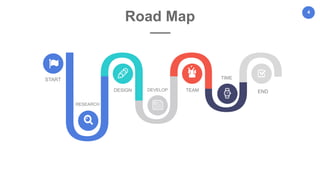
START
RESEARCH
DEVELOPDESIGN TEAM
TIME
END
Road Map
Home Automation
Home Automation
Introduction
Presenting Actual Model
Web Application and Web Service
Internet of Things Implementation
7
Home Automation
History
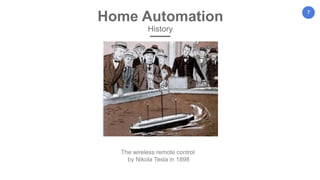
The wireless remote control
by Nikola Tesla in 1898
8
Home Automation
History
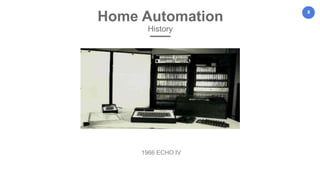
1966 ECHO IV
9
Home Automation
History
1970s - The grandfather of
automation “X10”
10
Home Automation
History
2010 - Nest enters the picture
11
Home Automation
History
2012 - SmartThings launches
12
Home Automation
History
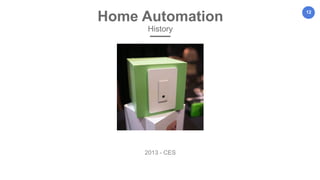
2013 - CES
13
Home Automation
History
2013 - Lab of Things
14
Home Automation
History
2014 - Everything in one place
15
Home Automation
History
2014 - Samsung SmartThings
16
Home Automation
History
2014 - iSmartHome
17
Home Automation
History
2014 - Partnerships galore
18
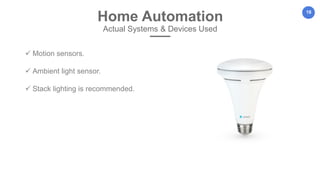
Home Automation
Actual Systems & Devices Used
 Motion sensors.
 Ambient light sensor.
 Stack lighting is recommended.
19
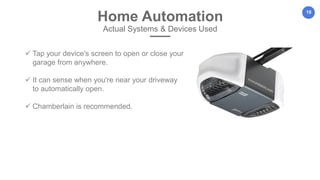
Home Automation
Actual Systems & Devices Used
 Tap your device's screen to open or close your
garage from anywhere.
 It can sense when you're near your driveway
to automatically open.
 Chamberlain is recommended.
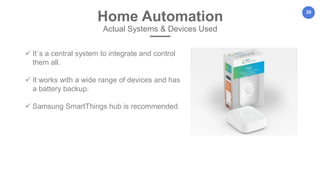
20
Home Automation
Actual Systems & Devices Used
 It`s a central system to integrate and control
them all.
 It works with a wide range of devices and has
a battery backup.
 Samsung SmartThings hub is recommended.
21
Home Automation
Actual Systems & Devices Used
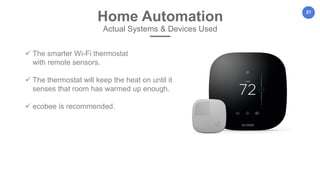
 The smarter Wi-Fi thermostat
with remote sensors.
 The thermostat will keep the heat on until it
senses that room has warmed up enough.
 ecobee is recommended.
22
Home Automation
Actual Systems & Devices Used
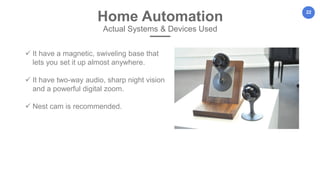
 It have a magnetic, swiveling base that
lets you set it up almost anywhere.
 It have two-way audio, sharp night vision
and a powerful digital zoom.
 Nest cam is recommended.
23
Home Automation
Actual Systems & Devices Used
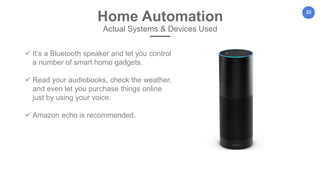
 It’s a Bluetooth speaker and let you control
a number of smart home gadgets.
 Read your audiobooks, check the weather,
and even let you purchase things online
just by using your voice.
 Amazon echo is recommended.
24
Home Automation
Actual Systems & Devices Used
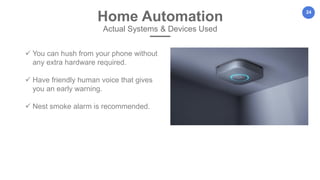
 You can hush from your phone without
any extra hardware required.
 Have friendly human voice that gives
you an early warning.
 Nest smoke alarm is recommended.
25
Home Automation
Actual Systems & Devices Used
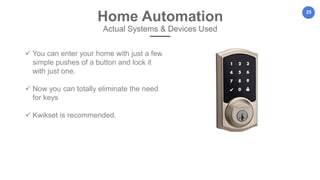
 You can enter your home with just a few
simple pushes of a button and lock it
with just one.
 Now you can totally eliminate the need
for keys
 Kwikset is recommended.
26
Home Automation
Actual Systems & Devices Used
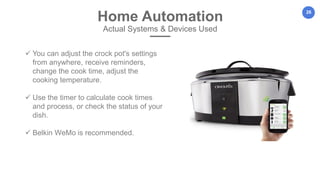
 You can adjust the crock pot's settings
from anywhere, receive reminders,
change the cook time, adjust the
cooking temperature.
 Use the timer to calculate cook times
and process, or check the status of your
dish.
 Belkin WeMo is recommended.
27
Home Automation
Actual Systems & Devices Used
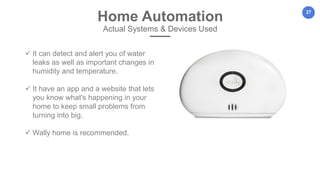
 It can detect and alert you of water
leaks as well as important changes in
humidity and temperature.
 It have an app and a website that lets
you know what's happening in your
home to keep small problems from
turning into big.
 Wally home is recommended.
28
Home Automation
Actual Systems & Devices Used
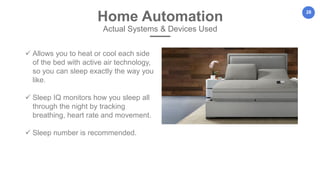
 Allows you to heat or cool each side
of the bed with active air technology,
so you can sleep exactly the way you
like.
 Sleep IQ monitors how you sleep all
through the night by tracking
breathing, heart rate and movement.
 Sleep number is recommended.
29
Home Automation
Actual Systems & Devices Used
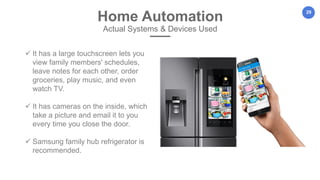
 It has a large touchscreen lets you
view family members' schedules,
leave notes for each other, order
groceries, play music, and even
watch TV.
 It has cameras on the inside, which
take a picture and email it to you
every time you close the door.
 Samsung family hub refrigerator is
recommended.
30
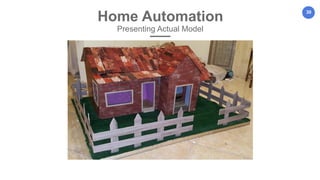
Home Automation
Presenting Actual Model
31
Home Automation
Presenting Actual Model
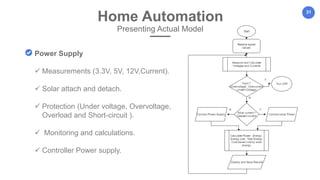
Power Supply
 Measurements (3.3V, 5V, 12V,Current).
 Solar attach and detach.
 Protection (Under voltage, Overvoltage,
Overload and Short-circuit ).
 Monitoring and calculations.
 Controller Power supply.
32
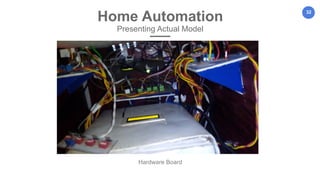
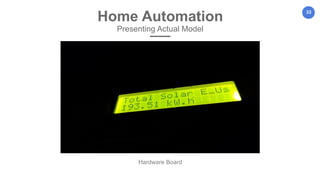
Home Automation
Presenting Actual Model
Hardware Board
33
Home Automation
Presenting Actual Model
Hardware Board
34
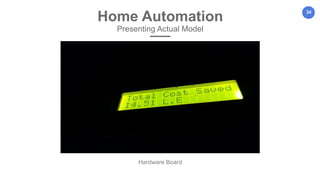
Home Automation
Presenting Actual Model
Hardware Board
35
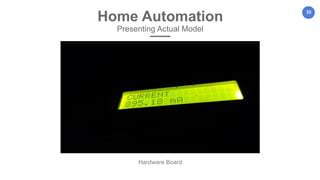
Home Automation
Presenting Actual Model
Hardware Board
36
Home Automation
Presenting Actual Model
Isolation System
 Importance.
 Components.
 Disadvantages.
37
Home Automation
Presenting Actual Model
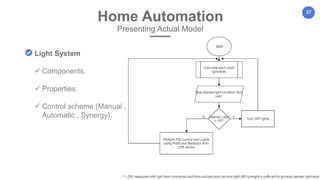
Light System
 Components.
 Properties.
 Control scheme (Manual ,
Automatic , Synergy).
38
Home Automation
Presenting Actual Model
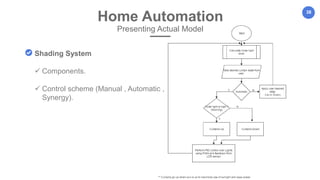
Shading System
 Components.
 Control scheme (Manual , Automatic ,
Synergy).
39
Home Automation
Presenting Actual Model
Hardware Board
40
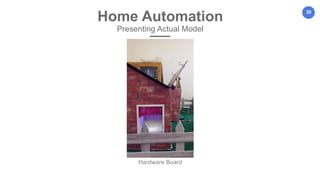
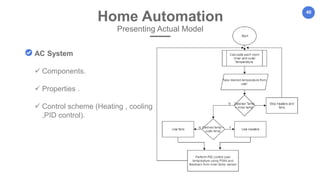
Home Automation
Presenting Actual Model
AC System
 Components.
 Properties .
 Control scheme (Heating , cooling
,PID control).
41
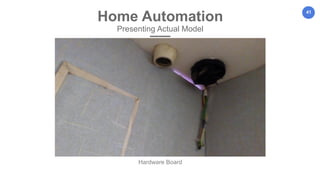
Home Automation
Presenting Actual Model
Hardware Board
42
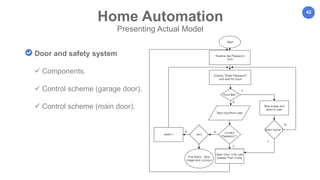
Home Automation
Presenting Actual Model
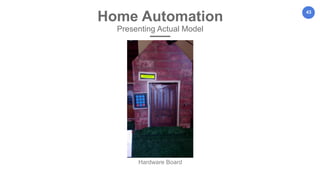
Door and safety system
 Components.
 Control scheme (garage door).
 Control scheme (main door).
43
Home Automation
Presenting Actual Model
Hardware Board
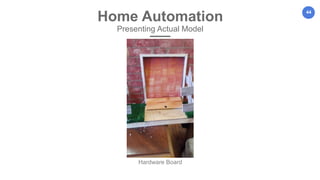
44
Home Automation
Presenting Actual Model
Hardware Board
45
Home Automation
Presenting Actual Model
Technical Difficulties
 Isolation between signal and power.
 Motors.
 Inaccurate sensors.
 Components rarity.
46
Home Automation
Internet of Things
 It is a network of physical objects, with the
addition of computational power and is
connected to the internet
 Three major benefits of Internet of Things
(IoT) that will impact every business, which
include: -
- Communication
- Control
- Cost savings.
47
Home Automation
The Three Cs’ of IoT
 Communication:
IoT communicates information to people and systems, such as:
state and health of equipment, data from sensors …etc.
 Control and Automation:
IoT remotely control a device, changing its state on/off,
adjust the temperature in a climate-controlled environment…
 Cost Savings:
IoT data can minimize equipment failure, allow the business
to perform planned maintenance, reduce fuel expense and help people
understand energy consumption and opportunities for cost savings.
48
Home Automation
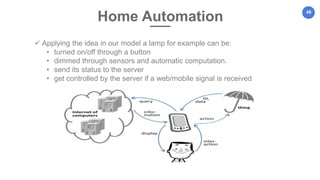
 Applying the idea in our model a lamp for example can be:
• turned on/off through a button
• dimmed through sensors and automatic computation.
• send its status to the server
• get controlled by the server if a web/mobile signal is received
49
Home Automation
Setting the Web Server (Ruby on Rails)
 Rails is a development tool which gives
web developers a framework to build
websites and applications.
 Rails is written in Ruby, the programming
language which is also used alongside Rails.
50
Home Automation
Why Rails?
 Ruby on Rails development is convention over configuration.
This means that the programmer does not have to spend a lot of time
configuring files in order to get setup, Rails comes with a set of conventions
which help speed up development.
 Rails is the emphasis on RESTful application design.
REST (Representational State Transfer) is a style of software architecture
based around the client-server relationship. It encourages a logical structure
within applications, which means they can easily be exposed as an API
(Application Programming Interface).
51
Home Automation
MVC Architecture
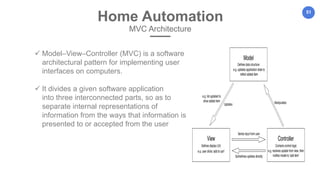
 Model–View–Controller (MVC) is a software
architectural pattern for implementing user
interfaces on computers.
 It divides a given software application
into three interconnected parts, so as to
separate internal representations of
information from the ways that information is
presented to or accepted from the user
52
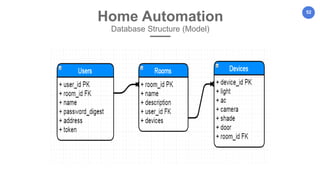
Home Automation
Database Structure (Model)
53
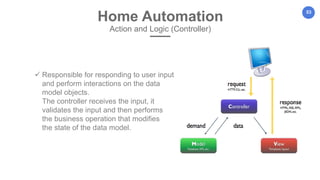
Home Automation
Action and Logic (Controller)
 Responsible for responding to user input
and perform interactions on the data
model objects.
The controller receives the input, it
validates the input and then performs
the business operation that modifies
the state of the data model.
54
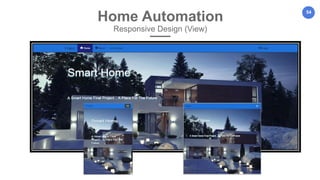
Home Automation
Responsive Design (View)
55
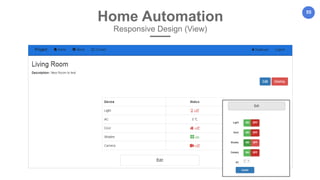
Home Automation
Responsive Design (View)
56
Home Automation
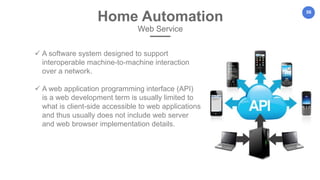
Web Service
 A software system designed to support
interoperable machine-to-machine interaction
over a network.
 A web application programming interface (API)
is a web development term is usually limited to
what is client-side accessible to web applications
and thus usually does not include web server
and web browser implementation details.
57
Home Automation
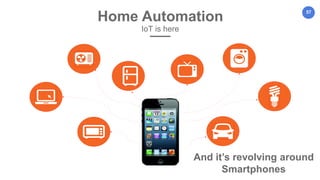
IoT is here
And it’s revolving around
Smartphones
58
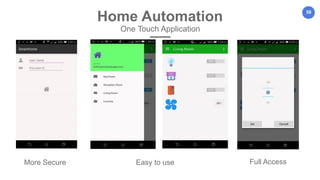
More Secure
Home Automation
One Touch Application
Easy to use Full Access
59
Home Automation
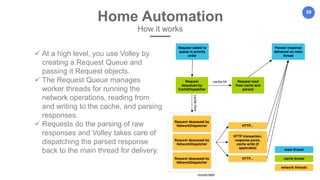
How it works
 At a high level, you use Volley by
creating a Request Queue and
passing it Request objects.
 The Request Queue manages
worker threads for running the
network operations, reading from
and writing to the cache, and parsing
responses.
 Requests do the parsing of raw
responses and Volley takes care of
dispatching the parsed response
back to the main thread for delivery.
60
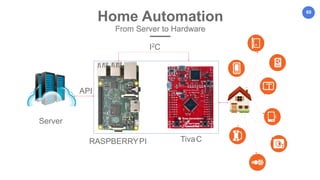
Server
RASPBERRYPI TivaC
API
I2C
Home Automation
From Server to Hardware
61
Home Automation
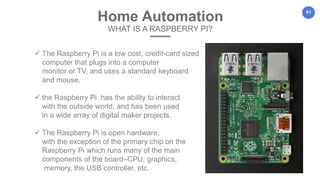
WHAT IS A RASPBERRY PI?
 The Raspberry Pi is a low cost, credit-card sized
computer that plugs into a computer
monitor or TV, and uses a standard keyboard
and mouse.
 the Raspberry Pi has the ability to interact
with the outside world, and has been used
in a wide array of digital maker projects.
 The Raspberry Pi is open hardware,
with the exception of the primary chip on the
Raspberry Pi which runs many of the main
components of the board–CPU, graphics,
memory, the USB controller, etc.
62
Home Automation
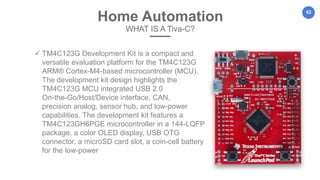
WHAT IS A Tiva-C?
 TM4C123G Development Kit is a compact and
versatile evaluation platform for the TM4C123G
ARM® Cortex-M4-based microcontroller (MCU).
The development kit design highlights the
TM4C123G MCU integrated USB 2.0
On-the-Go/Host/Device interface, CAN,
precision analog, sensor hub, and low-power
capabilities. The development kit features a
TM4C123GH6PGE microcontroller in a 144-LQFP
package, a color OLED display, USB OTG
connector, a microSD card slot, a coin-cell battery
for the low-power
63
Home Automation
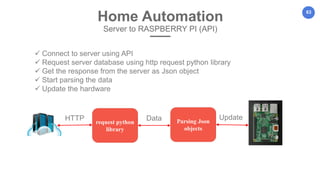
Server to RASPBERRY PI (API)
 Connect to server using API
 Request server database using http request python library
 Get the response from the server as Json object
 Start parsing the data
 Update the hardware
request python
library
Parsing Json
objects
HTTP Data Update
64
Home Automation
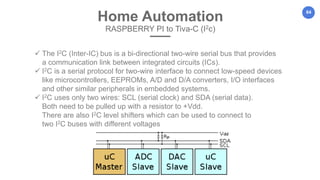
RASPBERRY PI to Tiva-C (I2c)
 The I2C (Inter-IC) bus is a bi-directional two-wire serial bus that provides
a communication link between integrated circuits (ICs).
 I2C is a serial protocol for two-wire interface to connect low-speed devices
like microcontrollers, EEPROMs, A/D and D/A converters, I/O interfaces
and other similar peripherals in embedded systems.
 I2C uses only two wires: SCL (serial clock) and SDA (serial data).
Both need to be pulled up with a resistor to +Vdd.
There are also I2C level shifters which can be used to connect to
two I2C buses with different voltages
Smart Home Materials
66
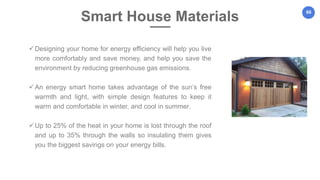
Designing your home for energy efficiency will help you live
more comfortably and save money, and help you save the
environment by reducing greenhouse gas emissions.
An energy smart home takes advantage of the sun’s free
warmth and light, with simple design features to keep it
warm and comfortable in winter, and cool in summer.
Up to 25% of the heat in your home is lost through the roof
and up to 35% through the walls so insulating them gives
you the biggest savings on your energy bills.
Smart House Materials
67
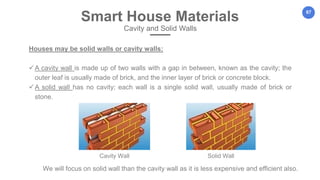
Houses may be solid walls or cavity walls:
A cavity wall is made up of two walls with a gap in between, known as the cavity; the
outer leaf is usually made of brick, and the inner layer of brick or concrete block.
A solid wall has no cavity; each wall is a single solid wall, usually made of brick or
stone.
Smart House Materials
Cavity and Solid Walls
Cavity Wall Solid Wall
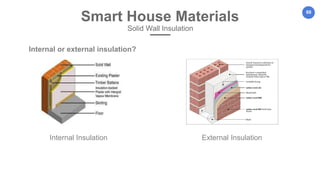
We will focus on solid wall than the cavity wall as it is less expensive and efficient also.
68
Internal or external insulation?
Smart House Materials
Solid Wall Insulation
Internal Insulation External Insulation
69
Internal Wall Insulation advantages and disadvantages
 Generally cheaper to install than external wall insulation
 Slightly reduce the floor area of any rooms in which it is applied (the thickness of the
insulation is around 100mm)
 Disruptive, but can be done room by room.
 Hard to fix heavy items inside walls – although special fixings are available.
External Wall Insulation advantages and disadvantages
 Can be applied without disruption to the household.
 Does not reduce the floor area of your home.
 Renews the appearance of outer walls.
 Improves weatherproofing and sound resistance.
 Fills cracks and gaps in the brickwork, which will reduce draughts.
 Increases the life of your walls by protecting the brickwork.
Smart House Materials
Solid Wall Insulation
70
Smart House Materials
71
Smart House Materials
72
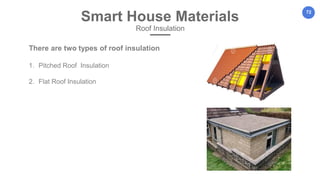
Smart House Materials
Roof Insulation
There are two types of roof insulation
1. Pitched Roof Insulation
2. Flat Roof Insulation
73
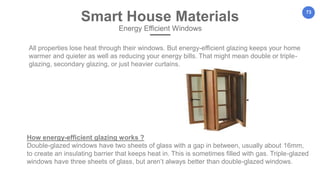
All properties lose heat through their windows. But energy-efficient glazing keeps your home
warmer and quieter as well as reducing your energy bills. That might mean double or triple-
glazing, secondary glazing, or just heavier curtains.
Smart House Materials
Energy Efficient Windows
How energy-efficient glazing works ?
Double-glazed windows have two sheets of glass with a gap in between, usually about 16mm,
to create an insulating barrier that keeps heat in. This is sometimes filled with gas. Triple-glazed
windows have three sheets of glass, but aren’t always better than double-glazed windows.
74
For all frame materials there are windows available in all energy ratings.
 uPVC frames last a long time and may be recycled.
 Wooden frames can have a lower environmental impact, but require maintenance. They
are often used in conservation areas where the original windows had timber frames.
 Aluminum or steel frames are slim and long-lasting, and may be recycled.
 Composite frames have an inner timber frame covered with aluminum or plastic. This
reduces the need for maintenance and keeps the frame weatherproof.
Smart House Materials
Windows Frame materials
75
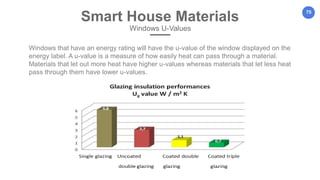
Windows that have an energy rating will have the u-value of the window displayed on the
energy label. A u-value is a measure of how easily heat can pass through a material.
Materials that let out more heat have higher u-values whereas materials that let less heat
pass through them have lower u-values.
Smart House Materials
Windows U-Values
76
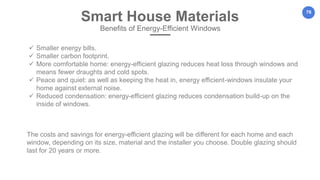
 Smaller energy bills.
 Smaller carbon footprint.
 More comfortable home: energy-efficient glazing reduces heat loss through windows and
means fewer draughts and cold spots.
 Peace and quiet: as well as keeping the heat in, energy efficient-windows insulate your
home against external noise.
 Reduced condensation: energy-efficient glazing reduces condensation build-up on the
inside of windows.
Smart House Materials
Benefits of Energy-Efficient Windows
The costs and savings for energy-efficient glazing will be different for each home and each
window, depending on its size, material and the installer you choose. Double glazing should
last for 20 years or more.
77
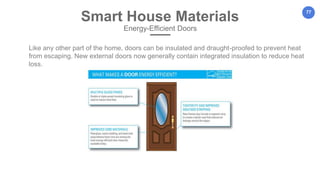
Like any other part of the home, doors can be insulated and draught-proofed to prevent heat
from escaping. New external doors now generally contain integrated insulation to reduce heat
loss.
Smart House Materials
Energy-Efficient Doors
78
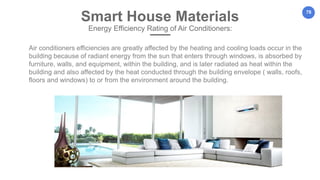
Air conditioners efficiencies are greatly affected by the heating and cooling loads occur in the
building because of radiant energy from the sun that enters through windows, is absorbed by
furniture, walls, and equipment, within the building, and is later radiated as heat within the
building and also affected by the heat conducted through the building envelope ( walls, roofs,
floors and windows) to or from the environment around the building.
Smart House Materials
Energy Efficiency Rating of Air Conditioners:
79
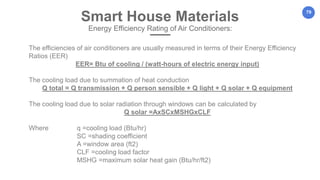
The efficiencies of air conditioners are usually measured in terms of their Energy Efficiency
Ratios (EER)
EER= Btu of cooling / (watt-hours of electric energy input)
The cooling load due to summation of heat conduction
Q total = Q transmission + Q person sensible + Q light + Q solar + Q equipment
The cooling load due to solar radiation through windows can be calculated by
Q solar =AxSCxMSHGxCLF
Where q =cooling load (Btu/hr)
SC =shading coefficient
A =window area (ft2)
CLF =cooling load factor
MSHG =maximum solar heat gain (Btu/hr/ft2)
Smart House Materials
Energy Efficiency Rating of Air Conditioners:
80
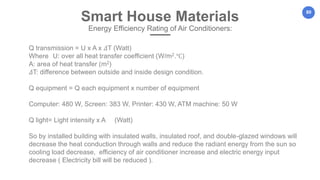
Q transmission = U x A x 𝛥T (Watt)
Where U: over all heat transfer coefficient (W/m2.℃)
A: area of heat transfer (m2)
𝛥T: difference between outside and inside design condition.
Q equipment = Q each equipment x number of equipment
Computer: 480 W, Screen: 383 W, Printer: 430 W, ATM machine: 50 W
Q light= Light intensity x A (Watt)
So by installed building with insulated walls, insulated roof, and double-glazed windows will
decrease the heat conduction through walls and reduce the radiant energy from the sun so
cooling load decrease, efficiency of air conditioner increase and electric energy input
decrease ( Electricity bill will be reduced ).
Smart House Materials
Energy Efficiency Rating of Air Conditioners:
81
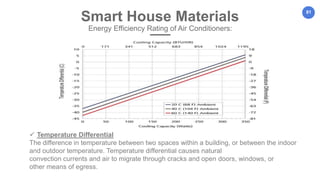
 Temperature Differential
The difference in temperature between two spaces within a building, or between the indoor
and outdoor temperature. Temperature differential causes natural
convection currents and air to migrate through cracks and open doors, windows, or
other means of egress.
Smart House Materials
Energy Efficiency Rating of Air Conditioners:
82
Lighting accounts for 18% of a typical household’s electricity bill. You can cut your lighting bill
and energy use by changing which bulbs you use and how you use them. Houses typically
use a mixture of standard light fittings and downlights or spotlight fittings. Energy efficient
bulbs are available for both types of fittings.
Smart House Materials
Energy Efficient Lighting
Which light bulbs are energy efficient?
 There are two main types of energy efficient light bulbs which are Compact Fluorescent
Lamps (CFLs) and Light Emitting Diodes (LEDs).
 CFLs are a cost-effective option for most general lighting requirements. Replacing a
traditional light bulb with a CFL of the same brightness will save energy.
 LEDs are available to fit both types of fittings and are particularly good for replacing
spotlights and dimmable lights. Though more expensive to buy initially, they are more
efficient than CFLs and will save you more money in the long term. By replacing all
halogen downlights in your home with LED alternatives.
83
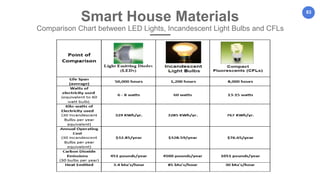
Smart House Materials
Comparison Chart between LED Lights, Incandescent Light Bulbs and CFLs
Solar Energy
Solar Energy
Photovoltaic Systems
Solar Concentration
Model
86
Solar Photovoltaic Systems
Definition
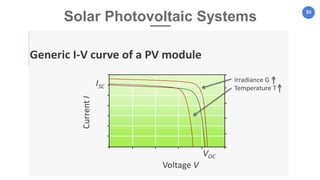
 Photovoltaic (PV) is the name of a method of converting solar energy into
direct current electricity using semiconducting materials that exhibit the
photovoltaic effect.
 Photovoltaic are best known as a method for generating electric power by
using solar cells to convert energy from the sun into a flow of electrons.
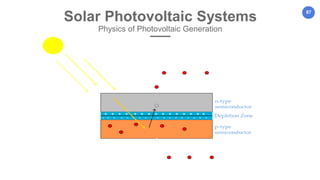
 The photovoltaic effect refers to photons of light exciting electrons into
a higher state of energy, allowing them to act as charge carriers for
an electric current.
87
Solar Photovoltaic Systems
Physics of Photovoltaic Generation
88
Solar Photovoltaic Systems
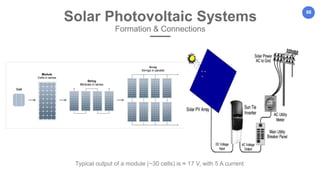
Formation & Connections
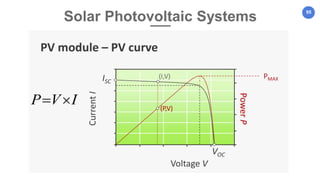
Typical output of a module (~30 cells) is ≈ 17 V, with 5 A current
89
Solar Photovoltaic Systems
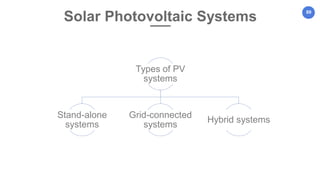
Types of PV
systems
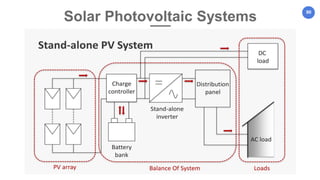
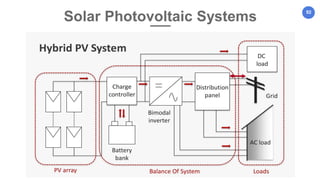
Stand-alone
systems
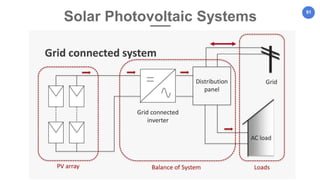
Grid-connected
systems
Hybrid systems
90
Solar Photovoltaic Systems
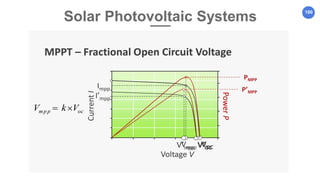
91
Solar Photovoltaic Systems
92
Solar Photovoltaic Systems
93
Solar Photovoltaic Systems
94
Solar Photovoltaic Systems
95
Solar Photovoltaic Systems
96
Solar Photovoltaic Systems
97
Solar Photovoltaic Systems
98
Solar Photovoltaic Systems
99
Solar Photovoltaic Systems
100
Solar Photovoltaic Systems
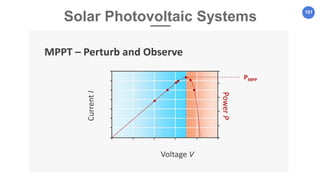
101
Solar Photovoltaic Systems
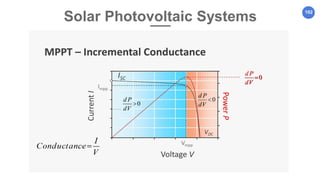
102
Solar Photovoltaic Systems
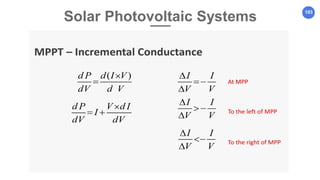
103
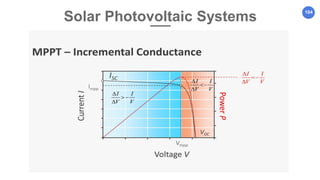
Solar Photovoltaic Systems
104
Solar Photovoltaic Systems
105
Solar Photovoltaic Systems
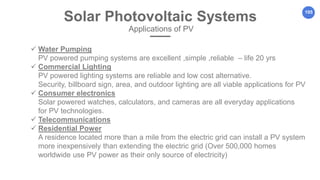
Applications of PV
 Water Pumping
PV powered pumping systems are excellent ,simple ,reliable – life 20 yrs
 Commercial Lighting
PV powered lighting systems are reliable and low cost alternative.
Security, billboard sign, area, and outdoor lighting are all viable applications for PV
 Consumer electronics
Solar powered watches, calculators, and cameras are all everyday applications
for PV technologies.
 Telecommunications
 Residential Power
A residence located more than a mile from the electric grid can install a PV system
more inexpensively than extending the electric grid (Over 500,000 homes
worldwide use PV power as their only source of electricity)
106
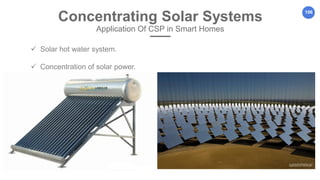
Concentrating Solar Systems
Application Of CSP in Smart Homes
 Solar hot water system.
 Concentration of solar power.
107
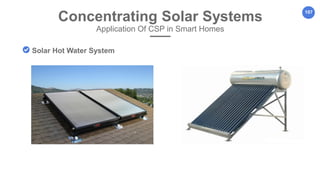
Concentrating Solar Systems
Application Of CSP in Smart Homes
Solar Hot Water System
108
Concentrating Solar Systems
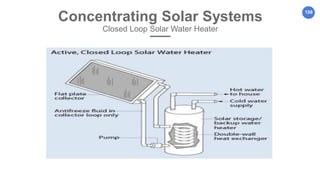
Closed Loop Solar Water Heater
109
Concentrating Solar Systems
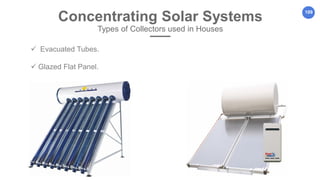
Types of Collectors used in Houses
 Evacuated Tubes.
 Glazed Flat Panel.
110
Concentrating Solar Systems
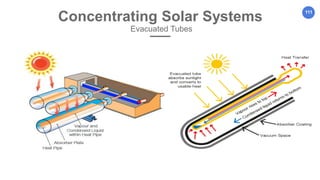
Evacuated Tubes
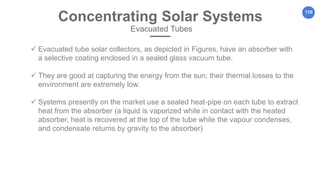
 Evacuated tube solar collectors, as depicted in Figures, have an absorber with
a selective coating enclosed in a sealed glass vacuum tube.
 They are good at capturing the energy from the sun; their thermal losses to the
environment are extremely low.
 Systems presently on the market use a sealed heat-pipe on each tube to extract
heat from the absorber (a liquid is vaporized while in contact with the heated
absorber, heat is recovered at the top of the tube while the vapour condenses,
and condensate returns by gravity to the absorber)
111
Concentrating Solar Systems
Evacuated Tubes
112
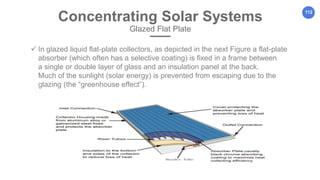
Concentrating Solar Systems
Glazed Flat Plate
 In glazed liquid flat-plate collectors, as depicted in the next Figure a flat-plate
absorber (which often has a selective coating) is fixed in a frame between
a single or double layer of glass and an insulation panel at the back.
Much of the sunlight (solar energy) is prevented from escaping due to the
glazing (the “greenhouse effect”).
113
Concentrating Solar Power
Concentrating Solar Power Basics
 Many power plants today use fossil fuels as a heat source to boil water.
The steam from the boiling water spins a large turbine, which drives a
generator to produce electricity. However, a new generation of power plants
with concentrating solar power systems uses the sun as a heat source.
 Types of concentrating solar power systems
• Linear Concentrator System
• Concentrating Solar Power Tower System
114
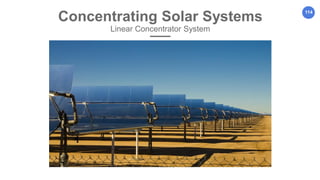
Concentrating Solar Systems
Linear Concentrator System
115
Concentrating Solar Systems
Linear Concentrator System
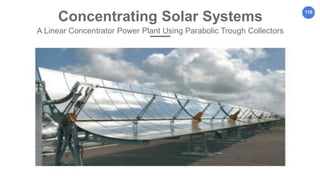
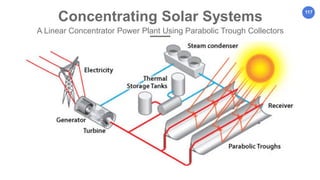
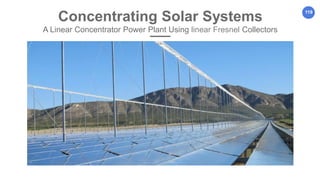
 Linear concentrating solar power (CSP) collectors capture the sun's energy
with large mirrors that reflect and focus the sunlight onto a linear receiver tube.
 The receiver contains a fluid that is heated by the sunlight and then used to
create superheated steam that spins a turbine that drives a generator to
produce electricity.
 Alternatively, steam can be generated directly in the solar field, which
eliminates the need for costly heat exchangers.
116
Concentrating Solar Systems
A Linear Concentrator Power Plant Using Parabolic Trough Collectors
117
Concentrating Solar Systems
A Linear Concentrator Power Plant Using Parabolic Trough Collectors
118
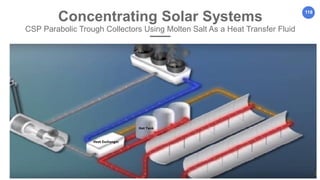
Concentrating Solar Systems
CSP Parabolic Trough Collectors Using Molten Salt As a Heat Transfer Fluid
119
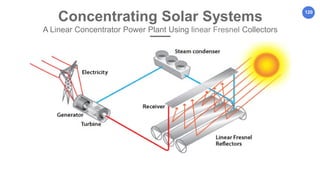
Concentrating Solar Systems
A Linear Concentrator Power Plant Using linear Fresnel Collectors
120
Concentrating Solar Systems
A Linear Concentrator Power Plant Using linear Fresnel Collectors
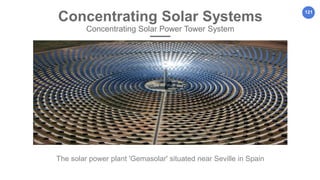
121
Concentrating Solar Systems
Concentrating Solar Power Tower System
The solar power plant 'Gemasolar' situated near Seville in Spain
122
Concentrating Solar Systems
Concentrating Solar Power Tower System Basics
 In power tower concentrating solar power systems, numerous large, flat,
sun-tracking mirrors, known as heliostats, focus sunlight onto a receiver
at the top of a tall tower. A heat-transfer fluid heated in the receiver is used
to generate steam, which, in turn, is used in a conventional turbine
generator to produce electricity. Some power towers use water/steam as
the heat-transfer fluid.
 Other advanced designs are experimenting with molten nitrate salt
because of its superior heat-transfer and energy-storage capabilities.
 Individual commercial plants can be sized to produce up to hundreds
megawatts of electricity.
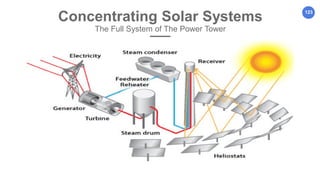
123
Concentrating Solar Systems
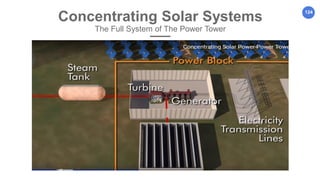
The Full System of The Power Tower
124
Concentrating Solar Systems
The Full System of The Power Tower
125
Concentrating Solar Systems
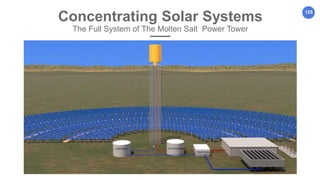
The Full System of The Molten Salt Power Tower
126
Concentrating Solar Systems
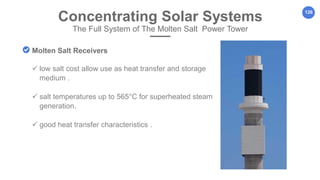
The Full System of The Molten Salt Power Tower
Molten Salt Receivers
 low salt cost allow use as heat transfer and storage
medium .
 salt temperatures up to 565°C for superheated steam
generation.
 good heat transfer characteristics .
127
Concentrating Solar Systems
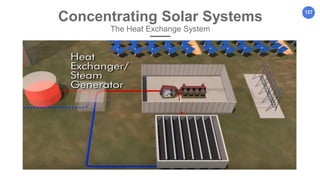
The Heat Exchange System
Wind Energy
Wind Energy
Introduction
Doubly-Fed Induction Generator
Permanent Magnet Synchronous Generator
130
Wind Energy
Introduction
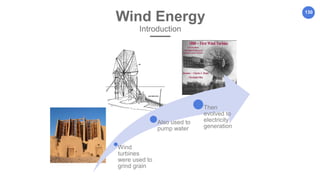
Wind
turbines
were used to
grind grain
Also used to
pump water
Then
evolved to
electricity
generation
131
Wind Energy
How To Design Wind Generation System?
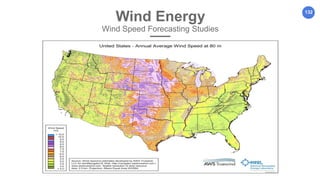
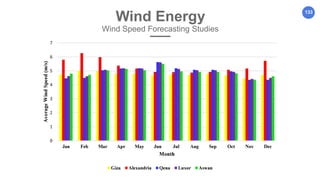
 Wind speed forecasting studies
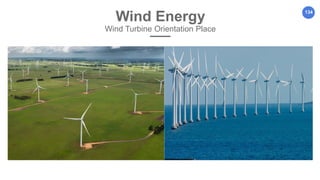
 Wind turbine orientation place
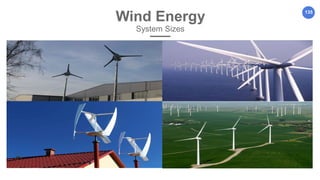
 System size
 Stand-Alone or Grid-tied system
 Tower types
 Turbine types
 Wind turbine subsystems
 Generators used
132
Wind Energy
Wind Speed Forecasting Studies
133
Wind Energy
Wind Speed Forecasting Studies
134
Wind Energy
Wind Turbine Orientation Place
135
Wind Energy
System Sizes
136
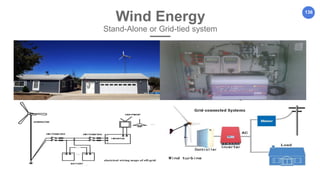
Wind Energy
Stand-Alone or Grid-tied system
137
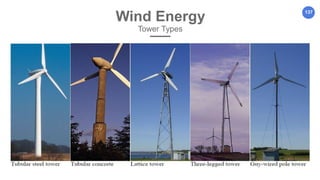
Wind Energy
Tower Types
138
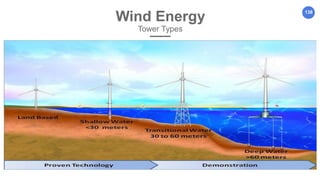
Wind Energy
Tower Types
139
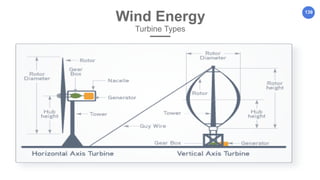
Wind Energy
Turbine Types
140
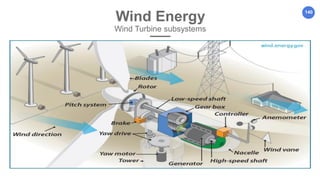
Wind Energy
Wind Turbine subsystems
141
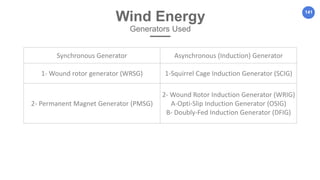
Wind Energy
Generators Used
Synchronous Generator Asynchronous (Induction) Generator
1- Wound rotor generator (WRSG) 1-Squirrel Cage Induction Generator (SCIG)
2- Permanent Magnet Generator (PMSG)
2- Wound Rotor Induction Generator (WRIG)
A-Opti-Slip Induction Generator (OSIG)
B- Doubly-Fed Induction Generator (DFIG)
142
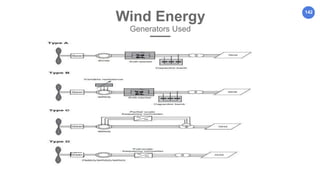
Wind Energy
Generators Used
143
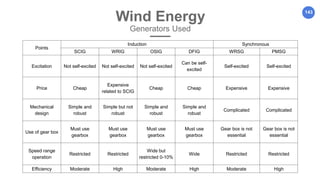
Wind Energy
Generators Used
Points
Induction Synchronous
SCIG WRIG OSIG DFIG WRSG PMSG
Excitation Not self-excited Not self-excited Not self-excited
Can be self-
excited
Self-excited Self-excited
Price Cheap
Expensive
related to SCIG
Cheap Cheap Expensive Expensive
Mechanical
design
Simple and
robust
Simple but not
robust
Simple and
robust
Simple and
robust
Complicated Complicated
Use of gear box
Must use
gearbox
Must use
gearbox
Must use
gearbox
Must use
gearbox
Gear box is not
essential
Gear box is not
essential
Speed range
operation
Restricted Restricted
Wide but
restricted 0-10%
Wide Restricted Restricted
Efficiency Moderate High Moderate High Moderate High
144
 The DFIG is an induction machine with a wound rotor where the rotor and stator are both
connected to electrical sources, hence the term ‘doubly-fed’.
 The DFIG is currently the system of choice for multi-MW wind turbines.
 The stator circuit is directly connected to the grid while the rotor winding is connected
via slip-rings to a three-phase converter.
 AC-DC-AC converter used on the rotor which consists of two voltage-sourced converters,
i.e., rotor-side converter (RSC) and grid-side converter (GSC), which are connected
“back-to-back.” and between the two converters a dc-link capacitor is placed.
DFIG Wind Turbine
Introduction
145
Advantages
 Variable speed operation.
 Rotor power converters handle only a fraction of the total power.
 Higher efficiency due to lower converters losses.
 Lower cost.
Disadvantages
 Presence of a gear box which needs continuous maintenance.
 Presence of slip rings which need frequent replacement.
 Speed restrictions over synchronous speed.
DFIG Wind Turbine
Advantages & Disadvantages
146
DFIG Wind Turbine
Rotor Power Converters
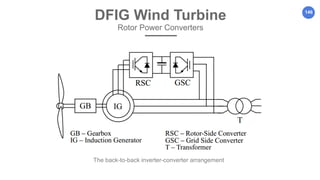
The back-to-back inverter-converter arrangement
147
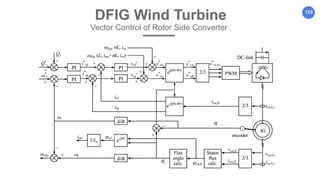
 The Rotor Side Converter (RSC)
The purpose of the rotor-side converter is to control the rotor currents such that the rotor
flux position is optimally oriented with respect to the stator flux in order that the desired
torque is developed at the shaft of the machine.
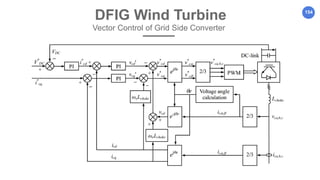
 The Grid Side Converter (GSC)
aims to regulate the voltage of the dc bus capacitor. Moreover, it is allowed to generate
or absorb reactive power for voltage support requirements.
 Converter losses
The losses of the converters can be divided into switching losses and conducting losses.
The switching losses of the transistors are the turn-on and turn-off losses. For the diode the
switching losses mainly consist of turn-off losses, i.e., reverse-recovery energy.
DFIG Wind Turbine
Rotor Power Converters
148
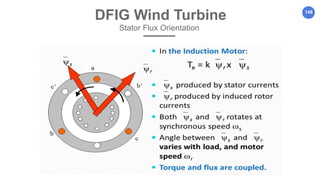
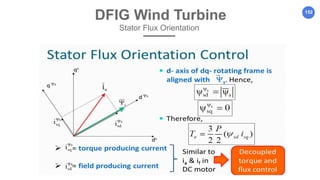
DFIG Wind Turbine
Stator Flux Orientation
149
DFIG Wind Turbine
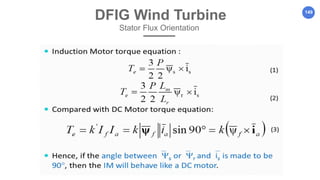
Stator Flux Orientation
150
DFIG Wind Turbine
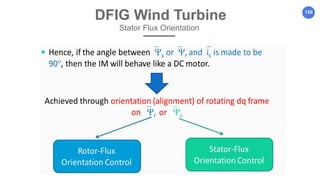
Stator Flux Orientation
151
DFIG Wind Turbine
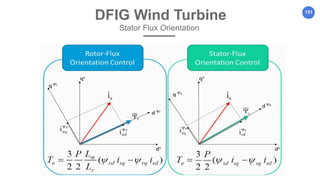
Stator Flux Orientation
152
DFIG Wind Turbine
Stator Flux Orientation
153
DFIG Wind Turbine
Vector Control of Rotor Side Converter
154
DFIG Wind Turbine
Vector Control of Grid Side Converter
155
DFIG Wind Turbine
Few Points to Discuss
 Limiting Speed Range.
 Phase Sequence Reversal.
 Reactive Power Generation from Stator and Rotor.
 Qs*and Iq*
 BDFIG – Brushless Doubly-Fed Induction Generator
156
DFIG Wind Turbine
Simulation Results
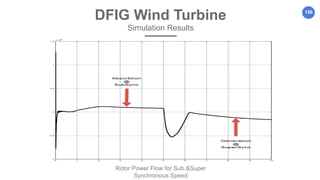
Rotor Power Flow for Sub.&Super
Synchronous Speed
157
DFIG Wind Turbine
Simulation Results
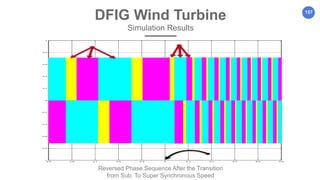
Reversed Phase Sequence After the Transition
from Sub. To Super Synchronous Speed
158
PMSG Wind Turbine
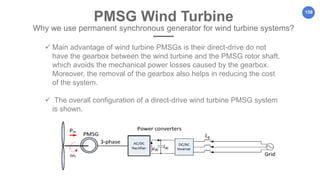
Why we use permanent synchronous generator for wind turbine systems?
 Main advantage of wind turbine PMSGs is their direct-drive do not
have the gearbox between the wind turbine and the PMSG rotor shaft,
which avoids the mechanical power losses caused by the gearbox.
Moreover, the removal of the gearbox also helps in reducing the cost
of the system.
 The overall configuration of a direct-drive wind turbine PMSG system
is shown.
159
PMSG Wind Turbine
PMSGs & FOC
 There are two big problems due to using PMSGs in wind energy systems.
1. The coupling between torque and flux.
2. The field is permanent magnet so, we can’t control the field.
Field oriented control could solve those problems.
160
PMSG Wind Turbine
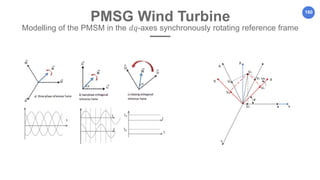
Modelling of the PMSM in the 𝑑𝑞-axes synchronously rotating reference frame
161
PMSG Wind Turbine
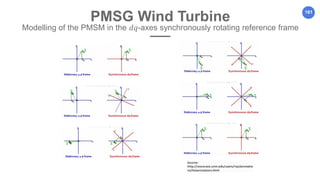
Modelling of the PMSM in the 𝑑𝑞-axes synchronously rotating reference frame
162
PMSG Wind Turbine
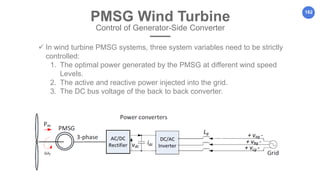
Control of Generator-Side Converter
 In wind turbine PMSG systems, three system variables need to be strictly
controlled:
1. The optimal power generated by the PMSG at different wind speed
Levels.
2. The active and reactive power injected into the grid.
3. The DC bus voltage of the back to back converter.
163
PMSG Wind Turbine
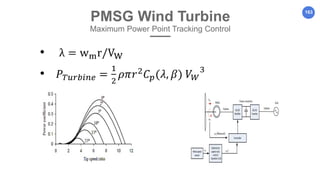
Maximum Power Point Tracking Control
164
PMSG Wind Turbine
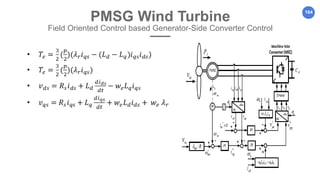
Field Oriented Control based Generator-Side Converter Control
165
PMSG Wind Turbine
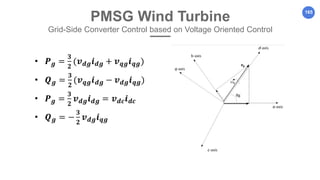
Grid-Side Converter Control based on Voltage Oriented Control
166
PMSG Wind Turbine
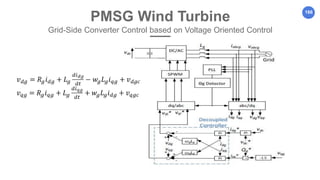
Grid-Side Converter Control based on Voltage Oriented Control
167
PMSG Wind Turbine
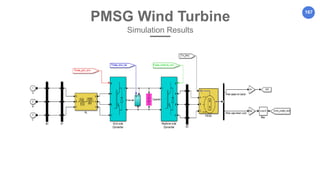
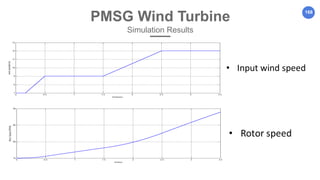
Simulation Results
168
PMSG Wind Turbine
Simulation Results
169
PMSG Wind Turbine
Simulation Results
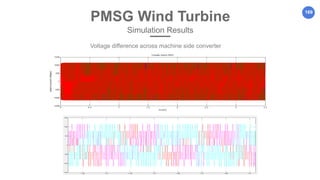
Voltage difference across machine side converter
170
PMSG Wind Turbine
Simulation Results
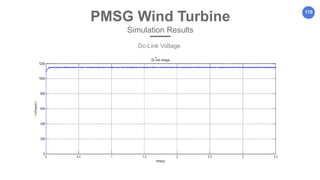
Dc-Link Voltage
171
PMSG Wind Turbine
Simulation Results
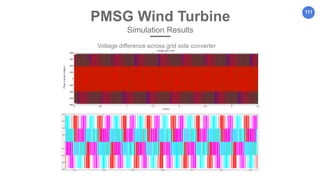
Voltage difference across grid side converter
172
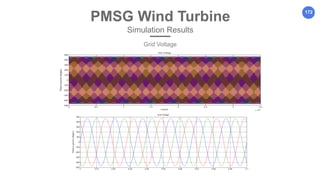
PMSG Wind Turbine
Simulation Results
Grid Voltage
Thank You

Graduation Project on "SMART HOMES & RENEWABLE ENERGY" PowerPoint Presentation

  • 1.
  • 2.
    2 Prof. Dr. MohamedYousry Gamal El-Din Electrical Engineering Department – Power Section Under Supervision of
  • 3.
    Four Topics ofDiscussion On which the whole project will be based Home Automation / Smart Home Smart Home Materials Solar Energy / Green Home WindEnergy
  • 4.
  • 5.
  • 6.
    Home Automation Introduction Presenting ActualModel Web Application and Web Service Internet of Things Implementation
  • 7.
    7 Home Automation History The wirelessremote control by Nikola Tesla in 1898
  • 8.
  • 9.
    9 Home Automation History 1970s -The grandfather of automation “X10”
  • 10.
    10 Home Automation History 2010 -Nest enters the picture
  • 11.
  • 12.
  • 13.
  • 14.
    14 Home Automation History 2014 -Everything in one place
  • 15.
  • 16.
  • 17.
  • 18.
    18 Home Automation Actual Systems& Devices Used  Motion sensors.  Ambient light sensor.  Stack lighting is recommended.
  • 19.
    19 Home Automation Actual Systems& Devices Used  Tap your device's screen to open or close your garage from anywhere.  It can sense when you're near your driveway to automatically open.  Chamberlain is recommended.
  • 20.
    20 Home Automation Actual Systems& Devices Used  It`s a central system to integrate and control them all.  It works with a wide range of devices and has a battery backup.  Samsung SmartThings hub is recommended.
  • 21.
    21 Home Automation Actual Systems& Devices Used  The smarter Wi-Fi thermostat with remote sensors.  The thermostat will keep the heat on until it senses that room has warmed up enough.  ecobee is recommended.
  • 22.
    22 Home Automation Actual Systems& Devices Used  It have a magnetic, swiveling base that lets you set it up almost anywhere.  It have two-way audio, sharp night vision and a powerful digital zoom.  Nest cam is recommended.
  • 23.
    23 Home Automation Actual Systems& Devices Used  It’s a Bluetooth speaker and let you control a number of smart home gadgets.  Read your audiobooks, check the weather, and even let you purchase things online just by using your voice.  Amazon echo is recommended.
  • 24.
    24 Home Automation Actual Systems& Devices Used  You can hush from your phone without any extra hardware required.  Have friendly human voice that gives you an early warning.  Nest smoke alarm is recommended.
  • 25.
    25 Home Automation Actual Systems& Devices Used  You can enter your home with just a few simple pushes of a button and lock it with just one.  Now you can totally eliminate the need for keys  Kwikset is recommended.
  • 26.
    26 Home Automation Actual Systems& Devices Used  You can adjust the crock pot's settings from anywhere, receive reminders, change the cook time, adjust the cooking temperature.  Use the timer to calculate cook times and process, or check the status of your dish.  Belkin WeMo is recommended.
  • 27.
    27 Home Automation Actual Systems& Devices Used  It can detect and alert you of water leaks as well as important changes in humidity and temperature.  It have an app and a website that lets you know what's happening in your home to keep small problems from turning into big.  Wally home is recommended.
  • 28.
    28 Home Automation Actual Systems& Devices Used  Allows you to heat or cool each side of the bed with active air technology, so you can sleep exactly the way you like.  Sleep IQ monitors how you sleep all through the night by tracking breathing, heart rate and movement.  Sleep number is recommended.
  • 29.
    29 Home Automation Actual Systems& Devices Used  It has a large touchscreen lets you view family members' schedules, leave notes for each other, order groceries, play music, and even watch TV.  It has cameras on the inside, which take a picture and email it to you every time you close the door.  Samsung family hub refrigerator is recommended.
  • 30.
  • 31.
    31 Home Automation Presenting ActualModel Power Supply  Measurements (3.3V, 5V, 12V,Current).  Solar attach and detach.  Protection (Under voltage, Overvoltage, Overload and Short-circuit ).  Monitoring and calculations.  Controller Power supply.
  • 32.
  • 33.
  • 34.
  • 35.
  • 36.
    36 Home Automation Presenting ActualModel Isolation System  Importance.  Components.  Disadvantages.
  • 37.
    37 Home Automation Presenting ActualModel Light System  Components.  Properties.  Control scheme (Manual , Automatic , Synergy).
  • 38.
    38 Home Automation Presenting ActualModel Shading System  Components.  Control scheme (Manual , Automatic , Synergy).
  • 39.
  • 40.
    40 Home Automation Presenting ActualModel AC System  Components.  Properties .  Control scheme (Heating , cooling ,PID control).
  • 41.
  • 42.
    42 Home Automation Presenting ActualModel Door and safety system  Components.  Control scheme (garage door).  Control scheme (main door).
  • 43.
  • 44.
  • 45.
    45 Home Automation Presenting ActualModel Technical Difficulties  Isolation between signal and power.  Motors.  Inaccurate sensors.  Components rarity.
  • 46.
    46 Home Automation Internet ofThings  It is a network of physical objects, with the addition of computational power and is connected to the internet  Three major benefits of Internet of Things (IoT) that will impact every business, which include: - - Communication - Control - Cost savings.
  • 47.
    47 Home Automation The ThreeCs’ of IoT  Communication: IoT communicates information to people and systems, such as: state and health of equipment, data from sensors …etc.  Control and Automation: IoT remotely control a device, changing its state on/off, adjust the temperature in a climate-controlled environment…  Cost Savings: IoT data can minimize equipment failure, allow the business to perform planned maintenance, reduce fuel expense and help people understand energy consumption and opportunities for cost savings.
  • 48.
    48 Home Automation  Applyingthe idea in our model a lamp for example can be: • turned on/off through a button • dimmed through sensors and automatic computation. • send its status to the server • get controlled by the server if a web/mobile signal is received
  • 49.
    49 Home Automation Setting theWeb Server (Ruby on Rails)  Rails is a development tool which gives web developers a framework to build websites and applications.  Rails is written in Ruby, the programming language which is also used alongside Rails.
  • 50.
    50 Home Automation Why Rails? Ruby on Rails development is convention over configuration. This means that the programmer does not have to spend a lot of time configuring files in order to get setup, Rails comes with a set of conventions which help speed up development.  Rails is the emphasis on RESTful application design. REST (Representational State Transfer) is a style of software architecture based around the client-server relationship. It encourages a logical structure within applications, which means they can easily be exposed as an API (Application Programming Interface).
  • 51.
    51 Home Automation MVC Architecture Model–View–Controller (MVC) is a software architectural pattern for implementing user interfaces on computers.  It divides a given software application into three interconnected parts, so as to separate internal representations of information from the ways that information is presented to or accepted from the user
  • 52.
  • 53.
    53 Home Automation Action andLogic (Controller)  Responsible for responding to user input and perform interactions on the data model objects. The controller receives the input, it validates the input and then performs the business operation that modifies the state of the data model.
  • 54.
  • 55.
  • 56.
    56 Home Automation Web Service A software system designed to support interoperable machine-to-machine interaction over a network.  A web application programming interface (API) is a web development term is usually limited to what is client-side accessible to web applications and thus usually does not include web server and web browser implementation details.
  • 57.
    57 Home Automation IoT ishere And it’s revolving around Smartphones
  • 58.
    58 More Secure Home Automation OneTouch Application Easy to use Full Access
  • 59.
    59 Home Automation How itworks  At a high level, you use Volley by creating a Request Queue and passing it Request objects.  The Request Queue manages worker threads for running the network operations, reading from and writing to the cache, and parsing responses.  Requests do the parsing of raw responses and Volley takes care of dispatching the parsed response back to the main thread for delivery.
  • 60.
  • 61.
    61 Home Automation WHAT ISA RASPBERRY PI?  The Raspberry Pi is a low cost, credit-card sized computer that plugs into a computer monitor or TV, and uses a standard keyboard and mouse.  the Raspberry Pi has the ability to interact with the outside world, and has been used in a wide array of digital maker projects.  The Raspberry Pi is open hardware, with the exception of the primary chip on the Raspberry Pi which runs many of the main components of the board–CPU, graphics, memory, the USB controller, etc.
  • 62.
    62 Home Automation WHAT ISA Tiva-C?  TM4C123G Development Kit is a compact and versatile evaluation platform for the TM4C123G ARM® Cortex-M4-based microcontroller (MCU). The development kit design highlights the TM4C123G MCU integrated USB 2.0 On-the-Go/Host/Device interface, CAN, precision analog, sensor hub, and low-power capabilities. The development kit features a TM4C123GH6PGE microcontroller in a 144-LQFP package, a color OLED display, USB OTG connector, a microSD card slot, a coin-cell battery for the low-power
  • 63.
    63 Home Automation Server toRASPBERRY PI (API)  Connect to server using API  Request server database using http request python library  Get the response from the server as Json object  Start parsing the data  Update the hardware request python library Parsing Json objects HTTP Data Update
  • 64.
    64 Home Automation RASPBERRY PIto Tiva-C (I2c)  The I2C (Inter-IC) bus is a bi-directional two-wire serial bus that provides a communication link between integrated circuits (ICs).  I2C is a serial protocol for two-wire interface to connect low-speed devices like microcontrollers, EEPROMs, A/D and D/A converters, I/O interfaces and other similar peripherals in embedded systems.  I2C uses only two wires: SCL (serial clock) and SDA (serial data). Both need to be pulled up with a resistor to +Vdd. There are also I2C level shifters which can be used to connect to two I2C buses with different voltages
  • 65.
  • 66.
    66 Designing your homefor energy efficiency will help you live more comfortably and save money, and help you save the environment by reducing greenhouse gas emissions. An energy smart home takes advantage of the sun’s free warmth and light, with simple design features to keep it warm and comfortable in winter, and cool in summer. Up to 25% of the heat in your home is lost through the roof and up to 35% through the walls so insulating them gives you the biggest savings on your energy bills. Smart House Materials
  • 67.
    67 Houses may besolid walls or cavity walls: A cavity wall is made up of two walls with a gap in between, known as the cavity; the outer leaf is usually made of brick, and the inner layer of brick or concrete block. A solid wall has no cavity; each wall is a single solid wall, usually made of brick or stone. Smart House Materials Cavity and Solid Walls Cavity Wall Solid Wall We will focus on solid wall than the cavity wall as it is less expensive and efficient also.
  • 68.
    68 Internal or externalinsulation? Smart House Materials Solid Wall Insulation Internal Insulation External Insulation
  • 69.
    69 Internal Wall Insulationadvantages and disadvantages  Generally cheaper to install than external wall insulation  Slightly reduce the floor area of any rooms in which it is applied (the thickness of the insulation is around 100mm)  Disruptive, but can be done room by room.  Hard to fix heavy items inside walls – although special fixings are available. External Wall Insulation advantages and disadvantages  Can be applied without disruption to the household.  Does not reduce the floor area of your home.  Renews the appearance of outer walls.  Improves weatherproofing and sound resistance.  Fills cracks and gaps in the brickwork, which will reduce draughts.  Increases the life of your walls by protecting the brickwork. Smart House Materials Solid Wall Insulation
  • 70.
  • 71.
  • 72.
    72 Smart House Materials RoofInsulation There are two types of roof insulation 1. Pitched Roof Insulation 2. Flat Roof Insulation
  • 73.
    73 All properties loseheat through their windows. But energy-efficient glazing keeps your home warmer and quieter as well as reducing your energy bills. That might mean double or triple- glazing, secondary glazing, or just heavier curtains. Smart House Materials Energy Efficient Windows How energy-efficient glazing works ? Double-glazed windows have two sheets of glass with a gap in between, usually about 16mm, to create an insulating barrier that keeps heat in. This is sometimes filled with gas. Triple-glazed windows have three sheets of glass, but aren’t always better than double-glazed windows.
  • 74.
    74 For all framematerials there are windows available in all energy ratings.  uPVC frames last a long time and may be recycled.  Wooden frames can have a lower environmental impact, but require maintenance. They are often used in conservation areas where the original windows had timber frames.  Aluminum or steel frames are slim and long-lasting, and may be recycled.  Composite frames have an inner timber frame covered with aluminum or plastic. This reduces the need for maintenance and keeps the frame weatherproof. Smart House Materials Windows Frame materials
  • 75.
    75 Windows that havean energy rating will have the u-value of the window displayed on the energy label. A u-value is a measure of how easily heat can pass through a material. Materials that let out more heat have higher u-values whereas materials that let less heat pass through them have lower u-values. Smart House Materials Windows U-Values
  • 76.
    76  Smaller energybills.  Smaller carbon footprint.  More comfortable home: energy-efficient glazing reduces heat loss through windows and means fewer draughts and cold spots.  Peace and quiet: as well as keeping the heat in, energy efficient-windows insulate your home against external noise.  Reduced condensation: energy-efficient glazing reduces condensation build-up on the inside of windows. Smart House Materials Benefits of Energy-Efficient Windows The costs and savings for energy-efficient glazing will be different for each home and each window, depending on its size, material and the installer you choose. Double glazing should last for 20 years or more.
  • 77.
    77 Like any otherpart of the home, doors can be insulated and draught-proofed to prevent heat from escaping. New external doors now generally contain integrated insulation to reduce heat loss. Smart House Materials Energy-Efficient Doors
  • 78.
    78 Air conditioners efficienciesare greatly affected by the heating and cooling loads occur in the building because of radiant energy from the sun that enters through windows, is absorbed by furniture, walls, and equipment, within the building, and is later radiated as heat within the building and also affected by the heat conducted through the building envelope ( walls, roofs, floors and windows) to or from the environment around the building. Smart House Materials Energy Efficiency Rating of Air Conditioners:
  • 79.
    79 The efficiencies ofair conditioners are usually measured in terms of their Energy Efficiency Ratios (EER) EER= Btu of cooling / (watt-hours of electric energy input) The cooling load due to summation of heat conduction Q total = Q transmission + Q person sensible + Q light + Q solar + Q equipment The cooling load due to solar radiation through windows can be calculated by Q solar =AxSCxMSHGxCLF Where q =cooling load (Btu/hr) SC =shading coefficient A =window area (ft2) CLF =cooling load factor MSHG =maximum solar heat gain (Btu/hr/ft2) Smart House Materials Energy Efficiency Rating of Air Conditioners:
  • 80.
    80 Q transmission =U x A x 𝛥T (Watt) Where U: over all heat transfer coefficient (W/m2.℃) A: area of heat transfer (m2) 𝛥T: difference between outside and inside design condition. Q equipment = Q each equipment x number of equipment Computer: 480 W, Screen: 383 W, Printer: 430 W, ATM machine: 50 W Q light= Light intensity x A (Watt) So by installed building with insulated walls, insulated roof, and double-glazed windows will decrease the heat conduction through walls and reduce the radiant energy from the sun so cooling load decrease, efficiency of air conditioner increase and electric energy input decrease ( Electricity bill will be reduced ). Smart House Materials Energy Efficiency Rating of Air Conditioners:
  • 81.
    81  Temperature Differential Thedifference in temperature between two spaces within a building, or between the indoor and outdoor temperature. Temperature differential causes natural convection currents and air to migrate through cracks and open doors, windows, or other means of egress. Smart House Materials Energy Efficiency Rating of Air Conditioners:
  • 82.
    82 Lighting accounts for18% of a typical household’s electricity bill. You can cut your lighting bill and energy use by changing which bulbs you use and how you use them. Houses typically use a mixture of standard light fittings and downlights or spotlight fittings. Energy efficient bulbs are available for both types of fittings. Smart House Materials Energy Efficient Lighting Which light bulbs are energy efficient?  There are two main types of energy efficient light bulbs which are Compact Fluorescent Lamps (CFLs) and Light Emitting Diodes (LEDs).  CFLs are a cost-effective option for most general lighting requirements. Replacing a traditional light bulb with a CFL of the same brightness will save energy.  LEDs are available to fit both types of fittings and are particularly good for replacing spotlights and dimmable lights. Though more expensive to buy initially, they are more efficient than CFLs and will save you more money in the long term. By replacing all halogen downlights in your home with LED alternatives.
  • 83.
    83 Smart House Materials ComparisonChart between LED Lights, Incandescent Light Bulbs and CFLs
  • 84.
  • 85.
  • 86.
    86 Solar Photovoltaic Systems Definition Photovoltaic (PV) is the name of a method of converting solar energy into direct current electricity using semiconducting materials that exhibit the photovoltaic effect.  Photovoltaic are best known as a method for generating electric power by using solar cells to convert energy from the sun into a flow of electrons.  The photovoltaic effect refers to photons of light exciting electrons into a higher state of energy, allowing them to act as charge carriers for an electric current.
  • 87.
    87 Solar Photovoltaic Systems Physicsof Photovoltaic Generation
  • 88.
    88 Solar Photovoltaic Systems Formation& Connections Typical output of a module (~30 cells) is ≈ 17 V, with 5 A current
  • 89.
    89 Solar Photovoltaic Systems Typesof PV systems Stand-alone systems Grid-connected systems Hybrid systems
  • 90.
  • 91.
  • 92.
  • 93.
  • 94.
  • 95.
  • 96.
  • 97.
  • 98.
  • 99.
  • 100.
  • 101.
  • 102.
  • 103.
  • 104.
  • 105.
    105 Solar Photovoltaic Systems Applicationsof PV  Water Pumping PV powered pumping systems are excellent ,simple ,reliable – life 20 yrs  Commercial Lighting PV powered lighting systems are reliable and low cost alternative. Security, billboard sign, area, and outdoor lighting are all viable applications for PV  Consumer electronics Solar powered watches, calculators, and cameras are all everyday applications for PV technologies.  Telecommunications  Residential Power A residence located more than a mile from the electric grid can install a PV system more inexpensively than extending the electric grid (Over 500,000 homes worldwide use PV power as their only source of electricity)
  • 106.
    106 Concentrating Solar Systems ApplicationOf CSP in Smart Homes  Solar hot water system.  Concentration of solar power.
  • 107.
    107 Concentrating Solar Systems ApplicationOf CSP in Smart Homes Solar Hot Water System
  • 108.
  • 109.
    109 Concentrating Solar Systems Typesof Collectors used in Houses  Evacuated Tubes.  Glazed Flat Panel.
  • 110.
    110 Concentrating Solar Systems EvacuatedTubes  Evacuated tube solar collectors, as depicted in Figures, have an absorber with a selective coating enclosed in a sealed glass vacuum tube.  They are good at capturing the energy from the sun; their thermal losses to the environment are extremely low.  Systems presently on the market use a sealed heat-pipe on each tube to extract heat from the absorber (a liquid is vaporized while in contact with the heated absorber, heat is recovered at the top of the tube while the vapour condenses, and condensate returns by gravity to the absorber)
  • 111.
  • 112.
    112 Concentrating Solar Systems GlazedFlat Plate  In glazed liquid flat-plate collectors, as depicted in the next Figure a flat-plate absorber (which often has a selective coating) is fixed in a frame between a single or double layer of glass and an insulation panel at the back. Much of the sunlight (solar energy) is prevented from escaping due to the glazing (the “greenhouse effect”).
  • 113.
    113 Concentrating Solar Power ConcentratingSolar Power Basics  Many power plants today use fossil fuels as a heat source to boil water. The steam from the boiling water spins a large turbine, which drives a generator to produce electricity. However, a new generation of power plants with concentrating solar power systems uses the sun as a heat source.  Types of concentrating solar power systems • Linear Concentrator System • Concentrating Solar Power Tower System
  • 114.
  • 115.
    115 Concentrating Solar Systems LinearConcentrator System  Linear concentrating solar power (CSP) collectors capture the sun's energy with large mirrors that reflect and focus the sunlight onto a linear receiver tube.  The receiver contains a fluid that is heated by the sunlight and then used to create superheated steam that spins a turbine that drives a generator to produce electricity.  Alternatively, steam can be generated directly in the solar field, which eliminates the need for costly heat exchangers.
  • 116.
    116 Concentrating Solar Systems ALinear Concentrator Power Plant Using Parabolic Trough Collectors
  • 117.
    117 Concentrating Solar Systems ALinear Concentrator Power Plant Using Parabolic Trough Collectors
  • 118.
    118 Concentrating Solar Systems CSPParabolic Trough Collectors Using Molten Salt As a Heat Transfer Fluid
  • 119.
    119 Concentrating Solar Systems ALinear Concentrator Power Plant Using linear Fresnel Collectors
  • 120.
    120 Concentrating Solar Systems ALinear Concentrator Power Plant Using linear Fresnel Collectors
  • 121.
    121 Concentrating Solar Systems ConcentratingSolar Power Tower System The solar power plant 'Gemasolar' situated near Seville in Spain
  • 122.
    122 Concentrating Solar Systems ConcentratingSolar Power Tower System Basics  In power tower concentrating solar power systems, numerous large, flat, sun-tracking mirrors, known as heliostats, focus sunlight onto a receiver at the top of a tall tower. A heat-transfer fluid heated in the receiver is used to generate steam, which, in turn, is used in a conventional turbine generator to produce electricity. Some power towers use water/steam as the heat-transfer fluid.  Other advanced designs are experimenting with molten nitrate salt because of its superior heat-transfer and energy-storage capabilities.  Individual commercial plants can be sized to produce up to hundreds megawatts of electricity.
  • 123.
    123 Concentrating Solar Systems TheFull System of The Power Tower
  • 124.
    124 Concentrating Solar Systems TheFull System of The Power Tower
  • 125.
    125 Concentrating Solar Systems TheFull System of The Molten Salt Power Tower
  • 126.
    126 Concentrating Solar Systems TheFull System of The Molten Salt Power Tower Molten Salt Receivers  low salt cost allow use as heat transfer and storage medium .  salt temperatures up to 565°C for superheated steam generation.  good heat transfer characteristics .
  • 127.
  • 128.
  • 129.
    Wind Energy Introduction Doubly-Fed InductionGenerator Permanent Magnet Synchronous Generator
  • 130.
    130 Wind Energy Introduction Wind turbines were usedto grind grain Also used to pump water Then evolved to electricity generation
  • 131.
    131 Wind Energy How ToDesign Wind Generation System?  Wind speed forecasting studies  Wind turbine orientation place  System size  Stand-Alone or Grid-tied system  Tower types  Turbine types  Wind turbine subsystems  Generators used
  • 132.
    132 Wind Energy Wind SpeedForecasting Studies
  • 133.
    133 Wind Energy Wind SpeedForecasting Studies
  • 134.
  • 135.
  • 136.
  • 137.
  • 138.
  • 139.
  • 140.
  • 141.
    141 Wind Energy Generators Used SynchronousGenerator Asynchronous (Induction) Generator 1- Wound rotor generator (WRSG) 1-Squirrel Cage Induction Generator (SCIG) 2- Permanent Magnet Generator (PMSG) 2- Wound Rotor Induction Generator (WRIG) A-Opti-Slip Induction Generator (OSIG) B- Doubly-Fed Induction Generator (DFIG)
  • 142.
  • 143.
    143 Wind Energy Generators Used Points InductionSynchronous SCIG WRIG OSIG DFIG WRSG PMSG Excitation Not self-excited Not self-excited Not self-excited Can be self- excited Self-excited Self-excited Price Cheap Expensive related to SCIG Cheap Cheap Expensive Expensive Mechanical design Simple and robust Simple but not robust Simple and robust Simple and robust Complicated Complicated Use of gear box Must use gearbox Must use gearbox Must use gearbox Must use gearbox Gear box is not essential Gear box is not essential Speed range operation Restricted Restricted Wide but restricted 0-10% Wide Restricted Restricted Efficiency Moderate High Moderate High Moderate High
  • 144.
    144  The DFIGis an induction machine with a wound rotor where the rotor and stator are both connected to electrical sources, hence the term ‘doubly-fed’.  The DFIG is currently the system of choice for multi-MW wind turbines.  The stator circuit is directly connected to the grid while the rotor winding is connected via slip-rings to a three-phase converter.  AC-DC-AC converter used on the rotor which consists of two voltage-sourced converters, i.e., rotor-side converter (RSC) and grid-side converter (GSC), which are connected “back-to-back.” and between the two converters a dc-link capacitor is placed. DFIG Wind Turbine Introduction
  • 145.
    145 Advantages  Variable speedoperation.  Rotor power converters handle only a fraction of the total power.  Higher efficiency due to lower converters losses.  Lower cost. Disadvantages  Presence of a gear box which needs continuous maintenance.  Presence of slip rings which need frequent replacement.  Speed restrictions over synchronous speed. DFIG Wind Turbine Advantages & Disadvantages
  • 146.
    146 DFIG Wind Turbine RotorPower Converters The back-to-back inverter-converter arrangement
  • 147.
    147  The RotorSide Converter (RSC) The purpose of the rotor-side converter is to control the rotor currents such that the rotor flux position is optimally oriented with respect to the stator flux in order that the desired torque is developed at the shaft of the machine.  The Grid Side Converter (GSC) aims to regulate the voltage of the dc bus capacitor. Moreover, it is allowed to generate or absorb reactive power for voltage support requirements.  Converter losses The losses of the converters can be divided into switching losses and conducting losses. The switching losses of the transistors are the turn-on and turn-off losses. For the diode the switching losses mainly consist of turn-off losses, i.e., reverse-recovery energy. DFIG Wind Turbine Rotor Power Converters
  • 148.
  • 149.
  • 150.
  • 151.
  • 152.
  • 153.
    153 DFIG Wind Turbine VectorControl of Rotor Side Converter
  • 154.
    154 DFIG Wind Turbine VectorControl of Grid Side Converter
  • 155.
    155 DFIG Wind Turbine FewPoints to Discuss  Limiting Speed Range.  Phase Sequence Reversal.  Reactive Power Generation from Stator and Rotor.  Qs*and Iq*  BDFIG – Brushless Doubly-Fed Induction Generator
  • 156.
    156 DFIG Wind Turbine SimulationResults Rotor Power Flow for Sub.&Super Synchronous Speed
  • 157.
    157 DFIG Wind Turbine SimulationResults Reversed Phase Sequence After the Transition from Sub. To Super Synchronous Speed
  • 158.
    158 PMSG Wind Turbine Whywe use permanent synchronous generator for wind turbine systems?  Main advantage of wind turbine PMSGs is their direct-drive do not have the gearbox between the wind turbine and the PMSG rotor shaft, which avoids the mechanical power losses caused by the gearbox. Moreover, the removal of the gearbox also helps in reducing the cost of the system.  The overall configuration of a direct-drive wind turbine PMSG system is shown.
  • 159.
    159 PMSG Wind Turbine PMSGs& FOC  There are two big problems due to using PMSGs in wind energy systems. 1. The coupling between torque and flux. 2. The field is permanent magnet so, we can’t control the field. Field oriented control could solve those problems.
  • 160.
    160 PMSG Wind Turbine Modellingof the PMSM in the 𝑑𝑞-axes synchronously rotating reference frame
  • 161.
    161 PMSG Wind Turbine Modellingof the PMSM in the 𝑑𝑞-axes synchronously rotating reference frame
  • 162.
    162 PMSG Wind Turbine Controlof Generator-Side Converter  In wind turbine PMSG systems, three system variables need to be strictly controlled: 1. The optimal power generated by the PMSG at different wind speed Levels. 2. The active and reactive power injected into the grid. 3. The DC bus voltage of the back to back converter.
  • 163.
    163 PMSG Wind Turbine MaximumPower Point Tracking Control
  • 164.
    164 PMSG Wind Turbine FieldOriented Control based Generator-Side Converter Control
  • 165.
    165 PMSG Wind Turbine Grid-SideConverter Control based on Voltage Oriented Control
  • 166.
    166 PMSG Wind Turbine Grid-SideConverter Control based on Voltage Oriented Control
  • 167.
  • 168.
  • 169.
    169 PMSG Wind Turbine SimulationResults Voltage difference across machine side converter
  • 170.
    170 PMSG Wind Turbine SimulationResults Dc-Link Voltage
  • 171.
    171 PMSG Wind Turbine SimulationResults Voltage difference across grid side converter
  • 172.
  • 173.