Science Lesson
MA'AM MEAN
Hi, students!
How is everyone doing?
The chromosomes of a cell
change their form as they
undergo cell transitions from one
stage to another in a typical cell
cycle.
The cell cycle may be
divided into two
stages:
1.Interphase
2.Cell Division
The cell cycle may be
divided into two
stages:
1.Interphase
2.Cell Division
Interphase is the interval
between two cell divisions.
During this stage, the cell is not
dividing; it merely grows. The
chromosome doubles or
replicates itself because the
DNA molecule contained in the
chromosome produces a precise
copy of itself.
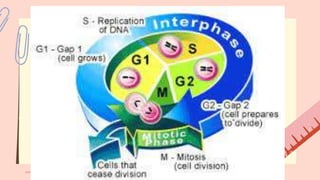
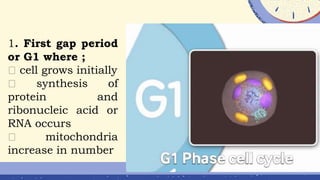
1. First gap period
or G1 where ;
cell grows initially
synthesis of
protein and
ribonucleic acid or
RNA occurs
mitochondria
increase in number
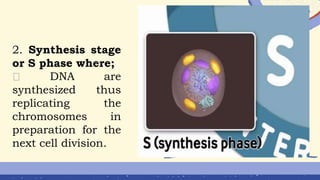
2. Synthesis stage
or S phase where;
DNA are
synthesized thus
replicating the
chromosomes in
preparation for the
next cell division.
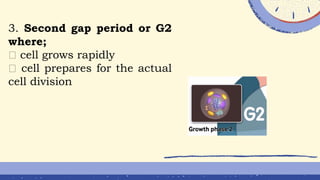
3. Second gap period or G2
where;
cell grows rapidly
cell prepares for the actual
cell division
2. A baseball is thrown up into the air.
What happens to the velocity as the ball
rises in the air?
a. the velocity increases
b. the velocity decreases
c. the velocity remains constant
d. None of the these.
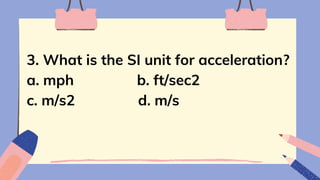
3. What is the SI unit for acceleration?
a. mph b. ft/sec2
c. m/s2 d. m/s
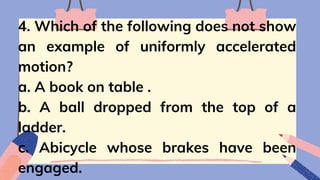
4. Which of the following does not show
an example of uniformly accelerated
motion?
a. A book on table .
b. A ball dropped from the top of a
ladder.
c. Abicycle whose brakes have been
engaged.
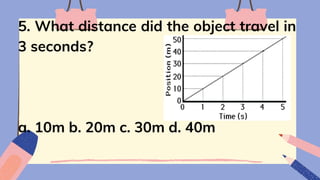
5. What distance did the object travel in
3 seconds?
a. 10m b. 20m c. 30m d. 40m
Thank You!

GRADE 8- SCIENCE 4TH QUARTER cell cycle.pptx

  • 1.
  • 2.
    Hi, students! How iseveryone doing?
  • 3.
    The chromosomes ofa cell change their form as they undergo cell transitions from one stage to another in a typical cell cycle.
  • 4.
    The cell cyclemay be divided into two stages: 1.Interphase 2.Cell Division
  • 5.
    The cell cyclemay be divided into two stages: 1.Interphase 2.Cell Division
  • 6.
    Interphase is theinterval between two cell divisions. During this stage, the cell is not dividing; it merely grows. The chromosome doubles or replicates itself because the DNA molecule contained in the chromosome produces a precise copy of itself.
  • 7.
    1. First gapperiod or G1 where ; cell grows initially synthesis of protein and ribonucleic acid or RNA occurs mitochondria increase in number
  • 8.
    2. Synthesis stage orS phase where; DNA are synthesized thus replicating the chromosomes in preparation for the next cell division.
  • 9.
    3. Second gapperiod or G2 where; cell grows rapidly cell prepares for the actual cell division
  • 10.
    2. A baseballis thrown up into the air. What happens to the velocity as the ball rises in the air? a. the velocity increases b. the velocity decreases c. the velocity remains constant d. None of the these.
  • 11.
    3. What isthe SI unit for acceleration? a. mph b. ft/sec2 c. m/s2 d. m/s
  • 12.
    4. Which ofthe following does not show an example of uniformly accelerated motion? a. A book on table . b. A ball dropped from the top of a ladder. c. Abicycle whose brakes have been engaged.
  • 13.
    5. What distancedid the object travel in 3 seconds? a. 10m b. 20m c. 30m d. 40m
  • 14.