GRADE : 6
SOCIAL SCIENCE
Geography
CHAPTER 3
Motions of the earth
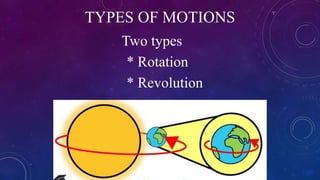
TYPES OF MOTIONS
Two types
* Rotation
* Revolution
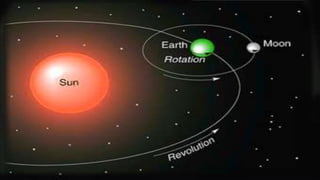
ROTATION
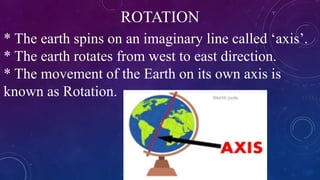
* The earth spins on an imaginary line called ‘axis’.
* The earth rotates from west to east direction.
* The movement of the Earth on its own axis is
known as Rotation.
ORBITAL PLANE
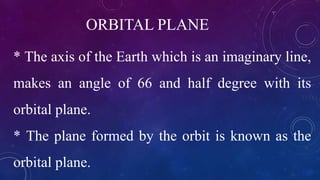
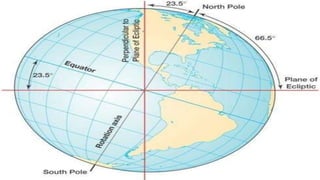
* The axis of the Earth which is an imaginary line,
makes an angle of 66 and half degree with its
orbital plane.
* The plane formed by the orbit is known as the
orbital plane.
CIRCLE OF ILLUMINATION
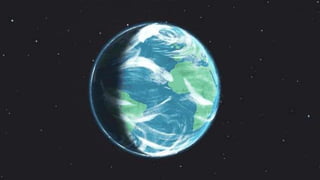
* Due to the spherical shape of the earth, only half
of it gets light from the Sun at a time.
* The portion facing the Sun experiences day and
the other half away from Sun experiences night.
* The circle that divides the day from night on the
globe is called circle of illumination
EARTHDAY
Earth day is the period of one rotation of the
earth is called one earthday.
1 earthday = 24 hours.
This is the daily motion of the earth.
WHAT WOULD HAPPEN IF THE EARTH DID
NOT ROTATE?
Earth facing the sun – Day – Warmth
Other half – Night – Freezing cold
* Life would not have been possible in
such extreme conditions.
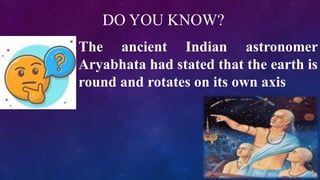
DO YOU KNOW?
The ancient Indian astronomer
Aryabhata had stated that the earth is
round and rotates on its own axis
REVOLUTION
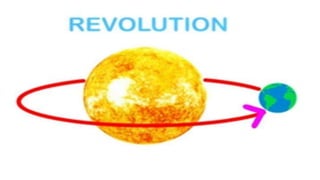
* The movement of the earth around the Sun in
in its orbit is called Revolution.
* It takes 365 days and 6 hours to revolve
around the Sun with the speed of 29.8 km/s.
* Six hours saved every year are added to make
one day (24 hours) over a span of four years.
* This surplus day is added to the month of
February.
LEAP YEAR
* Every fourth year, February is of 29 days instead
of 28 days.
* Such a year with 366 days is called a leap year.
FIND OUT WHEN WILL THE NEXT
LEAP YEAR BE?
ELLIPTICAL ORBIT
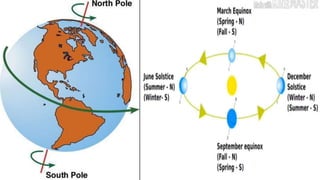
* The earth is going around the sun in an elliptical
orbit.
* Throughout its orbit , the earth is inclined in the
same direction.
* Because of the revolution of the earth we
experience different seasons.
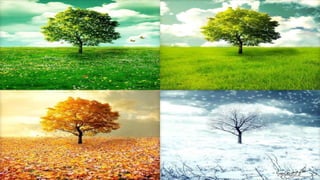
SEASONS
* Spring
* Summer
* Autumn
* Winter
* Seasons change due to the change in the
position of the earth around the sun.
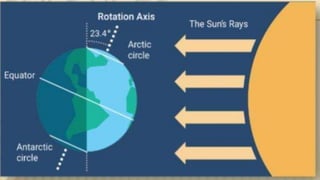
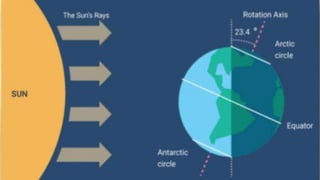
SOLSTICE
A solstice is the day when the midday sun
shines vertically overhead at one of the
tropics. (Tropic of Cancer or Tropic of
Capricorn)
* Summer Solstice – 21 June
* Winter Solstice – 22 December
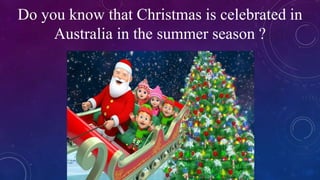
Do you know that Christmas is celebrated in
Australia in the summer season ?
EQUINOX
An equinox is the day when midday sun shines
vertically overhead at the equator.
21 March – North – Spring
South – Autumn
23 September – North – Autumn
South - Spring

Grade 6 Geography Chapter 3.pptx

  • 1.
    GRADE : 6 SOCIALSCIENCE Geography
  • 2.
  • 3.
    TYPES OF MOTIONS Twotypes * Rotation * Revolution
  • 5.
    ROTATION * The earthspins on an imaginary line called ‘axis’. * The earth rotates from west to east direction. * The movement of the Earth on its own axis is known as Rotation.
  • 6.
    ORBITAL PLANE * Theaxis of the Earth which is an imaginary line, makes an angle of 66 and half degree with its orbital plane. * The plane formed by the orbit is known as the orbital plane.
  • 8.
    CIRCLE OF ILLUMINATION *Due to the spherical shape of the earth, only half of it gets light from the Sun at a time. * The portion facing the Sun experiences day and the other half away from Sun experiences night. * The circle that divides the day from night on the globe is called circle of illumination
  • 10.
    EARTHDAY Earth day isthe period of one rotation of the earth is called one earthday. 1 earthday = 24 hours. This is the daily motion of the earth.
  • 11.
    WHAT WOULD HAPPENIF THE EARTH DID NOT ROTATE? Earth facing the sun – Day – Warmth Other half – Night – Freezing cold * Life would not have been possible in such extreme conditions.
  • 12.
    DO YOU KNOW? Theancient Indian astronomer Aryabhata had stated that the earth is round and rotates on its own axis
  • 13.
    REVOLUTION * The movementof the earth around the Sun in in its orbit is called Revolution. * It takes 365 days and 6 hours to revolve around the Sun with the speed of 29.8 km/s. * Six hours saved every year are added to make one day (24 hours) over a span of four years. * This surplus day is added to the month of February.
  • 15.
    LEAP YEAR * Everyfourth year, February is of 29 days instead of 28 days. * Such a year with 366 days is called a leap year.
  • 16.
    FIND OUT WHENWILL THE NEXT LEAP YEAR BE?
  • 17.
    ELLIPTICAL ORBIT * Theearth is going around the sun in an elliptical orbit. * Throughout its orbit , the earth is inclined in the same direction. * Because of the revolution of the earth we experience different seasons.
  • 18.
    SEASONS * Spring * Summer *Autumn * Winter * Seasons change due to the change in the position of the earth around the sun.
  • 21.
    SOLSTICE A solstice isthe day when the midday sun shines vertically overhead at one of the tropics. (Tropic of Cancer or Tropic of Capricorn)
  • 22.
    * Summer Solstice– 21 June * Winter Solstice – 22 December
  • 25.
    Do you knowthat Christmas is celebrated in Australia in the summer season ?
  • 26.
    EQUINOX An equinox isthe day when midday sun shines vertically overhead at the equator. 21 March – North – Spring South – Autumn 23 September – North – Autumn South - Spring