Earth motion
Hello friends my name is
sarthak today I will discuss
about earth motion
Wriiten and scripted
sarthak jha
Earth motion
Rotation
A rotation is a circular movement of an object around a centre of
rotation. If three-dimensional objects like earth, moon and other
planets always rotate around an imaginary line, it is called a rotation
axis. If the axis passes through the body’s centre of mass, the body is
said to rotate upon itself or spin. The spinning of the Earth around its
axis is called ‘rotation’. The axis has an angle of 2312∘ and is
perpendicular to the plane of Earth’s orbit. Which means, Earth is tilted
on its axis, and because of this tilt, the northern and southern
hemispheres lean in a direction away from the Sun. The rotation of the
Earth divides it into a lit-up half and a dark half, which gives rise to day
and night.
Revloution
Revolution is often used as a synonym for rotation. However, in many
fields like astronomy and its related subjects, revolution is referred to
as an orbital revolution. It is used when one body moves around
another, while rotation is used to mean the movement around the axis.
For example, the Moon revolves around the Earth and the Earth
revolves around the Sun. The movement of the Earth around the Sun in
a fixed path is called a revolution. The Earth revolves from west to east
i.e, in the anticlockwise direction. The Earth completes one revolution
around the Sun in one year or precisely in 365.242 days. The revolution
speed of the earth is 30 km/s-1.
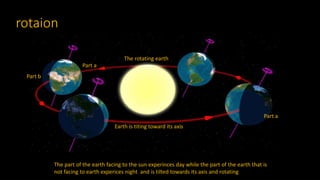
rotaion
The part of the earth facing to the sun experinces day while the part of the earth that is
not facing to earth experices night and is tilted towards its axis and rotating
Part a
Part b
Earth is titing toward its axis
Part a
The rotating earth
rotation
Earth's rotation is the rotation of planet Earth around its own axis. Earth rotates
eastward, in prograde motion. As viewed from the north pole star Polaris, Earth
turns counterclockwise.
The North Pole, also known as the Geographic North Pole or Terrestrial North Pole,
is the point in the Northern Hemisphere where Earth's axis of rotation meets its
surface. This point is distinct from Earth's North Magnetic Pole. The South Pole is
the other point where Earth's axis of rotation intersects its surface, in Antarctica.
Earth rotates once in about 24 hours with respect to the Sun, but once every 23
hours, 56 minutes, and 4 seconds with respect to other, distant, stars (see below).
Earth's rotation is slowing slightly with time; thus, a day was shorter in the past.
This is due to the tidal effects the Moon has on Earth's rotation.
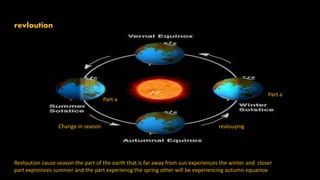
Revloution cause season the part of the earth that is far away from sun experiences the winter and closer
part expreinces summer and the part experiencg the spring other will be experiencing autumn equainox
revlouyingChange in season
Part a
Part a
revloution
revolution
that seasonal change occurs because of two things; the tilt of Earth on its
axis and its revolution around the sun. Revolution is the term used to
describe the orbit of Earth in space and will be the focus of this lesson. Earth
revolves around the sun in a counter-clockwise manner with one complete
revolution taking 365 ¼ days. This extra quarter day is responsible for our
leap year every four years. But, the revolution of Earth is responsible for
things much more noticeable than leap years. It's also responsible for our
changing seasons.
Notice how the earth has its top tilted away from the sun? This means the
Northern hemisphere (the top half) receives less direct solar radiation than
the Southern hemisphere (the bottom half).
Rotation and revloution

Rotation and revloution

  • 1.
    Earth motion Hello friendsmy name is sarthak today I will discuss about earth motion Wriiten and scripted sarthak jha
  • 2.
  • 3.
    Rotation A rotation isa circular movement of an object around a centre of rotation. If three-dimensional objects like earth, moon and other planets always rotate around an imaginary line, it is called a rotation axis. If the axis passes through the body’s centre of mass, the body is said to rotate upon itself or spin. The spinning of the Earth around its axis is called ‘rotation’. The axis has an angle of 2312∘ and is perpendicular to the plane of Earth’s orbit. Which means, Earth is tilted on its axis, and because of this tilt, the northern and southern hemispheres lean in a direction away from the Sun. The rotation of the Earth divides it into a lit-up half and a dark half, which gives rise to day and night.
  • 4.
    Revloution Revolution is oftenused as a synonym for rotation. However, in many fields like astronomy and its related subjects, revolution is referred to as an orbital revolution. It is used when one body moves around another, while rotation is used to mean the movement around the axis. For example, the Moon revolves around the Earth and the Earth revolves around the Sun. The movement of the Earth around the Sun in a fixed path is called a revolution. The Earth revolves from west to east i.e, in the anticlockwise direction. The Earth completes one revolution around the Sun in one year or precisely in 365.242 days. The revolution speed of the earth is 30 km/s-1.
  • 5.
    rotaion The part ofthe earth facing to the sun experinces day while the part of the earth that is not facing to earth experices night and is tilted towards its axis and rotating Part a Part b Earth is titing toward its axis Part a The rotating earth
  • 6.
    rotation Earth's rotation isthe rotation of planet Earth around its own axis. Earth rotates eastward, in prograde motion. As viewed from the north pole star Polaris, Earth turns counterclockwise. The North Pole, also known as the Geographic North Pole or Terrestrial North Pole, is the point in the Northern Hemisphere where Earth's axis of rotation meets its surface. This point is distinct from Earth's North Magnetic Pole. The South Pole is the other point where Earth's axis of rotation intersects its surface, in Antarctica. Earth rotates once in about 24 hours with respect to the Sun, but once every 23 hours, 56 minutes, and 4 seconds with respect to other, distant, stars (see below). Earth's rotation is slowing slightly with time; thus, a day was shorter in the past. This is due to the tidal effects the Moon has on Earth's rotation.
  • 7.
    Revloution cause seasonthe part of the earth that is far away from sun experiences the winter and closer part expreinces summer and the part experiencg the spring other will be experiencing autumn equainox revlouyingChange in season Part a Part a revloution
  • 8.
    revolution that seasonal changeoccurs because of two things; the tilt of Earth on its axis and its revolution around the sun. Revolution is the term used to describe the orbit of Earth in space and will be the focus of this lesson. Earth revolves around the sun in a counter-clockwise manner with one complete revolution taking 365 ¼ days. This extra quarter day is responsible for our leap year every four years. But, the revolution of Earth is responsible for things much more noticeable than leap years. It's also responsible for our changing seasons. Notice how the earth has its top tilted away from the sun? This means the Northern hemisphere (the top half) receives less direct solar radiation than the Southern hemisphere (the bottom half).