IN THE EARLIEST CITIES
The story of Harappa
2
The story of Harappa
◈ Very often, old buildings have a story to tell
◈ Nearly a hundred and fifty years ago, when
railway lines were being laid down for the
first time in the Punjab, engineers stumbled
upon the site of Harappa in present-day
Pakistan. 3
The story of Harappa
◈ To them, it seemed like a mound that was a rich source of ready made,
high quality bricks.
◈ So they carried off thousands of bricks from the walls of the old
buildings of the city to build railway lines.
◈ Many buildings were completely destroyed
◈ Then, about eighty years ago, archaeologists found the site, and realised
that this was one of the oldest cities in the subcontinent.
4
The story of Harappa
◈ As this was the first city to be discovered, all other sites from where
similar buildings (and other things) were found were described as
Harappan.
◈ These cities developed about 4700 years ago.
5
What was special about these
cities?
6
What was special about these cities
◈ What was special about these cities? Many of these cities were divided into two or
more parts.
◈ Usually, the part to the west was smaller but higher.
◈ Archaeologists describe this as the citadel.
◈ Generally, the part to the east was larger but lower.
◈ This is called the lower town. Very often walls of baked brick were built around
each part.
7
What was special about these cities
◈ The bricks were so well baked that they have lasted for thousands of years
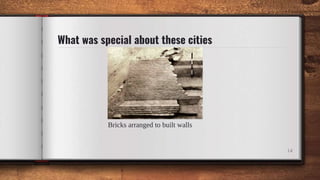
◈ The bricks were laid in an interlocking pattern and that made the walls strong.
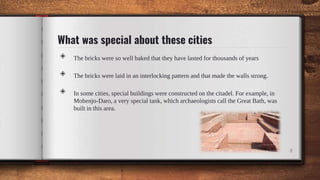
◈ In some cities, special buildings were constructed on the citadel. For example, in
Mohenjo-Daro, a very special tank, which archaeologists call the Great Bath, was
built in this area.
8
What was special about these cities
◈ This was lined with bricks, coated with plaster, and made water-tight with a layer
of natural tar. There were steps leading down to it from two sides, while there were
rooms on all sides.
◈ Water was probably brought in from a well, and drained out after use.
◈ Perhaps important people took a dip in this tank on special occasions
◈ Other cities, such as Kalibangan and Lothal had fire altars, where sacrifices may
have been performed.
9
What was special about these cities
◈ And some cities like Mohenjo-Daro, Harappa, and Lothal had elaborate store
houses.
10
Houses, drains and streets
11
Houses, Drains and stretts
◈ Generally, houses were either one or two storeys high, with rooms built around a
courtyard. Most houses had a separate bathing area, and some had wells to supply
water
◈ Many of these cities had covered drains. Notice how carefully these were laid out,
in straight lines.
◈ Although you cannot see it, each drain had a gentle slope so that water could flow
through it.
12
Houses, Drains and Stretts
◈ Very often, drains in houses were connected to those on the streets and smaller
drains led into bigger ones.
◈ . As the drains were covered, inspection holes were provided at intervals to clean
them.
◈ All three — houses, drains and streets — were probably planned and built at the
same time
13
What was special about these cities
Bricks arranged to built walls
14
Life in the city
15
Life in the city
◈ A Harappan city was a very busy place.
◈ There were people who planned the construction of special buildings in
the city.
◈ These were probably the rulers.
◈ It is likely that the rulers sent people to distant lands to get metal, precious stones,
and other things that they wanted
◈ They may have kept the most valuable objects, such as ornaments of gold and
silver, or beautiful beads, for themselves.
16
Life in the city
◈ And there were scribes, people who knew how to write, who helped prepare the
seals, and perhaps wrote on other materials that have not survived
◈ Besides, there were men and women, crafts persons, making all kinds of things —
either in their own homes, or in special workshops.|
◈ People were travelling to distant lands or returning with raw materials and, perhaps,
stories.
◈ Many terracotta toys have been found and children must have played with these.
17
New crafts in the city
18
New crafts in the city
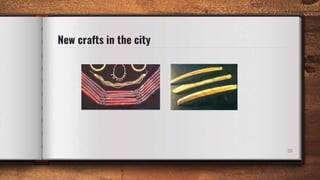
◈ Let us look at some of the objects that were made and found in Harappan cities
◈ Most of the things that have been found by archaeologists are made of stone, shell
and metal, including copper, bronze.
◈ Copper and bronze were used to make tools, weapons, ornaments and vessels.
◈ Gold and silver were used to make ornaments and vessels.
◈ Perhaps the most striking finds are those of beads, weights, and blades.
19
New crafts in the city
20
New crafts in the city
◈ The Harappans also made seals out of stone.
◈ These are generally rectangular
◈ and usually have an animal carved on them.
◈ The Harappans also made pots with beautiful black designs,
◈ Cotton was probably grown at Mehrgarh from about 7000 years ago.
◈ Actual pieces of cloth were found attached to the lid of a silver vase and some copper objects at Mohenjodaro.
21
New crafts in the city
◈ Archaeologists have also found spindle whorls, made of terracotta and faience
◈ Many of the things that were produced were probably the work of specialists.
◈ A specialist is a person who is trained to do only one kind of work, for example,
cutting stone, or polishing beads, or carving seals.
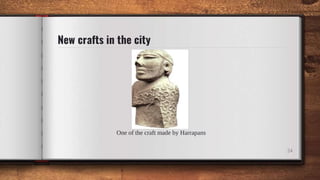
◈ Look at the illustration (page 28) and see how well the face is carved and how
carefully the beard is shown.
◈ This must have been the work of an expert crafts person
22
New crafts in the city
◈ Not everybody could have been a specialist.
◈ We do not know whether only men were specialists or only women were specialists
◈ Perhaps some women and men may have been specialists.
23
New crafts in the city
One of the craft made by Harrapans
24
In search of scarch of raw
materials
25
In search of raw materials
◈ Raw materials are substances that are either found naturally (such as wood, or ores of metals) or
produced by farmers or herders.
◈ These are then processed to produce finished goods
◈ For example, cotton, produced by farmers, is a raw material that may be processed to make
cloth.
◈ While some of the raw materials that the Harappans used were available locally, many items
such as copper, tin, gold, silver and precious stones had to be brought from distant places.

◈ The Harappans probably got copper from present-day Rajasthan, and even from Oman in West
Asia.
26
In search of raw materials
◈ Tin, which was mixed with copper to produce bronze, may have been brought from present-day Afghanistan
and Iran.
◈ Gold could have come all the way from present-day Karnataka, and precious stones from present-day Gujarat,
Iran and Afghanistan.
27
Food for people in the
cities
28
Food for people in the cities
◈ While many people lived in the cities, others living in the countryside grew crops and reared
animals
◈ These farmers and herders supplied food to crafts persons, scribes and rulers in the cities.
◈ We know from remains of plants that the Harappans grew wheat, barley, pulses, peas, rice,
sesame, linseed and mustard.
◈ A new tool, the plough, was used to dig the earth for turning the soil and planting seeds.
◈ While real ploughs, which were probably made of wood, have not survived, toy models have
been found.
29
Food for people in the cities
◈ As this region does not receive heavy rainfall, some form of irrigation may have
been used.
◈ that water was stored and supplied to the fields when the plants were growing.
◈ The Harappans reared cattle, sheep, goat and buffalo.
◈ Water and pastures were available around settlements.
◈ However, in the dry summer months large herds of animals were probably taken to
greater distances in search of grass and water. 30
A closer look — Harappan
towns in Gujrat
31
A closer look — Harappan to towns in Gujarat
◈ The city of Dholavira was located on Khadir Beyt (also spelled as Bet) in the Rann of Kutch,
where there was fresh water and fertile soil
◈ Unlike some of the other Harappan cities, which were divided into two parts, Dholavira was
divided into three parts, and each part was surrounded with massive stone walls, with entrances
through gateways. There was also a large open area in the settlement, where public ceremonies
could be held
◈ Other finds include large letters of the Harappan script that were carved out of white stone and
perhaps inlaid in wood.
◈ This is a unique find as generally Harappan writing has been found on small objects such as
seals.
32
A closer look — Harappan to towns in Gujarat
◈ The city of Lothal stood beside a tributary of the Sabarmati, in Gujarat, close to the
Gulf of Khambat.
◈ It was situated near areas where raw materials such as semi-precious stones were
easily available.
◈ This was an important centre for making objects out of stone, shell and metal.
◈ There was also a store house in the city.
◈ Many seals and sealings (the impression of seals on clay) were found in this
storehouse. 33
A closer look — Harappan to towns in Gujarat
◈ A building that was found here was probably a workshop for making
beads: pieces of stone, half made beads, tools for bead making, and
finished beads have all been found here.
34
A closer look — Harappan to towns in Gujarat
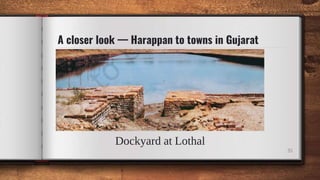
Dockyard at Lothal
35
The mystery of the end
36
The mystery of the end
◈ Around 3900 years ago we find the beginning of a major change.
◈ People stopped living in many of the cities
◈ Writing, seals and weights were no longer used
◈ Raw materials brought from long distances became rare.
◈ In Mohenjodaro, we find that garbage piled up on the streets, the drainage system
broke down, and new, less impressive houses were built, even over the streets.
37
The mystery of the end
◈ Why did all this happen? We are not sure. Some scholars suggest that the rivers dried up.
◈ Others suggest that there was deforestation.
◈ This could have happened because fuel was required for baking bricks, and for smelting copper ores
◈ Besides, grazing by large herds of cattle, sheep and goat may have destroyed the green cover.
◈ In some areas there were floods.
◈ But none of these reasons can explain the end of all the cities.
◈ Flooding, or a river drying up would have had an effect in only some areas.
38
The mystery of the end
◈ It appears as if the rulers lost control.
◈ In any case, the effects of the change are quite clear.
◈ Sites in Sind and west Punjab (present-day Pakistan) were abandoned,
while many people moved into newer, smaller settlements to the east and
the south.
◈ New cities emerged about 1400 years later.
39
THANKS!

NCERT Class 6 History CH 3

  • 1.
  • 2.
    The story ofHarappa 2
  • 3.
    The story ofHarappa ◈ Very often, old buildings have a story to tell ◈ Nearly a hundred and fifty years ago, when railway lines were being laid down for the first time in the Punjab, engineers stumbled upon the site of Harappa in present-day Pakistan. 3
  • 4.
    The story ofHarappa ◈ To them, it seemed like a mound that was a rich source of ready made, high quality bricks. ◈ So they carried off thousands of bricks from the walls of the old buildings of the city to build railway lines. ◈ Many buildings were completely destroyed ◈ Then, about eighty years ago, archaeologists found the site, and realised that this was one of the oldest cities in the subcontinent. 4
  • 5.
    The story ofHarappa ◈ As this was the first city to be discovered, all other sites from where similar buildings (and other things) were found were described as Harappan. ◈ These cities developed about 4700 years ago. 5
  • 6.
    What was specialabout these cities? 6
  • 7.
    What was specialabout these cities ◈ What was special about these cities? Many of these cities were divided into two or more parts. ◈ Usually, the part to the west was smaller but higher. ◈ Archaeologists describe this as the citadel. ◈ Generally, the part to the east was larger but lower. ◈ This is called the lower town. Very often walls of baked brick were built around each part. 7
  • 8.
    What was specialabout these cities ◈ The bricks were so well baked that they have lasted for thousands of years ◈ The bricks were laid in an interlocking pattern and that made the walls strong. ◈ In some cities, special buildings were constructed on the citadel. For example, in Mohenjo-Daro, a very special tank, which archaeologists call the Great Bath, was built in this area. 8
  • 9.
    What was specialabout these cities ◈ This was lined with bricks, coated with plaster, and made water-tight with a layer of natural tar. There were steps leading down to it from two sides, while there were rooms on all sides. ◈ Water was probably brought in from a well, and drained out after use. ◈ Perhaps important people took a dip in this tank on special occasions ◈ Other cities, such as Kalibangan and Lothal had fire altars, where sacrifices may have been performed. 9
  • 10.
    What was specialabout these cities ◈ And some cities like Mohenjo-Daro, Harappa, and Lothal had elaborate store houses. 10
  • 11.
  • 12.
    Houses, Drains andstretts ◈ Generally, houses were either one or two storeys high, with rooms built around a courtyard. Most houses had a separate bathing area, and some had wells to supply water ◈ Many of these cities had covered drains. Notice how carefully these were laid out, in straight lines. ◈ Although you cannot see it, each drain had a gentle slope so that water could flow through it. 12
  • 13.
    Houses, Drains andStretts ◈ Very often, drains in houses were connected to those on the streets and smaller drains led into bigger ones. ◈ . As the drains were covered, inspection holes were provided at intervals to clean them. ◈ All three — houses, drains and streets — were probably planned and built at the same time 13
  • 14.
    What was specialabout these cities Bricks arranged to built walls 14
  • 15.
    Life in thecity 15
  • 16.
    Life in thecity ◈ A Harappan city was a very busy place. ◈ There were people who planned the construction of special buildings in the city. ◈ These were probably the rulers. ◈ It is likely that the rulers sent people to distant lands to get metal, precious stones, and other things that they wanted ◈ They may have kept the most valuable objects, such as ornaments of gold and silver, or beautiful beads, for themselves. 16
  • 17.
    Life in thecity ◈ And there were scribes, people who knew how to write, who helped prepare the seals, and perhaps wrote on other materials that have not survived ◈ Besides, there were men and women, crafts persons, making all kinds of things — either in their own homes, or in special workshops.| ◈ People were travelling to distant lands or returning with raw materials and, perhaps, stories. ◈ Many terracotta toys have been found and children must have played with these. 17
  • 18.
    New crafts inthe city 18
  • 19.
    New crafts inthe city ◈ Let us look at some of the objects that were made and found in Harappan cities ◈ Most of the things that have been found by archaeologists are made of stone, shell and metal, including copper, bronze. ◈ Copper and bronze were used to make tools, weapons, ornaments and vessels. ◈ Gold and silver were used to make ornaments and vessels. ◈ Perhaps the most striking finds are those of beads, weights, and blades. 19
  • 20.
    New crafts inthe city 20
  • 21.
    New crafts inthe city ◈ The Harappans also made seals out of stone. ◈ These are generally rectangular ◈ and usually have an animal carved on them. ◈ The Harappans also made pots with beautiful black designs, ◈ Cotton was probably grown at Mehrgarh from about 7000 years ago. ◈ Actual pieces of cloth were found attached to the lid of a silver vase and some copper objects at Mohenjodaro. 21
  • 22.
    New crafts inthe city ◈ Archaeologists have also found spindle whorls, made of terracotta and faience ◈ Many of the things that were produced were probably the work of specialists. ◈ A specialist is a person who is trained to do only one kind of work, for example, cutting stone, or polishing beads, or carving seals. ◈ Look at the illustration (page 28) and see how well the face is carved and how carefully the beard is shown. ◈ This must have been the work of an expert crafts person 22
  • 23.
    New crafts inthe city ◈ Not everybody could have been a specialist. ◈ We do not know whether only men were specialists or only women were specialists ◈ Perhaps some women and men may have been specialists. 23
  • 24.
    New crafts inthe city One of the craft made by Harrapans 24
  • 25.
    In search ofscarch of raw materials 25
  • 26.
    In search ofraw materials ◈ Raw materials are substances that are either found naturally (such as wood, or ores of metals) or produced by farmers or herders. ◈ These are then processed to produce finished goods ◈ For example, cotton, produced by farmers, is a raw material that may be processed to make cloth. ◈ While some of the raw materials that the Harappans used were available locally, many items such as copper, tin, gold, silver and precious stones had to be brought from distant places. ◈ The Harappans probably got copper from present-day Rajasthan, and even from Oman in West Asia. 26
  • 27.
    In search ofraw materials ◈ Tin, which was mixed with copper to produce bronze, may have been brought from present-day Afghanistan and Iran. ◈ Gold could have come all the way from present-day Karnataka, and precious stones from present-day Gujarat, Iran and Afghanistan. 27
  • 28.
    Food for peoplein the cities 28
  • 29.
    Food for peoplein the cities ◈ While many people lived in the cities, others living in the countryside grew crops and reared animals ◈ These farmers and herders supplied food to crafts persons, scribes and rulers in the cities. ◈ We know from remains of plants that the Harappans grew wheat, barley, pulses, peas, rice, sesame, linseed and mustard. ◈ A new tool, the plough, was used to dig the earth for turning the soil and planting seeds. ◈ While real ploughs, which were probably made of wood, have not survived, toy models have been found. 29
  • 30.
    Food for peoplein the cities ◈ As this region does not receive heavy rainfall, some form of irrigation may have been used. ◈ that water was stored and supplied to the fields when the plants were growing. ◈ The Harappans reared cattle, sheep, goat and buffalo. ◈ Water and pastures were available around settlements. ◈ However, in the dry summer months large herds of animals were probably taken to greater distances in search of grass and water. 30
  • 31.
    A closer look— Harappan towns in Gujrat 31
  • 32.
    A closer look— Harappan to towns in Gujarat ◈ The city of Dholavira was located on Khadir Beyt (also spelled as Bet) in the Rann of Kutch, where there was fresh water and fertile soil ◈ Unlike some of the other Harappan cities, which were divided into two parts, Dholavira was divided into three parts, and each part was surrounded with massive stone walls, with entrances through gateways. There was also a large open area in the settlement, where public ceremonies could be held ◈ Other finds include large letters of the Harappan script that were carved out of white stone and perhaps inlaid in wood. ◈ This is a unique find as generally Harappan writing has been found on small objects such as seals. 32
  • 33.
    A closer look— Harappan to towns in Gujarat ◈ The city of Lothal stood beside a tributary of the Sabarmati, in Gujarat, close to the Gulf of Khambat. ◈ It was situated near areas where raw materials such as semi-precious stones were easily available. ◈ This was an important centre for making objects out of stone, shell and metal. ◈ There was also a store house in the city. ◈ Many seals and sealings (the impression of seals on clay) were found in this storehouse. 33
  • 34.
    A closer look— Harappan to towns in Gujarat ◈ A building that was found here was probably a workshop for making beads: pieces of stone, half made beads, tools for bead making, and finished beads have all been found here. 34
  • 35.
    A closer look— Harappan to towns in Gujarat Dockyard at Lothal 35
  • 36.
    The mystery ofthe end 36
  • 37.
    The mystery ofthe end ◈ Around 3900 years ago we find the beginning of a major change. ◈ People stopped living in many of the cities ◈ Writing, seals and weights were no longer used ◈ Raw materials brought from long distances became rare. ◈ In Mohenjodaro, we find that garbage piled up on the streets, the drainage system broke down, and new, less impressive houses were built, even over the streets. 37
  • 38.
    The mystery ofthe end ◈ Why did all this happen? We are not sure. Some scholars suggest that the rivers dried up. ◈ Others suggest that there was deforestation. ◈ This could have happened because fuel was required for baking bricks, and for smelting copper ores ◈ Besides, grazing by large herds of cattle, sheep and goat may have destroyed the green cover. ◈ In some areas there were floods. ◈ But none of these reasons can explain the end of all the cities. ◈ Flooding, or a river drying up would have had an effect in only some areas. 38
  • 39.
    The mystery ofthe end ◈ It appears as if the rulers lost control. ◈ In any case, the effects of the change are quite clear. ◈ Sites in Sind and west Punjab (present-day Pakistan) were abandoned, while many people moved into newer, smaller settlements to the east and the south. ◈ New cities emerged about 1400 years later. 39
  • 40.