Presentation on
Supply Chain Management
GOPALJEE : TRANSFORMING TRADITIONAL SUPPLY
CHAINS
Presented by:
SARIN RAJU
CET,TRIVANDRUM
1
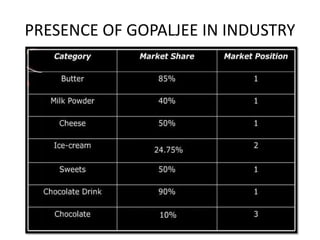
PRESENCE OF GOPALJEE IN INDUSTRY
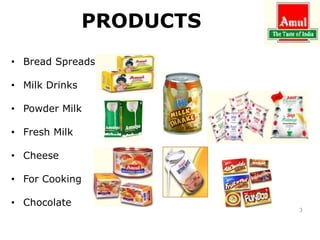
PRODUCTS
• Bread Spreads
• Milk Drinks
• Powder Milk
• Fresh Milk
• Cheese
• For Cooking
• Chocolate
3
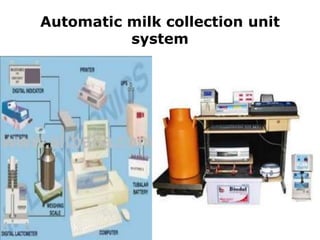
Automatic milk collection unit
system
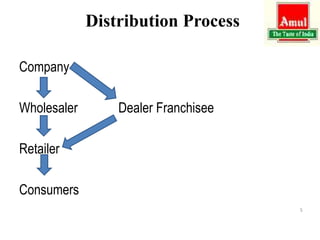
Distribution Process
Company
Wholesaler Dealer Franchisee
Retailer
Consumers
5
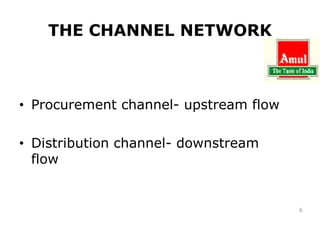
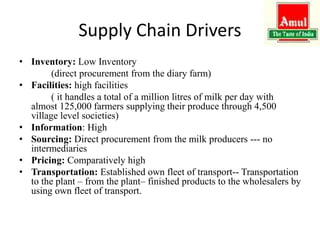
THE CHANNEL NETWORK
• Procurement channel- upstream flow
• Distribution channel- downstream
flow
6
Procurement
• Activities at the village level comprised
developing and servicing the VCSs.
• Increasing milk collection, procuring
milk, and transporting it to the chilling
and processing units twice a day.
• The VCSs provided the farmers with
good quality animal feed, fodder, and
other services like veterinary first aid.
7
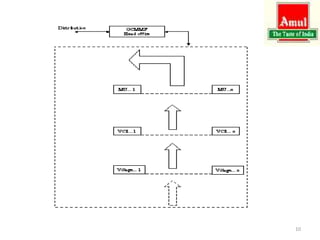
PROCUREMENT CHANNEL
(UPSTREAM)
• On an average around thousand farmers come to sell
milk at their local co-operative milk collection center.
• Each farmer has been given a plastic card for
identification.
• At the milk collection counter, the farmer drops the
card into a box and the identification number is
transmitted to a personal computer attached to the
machine.
• The milk is then weighed and the fat content of the
milk is measured by an electronic fat testing
machine.
Cont…
• Both these details are recorded in
the PC. The computer then
calculates the amount due to farmer
on the basis of the fat content.
• The value of the milk is then printed
out on a slip and handed over to
farmer who collects the payment at
adjacent window. 9
10
Cold Storage Network
• Chillers in proximity of villages
• Prompt transport to district facilities for
further dispatch to consumers/ processing
units.
• Chilled trucks to transport processed products
• Delivery to local chillers by insulated rail
tankers and chilled trucks.
• Refrigerators and freezers with retailers and
departmental stores to retain freshness. 11
Distribution
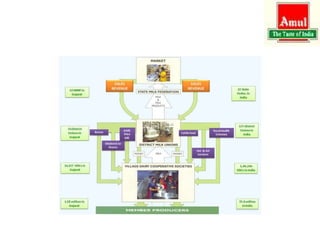
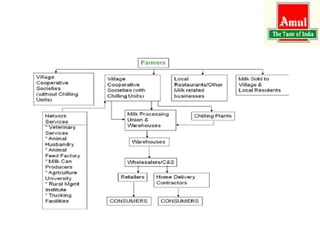
• GCMMF coordinated with various unions to get a
regular supply of milk and dairy products.
• The processed milk and dairy products were
procured from district dairy unions and
distributed through third party distributors.
• To ensure quality and timely deliveries, GCMMF
and the district unions had several mechanisms in
place.
• The unions monitored the supplies of milk and
the distribution of finished products. 12
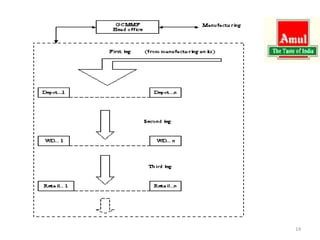
DOWNSTREAM FLOW
• First leg
• Manufacturing units to company depots using 9
and 18 MT trucks
• Frozen food below -18°C
• Dairy wet 0-4°C
• Second leg
• Depots to WDs
• Transport through insulated 3 and 5 MT TATA
407’s
• Third leg
• WDs to retailers
• Transport through rickshaws
13
14
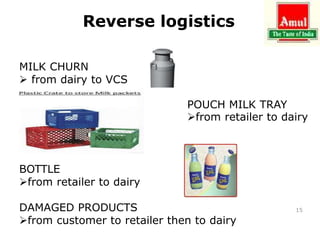
Reverse logistics
MILK CHURN
 from dairy to VCS
BOTTLE
from retailer to dairy
DAMAGED PRODUCTS
from customer to retailer then to dairy
15
POUCH MILK TRAY
from retailer to dairy
Direct retailing
• Amul has recently entered into direct
retailing through "Amul Utterly Delicious"
parlors created in major cities.
• Amul has plans to create a large chain of
such outlets to be managed by
franchisees throughout the country.
• More than 2000 parlor with a turnover of
Rs. 200 crores.
16
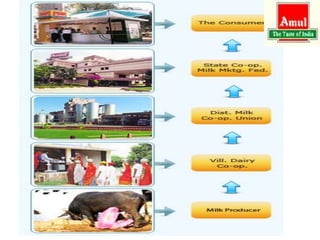
Supply Chain Drivers
• Inventory: Low Inventory
(direct procurement from the diary farm)
• Facilities: high facilities
( it handles a total of a million litres of milk per day with
almost 125,000 farmers supplying their produce through 4,500
village level societies)
• Information: High
• Sourcing: Direct procurement from the milk producers --- no
intermediaries
• Pricing: Comparatively high
• Transportation: Established own fleet of transport-- Transportation
to the plant – from the plant– finished products to the wholesalers by
using own fleet of transport.
18
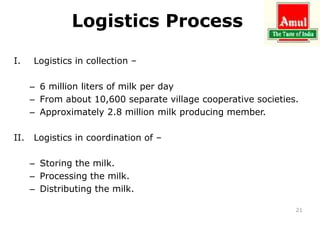
Logistics Process
I. Logistics in collection –
– 6 million liters of milk per day
– From about 10,600 separate village cooperative societies.
– Approximately 2.8 million milk producing member.
II. Logistics in coordination of –
– Storing the milk.
– Processing the milk.
– Distributing the milk.
21
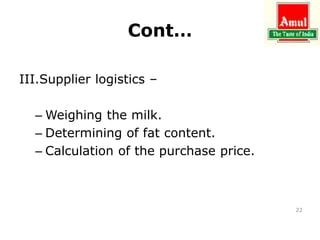
Cont…
III.Supplier logistics –
– Weighing the milk.
– Determining of fat content.
– Calculation of the purchase price.
22
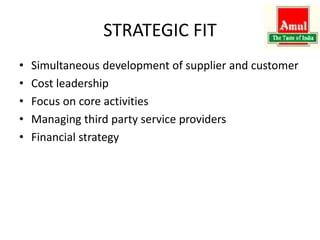
STRATEGIC FIT
• Simultaneous development of supplier and customer
• Cost leadership
• Focus on core activities
• Managing third party service providers
• Financial strategy
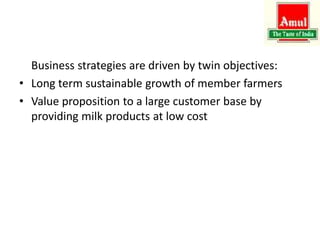
Business strategies are driven by twin objectives:
• Long term sustainable growth of member farmers
• Value proposition to a large customer base by
providing milk products at low cost
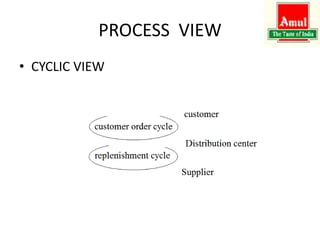
PROCESS VIEW
• CYCLIC VIEW
• PULL VIEW
– Anticipating customer demand
– Collection of milk—purifying– storage– conversion
to different milk products
INDIAN SUPPLY CHAIN SYSTEM—
A GLOBAL APPROACH
-Op Maestros
SOLOTAXONOMY APPROACH
PRIMARY LEVEL
INDIAN BUSINESS ARE HIGHLY FRAGMENTED.
UNISTRUCTURAL LEVEL
• ABSENCE OF INDUSTRY ROLE MODELS AND
BENCH MARKS MADE INDIAN BUSINESS
HIGHLY FRAMENTED IN WHICH THE SMALL
AND MICROSCALE OPERATIONS
PREDOMINATE
MULTI-STRUCTURAL LEVEL
• PAST ,INDIAN BUSINESS WAS HIGHLY
FRAGMENTED IN WHICH SMALLAND
MICROSCALE OPERATIONS PREDOMINATE.
• RISE OF GCMMF AND THEIR BRAND AMUL
RESTRUCTURED THIS CONCEPT.
RELATIONAL LEVEL
• PAST,INDIAN BUSINESS WAS HIGHLY
FRAGMENTED .
• RISE OF GCMMF AND THEIR BRAND AMUL
RESTRUCTURED THIS CONCEPT.
• MANY COMPANIES LIKE GOPALJEE GROUP OF
COMPANIES USE THE SAME ROADS TO
ACHIEVE PEAKS.
OUT OF BOX
• ELIMINATION OF INTERMEDIARIES BETWEEN
THE MANUFACTURERS AND CUSTOMERS –
REDUCTION IN INVENTORY COST—HANDLING
COST– TRANSPORTATION COST
How can Gopaljee supply and distribution model
be extended to other business lines in the Indian
and South Asian context?
• Indian subcontinent countries had highly
fragmented structure in which small and
micro scale operations predominate ,if not
control the entire sectors.
• The main reason behind this is the absence of
proper bench mark and role models.
a) Practice in Agriculture
 Indian subcontinent have mainly Agrarian
countries. The supply Chain system can be
usedd by these companies too, where retail
agriculture products are selling.
 They can remove the middle men,by directly
collecting vegetables and fruits from farmers
The role of Intermediary in Indian Agriculture
is very high .
They can also arrange classes for meeting
International standards(ie bio fertilizers,Bio
pesticides)
These companies can bench mark from
national and international experts in these
area like RELIANCE FRESH.
• Practice in Fisheries.
Indian Subcontinent is blessed with Fisheries due
to the presence of Indian Ocean-Arabian Sea—
Bay of Bengal .
Fishing Exporting and Processing companies can
also follow this system of supply chain.
They can reduce the intermediaries who act as a
link between fisherman and companies, there by
reducing the cost
Training Classes and Bench Marking is also
possible in this area.
What socio economic features of South Asian
societies can be identified as the foundations for
building Sustainable Supply Chains
• Family Bondage
Most of the companies in Indian Subcontinent
are run by a particular family rather than by
Debt-Equity share holders. Typical examples
includes Traditional TATA, Ambani group.They
follow a systematic supply chain linking their
family chain
• Caste System
South East Asia will be the only Geographical
area,where a certain group is allowed to do
only a specific set of Job.
This create a large supply chain. Both the Public
as well as Private Sector Companies are forced
to maintain a sustainable supply chain
• Emotional Bondage
South Asian countries gave predominant
consideration for emotions rather than
Marketing and Expanding Strategies.
This act as a foundation for building sustainable
supply chain
• Economic Factors
a)Subsistence Theory
Once a company follows a particular supply
chain,it become difficult to remove the chain,
as it affects the subsistence of that firm.
• B) Strategic Alliance
Strategic alliance between different companies
forced them to maintain a sustainable supply
chain.
How can these existing distribution channels in
South Asian regions be transformed to maximize
the value delivered to the customer?
a. Setup an international Bench Mark
b. Follow International Standards
c. Use best in Market Channel
d. Reduce the Intermediaries
e. Training Classes for every elements in
distribution channel
How can such indigenously developed SCM
modes integrate with and expand into
Global Supply Chain
• 3R system
• Reduce number of Intermediaries
• Setting up of International Bench Mark
• Giving Environment Considerations
• Sustainable Development Concept
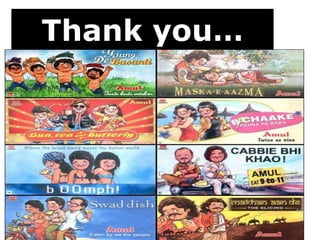
Thank you…
44

GOPALJEE : TRANSFORMING TRADITIONAL SUPPLY CHAINS

  • 1.
    Presentation on Supply ChainManagement GOPALJEE : TRANSFORMING TRADITIONAL SUPPLY CHAINS Presented by: SARIN RAJU CET,TRIVANDRUM 1
  • 2.
  • 3.
    PRODUCTS • Bread Spreads •Milk Drinks • Powder Milk • Fresh Milk • Cheese • For Cooking • Chocolate 3
  • 4.
  • 5.
    Distribution Process Company Wholesaler DealerFranchisee Retailer Consumers 5
  • 6.
    THE CHANNEL NETWORK •Procurement channel- upstream flow • Distribution channel- downstream flow 6
  • 7.
    Procurement • Activities atthe village level comprised developing and servicing the VCSs. • Increasing milk collection, procuring milk, and transporting it to the chilling and processing units twice a day. • The VCSs provided the farmers with good quality animal feed, fodder, and other services like veterinary first aid. 7
  • 8.
    PROCUREMENT CHANNEL (UPSTREAM) • Onan average around thousand farmers come to sell milk at their local co-operative milk collection center. • Each farmer has been given a plastic card for identification. • At the milk collection counter, the farmer drops the card into a box and the identification number is transmitted to a personal computer attached to the machine. • The milk is then weighed and the fat content of the milk is measured by an electronic fat testing machine.
  • 9.
    Cont… • Both thesedetails are recorded in the PC. The computer then calculates the amount due to farmer on the basis of the fat content. • The value of the milk is then printed out on a slip and handed over to farmer who collects the payment at adjacent window. 9
  • 10.
  • 11.
    Cold Storage Network •Chillers in proximity of villages • Prompt transport to district facilities for further dispatch to consumers/ processing units. • Chilled trucks to transport processed products • Delivery to local chillers by insulated rail tankers and chilled trucks. • Refrigerators and freezers with retailers and departmental stores to retain freshness. 11
  • 12.
    Distribution • GCMMF coordinatedwith various unions to get a regular supply of milk and dairy products. • The processed milk and dairy products were procured from district dairy unions and distributed through third party distributors. • To ensure quality and timely deliveries, GCMMF and the district unions had several mechanisms in place. • The unions monitored the supplies of milk and the distribution of finished products. 12
  • 13.
    DOWNSTREAM FLOW • Firstleg • Manufacturing units to company depots using 9 and 18 MT trucks • Frozen food below -18°C • Dairy wet 0-4°C • Second leg • Depots to WDs • Transport through insulated 3 and 5 MT TATA 407’s • Third leg • WDs to retailers • Transport through rickshaws 13
  • 14.
  • 15.
    Reverse logistics MILK CHURN from dairy to VCS BOTTLE from retailer to dairy DAMAGED PRODUCTS from customer to retailer then to dairy 15 POUCH MILK TRAY from retailer to dairy
  • 16.
    Direct retailing • Amulhas recently entered into direct retailing through "Amul Utterly Delicious" parlors created in major cities. • Amul has plans to create a large chain of such outlets to be managed by franchisees throughout the country. • More than 2000 parlor with a turnover of Rs. 200 crores. 16
  • 17.
    Supply Chain Drivers •Inventory: Low Inventory (direct procurement from the diary farm) • Facilities: high facilities ( it handles a total of a million litres of milk per day with almost 125,000 farmers supplying their produce through 4,500 village level societies) • Information: High • Sourcing: Direct procurement from the milk producers --- no intermediaries • Pricing: Comparatively high • Transportation: Established own fleet of transport-- Transportation to the plant – from the plant– finished products to the wholesalers by using own fleet of transport.
  • 18.
  • 21.
    Logistics Process I. Logisticsin collection – – 6 million liters of milk per day – From about 10,600 separate village cooperative societies. – Approximately 2.8 million milk producing member. II. Logistics in coordination of – – Storing the milk. – Processing the milk. – Distributing the milk. 21
  • 22.
    Cont… III.Supplier logistics – –Weighing the milk. – Determining of fat content. – Calculation of the purchase price. 22
  • 23.
    STRATEGIC FIT • Simultaneousdevelopment of supplier and customer • Cost leadership • Focus on core activities • Managing third party service providers • Financial strategy
  • 24.
    Business strategies aredriven by twin objectives: • Long term sustainable growth of member farmers • Value proposition to a large customer base by providing milk products at low cost
  • 25.
  • 26.
    • PULL VIEW –Anticipating customer demand – Collection of milk—purifying– storage– conversion to different milk products
  • 27.
    INDIAN SUPPLY CHAINSYSTEM— A GLOBAL APPROACH -Op Maestros
  • 28.
    SOLOTAXONOMY APPROACH PRIMARY LEVEL INDIANBUSINESS ARE HIGHLY FRAGMENTED.
  • 29.
    UNISTRUCTURAL LEVEL • ABSENCEOF INDUSTRY ROLE MODELS AND BENCH MARKS MADE INDIAN BUSINESS HIGHLY FRAMENTED IN WHICH THE SMALL AND MICROSCALE OPERATIONS PREDOMINATE
  • 30.
    MULTI-STRUCTURAL LEVEL • PAST,INDIAN BUSINESS WAS HIGHLY FRAGMENTED IN WHICH SMALLAND MICROSCALE OPERATIONS PREDOMINATE. • RISE OF GCMMF AND THEIR BRAND AMUL RESTRUCTURED THIS CONCEPT.
  • 31.
    RELATIONAL LEVEL • PAST,INDIANBUSINESS WAS HIGHLY FRAGMENTED . • RISE OF GCMMF AND THEIR BRAND AMUL RESTRUCTURED THIS CONCEPT. • MANY COMPANIES LIKE GOPALJEE GROUP OF COMPANIES USE THE SAME ROADS TO ACHIEVE PEAKS.
  • 32.
    OUT OF BOX •ELIMINATION OF INTERMEDIARIES BETWEEN THE MANUFACTURERS AND CUSTOMERS – REDUCTION IN INVENTORY COST—HANDLING COST– TRANSPORTATION COST
  • 33.
    How can Gopaljeesupply and distribution model be extended to other business lines in the Indian and South Asian context? • Indian subcontinent countries had highly fragmented structure in which small and micro scale operations predominate ,if not control the entire sectors. • The main reason behind this is the absence of proper bench mark and role models.
  • 34.
    a) Practice inAgriculture  Indian subcontinent have mainly Agrarian countries. The supply Chain system can be usedd by these companies too, where retail agriculture products are selling.  They can remove the middle men,by directly collecting vegetables and fruits from farmers
  • 35.
    The role ofIntermediary in Indian Agriculture is very high . They can also arrange classes for meeting International standards(ie bio fertilizers,Bio pesticides) These companies can bench mark from national and international experts in these area like RELIANCE FRESH.
  • 36.
    • Practice inFisheries. Indian Subcontinent is blessed with Fisheries due to the presence of Indian Ocean-Arabian Sea— Bay of Bengal . Fishing Exporting and Processing companies can also follow this system of supply chain. They can reduce the intermediaries who act as a link between fisherman and companies, there by reducing the cost Training Classes and Bench Marking is also possible in this area.
  • 37.
    What socio economicfeatures of South Asian societies can be identified as the foundations for building Sustainable Supply Chains • Family Bondage Most of the companies in Indian Subcontinent are run by a particular family rather than by Debt-Equity share holders. Typical examples includes Traditional TATA, Ambani group.They follow a systematic supply chain linking their family chain
  • 38.
    • Caste System SouthEast Asia will be the only Geographical area,where a certain group is allowed to do only a specific set of Job. This create a large supply chain. Both the Public as well as Private Sector Companies are forced to maintain a sustainable supply chain
  • 39.
    • Emotional Bondage SouthAsian countries gave predominant consideration for emotions rather than Marketing and Expanding Strategies. This act as a foundation for building sustainable supply chain
  • 40.
    • Economic Factors a)SubsistenceTheory Once a company follows a particular supply chain,it become difficult to remove the chain, as it affects the subsistence of that firm.
  • 41.
    • B) StrategicAlliance Strategic alliance between different companies forced them to maintain a sustainable supply chain.
  • 42.
    How can theseexisting distribution channels in South Asian regions be transformed to maximize the value delivered to the customer? a. Setup an international Bench Mark b. Follow International Standards c. Use best in Market Channel d. Reduce the Intermediaries e. Training Classes for every elements in distribution channel
  • 43.
    How can suchindigenously developed SCM modes integrate with and expand into Global Supply Chain • 3R system • Reduce number of Intermediaries • Setting up of International Bench Mark • Giving Environment Considerations • Sustainable Development Concept
  • 44.