   Retail Store- Saras Dairy

   Traditional Outlet – Local Milkman
INTRODUCTION
 Towards fulfillment of the national objective
  of making India self-sufficient in milk
  production, a small step was taken in
  March 1975 and Jaipur Zila Dugdh Utpadak
  Sahakari Sangh Ltd., Jaipur (popularly
  known as Jaipur Dairy)
 It was registered under Cooperative Act
  1965 to work in then Jaipur District. Initially
  this union did not have the processing
  facilities. It started with a modest beginning
  of procuring 250 liters of milk per day.
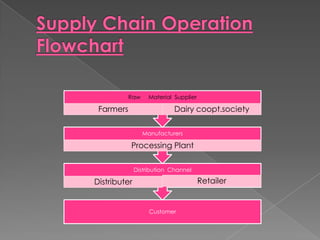
Raw     Material Supplier

 Farmers                    Dairy coopt.society

                 Manufacturers

           Processing Plant

              Distribution Channel

Distributer                            Retailer


                   Customer
   Procurement of raw material /supplier:

 Farmer's Organization,
 Input Services like Animal Health Coverage, animal
  breeding programme,
 Supply of balanced cattle feed and improved high
  yielding fodder seeds to the members,
 Cooperative institution building


   Processing plant:

 Processing facilities of the dairy plant presently include
  multidimensional activities
 At the Dairy stringent hygienic standards are maintained
   Distributor
   Processed milk is then packed into different units in
    hygienic plastic for the easiness of customer.
   It is then loaded into the transporting vehicles to
    various outlets inside the jaipur and insulated vehicles
    are used for delivering outside the jaipur


   Retailers:
   Jaipur Dairy sells its milk & milk products through a
    network of over 4500 retail outlets spread over Jaipur
    city and nearby 100 towns.


   Customers:
   Customers according to their need purchase the milk
    from the nearest retail outlet
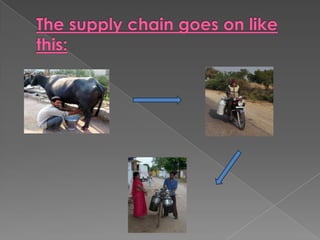
   Local vendors are those who serve the
    milk requirements. The supply chain
    includes direct serving to the customer.
    The customer approaches to the
    Milkman directly and either he serves at
    home or customer goes to the place of
    milkman for taking milk.

   Organized follows a set structure to supply products to customer
    whereas unorganized supply or serve directly to customer.

   Cost in organized is high as to maintain and continue the smooth flow of
    supply chain whereas cost involved in this is negligible low

   Proper storage options are there with organized system because they
    supply in bulk so they have to preserve the large amount of milk for
    timely supply.

   Demand forecasting is proper in organized as they got feedback from
    customers regular, so less chances of wastage.

   Lead time in unorganized is less as the market is very small.

   Flow of information might be detractive as it flows through different
    levels.
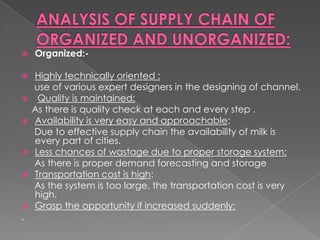
   Organized:-

   Highly technically oriented :
    use of various expert designers in the designing of channel.
    Quality is maintained:
    As there is quality check at each and every step .
   Availability is very easy and approachable:
    Due to effective supply chain the availability of milk is
    every part of cities.
   Less chances of wastage due to proper storage system:
    As there is proper demand forecasting and storage
   Transportation cost is high:
    As the system is too large, the transportation cost is very
    high.
   Grasp the opportunity if increased suddenly:
.
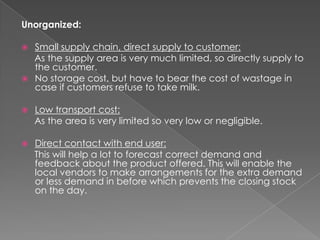
Unorganized:

 Small supply chain, direct supply to customer:
  As the supply area is very much limited, so directly supply to
  the customer.
 No storage cost, but have to bear the cost of wastage in
  case if customers refuse to take milk.

   Low transport cost:
    As the area is very limited so very low or negligible.

   Direct contact with end user:
    This will help a lot to forecast correct demand and
    feedback about the product offered. This will enable the
    local vendors to make arrangements for the extra demand
    or less demand in before which prevents the closing stock
    on the day.
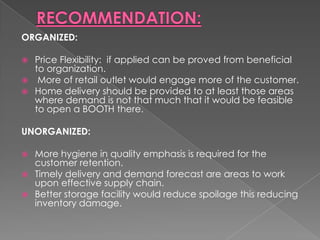
ORGANIZED:

 Price Flexibility: if applied can be proved from beneficial
  to organization.
 More of retail outlet would engage more of the customer.
 Home delivery should be provided to at least those areas
  where demand is not that much that it would be feasible
  to open a BOOTH there.

UNORGANIZED:

 More hygiene in quality emphasis is required for the
  customer retention.
 Timely delivery and demand forecast are areas to work
  upon effective supply chain.
 Better storage facility would reduce spoilage this reducing
  inventory damage.
Supply chain management

Supply chain management

  • 2.
    Retail Store- Saras Dairy  Traditional Outlet – Local Milkman
  • 3.
    INTRODUCTION  Towards fulfillmentof the national objective of making India self-sufficient in milk production, a small step was taken in March 1975 and Jaipur Zila Dugdh Utpadak Sahakari Sangh Ltd., Jaipur (popularly known as Jaipur Dairy)  It was registered under Cooperative Act 1965 to work in then Jaipur District. Initially this union did not have the processing facilities. It started with a modest beginning of procuring 250 liters of milk per day.
  • 4.
    Raw Material Supplier Farmers Dairy coopt.society Manufacturers Processing Plant Distribution Channel Distributer Retailer Customer
  • 5.
    Procurement of raw material /supplier:  Farmer's Organization,  Input Services like Animal Health Coverage, animal breeding programme,  Supply of balanced cattle feed and improved high yielding fodder seeds to the members,  Cooperative institution building  Processing plant:  Processing facilities of the dairy plant presently include multidimensional activities  At the Dairy stringent hygienic standards are maintained
  • 6.
    Distributor  Processed milk is then packed into different units in hygienic plastic for the easiness of customer.  It is then loaded into the transporting vehicles to various outlets inside the jaipur and insulated vehicles are used for delivering outside the jaipur  Retailers:  Jaipur Dairy sells its milk & milk products through a network of over 4500 retail outlets spread over Jaipur city and nearby 100 towns.  Customers:  Customers according to their need purchase the milk from the nearest retail outlet
  • 7.
    Local vendors are those who serve the milk requirements. The supply chain includes direct serving to the customer. The customer approaches to the Milkman directly and either he serves at home or customer goes to the place of milkman for taking milk. 
  • 9.
    Organized follows a set structure to supply products to customer whereas unorganized supply or serve directly to customer.  Cost in organized is high as to maintain and continue the smooth flow of supply chain whereas cost involved in this is negligible low  Proper storage options are there with organized system because they supply in bulk so they have to preserve the large amount of milk for timely supply.  Demand forecasting is proper in organized as they got feedback from customers regular, so less chances of wastage.  Lead time in unorganized is less as the market is very small.  Flow of information might be detractive as it flows through different levels.
  • 10.
    Organized:-  Highly technically oriented : use of various expert designers in the designing of channel.  Quality is maintained: As there is quality check at each and every step .  Availability is very easy and approachable: Due to effective supply chain the availability of milk is every part of cities.  Less chances of wastage due to proper storage system: As there is proper demand forecasting and storage  Transportation cost is high: As the system is too large, the transportation cost is very high.  Grasp the opportunity if increased suddenly: .
  • 11.
    Unorganized:  Small supplychain, direct supply to customer: As the supply area is very much limited, so directly supply to the customer.  No storage cost, but have to bear the cost of wastage in case if customers refuse to take milk.  Low transport cost: As the area is very limited so very low or negligible.  Direct contact with end user: This will help a lot to forecast correct demand and feedback about the product offered. This will enable the local vendors to make arrangements for the extra demand or less demand in before which prevents the closing stock on the day.
  • 12.
    ORGANIZED:  Price Flexibility:if applied can be proved from beneficial to organization.  More of retail outlet would engage more of the customer.  Home delivery should be provided to at least those areas where demand is not that much that it would be feasible to open a BOOTH there. UNORGANIZED:  More hygiene in quality emphasis is required for the customer retention.  Timely delivery and demand forecast are areas to work upon effective supply chain.  Better storage facility would reduce spoilage this reducing inventory damage.