STARLINK
ASSIST. LECTURER RIDWAN BOYA MARQAS
BM – DUHOK PRIVATE TECHNICAL INSTITUTE
2020 - 2021
STARLINK OUTLINE
HIGH SPEED INTERNET ACCESS ACROSS THE
GLOBE
KEEPING SPACE CLEAN
LESS MASS, MORE COMPACT
ANTENNAS
SINGULAR SOLAR ARRAY
ION PROPULSION SYSTEMS
STAR TRACKER
AUTONOMOUS COLLISION
AVOIDANCE
COVERAGE AREA
Network Technology
Kit & cost
Starlink Live tracker
STARLINK
HIGH SPEED INTERNET ACCESS
ACROSS THE GLOBE
• With performance that far surpasses that of traditional satellite
internet, and a global network unbounded by ground
infrastructure limitations, Starlink will deliver high speed
broadband internet to locations where access has been
unreliable, expensive, or completely unavailable.
• Starlink is targeting service in the Northern U.S. and Canada in
2020, rapidly expanding to near global coverage of the
populated world by 2021.
• Reference: www.starlink.com
KEEPING SPACE CLEAN • Starlink is on the leading
edge of on-orbit debris
mitigation, meeting or
exceeding all regulatory
and industry standards.
• At end of life, the satellites
will utilize their on-board
propulsion system to
deorbit over the course of
a few months. In the
unlikely event the
propulsion system
becomes inoperable, the
satellites will burn up in
Earth’s atmosphere within
1-5 years, significantly less
than the hundreds or
thousands of years
required at higher
altitudes.
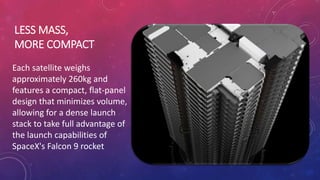
LESS MASS,
MORE COMPACT
Each satellite weighs
approximately 260kg and
features a compact, flat-panel
design that minimizes volume,
allowing for a dense launch
stack to take full advantage of
the launch capabilities of
SpaceX's Falcon 9 rocket
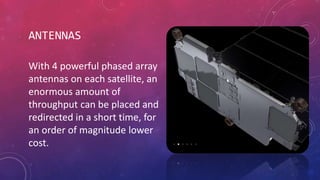
ANTENNAS
With 4 powerful phased array
antennas on each satellite, an
enormous amount of
throughput can be placed and
redirected in a short time, for
an order of magnitude lower
cost.
SINGULAR SOLAR ARRAY
• Starlink satellites feature a
single solar array, significantly
simplifying the system; solar
cells are standardized, and
easy to integrate into the
manufacturing process.
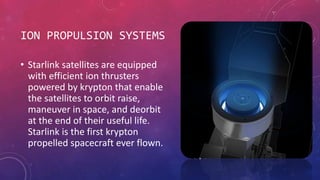
ION PROPULSION SYSTEMS
• Starlink satellites are equipped
with efficient ion thrusters
powered by krypton that enable
the satellites to orbit raise,
maneuver in space, and deorbit
at the end of their useful life.
Starlink is the first krypton
propelled spacecraft ever flown.
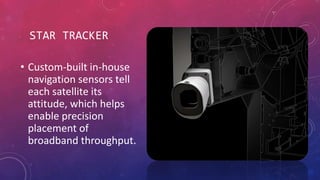
STAR TRACKER
• Custom-built in-house
navigation sensors tell
each satellite its
attitude, which helps
enable precision
placement of
broadband throughput.
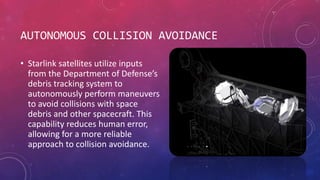
AUTONOMOUS COLLISION AVOIDANCE
• Starlink satellites utilize inputs
from the Department of Defense’s
debris tracking system to
autonomously perform maneuvers
to avoid collisions with space
debris and other spacecraft. This
capability reduces human error,
allowing for a more reliable
approach to collision avoidance.
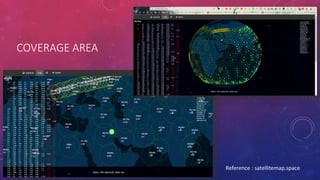
COVERAGE AREA
Reference : satellitemap.space
Starlink has over 800
operational satellites.
Some of the original
satellites from the first
two launches have
been deorbited, so we
don’t include these in
the official count.
NETWORK TECHNOLOGY
Starlink will eventually have 12,000
or more satellites in its Starlink
constellation. Starlink will be
capable of
delivering internet speeds of 100
Mbps or more with ultralow latency
to people all around the world.
Customers will just need a Starlink
dish receiver (what Elon Musk calls
“a UFO on a stick”) and a monthly
internet plan from Starlink.
reusable launch rockets,
Starlink’s low-orbit
satellites cost a fraction of
the price of typical
satellite launches, making
it easier and more
affordable to launch
satellites at scale
KIT & COST
SpaceX priced the Starlink Kit at $499 USD. The company states the phased-array dish
"is more advanced than what's in fighter jets." The monthly broadband service fee is
priced at $99 USD. SpaceX told early customers that they are part of a beta testing
phase of the network called "Better Than Nothing Beta" test program. The company
sent out an e-mail to potential customers which details what early Starlink users can
expect from being part of the program --"As you can see from the title, we are trying to
lower your initial expectations," SpaceX wrote, "Expect to see data speeds vary from
50Mb/s to 150Mb/s [megabits per second] and latency from 20ms to 40ms
[milliseconds] over the next several months as we enhance the Starlink system. There
will also be brief periods of no connectivity at all," the email reads. SpaceX states that
as more satellites are deployed to orbit the network's speed and reliability will increase
--"As we launch more satellites, install more ground stations and improve our
networking software, data speed, latency and uptime will improve dramatically," the
company wrote. "For latency, we expect to achieve 16ms to 19ms by summer 2021."
Reference : www.tesmanian.com/blogs/tesmanian-blog/starlink-speed
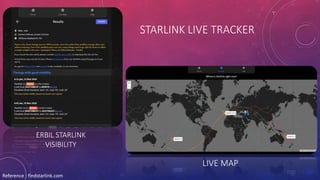
STARLINK LIVE TRACKER
LIVE MAP
ERBIL STARLINK
VISIBILITY
Reference : findstarlink.com
THANK YOU!
PGMR.RED@GMAIL.COM
RIDWAN.MARQAS@DHK-PTI.COM

STARLINK.pptx

  • 1.
    STARLINK ASSIST. LECTURER RIDWANBOYA MARQAS BM – DUHOK PRIVATE TECHNICAL INSTITUTE 2020 - 2021
  • 2.
    STARLINK OUTLINE HIGH SPEEDINTERNET ACCESS ACROSS THE GLOBE KEEPING SPACE CLEAN LESS MASS, MORE COMPACT ANTENNAS SINGULAR SOLAR ARRAY ION PROPULSION SYSTEMS STAR TRACKER AUTONOMOUS COLLISION AVOIDANCE COVERAGE AREA Network Technology Kit & cost Starlink Live tracker
  • 3.
    STARLINK HIGH SPEED INTERNETACCESS ACROSS THE GLOBE • With performance that far surpasses that of traditional satellite internet, and a global network unbounded by ground infrastructure limitations, Starlink will deliver high speed broadband internet to locations where access has been unreliable, expensive, or completely unavailable. • Starlink is targeting service in the Northern U.S. and Canada in 2020, rapidly expanding to near global coverage of the populated world by 2021. • Reference: www.starlink.com
  • 4.
    KEEPING SPACE CLEAN• Starlink is on the leading edge of on-orbit debris mitigation, meeting or exceeding all regulatory and industry standards. • At end of life, the satellites will utilize their on-board propulsion system to deorbit over the course of a few months. In the unlikely event the propulsion system becomes inoperable, the satellites will burn up in Earth’s atmosphere within 1-5 years, significantly less than the hundreds or thousands of years required at higher altitudes.
  • 5.
    LESS MASS, MORE COMPACT Eachsatellite weighs approximately 260kg and features a compact, flat-panel design that minimizes volume, allowing for a dense launch stack to take full advantage of the launch capabilities of SpaceX's Falcon 9 rocket
  • 6.
    ANTENNAS With 4 powerfulphased array antennas on each satellite, an enormous amount of throughput can be placed and redirected in a short time, for an order of magnitude lower cost.
  • 7.
    SINGULAR SOLAR ARRAY •Starlink satellites feature a single solar array, significantly simplifying the system; solar cells are standardized, and easy to integrate into the manufacturing process.
  • 8.
    ION PROPULSION SYSTEMS •Starlink satellites are equipped with efficient ion thrusters powered by krypton that enable the satellites to orbit raise, maneuver in space, and deorbit at the end of their useful life. Starlink is the first krypton propelled spacecraft ever flown.
  • 9.
    STAR TRACKER • Custom-builtin-house navigation sensors tell each satellite its attitude, which helps enable precision placement of broadband throughput.
  • 10.
    AUTONOMOUS COLLISION AVOIDANCE •Starlink satellites utilize inputs from the Department of Defense’s debris tracking system to autonomously perform maneuvers to avoid collisions with space debris and other spacecraft. This capability reduces human error, allowing for a more reliable approach to collision avoidance.
  • 11.
    COVERAGE AREA Reference :satellitemap.space
  • 12.
    Starlink has over800 operational satellites. Some of the original satellites from the first two launches have been deorbited, so we don’t include these in the official count. NETWORK TECHNOLOGY Starlink will eventually have 12,000 or more satellites in its Starlink constellation. Starlink will be capable of delivering internet speeds of 100 Mbps or more with ultralow latency to people all around the world. Customers will just need a Starlink dish receiver (what Elon Musk calls “a UFO on a stick”) and a monthly internet plan from Starlink. reusable launch rockets, Starlink’s low-orbit satellites cost a fraction of the price of typical satellite launches, making it easier and more affordable to launch satellites at scale
  • 13.
    KIT & COST SpaceXpriced the Starlink Kit at $499 USD. The company states the phased-array dish "is more advanced than what's in fighter jets." The monthly broadband service fee is priced at $99 USD. SpaceX told early customers that they are part of a beta testing phase of the network called "Better Than Nothing Beta" test program. The company sent out an e-mail to potential customers which details what early Starlink users can expect from being part of the program --"As you can see from the title, we are trying to lower your initial expectations," SpaceX wrote, "Expect to see data speeds vary from 50Mb/s to 150Mb/s [megabits per second] and latency from 20ms to 40ms [milliseconds] over the next several months as we enhance the Starlink system. There will also be brief periods of no connectivity at all," the email reads. SpaceX states that as more satellites are deployed to orbit the network's speed and reliability will increase --"As we launch more satellites, install more ground stations and improve our networking software, data speed, latency and uptime will improve dramatically," the company wrote. "For latency, we expect to achieve 16ms to 19ms by summer 2021." Reference : www.tesmanian.com/blogs/tesmanian-blog/starlink-speed
  • 14.
    STARLINK LIVE TRACKER LIVEMAP ERBIL STARLINK VISIBILITY Reference : findstarlink.com
  • 15.