Paige Jaeger
WSWHE BOCES School Library System
 Why do I have to learn
this, when I can just look
it up?
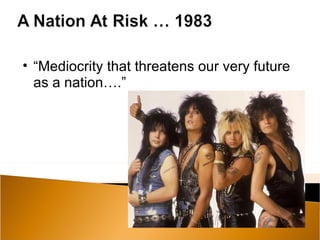
• “Mediocrity that threatens our very future
  as a nation….”
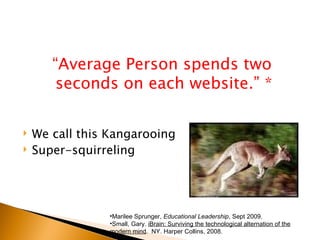
“Average Person spends two
        seconds on each website.” *

   We call this Kangarooing
   Super-squirreling


                 •Marilee Sprunger, Educational Leadership, Sept 2009.
                 •Small, Gary. iBrain: Surviving the technological alternation of the
                 modern mind. NY. Harper Collins, 2008.
   “Excessive connectedness can cause
    stress, which results in the release of
    Cortisol and adrenaline from the
    adrenal glands. Initially, this cocktail
    enhances memory. ... In small doses,
    this can be useful, but habitually
    using this kind of attention will
    put people's ability to problem
    solve and interact with others at
    risk .”
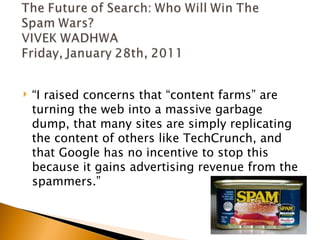
   “I raised concerns that “content farms” are
    turning the web into a massive garbage
    dump, that many sites are simply replicating
    the content of others like TechCrunch, and
    that Google has no incentive to stop this
    because it gains advertising revenue from the
    spammers.”
Content creation is big business, and there are big players
  involved. For example, Associated Content, which produces
  10,000 new articles per month, was purchased by Yahoo! for
  $100 million, in 2010. Demand Media has 8,000 writers who
  produce 180,000 new articles each month. It generated more
  than $200 million in revenue in 2009 and planning an initial
  public offering valued at about $1.5 billion. This content is
  what ends up as the landfill in the garbage websites that you
  find all over the web. And these are the first links that show
  up in your Google search results.
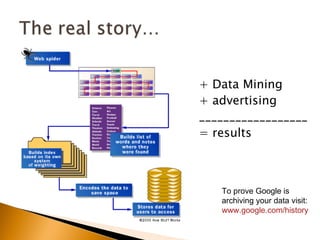
+ Data Mining
+ advertising
__________________
= results


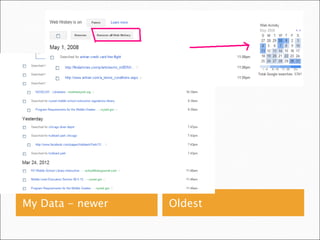
   To prove Google is
   archiving your data visit:
   www.google.com/history
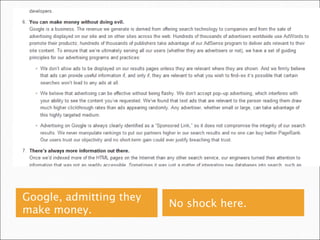
Google, admitting they
                         No shock here.
make money.
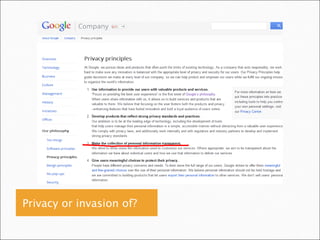
Privacy or invasion of?
My Data - newer   Oldest
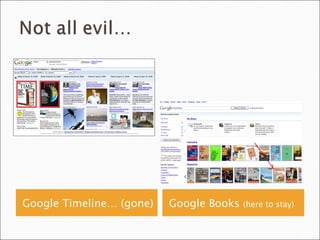
Google Timeline… (gone)   Google Books   (here to stay)
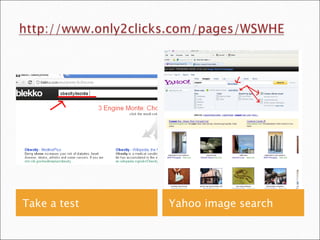
Take a test   Yahoo image search
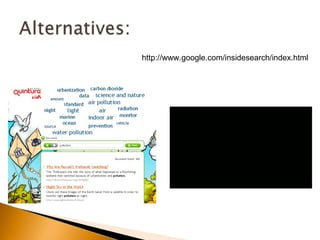
http://www.google.com/insidesearch/index.html
(to eliminate a word from results)

   Hurricane –basketball
   Lincoln -car
   Search for a specific   http://www.google.com/insidesearch
    file type
   Color
   Verbatim
   NOT
   OR
   Features
   More is less
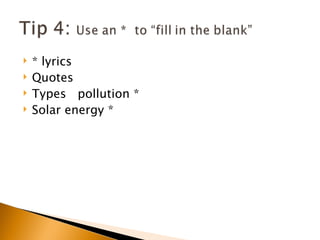
   * lyrics
   Quotes
   Types pollution *
   Solar energy *
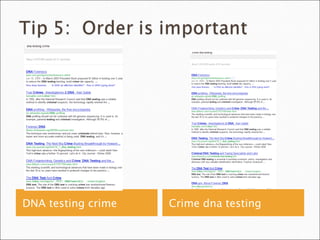
DNA testing crime   Crime dna testing
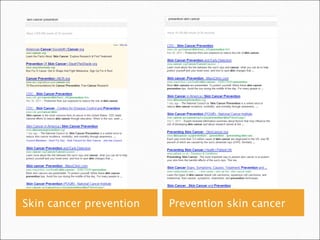
Skin cancer prevention   Prevention skin cancer
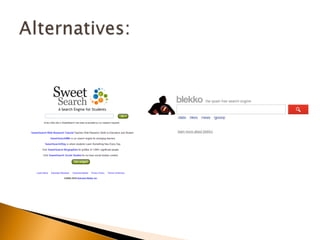
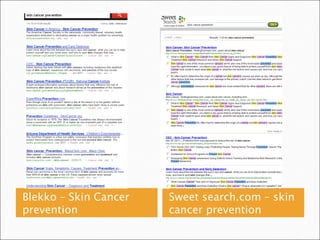
Blekko – Skin Cancer   Sweet search.com – skin
prevention             cancer prevention
CARS :
 Credible
 Accurate
 Reliable
 Supported


   CARTS (+Timely)
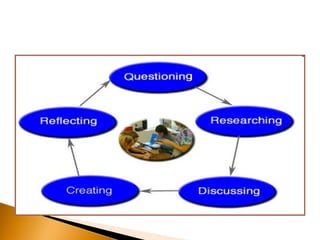
Change your research:
 Move from hide ‘n seek for facts 
 Requiring an answer to a question:

? – How did the values of the Colonists shape
  the constitution of the new world?

? – How do authors try to solve society’s
  problems through dystopic literature?
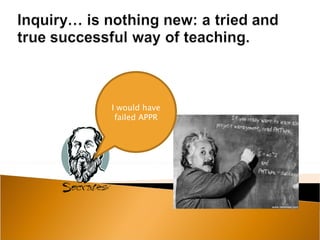
I would have
 failed APPR
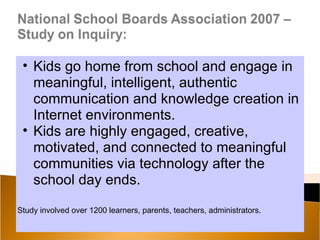
• Kids go home from school and engage in
   meaningful, intelligent, authentic
   communication and knowledge creation in
   Internet environments.
 • Kids are highly engaged, creative,
   motivated, and connected to meaningful
   communities via technology after the
   school day ends.

Study involved over 1200 learners, parents, teachers, administrators.
National Research Council, Inquiry and the
    National Science Education Standards, 2000

•
    "The challenge for all us who want to improve
    education is to create an educational system that
    exploits the natural curiosity of children, so that
    they maintain their motivation for learning not only
    through their school years but throughout life. We
    need to convince teachers and parents of the
    importance of children's questions."
Fogg, B.J., Soohoo, C., Danielson, D.R., Marable, L., Stanford, J. and Tauber, E.R. (2003), “How do
    users evaluate the credibility of web sites? A study with over 2,500 participants”,
    Proceedings of the 2003 Conference on Designing for User Experiences, San Francisco,
    CA, USA, pp. 1-15.
    Fogg, B.J., Marshall, J., Laraki, O., Osipovich, A., Varma, C., Fang, N., Paul, J., Rangnekar, A.,
    Shon, J., Swani, P. and Treinen, M. (2001), “What makes web sites credible? A report on a
    large quantitative study”, Proceedings of the SIGCHI Conference on Human Factors in
    Computing Systems, Seattle, Washington, USA, March 31-April 4, pp. 61-8.
    Fogg, B.J., Marshal, J., Osipovich, A., Varma, C., Laraki, O., Fang, N., Paul, J., Rangnekar, A.,
    Shon, J., Swani, P. and Treinen, M. (2000), “Elements that affect web credibility: early
    results from a self-report study”, Proceedings of ACM CHI ’00 Extended Abstracts on
    Human Factors in Computing Systems, The Hague, The Netherlands, pp. 287-8.


Deep Web vs. surface Web scores were obtained by using the BrightPlanet technology's selection by source option and then counting total
    documents and documents above the quality scoring threshold.
Results and Discussion
This study is the first known quantification and characterization of the deep Web. Very little has been written or known of the deep Web.
     Estimates of size and importance have been anecdotal at best and certainly underestimate scale. For example, Intelliseek's "invisible Web"
     says that, "In our best estimates today, the valuable content housed within these databases and searchable sources is far bigger than the
     800 million plus pages of the 'Visible Web.'" They also estimate total deep Web sources at about 50,000 or so. [35]
Ken Wiseman, who has written one of the most accessible discussions about the deep Web, intimates that it might be about equal in size to
    the known Web. He also goes on to say, "I can safely predict that the invisible portion of the Web will continue to grow exponentially
    before the tools to uncover the hidden Web are ready for general use." [36] A mid-1999 survey by About.com's Web search guide
    concluded the size of the deep Web was "big and getting bigger." [37] A paper at a recent library science meeting suggested that only "a
    relatively small fraction of the Web is accessible through search engines."[38]
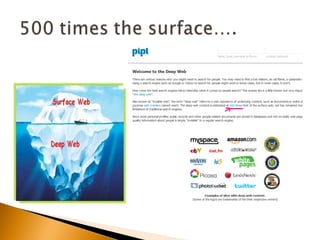
The deep Web is about 500 times larger than the surface Web, with, on average, about three times higher quality based on our document
    scoring methods on a per-document basis. On an absolute basis, total deep Web quality exceeds that of the surface Web by thousands of
    times.

Google & garbage lsta 2012

  • 1.
    Paige Jaeger WSWHE BOCESSchool Library System
  • 2.
     Why doI have to learn this, when I can just look it up?
  • 4.
    • “Mediocrity thatthreatens our very future as a nation….”
  • 5.
    “Average Person spendstwo seconds on each website.” *  We call this Kangarooing  Super-squirreling •Marilee Sprunger, Educational Leadership, Sept 2009. •Small, Gary. iBrain: Surviving the technological alternation of the modern mind. NY. Harper Collins, 2008.
  • 6.
    “Excessive connectedness can cause stress, which results in the release of Cortisol and adrenaline from the adrenal glands. Initially, this cocktail enhances memory. ... In small doses, this can be useful, but habitually using this kind of attention will put people's ability to problem solve and interact with others at risk .”
  • 7.
    “I raised concerns that “content farms” are turning the web into a massive garbage dump, that many sites are simply replicating the content of others like TechCrunch, and that Google has no incentive to stop this because it gains advertising revenue from the spammers.”
  • 8.
    Content creation isbig business, and there are big players involved. For example, Associated Content, which produces 10,000 new articles per month, was purchased by Yahoo! for $100 million, in 2010. Demand Media has 8,000 writers who produce 180,000 new articles each month. It generated more than $200 million in revenue in 2009 and planning an initial public offering valued at about $1.5 billion. This content is what ends up as the landfill in the garbage websites that you find all over the web. And these are the first links that show up in your Google search results.
  • 10.
    + Data Mining +advertising __________________ = results To prove Google is archiving your data visit: www.google.com/history
  • 11.
    Google, admitting they No shock here. make money.
  • 12.
  • 13.
    My Data -newer Oldest
  • 14.
    Google Timeline… (gone) Google Books (here to stay)
  • 17.
    Take a test Yahoo image search
  • 18.
  • 20.
    (to eliminate aword from results)  Hurricane –basketball  Lincoln -car
  • 21.
    Search for a specific http://www.google.com/insidesearch file type  Color  Verbatim  NOT  OR  Features
  • 22.
    More is less
  • 23.
    * lyrics  Quotes  Types pollution *  Solar energy *
  • 24.
    DNA testing crime Crime dna testing
  • 25.
    Skin cancer prevention Prevention skin cancer
  • 26.
    Blekko – SkinCancer Sweet search.com – skin prevention cancer prevention
  • 27.
    CARS :  Credible Accurate  Reliable  Supported  CARTS (+Timely)
  • 30.
    Change your research: Move from hide ‘n seek for facts  Requiring an answer to a question: ? – How did the values of the Colonists shape the constitution of the new world? ? – How do authors try to solve society’s problems through dystopic literature?
  • 31.
    I would have failed APPR
  • 33.
    • Kids gohome from school and engage in meaningful, intelligent, authentic communication and knowledge creation in Internet environments. • Kids are highly engaged, creative, motivated, and connected to meaningful communities via technology after the school day ends. Study involved over 1200 learners, parents, teachers, administrators.
  • 34.
    National Research Council,Inquiry and the National Science Education Standards, 2000 • "The challenge for all us who want to improve education is to create an educational system that exploits the natural curiosity of children, so that they maintain their motivation for learning not only through their school years but throughout life. We need to convince teachers and parents of the importance of children's questions."
  • 35.
    Fogg, B.J., Soohoo,C., Danielson, D.R., Marable, L., Stanford, J. and Tauber, E.R. (2003), “How do users evaluate the credibility of web sites? A study with over 2,500 participants”, Proceedings of the 2003 Conference on Designing for User Experiences, San Francisco, CA, USA, pp. 1-15. Fogg, B.J., Marshall, J., Laraki, O., Osipovich, A., Varma, C., Fang, N., Paul, J., Rangnekar, A., Shon, J., Swani, P. and Treinen, M. (2001), “What makes web sites credible? A report on a large quantitative study”, Proceedings of the SIGCHI Conference on Human Factors in Computing Systems, Seattle, Washington, USA, March 31-April 4, pp. 61-8. Fogg, B.J., Marshal, J., Osipovich, A., Varma, C., Laraki, O., Fang, N., Paul, J., Rangnekar, A., Shon, J., Swani, P. and Treinen, M. (2000), “Elements that affect web credibility: early results from a self-report study”, Proceedings of ACM CHI ’00 Extended Abstracts on Human Factors in Computing Systems, The Hague, The Netherlands, pp. 287-8. Deep Web vs. surface Web scores were obtained by using the BrightPlanet technology's selection by source option and then counting total documents and documents above the quality scoring threshold. Results and Discussion This study is the first known quantification and characterization of the deep Web. Very little has been written or known of the deep Web. Estimates of size and importance have been anecdotal at best and certainly underestimate scale. For example, Intelliseek's "invisible Web" says that, "In our best estimates today, the valuable content housed within these databases and searchable sources is far bigger than the 800 million plus pages of the 'Visible Web.'" They also estimate total deep Web sources at about 50,000 or so. [35] Ken Wiseman, who has written one of the most accessible discussions about the deep Web, intimates that it might be about equal in size to the known Web. He also goes on to say, "I can safely predict that the invisible portion of the Web will continue to grow exponentially before the tools to uncover the hidden Web are ready for general use." [36] A mid-1999 survey by About.com's Web search guide concluded the size of the deep Web was "big and getting bigger." [37] A paper at a recent library science meeting suggested that only "a relatively small fraction of the Web is accessible through search engines."[38] The deep Web is about 500 times larger than the surface Web, with, on average, about three times higher quality based on our document scoring methods on a per-document basis. On an absolute basis, total deep Web quality exceeds that of the surface Web by thousands of times.