GOODWILL- CONCEPT
& TYPES
PRESENTED BY--
DR. JYOTI KHARE
ASSOCIATE PROFESSOR
GOVT. DEGREE COLLEGE,
MALDEVTA RAIPUR DEHRADUN
WHAT IS GOODWILL?
• Goodwill is the value of the reputation of a firm.
• To Built over time with respect to the expected future profits over and above the normal profits.
• Any intangible attribute which contributes in the long-term to a company’s earning potential can be
described as goodwill.
• Goodwill is an intangible real asset.
• Goodwill is a form of an unidentifiable asset.
• Goodwill is an intangible asset arising in the course of purchase of one business by another business.
• It only represents the inherent value of a business that cannot be tagged anything in particular.
• To the accountant, therefore, goodwill may be said to be that element arising from the reputation,
connection, or other advantages possessed by a business which enables it to earn greater profits than
the return normally to be expected
•
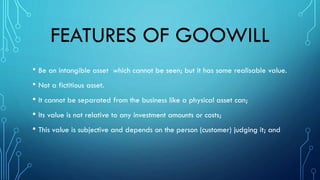
FEATURES OF GOOWILL
• Be an intangible asset which cannot be seen; but it has some realisable value.
• Not a fictitious asset.
• It cannot be separated from the business like a physical asset can;
• Its value is not relative to any investment amounts or costs;
• This value is subjective and depends on the person (customer) judging it; and
ELEMENT TO ARISE OR RAISE
‘ GOODWILL’
• 1.The location of the business premises, the nature of the firm’s products or the
reputation of its service.
• 2. The possession of favourable contracts, complete or partial monopoly, etc.
• 3. The personal reputation of the promoters.
• 4. The possession of efficient and contented employees.
• 5. The possession of trade marks, patents or a well-known business name.
• 6. The continuance of advertising campaigns.
• 7. The maintenance of the quality of the firm’s product and development of the
business with changing conditions
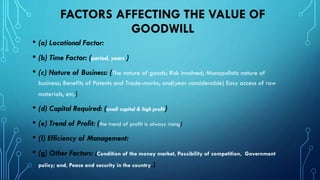
FACTORS AFFECTING THE VALUE OF
GOODWILL
• (a) Locational Factor:
• (b) Time Factor: (period, years )
• (c) Nature of Business: (The nature of goods; Risk involved; Monopolistic nature of
business; Benefits of Patents and Trade-marks; and(year considerable) Easy access of raw
materials, etc.)
• (d) Capital Required: (small capital & high profit)
• (e) Trend of Profit: (the trend of profit is always rising)
• (f) Efficiency of Management:
• (g) Other Factors: (Condition of the money market, Possibility of competition, Government
policy; and, Peace and security in the country.)
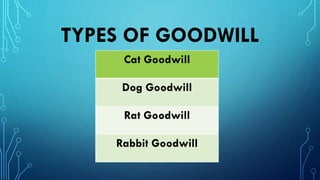
TYPES OF GOODWILL
cat Goodwill
Cat Goodwill
Dog Goodwill
Rat Goodwill
Rabbit Goodwill
THANK YOU

GOODWILL - CONCEPT & ITS TYPES

  • 1.
    GOODWILL- CONCEPT & TYPES PRESENTEDBY-- DR. JYOTI KHARE ASSOCIATE PROFESSOR GOVT. DEGREE COLLEGE, MALDEVTA RAIPUR DEHRADUN
  • 2.
    WHAT IS GOODWILL? •Goodwill is the value of the reputation of a firm. • To Built over time with respect to the expected future profits over and above the normal profits. • Any intangible attribute which contributes in the long-term to a company’s earning potential can be described as goodwill. • Goodwill is an intangible real asset. • Goodwill is a form of an unidentifiable asset. • Goodwill is an intangible asset arising in the course of purchase of one business by another business. • It only represents the inherent value of a business that cannot be tagged anything in particular. • To the accountant, therefore, goodwill may be said to be that element arising from the reputation, connection, or other advantages possessed by a business which enables it to earn greater profits than the return normally to be expected •
  • 3.
    FEATURES OF GOOWILL •Be an intangible asset which cannot be seen; but it has some realisable value. • Not a fictitious asset. • It cannot be separated from the business like a physical asset can; • Its value is not relative to any investment amounts or costs; • This value is subjective and depends on the person (customer) judging it; and
  • 4.
    ELEMENT TO ARISEOR RAISE ‘ GOODWILL’ • 1.The location of the business premises, the nature of the firm’s products or the reputation of its service. • 2. The possession of favourable contracts, complete or partial monopoly, etc. • 3. The personal reputation of the promoters. • 4. The possession of efficient and contented employees. • 5. The possession of trade marks, patents or a well-known business name. • 6. The continuance of advertising campaigns. • 7. The maintenance of the quality of the firm’s product and development of the business with changing conditions
  • 5.
    FACTORS AFFECTING THEVALUE OF GOODWILL • (a) Locational Factor: • (b) Time Factor: (period, years ) • (c) Nature of Business: (The nature of goods; Risk involved; Monopolistic nature of business; Benefits of Patents and Trade-marks; and(year considerable) Easy access of raw materials, etc.) • (d) Capital Required: (small capital & high profit) • (e) Trend of Profit: (the trend of profit is always rising) • (f) Efficiency of Management: • (g) Other Factors: (Condition of the money market, Possibility of competition, Government policy; and, Peace and security in the country.)
  • 6.
    TYPES OF GOODWILL catGoodwill Cat Goodwill Dog Goodwill Rat Goodwill Rabbit Goodwill
  • 7.