PROMOTION in HRM
Presented By--
Dr. jyoti khare
Associate Professor
Faculty of commerce
Govt. P. G. College
Maldevta, Raipur
Dehradun
What is PROMOTION?
Understanding of concept of ‘PROMOTION’ varies to its objetives and person / place used
 In HRM, Promotion is vertical movement of an employee within the organization.
 In other words, promotion refers to the upward movement of an employee from one job
to another higher one, with increase in salary, status and responsibilities.
 A promotion can refer to the advancement of an employee's position, creating
awareness around certain product deals.
 The term is used differently in different contexts, the most popular being a job promotion.
 In Marketing, Promotion is a marketing tool, used as a strategy to communicate between
the sellers and buyers.
 This technique of marketing creates an interest in the mindset of the customers and can
also retain them as a loyal customer.
 In investments, a promotion creates awareness of little known stocks in the hope of
increasing demand and the price of the stock.
DEFINITIONS OF PROMOTION
 According to Scott and Clothier- “A promotion is the transfer of an
employee to a job which pays more money or one that carries some
preferred status.”
 According to Paul Pigors and Charles A. Myers, Promotion is advancement
of an employee to a better job-better in terms of greater responsibility,
more prestige or status, greater skills and especially increased rate of pay or
salary.
 A promotion may be defined as “an upward advancement of an
employee in an organisation to another job, which commands better pay /
wages, better status / prestige and higher opportunities challenges and re-
sponsibility a better working environment, hours of work and facilities etc.”
FEATURES OF PROMOTION
 (i) Improves job, status and prestige.
 (ii) Gives more responsibility.
 (iii) Brings increase in pay and perks.
 (IV) Promotion Handles the New Job Efficiently
 (V)Promotion Motivates Higher Morale
 (VI) It Ensures More Efficiency
 (VII) Cost in Training will be Less
PURPOSE OF PROMOTION
 For the optimum utilization of the employees’ skill, knowledge at the
appropriate level.
 For the development of competitive spirit and inculcate the enthusiasm in
the employees
 To develop competent internal source of employees ready to take up jobs
at higher levels in the changing environment.
 To promote employee’s self-development and be ready for the promotion
as and when their turn of promotion occurs.
 To promote interest in training, development programmes and in team
development areas.
 To get rid of the problems created by the leaders of workers’ unions
TYPPES OF PROMOTION
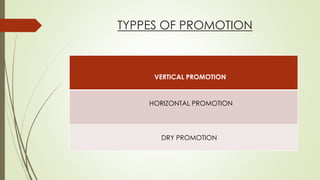
VERTICAL PROMOTION
HORIZONTAL PROMOTION
DRY PROMOTION
TYPPES OF PROMOTION
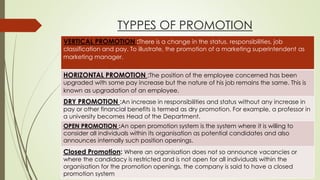
VERTICAL PROMOTION :There is a change in the status, responsibilities, job
classification and pay. To illustrate, the promotion of a marketing superintendent as
marketing manager.
HORIZONTAL PROMOTION :The position of the employee concerned has been
upgraded with some pay increase but the nature of his job remains the same. This is
known as upgradation of an employee.
DRY PROMOTION :An increase in responsibilities and status without any increase in
pay or other financial benefits is termed as dry promotion. For example, a professor in
a university becomes Head of the Department.
OPEN PROMOTION :An open promotion system is the system where it is willing to
consider all individuals within its organisation as potential candidates and also
announces internally such position openings.
Closed Promotion: Where an organisation does not so announce vacancies or
where the candidacy is restricted and is not open for all individuals within the
organisation for the promotion openings, the company is said to have a closed
promotion system
OTHER TYPPES OF PROMOTION
 Competitive promotions involve employees proving their worth in
comparison to other employees. This method focuses mostly on
performance, productivity, skills, experience, knowledge, and other similar
factors.
 Noncompetitive promotions take place after employees reach a standard
set milestone or accomplishment. These promotions look mainly at reaching
goals rather than variable features like performance, productivity, etc.
 Up-gradation promotions take place when the pay increases, but the job
title and rank stay the same.
BASIS OF PROMOTION
 PROMOTION BY SENIORITY
(develop sense of loyalty and morale, limits
casteism nepotism etc.)
 PROMOTION BY MERIT
(measure of employees’ contribution, performance
Potentiality, encouragement , recognition)
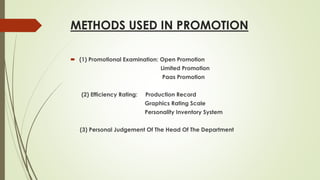
METHODS USED IN PROMOTION
 (1) Promotional Examination: Open Promotion
Limited Promotion
Paas Promotion
(2) Efficiency Rating: Production Record
Graphics Rating Scale
Personality Inventory System
(3) Personal Judgement Of The Head Of The Department
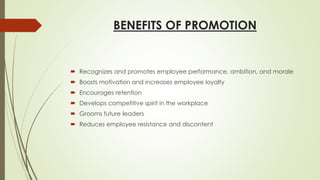
BENEFITS OF PROMOTION
 Recognizes and promotes employee performance, ambition, and morale
 Boosts motivation and increases employee loyalty
 Encourages retention
 Develops competitive spirit in the workplace
 Grooms future leaders
 Reduces employee resistance and discontent
THANK YOU

Promotion

  • 1.
    PROMOTION in HRM PresentedBy-- Dr. jyoti khare Associate Professor Faculty of commerce Govt. P. G. College Maldevta, Raipur Dehradun
  • 2.
    What is PROMOTION? Understandingof concept of ‘PROMOTION’ varies to its objetives and person / place used  In HRM, Promotion is vertical movement of an employee within the organization.  In other words, promotion refers to the upward movement of an employee from one job to another higher one, with increase in salary, status and responsibilities.  A promotion can refer to the advancement of an employee's position, creating awareness around certain product deals.  The term is used differently in different contexts, the most popular being a job promotion.  In Marketing, Promotion is a marketing tool, used as a strategy to communicate between the sellers and buyers.  This technique of marketing creates an interest in the mindset of the customers and can also retain them as a loyal customer.  In investments, a promotion creates awareness of little known stocks in the hope of increasing demand and the price of the stock.
  • 3.
    DEFINITIONS OF PROMOTION According to Scott and Clothier- “A promotion is the transfer of an employee to a job which pays more money or one that carries some preferred status.”  According to Paul Pigors and Charles A. Myers, Promotion is advancement of an employee to a better job-better in terms of greater responsibility, more prestige or status, greater skills and especially increased rate of pay or salary.  A promotion may be defined as “an upward advancement of an employee in an organisation to another job, which commands better pay / wages, better status / prestige and higher opportunities challenges and re- sponsibility a better working environment, hours of work and facilities etc.”
  • 4.
    FEATURES OF PROMOTION (i) Improves job, status and prestige.  (ii) Gives more responsibility.  (iii) Brings increase in pay and perks.  (IV) Promotion Handles the New Job Efficiently  (V)Promotion Motivates Higher Morale  (VI) It Ensures More Efficiency  (VII) Cost in Training will be Less
  • 5.
    PURPOSE OF PROMOTION For the optimum utilization of the employees’ skill, knowledge at the appropriate level.  For the development of competitive spirit and inculcate the enthusiasm in the employees  To develop competent internal source of employees ready to take up jobs at higher levels in the changing environment.  To promote employee’s self-development and be ready for the promotion as and when their turn of promotion occurs.  To promote interest in training, development programmes and in team development areas.  To get rid of the problems created by the leaders of workers’ unions
  • 6.
    TYPPES OF PROMOTION VERTICALPROMOTION HORIZONTAL PROMOTION DRY PROMOTION
  • 7.
    TYPPES OF PROMOTION VERTICALPROMOTION :There is a change in the status, responsibilities, job classification and pay. To illustrate, the promotion of a marketing superintendent as marketing manager. HORIZONTAL PROMOTION :The position of the employee concerned has been upgraded with some pay increase but the nature of his job remains the same. This is known as upgradation of an employee. DRY PROMOTION :An increase in responsibilities and status without any increase in pay or other financial benefits is termed as dry promotion. For example, a professor in a university becomes Head of the Department. OPEN PROMOTION :An open promotion system is the system where it is willing to consider all individuals within its organisation as potential candidates and also announces internally such position openings. Closed Promotion: Where an organisation does not so announce vacancies or where the candidacy is restricted and is not open for all individuals within the organisation for the promotion openings, the company is said to have a closed promotion system
  • 8.
    OTHER TYPPES OFPROMOTION  Competitive promotions involve employees proving their worth in comparison to other employees. This method focuses mostly on performance, productivity, skills, experience, knowledge, and other similar factors.  Noncompetitive promotions take place after employees reach a standard set milestone or accomplishment. These promotions look mainly at reaching goals rather than variable features like performance, productivity, etc.  Up-gradation promotions take place when the pay increases, but the job title and rank stay the same.
  • 9.
    BASIS OF PROMOTION PROMOTION BY SENIORITY (develop sense of loyalty and morale, limits casteism nepotism etc.)  PROMOTION BY MERIT (measure of employees’ contribution, performance Potentiality, encouragement , recognition)
  • 10.
    METHODS USED INPROMOTION  (1) Promotional Examination: Open Promotion Limited Promotion Paas Promotion (2) Efficiency Rating: Production Record Graphics Rating Scale Personality Inventory System (3) Personal Judgement Of The Head Of The Department
  • 11.
    BENEFITS OF PROMOTION Recognizes and promotes employee performance, ambition, and morale  Boosts motivation and increases employee loyalty  Encourages retention  Develops competitive spirit in the workplace  Grooms future leaders  Reduces employee resistance and discontent
  • 12.