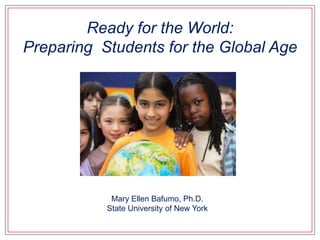
Ready for the World:Preparing  Students for the Global AgeMary Ellen Bafumo, Ph.D.State University of New York
              Welcome, Bienvenue,                Karibu!  Velkommen!              Maligayang pagdating!              Bienvenido!  繁體中文版
The global age is here, now. It arrived about a decade ago and its influence is expanding exponentially. Many schools are still preparing students for 20th century ideas, skills and jobs.Fact: we are preparing students for a future that is as yet undefined. Fact: We do know the global  skills, knowledge and dispositions that can create success.
Watch the film and consider what’s different about learning in the 21st century, in comparison to 20th century approaches to education.Learning to Change-Changing to Learn1931/33: mid west USA	                1990: Britain
Which changes most significantly impact education in the 21st century?technology & its use - perspectives about change – mobility – immigration – teacher development – funding – business needs….
The film makes this statement clear:The world has changed and educators must change, too.
The pace of change is acceleratingand technology is the force behind  the pace.?
We haven’t been standing still in education. In what ways have we already changed? How are schools/classrooms different?
Now let’s look at where we need to goto be ready for the future.
Why go global in elementary school?We already live in an intricately connected, complex, global society.We need to prepare today’s students for a future in an even more connected, more complex, global society.   The knowledge, skills and dispositions we want to see in   high school students have to be introduced, taught and  reinforced at the elementary level.Student success in life and the economic success of our nation is dependent on quality education.
There is a new paradigm in education today.     Old constructs		         New constructsChangeRenewImprovethe things we currently doRethinkReconceptualizeRevitalizethe field of education  for a better future
The new “3 Rs”rethink our purposes, programs, perspectivesreconceptualizewhat we teach, how we teach,                          where we teach, how we assess,                          the materials we userevitalizethe field of elementary education as a               result
We begin with the idea of Global Competencies.Global learning is about developing global competencies.
Global Competencies are the knowledge, skills & dispositionsrequired for success in the 21st century. There are 5 dimensions of Global Competence:Investigate the world                  Recognize and weigh perspectivesCommunicate ideas   Take actionAcquire disciplinary & interdisciplinary knowledge
Each dimension of Global Competence is highly integrated with the others.Content knowledge is critical to competence of any kind.Perspective taking, reasoning, compassion are necessary in an interconnected society. The ability to clearly articulate a message is essential in any society. The skills to take action to improve a situation require content knowledge, perspective,reason and a willingness to assistin making the planet a better place for everyone on it.
Steps to a global elementary schoolTeacher developmentRevitalized curriculum, instruction and assessment(including global competencies)A focus on world language instructionRich student experiences with technology, service learning,community resources, parents, travel opportunities
Teachers in a global school need:1. knowledge and understanding of other cultures2. the ability to integrate state mandated and global curriculum seamlessly3. skill in creating authentic assessments4. collaborative skills to tap the knowledge & skills of others5. an interest in finding learning experiences outside the classroom6. high level computer skills and ability to use multi-media7. an interest in meaningful professional learning8. skill in developing & implementing service learning9. ability to speak and understand a second language *
A revitalized curriculum:      Review        Revise/Replace        ResequenceMeshing district and state standards with global content requires a review of existing curriculum units and revision or replacement of one or two  with more engaging, globally focused units.(Begin with small changes!)Learning to identify places in the curriculum where a global perspective can be infused is a good place to start.
Transforming the Curriculum (p.13)Teams identify global content that works with the existing curriculum or is particularly relevant. Teams work at seamlessly integrating global and district topics. Teams determine engaging teaching strategies and  materials to support content and integration.Teams develop  lessons, create a feedback template to assess them, discuss results and adjust lessons.
Curriculum exampleStandard district approach“Revise/replace global approachMy NeighborhoodA CapetownNeighborhoodAdd a comparative study.Search forsimilarities,differences.PeopleHistory CelebrationsJobsGovernmentHousingFoodClothingChallengesPeopleHistoryCelebrationsJobsGovernmentHousingFoodChallengesWhat standard units can be shortened or revised to include global content?
Interdisciplinary, Thematic UnitsUsing an interdisciplinary approach is logical, saves time and teaches to the way the brain learns. Units can be year-long or much briefer.Thematic units are built on a broad-based concept and encompass all academic subjects.Planning with a graphic organizer helps to ensure that all content is included.
Degree of IntegrationDiscipline - Field BasedTypical, departmentalized curriculumParallel DisciplineConcurrent teaching of related subjectsMulti-DisciplinaryMore than one discipline integratesthe curriculumInterdisciplinary UnitsUse of the full range of disciplinesorganized around a broad-based themetheme
 Interdisciplinary Theme ExamplesThese are broad based to encompass all academic topics, including the fine and performing artsInterdependenceSymbolsPatternsConflictCultureEnvironments
Year-long Interdisciplinary Thematic UnitRegionalgeographyWeatherPeace poetry,literature, artExploration of AmericaPlants & animalsColonization/Native AmericansWorld War IArts of manynationsFrenchRevolutionConflictRevolution, US/BritainImmigrationEconomics/MathWorld CulturesConstitutionFederals vs.  StatesCivil WarInventionsSlavery vs.AbolitionLiterature ofeach era Arts of each era
Authentic Assessment examplesPerformances (research, script writing, persuasion)Projects (water testing, analysis, statistics for the town)Multi-media presentations (using powerpoint, video, interviews, graphs, charts, to make a case)Newscasts (research, writing, technology)Oral presentations in costume (research, writing,speaking, persuasion)Portfolios (collections of work over time)
Authentic AssessmentsAuthentic assessments provide varied opportunities to demonstrate learning.Does assessment match the learning project?Does assessment offer students an opportunity to creatively apply learning?Does assessment incorporate technology?Does assessment require real-life problem solving?
Active, student-centered instruction means:teaching to the way brain learnsengaging mind and body in activitiesusing many and varied materials (technology!)focusing on essential questions for students to answerusing inquiry so that students create knowledgedesigning meaningful service learning projects that use academic knowledge and skills
Here’s what stimulates the human brain to learn.colorlight movement noveltysoundsound
Materials for Global Learning & Active  EngagementMagazines – many have a global focus.Examine the magazines with a partner. What global content did you discover?Multicultural children’s literature – opens a window to other perspectives and experiences.  Websites – the world is at your fingertips;                   connect, communicate, learn                   (acquire international pen pals,                     track weather, work with scholars                    and labs, co-teach on-line and more)
World LanguagesWhat do you remember from last night’s panel about the usefulness of speaking a language other than English?Immersion versus daily language instruction..Native speakers versus Rosetta Stone??
Community Resources and Parent InvolvementWhat kinds of learning resources are available in your city or town?How do you use community resources in your school or classroom to enhance global learning?What role do parents play in your classroom and school?How can parents be helpful in teaching global content?
Travel as a tool for global curriculum developmentWhat are the benefits of teacher travel?What are the barriers to travel beyond funding?What can be done to increase student travel?
Watch the iconic video. Consider what it might possibly have to do with teachers working on a global approach to education.
What connections did you make to revitalizing education?The video demonstrates that a change of perspective on the ordinary changes everything.Teacher perspective and motivation may well be the key ingredients to going global at the elementary level.
Think about what you’ve seen and heard.What can you do to begin the journey to global education at the elementary level?If you’ve already started, what’s your next step?How can you enlist staff and community members?Make a commitment to take the next step!
Summary of the attributes of a global elementary schoolRobust, engaging curriculum that integrates mandates with global contentSecond & third (daily) language instructionActive, inquiry-based instructionAuthentic assessmentsTechnology for teaching, learning, connecting with othersExchange programs with sister schools
Summary of the attributes of a global elementary schoolEnergetic service and volunteer programsFocus on global content, skills, dispositions(global competencies)Use of venues beyond the school for teaching and learningA diverse faculty
Global contentknowledge of other nations, cultures, languages,politics, literature and the artsGlobal skillsAbility to communicate clearly in more than one language, critical thinking skills, interpersonal skillsGlobal dispositionsWillingness to take action, weigh perspectives, reason,empathize, use knowledge and skills to make a situationbetter
What about parents?Parents can: be teachers of heritage culturesassist with language instructionshare other skills they have with studentsbe assisted with instruction in English if they need itbe taught topics of interest at the school site(parenting, health issues, behavior issues, community resources)
What about community stakeholders?Community stakeholders can:use their skills to assist in the classroom – teaching topics of interest, sharing travel and cultural experiencesopen their businesses as venues for learningshare skilled employees with the school
What about faculty/staff?Faculty who are from other nations or have international travel experience:reflect the diversity of the world in which students liveoffer unique perspectives about other cultures and regions of the worldprovide authenticity to language instruction

Elementary Programs that Teach the World

  • 1.
    Ready for theWorld:Preparing Students for the Global AgeMary Ellen Bafumo, Ph.D.State University of New York
  • 2.
    Welcome, Bienvenue, Karibu! Velkommen! Maligayang pagdating! Bienvenido! 繁體中文版
  • 3.
    The global ageis here, now. It arrived about a decade ago and its influence is expanding exponentially. Many schools are still preparing students for 20th century ideas, skills and jobs.Fact: we are preparing students for a future that is as yet undefined. Fact: We do know the global skills, knowledge and dispositions that can create success.
  • 4.
    Watch the filmand consider what’s different about learning in the 21st century, in comparison to 20th century approaches to education.Learning to Change-Changing to Learn1931/33: mid west USA 1990: Britain
  • 5.
    Which changes mostsignificantly impact education in the 21st century?technology & its use - perspectives about change – mobility – immigration – teacher development – funding – business needs….
  • 6.
    The film makesthis statement clear:The world has changed and educators must change, too.
  • 7.
    The pace ofchange is acceleratingand technology is the force behind the pace.?
  • 8.
    We haven’t beenstanding still in education. In what ways have we already changed? How are schools/classrooms different?
  • 9.
    Now let’s lookat where we need to goto be ready for the future.
  • 10.
    Why go globalin elementary school?We already live in an intricately connected, complex, global society.We need to prepare today’s students for a future in an even more connected, more complex, global society. The knowledge, skills and dispositions we want to see in high school students have to be introduced, taught and reinforced at the elementary level.Student success in life and the economic success of our nation is dependent on quality education.
  • 11.
    There is anew paradigm in education today. Old constructs New constructsChangeRenewImprovethe things we currently doRethinkReconceptualizeRevitalizethe field of education for a better future
  • 12.
    The new “3Rs”rethink our purposes, programs, perspectivesreconceptualizewhat we teach, how we teach, where we teach, how we assess, the materials we userevitalizethe field of elementary education as a result
  • 13.
    We begin withthe idea of Global Competencies.Global learning is about developing global competencies.
  • 14.
    Global Competencies arethe knowledge, skills & dispositionsrequired for success in the 21st century. There are 5 dimensions of Global Competence:Investigate the world Recognize and weigh perspectivesCommunicate ideas Take actionAcquire disciplinary & interdisciplinary knowledge
  • 15.
    Each dimension ofGlobal Competence is highly integrated with the others.Content knowledge is critical to competence of any kind.Perspective taking, reasoning, compassion are necessary in an interconnected society. The ability to clearly articulate a message is essential in any society. The skills to take action to improve a situation require content knowledge, perspective,reason and a willingness to assistin making the planet a better place for everyone on it.
  • 16.
    Steps to aglobal elementary schoolTeacher developmentRevitalized curriculum, instruction and assessment(including global competencies)A focus on world language instructionRich student experiences with technology, service learning,community resources, parents, travel opportunities
  • 17.
    Teachers in aglobal school need:1. knowledge and understanding of other cultures2. the ability to integrate state mandated and global curriculum seamlessly3. skill in creating authentic assessments4. collaborative skills to tap the knowledge & skills of others5. an interest in finding learning experiences outside the classroom6. high level computer skills and ability to use multi-media7. an interest in meaningful professional learning8. skill in developing & implementing service learning9. ability to speak and understand a second language *
  • 18.
    A revitalized curriculum: Review Revise/Replace ResequenceMeshing district and state standards with global content requires a review of existing curriculum units and revision or replacement of one or two with more engaging, globally focused units.(Begin with small changes!)Learning to identify places in the curriculum where a global perspective can be infused is a good place to start.
  • 19.
    Transforming the Curriculum(p.13)Teams identify global content that works with the existing curriculum or is particularly relevant. Teams work at seamlessly integrating global and district topics. Teams determine engaging teaching strategies and materials to support content and integration.Teams develop lessons, create a feedback template to assess them, discuss results and adjust lessons.
  • 20.
    Curriculum exampleStandard districtapproach“Revise/replace global approachMy NeighborhoodA CapetownNeighborhoodAdd a comparative study.Search forsimilarities,differences.PeopleHistory CelebrationsJobsGovernmentHousingFoodClothingChallengesPeopleHistoryCelebrationsJobsGovernmentHousingFoodChallengesWhat standard units can be shortened or revised to include global content?
  • 21.
    Interdisciplinary, Thematic UnitsUsingan interdisciplinary approach is logical, saves time and teaches to the way the brain learns. Units can be year-long or much briefer.Thematic units are built on a broad-based concept and encompass all academic subjects.Planning with a graphic organizer helps to ensure that all content is included.
  • 22.
    Degree of IntegrationDiscipline- Field BasedTypical, departmentalized curriculumParallel DisciplineConcurrent teaching of related subjectsMulti-DisciplinaryMore than one discipline integratesthe curriculumInterdisciplinary UnitsUse of the full range of disciplinesorganized around a broad-based themetheme
  • 23.
    Interdisciplinary ThemeExamplesThese are broad based to encompass all academic topics, including the fine and performing artsInterdependenceSymbolsPatternsConflictCultureEnvironments
  • 24.
    Year-long Interdisciplinary ThematicUnitRegionalgeographyWeatherPeace poetry,literature, artExploration of AmericaPlants & animalsColonization/Native AmericansWorld War IArts of manynationsFrenchRevolutionConflictRevolution, US/BritainImmigrationEconomics/MathWorld CulturesConstitutionFederals vs. StatesCivil WarInventionsSlavery vs.AbolitionLiterature ofeach era Arts of each era
  • 25.
    Authentic Assessment examplesPerformances(research, script writing, persuasion)Projects (water testing, analysis, statistics for the town)Multi-media presentations (using powerpoint, video, interviews, graphs, charts, to make a case)Newscasts (research, writing, technology)Oral presentations in costume (research, writing,speaking, persuasion)Portfolios (collections of work over time)
  • 26.
    Authentic AssessmentsAuthentic assessmentsprovide varied opportunities to demonstrate learning.Does assessment match the learning project?Does assessment offer students an opportunity to creatively apply learning?Does assessment incorporate technology?Does assessment require real-life problem solving?
  • 27.
    Active, student-centered instructionmeans:teaching to the way brain learnsengaging mind and body in activitiesusing many and varied materials (technology!)focusing on essential questions for students to answerusing inquiry so that students create knowledgedesigning meaningful service learning projects that use academic knowledge and skills
  • 28.
    Here’s what stimulatesthe human brain to learn.colorlight movement noveltysoundsound
  • 29.
    Materials for GlobalLearning & Active EngagementMagazines – many have a global focus.Examine the magazines with a partner. What global content did you discover?Multicultural children’s literature – opens a window to other perspectives and experiences. Websites – the world is at your fingertips; connect, communicate, learn (acquire international pen pals, track weather, work with scholars and labs, co-teach on-line and more)
  • 30.
    World LanguagesWhat doyou remember from last night’s panel about the usefulness of speaking a language other than English?Immersion versus daily language instruction..Native speakers versus Rosetta Stone??
  • 31.
    Community Resources andParent InvolvementWhat kinds of learning resources are available in your city or town?How do you use community resources in your school or classroom to enhance global learning?What role do parents play in your classroom and school?How can parents be helpful in teaching global content?
  • 32.
    Travel as atool for global curriculum developmentWhat are the benefits of teacher travel?What are the barriers to travel beyond funding?What can be done to increase student travel?
  • 33.
    Watch the iconicvideo. Consider what it might possibly have to do with teachers working on a global approach to education.
  • 34.
    What connections didyou make to revitalizing education?The video demonstrates that a change of perspective on the ordinary changes everything.Teacher perspective and motivation may well be the key ingredients to going global at the elementary level.
  • 35.
    Think about whatyou’ve seen and heard.What can you do to begin the journey to global education at the elementary level?If you’ve already started, what’s your next step?How can you enlist staff and community members?Make a commitment to take the next step!
  • 36.
    Summary of theattributes of a global elementary schoolRobust, engaging curriculum that integrates mandates with global contentSecond & third (daily) language instructionActive, inquiry-based instructionAuthentic assessmentsTechnology for teaching, learning, connecting with othersExchange programs with sister schools
  • 37.
    Summary of theattributes of a global elementary schoolEnergetic service and volunteer programsFocus on global content, skills, dispositions(global competencies)Use of venues beyond the school for teaching and learningA diverse faculty
  • 38.
    Global contentknowledge ofother nations, cultures, languages,politics, literature and the artsGlobal skillsAbility to communicate clearly in more than one language, critical thinking skills, interpersonal skillsGlobal dispositionsWillingness to take action, weigh perspectives, reason,empathize, use knowledge and skills to make a situationbetter
  • 39.
    What about parents?Parentscan: be teachers of heritage culturesassist with language instructionshare other skills they have with studentsbe assisted with instruction in English if they need itbe taught topics of interest at the school site(parenting, health issues, behavior issues, community resources)
  • 40.
    What about communitystakeholders?Community stakeholders can:use their skills to assist in the classroom – teaching topics of interest, sharing travel and cultural experiencesopen their businesses as venues for learningshare skilled employees with the school
  • 41.
    What about faculty/staff?Facultywho are from other nations or have international travel experience:reflect the diversity of the world in which students liveoffer unique perspectives about other cultures and regions of the worldprovide authenticity to language instruction

Editor's Notes