Going to the dentist
Language circle
Objectives
• Explain dental health issues to your doctor
• Be able to schedule an appointment with a dentist
Agenda
1. Vocabulary
2. Reading
3. Speaking
4. Reflect on learning
Discussion
– Have you ever had a toothache? What do you
think caused the toothache?
– What could be done to prevent the toothache?


– Do you know what to do if you have a
toothache?
Vocabulary
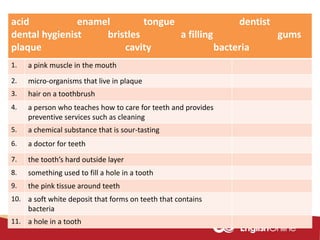
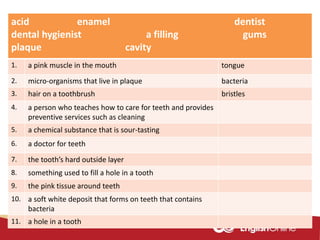
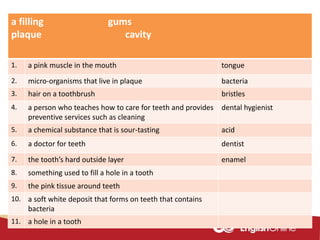
acid enamel tongue dentist
dental hygienist bristles a filling gums
plaque cavity bacteria
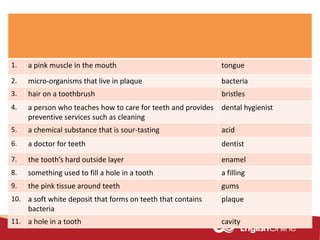
1. a pink muscle in the mouth
2. micro-organisms that live in plaque
3. hair on a toothbrush
4. a person who teaches how to care for teeth and provides
preventive services such as cleaning
5. a chemical substance that is sour-tasting
6. a doctor for teeth
7. the tooth’s hard outside layer
8. something used to fill a hole in a tooth
9. the pink tissue around teeth
10. a soft white deposit that forms on teeth that contains
bacteria
11. a hole in a tooth
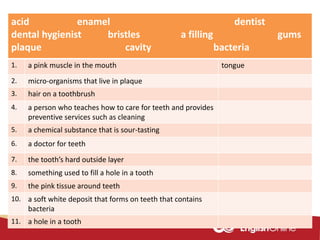
acid enamel dentist
dental hygienist bristles a filling gums
plaque cavity bacteria
1. a pink muscle in the mouth tongue
2. micro-organisms that live in plaque
3. hair on a toothbrush
4. a person who teaches how to care for teeth and provides
preventive services such as cleaning
5. a chemical substance that is sour-tasting
6. a doctor for teeth
7. the tooth’s hard outside layer
8. something used to fill a hole in a tooth
9. the pink tissue around teeth
10. a soft white deposit that forms on teeth that contains
bacteria
11. a hole in a tooth
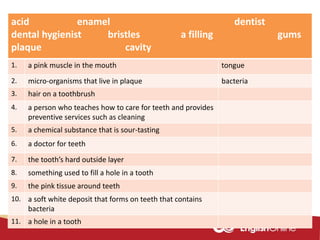
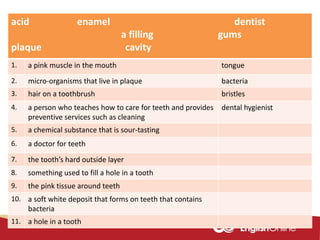
acid enamel dentist
dental hygienist bristles a filling gums
plaque cavity
1. a pink muscle in the mouth tongue
2. micro-organisms that live in plaque bacteria
3. hair on a toothbrush
4. a person who teaches how to care for teeth and provides
preventive services such as cleaning
5. a chemical substance that is sour-tasting
6. a doctor for teeth
7. the tooth’s hard outside layer
8. something used to fill a hole in a tooth
9. the pink tissue around teeth
10. a soft white deposit that forms on teeth that contains
bacteria
11. a hole in a tooth
acid enamel dentist
dental hygienist a filling gums
plaque cavity
1. a pink muscle in the mouth tongue
2. micro-organisms that live in plaque bacteria
3. hair on a toothbrush bristles
4. a person who teaches how to care for teeth and provides
preventive services such as cleaning
5. a chemical substance that is sour-tasting
6. a doctor for teeth
7. the tooth’s hard outside layer
8. something used to fill a hole in a tooth
9. the pink tissue around teeth
10. a soft white deposit that forms on teeth that contains
bacteria
11. a hole in a tooth
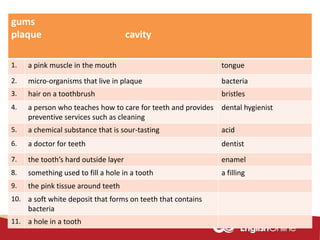
acid enamel dentist
a filling gums
plaque cavity
1. a pink muscle in the mouth tongue
2. micro-organisms that live in plaque bacteria
3. hair on a toothbrush bristles
4. a person who teaches how to care for teeth and provides
preventive services such as cleaning
dental hygienist
5. a chemical substance that is sour-tasting
6. a doctor for teeth
7. the tooth’s hard outside layer
8. something used to fill a hole in a tooth
9. the pink tissue around teeth
10. a soft white deposit that forms on teeth that contains
bacteria
11. a hole in a tooth
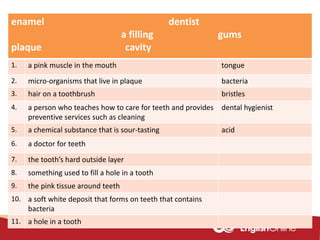
enamel dentist
a filling gums
plaque cavity
1. a pink muscle in the mouth tongue
2. micro-organisms that live in plaque bacteria
3. hair on a toothbrush bristles
4. a person who teaches how to care for teeth and provides
preventive services such as cleaning
dental hygienist
5. a chemical substance that is sour-tasting acid
6. a doctor for teeth
7. the tooth’s hard outside layer
8. something used to fill a hole in a tooth
9. the pink tissue around teeth
10. a soft white deposit that forms on teeth that contains
bacteria
11. a hole in a tooth
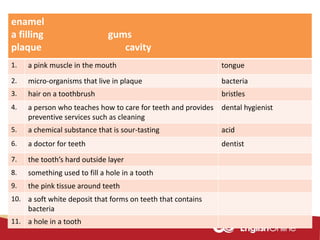
enamel
a filling gums
plaque cavity
1. a pink muscle in the mouth tongue
2. micro-organisms that live in plaque bacteria
3. hair on a toothbrush bristles
4. a person who teaches how to care for teeth and provides
preventive services such as cleaning
dental hygienist
5. a chemical substance that is sour-tasting acid
6. a doctor for teeth dentist
7. the tooth’s hard outside layer
8. something used to fill a hole in a tooth
9. the pink tissue around teeth
10. a soft white deposit that forms on teeth that contains
bacteria
11. a hole in a tooth
a filling gums
plaque cavity
1. a pink muscle in the mouth tongue
2. micro-organisms that live in plaque bacteria
3. hair on a toothbrush bristles
4. a person who teaches how to care for teeth and provides
preventive services such as cleaning
dental hygienist
5. a chemical substance that is sour-tasting acid
6. a doctor for teeth dentist
7. the tooth’s hard outside layer enamel
8. something used to fill a hole in a tooth
9. the pink tissue around teeth
10. a soft white deposit that forms on teeth that contains
bacteria
11. a hole in a tooth
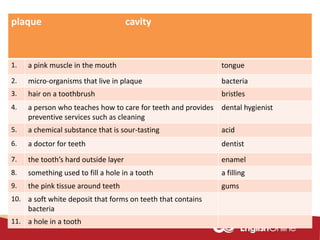
gums
plaque cavity
1. a pink muscle in the mouth tongue
2. micro-organisms that live in plaque bacteria
3. hair on a toothbrush bristles
4. a person who teaches how to care for teeth and provides
preventive services such as cleaning
dental hygienist
5. a chemical substance that is sour-tasting acid
6. a doctor for teeth dentist
7. the tooth’s hard outside layer enamel
8. something used to fill a hole in a tooth a filling
9. the pink tissue around teeth
10. a soft white deposit that forms on teeth that contains
bacteria
11. a hole in a tooth
plaque cavity
1. a pink muscle in the mouth tongue
2. micro-organisms that live in plaque bacteria
3. hair on a toothbrush bristles
4. a person who teaches how to care for teeth and provides
preventive services such as cleaning
dental hygienist
5. a chemical substance that is sour-tasting acid
6. a doctor for teeth dentist
7. the tooth’s hard outside layer enamel
8. something used to fill a hole in a tooth a filling
9. the pink tissue around teeth gums
10. a soft white deposit that forms on teeth that contains
bacteria
11. a hole in a tooth
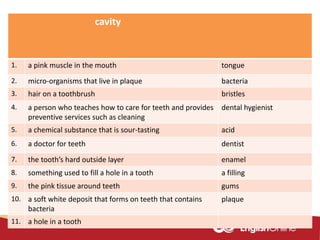
cavity
1. a pink muscle in the mouth tongue
2. micro-organisms that live in plaque bacteria
3. hair on a toothbrush bristles
4. a person who teaches how to care for teeth and provides
preventive services such as cleaning
dental hygienist
5. a chemical substance that is sour-tasting acid
6. a doctor for teeth dentist
7. the tooth’s hard outside layer enamel
8. something used to fill a hole in a tooth a filling
9. the pink tissue around teeth gums
10. a soft white deposit that forms on teeth that contains
bacteria
plaque
11. a hole in a tooth
1. a pink muscle in the mouth tongue
2. micro-organisms that live in plaque bacteria
3. hair on a toothbrush bristles
4. a person who teaches how to care for teeth and provides
preventive services such as cleaning
dental hygienist
5. a chemical substance that is sour-tasting acid
6. a doctor for teeth dentist
7. the tooth’s hard outside layer enamel
8. something used to fill a hole in a tooth a filling
9. the pink tissue around teeth gums
10. a soft white deposit that forms on teeth that contains
bacteria
plaque
11. a hole in a tooth cavity
Reading
Dental Health: general
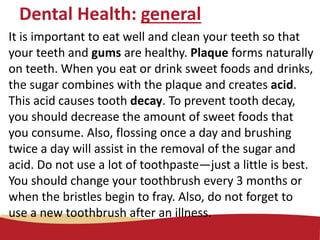
It is important to eat well and clean your teeth so that
your teeth and gums are healthy. Plaque forms naturally
on teeth. When you eat or drink sweet foods and drinks,
the sugar combines with the plaque and creates acid.
This acid causes tooth decay. To prevent tooth decay,
you should decrease the amount of sweet foods that
you consume. Also, flossing once a day and brushing
twice a day will assist in the removal of the sugar and
acid. Do not use a lot of toothpaste—just a little is best.
You should change your toothbrush every 3 months or
when the bristles begin to fray. Also, do not forget to
use a new toothbrush after an illness.
Dental Health: children
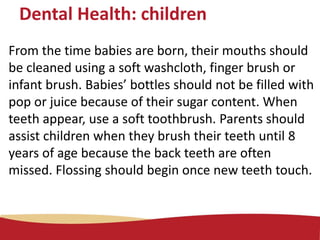
From the time babies are born, their mouths should
be cleaned using a soft washcloth, finger brush or
infant brush. Babies’ bottles should not be filled with
pop or juice because of their sugar content. When
teeth appear, use a soft toothbrush. Parents should
assist children when they brush their teeth until 8
years of age because the back teeth are often
missed. Flossing should begin once new teeth touch.
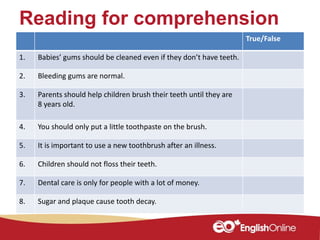
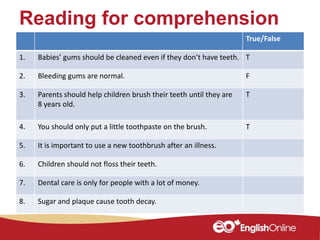
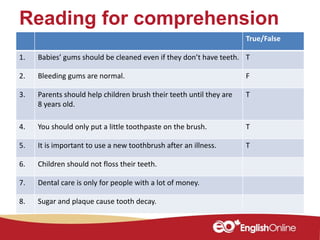
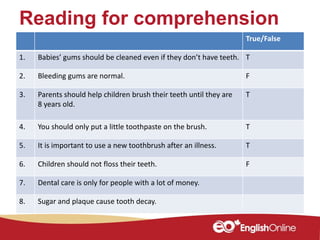
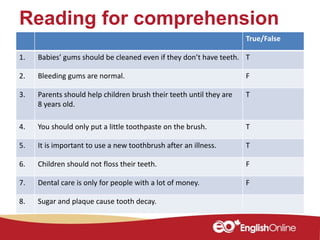
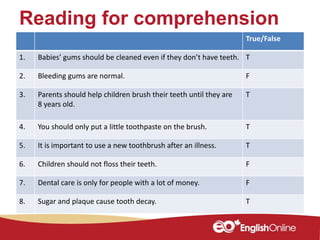
Reading for comprehension
True/False
1. Babies’ gums should be cleaned even if they don’t have teeth.
2. Bleeding gums are normal.
3. Parents should help children brush their teeth until they are
8 years old.
4. You should only put a little toothpaste on the brush.
5. It is important to use a new toothbrush after an illness.
6. Children should not floss their teeth.
7. Dental care is only for people with a lot of money.
8. Sugar and plaque cause tooth decay.
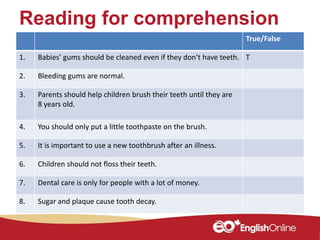
Reading for comprehension
True/False
1. Babies’ gums should be cleaned even if they don’t have teeth. T
2. Bleeding gums are normal.
3. Parents should help children brush their teeth until they are
8 years old.
4. You should only put a little toothpaste on the brush.
5. It is important to use a new toothbrush after an illness.
6. Children should not floss their teeth.
7. Dental care is only for people with a lot of money.
8. Sugar and plaque cause tooth decay.
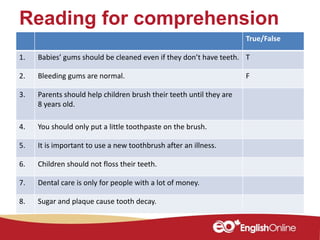
Reading for comprehension
True/False
1. Babies’ gums should be cleaned even if they don’t have teeth. T
2. Bleeding gums are normal. F
3. Parents should help children brush their teeth until they are
8 years old.
4. You should only put a little toothpaste on the brush.
5. It is important to use a new toothbrush after an illness.
6. Children should not floss their teeth.
7. Dental care is only for people with a lot of money.
8. Sugar and plaque cause tooth decay.
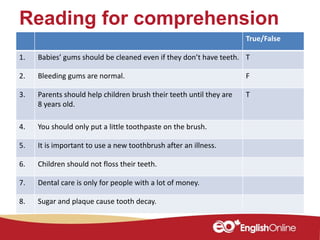
Reading for comprehension
True/False
1. Babies’ gums should be cleaned even if they don’t have teeth. T
2. Bleeding gums are normal. F
3. Parents should help children brush their teeth until they are
8 years old.
T
4. You should only put a little toothpaste on the brush.
5. It is important to use a new toothbrush after an illness.
6. Children should not floss their teeth.
7. Dental care is only for people with a lot of money.
8. Sugar and plaque cause tooth decay.
Reading for comprehension
True/False
1. Babies’ gums should be cleaned even if they don’t have teeth. T
2. Bleeding gums are normal. F
3. Parents should help children brush their teeth until they are
8 years old.
T
4. You should only put a little toothpaste on the brush. T
5. It is important to use a new toothbrush after an illness.
6. Children should not floss their teeth.
7. Dental care is only for people with a lot of money.
8. Sugar and plaque cause tooth decay.
Reading for comprehension
True/False
1. Babies’ gums should be cleaned even if they don’t have teeth. T
2. Bleeding gums are normal. F
3. Parents should help children brush their teeth until they are
8 years old.
T
4. You should only put a little toothpaste on the brush. T
5. It is important to use a new toothbrush after an illness. T
6. Children should not floss their teeth.
7. Dental care is only for people with a lot of money.
8. Sugar and plaque cause tooth decay.
Reading for comprehension
True/False
1. Babies’ gums should be cleaned even if they don’t have teeth. T
2. Bleeding gums are normal. F
3. Parents should help children brush their teeth until they are
8 years old.
T
4. You should only put a little toothpaste on the brush. T
5. It is important to use a new toothbrush after an illness. T
6. Children should not floss their teeth. F
7. Dental care is only for people with a lot of money.
8. Sugar and plaque cause tooth decay.
Reading for comprehension
True/False
1. Babies’ gums should be cleaned even if they don’t have teeth. T
2. Bleeding gums are normal. F
3. Parents should help children brush their teeth until they are
8 years old.
T
4. You should only put a little toothpaste on the brush. T
5. It is important to use a new toothbrush after an illness. T
6. Children should not floss their teeth. F
7. Dental care is only for people with a lot of money. F
8. Sugar and plaque cause tooth decay.
Reading for comprehension
True/False
1. Babies’ gums should be cleaned even if they don’t have teeth. T
2. Bleeding gums are normal. F
3. Parents should help children brush their teeth until they are
8 years old.
T
4. You should only put a little toothpaste on the brush. T
5. It is important to use a new toothbrush after an illness. T
6. Children should not floss their teeth. F
7. Dental care is only for people with a lot of money. F
8. Sugar and plaque cause tooth decay. T
Speaking
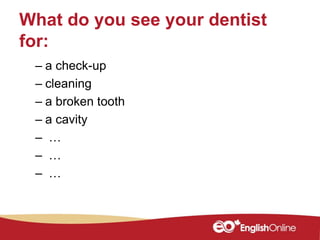
What do you see your dentist
for:
– a check-up
– cleaning
– a broken tooth
– a cavity
– …
– …
– …
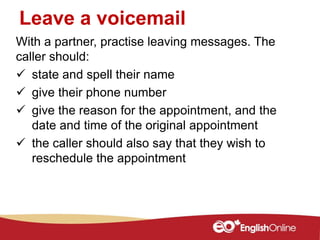
Leave a voicemail
With a partner, practise leaving messages. The
caller should:
 state and spell their name
 give their phone number
 give the reason for the appointment, and the
date and time of the original appointment
 the caller should also say that they wish to
reschedule the appointment
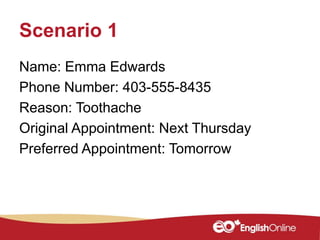
Scenario 1
Name: Emma Edwards
Phone Number: 403-555-8435
Reason: Toothache
Original Appointment: Next Thursday
Preferred Appointment: Tomorrow
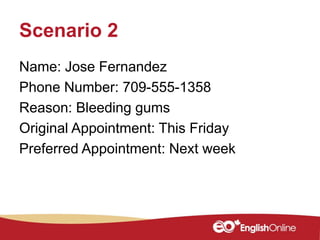
Scenario 2
Name: Jose Fernandez
Phone Number: 709-555-1358
Reason: Bleeding gums
Original Appointment: This Friday
Preferred Appointment: Next week
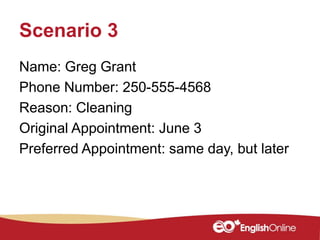
Scenario 3
Name: Greg Grant
Phone Number: 250-555-4568
Reason: Cleaning
Original Appointment: June 3
Preferred Appointment: same day, but later
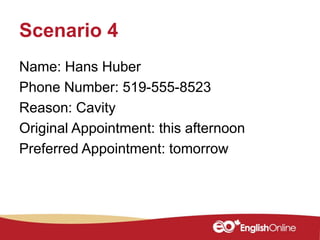
Scenario 4
Name: Hans Huber
Phone Number: 519-555-8523
Reason: Cavity
Original Appointment: this afternoon
Preferred Appointment: tomorrow
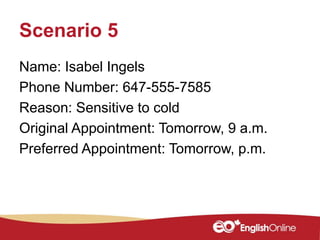
Scenario 5
Name: Isabel Ingels
Phone Number: 647-555-7585
Reason: Sensitive to cold
Original Appointment: Tomorrow, 9 a.m.
Preferred Appointment: Tomorrow, p.m.
Date or Other Description Goes Here
See you next time!

Going to the dentist

  • 1.
    Going to thedentist Language circle
  • 2.
    Objectives • Explain dentalhealth issues to your doctor • Be able to schedule an appointment with a dentist
  • 3.
    Agenda 1. Vocabulary 2. Reading 3.Speaking 4. Reflect on learning
  • 4.
    Discussion – Have youever had a toothache? What do you think caused the toothache? – What could be done to prevent the toothache? – Do you know what to do if you have a toothache?
  • 5.
  • 6.
    acid enamel tonguedentist dental hygienist bristles a filling gums plaque cavity bacteria 1. a pink muscle in the mouth 2. micro-organisms that live in plaque 3. hair on a toothbrush 4. a person who teaches how to care for teeth and provides preventive services such as cleaning 5. a chemical substance that is sour-tasting 6. a doctor for teeth 7. the tooth’s hard outside layer 8. something used to fill a hole in a tooth 9. the pink tissue around teeth 10. a soft white deposit that forms on teeth that contains bacteria 11. a hole in a tooth
  • 7.
    acid enamel dentist dentalhygienist bristles a filling gums plaque cavity bacteria 1. a pink muscle in the mouth tongue 2. micro-organisms that live in plaque 3. hair on a toothbrush 4. a person who teaches how to care for teeth and provides preventive services such as cleaning 5. a chemical substance that is sour-tasting 6. a doctor for teeth 7. the tooth’s hard outside layer 8. something used to fill a hole in a tooth 9. the pink tissue around teeth 10. a soft white deposit that forms on teeth that contains bacteria 11. a hole in a tooth
  • 8.
    acid enamel dentist dentalhygienist bristles a filling gums plaque cavity 1. a pink muscle in the mouth tongue 2. micro-organisms that live in plaque bacteria 3. hair on a toothbrush 4. a person who teaches how to care for teeth and provides preventive services such as cleaning 5. a chemical substance that is sour-tasting 6. a doctor for teeth 7. the tooth’s hard outside layer 8. something used to fill a hole in a tooth 9. the pink tissue around teeth 10. a soft white deposit that forms on teeth that contains bacteria 11. a hole in a tooth
  • 9.
    acid enamel dentist dentalhygienist a filling gums plaque cavity 1. a pink muscle in the mouth tongue 2. micro-organisms that live in plaque bacteria 3. hair on a toothbrush bristles 4. a person who teaches how to care for teeth and provides preventive services such as cleaning 5. a chemical substance that is sour-tasting 6. a doctor for teeth 7. the tooth’s hard outside layer 8. something used to fill a hole in a tooth 9. the pink tissue around teeth 10. a soft white deposit that forms on teeth that contains bacteria 11. a hole in a tooth
  • 10.
    acid enamel dentist afilling gums plaque cavity 1. a pink muscle in the mouth tongue 2. micro-organisms that live in plaque bacteria 3. hair on a toothbrush bristles 4. a person who teaches how to care for teeth and provides preventive services such as cleaning dental hygienist 5. a chemical substance that is sour-tasting 6. a doctor for teeth 7. the tooth’s hard outside layer 8. something used to fill a hole in a tooth 9. the pink tissue around teeth 10. a soft white deposit that forms on teeth that contains bacteria 11. a hole in a tooth
  • 11.
    enamel dentist a fillinggums plaque cavity 1. a pink muscle in the mouth tongue 2. micro-organisms that live in plaque bacteria 3. hair on a toothbrush bristles 4. a person who teaches how to care for teeth and provides preventive services such as cleaning dental hygienist 5. a chemical substance that is sour-tasting acid 6. a doctor for teeth 7. the tooth’s hard outside layer 8. something used to fill a hole in a tooth 9. the pink tissue around teeth 10. a soft white deposit that forms on teeth that contains bacteria 11. a hole in a tooth
  • 12.
    enamel a filling gums plaquecavity 1. a pink muscle in the mouth tongue 2. micro-organisms that live in plaque bacteria 3. hair on a toothbrush bristles 4. a person who teaches how to care for teeth and provides preventive services such as cleaning dental hygienist 5. a chemical substance that is sour-tasting acid 6. a doctor for teeth dentist 7. the tooth’s hard outside layer 8. something used to fill a hole in a tooth 9. the pink tissue around teeth 10. a soft white deposit that forms on teeth that contains bacteria 11. a hole in a tooth
  • 13.
    a filling gums plaquecavity 1. a pink muscle in the mouth tongue 2. micro-organisms that live in plaque bacteria 3. hair on a toothbrush bristles 4. a person who teaches how to care for teeth and provides preventive services such as cleaning dental hygienist 5. a chemical substance that is sour-tasting acid 6. a doctor for teeth dentist 7. the tooth’s hard outside layer enamel 8. something used to fill a hole in a tooth 9. the pink tissue around teeth 10. a soft white deposit that forms on teeth that contains bacteria 11. a hole in a tooth
  • 14.
    gums plaque cavity 1. apink muscle in the mouth tongue 2. micro-organisms that live in plaque bacteria 3. hair on a toothbrush bristles 4. a person who teaches how to care for teeth and provides preventive services such as cleaning dental hygienist 5. a chemical substance that is sour-tasting acid 6. a doctor for teeth dentist 7. the tooth’s hard outside layer enamel 8. something used to fill a hole in a tooth a filling 9. the pink tissue around teeth 10. a soft white deposit that forms on teeth that contains bacteria 11. a hole in a tooth
  • 15.
    plaque cavity 1. apink muscle in the mouth tongue 2. micro-organisms that live in plaque bacteria 3. hair on a toothbrush bristles 4. a person who teaches how to care for teeth and provides preventive services such as cleaning dental hygienist 5. a chemical substance that is sour-tasting acid 6. a doctor for teeth dentist 7. the tooth’s hard outside layer enamel 8. something used to fill a hole in a tooth a filling 9. the pink tissue around teeth gums 10. a soft white deposit that forms on teeth that contains bacteria 11. a hole in a tooth
  • 16.
    cavity 1. a pinkmuscle in the mouth tongue 2. micro-organisms that live in plaque bacteria 3. hair on a toothbrush bristles 4. a person who teaches how to care for teeth and provides preventive services such as cleaning dental hygienist 5. a chemical substance that is sour-tasting acid 6. a doctor for teeth dentist 7. the tooth’s hard outside layer enamel 8. something used to fill a hole in a tooth a filling 9. the pink tissue around teeth gums 10. a soft white deposit that forms on teeth that contains bacteria plaque 11. a hole in a tooth
  • 17.
    1. a pinkmuscle in the mouth tongue 2. micro-organisms that live in plaque bacteria 3. hair on a toothbrush bristles 4. a person who teaches how to care for teeth and provides preventive services such as cleaning dental hygienist 5. a chemical substance that is sour-tasting acid 6. a doctor for teeth dentist 7. the tooth’s hard outside layer enamel 8. something used to fill a hole in a tooth a filling 9. the pink tissue around teeth gums 10. a soft white deposit that forms on teeth that contains bacteria plaque 11. a hole in a tooth cavity
  • 18.
  • 19.
    Dental Health: general Itis important to eat well and clean your teeth so that your teeth and gums are healthy. Plaque forms naturally on teeth. When you eat or drink sweet foods and drinks, the sugar combines with the plaque and creates acid. This acid causes tooth decay. To prevent tooth decay, you should decrease the amount of sweet foods that you consume. Also, flossing once a day and brushing twice a day will assist in the removal of the sugar and acid. Do not use a lot of toothpaste—just a little is best. You should change your toothbrush every 3 months or when the bristles begin to fray. Also, do not forget to use a new toothbrush after an illness.
  • 20.
    Dental Health: children Fromthe time babies are born, their mouths should be cleaned using a soft washcloth, finger brush or infant brush. Babies’ bottles should not be filled with pop or juice because of their sugar content. When teeth appear, use a soft toothbrush. Parents should assist children when they brush their teeth until 8 years of age because the back teeth are often missed. Flossing should begin once new teeth touch.
  • 21.
    Reading for comprehension True/False 1.Babies’ gums should be cleaned even if they don’t have teeth. 2. Bleeding gums are normal. 3. Parents should help children brush their teeth until they are 8 years old. 4. You should only put a little toothpaste on the brush. 5. It is important to use a new toothbrush after an illness. 6. Children should not floss their teeth. 7. Dental care is only for people with a lot of money. 8. Sugar and plaque cause tooth decay.
  • 22.
    Reading for comprehension True/False 1.Babies’ gums should be cleaned even if they don’t have teeth. T 2. Bleeding gums are normal. 3. Parents should help children brush their teeth until they are 8 years old. 4. You should only put a little toothpaste on the brush. 5. It is important to use a new toothbrush after an illness. 6. Children should not floss their teeth. 7. Dental care is only for people with a lot of money. 8. Sugar and plaque cause tooth decay.
  • 23.
    Reading for comprehension True/False 1.Babies’ gums should be cleaned even if they don’t have teeth. T 2. Bleeding gums are normal. F 3. Parents should help children brush their teeth until they are 8 years old. 4. You should only put a little toothpaste on the brush. 5. It is important to use a new toothbrush after an illness. 6. Children should not floss their teeth. 7. Dental care is only for people with a lot of money. 8. Sugar and plaque cause tooth decay.
  • 24.
    Reading for comprehension True/False 1.Babies’ gums should be cleaned even if they don’t have teeth. T 2. Bleeding gums are normal. F 3. Parents should help children brush their teeth until they are 8 years old. T 4. You should only put a little toothpaste on the brush. 5. It is important to use a new toothbrush after an illness. 6. Children should not floss their teeth. 7. Dental care is only for people with a lot of money. 8. Sugar and plaque cause tooth decay.
  • 25.
    Reading for comprehension True/False 1.Babies’ gums should be cleaned even if they don’t have teeth. T 2. Bleeding gums are normal. F 3. Parents should help children brush their teeth until they are 8 years old. T 4. You should only put a little toothpaste on the brush. T 5. It is important to use a new toothbrush after an illness. 6. Children should not floss their teeth. 7. Dental care is only for people with a lot of money. 8. Sugar and plaque cause tooth decay.
  • 26.
    Reading for comprehension True/False 1.Babies’ gums should be cleaned even if they don’t have teeth. T 2. Bleeding gums are normal. F 3. Parents should help children brush their teeth until they are 8 years old. T 4. You should only put a little toothpaste on the brush. T 5. It is important to use a new toothbrush after an illness. T 6. Children should not floss their teeth. 7. Dental care is only for people with a lot of money. 8. Sugar and plaque cause tooth decay.
  • 27.
    Reading for comprehension True/False 1.Babies’ gums should be cleaned even if they don’t have teeth. T 2. Bleeding gums are normal. F 3. Parents should help children brush their teeth until they are 8 years old. T 4. You should only put a little toothpaste on the brush. T 5. It is important to use a new toothbrush after an illness. T 6. Children should not floss their teeth. F 7. Dental care is only for people with a lot of money. 8. Sugar and plaque cause tooth decay.
  • 28.
    Reading for comprehension True/False 1.Babies’ gums should be cleaned even if they don’t have teeth. T 2. Bleeding gums are normal. F 3. Parents should help children brush their teeth until they are 8 years old. T 4. You should only put a little toothpaste on the brush. T 5. It is important to use a new toothbrush after an illness. T 6. Children should not floss their teeth. F 7. Dental care is only for people with a lot of money. F 8. Sugar and plaque cause tooth decay.
  • 29.
    Reading for comprehension True/False 1.Babies’ gums should be cleaned even if they don’t have teeth. T 2. Bleeding gums are normal. F 3. Parents should help children brush their teeth until they are 8 years old. T 4. You should only put a little toothpaste on the brush. T 5. It is important to use a new toothbrush after an illness. T 6. Children should not floss their teeth. F 7. Dental care is only for people with a lot of money. F 8. Sugar and plaque cause tooth decay. T
  • 30.
  • 31.
    What do yousee your dentist for: – a check-up – cleaning – a broken tooth – a cavity – … – … – …
  • 32.
    Leave a voicemail Witha partner, practise leaving messages. The caller should:  state and spell their name  give their phone number  give the reason for the appointment, and the date and time of the original appointment  the caller should also say that they wish to reschedule the appointment
  • 33.
    Scenario 1 Name: EmmaEdwards Phone Number: 403-555-8435 Reason: Toothache Original Appointment: Next Thursday Preferred Appointment: Tomorrow
  • 34.
    Scenario 2 Name: JoseFernandez Phone Number: 709-555-1358 Reason: Bleeding gums Original Appointment: This Friday Preferred Appointment: Next week
  • 35.
    Scenario 3 Name: GregGrant Phone Number: 250-555-4568 Reason: Cleaning Original Appointment: June 3 Preferred Appointment: same day, but later
  • 36.
    Scenario 4 Name: HansHuber Phone Number: 519-555-8523 Reason: Cavity Original Appointment: this afternoon Preferred Appointment: tomorrow
  • 37.
    Scenario 5 Name: IsabelIngels Phone Number: 647-555-7585 Reason: Sensitive to cold Original Appointment: Tomorrow, 9 a.m. Preferred Appointment: Tomorrow, p.m.
  • 39.
    Date or OtherDescription Goes Here See you next time!

Editor's Notes