GOAL SETTING AND ACTION
PLANNING
Leadership on Demand
AGENDA
• Overview of goals
• SMART goals
• Your SMART goals
• Creating an action plan
DEFINITION OF GOAL
An observable and measurable end result having one or
more objectives to be achieved within a more or less
fixed timeframe.
IMPORTANCE OF GOAL SETTING
Goal setting provides a concrete way to identify:
• What we want
• How to get it
• How to measure our successes
CHARACTERISTICS OF GOALS
• Based on values and what we consider important.
• Future focused.
• Are fluid—they can change over time as our priorities
change and “life happens.”
• Can vary in terms of intensity as well as length of
time. Some goals may be short-term, minor goals,
such as finding a part time job; others may be long-
term, major goals, like buying a house.
SMART GOALS
Specific – Measurable – Action-Oriented – Realistic – Timely
S: Specific
• Goals should be stated in very specific terms. Vague
goals are difficult to attain, but specific goals give us a
concrete target.
• Goals should also have a specific purpose to them.
SMART GOALS
Specific – Measurable – Action-Oriented – Realistic – Timely
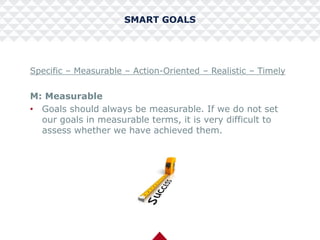
M: Measurable
• Goals should always be measurable. If we do not set
our goals in measurable terms, it is very difficult to
assess whether we have achieved them.
SMART GOALS
Specific – Measurable – Action-Oriented – Realistic – Timely
A: Action-Oriented
• Goals don’t just come true on their own. Effective goal
setting should include the action-based steps that you
will do to make the goal happen.
SMART GOALS
Specific – Measurable – Action-Oriented – Realistic – Timely
R: Realistic
• There are few things more damaging to our sense of
self-efficacy than setting ourselves up for failure.
Goals must be realistically attainable.
SMART GOALS
Specific – Measurable – Action-Oriented – Realistic – Timely
T: Timely
• Goals must have deadlines. This is not to say that
deadlines will never change, and it is not to say that
you won’t ever miss a deadline. Defining a time limit
for the goal gives us a definite time frame to work in
and a date at which to assess our success.
• Some goals, like some academic goals, may have pre-
defined deadlines.
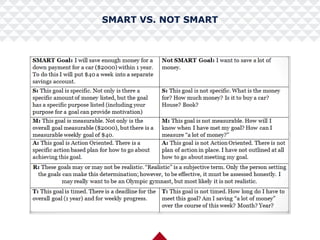
SMART VS. NOT SMART
YOUR SMART GOALS
Write three SMART Goals for your internship, club or
organization–can be individual or team related.
• Specific:
• Measurable:
• Action Oriented:
• Realistic (explain why):
• Timely:
ACTION PLAN
For each goal, list the following:
• Actions that I am already doing towards achieving this
goal:
• Actions that I am not currently doing, but will be able
to do towards achieving this goal:
• Actions that I am not currently doing that I will need
help/support with to achieve this goal:
• People and/or places from whom I can get
help/support to achieve this goal:
THANK YOU!
Leadership Programs
SUMC 404
leadershipondemand@email.arizona.edu

Goal Setting and Action Planning Slides.pdf

  • 1.
    GOAL SETTING ANDACTION PLANNING Leadership on Demand
  • 2.
    AGENDA • Overview ofgoals • SMART goals • Your SMART goals • Creating an action plan
  • 3.
    DEFINITION OF GOAL Anobservable and measurable end result having one or more objectives to be achieved within a more or less fixed timeframe.
  • 4.
    IMPORTANCE OF GOALSETTING Goal setting provides a concrete way to identify: • What we want • How to get it • How to measure our successes
  • 5.
    CHARACTERISTICS OF GOALS •Based on values and what we consider important. • Future focused. • Are fluid—they can change over time as our priorities change and “life happens.” • Can vary in terms of intensity as well as length of time. Some goals may be short-term, minor goals, such as finding a part time job; others may be long- term, major goals, like buying a house.
  • 6.
    SMART GOALS Specific –Measurable – Action-Oriented – Realistic – Timely S: Specific • Goals should be stated in very specific terms. Vague goals are difficult to attain, but specific goals give us a concrete target. • Goals should also have a specific purpose to them.
  • 7.
    SMART GOALS Specific –Measurable – Action-Oriented – Realistic – Timely M: Measurable • Goals should always be measurable. If we do not set our goals in measurable terms, it is very difficult to assess whether we have achieved them.
  • 8.
    SMART GOALS Specific –Measurable – Action-Oriented – Realistic – Timely A: Action-Oriented • Goals don’t just come true on their own. Effective goal setting should include the action-based steps that you will do to make the goal happen.
  • 9.
    SMART GOALS Specific –Measurable – Action-Oriented – Realistic – Timely R: Realistic • There are few things more damaging to our sense of self-efficacy than setting ourselves up for failure. Goals must be realistically attainable.
  • 10.
    SMART GOALS Specific –Measurable – Action-Oriented – Realistic – Timely T: Timely • Goals must have deadlines. This is not to say that deadlines will never change, and it is not to say that you won’t ever miss a deadline. Defining a time limit for the goal gives us a definite time frame to work in and a date at which to assess our success. • Some goals, like some academic goals, may have pre- defined deadlines.
  • 11.
  • 12.
    YOUR SMART GOALS Writethree SMART Goals for your internship, club or organization–can be individual or team related. • Specific: • Measurable: • Action Oriented: • Realistic (explain why): • Timely:
  • 13.
    ACTION PLAN For eachgoal, list the following: • Actions that I am already doing towards achieving this goal: • Actions that I am not currently doing, but will be able to do towards achieving this goal: • Actions that I am not currently doing that I will need help/support with to achieve this goal: • People and/or places from whom I can get help/support to achieve this goal:
  • 14.
    THANK YOU! Leadership Programs SUMC404 leadershipondemand@email.arizona.edu