A specific goalhas a much
greater chance of being
accomplished than a
general goal. “Attend at least 3 professional
development workshops or
conferences within the next
year to expand knowledge and
skills in my field.”
Creating specific goals
5.
To set aspecific goal you must answer the six "W"
questions:
Who: Who is involved?
What: What do I want to accomplish?
Where: Identify a location. (Science Lab)
When: Establish a time frame. (For second semester)
Which: Identify requirements and constraints.
Why: Specific reasons, purpose or benefits of
accomplishing the goal. (To help our students
become prepared for the common core state standards,
help them become college and career ready, and prepare
them for state and national testing.)
Creating specific goals
6.
Creating measurable goals
Whenyou measure your progress, you stay
on track, reach your target dates, and
experience the exhilaration of achievement
that spurs you on to continued effort
required to reach your goal.
Establish concrete criteria for
measuring progress toward the
attainment of each goal you
set.
7.
To determine ifyour goal is measurable,
ask questions such as:
• How much?
• How many?
• How will I know
when it is accomplished?
Creating measurable goals
8.
Creating attainable goals
Whenyou identify goals that are
most important to you, you begin
to figure out ways you can make
them come true.
You develop the attitudes, abilities, skills,
and financial capacity to reach them. You
begin seeing previously overlooked
opportunities to bring yourself closer to
the achievement of your goals.
9.
Creating attainable goals
Youcan attain most any goal you set when you plan your
steps wisely and establish a time frame that allows you to
carry out those steps.
Goals that may have seemed far away and out of reach
eventually move closer and become attainable, not because
your goals shrink, but because you grow and expand to
match them.
10.
Creating realistic goals
Tobe realistic, a goal must represent
an objective toward which you are
both willing and able to work.
A high goal is frequently easier to reach
than a low one because a low goal exerts
low motivational force. Some of the
hardest jobs you ever accomplished
actually seem easy simply because they
were a labor of love.
11.
Creating realistic goals
Todetermine if your goal is realistic,
ask questions such as:
• Do I truly believe that it can be accomplished?
• Have I accomplished anything similar in the past?
• Can I identify the conditions that would have to exist
to accomplish this goal?
12.
Creating timely goals
Whendo you want to accomplish your
goal? “Someday” won't work. But if
you anchor it within a timeframe (“by
May 1st
”), then you have already set
your unconscious mind into motion to
begin working on the goal.
A goal should be grounded within a
time frame. With no time frame tied
to it, there is no sense of urgency.
13.
T can alsostand for Tangible
A goal is tangible when you can experience it
with one of the senses, that is, taste, touch,
smell, sight or hearing.
When your goal is tangible you have a better
chance of making it specific and measurable
and thus attainable.
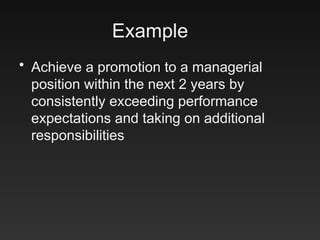
Example
• Achieve apromotion to a managerial
position within the next 2 years by
consistently exceeding performance
expectations and taking on additional
responsibilities
16.
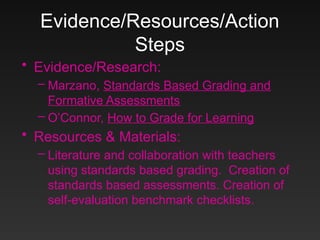
Evidence/Resources/Action
Steps
• Evidence/Research:
– Marzano,Standards Based Grading and
Formative Assessments
– O’Connor, How to Grade for Learning
• Resources & Materials:
– Literature and collaboration with teachers
using standards based grading. Creation of
standards based assessments. Creation of
self-evaluation benchmark checklists.
17.
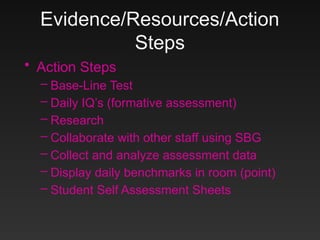
Evidence/Resources/Action
Steps
• Action Steps
–Base-Line Test
– Daily IQ’s (formative assessment)
– Research
– Collaborate with other staff using SBG
– Collect and analyze assessment data
– Display daily benchmarks in room (point)
– Student Self Assessment Sheets
19.
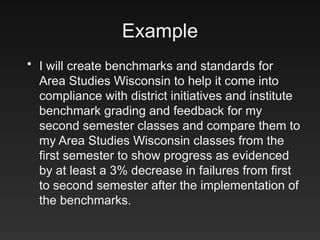
Example
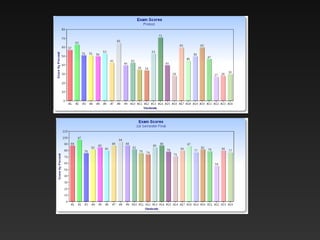
• I willcreate benchmarks and standards for
Area Studies Wisconsin to help it come into
compliance with district initiatives and institute
benchmark grading and feedback for my
second semester classes and compare them to
my Area Studies Wisconsin classes from the
first semester to show progress as evidenced
by at least a 3% decrease in failures from first
to second semester after the implementation of
the benchmarks.